Judges 11:38

Hebrew (Westminster Leningrad Codex) Judges 11:38 appears in the Hebrew Old Testament. The text above is from the Westminster Leningrad Codex. Each word links to its Strong’s number, a concise gloss, and parsing drawn from the Open Scriptures Hebrew Bible morphology. Click any word for its full Brown-Driver-Briggs (BDB) entry.
Download image
Cite this verse

Judges 11:38 (World English Bible). Public Domain. Lemma interlinear Bible study tool, https://lemma.gebible.app/v/judges/11/38.

Show BibTeX & RIS
BibTeX
RIS
English Translation
He said, Go. He sent her away for two months: and she departed, she and her companions, and mourned her virginity on the mountains.
World English Bible · Public Domain
Download a study sheet

One document with this verse’s original text, its word-by-word gloss line, the meaning frame, cross-references with their text, attributed commentary, and full source and license credits — printable, and it pastes into notes with its structure intact.

This verse Autodidact and up

Study sheet (.html) Plain text (.txt)

A passage Seminary Student

Up to 50 verses in one chapter. A passage sheet keeps up to 6 commentary sources and 12 cross-references per verse, in the order this page ranks them, and says so on the sheet whenever that leaves anything out. Ask for a single verse and you get the Autodidact verse sheet above.

Everything on this page stays free to read, with no account — the sheet is a download of what is already on screen, not access to it.

Want to remove ads? Support Godless Engineer
Compare translations 3

The same verse in 3 English versions, stacked beneath the original-language interlinear above. Click any original word for its lexicon entry.

Each is an independent rendering of the whole verse — the interlinear is not word-aligned to these translations.

Highlighted words mark where these versions differ — a whole-verse word diff, not a word-by-word alignment.

  • World English Bible Public Domain
    He said, Go. He sent her away for two months: and she departed, she and her companions, and mourned her virginity on the mountains.
  • King James Version Public Domain
    And he said, Go. And he sent her away for two months: and she went with her companions, and bewailed her virginity upon the mountains.
  • unfoldingWord Literal Text CC BY-SA 4.0
    And he said, “Go.” Then he sent her away two months. And she went, she and her companions, and she wept upon her virginity on the hills.

unfoldingWord Literal Text — © unfoldingWord, licensed CC BY-SA 4.0. Word-aligned USFM3 via Door43 (git.door43.org/unfoldingWord/en_ult).

Versions to compare (up to 4)

3 of 4 selected

Show all 18 translations

Every available English version of this verse, each an independent rendering of the whole verse.

  • World English Bible Public Domain
    He said, Go. He sent her away for two months: and she departed, she and her companions, and mourned her virginity on the mountains.
  • Berean Standard Bible Public Domain
    “Go,” he said. And he sent her away for two months. So she left with her friends and mourned her virginity upon the mountains.
  • Majority Standard Bible Public Domain
    “Go,” he said. And he sent her away for two months. So she left with her friends and mourned her virginity upon the mountains.
  • King James Version Public Domain
    And he said, Go. And he sent her away for two months: and she went with her companions, and bewailed her virginity upon the mountains.
  • American Standard Version (1901) Public Domain
    And he said, Go. And he sent her away for two months: and she departed, she and her companions, and bewailed her virginity upon the mountains.
  • Revised Version (1885) Public Domain
    And he said, Go. And he sent her away for two months: and she departed, she and her companions, and bewailed her virginity upon the mountains.
  • Geneva Bible (1599) Public Domain
    And he sayde, Goe: and he sent her away two moneths: so she went with her companions, and lamented her virginitie vpon the moutaines.
  • Douay-Rheims (1899) Public Domain
    And he answered her: Go. And he sent her away for two months. And when she was gone with her comrades and companions, she mourned her virginity in the mountains.
  • Young's Literal Translation Public Domain
    And he saith, `Go;' and he sendeth her away two months, and she goeth, she and her friends, and she weepeth for her virginity on the hills;
  • Literal Standard Version CC BY-SA 4.0
    And he says, “Go”; and he sends her away [for] two months, and she goes, she and her friends, and she weeps for her virginity on the hills;
  • Unlocked Literal Bible CC BY-SA 4.0
    He said, “Go.” He sent her away for two months. She left him, she and her companions, and they grieved her virginity in the hills.
  • unfoldingWord Literal Text CC BY-SA 4.0
    And he said, “Go.” Then he sent her away two months. And she went, she and her companions, and she wept upon her virginity on the hills.
  • Darby Bible Public Domain
    And he said, "Go." And he sent her away for two months; and she departed, she and her companions, and bewailed her virginity upon the mountains.
  • World Messianic Bible Public Domain
    He said, “Go.” He sent her away for two months; and she departed, she and her companions, and mourned her virginity on the mountains.
  • Webster's Bible Public Domain
    And he said, Go. And he sent her away for two months: and she went with her companions, and bewailed her virginity upon the mountains.
  • Free Bible Version CC BY-SA 4.0
    “You can go,” he told her. He sent her away for two months, and she and her friends went into the hills and cried because she would never marry.
  • Bible in Basic English Public Domain
    And he said, Go then. So he sent her away for two months; and she went with her friends to the mountains, weeping for her sad fate.
  • JPS Tanakh (1917) Public Domain
    And he said: 'Go.' And he sent her away for two months; and she departed, she and her companions, and bewailed her virginity upon the mountains.

Literal Standard Version (2020), Covenant Press — licensed CC BY-SA 4.0. Text via the HelloAO Bible API (eBible.org). Unlocked Literal Bible (unfoldingWord) — licensed CC BY-SA 4.0. Text via the HelloAO Bible API (eBible.org). unfoldingWord Literal Text — © unfoldingWord, licensed CC BY-SA 4.0. Word-aligned USFM3 via Door43 (git.door43.org/unfoldingWord/en_ult). Free Bible Version, Dr. Jonathan Gallagher — licensed CC BY-SA 4.0. Text via the HelloAO Bible API (eBible.org).

Word by word

More ways to search: Search by grammar → Find every occurrence → Compare this word →

Practice this passage: Drill this verse → Learn its vocabulary →

וְרֵ֣עוֹתֶ֔יהָ
rêʻâh
H7464
“and · companions · her”
Conjunction + Noun, Common, Feminine, Plural, Construct + Suffix, Personal, 3rd Person, Feminine, Singular
Part of Speech
Conjunction + Noun
Type
Common
Gender
Feminine
Number
Plural
State
Construct
Full BDB Definition

Origin: from H7453

TWOT: 2186c

female companion, companion, attendant (of maidens)
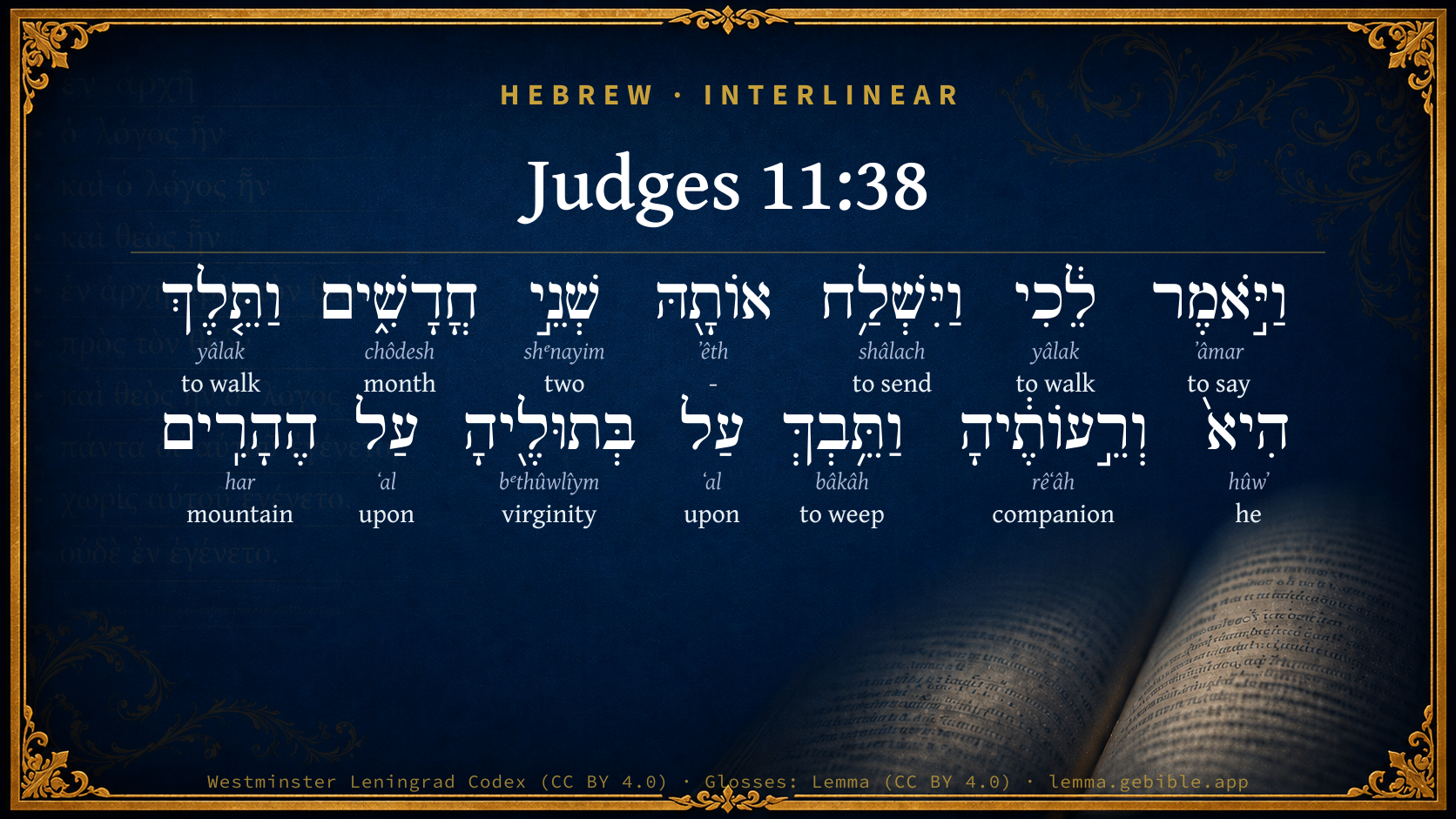
  1. וַיֹּ֣אמֶר ʼâmar H559 “and · to say” Conjunction + Verb, Qal, Sequential Imperfect, 3rd Person, Masculine, Singular
  2. לֵ֔כִי yâlak H3212 “walk” Verb, Qal, Imperative, 2nd Person, Feminine, Singular
  3. וַיִּשְׁלַ֥ח shâlach H7971 “and · to send” Conjunction + Verb, Qal, Sequential Imperfect, 3rd Person, Masculine, Singular
  4. אוֹתָ֖הּ ʼêth H853 “- · her” Particle, Direct Object + Suffix, Personal, 3rd Person, Feminine, Singular
  5. שְׁנֵ֣י shᵉnayim H8147 “two” Adjective, Cardinal number, Masculine, Dual, Construct
  6. חֳדָשִׁ֑ים chôdesh H2320 “months” Noun, Common, Masculine, Plural, Absolute
  7. וַתֵּ֤לֶךְ yâlak H3212 “and · to walk” Conjunction + Verb, Qal, Sequential Imperfect, 3rd Person, Feminine, Singular
  8. הִיא֙ hûwʼ H1931 “he” Pronoun, Personal, 3rd Person, Feminine, Singular
  9. וַתֵּ֥בְךְּ bâkâh H1058 “and · to weep” Conjunction + Verb, Qal, Sequential Imperfect, 3rd Person, Feminine, Singular
  10. עַל ʻal H5921 “upon” Preposition
  11. בְּתוּלֶ֖יהָ bᵉthûwlîym H1331 “virginity · her” Noun, Common, Both, Plural, Construct + Suffix, Personal, 3rd Person, Feminine, Singular
  12. עַל ʻal H5921 “upon” Preposition
  13. הֶהָרִֽים har H2022 “the · mountains” Particle, Definite Article + Noun, Common, Masculine, Plural, Absolute

About this verse

These counts appear in no published source. They are computed here, from the morphology-tagged text and Lemma’s own curated glosses. What Lemma adds →

14
words
12
distinct lemmas
Historical
section

Notable vocabulary

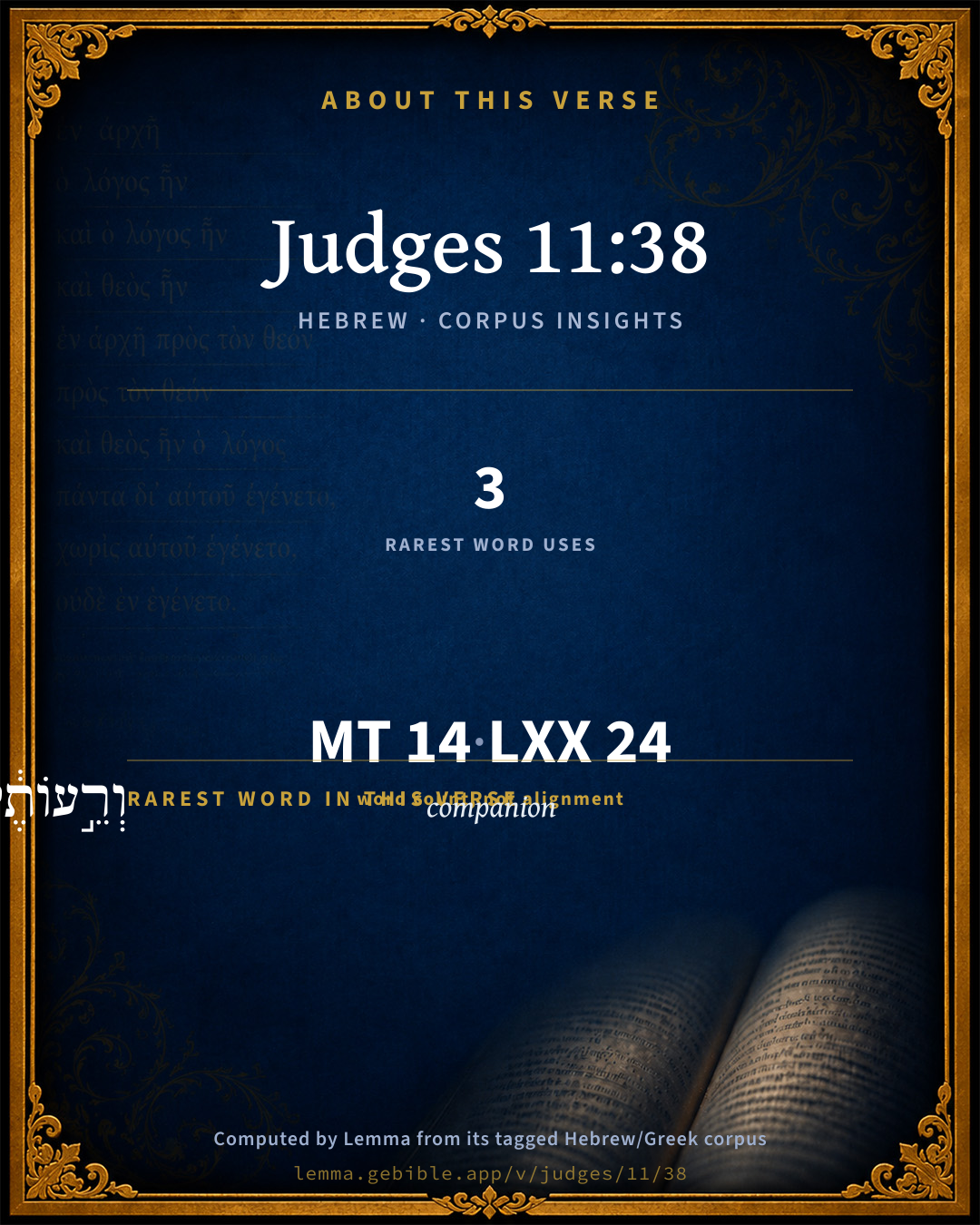
The rarest word here is וְרֵ֣עוֹתֶ֔יהָ companion H7464 — appearing just 3 times in the whole Hebrew Bible.

Shared distinctive vocabulary

וְרֵ֣עוֹתֶ֔יהָ companion H7464 occurs in 3 verses of the Hebrew Bible. Also found in:

Grammatical profile

  • 5 verbs
  • 4 nouns
  • 1 adjective
  • 1 pronoun
  • 2 prepositions
  • 1 particle

Verb forms

  • וַיֹּ֣אמֶר Qal · Sequential Imperfect
  • לֵ֔כִי Qal · Imperative
  • וַיִּשְׁלַ֥ח Qal · Sequential Imperfect
  • וַתֵּ֤לֶךְ Qal · Sequential Imperfect
  • וַתֵּ֥בְךְּ Qal · Sequential Imperfect

Repetition

Words recur within this verse — often emphatic in Hebrew:

  • לֵ֔כִי to walk H3212 ×2
  • עַל upon H5921 ×2

Hebrew & Septuagint length

In English translation the verse runs 24 words from the Hebrew and 26 from the Septuagint (LXX English) — closely comparable.

A rough comparison of the two English renderings, which tokenize alike — not a word-level alignment.

Word counts can differ between the Hebrew and the Greek without any difference in meaning — e.g. the Hebrew direct-object marker אֵת has no separate Greek word, and Greek often adds the article ὁ.

In the original languages it is 14 Hebrew tokens and 24 Greek tokens — but the two are counted differently (Hebrew bundles its prefixes and suffixes into one token; the Greek is in lemma form), so that isn’t a like-for-like length.

Hebrew and Greek witnesses Masoretic Hebrew ↔ Greek Septuagint

The same verse in the two great witnesses to the Old Testament, shown verse-for-verse.

These are two independent witnesses, not word-aligned to each other, and the Septuagint is shown in lemma (dictionary) form.

Hebrew Judges 11:38 Masoretic · Westminster Leningrad Codex

וַיֹּ֣אמֶר לֵ֔כִי וַיִּשְׁלַ֥ח אוֹתָ֖הּ שְׁנֵ֣י חֳדָשִׁ֑ים וַתֵּ֤לֶךְ הִיא֙ וְרֵ֣עוֹתֶ֔יהָ וַתֵּ֥בְךְּ עַל בְּתוּלֶ֖יהָ עַל הֶהָרִֽים

He said, Go. He sent her away for two months: and she departed, she and her companions, and mourned her virginity on the mountains.

World English Bible · Public Domain

Greek LXX Judges 11:38 Septuagint · lemma form

καί εἶπον πορεύομαι καί ἀποστέλλω αὐτός δύο μήν καί πορεύομαι αὐτός καί ὁ συνεταιρίς αὐτός καί κλαίω ἐπί ὁ παρθένεια αὐτός ἐπί ὁ ὄρος

And he said, Go: and he sent her away for two months; and she went, and her companions, and she bewailed her virginity on the mountains.

LXX2012 (modern English Septuagint) · Public Domain

Hebrew: Westminster Leningrad Codex (CC BY 4.0). Greek: Septuagint (public domain); English from LXX2012 (modern English Septuagint) (Public Domain). How the Septuagint differs from the Hebrew →

Targum (Aramaic paraphrase)

1

The Targum is the ancient Jewish Aramaic paraphrase of the Hebrew Scriptures — an interpretive translation, not the Hebrew text itself. Onkelos (literal) and Pseudo-Jonathan (expansive) render the Torah, and Jonathan the Prophets. Coverage is partial: where no permissively-licensed English translation exists for a verse, only the Aramaic is shown. This is verse-level text, not a word-by-word alignment to the Hebrew.

  1. Targum Jonathan Prophets (Joshua–Malachi)
    וַאֲמַר אֱזִילִי וּשְׁלַח יָתָהּ תְּרֵין יַרְחִין וַאֲזַלַת הִיא וְחַבְרָתָהָא וּבְכַת עַל בְּתוּלָהָא עַל טוּרַיָא:

    (no public-domain English translation for this verse)

    Targum Jonathan — Aramaic: “Mikraot Gedolot” (public domain). English: “Sefaria Community Translation” (CC0 1.0 (public-domain dedication)); “London "Chaldee Paraphrase," 1871” (public domain). Text via Sefaria.

Commentary

Notes on Judges 11:38 from classic Christian and Jewish commentators (each source and its license shown beneath its notes). The classic Christian expositions comment on the surrounding passage and are grouped to its opening verse, so a note may address several verses; the Jewish commentaries on the Tanakh (Rashi and others) are per-verse, so they appear only where the commentator wrote on this verse.

Lemma curates 59 commentaries, every one of them public domain or Creative Commons licensed, each selected and text-cleaned for this edition rather than reprinted as found. About our sources →

Trapp's Complete Commentary

John Trapp

Jdg 11:38 And he said, Go. And he sent her away [for] two months: and she went with her companions, and bewailed her virginity upon the mountains.

Ver. 38. Upon the mountains.] Which were solitary places, where she might pour forth her complaints with more freedom.

John Trapp, A Commentary or Exposition upon All the Books of the Old and New Testament (1647–1656) — public domain. Text from a community e-Sword module.

John Gill's Exposition

That the daughters of Israel went yearly to lament the daughter of Jephthah the Gileadite,.... Either the death of her, as some, or her virginity, as others; though the word (p) used may signify to talk and discourse with her, to hold a confabulation with her, and comfort her, as Kimchi and Ben Melech interpret it; to bring her some news, and tell her some diverting stories, to cheer and refresh her in her solitude. De Dieu observes, that the word signifies in the Arabic language to "praise", or speak in commendation of a person or thing; and indeed in this sense it seems to be used in this book, Jdg 5:11, "they shall rehearse", that is, with praise and thanksgiving, "the righteous acts of the Lord"; and so the daughters of Israel went every year to the place where the daughter of Jephthah was, to speak in the praise of her, of her heroism, in so cheerfully submitting to her father's vow, and expressing such gratitude and joy at the same time for victory over the enemies of Israel; and this they did in her presence and while she lived, to keep up her spirits; or it may be, in some public place, and even after her death, in memory of her, and to celebrate her praise. Epiphanius says (q), that in his time, at Sebaste, formerly called Samaria, they deified the daughter of Jephthah, and kept a feast for her every year. The meeting of the daughters of Israel, so long as the custom lasted, which perhaps was only during the life of Jephthah's daughter, was four days in a year; but whether they were four days running, or once in a quarter of a year, is not certain; the latter seems most probable.

(p) "ad alloquendum", Pagninus, Montanus; "ut dissererent", Tigurine version; "ut colloquerentur", Vatablus; "ad confabulandum", Junius & Tremellius, Piscator. (q) Contr. Haeres. l. 2. Haeres. 55.

Next: Judges Chapter 12

John Gill's Exposition of the Whole Bible (1746–1763) — public domain (CC PDM 1.0). Text via the HelloAO Bible API.

Haydock's Catholic Bible Commentary

Mountains. Such places were frequented in times of mourning, Jeremias xxxi. 15., and Isaias xv. 2. (Calmet) --- Jepthe allowed his daughter this short respite, without any offence, (Deuteronomy xxiii. 21,) before he immolated her, (Menochius) or before he debarred her from the society of men. (Grotius, &c.)

George Leo Haydock (1774–1849), Haydock's Catholic Family Bible and Commentary, 1859 edition — public domain. Excludes Psalms (Douay-Rheims chapter numbering differs from Protestant) and Deuterocanonical books (Catholic canon only).

Keil & Delitzsch

C. F. Keil & F. Delitzsch

The father granted this request.

Keil & Delitzsch — Biblical Commentary on the Old Testament (1861–1891) — public domain (CC PDM 1.0). Text via the HelloAO Bible API. (Old Testament only.)

unfoldingWord translationNotes

Door43 World Missions Community

the Gileadite

This refers to someone from Gilead. See how you translated this in Judges 10:3.

translationWords

promise

vow

had relations with

Israel

Jephthah

Gilead

unfoldingWord translationNotes — © Distant Shores Media and the Door43 World Missions Community, licensed CC BY-SA 4.0. Source: git.door43.org/Door43/en_tn.

Rashi

Rabbi Shlomo Yitzchaki (Rashi)

Wept over her maidenhood. Since it is not written "over her maidens," the inference is, over her actual maidenhood.

Rashi on the Tanakh — English translations: “The Judaica Press complete Tanach with Rashi, translated by A. J. Rosenberg” (CC BY 4.0); “Pentateuch with Rashi's commentary by M. Rosenbaum and A.M. Silbermann, 1929-1934” (public domain); “The Metsudah Tanach series, Lakewood, N.J” (CC BY 4.0); and “The Book of Joshua, Metsudah Publications, 1997” (CC BY 4.0). Text via Sefaria.

Lesson kit

Teaching starters — assembled from the data on this page, not authored interpretation. Every prompt links to the verse data it draws on. Edit before teaching.

Judges, in the Historical, opens this verse with 14 words (12 distinct Hebrew lemmas). Its most distinctive word is rêʻâh (“companion”). A historical commentator’s framing appears above. Read the whole chapter for the surrounding context.

Discussion questions

  1. The word rêʻâh carries the sense “companion.” How does it shape the verse?
  2. How does Judges 11:37, which shares the word «companion», read alongside this verse?
  3. What does the repetition of “to walk” (2× in this one verse) do in this verse?
  4. These translations render this verse differently. What is at stake in choosing one wording over another?
  5. «וַיֹּ֣אמֶר» is a Qal Sequential Imperfect verb. How does that grammatical form shape the action described?
  6. Compare how Trapp's Complete Commentary and John Gill's Exposition read this verse. Where do they agree or differ?

Things to notice

Reading settings

Reading text

Shown beneath each verse's original-language words.

Old Testament
Old Testament edition

Read the OT as the Masoretic Hebrew (MT) or the Greek Septuagint (LXX).

English shown for the Greek Septuagint (in the Hebrew ↔ Greek comparison).

Comparing translations? Open the Compare panel on any verse page to stack up to four side by side.