
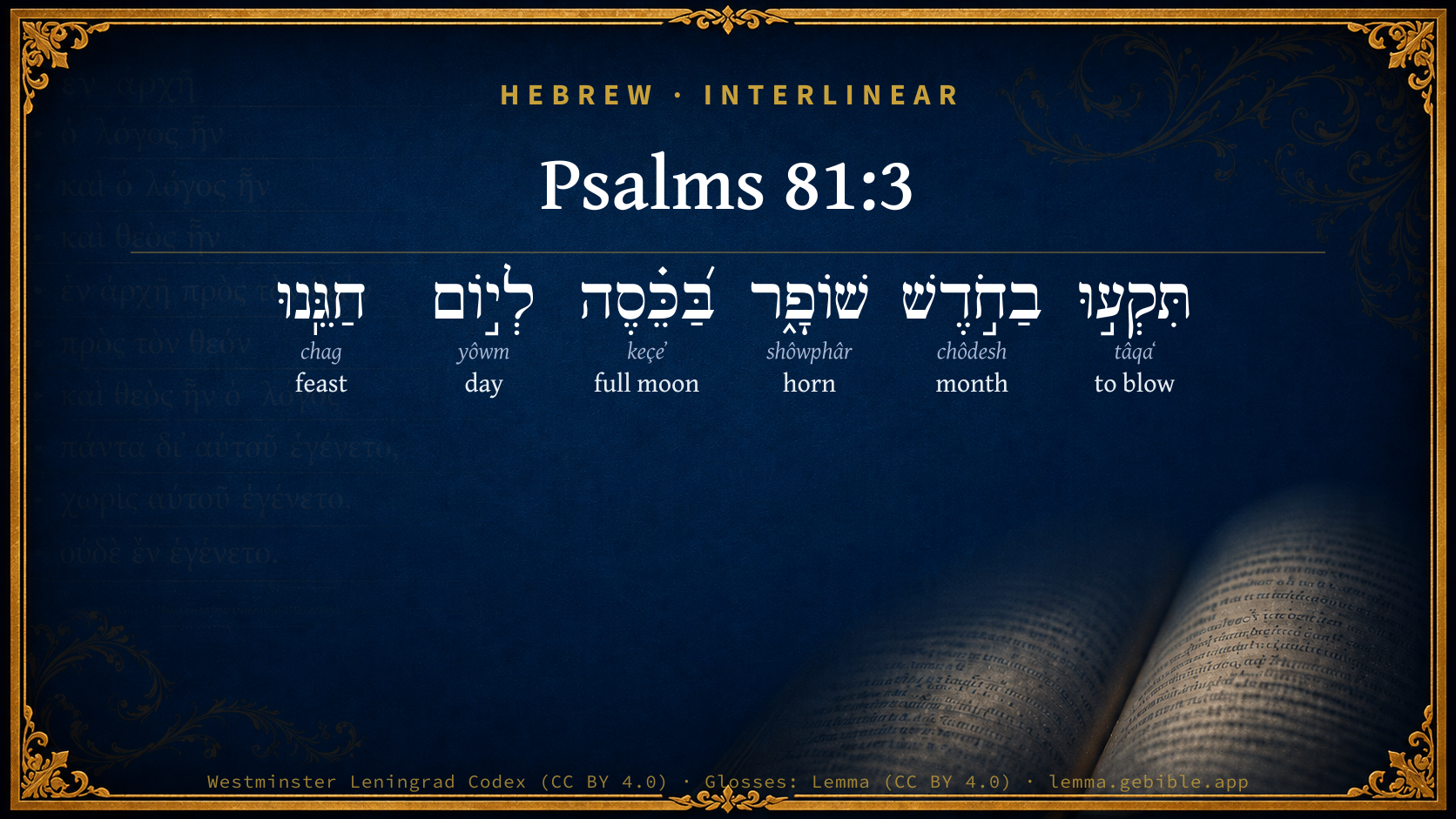
Psalms 81:3

Hebrew (Westminster Leningrad Codex) Psalms 81:3 appears in the Hebrew Old Testament. The text above is from the Westminster Leningrad Codex. Each word links to its Strong’s number, a concise gloss, and parsing drawn from the Open Scriptures Hebrew Bible morphology. Click any word for its full Brown-Driver-Briggs (BDB) entry.
Download image
Cite this verse

Psalms 81:3 (World English Bible). Public Domain. Lemma interlinear Bible study tool, https://lemma.gebible.app/v/psalms/81/3.

Show BibTeX & RIS
BibTeX
RIS
English Translation
Blow the trumpet at the New Moon, At the full moon, on our feast day.
World English Bible · Public Domain
Highlights
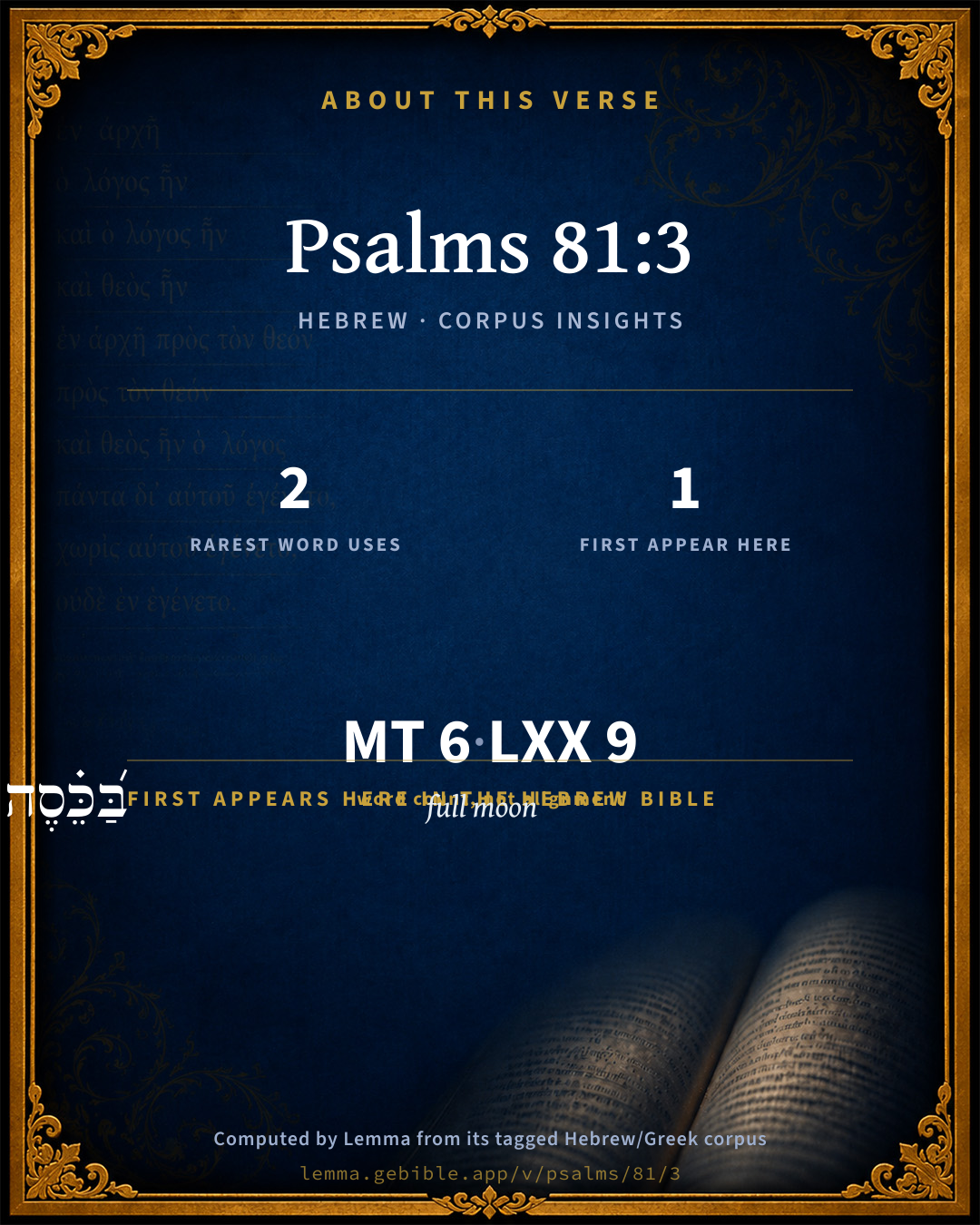
  • 1 first appearance in the Hebrew Bible
Full analysis ↓
Download a study sheet

One document with this verse’s original text, its word-by-word gloss line, the meaning frame, cross-references with their text, attributed commentary, and full source and license credits — printable, and it pastes into notes with its structure intact.

This verse Autodidact and up

Study sheet (.html) Plain text (.txt)

A passage Seminary Student

Up to 50 verses in one chapter. A passage sheet keeps up to 6 commentary sources and 12 cross-references per verse, in the order this page ranks them, and says so on the sheet whenever that leaves anything out. Ask for a single verse and you get the Autodidact verse sheet above.

Everything on this page stays free to read, with no account — the sheet is a download of what is already on screen, not access to it.

Want to remove ads? Support Godless Engineer
Compare translations 3

The same verse in 3 English versions, stacked beneath the original-language interlinear above. Click any original word for its lexicon entry.

Each is an independent rendering of the whole verse — the interlinear is not word-aligned to these translations.

Highlighted words mark where these versions differ — a whole-verse word diff, not a word-by-word alignment.

  • World English Bible Public Domain
    Blow the trumpet at the New Moon, At the full moon, on our feast day.
  • King James Version Public Domain
    Blow up the trumpet in the new moon, in the time appointed, on our solemn feast day.
  • unfoldingWord Literal Text CC BY-SA 4.0
    Blow a shofar at the new moon, at the full moon for the day of our festival.

unfoldingWord Literal Text — © unfoldingWord, licensed CC BY-SA 4.0. Word-aligned USFM3 via Door43 (git.door43.org/unfoldingWord/en_ult).

Versions to compare (up to 4)

3 of 4 selected

Show all 18 translations

Every available English version of this verse, each an independent rendering of the whole verse.

  • World English Bible Public Domain
    Blow the trumpet at the New Moon, At the full moon, on our feast day.
  • Berean Standard Bible Public Domain
    Sound the ram’s horn at the New Moon, and at the full moon on the day of our Feast.
  • Majority Standard Bible Public Domain
    Sound the ram’s horn at the New Moon, and at the full moon on the day of our Feast.
  • King James Version Public Domain
    Blow up the trumpet in the new moon, in the time appointed, on our solemn feast day.
  • American Standard Version (1901) Public Domain
    Blow the trumpet at the new moon, At the full moon, on our feast-day.
  • Revised Version (1885) Public Domain
    Blow up the trumpet in the new moon, at the full moon, on our solemn feast day.
  • Geneva Bible (1599) Public Domain
    Blowe the trumpet in the newe moone, euen in the time appointed, at our feast day.
  • Douay-Rheims (1899) Public Domain
    Take a psalm, and bring hither the timbrel: the pleasant psaltery with the harp.
  • Young's Literal Translation Public Domain
    Blow in the month a trumpet, In the new moon, at the day of our festival,
  • Literal Standard Version CC BY-SA 4.0
    Blow a horn in the month, || In the new moon, at the day of our festival,
  • Unlocked Literal Bible CC BY-SA 4.0
    Blow the trumpet on the day of the new moon, on the day of the full moon, when our feast day begins.
  • unfoldingWord Literal Text CC BY-SA 4.0
    Blow a shofar at the new moon, at the full moon for the day of our festival.
  • Darby Bible Public Domain
    Blow the trumpet at the new moon, at the set time, on our feast day:
  • World Messianic Bible Public Domain
    Blow the shofar at the New Moon, at the full moon, on our feast day.
  • Webster's Bible Public Domain
    \\81:2\\Take a psalm, and bring hither the timbrel, the pleasant harp with the psaltery.
  • Free Bible Version CC BY-SA 4.0
    Blow the trumpet at the new moon, and at full moon, to begin our festivals,
  • Bible in Basic English Public Domain
    Let the horn be sounded in the time of the new moon, at the full moon, on our holy feast-day:
  • JPS Tanakh (1917) Public Domain
    (81-4) Blow the horn at the new moon, at the full moon for our feast-day.

Literal Standard Version (2020), Covenant Press — licensed CC BY-SA 4.0. Text via the HelloAO Bible API (eBible.org). Unlocked Literal Bible (unfoldingWord) — licensed CC BY-SA 4.0. Text via the HelloAO Bible API (eBible.org). unfoldingWord Literal Text — © unfoldingWord, licensed CC BY-SA 4.0. Word-aligned USFM3 via Door43 (git.door43.org/unfoldingWord/en_ult). Free Bible Version, Dr. Jonathan Gallagher — licensed CC BY-SA 4.0. Text via the HelloAO Bible API (eBible.org).

Word by word

More ways to search: Search by grammar → Find every occurrence → Compare this word →

Practice this passage: Drill this verse → Learn its vocabulary →

About this verse

These counts appear in no published source. They are computed here, from the morphology-tagged text and Lemma’s own curated glosses. What Lemma adds →

6
words
6
distinct lemmas
Wisdom
section

Notable vocabulary

The rarest word here is בַּ֝כֵּ֗סֶה full moon H3677 — appearing just 2 times in the whole Hebrew Bible.

First appearance in Scripture

This word makes its first canonical appearance in the Hebrew Bible here:

  • בַּ֝כֵּ֗סֶה full moon H3677

Shared distinctive vocabulary

בַּ֝כֵּ֗סֶה full moon H3677 occurs in 2 verses of the Hebrew Bible. Also found in:

Grammatical profile

  • 1 verb
  • 5 nouns

Verb forms

  • תִּקְע֣וּ Qal · Imperative

Hebrew & Septuagint length

In English translation the verse runs 15 words from the Hebrew and 14 from the Septuagint (LXX English) — closely comparable.

A rough comparison of the two English renderings, which tokenize alike — not a word-level alignment.

Word counts can differ between the Hebrew and the Greek without any difference in meaning — e.g. the Hebrew direct-object marker אֵת has no separate Greek word, and Greek often adds the article ὁ.

In the original languages it is 6 Hebrew tokens and 9 Greek tokens — but the two are counted differently (Hebrew bundles its prefixes and suffixes into one token; the Greek is in lemma form), so that isn’t a like-for-like length.

Cross-references

17

Topical passages linked to Psalms 81:3 in the Treasury of Scripture Knowledge — connected by theme and wording, ordered by reader-vote popularity; previews shown in the World English Bible.

  • Numbers 15:3 and will make an offering by fire to Yahweh, a burnt offering, or a sacrifice, to accomplish a vow, or as a freewill-offering, or in your set feasts, to make a sweet savor to Yahweh, of the herd, or of the flock;
  • Leviticus 23:24–25 "Speak to the children of Israel, saying, 'In the seventh month, on the first day of the month, shall be a solemn rest to you, a memorial of blowing of trumpets, a holy convocation.
  • 2 Chronicles 2:4 Behold, I am about to build a house for the name of Yahweh my God, to dedicate it to him, and to burn before him incense of sweet spices, and for the continual show bread, and for the burnt offerings morning and evening, on the Sabbaths, and on the new moons, and on the set feasts of Yahweh our God. This is [an ordinance] forever to Israel.
  • Numbers 10:1–10 Yahweh spoke to Moses, saying,
  • 2 Chronicles 13:14 When Judah looked back, behold, the battle was before and behind them; and they cried to Yahweh, and the priests sounded with the trumpets.
  • Numbers 28:11 In the beginnings of your months you shall offer a burnt offering to Yahweh: two young bulls, and one ram, seven he-lambs a year old without blemish;
  • Deuteronomy 16:15 Seven days shall you keep a feast to Yahweh your God in the place which Yahweh shall choose; because Yahweh your God will bless you in all your increase, and in all the work of your hands, and you shall be altogether joyful.
  • 2 Kings 4:23 He said, Why will you go to him today? it is neither new moon nor Sabbath. She said, It shall be well.
  • 1 Chronicles 15:24 Shebaniah, and Joshaphat, and Nethanel, and Amasai, and Zechariah, and Benaiah, and Eliezer, the priests, did blow the trumpets before the ark of God: and Obed-edom and Jehiah were doorkeepers for the ark.
  • 1 Chronicles 16:6 and Benaiah and Jahaziel the priests with trumpets continually, before the ark of the covenant of God.
  • 1 Chronicles 16:42 and with them Heman and Jeduthun [with] trumpets and cymbals for those that should sound aloud, and [with] instruments for the songs of God; and the sons of Jeduthun to be at the gate.
  • 2 Chronicles 5:12 also the Levites who were the singers, all of them, even Asaph, Heman, Jeduthun, and their sons and their brothers, arrayed in fine linen, with cymbals and psalteries and harps, stood at the east end of the altar, and with them one hundred twenty priests sounding with trumpets;)
  • 2 Chronicles 13:12 Behold, God is with us at our head, and his priests with the trumpets of alarm to sound an alarm against you. Children of Israel, don't you fight against Yahweh, the God of your fathers; for you shall not prosper.
  • Psalms 98:6 With trumpets and sound of the ram's horn, Make a joyful noise before the King, Yahweh.
  • Nahum 1:15 Behold, on the mountains the feet of him who brings good news, who publishes peace! Keep your feasts, Judah! Perform your vows, for the wicked one will no more pass through you. He is utterly cut off.
  • Lamentations 2:6 He has violently taken away his tent, as if it were of a garden; he has destroyed his place of assembly: Yahweh has caused solemn assembly and Sabbath to be forgotten in Zion, Has despised in the indignation of his anger the king and the priest.
  • Colossians 2:16 Let no man therefore judge you in eating, or in drinking, or with respect to a feast day or a new moon or a Sabbath day,

Cross-references courtesy of OpenBible.info (CC BY 4.0).

Hebrew and Greek witnesses Masoretic Hebrew ↔ Greek Septuagint

The same verse in the two great witnesses to the Old Testament, shown verse-for-verse.

You’re reading Greek Psalm 80 (Hebrew Psalm 81). The Septuagint counts the superscription, so verse numbers can differ from the Hebrew — chapter-level alignment, not verse-by-verse. Numbering follows Rahlfs.

These are two independent witnesses, not word-aligned to each other, and the Septuagint is shown in lemma (dictionary) form.

Hebrew Psalms 81:3 Masoretic · Westminster Leningrad Codex

תִּקְע֣וּ בַחֹ֣דֶשׁ שׁוֹפָ֑ר בַּ֝כֵּ֗סֶה לְי֣וֹם חַגֵּֽנוּ

Blow the trumpet at the New Moon, At the full moon, on our feast day.

World English Bible · Public Domain

Greek LXX Greek Psalm 80:3 Septuagint · lemma form

λαμβάνω ψαλμός καί δίδωμι τύμπανον ψαλτήριον τερπνός μετά κιθάρα

Blow the trumpet at the new moon, in the glorious day of your feast.

LXX2012 (modern English Septuagint) · Public Domain

On this verse, Ellicott's Commentary for English Readers discusses the Septuagint’s reading. Read the note in Commentary ↓

Hebrew: Westminster Leningrad Codex (CC BY 4.0). Greek: Septuagint (public domain); English from LXX2012 (modern English Septuagint) (Public Domain). How the Septuagint differs from the Hebrew →

Commentary

Notes on Psalms 81:3 from classic Christian and Jewish commentators (each source and its license shown beneath its notes). The classic Christian expositions comment on the surrounding passage and are grouped to its opening verse, so a note may address several verses; the Jewish commentaries on the Tanakh (Rashi and others) are per-verse, so they appear only where the commentator wrote on this verse.

Lemma curates 59 commentaries, every one of them public domain or Creative Commons licensed, each selected and text-cleaned for this edition rather than reprinted as found. About our sources →

Trapp's Complete Commentary

John Trapp

Psa 81:3 Blow up the trumpet in the new moon, in the time appointed, on our solemn feast day.

Ver. 3. Blow up the trumpet in the new moon] And the like at other solemn feasts, three whereof (all in the seventh month to be kept) Beza thinketh to be here plainly and distinctly noted. These feasts were a shadow of things to come, but the body is in Christ, Col 2:16-17.

John Trapp, A Commentary or Exposition upon All the Books of the Old and New Testament (1647–1656) — public domain. Text from a community e-Sword module.

J. A. Alexander on Psalms

Joseph Addison Alexander

4. (Psa 81:3) Blow, in the month, the trumpet, at the full moon, on the dayof our feast. The month, by way of eminence, was the first month, in which the passover was celebrated (Exo 12:1-2). Here, as in the Hebrew of Lev 23:5, the month is first named, then the particular part of it. That this last was no unessential circumstance, appears from the fact, that when an extraordinary passover was kept, it was on the same day of another month (Num 9:9-14), and that when Jeroboam changed the feast of tabernacles, he transferred it to the same day of the eighth month (1Ki 12:32). The time thus selected for religious observance seems to have been that of the full moon. Compare the original and marginal translation of Pro 7:20. The day of our festival or feast, i.e. the great day of the Passover. Our feast, if emphatic, is intended to describe it as a distinctive national solemnity. The continued use of instrumental music at this festival appears from 2Ch 30:21.

Joseph Addison Alexander, The Psalms Translated and Explained (1850) — public domain. Text from a community e-Sword module.

Tyndale Open Study Notes

Tyndale Open Resources

81:3 The ram’s horn mustered armies and announced special holy days (47:5; 98:6). • new moon: The first day of the lunar month marked a festival.

Tyndale Open Study Notes — © Tyndale Open Resources, licensed CC BY-SA 4.0. Text via the HelloAO Bible API.

Geneva Bible (1599)

Geneva Bible translators

Under this feast he comprehendeth all other solemn days.

Geneva Bible (1599) marginal notes — public domain. Text via Bolls.life.

Adam Clarke's Commentary

Verse 3. Blow up the trumpet] שופר shophar, a species of horn. Certainly a wind instrument, as the two last were stringed instruments. Perhaps some chanted a psalm in recitativo, while all these instruments were used as accompaniments. In a representative system of religion, such as the Jewish, there must have been much outside work, all emblematical of better things: no proof that such things should be continued under the Gospel dispensation, where outsides have disappeared, shadows flown away, and the substance alone is presented to the hearts of mankind. He must be ill off for proofs in favour of instrumental music in the Church of Christ, who has recourse to practices under the Jewish ritual.

The feast of the new moon was always proclaimed by sound of trumpet. Of the ceremonies on this occasion I have given a full account in my Discourse on the Eucharist. For want of astronomical knowledge, the poor Jews were put to sad shifts to know the real time of the new moon. They generally sent persons to the top of some hill or mountain about the time which, according to their supputations, the new moon should appear. The first who saw it was to give immediate notice to the Sanhedrin; they closely examined the reporter as to his credibility, and whether his information agreed with their calculations. If all was found satisfactory, the president proclaimed the new moon by shouting out מקדש mikkodesh! "It is consecrated." This word was repeated twice aloud by the people; and was then proclaimed every where by blowing of horns, or what is called the sound of trumpets. Among the Hindoos some feasts are announced by the sound of the conch or sacred shell.

Adam Clarke's Commentary on the Bible (1810–1826) — public domain. Text from a community e-Sword/MySword module.

Ellicott's Commentary for English Readers

(3) Trumpet.—Heb., shôphar. (See Exo_19:16; Psa_47:5.) In connection with this festival psalm the mention of the shôphar is especially interesting as being the only ancient Hebrew instrument of which the use is still on solemn occasions retained. (See Bible Educator, Vol. ii. 242.)

In the new moon.—Standing by itself this might mean the beginning of every month (comp. Num. x 10), and so many scholars are inclined to take it here. Others render “in this month.” But see next Note.

In the time appointed.—This is the rendering given of the Hebrew kçseh by a long array of authorities. But in Pro_7:20, the only other place where the word is found, the Vulg. gives “after many days;” and while the English margin has “new moon” Aquila and Jerome give “full moon.” This latter meaning is supported by the fact that the Syrian version gives keso for the 15th day of the month (1Ki_12:32). But in 2Ch_7:10 the same word is used for the 23rd day; hence, it is supposed to denote the whole time of the moon’s waning from the full. It seems, therefore, hardly possible that keseh as well as chadesh can mean new moon here as some think, though it is strange to find both the new and the full moon mentioned together. Some remove the difficulty by reading with the Syriac, Chaldee, and several MSS. feast-days in the plural, but the authority of the LXX. is against this reading. But apparently the festival in question was the Feast of Tabernacles. The word chag here used is said by Gesenius to be in the Talmud used pre-eminently of this feast, as it is in 2Ch_5:3; 1Ki_8:2 (comp. Psa_42:4), and the Jews, always tenacious of ancient tradition, regularly use this psalm for the office of the 1st day of Tisri. Thus the new moon is that of the seventh month, which in Num_29:1 is called especially “a day of trumpet blowing” (sec Note Psa_81:1), and the full moon denotes this feast, (See Num_29:12; Lev_23:24.)

A Bible Commentary for English Readers, edited by Charles John Ellicott (1878–1897) — public domain. Text from a community e-Sword module.

The Cambridge Bible for Schools and Colleges

gen. ed. J. J. S. Perowne

3. the trumpet] Heb. shôphâr, the horn, as distinguished from the metal trumpet. In the Pentateuch the use of the shôphâr is only prescribed in connexion with the year of Jubilee (Lev_25:9), but according to practice it was used for the New Year as well.

in the new moon] The Targum expressly states that the new moon of Tisri is meant here, and there is no sufficient reason for setting aside this ancient Jewish tradition and supposing that the new moon of Nisan, the first month of the ecclesiastical year, is meant, on the ground that the contents of the Psalm shew that the festival at the full moon referred to in the next line must be the Passover.

in the time appointed &c.] Better, at the full moon, for the day of our feast. If the month referred to is Tisri, our feast must be the Feast of Tabernacles, which began at the full moon on the 15th of that month. It was often called simply “the feast” (1Ki_8:2, &c.), and was regarded as the most joyous of all the feasts. The trumpet blowing at the beginning of the month is regarded as pointing forward to it, and it was repeated on the day itself, in accordance with the law of Num_10:10.

The Cambridge Bible for Schools and Colleges (gen. ed. J. J. S. Perowne; Cambridge University Press, 1878–1918) — public domain. Text from a community e-Sword module.

John Gill's Exposition

Blow up the trumpet in the new moon,.... Either in every new moon, or first day of the month, which was religiously observed by the Jews, Kg2 4:23 or rather the new moon, or first day of the seventh month, the month Tisri, which day was a memorial of blowing of trumpets, Lev 23:34, and so the Targum,

"blow the trumpet in the month of Tisri,''

when their new year began, and was typical of the year of the redeemed of the Lord, of the acceptable year of our God, of the famous new year, the Gospel dispensation, when old things passed away, and all things became new. The Jews say this blowing of trumpets was in commemoration of Isaac's deliverance, a ram being sacrificed for him, and therefore they sounded with trumpets made of rams' horns; or in remembrance of the trumpet blown at the giving of the law; though it rather was an emblem of the Gospel, and the ministry of it, by which sinners are aroused, awakened and quickened, and souls are charmed and allured, and filled with spiritual joy and gladness:

in the time appointed; so Aben Ezra, Jarchi, and Kimchi, interpret the word of a set fixed time; see Pro 7:20, the word (a) used has the signification of covering; and the former of these understand it of the time just before the change of the moon, when it is covered, which falls in with the former phrase; and so the Targum,

"in the moon that is covered;''

though the Latin interpreter renders it,

"in the month which is covered with the days of our solemnities,''

there being many festivals in the month of Tisri; the blowing of trumpets on the first day of it, the atonement on the tenth, and the feast of tabernacles on the fifteenth. But De Dieu has made it appear, from the use of the word in the Syriac language, that it should be rendered "in the full moon", and so directs to the right understanding of the feast next mentioned;

on our solemn feast day, which must design a feast which was at the full of the moon; and so must be either the feast of the passover, which was on the fourteenth day of the month Nisan, and was a type of Christ our Passover, sacrificed for us, on which account we should keep the feast, Exo 12:6, or else the feast of tabernacles, which was on the fifteenth of the month Tisri, kept in commemoration of the Israelites dwelling in booths, Lev 23:34 and which is called the feast, and the solemn feast, emphatically; see Kg1 8:2, and was typical of the state of God's people in this world, who dwell in the earthly houses of their tabernacles, and have no continuing city; and of the churches of Christ, which are the tabernacles in which God and his people dwell, and will abide in this form but for a time, and are moveable; and also of Christ's tabernacling in human nature, Joh 1:14.

(a) "quum tegitur luna", Piscator; "ad verbum in obtectione", i. e. "eum obtegatur luna a sole", Amama.

John Gill's Exposition of the Whole Bible (1746–1763) — public domain (CC PDM 1.0). Text via the HelloAO Bible API.

Albert Barnes' Notes on the Bible

Blow up the trumpet - The word rendered blow means to make a clangor or noise as on a trumpet. The trumpet was, like the timbrel, the harp, and the psaltery, a common instrument of music, and was employed on all their festive occasions. It was at first made of horn, and then was made similar in shape to a horn. Compare Jos 6:5; Lev 25:9; Job 39:25.

In the new moon - On the festival held at the time of the new moon. There was a high festival on the appearance of the new moon in the month of Tisri, or October, which was the beginning of their civil year, and it is not improbable that the return of each new moon was celebrated with special services. See the notes at Isa 1:13; compare 2Ki 4:23; Amo 8:5; 1Ch 23:31; 2Ch 2:4. It is not certain, however, that the word used here means new moon. Prof. Alexander renders it in the month; that is, in the month, by way of eminence, in which the passover was celebrated. The word used - חדשׁ chôdesh - means, indeed, commonly the new moon; the day of the new moon; the first day of the lunar month Num 29:6; 1Sa 20:5, 1Sa 20:18, 1Sa 20:24; but it also means a month; that is, a lunar month, beginning at the new moon, Gen 8:5; Exo 13:4; et al. The corresponding or parallel word, as we shall see, which is rendered in our version, in the time appointed, means full moon; and the probability is, as Professor Alexander suggests, that in the beginning of the verse the month is mentioned in general, and the particular time of the month - the full moon - in the other part of the verse. Thus the language is applicable to the passover. On the other supposition - the supposition that the new moon and the full moon are both mentioned - there would be manifest confusion as to the time.

In the time appointed - The word used here - כסה keseh - means properly the full moon; the time of the full moon. In Syriac the word means either “the first day of the full moon,” or “the whole time of the full moon.” (Isa Bar Ali, as quoted by Gesenius, Lexicon) Thus, the word means, not as in our translation, in the time appointed, but at the full moon, and would refer to the time of the Passover, which was celebrated on the fourteenth day of the lunar month; that is, when the moon was at the full. Exo 12:6.

On our solemn feast day - Hebrew, In the day of our feast. The word solemn is not necessarily in the original, though the day was one of great solemnity. The Passover is doubtless referred to.

Albert Barnes' Notes on the Bible (1834–1885) — public domain. Text from a community e-Sword/MySword module.

Matthew Poole's English Annotations

The new moon; which was a sacred and festival time, as appears from Num 10:10; 28:11,14; 2Ki 4:23; Isa 66:23. But this may be understood either,

1. Generally of every new moon. Or rather,

2. Specially of that new moon, as the word may be rendered, which begun the seventh month; as may be gathered both from the following words, and by comparing this place with Lev 23:24; Num 29:1, where this very day is called a day of blowing of trumpets. In the time appointed, on our solemn feast day; or, for the day or time of our solemn festivity; whereby may be understood either,

1. The day of the new moon, on which the trumpets were blown for the celebration of that solemn time. Or,

2. The seventh month, which that new moon did introduce or begin, and in which, besides other solemnities, they kept the feast of tabernacles, which the Hebrew doctors call the feast by way of eminency, and Josephus affirms to have been the most sacred and the chief of all the Jewish feasts.

Matthew Poole's English Annotations on the Holy Bible (1683–1685) — public domain. Text from a community e-Sword/MySword module.

The Treasury of David

Charles H. Spurgeon

Ver. 3. Blow up the trumpet in the new moon. Announce the sacred month, the beginning of months, when the Lord brought his people out of the house of bondage. Clear and shrill let the summons be which calls all Israel to adore the Redeeming Lord.

In the time appointed, on our solemn feast day. Obedience is to direct our worship, not whim and sentiment: God's appointment gives a solemnity to rites and times which no ceremonial pomp or hierarchical ordinance could confer. The Jews not only observed the ordained month, but that part of the month which had been divinely set apart. The Lord's people in the olden time welcomed the times appointed for worship; let us feel the same exultation, and never speak of the Sabbath as though it could be other than "a delight" and "honourable." Those who plead this passage will keep such feasts as the Lord appoints, but not those which Rome or Canterbury may ordain.

Ver. 3. Blow up the trumpet, etc. The Jews say this blowing of trumpets was in commemoration of Isaac's deliverance, a ram being sacrificed for him, and therefore they sounded with trumpets made of ram's horns: or in remembrance of the trumpet blown at the giving of the law; though it rather was an emblem of the gospel and ministry of it, by which sinners are aroused, awakened and quickened, and souls are charmed and allured, and filled with spiritual joy and gladness. John Gill.

Ver. 3 The trumpet. The sound of the trumpet is very commonly employed in Scripture as an image of the voice or word of God. The voice of God, and the voice of the trumpet on Mount Sinai, were heard together (Ex 19:5, 18-19), first the trumpet sound as the symbol, then the reality. So also John heard the voice of the Lord as that of a trumpet (Re 1:10 4:1), and the sound of the trumpet is once and again spoken of as the harbinger of the Son of Man, when coming in power and great glory, to utter the almighty word which shall quicken the dead to life, and make all things new (Mt 24:31 1Co 15:52; 1Th 4:16). The sound of the trumpet, then, was a symbol of the majestic, omnipotent voice or word of God; but of course only in those things in which it was employed in respect to what God had to say to men. It might be used also as from man to God, or by the people, as from one to another. In this case, it would be a call to a greater than usual degree of alacrity and excitement in regard to the work and service of God. And such probably was the more peculiar design of the blowing of trumpets at the festivals generally, and especially at the festival of trumpets on the first day of the second month. Joseph Francis Thrupp.

Ver. 3 "In the new moon, "etc. The feast of the new moon was always proclaimed by sound of trumpet. For want of astronomical knowledge, the poor Jews were put to sad shifts to know the real time of the new moon. They generally sent persons to the top of some hill or mountain about the time which, according to their supputations, the new moon should appear. The first who saw it was to give immediate notice to the Sanhedrim; they closely examined the reporter as to his credibility, and whether his information agreed with their calculations. If all was found satisfactory, the president proclaimed the new moon by shouting out, wdqm mikkodesh! "It is consecrated." This word was repeated twice aloud by the people; and was then proclaimed everywhere by blowing of horns, or what is called the sound of trumpets. Among the Hindus some feasts are announced by the sound of the conch, or sacred shell. Adam Clarke.

Ver. 3 In the time appointed. The word rendered the time appointed, signifies the hidden or covered period; that is, the time when the moon is concealed or covered with darkness. This day was a joyful festival, returning every month; but the first day of the seventh moon was most solemn of the whole; being not only the first of the moon, but of the civil year. This was called the feast of trumpets, as it was celebrated by the blowing of trumpets from sunrising to sun setting; according to the command, "It shall be a day of the blowing of trumpets to you." This joy was a memorial of the joy of creation, and the joy of giving the law; it also preindicated the blowing of the gospel trumpet, after the dark, the covered period of the death of Christ, when the form of the church changed, and the year of the "redeemed" began; and finally, it prefigured the last day, when the trumpet of God shall sound, and the dead shall be raised. Alexander Pirie.

Charles H. Spurgeon's The Treasury of David (1869–1885) — public domain. Psalms only. Text from a community e-Sword/MySword module.

Whedon's Commentary on the Bible

Daniel D. Whedon

3. Blow up the trumpet—This was an order to the priests, whose business it was to give public notice by sound of “trumpet” of the new year, the beginning of months, the calling of assemblies to the festivals, the jubilee, the sacrifice, etc. The particular instrument here mentioned is the שׁופר, (shophar,) or cornet, commonly made of the horn of the ram or chamois. On the silver trumpets see Psa_98:6.

New moon—The Hebrews reckoned time by lunar months, and the sacred calendar rested with the priests, who were to announce every “new moon” by the sound of the trumpets, but especially that of Nisan, answering to the “moon” of our March, which was the beginning of the ecclesiastical year and the month of the passover. Exo_12:2. Its entrance was saluted with joy, as was the feast of the passover with music and trumpets. 2Ch_30:21

Daniel D. Whedon (gen. ed.), Commentary on the Old and New Testaments (1874–1909) — public domain. Text from a community e-Sword module.

The Pulpit Commentary

Blow up the trumpet in the new moon. There was a Mowing of trumpets at the beginning of every month, (Num_10:10) in connection with the appointed sacrifices; (Le 23) so that the month intended cannot, so far, i.e. fixed. As, however, the chief blowing of trumpets was on the first day of the seventh month, (Lev_23:24) most commentators regard the psalm as composed for this occasion. There are some, however, as Hengstenberg, Professor Cheyne, and Professor Alexander, who consider it to be a Passover psalm. In the time appointed; rather, at the full moon; i.e. on the fifteenth day of the seventh month, when the Feast of Tabernacles was opened. (see Num_29:12) Trumpets were probably blown then also. On our solemn feast day. The Feast of Tabernacles is called kat exochn , "the feast," in many passages of the Old Testament (see Professor Cheyne"s comment on this psalm, "Book of Psalms," p. 228).

The Pulpit Commentary (1880–1919), ed. H.D.M. Spence-Jones & Joseph S. Exell — public domain. Text from a community e-Sword module.

Rashi

Rabbi Shlomo Yitzchaki (Rashi)

a pleasant harp with a lyre Rabbi Chiyya bar Abba says: The “kinnor” and the “nevel” are the same. Rabbi Simon says: The [number of] strings distinguishes one from the other. Why is it called “nevel”? Because it puts all other types of music to shame.

Rashi on the Tanakh — English translations: “The Judaica Press complete Tanach with Rashi, translated by A. J. Rosenberg” (CC BY 4.0); “Pentateuch with Rashi's commentary by M. Rosenbaum and A.M. Silbermann, 1929-1934” (public domain); “The Metsudah Tanach series, Lakewood, N.J” (CC BY 4.0); and “The Book of Joshua, Metsudah Publications, 1997” (CC BY 4.0). Text via Sefaria.

Lesson kit

Teaching starters — assembled from the data on this page, not authored interpretation. Every prompt links to the verse data it draws on. Edit before teaching.

Psalms, in the Wisdom, opens this verse with 6 words (6 distinct Hebrew lemmas). Its most distinctive word is keçeʼ (“full moon”). A historical commentator’s framing appears above. Read the whole chapter for the surrounding context.

Discussion questions

  1. What does “full moon” (keçeʼ) contribute to the verse as a whole?
  2. The word “full moon” first appears here in Scripture. What is being introduced at this debut?
  3. Proverbs 7:20 shares the word «full moon» with this verse. How do the two illuminate each other?
  4. The translations on this page render this verse differently — a whole-verse word diff, not a word-by-word alignment. What might account for the different wordings?
  5. The verb «תִּקְע֣וּ» is Qal Imperative. How does its form color the action?
  6. Reading how Trapp's Complete Commentary and J. A. Alexander on Psalms read this verse, where do the two commentators agree and where do they part?

Things to notice

Reading settings

Reading text

Shown beneath each verse's original-language words.

Old Testament
Old Testament edition

Read the OT as the Masoretic Hebrew (MT) or the Greek Septuagint (LXX).

English shown for the Greek Septuagint (in the Hebrew ↔ Greek comparison).

Comparing translations? Open the Compare panel on any verse page to stack up to four side by side.