Esther 8:12

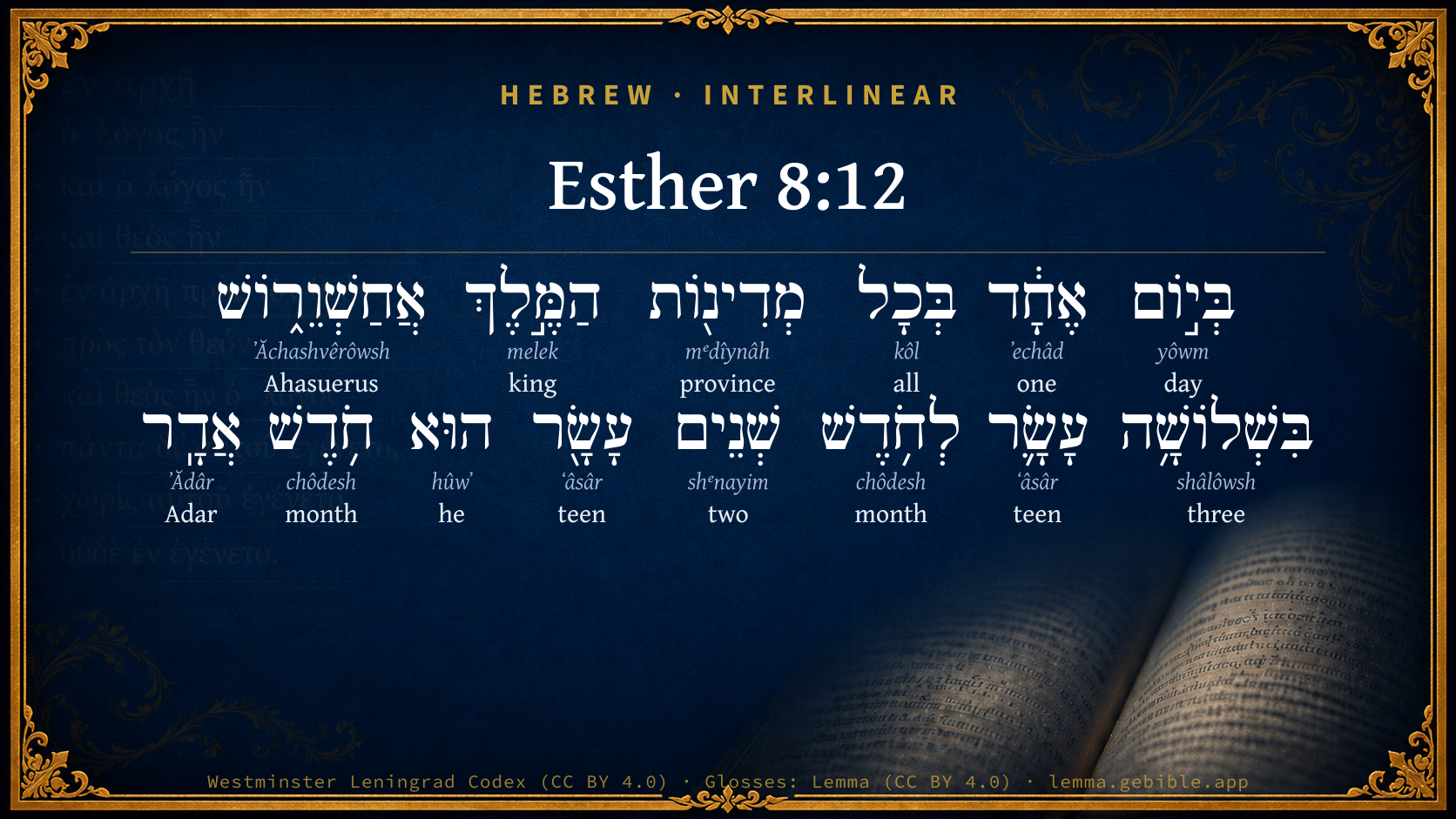
Hebrew (Westminster Leningrad Codex) Esther 8:12 appears in the Hebrew Old Testament. The text above is from the Westminster Leningrad Codex. Each word links to its Strong’s number, a concise gloss, and parsing drawn from the Open Scriptures Hebrew Bible morphology. Click any word for its full Brown-Driver-Briggs (BDB) entry.
Download image
Cite this verse

Esther 8:12 (World English Bible). Public Domain. Lemma interlinear Bible study tool, https://lemma.gebible.app/v/esther/8/12.

Show BibTeX & RIS
BibTeX
RIS
English Translation
on one day in all the provinces of king Ahasuerus, [namely], on the thirteenth [day] of the twelfth month, which is the month Adar.
World English Bible · Public Domain
Download a study sheet

One document with this verse’s original text, its word-by-word gloss line, the meaning frame, cross-references with their text, attributed commentary, and full source and license credits — printable, and it pastes into notes with its structure intact.

This verse Autodidact and up

Study sheet (.html) Plain text (.txt)

A passage Seminary Student

Up to 50 verses in one chapter. A passage sheet keeps up to 6 commentary sources and 12 cross-references per verse, in the order this page ranks them, and says so on the sheet whenever that leaves anything out. Ask for a single verse and you get the Autodidact verse sheet above.

Everything on this page stays free to read, with no account — the sheet is a download of what is already on screen, not access to it.

Want to remove ads? Support Godless Engineer
Compare translations 3

The same verse in 3 English versions, stacked beneath the original-language interlinear above. Click any original word for its lexicon entry.

Each is an independent rendering of the whole verse — the interlinear is not word-aligned to these translations.

Highlighted words mark where these versions differ — a whole-verse word diff, not a word-by-word alignment.

  • World English Bible Public Domain
    on one day in all the provinces of king Ahasuerus, [namely], on the thirteenth [day] of the twelfth month, which is the month Adar.
  • King James Version Public Domain
    Upon one day in all the provinces of king Ahasuerus, namely, upon the thirteenth day of the twelfth month, which is the month Adar.
  • unfoldingWord Literal Text CC BY-SA 4.0
    on one day in all the provinces of the king Ahasuerus, on the thirteenth of month 12, which is the month of Adar.

unfoldingWord Literal Text — © unfoldingWord, licensed CC BY-SA 4.0. Word-aligned USFM3 via Door43 (git.door43.org/unfoldingWord/en_ult).

Versions to compare (up to 4)

3 of 4 selected

Show all 18 translations

Every available English version of this verse, each an independent rendering of the whole verse.

  • World English Bible Public Domain
    on one day in all the provinces of king Ahasuerus, [namely], on the thirteenth [day] of the twelfth month, which is the month Adar.
  • Berean Standard Bible Public Domain
    The single day appointed throughout all the provinces of King Xerxes was the thirteenth day of the twelfth month, the month of Adar.
  • Majority Standard Bible Public Domain
    The single day appointed throughout all the provinces of King Xerxes was the thirteenth day of the twelfth month, the month of Adar.
  • King James Version Public Domain
    Upon one day in all the provinces of king Ahasuerus, namely, upon the thirteenth day of the twelfth month, which is the month Adar.
  • American Standard Version (1901) Public Domain
    upon one day in all the provinces of king Ahasuerus, `namely', upon the thirteenth `day' of the twelfth month, which is the month Adar.
  • Revised Version (1885) Public Domain
    upon one day in all the provinces of king Ahasuerus, namely, upon the thirteenth day of the twelfth month, which is the month Adar.
  • Geneva Bible (1599) Public Domain
    Vpon one day in all the prouinces of King Ahashuerosh, euen in the thirteenth day of the twelft moneth, which is the moneth Adar.
  • Douay-Rheims (1899) Public Domain
    And one day of revenge was appointed through all the provinces, to wit, the thirteenth of the twelfth month Adar.
  • Young's Literal Translation Public Domain
    In one day, in all the provinces of the king Ahasuerus, on the thirteenth of the twelfth month -- it `is' the month of Adar --
  • Literal Standard Version CC BY-SA 4.0
    In one day, in all the provinces of King Ahasuerus, on the thirteenth of the twelfth month—it [is] the month of Adar—
  • Unlocked Literal Bible CC BY-SA 4.0
    This was to be in effect in all the provinces of King Ahasuerus, on the thirteenth day of the twelfth month, which is the month of Adar.
  • unfoldingWord Literal Text CC BY-SA 4.0
    on one day in all the provinces of the king Ahasuerus, on the thirteenth of month 12, which is the month of Adar.
  • Darby Bible Public Domain
    upon one day in all the provinces of king Ahasuerus, upon the thirteenth of the twelfth month, that is, the month Adar.
  • World Messianic Bible Public Domain
    on one day in all the provinces of King Ahasuerus, on the thirteenth day of the twelfth month, which is the month Adar.
  • Webster's Bible Public Domain
    Upon one day in all the provinces of king Ahasuerus, namely, upon the thirteenth day of the twelfth month, which is the month Adar,
  • Free Bible Version CC BY-SA 4.0
    This was to happen on one day throughout all the provinces of King Xerxes, the thirteenth day of the twelfth month, the month of Adar.
  • Bible in Basic English Public Domain
    On one day in every division of the kingdom of Ahasuerus, that is, on the thirteenth day of the twelfth month, the month Adar.
  • JPS Tanakh (1917) Public Domain
    upon one day in all the provinces of king Ahasuerus, namely, upon the thirteenth day of the twelfth month, which is the month Adar.

Literal Standard Version (2020), Covenant Press — licensed CC BY-SA 4.0. Text via the HelloAO Bible API (eBible.org). Unlocked Literal Bible (unfoldingWord) — licensed CC BY-SA 4.0. Text via the HelloAO Bible API (eBible.org). unfoldingWord Literal Text — © unfoldingWord, licensed CC BY-SA 4.0. Word-aligned USFM3 via Door43 (git.door43.org/unfoldingWord/en_ult). Free Bible Version, Dr. Jonathan Gallagher — licensed CC BY-SA 4.0. Text via the HelloAO Bible API (eBible.org).

Word by word

More ways to search: Search by grammar → Find every occurrence → Compare this word →

Practice this passage: Drill this verse → Learn its vocabulary →

אֲדָֽר
ʼĂdâr
H143
“Adar”
Noun, Proper
Part of Speech
Noun
Type
Proper
Full BDB Definition

Origin: probably of foreign derivation

TWOT: None

Adar = "glorious" - twelfth month, corresponding to modern March-April
  1. בְּי֣וֹם yôwm H3117 “in/at · day” Preposition + Noun, Common, Masculine, Singular, Absolute
  2. אֶחָ֔ד ʼechâd H259 “one” Adjective, Cardinal number, Masculine, Singular, Absolute
  3. בְּכָל kôl H3605 “in/at · all of” Preposition + Noun, Common, Masculine, Singular, Construct
  4. מְדִינ֖וֹת mᵉdîynâh H4082 “provinces of” Noun, Common, Feminine, Plural, Construct
  5. הַמֶּ֣לֶךְ melek H4428 “the · king” Particle, Definite Article + Noun, Common, Masculine, Singular, Absolute
  6. אֲחַשְׁוֵר֑וֹשׁ ʼĂchashvêrôwsh H325 “Ahasuerus” Noun, Proper
  7. בִּשְׁלוֹשָׁ֥ה shâlôwsh H7969 “in/at · three” Preposition + Adjective, Cardinal number, Masculine, Singular, Absolute
  8. עָשָׂ֛ר ʻâsâr H6240 “teen” Adjective, Cardinal number, Masculine, Singular, Absolute
  9. לְחֹ֥דֶשׁ chôdesh H2320 “to/for · month” Preposition + Noun, Common, Masculine, Singular, Absolute
  10. שְׁנֵים shᵉnayim H8147 “two” Adjective, Cardinal number, Masculine, Dual, Absolute
  11. עָשָׂ֖ר ʻâsâr H6240 “teen” Adjective, Cardinal number, Masculine, Singular, Absolute
  12. הוּא hûwʼ H1931 “he” Pronoun, Personal, 3rd Person, Masculine, Singular
  13. חֹ֥דֶשׁ chôdesh H2320 “month of” Noun, Common, Masculine, Singular, Construct

About this verse

These counts appear in no published source. They are computed here, from the morphology-tagged text and Lemma’s own curated glosses. What Lemma adds →

14
words
12
distinct lemmas
Historical
section

Notable vocabulary

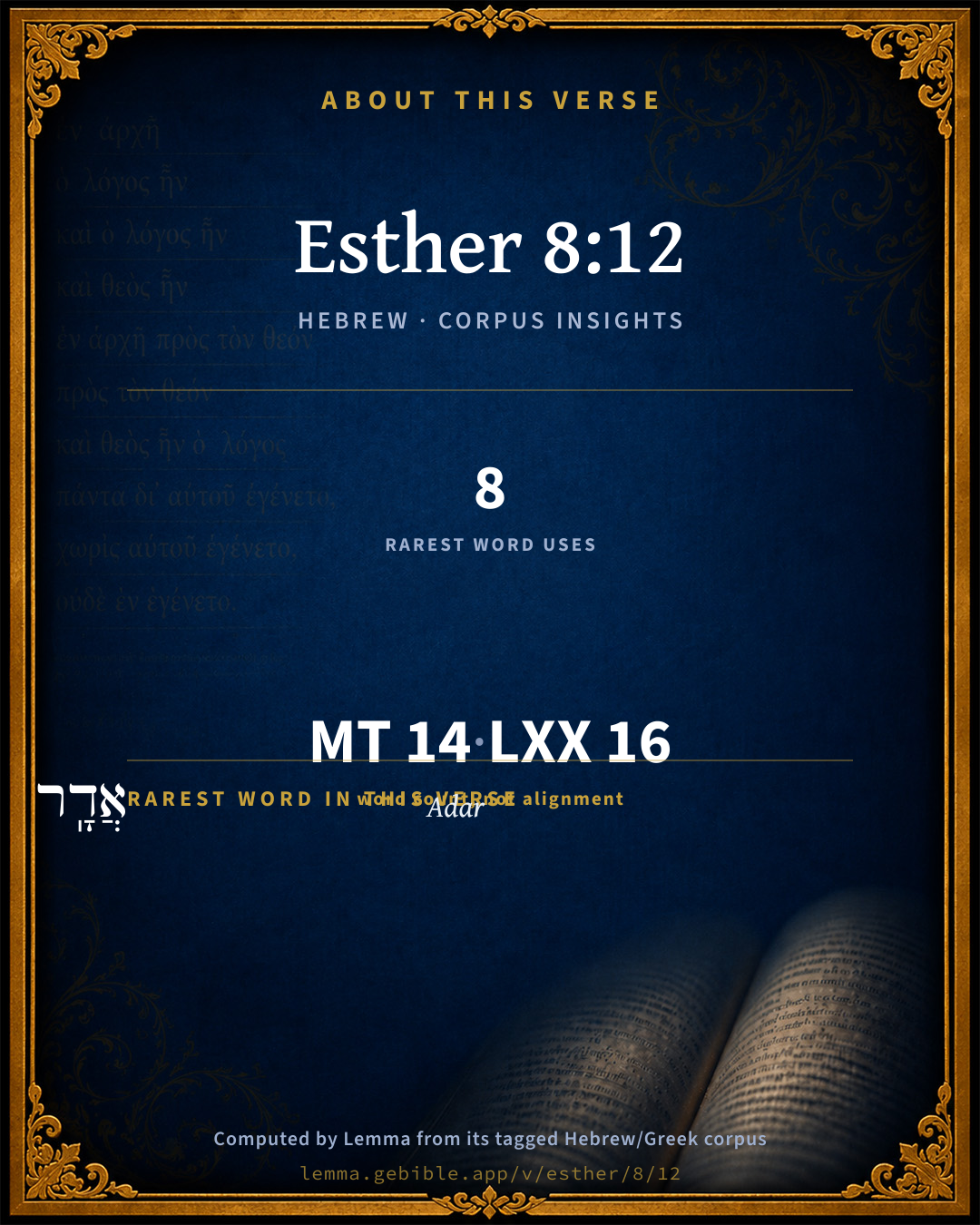
The rarest word here is אֲדָֽר Adar H143 — appearing just 8 times in the whole Hebrew Bible.

Shared distinctive vocabulary

אֲדָֽר Adar H143 occurs in 8 verses of the Hebrew Bible. Also found in:

Grammatical profile

  • 8 nouns
  • 5 adjectives
  • 1 pronoun

Repetition

Words recur within this verse — often emphatic in Hebrew:

  • עָשָׂ֛ר teen H6240 ×2
  • לְחֹ֥דֶשׁ month H2320 ×2

Hebrew & Septuagint length

In English translation the verse runs 24 words from the Hebrew and 20 from the Septuagint (LXX English) — closely comparable.

A rough comparison of the two English renderings, which tokenize alike — not a word-level alignment.

Word counts can differ between the Hebrew and the Greek without any difference in meaning — e.g. the Hebrew direct-object marker אֵת has no separate Greek word, and Greek often adds the article ὁ.

In the original languages it is 14 Hebrew tokens and 16 Greek tokens — but the two are counted differently (Hebrew bundles its prefixes and suffixes into one token; the Greek is in lemma form), so that isn’t a like-for-like length.

Cross-references

4

Topical passages linked to Esther 8:12 in the Treasury of Scripture Knowledge — connected by theme and wording, ordered by reader-vote popularity; previews shown in the World English Bible.

  • Esther 9:1 Now in the twelfth month, which is the month Adar, on the thirteenth day of the same, when the king's commandment and his decree drew near to be put in execution, on the day that the enemies of the Jews hoped to have rule over them, (whereas it was turned to the contrary, that the Jews had rule over those who hated them),
  • Esther 3:13–15 Letters were sent by posts into all the king's provinces, to destroy, to kill, and to cause to perish, all Jews, both young and old, little children and women, in one day, even on the thirteenth [day] of the twelfth month, which is the month Adar, and to take the spoil of them for a prey.
  • Exodus 15:9–10 The enemy said, 'I will pursue, I will overtake, I will divide the spoil. My desire shall be satisfied on them. I will draw my sword, my hand shall destroy them.'
  • Judges 1:6–7 But Adoni-bezek fled; and they pursued after him, and caught him, and cut off his thumbs and his great toes.

Cross-references courtesy of OpenBible.info (CC BY 4.0).

Hebrew and Greek witnesses Masoretic Hebrew ↔ Greek Septuagint

The same verse in the two great witnesses to the Old Testament, shown verse-for-verse.

These are two independent witnesses, not word-aligned to each other, and the Septuagint is shown in lemma (dictionary) form.

Hebrew Esther 8:12 Masoretic · Westminster Leningrad Codex

בְּי֣וֹם אֶחָ֔ד בְּכָל מְדִינ֖וֹת הַמֶּ֣לֶךְ אֲחַשְׁוֵר֑וֹשׁ בִּשְׁלוֹשָׁ֥ה עָשָׂ֛ר לְחֹ֥דֶשׁ שְׁנֵים עָשָׂ֖ר הוּא חֹ֥דֶשׁ אֲדָֽר

on one day in all the provinces of king Ahasuerus, [namely], on the thirteenth [day] of the twelfth month, which is the month Adar.

World English Bible · Public Domain

Greek LXX Esther 8:12 Septuagint · lemma form

ἐν ἡμέρα εἷς ἐν πᾶς ὁ βασιλεία ἀρταξέρξης ὁ τρισκαιδέκατος ὁ δωδέκατος μήν ὅς εἰμί αδαρ

on one day in all the kingdom of Artaxerxes, on the thirteenth day of the twelfth month, which is Adar.

LXX2012 (modern English Septuagint) · Public Domain

Hebrew: Westminster Leningrad Codex (CC BY 4.0). Greek: Septuagint (public domain); English from LXX2012 (modern English Septuagint) (Public Domain). How the Septuagint differs from the Hebrew →

Commentary

Notes on Esther 8:12 from classic Christian and Jewish commentators (each source and its license shown beneath its notes). The classic Christian expositions comment on the surrounding passage and are grouped to its opening verse, so a note may address several verses; the Jewish commentaries on the Tanakh (Rashi and others) are per-verse, so they appear only where the commentator wrote on this verse.

Lemma curates 59 commentaries, every one of them public domain or Creative Commons licensed, each selected and text-cleaned for this edition rather than reprinted as found. About our sources →

Trapp's Complete Commentary

John Trapp

Est 8:12 Upon one day in all the provinces of king Ahasuerus, [namely], upon the thirteenth [day] of the twelfth month, which [is] the month Adar.

Ver. 12. Upon one day in all the provinces, &c.] That once fatal day, but henceforth (the brunt once past) festival. That long-looked-for day, wherein the enemy hoped to revel in the Church’s ruins; to frame comedies out of her tragedies; to wash their feet in her blood, yea, to ride their horses up to the saddle skirts therein, as Farnesius, the pope’s champion, threatened to do in Germany, and Minerius in France, and the Papists here in England, at the death of Queen Elizabeth, and again upon the good success of the gunpowder plot, that great crack and black day, as they called it. For the speeding and furthering whereof, they had a devilish ditty, consisting of a seven-fold psalmody, which secretly they passed from hand to hand with tunes set to be sung for the cheering up of their wicked hearts with an expectation (as they called it) of their day of Jubilee. This is one passage therein, Confirm your hearts with hope, for the day of your redemption is not far off. The year of visitation draweth to an end, and jubilation is at hand, &c. (Spec. Bell. Sacr. xx. 2). The psalter is hard to be had, for they are taken up by the Papists, as other books be that discover their shame. But do what they can, shame shall be the promotion of fools (as it was of Haman), but the wise (as Mordecai) shall inherit glory, Pro 3:35.

John Trapp, A Commentary or Exposition upon All the Books of the Old and New Testament (1647–1656) — public domain. Text from a community e-Sword module.

Joseph Benson's Commentary

Est 8:12-14. Upon one day, &c. — Which day was chosen and appointed by Haman for their destruction. That the Jews should be ready against that day — Should be furnished with arms, and all things necessary for their defence. Being hastened by the king’s commandment — By his particular and express command to that purpose.

Joseph Benson's Commentary on the Old and New Testaments (1811–1818) — public domain. Text from a community e-Sword module.

Tyndale Open Study Notes

Tyndale Open Resources

8:12 March 7 of the next year: This date was nearly a year after Haman’s original decree was published (3:12).

Tyndale Open Study Notes — © Tyndale Open Resources, licensed CC BY-SA 4.0. Text via the HelloAO Bible API.

Geneva Bible (1599)

Geneva Bible translators

Which hath part of February and part of March.

Geneva Bible (1599) marginal notes — public domain. Text via Bolls.life.

John Gill's Exposition

So the posts that rode upon mules and camels went out,.... Or on the mules, which in the Persian language were called "ahashteranim"; See Gill on Est 8:10,

being hastened and pressed on by the king's commandment; who gave them a special order to make what haste they could, that the Jews might have time to prepare for their defence, and their enemies be the more intimidated:

and the decree was given at Shushan the palace; the king's counsellors agreeing to it, and perhaps signing it, as they did the former; see Est 3:15.

John Gill's Exposition of the Whole Bible (1746–1763) — public domain (CC PDM 1.0). Text via the HelloAO Bible API.

Scofield Reference Notes

C. I. Scofield

twelfth month

i.e. March; also Est 8:15; Est 8:17.

The Scofield Reference Bible (1917 edition), notes by C. I. Scofield — public domain. Text from a community e-Sword module.

Lesson kit

Teaching starters — assembled from the data on this page, not authored interpretation. Every prompt links to the verse data it draws on. Edit before teaching.

Esther, in the Historical, opens this verse with 14 words (12 distinct Hebrew lemmas). Its most distinctive word is ʼĂdâr (“Adar”). A historical commentator’s framing appears above. Read the whole chapter for the surrounding context.

Discussion questions

  1. How does “Adar” (ʼĂdâr) shape what this verse is saying?
  2. Esther 3:7 shares the word «Adar» with this verse. How do the two illuminate each other?
  3. “teen” occurs 2× in this one verse. What is the effect of the repetition?
  4. The translations on this page render this verse differently — a whole-verse word diff, not a word-by-word alignment. What might account for the different wordings?
  5. Reading how Trapp's Complete Commentary and Joseph Benson's Commentary read this verse, where do the two commentators agree and where do they part?

Things to notice

Reading settings

Reading text

Shown beneath each verse's original-language words.

Old Testament
Old Testament edition

Read the OT as the Masoretic Hebrew (MT) or the Greek Septuagint (LXX).

English shown for the Greek Septuagint (in the Hebrew ↔ Greek comparison).

Comparing translations? Open the Compare panel on any verse page to stack up to four side by side.