
2 Chronicles 30:15

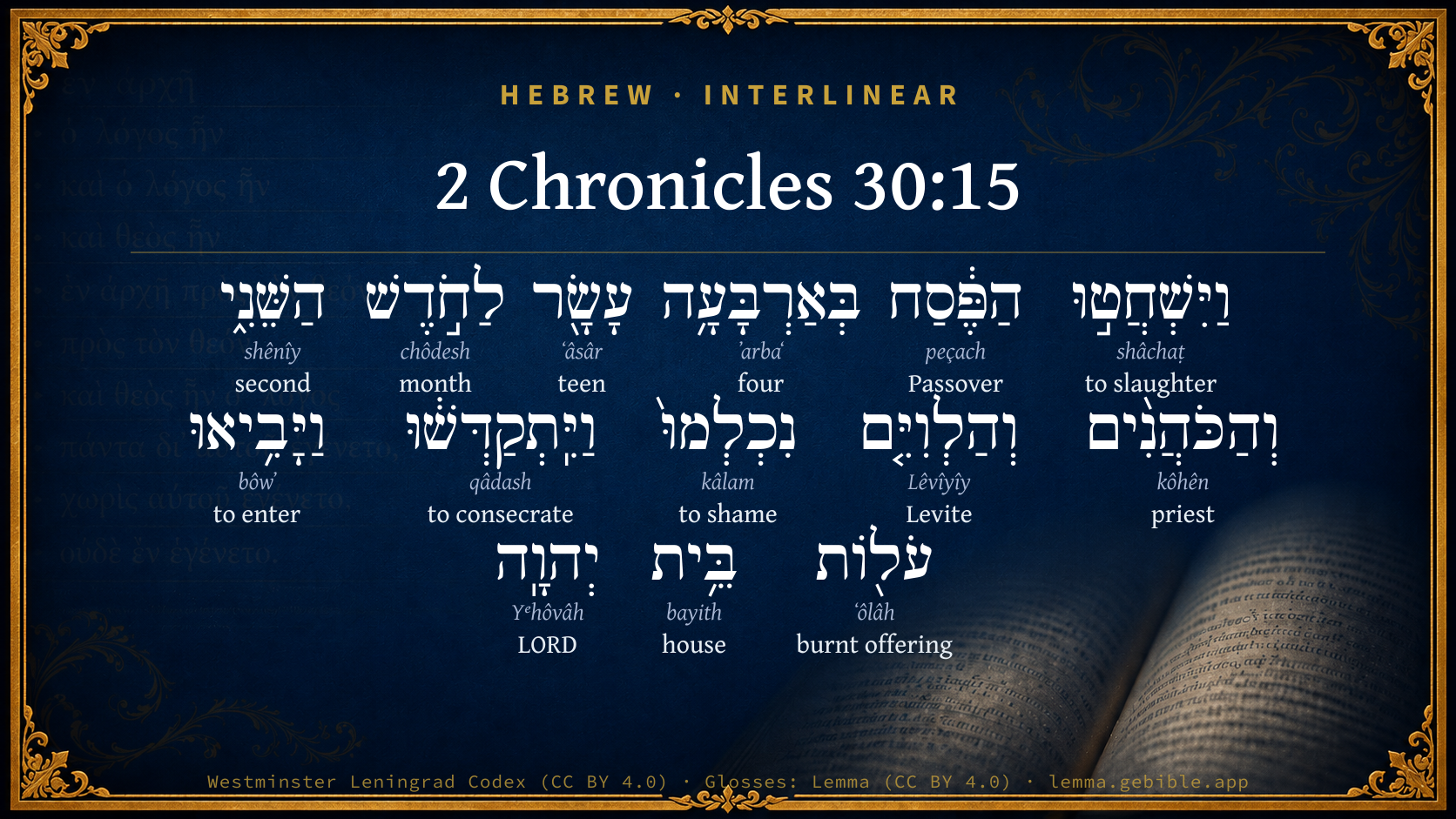
Hebrew (Westminster Leningrad Codex) 2 Chronicles 30:15 appears in the Hebrew Old Testament. The text above is from the Westminster Leningrad Codex. Each word links to its Strong’s number, a concise gloss, and parsing drawn from the Open Scriptures Hebrew Bible morphology. Click any word for its full Brown-Driver-Briggs (BDB) entry.
Download image
Cite this verse

2 Chronicles 30:15 (World English Bible). Public Domain. Lemma interlinear Bible study tool, https://lemma.gebible.app/v/2-chronicles/30/15.

Show BibTeX & RIS
BibTeX
RIS
English Translation
Then they killed the Passover on the fourteenth [day] of the second month: and the priests and the Levites were ashamed, and sanctified themselves, and brought burnt offerings into the house of Yahweh.
World English Bible · Public Domain
Download a study sheet

One document with this verse’s original text, its word-by-word gloss line, the meaning frame, cross-references with their text, attributed commentary, and full source and license credits — printable, and it pastes into notes with its structure intact.

This verse Autodidact and up

Study sheet (.html) Plain text (.txt)

A passage Seminary Student

Up to 50 verses in one chapter. A passage sheet keeps up to 6 commentary sources and 12 cross-references per verse, in the order this page ranks them, and says so on the sheet whenever that leaves anything out. Ask for a single verse and you get the Autodidact verse sheet above.

Everything on this page stays free to read, with no account — the sheet is a download of what is already on screen, not access to it.

Want to remove ads? Support Godless Engineer
Compare translations 3

The same verse in 3 English versions, stacked beneath the original-language interlinear above. Click any original word for its lexicon entry.

Each is an independent rendering of the whole verse — the interlinear is not word-aligned to these translations.

Highlighted words mark where these versions differ — a whole-verse word diff, not a word-by-word alignment.

  • World English Bible Public Domain
    Then they killed the Passover on the fourteenth [day] of the second month: and the priests and the Levites were ashamed, and sanctified themselves, and brought burnt offerings into the house of Yahweh.
  • King James Version Public Domain
    Then they killed the passover on the fourteenth day of the second month: and the priests and the Levites were ashamed, and sanctified themselves, and brought in the burnt offerings into the house of the LORD.
  • unfoldingWord Literal Text CC BY-SA 4.0
    And they slaughtered the Passover lambs on the 14th of the second month. And the priests and the Levites were ashamed, and they consecrated themselves, and they brought in the burnt offerings to the house of Yahweh.

unfoldingWord Literal Text — © unfoldingWord, licensed CC BY-SA 4.0. Word-aligned USFM3 via Door43 (git.door43.org/unfoldingWord/en_ult).

Versions to compare (up to 4)

3 of 4 selected

Show all 18 translations

Every available English version of this verse, each an independent rendering of the whole verse.

  • World English Bible Public Domain
    Then they killed the Passover on the fourteenth [day] of the second month: and the priests and the Levites were ashamed, and sanctified themselves, and brought burnt offerings into the house of Yahweh.
  • Berean Standard Bible Public Domain
    And on the fourteenth day of the second month they slaughtered the Passover lamb. The priests and Levites were ashamed, and they consecrated themselves and brought burnt offerings to the house of the LORD.
  • Majority Standard Bible Public Domain
    And on the fourteenth day of the second month they slaughtered the Passover lamb. The priests and Levites were ashamed, and they consecrated themselves and brought burnt offerings to the house of the LORD.
  • King James Version Public Domain
    Then they killed the passover on the fourteenth day of the second month: and the priests and the Levites were ashamed, and sanctified themselves, and brought in the burnt offerings into the house of the LORD.
  • American Standard Version (1901) Public Domain
    Then they killed the passover on the fourteenth `day' of the second month: and the priests and the Levites were ashamed, and sanctified themselves, and brought burnt-offerings into the house of Jehovah.
  • Revised Version (1885) Public Domain
    Then they killed the passover on the fourteenth day of the second month: and the priests and the Levites were ashamed, and sanctified themselves, and brought burnt offerings into the house of the LORD.
  • Geneva Bible (1599) Public Domain
    Afterwarde they slewe the Passeouer the fourteenth day of the seconde moneth: and the Priestes and Leuites were ashamed, and sanctified themselues, and brought the burnt offrings into the house of the Lord.
  • Douay-Rheims (1899) Public Domain
    And they arose and destroyed the altars that were in Jerusalem, and took sway all things in which incense was burnt to idols, and cast them into the torrent Cedron.
  • Young's Literal Translation Public Domain
    and they slaughter the passover-offering on the fourteenth of the second month, and the priests and the Levites have been ashamed, and sanctify themselves, and bring in burnt-offerings to the house of Jehovah.
  • Literal Standard Version CC BY-SA 4.0
    and they slaughter the Passover-offering on the fourteenth of the second month, and the priests and the Levites have been ashamed, and sanctify themselves, and bring in burnt-offerings to the house of YHWH.
  • Unlocked Literal Bible CC BY-SA 4.0
    Then they killed the Passover lambs on the fourteenth day of the second month. The priests and Levites were ashamed, so they consecrated themselves and brought burnt offerings into the house of Yahweh.
  • unfoldingWord Literal Text CC BY-SA 4.0
    And they slaughtered the Passover lambs on the 14th of the second month. And the priests and the Levites were ashamed, and they consecrated themselves, and they brought in the burnt offerings to the house of Yahweh.
  • Darby Bible Public Domain
    And they slaughtered the passover on the fourteenth of the second month; and the priests and the Levites were ashamed, and hallowed themselves; and they brought the burnt-offerings into the house of Jehovah.
  • World Messianic Bible Public Domain
    Then they killed the Passover on the fourteenth day of the second month. The priests and the Levites were ashamed, and sanctified themselves, and brought burnt offerings into the LORD’s house.
  • Webster's Bible Public Domain
    Then they killed the passover on the fourteenth day of the second month: and the priests and the Levites were ashamed, and sanctified themselves, and brought in the burnt-offerings into the house of the LORD.
  • Free Bible Version CC BY-SA 4.0
    On the fourteenth day of the second month they killed the Passover lamb. The priests and Levites were ashamed, and they purified themselves and brought burnt offerings to the Lord's Temple.
  • Bible in Basic English Public Domain
    Then on the fourteenth day of the second month they put the Passover lambs to death: and the priests and the Levites were shamed, and made themselves holy and took burned offerings into the house of the Lord.
  • JPS Tanakh (1917) Public Domain
    Then they killed the passover lamb on the fourteenth day of the second month; and the priests and the Levites were ashamed, and sanctified themselves, and brought burnt-offerings into the house of the LORD.

Literal Standard Version (2020), Covenant Press — licensed CC BY-SA 4.0. Text via the HelloAO Bible API (eBible.org). Unlocked Literal Bible (unfoldingWord) — licensed CC BY-SA 4.0. Text via the HelloAO Bible API (eBible.org). unfoldingWord Literal Text — © unfoldingWord, licensed CC BY-SA 4.0. Word-aligned USFM3 via Door43 (git.door43.org/unfoldingWord/en_ult). Free Bible Version, Dr. Jonathan Gallagher — licensed CC BY-SA 4.0. Text via the HelloAO Bible API (eBible.org).

Word by word

More ways to search: Search by grammar → Find every occurrence → Compare this word →

Practice this passage: Drill this verse → Learn its vocabulary →

נִכְלְמוּ֙
kâlam
H3637
“to shame”
Verb, Niphal, Perfect, 3rd Person, Common, Plural
Part of Speech
Verb
Stem
Niphal
Form
Perfect
Person
3rd Person
Gender
Common
Number
Plural
Full BDB Definition

Origin: a primitive root

TWOT: 987

to insult, shame, humiliate, blush, be ashamed, be put to shame, be reproached, be put to confusion, be humiliated - (Niphal) - to be humiliated, be ashamed - to be put to shame, be dishonoured, be confounded - (Hiphil) - to put to shame, insult, humiliate, cause shame to - to exhibit shame - (Hophal) - to be insulted, be humiliated - to be put to shame, be dishonoured, be confounded
  1. וַיִּשְׁחֲט֣וּ shâchaṭ H7819 “and · to slaughter” Conjunction + Verb, Qal, Sequential Imperfect, 3rd Person, Masculine, Plural
  2. הַפֶּ֔סַח peçach H6453 “the · Passover” Particle, Definite Article + Noun, Common, Masculine, Singular, Absolute
  3. בְּאַרְבָּעָ֥ה ʼarbaʻ H702 “in/at · four” Preposition + Adjective, Cardinal number, Masculine, Singular, Absolute
  4. עָשָׂ֖ר ʻâsâr H6240 “teen” Adjective, Cardinal number, Masculine, Singular, Absolute
  5. לַחֹ֣דֶשׁ chôdesh H2320 “to/for the · month” Preposition, Determined + Noun, Common, Masculine, Singular, Absolute
  6. הַשֵּׁנִ֑י shênîy H8145 “the · second” Particle, Definite Article + Adjective, Ordinal number, Masculine, Singular, Absolute
  7. וְהַכֹּהֲנִ֨ים kôhên H3548 “and · the · priests” Conjunction + Particle, Definite Article + Noun, Common, Masculine, Plural, Absolute
  8. וְהַלְוִיִּ֤ם Lêvîyîy H3881 “and · the · Levites” Conjunction + Particle, Definite Article + Noun, Gentilic, Masculine, Plural, Absolute
  9. וַיִּֽתְקַדְּשׁ֔וּ qâdash H6942 “and · to consecrate” Conjunction + Verb, Hithpael, Sequential Imperfect, 3rd Person, Masculine, Plural
  10. וַיָּבִ֥יאוּ bôwʼ H935 “and · to enter” Conjunction + Verb, Hiphil, Sequential Imperfect, 3rd Person, Masculine, Plural
  11. עֹל֖וֹת ʻôlâh H5930 “burnt offerings” Noun, Common, Feminine, Plural, Absolute
  12. בֵּ֥ית bayith H1004 “house of” Noun, Common, Masculine, Singular, Construct
  13. יְהוָֽה Yᵉhôvâh H3068 “LORD” Noun, Proper

About this verse

These counts appear in no published source. They are computed here, from the morphology-tagged text and Lemma’s own curated glosses. What Lemma adds →

14
words
14
distinct lemmas
Historical
section

Shared distinctive vocabulary

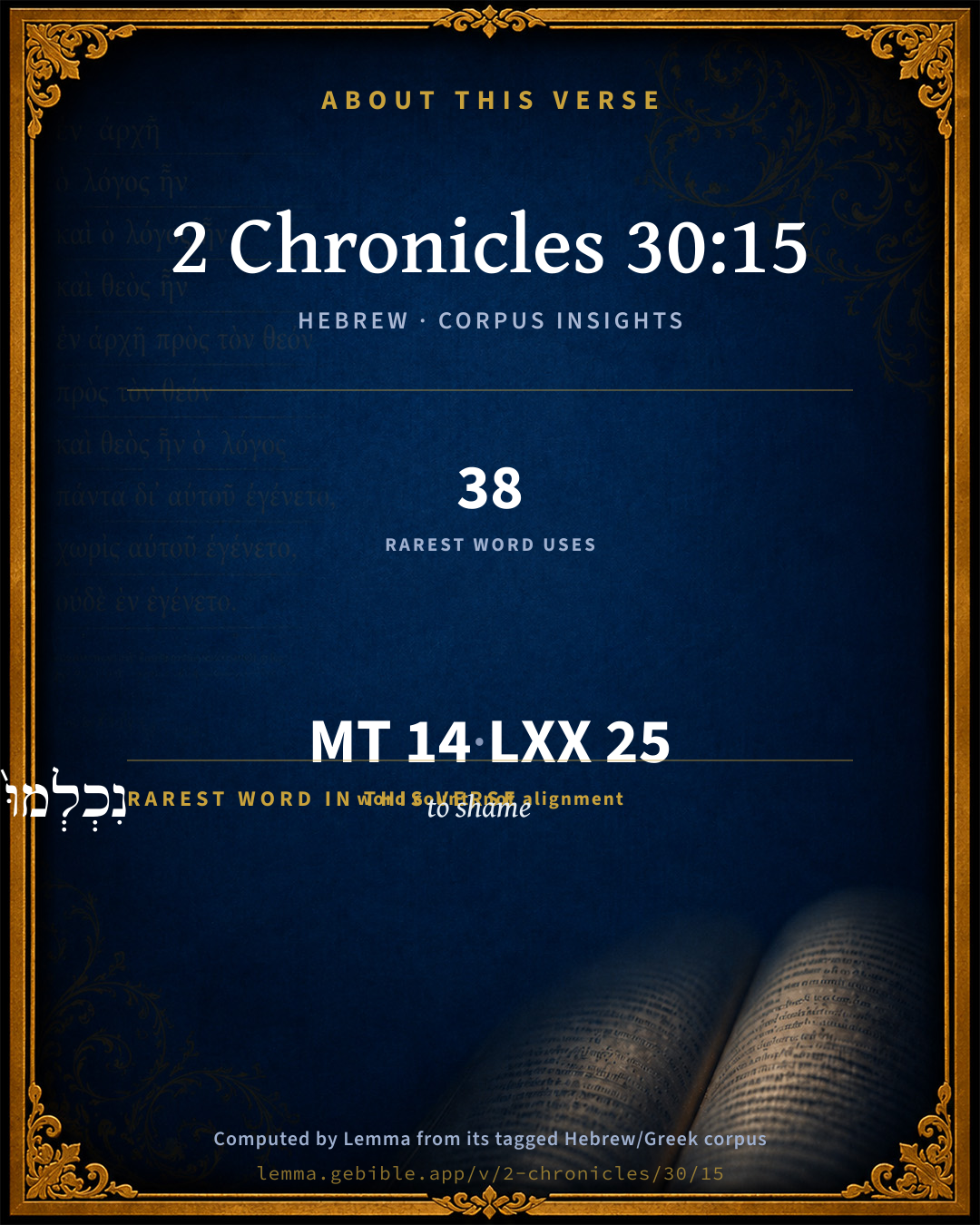
נִכְלְמוּ֙ to shame H3637 occurs in 38 verses of the Hebrew Bible. Also found in:

Grammatical profile

  • 4 verbs
  • 7 nouns
  • 3 adjectives

Verb forms

  • וַיִּשְׁחֲט֣וּ Qal · Sequential Imperfect
  • נִכְלְמוּ֙ Niphal · Perfect
  • וַיִּֽתְקַדְּשׁ֔וּ Hithpael · Sequential Imperfect
  • וַיָּבִ֥יאוּ Hiphil · Sequential Imperfect

Hebrew & Septuagint length

In English translation the verse runs 33 words from the Hebrew and 34 from the Septuagint (LXX English) — closely comparable.

A rough comparison of the two English renderings, which tokenize alike — not a word-level alignment.

Word counts can differ between the Hebrew and the Greek without any difference in meaning — e.g. the Hebrew direct-object marker אֵת has no separate Greek word, and Greek often adds the article ὁ.

In the original languages it is 14 Hebrew tokens and 25 Greek tokens — but the two are counted differently (Hebrew bundles its prefixes and suffixes into one token; the Greek is in lemma form), so that isn’t a like-for-like length.

Cross-references

9

Topical passages linked to 2 Chronicles 30:15 in the Treasury of Scripture Knowledge — connected by theme and wording, ordered by reader-vote popularity; previews shown in the World English Bible.

  • 2 Chronicles 29:34 But the priests were too few, so that they could not flay all the burnt offerings: therefore their brothers the Levites helped them, until the work was ended, and until the priests had sanctified themselves; for the Levites were more upright in heart to sanctify themselves than the priests.
  • Exodus 19:10 Yahweh said to Moses, "Go to the people, and sanctify them today and tomorrow, and let them wash their garments,
  • Exodus 19:22 Let the priests also, who come near to Yahweh, sanctify themselves, lest Yahweh break forth on them."
  • 2 Chronicles 5:11 It happened, when the priests were come out of the holy place, (for all the priests who were present had sanctified themselves, and did not keep their divisions;
  • 2 Chronicles 29:15 They gathered their brothers, and sanctified themselves, and went in, according to the commandment of the king by the words of Yahweh, to cleanse the house of Yahweh.
  • 2 Chronicles 30:24 For Hezekiah king of Judah did give to the assembly for offerings one thousand bulls and seven thousand sheep; and the princes gave to the assembly a thousand bulls and ten thousand sheep: and a great number of priests sanctified themselves.
  • 2 Chronicles 31:18 and those who were reckoned by genealogy of all their little ones, their wives, and their sons, and their daughters, through all the congregation: for in their office of trust they sanctified themselves in holiness.
  • Ezekiel 16:61–63 Then shall you remember your ways, and be ashamed, when you shall receive your sisters, your elder [sisters] and your younger; and I will give them to you for daughters, but not by your covenant.
  • Ezekiel 43:10–11 You, son of man, show the house to the house of Israel, that they may be ashamed of their iniquities; and let them measure the pattern.

Cross-references courtesy of OpenBible.info (CC BY 4.0).

Hebrew and Greek witnesses Masoretic Hebrew ↔ Greek Septuagint

The same verse in the two great witnesses to the Old Testament, shown verse-for-verse.

These are two independent witnesses, not word-aligned to each other, and the Septuagint is shown in lemma (dictionary) form.

Hebrew 2 Chronicles 30:15 Masoretic · Westminster Leningrad Codex

וַיִּשְׁחֲט֣וּ הַפֶּ֔סַח בְּאַרְבָּעָ֥ה עָשָׂ֖ר לַחֹ֣דֶשׁ הַשֵּׁנִ֑י וְהַכֹּהֲנִ֨ים וְהַלְוִיִּ֤ם נִכְלְמוּ֙ וַיִּֽתְקַדְּשׁ֔וּ וַיָּבִ֥יאוּ עֹל֖וֹת בֵּ֥ית יְהוָֽה

Then they killed the Passover on the fourteenth [day] of the second month: and the priests and the Levites were ashamed, and sanctified themselves, and brought burnt offerings into the house of Yahweh.

World English Bible · Public Domain

Greek LXX 2 Chronicles 30:15 Septuagint · lemma form

καί θύω ὁ φασεκ ὁ οςτεσσαρεσκαιδέκατ ὁ μήν ὁ δεύτερος καί ὁ ἱερεύς καί ὁ λευείτης ἐντρέπω καί ἁγνίζω καί εἰςφέρω ὁλοκαύτωμα εἰς οἶκος κύριος

Then they killed the passover on the fourteenth day of the second month: and the priests and the Levites repented, and purified themselves, and brought whole burnt offerings into the house of the Lord.

LXX2012 (modern English Septuagint) · Public Domain

Hebrew: Westminster Leningrad Codex (CC BY 4.0). Greek: Septuagint (public domain); English from LXX2012 (modern English Septuagint) (Public Domain). How the Septuagint differs from the Hebrew →

Commentary

Notes on 2 Chronicles 30:15 from classic Christian and Jewish commentators (each source and its license shown beneath its notes). The classic Christian expositions comment on the surrounding passage and are grouped to its opening verse, so a note may address several verses; the Jewish commentaries on the Tanakh (Rashi and others) are per-verse, so they appear only where the commentator wrote on this verse.

Lemma curates 59 commentaries, every one of them public domain or Creative Commons licensed, each selected and text-cleaned for this edition rather than reprinted as found. About our sources →

Trapp's Complete Commentary

John Trapp

2Ch 30:15 Then they killed the passover on the fourteenth [day] of the second month: and the priests and the Levites were ashamed, and sanctified themselves, and brought in the burnt offerings into the house of the LORD.

Ver. 15. Then they killed the passover.] So must we first cast the baggage into the brook, and then come to the Lord’s supper. {1Co 5:7-8}

And the priests and Levites were ashamed.] As well they might, that they had been so slack and backward to so good a business, so generally and zealously set upon.

John Trapp, A Commentary or Exposition upon All the Books of the Old and New Testament (1647–1656) — public domain. Text from a community e-Sword module.

Joseph Benson's Commentary

2Ch 30:15. The priests and Levites were ashamed — Their negligence and remissness being upbraided by the general forwardness of the people. The zeal which we observe in others, should make us ashamed of our own coldness, and quicken us not only to do our duty, but to do it with our might.

Joseph Benson's Commentary on the Old and New Testaments (1811–1818) — public domain. Text from a community e-Sword module.

Tyndale Open Study Notes

Tyndale Open Resources

30:15 The priests were inadequately prepared for the great number of people who came. The problem might have involved the priests who came from outside the city and had not been a part of the earlier purification. However, the response of the people outstripped that of the professional clerics, to their great shame.

Tyndale Open Study Notes — © Tyndale Open Resources, licensed CC BY-SA 4.0. Text via the HelloAO Bible API.

Geneva Bible (1599)

Geneva Bible translators

Seeing their own negligence (who should have been most prompt) and the readiness of the people, 2 Chron. 29:36.

Geneva Bible (1599) marginal notes — public domain. Text via Bolls.life.

Jamieson, Fausset & Brown

Robert Jamieson, A. R. Fausset & David Brown

the priests and the Levites were ashamed--Though the Levites are associated in this statement, the priests were principally referred to; those of them who had been dilatory or negligent in sanctifying themselves (Ch2 29:34) were put to the blush and stimulated to their duty by the greater alacrity and zeal of the people.

Jamieson, Fausset & Brown — Commentary Critical and Explanatory on the Whole Bible (1871) — public domain (CC PDM 1.0). Text via the HelloAO Bible API.

Ellicott's Commentary for English Readers

(15) And the priests and the Levites were ashamed, and sanctified themselves.—Ashamed of their former reluctance to purify themselves from the defilement contracted by their connection with illegal cults and sanctuaries during the late reign (2Ch_29:34; and 2Ch_30:3, supra). In the former passage the Levites are favourably contrasted with the priests; here they are spoken of in the same terms, a verbal inaccuracy apparently due to the writer’s desire to be brief.

A Bible Commentary for English Readers, edited by Charles John Ellicott (1878–1897) — public domain. Text from a community e-Sword module.

The Cambridge Bible for Schools and Colleges

gen. ed. J. J. S. Perowne

15. the second month] Cp. 2Ch_30:2-3.

were ashamed] Of their former backwardness; cp. 2Ch_30:3, 2Ch_29:34.

brought in the burnt offerings] R.V. brought burnt offerings, i.e. as an atonement for themselves.

The Cambridge Bible for Schools and Colleges (gen. ed. J. J. S. Perowne; Cambridge University Press, 1878–1918) — public domain. Text from a community e-Sword module.

John Gill's Exposition

And they stood in their place after their manner, according to the law of Moses the man of God,.... The priests in their place, and the Levites in theirs, in which they were ordered to stand when they offered sacrifice:

the priests sprinkled the blood, which they received of the hand of the Levites; the blood either of the burnt offerings before mentioned, or of the passover lambs, which the Levites slew, and received the blood of them in basins; and which the priests took of them, and sprinkled, not on the door posts of houses, as in Egypt, but on the altar round about, and which none but priests might do, Lev 1:5.

John Gill's Exposition of the Whole Bible (1746–1763) — public domain (CC PDM 1.0). Text via the HelloAO Bible API.

Albert Barnes' Notes on the Bible

The laggart priests and Levites, who from want of zeal for the Yahweh-worship, or from actual inclination to idolatry, had neglected to purify themselves (2Ch 30:3 and marginal reference), were now shamed by the general ardor, and sanctified themselves for the Paschal festival.

And brought in the burnt offerings - Received them, i. e. from the offerers at the doors of the inner court, and took them up to the brass altar in front of the porch. No part of the burnt offerings was ever taken inside the temple building.

Albert Barnes' Notes on the Bible (1834–1885) — public domain. Text from a community e-Sword/MySword module.

Haydock's Catholic Bible Commentary

At length. Sept. "were converted." Heb. "ashamed, and sanctified themselves." H. --- The ceremonies of purification for priests were longer, (chap. xxix. 34.) and the sacred ministers were ashamed to be outdone by the people. M.

George Leo Haydock (1774–1849), Haydock's Catholic Family Bible and Commentary, 1859 edition — public domain. Excludes Psalms (Douay-Rheims chapter numbering differs from Protestant) and Deuterocanonical books (Catholic canon only).

Matthew Poole's English Annotations

The priests and the Levites were ashamed; their negligence and remissness being upbraided by the great and general alacrity and forwardness of the people.

Matthew Poole's English Annotations on the Holy Bible (1683–1685) — public domain. Text from a community e-Sword/MySword module.

Whedon's Commentary on the Bible

Daniel D. Whedon

15. The priests and the Levites were ashamed — Because of their uncleanness and their lack of zeal for Jehovah’s worship. The zeal of others, and the thought of their own tendency to idolatry, put them to the blush. In 2Ch_30:3, and 2Ch_29:34, we learn that the delinquents were chiefly priests; but here it appears that there were Levites also who had not sufficiently sanctified themselves.

Sanctified themselves — Or, had sanctified themselves; that is, previously to the fourteenth day of the month, so that they were ceremonially fit on that day to minister in the passover offerings.

Into the house of the Lord — Into the court of burnt offerings, where the brazen altar stood.

Daniel D. Whedon (gen. ed.), Commentary on the Old and New Testaments (1874–1909) — public domain. Text from a community e-Sword module.

The Pulpit Commentary

Were ashamed; Hebrew, Wmlkgi. This word, occurring in one conjugation or another thirty-eight times, expresses in every instance a genuine shame. It now was the forerunner of a practical repenting. And brought in into; better rendered, and carried up to the house of the Lord.

The Pulpit Commentary (1880–1919), ed. H.D.M. Spence-Jones & Joseph S. Exell — public domain. Text from a community e-Sword module.

John Wesley's Explanatory Notes

Ashamed - Their negligence and remissness being upbraided by the general forwardness of the people. The zeal which we observe in others, should make us ashamed of our own coldness, and quicken us not only to do our duty, but to do it with our might.

John Wesley, Explanatory Notes Upon the Whole Bible (1754–1765) — public domain. Text via the GEBible commentary corpus.

Rashi

Rabbi Shlomo Yitzchaki (Rashi)

and the priests and the Levites were embarrassed that they had delayed to consecrate themselves. They tarried so long and did not come until now for the following reason: they could not believe that this was true beforehand, because Ahaz had dismissed them from officiating as priests. And so they said, “Is it possible that yesterday Ahaz worshipped idols, and that his son Hezekiah, immediately in the first year and first month would tell the priests and Levites to worship the one God alone and have need of us?” They were therefore lazy and neglected to come, together with the rest of Judah, whom Ahaz had dismissed. But when they investigated and understood that everything was for the name of Heaven, they all came and consecrated themselves.

Rashi on the Tanakh — English translations: “The Judaica Press complete Tanach with Rashi, translated by A. J. Rosenberg” (CC BY 4.0); “Pentateuch with Rashi's commentary by M. Rosenbaum and A.M. Silbermann, 1929-1934” (public domain); “The Metsudah Tanach series, Lakewood, N.J” (CC BY 4.0); and “The Book of Joshua, Metsudah Publications, 1997” (CC BY 4.0). Text via Sefaria.

Lesson kit

Teaching starters — assembled from the data on this page, not authored interpretation. Every prompt links to the verse data it draws on. Edit before teaching.

2 Chronicles, in the Historical, opens this verse with 14 words (14 distinct Hebrew lemmas). Its most distinctive word is kâlam (“to shame”). A historical commentator’s framing appears above. Read the whole chapter for the surrounding context.

Discussion questions

  1. What does “to shame” (kâlam) contribute to the verse as a whole?
  2. How does Numbers 12:14, which shares the word «to shame», read alongside this verse?
  3. These translations render this verse differently. What is at stake in choosing one wording over another?
  4. «וַיִּשְׁחֲט֣וּ» is a Qal Sequential Imperfect verb. How does that grammatical form shape the action described?
  5. Compare how Trapp's Complete Commentary and Joseph Benson's Commentary read this verse. Where do they agree or differ?

Things to notice

Reading settings

Reading text

Shown beneath each verse's original-language words.

Old Testament
Old Testament edition

Read the OT as the Masoretic Hebrew (MT) or the Greek Septuagint (LXX).

English shown for the Greek Septuagint (in the Hebrew ↔ Greek comparison).

Comparing translations? Open the Compare panel on any verse page to stack up to four side by side.