
Jeremiah 28:17

Hebrew (Westminster Leningrad Codex) Jeremiah 28:17 appears in the Hebrew Old Testament. The text above is from the Westminster Leningrad Codex. Each word links to its Strong’s number, a concise gloss, and parsing drawn from the Open Scriptures Hebrew Bible morphology. Click any word for its full Brown-Driver-Briggs (BDB) entry.
Download image
Cite this verse

Jeremiah 28:17 (World English Bible). Public Domain. Lemma interlinear Bible study tool, https://lemma.gebible.app/v/jeremiah/28/17.

Show BibTeX & RIS
BibTeX
RIS
English Translation
So Hananiah the prophet died the same year in the seventh month.
World English Bible · Public Domain
Download a study sheet

One document with this verse’s original text, its word-by-word gloss line, the meaning frame, cross-references with their text, attributed commentary, and full source and license credits — printable, and it pastes into notes with its structure intact.

This verse Autodidact and up

Study sheet (.html) Plain text (.txt)

A passage Seminary Student

Up to 50 verses in one chapter. A passage sheet keeps up to 6 commentary sources and 12 cross-references per verse, in the order this page ranks them, and says so on the sheet whenever that leaves anything out. Ask for a single verse and you get the Autodidact verse sheet above.

Everything on this page stays free to read, with no account — the sheet is a download of what is already on screen, not access to it.

Want to remove ads? Support Godless Engineer
Compare translations 3

The same verse in 3 English versions, stacked beneath the original-language interlinear above. Click any original word for its lexicon entry.

Each is an independent rendering of the whole verse — the interlinear is not word-aligned to these translations.

Highlighted words mark where these versions differ — a whole-verse word diff, not a word-by-word alignment.

  • World English Bible Public Domain
    So Hananiah the prophet died the same year in the seventh month.
  • King James Version Public Domain
    So Hananiah the prophet died the same year in the seventh month.
  • unfoldingWord Literal Text CC BY-SA 4.0
    And Hananiah the prophet died in that year, in the seventh month.

unfoldingWord Literal Text — © unfoldingWord, licensed CC BY-SA 4.0. Word-aligned USFM3 via Door43 (git.door43.org/unfoldingWord/en_ult).

Versions to compare (up to 4)

3 of 4 selected

Show all 18 translations

Every available English version of this verse, each an independent rendering of the whole verse.

  • World English Bible Public Domain
    So Hananiah the prophet died the same year in the seventh month.
  • Berean Standard Bible Public Domain
    And in the seventh month of that very year, the prophet Hananiah died.
  • Majority Standard Bible Public Domain
    And in the seventh month of that very year, the prophet Hananiah died.
  • King James Version Public Domain
    So Hananiah the prophet died the same year in the seventh month.
  • American Standard Version (1901) Public Domain
    So Hananiah the prophet died the same year in the seventh month.
  • Revised Version (1885) Public Domain
    So Hananiah the prophet died the same year in the seventh month.
  • Geneva Bible (1599) Public Domain
    So Hananiah the Prophet died the same yeere in the seuenth moneth.
  • Douay-Rheims (1899) Public Domain
    And Hananias the prophet died in that year, in the seventh month.
  • Young's Literal Translation Public Domain
    And Hananiah the prophet dieth in that year, in the seventh month.
  • Literal Standard Version CC BY-SA 4.0
    And Hananiah the prophet dies in that year, in the seventh month.
  • Unlocked Literal Bible CC BY-SA 4.0
    In the seventh month of that same year, Hananiah the prophet died.
  • unfoldingWord Literal Text CC BY-SA 4.0
    And Hananiah the prophet died in that year, in the seventh month.
  • Darby Bible Public Domain
    And the prophet Hananiah died in the same year in the seventh month.
  • World Messianic Bible Public Domain
    So Hananiah the prophet died the same year in the seventh month.
  • Webster's Bible Public Domain
    So Hananiah the prophet died the same year in the seventh month.
  • Free Bible Version CC BY-SA 4.0
    The prophet Hananiah died in the seventh month of that very year.
  • Bible in Basic English Public Domain
    So death came to Hananiah the prophet the same year, in the seventh month.
  • JPS Tanakh (1917) Public Domain
    So Hananiah the prophet died the same year in the seventh month.

Literal Standard Version (2020), Covenant Press — licensed CC BY-SA 4.0. Text via the HelloAO Bible API (eBible.org). Unlocked Literal Bible (unfoldingWord) — licensed CC BY-SA 4.0. Text via the HelloAO Bible API (eBible.org). unfoldingWord Literal Text — © unfoldingWord, licensed CC BY-SA 4.0. Word-aligned USFM3 via Door43 (git.door43.org/unfoldingWord/en_ult). Free Bible Version, Dr. Jonathan Gallagher — licensed CC BY-SA 4.0. Text via the HelloAO Bible API (eBible.org).

Word by word

More ways to search: Search by grammar → Find every occurrence → Compare this word →

Practice this passage: Drill this verse → Learn its vocabulary →

חֲנַנְיָ֥ה
Chănanyâh
H2608
“Hananiah”
Noun, Proper
Part of Speech
Noun
Type
Proper
Full BDB Definition

Origin: from H2603 and H3050

TWOT: None

Hananiah = "God has favoured" - one of the 14 sons of Heman and chief of the 16th course - a general in the army of King Uzziah - father of Zedekiah in the time of Jehoiakim - son of Azur, a Benjamite of Gibeon and a false prophet in the reign of Zedekiah king of Judah - grandfather of Irijah, the captain of the ward at the gate of Benjamin who arrested Jeremiah on the charge of deserting to the Chaldeans - a head of a Benjamite house - son of Zerubbabel from whom Christ derived His descent also called 'Joanna' by Luke - one of the sons of Bebai who returned with Ezra from Babylon - a priest, one of the makers of the sacred ointments and incense, who built a portion of the wall of Jerusalem in the days of Nehemiah - head of the priestly course of Jeremiah in the days of Joiakim - ruler of the palace at Jerusalem under Nehemiah and also, along with Hanani, the Tirshatha's brother, entrusted with the arrangements of guarding the gates of Jerusalem - Two post exilic Israelites
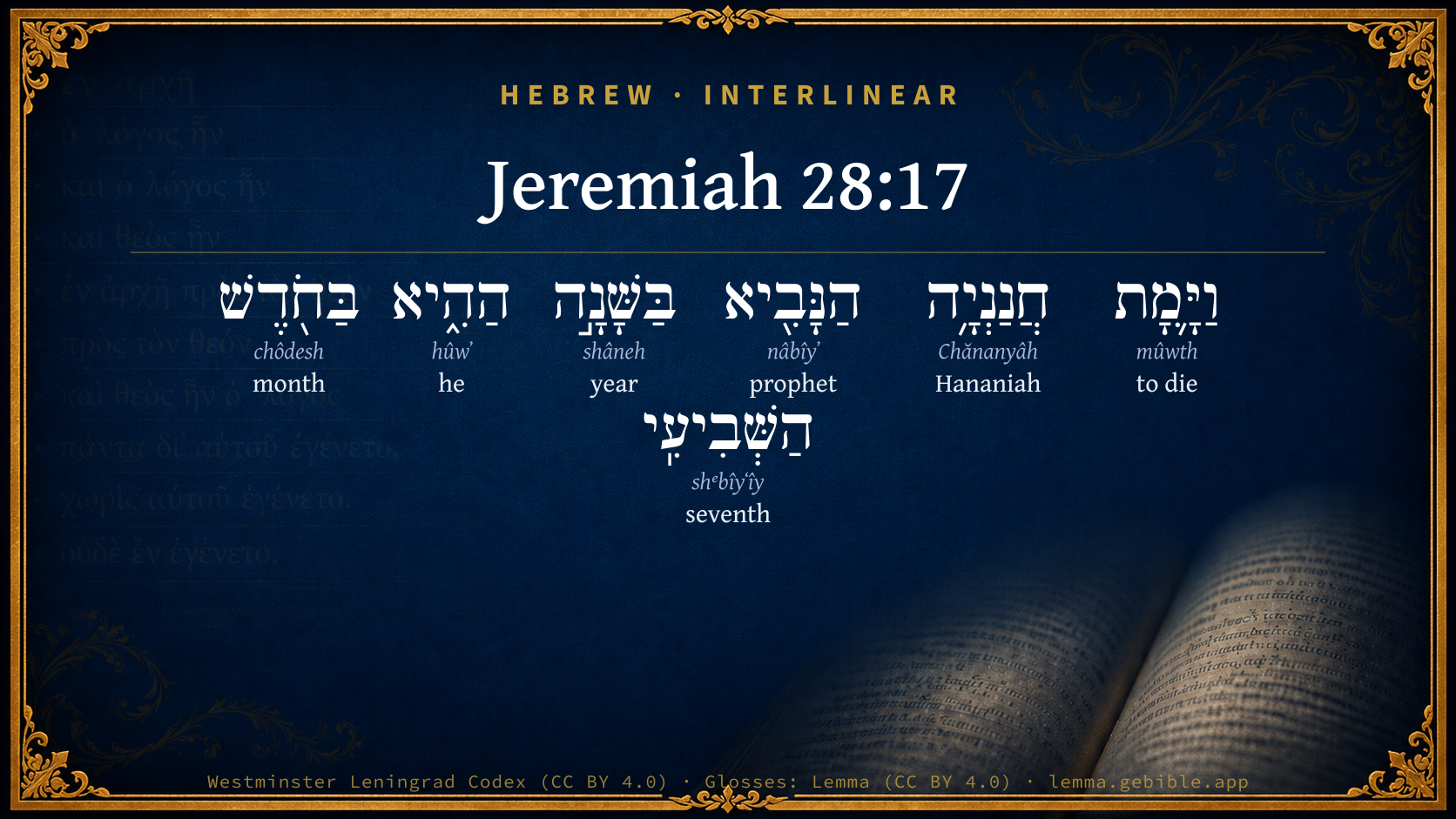
  1. וַיָּ֛מָת mûwth H4191 “and · to die” Conjunction + Verb, Qal, Sequential Imperfect, 3rd Person, Masculine, Singular
  2. הַנָּבִ֖יא nâbîyʼ H5030 “the · prophet” Particle, Definite Article + Noun, Common, Masculine, Singular, Absolute
  3. בַּשָּׁנָ֣ה shâneh H8141 “in/at the · year” Preposition, Determined + Noun, Common, Feminine, Singular, Absolute
  4. הַהִ֑יא hûwʼ H1931 “the · he” Particle, Definite Article + Pronoun, Personal, 3rd Person, Feminine, Singular
  5. בַּחֹ֖דֶשׁ chôdesh H2320 “in/at the · month” Preposition, Determined + Noun, Common, Masculine, Singular, Absolute
  6. הַשְּׁבִיעִֽי shᵉbîyʻîy H7637 “the · seventh” Particle, Definite Article + Adjective, Ordinal number, Masculine, Singular, Absolute

About this verse

These counts appear in no published source. They are computed here, from the morphology-tagged text and Lemma’s own curated glosses. What Lemma adds →

7
words
7
distinct lemmas
Prophets
section

Shared distinctive vocabulary

חֲנַנְיָ֥ה Hananiah H2608 occurs in 28 verses of the Hebrew Bible. Also found in:

Grammatical profile

  • 1 verb
  • 4 nouns
  • 1 adjective
  • 1 pronoun

Verb forms

  • וַיָּ֛מָת Qal · Sequential Imperfect

Cross-references

2

Topical passages linked to Jeremiah 28:17 in the Treasury of Scripture Knowledge — connected by theme and wording, ordered by reader-vote popularity; previews shown in the World English Bible.

  • Zechariah 1:6 But my words and my decrees, which I commanded my servants the prophets, didn't they overtake your fathers? "Then they repented and said, 'Just as Yahweh of Hosts determined to do to us, according to our ways, and according to our practices, so he has dealt with us.'"
  • Isaiah 44:25–26 who frustrates the signs of the liars, and makes diviners mad; who turns wise men backward, and makes their knowledge foolish;

Cross-references courtesy of OpenBible.info (CC BY 4.0).

Hebrew and Greek witnesses Masoretic Hebrew ↔ Greek Septuagint

The same verse in the two great witnesses to the Old Testament, shown verse-for-verse.

These are two independent witnesses, not word-aligned to each other, and the Septuagint is shown in lemma (dictionary) form.

Hebrew Jeremiah 28:17 Masoretic · Westminster Leningrad Codex

וַיָּ֛מָת חֲנַנְיָ֥ה הַנָּבִ֖יא בַּשָּׁנָ֣ה הַהִ֑יא בַּחֹ֖דֶשׁ הַשְּׁבִיעִֽי

So Hananiah the prophet died the same year in the seventh month.

World English Bible · Public Domain

Greek LXX Structure differs

In the Septuagint, Jeremiah is about an eighth shorter than the Hebrew and arranges its material differently — the Oracles Against the Nations (Hebrew chapters 46–51) appear in the middle of the Greek book, after 25:13. Because the chapter and verse boundaries do not line up, a verse-for-verse comparison with the Hebrew is not shown.

A verse-for-verse comparison isn’t shown here because the chapters and verses don’t line up. Switch to the LXX edition with the MT / LXX toggle above to read the Greek directly.

Hebrew: Westminster Leningrad Codex (CC BY 4.0). Greek: Septuagint (public domain); English from a public-domain English Septuagint. How the Septuagint differs from the Hebrew →

Targum (Aramaic paraphrase)

1

The Targum is the ancient Jewish Aramaic paraphrase of the Hebrew Scriptures — an interpretive translation, not the Hebrew text itself. Onkelos (literal) and Pseudo-Jonathan (expansive) render the Torah, and Jonathan the Prophets. Coverage is partial: where no permissively-licensed English translation exists for a verse, only the Aramaic is shown. This is verse-level text, not a word-by-word alignment to the Hebrew.

  1. Targum Jonathan Prophets (Joshua–Malachi)
    וּמִית חֲנַנְיָה נְבִיָא שִׁקְרָא בְּשַׁתָּא הַהִיא וְאִתְקְבַר בְּיַרְחָא שְׁבִיעָאָה:

    (no public-domain English translation for this verse)

    Targum Jonathan — Aramaic: “Mikraot Gedolot” (public domain). English: “Sefaria Community Translation” (CC0 1.0 (public-domain dedication)); “London "Chaldee Paraphrase," 1871” (public domain). Text via Sefaria.

Commentary

Notes on Jeremiah 28:17 from classic Christian and Jewish commentators (each source and its license shown beneath its notes). The classic Christian expositions comment on the surrounding passage and are grouped to its opening verse, so a note may address several verses; the Jewish commentaries on the Tanakh (Rashi and others) are per-verse, so they appear only where the commentator wrote on this verse.

Lemma curates 59 commentaries, every one of them public domain or Creative Commons licensed, each selected and text-cleaned for this edition rather than reprinted as found. About our sources →

Trapp's Complete Commentary

John Trapp

Jer 28:17 So Hananiah the prophet died the same year in the seventh month.

Ver. 17. So Hananiah died.] Two months after this prediction, {Jer 28:1} yet the people relented not, but persisted in their obstinace to the end. Such a sward, or rather hoof, is grown over some men’s hearts, as neither ministry, nor misery, nor miracle, nor mercy, can possibly mollify.

John Trapp, A Commentary or Exposition upon All the Books of the Old and New Testament (1647–1656) — public domain. Text from a community e-Sword module.

Geneva Bible (1599)

Geneva Bible translators

Seeing this thing was evident in the eyes of the people, and yet they returned not to the Lord, it is manifest, that miracles cannot move us, neither the word itself, except God touch the heart.

Geneva Bible (1599) marginal notes — public domain. Text via Bolls.life.

Adam Clarke's Commentary

Verse 17. So Hananiah - died the same year in the seventh month.] The prophecy was delivered in the fifth month, (Jer 28:1,) and Hananiah died in the seventh month. And thus God, in mercy, gave him about two months, in which he might prepare to meet his Judge. Here, then the true prophet was demonstrated, and the false prophet detected. The death of Hananiah, thus predicted, was God's seal to the words of his prophet; and must have gained his other predictions great credit among the people.

Adam Clarke's Commentary on the Bible (1810–1826) — public domain. Text from a community e-Sword/MySword module.

John Calvin's Commentaries

All those who had disregarded Jeremiah saw, in a manner, before their eyes the judgment of God. No surer confirmation could have been expected by the Jews, had they a particle of understanding, than to see the impostor slain by the word of Jeremiah alone; for he never touched him with a finger, nor caused him to be led to punishment, though he deserved this; but he drove him out of the world by the mere sound of his tongue. As, then, the word of the holy Prophet had a celestial and divine power, as though God himself had fulminated from heaven, or with an armed hand had slain that ungodly man, how great was their blindness not to be moved! However, they were not moved; hence some of the Rabbins, wishing to conceal, as their manner is, the reproach of their own nation, imagine that the disciples of Hananiah secretly took away his body, and that then the people knew nothing of his death. But what need is there of such an evasion as this? for Jeremiah says no such thing, but speaks of the event as well known; it was indeed a sure testimony of his own call. It hence follows that it was not unknown to the Jews; and yet the devil had so blinded the greatest part of them, that they paid no more attention to the holy man than before; on the contrary, they wholly disregarded those threatenings of which he had been the witness and herald.

But how does this appear? the greatest part of the people often rose up against him as though he was the most wicked of men; he was accused as the betrayer of his country, and hardly escaped, through the clemency of. a cruel king, when he was cast into a dungeon as one half-dead. Since, then, the Jews thus pertinaciously raged, we hence understand what the Prophet so often threatened them with, even with the spirit of giddiness, and of fury, and of madness, and of stupor, and of drunkenness. Moreover, it was needful for that small portion which was not wholly irreclaimable to be restored to the right way; and this was done by this manifest proof of Jeremiah’s call. It was also necessary on the other hand that the unbelieving should be more restrained, so that they might be condemned by their own conscience, as Paul calls heretics self-condemned who were become fixed in their own perverseness, and had willingly and designedly sold themselves as slaves to the devil.

John Calvin's Commentaries (1540-1563) — public domain. Text from the Calvin Translation Society English edition (1840s-50s) via the Christian Classics Ethereal Library (ccel.org). Calvin's coverage is partial (roughly two-thirds of the Bible); uncommented books and verses are honest gaps, never fabricated. The 19th-century editor's footnotes and remarks are omitted so the notes are faithfully Calvin's own voice.

The Cambridge Bible for Schools and Colleges

gen. ed. J. J. S. Perowne

17. in the seventh month] i.e. within two months (see Jer_28:1).

The Cambridge Bible for Schools and Colleges (gen. ed. J. J. S. Perowne; Cambridge University Press, 1878–1918) — public domain. Text from a community e-Sword module.

John Gill's Exposition

So Hananiah the prophet died the same year,.... That he had delivered out his prophecy; in the same year in which Jeremiah said he should die; which proved him to be a false prophet, and Jeremiah to be a true one:

in the seventh month: it was two months after he had prophesied; for it was in the fifth month that he prophesied, and in the seventh he died; not after seven months, as Theodoret remarks, but in two months; so he that prophesied, that within two years what he foretold would come to pass, in two months time dies himself, according to the word of the Lord, and his prophecies die with him. The Jewish writers move a difficulty here, how he should be said to die the same year, when the seventh month was the beginning of another year; for the civil year of the Jews began from the seventh month, or the month Tisri; as their ecclesiastical year from the month Nisan or Abib. To solve this they observe a tradition, that he died the last day of the sixth month, or the eve of the new year; and ordered his sons and his servants, before his death, to hide it, and not bring him out to be buried till after the year was begun, to make Jeremiah a liar: to which agrees the Targum, both of the clause in Jer 28:16; and this; the former of which it paraphrases thus,

"this year shall thou die; and in the other year (or the year following) thou shalt be buried;''

and this verse thus,

"and Hananiah the false prophet died this year, and was buried in the seventh month:''

but there was no occasion to raise such a difficulty, since it would have been enough to have verified the prediction, that he died any time within the twelve months from the date of it; and, besides, the solution makes the difficulty greater, and contradicts the very text, which says, he died in the seventh month.

Next: Jeremiah Chapter 29

John Gill's Exposition of the Whole Bible (1746–1763) — public domain (CC PDM 1.0). Text via the HelloAO Bible API.

Haydock's Catholic Bible Commentary

Seventh month. He had spoken in the 5th of the sacred year, ver. 1. (Calmet)

George Leo Haydock (1774–1849), Haydock's Catholic Family Bible and Commentary, 1859 edition — public domain. Excludes Psalms (Douay-Rheims chapter numbering differs from Protestant) and Deuterocanonical books (Catholic canon only).

Matthew Poole's English Annotations

That is, within the compass of a year after that Jeremiah had spoken these words, within two months after that Jeremiah had thus prophesied, as appeareth from Jer 28:1; so dangerous a thing it is for ministers to teach people contrary to the revealed will of God.

Matthew Poole's English Annotations on the Holy Bible (1683–1685) — public domain. Text from a community e-Sword/MySword module.

John Wesley's Explanatory Notes

Died - Within two months after Jeremiah had thus prophesied; so dangerous a thing it is for ministers to teach people contrary to the revealed will of God.

John Wesley, Explanatory Notes Upon the Whole Bible (1754–1765) — public domain. Text via the GEBible commentary corpus.

Scofield Reference Notes

C. I. Scofield

seventh month

i.e. October.

The Scofield Reference Bible (1917 edition), notes by C. I. Scofield — public domain. Text from a community e-Sword module.

Rashi

Rabbi Shlomo Yitzchaki (Rashi)

in that year, in the seventh month Is it not so that the seventh month is not of the year? Rather, he died on the day preceding Rosh Hashanah and commanded his children to hurry him after Rosh Hashanah, but not before, and they should conceal his death on that day in order to make Jeremiah’s prophecy appear false.

Rashi on the Tanakh — English translations: “The Judaica Press complete Tanach with Rashi, translated by A. J. Rosenberg” (CC BY 4.0); “Pentateuch with Rashi's commentary by M. Rosenbaum and A.M. Silbermann, 1929-1934” (public domain); “The Metsudah Tanach series, Lakewood, N.J” (CC BY 4.0); and “The Book of Joshua, Metsudah Publications, 1997” (CC BY 4.0). Text via Sefaria.

Lesson kit

Teaching starters — assembled from the data on this page, not authored interpretation. Every prompt links to the verse data it draws on. Edit before teaching.

Jeremiah, in the Prophets, opens this verse with 7 words (7 distinct Hebrew lemmas). Its most distinctive word is Chănanyâh (“Hananiah”). A historical commentator’s framing appears above. Read the whole chapter for the surrounding context.

Discussion questions

  1. The word Chănanyâh carries the sense “Hananiah.” How does it shape the verse?
  2. How does 1 Chronicles 3:19, which shares the word «Hananiah», read alongside this verse?
  3. These translations render this verse differently; the difference is in the English rendering, not the original. What questions does that raise?
  4. «וַיָּ֛מָת» is a Qal Sequential Imperfect verb. How does that grammatical form shape the action described?
  5. Compare how Trapp's Complete Commentary and Geneva Bible (1599) read this verse. Where do they agree or differ?

Things to notice

Reading settings

Reading text

Shown beneath each verse's original-language words.

Old Testament
Old Testament edition

Read the OT as the Masoretic Hebrew (MT) or the Greek Septuagint (LXX).

English shown for the Greek Septuagint (in the Hebrew ↔ Greek comparison).

Comparing translations? Open the Compare panel on any verse page to stack up to four side by side.