
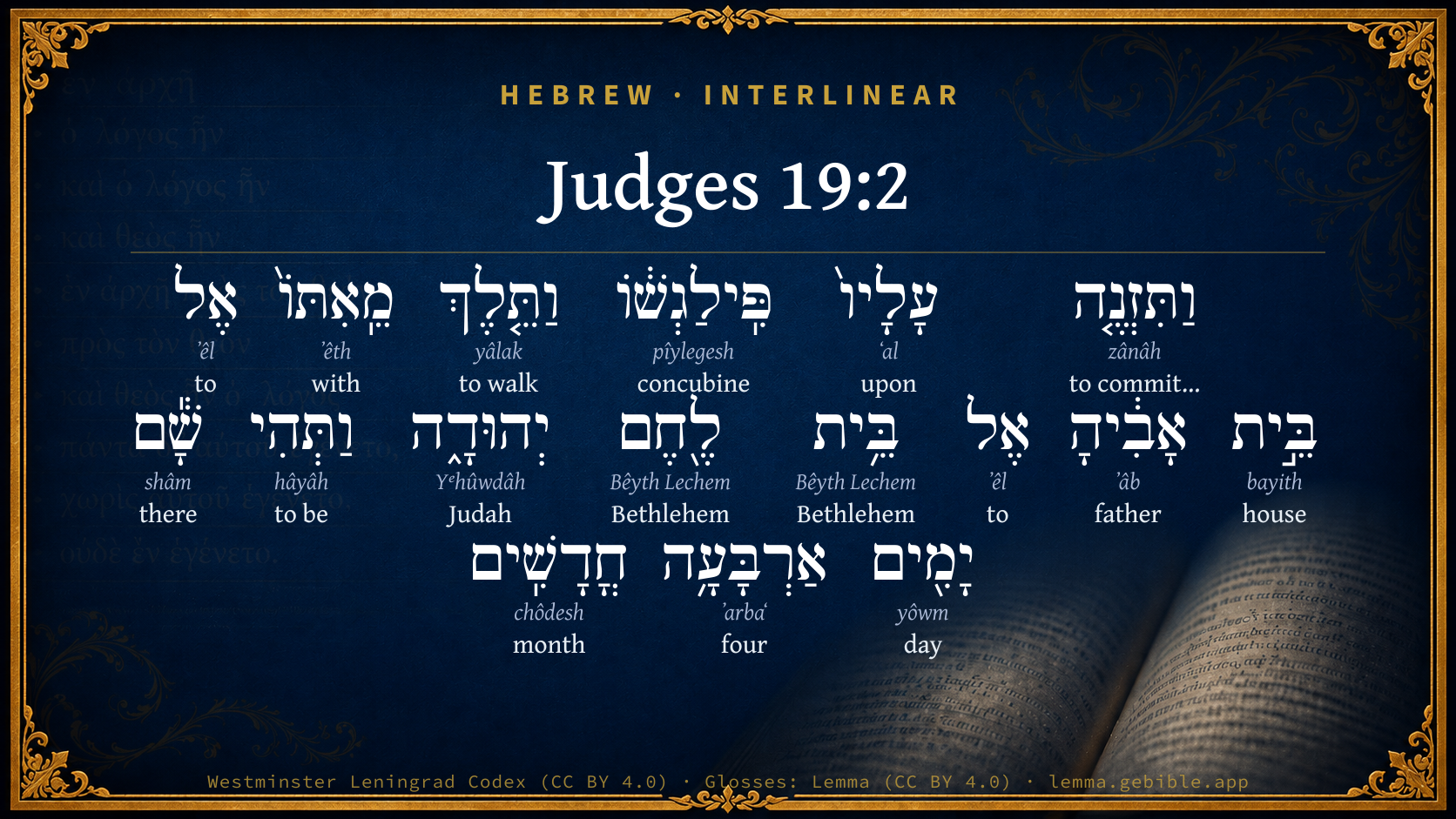
Judges 19:2

Hebrew (Westminster Leningrad Codex) Judges 19:2 appears in the Hebrew Old Testament. The text above is from the Westminster Leningrad Codex. Each word links to its Strong’s number, a concise gloss, and parsing drawn from the Open Scriptures Hebrew Bible morphology. Click any word for its full Brown-Driver-Briggs (BDB) entry.
Download image
Cite this verse

Judges 19:2 (World English Bible). Public Domain. Lemma interlinear Bible study tool, https://lemma.gebible.app/v/judges/19/2.

Show BibTeX & RIS
BibTeX
RIS
English Translation
His concubine played the prostitute against him, and went away from him to her father's house to Bethlehem Judah, and was there the space of four months.
World English Bible · Public Domain
Download a study sheet

One document with this verse’s original text, its word-by-word gloss line, the meaning frame, cross-references with their text, attributed commentary, and full source and license credits — printable, and it pastes into notes with its structure intact.

This verse Autodidact and up

Study sheet (.html) Plain text (.txt)

A passage Seminary Student

Up to 50 verses in one chapter. A passage sheet keeps up to 6 commentary sources and 12 cross-references per verse, in the order this page ranks them, and says so on the sheet whenever that leaves anything out. Ask for a single verse and you get the Autodidact verse sheet above.

Everything on this page stays free to read, with no account — the sheet is a download of what is already on screen, not access to it.

Want to remove ads? Support Godless Engineer
Compare translations 3

The same verse in 3 English versions, stacked beneath the original-language interlinear above. Click any original word for its lexicon entry.

Each is an independent rendering of the whole verse — the interlinear is not word-aligned to these translations.

Highlighted words mark where these versions differ — a whole-verse word diff, not a word-by-word alignment.

  • World English Bible Public Domain
    His concubine played the prostitute against him, and went away from him to her father's house to Bethlehem Judah, and was there the space of four months.
  • King James Version Public Domain
    And his concubine played the whore against him, and went away from him unto her father's house to Bethlehemjudah, and was there four whole months.
  • unfoldingWord Literal Text CC BY-SA 4.0
    But his concubine whored against him, and she went from with him to the house of her father, to Bethlehem Judah. And she was there days, four months.

unfoldingWord Literal Text — © unfoldingWord, licensed CC BY-SA 4.0. Word-aligned USFM3 via Door43 (git.door43.org/unfoldingWord/en_ult).

Versions to compare (up to 4)

3 of 4 selected

Show all 18 translations

Every available English version of this verse, each an independent rendering of the whole verse.

  • World English Bible Public Domain
    His concubine played the prostitute against him, and went away from him to her father's house to Bethlehem Judah, and was there the space of four months.
  • Berean Standard Bible Public Domain
    But she was unfaithful to him and left him to return to her father’s house in Bethlehem in Judah. After she had been there four months,
  • Majority Standard Bible Public Domain
    But she was unfaithful to him and left him to return to her father’s house in Bethlehem in Judah. After she had been there four months,
  • King James Version Public Domain
    And his concubine played the whore against him, and went away from him unto her father's house to Bethlehemjudah, and was there four whole months.
  • American Standard Version (1901) Public Domain
    And his concubine played the harlot against him, and went away from him unto her father's house to Beth-lehem-judah, and was there the space of four months.
  • Revised Version (1885) Public Domain
    And his concubine played the harlot against him, and went away from him unto her father’s house to Beth-lehem-judah, and was there the space of four months.
  • Geneva Bible (1599) Public Domain
    And his concubine played ye whore there, and went away from him vnto her fathers house to Beth-lehem Iudah, and there continued the space of foure moneths.
  • Douay-Rheims (1899) Public Domain
    And she left him and returned to her father's house in Bethlehem, and abode with him four months.
  • Young's Literal Translation Public Domain
    and commit whoredom against him doth his concubine, and she goeth from him unto the house of her father, unto Beth-Lehem-Judah, and is there days -- four months.
  • Literal Standard Version CC BY-SA 4.0
    and his concubine commits whoredom against him, and she goes from him to the house of her father, to Beth-Lehem-Judah, and is there four months of days.
  • Unlocked Literal Bible CC BY-SA 4.0
    But his concubine was unfaithful to him; she left him and went back to her father's house in Bethlehem of Judah. She stayed there for four months.
  • unfoldingWord Literal Text CC BY-SA 4.0
    But his concubine whored against him, and she went from with him to the house of her father, to Bethlehem Judah. And she was there days, four months.
  • Darby Bible Public Domain
    And his concubine became angry with him, and she went away from him to her father's house at Bethlehem in Judah, and was there some four months.
  • World Messianic Bible Public Domain
    His concubine played the prostitute against him, and went away from him to her father’s house to Bethlehem Judah, and was there for four months.
  • Webster's Bible Public Domain
    And his concubine played the harlot against him, and went away from him to her father's house to Beth-lehem-judah, and was there four whole months.
  • Free Bible Version CC BY-SA 4.0
    But she was unfaithful to him and left him to return to her father's house in Bethlehem. She was there for four months.
  • Bible in Basic English Public Domain
    And his servant-wife was angry with him, and went away from him to her father's house at Beth-lehem-judah, and was there for four months.
  • JPS Tanakh (1917) Public Domain
    And his concubine played the harlot against him, and went away from him unto her father's house to Beth-lehem in Judah, and was there the space of four months.

Literal Standard Version (2020), Covenant Press — licensed CC BY-SA 4.0. Text via the HelloAO Bible API (eBible.org). Unlocked Literal Bible (unfoldingWord) — licensed CC BY-SA 4.0. Text via the HelloAO Bible API (eBible.org). unfoldingWord Literal Text — © unfoldingWord, licensed CC BY-SA 4.0. Word-aligned USFM3 via Door43 (git.door43.org/unfoldingWord/en_ult). Free Bible Version, Dr. Jonathan Gallagher — licensed CC BY-SA 4.0. Text via the HelloAO Bible API (eBible.org).

Word by word

More ways to search: Search by grammar → Find every occurrence → Compare this word →

Practice this passage: Drill this verse → Learn its vocabulary →

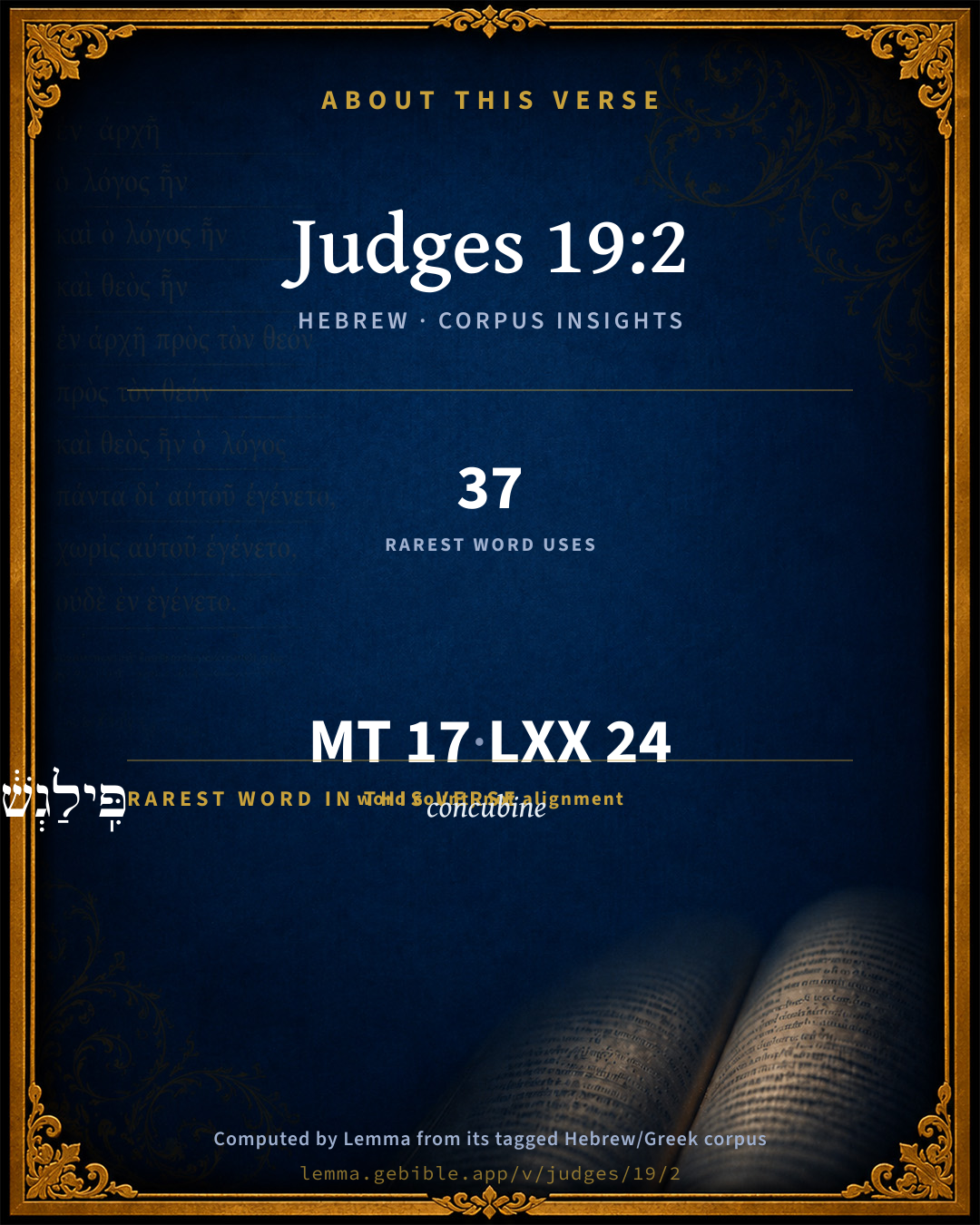
פִּֽילַגְשׁ֔וֹ
pîylegesh
H6370
“concubine · his”
Noun, Common, Feminine, Singular, Construct + Suffix, Personal, 3rd Person, Masculine, Singular
Part of Speech
Noun
Type
Common
Gender
Feminine
Number
Singular
State
Construct
Full BDB Definition

Origin: of uncertain derivation

TWOT: 1770

concubine, paramour - concubine - paramour
  1. וַתִּזְנֶ֤ה zânâh H2181 “and · to commit fornication” Conjunction + Verb, Qal, Sequential Imperfect, 3rd Person, Feminine, Singular
  2. עָלָיו֙ ʻal H5921 “upon · him” Preposition + Suffix, Personal, 3rd Person, Masculine, Singular
  3. וַתֵּ֤לֶךְ yâlak H3212 “and · to walk” Conjunction + Verb, Qal, Sequential Imperfect, 3rd Person, Feminine, Singular
  4. מֵֽאִתּוֹ֙ ʼêth H854 “from · with · him” Preposition + Preposition + Suffix, Personal, 3rd Person, Masculine, Singular
  5. אֶל ʼêl H413 “to” Preposition
  6. בֵּ֣ית bayith H1004 “house of” Noun, Common, Masculine, Singular, Construct
  7. אָבִ֔יהָ ʼâb H1 “father · her” Noun, Common, Masculine, Singular, Construct + Suffix, Personal, 3rd Person, Feminine, Singular
  8. אֶל ʼêl H413 “to” Preposition
  9. בֵּ֥ית Bêyth Lechem H1035 “Bethlehem” Noun, Proper
  10. לֶ֖חֶם Bêyth Lechem H1035 “Bethlehem” Noun, Proper
  11. יְהוּדָ֑ה Yᵉhûwdâh H3063 “Judah” Noun, Proper
  12. וַתְּהִי hâyâh H1961 “and · to be” Conjunction + Verb, Qal, Sequential Imperfect, 3rd Person, Feminine, Singular
  13. שָׁ֕ם shâm H8033 “there” Adverb
  14. יָמִ֖ים yôwm H3117 “days” Noun, Common, Masculine, Plural, Absolute
  15. אַרְבָּעָ֥ה ʼarbaʻ H702 “four” Adjective, Cardinal number, Masculine, Singular, Absolute
  16. חֳדָשִֽׁים chôdesh H2320 “months” Noun, Common, Masculine, Plural, Absolute

About this verse

These counts appear in no published source. They are computed here, from the morphology-tagged text and Lemma’s own curated glosses. What Lemma adds →

17
words
15
distinct lemmas
Historical
section

Shared distinctive vocabulary

פִּֽילַגְשׁ֔וֹ concubine H6370 occurs in 35 verses of the Hebrew Bible. Also found in:

Grammatical profile

  • 3 verbs
  • 8 nouns
  • 1 adjective
  • 4 prepositions
  • 1 adverb

Verb forms

  • וַתִּזְנֶ֤ה Qal · Sequential Imperfect
  • וַתֵּ֤לֶךְ Qal · Sequential Imperfect
  • וַתְּהִי Qal · Sequential Imperfect

Repetition

Words recur within this verse — often emphatic in Hebrew:

  • בֵּ֥ית Bethlehem H1035 ×2
  • אֶל to H413 ×2

Hebrew & Septuagint length

In English translation the verse runs 27 words from the Hebrew and 26 from the Septuagint (LXX English) — closely comparable.

A rough comparison of the two English renderings, which tokenize alike — not a word-level alignment.

Word counts can differ between the Hebrew and the Greek without any difference in meaning — e.g. the Hebrew direct-object marker אֵת has no separate Greek word, and Greek often adds the article ὁ.

In the original languages it is 17 Hebrew tokens and 24 Greek tokens — but the two are counted differently (Hebrew bundles its prefixes and suffixes into one token; the Greek is in lemma form), so that isn’t a like-for-like length.

Cross-references

3

Topical passages linked to Judges 19:2 in the Treasury of Scripture Knowledge — connected by theme and wording, ordered by reader-vote popularity; previews shown in the World English Bible.

  • Ezekiel 16:28 You have played the prostitute also with the Assyrians, because you were insatiable; yes, you have played the prostitute with them, and yet you weren't satisfied.
  • Leviticus 21:9 "'The daughter of any priest, if she profanes herself by playing the prostitute, she profanes her father: she shall be burned with fire.
  • Deuteronomy 22:21 then they shall bring out the young lady to the door of her father's house, and the men of her city shall stone her to death with stones, because she has done folly in Israel, to play the prostitute in her father's house: so shall you put away the evil from the midst of you.

Cross-references courtesy of OpenBible.info (CC BY 4.0).

Hebrew and Greek witnesses Masoretic Hebrew ↔ Greek Septuagint

The same verse in the two great witnesses to the Old Testament, shown verse-for-verse.

These are two independent witnesses, not word-aligned to each other, and the Septuagint is shown in lemma (dictionary) form.

Hebrew Judges 19:2 Masoretic · Westminster Leningrad Codex

וַתִּזְנֶ֤ה עָלָיו֙ פִּֽילַגְשׁ֔וֹ וַתֵּ֤לֶךְ מֵֽאִתּוֹ֙ אֶל בֵּ֣ית אָבִ֔יהָ אֶל בֵּ֥ית לֶ֖חֶם יְהוּדָ֑ה וַתְּהִי שָׁ֕ם יָמִ֖ים אַרְבָּעָ֥ה חֳדָשִֽׁים

His concubine played the prostitute against him, and went away from him to her father's house to Bethlehem Judah, and was there the space of four months.

World English Bible · Public Domain

Greek LXX Judges 19:2 Septuagint · lemma form

καί πορεύομαι ἀπό αὐτός ὁ παλλακή αὐτός καί ἀποἔρχομαι παρά αὐτός εἰς οἶκος πατήρ αὐτός εἰς βηθλεεμ ιουδα καί εἰμί ἐκεῖ ἡμέρα τέσσαρες μήν

And his concubine departed from him, and went away from him to the house of her father to Bethleem Juda, and she was there four months.

LXX2012 (modern English Septuagint) · Public Domain

On this verse, Adam Clarke's Commentary discusses the Septuagint’s reading. Read the note in Commentary ↓

Hebrew: Westminster Leningrad Codex (CC BY 4.0). Greek: Septuagint (public domain); English from LXX2012 (modern English Septuagint) (Public Domain). How the Septuagint differs from the Hebrew →

Targum (Aramaic paraphrase)

1

The Targum is the ancient Jewish Aramaic paraphrase of the Hebrew Scriptures — an interpretive translation, not the Hebrew text itself. Onkelos (literal) and Pseudo-Jonathan (expansive) render the Torah, and Jonathan the Prophets. Coverage is partial: where no permissively-licensed English translation exists for a verse, only the Aramaic is shown. This is verse-level text, not a word-by-word alignment to the Hebrew.

  1. Targum Jonathan Prophets (Joshua–Malachi)
    וּבְסָרַת עֲלוֹהִי לְחֵינָתֵיהּ וַאֲזָלַת מִלְוָתֵיהּ לְבֵית אֲבוּהָא לְבֵית לֶחֶם דְבֵית יְהוּדָה וַהֲוָת תַּמָן יוֹמִין אַרְבְּעָא יַרְחִין:

    (no public-domain English translation for this verse)

    Targum Jonathan — Aramaic: “Mikraot Gedolot” (public domain). English: “Sefaria Community Translation” (CC0 1.0 (public-domain dedication)); “London "Chaldee Paraphrase," 1871” (public domain). Text via Sefaria.

Commentary

Notes on Judges 19:2 from classic Christian and Jewish commentators (each source and its license shown beneath its notes). The classic Christian expositions comment on the surrounding passage and are grouped to its opening verse, so a note may address several verses; the Jewish commentaries on the Tanakh (Rashi and others) are per-verse, so they appear only where the commentator wrote on this verse.

Lemma curates 59 commentaries, every one of them public domain or Creative Commons licensed, each selected and text-cleaned for this edition rather than reprinted as found. About our sources →

Trapp's Complete Commentary

John Trapp

Jdg 19:2 And his concubine played the whore against him, and went away from him unto her father’s house to Bethlehemjudah, and was there four whole months.

Ver. 2. And his concubine played the whore against.] Which she could not have done had she not been a kind of secondary wife, according to the corrupt custom of those times. Josephus saith {a} that she was a fair woman, and not affecting her husband as she ought, but lingering after other lovers, great strife grew between them, whereupon she went away to her parents within four months after marriage. Varium et mutable semper femina.

And went away from him.] An odious woman she was, which is one of those four things that disquiet the earth. {Pro 30:20}

Unto her father’s house.] Who, as a fond father, received her, whenas he should rather have rated or punished her, and sent her home again.

{a} Antiq, lib. iii. cap. 2.

John Trapp, A Commentary or Exposition upon All the Books of the Old and New Testament (1647–1656) — public domain. Text from a community e-Sword module.

Joseph Benson's Commentary

Jdg 19:2-3. Played the whore against him — Against her faith given to him. Went away — Either for fear of punishment, or because her heart was alienated from him; wherein not only she sinned, but her father, by connivance at her sin, and neglect of just endeavours for her reconciliation to her husband. Her husband went to speak friendly unto her — To offer her pardon and reconciliation.

Joseph Benson's Commentary on the Old and New Testaments (1811–1818) — public domain. Text from a community e-Sword module.

Geneva Bible (1599)

Geneva Bible translators

Hebrew, besides him, to wit, with others.

Geneva Bible (1599) marginal notes — public domain. Text via Bolls.life.

Jamieson, Fausset & Brown

Robert Jamieson, A. R. Fausset & David Brown

his concubine . . . went away from him unto her father's house--The cause of the separation assigned in our version rendered it unlawful for her husband to take her back (Deu 24:4); and according to the uniform style of sentiment and practice in the East, she would have been put to death, had she gone to her father's family. Other versions concur with JOSEPHUS, in representing the reason for the flight from her husband's house to be, that she was disgusted with him, through frequent brawls.

Jamieson, Fausset & Brown — Commentary Critical and Explanatory on the Whole Bible (1871) — public domain (CC PDM 1.0). Text via the HelloAO Bible API.

Adam Clarke's Commentary

Verse 2. Played the whore] Neither the Vulgate, Septuagint, Targum, nor Josephus, understand this word as implying any act of conjugal infidelity on the woman's part. They merely state that the parties disagreed, and the woman returned to her father's house. Indeed all the circumstances of the case vindicate this view of the subject. If she had been a whore, or adulteress, it is not very likely that her husband would have gone after her to speak friendly, literally, to speak to her heart, and entreat her to return. The Vulgate simply states, quae reliquit eum, that she left him; the Septuagint, ωργισθη αυτω, that she was angry with him; the Targum ובסרת עלוהי ubserath alohi, that she despised him; Josephus, αλλοτοιως ειχε, that she was alienated, or separated herself, from him. Houbigant translates the clause: quae cum ab eo alienata esset, vel irata in eum esset, eum reliquit; "who when she was alienated from him, or angry with him, left him;" and he defends this version in his note. I think the true meaning to be among the above interpretations. They had contentions; she ceased to love him, her affections were alienated from him; and she left his house, and went home to her father.

Adam Clarke's Commentary on the Bible (1810–1826) — public domain. Text from a community e-Sword/MySword module.

Ellicott's Commentary for English Readers

(2) Four whole months.—Literally, days, four months, which some interpret to mean “a year (see Note on Jdg_17:10) and four months.” The incident has, however, little bearing on the general story.

A Bible Commentary for English Readers, edited by Charles John Ellicott (1878–1897) — public domain. Text from a community e-Sword module.

The Cambridge Bible for Schools and Colleges

gen. ed. J. J. S. Perowne

2. played the harlot against him] The text is open to suspicion. LXX. cod. A reads was angry with him; this suits the context, which implies a quarrel, but not unfaithfulness, on the woman’s part; she left him in anger and returned to her father’s house, whither the Levite followed to pacify her (Jdg_19:3 f.). How are we to account for the reading of the text? Moore ingeniously suggests that by the transposition of two letters she was angry (te’ĕnaph) might have become ‘she committed adultery’ (tin’aph), which was altered by the Jews to ‘played the harlot,’ on the ground that only a wedded wife could be said to commit adultery. It is simpler to suppose that the original she was angry was deliberately altered under a misconception of the relationship.

the space of four months] lit. days, four months; days sometimes has the specific sense of a year, e.g. 1Sa_27:7 ‘a full year and four months’; cf. ch. Jdg_17:10 ‘by the year,’ lit. ‘by the days.’ But days can also have an indefinite sense, some time, as probably here.

The Cambridge Bible for Schools and Colleges (gen. ed. J. J. S. Perowne; Cambridge University Press, 1878–1918) — public domain. Text from a community e-Sword module.

John Gill's Exposition

And his concubine played the whore against him,.... Was unfaithful to him and his bed, and broke the covenant and agreement between them; or "with him" (i), while she was with him in the house; or "before him" (k), of which he had knowledge and proof; though some think this is not to be understood of whoredom or adultery, but of her ill usage of him, and departure from him. The Targum is, she despised him; so Kimchi and Ben Gersom interpret it of her declining and turning aside from him, and returning to her father's house, as follows: and indeed, had she been guilty of such a crime, one would think he would never have sought after her to reconcile her, and take her again, since she not only deserved to be put away, but to be put to death according to the law of God:

and went away from him to her father's house to Bethlehemjudah; where she was received, as she knew she should, having a parent perhaps too indulgent, and which was an encouragement to her to leave her husband:

and was there some whole months or a year and four whole months, according to Ben Gersom; so Kimchi and Ben Melech observe the copulative "and" is wanting, which is expressed in Sa1 27:7 and "yamim, days", is so the times used for a year, Jdg 14:8.

(i) "apud eum", Pagninus, Piscator; "cum eo", Junius & Tremellius. (k) "Conspectu ejus", Vatablus; "coram eo", Drusius.

John Gill's Exposition of the Whole Bible (1746–1763) — public domain (CC PDM 1.0). Text via the HelloAO Bible API.

Albert Barnes' Notes on the Bible

Played the whore against him - Perhaps only meaning that she ran away from him, and left him, for she returned to her father’s house.

Albert Barnes' Notes on the Bible (1834–1885) — public domain. Text from a community e-Sword/MySword module.

Haydock's Catholic Bible Commentary

Left him. Hebrew Thozne. Now tizne, (Du Hamel) "his concubine, fell into fornication against (Junius improperly translates with) him." Chaldean, "She despised went from him." Septuagint, "She was vexed at or she left him." (Calmet) --- Josephus, "as he was deeply in love with her on account of her beauty, he was displeased that she did not correspond with his love. Hence a quarrel ensuing, the woman would not bear his continual expostulations, and leaving her husband, after four months, returns to her parents. Hither, overcome by his love for her, he follows, and, by the mediation of her parents, he is reconciled to his wife, both agreeing to lay aside all complaints." (Antiquities v. 2.) --- It is clear that the Septuagint, Vulgate, &c., have read the text in a different manner from what we do at present, and their explanation seems more rational than the Hebrew. For, is it probable that a Levite should go to be reconciled to an adulteress, contrary to the intention of the law (Deuteronomy xxiv. 2., Jeremias iii. 1., and Proverbs xviii. 22.) and the custom of the Jews, as well as of pagan nations, who looked upon those with contempt, who kept a woman of this character? The word concubine, we have often remarked, signifies a wife without a dowry, &c., (Calmet) such as the Mahometans still maintain as lawful wives. (Busbec. ii.) --- Months. Josephus explain this of the time she had remained with her husband.

George Leo Haydock (1774–1849), Haydock's Catholic Family Bible and Commentary, 1859 edition — public domain. Excludes Psalms (Douay-Rheims chapter numbering differs from Protestant) and Deuterocanonical books (Catholic canon only).

Matthew Poole's English Annotations

Against him, i.e. against her faith given to him, or to his wrong; or, with him, i.e. in his house; or whilst she lived with him, which is opposed to her going away, which here follows.

Went away from him; either for fear of his severe rebukes or punishment, or because her heart was alienated from him.

Four whole months, Heb. some days, to wit, four months; or, a year (so days commonly signify) and four months; wherein not only site sinned, but her father by some indulgence and connivance at her sin, and neglect of just endeavours for her reconciliation to her husband, the ill effects whereof he speedily felt, in the loss of his daughter in so dreadful a manner.

Matthew Poole's English Annotations on the Holy Bible (1683–1685) — public domain. Text from a community e-Sword/MySword module.

Whedon's Commentary on the Bible

Daniel D. Whedon

2. Played the whore — Dr. Clarke, on the authority of Josephus and several of the ancient versions, understands that they had contentions, and, being alienated in her affections from her husband, she ran away, and went home to her father’s house; but the Hebrew word here used ever means a criminal act of conjugal infidelity.

Daniel D. Whedon (gen. ed.), Commentary on the Old and New Testaments (1874–1909) — public domain. Text from a community e-Sword module.

The Pulpit Commentary

Played the whore, etc. Perhaps the phrase only means that she revolted from him and left him. Her returning to her father"s house, and his anxiety to make up the quarrel, both discourage taking the phrase in its worst sense. Four whole months. Literally, days, four months; meaning either a year and four months, as in 1Sa_27:7, where, however, the and is expressed; or days (i.e. many days), viz., four months. For the use of days for a year see Exo_13:10 Jud_1:17:10, etc.

The Pulpit Commentary (1880–1919), ed. H.D.M. Spence-Jones & Joseph S. Exell — public domain. Text from a community e-Sword module.

John Wesley's Explanatory Notes

Against him - That is, against her faith given to him. Went away - Either for fear of punishment; or, because her heart was alienated from him; wherein not only she sinned, but her father by connivance at her sin, and neglect of just endeavours for her reconciliation to her husband.

John Wesley, Explanatory Notes Upon the Whole Bible (1754–1765) — public domain. Text via the GEBible commentary corpus.

Rashi

Rabbi Shlomo Yitzchaki (Rashi)

His concubine strayed away from him She strayed away from his home to the outside. The word זְנוּת, "promiscuity," always denotes departure—"One who departs to the outside," who leaves her husband and loves another.

Rashi on the Tanakh — English translations: “The Judaica Press complete Tanach with Rashi, translated by A. J. Rosenberg” (CC BY 4.0); “Pentateuch with Rashi's commentary by M. Rosenbaum and A.M. Silbermann, 1929-1934” (public domain); “The Metsudah Tanach series, Lakewood, N.J” (CC BY 4.0); and “The Book of Joshua, Metsudah Publications, 1997” (CC BY 4.0). Text via Sefaria.

Lesson kit

Teaching starters — assembled from the data on this page, not authored interpretation. Every prompt links to the verse data it draws on. Edit before teaching.

Judges, in the Historical, opens this verse with 17 words (15 distinct Hebrew lemmas). Its most distinctive word is pîylegesh (“concubine”). A historical commentator’s framing appears above. Read the whole chapter for the surrounding context.

Discussion questions

  1. The word pîylegesh carries the sense “concubine.” How does it shape the verse?
  2. Genesis 22:24 shares the word «concubine» with this verse. How do the two illuminate each other?
  3. “Bethlehem” occurs 2× in this one verse. What is the effect of the repetition?
  4. These translations render this verse differently. What is at stake in choosing one wording over another?
  5. The verb «וַתִּזְנֶ֤ה» is Qal Sequential Imperfect. How does its form color the action?
  6. Reading how Trapp's Complete Commentary and Joseph Benson's Commentary read this verse, where do the two commentators agree and where do they part?

Things to notice

Reading settings

Reading text

Shown beneath each verse's original-language words.

Old Testament
Old Testament edition

Read the OT as the Masoretic Hebrew (MT) or the Greek Septuagint (LXX).

English shown for the Greek Septuagint (in the Hebrew ↔ Greek comparison).

Comparing translations? Open the Compare panel on any verse page to stack up to four side by side.