
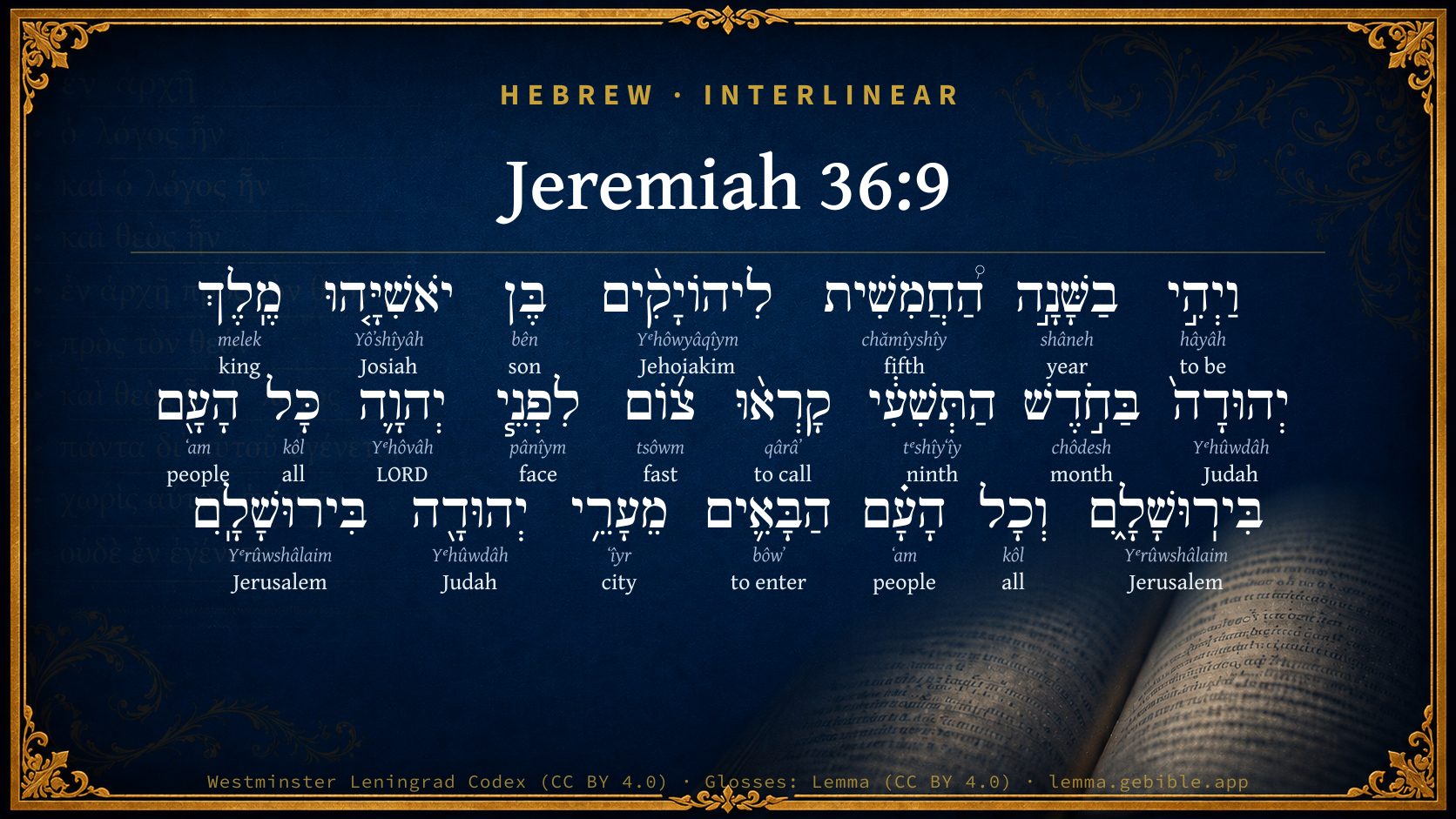
Jeremiah 36:9

Hebrew (Westminster Leningrad Codex) Jeremiah 36:9 appears in the Hebrew Old Testament. The text above is from the Westminster Leningrad Codex. Each word links to its Strong’s number, a concise gloss, and parsing drawn from the Open Scriptures Hebrew Bible morphology. Click any word for its full Brown-Driver-Briggs (BDB) entry.
Download image
Cite this verse

Jeremiah 36:9 (World English Bible). Public Domain. Lemma interlinear Bible study tool, https://lemma.gebible.app/v/jeremiah/36/9.

Show BibTeX & RIS
BibTeX
RIS
English Translation
Now it happened in the fifth year of Jehoiakim the son of Josiah, king of Judah, in the ninth month, that all the people in Jerusalem, and all the people who came from the cities of Judah to Jerusalem, proclaimed a fast before Yahweh.
World English Bible · Public Domain
Download a study sheet

One document with this verse’s original text, its word-by-word gloss line, the meaning frame, cross-references with their text, attributed commentary, and full source and license credits — printable, and it pastes into notes with its structure intact.

This verse Autodidact and up

Study sheet (.html) Plain text (.txt)

A passage Seminary Student

Up to 50 verses in one chapter. A passage sheet keeps up to 6 commentary sources and 12 cross-references per verse, in the order this page ranks them, and says so on the sheet whenever that leaves anything out. Ask for a single verse and you get the Autodidact verse sheet above.

Everything on this page stays free to read, with no account — the sheet is a download of what is already on screen, not access to it.

Want to remove ads? Support Godless Engineer
Compare translations 3

The same verse in 3 English versions, stacked beneath the original-language interlinear above. Click any original word for its lexicon entry.

Each is an independent rendering of the whole verse — the interlinear is not word-aligned to these translations.

Highlighted words mark where these versions differ — a whole-verse word diff, not a word-by-word alignment.

  • World English Bible Public Domain
    Now it happened in the fifth year of Jehoiakim the son of Josiah, king of Judah, in the ninth month, that all the people in Jerusalem, and all the people who came from the cities of Judah to Jerusalem, proclaimed a fast before Yahweh.
  • King James Version Public Domain
    And it came to pass in the fifth year of Jehoiakim the son of Josiah king of Judah, in the ninth month, that they proclaimed a fast before the LORD to all the people in Jerusalem, and to all the people that came from the cities of Judah unto Jerusalem.
  • unfoldingWord Literal Text CC BY-SA 4.0
    It came about in the fifth year and ninth month of Jehoiakim son of Josiah, king of Judah, that all the people in Jerusalem and the people who came to Jerusalem from the cities of Judah proclaimed a fast before Yahweh.

unfoldingWord Literal Text — © unfoldingWord, licensed CC BY-SA 4.0. Word-aligned USFM3 via Door43 (git.door43.org/unfoldingWord/en_ult).

Versions to compare (up to 4)

3 of 4 selected

Show all 18 translations

Every available English version of this verse, each an independent rendering of the whole verse.

  • World English Bible Public Domain
    Now it happened in the fifth year of Jehoiakim the son of Josiah, king of Judah, in the ninth month, that all the people in Jerusalem, and all the people who came from the cities of Judah to Jerusalem, proclaimed a fast before Yahweh.
  • Berean Standard Bible Public Domain
    Now in the ninth month of the fifth year of Jehoiakim son of Josiah king of Judah, a fast before the LORD was proclaimed to all the people of Jerusalem and all who had come there from the cities of Judah.
  • Majority Standard Bible Public Domain
    Now in the ninth month of the fifth year of Jehoiakim son of Josiah king of Judah, a fast before the LORD was proclaimed to all the people of Jerusalem and all who had come there from the cities of Judah.
  • King James Version Public Domain
    And it came to pass in the fifth year of Jehoiakim the son of Josiah king of Judah, in the ninth month, that they proclaimed a fast before the LORD to all the people in Jerusalem, and to all the people that came from the cities of Judah unto Jerusalem.
  • American Standard Version (1901) Public Domain
    Now it came to pass in the fifth year of Jehoiakim the son of Josiah, king of Judah, in the ninth month, that all the people in Jerusalem, and all the people that came from the cities of Judah unto Jerusalem, proclaimed a fast before Jehovah.
  • Revised Version (1885) Public Domain
    Now it came to pass in the fifth year of Jehoiakim the son of Josiah, king of Judah, in the ninth month, that all the people in Jerusalem, and all the people that came from the cities of Judah unto Jerusalem, proclaimed a fast before the LORD.
  • Geneva Bible (1599) Public Domain
    And in the fift yeere of Iehoiakim the sonne of Iosiah King of Iudah, in the ninth moneth, they proclaimed a fast before the Lord to all the people in Ierusalem, and to all the people that came from the cities of Iudah vnto Ierusalem.
  • Douay-Rheims (1899) Public Domain
    And it came to pass in the fifth year of Joakim the son of Josias king of Juda, in the ninth month, that they proclaimed a fast before the Lord to all the people in Jerusalem, and to all the people that were come together out of the cities of Juda to Jerusalem.
  • Young's Literal Translation Public Domain
    And it cometh to pass, in the fifth year of Jehoiakim son of Josiah king of Judah, in the ninth month, proclaimed a fast before Jehovah have all the people in Jerusalem, and all the people who are coming in from cities of Judah to Jerusalem;
  • Literal Standard Version CC BY-SA 4.0
    And it comes to pass, in the fifth year of Jehoiakim son of Josiah king of Judah, in the ninth month, they proclaimed a fast before YHWH to all the people in Jerusalem, and to all the people who are coming in from cities of Judah to Jerusalem;
  • Unlocked Literal Bible CC BY-SA 4.0
    It came about in the fifth year and ninth month of Jehoiakim son of Josiah, king of Judah, that all the people in Jerusalem and the people who came to Jerusalem from the cities of Judah proclaimed a fast before Yahweh.
  • unfoldingWord Literal Text CC BY-SA 4.0
    It came about in the fifth year and ninth month of Jehoiakim son of Josiah, king of Judah, that all the people in Jerusalem and the people who came to Jerusalem from the cities of Judah proclaimed a fast before Yahweh.
  • Darby Bible Public Domain
    And it came to pass in the fifth year of Jehoiakim the son of Josiah, the king of Judah, in the ninth month, [that] they proclaimed a fast before Jehovah, for all the people in Jerusalem, and for all the people that came from the cities of Judah to Jerusalem.
  • World Messianic Bible Public Domain
    Now in the fifth year of Jehoiakim the son of Josiah, king of Judah, in the ninth month, all the people in Jerusalem and all the people who came from the cities of Judah to Jerusalem, proclaimed a fast before the LORD.
  • Webster's Bible Public Domain
    And it came to pass in the fifth year of Jehoiakim the son of Josiah king of Judah, in the ninth month, that they proclaimed a fast before the LORD to all the people in Jerusalem, and to all the people that came from the cities of Judah to Jerusalem.
  • Free Bible Version CC BY-SA 4.0
    This is how it happened. A fast to honor the Lord was declared involving all the people of Jerusalem and everyone who had come there from the towns of Judah. This was in the ninth month of the fifth year of the reign of Jehoiakim son of Josiah king of Judah.
  • Bible in Basic English Public Domain
    Now it came about in the fifth year of Jehoiakim, the son of Josiah, king of Judah, in the ninth month, that it was given out publicly that all the people in Jerusalem, and all the people who came from the towns of Judah to Jerusalem, were to keep from food before the Lord.
  • JPS Tanakh (1917) Public Domain
    Now it came to pass in the fifth year of Jehoiakim the son of Josiah, king of Judah, in the ninth month, that they proclaimed a fast before the LORD, all the people in Jerusalem, and all the people that came from the cities of Judah unto Jerusalem.

Literal Standard Version (2020), Covenant Press — licensed CC BY-SA 4.0. Text via the HelloAO Bible API (eBible.org). Unlocked Literal Bible (unfoldingWord) — licensed CC BY-SA 4.0. Text via the HelloAO Bible API (eBible.org). unfoldingWord Literal Text — © unfoldingWord, licensed CC BY-SA 4.0. Word-aligned USFM3 via Door43 (git.door43.org/unfoldingWord/en_ult). Free Bible Version, Dr. Jonathan Gallagher — licensed CC BY-SA 4.0. Text via the HelloAO Bible API (eBible.org).

Word by word

More ways to search: Search by grammar → Find every occurrence → Compare this word →

Practice this passage: Drill this verse → Learn its vocabulary →

הַתְּשִׁעִ֔י
tᵉshîyʻîy
H8671
“the · ninth”
Particle, Definite Article + Adjective, Ordinal number, Masculine, Singular, Absolute
Part of Speech
Particle + Adjective
Type
Ordinal number
Gender
Masculine
Number
Singular
State
Absolute
Full BDB Definition

Origin: ordinal from H8672

TWOT: 2551

ninth (as ordinal number)
  1. וַיְהִ֣י hâyâh H1961 “and · to be” Conjunction + Verb, Qal, Sequential Imperfect, 3rd Person, Masculine, Singular
  2. בַשָּׁנָ֣ה shâneh H8141 “in/at the · year” Preposition, Determined + Noun, Common, Feminine, Singular, Absolute
  3. הַ֠חֲמִשִׁית chămîyshîy H2549 “the · fifth” Particle, Definite Article + Adjective, Ordinal number, Feminine, Singular, Absolute
  4. לִיהוֹיָקִ֨ים Yᵉhôwyâqîym H3079 “to/for · Jehoiakim” Preposition + Noun, Proper
  5. בֶּן bên H1121 “son of” Noun, Common, Masculine, Singular, Construct
  6. יֹאשִׁיָּ֤הוּ Yôʼshîyâh H2977 “Josiah” Noun, Proper
  7. מֶֽלֶךְ melek H4428 “king of” Noun, Common, Masculine, Singular, Construct
  8. יְהוּדָה֙ Yᵉhûwdâh H3063 “Judah” Noun, Proper
  9. בַּחֹ֣דֶשׁ chôdesh H2320 “in/at the · month” Preposition, Determined + Noun, Common, Masculine, Singular, Absolute
  10. קָרְא֨וּ qârâʼ H7121 “to call” Verb, Qal, Perfect, 3rd Person, Common, Plural
  11. צ֜וֹם tsôwm H6685 “fast” Noun, Common, Masculine, Singular, Absolute
  12. לִפְנֵ֧י pânîym H6440 “to/for · face(s) of” Preposition + Noun, Common, Both, Plural, Construct
  13. יְהוָ֛ה Yᵉhôvâh H3068 “LORD” Noun, Proper
  14. כָּל kôl H3605 “all of” Noun, Common, Masculine, Singular, Construct
  15. הָעָ֖ם ʻam H5971 “the · people” Particle, Definite Article + Noun, Common, Masculine, Singular, Absolute
  16. בִּירֽוּשָׁלִָ֑ם Yᵉrûwshâlaim H3389 “in/at · Jerusalem” Preposition + Noun, Proper
  17. וְכָל kôl H3605 “and · all of” Conjunction + Noun, Common, Masculine, Singular, Construct
  18. הָעָ֗ם ʻam H5971 “the · people” Particle, Definite Article + Noun, Common, Masculine, Singular, Absolute
  19. הַבָּאִ֛ים bôwʼ H935 “the · entering” Particle, Definite Article + Verb, Qal, Participle Active, Masculine, Plural, Absolute
  20. מֵעָרֵ֥י ʻîyr H5892 “from · cities of” Preposition + Noun, Common, Feminine, Plural, Construct
  21. יְהוּדָ֖ה Yᵉhûwdâh H3063 “Judah” Noun, Proper
  22. בִּירוּשָׁלִָֽם Yᵉrûwshâlaim H3389 “in/at · Jerusalem” Preposition + Noun, Proper

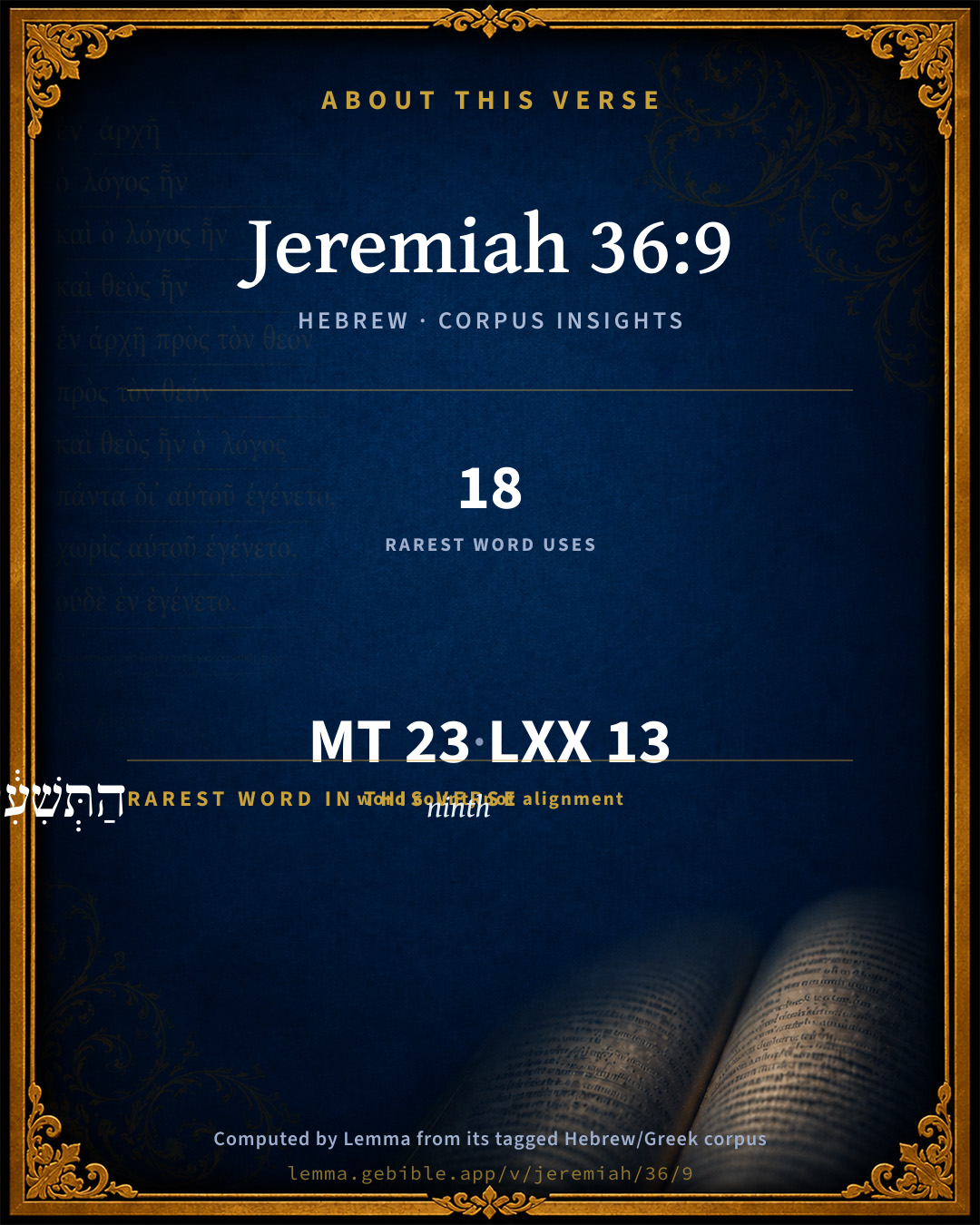
About this verse

These counts appear in no published source. They are computed here, from the morphology-tagged text and Lemma’s own curated glosses. What Lemma adds →

23
words
19
distinct lemmas
Prophets
section

Notable vocabulary

The rarest word here is הַתְּשִׁעִ֔י ninth H8671 — appearing just 18 times in the whole Hebrew Bible.

Shared distinctive vocabulary

הַתְּשִׁעִ֔י ninth H8671 occurs in 17 verses of the Hebrew Bible. Also found in:

Grammatical profile

  • 3 verbs
  • 18 nouns
  • 2 adjectives

Verb forms

  • וַיְהִ֣י Qal · Sequential Imperfect
  • קָרְא֨וּ Qal · Perfect
  • הַבָּאִ֛ים Qal · Participle Active

Repetition

Words recur within this verse — often emphatic in Hebrew:

  • יְהוּדָה֙ Judah H3063 ×2
  • כָּל all H3605 ×2
  • הָעָ֖ם people H5971 ×2
  • בִּירֽוּשָׁלִָ֑ם Jerusalem H3389 ×2

Hebrew & Septuagint length

In the original languages it is 23 Hebrew tokens and 13 Greek tokens — but the two are counted differently (Hebrew bundles its prefixes and suffixes into one token; the Greek is in lemma form), so that isn’t a like-for-like length.

Cross-references

12

Topical passages linked to Jeremiah 36:9 in the Treasury of Scripture Knowledge — connected by theme and wording, ordered by reader-vote popularity; previews shown in the World English Bible.

  • 2 Chronicles 20:3 Jehoshaphat feared, and set himself to seek to Yahweh; and he proclaimed a fast throughout all Judah.
  • Esther 4:16 Go, gather together all the Jews who are present in Shushan, and fast you for me, and neither eat nor drink three days, night or day: I also and my maidens will fast in like manner; and so will I go in to the king, which is not according to the law: and if I perish, I perish.
  • Jeremiah 36:22 Now the king was sitting in the winter-house in the ninth month: and [there was a fire in] the brazier burning before him.
  • Jonah 3:5 The people of Nineveh believed God; and they proclaimed a fast, and put on sackcloth, from the greatest of them even to the least of them.
  • Leviticus 23:27 "However on the tenth day of this seventh month is the day of atonement: it shall be a holy convocation to you, and you shall afflict yourselves; and you shall offer an offering made by fire to Yahweh.
  • Nehemiah 9:1 Now in the twenty-fourth day of this month the children of Israel were assembled with fasting, and with sackcloth, and earth on them.
  • Isaiah 58:1–3 Cry aloud, don't spare, lift up your voice like a trumpet, and declare to my people their disobedience, and to the house of Jacob their sins.
  • Jeremiah 36:1 It happened in the fourth year of Jehoiakim the son of Josiah, king of Judah, that this word came to Jeremiah from Yahweh, saying,
  • Joel 1:13 Put on sackcloth and mourn, you priests! Wail, you ministers of the altar. Come, lie all night in sackcloth, you ministers of my God, For the meal offering and the drink offering are withheld from your God's house.
  • Joel 2:12–17 "Yet even now," says Yahweh, "turn to me with all your heart, And with fasting, and with weeping, and with mourning."
  • Zechariah 7:5–6 "Speak to all the people of the land, and to the priests, saying, 'When you fasted and mourned in the fifth and in the seventh month for these seventy years, did you at all fast to me, really to me?
  • Zechariah 8:19 Thus says Yahweh of Hosts: "The fasts of the fourth fifth, seventh, and tenth months shall be for the house of Judah joy and gladness, and cheerful feasts. Therefore love truth and peace."

Cross-references courtesy of OpenBible.info (CC BY 4.0).

Hebrew and Greek witnesses Masoretic Hebrew ↔ Greek Septuagint

The same verse in the two great witnesses to the Old Testament, shown verse-for-verse.

These are two independent witnesses, not word-aligned to each other, and the Septuagint is shown in lemma (dictionary) form.

Hebrew Jeremiah 36:9 Masoretic · Westminster Leningrad Codex

וַיְהִ֣י בַשָּׁנָ֣ה הַ֠חֲמִשִׁית לִיהוֹיָקִ֨ים בֶּן יֹאשִׁיָּ֤הוּ מֶֽלֶךְ יְהוּדָה֙ בַּחֹ֣דֶשׁ הַתְּשִׁעִ֔י קָרְא֨וּ צ֜וֹם לִפְנֵ֧י יְהוָ֛ה כָּל הָעָ֖ם בִּירֽוּשָׁלִָ֑ם וְכָל הָעָ֗ם הַבָּאִ֛ים מֵעָרֵ֥י יְהוּדָ֖ה בִּירוּשָׁלִָֽם

Now it happened in the fifth year of Jehoiakim the son of Josiah, king of Judah, in the ninth month, that all the people in Jerusalem, and all the people who came from the cities of Judah to Jerusalem, proclaimed a fast before Yahweh.

World English Bible · Public Domain

Greek LXX Structure differs

In the Septuagint, Jeremiah is about an eighth shorter than the Hebrew and arranges its material differently — the Oracles Against the Nations (Hebrew chapters 46–51) appear in the middle of the Greek book, after 25:13. Because the chapter and verse boundaries do not line up, a verse-for-verse comparison with the Hebrew is not shown.

A verse-for-verse comparison isn’t shown here because the chapters and verses don’t line up. Switch to the LXX edition with the MT / LXX toggle above to read the Greek directly.

On this verse, Lange's Commentary on the Holy Scriptures discusses the Septuagint’s reading. Read the note in Commentary ↓

Hebrew: Westminster Leningrad Codex (CC BY 4.0). Greek: Septuagint (public domain); English from a public-domain English Septuagint. How the Septuagint differs from the Hebrew →

Targum (Aramaic paraphrase)

1

The Targum is the ancient Jewish Aramaic paraphrase of the Hebrew Scriptures — an interpretive translation, not the Hebrew text itself. Onkelos (literal) and Pseudo-Jonathan (expansive) render the Torah, and Jonathan the Prophets. Coverage is partial: where no permissively-licensed English translation exists for a verse, only the Aramaic is shown. This is verse-level text, not a word-by-word alignment to the Hebrew.

  1. Targum Jonathan Prophets (Joshua–Malachi)
    וַהֲוָה בְּשַׁתָּא חֲמִשְׁתָּא לִיהוֹיָקִים בַּר יֹאשִׁיָה מְלַךְ שִׁבְטָא דְבֵית יְהוּדָה בְּיַרְחָא תְשִׁיעָאָה גְזָרוּ צוֹמָא קֳדָם יְיָ כָּל עַמָא בִּירוּשְׁלֵם וְכָל עַמָא דְאָתָן מִקִרְוַיָא דְבֵית יְהוּדָה בִּירוּשְׁלֵם:

    (no public-domain English translation for this verse)

    Targum Jonathan — Aramaic: “Mikraot Gedolot” (public domain). English: “Sefaria Community Translation” (CC0 1.0 (public-domain dedication)); “London "Chaldee Paraphrase," 1871” (public domain). Text via Sefaria.

Commentary

Notes on Jeremiah 36:9 from classic Christian and Jewish commentators (each source and its license shown beneath its notes). The classic Christian expositions comment on the surrounding passage and are grouped to its opening verse, so a note may address several verses; the Jewish commentaries on the Tanakh (Rashi and others) are per-verse, so they appear only where the commentator wrote on this verse.

Lemma curates 59 commentaries, every one of them public domain or Creative Commons licensed, each selected and text-cleaned for this edition rather than reprinted as found. About our sources →

Matthew Henry's Commentary

It should seem that Baruch had been frequently reading out of the book, to all companies that would give him the hearing, before the most solemn reading of it altogether which is here spoken of; for the directions were given about it in the fourth year of Jehoiakim, whereas this was done in the fifth year, Jer 36:9. But some think that the writing of the book fairly over took up so much time that it was another year ere it was perfected; and yet perhaps it might not be past a month or two; he might begin in the latter end of the fourth year and finish it in the beginning of the fifth, for thee ninth month refers to the computation of the year in general, not to the year of that reign. Now observe here, 1. The government appointed a public fast to be religiously observed (Jer 36:9), on account either of the distress they were brought into by the army of the Chaldeans or of the want of rain (Jer 14:1): They proclaimed a fast to the people; whether the king and princes or the priests, ordered this fast, is not certain; but it was plain that God by his providence called them aloud to it. Note, Great shows of piety and devotion may be found even among those who, though they keep up these forms of godliness, are strangers and enemies to the power of it. But what will such hypocritical services avail? Fasting, without reforming and turning away from sin, will never turn away the judgments of God, Jon 3:10. Notwithstanding this fast, God proceeded in his controversy with this people. 2. Baruch repeated Jeremiah's sermons publicly in the house of the Lord, on the fast-day. He stood in a chamber that belonged to Gemariah, and out of a window, or balcony, read to the people that were in the court, Jer 36:10. Note, When we are speaking to God we must be willing to hear from him; and therefore, on days of fasting and prayer, it is requisite that the word be read and preached. Hearken unto me, that God may hearken unto you. Jdg 9:7. For our help in suing out mercy and grace, it is proper that we should be told of sin and duty. 3. An account was brought of this to the princes that attended the court and were now together in the secretary's office, here called the scribe's chamber, Jer 36:12. It should seem, though the princes had called the people to meet in the house of God, to fact, and pray, and hear the word, they did not think fit to attend there themselves, which was a sign that it was not from a principle of true devotion, but merely for fashion sake, that they proclaimed this fast. We are willing to hope that it was not with a bad design, to bring Jeremiah into trouble for his preaching, but with a good design, to bring the princes into trouble for their sins, that Michaiah informed the princes of what Baruch had read; for his father Gemariah so far countenanced Baruch as to lend him his chamber to read out of. Michaiah finds the princes sitting in the scribe's chamber, and tells them they had better have been where he had been, hearing a good sermon in the temple, which he gives them the heads of. Note, When we have heard some good word that has affected and edified us we should be ready to communicate it to others that did not hear it, for their edification. Out of the abundance of the heart the mouth speaks. 4. Baruch is sent for, and is ordered to sit down among them and read it all over again to them (Jer 36:14, Jer 36:15), which he readily did, not complaining that he was weary with his public work and therefore desiring to be excused, nor upbraiding the princes with their being absent from the temple, where they might have heard it when he read it there. Note, God's ministers must become all things to all men, if by any means they may gain some, must comply with them in circumstances, that they may secure the substance. St. Paul preached privately to those of reputation, Gal 2:2. 5. The princes were for the present much affected with the word that was read to them, Jer 36:16. Observe, They heard all the words they did not interrupt him, but very patiently attended to the reading of the whole book; for otherwise how could they form a competent judgment of it? And, when they had heard all, they were afraid, were all afraid, one as well as another; like Felix, who trembled at Paul's reasonings. The reproofs were just, the threatenings terrible, and the predictions now in a fair way to be fulfilled; so that, laying all together, they were in a great consternation. We are not told what impressions this reading of the roll made upon the people (Jer 36:10), but the princes were put into a fright by it, and (as some read it) looked one upon another, not knowing what to say. They were all convinced that it was worthy to be regarded, but none of them had courage to second it, only they agreed to tell the king of all these words; and, if he think fit to give credit to them, they will, otherwise not, no, though it were to prevent the ruin of the nation. And yet at the same time they knew the king's mind so far that they advised Baruch and Jeremiah to hide themselves (Jer 36:19) and to shift as they could for their own safety, expecting no other than that the king, instead of being convinced, would be exasperated. Note, It is common for sinners, under convictions, to endeavour to shake them off, by shifting off the prosecution of them to other persons, as these princes here, or to another more convenient season, as Felix. 6. They asked Baruch a trifling question, How he wrote all these words (v. 17), as if they suspected there was something extraordinary in it; but Baruch gives them a plain answer, that there was nothing but what was common in the manner of the writing - Jeremiah dictated and he wrote, Jer 36:18. But thus it is common for those who would avoid the convictions of the word of God to start needless questions about the way and manner of the inspiration of it.

Matthew Henry's Commentary on the Whole Bible (1708–1710) — public domain (CC PDM 1.0). Text via the HelloAO Bible API.

Trapp's Complete Commentary

John Trapp

Jer 36:9 And it came to pass in the fifth year of Jehoiakim the son of Josiah king of Judah, in the ninth month, [that] they proclaimed a fast before the LORD to all the people in Jerusalem, and to all the people that came from the cities of Judah unto Jerusalem.

Ver. 9. They proclaimed a fast.] Haply for fear of the Chaldeans, who, having lately beaten Pharaohnecho, was like enough to invade Judea; or else, because of that great dearth. {Jer 14:1-2; Jer 14:12; Jer 36:6}

John Trapp, A Commentary or Exposition upon All the Books of the Old and New Testament (1647–1656) — public domain. Text from a community e-Sword module.

Joseph Benson's Commentary

Jer 36:9-10. In the fifth year, &c., they proclaimed a fast — “It was customary among the Jews to proclaim anniversary fasts upon certain days, in memory of some great calamities which had befallen them at that time. Of this kind were the fasts of the fourth, fifth, seventh, and tenth months, mentioned Zec 7:5; Zec 8:19; the first instituted in remembrance of the city’s being taken by Nebuchadnezzar; the second in memory of the temple’s being burned in that month; the third for the murder of Gedaliah; the fourth in memory of the siege which then began. Then read Baruch the words of Jeremiah, in the house of the Lord — It has been before observed, that by the house of the Lord is meant all that is included within the sacred precincts of the temple; not only the sanctuary, or house properly so called, but all the out-buildings, and the courts around, both the inner court of the priests, and the outer court, which was open to all the people. In the chamber of Gemariah the scribe — This chamber was undoubtedly in the great outer court, either close to, or over the gateway of the eastern gate; so that if he read, as is supposed, from a window, or balcony, he would be heard by the concourse of people that came flocking into the court through that gate: see Jer 26:10.

Joseph Benson's Commentary on the Old and New Testaments (1811–1818) — public domain. Text from a community e-Sword module.

Whedon's Commentary on the Bible

Daniel D. Whedon

PARTICULARS OF THE READING, Jer_36:9-18.

9. In the ninth month… proclaimed a fast — This would fall about December. The ordinary fast was in the seventh month. Keil conjectures that this was a fast appointed in view of the capture of Jerusalem in the previous year.

Daniel D. Whedon (gen. ed.), Commentary on the Old and New Testaments (1874–1909) — public domain. Text from a community e-Sword module.

Lange's Commentary on the Holy Scriptures

2. THE READING TO THE PEOPLE

Jer_36:9-18

9And it came to pass in the fifth year of Jehoiakim the son of Josiah king of Judah, in the ninth month, that they proclaimed a fast before the Lord to all the peo10ple in Jerusalem and to all the people that came from the cities of Judah unto Jerusalem. Then read Baruch in the book the words of Jeremiah in the house of the Lord, in the chamber [cell] of Gemariah, the son of Shaphan the scribe, in the higher court, at the entry of the new gate of the Lord’s house, in the ears of11all the people. When Michaiah the son of Gemariah, the son of Shaphan, had12heard out of the book all the words of the Lord. Then he went down into the king’s house, into the scribe’s chamber:3 and, lo, all the princes sat there, even Elishama the scribe, and Delaiah the son of Shemaiah, and Elnathan the son of Achbor, and Gemariah the son of Shaphan, and Zedekiah the son of Hananiah,13and all the princes. Then Michaiah declared unto them all the words that he had heard when Baruch read the book in the ears of the people.

14Therefore all the princes sent Jehudi the son of Nethaniah, the son of Shelemiah, the son of Cushi, unto Baruch, saying, Take in thine hand the roll wherein thou hast read in the ears of the people, and come4 So Baruch the son of Neriah took15the roll in his hand, and came unto them. And they said unto him, Sit down now16and read it in our ears. Now it came to pass, when they had heard all the words, they were afraid both one and other,5 and said unto Baruch, We will surely tell the17king of all these words. And they asked Baruch, saying, Tell us now, How didst18thou write all these words at his mouth?6 Then Baruch answered them, He pronounced7all these words unto me with his mouth, and I wrote them with, ink8 in the book.

EXEGETICAL AND CRITICAL

In the fifth year of Jehoiakim and the ninth month Baruch on occasion of a public fast reads to the assembled people in the temple the discourses of Jeremiah, written down by him (Jer_36:9-10). Michaiah, the son of Gemariah, gives notice of this to the princes assembled in the royal chancery, among whom was his father (Jer_36:11-13). Thereupon the princes cause Baruch to be brought with his roll, and commanded him to read it to them (Jer_36:14-15). What he reads fills them with terror. They declare to Baruch that they must inform the king and inquire as to the particular circumstances of the writing (Jer_36:16-17). Baruch replies simply that Jeremiah dictated the words to him and he wrote them down (Jer_36:18).

Jer_36:9-10. And it came to pass … all the people. The rendering of the “ninth month” of the fifth year of Jehoiakim as the ninth month of the civil year, i.e. about December, is favored especially by the circumstance that the statement of the months and days (comp. Jer_39:2), without a previous exact statement of the day and month of the beginning of the reign, would be unintelligible and purposeless, while, if we understand the months and days of the civil year, the matter is clear, provided that the fragments of the initial and concluding years are reckoned as full years.—Proclaimed a fast. It was at any rate an extraordinary fast, such as was not infrequently appointed in times of distress (comp. Joe_1:14; Joe_2:15; 1Ki_21:9; 1Ki_21:12; 2Ch_20:3), then probably occasioned by the danger threatening from the Chaldeans (comp, Jer_36:29). It is therefore very probable, that Nebuchadnezzar then (in December of the fifth year of Jehoiakim) had not yet retired from Jerusalem. This is opposed to those who make the battle of Carchemish immediately precede the siege of Jerusalem (“only a few weeks.” Comp. Gustav Rösch. Art. Bibl. Zeitrechnung [Bibl. Chronology] in Herzog,R.-Enc., XVIII., S. 464). The subject, proclaiming the fast, appears (as in Jon_3:5 colt. Joe_1:14; Joe_2:15) to be the whole people. Elsewhere it is the presiding officers who proclaim the fast (1Ki_21:9; 1Ki_21:12; 2Ch_20:3; Ezr_8:21). Whether by the former mode of expression anything is intimated concerning the suggestion of the appointment, or a rite in proclamations unknown to us, is not clear. Ewald, as it seems to me incorrectly, after the Vulg., connects “all the people” with “fast” as a genitive [jejunium omni populo].—In the chamber of Gemariah, Jer_36:10. Comp. rems. on Jer_35:2; Jer_35:4.—This Gemariah is named immediately afterwards as one of the princes assembled in the royal chancery. He had, it seems, as scribe a room in the temple, and also took part in the official transactions in the scribe’s chamber in the king’s house. (Comp. infra on Jer_36:12). His father appears to have been scribe under Josiah (2Ki_22:3 sqq.). Possibly the family was a priestly one. (Comp. 2Ki_22:3 with 1Ch_9:11-12). His brother Ahikam is mentioned as a protector of Jer_26:24. On the upper fore-court and new gate comp. comm. on Jer_20:2; Jer_26:10. The room was situated not in the entry but at the entry, so that it might probably be entered directly from the gateway. At any rate it was a very frequented spot. As the higher court was that of the priests (comp. Herz. R.-Enc XV., S. 609), which the people might not enter, it is possible that the new gate led from the higher into the outer (Eze_40:17), or great court (2Ch_4:9), and that accordingly the room, from its elevated position, afforded a view over the great court. comp. Hitzig, in loc.

Jer_36:11-18. When Michaiah … in the book. Michaiah, the son of that Gemariah in whose temple-chamber Baruch held his lecture, who was probably present in the chamber, thought himself called upon to inform his father. He found him in the royal chancery (so Luther). According to Jer_36:20, the princes go from the chancery into the court of the palace, to the presence of the king. Accordingly, the chancery appears to have been placed more on the outer side of the palace, probably for the sake of accessibility. The “scribe” Gemariah appears to have had the ecclesiastical department (Jer_36:10, minister of worship), and the “scribe” Elishama the political. The latter was thus chancellor, or Secretary of State. Comp. Herzog, R.-Enc. XIV., S. 2. On the general meaning of “princes” comp. the list of Solomon’s princes, 1Ki_4:2 sqq.—If Elishama is identical with the one mentioned in Jer_41:1 and 2Ki_25:15, which is not impossible, he was a prince of the royal family. Comp. on Jer_41:1.—Elnathan, the son of Achbor, was mentioned before in Jer_26:22.—Jehudi, etc. The name of his ancestor leads us to conclude that he was of Cushite descent. It is not probable that the name Jehudi was given with reference to the injunction in Deu_23:8, for there it is merely said that the descendants of the Edomites and Egyptians are not to enter the congregation of the Lord till the third generation. With respect to the other nations (with the exception of still more strictly excluded Canaanites, Ammonites and Moabites) there was no such limitation. They might be naturalized in the first generation on fulfilment of the conditions. Comp. Saalschuetz, Mos. Recht, Kap. 92, § 3; Kap. 100, § 2. Moreover, both the father and grandfather bear Israelitish names, and Jehudi is a family, not a national name. The feminine, Judith, appears, even in ancient times, as a proper name among the Hittites (Gen_26:34). Comp. Fuerst s. v.—Sit down now. They are evidently friendlily disposed. Comp. Jer_36:19; Jer_36:25.—I do not believe that they were terrified merely in the interest of Jeremiah and Baruch. It was possible to protect them. Without doubt the concentration of the threatenings did not fail of its intended object in their case.—It was clear that after the public reading in the temple, the matter could not be kept concealed from the king. Purposed concealment might be dangerous to those whose duty it was to report.—Rosenmueller, Hitzig, Graf understand the question in Jer_36:17 as if the princes wished to know whether Baruch had not compiled the book against the will and knowledge of Jeremiah, from memory or written documents. But then the reading would have been different. [See Textual Notes]. As the words stand, they seem to me simply to express the curious desire for a peep, as it were, into the prophet’s workshop. They supposed that Baruch must have been a witness of secret transactions, and they, therefore, wish to know how the dictation, on the part of the prophet, was given, whether, ex. gr., consciously or in a state of ecstasy. Baruch answers that Jeremiah simply pronounced the words and he as simply wrote them down with ink. There was nothing wonderful about it. How Hitzig can say that קרא cannot mean speaking, but only reading to another, I do not understand. Dictation requires no less an elevation of the voice than reading aloud, and may therefore be designated as “calling.” The phrase “with his mouth” also seems to imply just the opposite of reading from a book. Comp. Jer_36:4 with Jer_36:6; Jer_36:10.

HOMILETICAL AND PRACTICAL

1. On Jer_36:2. The object of the writing was not only that “litera scripta manet” (Cramer: “the mouth speaks only to those who are present, but the pen to the absent; the mouth speaks only to the present hours and times, the pen many hundred years afterwards also.” Comp. Exo_34:27; Deu_10:4-5; Deu_17:18; Isa_30:8; Hab_2:2), but also to collect all the single lightning strokes into one grand prophetic tempest. Moreover, it is a matter of course that the written word was of special use, not only to posterity, but also to the contemporaries in so far as it rendered possible continued study, repeated quiet contemplation, and careful comparison. Jeremiah certainly prevented no one from taking copies of his book.

2. On Jer_36:4. Did Jeremiah hold such a relation to the Spirit of God as Baruch to Jeremiah when dictating? Then it was a matter of indifference to whom the dictation was made. Then a Saul would do as well as a Samuel, if he could only write. The best writer would be the most chosen instrument. There was no mingling of the individuality of the prophet except in the MS., and that is lost to us with the original. All prophetic writings must have the same type as to form and purport, which, as is well known, is so little the case that according to the saying of Buffon, le stylec’est l’homme, the portrait of a prophet might almost be drawn from his style.

3. On Jer_36:5. “God’s word is not bound; 2Ti_2:9. Paul for example wrote his most beautiful epistles from prison, as those to the Galatians, the Ephesians, the Philippians, the Colossians, to Philemon, and the second to Timothy.” Cramer.

4. On Jer_36:14. “It is a good state of things when rulers ask for God’s Word, and cannot be answered or helped promptly and quickly enough to the fulfilment of their purpose. So it was a joy to Paul that he could tell Agrippa what the Lord had done for his soul, and his heart yearned after Agrippa, Festus and all those around them.” Zinzendorf.

5. On Jer_36:16. “When a true servant of God gets his superiors so far that they hear him, he may surely not doubt, that he will also bring them to obedience. It is then not his, but the Lord’s affair.” Zinzendorf.

6. On Jer_36:23. “The higher the enemies of God are, the more dangerous; the greater, the more bitterly opposed to the work of the Lord, and the general patience with respect to the wickedness and unrighteousness of men, has certainly given something special to the δόξαις. Procul a Jove procul a fulmine.” Zinzendorf.

7. On Jer_36:23. “Locus maxime principalis in præsenti hoc textu est de combustione sacrorum librorum, quale fatum illi experti sunt non tantum Jeremiah 36, verum etiam 1Ma_1:59 sub Antiocho Epiphane; nec non tempore Diocleliani, qui et ipse multa bibliorum sacrorum exemplaria undiquaque conquisita comburi jussit; quorum vestigiis insistere non dubitarunt Pontifices romani et præsertim Leo X. qui anno 1520 binos legatos emisit ad Fridericum Sapienlem, postulantes ab ipso, ut libros Lutheri combureret … Quid hodie Jesuitæ de librorum combustione, qui a Lutheranis eduntur, sentiant, peculiari scripto Gretserus aperuit, quod de hoc argumento consarcinavit de jure et more prohibendi, expurgandi et abolendi libros hæreticos et noxios. Ingolst. 1603, 40).” Förster.

8. On Jer_36:25. “When John’s head was in question, Herod did not understand how he could resist his magnates. When Daniel is to go into the lions’ den, Darius has not the heart to refuse his princes. When Jeremiah is to be delivered up, Zedekiah says with great modesty to his princes: the king can do nothing against you’ (Jer_38:5). But when anything evil is to be done, the rulers can insist on having their own way. Here we have an instance: he hearkened not unto them.” Zinzendorf.

9. On Jer_36:26. “Dominus eos abscondidisse dicilur, quaratione olim Eliam (1 Reg. xvii. 2 sqq. et xvii. 12), nec non Elisæum (2 Reg. vi.), itemque Athanasium et Augustinum et nostro tempore Lutherum abscondidit.” Förster.

10. On Jer_36:27. [“Here is a sublime specimen of the triumph of God’s Word, when repressed by the power, and burnt by the rage of this world, whether it be in the suppression of the Scriptures, or in preventing their circulation, or in casting copies of them into the fire, or in the imprisonment and martyrdom of God’s preachers. That Word rises more gloriously out of all its persecutions.” Wordsworth.—S. R. A.]

HOMILETICAL AND PRACTICAL

1. On Jer_36:2-3. Sermon at a Bible Society Anniversary. The blessing of the written word. 1. That which it has in common with the spoken word (Jer_36:3): preparation of the heart for the reception of salvation. 2. That which it brings in distinction from the written Word: (a) it is present for every one: (b) it is present at every time and at every place: (c) it is present in all its parts (comparison).

2. On Jer_36:21-32. The majesty of the Word. 1. The power, which the word exercises. 2. The independence, which it maintains. 3. The self-verification which it continually effects. Sermons in Berlin by Fr. Wilh. Krummacher. Berlin, 1849.

3. On Jer_36:24. [“The guilt of indifference to the divine threatenings. It involves: 1, contempt of God; 2, unbelief, making God a liar; 3, extreme hardness of heart.” Payson.—S. R. A.]

Footnotes

[3]Jer_36:12—[Naegelsbach: Chancery chamber or chancellor’s room, according to the original Roman use of the word chancellor for chief notary or scribe, or according to the Scripture use for master of decrees, or president of the council, Ezra 4.—S. R. A.]

[4]Jer_36:14.—According to our idiom the expression designates removal from the speaker. In Hebrew it merely designates the leaving of the former position on the part of the person addressed, the terminus in quem being inferred from the context. Comp. 1Sa_9:9; 1Sa_11:14.

[5]Jer_36:16.—פחדו איש אל־רעהו. On the construction comp. Naegelsb. Gr., § 112, 7; Gen_42:28.

[6]Jer_36:17.—מפיו. The LXX. omit the word. So also Ewald. Others take is as=הֲמִפִיו as it must be according to their understanding of the question. [See Exeget.]

[7]Jer_36:18—יקרא. The Imperf. designates duration in the pest, wherefore also the part. כֹתֵב corresponds to it. Comp. Naegelsb. Gr., § 87, f—Jer_13:7, Jer_15:6.

[8]Jer_36:18.—דיו. The word is ἅπ. λεγ. It implies that Baruch only performed the mechanical work. Comp. Winer, H. W. B. Art. Schreibekunst; Herzog, R.-Enc., Art. Schriftzeichen und Schreibekunst, S. 19, [Smith Dict. III. 1802].

Lange's Commentary on the Holy Scriptures (Critical, Doctrinal, and Homiletical), ed. John Peter Lange, English translation edited by Philip Schaff (1864–1880) — public domain. Text from a community e-Sword module.

Geneva Bible (1599)

Geneva Bible translators

The fast was then proclaimed, and Baruch read this rule, which was a little before that Jerusalem was first taken, and then Jehoiakim, and Daniel and his companions were led away captives.

Geneva Bible (1599) marginal notes — public domain. Text via Bolls.life.

Jamieson, Fausset & Brown

Robert Jamieson, A. R. Fausset & David Brown

they proclaimed . . . to all the people . . . to all, &c.--rather, "all the people . . . all the people proclaimed a fast" [MICHAELIS]. The chiefs appointed the fast by the wish of the people. In either version the ungodly king had no share in appointing the fast.

Jamieson, Fausset & Brown — Commentary Critical and Explanatory on the Whole Bible (1871) — public domain (CC PDM 1.0). Text via the HelloAO Bible API.

Adam Clarke's Commentary

Verse 9. In the ninth month] Answering to a part of our December.

Adam Clarke's Commentary on the Bible (1810–1826) — public domain. Text from a community e-Sword/MySword module.

John Calvin's Commentaries

Here is added a fuller explanation; for the Prophet relates nothing new, but according to what is common in Hebrew he expresses at large what he had before briefly stated: for he had said, that Baruch read in the Temple the words of God as he had been commanded; but he now relates when and how this was done, even in the fifth year of Jehoiakim, and when a fast was proclaimed in the ninth month We now then see the design of this repetition, even to point out more clearly the time. He then says that the book was read and recited when a fast was proclaimed in the fifth year of Jehoiakim. The Jews, no doubt, knew that some grievous calamity was at hand, for this proclamation was extraordinary. And we know that when some calamity was apprehended, they usually betook themselves to this remedy, not that fasting in itself was pleasing to God, but because it was a symbol of humiliation, and it also prepared men for prayer. This custom did not creep in without reason, but God designed thus to habituate his people to repentance. When, therefore, God manifested some tokens of his displeasure, the Jews then thought it necessary, not only to seek forgiveness, but also to add fasting to their prayers, according to what we find in the second chapter of Joel as well as in other places. It was then a solemn confession of sin and guilt; for by fasting they acknowledged themselves to be exposed to God’s judgment, and also by sackcloth and ashes; for they were wont to throw aside their fine garments and to put on sackcloth, and also to scatter ashes on their heads, or to lie on the ground: and these were the filth as it were of the guilty: and in this state of debasement they sought pardon of God, thus acknowledging in the first place their own filthiness by these external symbols, and secondly, confessing before God and angels that they were worthy of death, and that no hope remained for them except God forgave them.

As, then, Jeremiah writes here that there was a fast proclaimed, there is not the least doubt but that some tokens of God’s vengeance then appeared. And though Jehoiakim had provoked the King Nebuchadnezzar by refusing to pay tribute, yet the idea prevailed always among the Jews that nothing happened except through the just vengeance of God. As, then, they knew that they had to do with God, they thought that it behoved them to pacify him.

He afterwards adds, that a fast before Jehovah was proclaimed; not that it was meritorious, or that an expiation would thereby be done, as the Papists imagine, who think that they can redeem their sins by fastings, and hence they call them satisfactions; but the Prophet says that the fast was proclaimed before Jehovah, as an addition to prayer. As, then, it was a solemn meeting for prayer, fasting was, as it were, a part added to it, that they might by this external symbol more fully humble themselves before God, and at the same time testify their repentance. And he says that it was proclaimed to all the people who were at Jerusalem, and to the other Jews who came from other cities to the Temple to pray. And we hence conclude that fasting in itself is of no moment, but that it was an evidence of repentance, and therefore added to prayer. And Christ, having mentioned prayer, added fasting, (Matthew 17:21) not that fasting ought not to be separated from daily prayers; for we ought always to pray; but we are not to fast morning and evening; nay, we pray when our table is prepared for us and meat are set before us; and then when we dine and sup, we pray to God. But this is to be understood of more serious prayers, when, as we have said, God summons us, as it were, before his tribunal, and shews manifest tokens of his displeasure. And for this reason also, Paul, in 1 Corinthians 7:5, when bidding husbands to dwell with their wives, adds this,

“Except it may be for a time”

— for what purpose? even that they might give themselves wholly to prayer and fasting. We hence see that fasting was not an ordinary thing, but when required by some urgent necessity.

Then, this also is to be noticed, that the fast was proclaimed to the other Jews who had come to Jerusalem; for why was it necessary for them to come to Jerusalem, except humbly to supplicate God’s favor.

John Calvin's Commentaries (1540-1563) — public domain. Text from the Calvin Translation Society English edition (1840s-50s) via the Christian Classics Ethereal Library (ccel.org). Calvin's coverage is partial (roughly two-thirds of the Bible); uncommented books and verses are honest gaps, never fabricated. The 19th-century editor's footnotes and remarks are omitted so the notes are faithfully Calvin's own voice.

Ellicott's Commentary for English Readers

(9) It came to pass in the fifth year of Jehoiakim.—The LXX. gives “the eighth year,” but the Hebrew text gives much the more probable date. What follows refers apparently to the same occasion as Jer_36:8, and is of the nature of a note explaining the circumstances under which the prophetic discourse was read. An interval of some months thus passed between the writing of the book and its delivery in the Temple, during which its substance was, perhaps, made known to the inner circle of the prophet’s disciples. The fast was probably proclaimed on the king’s hearing of the approach of Nebuchadnezzar’s army, as described by the Rechabites in Jer_35:11.

A Bible Commentary for English Readers, edited by Charles John Ellicott (1878–1897) — public domain. Text from a community e-Sword module.

The Cambridge Bible for Schools and Colleges

gen. ed. J. J. S. Perowne

9. in the ninth month] afterwards called Chisleu, our December (see Jer_36:22), not therefore the annual solemnity of the seventh month, the only stated fast of the Law (Lev_16:29; Lev_23:27).

9–20. See introd. summary to the chapter.

The Cambridge Bible for Schools and Colleges (gen. ed. J. J. S. Perowne; Cambridge University Press, 1878–1918) — public domain. Text from a community e-Sword module.

John Gill's Exposition

And it came to pass in the fifth year of Jehoiakim the son of Josiah king of Judah, in the ninth month,.... This was a different time of reading the book from the former, enjoined by the prophet, and performed by Baruch, Jer 36:6; that was on the tenth day of the seventh month, in the fourth year of Jehoiakim; this was in the fifth year of his reign, and in the ninth month of the year, a year and two months after the former, as it should seem; but Jehoiakim's fifth year beginning in the seventh month after the day of atonement, this ninth month is to be reckoned not from the beginning of his fifth year, but from the beginning of the ecclesiastical year in the spring; so that this was but two months after the former reading:

that they proclaimed a fast before the Lord: this was not an ordinary fast, or a common annual one of divine appointment, which came in course, but an extraordinary one, upon some particular occasion. Some think it was on account of the dearth, drought, and famine in the land, Jer 14:1; and others, which seems most likely, take it to be on account of the calamity threatened the nation by the Chaldean army. This fast was not in course, but was proclaimed by the order of the king and his council; and it may be at the request of the people, at least they, greed and consented to it, and indeed are represented in the text as the proclaimers; for so the word "they" is explained in the following clause, which should be rendered, not

to all the people, but even "all the people in Jerusalem" (p),

and all the people that came from the cities of Judah unto Jerusalem: these proclaimed the fast; they applied to the government for one, or however obeyed the king's orders, and published and proclaimed a fast; not only the inhabitants of Jerusalem, but those who came from other cities on business, or for safety, or for worship.

(p) "omnis populus Hierosolyma", Cocceius; "omnis populus in Hierosolyma", Schmidt.

John Gill's Exposition of the Whole Bible (1746–1763) — public domain (CC PDM 1.0). Text via the HelloAO Bible API.

Albert Barnes' Notes on the Bible

The ninth month answers to our December, and the fast was probably in commemoration of the capture of Jerusalem by the Chaldaeans in the previous year.

Albert Barnes' Notes on the Bible (1834–1885) — public domain. Text from a community e-Sword/MySword module.

Haydock's Catholic Bible Commentary

Fast. Probably on account of the catastrophe the second year, Daniel i. 2. Many such were afterwards appointed, Zacharias vii. 3., and viii. 19. All came to Jerusalem on such occasions.

George Leo Haydock (1774–1849), Haydock's Catholic Family Bible and Commentary, 1859 edition — public domain. Excludes Psalms (Douay-Rheims chapter numbering differs from Protestant) and Deuterocanonical books (Catholic canon only).

Matthew Poole's English Annotations

This fast was appointed upon a particular emergency, whether it was for a famine which was then in the land, or to avert the ruin which they justly feared from the king of Babylon, who had lately brought them under his servitude, is not certain; the yearly fast, Lev 23:27, was to be kept in the seventh month, nor did God ever ordain any fast to be kept in the ninth month.

Matthew Poole's English Annotations on the Holy Bible (1683–1685) — public domain. Text from a community e-Sword/MySword module.

The Pulpit Commentary

In the fifth year of Jehoiakim. It is remarkable that the Septuagint has here the eighth year; and Josephus, too, relates that Jehoiakim paid tribute to Nebuchadnezzar in his eighth year. This latter statement seems to tally with the notices in 2Ki 24. The vassalage of Jehoiakim is there said to have lasted three years; this followed the rebellion; while the siege of Jerusalem was reserved for the short reign of Jehoiachin. Now, as this siege must have been the punishment of Jehoiakim"s rebellion, and as the reign of the latter king lasted eleven years, we are brought to the same date as that given by Josephus for the commencement of the vassalage, viz. the eighth year. It is to this year, then, that 2Ki_24:1 refers when it says, "In his days Nebuchadnezzar King of Babylon came up, and Jehoiakim became his servant;" and also the narrative before us in the statement that "they proclaimed a fast before Jehovah to all the people in Jerusalem, and to all the people that came from the cities of Judah unto Jerusalem." What other event would have produced such a concourse of worshippers? The battle of Carchemish (which took place in the fourth year of Jehoiakim)? But it was by no means clear as yet that the consequences of this would be disastrous for Judah. Carchemish was too far off for the people of Judah to show such serious alarm (similarly Gratz, "Monatsschrift," etc., vol. 23. p. 300). If so, Jeremiah kept his prophecy by him for several years, till the fight moment came. The ninth month. As this is a winter month (see ver. 22), Jeremiah evidently reckons by the Babylonian calendar, the ninth month of which, Kisiluv (Hebrew, Chisleu), began from the new moon of December.

Vers. 9-16. Free course of the Word of God.

The progress made by the messages of Jeremiah when read aloud in the scribe"s cell at the entrance of the higher court of the temple was very remarkable, and fully justified the great care and ingenuity with which it was effected.

I A SANCTIFIED INGENUITY SHOULD BE SHOWN IN TAKING ADVANTAGE OF OR CREATING SUITABLE OCCASIONS FOR MAKING KNOWN GOD"S WORD.

II THE WORD OF GOD IS COMMENDED BY ITS GENERAL AND SPECIAL HUMAN INTEREST.

III WHEN ONE INSTRUMENTALITY FAILS, GOD WILL RAISE UP ANOTHER, UNTIL HIS MESSAGE ATTAINS ITS DESTINATION. M.

The Pulpit Commentary (1880–1919), ed. H.D.M. Spence-Jones & Joseph S. Exell — public domain. Text from a community e-Sword module.

Scofield Reference Notes

C. I. Scofield

ninth month

i.e. December.

The Scofield Reference Bible (1917 edition), notes by C. I. Scofield — public domain. Text from a community e-Sword module.

unfoldingWord translationNotes

Door43 World Missions Community

It came about

See how you translated this phrase in Jeremiah 36:1.

in the fifth year and ninth month of Jehoiakim ... king of Judah

This is the ninth month of the Hebrew calendar. It is during the last part of November and the first part of December on Western calendars. "after Jehoiakim ... had been king of Judah for more than four years, during the ninth month" (See: Hebrew Months and Ordinal Numbers)

of Jehoiakim son of Josiah, king of Judah

See how you translated this phrase in Jeremiah 25:1.

proclaimed a fast

"told everyone that they were going to fast"

Jeremiah's words

It is not clear why Jeremiah is referring to himself by name here. (See: First, Second, or Third Person)

Gemariah son of Shaphan

This is the name of a person. (See: How to Translate Names)

the scribe

"who was a scribe"

by the gate of the entrance to the house of Yahweh

"in the entrance of the new gate of the house of Yahweh"

He did this

He read aloud Jeremiah's words.

in the hearing of all the people

"where all the people could hear him." See how similar words are translated in Jeremiah 2:2.

translationWords

year

Jehoiakim

Josiah

king

kingdom of Judah

Jerusalem

preach

fast

honor

Yahweh

Baruch

house of God

scribe

court

gate

unfoldingWord translationNotes — © Distant Shores Media and the Door43 World Missions Community, licensed CC BY-SA 4.0. Source: git.door43.org/Door43/en_tn.

Lesson kit

Teaching starters — assembled from the data on this page, not authored interpretation. Every prompt links to the verse data it draws on. Edit before teaching.

Jeremiah, in the Prophets, opens this verse with 23 words (19 distinct Hebrew lemmas). Its most distinctive word is tᵉshîyʻîy (“ninth”). A historical commentator’s framing appears above. Read the whole chapter for the surrounding context.

Discussion questions

  1. What does “ninth” (tᵉshîyʻîy) contribute to the verse as a whole?
  2. How does Leviticus 25:22, which shares the word «ninth», read alongside this verse?
  3. What does the repetition of “Judah” (2× in this one verse) do in this verse?
  4. These translations render this verse differently. What is at stake in choosing one wording over another?
  5. «וַיְהִ֣י» is a Qal Sequential Imperfect verb. How does that grammatical form shape the action described?
  6. Compare how Matthew Henry's Commentary and Trapp's Complete Commentary read this verse. Where do they agree or differ?

Things to notice

Reading settings

Reading text

Shown beneath each verse's original-language words.

Old Testament
Old Testament edition

Read the OT as the Masoretic Hebrew (MT) or the Greek Septuagint (LXX).

English shown for the Greek Septuagint (in the Hebrew ↔ Greek comparison).

Comparing translations? Open the Compare panel on any verse page to stack up to four side by side.