
1 Chronicles 23:31

Hebrew (Westminster Leningrad Codex) 1 Chronicles 23:31 appears in the Hebrew Old Testament. The text above is from the Westminster Leningrad Codex. Each word links to its Strong’s number, a concise gloss, and parsing drawn from the Open Scriptures Hebrew Bible morphology. Click any word for its full Brown-Driver-Briggs (BDB) entry.
Download image
Cite this verse

1 Chronicles 23:31 (World English Bible). Public Domain. Lemma interlinear Bible study tool, https://lemma.gebible.app/v/1-chronicles/23/31.

Show BibTeX & RIS
BibTeX
RIS
English Translation
and to offer all burnt offerings to Yahweh, on the Sabbaths, on the new moons, and on the set feasts, in number according to the ordinance concerning them, continually before Yahweh;
World English Bible · Public Domain
Download a study sheet

One document with this verse’s original text, its word-by-word gloss line, the meaning frame, cross-references with their text, attributed commentary, and full source and license credits — printable, and it pastes into notes with its structure intact.

This verse Autodidact and up

Study sheet (.html) Plain text (.txt)

A passage Seminary Student

Up to 50 verses in one chapter. A passage sheet keeps up to 6 commentary sources and 12 cross-references per verse, in the order this page ranks them, and says so on the sheet whenever that leaves anything out. Ask for a single verse and you get the Autodidact verse sheet above.

Everything on this page stays free to read, with no account — the sheet is a download of what is already on screen, not access to it.

Want to remove ads? Support Godless Engineer
Compare translations 3

The same verse in 3 English versions, stacked beneath the original-language interlinear above. Click any original word for its lexicon entry.

Each is an independent rendering of the whole verse — the interlinear is not word-aligned to these translations.

Highlighted words mark where these versions differ — a whole-verse word diff, not a word-by-word alignment.

  • World English Bible Public Domain
    and to offer all burnt offerings to Yahweh, on the Sabbaths, on the new moons, and on the set feasts, in number according to the ordinance concerning them, continually before Yahweh;
  • King James Version Public Domain
    And to offer all burnt sacrifices unto the LORD in the sabbaths, in the new moons, and on the set feasts, by number, according to the order commanded unto them, continually before the LORD:
  • unfoldingWord Literal Text CC BY-SA 4.0
    and for every offering burnt offerings to Yahweh on the Sabbaths, at the new moons, and at the annual festivals by number according to the regulation about them continually to the face of Yahweh.

unfoldingWord Literal Text — © unfoldingWord, licensed CC BY-SA 4.0. Word-aligned USFM3 via Door43 (git.door43.org/unfoldingWord/en_ult).

Versions to compare (up to 4)

3 of 4 selected

Show all 18 translations

Every available English version of this verse, each an independent rendering of the whole verse.

  • World English Bible Public Domain
    and to offer all burnt offerings to Yahweh, on the Sabbaths, on the new moons, and on the set feasts, in number according to the ordinance concerning them, continually before Yahweh;
  • Berean Standard Bible Public Domain
    Whenever burnt offerings were presented to the LORD on the Sabbaths, New Moons, and appointed feasts, they were to serve regularly before the LORD in the numbers prescribed for them.
  • Majority Standard Bible Public Domain
    Whenever burnt offerings were presented to the LORD on the Sabbaths, New Moons, and appointed feasts, they were to serve regularly before the LORD in the numbers prescribed for them.
  • King James Version Public Domain
    And to offer all burnt sacrifices unto the LORD in the sabbaths, in the new moons, and on the set feasts, by number, according to the order commanded unto them, continually before the LORD:
  • American Standard Version (1901) Public Domain
    and to offer all burnt-offerings unto Jehovah, on the sabbaths, on the new moons, and on the set feasts, in number according to the ordinance concerning them, continually before Jehovah;
  • Revised Version (1885) Public Domain
    and to offer all burnt offerings unto the LORD, in the sabbaths, in the new moons, and on the set feast, in number according to the ordinance concerning them, continually before the LORD:
  • Geneva Bible (1599) Public Domain
    And to offer all burnt offrings vnto the Lord, in the Sabbaths, in the moneths, and at the appointed times, according to the nomber and according to their custome continually before the Lord,
  • Douay-Rheims (1899) Public Domain
    As well in the oblation of the holocausts of the Lord, as in the sabbaths and in the new moons, and the rest of the solemnities, according to the number and ceremonies prescribed for every thing, continually before the Lord.
  • Young's Literal Translation Public Domain
    and for all the burnt-offerings -- burnt-offerings to Jehovah for sabbaths, for new moons, and for appointed seasons, by number, according to the ordinance upon them continually, before Jehovah.
  • Literal Standard Version CC BY-SA 4.0
    and for all the burnt-offerings—burnt-offerings to YHWH for Sabbaths, for new moons, and for appointed times, by number, according to the ordinance on them continually, before YHWH.
  • Unlocked Literal Bible CC BY-SA 4.0
    and whenever burnt offerings were offered to Yahweh, on the Sabbath and at the new moon festivals and feast days. A fixed number, assigned by decree, always had to be present before Yahweh.
  • unfoldingWord Literal Text CC BY-SA 4.0
    and for every offering burnt offerings to Yahweh on the Sabbaths, at the new moons, and at the annual festivals by number according to the regulation about them continually to the face of Yahweh.
  • Darby Bible Public Domain
    and for all burnt-offerings offered up to Jehovah on the sabbaths, on the new moons, and on the set feasts, by number, according to the ordinance concerning them, continually, before Jehovah;
  • World Messianic Bible Public Domain
    and to offer all burnt offerings to the LORD on the Sabbaths, on the new moons, and on the set feasts, in number according to the ordinance concerning them, continually before the LORD;
  • Webster's Bible Public Domain
    And to offer all burnt-sacrifices to the LORD on the sabbaths, in the new moons, and on the set feasts, by number, according to the order commanded to them, continually before the LORD:
  • Free Bible Version CC BY-SA 4.0
    and whenever burnt offerings were presented to the Lord whether on Sabbaths, new moons, and feast days. They were to serve regularly before the Lord according to the number required for them.
  • Bible in Basic English Public Domain
    At every offering of burned offerings to the Lord, on Sabbaths, and at the new moons, and on the regular feasts, in the number ordered by the law, at all times before the Lord;
  • JPS Tanakh (1917) Public Domain
    and to offer all burnt-offerings unto the LORD, on the sabbaths, on the new moons, and in the appointed seasons, in number according to the ordinance concerning them, continually, before the LORD;

Literal Standard Version (2020), Covenant Press — licensed CC BY-SA 4.0. Text via the HelloAO Bible API (eBible.org). Unlocked Literal Bible (unfoldingWord) — licensed CC BY-SA 4.0. Text via the HelloAO Bible API (eBible.org). unfoldingWord Literal Text — © unfoldingWord, licensed CC BY-SA 4.0. Word-aligned USFM3 via Door43 (git.door43.org/unfoldingWord/en_ult). Free Bible Version, Dr. Jonathan Gallagher — licensed CC BY-SA 4.0. Text via the HelloAO Bible API (eBible.org).

Word by word

More ways to search: Search by grammar → Find every occurrence → Compare this word →

Practice this passage: Drill this verse → Learn its vocabulary →

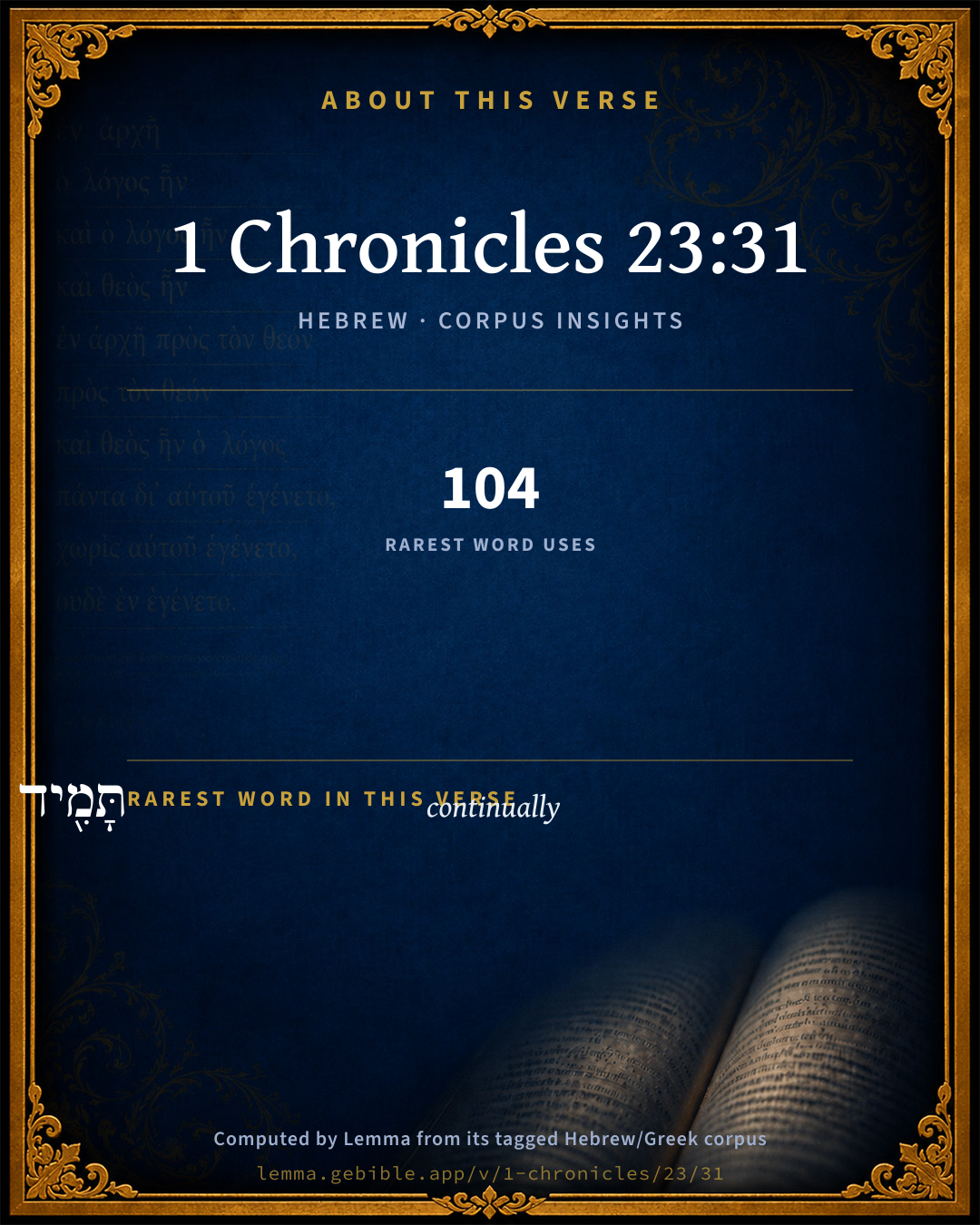
תָּמִ֖יד
tâmîyd
H8548
“continually”
Noun, Common, Masculine, Singular, Absolute
Part of Speech
Noun
Type
Common
Gender
Masculine
Number
Singular
State
Absolute
Full BDB Definition

Origin: from an unused root meaning to stretch

TWOT: 1157a

continuity, perpetuity, to stretch - continually, continuously (as adverb) - continuity (substantive)
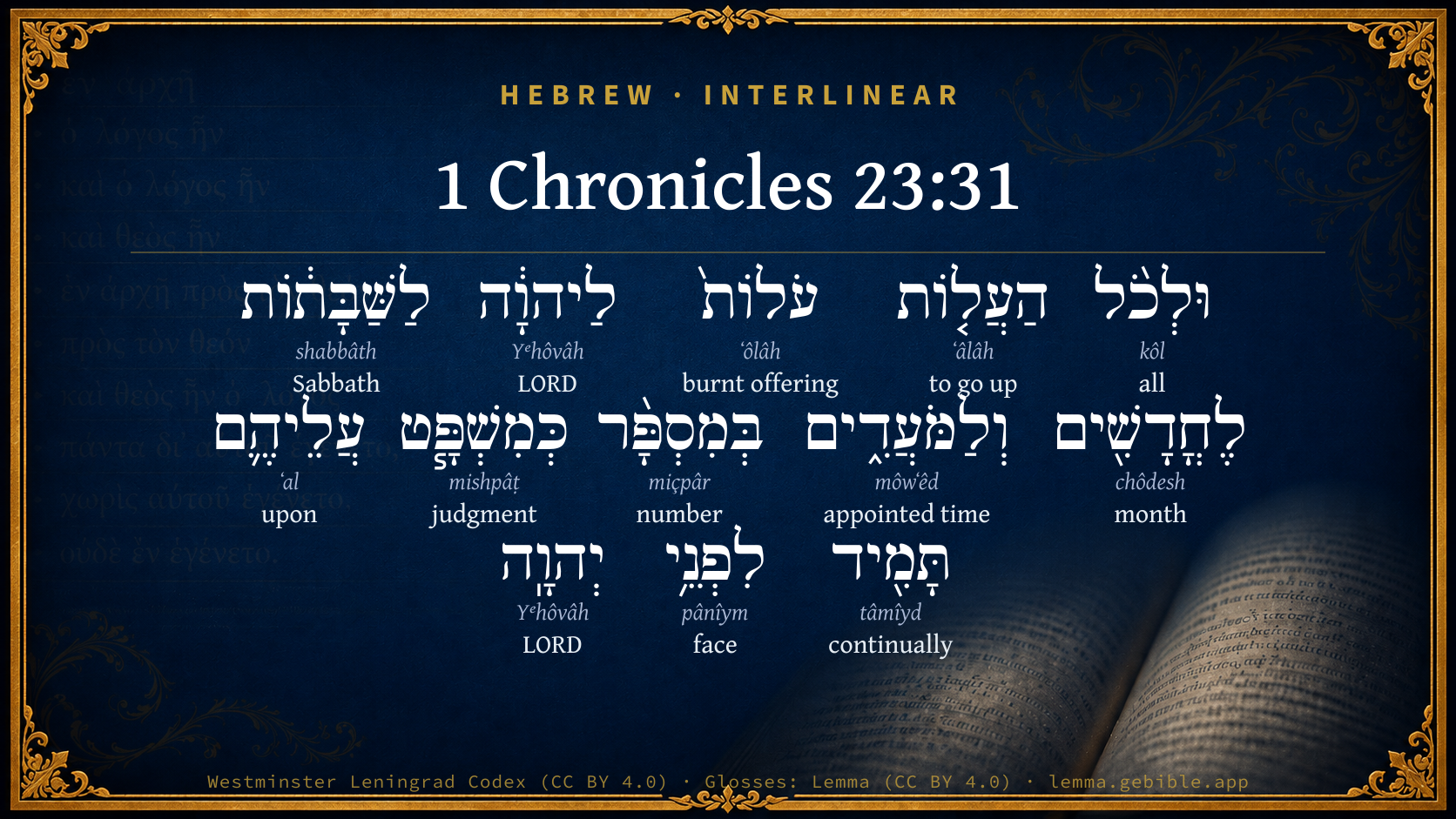
  1. וּלְכֹ֨ל kôl H3605 “and · to/for · all of” Conjunction + Preposition + Noun, Common, Masculine, Singular, Construct
  2. הַעֲל֤וֹת ʻâlâh H5927 “to go up” Verb, Hiphil, Infinitive Construct
  3. עֹלוֹת֙ ʻôlâh H5930 “burnt offerings” Noun, Common, Feminine, Plural, Absolute
  4. לַיהוָ֔ה Yᵉhôvâh H3068 “to/for · LORD” Preposition + Noun, Proper
  5. לַשַּׁבָּת֔וֹת shabbâth H7676 “to/for the · Sabbaths” Preposition, Determined + Noun, Common, Both, Plural, Absolute
  6. לֶחֳדָשִׁ֖ים chôdesh H2320 “to/for the · months” Preposition, Determined + Noun, Common, Masculine, Plural, Absolute
  7. וְלַמֹּעֲדִ֑ים môwʻêd H4150 “and · to/for the · appointed times” Conjunction + Preposition, Determined + Noun, Common, Masculine, Plural, Absolute
  8. בְּמִסְפָּ֨ר miçpâr H4557 “in/at · number” Preposition + Noun, Common, Masculine, Singular, Absolute
  9. כְּמִשְׁפָּ֧ט mishpâṭ H4941 “like/as · judgment” Preposition + Noun, Common, Masculine, Singular, Absolute
  10. עֲלֵיהֶ֛ם ʻal H5921 “upon · them” Preposition + Suffix, Personal, 3rd Person, Masculine, Plural
  11. לִפְנֵ֥י pânîym H6440 “to/for · face(s) of” Preposition + Noun, Common, Both, Plural, Construct
  12. יְהוָֽה Yᵉhôvâh H3068 “LORD” Noun, Proper

About this verse

These counts appear in no published source. They are computed here, from the morphology-tagged text and Lemma’s own curated glosses. What Lemma adds →

13
words
12
distinct lemmas
Historical
section

Grammatical profile

  • 1 verb
  • 11 nouns
  • 1 preposition

Verb forms

  • הַעֲל֤וֹת Hiphil · Infinitive Construct

Repetition

A word recurs within this verse — often emphatic in Hebrew:

  • לַיהוָ֔ה LORD H3068 ×2

Hebrew & Septuagint length

In English translation the verse runs 31 words from the Hebrew and 41 from the Septuagint (LXX English) — closely comparable.

A rough comparison of the two English renderings, which tokenize alike — not a word-level alignment.

Word counts can differ between the Hebrew and the Greek without any difference in meaning — e.g. the Hebrew direct-object marker אֵת has no separate Greek word, and Greek often adds the article ὁ.

Cross-references

7

Topical passages linked to 1 Chronicles 23:31 in the Treasury of Scripture Knowledge — connected by theme and wording, ordered by reader-vote popularity; previews shown in the World English Bible.

  • Isaiah 1:13–14 Bring no more vain offerings. Incense is an abomination to me; New moons, Sabbaths, and convocations: I can't bear with evil assemblies.
  • Leviticus 23:1–17 Yahweh spoke to Moses, saying,
  • Leviticus 23:24 "Speak to the children of Israel, saying, 'In the seventh month, on the first day of the month, shall be a solemn rest to you, a memorial of blowing of trumpets, a holy convocation.
  • Leviticus 23:39 "'So on the fifteenth day of the seventh month, when you have gathered in the fruits of the land, you shall keep the feast of Yahweh seven days: on the first day shall be a solemn rest, and on the eighth day shall be a solemn rest.
  • Numbers 10:10 Also in the day of your gladness, and in your set feasts, and in the beginnings of your months, you shall blow the trumpets over your burnt offerings, and over the sacrifices of your peace-offerings; and they shall be to you for a memorial before your God: I am Yahweh your God.
  • Numbers 28:1–29 Yahweh spoke to Moses, saying,
  • Psalms 81:1–4 Sing aloud to God, our strength! Make a joyful shout to the God of Jacob!

Cross-references courtesy of OpenBible.info (CC BY 4.0).

Hebrew and Greek witnesses Masoretic Hebrew ↔ Greek Septuagint

The same verse in the two great witnesses to the Old Testament, shown verse-for-verse.

These are two independent witnesses, not word-aligned to each other, and the Septuagint is shown in lemma (dictionary) form.

Hebrew 1 Chronicles 23:31 Masoretic · Westminster Leningrad Codex

וּלְכֹ֨ל הַעֲל֤וֹת עֹלוֹת֙ לַיהוָ֔ה לַשַּׁבָּת֔וֹת לֶחֳדָשִׁ֖ים וְלַמֹּעֲדִ֑ים בְּמִסְפָּ֨ר כְּמִשְׁפָּ֧ט עֲלֵיהֶ֛ם תָּמִ֖יד לִפְנֵ֥י יְהוָֽה

and to offer all burnt offerings to Yahweh, on the Sabbaths, on the new moons, and on the set feasts, in number according to the ordinance concerning them, continually before Yahweh;

World English Bible · Public Domain

Greek LXX 1 Chronicles 23:31 Septuagint · lemma form

καί ἐπί πᾶς ὁ ἀναφέρω ὁλοκαύτωμα ὁ κύριος ἐν ὁ σάββατον καί ἐν ὁ νουμηνία καί ἐν ὁ ἑορτή κατά ἀριθμός κατά ὁ κρίσις ἐπί αὐτός διά πᾶς ὁ κύριος

and to be over all the whole burnt offerings that were offered up to the Lord on the sabbaths, and at the new moons, and at the feasts, by number, according to the order given to them, continually before the Lord.

LXX2012 (modern English Septuagint) · Public Domain

Hebrew: Westminster Leningrad Codex (CC BY 4.0). Greek: Septuagint (public domain); English from LXX2012 (modern English Septuagint) (Public Domain). How the Septuagint differs from the Hebrew →

Commentary

Notes on 1 Chronicles 23:31 from classic Christian and Jewish commentators (each source and its license shown beneath its notes). The classic Christian expositions comment on the surrounding passage and are grouped to its opening verse, so a note may address several verses; the Jewish commentaries on the Tanakh (Rashi and others) are per-verse, so they appear only where the commentator wrote on this verse.

Lemma curates 59 commentaries, every one of them public domain or Creative Commons licensed, each selected and text-cleaned for this edition rather than reprinted as found. About our sources →

Ellicott's Commentary for English Readers

(31) And to offer all burnt sacrifices.—Rather, And over all offering of burnt offerings. The Levites had to select and prepare the victims, the priests offered them, when ready, upon the altar. The Levites had to do this “by number,” i.e., according to the several numbers prescribed by the Law for each occasion. (See Numbers 28)

According to the order commanded unto them.—According to the rule concerning them: i.e., concerning the sacrifices.

Continually.—Heb., tamîd, the technical term in connection with the burnt offerings, which regularly recurred at stated times, e.g., a lamb was offered morning and evening. (Comp. Num_28:6.)

A Bible Commentary for English Readers, edited by Charles John Ellicott (1878–1897) — public domain. Text from a community e-Sword module.

The Cambridge Bible for Schools and Colleges

gen. ed. J. J. S. Perowne

31. to offer] The Levites’ duty was to give any help short of actually offering the victim on the altar and sprinkling the blood. See 2Ch_29:21-27; 2Ch_30:16-17; 2Ch_35:10-11.

the set feasts] i.e. the three yearly feasts; Exo_23:14-17.

by number, according to the order commanded unto them] R.V, in number according to the ordinance concerning them. The words refer not to the Levites (A.V.), but to the sacrifices (R.V.).

The Cambridge Bible for Schools and Colleges (gen. ed. J. J. S. Perowne; Cambridge University Press, 1878–1918) — public domain. Text from a community e-Sword module.

Albert Barnes' Notes on the Bible

Though the Levites were not allowed by themselves to offer sacrifice, yet there were many respects in which they assisted the priests when sacrifice was offered. See 2Ch 29:34; 2Ch 35:11-12.

The set feasts - The Passover, Feast of Pentecost, and Feast of Tabernacles (marginal reference).

Albert Barnes' Notes on the Bible (1834–1885) — public domain. Text from a community e-Sword/MySword module.

Haydock's Catholic Bible Commentary

Lord. Music accompanied this service twice a day, as it did the sacrifices which were offered for the prince, or for the nation, Numbers x. 10. (Calmet) --- Rest. Hebrew, "the set festivals, by number, according to the order prescribed unto them continually," &c. (Haydock)

George Leo Haydock (1774–1849), Haydock's Catholic Family Bible and Commentary, 1859 edition — public domain. Excludes Psalms (Douay-Rheims chapter numbering differs from Protestant) and Deuterocanonical books (Catholic canon only).

Matthew Poole's English Annotations

Commanded unto them, i.e. unto those persons, the Levites, of whom he speaks. Or, concerning them, i.e. about those things.

Matthew Poole's English Annotations on the Holy Bible (1683–1685) — public domain. Text from a community e-Sword/MySword module.

Whedon's Commentary on the Bible

Daniel D. Whedon

31. To offer all burnt sacrifices — That is, to assist the priests in offering, for the ordinary Levite did not offer up the offering with his own bands, but he prepared the altar and the wood, and selected and brought the victims, and helped to slay and skin them. Comp. Num_3:5-10; Num_18:1-7.

Daniel D. Whedon (gen. ed.), Commentary on the Old and New Testaments (1874–1909) — public domain. Text from a community e-Sword module.

The Pulpit Commentary

And to offer; Hebrew, "and for all the offering of burnt offerings." For other references to the help which the Levites gave in the matter of the burnt offerings, and for the number (2Sa_2:15; Num_28:1-31) of them, see Num_29:2-34; 2Ch_29:32-34 2Ch_35:2-12. The priests alone performed the actual sacrifices. The set feasts. These refer to the three:

(1) the Passover; (Lev_23:4, Lev_23:5)

(2) the Pentecost; (Lev_23:15-17)

(3) the Feast of Tabernacles. (Lev_23:33-37)

The Pulpit Commentary (1880–1919), ed. H.D.M. Spence-Jones & Joseph S. Exell — public domain. Text from a community e-Sword module.

Rashi

Rabbi Shlomo Yitzchaki (Rashi)

And for every offering up of burnt offerings to the Lord on Sabbaths, on New Moons The meaning is: They will be appointed over the chambers and also over the chamber of the house of the lambs, where the sacrificial animals are kept, and they will bring [them] to the priests constantly every day, according to the number that is required for each day, whether on weekdays, whether on Sabbaths, and on New Moons and festivals, when additional sacrifices are offered up with the daily offerings - all these they will bring in number according to the ordinance, and they will also assist the priests in flaying the sacrifice. And so we find with Hezekiah (II Chron. 29:34): “Only the priests were few, and they could not flay all the burnt offerings; so their brethren the Levites strengthened them, etc.”

Rashi on the Tanakh — English translations: “The Judaica Press complete Tanach with Rashi, translated by A. J. Rosenberg” (CC BY 4.0); “Pentateuch with Rashi's commentary by M. Rosenbaum and A.M. Silbermann, 1929-1934” (public domain); “The Metsudah Tanach series, Lakewood, N.J” (CC BY 4.0); and “The Book of Joshua, Metsudah Publications, 1997” (CC BY 4.0). Text via Sefaria.

Lesson kit

Teaching starters — assembled from the data on this page, not authored interpretation. Every prompt links to the verse data it draws on. Edit before teaching.

1 Chronicles, in the Historical, opens this verse with 13 words (12 distinct Hebrew lemmas). Its most distinctive word is tâmîyd (“continually”). A historical commentator’s framing appears above. Read the whole chapter for the surrounding context.

Discussion questions

  1. The word tâmîyd carries the sense “continually.” How does it shape the verse?
  2. Isaiah 1:13–14 shares this passage’s theme. How do the two illuminate each other?
  3. “LORD” occurs 2× in this one verse. What is the effect of the repetition?
  4. These translations render this verse differently. What is at stake in choosing one wording over another?
  5. The verb «הַעֲל֤וֹת» is Hiphil Infinitive Construct. How does its form color the action?
  6. Reading how Ellicott's Commentary for English Readers and The Cambridge Bible for Schools and Colleges read this verse, where do the two commentators agree and where do they part?

Things to notice

Reading settings

Reading text

Shown beneath each verse's original-language words.

Old Testament
Old Testament edition

Read the OT as the Masoretic Hebrew (MT) or the Greek Septuagint (LXX).

English shown for the Greek Septuagint (in the Hebrew ↔ Greek comparison).

Comparing translations? Open the Compare panel on any verse page to stack up to four side by side.