Numbers 3:15

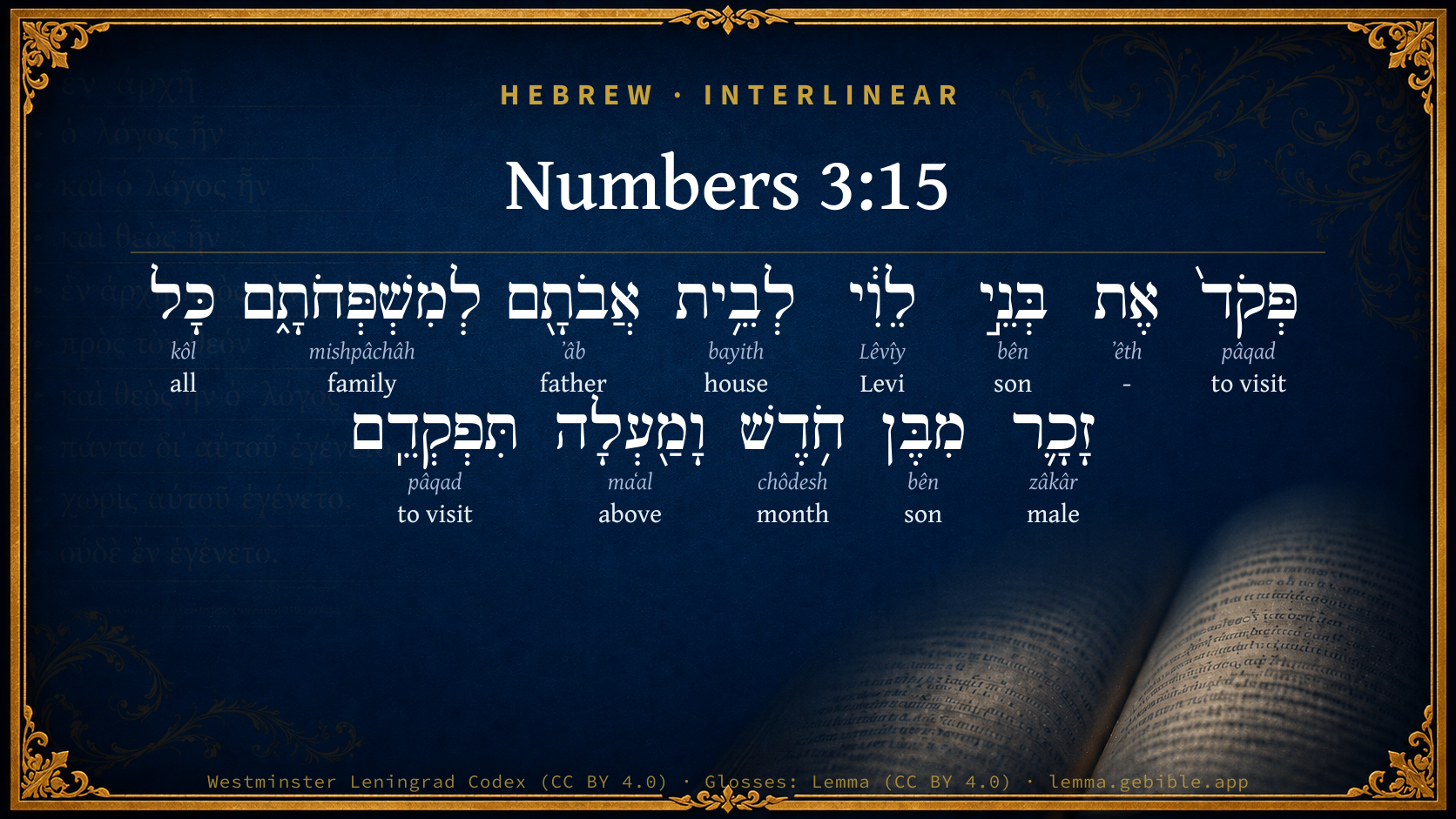
Hebrew (Westminster Leningrad Codex) Numbers 3:15 appears in the Hebrew Old Testament. The text above is from the Westminster Leningrad Codex. Each word links to its Strong’s number, a concise gloss, and parsing drawn from the Open Scriptures Hebrew Bible morphology. Click any word for its full Brown-Driver-Briggs (BDB) entry.
Download image
Cite this verse

Numbers 3:15 (World English Bible). Public Domain. Lemma interlinear Bible study tool, https://lemma.gebible.app/v/numbers/3/15.

Show BibTeX & RIS
BibTeX
RIS
English Translation
"Number the children of Levi by their fathers' houses, by their families: every male from a month old and upward shall you number."
World English Bible · Public Domain
Download a study sheet

One document with this verse’s original text, its word-by-word gloss line, the meaning frame, cross-references with their text, attributed commentary, and full source and license credits — printable, and it pastes into notes with its structure intact.

This verse Autodidact and up

Study sheet (.html) Plain text (.txt)

A passage Seminary Student

Up to 50 verses in one chapter. A passage sheet keeps up to 6 commentary sources and 12 cross-references per verse, in the order this page ranks them, and says so on the sheet whenever that leaves anything out. Ask for a single verse and you get the Autodidact verse sheet above.

Everything on this page stays free to read, with no account — the sheet is a download of what is already on screen, not access to it.

Want to remove ads? Support Godless Engineer
Compare translations 3

The same verse in 3 English versions, stacked beneath the original-language interlinear above. Click any original word for its lexicon entry.

Each is an independent rendering of the whole verse — the interlinear is not word-aligned to these translations.

Highlighted words mark where these versions differ — a whole-verse word diff, not a word-by-word alignment.

  • World English Bible Public Domain
    "Number the children of Levi by their fathers' houses, by their families: every male from a month old and upward shall you number."
  • King James Version Public Domain
    Number the children of Levi after the house of their fathers, by their families: every male from a month old and upward shalt thou number them.
  • unfoldingWord Literal Text CC BY-SA 4.0
    “Count the sons of Levi according to the house of their fathers, according to their clans. You shall count them, every male from a son of a month and upward.”

unfoldingWord Literal Text — © unfoldingWord, licensed CC BY-SA 4.0. Word-aligned USFM3 via Door43 (git.door43.org/unfoldingWord/en_ult).

Versions to compare (up to 4)

3 of 4 selected

Show all 18 translations

Every available English version of this verse, each an independent rendering of the whole verse.

  • World English Bible Public Domain
    "Number the children of Levi by their fathers' houses, by their families: every male from a month old and upward shall you number."
  • Berean Standard Bible Public Domain
    “Number the Levites by their families and clans. You are to count every male a month old or more.”
  • Majority Standard Bible Public Domain
    “Number the Levites by their families and clans. You are to count every male a month old or more.”
  • King James Version Public Domain
    Number the children of Levi after the house of their fathers, by their families: every male from a month old and upward shalt thou number them.
  • American Standard Version (1901) Public Domain
    Number the children of Levi by their fathers' houses, by their families: every male from a month old and upward shalt thou number them.
  • Revised Version (1885) Public Domain
    Number the children of Levi by their fathers’ houses, by their families: every male from a month old and upward shalt thou number them.
  • Geneva Bible (1599) Public Domain
    Nomber the children of Leui after the houses of their fathers, in their families: euery male from a moneth olde and aboue shalt thou nomber.
  • Douay-Rheims (1899) Public Domain
    Number the sons of Levi by the houses of their fathers and their families, every male from one month and upward.
  • Young's Literal Translation Public Domain
    `Number the sons of Levi by the house of their fathers, by their families; every male from a son of a month and upward thou dost number them.'
  • Literal Standard Version CC BY-SA 4.0
    “Number the sons of Levi by the house of their fathers, by their families; every male from a son of a month and upward—you number them.”
  • Unlocked Literal Bible CC BY-SA 4.0
    “Count the descendants of Levi in each family, in their clans. Count every male who is one month old and older.”
  • unfoldingWord Literal Text CC BY-SA 4.0
    “Count the sons of Levi according to the house of their fathers, according to their clans. You shall count them, every male from a son of a month and upward.”
  • Darby Bible Public Domain
    Number the sons of Levi according to their fathers' houses, after their families; every male from a month old and upward shalt thou number them.
  • World Messianic Bible Public Domain
    “Count the children of Levi by their fathers’ houses, by their families. You shall count every male from a month old and upward.”
  • Webster's Bible Public Domain
    Number the children of Levi after the house of their fathers, by their families: every male from a month old and upward shalt thou number them.
  • Free Bible Version CC BY-SA 4.0
    “Register the Levites by their father's line and family. Count every male aged one month or older.”
  • Bible in Basic English Public Domain
    Let all the children of Levi be numbered by their families and their fathers' houses; let every male of a month old and over be numbered.
  • JPS Tanakh (1917) Public Domain
    'Number the children of Levi by their fathers' houses, by their families; every male from a month old and upward shalt thou number them.'

Literal Standard Version (2020), Covenant Press — licensed CC BY-SA 4.0. Text via the HelloAO Bible API (eBible.org). Unlocked Literal Bible (unfoldingWord) — licensed CC BY-SA 4.0. Text via the HelloAO Bible API (eBible.org). unfoldingWord Literal Text — © unfoldingWord, licensed CC BY-SA 4.0. Word-aligned USFM3 via Door43 (git.door43.org/unfoldingWord/en_ult). Free Bible Version, Dr. Jonathan Gallagher — licensed CC BY-SA 4.0. Text via the HelloAO Bible API (eBible.org).

Word by word

More ways to search: Search by grammar → Find every occurrence → Compare this word →

Practice this passage: Drill this verse → Learn its vocabulary →

לֵוִ֔י
Lêvîy
H3878
“Levi”
Noun, Proper
Part of Speech
Noun
Type
Proper
Full BDB Definition

Origin: from H3867

TWOT: 1093

Levi = "joined to" - the 3rd son of Jacob by Leah and progenitor of tribe of Levites
  1. פְּקֹד֙ pâqad H6485 “visit” Verb, Qal, Imperative, 2nd Person, Masculine, Singular
  2. אֶת ʼêth H853 “-” Particle, Direct Object
  3. בְּנֵ֣י bên H1121 “sons of” Noun, Common, Masculine, Plural, Construct
  4. לְבֵ֥ית bayith H1004 “to/for · house of” Preposition + Noun, Common, Masculine, Singular, Construct
  5. אֲבֹתָ֖ם ʼâb H1 “fathers · their” Noun, Common, Masculine, Plural, Construct + Suffix, Personal, 3rd Person, Masculine, Plural
  6. לְמִשְׁפְּחֹתָ֑ם mishpâchâh H4940 “to/for · families · their” Preposition + Noun, Common, Feminine, Plural, Construct + Suffix, Personal, 3rd Person, Masculine, Plural
  7. כָּל kôl H3605 “all of” Noun, Common, Masculine, Singular, Construct
  8. זָכָ֛ר zâkâr H2145 “male” Adjective, Adjective, Masculine, Singular, Absolute
  9. מִבֶּן bên H1121 “from · son of” Preposition + Noun, Common, Masculine, Singular, Construct
  10. חֹ֥דֶשׁ chôdesh H2320 “month” Noun, Common, Masculine, Singular, Absolute
  11. וָמַ֖עְלָה maʻal H4605 “and · above · toward” Conjunction + Adverb + Suffix, Demonstrative
  12. תִּפְקְדֵֽם pâqad H6485 “to visit · them” Verb, Qal, Imperfect, 2nd Person, Masculine, Singular + Suffix, Personal, 3rd Person, Masculine, Plural

About this verse

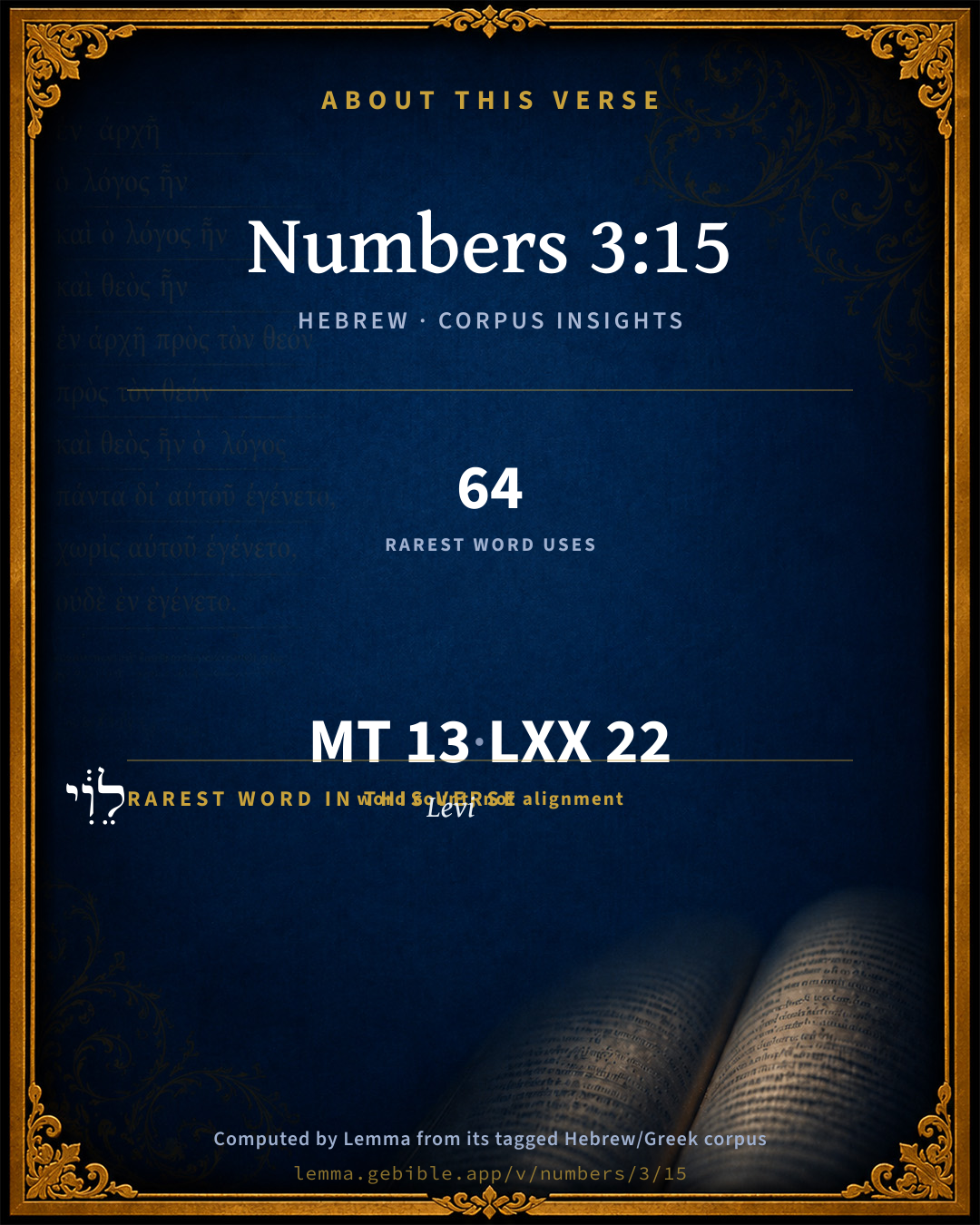
These counts appear in no published source. They are computed here, from the morphology-tagged text and Lemma’s own curated glosses. What Lemma adds →

13
words
11
distinct lemmas
Pentateuch
section

Grammatical profile

  • 2 verbs
  • 8 nouns
  • 1 adjective
  • 1 adverb
  • 1 particle

Verb forms

  • פְּקֹד֙ Qal · Imperative
  • תִּפְקְדֵֽם Qal · Imperfect

Repetition

Words recur within this verse — often emphatic in Hebrew:

  • פְּקֹד֙ to visit H6485 ×2
  • בְּנֵ֣י son H1121 ×2

Hebrew & Septuagint length

In English translation the verse runs 23 words from the Hebrew and 30 from the Septuagint (LXX English) — closely comparable.

A rough comparison of the two English renderings, which tokenize alike — not a word-level alignment.

Word counts can differ between the Hebrew and the Greek without any difference in meaning — e.g. the Hebrew direct-object marker אֵת has no separate Greek word, and Greek often adds the article ὁ.

In the original languages it is 13 Hebrew tokens and 22 Greek tokens — but the two are counted differently (Hebrew bundles its prefixes and suffixes into one token; the Greek is in lemma form), so that isn’t a like-for-like length.

Cross-references

13

Topical passages linked to Numbers 3:15 in the Treasury of Scripture Knowledge — connected by theme and wording, ordered by reader-vote popularity; previews shown in the World English Bible.

  • Numbers 26:62 Those who were numbered of them were twenty-three thousand, every male from a month old and upward: for they were not numbered among the children of Israel, because there was no inheritance given them among the children of Israel.
  • Mark 10:14 But when Jesus saw it, he was moved with indignation, and said to them, "Allow the little children to come to me! Don't forbid them, for the Kingdom of God belongs to such as these.
  • 2 Timothy 3:15 From infancy, you have known the sacred writings which are able to make you wise for salvation through faith, which is in Christ Jesus.
  • Numbers 1:47 But the Levites after the tribe of their fathers were not numbered among them.
  • Numbers 3:22 Those who were numbered of them, according to the number of all the males, from a month old and upward, even those who were numbered of them were seven thousand five hundred.
  • Numbers 3:28 According to the number of all the males, from a month old and upward, there were eight thousand six hundred, keeping the charge of the sanctuary.
  • Numbers 3:34 Those who were numbered of them, according to the number of all the males, from a month old and upward, were six thousand two hundred.
  • Numbers 3:39–40 All who were numbered of the Levites, whom Moses and Aaron numbered at the commandment of Yahweh, by their families, all the males from a month old and upward, were twenty-two thousand.
  • Numbers 3:43 All the firstborn males according to the number of names, from a month old and upward, of those who were numbered of them, were twenty-two thousand two hundred seventy-three.
  • Numbers 18:15–16 Everything that opens the womb, of all flesh which they offer to Yahweh, both of man and animal shall be yours: nevertheless the firstborn of man shall you surely redeem, and the firstborn of unclean animals shall you redeem.
  • Proverbs 8:17 I love those who love me. Those who seek me diligently will find me.
  • Jeremiah 2:2 Go, and cry in the ears of Jerusalem, saying, Thus says Yahweh, I remember for you the kindness of your youth, the love of your weddings; how you went after me in the wilderness, in a land that was not sown.
  • Jeremiah 31:3 Yahweh appeared of old to me, [saying], Yes, I have loved you with an everlasting love: therefore with loving kindness have I drawn you.

Cross-references courtesy of OpenBible.info (CC BY 4.0).

Hebrew and Greek witnesses Masoretic Hebrew ↔ Greek Septuagint

The same verse in the two great witnesses to the Old Testament, shown verse-for-verse.

These are two independent witnesses, not word-aligned to each other, and the Septuagint is shown in lemma (dictionary) form.

Hebrew Numbers 3:15 Masoretic · Westminster Leningrad Codex

פְּקֹד֙ אֶת בְּנֵ֣י לֵוִ֔י לְבֵ֥ית אֲבֹתָ֖ם לְמִשְׁפְּחֹתָ֑ם כָּל זָכָ֛ר מִבֶּן חֹ֥דֶשׁ וָמַ֖עְלָה תִּפְקְדֵֽם

"Number the children of Levi by their fathers' houses, by their families: every male from a month old and upward shall you number."

World English Bible · Public Domain

Greek LXX Numbers 3:15 Septuagint · lemma form

ἐπισκέπτω ὁ υἱός λευί κατά οἶκος πατριά αὐτός κατά δῆμος αὐτός κατά συγγένεια αὐτός πᾶς ἀρσενικός ἀπό μηνιαῖος καί ἐπάνω ἐπισκέπτω αὐτός

Take the number of the sons of Levi, according to the houses of their families, according to their divisions; number you⌃ them every male from a month old and upwards.

LXX2012 (modern English Septuagint) · Public Domain

Hebrew: Westminster Leningrad Codex (CC BY 4.0). Greek: Septuagint (public domain); English from LXX2012 (modern English Septuagint) (Public Domain). How the Septuagint differs from the Hebrew →

Targum (Aramaic paraphrase)

2

The Targum is the ancient Jewish Aramaic paraphrase of the Hebrew Scriptures — an interpretive translation, not the Hebrew text itself. Onkelos (literal) and Pseudo-Jonathan (expansive) render the Torah, and Jonathan the Prophets. Coverage is partial: where no permissively-licensed English translation exists for a verse, only the Aramaic is shown. This is verse-level text, not a word-by-word alignment to the Hebrew.

  1. Targum Onkelos Torah (Genesis–Deuteronomy)
    מְנֵי יָת בְּנֵי לֵוִי לְבֵית אֲבָהַתְהוֹן לְזַרְעֲיַתְהוֹן כָּל דְכוּרָא מִבַּר יַרְחָא וּלְעֵלָא תִּמְנִנוּן

    (no public-domain English translation for this verse)

    Targum Onkelos — Aramaic: “Onkelos Genesis” (public domain); “Onkelos Exodus” (public domain); “Onkelos Leviticus” (public domain); “Onkelos Numbers” (public domain); “Onkelos Deuteronomy” (public domain). English: “Sefaria Community Translation” (CC0 1.0 (public-domain dedication)); “J.W. Etheridge. The Targums of Onkelos and Jonathan Ben Uzziel on the Pentateuch. London: Longmans, Green, 1862” (public domain). Text via Sefaria.

  2. Targum Pseudo-Jonathan Torah (Genesis–Deuteronomy)
    מַנֵי יַת בְּנֵי לֵוִי לְבֵית אַבְהַתְהוֹן לִגְנִיסַתְהוֹן כָּל דְכוּרָא מִבַּר יַרְחָא וּלְעֵילָא תִמְנִינוּן

    Number the sons of Levi according to the house of their fathers and their families; every male from a month old and upward shalt thou number them.

    Targum Pseudo-Jonathan — Aramaic: “Targum Jonathan on Genesis” (public domain); “Targum Jonathan on Exodus” (public domain); “Targum Jonathan on Leviticus” (public domain); “Targum Jonathan on Numbers” (public domain); “Targum Jonathan on Deuteronomy” (public domain). English: “The Targum of Jonathan ben Uzziel, trans. J. W. Etheridge, London, 1862” (public domain). Text via Sefaria.

Commentary

Notes on Numbers 3:15 from classic Christian and Jewish commentators (each source and its license shown beneath its notes). The classic Christian expositions comment on the surrounding passage and are grouped to its opening verse, so a note may address several verses; the Jewish commentaries on the Tanakh (Rashi and others) are per-verse, so they appear only where the commentator wrote on this verse.

Lemma curates 59 commentaries, every one of them public domain or Creative Commons licensed, each selected and text-cleaned for this edition rather than reprinted as found. About our sources →

The Biblical Illustrator

Joseph S. Exell

Num_3:15-22

From a month old.

Dedication of infants to God

That He taketh them from a month old is a thing of good use, and we may note it, for it notably showeth that we may destinate our children to God before they be fit for any other course of life. In the Gospel, those parents that brought little children to Christ are chronicled up for an eternal praise of them, and for an example to all parents to the end of the world. Matthew calleth them little children. Luke calleth them babes, even such as yet hanged upon the breast, effectually noting how soon we should bring them to Christ. Satans envy even against these babes to be brought to Christ appeareth there, and our Saviours unspeakable good against that malice, commanding them to be brought unto Him, and not to be hindered, taking them in His arms, putting His hands upon them, blessing them, and graciously affirming, that of such is the kingdom of God. A natural parent wishes all good to his child, and as he is able, procureth it, even as the root spreadeth his sap to the branches without grudge or exception; and a religious parent, above all worldly good, careth for Gods holy fear to be planted in his child. For the effecting whereof soon he bringeth him unto Christ, knowing that the first liquor put into a vessel is of great force ever in the same. Alas, what will the whole world profit them, were we able to give it them, ii eternally they be damned--yea, they and we both, they for not knowing Christ, and we for not bringing them to Christ. Wherefore earnest is that commandment of the Holy Ghost, Fathers, bring up your children in instruction and information of the Lord. Abraham is registered up for this care; and whilst this Book of God remaineth it will be found written to their praise that Timothys grandmother and mother brought him up in the knowledge of the Scripture from a child. Honour may shine and glory may glitter, but how soon covered with a cloud. Beauty much wished, but permanent with neither wishes nor wisdom whatsoever. Only the good gotten by bringing children to Christ remaineth for ever in his reward. And therefore let religious parents have a care of it, even soon, soon, remembering this place, that the Levites, appointed for His service, He would have numbered from a month old. (Bp. Babington.)

Church membership of children:

What, then, is this infant membership? What conception can we take of it which will justify its Christian dignity? A great many persons who are very sharp at this kind of criticism appear to have never observed that creatures existing under conditions of growth allow no such terms of classification as those do which are dead and have no growth; such, for example, as stones, metals, and earths. They are certain that gold is not iron, and iron is not silver, and they suppose that they can class the growing and transitional creatures, that are separated by no absolute lines, in the same manner. They talk of colts and horses, lambs and sheep, and it possibly not once occurs to them that they can never tell when the colt becomes a horse, or the lamb a sheep; and that about the most definite thing they can say, when pressed with that question, is that the colt is potentially a horse, the lamb a sheep, even from the first, having in itself this definite futurition; and, therefore, that while horses and sheep are not all to be classed as colts and lambs, all colts and lambs may be classed as horses and sheep. And just so children are all men and women; and if there is the law of futurition in them to justify it, may be fitly classed as believing men and women. And all the sharp arguments that go to cover their membership as such in the Church with absurdity, or to turn it into derision, are just such arguments as the inventors could raise with equal point to ridicule the horsehood and sheephood of the young animals just referred to. The propriety of this membership does not lie in what those infants can or cannot believe, or do or do not believe, at some given time, as, for example, on the day of their baptism; but it lies in tile covenant of promise, which makes their parents parents in the Lord; their nurture a nurture of the Lord, and so constitutes a force of futurition by which they are to grow up imperceptibly into faithfuls among faithfuls, in Christ Jesus . . . The conception, then, of this membership is, that it is potentially a real one; that it stands, for the present, in the faith of the parents and the promise which is to them and to their children, and that on this ground they may well enough be accounted believers, just as they are accounted potentially men and women. Then, as they come forward into maturity, it is to be assumed that they will come forward into faith, being grown in the nurture of faith, and will claim for themselves the membership into which they were before inserted. Nor is this a case which has no analogies that it should be held up as a mark of derision. It is generally supposed that our common law has some basis of common sense. And yet this body of law makes every infant child a citizen; requiring, as a point of public order, the whole constabulary and even military force of the state to come to the rescue or the redress of his wrongs, when his person is seized or property invaded by conspiracy. This infant child can sue and be sued; for the Court of Chancery will appoint him a guardian, whose acts shall be the childs acts; and it shall be as if he were answerable for his own education, dress, board, entertainments, and the damages done by his servants, precisely as if he were a man acting in his own cause. Doubtless it may sound very absurdly to call him a citizen. What can he do as a citizen? He cannot vote or bear arms; he does not even know what these things mean, and yet he is a citizen. In one view he votes, bears arms, legislates, even in his cradle; for the potentiality is in him, and the state takes him up in her arms, as it were, to own him as her citizen. (H. Bushnell, D. D.)

The Biblical Illustrator, edited by Joseph S. Exell (c. 1880s–1900s) — public domain. Text from a community e-Sword module.

Joseph Benson's Commentary

Num 3:15. From a month old — Because at that time the firstborn, in whose stead the Levites came, were offered to God. And from that time the Levites were consecrated to God, and were, as soon as capable, instructed in their work. Elsewhere they are numbered from twenty-five years old, when they were entered as novices into part of their work, (Num 8:24,) and from thirty years old, when they were admitted to their whole office.

Joseph Benson's Commentary on the Old and New Testaments (1811–1818) — public domain. Text from a community e-Sword module.

Adam Clarke's Commentary

Verse 15. A month old and upward] The males of all the other tribes were numbered, from twenty years and upward; had the Levites been numbered in this way, they would not have been nearly equal in number to the firstborn of the twelve tribes. Add to this, that as there must have been first-born of all ages in the other tribes, it was necessary that the Levites, who were to be their substitutes, should be also of all ages; and it appears to have been on this ground, at least partly, that the Levites were numbered from four weeks old and upward.

Adam Clarke's Commentary on the Bible (1810–1826) — public domain. Text from a community e-Sword/MySword module.

Ellicott's Commentary for English Readers

(15) From a month old and upward . . . —The males of the other tribes had been numbered “from twenty years old and upward” (Num_1:3). The firstborn males, however, among all the children of Israel, in whose place the Levites were taken, wer-directed to be numbered “from a month old and upward” (Num_3:40; Num_3:43); and this was the age afterwards fixed for their redemption (Num_18:16).

A Bible Commentary for English Readers, edited by Charles John Ellicott (1878–1897) — public domain. Text from a community e-Sword module.

The Cambridge Bible for Schools and Colleges

gen. ed. J. J. S. Perowne

15. from, a month old] to correspond with the firstborn (see Num_3:40).

The Cambridge Bible for Schools and Colleges (gen. ed. J. J. S. Perowne; Cambridge University Press, 1878–1918) — public domain. Text from a community e-Sword module.

John Gill's Exposition

Number the children of Levi,.... Who were left out of the general muster of the children of Israel, but now were to be numbered alone, and in a different manner, and for, a different purpose, the Lord having a special regard auto, them, and special service for them:

after the house of their fathers, by their families; into which the tribe was divided; house seems to be put for "houses", which were principal ones; and these were divided into families, which branched from them, and according to these, denominated from their fathers, and not their, mothers, were they to be numbered; for as the Jewish writers often say, a mother's family is no family; wherefore, if a Levite woman married into any other tribe, as she might, her, descendants were not taken into this accounts only such whose fathers were Levites, see Num 1:2,

every male from a month old and upwards shalt thou number them; the reason of this was, because the firstborn, for whom they were to be exchanged, were at a month old claimed by the Lord as his, and to be redeemed; and as this numbering was on, another account than, that of the children of Israel, who were numbered from twenty years of age and upwards, that they might on occasion be called out to war, from which the Levites were exempted, and the numbering of them was for the service of the sanctuary; so from their youth they were to be brought up and trained for this, that they might be fit for it, and enter upon it at a proper age.

John Gill's Exposition of the Whole Bible (1746–1763) — public domain (CC PDM 1.0). Text via the HelloAO Bible API.

Haydock's Catholic Bible Commentary

Month; at which time the first-born were to be redeemed, chap xviii. 16. (Menochius) --- If only those of 20 years of age had been counted, they could not have amounted to nearly an equal number with the first-born of all the other tribes. (Calmet)

George Leo Haydock (1774–1849), Haydock's Catholic Family Bible and Commentary, 1859 edition — public domain. Excludes Psalms (Douay-Rheims chapter numbering differs from Protestant) and Deuterocanonical books (Catholic canon only).

Matthew Poole's English Annotations

From a month old, because at that time the first-born, in whose stead the Levites came, Num 8:16, were offered to God, Luk 2:22, and to be redeemed, Num 18:16. And from that time the Levites were consecrated to God, and were as soon as they were capable,’ to be instructed in their work. Elsewhere they are numbered from twenty-five years old, when they were entered as novices to part of their work, Num 8:24; and from thirty years old, when they were completely admitted to their whole office.

Matthew Poole's English Annotations on the Holy Bible (1683–1685) — public domain. Text from a community e-Sword/MySword module.

Whedon's Commentary on the Bible

Daniel D. Whedon

15. After the house of their fathers — Their mothers might have married into other tribes, and borne sons who were counted in those tribes.

Daniel D. Whedon (gen. ed.), Commentary on the Old and New Testaments (1874–1909) — public domain. Text from a community e-Sword module.

The Pulpit Commentary

From a month old. The first-born were to be redeemed "from a month old". (Num_18:16)

The Pulpit Commentary (1880–1919), ed. H.D.M. Spence-Jones & Joseph S. Exell — public domain. Text from a community e-Sword module.

John Wesley's Explanatory Notes

From a month old - Because at that time the first-born, in whose stead the Levites came, were offered to God. And from that time the Levites were consecrated to God, and were, as soon as capable, instructed in their work. Elsewhere they are numbered from twenty-five years old, when they were entered as novices into part of their work, chap. viii, 24, and from thirty years old, when they were admitted to their whole office.

John Wesley, Explanatory Notes Upon the Whole Bible (1754–1765) — public domain. Text via the GEBible commentary corpus.

Rashi

Rabbi Shlomo Yitzchaki (Rashi)

מבן חדש ומעלה [NUMBER THE CHILDREN OF LEVI … EVERY MALE] FROM A MONTH OLD AND ONWARDS — As soon as it passed the age of a non-viable child (a full month was regarded as the utmost time such a child can live) it can be counted to come under the term “keeper of the holy charge”. — R. Judah the son of R. Shalom said: It is quite the usual thing with this tribe to be included in a census from their very birth, for it is said, (Numbers XXVI 59) “[And the name of Amram’s wife was Jochebed, the daughter of Levi], whom her mother bore to Levi in Egypt” — which is explained to mean that she bore her just as she entered the gates of the border-city of Egypt and yet she is counted among the seventy souls which came down with Jacob into Egypt (cf. Genesis 46:27 and Rashi thereon), because if you count their number (as set forth in Genesis 46:8—27) you will find that they were one short of seventy, and it was she whose name is not mentioned there who made up the number seventy (cf. Midrash Tanchuma, Bamidbar 16).

Rashi on the Tanakh — English translations: “The Judaica Press complete Tanach with Rashi, translated by A. J. Rosenberg” (CC BY 4.0); “Pentateuch with Rashi's commentary by M. Rosenbaum and A.M. Silbermann, 1929-1934” (public domain); “The Metsudah Tanach series, Lakewood, N.J” (CC BY 4.0); and “The Book of Joshua, Metsudah Publications, 1997” (CC BY 4.0). Text via Sefaria.

Lesson kit

Teaching starters — assembled from the data on this page, not authored interpretation. Every prompt links to the verse data it draws on. Edit before teaching.

Numbers, in the Pentateuch, opens this verse with 13 words (11 distinct Hebrew lemmas). Its most distinctive word is Lêvîy (“Levi”). A historical commentator’s framing appears above. Read the whole chapter for the surrounding context.

Discussion questions

  1. What does “Levi” (Lêvîy) contribute to the verse as a whole?
  2. How does Numbers 26:62, which shares this passage’s theme, read alongside this verse?
  3. What does the repetition of “to visit” (2× in this one verse) do in this verse?
  4. The translations on this page render this verse differently — a whole-verse word diff, not a word-by-word alignment. What might account for the different wordings?
  5. «פְּקֹד֙» is a Qal Imperative verb. How does that grammatical form shape the action described?
  6. Compare how The Biblical Illustrator and Joseph Benson's Commentary read this verse. Where do they agree or differ?

Things to notice

Reading settings

Reading text

Shown beneath each verse's original-language words.

Old Testament
Old Testament edition

Read the OT as the Masoretic Hebrew (MT) or the Greek Septuagint (LXX).

English shown for the Greek Septuagint (in the Hebrew ↔ Greek comparison).

Comparing translations? Open the Compare panel on any verse page to stack up to four side by side.