
1 Kings 12:32

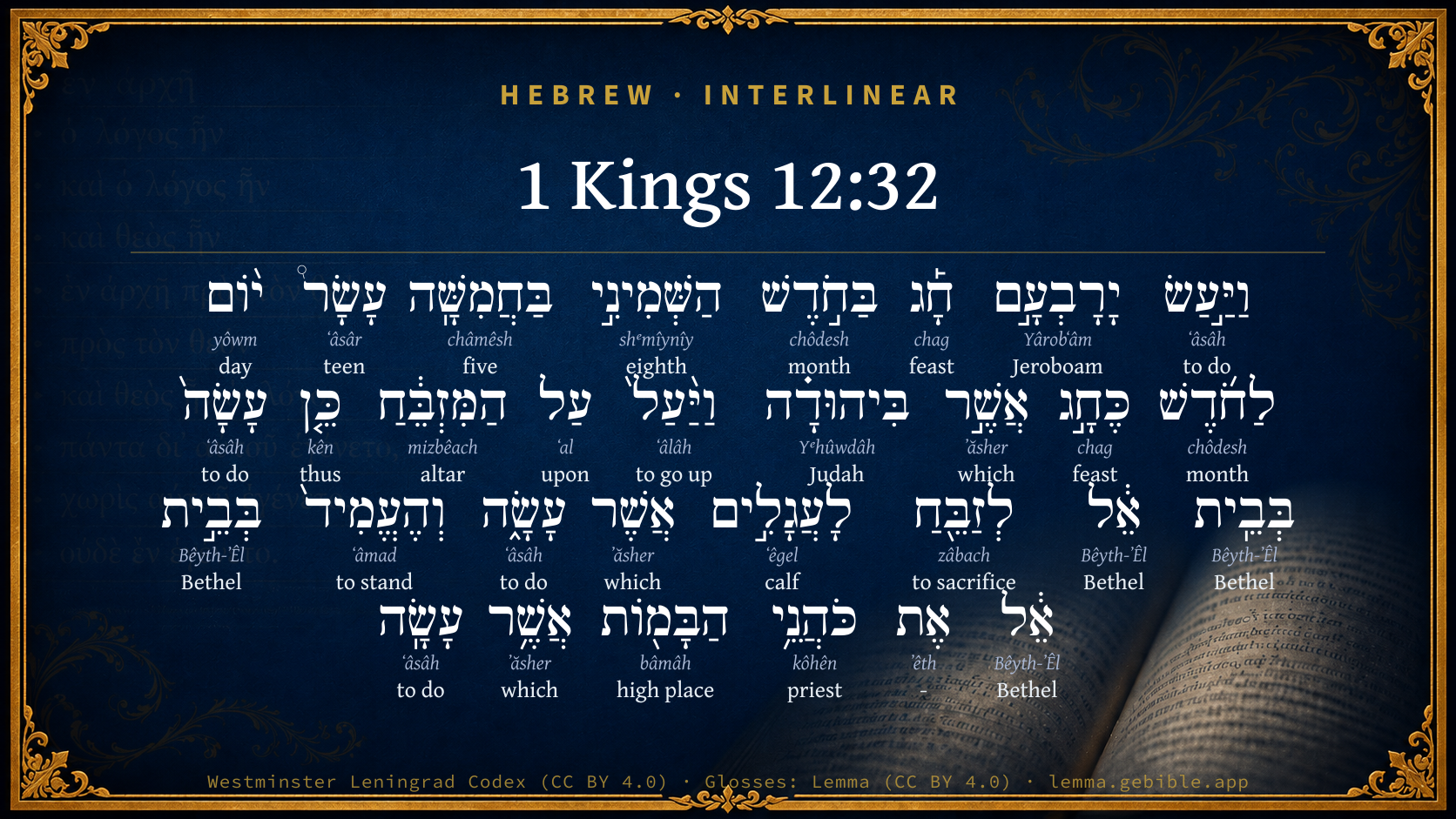
Hebrew (Westminster Leningrad Codex) 1 Kings 12:32 appears in the Hebrew Old Testament. The text above is from the Westminster Leningrad Codex. Each word links to its Strong’s number, a concise gloss, and parsing drawn from the Open Scriptures Hebrew Bible morphology. Click any word for its full Brown-Driver-Briggs (BDB) entry.
Download image
Cite this verse

1 Kings 12:32 (World English Bible). Public Domain. Lemma interlinear Bible study tool, https://lemma.gebible.app/v/1-kings/12/32.

Show BibTeX & RIS
BibTeX
RIS
English Translation
Jeroboam ordained a feast in the eighth month, on the fifteenth day of the month, like the feast that is in Judah, and he went up to the altar; so did he in Bethel, sacrificing to the calves that he had made: and he placed in Bethel the priests of the high places that he had made.
World English Bible · Public Domain
Download a study sheet

One document with this verse’s original text, its word-by-word gloss line, the meaning frame, cross-references with their text, attributed commentary, and full source and license credits — printable, and it pastes into notes with its structure intact.

This verse Autodidact and up

Study sheet (.html) Plain text (.txt)

A passage Seminary Student

Up to 50 verses in one chapter. A passage sheet keeps up to 6 commentary sources and 12 cross-references per verse, in the order this page ranks them, and says so on the sheet whenever that leaves anything out. Ask for a single verse and you get the Autodidact verse sheet above.

Everything on this page stays free to read, with no account — the sheet is a download of what is already on screen, not access to it.

Want to remove ads? Support Godless Engineer
Compare translations 3

The same verse in 3 English versions, stacked beneath the original-language interlinear above. Click any original word for its lexicon entry.

Each is an independent rendering of the whole verse — the interlinear is not word-aligned to these translations.

Highlighted words mark where these versions differ — a whole-verse word diff, not a word-by-word alignment.

  • World English Bible Public Domain
    Jeroboam ordained a feast in the eighth month, on the fifteenth day of the month, like the feast that is in Judah, and he went up to the altar; so did he in Bethel, sacrificing to the calves that he had made: and he placed in Bethel the priests of the high places that he had made.
  • King James Version Public Domain
    And Jeroboam ordained a feast in the eighth month, on the fifteenth day of the month, like unto the feast that is in Judah, and he offered upon the altar. So did he in Bethel, sacrificing unto the calves that he had made: and he placed in Bethel the priests of the high places which he had made.
  • unfoldingWord Literal Text CC BY-SA 4.0
    And Jeroboam made a feast in the eighth month, on the fifteenth day of the month, like the feast that in Judah, and he offered on the altar. Thus he did at Bethel, sacrificing to the calves that he had made. And he stationed at Bethel the priests of the high places that he had made.

unfoldingWord Literal Text — © unfoldingWord, licensed CC BY-SA 4.0. Word-aligned USFM3 via Door43 (git.door43.org/unfoldingWord/en_ult).

Versions to compare (up to 4)

3 of 4 selected

Show all 18 translations

Every available English version of this verse, each an independent rendering of the whole verse.

  • World English Bible Public Domain
    Jeroboam ordained a feast in the eighth month, on the fifteenth day of the month, like the feast that is in Judah, and he went up to the altar; so did he in Bethel, sacrificing to the calves that he had made: and he placed in Bethel the priests of the high places that he had made.
  • Berean Standard Bible Public Domain
    And Jeroboam ordained a feast on the fifteenth day of the eighth month, like the feast that was in Judah, and he offered sacrifices on the altar; he made this offering in Bethel to sacrifice to the calves he had set up, and he installed priests in Bethel for the high places he had set up.
  • Majority Standard Bible Public Domain
    And Jeroboam ordained a feast on the fifteenth day of the eighth month, like the feast that was in Judah, and he offered sacrifices on the altar; he made this offering in Bethel to sacrifice to the calves he had set up, and he installed priests in Bethel for the high places he had set up.
  • King James Version Public Domain
    And Jeroboam ordained a feast in the eighth month, on the fifteenth day of the month, like unto the feast that is in Judah, and he offered upon the altar. So did he in Bethel, sacrificing unto the calves that he had made: and he placed in Bethel the priests of the high places which he had made.
  • American Standard Version (1901) Public Domain
    And Jeroboam ordained a feast in the eighth month, on the fifteenth day of the month, like unto the feast that is in Judah, and he went up unto the altar; so did he in Beth-el, sacrificing unto the calves that he had made: and he placed in Beth-el the priests of the high places that he had made.
  • Revised Version (1885) Public Domain
    And Jeroboam ordained a feast in the eighth month, on the fifteenth day of the month, like unto the feast that is in Judah, and he went up unto the altar; so did he in Beth-el, sacrificing unto the calves that he had made: and he placed in Beth-el the priests of the high places which he had made.
  • Geneva Bible (1599) Public Domain
    And Ieroboam made a feast the fifteenth day of the eight moneth, like vnto the feast that is in Iudah, and offred on the altar. So did he in Beth-el and offered vnto the calues that he had made: and he placed in Beth-el the Priestes of the hie places, which he had made.
  • Douay-Rheims (1899) Public Domain
    And he appointed a feast in the eighth month, on the fifteenth day of the month, after the manner of the feast that was celebrated in Juda. And going up to the altar, he did in like manner in Bethel, to sacrifice to the calves, which he had made: and he placed in Bethel priests of the high places, which he had made.
  • Young's Literal Translation Public Domain
    and Jeroboam maketh a festival in the eighth month, in the fifteenth day of the month, like the festival that `is' in Judah, and he offereth on the altar -- so did he in Beth-El -- to sacrifice to the calves which he made, and he hath appointed in Beth-El the priests of the high places that he made.
  • Literal Standard Version CC BY-SA 4.0
    and Jeroboam makes a festival in the eighth month, on the fifteenth day of the month, like the festival that [is] in Judah, and he offers on the altar—so he did in Beth-El—to sacrifice to the calves which he made, and he has appointed in Beth-El the priests of the high places that he made.
  • Unlocked Literal Bible CC BY-SA 4.0
    Jeroboam ordained a feast in the eighth month, on the fifteenth day of the month, like the feast that is in Judah, and he went up to the altar. He did so at Bethel, sacrificing to the calves that he had made, and he placed in Bethel the priests of the high places he had made.
  • unfoldingWord Literal Text CC BY-SA 4.0
    And Jeroboam made a feast in the eighth month, on the fifteenth day of the month, like the feast that in Judah, and he offered on the altar. Thus he did at Bethel, sacrificing to the calves that he had made. And he stationed at Bethel the priests of the high places that he had made.
  • Darby Bible Public Domain
    And Jeroboam ordained a feast in the eighth month, on the fifteenth day of the month, like the feast that was in Judah, and he offered upon the altar. So did he in Bethel, sacrificing to the calves that he had made; and he placed in Bethel the priests of the high places that he had made.
  • World Messianic Bible Public Domain
    Jeroboam ordained a feast in the eighth month, on the fifteenth day of the month, like the feast that is in Judah, and he went up to the altar. He did so in Bethel, sacrificing to the calves that he had made, and he placed in Bethel the priests of the high places that he had made.
  • Webster's Bible Public Domain
    And Jeroboam ordained a feast in the eighth month, on the fifteenth day of the month, like the feast that is in Judah, and he offered upon the altar. So did he in Beth-el, sacrificing to the calves that he had made: and he placed in Beth-el the priests of the high places which he had made.
  • Free Bible Version CC BY-SA 4.0
    Jeroboam initiated a festival on the fifteenth day of the eighth month, just like the festival held in Judah, and he offered sacrifices on the altar. He made this offering in Bethel, sacrificing to the calves he had made, and appointed priests in Bethel for the high places he had built.
  • Bible in Basic English Public Domain
    And Jeroboam gave orders for a feast in the eighth month, on the fifteenth day of the month, like the feast which is kept in Judah, and he went up to the altar. And in the same way, in Beth-el, he gave offerings to the oxen which he had made, placing in Beth-el the priests of the high places he had made.
  • JPS Tanakh (1917) Public Domain
    And Jeroboam ordained a feast in the eighth month, on the fifteenth day of the month, like unto the feast that is in Judah, and he went up unto the altar; so did he in Beth-el, to sacrifice unto the calves that he had made; and he placed in Beth-el the priests of the high places that he had made.

Literal Standard Version (2020), Covenant Press — licensed CC BY-SA 4.0. Text via the HelloAO Bible API (eBible.org). Unlocked Literal Bible (unfoldingWord) — licensed CC BY-SA 4.0. Text via the HelloAO Bible API (eBible.org). unfoldingWord Literal Text — © unfoldingWord, licensed CC BY-SA 4.0. Word-aligned USFM3 via Door43 (git.door43.org/unfoldingWord/en_ult). Free Bible Version, Dr. Jonathan Gallagher — licensed CC BY-SA 4.0. Text via the HelloAO Bible API (eBible.org).

Word by word

More ways to search: Search by grammar → Find every occurrence → Compare this word →

Practice this passage: Drill this verse → Learn its vocabulary →

הַשְּׁמִינִ֣י
shᵉmîynîy
H8066
“the · eighth”
Particle, Definite Article + Adjective, Ordinal number, Masculine, Singular, Absolute
Part of Speech
Particle + Adjective
Type
Ordinal number
Gender
Masculine
Number
Singular
State
Absolute
Full BDB Definition

Origin: from H8083

TWOT: 2411c

eighth (ordinal number)
  1. וַיַּ֣עַשׂ ʻâsâh H6213 “and · to do” Conjunction + Verb, Qal, Sequential Imperfect, 3rd Person, Masculine, Singular
  2. יָרָבְעָ֣ם Yârobʻâm H3379 “Jeroboam” Noun, Proper
  3. חָ֡ג chag H2282 “feast” Noun, Common, Masculine, Singular, Absolute
  4. בַּחֹ֣דֶשׁ chôdesh H2320 “in/at the · month” Preposition, Determined + Noun, Common, Masculine, Singular, Absolute
  5. בַּחֲמִשָּֽׁה châmêsh H2568 “in/at the · five” Preposition, Determined + Adjective, Cardinal number, Masculine, Singular, Absolute
  6. עָשָׂר֩ ʻâsâr H6240 “teen” Adjective, Cardinal number, Masculine, Singular, Absolute
  7. י֨וֹם yôwm H3117 “day” Noun, Common, Masculine, Singular, Absolute
  8. לַחֹ֜דֶשׁ chôdesh H2320 “to/for the · month” Preposition, Determined + Noun, Common, Masculine, Singular, Absolute
  9. כֶּחָ֣ג chag H2282 “like/as the · feast” Preposition, Determined + Noun, Common, Masculine, Singular, Absolute
  10. אֲשֶׁ֣ר ʼăsher H834 “which” Particle, Relative
  11. בִּיהוּדָ֗ה Yᵉhûwdâh H3063 “in/at · Judah” Preposition + Noun, Proper
  12. וַיַּ֨עַל֙ ʻâlâh H5927 “and · to go up” Conjunction + Verb, Hiphil, Sequential Imperfect, 3rd Person, Masculine, Singular
  13. עַל ʻal H5921 “upon” Preposition
  14. הַמִּזְבֵּ֔חַ mizbêach H4196 “the · altar” Particle, Definite Article + Noun, Common, Masculine, Singular, Absolute
  15. כֵּ֤ן kên H3651 “thus” Particle, Demonstrative
  16. עָשָׂה֙ ʻâsâh H6213 “to do” Verb, Qal, Perfect, 3rd Person, Masculine, Singular
  17. בְּבֵֽית Bêyth-ʼÊl H1008 “in/at · Bethel” Preposition + Noun, Proper
  18. אֵ֔ל Bêyth-ʼÊl H1008 “Bethel” Noun, Proper
  19. לְזַבֵּ֖חַ zâbach H2076 “to sacrifice” Preposition + Verb, Piel, Infinitive Construct
  20. לָעֲגָלִ֣ים ʻêgel H5695 “to/for the · calves” Preposition, Determined + Noun, Common, Masculine, Plural, Absolute
  21. אֲשֶׁר ʼăsher H834 “which” Particle, Relative
  22. עָשָׂ֑ה ʻâsâh H6213 “to do” Verb, Qal, Perfect, 3rd Person, Masculine, Singular
  23. וְהֶעֱמִיד֙ ʻâmad H5975 “and · to stand” Conjunction + Verb, Hiphil, Perfect, 3rd Person, Masculine, Singular
  24. בְּבֵ֣ית Bêyth-ʼÊl H1008 “in/at · Bethel” Preposition + Noun, Proper
  25. אֵ֔ל Bêyth-ʼÊl H1008 “Bethel” Noun, Proper
  26. אֶת ʼêth H853 “-” Particle, Direct Object
  27. כֹּהֲנֵ֥י kôhên H3548 “priests of” Noun, Common, Masculine, Plural, Construct
  28. הַבָּמ֖וֹת bâmâh H1116 “the · high places” Particle, Definite Article + Noun, Common, Feminine, Plural, Absolute
  29. אֲשֶׁ֥ר ʼăsher H834 “which” Particle, Relative
  30. עָשָֽׂה ʻâsâh H6213 “to do” Verb, Qal, Perfect, 3rd Person, Masculine, Singular

About this verse

These counts appear in no published source. They are computed here, from the morphology-tagged text and Lemma’s own curated glosses. What Lemma adds →

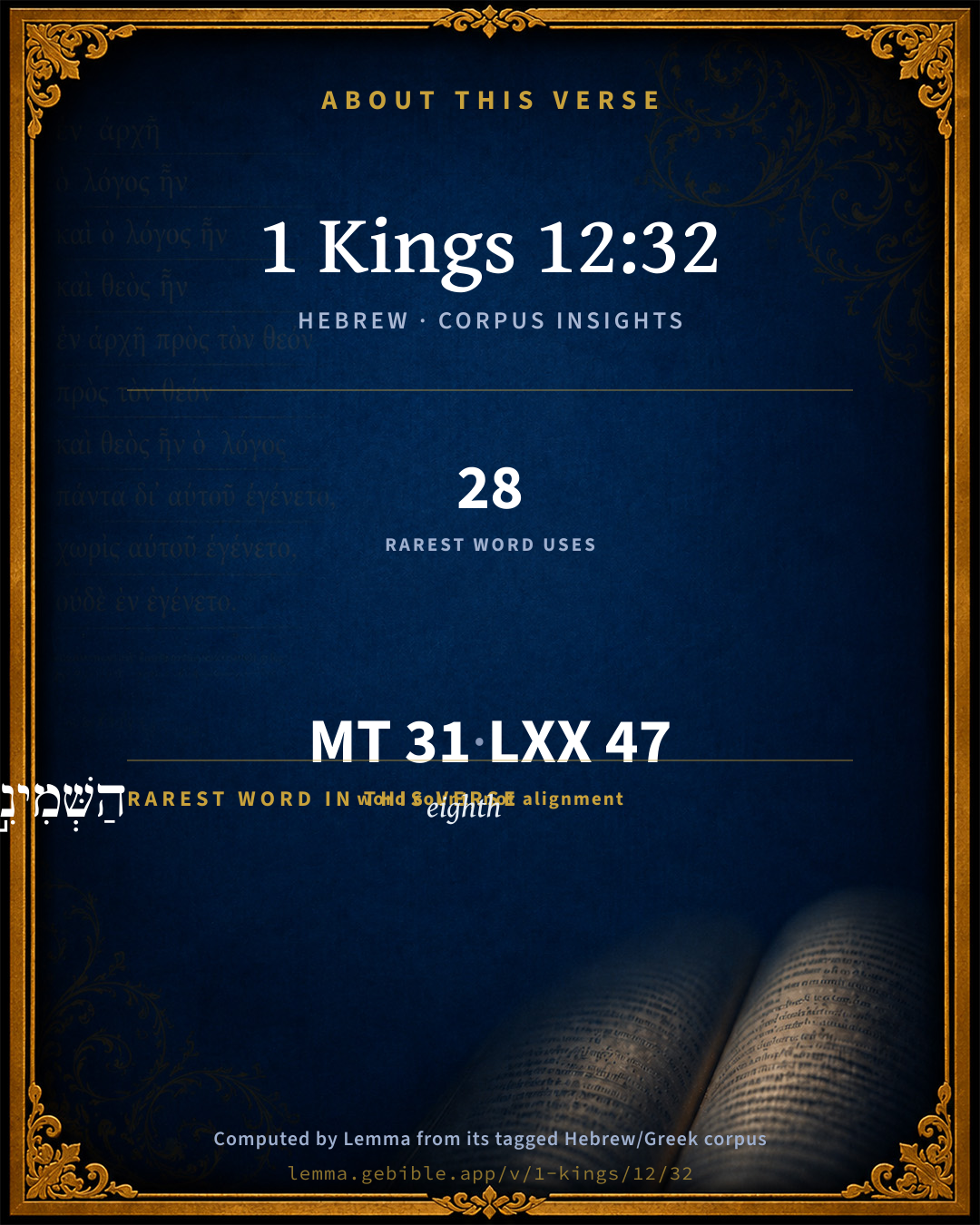
31
words
21
distinct lemmas
Historical
section

Shared distinctive vocabulary

הַשְּׁמִינִ֣י eighth H8066 occurs in 27 verses of the Hebrew Bible. Also found in:

Grammatical profile

  • 7 verbs
  • 15 nouns
  • 3 adjectives
  • 1 preposition
  • 5 particles

Verb forms

  • וַיַּ֣עַשׂ Qal · Sequential Imperfect
  • וַיַּ֨עַל֙ Hiphil · Sequential Imperfect
  • עָשָׂה֙ Qal · Perfect
  • לְזַבֵּ֖חַ Piel · Infinitive Construct
  • עָשָׂ֑ה Qal · Perfect
  • וְהֶעֱמִיד֙ Hiphil · Perfect
  • עָשָֽׂה Qal · Perfect

Repetition

Words recur within this verse — often emphatic in Hebrew:

  • וַיַּ֣עַשׂ to do H6213 ×4
  • בְּבֵֽית Bethel H1008 ×4
  • חָ֡ג feast H2282 ×2
  • בַּחֹ֣דֶשׁ month H2320 ×2
  • אֲשֶׁ֣ר which H834 ×3

Hebrew & Septuagint length

In English translation the verse runs 57 words from the Hebrew and 25 from the Septuagint (LXX English) — the Septuagint runs noticeably shorter here. See the side-by-side →

A rough comparison of the two English renderings, which tokenize alike — not a word-level alignment.

Word counts can differ between the Hebrew and the Greek without any difference in meaning — e.g. the Hebrew direct-object marker אֵת has no separate Greek word, and Greek often adds the article ὁ.

In the original languages it is 31 Hebrew tokens and 47 Greek tokens — but the two are counted differently (Hebrew bundles its prefixes and suffixes into one token; the Greek is in lemma form), so that isn’t a like-for-like length.

Cross-references

7

Topical passages linked to 1 Kings 12:32 in the Treasury of Scripture Knowledge — connected by theme and wording, ordered by reader-vote popularity; previews shown in the World English Bible.

  • Numbers 29:12–40 On the fifteenth day of the seventh month you shall have a holy convocation; you shall do no servile work, and you shall keep a feast to Yahweh seven days:
  • 1 Kings 8:2 All the men of Israel assembled themselves to king Solomon at the feast, in the month Ethanim, which is the seventh month.
  • 1 Kings 8:5 King Solomon and all the congregation of Israel, who were assembled to him, were with him before the ark, sacrificing sheep and oxen, that could not be counted nor numbered for multitude.
  • Amos 7:10–13 Then Amaziah the priest of Beth El sent to Jeroboam king of Israel, saying, "Amos has conspired against you in the midst of the house of Israel. The land is not able to bear all his words.
  • Leviticus 23:33–44 Yahweh spoke to Moses, saying,
  • Ezekiel 43:8 in their setting of their threshold by my threshold, and their door-post beside my door-post, and there was [but] the wall between me and them; and they have defiled my holy name by their abominations which they have committed: therefore I have consumed them in my anger.
  • Matthew 15:8–9 'These people draw near to me with their mouth, And honor me with their lips; But their heart is far from me.

Cross-references courtesy of OpenBible.info (CC BY 4.0).

Hebrew and Greek witnesses Masoretic Hebrew ↔ Greek Septuagint

The same verse in the two great witnesses to the Old Testament, shown verse-for-verse.

Here the Septuagint runs noticeably shorter than the Hebrew — LXX2012 (modern English Septuagint) 25 words vs World English Bible 57. A rough length comparison of the two English translations, not a word-level alignment — read both below.

These are two independent witnesses, not word-aligned to each other, and the Septuagint is shown in lemma (dictionary) form.

Hebrew 1 Kings 12:32 Masoretic · Westminster Leningrad Codex

וַיַּ֣עַשׂ יָרָבְעָ֣ם חָ֡ג בַּחֹ֣דֶשׁ הַשְּׁמִינִ֣י בַּחֲמִשָּֽׁה עָשָׂר֩ י֨וֹם לַחֹ֜דֶשׁ כֶּחָ֣ג אֲשֶׁ֣ר בִּיהוּדָ֗ה וַיַּ֨עַל֙ עַל הַמִּזְבֵּ֔חַ כֵּ֤ן עָשָׂה֙ בְּבֵֽית אֵ֔ל לְזַבֵּ֖חַ לָעֲגָלִ֣ים אֲשֶׁר עָשָׂ֑ה וְהֶעֱמִיד֙ בְּבֵ֣ית אֵ֔ל אֶת כֹּהֲנֵ֥י הַבָּמ֖וֹת אֲשֶׁ֥ר עָשָֽׂה

Jeroboam ordained a feast in the eighth month, on the fifteenth day of the month, like the feast that is in Judah, and he went up to the altar; so did he in Bethel, sacrificing to the calves that he had made: and he placed in Bethel the priests of the high places that he had made.

World English Bible · Public Domain

Greek LXX 1 Kings 12:32 Septuagint · lemma form

καί ποιέω ιεροβοαμ ἑορτή ἐν ὁ μήν ὁ ὄγδοος ἐν ὁ πεντεκαιδέκατος ἡμέρα ὁ μήν κατά ὁ ἑορτή ὁ ἐν γῆ ιουδα καί ἀναβαίνω ἐπί ὁ θυσιαστήριον ὅς ποιέω ἐν βαιθηλ ὁ θύω ὁ δάμαλις ὅς ποιέω καί παραἵστημι ἐν βαιθηλ ὁ ἱερεύς ὁ ὑψηλός ὅς ποιέω

And Jeroboam appointed a feast in the eighth month, on the fifteenth day of the month, according to the feast in the land of Juda;

LXX2012 (modern English Septuagint) · Public Domain

On this verse, The Pulpit Commentary discusses the Septuagint’s reading. Read the note in Commentary ↓

Hebrew: Westminster Leningrad Codex (CC BY 4.0). Greek: Septuagint (public domain); English from LXX2012 (modern English Septuagint) (Public Domain). How the Septuagint differs from the Hebrew →

Targum (Aramaic paraphrase)

1

The Targum is the ancient Jewish Aramaic paraphrase of the Hebrew Scriptures — an interpretive translation, not the Hebrew text itself. Onkelos (literal) and Pseudo-Jonathan (expansive) render the Torah, and Jonathan the Prophets. Coverage is partial: where no permissively-licensed English translation exists for a verse, only the Aramaic is shown. This is verse-level text, not a word-by-word alignment to the Hebrew.

  1. Targum Jonathan Prophets (Joshua–Malachi)
    וַעֲבַד יָרָבְעָם חַגָא בְּיַרְחָא תְמִינָאָה בְּחַמְשָׁא עַסְרָא יוֹמָא לְיַרְחָא כְּחַגָא דְשִׁבְטָא דִיהוּדָה וְאַסֵיק עַל אֱגוֹרָא כֵּן עֲבַד בְּבֵית אֵל לְדַבְּחָא לְעֶגְלַיָא דִי עֲבַד וַאֲקֵים בְּבֵית אֵל יַת כּוּמָרֵי בְמָתָא דִי עֲבַד:

    (no public-domain English translation for this verse)

    Targum Jonathan — Aramaic: “Mikraot Gedolot” (public domain). English: “Sefaria Community Translation” (CC0 1.0 (public-domain dedication)); “London "Chaldee Paraphrase," 1871” (public domain). Text via Sefaria.

Commentary

Notes on 1 Kings 12:32 from classic Christian and Jewish commentators (each source and its license shown beneath its notes). The classic Christian expositions comment on the surrounding passage and are grouped to its opening verse, so a note may address several verses; the Jewish commentaries on the Tanakh (Rashi and others) are per-verse, so they appear only where the commentator wrote on this verse.

Lemma curates 59 commentaries, every one of them public domain or Creative Commons licensed, each selected and text-cleaned for this edition rather than reprinted as found. About our sources →

Trapp's Complete Commentary

John Trapp

1Ki 12:32 And Jeroboam ordained a feast in the eighth month, on the fifteenth day of the month, like unto the feast that [is] in Judah, and he offered upon the altar. So did he in Bethel, sacrificing unto the calves that he had made: and he placed in Bethel the priests of the high places which he had made.

Ver. 32. Like unto the feast,] viz., The feast of tabernacles, but not in the same month. Satan Dei simia:

“ Simia quam similis turpissima bestia nobis! ” - Ennius.

John Trapp, A Commentary or Exposition upon All the Books of the Old and New Testament (1647–1656) — public domain. Text from a community e-Sword module.

Joseph Benson's Commentary

1Ki 12:32. Jeroboam ordained a feast on the eighth month, &c. — The feast of tabernacles; which by the law was to be celebrated on the fifteenth day of the seventh month. His chief intention in this change, no doubt, was to alienate the people from the rites observed at Jerusalem. “Some suppose, with Mr. Locke, that as this feast was appointed by God to be observed after the gathering in of the fruits, which might be sooner ripe about Jerusalem than in the northern parts of the country; so Jeroboam might pretend that the eighth month would be a better time for it than the seventh, because then they would everywhere be gathered.” Add to this, he might possibly have two other reasons for making this alteration: 1st, Lest he should seem directly to oppose the God of Israel, who had in a special manner commanded all the people to go up to Jerusalem on the fifteenth day of the seventh month, if he should require their attendance to celebrate the feast elsewhere at the same time: and, 2d, That by appointing his feast to be kept a month after that at Jerusalem was past, he might give those of the people of Judah an opportunity of attending it, whose curiosity might lead them so to do; and thereby might ensure the presence of a greater concourse of people to honour his institution. On the fifteenth day — And so forward till the seven days were ended. Like that in Judah — From whence he took his pattern, to show that he worshipped the same God, and professed the same religion, for substance, which they did, however he differed in circumstances. He offered upon the altar — With his own hands, as appears from 1Ki 13:1-4, which he did to give the more countenance to his newly-devised solemnity. And it is no marvel, that he, who assumed a power to make priests, should undertake to do the priests’ work with his own hands. So he (Jeroboam) did in Beth-el — Sacrificing there also, as well as in Dan, to the calves that he had made — Or, to Jehovah, as he pretended, under the image of these calves. And he placed in Beth-el the priests of the high places — Having built a house or temple there also, as well as in Dan, and set up many altars in it where these priests officiated, as was done in other high places.

Joseph Benson's Commentary on the Old and New Testaments (1811–1818) — public domain. Text from a community e-Sword module.

Tyndale Open Study Notes

Tyndale Open Resources

12:32-33 Replacing the Festival of Shelters, Israel’s crowning ceremonial feast in the seventh month, with the festival in Bethel also violated the law (Deut 16:13-15). The imitation observance one month later during the eighth month may have coincided with the end of the Canaanite agricultural year. Jeroboam’s false religious practices led to Israel’s downfall (2 Kgs 17:22). • Jeroboam’s offering of sacrifices on the altar at Bethel set a bad precedent in spiritual leadership.

Tyndale Open Study Notes — © Tyndale Open Resources, licensed CC BY-SA 4.0. Text via the HelloAO Bible API.

Geneva Bible (1599)

Geneva Bible translators

Because he would the more bind the people’s devotion to his idolatry, he made a new holy day, besides those that the Lord had appointed in the Law.

Geneva Bible (1599) marginal notes — public domain. Text via Bolls.life.

Adam Clarke's Commentary

Verse 32. Ordained a feast] The Jews held their feast of tabernacles on the fifteenth day of the seventh month; Jeroboam, who would meet the prejudices of the people as far as he could, appointed a similar feast on the fifteenth of the eighth month; thus appearing to hold the thing while he subverted the ordinance.

Adam Clarke's Commentary on the Bible (1810–1826) — public domain. Text from a community e-Sword/MySword module.

Ellicott's Commentary for English Readers

(32) In the eighth month, on the fifteenth day of the month . . .—The “feast that was in Judah,” to which this is said to be like, is clearly the Feast of Tabernacles, on the fifteenth day of the seventh month. The fixing of Jeroboam’s festival of dedication for the Temple at Bethel to this special day is characteristic. It at once challenged likeness to the Feast of Tabernacles, which was (see 1Ki_8:2) the occasion of Solomon’s dedication at Jerusalem, and yet took liberty to alter the date, and fix it in the month “which he had devised of his own heart,” thus assuming the right to set aside the letter of the old law, while professing still to observe the worship of Jehovah.

Offered—or (see margin) went up—upon the altar.—The expression seems to imply that he ventured on a still greater innovation by taking on himself both functions of the priestly office—to offer sacrifice and (see 1Ki_12:33) to burn incense. This is not, indeed, necessarily implied; for (see 1Ki_8:63) the sacrificer is often said to offer, when he evidently does so only through the priests. But Jeroboam had set aside the peculiar sanctity of the Levitical priesthood already; and so was very naturally prepared to crown this process by acting as head of the unauthorised priesthood which he had created. Perhaps he had witnessed the exclusive prominence of Solomon at the great dedication festival, and desired to imitate and outdo it.

A Bible Commentary for English Readers, edited by Charles John Ellicott (1878–1897) — public domain. Text from a community e-Sword module.

The Cambridge Bible for Schools and Colleges

gen. ed. J. J. S. Perowne

32. And Jeroboam ordained a feast] This was intended to be a set-off for the Feast of Tabernacles, of the celebration of which, in Jerusalem, Jeroboam had been so much in fear.

in the eighth month on the fifteenth day] The Feast of Tabernacles was on the fifteenth day of the seventh month (Lev_23:34). Jeroboam came as near as he could but chose a later month, perhaps induced to do so because the harvest-celebration kept at the Feast of Tabernacles could be very well placed later in the northern part of the land. Josephus (Ant. VIII. 8. 5) says, contrary to all other authorities, that Jeroboam’s feast was in the seventh month.

and he offered upon the altar] The verb sometimes means ‘to go up unto,’ and this is represented on the margin of A. V. The text and margin change places in R.V., because the sacrificing is spoken of in the words which immediately follow. Read, he went up unto, and so twice over in 1Ki_12:33.

so did he in Beth-el] The king himself took part in the dedication of the southern high place. The more distant Dan perhaps was inaugurated by some of the newly-made priests. Thus Jeroboam in some degree imitated Solomon’s dedication of the Temple.

The Cambridge Bible for Schools and Colleges (gen. ed. J. J. S. Perowne; Cambridge University Press, 1878–1918) — public domain. Text from a community e-Sword module.

Albert Barnes' Notes on the Bible

A feast - Intended as a substitute for the Feast of tabernacles (marginal reference “c”). It may also have assumed the character of a feast of dedication, held at the same time, after the example of Solomon 1Ki 8:2. His object in changing the month from the seventh to the eighth, and yet keeping the day of the month, is not clear. Perhaps it was on account of the later vintage of the more northern regions. It is remarkable that Josephus places the scene in the “seventh” month. He therefore, was not aware that the people of Israel kept the feast of tabernacles a month later than their brethren of Judah. The expression “he offered upon the altar” (see the margin and Exo 20:26) shows that Jeroboam himself officiated as priest, and offered this sacrifice - at Bethel, not at Dan; where it is possible that the priests descended from Jonathan, the son of Gershom and grandson of Moses, undertook the services (Jdg 18:30 note).

Albert Barnes' Notes on the Bible (1834–1885) — public domain. Text from a community e-Sword/MySword module.

Haydock's Catholic Bible Commentary

Day. God had prescribed the seventh month, (Calmet) and this wicked prince purposely made choice of another, that the observance of the days appointed might be obliterated. Thus the Jacobins, in France, decreed that the tenth day should be the day of rest, instead of Sunday. (Haydock) --- Religious assemblies tend greatly to promote the spirit of concord and peace.

George Leo Haydock (1774–1849), Haydock's Catholic Family Bible and Commentary, 1859 edition — public domain. Excludes Psalms (Douay-Rheims chapter numbering differs from Protestant) and Deuterocanonical books (Catholic canon only).

Matthew Poole's English Annotations

Either,

1. A feast of dedication, like that which was in Judah, at the dedication of the temple. Or rather,

2. The feast of tabernacles, as may be thought, 1. Because that began on the fifteenth day of the month, Lev 23:34.

2. Because he is not blamed for devising the feast, (which thereby seems to have been of God’s appointment,) but only for devising the month, 1Ki 12:33; for keeping God’s feast, not in God’s time, which was the fifteenth day of the seventh month, and so onward, Lev 23:34; but on the fifteenth day of the eighth month. And this alteration he made, either,

1. To keep up the difference between his subjects and those of Judah, as by the differing manners, so by the distinct times of their worship. Or,

2. Lest he should seem directly to oppose the God of Israel, (who had in a special manner obliged all the people to go up to Jerusalem at that time, Deu 16:16) by requiring their attendance to celebrate the feast elsewhere at the same time. Or,

3. To engage as many persons as possibly he could to come to his feast; which they would more willingly do, when the feast at Jerusalem was past, and all the fruits of the earth were most perfectly gathered in.

On the fifteenth day of the month; and so onward till the seven days ended. He took his pattern thence, to show that he worshipped the same God, and professed the same religion for substance, which they did; howsoever he differed in circumstances, as here he did in the time.

He offered; either,

1. By his priests. Or rather,

2. By his own hands; as appears from 1Ki 13:1,4; which he did, to give the more countenance to his new-devised solemnity. Nor is this strange; for he might plausibly think, that he who by his own authority had made others priests, might much more exercise a part of that office; at least, upon an extraordinary occasion; in which case he knew David himself had done some things, which otherwise he might not do.

So did he in Beth-el, i.e. he himself did offer there in like manner, as he now had done at Dan.

Unto the calves; for they were two, 1Ki 12:29.

He placed in Beth-el the priests; as he had done at Dan, 1Ki 12:31.

Matthew Poole's English Annotations on the Holy Bible (1683–1685) — public domain. Text from a community e-Sword/MySword module.

Whedon's Commentary on the Bible

Daniel D. Whedon

32. A feast in the eighth month — Solomon fixed upon the feast of tabernacles in the seventh mouth (1Ki_8:2) for the dedication of the temple, and Jeroboam selects the same feast for the dedication of his house at the high place in Beth-el, but he ordains that it be held a month later there than it was in Judah. “A plausible occasion for this arbitrary deviation from the law, which repeatedly names the seventh month as the time appointed of the Lord, (Lev_23:34; Lev_23:39; Lev_23:41,) might be found in the circumstance that in the northern districts of his kingdom the grain ripened at least a month later than in the southern Judah, and this festival was to be kept at the ingathering of the fruit of the land.” — Keil.

The fifteenth day — “He adhered to the day of the month,” says the same writer, “on account of the weak, who might take offence at the innovations.”

The feast that is in Judah — The feast of tabernacles, that continued to be celebrated in Judah according to the law.

He offered upon the altar — This need not be pressed to mean that Jeroboam himself offered the sacrifices at Beth-el, any more than 1Ki_8:63-64, to show that Solomon did the same. The ministry of the priests is to be supposed in either case. But with Jeroboam, who had already gone so far as to ordain priests contrary to the law, it were no strange thing to even sacrilegiously perform with his own hand the sacred duties of the priesthood, and 1Ki_13:1; 1Ki_13:4, seem quite clearly to indicate that he did at least burn the incense himself.

So he did in Beth-el — The frequent mention of Beth-el in this passage shows that it was regarded as the more important of the two high places.

Daniel D. Whedon (gen. ed.), Commentary on the Old and New Testaments (1874–1909) — public domain. Text from a community e-Sword module.

The Pulpit Commentary

And Jeroboam ordained a feast in the eighth month, on the fifteenth day of the month, like unto the feast that is in Judah i.e. , the Feast of Tabernacles, which was held on the 15th of the seventh month. (1Ki_8:2) This was the great feast of the year, and, as the feast of harvest or ingathering, the most joyous. See on 1Ki_8:1. Had Jeroboam provided no counter attraction to this great festive gathering in Judah he might have found it a formidable temptation to his subjects. The reason usually given for the alteration of the time in defiance of the law, which expressly fixed it in the seventh month (Lev_23:34, Lev_23:39, Lev_23:41) is that the eighth would be more generally convenient in the north,where the harvest or vintage was a month later (Then., Keil), as affording more time for the ingathering. In favour of this view is the consideration that the Jews not unfrequently had to intercalate a month a second Adar into their year, because of the season being a late one. Some of theolder commentators, e.g., Vatab., think this time was chosen as the anniversary of his secession, but this is pure conjecture, and such an association would be contrary to the genius of the Hebrew people. Keil maintains that Jeroboam"s design was to "make the separation, in a religious point of view, as complete as possible." But we can hardly be expected to believe that he altered the month, for the sake of creating a distinction, but "retained the day of the month, the fifteenth, for the sake of the weak who took offence at his innovations" (Keil). The day was retained, as Bahr points out, because, the months being lunar, the fifteenth was the day of the full moon, and he offered Heb. as marg., and he went up," i.e., ascended the altar; LXX ajnebh. (Keil contends that lYw means "and he sacrificed," but this translation is without precedent. Ver. 33, "and he went up to burn incense is decisive as to the meaning.) the altar was always raised. It was probably approached by s slope, as Exo_20:26 forbade steps, though it is by no means certain that they were not used even in Solomon"s temple, and Jeroboam probably would have no scruples on such a minute point of ritual. It has been thought (Kitto, 4:147) that he was moved to officiate in person by the precedent of the Egyptian kings, who exercised priestly functions; but it is much more probable that he was guided by the example of Solomon at the dedication of the temple upon i.e., he stood upon the ledge or platform (called in the A.V "compass," Exo_27:5) in the middle of the altar the altar. So did he in Bethel i.e., the feast was held at one centre only, and at Bethel alone the king offered in person. But I venture to suggest that instead of Ke, "so did he," etc., we should read yKi. The LXX seem to have had this word before them ejpi torion o) epoihsen ejn baiqhl. And not only does this slight change bring the Hebrew into harmony with the LXX, but it also simplifies the construction. "He went up upon the altar which he made to sacrifice unto the calves which he made." The very tautology is instructive, as suggesting that altar, calves, and priests were all of Jeroboam"s making, not of God"s ordaining. The use of yK as a relative (=rva) is strictly grammatical, sacrificing marg., to sacrifice unto the calves that he had made: and he placed in Bethel Dan being already provided with its priesthood the priests of the high places i.e., of "the house of high places" (ver. 31). Or it may be a contemptuous designation of Jeroboam"s irregular priests which he had made.

The Pulpit Commentary (1880–1919), ed. H.D.M. Spence-Jones & Joseph S. Exell — public domain. Text from a community e-Sword module.

John Wesley's Explanatory Notes

A feast - The feast of tabernacles. So he would keep God's feast, not in God's time, which was the fifteenth day of the seventh month, and so onward, Levit xxiii, 34, but on the fifteenth day of the eighth month. And this alteration he made, either,

1. to keep up the difference between his subjects, and those of Judah as by the differing manners, so by the distinct times of their worship. Or,

2. lest he should seem directly to oppose the God of Israel, (who had in a special manner obliged all the people to go up to Jerusalem at that time,) by requiring their attendance to celebrate the feast elsewhere, at the same time. Or,

3. to engage as many persons as possibly he could, to come to his feast; which they would more willingly do when the feast at Jerusalem was past and all the fruits of the earth were perfectly gathered in. Fifteenth day - And so onward till the seven days ended. Like that in Judah - He took his pattern thence, to shew, that he worshipped the same God, and professed the same religion for substance, which they did: howsoever he differed in circumstances. He offered - Either,

1. by his priests. Or, rather,

2. by his own hands; as appears from chap. xiii, 1, 4, which he did, to give the more countenance to his new-devised solemnity. Nor is this strange; for he might plausibly think, that he who by his own authority had made others priests might much more exercise a part of that office; at least, upon an extraordinary occasion; in which case, he knew David himself had done some things, which otherwise he might not do. So he did - He himself did offer there in like manner, as he now had done at Dan.

John Wesley, Explanatory Notes Upon the Whole Bible (1754–1765) — public domain. Text via the GEBible commentary corpus.

Scofield Reference Notes

C. I. Scofield

eighth month i.e. November. 1Ki 12:33.

altar See 1Ki 12:25-33; Deu 12:4-14. (See Scofield "Amo 4:4").

The Scofield Reference Bible (1917 edition), notes by C. I. Scofield — public domain. Text from a community e-Sword module.

Lesson kit

Teaching starters — assembled from the data on this page, not authored interpretation. Every prompt links to the verse data it draws on. Edit before teaching.

1 Kings, in the Historical, opens this verse with 31 words (21 distinct Hebrew lemmas). Its most distinctive word is shᵉmîynîy (“eighth”). The Greek Septuagint runs shorter here. A historical commentator’s framing appears above. Read the whole chapter for the surrounding context.

Discussion questions

  1. How does “eighth” (shᵉmîynîy) shape what this verse is saying?
  2. How does Exodus 22:30, which shares the word «eighth», read alongside this verse?
  3. What does the repetition of “to do” (4× in this one verse) do in this verse?
  4. The Septuagint runs shorter here than the Hebrew. What might account for the difference?
  5. These translations render this verse differently; the difference is in the English rendering, not the original. What questions does that raise?
  6. «וַיַּ֣עַשׂ» is a Qal Sequential Imperfect verb. How does that grammatical form shape the action described?
  7. Compare how Trapp's Complete Commentary and Joseph Benson's Commentary read this verse. Where do they agree or differ?

Things to notice

Reading settings

Reading text

Shown beneath each verse's original-language words.

Old Testament
Old Testament edition

Read the OT as the Masoretic Hebrew (MT) or the Greek Septuagint (LXX).

English shown for the Greek Septuagint (in the Hebrew ↔ Greek comparison).

Comparing translations? Open the Compare panel on any verse page to stack up to four side by side.