Ezekiel 45:20

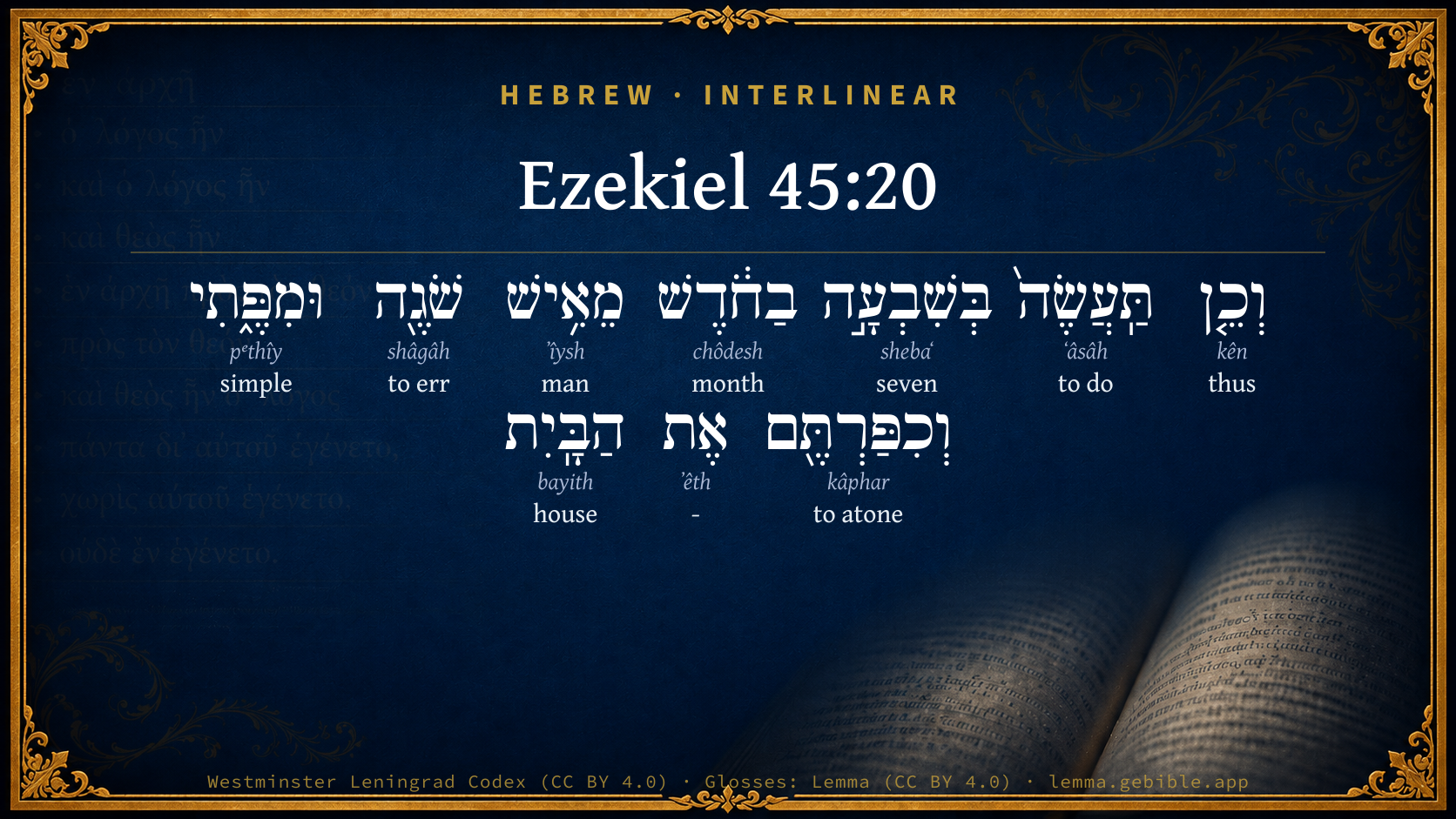
Hebrew (Westminster Leningrad Codex) Ezekiel 45:20 appears in the Hebrew Old Testament. The text above is from the Westminster Leningrad Codex. Each word links to its Strong’s number, a concise gloss, and parsing drawn from the Open Scriptures Hebrew Bible morphology. Click any word for its full Brown-Driver-Briggs (BDB) entry.
Download image
Cite this verse

Ezekiel 45:20 (World English Bible). Public Domain. Lemma interlinear Bible study tool, https://lemma.gebible.app/v/ezekiel/45/20.

Show BibTeX & RIS
BibTeX
RIS
English Translation
So you shall do on the seventh [day] of the month for everyone who errs, and for him who is simple: so shall you make atonement for the house.
World English Bible · Public Domain
Download a study sheet

One document with this verse’s original text, its word-by-word gloss line, the meaning frame, cross-references with their text, attributed commentary, and full source and license credits — printable, and it pastes into notes with its structure intact.

This verse Autodidact and up

Study sheet (.html) Plain text (.txt)

A passage Seminary Student

Up to 50 verses in one chapter. A passage sheet keeps up to 6 commentary sources and 12 cross-references per verse, in the order this page ranks them, and says so on the sheet whenever that leaves anything out. Ask for a single verse and you get the Autodidact verse sheet above.

Everything on this page stays free to read, with no account — the sheet is a download of what is already on screen, not access to it.

Want to remove ads? Support Godless Engineer
Compare translations 3

The same verse in 3 English versions, stacked beneath the original-language interlinear above. Click any original word for its lexicon entry.

Each is an independent rendering of the whole verse — the interlinear is not word-aligned to these translations.

Highlighted words mark where these versions differ — a whole-verse word diff, not a word-by-word alignment.

  • World English Bible Public Domain
    So you shall do on the seventh [day] of the month for everyone who errs, and for him who is simple: so shall you make atonement for the house.
  • King James Version Public Domain
    And so thou shalt do the seventh day of the month for every one that erreth, and for him that is simple: so shall ye reconcile the house.
  • unfoldingWord Literal Text CC BY-SA 4.0
    You will do this on the seventh of the month for each person’s sin by accident or ignorance; in this way you will atone for the temple.

unfoldingWord Literal Text — © unfoldingWord, licensed CC BY-SA 4.0. Word-aligned USFM3 via Door43 (git.door43.org/unfoldingWord/en_ult).

Versions to compare (up to 4)

3 of 4 selected

Show all 18 translations

Every available English version of this verse, each an independent rendering of the whole verse.

  • World English Bible Public Domain
    So you shall do on the seventh [day] of the month for everyone who errs, and for him who is simple: so shall you make atonement for the house.
  • Berean Standard Bible Public Domain
    You must do the same thing on the seventh day of the month for anyone who strays unintentionally or in ignorance. In this way you will make atonement for the temple.
  • Majority Standard Bible Public Domain
    You must do the same thing on the seventh day of the month for anyone who strays unintentionally or in ignorance. In this way you will make atonement for the temple.
  • King James Version Public Domain
    And so thou shalt do the seventh day of the month for every one that erreth, and for him that is simple: so shall ye reconcile the house.
  • American Standard Version (1901) Public Domain
    And so thou shalt do on the seventh `day' of the month for every one that erreth, and for him that is simple: so shall ye make atonement for the house.
  • Revised Version (1885) Public Domain
    And so thou shalt do on the seventh day of the month for every one that erreth, and for him that is simple: so shall ye make atonement for the house.
  • Geneva Bible (1599) Public Domain
    And so shalt thou doe the seuenth day of the moneth, for euery one that hath erred and for him that is deceiued: so shall you reconcile the house.
  • Douay-Rheims (1899) Public Domain
    And so shalt thou do in the seventh day of the month, for every one that hath been ignorant, and hath been deceived by error, and thou shalt make expiation for the house.
  • Young's Literal Translation Public Domain
    And so thou dost do on the seventh of the month, because of each erring one, and because of the simple one -- and ye have purified the house.
  • Literal Standard Version CC BY-SA 4.0
    And so you do on the seventh of the month, because of each erring one, and because of the simple one—and you have purified the house.
  • Unlocked Literal Bible CC BY-SA 4.0
    You will do this on the seventh of the month for each person's sin by accident or ignorance; in this way you will atone for the temple.
  • unfoldingWord Literal Text CC BY-SA 4.0
    You will do this on the seventh of the month for each person’s sin by accident or ignorance; in this way you will atone for the temple.
  • Darby Bible Public Domain
    So thou shalt do also on the seventh of the month for every one that erreth, and for the simple; and ye shall make atonement for the house.
  • World Messianic Bible Public Domain
    So you shall do on the seventh day of the month for everyone who errs, and for him who is simple. So you shall make atonement for the house.
  • Webster's Bible Public Domain
    And so thou shalt do the seventh day of the month for every one that erreth, and for him that is simple: so shall ye reconcile the house.
  • Free Bible Version CC BY-SA 4.0
    You are also to do this on the seventh day of the month on behalf of anyone who does wrong unintentionally or in ignorance. By doing this you purify the Temple.
  • Bible in Basic English Public Domain
    And this you are to do on the seventh day of the month for everyone who is in error and for the feeble-minded: you are to make the house free from sin.
  • JPS Tanakh (1917) Public Domain
    And so thou shalt do on the seventh day of the month for every one that erreth, and for him that is simple; so shall ye make atonement for the house.

Literal Standard Version (2020), Covenant Press — licensed CC BY-SA 4.0. Text via the HelloAO Bible API (eBible.org). Unlocked Literal Bible (unfoldingWord) — licensed CC BY-SA 4.0. Text via the HelloAO Bible API (eBible.org). unfoldingWord Literal Text — © unfoldingWord, licensed CC BY-SA 4.0. Word-aligned USFM3 via Door43 (git.door43.org/unfoldingWord/en_ult). Free Bible Version, Dr. Jonathan Gallagher — licensed CC BY-SA 4.0. Text via the HelloAO Bible API (eBible.org).

Word by word

More ways to search: Search by grammar → Find every occurrence → Compare this word →

Practice this passage: Drill this verse → Learn its vocabulary →

וּמִפֶּ֑תִי
pᵉthîy
H6612
“and · from · simple”
Conjunction + Preposition + Noun, Common, Masculine, Singular, Absolute
Part of Speech
Conjunction + Preposition + Noun
Type
Common
Gender
Masculine
Number
Singular
State
Absolute
Full BDB Definition

Origin: from H6601

TWOT: 1853a

simplicity, naivete (noun feminine) - simple, foolish, open-minded (adjective)
  1. וְכֵ֤ן kên H3651 “and · thus” Conjunction + Particle, Demonstrative
  2. תַּֽעֲשֶׂה֙ ʻâsâh H6213 “to do” Verb, Qal, Imperfect, 2nd Person, Masculine, Singular
  3. בְּשִׁבְעָ֣ה shebaʻ H7651 “in/at · seven” Preposition + Adjective, Cardinal number, Masculine, Singular, Absolute
  4. בַחֹ֔דֶשׁ chôdesh H2320 “in/at the · month” Preposition, Determined + Noun, Common, Masculine, Singular, Absolute
  5. מֵאִ֥ישׁ ʼîysh H376 “from · man” Preposition + Noun, Common, Masculine, Singular, Absolute
  6. שֹׁגֶ֖ה shâgâh H7686 “erring” Verb, Qal, Participle Active, Masculine, Singular, Absolute
  7. וְכִפַּרְתֶּ֖ם kâphar H3722 “and · to atone” Conjunction + Verb, Piel, Sequential Perfect, 2nd Person, Masculine, Plural
  8. אֶת ʼêth H853 “-” Particle, Direct Object
  9. הַבָּֽיִת bayith H1004 “the · house” Particle, Definite Article + Noun, Common, Masculine, Singular, Absolute

About this verse

These counts appear in no published source. They are computed here, from the morphology-tagged text and Lemma’s own curated glosses. What Lemma adds →

10
words
10
distinct lemmas
Prophets
section

Notable vocabulary

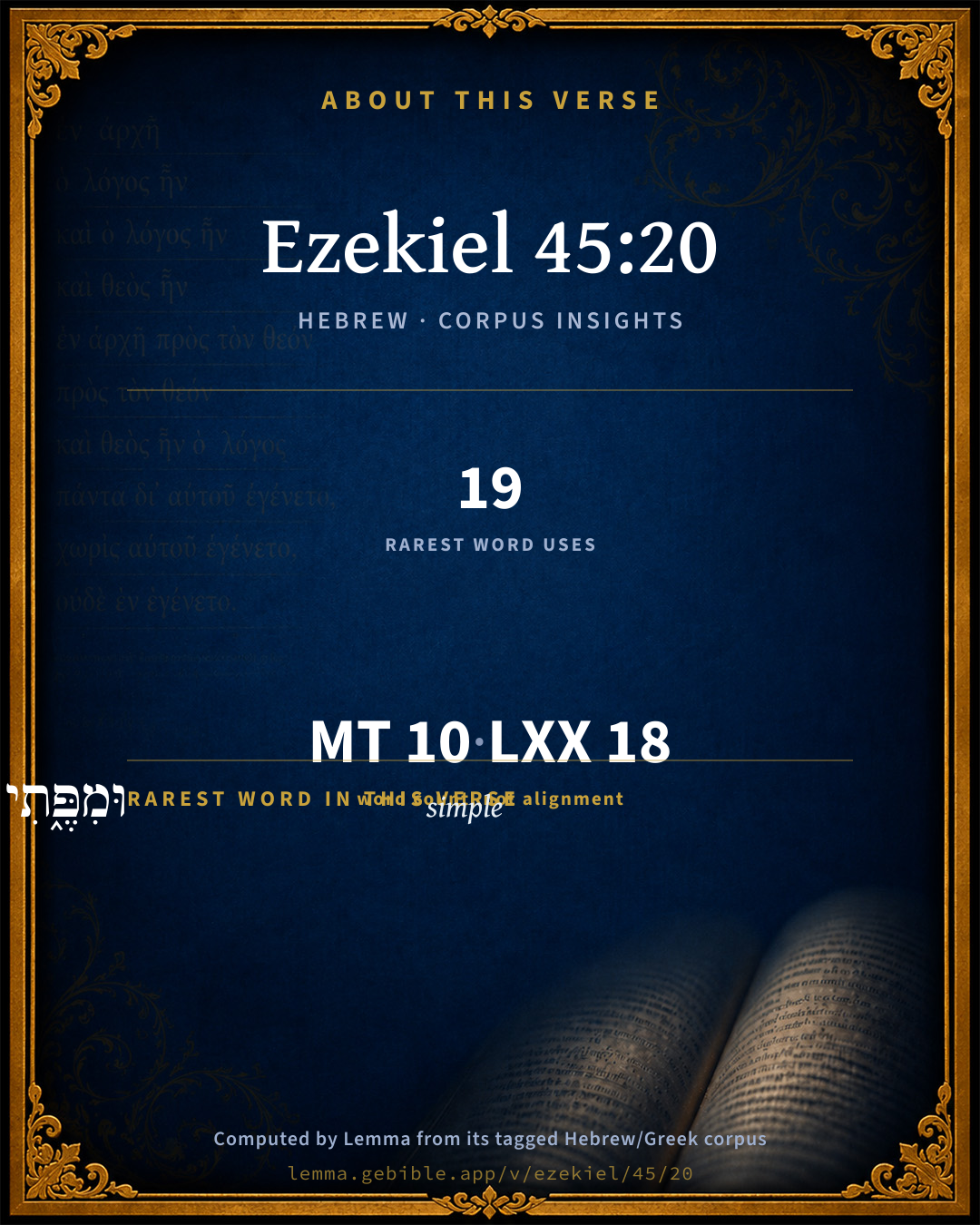
The rarest word here is וּמִפֶּ֑תִי simple H6612 — appearing just 19 times in the whole Hebrew Bible.

Shared distinctive vocabulary

וּמִפֶּ֑תִי simple H6612 occurs in 18 verses of the Hebrew Bible. Also found in:

Grammatical profile

  • 3 verbs
  • 4 nouns
  • 1 adjective
  • 2 particles

Verb forms

  • תַּֽעֲשֶׂה֙ Qal · Imperfect
  • שֹׁגֶ֖ה Qal · Participle Active
  • וְכִפַּרְתֶּ֖ם Piel · Sequential Perfect

Hebrew & Septuagint length

In English translation the verse runs 29 words from the Hebrew and 32 from the Septuagint (LXX English) — closely comparable.

A rough comparison of the two English renderings, which tokenize alike — not a word-level alignment.

Word counts can differ between the Hebrew and the Greek without any difference in meaning — e.g. the Hebrew direct-object marker אֵת has no separate Greek word, and Greek often adds the article ὁ.

In the original languages it is 10 Hebrew tokens and 18 Greek tokens — but the two are counted differently (Hebrew bundles its prefixes and suffixes into one token; the Greek is in lemma form), so that isn’t a like-for-like length.

Cross-references

7

Topical passages linked to Ezekiel 45:20 in the Treasury of Scripture Knowledge — connected by theme and wording, ordered by reader-vote popularity; previews shown in the World English Bible.

  • Psalms 19:12 Who can discern his errors? Forgive me from hidden errors.
  • Leviticus 4:27–35 "'If anyone of the common people sins unwittingly, in doing any of the things which Yahweh has commanded not to be done, and is guilty;
  • Leviticus 16:20 "When he has made an end of atoning for the Holy Place, the Tent of Meeting, and the altar, he shall present the live goat.
  • Ezekiel 45:15 and one lamb of the flock, out of two hundred, from the well-watered pastures of Israel; -for a meal-offering, and for a burnt offering, and for peace-offerings, to make atonement for them, says the Lord Yahweh.
  • Ezekiel 45:18 Thus says the Lord Yahweh: In the first [month], in the first [day] of the month, you shall take a young bull without blemish; and you shall cleanse the sanctuary.
  • Romans 16:18–19 For those who are such don't serve our Lord, Jesus Christ, but their own belly; and by their smooth and flattering speech, they deceive the hearts of the innocent.
  • Hebrews 5:2 The high priest can deal gently with those who are ignorant and going astray, because he himself is also surrounded with weakness.

Cross-references courtesy of OpenBible.info (CC BY 4.0).

Hebrew and Greek witnesses Masoretic Hebrew ↔ Greek Septuagint

The same verse in the two great witnesses to the Old Testament, shown verse-for-verse.

These are two independent witnesses, not word-aligned to each other, and the Septuagint is shown in lemma (dictionary) form.

Hebrew Ezekiel 45:20 Masoretic · Westminster Leningrad Codex

וְכֵ֤ן תַּֽעֲשֶׂה֙ בְּשִׁבְעָ֣ה בַחֹ֔דֶשׁ מֵאִ֥ישׁ שֹׁגֶ֖ה וּמִפֶּ֑תִי וְכִפַּרְתֶּ֖ם אֶת הַבָּֽיִת

So you shall do on the seventh [day] of the month for everyone who errs, and for him who is simple: so shall you make atonement for the house.

World English Bible · Public Domain

Greek LXX Ezekiel 45:20 Septuagint · lemma form

καί οὕτως ποιέω ἐν ὁ ἕβδομος μήν εἷς ὁ μήν λαμβάνω παρά ἕκαστος ἀπόμοιρα καί ἐκἱλάσκομαι ὁ οἶκος

And thus shall you do in the seventh month; on the first day of the month you shall take a rate from each one; and you⌃ shall make atonement for the house.

LXX2012 (modern English Septuagint) · Public Domain

On this verse, The Cambridge Bible for Schools and Colleges discusses the Septuagint’s reading. Read the note in Commentary ↓

Hebrew: Westminster Leningrad Codex (CC BY 4.0). Greek: Septuagint (public domain); English from LXX2012 (modern English Septuagint) (Public Domain). How the Septuagint differs from the Hebrew →

Targum (Aramaic paraphrase)

1

The Targum is the ancient Jewish Aramaic paraphrase of the Hebrew Scriptures — an interpretive translation, not the Hebrew text itself. Onkelos (literal) and Pseudo-Jonathan (expansive) render the Torah, and Jonathan the Prophets. Coverage is partial: where no permissively-licensed English translation exists for a verse, only the Aramaic is shown. This is verse-level text, not a word-by-word alignment to the Hebrew.

  1. Targum Jonathan Prophets (Joshua–Malachi)
    וְכֵן תַּעְבֵיד בְּשַׁבְעָא בְּיַרְחָא מִגְבַר דְמִשְׁתְּלֵי וּמִטְפַשׁ וּתְכַפְּרוּן עַל בֵּיתָא:

    (no public-domain English translation for this verse)

    Targum Jonathan — Aramaic: “Mikraot Gedolot” (public domain). English: “Sefaria Community Translation” (CC0 1.0 (public-domain dedication)); “London "Chaldee Paraphrase," 1871” (public domain). Text via Sefaria.

Commentary

Notes on Ezekiel 45:20 from classic Christian and Jewish commentators (each source and its license shown beneath its notes). The classic Christian expositions comment on the surrounding passage and are grouped to its opening verse, so a note may address several verses; the Jewish commentaries on the Tanakh (Rashi and others) are per-verse, so they appear only where the commentator wrote on this verse.

Lemma curates 59 commentaries, every one of them public domain or Creative Commons licensed, each selected and text-cleaned for this edition rather than reprinted as found. About our sources →

Trapp's Complete Commentary

John Trapp

Eze 45:20 And so thou shalt do the seventh [day] of the month for every one that erreth, and for [him that is] simple: so shall ye reconcile the house.

Ver. 20. And so thou shalt.] This also is a new injunction, {see Eze 45:19} and very comfortable to those that sin of passion or precipitancy. See 1Jn 2:1-2.

John Trapp, A Commentary or Exposition upon All the Books of the Old and New Testament (1647–1656) — public domain. Text from a community e-Sword module.

The Biblical Illustrator

Joseph S. Exell

Eze_45:20

And so thou shalt do . . . for everyone that erreth, and for him that is simple.

Provision for the erring and simple

A very touching provision is here. When the services of the newly constituted temple were in full operation, and the priests were performing the usual rites in all the pomp and splendour of their ceremonial on the behalf of all righteous and godly souls, there was to be special thought of the erring and simple; for these two characters a special offering was made. Perhaps the erring were too hardened and the simple too obtuse to bring an offering for themselves; but they were not forgotten. The blood of the sin-offering was to be placed on the posts of the house and on the posts of the gate of the inner court, each seventh day of the month, on their behalf. Whenever we draw around the altar of God, whether in the home or church, we should remember the erring and simple. If a family misses from its ranks one erring member, its prayer and thought are more directed towards that one than to those that have not gone astray. Does not the child who is deficient in its intellect attract more loving care than those who are able to care for themselves? Should it be otherwise in Gods home? (F. B. Meyer, B. A.)

.

The Biblical Illustrator, edited by Joseph S. Exell (c. 1880s–1900s) — public domain. Text from a community e-Sword module.

Jamieson, Fausset & Brown

Robert Jamieson, A. R. Fausset & David Brown

for him that is simple--for sins of ignorance (Lev 4:2, Lev 4:13, Lev 4:27).

Jamieson, Fausset & Brown — Commentary Critical and Explanatory on the Whole Bible (1871) — public domain (CC PDM 1.0). Text via the HelloAO Bible API.

Adam Clarke's Commentary

Verse 20. For him that is simple] That wants understanding to conduct himself properly.

Adam Clarke's Commentary on the Bible (1810–1826) — public domain. Text from a community e-Sword/MySword module.

Ellicott's Commentary for English Readers

(20) so shall ye reconcile the house.—The object of “the sin offering” on the first day of the month is expressly said to be to “cleanse the sanctuary” (Eze_45:18); but here the offering is for “every one that erreth, and for him that is simple,” i.e., for all who have sinned thoughtlessly rather than wilfully. Yet it is added, “so shall ye reconcile the house,” more literally, make an atonement for the house; and the question has therefore been raised whether this offering on the seventh day was still for the purification of the sanctuary or for the sins of the people. The answer to this question must be sought in the sacrifices of the Day of Atonement (Leviticus 16), which these days seem intended to replace. These were very distinctly for the sins of the priests and the people, and at the same time for the tabernacle. The one involved the other, and the holy place required purification because of the sins of “the holy people” among whom it was placed.

A Bible Commentary for English Readers, edited by Charles John Ellicott (1878–1897) — public domain. Text from a community e-Sword module.

The Cambridge Bible for Schools and Colleges

gen. ed. J. J. S. Perowne

20. seventh day of the month] The text can hardly be so rendered. Probably: in the seventh month, on the new moon (i.e. the first day). LXX. fully: in the seventh month, on the first day of the month. An atonement was made for the sanctuary, purifying it from the defilements of the people, at the beginning of each half-year. No mention is made of burnt-offerings, but cf. Eze_46:6-7.

every one that erreth] i.e. not for any particular person had in view, but for the people on account of there being among them persons who have erred unwittingly or through simplicity, i.e. natural slowness which may not have apprehended the exact requirements of duty. Ezekiel is speaking of the people in their perfect condition, when, of course, only such mistakes will be committed as are due to inadvertence and the limitations to which the mind of man is subject.

reconcile the house] make atonement for. Cf. Lev_16:6; Lev_16:18.

The Cambridge Bible for Schools and Colleges (gen. ed. J. J. S. Perowne; Cambridge University Press, 1878–1918) — public domain. Text from a community e-Sword module.

John Gill's Exposition

And so thou shall do the seventh day of the month,.... Of the first month Nisan; here is another new rule or law, as Kimchi owns, of which no mention is made in the law of Moses:

for everyone that erreth, and for him that is simple: so shall ye reconcile the house; or, "expiate" it (h); make atonement for it; that is, for the house of God, the whole church, all his people; particularly for fallen believers, who have gone astray, either in principle or practice; through ignorance and simplicity, through the prevalence of corruption, the temptations of Satan, and the snares of this world; but are recovered again, and brought to repentance; to whom the doctrines of peace and reconciliation, of free and full pardon by the blood of Christ, and of atonement of all their sins by his sacrifice, are to be preached for the comfort and refreshment of their souls; and they are to be received into the church, having their consciences sprinkled by the blood of Christ; the same things being done on this day as on the first. Jarchi thinks these words are to be transposed thus,

and ye shall reconcile, or "expiate the house from the man that erreth, and the simple one": quite contrary to the design of the text, which directs to the reception, and not the exclusion, of such persons.

(h) "ut expietis", Junius & Tremellius, Piscator; "et expiabitis", Cocceius, Starckius.

John Gill's Exposition of the Whole Bible (1746–1763) — public domain (CC PDM 1.0). Text via the HelloAO Bible API.

Haydock's Catholic Bible Commentary

Seventh, or so many days before the solemn feast. Septuagint, "on the first of the seventh month," the feast of trumpets, Numbers xxix. 1. (Calmet)

George Leo Haydock (1774–1849), Haydock's Catholic Family Bible and Commentary, 1859 edition — public domain. Excludes Psalms (Douay-Rheims chapter numbering differs from Protestant) and Deuterocanonical books (Catholic canon only).

Matthew Poole's English Annotations

The priest must offer the like sacrifice for cleansing the errors of the people, and reconciling them.

The seventh day; about a week before the passover.

For every one that erreth; for all the errors of all the house of Israel, in all that had erred through ignorance.

For him that is simple; that is, of weak intellectuals, half-witted, or a fool, as the word signifies; or, for one that was seduced.

Reconcile the house, i.e. cleanse, as Eze 45:18, which legally or ceremonially was defiled by those errors done in the city or courts of the house, whither these persons might come, for it is not the temple itself, I suppose, that is here meant.

Matthew Poole's English Annotations on the Holy Bible (1683–1685) — public domain. Text from a community e-Sword/MySword module.

The Pulpit Commentary

The same ceremony should be repeated on the seventh day of the month, not on the first day of the seventh month, as Smend proposes, in accordance with the lhyh, and on the ground that "the seventh day of (the same) mouth" would have been in Hebrew vdjol hbviB, as in Eze_1:1 Eze_30:20; at the same time admitting that vdjoB is sometimes, (Num_10:11) though not (except in this verse) by Ezekiel. The sin offerings in question should be made for (or, on account of, mi, "away from," expressing the reason why anything is done) every one that erreth, and for him that is simple, i.e. for such transgressors as should have gone aside from the straight path through ignorance or foolishness, the "simple" man being here, as in Pro_7:7 Pro_22:3 Pro_27:12, one easily enticed or persuaded to do evil. For such offenders the Law of Moses provided means of expiation (Lev_2:2, etc.; Lev_5:15; Num_15:27) for the presumptuous sinner, who despised the word of the Lord and violated his commandment, only one doom remained, to be cut off from among his people. (Num_15:30; Deu_17:12)

The erring and the simple.

The sacrifices under the Law of Moses were not intended for presumptuous, high-handed sins of the worst kind. (see Num_15:30; Deu_17:12) They were designed for the less grave offences, more especially for transgressions of the ceremonial law. Here we have an injunction requiring a general, and not individual, offering to be rendered on behalf of those who had been inadvertently led into error, or who, by reason of mental simplicity, had failed to recognize their duty, and had therefore left it undone. It was valuable as recognizing the responsibility of the nation for those of its members who were less well able to take care of themselves, and it suggests to us our Christian duty to seek, for their sake as much as for our own, to guide or to restore them.

I THE PRESENCE OF THE SIMPLE. We not only come into this world very variously endowed, some having inclinations and faculties of which others are not conscious at all, but our minds are of very different gradations in general capacity. Between that of the man just above imbecility and that of the greatest poet, or statesman, or organizer, how immeasurable the distance! There is quite a considerable company of the imbecile; these have been, in some countries, singularly regarded as in close connection with the supernal powers, and treated with peculiar regard on that account. Otherwise and elsewhere they are usually the objects of a good-natured tolerance. But above these and below the men and women of average intelligence are "the simple those who can acquire but very little learning, study how they may; who soon lose their way in reasoning, and are easily worsted in dispute; who cannot look far ahead, and may be readily taken advantage of by the unscrupulous; who cannot discern dangers ahead, and are specially open to the attacks of the enemy.

II THE PRESENCE OF THE ERRING. It is, no doubt, "the simple" who become "the erring," whose error is due to their simplicity. But it is not all the simple who err, nor are all the erring to be found among the simple.

There are those who leave the strait path without that excuse men and women who are possessed of the ordinary intelligence and have received a very fair measure of instruction and Christian influence, who are found in paths of folly. Some temptation has proved too strong for them. And if they are not among the flagrantly immoral, yet is there, in their case, a deviation from the straight line of truthfulness, or of purity, or of sobriety, or of reverence, or of the becoming and the consistent a deviation which detracts seriously from the worth and beauty of their character, and which makes their best friends concerned or even alarmed about them.

III OUR SACRED DUTY, WHICH IS OUR PRIVILEGE, CONCERNING THESE.

1. To guide and guard. Those on whom God has conferred greater power, and who can consequently see more clearly where evil lies and where danger begins, should esteem it their most sacred and bounden duty to befriend, to preserve, to save, those who are feebler and more exposed. We have our powers, no doubt, that we may take care of ourselves, that we may secure and enrich ourselves. But this is only one part, and it is quite a small part, of our duty and of our opportunity. We live to love and bless. God has made us what we are and given us what we have, for the express purpose that we may serve those who are around us, and more particularly those who are nearly related to us, by defending them when they are assailed, by timely warning against attack, by arming them for the evil hour, by encouraging them m the midst of the battle when they are distressed, by enabling them to make the most of the resources which they possess. By wise direction and strengthening companionship many a simple soldier has been enabled, on moral as well as material fields, to fight a brave and faithful battle, and to win the victory and the crown.

2. To restore. "Ye who are spiritual restore such a one". (Gal_6:1) Here is not only a sacred duty, but a very high privilege. To win a fortune, to establish "a house" or a family, to build up a great reputation, to rise to conspicuous eminence, this is laudable, honorable, attractive enough, or at least it may be so. But there are things which are higher and better than these. And of these nobler things there are few that rank higher in the estimate of Christ or will give our own hearts deeper satisfaction in the calmer and truer moments of our life than the act of restoration. To lead our erring brother or sister back again from the highway or the byway of evil into the road of rectitude, into the path of life, this is emphatically and pre-eminently the Christian thing to do; it is to reduce to action the Divine instruction, "As my Father hath sent me, even so send I you. C.

The Pulpit Commentary (1880–1919), ed. H.D.M. Spence-Jones & Joseph S. Exell — public domain. Text from a community e-Sword module.

John Wesley's Explanatory Notes

For every one that erreth - For all the errors of all the house of Israel, through ignorance. For him that is simple - That is half- witted, or a fool. Reconcile - Cleanse, as ver. 18, which legally was defiled by those errors done in the city, or courts of the house, whither these persons might come.

John Wesley, Explanatory Notes Upon the Whole Bible (1754–1765) — public domain. Text via the GEBible commentary corpus.

Scofield Reference Notes

C. I. Scofield

reconcile

Heb. "kaphar," atone. (See Scofield "Dan 9:24").

The Scofield Reference Bible (1917 edition), notes by C. I. Scofield — public domain. Text from a community e-Sword module.

Rashi

Rabbi Shlomo Yitzchaki (Rashi)

And so shall you do on seven [days] in the month It may be said that [this means]: And so shall you do all seven, and so too he says above (43:26): “For seven days they shall effect atonement for the altar.” But our Rabbis explained it in Menahoth (45a) in the following manner: And so shall you make [as a sacrifice] a bull that is not to be eaten in [the event of] “seven” tribes who “interpreted the Torah in a new way (שֶּׁחְדֹּשּׁוּ)” and whose tribunal issued a decision that fat is permissible, and seven tribes, (which are the majority of the nation), who acted on their word. They must bring a bull for communal error.

because of mistaken and simple-minded men This is a transposed verse: And you shall expiate the House from mistaken and simple-minded men. After the seven days of investiture, whenceforth the altar will be dedicated, they shall bring their sin-offerings and their guilt-offerings, and they will attain atonement, for at the time that Israel attains atonement, the House attains atonement.

Rashi on the Tanakh — English translations: “The Judaica Press complete Tanach with Rashi, translated by A. J. Rosenberg” (CC BY 4.0); “Pentateuch with Rashi's commentary by M. Rosenbaum and A.M. Silbermann, 1929-1934” (public domain); “The Metsudah Tanach series, Lakewood, N.J” (CC BY 4.0); and “The Book of Joshua, Metsudah Publications, 1997” (CC BY 4.0). Text via Sefaria.

Lesson kit

Teaching starters — assembled from the data on this page, not authored interpretation. Every prompt links to the verse data it draws on. Edit before teaching.

Ezekiel, in the Prophets, opens this verse with 10 words (10 distinct Hebrew lemmas). Its most distinctive word is pᵉthîy (“simple”). A historical commentator’s framing appears above. Read the whole chapter for the surrounding context.

Discussion questions

  1. The word pᵉthîy carries the sense “simple.” How does it shape the verse?
  2. Psalms 19:7 shares the word «simple» with this verse. How do the two illuminate each other?
  3. These translations render this verse differently; the difference is in the English rendering, not the original. What questions does that raise?
  4. The verb «תַּֽעֲשֶׂה֙» is Qal Imperfect. How does its form color the action?
  5. Reading how Trapp's Complete Commentary and The Biblical Illustrator read this verse, where do the two commentators agree and where do they part?

Things to notice

Reading settings

Reading text

Shown beneath each verse's original-language words.

Old Testament
Old Testament edition

Read the OT as the Masoretic Hebrew (MT) or the Greek Septuagint (LXX).

English shown for the Greek Septuagint (in the Hebrew ↔ Greek comparison).

Comparing translations? Open the Compare panel on any verse page to stack up to four side by side.