Judges 20:47

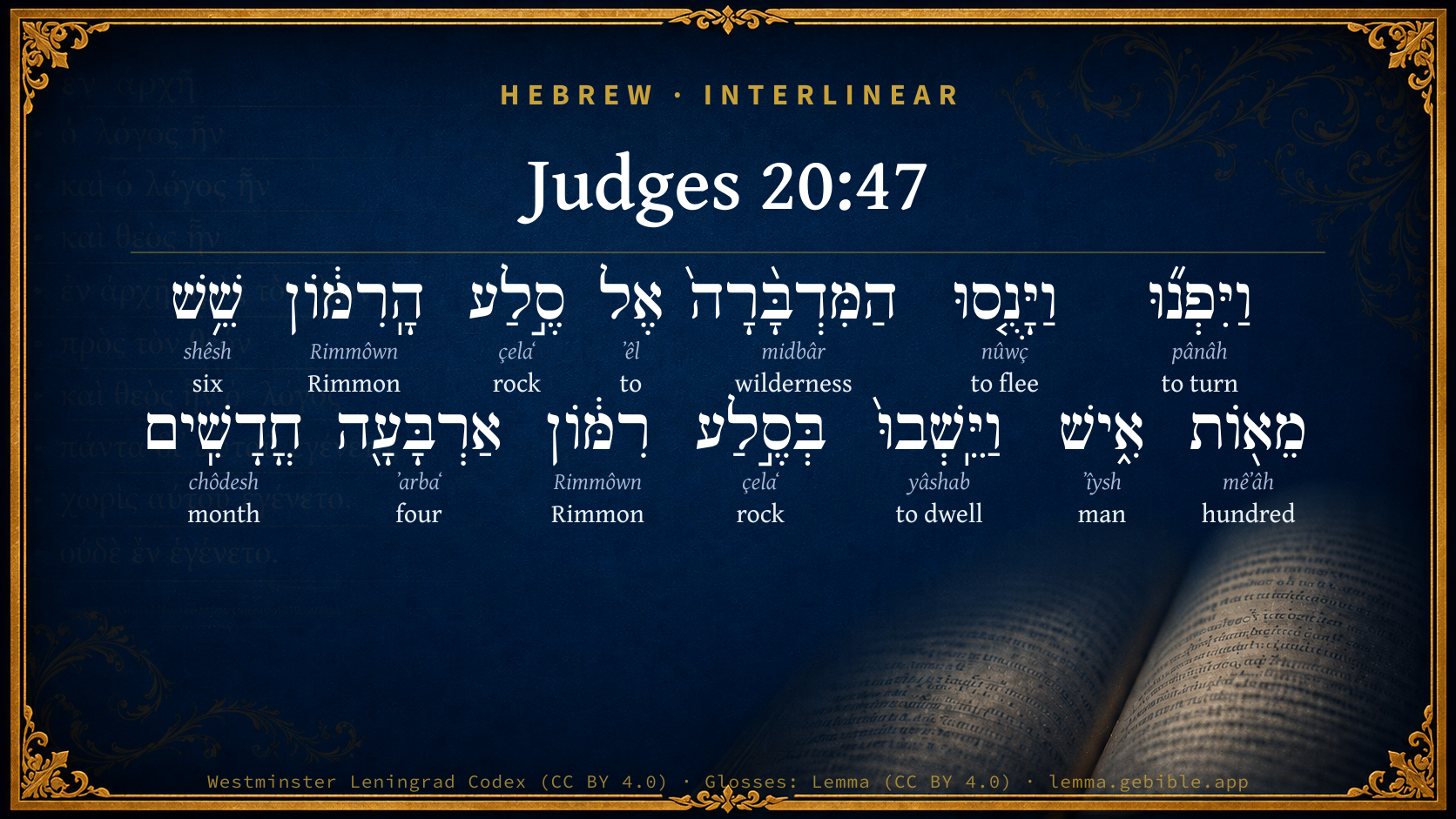
Hebrew (Westminster Leningrad Codex) Judges 20:47 appears in the Hebrew Old Testament. The text above is from the Westminster Leningrad Codex. Each word links to its Strong’s number, a concise gloss, and parsing drawn from the Open Scriptures Hebrew Bible morphology. Click any word for its full Brown-Driver-Briggs (BDB) entry.
Download image
Cite this verse

Judges 20:47 (World English Bible). Public Domain. Lemma interlinear Bible study tool, https://lemma.gebible.app/v/judges/20/47.

Show BibTeX & RIS
BibTeX
RIS
English Translation
But six hundred men turned and fled toward the wilderness to the rock of Rimmon, and abode in the rock of Rimmon four months.
World English Bible · Public Domain
Download a study sheet

One document with this verse’s original text, its word-by-word gloss line, the meaning frame, cross-references with their text, attributed commentary, and full source and license credits — printable, and it pastes into notes with its structure intact.

This verse Autodidact and up

Study sheet (.html) Plain text (.txt)

A passage Seminary Student

Up to 50 verses in one chapter. A passage sheet keeps up to 6 commentary sources and 12 cross-references per verse, in the order this page ranks them, and says so on the sheet whenever that leaves anything out. Ask for a single verse and you get the Autodidact verse sheet above.

Everything on this page stays free to read, with no account — the sheet is a download of what is already on screen, not access to it.

Want to remove ads? Support Godless Engineer
Compare translations 3

The same verse in 3 English versions, stacked beneath the original-language interlinear above. Click any original word for its lexicon entry.

Each is an independent rendering of the whole verse — the interlinear is not word-aligned to these translations.

Highlighted words mark where these versions differ — a whole-verse word diff, not a word-by-word alignment.

  • World English Bible Public Domain
    But six hundred men turned and fled toward the wilderness to the rock of Rimmon, and abode in the rock of Rimmon four months.
  • King James Version Public Domain
    But six hundred men turned and fled to the wilderness unto the rock Rimmon, and abode in the rock Rimmon four months.
  • unfoldingWord Literal Text CC BY-SA 4.0
    But 600 men turned and fled to the wilderness, to the rock of Rimmon, and they stayed at the rock of Rimmon four months.

unfoldingWord Literal Text — © unfoldingWord, licensed CC BY-SA 4.0. Word-aligned USFM3 via Door43 (git.door43.org/unfoldingWord/en_ult).

Versions to compare (up to 4)

3 of 4 selected

Show all 18 translations

Every available English version of this verse, each an independent rendering of the whole verse.

  • World English Bible Public Domain
    But six hundred men turned and fled toward the wilderness to the rock of Rimmon, and abode in the rock of Rimmon four months.
  • Berean Standard Bible Public Domain
    But 600 men turned and fled into the wilderness to the rock of Rimmon, where they stayed four months.
  • Majority Standard Bible Public Domain
    But 600 men turned and fled into the wilderness to the rock of Rimmon, where they stayed four months.
  • King James Version Public Domain
    But six hundred men turned and fled to the wilderness unto the rock Rimmon, and abode in the rock Rimmon four months.
  • American Standard Version (1901) Public Domain
    But six hundred men turned and fled toward the wilderness unto the rock of Rimmon, and abode in the rock of Rimmon four months.
  • Revised Version (1885) Public Domain
    But six hundred men turned and fled toward the wilderness unto the rock of Rimmon, and abode in the rock of Rimmon four months.
  • Geneva Bible (1599) Public Domain
    But sixe hundreth men turned and fled to the wildernesse vnto the rocke of Rimmon, and abode in the rocke of Rimmon foure moneths.
  • Douay-Rheims (1899) Public Domain
    And there remained of all the number of Benjamin only six hundred men that were able to escape, and flee to the wilderness: and they abode in the rock Remmon four months.
  • Young's Literal Translation Public Domain
    and there turn and flee into the wilderness, unto the rock of Rimmon six hundred men, and they dwell in the rock Rimmon four months.
  • Literal Standard Version CC BY-SA 4.0
    but six hundred men turn and flee into the wilderness, to the rock of Rimmon, and they dwell in the rock of Rimmon four months.
  • Unlocked Literal Bible CC BY-SA 4.0
    But six hundred men turned and fled to the wilderness, toward the rock of Rimmon. For four months they stayed at the rock of Rimmon.
  • unfoldingWord Literal Text CC BY-SA 4.0
    But 600 men turned and fled to the wilderness, to the rock of Rimmon, and they stayed at the rock of Rimmon four months.
  • Darby Bible Public Domain
    But six hundred men turned and fled toward the wilderness to the rock of Rimmon, and abode at the rock of Rimmon four months.
  • World Messianic Bible Public Domain
    But six hundred men turned and fled toward the wilderness to the rock of Rimmon, and stayed in the rock of Rimmon four months.
  • Webster's Bible Public Domain
    But six hundred men turned and fled to the wilderness to the rock Rimmon, and abode in the rock Rimmon four months.
  • Free Bible Version CC BY-SA 4.0
    There were six hundred who ran away to Pomegranate Rock in the desert and they stayed there four months.
  • Bible in Basic English Public Domain
    But six hundred men, turning back, went in flight to the rock of Rimmon in the waste land, and were living on the rock of Rimmon for four months.
  • JPS Tanakh (1917) Public Domain
    But six hundred men turned and fled toward the wilderness unto the rock of Rimmon, and abode in the rock of Rimmon four months.

Literal Standard Version (2020), Covenant Press — licensed CC BY-SA 4.0. Text via the HelloAO Bible API (eBible.org). Unlocked Literal Bible (unfoldingWord) — licensed CC BY-SA 4.0. Text via the HelloAO Bible API (eBible.org). unfoldingWord Literal Text — © unfoldingWord, licensed CC BY-SA 4.0. Word-aligned USFM3 via Door43 (git.door43.org/unfoldingWord/en_ult). Free Bible Version, Dr. Jonathan Gallagher — licensed CC BY-SA 4.0. Text via the HelloAO Bible API (eBible.org).

Word by word

More ways to search: Search by grammar → Find every occurrence → Compare this word →

Practice this passage: Drill this verse → Learn its vocabulary →

הָֽרִמּ֔וֹן
Rimmôwn
H7417
“the · Rimmon”
Particle, Definite Article + Noun, Proper
Part of Speech
Particle + Noun
Type
Proper
Full BDB Definition

Origin: the same as H7416

TWOT: 2171

Rimmon = "pomegranate" - the deity of wind, rain, and storm, worshipped by the Syrians of Damascus (noun proper deity) - a Benjamite of Beeroth, the father of Rechab and Baanah, the murderers of Ishbosheth (noun proper masculine) - the Rock; a cliff or inaccessible natural fastness in which the 600 Benjamites who escaped the slaughter of Gibeah took refuge (noun proper locative) - a town in the southern portion of Judah allotted to Simeon (noun proper locative) - a Levitical city in Zebulun located approximately 6 miles north of Nazareth (noun proper locative)
  1. וַיִּפְנ֞וּ pânâh H6437 “and · to turn” Conjunction + Verb, Qal, Sequential Imperfect, 3rd Person, Masculine, Plural
  2. וַיָּנֻ֤סוּ nûwç H5127 “and · to flee” Conjunction + Verb, Qal, Sequential Imperfect, 3rd Person, Masculine, Plural
  3. הַמִּדְבָּ֨רָה֙ midbâr H4057 “the · wilderness · toward” Particle, Definite Article + Noun, Common, Masculine, Singular, Absolute + Suffix, Demonstrative
  4. אֶל ʼêl H413 “to” Preposition
  5. סֶ֣לַע çelaʻ H5553 “rock of” Noun, Common, Masculine, Singular, Construct
  6. שֵׁ֥שׁ shêsh H8337 “six” Adjective, Cardinal number, Feminine, Singular, Absolute
  7. מֵא֖וֹת mêʼâh H3967 “hundred” Adjective, Cardinal number, Both, Plural, Absolute
  8. אִ֑ישׁ ʼîysh H376 “man” Noun, Common, Masculine, Singular, Absolute
  9. וַיֵּֽשְׁבוּ֙ yâshab H3427 “and · to dwell” Conjunction + Verb, Qal, Sequential Imperfect, 3rd Person, Masculine, Plural
  10. בְּסֶ֣לַע çelaʻ H5553 “in/at · rock of” Preposition + Noun, Common, Masculine, Singular, Construct
  11. רִמּ֔וֹן Rimmôwn H7417 “Rimmon” Noun, Proper
  12. אַרְבָּעָ֖ה ʼarbaʻ H702 “four” Adjective, Cardinal number, Masculine, Singular, Absolute
  13. חֳדָשִֽׁים chôdesh H2320 “months” Noun, Common, Masculine, Plural, Absolute

About this verse

These counts appear in no published source. They are computed here, from the morphology-tagged text and Lemma’s own curated glosses. What Lemma adds →

14
words
12
distinct lemmas
Historical
section

Notable vocabulary

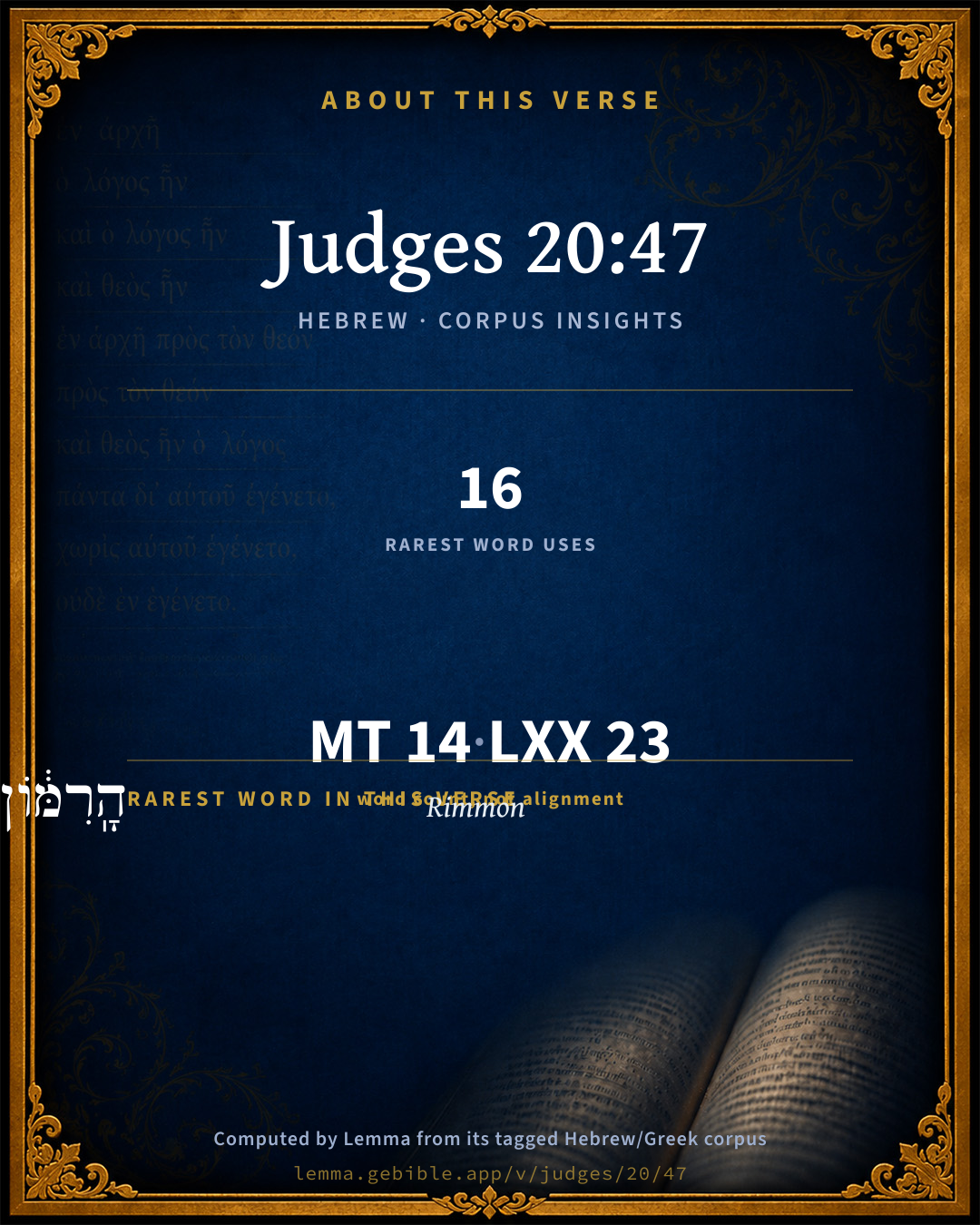
The rarest word here is הָֽרִמּ֔וֹן Rimmon H7417 — appearing just 16 times in the whole Hebrew Bible.

Shared distinctive vocabulary

הָֽרִמּ֔וֹן Rimmon H7417 occurs in 13 verses of the Hebrew Bible. Also found in:

Grammatical profile

  • 3 verbs
  • 7 nouns
  • 3 adjectives
  • 1 preposition

Verb forms

  • וַיִּפְנ֞וּ Qal · Sequential Imperfect
  • וַיָּנֻ֤סוּ Qal · Sequential Imperfect
  • וַיֵּֽשְׁבוּ֙ Qal · Sequential Imperfect

Repetition

Words recur within this verse — often emphatic in Hebrew:

  • סֶ֣לַע rock H5553 ×2
  • הָֽרִמּ֔וֹן Rimmon H7417 ×2

Hebrew & Septuagint length

In English translation the verse runs 24 words from the Hebrew and 28 from the Septuagint (LXX English) — closely comparable.

A rough comparison of the two English renderings, which tokenize alike — not a word-level alignment.

Word counts can differ between the Hebrew and the Greek without any difference in meaning — e.g. the Hebrew direct-object marker אֵת has no separate Greek word, and Greek often adds the article ὁ.

In the original languages it is 14 Hebrew tokens and 23 Greek tokens — but the two are counted differently (Hebrew bundles its prefixes and suffixes into one token; the Greek is in lemma form), so that isn’t a like-for-like length.

Cross-references

6

Topical passages linked to Judges 20:47 in the Treasury of Scripture Knowledge — connected by theme and wording, ordered by reader-vote popularity; previews shown in the World English Bible.

  • Jeremiah 14:7 Though our iniquities testify against us, work you for your name's sake, Yahweh; for our backslidings are many; we have sinned against you.
  • Judges 21:13 The whole congregation sent and spoke to the children of Benjamin who were in the rock of Rimmon, and proclaimed peace to them.
  • Psalms 103:9–10 He will not always accuse; Neither will he stay angry forever.
  • Isaiah 1:9 Unless Yahweh of hosts had left to us a very small remnant, We would have been as Sodom; We would have been like Gomorrah.
  • Lamentations 3:32 For though he cause grief, yet will he have compassion according to the multitude of his loving kindnesses.
  • Habakkuk 3:2 Yahweh, I have heard of your fame. I stand in awe of your deeds, Yahweh. Renew your work in the midst of the years. In the midst of the years make it known. In wrath, you remember mercy.

Cross-references courtesy of OpenBible.info (CC BY 4.0).

Hebrew and Greek witnesses Masoretic Hebrew ↔ Greek Septuagint

The same verse in the two great witnesses to the Old Testament, shown verse-for-verse.

These are two independent witnesses, not word-aligned to each other, and the Septuagint is shown in lemma (dictionary) form.

Hebrew Judges 20:47 Masoretic · Westminster Leningrad Codex

וַיִּפְנ֞וּ וַיָּנֻ֤סוּ הַמִּדְבָּ֨רָה֙ אֶל סֶ֣לַע הָֽרִמּ֔וֹן שֵׁ֥שׁ מֵא֖וֹת אִ֑ישׁ וַיֵּֽשְׁבוּ֙ בְּסֶ֣לַע רִמּ֔וֹן אַרְבָּעָ֖ה חֳדָשִֽׁים

But six hundred men turned and fled toward the wilderness to the rock of Rimmon, and abode in the rock of Rimmon four months.

World English Bible · Public Domain

Greek LXX Judges 20:47 Septuagint · lemma form

καί ἐπιβλέπω ὁ λοιπός καί φεύγω εἰς ὁ ἔρημος πρός ὁ πέτρα ὁ ρεμμων ἑξακόσιοι ἀνήρ καί καταἵζω ἐν πέτρα ρεμμων τέσσαρες μήν

And the rest turned, and fled to the wilderness to the rock of Remmon, even six hundred men; and they sojourned four months in the rock of Remmon.

LXX2012 (modern English Septuagint) · Public Domain

Hebrew: Westminster Leningrad Codex (CC BY 4.0). Greek: Septuagint (public domain); English from LXX2012 (modern English Septuagint) (Public Domain). How the Septuagint differs from the Hebrew →

Targum (Aramaic paraphrase)

1

The Targum is the ancient Jewish Aramaic paraphrase of the Hebrew Scriptures — an interpretive translation, not the Hebrew text itself. Onkelos (literal) and Pseudo-Jonathan (expansive) render the Torah, and Jonathan the Prophets. Coverage is partial: where no permissively-licensed English translation exists for a verse, only the Aramaic is shown. This is verse-level text, not a word-by-word alignment to the Hebrew.

  1. Targum Jonathan Prophets (Joshua–Malachi)
    וְאִתְפְּנִיאוּ וְאַפִּיכוּ לְמַדְבְּרָא לְכֵיף רִמוֹן שִׁית מְאָה גַבְרָא וִיתִיבוּ בְּכֵיף רִמוֹן אַרְבְּעָא יַרְחִין:

    (no public-domain English translation for this verse)

    Targum Jonathan — Aramaic: “Mikraot Gedolot” (public domain). English: “Sefaria Community Translation” (CC0 1.0 (public-domain dedication)); “London "Chaldee Paraphrase," 1871” (public domain). Text via Sefaria.

Commentary

Notes on Judges 20:47 from classic Christian and Jewish commentators (each source and its license shown beneath its notes). The classic Christian expositions comment on the surrounding passage and are grouped to its opening verse, so a note may address several verses; the Jewish commentaries on the Tanakh (Rashi and others) are per-verse, so they appear only where the commentator wrote on this verse.

Lemma curates 59 commentaries, every one of them public domain or Creative Commons licensed, each selected and text-cleaned for this edition rather than reprinted as found. About our sources →

Trapp's Complete Commentary

John Trapp

Jdg 20:47 But six hundred men turned and fled to the wilderness unto the rock Rimmon, and abode in the rock Rimmon four months.

Ver. 47. Unto the rock Rimmon.] Wherein there was a sweet providence, that these might be as a seminary, for recruit of that tribe.

John Trapp, A Commentary or Exposition upon All the Books of the Old and New Testament (1647–1656) — public domain. Text from a community e-Sword module.

Ellicott's Commentary for English Readers

(47) In the rock Rimmon.—This may be quite literally taken, for there are four large caverns in the hill.

A Bible Commentary for English Readers, edited by Charles John Ellicott (1878–1897) — public domain. Text from a community e-Sword module.

The Cambridge Bible for Schools and Colleges

gen. ed. J. J. S. Perowne

47. A’s version of the final flight. The 600 survivors have a part to play in the sequel.

The Cambridge Bible for Schools and Colleges (gen. ed. J. J. S. Perowne; Cambridge University Press, 1878–1918) — public domain. Text from a community e-Sword module.

John Gill's Exposition

And the men of Israel turned again upon the children of Benjamin,.... After they had destroyed their army, the city of Gibeah, and the inhabitants of it: not content with this, in their wrath and fury, turned and went:

and smote them with the edge of the sword, as well the men of every city; even men, women, and children, in every city of Benjamin, at least all that lay in their way; and which they might do to be avenged on them, for sending out their militia against them, which had made such a slaughter among them to the loss of 40,000 men, or to fulfil their oath, that such who came not to Mizpeh should be put to death; for which reason also the inhabitants of Jabeshgilead, as well as of the cities of Benjamin, were put to death, men, women, and children, dealing in the same severity with them as with the Canaanitish nations, or as with a city given to idolatry:

as the beast, and all that came to hand; spared no living creature, herds and flocks:

also they set on fire all the cities that they came unto; which belonged to the tribe of Benjamin, so exceedingly wroth were they with them, for protecting such that had been the authors of such abominable wickedness, and for the loss of the lives of so many valuable men.

Next: Judges Chapter 21

John Gill's Exposition of the Whole Bible (1746–1763) — public domain (CC PDM 1.0). Text via the HelloAO Bible API.

Haydock's Catholic Bible Commentary

Escape. Mercy was shewn to these, as the tribe had been already treated with sufficient severity. St. Jerome says, they were "reserved for the sake of the apostle Paul," (epit. Paul.; Menochius) who was descended from some of them. (Haydock) --- Remmon, near Gabaa, Zacharias xiv. 10. Eusebius places it fourteen miles north of Jerusalem. (Calmet)

George Leo Haydock (1774–1849), Haydock's Catholic Family Bible and Commentary, 1859 edition — public domain. Excludes Psalms (Douay-Rheims chapter numbering differs from Protestant) and Deuterocanonical books (Catholic canon only).

Matthew Poole's English Annotations

In a cave within that rock, where they fortified themselves and fetched in provision as they had opportunity; which they could easily do, when the heat of the battle was over, and the Israelites were not solicitous to pursue them farther.

Matthew Poole's English Annotations on the Holy Bible (1683–1685) — public domain. Text from a community e-Sword/MySword module.

The Pulpit Commentary

But six hundred men turned. If these 600 survivors are added to the 25, 000, or 25, 100, enumerated as slain (vers. "35, 44), it gives a total of 25, 700. But the total number of Benjamites, as given in ver. 15, was 26, 700. There remain, therefore, 1000 men unaccounted for. These may, have been killed partly in the two first days successful battles (vers. 21, 25), and partly in the different cities into which they had escaped, when the general massacre recorded in ver. 48 took place. The rock Rimmon. There are two proposed identifications of this place. One makes it the same as Rummon, "a village perched on the summit of a conical chalky hill," "rising on the south side to a height of several hundred feet from the Wady Muti-yah," and defended on the west side "by a cross valley of great depth," which lies three miles east of Bethel, and seven miles northeast of Gibeah (Tulell el-Ful), and is situated in the wilderness between the highlands of Benjamin and the Jordan. This is advocated by Robinson ("Biblical Researches," 1:440), by Mr. Grove in the "Dictionary of the Bible," and by Lt. Conder ("Quart. State. for July 1880," P. 173). The other is advocated by Mr. W. F. Birch ("Pal. Expl., Quart. State. for April 1880"). This identifies it with the Wady er-Rummon, discovered by Mr. Rawnsley, where there is a vast cave, Mugharet el Jai, about a mile and a half from Geba, capable, according to the local tradition, of holding 600 men, and used to the present day by the villagers as a place of refuge from the government persecutions According to this view, the statement that they abode in the rock Rimmon is strictly correct.

The Pulpit Commentary (1880–1919), ed. H.D.M. Spence-Jones & Joseph S. Exell — public domain. Text from a community e-Sword module.

unfoldingWord translationNotes

Door43 World Missions Community

six hundred

"600" (See: Numbers)

turned back against the people of Benjamin

These people of Benjamin are not the soldiers who fled to the rock of Rimmon, but the ones who were still in the city.

the city

Here "the city" refers to the people in that city. AT: "everyone who was in the city" (See: Metonymy)

in their path

This idiom refers to everything that they found as they went toward the city. AT: "they came to" (See: Idiom)

translationWords

desert

Israel

Benjamin

unfoldingWord translationNotes — © Distant Shores Media and the Door43 World Missions Community, licensed CC BY-SA 4.0. Source: git.door43.org/Door43/en_tn.

Lesson kit

Teaching starters — assembled from the data on this page, not authored interpretation. Every prompt links to the verse data it draws on. Edit before teaching.

Judges, in the Historical, opens this verse with 14 words (12 distinct Hebrew lemmas). Its most distinctive word is Rimmôwn (“Rimmon”). A historical commentator’s framing appears above. Read the whole chapter for the surrounding context.

Discussion questions

  1. How does “Rimmon” (Rimmôwn) shape what this verse is saying?
  2. How does Joshua 15:32, which shares the word «Rimmon», read alongside this verse?
  3. What does the repetition of “rock” (2× in this one verse) do in this verse?
  4. These translations render this verse differently; the difference is in the English rendering, not the original. What questions does that raise?
  5. «וַיִּפְנ֞וּ» is a Qal Sequential Imperfect verb. How does that grammatical form shape the action described?
  6. Compare how Trapp's Complete Commentary and Ellicott's Commentary for English Readers read this verse. Where do they agree or differ?

Things to notice

Reading settings

Reading text

Shown beneath each verse's original-language words.

Old Testament
Old Testament edition

Read the OT as the Masoretic Hebrew (MT) or the Greek Septuagint (LXX).

English shown for the Greek Septuagint (in the Hebrew ↔ Greek comparison).

Comparing translations? Open the Compare panel on any verse page to stack up to four side by side.