
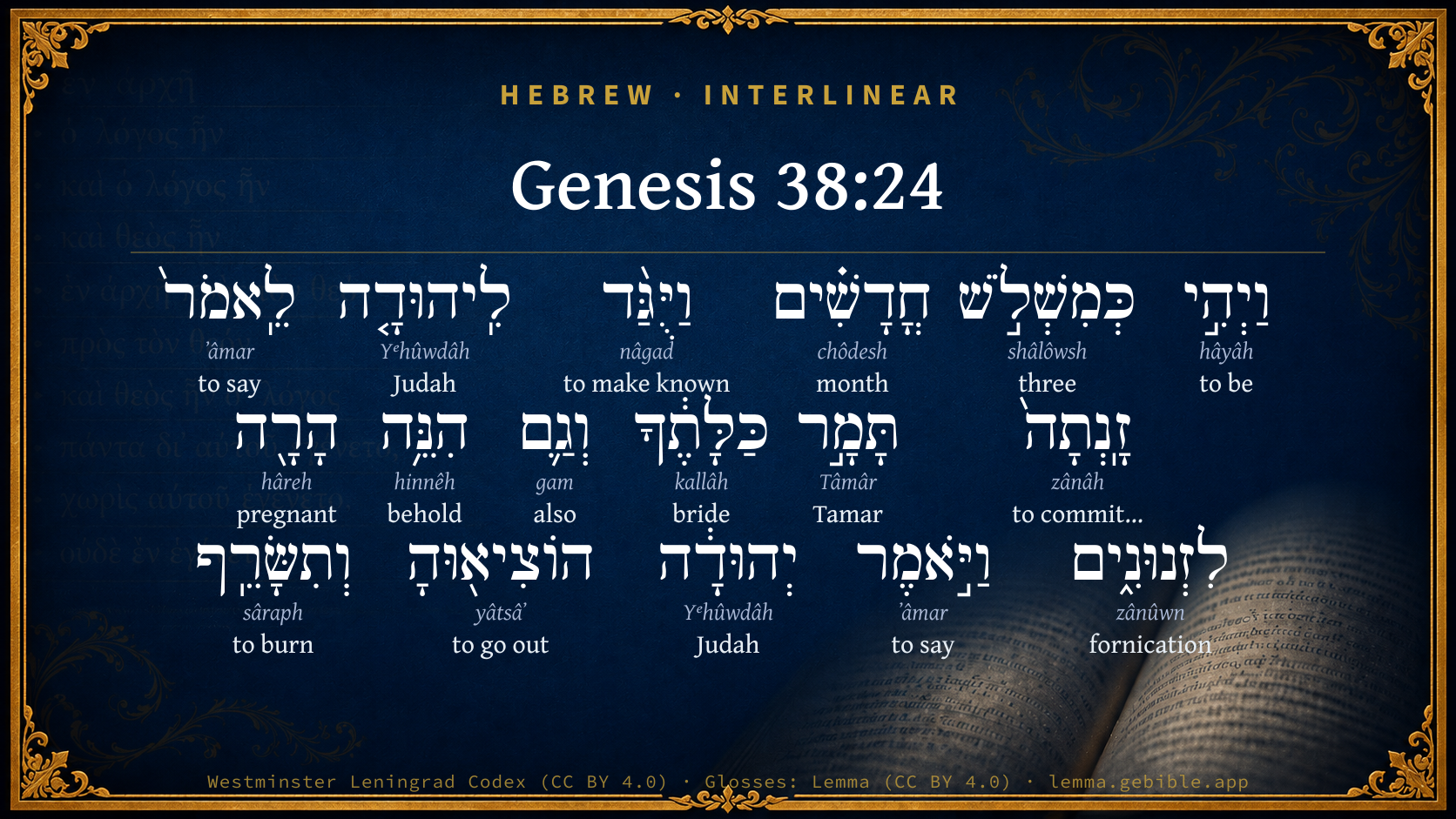
Genesis 38:24

Hebrew (Westminster Leningrad Codex) Genesis 38:24 appears in the Hebrew Old Testament. The text above is from the Westminster Leningrad Codex. Each word links to its Strong’s number, a concise gloss, and parsing drawn from the Open Scriptures Hebrew Bible morphology. Click any word for its full Brown-Driver-Briggs (BDB) entry.
Download image
Cite this verse

Genesis 38:24 (World English Bible). Public Domain. Lemma interlinear Bible study tool, https://lemma.gebible.app/v/genesis/38/24.

Show BibTeX & RIS
BibTeX
RIS
English Translation
It happened about three months later, that it was told Judah, saying, "Tamar, your daughter-in-law, has played the prostitute; and moreover, behold, she is with child by prostitution." Judah said, "Bring her forth, and let her be burnt."
World English Bible · Public Domain
Highlights
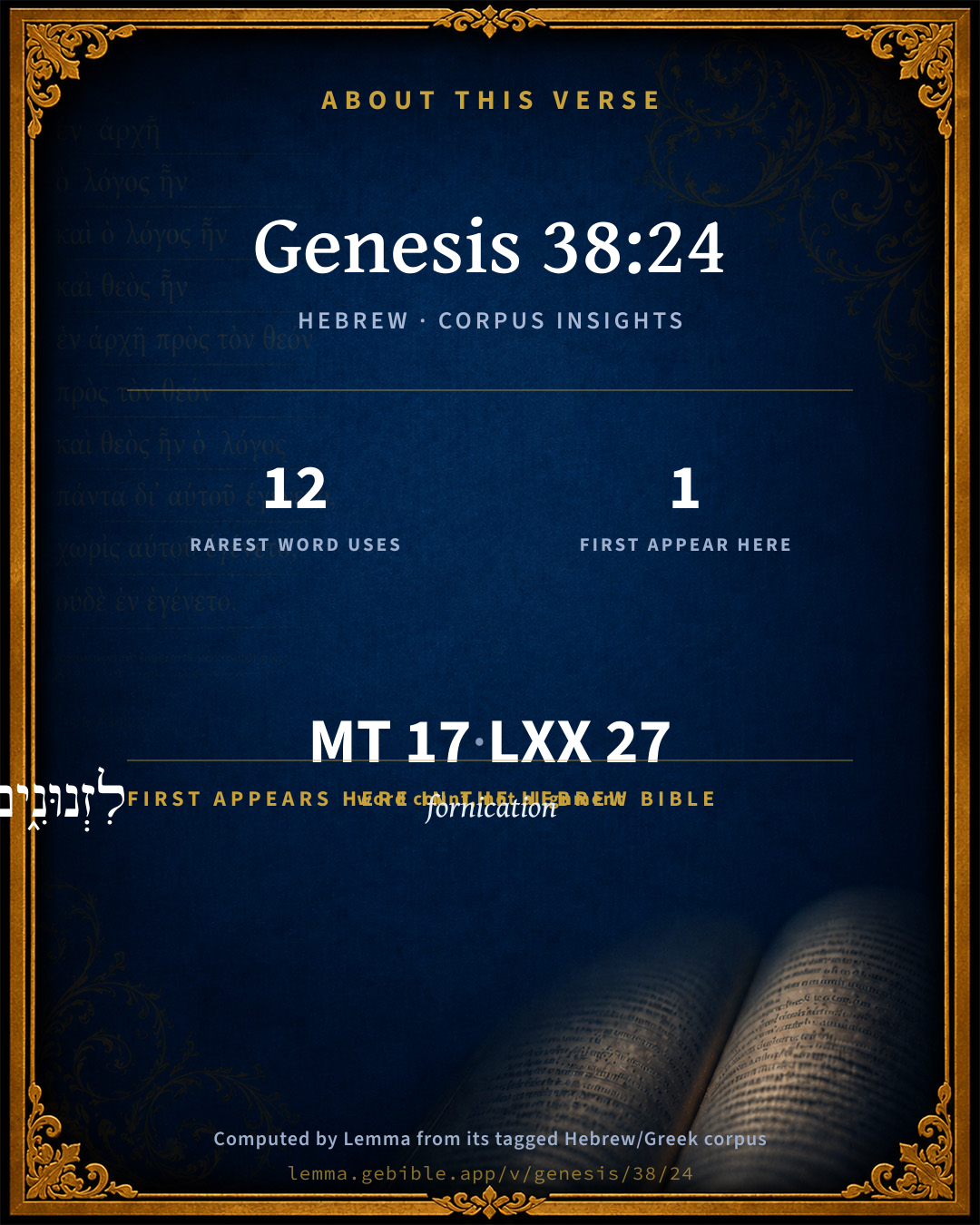
  • 1 first appearance in the Hebrew Bible
Full analysis ↓
Download a study sheet

One document with this verse’s original text, its word-by-word gloss line, the meaning frame, cross-references with their text, attributed commentary, and full source and license credits — printable, and it pastes into notes with its structure intact.

This verse Autodidact and up

Study sheet (.html) Plain text (.txt)

A passage Seminary Student

Up to 50 verses in one chapter. A passage sheet keeps up to 6 commentary sources and 12 cross-references per verse, in the order this page ranks them, and says so on the sheet whenever that leaves anything out. Ask for a single verse and you get the Autodidact verse sheet above.

Everything on this page stays free to read, with no account — the sheet is a download of what is already on screen, not access to it.

Want to remove ads? Support Godless Engineer
Compare translations 3

The same verse in 3 English versions, stacked beneath the original-language interlinear above. Click any original word for its lexicon entry.

Each is an independent rendering of the whole verse — the interlinear is not word-aligned to these translations.

Highlighted words mark where these versions differ — a whole-verse word diff, not a word-by-word alignment.

  • World English Bible Public Domain
    It happened about three months later, that it was told Judah, saying, "Tamar, your daughter-in-law, has played the prostitute; and moreover, behold, she is with child by prostitution." Judah said, "Bring her forth, and let her be burnt."
  • King James Version Public Domain
    And it came to pass about three months after, that it was told Judah, saying, Tamar thy daughter in law hath played the harlot; and also, behold, she is with child by whoredom. And Judah said, Bring her forth, and let her be burnt.
  • unfoldingWord Literal Text CC BY-SA 4.0
    And it happened about three months later that it was told to Judah, saying, “Tamar your daughter-in-law has prostituted herself, and also, behold, pregnant by her prostitutions!” So Judah said, “Bring her out, and let her be burned!”

unfoldingWord Literal Text — © unfoldingWord, licensed CC BY-SA 4.0. Word-aligned USFM3 via Door43 (git.door43.org/unfoldingWord/en_ult).

Versions to compare (up to 4)

3 of 4 selected

Show all 18 translations

Every available English version of this verse, each an independent rendering of the whole verse.

  • World English Bible Public Domain
    It happened about three months later, that it was told Judah, saying, "Tamar, your daughter-in-law, has played the prostitute; and moreover, behold, she is with child by prostitution." Judah said, "Bring her forth, and let her be burnt."
  • Berean Standard Bible Public Domain
    About three months later, Judah was told, “Your daughter-in-law Tamar has prostituted herself, and now she is pregnant.” “Bring her out!” Judah replied. “Let her be burned to death!”
  • Majority Standard Bible Public Domain
    About three months later, Judah was told, “Your daughter-in-law Tamar has prostituted herself, and now she is pregnant.” “Bring her out!” Judah replied. “Let her be burned to death!”
  • King James Version Public Domain
    And it came to pass about three months after, that it was told Judah, saying, Tamar thy daughter in law hath played the harlot; and also, behold, she is with child by whoredom. And Judah said, Bring her forth, and let her be burnt.
  • American Standard Version (1901) Public Domain
    And it came to pass about three months after, that it was told Judah, saying, Tamar thy daughter-in-law hath played the harlot; and moreover, behold, she is with child by whoredom. And Judah said, Bring her forth, and let her be burnt.
  • Revised Version (1885) Public Domain
    And it came to pass about three months after, that it was told Judah, saying, Tamar thy daughter in law hath played the harlot; and moreover, behold, she is with child by whoredom. And Judah said, Bring her forth, and let her be burnt.
  • Geneva Bible (1599) Public Domain
    Now after three moneths, one tolde Iudah, saying, Tamar thy daughter in law hath played the whore, and lo, with playing the whore, she is great with childe. Then Iudah saide, Bring ye her foorth and let her be burnt.
  • Douay-Rheims (1899) Public Domain
    Juda said: Let her take it to herself; surely she cannot charge us with a,lie: I sent the kid which I promised: and thou didst not find her.
  • Young's Literal Translation Public Domain
    And it cometh to pass about three months `after', that it is declared to Judah, saying, `Tamar thy daughter-in-law hath committed fornication; and also, lo, she hath conceived by fornication:' and Judah saith, `Bring her out -- and she is burnt.'
  • Literal Standard Version CC BY-SA 4.0
    And it comes to pass about three months [after], that it is declared to Judah, saying, “Your daughter-in-law Tamar has committed fornication; and also, behold, she has conceived by fornication”: and Judah says, “Bring her out—and she is burned.”
  • Unlocked Literal Bible CC BY-SA 4.0
    It came about after about three months that it was told to Judah, “Tamar your daughter-in-law has committed prostitution, and indeed, she is pregnant by it.” Judah said, “Bring her here and let her be burned.”
  • unfoldingWord Literal Text CC BY-SA 4.0
    And it happened about three months later that it was told to Judah, saying, “Tamar your daughter-in-law has prostituted herself, and also, behold, pregnant by her prostitutions!” So Judah said, “Bring her out, and let her be burned!”
  • Darby Bible Public Domain
    And it came to pass about three months after, that it was told Judah, saying, Tamar thy daughter-in-law has committed fornication, and behold, she is also with child by fornication. And Judah said, Bring her forth, that she may be burned.
  • World Messianic Bible Public Domain
    About three months later, Judah was told, “Tamar, your daughter-in-law, has played the prostitute. Moreover, behold, she is with child by prostitution.” Judah said, “Bring her out, and let her be burned.”
  • Webster's Bible Public Domain
    And it came to pass about three months after, that it was told to Judah, saying, Tamar thy daughter-in-law hath played the harlot; and also, behold she is with child by lewdness: and Judah said, Bring her forth, and let her be burnt.
  • Free Bible Version CC BY-SA 4.0
    Then about three months later Judah was told, “Tamar your daughter-in-law has had sex like a prostitute and now as a result she's pregnant!” “Bring her out and burn her to death!” Judah ordered.
  • Bible in Basic English Public Domain
    Now about three months after this, word came to Judah that Tamar, his daughter-in-law, had been acting like a loose woman and was with child. And Judah said, Take her out and let her be burned.
  • JPS Tanakh (1917) Public Domain
    And it came to pass about three months after, that it was told Judah, saying: 'Tamar thy daughter-in-law hath played the harlot; and moreover, behold, she is with child by harlotry.' And Judah said: 'Bring her forth, and let her be burnt.'

Literal Standard Version (2020), Covenant Press — licensed CC BY-SA 4.0. Text via the HelloAO Bible API (eBible.org). Unlocked Literal Bible (unfoldingWord) — licensed CC BY-SA 4.0. Text via the HelloAO Bible API (eBible.org). unfoldingWord Literal Text — © unfoldingWord, licensed CC BY-SA 4.0. Word-aligned USFM3 via Door43 (git.door43.org/unfoldingWord/en_ult). Free Bible Version, Dr. Jonathan Gallagher — licensed CC BY-SA 4.0. Text via the HelloAO Bible API (eBible.org).

Word by word

More ways to search: Search by grammar → Find every occurrence → Compare this word →

Practice this passage: Drill this verse → Learn its vocabulary →

לִזְנוּנִ֑ים
zânûwn
H2183
“to/for · fornication”
Preposition + Noun, Common, Masculine, Plural, Absolute
Part of Speech
Preposition + Noun
Type
Common
Gender
Masculine
Number
Plural
State
Absolute
Full BDB Definition

Origin: from H2181

TWOT: 563a

adultery, fornication, prostitution
  1. וַיְהִ֣י hâyâh H1961 “and · to be” Conjunction + Verb, Qal, Sequential Imperfect, 3rd Person, Masculine, Singular
  2. כְּמִשְׁלֹ֣שׁ shâlôwsh H7969 “like/as · from · three” Preposition + Preposition + Adjective, Cardinal number, Feminine, Singular, Construct
  3. חֳדָשִׁ֗ים chôdesh H2320 “months” Noun, Common, Masculine, Plural, Absolute
  4. וַיֻּגַּ֨ד nâgad H5046 “and · to make known” Conjunction + Verb, Hophal, Sequential Imperfect, 3rd Person, Masculine, Singular
  5. לִֽיהוּדָ֤ה Yᵉhûwdâh H3063 “to/for · Judah” Preposition + Noun, Proper
  6. לֵֽאמֹר֙ ʼâmar H559 “to say” Preposition + Verb, Qal, Infinitive Construct
  7. זָֽנְתָה֙ zânâh H2181 “to commit fornication” Verb, Qal, Perfect, 3rd Person, Feminine, Singular
  8. תָּמָ֣ר Tâmâr H8559 “Tamar” Noun, Proper
  9. כַּלָּתֶ֔ךָ kallâh H3618 “bride · your” Noun, Common, Feminine, Singular, Construct + Suffix, Personal, 2nd Person, Masculine, Singular
  10. וְגַ֛ם gam H1571 “and · also” Conjunction + Particle, Accusative
  11. הִנֵּ֥ה hinnêh H2009 “behold” Particle, Demonstrative
  12. הָרָ֖ה hâreh H2030 “pregnant” Adjective, Adjective, Feminine, Singular, Absolute
  13. וַיֹּ֣אמֶר ʼâmar H559 “and · to say” Conjunction + Verb, Qal, Sequential Imperfect, 3rd Person, Masculine, Singular
  14. יְהוּדָ֔ה Yᵉhûwdâh H3063 “Judah” Noun, Proper
  15. הוֹצִיא֖וּהָ yâtsâʼ H3318 “go out · her” Verb, Hiphil, Imperative, 2nd Person, Masculine, Plural + Suffix, Personal, 3rd Person, Feminine, Singular
  16. וְתִשָּׂרֵֽף sâraph H8313 “and · to burn” Conjunction + Verb, Niphal, Imperfect, 3rd Person, Feminine, Singular

About this verse

These counts appear in no published source. They are computed here, from the morphology-tagged text and Lemma’s own curated glosses. What Lemma adds →

17
words
15
distinct lemmas
Pentateuch
section

Notable vocabulary

The rarest word here is לִזְנוּנִ֑ים fornication H2183 — appearing just 12 times in the whole Hebrew Bible.

First appearance in Scripture

This word makes its first canonical appearance in the Hebrew Bible here:

  • לִזְנוּנִ֑ים fornication H2183

Shared distinctive vocabulary

לִזְנוּנִ֑ים fornication H2183 occurs in 10 verses of the Hebrew Bible. Also found in:

Grammatical profile

  • 7 verbs
  • 6 nouns
  • 2 adjectives
  • 2 particles

Verb forms

  • וַיְהִ֣י Qal · Sequential Imperfect
  • וַיֻּגַּ֨ד Hophal · Sequential Imperfect
  • לֵֽאמֹר֙ Qal · Infinitive Construct
  • זָֽנְתָה֙ Qal · Perfect
  • וַיֹּ֣אמֶר Qal · Sequential Imperfect
  • הוֹצִיא֖וּהָ Hiphil · Imperative
  • וְתִשָּׂרֵֽף Niphal · Imperfect

Repetition

Words recur within this verse — often emphatic in Hebrew:

  • לִֽיהוּדָ֤ה Judah H3063 ×2
  • לֵֽאמֹר֙ to say H559 ×2

Hebrew & Septuagint length

In English translation the verse runs 38 words from the Hebrew and 41 from the Septuagint (LXX English) — closely comparable.

A rough comparison of the two English renderings, which tokenize alike — not a word-level alignment.

Word counts can differ between the Hebrew and the Greek without any difference in meaning — e.g. the Hebrew direct-object marker אֵת has no separate Greek word, and Greek often adds the article ὁ.

In the original languages it is 17 Hebrew tokens and 27 Greek tokens — but the two are counted differently (Hebrew bundles its prefixes and suffixes into one token; the Greek is in lemma form), so that isn’t a like-for-like length.

Cross-references

29

Topical passages linked to Genesis 38:24 in the Treasury of Scripture Knowledge — connected by theme and wording, ordered by reader-vote popularity; previews shown in the World English Bible.

  • Leviticus 21:9 "'The daughter of any priest, if she profanes herself by playing the prostitute, she profanes her father: she shall be burned with fire.
  • Judges 19:2 His concubine played the prostitute against him, and went away from him to her father's house to Bethlehem Judah, and was there the space of four months.
  • Ezekiel 23:5 Oholah played the prostitute when she was mine; and she doted on her lovers, on the Assyrians [her] neighbors,
  • Ezekiel 23:19 Yet she multiplied her prostitution, remembering the days of her youth, in which she had played the prostitute in the land of Egypt.
  • Ezekiel 23:44 They went in to her, as they go in to a prostitute: so went they in to Oholah and to Oholibah, the lewd women.
  • Hosea 2:5 For their mother has played the prostitute. She who conceived them has done shamefully; For she said, 'I will go after my lovers, Who give me my bread and my water, My wool and my flax, My oil and my drink.'
  • Genesis 20:3 But God came to Abimelech in a dream of the night, and said to him, "Behold, you are a dead man, because of the woman whom you have taken. For she is a man's wife."
  • Genesis 20:7 Now therefore, restore the man's wife. For he is a prophet, and he will pray for you, and you will live. If you don't restore her, know for sure that you will die, you, and all who are yours."
  • Genesis 20:9 Then Abimelech called Abraham, and said to him, "What have you done to us? How have I sinned against you, that you have brought on me and on my kingdom a great sin? You have done deeds to me that ought not to be done!"
  • Genesis 34:31 They said, "Should he deal with our sister as with a prostitute?"
  • Leviticus 20:10 "'The man who commits adultery with another man's wife, even he who commits adultery with his neighbor's wife, the adulterer and the adulteress shall surely be put to death.
  • Deuteronomy 22:21–27 then they shall bring out the young lady to the door of her father's house, and the men of her city shall stone her to death with stones, because she has done folly in Israel, to play the prostitute in her father's house: so shall you put away the evil from the midst of you.
  • Deuteronomy 24:16 The fathers shall not be put to death for the children, neither shall the children be put to death for the fathers: every man shall be put to death for his own sin.
  • 2 Samuel 12:5 David's anger was greatly kindled against the man, and he said to Nathan, "As Yahweh lives, the man who has done this is worthy to die!
  • 2 Samuel 12:7 Nathan said to David, "You are the man. This is what Yahweh, the God of Israel, says: 'I anointed you king over Israel, and I delivered you out of the hand of Saul.
  • Ecclesiastes 7:26 I find more bitter than death the woman whose heart is snares and traps, whose hands are chains. Whoever pleases God shall escape from her; but the sinner will be ensnared by her.
  • Jeremiah 2:20 For of old time I have broken your yoke, and burst your bonds; and you said, I will not serve; for on every high hill and under every green tree you did bow yourself, playing the prostitute.
  • Jeremiah 3:1 They say, If a man put away his wife, and she go from him, and become another man's, will he return to her again? Won't that land be greatly polluted? But you have played the prostitute with many lovers; yet return again to me, says Yahweh.
  • Jeremiah 3:6 Moreover Yahweh said to me in the days of Josiah the king, Have you seen that which backsliding Israel has done? she is gone up on every high mountain and under every green tree, and there has played the prostitute.
  • Jeremiah 3:8 I saw, when, for this very cause that backsliding Israel had committed adultery, I had put her away and given her a bill of divorce, yet treacherous Judah, her sister, didn't fear; but she also went and played the prostitute.
  • Jeremiah 29:22–23 and of them shall be taken up a curse by all the captives of Judah who are in Babylon, saying, Yahweh make you like Zedekiah and like Ahab, whom the king of Babylon roasted in the fire;
  • Ezekiel 16:15 But you did trust in your beauty, and played the prostitute because of your renown, and poured out your prostitution on everyone who passed by; his it was.
  • Ezekiel 16:28 You have played the prostitute also with the Assyrians, because you were insatiable; yes, you have played the prostitute with them, and yet you weren't satisfied.
  • Ezekiel 16:41 They shall burn your houses with fire, and execute judgments on you in the sight of many women; and I will cause you to cease from playing the prostitute, and you shall also give no hire any more.
  • Hosea 3:3 I said to her, "You shall stay with me many days. You shall not play the prostitute, and you shall not be with any other man. I will also be so toward you."
  • Hosea 4:15 "Though you, Israel, play the prostitute, Yet don't let Judah offend; And don't come to Gilgal, Neither go up to Beth Aven, Nor swear, 'As Yahweh lives.'
  • Matthew 7:1–5 "Don't judge, so that you won't be judged.
  • Romans 2:1–2 Therefore you are without excuse, O man, whoever you are who judge. For in that which you judge another, you condemn yourself. For you who judge practice the same things.
  • Romans 14:22 Do you have faith? Have it to yourself before God. Happy is he who doesn't judge himself in that which he approves.

Cross-references courtesy of OpenBible.info (CC BY 4.0).

Hebrew and Greek witnesses Masoretic Hebrew ↔ Greek Septuagint

The same verse in the two great witnesses to the Old Testament, shown verse-for-verse.

These are two independent witnesses, not word-aligned to each other, and the Septuagint is shown in lemma (dictionary) form.

Hebrew Genesis 38:24 Masoretic · Westminster Leningrad Codex

וַיְהִ֣י כְּמִשְׁלֹ֣שׁ חֳדָשִׁ֗ים וַיֻּגַּ֨ד לִֽיהוּדָ֤ה לֵֽאמֹר֙ זָֽנְתָה֙ תָּמָ֣ר כַּלָּתֶ֔ךָ וְגַ֛ם הִנֵּ֥ה הָרָ֖ה לִזְנוּנִ֑ים וַיֹּ֣אמֶר יְהוּדָ֔ה הוֹצִיא֖וּהָ וְתִשָּׂרֵֽף

It happened about three months later, that it was told Judah, saying, "Tamar, your daughter-in-law, has played the prostitute; and moreover, behold, she is with child by prostitution." Judah said, "Bring her forth, and let her be burnt."

World English Bible · Public Domain

Greek LXX Genesis 38:24 Septuagint · lemma form

γίγνομαι δέ μετά τρίμηνος ἀποἀγγέλλω ὁ ιουδα λέγω ἐκπορνεύω θαμαρ ὁ νύμφη σύ καί ἰδού ἐν γαστήρ ἔχω ἐκ πορνεία εἶπον δέ ἰούδας ἐκἄγω αὐτός καί κατακαίω

And it came to pass after three months, that it was told Judas, saying, Thamar your daughter-in-law has grievously played the harlot, and behold she is with child by whoredom; and Judas said, Bring her out, and let her be burnt.

LXX2012 (modern English Septuagint) · Public Domain

Hebrew: Westminster Leningrad Codex (CC BY 4.0). Greek: Septuagint (public domain); English from LXX2012 (modern English Septuagint) (Public Domain). How the Septuagint differs from the Hebrew →

Targum (Aramaic paraphrase)

2

The Targum is the ancient Jewish Aramaic paraphrase of the Hebrew Scriptures — an interpretive translation, not the Hebrew text itself. Onkelos (literal) and Pseudo-Jonathan (expansive) render the Torah, and Jonathan the Prophets. Coverage is partial: where no permissively-licensed English translation exists for a verse, only the Aramaic is shown. This is verse-level text, not a word-by-word alignment to the Hebrew.

  1. Targum Onkelos Torah (Genesis–Deuteronomy)
    וַהֲוָה כִּתְלָתוּת יַרְחַיָּא וְאִתְחַוָּא לִיהוּדָה לְמֵימַר זַנִּיאַת תָּמָר כַּלְּתָךְ וְאַף הָא מַעַדְּיָא לִזְנוּתָא וַאֲמַר יְהוּדָה אַפְּקוּהַ וְתִתּוֹקָד

    (no public-domain English translation for this verse)

    Targum Onkelos — Aramaic: “Onkelos Genesis” (public domain); “Onkelos Exodus” (public domain); “Onkelos Leviticus” (public domain); “Onkelos Numbers” (public domain); “Onkelos Deuteronomy” (public domain). English: “Sefaria Community Translation” (CC0 1.0 (public-domain dedication)); “J.W. Etheridge. The Targums of Onkelos and Jonathan Ben Uzziel on the Pentateuch. London: Longmans, Green, 1862” (public domain). Text via Sefaria.

  2. Targum Pseudo-Jonathan Torah (Genesis–Deuteronomy)
    וַהֲוָה בִּזְמַן תְּלַת יַרְחִין אִשְׁתְּמוֹדְעָא דִמְעַבְּרָא הִיא וְאִיתְנֵי לִיהוּדָה לְמֵימַר זַנְיָית תָּמָר כַּלְתֵךְ וְאוּף הָא מְעַבְּרָא לִזְנוּ וַאֲמַר יְהוּדָה הֲלָא בַּת כָּהֵן הִיא הַנְפָקוּהָא וְתִתּוֹקָד

    And it was at the time of three months, that she was known to be with child: and it was told to Jehuda, saying Tamar thy daughter--in--law hath committed fornication and, behold, she is with child by fornication. And Jehuda said, Is she not the daughter of a priest. Let her be brought forth and burned.

    Targum Pseudo-Jonathan — Aramaic: “Targum Jonathan on Genesis” (public domain); “Targum Jonathan on Exodus” (public domain); “Targum Jonathan on Leviticus” (public domain); “Targum Jonathan on Numbers” (public domain); “Targum Jonathan on Deuteronomy” (public domain). English: “The Targum of Jonathan ben Uzziel, trans. J. W. Etheridge, London, 1862” (public domain). Text via Sefaria.

Commentary

Notes on Genesis 38:24 from classic Christian and Jewish commentators (each source and its license shown beneath its notes). The classic Christian expositions comment on the surrounding passage and are grouped to its opening verse, so a note may address several verses; the Jewish commentaries on the Tanakh (Rashi and others) are per-verse, so they appear only where the commentator wrote on this verse.

Lemma curates 59 commentaries, every one of them public domain or Creative Commons licensed, each selected and text-cleaned for this edition rather than reprinted as found. About our sources →

Matthew Henry's Commentary

Here is, I. Judah's rigour against Tamar, when he heard she was an adulteress. She was, in the eye of the law, Shelah's wife, and therefore her being with child by another was looked upon as an injury and reproach to Judah's family: Bring her forth therefore, says Judah, the master of the family, and let her be burnt; not burnt to death, but burnt in the cheek or forehead, stigmatized for a harlot. This seems probable, Gen 38:24. Note, it is a common thing for men to be severe against those very sins in others in which yet they allow themselves; and so, in judging others, they condemn themselves, Rom 2:1; Rom 14:22. If he designed that she should be burnt to death, perhaps, under pretence of zeal against the sin, he was contriving how to get rid of his daughter-in-law, being loath to marry Shelah to her. Note, It is a common thing, but a very bad thing, to cover malice against men's persons with a show of zeal against their vices.

II. Judah's shame, when it was made to appear that he was the adulterer. She produced the ring and the bracelets in court, which justified the fathering of the child upon Judah, Gen 38:25, Gen 38:26. Note, The wickedness that has been most secretly committed, and most industriously concealed, yet sometimes is strangely brought to light, to the shame and confusion of those who have said, No eye sees. A bird of the air may carry the voice; however, there is a destroying day coming, when all will be laid open. Some of the Jewish writers observe that as Judah had said to his father, See, is this thy son's coat? (Gen 37:32) so it was now said to him, "See, are these thy signet and bracelets?" Judah, being convicted by his own conscience, 1. Confesses his sin: She has been more righteous than I. He owns that a perpetual mark of infamy should be fastened rather upon him, who had been so much accessory to it. Note, Those offenders ought to be treated with the greatest tenderness to whom we have any way given occasion of offending. If servants purloin, and their masters, by withholding from them what is due, tempt them to it, they ought to forgive them. 2. He never returned to it again: He knew her again no more. Note, Those do not truly repent of their sins that do not forsake them.

III. The building up of Judah's family hereby, notwithstanding, in the birth of Pharez and Zarah, from whom descended the most considerable families of the illustrious tribe of Judah. It should seem, the birth was hard to the mother, by which she was corrected for her sin. The children also, like Jacob and Esau, struggled for the birthright, and Pharez obtained it, who is ever named first, and from him Christ descended. He had his name from his breaking forth before his brother: This breach be upon thee, which is applicable to those that sow discord, and create distance, between brethren. The Jews, as Zarah, bade fair for the birthright, and were marked with a scarlet thread, as those that came out first; but the Gentiles, like Pharez, as a son of violence, got the start of them, by that violence which the kingdom of heaven suffers, and attained to the righteousness of which the Jews came short. Yet, when the fulness of time is come, all Israel shall be saved. Both these sons are named in the genealogy of our Saviour (Mat 1:3), to perpetuate the story, as an instance of the humiliation of our Lord Jesus. Some observe that the four eldest sons of Jacob fell under very foul guilt, Reuben and Judah under the guilt of incest, Simeon and Levi under that of murder; yet they were patriarchs, and from Levi descended the priests, from Judah the kings and Messiah. Thus they became examples of repentance, and monuments of pardoning mercy.

Matthew Henry's Commentary on the Whole Bible (1708–1710) — public domain (CC PDM 1.0). Text via the HelloAO Bible API.

Trapp's Complete Commentary

John Trapp

Gen 38:24 And it came to pass about three months after, that it was told Judah, saying, Tamar thy daughter in law hath played the harlot; and also, behold, she [is] with child by whoredom. And Judah said, Bring her forth, and let her be burnt.

Ver. 24. Bring her forth, and let her be burnt.] He was willing to be rid of her, for fear of losing his son Shelah, and therefore passeth a precipitate and savage sentence, to burn a great-bellied woman; which the very heathens condemned as a cruelty, in Claudius. {a} Howbeit there are that take these to be his words, not as a judge in the cause, but as an accuser. {b} "Bring her forth," sc., into the gates, before the judges; and let her be burnt if found guilty, according to the custom of the country. We read not of any that were, by God’s law, to be burnt with fire, but the high priest’s daughter only, for adultery. {Lev 21:9} Hence the Hebrews say, that this Tamar was Melchizedek the high priest’s daughter. But it is more likely she was a Canaanitish proselyte. Let us beware of that sin, for which so peculiar a plague was appointed, and by very heathens executed. See Jer 29:22-23.

{a} Dio, lib. lvii.

{b} Verba Iudae de vivicomburio Thamarae, non sunt Iudicis, sed Accusatoris. - Alsted.

John Trapp, A Commentary or Exposition upon All the Books of the Old and New Testament (1647–1656) — public domain. Text from a community e-Sword module.

Joseph Benson's Commentary

Gen 38:24. Judah said, Bring her forth, and let her be burnt — Some have inferred from this that fathers then had the power of life and death over their children. But if so, it is probable that some instance would have occurred and have appeared on record in which such a power was actually exercised. It seems very unlikely that Judah should have such a power, at least over her, who was a Canaanite, and who was not in his, but in her own father’s house. He probably only meant, Bring her forth to the magistrate, from whom she may receive her sentence and deserved punishment, as a person guilty of adultery, (having been betrothed to Shelah,) a crime formerly punished with death by the laws of God, and of divers nations. See Deu 22:23-24; Jer 29:22-23. This eagerness of Judah, however, proceeded not from zeal for justice, for then he would not have endeavoured to destroy the innocent child with the guilty mother, but from worldly policy, that he might take her out of the way whom he viewed as a disgrace and burden to his family. But perhaps, though he uttered this severe sentence in the heat of his passion, he would not have urged the putting of it in execution; or, as some think, by burning her he might mean no more than branding her in the forehead to denote her being a harlot.

Joseph Benson's Commentary on the Old and New Testaments (1811–1818) — public domain. Text from a community e-Sword module.

Tyndale Open Study Notes

Tyndale Open Resources

38:24-26 Judah played the hypocrite when he condemned Tamar to death for adultery. When she produced the seal and cord and walking stick that identified him as the father, he withdrew the condemnation.

Tyndale Open Study Notes — © Tyndale Open Resources, licensed CC BY-SA 4.0. Text via the HelloAO Bible API.

Geneva Bible (1599)

Geneva Bible translators

We see that the Law, which was written in man’s heart, taught them that whoredom should be punished with death: albeit no law, as yet was given.

Geneva Bible (1599) marginal notes — public domain. Text via Bolls.life.

Jamieson, Fausset & Brown

Robert Jamieson, A. R. Fausset & David Brown

Bring her forth, and let her be burnt--In patriarchal times fathers seem to have possessed the power of life and death over the members of their families. The crime of adultery was anciently punished in many places by burning (Lev 21:9; Jdg 15:6; Jer 29:22). This chapter contains details, which probably would never have obtained a place in the inspired record, had it not been to exhibit the full links of the chain that connects the genealogy of the Saviour with Abraham; and in the disreputable character of the ancestry who figure in this passage, we have a remarkable proof that "He made himself of no reputation" [Phi 2:7].

Next: Genesis Chapter 39

Jamieson, Fausset & Brown — Commentary Critical and Explanatory on the Whole Bible (1871) — public domain (CC PDM 1.0). Text via the HelloAO Bible API.

Adam Clarke's Commentary

Verse 24. Bring her forth, and let her be burnt.] As he had ordered Tamar to live as a widow in her own father's house till his son Shelah should be marriageable, he considers her therefore as the wife of his son; and as Shelah was not yet given to her, and she is found with child, she is reputed by him as an adulteress, and burning, it seems, was anciently the punishment of this crime. Judah, being a patriarch or head of a family, had, according to the custom of those times, the supreme magisterial authority over all the branches of his own family; therefore he only acts here in his juridical capacity. How strange that in the very place where adultery was punished by the most violent death, prostitution for money and for religious purposes should be considered as no crime!

Adam Clarke's Commentary on the Bible (1810–1826) — public domain. Text from a community e-Sword/MySword module.

John Calvin's Commentaries

24. And it came to pass about three months after. Tamar might sooner have exposed the crime; but she waited till she should be demanded for capital punishment; for then she would have stronger ground for expostulation. The reason why Judah subjects his daughter-in-law to a punishment so severe, was, that he deemed her guilty of adultery: for what the Lord afterwards confirmed by his law, appears then to have prevailed by custom among men, that a maid, from the time of her espousals, should be strictly faithful to her husband. Tamar had married into the family of Judah; she was then espoused to his third son. It was not therefore simple and common fornication which was the question for judgment; but the crime of adultery, which Judah prosecuted in his own right, because he had been injured in the person of his son. Now this kind of punishment is a proof that adultery has been greatly abhorred in all ages. The law of God commands adulterers to be stoned. Before punishment was sanctioned by a written law, the adulterous woman was, by the consent of all, committed to the flames. This seems to have been done by a divine instinct, that, under the direction and authority of nature, the sanctity of marriage might be fortified, as by a firm guard: and although man is not the lord of his own body, but there is a mutual obligation between himself and his wife, yet husbands who have had illicit intercourse with unmarried women have not been subject to capital punishment; because that punishment was awarded to women, not only on account of their immodesty, but also, of the disgrace which the woman brings upon her husband, and of the confusion caused by the clandestine admixture of seeds. For what else will remain safe in human society, if license be given to bring in by stealth the offspring of a stranger? To steal a name which may be given to spurious offspring? And to transfer to them property taken away from the lawful heirs? It is no wonder, then, that formerly the fidelity of marriage was so sternly asserted on this point. How much more vile, and how much less excusable, is our negligence at this day, which cherishes adulteries, by allowing them to pass with impunity. Capital punishment, indeed, is deemed too severe for the measure of the offense. Why then do we punish lighter faults with greater rigor? Truly, the world was beguiled by the wiles of Satan, when it suffered the law, engraven on all by nature, to become obsolete. Meanwhile, a pretext has been found for this gross madness, in that Christ dismissed the adulteress in safety, (John 8:11,) as if, truly, he had undertaken to indict punishment upon thieves, homicides, liars, and sorcerers. In vain, therefore, is a rule sought to be established by an act of Christ, who purposely abstained from the office of an earthly judge. It may however be asked, since Judah, who thus boldly usurps the right of the sword, was a private person, and even a stranger in the land; whence had he this great liberty to be the arbiter of life and death? I answer, that the words ought not to be taken as if he would command, on his own authority, his daughter-in-law to be put to death, or as if executioners were ready at his nod; but because the offense was verified and made known, he, as her accuser, freely pronounces concerning the punishment, as if the sentence had already been passed by the judges. Indeed I do not doubt that assemblies were then wont to be held, in which judgments were passed; and therefore I simply explain, that Judah commanded Tamar to be brought forward in public; in order that, the cause being tried, she might be punished according to custom. But the specification of the punishment is to this effect, that the case is one which does not admit of dispute; because Tamar is convicted of the crime before she is cited to judgment.

John Calvin's Commentaries (1540-1563) — public domain. Text from the Calvin Translation Society English edition (1840s-50s) via the Christian Classics Ethereal Library (ccel.org). Calvin's coverage is partial (roughly two-thirds of the Bible); uncommented books and verses are honest gaps, never fabricated. The 19th-century editor's footnotes and remarks are omitted so the notes are faithfully Calvin's own voice.

Ellicott's Commentary for English Readers

(24) Let her be burnt.—As being by law the wife of Shelah, Tamar was condemned by Judah in right of his position, as head of the family, to the punishment usual for adultery. In subsequent times, this penalty was limited to one who had married mother and daughter (Lev_20:14); or to the daughter of a priest guilty of unchastity (Lev_21:9). On this account, the Jewish expositors argue that Tamar belonged to a priestly family, and some even think that she was descended from Melchisedek.

A Bible Commentary for English Readers, edited by Charles John Ellicott (1878–1897) — public domain. Text from a community e-Sword module.

The Cambridge Bible for Schools and Colleges

gen. ed. J. J. S. Perowne

24. let her be burnt] Judah, as the head of the family, acts as judge having power of life and death, cf. Gen_31:32. It is remarkable that the matter is not referred to Jacob; but, presumably, this story constitutes a separate tribal tradition, in which Judah stands as the chief authority.

Judah sentences her to death as an adulteress. He treats her as the betrothed of Shelah, and the childless widow of Er. The penalty for adultery in the Levitical law was death by stoning (cf. Lev_20:10 with Deu_22:22; Eze_16:40; Joh_8:5). Death by burning, the penalty of a priest’s daughter, Lev_21:9, was the more ancient usage. The penalty of burning is recorded in the Code of Hammurabi; and occurs in ancient Egyptian sentences for adultery.

The Cambridge Bible for Schools and Colleges (gen. ed. J. J. S. Perowne; Cambridge University Press, 1878–1918) — public domain. Text from a community e-Sword module.

John Gill's Exposition

When she was brought forth,.... From her father's house, not to the place of execution, or in order to be burnt, but to the court of judicature, in order to take tier trial:

she sent to her father in law, saying, by the man whose these are,

am I with child; she sent a messenger to him, and by him the signet, bracelets, and staff, be they what they may, she had received from him as a pledge for the kid he promised her; and ordered the messenger to say, at the same time he showed him these things, that she was with child by the person to whom they belonged; which was a very modest way of laying it to his charge, and yet very striking and convincing:

and she said; by the messenger she sent:

discern, I pray thee, whose are these, the signet, and bracelets, and staff; which were the things given her as a pledge till she received the kid, the hire she was to have for his lying with her.

John Gill's Exposition of the Whole Bible (1746–1763) — public domain (CC PDM 1.0). Text via the HelloAO Bible API.

Matthew Poole's English Annotations

Bring her forth to the magistrate, from whom she may receive her sentence and deserved punishment. Judah had not the power of life and death, at least not over her, who was a Canaanite, and who was not in his, but in her own father’s house. But he being a person of great estate and authority, and, as it seems, of obliging conversation, could do very much to persuade those who then had the power of the sword, either to draw it forth, at least in a just cause, on his behalf, or to sheath it upon his desire and satisfaction.

Let her be burnt, as guilty of adultery, which was punished with death by the laws of God, Deu 22:23,24, and of nations too, Jer 29:22,23. He chargeth her with adultery, because she was betrothed to Shelah. See Deu 22:23. This eagerness of Judah proceeded not from zeal of justice, for then he would not have endeavoured to destroy the innocent child with the guilty mother, against God’s law, Deu 24:16; Eze 18:20, but from worldly policy, that he might take her out of the way, which he esteemed a burden and a blot to his family.

Matthew Poole's English Annotations on the Holy Bible (1683–1685) — public domain. Text from a community e-Sword/MySword module.

Whedon's Commentary on the Bible

Daniel D. Whedon

24. Let her be burnt — How ready, like David, (2Sa_12:5,) to condemn before he knows his own share of the guilt and shame! His words evidence the existence of a law of severest punishment for one guilty of such sins long before the law of Moses on the subject. Comp. Lev_21:9; Deuteronomy 20:21-24.

Daniel D. Whedon (gen. ed.), Commentary on the Old and New Testaments (1874–1909) — public domain. Text from a community e-Sword module.

The Pulpit Commentary

And it same to pass about three months after (the usual time at which pregnancy is certainly determined), that it was told Judah, saying, Tamar thy daughter-in-law hath played the harlot (or, acted as a zonah); and also, behold, she is with child by whoredom. And Judah said (altogether unmindful of his own iniquity three months previous), Bring her forth, and let her be burnt. Under the law stoning was the punishment allotted to the crime of Tamar, (Deu_22:20-24) burning being added only in cases of excessive criminality. (Lev_20:14 Lev_21:9) It is obvious that the power of life and death lay in the hand of Judah, as the head of his family.

The Pulpit Commentary (1880–1919), ed. H.D.M. Spence-Jones & Joseph S. Exell — public domain. Text from a community e-Sword module.

Kretzmann's Popular Commentary

Paul E. Kretzmann

The children of Tamar

v. 24. And it came to pass about three months after that it was told Judah, saying, Tamar, thy daughter-in-law, hath played the harlot; and also, behold, she is with child by whoredom. And Judah said, Bring her forth, and let her be burnt. Tamar was not only the widow of two of Judah’s sons, but the promised wife of the third. "In his patriarchal authority he commanded her to be brought forth to be burned. Tamar was regarded as betrothed, and was, therefore, to be punished as a bride convicted of unchastity. But in this case the Mosaic Law imposes only the penalty of being stoned to death, Deu 22:20, whilst burning to death was inflicted only upon the daughter of a priest, and upon carnal intercourse both with mother and daughter, Lev 21:19; Lev 20:14. Judah’s sentence, therefore, is more severe than that of the future Law. " (Keil. )

v. 25. When she was brought forth for execution, she sent to her father-in-law, saying, By the man whose these are am I with child; and she said, Discern, I pray thee, whose are these, the signet, and bracelets, and staff, the signet-ring with its cord and the staff with its peculiar carved work.

v. 26. And Judah acknowledged them, he could not help but recognize them, and said, She hath been more righteous than I, because that I gave her not to Shelah, my son. That was the result of his not having kept his word to Tamar: deceit, harlotry, incest. By managing to obtain children from Judah himself, Tamar had become guilty of a great sin, but her guilt was smaller than that of Judah. And he knew her again no more; it was a lesson for him to conquer the desires of his flesh and to struggle against sin in every form with greater earnestness.

v. 27. And it came to pass in the time of her travail, that, behold, twins were in her womb.

v. 28. And it came to pass, when she travailed, that the one put out his hand, due to an abnormal position; and the midwife took and bound upon his hand a scarlet thread, saying, This came out first. She thought this would be the first-born

v. 29. And it came to pass as he drew back his hand, that, behold, his brother came out; and she said, How hast thou broken forth? This breach be upon thee; therefore his name was called Pharez (breach). The midwife’s cry of vexation: Why didst thou make a breach in thy interest; upon thee be the breach! was thus retained in the name of the son.

v. 30. And afterward came out his brother, that had the scarlet thread upon his hand; and his name was called Zarah (rising), because he wanted to appear first. The entire story of Tamar, with all the attendant sins, is here told because Pharez, the son of harlotry, became one of the ancestors of Christ, whose suffering and death atoned also for these sins of His forefathers, whose perfect righteousness covers the sin and shame of all men. Cf Mat 1:3.

Paul E. Kretzmann, Popular Commentary of the Bible (1921–1924) — public domain. Text from a community e-Sword module.

unfoldingWord translationNotes

Door43 World Missions Community

It came about

This phrase is used here to mark the beginning of a new part of the story. (See: Introduction of a New Event)

it was told to Judah

This can be stated in active form. AT: "someone told Judah" (See: Active or Passive)

Tamar your daughter-in-law

"Tamar, your oldest son's wife"

she is pregnant by it

Here the word "it" refers to the "prostitution" that she committed. This can be stated in active form. AT: "it has made her pregnant" or "she is pregnant" (See: Active or Passive)

Bring her here

"Bring her out"

let her be burned

This can be stated in active form. AT: "we will burn her to death" (See: Active or Passive)

When she was brought out

This can be stated in active form. AT: "When they brought her out" (See: Active or Passive)

her father-in-law

"her husband's father"

seal and cords and staff

A "seal" is similar to a coin with a design engraved on it, used to make an impression in melted wax. The "cord" was put through the seal so the owner could wear it around his neck. A staff was long wooden stick that helped in walking over rough ground. See how you translated this in Genesis 38:18.

Shelah

This is the name of one of Judah's sons. See how you translated this name in Genesis 38:5. (See: How to Translate Names)

translationWords

Tamar

prostitute

had relations with

unfoldingWord translationNotes — © Distant Shores Media and the Door43 World Missions Community, licensed CC BY-SA 4.0. Source: git.door43.org/Door43/en_tn.

Rashi

Rabbi Shlomo Yitzchaki (Rashi)

כמשלש חדשים ABOUT THREE MONTHS AFTER — the greater part of the first, the greater part of the third and the entire middle (second) one (Genesis Rabbah 85:10). The expression כמשלש חדשים signifies “when the months repeated themselves three times”. The word משלש is similar in form to (Ester 9:19) “and sending (ומשלח) portions”; (Isaiah 11:14), “sending (משלח) forth their hand”. Onkelos renders it similarly כתלתות ירחיא (where תלתות is the infinitive of תַּלַּת “when the months become three”).

הרה לזנונים SHE IS WITH CHILD BY HARLOTRY — The word הרה is an adjective, meaning pregnant, like (Exodus 21:22) “a pregnant (הרה) woman” (where הרה can be only an adjective) and as (Song. 7:10) “Clear (ברה) as the sun” (where ברה is an adjective; Rashi perhaps quotes this example to prove also that הרה is from root הרר just as ברה is from ברר)

ותשרף AND LET HER BE BURNT — Ephraim the Disputant said in the name of Rabbi Meir: She was the daughter of Shem who was a priest (see Rashi on Genesis 14:18) on this account they sentenced her to be burnt (cf. Leviticus 21:9) (Genesis Rabbah 85:10).

Rashi on the Tanakh — English translations: “The Judaica Press complete Tanach with Rashi, translated by A. J. Rosenberg” (CC BY 4.0); “Pentateuch with Rashi's commentary by M. Rosenbaum and A.M. Silbermann, 1929-1934” (public domain); “The Metsudah Tanach series, Lakewood, N.J” (CC BY 4.0); and “The Book of Joshua, Metsudah Publications, 1997” (CC BY 4.0). Text via Sefaria.

Ramban (Nachmanides)

Rabbi Moshe ben Nachman (Ramban / Nachmanides)

AND JUDAH SAID: BRING HER FORTH, AND LET HER BE BURNT! Ephraim Makshoah, ); (b) he was a scholar famous for his great ability in debate (kasheh). See Commentaries to Bereshith Rabbah 84:11. a disciple of Rabbi Meir, said in the name of Rabbi Meir: “Tamar was the daughter of Shem who was a priest. They therefore sentenced her to be burnt.” Rashi quoted this Midrash but did not explain it. And I do not know this law, for a priest’s daughter is not liable to be burned except for harlotry in conjunction with a binding relation to a husband, either espoused or married, as is explained in the Gemara in Tractate Sanhedrin. However, a priest’s daughter who is waiting to be married by a brother-in-law is not at all liable to death for harlotry. Whether she is an Israelite’s daughter or a priest’s daughter, her punishment is only that of having violated a simple negative precept. And should you say that marrying a childless brother’s wife was customary among the Sons of Noah, and that she was regarded by them as having the status of a married woman, and that their prohibitions were punishable by death, it would not be correct. The Rabbis say in Bereshith Rabbah that Judah was the one who first inaugurated the observance of the commandment that a brother marry a childless brother’s widow. And again, in the Gemara in Tractate Sanhedrin, it is made clear that a childless brother’s widow of the Sons of Noah is not at all liable to any punishment for harlotry.It appears to me that since Judah was a chief, an officer, and a ruler of the land, his daughter-in-law who committed harlotry against him was not judged by the same law as other people, but as one who degraded royalty. It is for this reason that it is written, And Judah said: Bring her forth, and let her be burnt, for the people came before him to do unto her in accordance with his command, and he declared her guilty of a capital crime because of the superior rank of royalty. Thus he judged her as if she had profaned her father in respect of his priesthood, but this was not the judgment meted out to commoners.In line with the literal interpretation of Scripture, it is possible that their law was similar to that which is presently customary in some of the countries of Spain, i.e., that a married woman who commits a faithless act is turned over to her husband who decrees death or life for her, as he wishes. Now Tamar was designated for his son Shelah, and in the eyes of their laws she was considered as a married woman.

Ramban (Nachmanides) on the Tanakh — English translation: “Commentary on the Torah by Ramban (Nachmanides). Translated and annotated by Charles B. Chavel. New York, Shilo Pub. House, 1971-1976” (CC BY 4.0). Text via Sefaria.

Radak

Rabbi David Kimhi (Radak)

ויהי כמשלש חדשים, after, or at the end of. The letter כ is used to describe a quantity, a measure, as in Samuel I 14,14 כעשרים איש, “approximately 20 people.” There are numerous similar examples in Scripture for the use of the prefix כ in that sense. In Bereshit Rabbah 85,10 Sumchus quotes Rabbi Meir as having said that this verse is the source of the statement that we cannot tell by looking at her that a woman is pregnant until 3 months after she conceived. Rabbi Hunna, quoting Rabbi Yosseph, added that what is meant is not that until the end of the third month of pregnancy no signs are visible. The pregnant woman herself can perceive signs after as little as 2 weeks, but outsiders cannot. [I amended the text of Rabbi Hunna’s comment in order to make it understandable. Ed.]

הוציאוה, to the site reserved for such executions by fire.

ותשרף, for in accordance with the local practice a widow awaiting to be wed to her brother-in-law was subject to the same rules of adultery as a regularly married woman, i.e. death by burning. At the same time, she was not out of bounds to her father-in-law if he wanted to marry her in order to have seed from his deceased son. Both other sons of the surviving father and the father himself were close relatives of the deceased, after all. The surviving brother of the deceased had the first claim on such a widow, but Tamar, under the circumstances had been forced to become the wife of Yehudah seeing that Shelah had been denied her.

Radak on the Tanakh — English translations: “Sefaria Community Translation” (CC0 1.0 (public-domain dedication)); “Eliyahu Munk, HaChut Hameshulash” (CC BY 4.0); “Rabbi Mike Feuer, Jerusalem Anthology” (CC BY 4.0); and “R. David Kimhi on the first book of Psalms, Translated by R.G. Finch, London, 1919” (public domain). Text via Sefaria.

Lesson kit

Teaching starters — assembled from the data on this page, not authored interpretation. Every prompt links to the verse data it draws on. Edit before teaching.

Genesis, in the Pentateuch, opens this verse with 17 words (15 distinct Hebrew lemmas). Its most distinctive word is zânûwn (“fornication”). A historical commentator’s framing appears above. Read the whole chapter for the surrounding context.

Discussion questions

  1. What does “fornication” (zânûwn) contribute to the verse as a whole?
  2. This is the first place “fornication” appears in Scripture (first appears here). What does its debut here establish?
  3. How does 2 Kings 9:22, which shares the word «fornication», read alongside this verse?
  4. What does the repetition of “Judah” (2× in this one verse) do in this verse?
  5. The translations on this page render this verse differently — a whole-verse word diff, not a word-by-word alignment. What might account for the different wordings?
  6. «וַיְהִ֣י» is a Qal Sequential Imperfect verb. How does that grammatical form shape the action described?
  7. Compare how Matthew Henry's Commentary and Trapp's Complete Commentary read this verse. Where do they agree or differ?

Things to notice

Reading settings

Reading text

Shown beneath each verse's original-language words.

Old Testament
Old Testament edition

Read the OT as the Masoretic Hebrew (MT) or the Greek Septuagint (LXX).

English shown for the Greek Septuagint (in the Hebrew ↔ Greek comparison).

Comparing translations? Open the Compare panel on any verse page to stack up to four side by side.