
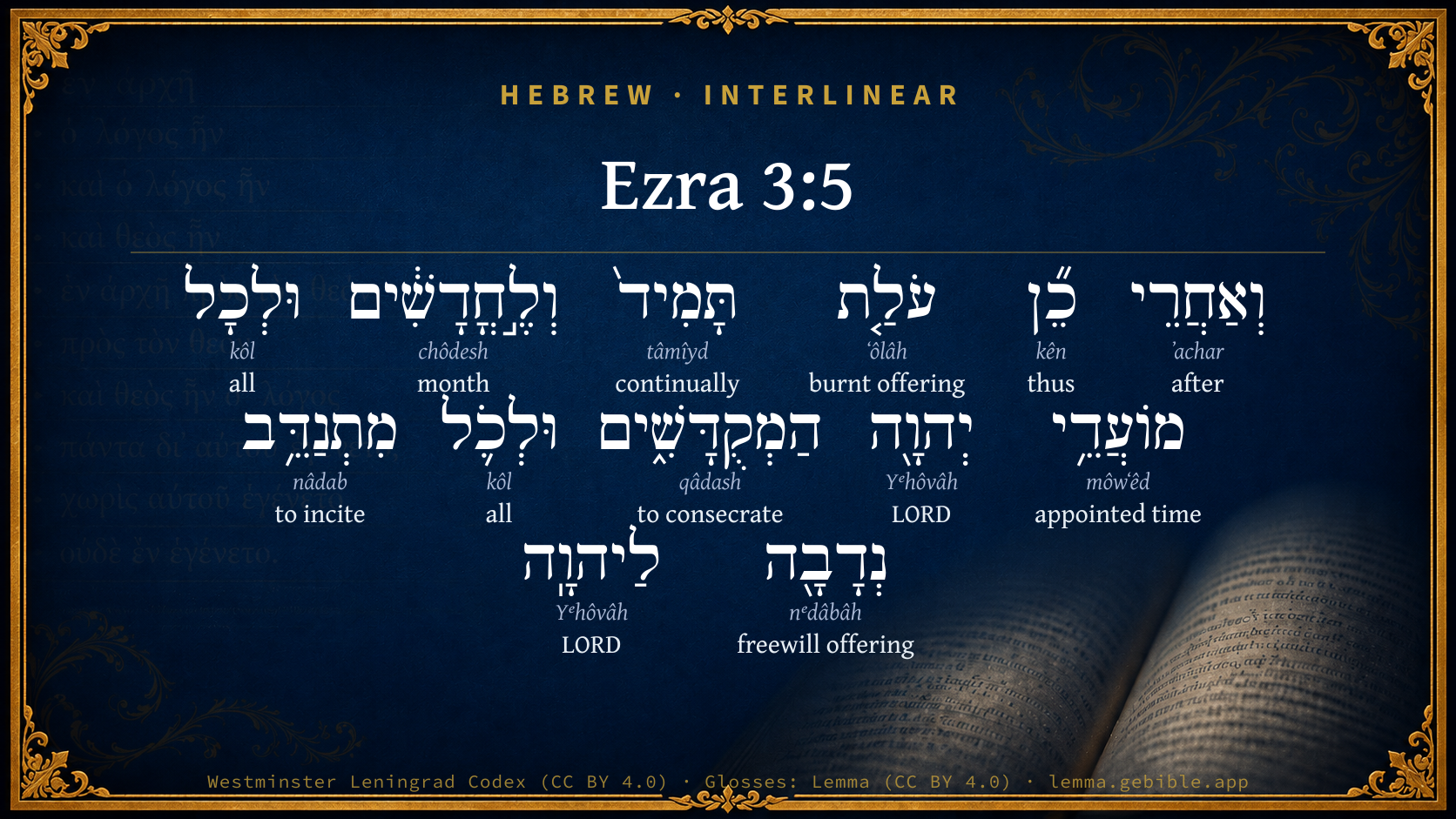
Ezra 3:5

Hebrew (Westminster Leningrad Codex) Ezra 3:5 appears in the Hebrew Old Testament. The text above is from the Westminster Leningrad Codex. Each word links to its Strong’s number, a concise gloss, and parsing drawn from the Open Scriptures Hebrew Bible morphology. Click any word for its full Brown-Driver-Briggs (BDB) entry.
Download image
Cite this verse

Ezra 3:5 (World English Bible). Public Domain. Lemma interlinear Bible study tool, https://lemma.gebible.app/v/ezra/3/5.

Show BibTeX & RIS
BibTeX
RIS
English Translation
and afterward the continual burnt-offering, and [the offerings] of the new moons, and of all the set feasts of Yahweh that were consecrated, and of everyone who willingly offered a freewill-offering to Yahweh.
World English Bible · Public Domain
Download a study sheet

One document with this verse’s original text, its word-by-word gloss line, the meaning frame, cross-references with their text, attributed commentary, and full source and license credits — printable, and it pastes into notes with its structure intact.

This verse Autodidact and up

Study sheet (.html) Plain text (.txt)

A passage Seminary Student

Up to 50 verses in one chapter. A passage sheet keeps up to 6 commentary sources and 12 cross-references per verse, in the order this page ranks them, and says so on the sheet whenever that leaves anything out. Ask for a single verse and you get the Autodidact verse sheet above.

Everything on this page stays free to read, with no account — the sheet is a download of what is already on screen, not access to it.

Want to remove ads? Support Godless Engineer
Compare translations 3

The same verse in 3 English versions, stacked beneath the original-language interlinear above. Click any original word for its lexicon entry.

Each is an independent rendering of the whole verse — the interlinear is not word-aligned to these translations.

Highlighted words mark where these versions differ — a whole-verse word diff, not a word-by-word alignment.

  • World English Bible Public Domain
    and afterward the continual burnt-offering, and [the offerings] of the new moons, and of all the set feasts of Yahweh that were consecrated, and of everyone who willingly offered a freewill-offering to Yahweh.
  • King James Version Public Domain
    And afterward offered the continual burnt offering, both of the new moons, and of all the set feasts of the LORD that were consecrated, and of every one that willingly offered a freewill offering unto the LORD.
  • unfoldingWord Literal Text CC BY-SA 4.0
    And after this was a continual burnt up offering, and for the new moons, and for all the consecrated appointed times of Yahweh, and for everyone who freely offered a freewill offering to Yahweh.

unfoldingWord Literal Text — © unfoldingWord, licensed CC BY-SA 4.0. Word-aligned USFM3 via Door43 (git.door43.org/unfoldingWord/en_ult).

Versions to compare (up to 4)

3 of 4 selected

Show all 18 translations

Every available English version of this verse, each an independent rendering of the whole verse.

  • World English Bible Public Domain
    and afterward the continual burnt-offering, and [the offerings] of the new moons, and of all the set feasts of Yahweh that were consecrated, and of everyone who willingly offered a freewill-offering to Yahweh.
  • Berean Standard Bible Public Domain
    After that, they presented the regular burnt offerings and those for New Moons and for all the appointed sacred feasts of the LORD, as well as all the freewill offerings brought to the LORD.
  • Majority Standard Bible Public Domain
    After that, they presented the regular burnt offerings and those for New Moons and for all the appointed sacred feasts of the LORD, as well as all the freewill offerings brought to the LORD.
  • King James Version Public Domain
    And afterward offered the continual burnt offering, both of the new moons, and of all the set feasts of the LORD that were consecrated, and of every one that willingly offered a freewill offering unto the LORD.
  • American Standard Version (1901) Public Domain
    and afterward the continual burnt-offering, and `the offerings' of the new moons, and of all the set feasts of Jehovah that were consecrated, and of every one that willingly offered a freewill-offering unto Jehovah.
  • Revised Version (1885) Public Domain
    and afterward the continual burnt offering, and the offerings of the new moons, and of all the set feasts of the LORD that were consecrated, and of every one that willingly offered a freewill offering unto the LORD.
  • Geneva Bible (1599) Public Domain
    And afterwarde the continuall bnrnt offring, both in the newe moneths and in all the feast dayes that were consecrate vnto the Lord, and in all the oblations willingly offered vnto the Lord.
  • Douay-Rheims (1899) Public Domain
    And afterwards the continual holocaust, both on the new moons, and on all the solemnities of the Lord, that were consecrated, and on all in which a freewill offering was made to the Lord.
  • Young's Literal Translation Public Domain
    and after this a continual burnt-offering, and for new moons, and for all appointed seasons of Jehovah that are sanctified; and for every one who is willingly offering a willing-offering to Jehovah.
  • Literal Standard Version CC BY-SA 4.0
    and after this a continual burnt-offering, and for new moons, and for all appointed times of YHWH that are sanctified; and for everyone who is willingly offering a willing-offering to YHWH.
  • Unlocked Literal Bible CC BY-SA 4.0
    Accordingly, there were daily burnt offerings and monthly ones and offerings for all the fixed feasts of Yahweh, along with all the freewill offerings.
  • unfoldingWord Literal Text CC BY-SA 4.0
    And after this was a continual burnt up offering, and for the new moons, and for all the consecrated appointed times of Yahweh, and for everyone who freely offered a freewill offering to Yahweh.
  • Darby Bible Public Domain
    and afterwards the continual burnt-offering, and those of the new moons, and of all the set feasts of Jehovah that were consecrated, and of every one that willingly offered a voluntary offering to Jehovah.
  • World Messianic Bible Public Domain
    and afterward the continual burnt offering, the offerings of the new moons, of all the set feasts of the LORD that were consecrated, and of everyone who willingly offered a free will offering to the LORD.
  • Webster's Bible Public Domain
    And afterward offered the continual burnt-offering, both of the new moons, and of all the set feasts of the LORD that were consecrated, and of every one that willingly offered a free-will-offering to the LORD.
  • Free Bible Version CC BY-SA 4.0
    After that they also presented the daily burnt offerings and the new moon offerings, as well as those for all the yearly festivals of the lord and for those who brought voluntary offerings to the Lord.
  • Bible in Basic English Public Domain
    And after that, the regular burned offering and the offerings for the new moons and all the fixed feasts of the Lord which had been made holy, and the offering of everyone who freely gave his offering to the Lord.
  • JPS Tanakh (1917) Public Domain
    and afterward the continual burnt-offering, and the offerings of the new moons, and of all the appointed seasons of the LORD that were hallowed, and of every one that willingly offered a freewill-offering unto the LORD.

Literal Standard Version (2020), Covenant Press — licensed CC BY-SA 4.0. Text via the HelloAO Bible API (eBible.org). Unlocked Literal Bible (unfoldingWord) — licensed CC BY-SA 4.0. Text via the HelloAO Bible API (eBible.org). unfoldingWord Literal Text — © unfoldingWord, licensed CC BY-SA 4.0. Word-aligned USFM3 via Door43 (git.door43.org/unfoldingWord/en_ult). Free Bible Version, Dr. Jonathan Gallagher — licensed CC BY-SA 4.0. Text via the HelloAO Bible API (eBible.org).

Word by word

More ways to search: Search by grammar → Find every occurrence → Compare this word →

Practice this passage: Drill this verse → Learn its vocabulary →

מִתְנַדֵּ֥ב
nâdab
H5068
“inciting”
Verb, Hithpael, Participle Active, Masculine, Singular, Absolute
Part of Speech
Verb
Stem
Hithpael
Form
Participle Active
Gender
Masculine
Number
Singular
State
Absolute
Full BDB Definition

Origin: a primitive root

TWOT: 1299

to incite, impel, make willing - (Qal) to incite, impel - (Hithpael) - to volunteer - to offer free-will offerings
  1. וְאַחֲרֵי ʼachar H310 “and · after” Conjunction + Adverb
  2. כֵ֞ן kên H3651 “thus” Adverb
  3. עֹלַ֤ת ʻôlâh H5930 “burnt offering of” Noun, Common, Feminine, Singular, Construct
  4. תָּמִיד֙ tâmîyd H8548 “continually” Noun, Common, Masculine, Singular, Absolute
  5. וְלֶ֣חֳדָשִׁ֔ים chôdesh H2320 “and · to/for the · months” Conjunction + Preposition, Determined + Noun, Common, Masculine, Plural, Absolute
  6. וּלְכָל kôl H3605 “and · to/for · all of” Conjunction + Preposition + Noun, Common, Masculine, Singular, Construct
  7. מוֹעֲדֵ֥י môwʻêd H4150 “appointed times of” Noun, Common, Masculine, Plural, Construct
  8. יְהוָ֖ה Yᵉhôvâh H3068 “LORD” Noun, Proper
  9. הַמְקֻדָּשִׁ֑ים qâdash H6942 “the · consecrated” Particle, Definite Article + Verb, Pual, Participle Passive, Masculine, Plural, Absolute
  10. וּלְכֹ֛ל kôl H3605 “and · to/for · all of” Conjunction + Preposition + Noun, Common, Masculine, Singular, Construct
  11. נְדָבָ֖ה nᵉdâbâh H5071 “freewill offering” Noun, Common, Feminine, Singular, Absolute
  12. לַיהוָֽה Yᵉhôvâh H3068 “to/for · LORD” Preposition + Noun, Proper

About this verse

These counts appear in no published source. They are computed here, from the morphology-tagged text and Lemma’s own curated glosses. What Lemma adds →

13
words
11
distinct lemmas
Historical
section

Notable vocabulary

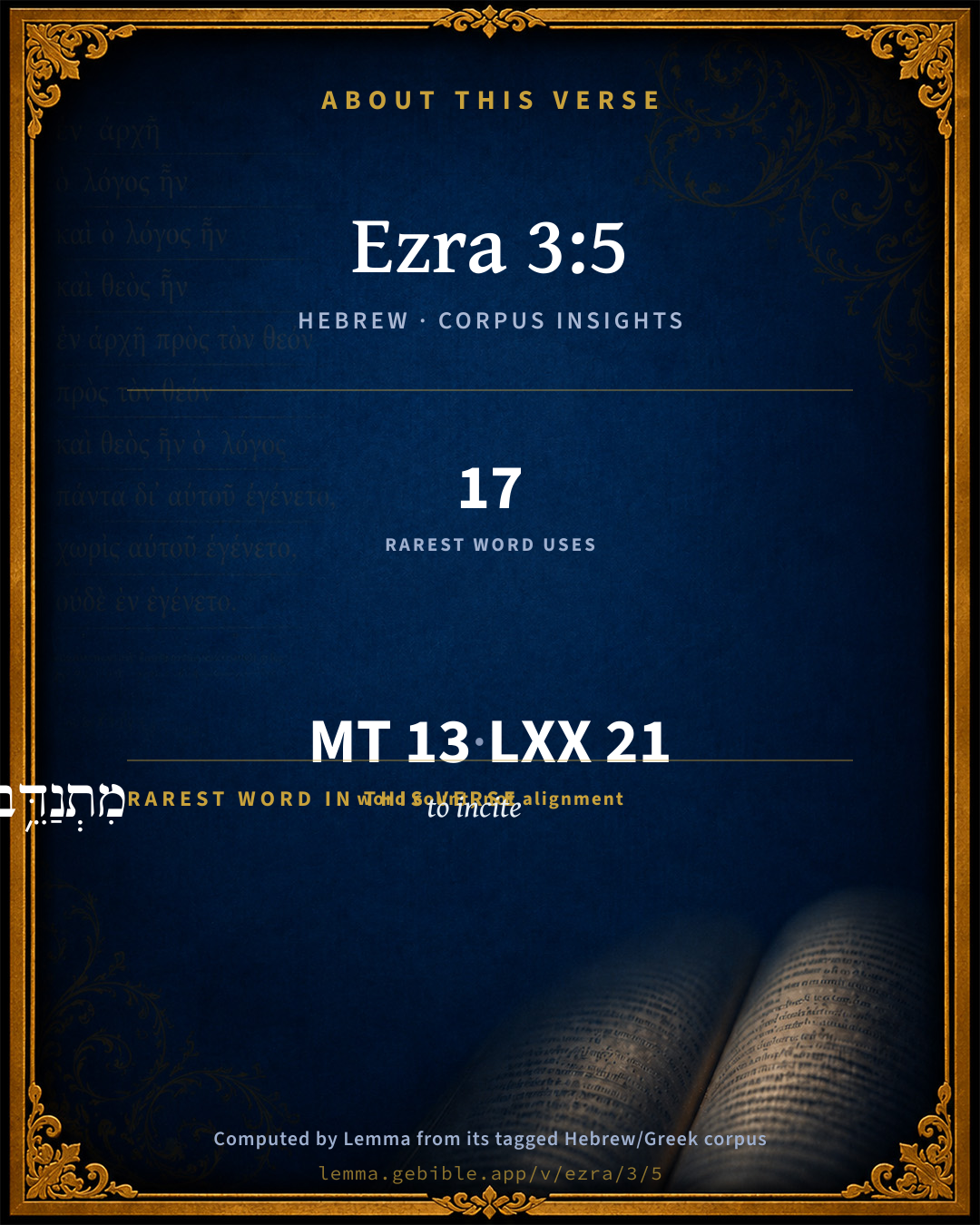
The rarest word here is מִתְנַדֵּ֥ב to incite H5068 — appearing just 17 times in the whole Hebrew Bible.

Shared distinctive vocabulary

מִתְנַדֵּ֥ב to incite H5068 occurs in 15 verses of the Hebrew Bible. Also found in:

Grammatical profile

  • 2 verbs
  • 9 nouns
  • 2 adverbs

Verb forms

  • הַמְקֻדָּשִׁ֑ים Pual · Participle Passive
  • מִתְנַדֵּ֥ב Hithpael · Participle Active

Repetition

Words recur within this verse — often emphatic in Hebrew:

  • וּלְכָל all H3605 ×2
  • יְהוָ֖ה LORD H3068 ×2

Hebrew & Septuagint length

In English translation the verse runs 33 words from the Hebrew and 38 from the Septuagint (LXX English) — closely comparable.

A rough comparison of the two English renderings, which tokenize alike — not a word-level alignment.

Word counts can differ between the Hebrew and the Greek without any difference in meaning — e.g. the Hebrew direct-object marker אֵת has no separate Greek word, and Greek often adds the article ὁ.

In the original languages it is 13 Hebrew tokens and 21 Greek tokens — but the two are counted differently (Hebrew bundles its prefixes and suffixes into one token; the Greek is in lemma form), so that isn’t a like-for-like length.

Cross-references

13

Topical passages linked to Ezra 3:5 in the Treasury of Scripture Knowledge — connected by theme and wording, ordered by reader-vote popularity; previews shown in the World English Bible.

  • Numbers 29:39 These you shall offer to Yahweh in your set feasts, besides your vows, and your freewill-offerings, for your burnt offerings, and for your meal-offerings, and for your drink-offerings, and for your peace-offerings.
  • Exodus 29:38–42 "Now this is that which you shall offer on the altar: two lambs a year old day by day continually.
  • Leviticus 1:3 "'If his offering is a burnt offering from the herd, he shall offer a male without blemish. He shall offer it at the door of the Tent of Meeting, that he may be accepted before Yahweh.
  • Numbers 28:3–11 You shall tell them, This is the offering made by fire which you shall offer to Yahweh: he-lambs a year old without blemish, two day by day, for a continual burnt offering.
  • Numbers 28:14 Their drink-offerings shall be half a hin of wine for a bull, and the third part of a hin for the ram, and the fourth part of a hin for a lamb: this is the burnt offering of every month throughout the months of the year.
  • Numbers 28:19 but you shall offer an offering made by fire, a burnt offering to Yahweh: two young bulls, and one ram, and seven he-lambs a year old; they shall be to you without blemish;
  • Numbers 28:27 but you shall offer a burnt offering for a sweet savor to Yahweh: two young bulls, one ram, seven he-lambs a year old;
  • Numbers 29:2 You shall offer a burnt offering for a sweet savor to Yahweh: one young bull, one ram, seven he-lambs a year old without blemish;
  • Numbers 29:8 but you shall offer a burnt offering to Yahweh for a sweet savor: one young bull, one ram, seven he-lambs a year old; they shall be to you without blemish;
  • Numbers 29:13 and you shall offer a burnt offering, an offering made by fire, of a sweet savor to Yahweh; thirteen young bulls, two rams, fourteen he-lambs a year old; they shall be without blemish;
  • Deuteronomy 12:6 and there you shall bring your burnt offerings, and your sacrifices, and your tithes, and the heave-offering of your hand, and your vows, and your freewill-offerings, and the firstborn of your herd and of your flock:
  • Deuteronomy 12:17 You may not eat within your gates the tithe of your grain, or of your new wine, or of your oil, or the firstborn of your herd or of your flock, nor any of your vows which you vow, nor your freewill-offerings, nor the heave-offering of your hand;
  • 2 Chronicles 29:31–32 Then Hezekiah answered, Now you have consecrated yourselves to Yahweh; come near and bring sacrifices and thank-offerings into the house of Yahweh. The assembly brought in sacrifices and thank-offerings; and as many as were of a willing heart [brought] burnt offerings.

Cross-references courtesy of OpenBible.info (CC BY 4.0).

Hebrew and Greek witnesses Masoretic Hebrew ↔ Greek Septuagint

The same verse in the two great witnesses to the Old Testament, shown verse-for-verse.

These are two independent witnesses, not word-aligned to each other, and the Septuagint is shown in lemma (dictionary) form.

Hebrew Ezra 3:5 Masoretic · Westminster Leningrad Codex

וְאַחֲרֵי כֵ֞ן עֹלַ֤ת תָּמִיד֙ וְלֶ֣חֳדָשִׁ֔ים וּלְכָל מוֹעֲדֵ֥י יְהוָ֖ה הַמְקֻדָּשִׁ֑ים וּלְכֹ֛ל מִתְנַדֵּ֥ב נְדָבָ֖ה לַיהוָֽה

and afterward the continual burnt-offering, and [the offerings] of the new moons, and of all the set feasts of Yahweh that were consecrated, and of everyone who willingly offered a freewill-offering to Yahweh.

World English Bible · Public Domain

Greek LXX Ezra 3:5 Septuagint · lemma form

καί μετά οὗτος ὁλοκαύτωσις ἐνδελεχισμός καί εἰς ὁ νουμηνία καί εἰς πᾶς ἑορτή ὁ ἁγιάζω καί πᾶς ἑκουσιάζομαι ἑκούσιος ὁ κύριος

And after this the perpetual whole burnt offering, and offering for the season of new moon, and for all the hallowed feasts to the Lord, and for every one that offered a free will offering to the Lord.

LXX2012 (modern English Septuagint) · Public Domain

In the Septuagint this is one book — Esdras B (2 Esdras): Ezra is chapters 1–10, Nehemiah 11–23.

Hebrew: Westminster Leningrad Codex (CC BY 4.0). Greek: Septuagint (public domain); English from LXX2012 (modern English Septuagint) (Public Domain). How the Septuagint differs from the Hebrew →

Commentary

Notes on Ezra 3:5 from classic Christian and Jewish commentators (each source and its license shown beneath its notes). The classic Christian expositions comment on the surrounding passage and are grouped to its opening verse, so a note may address several verses; the Jewish commentaries on the Tanakh (Rashi and others) are per-verse, so they appear only where the commentator wrote on this verse.

Lemma curates 59 commentaries, every one of them public domain or Creative Commons licensed, each selected and text-cleaned for this edition rather than reprinted as found. About our sources →

Trapp's Complete Commentary

John Trapp

Ezr 3:5 And afterward [offered] the continual burnt offering, both of the new moons, and of all the set feasts of the LORD that were consecrated, and of every one that willingly offered a freewill offering unto the LORD.

Ver. 5. And afterward offered] Finding a float of holy affections in their hearts, they passed from one good exercise to another, and were indefatigable in the Lord’s work. David, finding such a heat and height in his people, prays God to "keep it ever in the imagination of the thoughts of their hearts," which he knew well to be fickle and false, 1Ch 29:18.

Both of the new moons] Kept in thankfulness to God for their time renewed upon them, from month to month, and his mercies every morning and moment.

And of all the set feasts of the Lord that were consecrated] By a holy resting, both from corporal labour and from spiritual idleness.

A freewill offering] {See Trapp on "Ezr 1:4"}

John Trapp, A Commentary or Exposition upon All the Books of the Old and New Testament (1647–1656) — public domain. Text from a community e-Sword module.

Joseph Benson's Commentary

Ezr 3:5. And afterward offered the continual burnt-offering — The morning and evening sacrifice. The law required much, but they offered more; for though they had little wealth, they had much zeal. Happy they that bring with them out of the furnace of affliction such a holy heat as this!

Joseph Benson's Commentary on the Old and New Testaments (1811–1818) — public domain. Text from a community e-Sword module.

Tyndale Open Study Notes

Tyndale Open Resources

3:5-6 The catalog of sacrifices, offered even before the Temple’s foundation was laid, showed the people’s enthusiasm for faithfully worshiping God at every opportunity. They did everything exactly as they were instructed in the law. • The new moon celebrations took place on the first day of every Hebrew month; the sacrifices and blowing of trumpets reminded the people of God’s covenant with them (Num 10:10; 28:11-15). • Voluntary offerings were such gifts as money for building the Temple (Exod 35:29; 36:3). The Hebrew term can also refer to peace offerings of meat or bread that were eaten to celebrate fellowship with God (Lev 7:11-21).

Tyndale Open Study Notes — © Tyndale Open Resources, licensed CC BY-SA 4.0. Text via the HelloAO Bible API.

Geneva Bible (1599)

Geneva Bible translators

That is, after the feast of Tabernacles.

Geneva Bible (1599) marginal notes — public domain. Text via Bolls.life.

Ellicott's Commentary for English Readers

(5) Both of the new moons.—And of the new moons. The whole verse is general and anticipatory. The new moons, the three feasts, and the constant presentation of freewill offerings, added to the daily sacrifice, made up the essentials of ritual; all being, like the arrangements in the Book of Leviticus, fixed before the Temple was built, and afterwards observed.

A Bible Commentary for English Readers, edited by Charles John Ellicott (1878–1897) — public domain. Text from a community e-Sword module.

The Cambridge Bible for Schools and Colleges

gen. ed. J. J. S. Perowne

5. and afterward offered] R.V. ‘and afterward’, the verb being supplied from the previous verse.

The clause implies that after the celebration of this Feast of Tabernacles the Jews resumed for the first time since the destruction of Jerusalem the regular sacrificial system.

the continual burnt offering] i.e. the daily morning and evening sacrifice, prescribed in Exo_29:38-42.

both of the new moons, and of all the set feasts &c.] R.V. ‘and the offerings of the new moons, and of all the set feasts’ &c. The A.V. gives the wrong impression that ‘the continual burnt offering’ belonged to ‘the new moons, set feasts,’ &c. The R.V. gives the right meaning.

The verse states that the Jews, now that the altar had been set up and the new order of things initiated by the solemn celebration of the Feast of Tabernacles, resumed the customary burnt offerings, (1) daily, morning and evening, (2) at the new moon, (3) on all ‘set feasts’, (4) on the occasion of freewill offerings.

‘the new moons’. A popular day of religious observance among the Israelites (cf. 2Ki_4:23; Hos_2:11; Amo_8:5): not included among ‘the set feasts’ described in Leviticus 23, where the first day of the seventh month is the only new-moon day spoken of as a ‘holy convocation’ (Lev_23:24). Perhaps because the observance of ‘the new moons’ had been adopted from the general religious customs of the Semitic races, it received no special prominence in the Levitical code. The sacrifices for the ‘new moons’ are described in Num_28:11-15.

the set feasts]—see Lev_23:2-37, ‘The set feasts of the Lord, which ye shall proclaim to be holy convocations’ (R.V.),—i.e. (1) the Sabbath ( Lev_23:3), (2) the Passover ( Lev_23:5), (3) the Feast of Weeks ( Lev_23:15-21), (4) the Feast of Trumpets ( Lev_23:24), (5) the Day of Atonement ( Lev_23:27-32), (6) the Feast of Tabernacles ( Lev_23:34-36). In 2Ch_8:13, ‘the set feasts’ are the three great annual festivals, ‘unleavened bread’, ‘weeks’, ‘tabernacles’, and these are probably intended here.

The ‘new moons’ and the ‘set feasts’ are found along with ‘the Sabbaths’ in 1Ch_23:31; 2Ch_2:4; 2Ch_8:13; 2Ch_31:3; Neh_10:33.

a freewill offering] Freewill offerings were made (1) on the great feast-days, see Deu_16:10; Deu_16:16-17; and (2) whensoever any individual Israelite or Gentile desired (Num_29:39). They are called ‘oblations’ (Corbans) in Leviticus 1, 2, 3, where they are defined in detail.

The Cambridge Bible for Schools and Colleges (gen. ed. J. J. S. Perowne; Cambridge University Press, 1878–1918) — public domain. Text from a community e-Sword module.

John Gill's Exposition

And afterwards offered the continual burnt offering,.... Not after the feast of tabernacles, as if they then began to offer the daily sacrifice; for that they did as soon as the altar was set up, and on the first day of the month, Ezr 3:3, rather the sense is, that after the daily burnt offering of the morning, they offered the other sacrifices peculiar to the several days of the feast of tabernacles; they never neglected that, yea, always began with it; all the rest were after it, and so on other festivals:

both of the new moons, and of all the set feasts of the Lord that were consecrated; to the service of the Lord, and the honour of his name, as every first day of the month, and every other appointed festival, they offered the sacrifices appropriate to each; but not to the neglect of that sacrifice, and always after it:

and of everyone that willingly offered a freewill offering unto the Lord; these they were careful also to offer in their proper time.

John Gill's Exposition of the Whole Bible (1746–1763) — public domain (CC PDM 1.0). Text via the HelloAO Bible API.

Matthew Poole's English Annotations

The continual burnt offering; thee morning and evening sacrifice; of which see on Num 28:6.

Consecrated, i.e. set apart for the solemn and holy service of God.

Matthew Poole's English Annotations on the Holy Bible (1683–1685) — public domain. Text from a community e-Sword/MySword module.

Whedon's Commentary on the Bible

Daniel D. Whedon

5. The continual burnt offering — Described in Exo_29:38-42; Num_28:3-8.

New moons — See at Num_10:10; Num_28:11.

All the set feasts — Enumerated in Numbers 28, 29.

A freewill offering — That is, one willingly offered over and above what was prescribed in the law.

Daniel D. Whedon (gen. ed.), Commentary on the Old and New Testaments (1874–1909) — public domain. Text from a community e-Sword module.

The Pulpit Commentary

PERMANENT ESTABLISHMENT OF THE DAILY SACRIFICE, THE SET FEASTS, AND THE OFFERING OF FREE-WILL OFFERINGS (vers. 5, 6). Having set up the altar, and celebrated the particular festival which the revolving year happened to have brought round, and which it would have been wrong to neglect, the exiles re-established permanently three things:

1. The daily sacrifice;

2. The celebration of the new moons and other regular feasts; and

3. The practice of allowing the people to bring offerings whenever they pleased, to be offered on the great altar by the priest or priests in attendance.

The first of these was for atonement; the second for public thanksgiving and acknowledgment of God"s mercies; the third for private devotion, the payment of vows, and the like.

The continual burnt offering. This is beyond a doubt the daily morning and evening sacrifice, called "the continual burnt offering" in Exo_29:42 and Num_28:3-6. The clause is not modified by the succeeding words, which are additional, not exegetical, and which should not be translated, as in the A. V, both of the new moons, but, and those of the new moons." The returned exiles kept henceforth regularly both the daily morning and evening sacrifice, and also that appointed for the new moons, (Num_28:11-15) and those appointed for the other "set feasts,"such as the passover and the feast of Pentecost. And of every one that willingly offered. Nor was this all. The practice was resumed of sacrificing on the great altar at any time any freewill offerings that individual Israelites might bring. (see Lev 1:, Lev 2:, Lev_2:3, etc.) Thus provision was made for all that was most essential in the ritual of religion, while the temple itself still remained unbuilt (see ver. 6).

The Pulpit Commentary (1880–1919), ed. H.D.M. Spence-Jones & Joseph S. Exell — public domain. Text from a community e-Sword module.

John Wesley's Explanatory Notes

Offering - The morning and evening, sacrifice. The law required much; but they offered more; for tho' thy had little wealth, they had much zeal. Happy they that bring with them out of the furnace of affliction, such a holy heat as this!

John Wesley, Explanatory Notes Upon the Whole Bible (1754–1765) — public domain. Text via the GEBible commentary corpus.

Rashi

Rabbi Shlomo Yitzchaki (Rashi)

And afterwards And after Succoth they would offer up sacrifices every day, for the morning and for the evening.

and for the New Moon lit. and for the months. And at the beginning of the months they would offer up the sacrifices of the New Moon.

and for all the appointed seasons of the Lord and for the rest of the appointed seasons of their sacrifices.

and for everyone who willingly offered And for all those who willingly offered their free-will offerings, the priests would accept them to sacrifice them, and from the first day of Tishri they commenced to offer up sacrifices, but the foundation of the Temple was not yet built.

Rashi on the Tanakh — English translations: “The Judaica Press complete Tanach with Rashi, translated by A. J. Rosenberg” (CC BY 4.0); “Pentateuch with Rashi's commentary by M. Rosenbaum and A.M. Silbermann, 1929-1934” (public domain); “The Metsudah Tanach series, Lakewood, N.J” (CC BY 4.0); and “The Book of Joshua, Metsudah Publications, 1997” (CC BY 4.0). Text via Sefaria.

Lesson kit

Teaching starters — assembled from the data on this page, not authored interpretation. Every prompt links to the verse data it draws on. Edit before teaching.

Ezra, in the Historical, opens this verse with 13 words (11 distinct Hebrew lemmas). Its most distinctive word is nâdab (“to incite”). A historical commentator’s framing appears above. Read the whole chapter for the surrounding context.

Discussion questions

  1. What does “to incite” (nâdab) contribute to the verse as a whole?
  2. Exodus 25:2 shares the word «to incite» with this verse. How do the two illuminate each other?
  3. “all” occurs 2× in this one verse. What is the effect of the repetition?
  4. The translations on this page render this verse differently — a whole-verse word diff, not a word-by-word alignment. What might account for the different wordings?
  5. The verb «הַמְקֻדָּשִׁ֑ים» is Pual Participle Passive. How does its form color the action?
  6. Reading how Trapp's Complete Commentary and Joseph Benson's Commentary read this verse, where do the two commentators agree and where do they part?

Things to notice

Reading settings

Reading text

Shown beneath each verse's original-language words.

Old Testament
Old Testament edition

Read the OT as the Masoretic Hebrew (MT) or the Greek Septuagint (LXX).

English shown for the Greek Septuagint (in the Hebrew ↔ Greek comparison).

Comparing translations? Open the Compare panel on any verse page to stack up to four side by side.