
Nehemiah 7:73

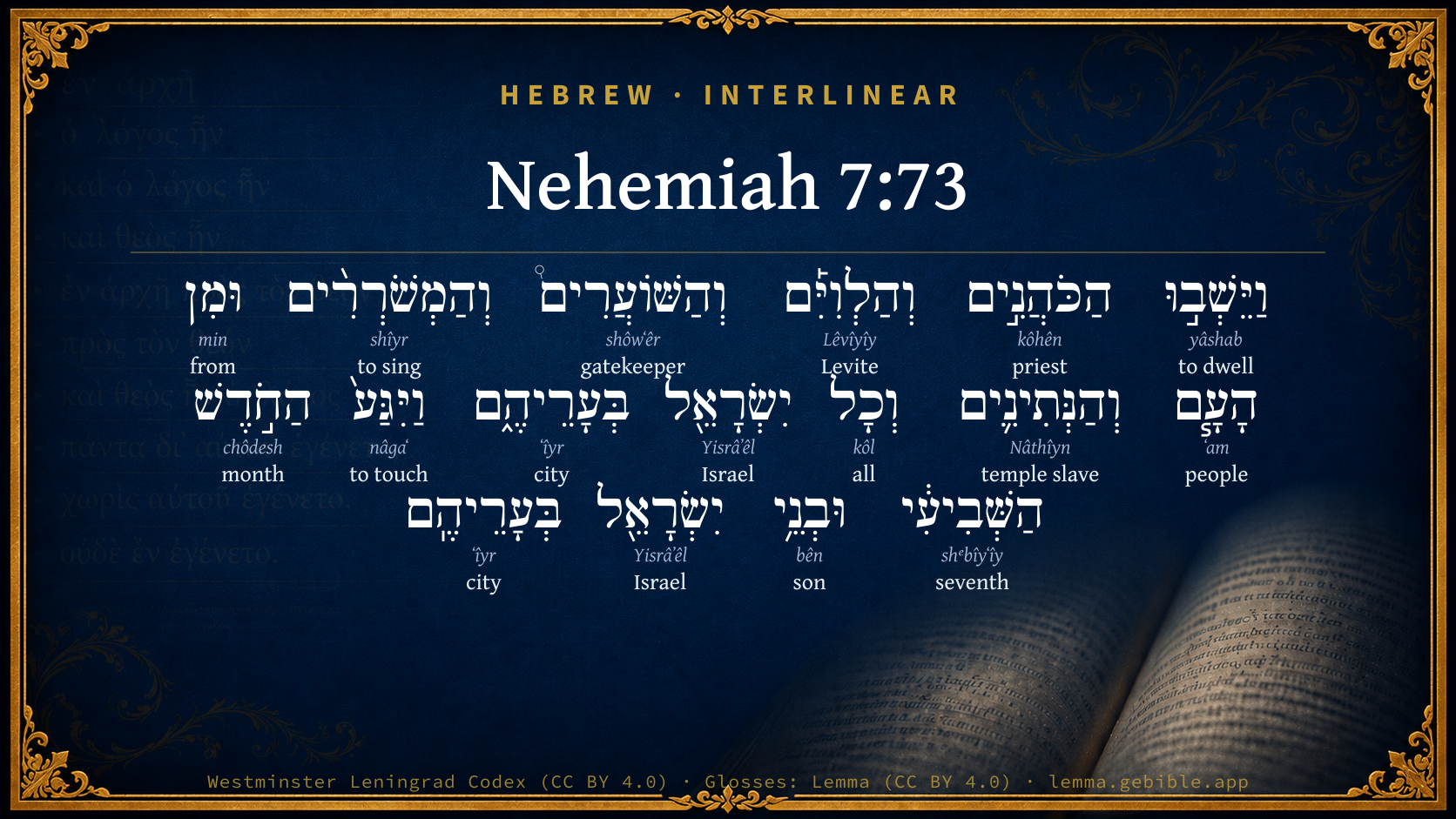
Hebrew (Westminster Leningrad Codex) Nehemiah 7:73 appears in the Hebrew Old Testament. The text above is from the Westminster Leningrad Codex. Each word links to its Strong’s number, a concise gloss, and parsing drawn from the Open Scriptures Hebrew Bible morphology. Click any word for its full Brown-Driver-Briggs (BDB) entry.
Download image
Cite this verse

Nehemiah 7:73 (World English Bible). Public Domain. Lemma interlinear Bible study tool, https://lemma.gebible.app/v/nehemiah/7/73.

Show BibTeX & RIS
BibTeX
RIS
English Translation
So the priests, and the Levites, and the porters, and the singers, and some of the people, and the Nethinim, and all Israel, lived in their cities. When the seventh month was come, the children of Israel were in their cities.
World English Bible · Public Domain
Download a study sheet

One document with this verse’s original text, its word-by-word gloss line, the meaning frame, cross-references with their text, attributed commentary, and full source and license credits — printable, and it pastes into notes with its structure intact.

This verse Autodidact and up

Study sheet (.html) Plain text (.txt)

A passage Seminary Student

Up to 50 verses in one chapter. A passage sheet keeps up to 6 commentary sources and 12 cross-references per verse, in the order this page ranks them, and says so on the sheet whenever that leaves anything out. Ask for a single verse and you get the Autodidact verse sheet above.

Everything on this page stays free to read, with no account — the sheet is a download of what is already on screen, not access to it.

Want to remove ads? Support Godless Engineer
Compare translations 3

The same verse in 3 English versions, stacked beneath the original-language interlinear above. Click any original word for its lexicon entry.

Each is an independent rendering of the whole verse — the interlinear is not word-aligned to these translations.

Highlighted words mark where these versions differ — a whole-verse word diff, not a word-by-word alignment.

  • World English Bible Public Domain
    So the priests, and the Levites, and the porters, and the singers, and some of the people, and the Nethinim, and all Israel, lived in their cities. When the seventh month was come, the children of Israel were in their cities.
  • King James Version Public Domain
    So the priests, and the Levites, and the porters, and the singers, and some of the people, and the Nethinims, and all Israel, dwelt in their cities; and when the seventh month came, the children of Israel were in their cities.
  • unfoldingWord Literal Text CC BY-SA 4.0
    And the priests, and the Levites, and the gatekeepers, and the ones who sang, and some from the people, and the Nethinim, and all Israel dwelt in their cities. And the seventh month came, and the sons of Israel were in their cities.

unfoldingWord Literal Text — © unfoldingWord, licensed CC BY-SA 4.0. Word-aligned USFM3 via Door43 (git.door43.org/unfoldingWord/en_ult).

Versions to compare (up to 4)

3 of 4 selected

Show all 18 translations

Every available English version of this verse, each an independent rendering of the whole verse.

  • World English Bible Public Domain
    So the priests, and the Levites, and the porters, and the singers, and some of the people, and the Nethinim, and all Israel, lived in their cities. When the seventh month was come, the children of Israel were in their cities.
  • Berean Standard Bible Public Domain
    So the priests, Levites, gatekeepers, singers, and temple servants, along with some of the people and the rest of the Israelites, settled in their own towns. And by the seventh month the Israelites had settled in their towns.
  • Majority Standard Bible Public Domain
    So the priests, Levites, gatekeepers, singers, and temple servants, along with some of the people and the rest of the Israelites, settled in their own towns. And by the seventh month the Israelites had settled in their towns.
  • King James Version Public Domain
    So the priests, and the Levites, and the porters, and the singers, and some of the people, and the Nethinims, and all Israel, dwelt in their cities; and when the seventh month came, the children of Israel were in their cities.
  • American Standard Version (1901) Public Domain
    So the priests, and the Levites, and the porters, and the singers, and some of the people, and the Nethinim, and all Israel, dwelt in their cities. And when the seventh month was come, the children of Israel were in their cities.
  • Revised Version (1885) Public Domain
    So the priests, and the Levites, and the porters, and the singers, and some of the people, and the Nethinim, and all Israel, dwelt in their cities. And when the seventh month was come, the children of Israel were in their cities.
  • Geneva Bible (1599) Public Domain
    And the Priestes, and Leuites, and the porters and the singers and the rest of the people and the Nethinims, and all Israel dwelt in their cities: and when the seuenth moneth came, the children of Israel were in their cities.
  • Douay-Rheims (1899) Public Domain
    And the priests, and the Levites, and the porters, and the singing men, and the rest of the common people, and the Nathinites, and all Israel dwelt in their cities.
  • Young's Literal Translation Public Domain
    And they dwell -- the priests, and the Levites, and the gatekeepers, and the singers, and `some' of the people, and the Nethinim, and all Israel -- in their cities, and the seventh month cometh, and the sons of Israel `are' in their cities.
  • Literal Standard Version CC BY-SA 4.0
    And they dwell—the priests, and the Levites, and the gatekeepers, and the singers, and [some] of the people, and the Nethinim, and all Israel—in their cities, and the seventh month comes, and the sons of Israel [are] in their cities.
  • Unlocked Literal Bible CC BY-SA 4.0
    So the priests, the Levites, the gatekeepers, the singers, some of the people, the temple servants, and all Israel lived in their cities. By the seventh month the people of Israel were settled in their cities.”
  • unfoldingWord Literal Text CC BY-SA 4.0
    And the priests, and the Levites, and the gatekeepers, and the ones who sang, and some from the people, and the Nethinim, and all Israel dwelt in their cities. And the seventh month came, and the sons of Israel were in their cities.
  • Darby Bible Public Domain
    And the priests, and the Levites, and the doorkeepers, and the singers, and [some] of the people, and the Nethinim, and all Israel, dwelt in their cities. And when the seventh month came, and the children of Israel were in their cities,
  • World Messianic Bible Public Domain
    So the priests, the Levites, the gatekeepers, the singers, some of the people, the temple servants, and all Israel lived in their cities. When the seventh month had come, the children of Israel were in their cities.
  • Webster's Bible Public Domain
    So the priests, and the Levites, and the porters, and the singers, and some of the people, and the Nethinims, and all Israel, dwelt in their cities; and when the seventh month came, the children of Israel were in their cities.
  • Free Bible Version CC BY-SA 4.0
    The priests, Levites, gatekeepers, singers, and Temple servants, as well as some of the people and the rest of the Israelites, went back to live in their specific towns. By the seventh month the Israelites were living in their towns,
  • Bible in Basic English Public Domain
    So the priests and the Levites and the door-keepers and the music-makers and some of the people and the Nethinim, and all Israel, were living in their towns.
  • JPS Tanakh (1917) Public Domain
    So the priests, and the Levites, and the porters, and the singers, and some of the people, and the Nethinim, and all Israel, dwelt in their cities. And when the seventh month was come, and the children of Israel were in their cities,

Literal Standard Version (2020), Covenant Press — licensed CC BY-SA 4.0. Text via the HelloAO Bible API (eBible.org). Unlocked Literal Bible (unfoldingWord) — licensed CC BY-SA 4.0. Text via the HelloAO Bible API (eBible.org). unfoldingWord Literal Text — © unfoldingWord, licensed CC BY-SA 4.0. Word-aligned USFM3 via Door43 (git.door43.org/unfoldingWord/en_ult). Free Bible Version, Dr. Jonathan Gallagher — licensed CC BY-SA 4.0. Text via the HelloAO Bible API (eBible.org).

Word by word

More ways to search: Search by grammar → Find every occurrence → Compare this word →

Practice this passage: Drill this verse → Learn its vocabulary →

וְהַנְּתִינִ֛ים
Nâthîyn
H5411
“and · the · temple slaves”
Conjunction + Particle, Definite Article + Noun, Common, Masculine, Plural, Absolute
Part of Speech
Conjunction + Particle + Noun
Type
Common
Gender
Masculine
Number
Plural
State
Absolute
Full BDB Definition

Origin: from H5414

TWOT: 1443a

Nethinims - temple slaves assigned to the Levites and priests for service in the sanctuary
  1. וַיֵּשְׁב֣וּ yâshab H3427 “and · to dwell” Conjunction + Verb, Qal, Sequential Imperfect, 3rd Person, Masculine, Plural
  2. הַכֹּהֲנִ֣ים kôhên H3548 “the · priests” Particle, Definite Article + Noun, Common, Masculine, Plural, Absolute
  3. וְהַלְוִיִּ֡ם Lêvîyîy H3881 “and · the · Levites” Conjunction + Particle, Definite Article + Noun, Gentilic, Masculine, Plural, Absolute
  4. וְהַשּׁוֹעֲרִים֩ shôwʻêr H7778 “and · the · gatekeepers” Conjunction + Particle, Definite Article + Noun, Common, Masculine, Plural, Absolute
  5. וְהַמְשֹׁרְרִ֨ים shîyr H7891 “and · the · singing” Conjunction + Particle, Definite Article + Verb, Polel, Participle Active, Masculine, Plural, Absolute
  6. וּמִן min H4480 “and · from” Conjunction + Preposition
  7. הָעָ֧ם ʻam H5971 “the · people” Particle, Definite Article + Noun, Common, Masculine, Singular, Absolute
  8. וְכָל kôl H3605 “and · all of” Conjunction + Noun, Common, Masculine, Singular, Construct
  9. יִשְׂרָאֵ֖ל Yisrâʼêl H3478 “Israel” Noun, Proper
  10. בְּעָרֵיהֶ֑ם ʻîyr H5892 “in/at · cities · their” Preposition + Noun, Common, Feminine, Plural, Construct + Suffix, Personal, 3rd Person, Masculine, Plural
  11. וַיִּגַּע֙ nâgaʻ H5060 “and · to touch” Conjunction + Verb, Qal, Sequential Imperfect, 3rd Person, Masculine, Singular
  12. הַחֹ֣דֶשׁ chôdesh H2320 “the · month” Particle, Definite Article + Noun, Common, Masculine, Singular, Absolute
  13. הַשְּׁבִיעִ֔י shᵉbîyʻîy H7637 “the · seventh” Particle, Definite Article + Adjective, Ordinal number, Masculine, Singular, Absolute
  14. וּבְנֵ֥י bên H1121 “and · sons of” Conjunction + Noun, Common, Masculine, Plural, Construct
  15. יִשְׂרָאֵ֖ל Yisrâʼêl H3478 “Israel” Noun, Proper
  16. בְּעָרֵיהֶֽם ʻîyr H5892 “in/at · cities · their” Preposition + Noun, Common, Feminine, Plural, Construct + Suffix, Personal, 3rd Person, Masculine, Plural

About this verse

These counts appear in no published source. They are computed here, from the morphology-tagged text and Lemma’s own curated glosses. What Lemma adds →

17
words
15
distinct lemmas
Historical
section

Notable vocabulary

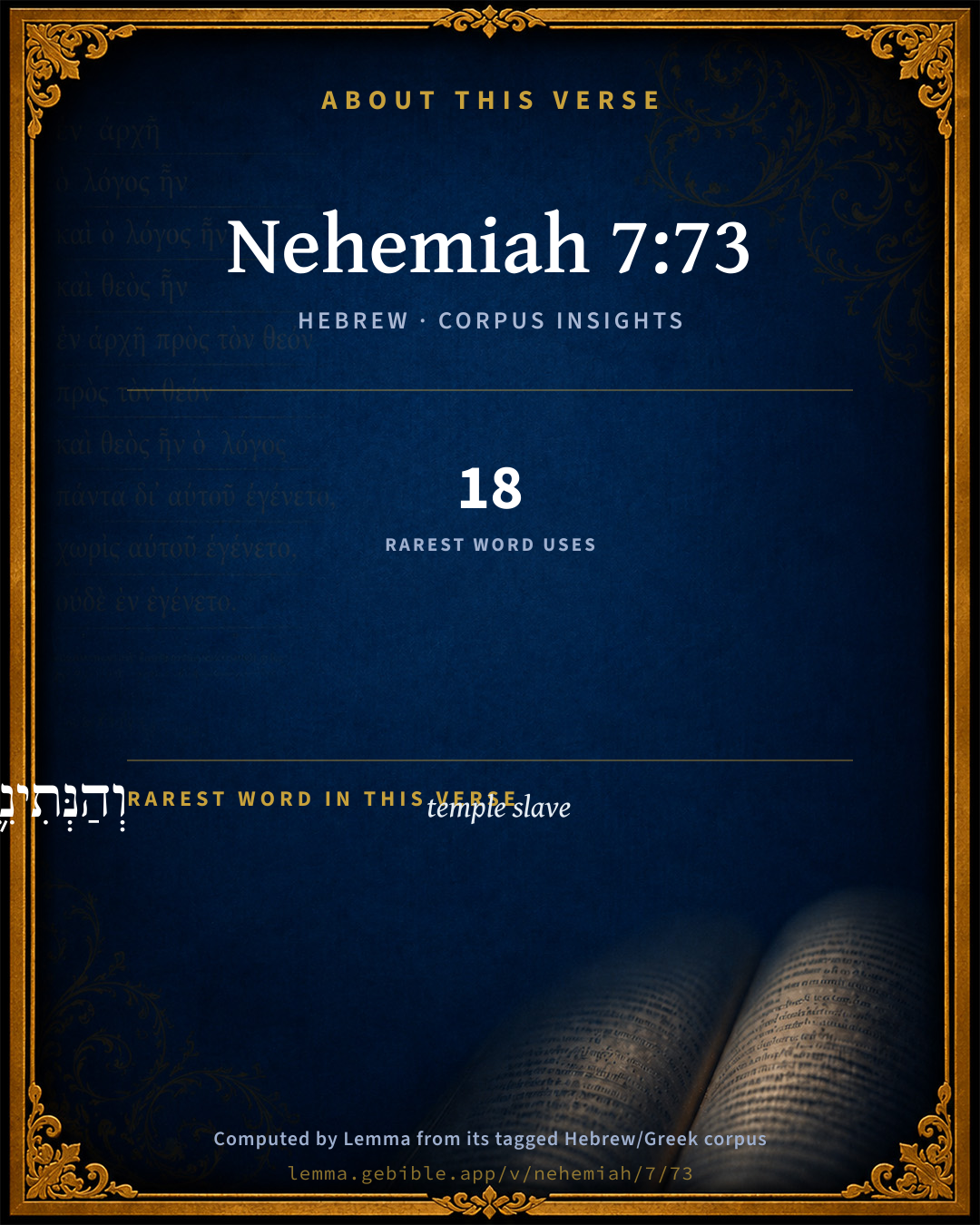
The rarest word here is וְהַנְּתִינִ֛ים temple slave H5411 — appearing just 18 times in the whole Hebrew Bible.

Shared distinctive vocabulary

וְהַנְּתִינִ֛ים temple slave H5411 occurs in 15 verses of the Hebrew Bible. Also found in:

Grammatical profile

  • 3 verbs
  • 12 nouns
  • 1 adjective
  • 1 preposition

Verb forms

  • וַיֵּשְׁב֣וּ Qal · Sequential Imperfect
  • וְהַמְשֹׁרְרִ֨ים Polel · Participle Active
  • וַיִּגַּע֙ Qal · Sequential Imperfect

Repetition

Words recur within this verse — often emphatic in Hebrew:

  • יִשְׂרָאֵ֖ל Israel H3478 ×2
  • בְּעָרֵיהֶ֑ם city H5892 ×2

Cross-references

1

Topical passages linked to Nehemiah 7:73 in the Treasury of Scripture Knowledge — connected by theme and wording, ordered by reader-vote popularity; previews shown in the World English Bible.

  • Ezra 2:70–3:1 So the priests, and the Levites, and some of the people, and the singers, and the porters, and the Nethinim, lived in their cities, and all Israel in their cities.

Cross-references courtesy of OpenBible.info (CC BY 4.0).

Hebrew and Greek witnesses Masoretic Hebrew ↔ Greek Septuagint

The same verse in the two great witnesses to the Old Testament, shown verse-for-verse.

These are two independent witnesses, not word-aligned to each other, and the Septuagint is shown in lemma (dictionary) form.

Hebrew Nehemiah 7:73 Masoretic · Westminster Leningrad Codex

וַיֵּשְׁב֣וּ הַכֹּהֲנִ֣ים וְהַלְוִיִּ֡ם וְהַשּׁוֹעֲרִים֩ וְהַמְשֹׁרְרִ֨ים וּמִן הָעָ֧ם וְהַנְּתִינִ֛ים וְכָל יִשְׂרָאֵ֖ל בְּעָרֵיהֶ֑ם וַיִּגַּע֙ הַחֹ֣דֶשׁ הַשְּׁבִיעִ֔י וּבְנֵ֥י יִשְׂרָאֵ֖ל בְּעָרֵיהֶֽם

So the priests, and the Levites, and the porters, and the singers, and some of the people, and the Nethinim, and all Israel, lived in their cities. When the seventh month was come, the children of Israel were in their cities.

World English Bible · Public Domain

Greek LXX Structure differs

The Septuagint has no separate book of Nehemiah. Its Greek text is the second half of Esdras B (2 Esdras), chapters 11–23; Ezra is the first half (1–10).

A verse-for-verse comparison isn’t shown here because the chapters and verses don’t line up. Switch to the LXX edition with the MT / LXX toggle above to read the Greek directly.

On this verse, The Cambridge Bible for Schools and Colleges discusses the Septuagint’s reading. Read the note in Commentary ↓

Hebrew: Westminster Leningrad Codex (CC BY 4.0). Greek: Septuagint (public domain); English from a public-domain English Septuagint. How the Septuagint differs from the Hebrew →

Commentary

Notes on Nehemiah 7:73 from classic Christian and Jewish commentators (each source and its license shown beneath its notes). The classic Christian expositions comment on the surrounding passage and are grouped to its opening verse, so a note may address several verses; the Jewish commentaries on the Tanakh (Rashi and others) are per-verse, so they appear only where the commentator wrote on this verse.

Lemma curates 59 commentaries, every one of them public domain or Creative Commons licensed, each selected and text-cleaned for this edition rather than reprinted as found. About our sources →

The Cambridge Bible for Schools and Colleges

gen. ed. J. J. S. Perowne

73. some] R.V. some. The Heb. gives the partitive idea. (LXX. οἱ ἀπὸ τοῦ λαοῦ. Vulg. ‘reliquum vulgus.’)

Nethinims] R.V. Nethinim.

Neh_7:73 b–8:12. The Reading of the Law

This verse begins a new section in the work. The style alters. The use of the first pers. sing. is resumed in Neh_12:31. The Compiler has recourse to other material for this narrative. The thread of Nehemiah’s Memoir, which was broken off at Neh_7:5, is therefore not resumed.

and when the seventh month came] R.V. And when the seventh month was come. The R.V. gives the right division of the verse. The second clause introduces a new section. Very similar words occur in Ezr_3:1 after the register of names. The close of the ‘register’ perhaps contained suitable words with which to resume the narrative in both passages. But possibly the Compiler consciously repeats himself and borrows from Ezr_3:1, ‘the seventh month.’ The mention of this date raises the question of the chronology of the following episodes.

The year is not stated. It is not therefore possible to say with certainty that the events described in chap. 8. followed immediately upon the completion of the wall. But, although not stated, this is what is clearly suggested by the compiler of the work. The mention of the 25th of the 6th month (Neh_6:15) is followed by the narrative of the 1st of the 7th month (Neh_7:73; Neh_8:2). As no other year is mentioned, presumably the events are those which occurred in the same year.

The objection which has been raised against this simple view is chiefly based upon the difficulty caused by the strangely sudden reappearance of Ezra. The fact that in 1Es_9:37 ff. the events here described follow immediately upon the expulsion of ‘the strange women’ (Ezra 9) has been by some scholars understood to supply the right order of time. The public reading of the law and the sacred covenant would then have to be placed in the year 457, and ‘the seventh month’ in the second year after Ezra’s arrival. An apparent confirmation of this view is given by Josephus. But the chronology of Josephus in this period is very untrustworthy. Undoubtedly following 1 Esdras, which does not mention Nehemiah, he places Ezra’s activity in the generation before that of Nehemiah, and Ezra’s death before Nehemiah’s arrival at Jerusalem. His treatment of their lives seems to be based on the supposition that they were not contemporaries (see Josephus, Antiquities, xi. 5); in § 1, Ezra appears as a contemporary of Joiakim the High-priest, in § 5 his death is mentioned as occurring at the same time as that of Joiakim the High-priest, who was succeeded by Eliashib. It seems fatal to this view that, in order to maintain it, it is necessary to strike out, as later glosses, the mention of Nehemiah’s name in Neh_8:9, Neh_10:1.

The Cambridge Bible for Schools and Colleges (gen. ed. J. J. S. Perowne; Cambridge University Press, 1878–1918) — public domain. Text from a community e-Sword module.

Joseph Benson's Commentary

Neh 7:73. So the priests and the Levites, &c.,dwelt in their cities — When all the business before mentioned was finished, the people were sent back, by Nehemiah’s direction, to the several cities to which they belonged; where they remained till the seventh month came, which was five days after the wall was finished, that being on the twenty-fifth day of the sixth month, chap. Neh 6:15.

Joseph Benson's Commentary on the Old and New Testaments (1811–1818) — public domain. Text from a community e-Sword module.

Tyndale Open Study Notes

Tyndale Open Resources

7:73–10:39 This section, perhaps originally a part of Ezra’s personal memoirs, describes how Ezra’s teaching of God’s law brought renewal of the people’s commitment to serve God and follow his instructions. Spiritual revival accompanied the civic work of Ezra and Nehemiah.

7:73 their own towns throughout Israel: Each family settled in the land that had been inhabited by their ancestors before the Exile.

Tyndale Open Study Notes — © Tyndale Open Resources, licensed CC BY-SA 4.0. Text via the HelloAO Bible API.

Geneva Bible (1599)

Geneva Bible translators

Which containeth part of September and part of October.

Geneva Bible (1599) marginal notes — public domain. Text via Bolls.life.

Jamieson, Fausset & Brown

Robert Jamieson, A. R. Fausset & David Brown

So . . . all Israel, dwelt in their cities--The utility of these genealogical registers was thus found in guiding to a knowledge of the cities and localities in each tribe to which every family anciently belonged.

Next: Nehemiah Chapter 8

Jamieson, Fausset & Brown — Commentary Critical and Explanatory on the Whole Bible (1871) — public domain (CC PDM 1.0). Text via the HelloAO Bible API.

Adam Clarke's Commentary

Verse 73. All Israel, dwelt in their cities] It was in reference to this particularly that the public registers were examined; for by them they found the different families, and consequently the cities, villages, c., which belonged to them, according to the ancient division of the lands. It seems that the examination of the registers occupied about a month for as soon as the walls were finished, which was in the sixth month, (Elul,) Ne 6:15, Nehemiah instituted the examination mentioned in this chapter, Ne 7:5; and by the concluding verse we find that the different families had got into their paternal cities in the seventh month, Tisri, answering to a part of our September and October. Thus the register determined every thing: there was no room for complaint, and none to accuse the governor of partiality.

Adam Clarke's Commentary on the Bible (1810–1826) — public domain. Text from a community e-Sword/MySword module.

The Pulpit Commentary

And all Israel dwelt in their cities. The document found by Nehemiah (ver. 5) probably ended with these words; (comp. Ezr_2:70) and Ne 7 should here terminate, as it does in the Septuagint. Having completed the account of what happened in the sixth month, Elul, (Neh_6:15) and transcribed the register which he had the good fortune to discover at that date, Nehemiah proceeds to relate events belonging to the seventh month.

The Pulpit Commentary (1880–1919), ed. H.D.M. Spence-Jones & Joseph S. Exell — public domain. Text from a community e-Sword module.

Scofield Reference Notes

C. I. Scofield

seventh month

i.e. October; also, Neh 8:2; Neh 8:14.

The Scofield Reference Bible (1917 edition), notes by C. I. Scofield — public domain. Text from a community e-Sword module.

unfoldingWord translationNotes

Door43 World Missions Community

gatekeepers

See how you translated this in Nehemiah 7:1.

singers

See how you translated this in Nehemiah 7:1.

some of the people

The implied information is that this refers to some of the Israelites who were not priests or other temple workers. (See: Assumed Knowledge and Implicit Information)

all Israel

Possible meanings are: 1) all the groups of Israelites that are listed in this verse or 2) the rest of the Israelites who did not work in the temple.

the seventh month

"month 7." This is the seventh month of the Hebrew calendar. It is during the last part of September and the first part of October on Western calendars. (See: Ordinal Numbers and Hebrew Months)

were settled in their cities

"lived in their own cities"

translationWords

Levi

temple

servant

Israel

life

unfoldingWord translationNotes — © Distant Shores Media and the Door43 World Missions Community, licensed CC BY-SA 4.0. Source: git.door43.org/Door43/en_tn.

Lesson kit

Teaching starters — assembled from the data on this page, not authored interpretation. Every prompt links to the verse data it draws on. Edit before teaching.

Nehemiah, in the Historical, opens this verse with 17 words (15 distinct Hebrew lemmas). Its most distinctive word is Nâthîyn (“temple slave”). A historical commentator’s framing appears above. Read the whole chapter for the surrounding context.

Discussion questions

  1. What does “temple slave” (Nâthîyn) contribute to the verse as a whole?
  2. 1 Chronicles 9:2 shares the word «temple slave» with this verse. How do the two illuminate each other?
  3. “Israel” occurs 2× in this one verse. What is the effect of the repetition?
  4. The translations on this page render this verse differently — a whole-verse word diff, not a word-by-word alignment. What might account for the different wordings?
  5. The verb «וַיֵּשְׁב֣וּ» is Qal Sequential Imperfect. How does its form color the action?
  6. Reading how The Cambridge Bible for Schools and Colleges and Joseph Benson's Commentary read this verse, where do the two commentators agree and where do they part?

Things to notice

Reading settings

Reading text

Shown beneath each verse's original-language words.

Old Testament
Old Testament edition

Read the OT as the Masoretic Hebrew (MT) or the Greek Septuagint (LXX).

English shown for the Greek Septuagint (in the Hebrew ↔ Greek comparison).

Comparing translations? Open the Compare panel on any verse page to stack up to four side by side.