
Leviticus 27:6

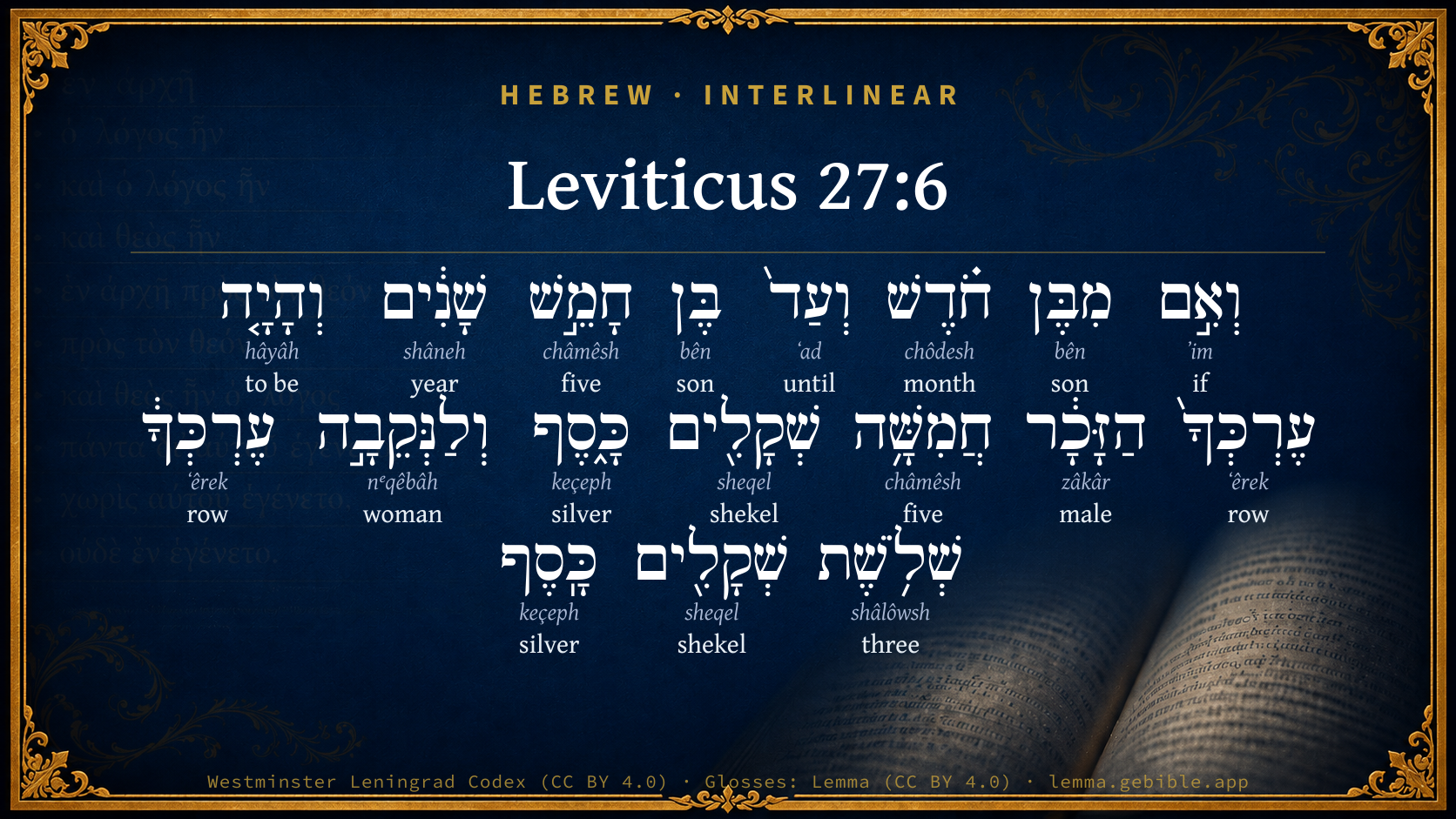
Hebrew (Westminster Leningrad Codex) Leviticus 27:6 appears in the Hebrew Old Testament. The text above is from the Westminster Leningrad Codex. Each word links to its Strong’s number, a concise gloss, and parsing drawn from the Open Scriptures Hebrew Bible morphology. Click any word for its full Brown-Driver-Briggs (BDB) entry.
Download image
Cite this verse

Leviticus 27:6 (World English Bible). Public Domain. Lemma interlinear Bible study tool, https://lemma.gebible.app/v/leviticus/27/6.

Show BibTeX & RIS
BibTeX
RIS
English Translation
If the person is from a month old even to five years old, then your valuation shall be for a male five shekels of silver, and for a female your valuation shall be three shekels of silver.
World English Bible · Public Domain
Download a study sheet

One document with this verse’s original text, its word-by-word gloss line, the meaning frame, cross-references with their text, attributed commentary, and full source and license credits — printable, and it pastes into notes with its structure intact.

This verse Autodidact and up

Study sheet (.html) Plain text (.txt)

A passage Seminary Student

Up to 50 verses in one chapter. A passage sheet keeps up to 6 commentary sources and 12 cross-references per verse, in the order this page ranks them, and says so on the sheet whenever that leaves anything out. Ask for a single verse and you get the Autodidact verse sheet above.

Everything on this page stays free to read, with no account — the sheet is a download of what is already on screen, not access to it.

Want to remove ads? Support Godless Engineer
Compare translations 3

The same verse in 3 English versions, stacked beneath the original-language interlinear above. Click any original word for its lexicon entry.

Each is an independent rendering of the whole verse — the interlinear is not word-aligned to these translations.

Highlighted words mark where these versions differ — a whole-verse word diff, not a word-by-word alignment.

  • World English Bible Public Domain
    If the person is from a month old even to five years old, then your valuation shall be for a male five shekels of silver, and for a female your valuation shall be three shekels of silver.
  • King James Version Public Domain
    And if it be from a month old even unto five years old, then thy estimation shall be of the male five shekels of silver, and for the female thy estimation shall be three shekels of silver.
  • unfoldingWord Literal Text CC BY-SA 4.0
    And if from a son of a month and until a son of five years, then your valuation will be the male five shekels of silver, and for the female your valuation three shekels of silver.

unfoldingWord Literal Text — © unfoldingWord, licensed CC BY-SA 4.0. Word-aligned USFM3 via Door43 (git.door43.org/unfoldingWord/en_ult).

Versions to compare (up to 4)

3 of 4 selected

Show all 18 translations

Every available English version of this verse, each an independent rendering of the whole verse.

  • World English Bible Public Domain
    If the person is from a month old even to five years old, then your valuation shall be for a male five shekels of silver, and for a female your valuation shall be three shekels of silver.
  • Berean Standard Bible Public Domain
    Now if the person is from one month to five years of age, then your valuation for the male shall be five shekels of silver, and for the female three shekels of silver.
  • Majority Standard Bible Public Domain
    Now if the person is from one month to five years of age, then your valuation for the male shall be five shekels of silver, and for the female three shekels of silver.
  • King James Version Public Domain
    And if it be from a month old even unto five years old, then thy estimation shall be of the male five shekels of silver, and for the female thy estimation shall be three shekels of silver.
  • American Standard Version (1901) Public Domain
    And if it be from a month old even unto five years old, then thy estimation shall be of the male five shekels of silver, and for the female thy estimation shall be three shekels of silver.
  • Revised Version (1885) Public Domain
    And if it be from a month old even unto five years old, then thy estimation shall be of the male five shekels of silver, and for the female thy estimation shall be three shekels of silver.
  • Geneva Bible (1599) Public Domain
    But from a moneth old vnto fiue yere old, thy price of the male shall bee fiue shekels of siluer, and thy price of the female, three shekels of siluer.
  • Douay-Rheims (1899) Public Domain
    From one month until the fifth year. for a male shall be given five sides: for a female three.
  • Young's Literal Translation Public Domain
    and if from a son of a month even unto a son of five years -- then hath thy valuation been of the male five shekels of silver, and for the female thy valuation `is' three shekels of silver;
  • Literal Standard Version CC BY-SA 4.0
    and if from a son of a month even to a son of five years, then your valuation of the male has been five shekels of silver, and for the female your valuation [is] three shekels of silver;
  • Unlocked Literal Bible CC BY-SA 4.0
    From one month old to five years your standard value for a male must be five shekels of silver, and for a female three shekels of silver.
  • unfoldingWord Literal Text CC BY-SA 4.0
    And if from a son of a month and until a son of five years, then your valuation will be the male five shekels of silver, and for the female your valuation three shekels of silver.
  • Darby Bible Public Domain
    And if it be from a month old even unto five years old, thy valuation of the male shall be five shekels of silver; and for the female thy valuation shall be three shekels of silver.
  • World Messianic Bible Public Domain
    If the person is from a month old to five years old, then your valuation shall be for a male five shekels of silver, and for a female your valuation shall be three shekels of silver.
  • Webster's Bible Public Domain
    And if it shall be from a month old even to five years old, then thy estimation shall be of the male five shekels of silver, and for the female thy estimation shall be three shekels of silver.
  • Free Bible Version CC BY-SA 4.0
    The value of someone aged one month to five years is five shekels of silver for a male and three shekels of silver for a female.
  • Bible in Basic English Public Domain
    And if the person is from one month to five years old, then the value for a male will be five shekels of silver, and for a female three shekels.
  • JPS Tanakh (1917) Public Domain
    And if it be from a month old even unto five years old, then thy valuation shall be for the male five shekels of silver, and for the female thy valuation shall be three shekels of silver.

Literal Standard Version (2020), Covenant Press — licensed CC BY-SA 4.0. Text via the HelloAO Bible API (eBible.org). Unlocked Literal Bible (unfoldingWord) — licensed CC BY-SA 4.0. Text via the HelloAO Bible API (eBible.org). unfoldingWord Literal Text — © unfoldingWord, licensed CC BY-SA 4.0. Word-aligned USFM3 via Door43 (git.door43.org/unfoldingWord/en_ult). Free Bible Version, Dr. Jonathan Gallagher — licensed CC BY-SA 4.0. Text via the HelloAO Bible API (eBible.org).

Word by word

More ways to search: Search by grammar → Find every occurrence → Compare this word →

Practice this passage: Drill this verse → Learn its vocabulary →

וְלַנְּקֵבָ֣ה
nᵉqêbâh
H5347
“and · to/for the · woman”
Conjunction + Preposition, Determined + Noun, Common, Feminine, Singular, Absolute
Part of Speech
Conjunction + Preposition + Noun
Type
Common
Gender
Feminine
Number
Singular
State
Absolute
Full BDB Definition

Origin: from H5344

TWOT: 1409b

female - woman, female child - female animal
  1. וְאִ֣ם ʼim H518 “and · if” Conjunction + Conjunction
  2. מִבֶּן bên H1121 “from · son of” Preposition + Noun, Common, Masculine, Singular, Construct
  3. חֹ֗דֶשׁ chôdesh H2320 “month” Noun, Common, Masculine, Singular, Absolute
  4. וְעַד֙ ʻad H5704 “and · until” Conjunction + Preposition
  5. בֶּן bên H1121 “son of” Noun, Common, Masculine, Singular, Construct
  6. חָמֵ֣שׁ châmêsh H2568 “five” Adjective, Cardinal number, Feminine, Singular, Absolute
  7. שָׁנִ֔ים shâneh H8141 “years” Noun, Common, Feminine, Plural, Absolute
  8. וְהָיָ֤ה hâyâh H1961 “and · to be” Conjunction + Verb, Qal, Sequential Perfect, 3rd Person, Masculine, Singular
  9. עֶרְכְּךָ֙ ʻêrek H6187 “row · your” Noun, Common, Masculine, Singular, Construct + Suffix, Personal, 2nd Person, Masculine, Singular
  10. הַזָּכָ֔ר zâkâr H2145 “the · male” Particle, Definite Article + Noun, Common, Masculine, Singular, Absolute
  11. חֲמִשָּׁ֥ה châmêsh H2568 “five” Adjective, Cardinal number, Masculine, Singular, Absolute
  12. שְׁקָלִ֖ים sheqel H8255 “shekels” Noun, Common, Masculine, Plural, Absolute
  13. כָּ֑סֶף keçeph H3701 “silver” Noun, Common, Masculine, Singular, Absolute
  14. עֶרְכְּךָ֔ ʻêrek H6187 “row · your” Noun, Common, Masculine, Singular, Construct + Suffix, Personal, 2nd Person, Masculine, Singular
  15. שְׁלֹ֥שֶׁת shâlôwsh H7969 “three” Adjective, Cardinal number, Masculine, Singular, Construct
  16. שְׁקָלִ֖ים sheqel H8255 “shekels” Noun, Common, Masculine, Plural, Absolute
  17. כָּֽסֶף keçeph H3701 “silver” Noun, Common, Masculine, Singular, Absolute

About this verse

These counts appear in no published source. They are computed here, from the morphology-tagged text and Lemma’s own curated glosses. What Lemma adds →

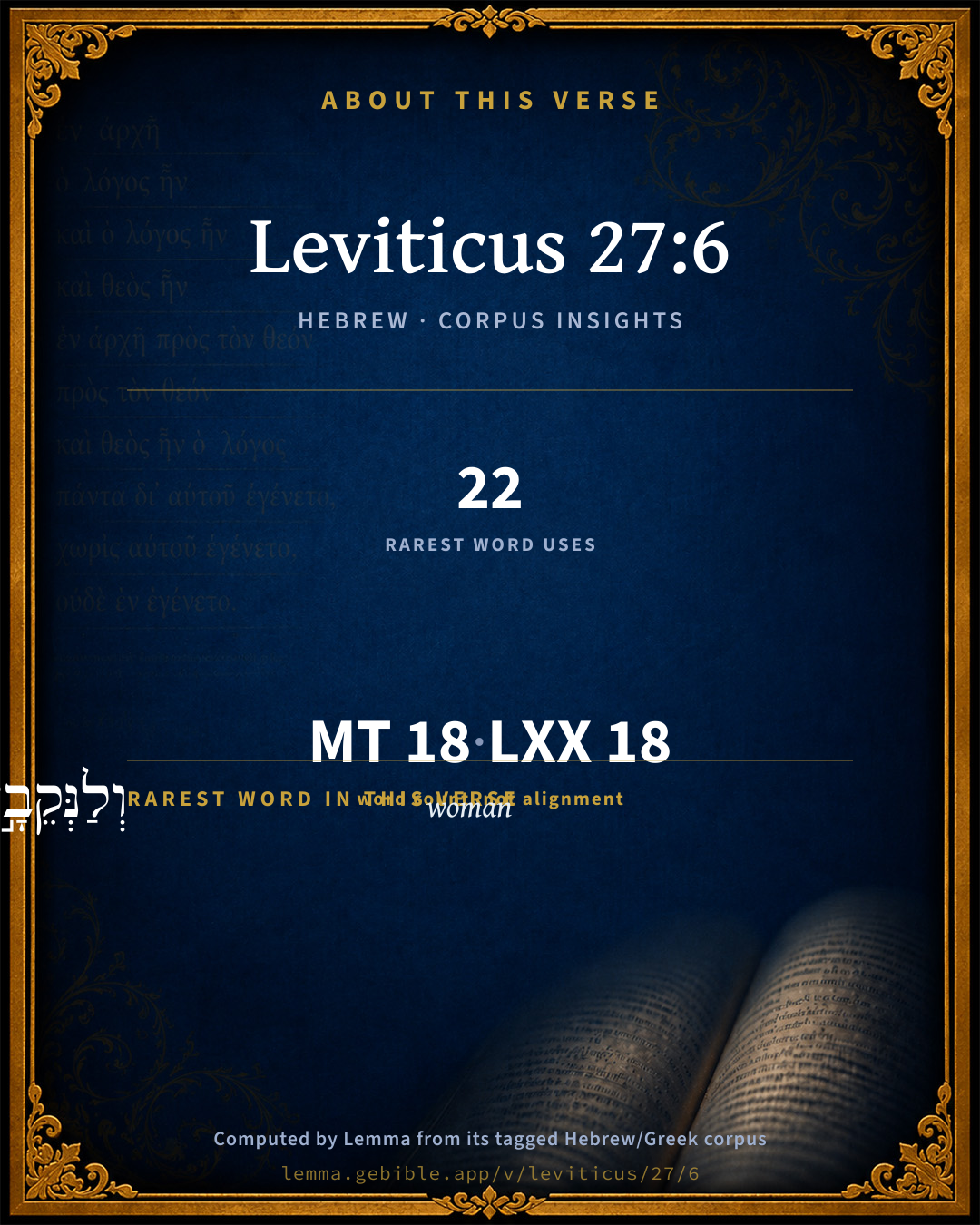
18
words
13
distinct lemmas
Pentateuch
section

Notable vocabulary

The rarest word here is וְלַנְּקֵבָ֣ה woman H5347 — appearing just 22 times in the whole Hebrew Bible.

Shared distinctive vocabulary

וְלַנְּקֵבָ֣ה woman H5347 occurs in 22 verses of the Hebrew Bible. Also found in:

Grammatical profile

  • 1 verb
  • 12 nouns
  • 3 adjectives
  • 1 preposition
  • 1 conjunction

Verb forms

  • וְהָיָ֤ה Qal · Sequential Perfect

Repetition

Words recur within this verse — often emphatic in Hebrew:

  • מִבֶּן son H1121 ×2
  • חָמֵ֣שׁ five H2568 ×2
  • עֶרְכְּךָ֙ row H6187 ×2
  • שְׁקָלִ֖ים shekel H8255 ×2
  • כָּ֑סֶף silver H3701 ×2

Hebrew & Septuagint length

In English translation the verse runs 37 words from the Hebrew and 26 from the Septuagint (LXX English) — the Septuagint runs noticeably shorter here. See the side-by-side →

A rough comparison of the two English renderings, which tokenize alike — not a word-level alignment.

Word counts can differ between the Hebrew and the Greek without any difference in meaning — e.g. the Hebrew direct-object marker אֵת has no separate Greek word, and Greek often adds the article ὁ.

In the original languages it is 18 Hebrew tokens and 18 Greek tokens — but the two are counted differently (Hebrew bundles its prefixes and suffixes into one token; the Greek is in lemma form), so that isn’t a like-for-like length.

Cross-references

2

Topical passages linked to Leviticus 27:6 in the Treasury of Scripture Knowledge — connected by theme and wording, ordered by reader-vote popularity; previews shown in the World English Bible.

  • Numbers 3:40–43 Yahweh said to Moses, "Number all the firstborn males of the children of Israel from a month old and upward, and take the number of their names.
  • Numbers 18:14–16 Everything devoted in Israel shall be yours.

Cross-references courtesy of OpenBible.info (CC BY 4.0).

Hebrew and Greek witnesses Masoretic Hebrew ↔ Greek Septuagint

The same verse in the two great witnesses to the Old Testament, shown verse-for-verse.

Here the Septuagint runs noticeably shorter than the Hebrew — LXX2012 (modern English Septuagint) 26 words vs World English Bible 37. A rough length comparison of the two English translations, not a word-level alignment — read both below.

These are two independent witnesses, not word-aligned to each other, and the Septuagint is shown in lemma (dictionary) form.

Hebrew Leviticus 27:6 Masoretic · Westminster Leningrad Codex

וְאִ֣ם מִבֶּן חֹ֗דֶשׁ וְעַד֙ בֶּן חָמֵ֣שׁ שָׁנִ֔ים וְהָיָ֤ה עֶרְכְּךָ֙ הַזָּכָ֔ר חֲמִשָּׁ֥ה שְׁקָלִ֖ים כָּ֑סֶף וְלַנְּקֵבָ֣ה עֶרְכְּךָ֔ שְׁלֹ֥שֶׁת שְׁקָלִ֖ים כָּֽסֶף

If the person is from a month old even to five years old, then your valuation shall be for a male five shekels of silver, and for a female your valuation shall be three shekels of silver.

World English Bible · Public Domain

Greek LXX Leviticus 27:6 Septuagint · lemma form

ἀπό δέ μηνιαῖος ἕως πενταετής εἰμί ὁ τιμή ὁ ἄρσην πέντε δίδραγμον ἀργύριον ὁ δέ θῆλυς τρεῖς δίδραγμον

And from a month old to five years old, the valuation of a male shall be five didrachmas, and of a female, three didrachmas of silver.

LXX2012 (modern English Septuagint) · Public Domain

Hebrew: Westminster Leningrad Codex (CC BY 4.0). Greek: Septuagint (public domain); English from LXX2012 (modern English Septuagint) (Public Domain). How the Septuagint differs from the Hebrew →

Targum (Aramaic paraphrase)

2

The Targum is the ancient Jewish Aramaic paraphrase of the Hebrew Scriptures — an interpretive translation, not the Hebrew text itself. Onkelos (literal) and Pseudo-Jonathan (expansive) render the Torah, and Jonathan the Prophets. Coverage is partial: where no permissively-licensed English translation exists for a verse, only the Aramaic is shown. This is verse-level text, not a word-by-word alignment to the Hebrew.

  1. Targum Onkelos Torah (Genesis–Deuteronomy)
    וְאִם מִבַּר יַרְחָא וְעַד בַּר חֲמֵשׁ שְׁנִין וִיהֵי פֻרְסָנֵהּ דְכוּרָא חֲמֵשׁ סִלְעִין דִכְסָף וְלִנְקוּבְתָא פֻרְסָנֵהּ תְּלַת סִלְעִין דִכְסָף

    (no public-domain English translation for this verse)

    Targum Onkelos — Aramaic: “Onkelos Genesis” (public domain); “Onkelos Exodus” (public domain); “Onkelos Leviticus” (public domain); “Onkelos Numbers” (public domain); “Onkelos Deuteronomy” (public domain). English: “Sefaria Community Translation” (CC0 1.0 (public-domain dedication)); “J.W. Etheridge. The Targums of Onkelos and Jonathan Ben Uzziel on the Pentateuch. London: Longmans, Green, 1862” (public domain). Text via Sefaria.

  2. Targum Pseudo-Jonathan Torah (Genesis–Deuteronomy)
    וְאִין מִבַּר יַרְחָא וְעַד בַּר חֲמֵשׁ שְׁנִין וִיהֵי עֲלוֹיֵיהּ דְבִיר דְכַר חֲמֵשׁ סִלְעִין דִכְסַף וְדִבְרַתָּא נוּקְבָא עִילוֹיֵיהּ תְּלָתָא סִלְעִין דִכְסַף

    But for a child of a month old until five years, his estimation for a male shall be five silver shekels; and for a female, three silver shekels.

    Targum Pseudo-Jonathan — Aramaic: “Targum Jonathan on Genesis” (public domain); “Targum Jonathan on Exodus” (public domain); “Targum Jonathan on Leviticus” (public domain); “Targum Jonathan on Numbers” (public domain); “Targum Jonathan on Deuteronomy” (public domain). English: “The Targum of Jonathan ben Uzziel, trans. J. W. Etheridge, London, 1862” (public domain). Text via Sefaria.

Commentary

Notes on Leviticus 27:6 from classic Christian and Jewish commentators (each source and its license shown beneath its notes). The classic Christian expositions comment on the surrounding passage and are grouped to its opening verse, so a note may address several verses; the Jewish commentaries on the Tanakh (Rashi and others) are per-verse, so they appear only where the commentator wrote on this verse.

Lemma curates 59 commentaries, every one of them public domain or Creative Commons licensed, each selected and text-cleaned for this edition rather than reprinted as found. About our sources →

Trapp's Complete Commentary

John Trapp

Lev 27:6 And if [it be] from a month old even unto five years old, then thy estimation shall be of the male five shekels of silver, and for the female thy estimation [shall be] three shekels of silver.

Ver. 6. From a month old.] If his parents have made a vow concerning him.

John Trapp, A Commentary or Exposition upon All the Books of the Old and New Testament (1647–1656) — public domain. Text from a community e-Sword module.

Geneva Bible (1599)

Geneva Bible translators

He speaketh of those vows whereby the fathers dedicated their children to God which were not of such force; but they might be redeemed from them.

Geneva Bible (1599) marginal notes — public domain. Text via Bolls.life.

Adam Clarke's Commentary

Verse 6. A month old] The male child, five shekels, 15s., the female, three shekels, 9s. Being both in comparative infancy, they were nearly of an equal value. None were vowed under a month old: the first-born being always considered as the Lord's property, could not be vowed, see Le 27:26.

Adam Clarke's Commentary on the Bible (1810–1826) — public domain. Text from a community e-Sword/MySword module.

Ellicott's Commentary for English Readers

(6) From a month old even unto five years old.—That is, if a parent, or any other person, devotes his or anyone else’s child to the sanctuary, he is obliged to be redeemed according to the prescribed valuation. The formula used in such a case during the second Temple was, “Behold the estimation of this my boy, or this my girl, or of that boy or that girl, be upon me.”

The male five shekels of silver.—As at this tender age the service of a child is not of much value, the vower is to pay for a boy 12s. 11d.

The female . . . three shekels of silver.—The girl being proportionately less valuable, is to be redeemed at 7s. 9d.

A Bible Commentary for English Readers, edited by Charles John Ellicott (1878–1897) — public domain. Text from a community e-Sword module.

John Gill's Exposition

And if it be from sixty years old and above,.... When man is almost past his labour, and it is high time to leave off business:

if it be a male, then thy estimation shall between shekels; about one pound fifteen shillings:

and for the female ten shekels; about one pound three shillings; it may be observed that there is not the disproportion between a man and a woman in old age as in youth, with respect to the estimation of them; the reason of which is, because there is but little difference in their labour and service; nay, sometimes the woman is most useful and serviceable; for when a man, through age, is quite worn out and his labour gone, an older woman is capable of managing the affairs of the family, and is of great use and service, either by directing and advising, or by doing: so Jarchi observes, when persons come to old age, a woman is nearly to be reckoned as a man, and quotes a proverb of theirs, an old man in a house is a broken potsherd in the house (some interpret the word, a snare or stumbling block, that is in the way); an old woman in a house is a treasure in a house, a good sign in a house (p), of great use in the management of the affairs of the family.

(p) T. Bab. Eracin, fol. 19. 1. vid. Yalkut, par. 1. fol. 198. 1.

John Gill's Exposition of the Whole Bible (1746–1763) — public domain (CC PDM 1.0). Text via the HelloAO Bible API.

Lesson kit

Teaching starters — assembled from the data on this page, not authored interpretation. Every prompt links to the verse data it draws on. Edit before teaching.

Leviticus, in the Pentateuch, opens this verse with 18 words (13 distinct Hebrew lemmas). Its most distinctive word is nᵉqêbâh (“woman”). The Greek Septuagint runs shorter here. A historical commentator’s framing appears above. Read the whole chapter for the surrounding context.

Discussion questions

  1. How does “woman” (nᵉqêbâh) shape what this verse is saying?
  2. How does Genesis 1:27, which shares the word «woman», read alongside this verse?
  3. What does the repetition of “son” (2× in this one verse) do in this verse?
  4. The Septuagint runs shorter here than the Hebrew. What might account for the difference?
  5. The translations on this page render this verse differently — a whole-verse word diff, not a word-by-word alignment. What might account for the different wordings?
  6. «וְהָיָ֤ה» is a Qal Sequential Perfect verb. How does that grammatical form shape the action described?
  7. Compare how Trapp's Complete Commentary and Geneva Bible (1599) read this verse. Where do they agree or differ?

Things to notice

Reading settings

Reading text

Shown beneath each verse's original-language words.

Old Testament
Old Testament edition

Read the OT as the Masoretic Hebrew (MT) or the Greek Septuagint (LXX).

English shown for the Greek Septuagint (in the Hebrew ↔ Greek comparison).

Comparing translations? Open the Compare panel on any verse page to stack up to four side by side.