
Ezekiel 45:17

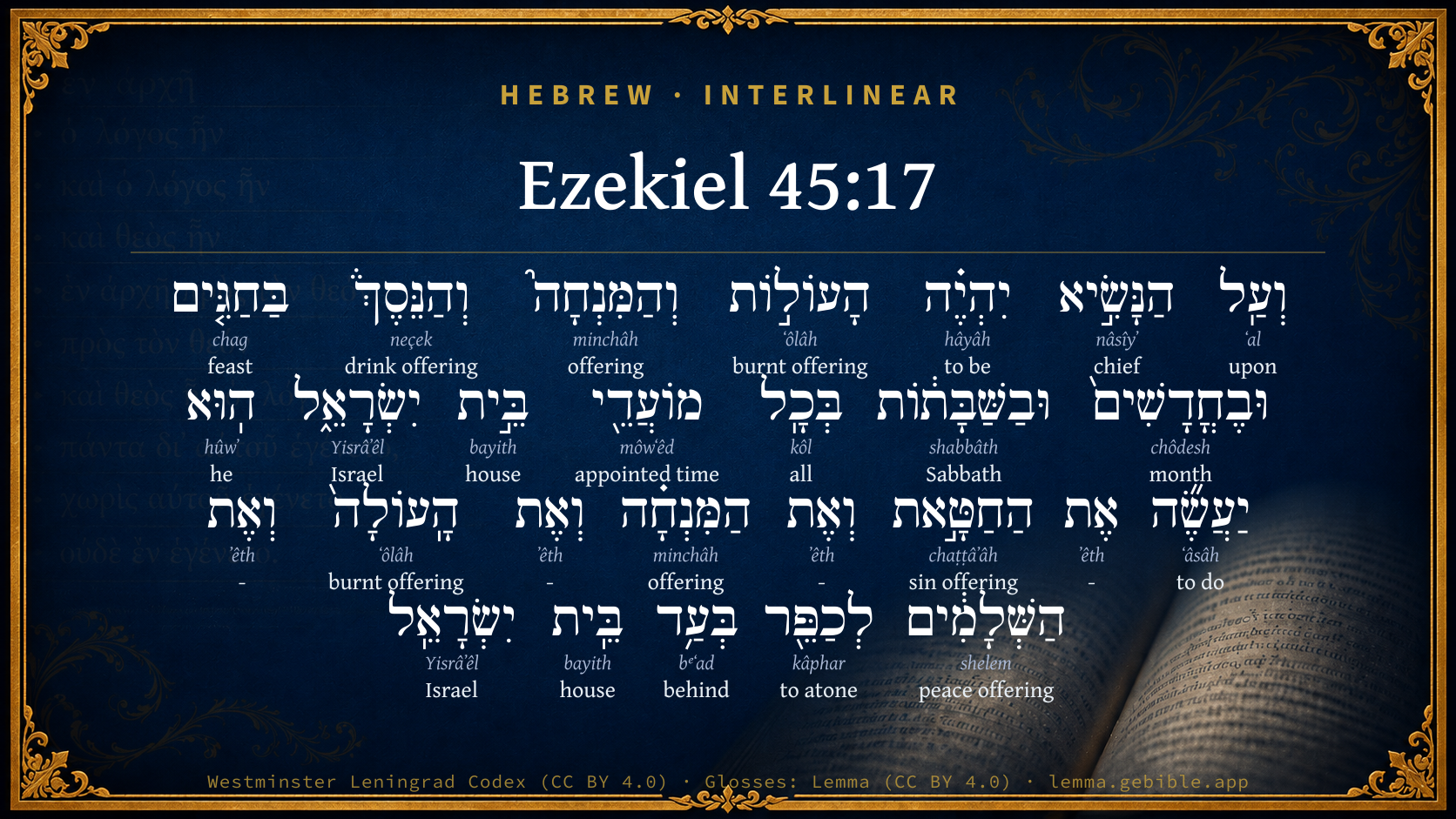
Hebrew (Westminster Leningrad Codex) Ezekiel 45:17 appears in the Hebrew Old Testament. The text above is from the Westminster Leningrad Codex. Each word links to its Strong’s number, a concise gloss, and parsing drawn from the Open Scriptures Hebrew Bible morphology. Click any word for its full Brown-Driver-Briggs (BDB) entry.
Download image
Cite this verse

Ezekiel 45:17 (World English Bible). Public Domain. Lemma interlinear Bible study tool, https://lemma.gebible.app/v/ezekiel/45/17.

Show BibTeX & RIS
BibTeX
RIS
English Translation
It shall be the prince's part to give the burnt offerings, and the meal-offerings, and the drink-offerings, in the feasts, and on the new moons, and on the Sabbaths, in all the appointed feasts of the house of Israel: he shall prepare the sin-offering, and the meal-offering, and the burnt offering, and the peace-offerings, to make atonement for the house of Israel.
World English Bible · Public Domain
Download a study sheet

One document with this verse’s original text, its word-by-word gloss line, the meaning frame, cross-references with their text, attributed commentary, and full source and license credits — printable, and it pastes into notes with its structure intact.

This verse Autodidact and up

Study sheet (.html) Plain text (.txt)

A passage Seminary Student

Up to 50 verses in one chapter. A passage sheet keeps up to 6 commentary sources and 12 cross-references per verse, in the order this page ranks them, and says so on the sheet whenever that leaves anything out. Ask for a single verse and you get the Autodidact verse sheet above.

Everything on this page stays free to read, with no account — the sheet is a download of what is already on screen, not access to it.

Want to remove ads? Support Godless Engineer
Compare translations 3

The same verse in 3 English versions, stacked beneath the original-language interlinear above. Click any original word for its lexicon entry.

Each is an independent rendering of the whole verse — the interlinear is not word-aligned to these translations.

Highlighted words mark where these versions differ — a whole-verse word diff, not a word-by-word alignment.

  • World English Bible Public Domain
    It shall be the prince's part to give the burnt offerings, and the meal-offerings, and the drink-offerings, in the feasts, and on the new moons, and on the Sabbaths, in all the appointed feasts of the house of Israel: he shall prepare the sin-offering, and the meal-offering, and the burnt offering, and the peace-offerings, to make atonement for the house of Israel.
  • King James Version Public Domain
    And it shall be the prince's part to give burnt offerings, and meat offerings, and drink offerings, in the feasts, and in the new moons, and in the sabbaths, in all solemnities of the house of Israel: he shall prepare the sin offering, and the meat offering, and the burnt offering, and the peace offerings, to make reconciliation for the house of Israel.
  • unfoldingWord Literal Text CC BY-SA 4.0
    It will be the prince’s responsibility to furnish animals for the burnt offerings, the grain offerings, and the drink offerings at the festivals and the new moon celebrations, and on the Sabbath days—all the fixed festivals of the house of Israel. He will provide for the sin offerings, the grain offerings, the burnt offerings, and the peace offerings for atonement on behalf of the house of Israel.

unfoldingWord Literal Text — © unfoldingWord, licensed CC BY-SA 4.0. Word-aligned USFM3 via Door43 (git.door43.org/unfoldingWord/en_ult).

Versions to compare (up to 4)

3 of 4 selected

Show all 18 translations

Every available English version of this verse, each an independent rendering of the whole verse.

  • World English Bible Public Domain
    It shall be the prince's part to give the burnt offerings, and the meal-offerings, and the drink-offerings, in the feasts, and on the new moons, and on the Sabbaths, in all the appointed feasts of the house of Israel: he shall prepare the sin-offering, and the meal-offering, and the burnt offering, and the peace-offerings, to make atonement for the house of Israel.
  • Berean Standard Bible Public Domain
    And it shall be the prince’s part to provide the burnt offerings, grain offerings, and drink offerings for the feasts, New Moons, and Sabbaths—for all the appointed feasts of the house of Israel. He will provide the sin offerings, grain offerings, burnt offerings, and peace offerings to make atonement for the house of Israel.
  • Majority Standard Bible Public Domain
    And it shall be the prince’s part to provide the burnt offerings, grain offerings, and drink offerings for the feasts, New Moons, and Sabbaths—for all the appointed feasts of the house of Israel. He will provide the sin offerings, grain offerings, burnt offerings, and peace offerings to make atonement for the house of Israel.
  • King James Version Public Domain
    And it shall be the prince's part to give burnt offerings, and meat offerings, and drink offerings, in the feasts, and in the new moons, and in the sabbaths, in all solemnities of the house of Israel: he shall prepare the sin offering, and the meat offering, and the burnt offering, and the peace offerings, to make reconciliation for the house of Israel.
  • American Standard Version (1901) Public Domain
    And it shall be the prince's part to give the burnt-offerings, and the meal-offerings, and the drink-offerings, in the feasts, and on the new moons, and on the sabbaths, in all the appointed feasts of the house of Israel: he shall prepare the sin-offering, and the meal-offering, and the burnt-offering, and the peace-offerings, to make atonement for the house of Israel.
  • Revised Version (1885) Public Domain
    And it shall be the prince’s part to give the burnt offerings, and the meal offerings, and the drink offerings, in the feasts, and in the new moons, and in the sabbaths, in all the appointed feasts of the house of Israel: he shall prepare the sin offering, and the meal offering, and the burnt offering, and the peace offerings, to make atonement for the house of Israel.
  • Geneva Bible (1599) Public Domain
    And it shalbe ye princes part to giue burnt offrings, and meat offrings, and drinke offrings in the solemne feasts and in the newe moones, and in the Sabbaths, and in all the hie feasts of the house of Israel: he shall prepare the sinne offring, and the meat offring, and the burnt offring, and the peace offrings to make reconciliation for the house of Israel.
  • Douay-Rheims (1899) Public Domain
    And the prince shall give the holocaust, and the sacrifice, and the libations on the feasts, and on the new moons, and on the sabbaths, and on all the solemnities of the house of Israel: he shall offer the sacrifice for sin, and the holocaust, and the peace offerings to make expiation for the house of Israel.
  • Young's Literal Translation Public Domain
    And on the prince are the burnt-offerings, and the present, and the libation, in feasts, and in new moons, and in sabbaths, in all appointed times of the house of Israel: he doth make the sin-offering, and the present, and the burnt-offering, and the peace-offerings, to make atonement for the house of Israel.
  • Literal Standard Version CC BY-SA 4.0
    And on the prince are the burnt-offerings, and the present, and the drink-offering, in celebrations, and in new moons, and in Sabbaths, in all appointed times of the house of Israel: he makes the sin-offering, and the present, and the burnt-offering, and the peace-offerings, to make atonement for the house of Israel.”
  • Unlocked Literal Bible CC BY-SA 4.0
    It will be the prince's responsibility to furnish animals for the burnt offerings, the grain offerings, and the drink offerings at the festivals and the new moon celebrations, and on the Sabbath days—all the fixed festivals of the house of Israel. He will provide for the sin offerings, the grain offerings, the burnt offerings, and the peace offerings for atonement on behalf of the house of Israel.
  • unfoldingWord Literal Text CC BY-SA 4.0
    It will be the prince’s responsibility to furnish animals for the burnt offerings, the grain offerings, and the drink offerings at the festivals and the new moon celebrations, and on the Sabbath days—all the fixed festivals of the house of Israel. He will provide for the sin offerings, the grain offerings, the burnt offerings, and the peace offerings for atonement on behalf of the house of Israel.
  • Darby Bible Public Domain
    And it shall be the prince's part [to supply] the burnt-offerings, and the oblation, and the drink-offering, at the feasts, and at the new moons, and on the sabbaths, in all the solemnities of the house of Israel: it is he that shall prepare the sin-offering, and the oblation, and the burnt-offering, and the peace-offerings, to make atonement for the house of Israel.
  • World Messianic Bible Public Domain
    It shall be the prince’s part to give the burnt offerings, the meal offerings, and the drink offerings, in the feasts, and on the new moons, and on the Sabbaths, in all the appointed feasts of the house of Israel. He shall prepare the sin offering, the meal offering, the burnt offering, and the peace offerings, to make atonement for the house of Israel.”
  • Webster's Bible Public Domain
    And it shall be the prince's part to give burnt-offerings, and meat-offerings, and drink-offerings, in the feasts, and in the new moons, and in the sabbaths, in all solemnities of the house of Israel: he shall prepare the sin-offering, and the meat-offering, and the burnt-offering, and the peace-offerings, to make reconciliation for the house of Israel.
  • Free Bible Version CC BY-SA 4.0
    The prince's role is to provide the burnt offerings, grain offerings, and drink offerings for the religious festivals, New Moons, and Sabbaths—in fact for all the regular religious festivals of the people of Israel. He is to provide the sin offerings, grain offerings, burnt offerings, and peace offerings to set the people of Israel right.
  • Bible in Basic English Public Domain
    And the ruler will be responsible for the burned offering and the meal offering and the drink offering, at the feasts and the new moons and the Sabbaths, at all the fixed feasts of the children of Israel: he will give the sin-offering and meal offering and burned offering and the peace-offerings, to take away the sin of the children of Israel.
  • JPS Tanakh (1917) Public Domain
    And it shall be the prince's part to give the burnt-offerings, and the meal-offerings, and the drink-offerings, in the feasts, and in the new moons, and in the sabbaths, in all the appointed seasons of the house of Israel; he shall prepare the sin-offering, and the meal-offering, and the burnt-offering, and the peace-offerings, to make atonement for the house of Israel.

Literal Standard Version (2020), Covenant Press — licensed CC BY-SA 4.0. Text via the HelloAO Bible API (eBible.org). Unlocked Literal Bible (unfoldingWord) — licensed CC BY-SA 4.0. Text via the HelloAO Bible API (eBible.org). unfoldingWord Literal Text — © unfoldingWord, licensed CC BY-SA 4.0. Word-aligned USFM3 via Door43 (git.door43.org/unfoldingWord/en_ult). Free Bible Version, Dr. Jonathan Gallagher — licensed CC BY-SA 4.0. Text via the HelloAO Bible API (eBible.org).

Word by word

More ways to search: Search by grammar → Find every occurrence → Compare this word →

Practice this passage: Drill this verse → Learn its vocabulary →

בַּחַגִּ֤ים
chag
H2282
“in/at the · feasts”
Preposition, Determined + Noun, Common, Masculine, Plural, Absolute
Part of Speech
Preposition + Noun
Type
Common
Gender
Masculine
Number
Plural
State
Absolute
Full BDB Definition

Origin: from H2287

TWOT: 602a

festival, feast, festival-gathering, pilgrim-feast - feast - festival sacrifice
  1. וְעַֽל ʻal H5921 “and · upon” Conjunction + Preposition
  2. הַנָּשִׂ֣יא nâsîyʼ H5387 “the · chief” Particle, Definite Article + Noun, Common, Masculine, Singular, Absolute
  3. יִהְיֶ֗ה hâyâh H1961 “to be” Verb, Qal, Imperfect, 3rd Person, Masculine, Singular
  4. הָעוֹל֣וֹת ʻôlâh H5930 “the · burnt offerings” Particle, Definite Article + Noun, Common, Feminine, Plural, Absolute
  5. וְהַמִּנְחָה֮ minchâh H4503 “and · the · offering” Conjunction + Particle, Definite Article + Noun, Common, Feminine, Singular, Absolute
  6. וְהַנֵּסֶךְ֒ neçek H5262 “and · the · drink offering” Conjunction + Particle, Definite Article + Noun, Common, Masculine, Singular, Absolute
  7. וּבֶחֳדָשִׁים֙ chôdesh H2320 “and · in/at the · months” Conjunction + Preposition, Determined + Noun, Common, Masculine, Plural, Absolute
  8. וּבַשַּׁבָּת֔וֹת shabbâth H7676 “and · in/at the · Sabbaths” Conjunction + Preposition, Determined + Noun, Common, Both, Plural, Absolute
  9. בְּכָֽל kôl H3605 “in/at · all of” Preposition + Noun, Common, Masculine, Singular, Construct
  10. מוֹעֲדֵ֖י môwʻêd H4150 “appointed times of” Noun, Common, Masculine, Plural, Construct
  11. בֵּ֣ית bayith H1004 “house of” Noun, Common, Masculine, Singular, Construct
  12. יִשְׂרָאֵ֑ל Yisrâʼêl H3478 “Israel” Noun, Proper
  13. הֽוּא hûwʼ H1931 “he” Pronoun, Personal, 3rd Person, Masculine, Singular
  14. יַעֲשֶׂ֞ה ʻâsâh H6213 “to do” Verb, Qal, Imperfect, 3rd Person, Masculine, Singular
  15. אֶת ʼêth H853 “-” Particle, Direct Object
  16. הַחַטָּ֣את chaṭṭâʼâh H2403 “the · sin offering” Particle, Definite Article + Noun, Common, Feminine, Singular, Absolute
  17. וְאֶת ʼêth H853 “and · -” Conjunction + Particle, Direct Object
  18. הַמִּנְחָ֗ה minchâh H4503 “the · offering” Particle, Definite Article + Noun, Common, Feminine, Singular, Absolute
  19. וְאֶת ʼêth H853 “and · -” Conjunction + Particle, Direct Object
  20. הָֽעוֹלָה֙ ʻôlâh H5930 “the · burnt offering” Particle, Definite Article + Noun, Common, Feminine, Singular, Absolute
  21. וְאֶת ʼêth H853 “and · -” Conjunction + Particle, Direct Object
  22. הַשְּׁלָמִ֔ים shelem H8002 “the · peace offerings” Particle, Definite Article + Noun, Common, Masculine, Plural, Absolute
  23. לְכַפֵּ֖ר kâphar H3722 “to atone” Preposition + Verb, Piel, Infinitive Construct
  24. בְּעַ֥ד bᵉʻad H1157 “behind” Preposition
  25. בֵּֽית bayith H1004 “house of” Noun, Common, Masculine, Singular, Construct
  26. יִשְׂרָאֵֽל Yisrâʼêl H3478 “Israel” Noun, Proper

About this verse

These counts appear in no published source. They are computed here, from the morphology-tagged text and Lemma’s own curated glosses. What Lemma adds →

27
words
20
distinct lemmas
Prophets
section

Grammatical profile

  • 3 verbs
  • 17 nouns
  • 1 pronoun
  • 2 prepositions
  • 4 particles

Verb forms

  • יִהְיֶ֗ה Qal · Imperfect
  • יַעֲשֶׂ֞ה Qal · Imperfect
  • לְכַפֵּ֖ר Piel · Infinitive Construct

Repetition

Words recur within this verse — often emphatic in Hebrew:

  • הָעוֹל֣וֹת burnt offering H5930 ×2
  • וְהַמִּנְחָה֮ offering H4503 ×2
  • בֵּ֣ית house H1004 ×2
  • יִשְׂרָאֵ֑ל Israel H3478 ×2

Hebrew & Septuagint length

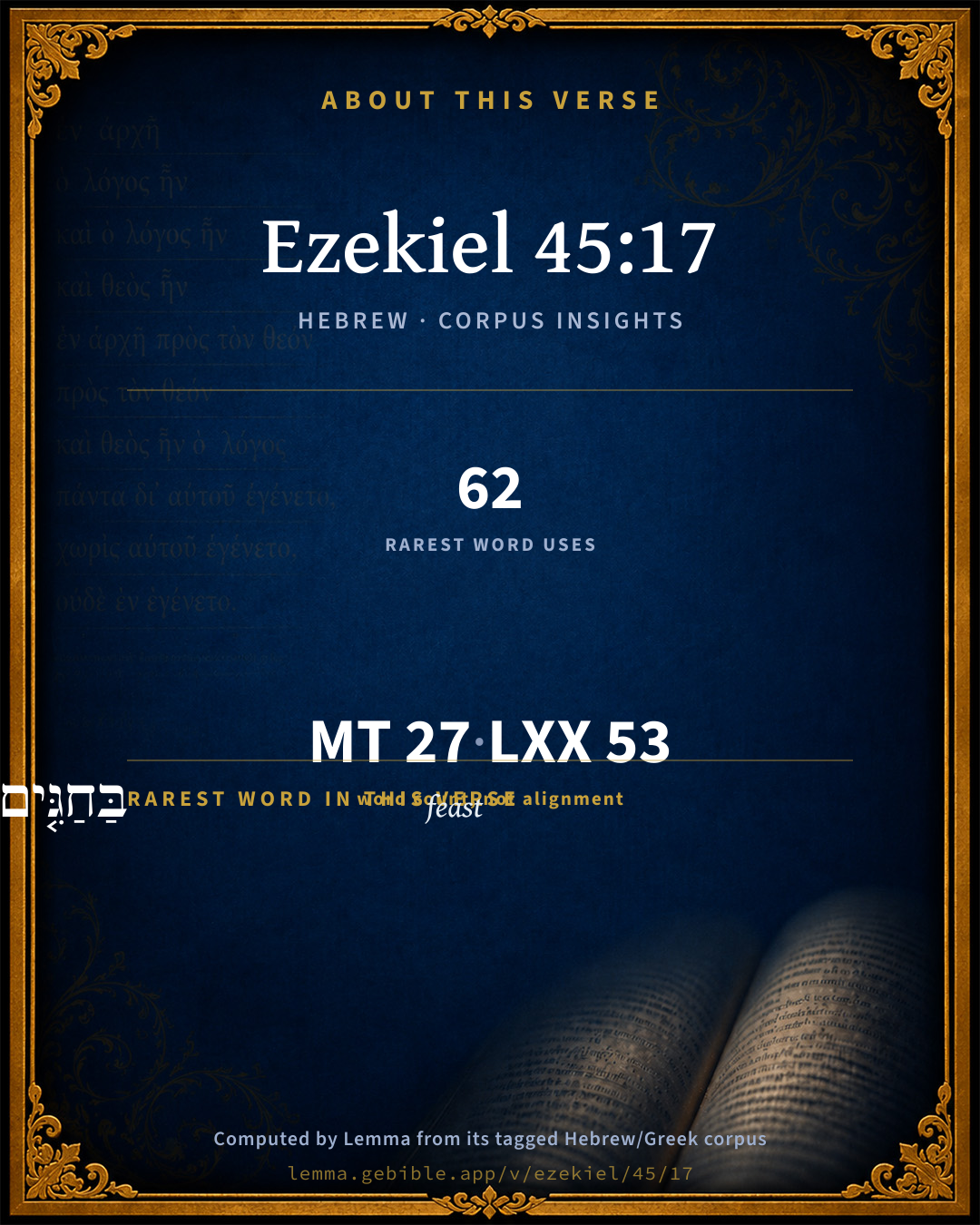
In English translation the verse runs 62 words from the Hebrew and 63 from the Septuagint (LXX English) — closely comparable.

A rough comparison of the two English renderings, which tokenize alike — not a word-level alignment.

Word counts can differ between the Hebrew and the Greek without any difference in meaning — e.g. the Hebrew direct-object marker אֵת has no separate Greek word, and Greek often adds the article ὁ.

In the original languages it is 27 Hebrew tokens and 53 Greek tokens — but the two are counted differently (Hebrew bundles its prefixes and suffixes into one token; the Greek is in lemma form), so that isn’t a like-for-like length.

Cross-references

30

Topical passages linked to Ezekiel 45:17 in the Treasury of Scripture Knowledge — connected by theme and wording, ordered by reader-vote popularity; previews shown in the World English Bible.

  • 2 Chronicles 31:3 [He appointed] also the king's portion of his substance for the burnt-offerings, [to wit], for the morning and evening burnt offerings, and the burnt offerings for the Sabbaths, and for the new moons, and for the set feasts, as it is written in the law of Yahweh.
  • Isaiah 66:23 It shall happen, that from one new moon to another, and from one Sabbath to another, shall all flesh come to worship before me, says Yahweh.
  • Ezekiel 46:4–12 The burnt offering that the prince shall offer to Yahweh shall be on the Sabbath day six lambs without blemish and a ram without blemish;
  • Leviticus 23:1–44 Yahweh spoke to Moses, saying,
  • Numbers 28:1–29 Yahweh spoke to Moses, saying,
  • 1 Kings 8:63–64 Solomon offered for the sacrifice of peace-offerings, which he offered to Yahweh, two and twenty thousand oxen, and one hundred twenty thousand sheep. So the king and all the children of Israel dedicated the house of Yahweh.
  • 2 Chronicles 30:24 For Hezekiah king of Judah did give to the assembly for offerings one thousand bulls and seven thousand sheep; and the princes gave to the assembly a thousand bulls and ten thousand sheep: and a great number of priests sanctified themselves.
  • Ezekiel 43:27 When they have accomplished the days, it shall be that on the eighth day, and forward, the priests shall make your burnt offerings on the altar, and your peace-offerings; and I will accept you, says the Lord Yahweh.
  • 2 Samuel 6:19 He dealt among all the people, even among the whole multitude of Israel, both to men and women, to everyone a cake of bread, and a portion [of flesh], and a cake of raisins. So all the people departed everyone to his house.
  • 1 Chronicles 16:2–3 When David had made an end of offering the burnt offering and the peace-offerings, he blessed the people in the name of Yahweh.
  • 1 Chronicles 29:3–9 In addition, because I have set my affection on the house of my God, seeing that I have a treasure of my own of gold and silver, I give it to the house of my God, over and above all that I have prepared for the holy house,
  • 2 Chronicles 5:6 King Solomon and all the congregation of Israel, that were assembled to him, were before the ark, sacrificing sheep and oxen, that could not be counted nor numbered for multitude.
  • 2 Chronicles 7:4–5 Then the king and all the people offered sacrifice before Yahweh.
  • 2 Chronicles 8:12–13 Then Solomon offered burnt-offerings to Yahweh on the altar of Yahweh, which he had built before the porch,
  • 2 Chronicles 35:7–8 Josiah gave to the children of the people, of the flock, lambs and kids, all of them for the Passover offerings, to all who were present, to the number of thirty thousand, and three thousand bulls: these were of the king's substance.
  • Ezra 1:5 Then rose up the heads of fathers' [houses] of Judah and Benjamin, and the priests, and the Levites, even all whose spirit God had stirred to go up to build the house of Yahweh which is in Jerusalem.
  • Ezra 6:8–9 Moreover I make a decree what you shall do to these elders of the Jews for the building of this house of God: that of the king's goods, even of the tribute beyond the River, expenses be given with all diligence to these men, that they be not hindered.
  • Psalms 22:15–26 My strength is dried up like a potsherd. My tongue sticks to the roof of my mouth. You have brought me into the dust of death.
  • Psalms 22:29 All the rich ones of the earth shall eat and worship. All those who go down to the dust shall bow before him, Even he who can't keep his soul alive.
  • Psalms 68:18 You have ascended on high. You have led away captives. You have received gifts among men, Yes, among the rebellious also, that Yah God might dwell there.
  • John 1:16 From his fullness we all received grace upon grace.
  • John 6:51–57 I am the living bread which came down out of heaven. If anyone eats of this bread, he will live forever. Yes, the bread which I will give for the life of the world is my flesh."
  • Romans 11:35–36 "Or who has first given to him, And it will be repaid to him again?"
  • 1 Corinthians 5:7–8 Purge out the old yeast, that you may be a new lump, even as you are unleavened. For indeed Christ, our Passover, has been sacrificed in our place.
  • Ephesians 5:2 Walk in love, even as Christ also loved you, and gave himself up for us, an offering and a sacrifice to God for a sweet-smelling fragrance.
  • Colossians 3:17 Whatever you do, in word or in deed, do all in the name of the Lord Jesus, giving thanks to God the Father, through him.
  • Hebrews 13:10 We have an altar from which those who serve the holy tabernacle have no right to eat.
  • Hebrews 13:15 Through him, then, let us offer up a sacrifice of praise to God continually, that is, the fruit of lips which make confession to his name.
  • 1 Peter 2:24 who his own self bore our sins in his body on the tree, that we, having died to sins, might live to righteousness; by whose stripes you were healed.
  • 1 Peter 3:18 Because Christ also suffered for sins once, the righteous for the unrighteous, that he might bring you to God; being put to death in the flesh, but made alive in the spirit;

Cross-references courtesy of OpenBible.info (CC BY 4.0).

Hebrew and Greek witnesses Masoretic Hebrew ↔ Greek Septuagint

The same verse in the two great witnesses to the Old Testament, shown verse-for-verse.

These are two independent witnesses, not word-aligned to each other, and the Septuagint is shown in lemma (dictionary) form.

Hebrew Ezekiel 45:17 Masoretic · Westminster Leningrad Codex

וְעַֽל הַנָּשִׂ֣יא יִהְיֶ֗ה הָעוֹל֣וֹת וְהַמִּנְחָה֮ וְהַנֵּסֶךְ֒ בַּחַגִּ֤ים וּבֶחֳדָשִׁים֙ וּבַשַּׁבָּת֔וֹת בְּכָֽל מוֹעֲדֵ֖י בֵּ֣ית יִשְׂרָאֵ֑ל הֽוּא יַעֲשֶׂ֞ה אֶת הַחַטָּ֣את וְאֶת הַמִּנְחָ֗ה וְאֶת הָֽעוֹלָה֙ וְאֶת הַשְּׁלָמִ֔ים לְכַפֵּ֖ר בְּעַ֥ד בֵּֽית יִשְׂרָאֵֽל

It shall be the prince's part to give the burnt offerings, and the meal-offerings, and the drink-offerings, in the feasts, and on the new moons, and on the Sabbaths, in all the appointed feasts of the house of Israel: he shall prepare the sin-offering, and the meal-offering, and the burnt offering, and the peace-offerings, to make atonement for the house of Israel.

World English Bible · Public Domain

Greek LXX Ezekiel 45:17 Septuagint · lemma form

καί διά ὁ ἀποἡγέομαι εἰμί ὁ ὁλοκαύτωμα καί ὁ θυσία καί ὁ σπονδή εἰμί ἐν ὁ ἑορτή καί ἐν ὁ νεομηνία καί ἐν ὁ σάββατον καί ἐν πᾶς ὁ ἑορτή οἶκος ἰσραήλ αὐτός ποιέω ὁ ὑπέρ ἁμαρτία καί ὁ θυσία καί ὁ ὁλοκαύτωμα καί ὁ ὁ σωτήριον ὁ ἐκἱλάσκομαι ὑπέρ ὁ οἶκος ἰσραήλ

And through the prince shall be offered the whole burnt offerings and the meat-offerings, and the drink-offerings in the feasts, and at the new moons, and on the sabbaths; and in all the feasts of the house of Israel: he shall offer the sin-offerings, and the meat-offering, and the whole burnt offerings, and the peace-offerings, to make atonement for the house of Israel.

LXX2012 (modern English Septuagint) · Public Domain

Hebrew: Westminster Leningrad Codex (CC BY 4.0). Greek: Septuagint (public domain); English from LXX2012 (modern English Septuagint) (Public Domain). How the Septuagint differs from the Hebrew →

Targum (Aramaic paraphrase)

1

The Targum is the ancient Jewish Aramaic paraphrase of the Hebrew Scriptures — an interpretive translation, not the Hebrew text itself. Onkelos (literal) and Pseudo-Jonathan (expansive) render the Torah, and Jonathan the Prophets. Coverage is partial: where no permissively-licensed English translation exists for a verse, only the Aramaic is shown. This is verse-level text, not a word-by-word alignment to the Hebrew.

  1. Targum Jonathan Prophets (Joshua–Malachi)
    וְעַל רַבָּא יְהֵי עֲלָתָא וּמִנְחֲתָא וְנִסְכַיָא בְּחַגַיָא וּבְיַרְחַיָא וּבְשַׁבַּיָא וּבְכָל מוֹעֲדֵי בֵּית יִשְׂרָאֵל הוּא יַעֲבֵיד יַת חַטָאתָא וְיַת מִנְחָתָא וְיַת עֲלָתָא וְיַת נִכְסַת קוּדְשַׁיָא לְכַפָּרָא עַל בֵּית יִשְׂרָאֵל:

    (no public-domain English translation for this verse)

    Targum Jonathan — Aramaic: “Mikraot Gedolot” (public domain). English: “Sefaria Community Translation” (CC0 1.0 (public-domain dedication)); “London "Chaldee Paraphrase," 1871” (public domain). Text via Sefaria.

Commentary

Notes on Ezekiel 45:17 from classic Christian and Jewish commentators (each source and its license shown beneath its notes). The classic Christian expositions comment on the surrounding passage and are grouped to its opening verse, so a note may address several verses; the Jewish commentaries on the Tanakh (Rashi and others) are per-verse, so they appear only where the commentator wrote on this verse.

Lemma curates 59 commentaries, every one of them public domain or Creative Commons licensed, each selected and text-cleaned for this edition rather than reprinted as found. About our sources →

Trapp's Complete Commentary

John Trapp

Eze 45:17 And it shall be the prince’s part [to give] burnt offerings, and meat offerings, and drink offerings, in the feasts, and in the new moons, and in the sabbaths, in all solemnities of the house of Israel: he shall prepare the sin offering, and the meat offering, and the burnt offering, and the peace offerings, to make reconciliation for the house of Israel.

Ver. 17. He shall prepare the sin offering.] Or, He shall offer, so some render it, and apply it to Christ. {so Eze 45:22} This prince then is in addition a priest of the tribe of Judah. See Psa 110:4 Heb 7:11-28; Heb 8:1-6. Non mirum quod hic haereant Iudaei; { a} here the Jews are puzzled.

{a} Oecolamp.

John Trapp, A Commentary or Exposition upon All the Books of the Old and New Testament (1647–1656) — public domain. Text from a community e-Sword module.

Ellicott's Commentary for English Readers

(17) The prince’s part.—The prince, receiving these contributions from the people, was bound to provide the offerings on the various stated occasions of sacrifice. This is an entirely new feature, for the Mosaic law made no provision in regard to the source from which the festal sacrifices were to be obtained. What had been left to free-will offering now becomes established duty.

Shall prepare.—The word means simply provide, not prepare in a priestly sense.

A Bible Commentary for English Readers, edited by Charles John Ellicott (1878–1897) — public domain. Text from a community e-Sword module.

The Cambridge Bible for Schools and Colleges

gen. ed. J. J. S. Perowne

17. In return for these dues paid him by the people the prince shall be charged with providing the sacrifices for public worship.

he shall prepare] provide.

The “feasts” were the three great festivals, passover or unleavened bread (easter), the feast of weeks, or pentecost, and the feast of ingathering or tabernacles at the end of the vintage. Ezekiel, however, seems to give no place to pentecost.

all solemnities] i.e. stated seasons. A reconciling or “atoning” efficacy appears attributed by the prophet to all the various kinds of sacrifices.

The Cambridge Bible for Schools and Colleges (gen. ed. J. J. S. Perowne; Cambridge University Press, 1878–1918) — public domain. Text from a community e-Sword module.

John Gill's Exposition

And it shall be the prince's part to give burnt offerings,.... Or, "upon the prince shall be the burnt offerings" (e); it shall lie upon him to provide them; who is not the high priest, as Jarchi; nor the civil magistrate or king, as Menachem; but Christ, who is both Prince and Priest; and whose sacrifice of himself is designed by these, and the other sacrifices after mentioned, of which the sacrifices were all typical; though he is but one, they many, his answers to them all, and is one for all; and though his is but once offered up, they often, because of the fulness of efficacy in the one, and the want of it in the other; and though in itself infinitely superior to these. Of the burnt offerings, and of their being typical of Christ; see Gill on Eze 40:39,

and meat offerings, and drink offerings; the meat offerings, which were rather bread offerings, were made of fine flour, with oil poured, and frankincense put thereon, Lev 2:1 and were typical of Christ, compared to a corn of wheat dying in the earth, and bringing forth fruit, Joh 12:24 and to wheat as bruised and ground into fine flour, kneaded and baked, which may denote his various sufferings, and so made bread of; he being the true and living bread, which gives life to men. The "oil" poured upon this offering may signify the grace of the Spirit without measure on Christ; and the "frankincense" how savoury and acceptable he is to his people. The "drink offering" was of wine, which went along with other sacrifices, and was very acceptable to God; and may denote the blood of Christ, which is drink indeed; and his love expressed in shedding it, which is better than the choicest wine; both these are held forth, Christ's flesh, which is meat, and his blood, which is drink, in the ordinance of the supper, administered by his priests, whom he furnishes with such offerings to set before his saints:

in the feasts, and in the new moons, and in the sabbaths, and in all solemnities of the house of Israel; in the feasts of the passover, tabernacle, and pentecost, which were all figures of Christ; of his being the passover sacrificed for us, of his tabernacling in our nature, and of the effusion of his Spirit; and the "new moons", and "sabbaths", and "solemn days", are only Old Testament phrases to express the times of New Testament worship; see Isa 66:23, as monthly days for the administration of the ordinance of the supper, and the Lord's day for the preaching of the word, and other parts of public worship; in all which the sacrifice of Christ, his blood, righteousness, and satisfaction, make a principal part:

he shall prepare the sin offering; which also was a type of Christ; of which See Gill on Eze 40:39, and this, with the

meat offering; and the burnt offering, of which before, were to be prepared by the prince himself, or our Lord Jesus Christ: and also the "peace offerings", or thank offerings (f); his own thank offerings for himself and his people; see Joh 11:41 and the thank offerings of them, or their sacrifices of praise, which become acceptable through him, Heb 13:15, and even himself, for whom the saints offer thanks to God, Co2 9:15, and as the end of all the legal sacrifices was

to make reconciliation for the house of Israel; so this is the end and use of the sacrifice of Christ, typified by them, to make peace for the Israel of God; which could not be made by them, by their obedience, repentance, or faith; and yet was necessary to their happiness, to their communion with God, and enjoyment of him; this Christ has made by his obedience, sufferings, and death, whereby he has fulfilled the law, satisfied justice, and made atonement for sin: this is all at his expense, and is meant by his "preparing" these offerings; which denotes his ready and cheerful engagement to become a sacrifice; his voluntary offering up himself unto God, or giving himself an offering and a sacrifice unto him; and also his furnishing his ministers with proper matter for their ministrations in all the solemn times and seasons thereof, which is the doctrine of his sacrifice and satisfaction, or salvation by a crucified Christ; and so as the people are to offer to their maintenance, Christ the Prince takes care to furnish them for their ministry.

(e) "et super principem erunt holocausta", V. L. Starckius; "nam principi incumbet dare holocausta", Junius & Tremellius. (f) "eucharistica", Junius & Tremellius, Polanus, Piscator.

John Gill's Exposition of the Whole Bible (1746–1763) — public domain (CC PDM 1.0). Text via the HelloAO Bible API.

Haydock's Catholic Bible Commentary

Holocaust. This was given before perhaps gratis, 2 Paralipomenon xxxi. 3. Solomon and Ezechias shewed great magnificence. After the captivity the people laid on the third of a sicle per head, as this order was not observed, 2 Esdras x. 32.

George Leo Haydock (1774–1849), Haydock's Catholic Family Bible and Commentary, 1859 edition — public domain. Excludes Psalms (Douay-Rheims chapter numbering differs from Protestant) and Deuterocanonical books (Catholic canon only).

Matthew Poole's English Annotations

The prince’s part; beside the share he gives to the daily sacrifice in the common charge, Eze 45:16, the prince is bound also on solemnities to give sacrifices out of his own.

Burnt-offerings: see Le 1, where these are described. Meat-offerings rings: see Lev 2:1, &c. Drink-offerings: see Exo 30:9; Num 15:24 the drink-offering was ever joined with the meat-offering, Num 29:11,16,19,22.

In the feasts; which he doth particularly recount, as new moons, &c.; of all particularly to treat would be too long.

He shall prepare: here lieth the main deciding circumstance, whether the secular or ecclesiastical prince be here intended. Some say this preparing is a sacerdotal act in order to offering; if so, it must be the high priest; but I think they mistake. This preparing is nothing more than on the prince’s charge, and by his care, to see that there be such beasts ready at hand as are required at such solemnities; and so it is the secular prince.

To make reconciliation: see Eze 45:15.

For the house of Israel; all the people.

Matthew Poole's English Annotations on the Holy Bible (1683–1685) — public domain. Text from a community e-Sword/MySword module.

The Pulpit Commentary

The prince, as receiver-general of the people"s offerings, should devote them to maintaining (literally, it should be upon him, and so form part of his duty to maintain) the sacrificial worship of the new temple, in the feasts ( or joyous celebrations), and in the now moons, and in the sabbaths, and generally in all solemnities ( or appointed times, hence festal seasons) of the house of Israel, (comp. Ezr_7:17) that thereby he might make reconciliation (or, atonement) for the house of Israel. This combination of the kingly and priestly offices in the person of the prince (David) obviously typified the similar union of the same offices in David"s Son (Christ).

The Pulpit Commentary (1880–1919), ed. H.D.M. Spence-Jones & Joseph S. Exell — public domain. Text from a community e-Sword module.

Scofield Reference Notes

C. I. Scofield

reconciliation

Heb. "kaphar," atone. (See Scofield "Dan 9:24").

The Scofield Reference Bible (1917 edition), notes by C. I. Scofield — public domain. Text from a community e-Sword module.

Rashi

Rabbi Shlomo Yitzchaki (Rashi)

on the prince I say that this “prince” as well as every [mention of] “the prince” in this section means the High Priest; but I heard in the name of Rabbi Menahem that it means the king.

Rashi on the Tanakh — English translations: “The Judaica Press complete Tanach with Rashi, translated by A. J. Rosenberg” (CC BY 4.0); “Pentateuch with Rashi's commentary by M. Rosenbaum and A.M. Silbermann, 1929-1934” (public domain); “The Metsudah Tanach series, Lakewood, N.J” (CC BY 4.0); and “The Book of Joshua, Metsudah Publications, 1997” (CC BY 4.0). Text via Sefaria.

Lesson kit

Teaching starters — assembled from the data on this page, not authored interpretation. Every prompt links to the verse data it draws on. Edit before teaching.

Ezekiel, in the Prophets, opens this verse with 27 words (20 distinct Hebrew lemmas). Its most distinctive word is chag (“feast”). A historical commentator’s framing appears above. Read the whole chapter for the surrounding context.

Discussion questions

  1. What does “feast” (chag) contribute to the verse as a whole?
  2. 2 Chronicles 31:3 shares this passage’s theme. How do the two illuminate each other?
  3. “burnt offering” occurs 2× in this one verse. What is the effect of the repetition?
  4. These translations render this verse differently; the difference is in the English rendering, not the original. What questions does that raise?
  5. The verb «יִהְיֶ֗ה» is Qal Imperfect. How does its form color the action?
  6. Reading how Trapp's Complete Commentary and Ellicott's Commentary for English Readers read this verse, where do the two commentators agree and where do they part?

Things to notice

Reading settings

Reading text

Shown beneath each verse's original-language words.

Old Testament
Old Testament edition

Read the OT as the Masoretic Hebrew (MT) or the Greek Septuagint (LXX).

English shown for the Greek Septuagint (in the Hebrew ↔ Greek comparison).

Comparing translations? Open the Compare panel on any verse page to stack up to four side by side.