

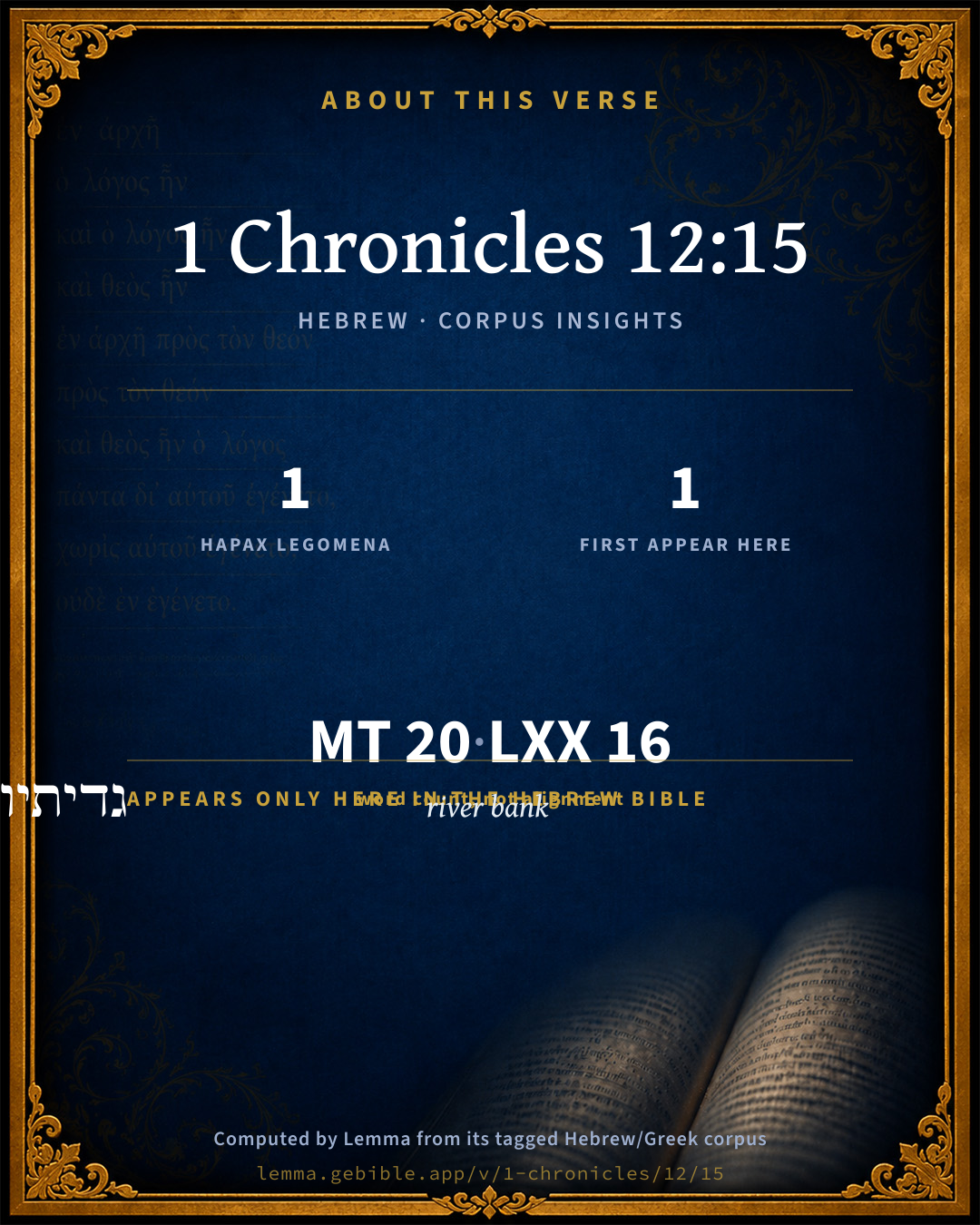
1 Chronicles 12:15

Hebrew (Westminster Leningrad Codex) 1 Chronicles 12:15 appears in the Hebrew Old Testament. The text above is from the Westminster Leningrad Codex. Each word links to its Strong’s number, a concise gloss, and parsing drawn from the Open Scriptures Hebrew Bible morphology. Click any word for its full Brown-Driver-Briggs (BDB) entry.
Download image
Cite this verse

1 Chronicles 12:15 (World English Bible). Public Domain. Lemma interlinear Bible study tool, https://lemma.gebible.app/v/1-chronicles/12/15.

Show BibTeX & RIS
BibTeX
RIS
English Translation
These are those who went over the Jordan in the first month, when it had overflowed all its banks; and they put to flight all them of the valleys, both toward the east, and toward the west.
World English Bible · Public Domain
Highlights
  • 1 hapax legomenon — only here in the Hebrew Bible
  • 1 first appearance in the Hebrew Bible
Full analysis ↓
Download a study sheet

One document with this verse’s original text, its word-by-word gloss line, the meaning frame, cross-references with their text, attributed commentary, and full source and license credits — printable, and it pastes into notes with its structure intact.

This verse Autodidact and up

Study sheet (.html) Plain text (.txt)

A passage Seminary Student

Up to 50 verses in one chapter. A passage sheet keeps up to 6 commentary sources and 12 cross-references per verse, in the order this page ranks them, and says so on the sheet whenever that leaves anything out. Ask for a single verse and you get the Autodidact verse sheet above.

Everything on this page stays free to read, with no account — the sheet is a download of what is already on screen, not access to it.

Want to remove ads? Support Godless Engineer
Compare translations 3

The same verse in 3 English versions, stacked beneath the original-language interlinear above. Click any original word for its lexicon entry.

Each is an independent rendering of the whole verse — the interlinear is not word-aligned to these translations.

Highlighted words mark where these versions differ — a whole-verse word diff, not a word-by-word alignment.

  • World English Bible Public Domain
    These are those who went over the Jordan in the first month, when it had overflowed all its banks; and they put to flight all them of the valleys, both toward the east, and toward the west.
  • King James Version Public Domain
    These are they that went over Jordan in the first month, when it had overflown all his banks; and they put to flight all them of the valleys, both toward the east, and toward the west.
  • unfoldingWord Literal Text CC BY-SA 4.0
    These they who passed over the Jordan in the first month, and it was filling over all of its banks, and they made all of the valleys flee, to the east and to the west.

unfoldingWord Literal Text — © unfoldingWord, licensed CC BY-SA 4.0. Word-aligned USFM3 via Door43 (git.door43.org/unfoldingWord/en_ult).

Versions to compare (up to 4)

3 of 4 selected

Show all 18 translations

Every available English version of this verse, each an independent rendering of the whole verse.

  • World English Bible Public Domain
    These are those who went over the Jordan in the first month, when it had overflowed all its banks; and they put to flight all them of the valleys, both toward the east, and toward the west.
  • Berean Standard Bible Public Domain
    These are the ones who crossed the Jordan in the first month when it was overflowing all its banks, and they put to flight all those in the valleys, both to the east and to the west.
  • Majority Standard Bible Public Domain
    These are the ones who crossed the Jordan in the first month when it was overflowing all its banks, and they put to flight all those in the valleys, both to the east and to the west.
  • King James Version Public Domain
    These are they that went over Jordan in the first month, when it had overflown all his banks; and they put to flight all them of the valleys, both toward the east, and toward the west.
  • American Standard Version (1901) Public Domain
    These are they that went over the Jordan in the first month, when it had overflowed all its banks; and they put to flight all them of the valleys, both toward the east, and toward the west.
  • Revised Version (1885) Public Domain
    These are they that went over Jordan in the first month, when it had overflown all its banks; and they put to flight all them of the valleys, both toward the east, and toward the west.
  • Geneva Bible (1599) Public Domain
    These are they that went ouer Iorden in the first moneth when he had filled ouer all his bankes, and put to flight all them of the valley, toward the East and the West.
  • Douay-Rheims (1899) Public Domain
    These are they who passed over the Jordan in the first month, when it is used to how over its banks: and they put to flight all that dwelt in the valleys both toward the east and toward the west.
  • Young's Literal Translation Public Domain
    these `are' they who have passed over the Jordan in the first month, -- and it is full over all its banks -- and cause all `they of' the valley to flee to the east and to the west.
  • Literal Standard Version CC BY-SA 4.0
    these [are] they who have passed over the Jordan in the first month—and it is full over all its banks—and cause all [those in] the valley to flee to the east and to the west.
  • Unlocked Literal Bible CC BY-SA 4.0
    They crossed the Jordan in the first month, when it overflowed its banks, and chased away all those living in the valleys, both toward the east and toward the west.
  • unfoldingWord Literal Text CC BY-SA 4.0
    These they who passed over the Jordan in the first month, and it was filling over all of its banks, and they made all of the valleys flee, to the east and to the west.
  • Darby Bible Public Domain
    These are they that went over Jordan in the first month, when it overflows all its banks, and they put to flight all [them] of the valleys, toward the east and toward the west.
  • World Messianic Bible Public Domain
    These are those who went over the Jordan in the first month, when it had overflowed all its banks; and they put to flight all who lived in the valleys, both toward the east and toward the west.
  • Webster's Bible Public Domain
    These are they that went over Jordan in the first month, when it had overflowed all its banks; and they put to flight all them of the valleys, both towards the east, and towards the west.
  • Free Bible Version CC BY-SA 4.0
    These were ones who crossed the Jordan River in the first month of the year when it overflows its banks. They chased out all the people living in the valley, both to the east and to the west.
  • Bible in Basic English Public Domain
    It was they who went over Jordan in the first month, when the river was overflowing, and put to flight all the people of the valleys, to the east and to the west.
  • JPS Tanakh (1917) Public Domain
    (12-16) These are they that went over the Jordan in the first month, when it had overflown all its banks; and they put to flight all them of the valleys, both toward the east, and toward the west.

Literal Standard Version (2020), Covenant Press — licensed CC BY-SA 4.0. Text via the HelloAO Bible API (eBible.org). Unlocked Literal Bible (unfoldingWord) — licensed CC BY-SA 4.0. Text via the HelloAO Bible API (eBible.org). unfoldingWord Literal Text — © unfoldingWord, licensed CC BY-SA 4.0. Word-aligned USFM3 via Door43 (git.door43.org/unfoldingWord/en_ult). Free Bible Version, Dr. Jonathan Gallagher — licensed CC BY-SA 4.0. Text via the HelloAO Bible API (eBible.org).

Word by word

More ways to search: Search by grammar → Find every occurrence → Compare this word →

Practice this passage: Drill this verse → Learn its vocabulary →

גדיתיו
gidyâh
H1428
“river banks · his”
Noun, Common, Feminine, Plural, Construct + Suffix, Personal, 3rd Person, Masculine, Singular
Part of Speech
Noun
Type
Common
Gender
Feminine
Number
Plural
State
Construct
Full BDB Definition

Origin: the same as H1415

TWOT: 314a

river bank, shore
  1. אֵ֣לֶּה ʼêl-leh H428 “these” Pronoun, Demonstrative, Common, Plural
  2. הֵ֗ם hêm H1992 “they” Pronoun, Personal, 3rd Person, Masculine, Plural
  3. אֲשֶׁ֨ר ʼăsher H834 “which” Particle, Relative
  4. עָבְר֤וּ ʻâbar H5674 “to pass over” Verb, Qal, Perfect, 3rd Person, Common, Plural
  5. אֶת ʼêth H853 “-” Particle, Direct Object
  6. הַיַּרְדֵּן֙ Yardên H3383 “the · Jordan” Particle, Definite Article + Noun, Proper
  7. בַּחֹ֣דֶשׁ chôdesh H2320 “in/at the · month” Preposition, Determined + Noun, Common, Masculine, Singular, Absolute
  8. הָרִאשׁ֔וֹן riʼshôwn H7223 “the · first” Particle, Definite Article + Adjective, Ordinal number, Masculine, Singular, Absolute
  9. וְה֥וּא hûwʼ H1931 “and · he” Conjunction + Pronoun, Personal, 3rd Person, Masculine, Singular
  10. מְמַלֵּ֖א mâlêʼ H4390 “filling” Verb, Piel, Participle Active, Masculine, Singular, Absolute
  11. עַל ʻal H5921 “upon” Preposition
  12. כָּל kôl H3605 “all of” Noun, Common, Masculine, Singular, Construct
  13. גְּדוֹתָ֑יו gâdâh H1415 “river banks · his” Noun, Common, Feminine, Plural, Construct + Suffix, Personal, 3rd Person, Masculine, Singular
  14. וַיַּבְרִ֨יחוּ֙ bârach H1272 “and · to flee” Conjunction + Verb, Hiphil, Sequential Imperfect, 3rd Person, Masculine, Plural
  15. אֶת ʼêth H853 “-” Particle, Direct Object
  16. כָּל kôl H3605 “all of” Noun, Common, Masculine, Singular, Construct
  17. הָ֣עֲמָקִ֔ים ʻêmeq H6010 “the · valleys” Particle, Definite Article + Noun, Common, Masculine, Plural, Absolute
  18. לַמִּזְרָ֖ח mizrâch H4217 “to/for the · east” Preposition, Determined + Noun, Common, Masculine, Singular, Absolute
  19. וְלַֽמַּעֲרָֽב maʻărâb H4628 “and · to/for the · west” Conjunction + Preposition, Determined + Noun, Common, Masculine, Singular, Absolute

About this verse

These counts appear in no published source. They are computed here, from the morphology-tagged text and Lemma’s own curated glosses. What Lemma adds →

20
words
18
distinct lemmas
Historical
section

Notable vocabulary

1 hapax legomenon — a word that appears only here in the entire Hebrew Bible:

  • גדיתיו river bank H1428

First appearance in Scripture

This word makes its first canonical appearance in the Hebrew Bible here:

  • גדיתיו river bank H1428

Shared distinctive vocabulary

גְּדוֹתָ֑יו river bank H1415 occurs in 4 verses of the Hebrew Bible. Also found in:

Grammatical profile

  • 3 verbs
  • 9 nouns
  • 1 adjective
  • 3 pronouns
  • 1 preposition
  • 3 particles

Verb forms

  • עָבְר֤וּ Qal · Perfect
  • מְמַלֵּ֖א Piel · Participle Active
  • וַיַּבְרִ֨יחוּ֙ Hiphil · Sequential Imperfect

Repetition

A word recurs within this verse — often emphatic in Hebrew:

Hebrew & Septuagint length

In English translation the verse runs 37 words from the Hebrew and 35 from the Septuagint (LXX English) — closely comparable.

A rough comparison of the two English renderings, which tokenize alike — not a word-level alignment.

Word counts can differ between the Hebrew and the Greek without any difference in meaning — e.g. the Hebrew direct-object marker אֵת has no separate Greek word, and Greek often adds the article ὁ.

In the original languages it is 20 Hebrew tokens and 16 Greek tokens — but the two are counted differently (Hebrew bundles its prefixes and suffixes into one token; the Greek is in lemma form), so that isn’t a like-for-like length.

Cross-references

4

Topical passages linked to 1 Chronicles 12:15 in the Treasury of Scripture Knowledge — connected by theme and wording, ordered by reader-vote popularity; previews shown in the World English Bible.

  • Joshua 3:15 and when those who bore the ark were come to the Jordan, and the feet of the priests who bore the ark were dipped in the brink of the water (for the Jordan overflows all its banks all the time of harvest),
  • Joshua 4:18 It happened, when the priests who bore the ark of the covenant of Yahweh were come up out of the midst of the Jordan, and the soles of the priests' feet were lifted up to the dry ground, that the waters of the Jordan returned to their place, and went over all its banks, as before.
  • Jeremiah 12:5 If you have run with the footmen, and they have wearied you, then how can you contend with horses? and though in a land of peace you are secure, yet how will you do in the pride of the Jordan?
  • Jeremiah 49:19 Behold, he shall come up like a lion from the pride of the Jordan against the strong habitation: for I will suddenly make them run away from it; and whoever is chosen, him will I appoint over it: for who is like me? and who will appoint me a time? and who is the shepherd who will stand before me?

Cross-references courtesy of OpenBible.info (CC BY 4.0).

Hebrew and Greek witnesses Masoretic Hebrew ↔ Greek Septuagint

The same verse in the two great witnesses to the Old Testament, shown verse-for-verse.

These are two independent witnesses, not word-aligned to each other, and the Septuagint is shown in lemma (dictionary) form.

Hebrew 1 Chronicles 12:15 Masoretic · Westminster Leningrad Codex

אֵ֣לֶּה הֵ֗ם אֲשֶׁ֨ר עָבְר֤וּ אֶת הַיַּרְדֵּן֙ בַּחֹ֣דֶשׁ הָרִאשׁ֔וֹן וְה֥וּא מְמַלֵּ֖א עַל כָּל גדיתיו גְּדוֹתָ֑יו וַיַּבְרִ֨יחוּ֙ אֶת כָּל הָ֣עֲמָקִ֔ים לַמִּזְרָ֖ח וְלַֽמַּעֲרָֽב

These are those who went over the Jordan in the first month, when it had overflowed all its banks; and they put to flight all them of the valleys, both toward the east, and toward the west.

World English Bible · Public Domain

Greek LXX 1 Chronicles 12:15 Septuagint · lemma form

οὗτος ἐκ ὁ υἱός γαδ ἄρχων ὁ στρατιά εἷς ὁ ἑκατόν μικρός καί μέγας ὁ χίλιοι

These are the men that crossed over Jordan in the first month, and it had overflowed all its banks; and they drove out all the inhabitants of the valleys, from the east to the west.

LXX2012 (modern English Septuagint) · Public Domain

Hebrew: Westminster Leningrad Codex (CC BY 4.0). Greek: Septuagint (public domain); English from LXX2012 (modern English Septuagint) (Public Domain). How the Septuagint differs from the Hebrew →

Commentary

Notes on 1 Chronicles 12:15 from classic Christian and Jewish commentators (each source and its license shown beneath its notes). The classic Christian expositions comment on the surrounding passage and are grouped to its opening verse, so a note may address several verses; the Jewish commentaries on the Tanakh (Rashi and others) are per-verse, so they appear only where the commentator wrote on this verse.

Lemma curates 59 commentaries, every one of them public domain or Creative Commons licensed, each selected and text-cleaned for this edition rather than reprinted as found. About our sources →

Trapp's Complete Commentary

John Trapp

1Ch 12:15 These [are] they that went over Jordan in the first month, when it had overflown all his banks; and they put to flight all [them] of the valleys, [both] toward the east, and toward the west.

Ver. 15. These are they that went over Jordan.] To help David. Much water could not quench their love.

And they put to flight all them of the valleys.] The Philistines, who, having slain Saul, and driven the Israelites out of their habitations, dwelt now in their room; but were soon beaten out by these valiant Gadites. An autem navigio vel natando transierint, non liquet.

John Trapp, A Commentary or Exposition upon All the Books of the Old and New Testament (1647–1656) — public domain. Text from a community e-Sword module.

Joseph Benson's Commentary

1Ch 12:15. These are they that went over Jordan, &c. — Namely, in Saul’s time, when, it seems, the enemies of the Israelites had made an inroad, and done some mischiefs to the Israelites beyond Jordan, to whose help these persons then came. When it had overflowed all its banks — As it commonly did about that time. Probably these, being men of great courage and dexterity, swam over Jordan, at the time here specified, through their ardent desire to help their brethren, and to fight with their enemies. And they put to flight all them of the valleys — The people that lived in the valleys or deserts beyond Jordan, who, it seems, when Saul was engaged against the Philistines, took that advantage to fall upon the Israelites beyond Jordan. Both toward the east and toward the west — Both the people that lived more eastward and remote from Jordan, and those that lived more westward and nearer to it.

Joseph Benson's Commentary on the Old and New Testaments (1811–1818) — public domain. Text from a community e-Sword module.

Geneva Bible (1599)

Geneva Bible translators

Which the Hebrews called Nisan, or Abib, containing half March, and half April, when Jordan was wont to overflow his banks, read Josh. 3:15.

Geneva Bible (1599) marginal notes — public domain. Text via Bolls.life.

Jamieson, Fausset & Brown

Robert Jamieson, A. R. Fausset & David Brown

These are they that went over Jordan in the first month--that is, in spring, when the swollen river generally fills up the banks of its channel (see on Jos 3:14; Jos 4:19; Jos 5:10).

they put to flight all them of the valleys--This was probably done at the time of their separating themselves and their purpose being discovered, they had to cut their passage through the opposing adherents of Saul, both on the eastern and western banks. The impossibility of taking the fords at such a time, and the violent rapidity of the current, make this crossing of the Jordan--in whatever way these Gadites accomplished it--a remarkable feat.

Jamieson, Fausset & Brown — Commentary Critical and Explanatory on the Whole Bible (1871) — public domain (CC PDM 1.0). Text via the HelloAO Bible API.

Adam Clarke's Commentary

Verse 15. In the first month] Perhaps this was the month Nisan, which answers to a part of our March and April. This was probably before the snows on the mountains were melted, just as Jordan began to overflow its banks; or if we allow that it had already overflowed its banks, it made their attempt more hazardous, and afforded additional proof of their heroism.

Adam Clarke's Commentary on the Bible (1810–1826) — public domain. Text from a community e-Sword/MySword module.

Ellicott's Commentary for English Readers

(15) When it had overflown.—A proof of their valour. They did not wait till summer had made the Jordan shallow, but crossed it in spring, when perilously swollen with the rains and the melted snows of Lebanon. (Comp. Jos_3:15.)

In the first month,—March—April; in Heb, A bib or Nisan.

Had overflown.—Was fillύng or brimming over.

And they put to flight all . . . the valleys.—Literally, and they made all the valleys flee: that is, their inhabitants, who were hostile to their enterprise, both to the sunrise and the sunset, or on both sides of the river.

A Bible Commentary for English Readers, edited by Charles John Ellicott (1878–1897) — public domain. Text from a community e-Sword module.

The Cambridge Bible for Schools and Colleges

gen. ed. J. J. S. Perowne

15. in the first month] In Nisan (the month of harvest) when the snow was melting and filling all streams; cp. Jos_3:15.

all them of the valleys] i.e. all inhabitants of the valleys who in the interest of Saul sought to bar their march westward to join David.

The Cambridge Bible for Schools and Colleges (gen. ed. J. J. S. Perowne; Cambridge University Press, 1878–1918) — public domain. Text from a community e-Sword module.

John Gill's Exposition

Then the spirit came upon Amasai,.... Or "clothed" (f) him; a spirit of fortitude, as the Targum, of strength, courage, and presence of mind, with which he was endowed, covered, and clothed as with a garment; this was a sister's son of David's, see Sa2 17:25.

who was chief of the captains; of them that came at this time with him to David; he was afterwards Absalom's general, and designed to be David's, but was murdered by Joab:

and he said, thine are we, David, and on thy side, thou son of Jesse; which being spoken in this short and concise manner, as the supplement shows, denotes the vehemency with which he spake, and is expressive of their cordial fidelity to him, and their resolution to abide by him at all events:

peace, peace be unto thee, and peace be to thine helpers; wishing all prosperity, temporal and spiritual, to him and all his confederates and auxiliaries, among whom they reckoned themselves:

for thy God helpeth thee; which they perceived by the remarkable deliverances of him out of the hand of Saul, when in imminent danger; the Targum is,"for the Word of the Lord is for thy help:"

then David received them; into the hold, and admitted them as his friends:

and made them the captains of the band; they brought with them; or in later times, when he came to the throne.

(f) "induit", Pagninus, Montanus, &c.

John Gill's Exposition of the Whole Bible (1746–1763) — public domain (CC PDM 1.0). Text via the HelloAO Bible API.

Albert Barnes' Notes on the Bible

On the danger of the exploit, see the marginal reference note.

This passage 1Ch 12:8-15 seems to be taken verbatim from an ancient source, the poetical expressions in 1Ch 12:8, 1Ch 12:14, being especially unlike the usual style of our author.

Albert Barnes' Notes on the Bible (1834–1885) — public domain. Text from a community e-Sword/MySword module.

Haydock's Catholic Bible Commentary

Month, Nisan. (Tirinus) --- Banks. This circumstance enhances their courage. Maundrel (Alep. p. 136) went to see the Jordan, 13th March, 1697, but the river was nine feet from the banks. Its rapidity has perhaps made its bed so much deeper, that it does not overflow so frequently at present. (Calmet)

George Leo Haydock (1774–1849), Haydock's Catholic Family Bible and Commentary, 1859 edition — public domain. Excludes Psalms (Douay-Rheims chapter numbering differs from Protestant) and Deuterocanonical books (Catholic canon only).

Matthew Poole's English Annotations

They that went over Jordan, to wit, in Saul’s time, when, it seems, the enemies of the Israelites had made an inroad, and done some mischiefs to the Israelites beyond Jordan, to whose help these then came.

When it had overflown all his banks; as it commonly did about that time. See Jos 3:15; 4:18; Jer 49:19. This is noted either as a description of the time when this was done, it being usual with historians to note the circumstances of great actions; or as an aggravation of the fact. And possibly these, being men of great nimbleness and dexterity, did swim over Jordan, through their ardent desire to help their brethren, and to fight with their enemies.

All them of the valleys, i.e. the people that lived in the valleys or deserts beyond Jordan, who, as it seems, when Saul was engaged against the Philistines, took that advantage to fall upon the Israelites beyond Jordan.

Toward the east, and toward the west; either,

1. The people that lived more eastward, and remote from Jordan, and those who lived more westward, or nearer to it. Or,

2. Them made they fly several ways, some eastward, some westward, as they saw the way open for them. See Deu 28:7,25.

Matthew Poole's English Annotations on the Holy Bible (1683–1685) — public domain. Text from a community e-Sword/MySword module.

Whedon's Commentary on the Bible

Daniel D. Whedon

15. These — Namely, these Gadites. The writer thus gives in this verse an instance of their valour.

Went over Jordan in the first month — That is, in Abib, (April,) when the river usually overflows all its banks, and the crossing is both difficult and dangerous.

Put to flight all them of the valleys — This expedition of the Gadites was, perhaps, a mere scheme of predatory conquest; or, it may have been undertaken to punish the people of these valleys for marauding expeditions they had carried on. If, however, we should understand “the hold” of 1Ch_12:8 to be that of Mizpeh of Moab, where David dwelt awhile, (1Sa_22:3-5,) this exploit of the Gadites may have taken place at the time they separated themselves from the rest of the Gadites. In resorting unto David they may have met with opposition from Saul’s partisans, and were therefore obliged to fight their way through the valleys east and west of the Jordan.

Daniel D. Whedon (gen. ed.), Commentary on the Old and New Testaments (1874–1909) — public domain. Text from a community e-Sword module.

The Pulpit Commentary

In the first month. This corresponds with our end of March. The interesting incident of this verse is unrecorded in detail elsewhere (Jos_3:15; Jer_12:5 Jer_49:19 Jer_50:44)

The Pulpit Commentary (1880–1919), ed. H.D.M. Spence-Jones & Joseph S. Exell — public domain. Text from a community e-Sword module.

Keil & Delitzsch

C. F. Keil & F. Delitzsch

Then the spirit came upon Amasai,.... Or "clothed" (f) him; a spirit of fortitude, as the Targum, of strength, courage, and presence of mind, with which he was endowed, covered, and clothed as with a garment; this was a sister's son of David's, see Sa2 17:25.

who was chief of the captains; of them that came at this time with him to David; he was afterwards Absalom's general, and designed to be David's, but was murdered by Joab:

and he said, thine are we, David, and on thy side, thou son of Jesse; which being spoken in this short and concise manner, as the supplement shows, denotes the vehemency with which he spake, and is expressive of their cordial fidelity to him, and their resolution to abide by him at all events:

peace, peace be unto thee, and peace be to thine helpers; wishing all prosperity, temporal and spiritual, to him and all his confederates and auxiliaries, among whom they reckoned themselves:

for thy God helpeth thee; which they perceived by the remarkable deliverances of him out of the hand of Saul, when in imminent danger; the Targum is,"for the Word of the Lord is for thy help:"

then David received them; into the hold, and admitted them as his friends:

and made them the captains of the band; they brought with them; or in later times, when he came to the throne.

(f) "induit", Pagninus, Montanus, &c.

Keil & Delitzsch — Biblical Commentary on the Old Testament (1861–1891) — public domain (CC PDM 1.0). Text via the HelloAO Bible API. (Old Testament only.)

Scofield Reference Notes

C. I. Scofield

first month

i.e. April.

The Scofield Reference Bible (1917 edition), notes by C. I. Scofield — public domain. Text from a community e-Sword module.

Rashi

Rabbi Shlomo Yitzchaki (Rashi)

these were some of the sons of Gad as is written above (v. 8): “And some of the Gadites separated to David.”

the smallest one a hundred The smallest of them could pursue a hundred.

and the greatest a thousand And the greatest of them could pursue a thousand. This is an actualization of the verse (Lev. 26:8): “Five of you will pursue one hundred, and one hundred of you, etc.”

Rashi on the Tanakh — English translations: “The Judaica Press complete Tanach with Rashi, translated by A. J. Rosenberg” (CC BY 4.0); “Pentateuch with Rashi's commentary by M. Rosenbaum and A.M. Silbermann, 1929-1934” (public domain); “The Metsudah Tanach series, Lakewood, N.J” (CC BY 4.0); and “The Book of Joshua, Metsudah Publications, 1997” (CC BY 4.0). Text via Sefaria.

Lesson kit

Teaching starters — assembled from the data on this page, not authored interpretation. Every prompt links to the verse data it draws on. Edit before teaching.

1 Chronicles, in the Historical, opens this verse with 20 words (18 distinct Hebrew lemmas). Its most distinctive word is gidyâh (“river bank”). A historical commentator’s framing appears above. Read the whole chapter for the surrounding context.

Discussion questions

  1. The word gidyâh carries the sense “river bank.” How does it shape the verse?
  2. This verse holds 1 word here found nowhere else in the Hebrew Bible. What might the rare word draw attention to?
  3. The word “river bank” first appears here in Scripture. What is being introduced at this debut?
  4. Joshua 3:15 shares the word «river bank» with this verse. How do the two illuminate each other?
  5. “all” occurs 2× in this one verse. What is the effect of the repetition?
  6. The translations on this page render this verse differently — a whole-verse word diff, not a word-by-word alignment. What might account for the different wordings?
  7. The verb «עָבְר֤וּ» is Qal Perfect. How does its form color the action?
  8. Reading how Trapp's Complete Commentary and Joseph Benson's Commentary read this verse, where do the two commentators agree and where do they part?

Things to notice

  • 1 word in this verse appears nowhere else in the Hebrew Bible.
  • 1 word makes its first canonical appearance in Scripture here.
  • This verse counts 20 Hebrew ↔ 16 Greek words.
  • These translations choose different wording for 14 words in this verse.
  • “all” occurs 2× in this single verse.

Reading settings

Reading text

Shown beneath each verse's original-language words.

Old Testament
Old Testament edition

Read the OT as the Masoretic Hebrew (MT) or the Greek Septuagint (LXX).

English shown for the Greek Septuagint (in the Hebrew ↔ Greek comparison).

Comparing translations? Open the Compare panel on any verse page to stack up to four side by side.