
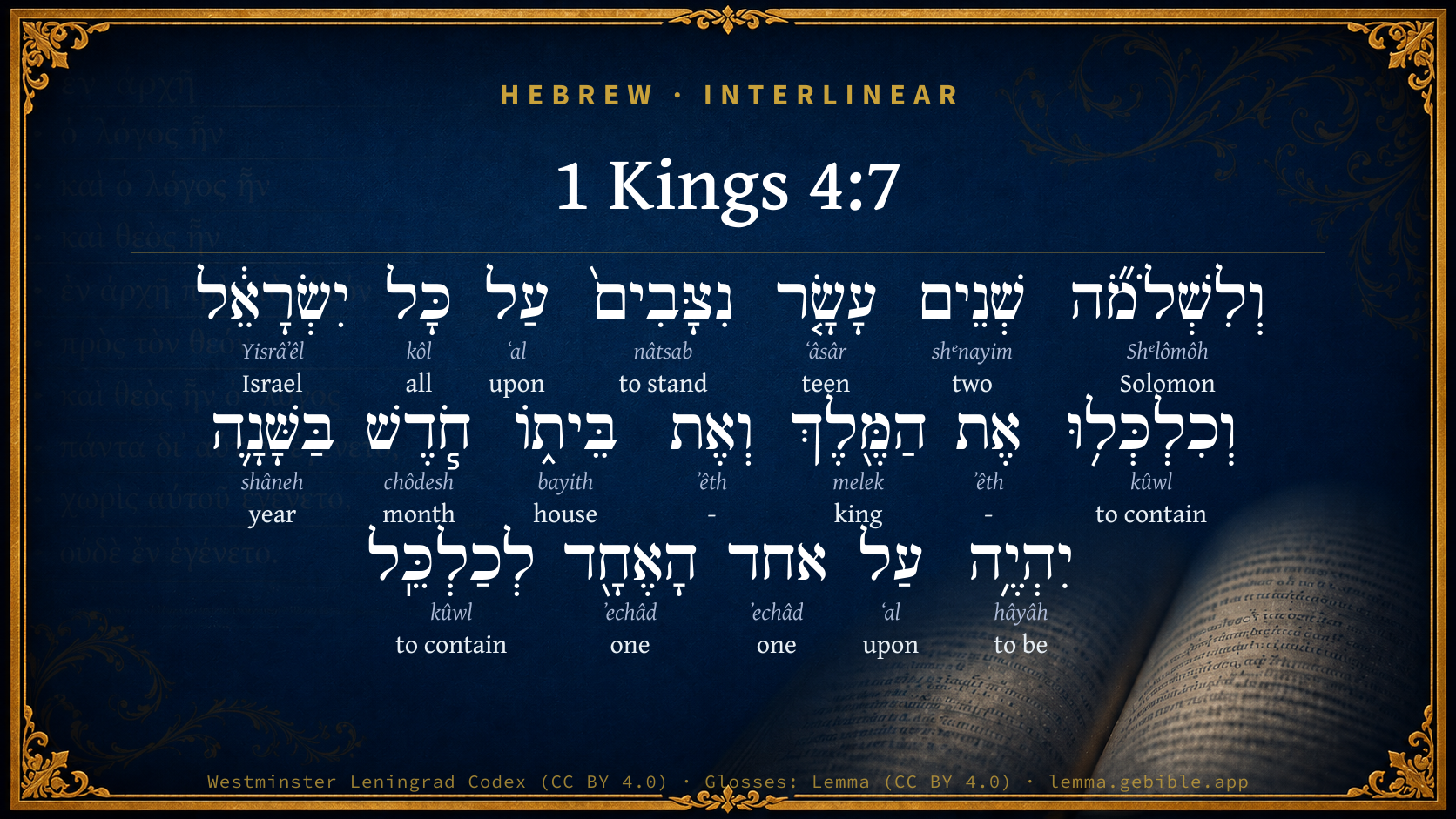
1 Kings 4:7

Hebrew (Westminster Leningrad Codex) 1 Kings 4:7 appears in the Hebrew Old Testament. The text above is from the Westminster Leningrad Codex. Each word links to its Strong’s number, a concise gloss, and parsing drawn from the Open Scriptures Hebrew Bible morphology. Click any word for its full Brown-Driver-Briggs (BDB) entry.
Download image
Cite this verse

1 Kings 4:7 (World English Bible). Public Domain. Lemma interlinear Bible study tool, https://lemma.gebible.app/v/1-kings/4/7.

Show BibTeX & RIS
BibTeX
RIS
English Translation
Solomon had twelve officers over all Israel, who provided food for the king and his household: each man had to make provision for a month in the year.
World English Bible · Public Domain
Download a study sheet

One document with this verse’s original text, its word-by-word gloss line, the meaning frame, cross-references with their text, attributed commentary, and full source and license credits — printable, and it pastes into notes with its structure intact.

This verse Autodidact and up

Study sheet (.html) Plain text (.txt)

A passage Seminary Student

Up to 50 verses in one chapter. A passage sheet keeps up to 6 commentary sources and 12 cross-references per verse, in the order this page ranks them, and says so on the sheet whenever that leaves anything out. Ask for a single verse and you get the Autodidact verse sheet above.

Everything on this page stays free to read, with no account — the sheet is a download of what is already on screen, not access to it.

Want to remove ads? Support Godless Engineer
Compare translations 3

The same verse in 3 English versions, stacked beneath the original-language interlinear above. Click any original word for its lexicon entry.

Each is an independent rendering of the whole verse — the interlinear is not word-aligned to these translations.

Highlighted words mark where these versions differ — a whole-verse word diff, not a word-by-word alignment.

  • World English Bible Public Domain
    Solomon had twelve officers over all Israel, who provided food for the king and his household: each man had to make provision for a month in the year.
  • King James Version Public Domain
    And Solomon had twelve officers over all Israel, which provided victuals for the king and his household: each man his month in a year made provision.
  • unfoldingWord Literal Text CC BY-SA 4.0
    Now to Solomon 12 deputies over all of Israel, and they sustained the king and his house. A month in the year was upon one to sustain.

unfoldingWord Literal Text — © unfoldingWord, licensed CC BY-SA 4.0. Word-aligned USFM3 via Door43 (git.door43.org/unfoldingWord/en_ult).

Versions to compare (up to 4)

3 of 4 selected

Show all 18 translations

Every available English version of this verse, each an independent rendering of the whole verse.

  • World English Bible Public Domain
    Solomon had twelve officers over all Israel, who provided food for the king and his household: each man had to make provision for a month in the year.
  • Berean Standard Bible Public Domain
    Solomon had twelve governors over all Israel to provide food for the king and his household. Each one would arrange provisions for one month of the year,
  • Majority Standard Bible Public Domain
    Solomon had twelve governors over all Israel to provide food for the king and his household. Each one would arrange provisions for one month of the year,
  • King James Version Public Domain
    And Solomon had twelve officers over all Israel, which provided victuals for the king and his household: each man his month in a year made provision.
  • American Standard Version (1901) Public Domain
    And Solomon had twelve officers over all Israel, who provided victuals for the king and his household: each man had to make provision for a month in the year.
  • Revised Version (1885) Public Domain
    And Solomon had twelve officers over all Israel, which provided victuals for the king and his household: each man had to make provision for a month in the year:
  • Geneva Bible (1599) Public Domain
    And Salomon had twelue officers ouer all Israel, which prouided vitailes for the King and his housholde: eche man had a moneth in the yeere to prouide vitailes.
  • Douay-Rheims (1899) Public Domain
    And Solomon had twelve governors over all Israel, who provided victuals for the king and for his household: for every one provided necessaries, each man his month in the year.
  • Young's Literal Translation Public Domain
    And Solomon hath twelve officers over all Israel, and they have sustained the king and his household -- a month in the year is on each one for sustenance;
  • Literal Standard Version CC BY-SA 4.0
    And Solomon has twelve officers over all Israel, and they have sustained the king and his household—a month in the year is on each one for sustenance;
  • Unlocked Literal Bible CC BY-SA 4.0
    Solomon had twelve officers over all Israel, who provided food for the king and his household. Each man had to make provision for one month in the year.
  • unfoldingWord Literal Text CC BY-SA 4.0
    Now to Solomon 12 deputies over all of Israel, and they sustained the king and his house. A month in the year was upon one to sustain.
  • Darby Bible Public Domain
    And Solomon had twelve superintendents over all Israel; and they provided food for the king and his household: each man his month in the year had to make provision.
  • World Messianic Bible Public Domain
    Solomon had twelve officers over all Israel, who provided food for the king and his household. Each man had to make provision for a month in the year.
  • Webster's Bible Public Domain
    And Solomon had twelve officers over all Israel, who provided victuals for the king and his household: each man his month in a year made provision.
  • Free Bible Version CC BY-SA 4.0
    Solomon had twelve area governors whose responsibilities covered the whole of Israel, providing food for the king and his household. Each one in turn arranged supplies for one month of the year.
  • Bible in Basic English Public Domain
    And Solomon put twelve overseers over all Israel, to be responsible for the stores needed for the king and those of his house; every man was responsible for one month in the year.
  • JPS Tanakh (1917) Public Domain
    And Solomon had twelve officers over all Israel, who provided victuals for the king and his household: each man had to make provision for a month in the year.

Literal Standard Version (2020), Covenant Press — licensed CC BY-SA 4.0. Text via the HelloAO Bible API (eBible.org). Unlocked Literal Bible (unfoldingWord) — licensed CC BY-SA 4.0. Text via the HelloAO Bible API (eBible.org). unfoldingWord Literal Text — © unfoldingWord, licensed CC BY-SA 4.0. Word-aligned USFM3 via Door43 (git.door43.org/unfoldingWord/en_ult). Free Bible Version, Dr. Jonathan Gallagher — licensed CC BY-SA 4.0. Text via the HelloAO Bible API (eBible.org).

Word by word

More ways to search: Search by grammar → Find every occurrence → Compare this word →

Practice this passage: Drill this verse → Learn its vocabulary →

וְכִלְכְּל֥וּ
kûwl
H3557
“and · to contain”
Conjunction + Verb, Pilpel, Perfect, 3rd Person, Common, Plural
Part of Speech
Conjunction + Verb
Stem
Pilpel
Form
Perfect
Person
3rd Person
Gender
Common
Number
Plural
Full BDB Definition

Origin: a primitive root

TWOT: 962

to seize, contain, measure - (Qal) to measure, calculate - (Pilpel) to sustain, maintain, contain - to sustain, support, nourish - to contain, hold in, restrain - to support, endure - (Polpal) to be supplied - (Hiphil) to contain, hold, hold in, endure - to contain - to sustain, endure
  1. וְלִשְׁלֹמֹ֞ה Shᵉlômôh H8010 “and · to/for · Solomon” Conjunction + Preposition + Noun, Proper
  2. שְׁנֵים shᵉnayim H8147 “two” Adjective, Cardinal number, Masculine, Dual, Absolute
  3. עָשָׂ֤ר ʻâsâr H6240 “teen” Adjective, Cardinal number, Masculine, Singular, Absolute
  4. נִצָּבִים֙ nâtsab H5324 “standing” Verb, Niphal, Participle Active, Masculine, Plural, Absolute
  5. עַל ʻal H5921 “upon” Preposition
  6. כָּל kôl H3605 “all of” Noun, Common, Masculine, Singular, Construct
  7. יִשְׂרָאֵ֔ל Yisrâʼêl H3478 “Israel” Noun, Proper
  8. אֶת ʼêth H853 “-” Particle, Direct Object
  9. הַמֶּ֖לֶךְ melek H4428 “the · king” Particle, Definite Article + Noun, Common, Masculine, Singular, Absolute
  10. וְאֶת ʼêth H853 “and · -” Conjunction + Particle, Direct Object
  11. בֵּית֑וֹ bayith H1004 “house · his” Noun, Common, Masculine, Singular, Construct + Suffix, Personal, 3rd Person, Masculine, Singular
  12. חֹ֧דֶשׁ chôdesh H2320 “month” Noun, Common, Masculine, Singular, Absolute
  13. בַּשָּׁנָ֛ה shâneh H8141 “in/at the · year” Preposition, Determined + Noun, Common, Feminine, Singular, Absolute
  14. יִהְיֶ֥ה hâyâh H1961 “to be” Verb, Qal, Imperfect, 3rd Person, Masculine, Singular
  15. עַל ʻal H5921 “upon” Preposition
  16. אחד ʼechâd H259 “one” Adjective, Cardinal number, Masculine, Singular, Absolute
  17. הָאֶחָ֖ד ʼechâd H259 “the · one” Particle, Definite Article + Adjective, Cardinal number, Masculine, Singular, Absolute
  18. לְכַלְכֵּֽל kûwl H3557 “to contain” Preposition + Verb, Pilpel, Infinitive Construct

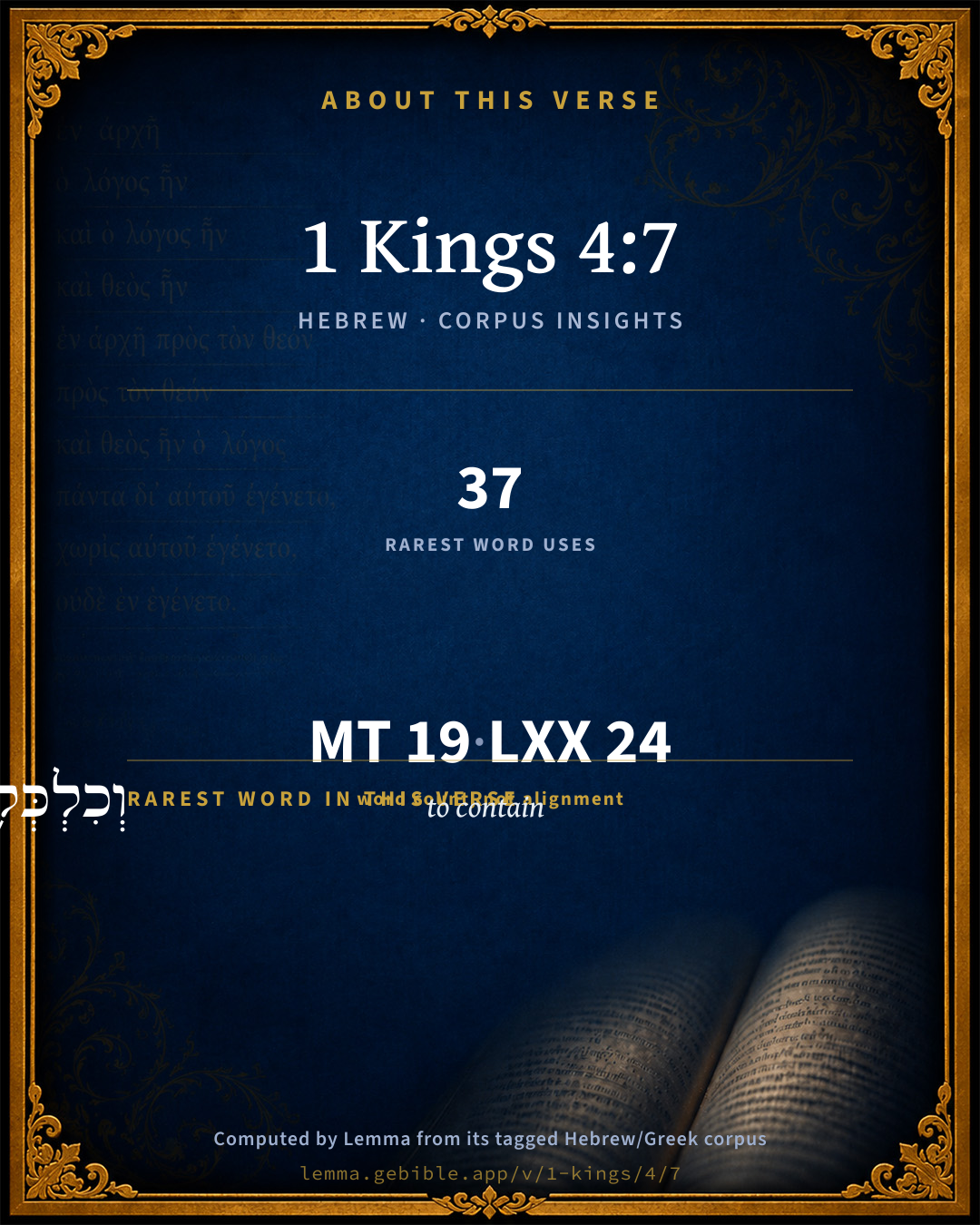
About this verse

These counts appear in no published source. They are computed here, from the morphology-tagged text and Lemma’s own curated glosses. What Lemma adds →

19
words
15
distinct lemmas
Historical
section

Shared distinctive vocabulary

וְכִלְכְּל֥וּ to contain H3557 occurs in 36 verses of the Hebrew Bible. Also found in:

Grammatical profile

  • 4 verbs
  • 7 nouns
  • 4 adjectives
  • 2 prepositions
  • 2 particles

Verb forms

  • נִצָּבִים֙ Niphal · Participle Active
  • וְכִלְכְּל֥וּ Pilpel · Perfect
  • יִהְיֶ֥ה Qal · Imperfect
  • לְכַלְכֵּֽל Pilpel · Infinitive Construct

Repetition

Words recur within this verse — often emphatic in Hebrew:

  • עַל upon H5921 ×2
  • וְכִלְכְּל֥וּ to contain H3557 ×2
  • אחד one H259 ×2

Hebrew & Septuagint length

In English translation the verse runs 28 words from the Hebrew and 28 from the Septuagint (LXX English) — the same length.

A rough comparison of the two English renderings, which tokenize alike — not a word-level alignment.

Word counts can differ between the Hebrew and the Greek without any difference in meaning — e.g. the Hebrew direct-object marker אֵת has no separate Greek word, and Greek often adds the article ὁ.

In the original languages it is 19 Hebrew tokens and 24 Greek tokens — but the two are counted differently (Hebrew bundles its prefixes and suffixes into one token; the Greek is in lemma form), so that isn’t a like-for-like length.

Cross-references

1

Topical passages linked to 1 Kings 4:7 in the Treasury of Scripture Knowledge — connected by theme and wording, ordered by reader-vote popularity; previews shown in the World English Bible.

  • 1 Chronicles 27:1–15 Now the children of Israel after their number, the heads of fathers' [houses] and the captains of thousands and of hundreds, and their officers who served the king, in any matter of the divisions which came in and went out month by month throughout all the months of the year--of every division were twenty-four thousand.

Cross-references courtesy of OpenBible.info (CC BY 4.0).

Hebrew and Greek witnesses Masoretic Hebrew ↔ Greek Septuagint

The same verse in the two great witnesses to the Old Testament, shown verse-for-verse.

These are two independent witnesses, not word-aligned to each other, and the Septuagint is shown in lemma (dictionary) form.

Hebrew 1 Kings 4:7 Masoretic · Westminster Leningrad Codex

וְלִשְׁלֹמֹ֞ה שְׁנֵים עָשָׂ֤ר נִצָּבִים֙ עַל כָּל יִשְׂרָאֵ֔ל וְכִלְכְּל֥וּ אֶת הַמֶּ֖לֶךְ וְאֶת בֵּית֑וֹ חֹ֧דֶשׁ בַּשָּׁנָ֛ה יִהְיֶ֥ה עַל אחד הָאֶחָ֖ד לְכַלְכֵּֽל

Solomon had twelve officers over all Israel, who provided food for the king and his household: each man had to make provision for a month in the year.

World English Bible · Public Domain

Greek LXX 1 Kings 4:7 Septuagint · lemma form

καί ὁ σαλωμών δώδεκα καταἵστημι ἐπί πᾶς ἰσραήλ χορηγέω ὁ βασιλεύς καί ὁ οἶκος αὐτός μήν ἐν ὁ ἐνιαυτός γίγνομαι ἐπί ὁ εἷς χορηγέω

And Solomon had twelve officers over all Israel, to provide for the king and his household; each one's turn came to supply for a month in the year.

LXX2012 (modern English Septuagint) · Public Domain

On this verse, Keil & Delitzsch discusses the Septuagint’s reading. Read the note in Commentary ↓

Hebrew: Westminster Leningrad Codex (CC BY 4.0). Greek: Septuagint (public domain); English from LXX2012 (modern English Septuagint) (Public Domain). How the Septuagint differs from the Hebrew →

Targum (Aramaic paraphrase)

1

The Targum is the ancient Jewish Aramaic paraphrase of the Hebrew Scriptures — an interpretive translation, not the Hebrew text itself. Onkelos (literal) and Pseudo-Jonathan (expansive) render the Torah, and Jonathan the Prophets. Coverage is partial: where no permissively-licensed English translation exists for a verse, only the Aramaic is shown. This is verse-level text, not a word-by-word alignment to the Hebrew.

  1. Targum Jonathan Prophets (Joshua–Malachi)
    וְלִשְׁלֹמֹה תְּרֵי עֲסַר אִסְטַרְטִיגַיָא מְמַנָן עַל כָּל יִשְׂרָאֵל וּמְסוֹבְרִין יַת מַלְכָּא וְיַת אֱנַשׁ בֵּיתֵיהּ יַרְחָא בְּשַׁתָּא מָטֵי לְחָד לְסוֹבָרָא:

    (no public-domain English translation for this verse)

    Targum Jonathan — Aramaic: “Mikraot Gedolot” (public domain). English: “Sefaria Community Translation” (CC0 1.0 (public-domain dedication)); “London "Chaldee Paraphrase," 1871” (public domain). Text via Sefaria.

Commentary

Notes on 1 Kings 4:7 from classic Christian and Jewish commentators (each source and its license shown beneath its notes). The classic Christian expositions comment on the surrounding passage and are grouped to its opening verse, so a note may address several verses; the Jewish commentaries on the Tanakh (Rashi and others) are per-verse, so they appear only where the commentator wrote on this verse.

Lemma curates 59 commentaries, every one of them public domain or Creative Commons licensed, each selected and text-cleaned for this edition rather than reprinted as found. About our sources →

Jamieson, Fausset & Brown

Robert Jamieson, A. R. Fausset & David Brown

HIS TWELVE OFFICERS. (Kg1 4:7-21)

Solomon had twelve officers over all Israel--The royal revenues were raised according to the ancient, and still, in many parts, existing usage of the East, not in money payments, but in the produce of the soil. There would be always a considerable difficulty in the collection and transmission of these tithes (Sa1 8:15). Therefore, to facilitate the work, Solomon appointed twelve officers, who had each the charge of a tribe or particular district of country, from which, in monthly rotation, the supplies for the maintenance of the king's household were drawn, having first been deposited in "the store cities" which were erected for their reception (Kg1 9:19; Ch2 8:4, Ch2 8:6).

Jamieson, Fausset & Brown — Commentary Critical and Explanatory on the Whole Bible (1871) — public domain (CC PDM 1.0). Text via the HelloAO Bible API.

Trapp's Complete Commentary

John Trapp

1Ki 4:7 And Solomon had twelve officers over all Israel, which provided victuals for the king and his household: each man his month in a year made provision.

Ver. 7. And Solomon had twelve officers.] Purveyors, which were to cater for the court, and send in provision. God hath taken the best of his creatures, and commanded them to cater for his people. {Hos 2:21-22}

John Trapp, A Commentary or Exposition upon All the Books of the Old and New Testament (1647–1656) — public domain. Text from a community e-Sword module.

Keil & Delitzsch

C. F. Keil & F. Delitzsch

Solomon's Official Persons and Their Districts. - Kg1 4:7. Solomon had (appointed) twelve נצּבים over all Israel, who provided (כּלכּלוּ) for the king and his house, i.e., supplied provisions for the necessities of the court. These prefects are not to be regarded as "chamberlains," or administrators of the royal domains (Michaelis and Ewald), for these are mentioned in Ch1 27:25. under a different title. They are "general receivers of taxes," or "chief tax-collectors," as Rosenmller expresses it, who levied the king's duties or taxes, which consisted in the East, as they still do to the present time, for the most part of natural productions, or the produce of the land, and not of money payments as in the West, and delivered them at the royal kitchen (Rosenmller, A. und N. Morgenland, iii. p. 166). It cannot be inferred from the explanation given by Josephus, ἡγεμόνες καὶ στρατηγοί, that they exercised a kind of government, as Thenius supposes, since this explanation is nothing but a subjective conjecture. "One month in the year was it every one's duty (אחד על יהיה) to provide." The districts assigned to the twelve prefects coincide only partially with the territories of the tribes, because the land was probably divided among them according to its greater or smaller productiveness. Moreover, the order in which the districts are enumerated is not a geographical one, but probably follows the order in which the different prefects had to send the natural productions month by month for the maintenance of the king's court. The description begins with Ephraim in Ch1 27:8, then passes over in Ch1 27:9 to the territory of Dan to the west of it, in Ch1 27:10 to the territory of Judah and Simeon on the south, in Ch1 27:11 and Ch1 27:12 to the territory of Manasseh on this side from the Mediterranean to the Jordan, then in vv. 13 and 14 to the territory of Manasseh on the other side of the Jordan, thence back again in vv. 15 and 16 to the northern parts of the land on this side, viz., the territories of Naphtali and Asher, and thence farther south to Issachar in v. 17, and Benjamin in v. 18, closing at last in v. 19 with Gilead.

Kg1 4:8

In the names of the prefects we are struck with the fact, that in the case of five of them the names given are not their own but their fathers' names. It is very improbable that the proper names should have dropped out five times (as Clericus, Michaelis, and others suppose); and consequently there is simply the assumption left, that the persons in question bore their fathers' names with Ben prefixed as their own proper names: Benhur, Bendeker, etc., after the analogy of Benchanan in Ch1 4:20 and others, although such a proper name as Ben-Abinadab (Ch1 4:11) appears very strange. Benhur was stationed on the mountains of Ephraim. These mountains, here only the mountainous district of the tribe of Ephraim, were among the most fruitful portions of Palestine (see at Jos 17:14-15).

Kg1 4:9

Bendeker was in Makaz, a city only mentioned here, the situation of which is unknown, but which is at any rate to be sought for in the tribe of Dan, to which the other cities of this district belong. Shaalbim has probably been preserved in the present Selbit, to the north-west of Ylo (see at Jos 19:42). Bethshemesh, the present Ain-Shems (see at Jos 15:10). Elon (אילון), which is distinguished from Ajalon (Jos 19:42 and Jos 19:43) by the epithet Bethchanan, and belonged to the tribe of Dan, has not yet been discovered (see at Jos 19:43). The lxx have arbitrarily interpolated ἕως before Bethchanan, and Thenius naturally takes this under his protection, and consequently traces Bethchanan in the village of Beit Hunn (Rob. Pal. ii. p. 371), but without considering that ἕως yields no reasonable sense unless preceded by מן, ἐκ (from; cf. Kg1 4:12).

Kg1 4:10

Benhesed was in Arubboth, which does not occur again, so that its situation, even if it should be identical with Arab in Jos 15:52, as Bttcher conjectures, can only be approximatively inferred from the localities which follow. To him (לו), i.e., to his district, belonged Sochoh and all the land of Hepher. From Sochoh we may see that Benhesed's district was in the tribe of Judah. Of the two Sochohs in Judah, that still exist under the name of Shuweikeh, it is impossible to determine with certainty which is intended here, whether the one upon the mountains (Jos 15:48) or the one in the plain (Jos 15:35). The fact that it is associated with the land of Hepher rather favours the latter. The land of Hepher, which must not be confounded with the city of Gath-hepher in the tribe of Zebulun (Jos 19:13; Kg2 14:25), but was the territory of one of the Canaanitish kings who were defeated by Joshua, was probably situated in the plain (see at Jos 12:17).

Kg1 4:11

Ben-Abinadab had the whole of the high range of Dor (דּאר נפת, Jos 12:23), i.e., the strip of coast on the Mediterranean Sea below the promontory of Carmel, where the city of Dor, which has been preserved in the village of Tantura or Tortura, nine miles to the north of Caesarea, was situated (see at Jos 11:2). Whether this district embraced the fruitful plain of Sharon is not so clearly made out as Thenius supposes. בּן־אבינדב stands at the head absolutely, without any grammatical connection with כּל־נפת: "Abinadab: the whole of the high range of Dor," etc. The person named was probably a son of David's eldest brother but one (Sa1 16:8; Sa1 17:13), and therefore Solomon's cousin; and he had married Solomon's daughter.

Kg1 4:12

Baana the son of Ahilud was most likely a brother of Jehoshaphat the chancellor (Kg1 4:3). This district embraced the cities on the southern edge of the plain of Jezreel, and extended to the Jordan. Taanach and Megiddo, which have been preserved in the villages of Taanuk and Lejun, were situated on the south-western border of this plain, and belonged to the Manassites (see at Jos 12:21; Jos 17:11). "And all Bethshean," in other words, the whole of the district of Bethshean, i.e., Beisan, at the eastern end of the valley of Jezreel, where it opens into the Jordan valley (Rob. Pal. ii. p. 740ff.), "which (district was situated) by the side of Zarthan below Jezreel, from (the town of) Bethshean (see at Jos 17:11) to Abel-Mecholah, on the other side of Jokmeam." Zarthan, also called Zereda (compare Kg1 7:46 with Ch2 4:17), has probably been preserved, so far as the name is concerned, in Kurn Sartabeh, in the neighbourhood of which the old city probably stood, about five miles to the south of Beisan, at a point where the Jordan valley contracts (see at Jos 3:16). The expression "below Jezreel" refers to "all Bethshean," and may be explained from the elevated situation of Jezreel, the present Zern (see at Jos 19:18). According to Rob. iii. p. 163, this is "comparatively high, and commands a wide and noble view, extending down the broad low valley on the east of Beisan and to the mountains of Ajlun beyond the Jordan." The following words, "from Bethshean to Abel-Mecholah," give a more precise definition of the boundary. The lxx have erroneously inserted καὶ before מבּית־שׁאן, and Thenius and Bttcher defend it on the strength of their erroneous interpretations of the preceding statements. Abel-Mecholah was in the Jordan valley, according to the Onomast., ten Roman miles to the south of Beisan (see at Jdg 7:22). The last clause is not quite intelligible to us, as the situation of the Levitical city Jokmeam (Ch1 6:53, or Kibzaim, a different place from the Jokneam on Carmel, Jos 12:22; Jos 21:34) has not yet been discovered (see at Jos 21:22). According to this, Baanah's district in the Jordan valley did not extend so far as Kurn Sartabeh, but simply to the neighbourhood of Zarthan, and embraced the whole of the tribe-territory of Manasseh on this side of the Jordan.

Kg1 4:13

Bengeber was in Ramoth of Gilead in the tribe of Gad (Jos 20:8), probably on the site of the modern Szalt (see at Deu 4:43). "To him belonged the Havvoth Jair (Jair's-lives) in Gilead, to him the region of Argob in Bashan, sixty great cities with walls and brazen bolts." If we look at this passage alone, the region of Argob in Bashan appears to be distinct from the Havvoth Jair in Gilead. But if we compare it with Num 32:40-41; Deu 3:4-5, and Deu 3:13, Deu 3:14, and Jos 13:30, it is evident from these passages that the Jair's-lives are identical with the sixty large and fortified cities of the region of Argob. For, according to Deu 3:4, these sixty fortified cities, with high walls, gates, and bars, were all fortified cities of the kingdom of Og of Bashan, which the Israelites conquered under Moses, and to which, according to Num 32:41, Jair the Manassite, who had conquered them, gave the name of Havvoth Jair. Hence it is stated in Jos 13:30, that the sixty Jair-towns were situated in Bashan. Consequently the אר חבל לו in our verse is to be taken as a more precise definition of וגו יאיר חוּת לו, or a clearer description of the district superintended by Bengeber, so that Gilead is used, as is frequently the case, in the broader sense of Peraea. Compare with this the Commentary on Deu 3:4, Deu 3:13, Deu 3:14, where the names ארגּב and חוּת are explained, and the imaginary discrepancy between the sixty Jair's-towns in the passages cited, and the twenty-three and thirty cities of Jair in Ch1 2:22 and Jdg 10:4, is discussed and solved. And when Thenius objects to this explanation on the ground that the villages of Jair cannot be identical with the sixty fortified cities, because villages of nomads and strongly fortified cities could not be one and the same, this objection falls to the ground with the untenable interpretation of חוּת as applying to nomad villages.

Kg1 4:14

Ahinadab the son of Iddo received as his district Mahanaim, a fortified and probably also a very important city to the north of the Jabbok, on the border of the tribe of Gad, which may perhaps have been preserved in the ruin of Mahneh (see at Jos 13:26 and Gen 32:3). מחנימה, to Mahanaim (cf. Ewald, 216, a., note), with ה local, probably referring to the fact that Ahinadab was sent away to Mahanaim.

Kg1 4:15

Ahimaaz, possibly Zadok's son (Sa2 15:27; Sa2 17:17.), in Naphtali. This does not denote generally "the most northern portion of the land, say from the northern end of the lake of Gennesaret into Coele-Syria," as Thenius supposes; for the tribe-territory of Asher, which had a prefect of its own, was not situated to the south-west of Naphtali, but ran along the west of Naphtali to the northern boundary of Canaan (see at Jos 19:24-31). He also (like Ben-Abinadab, Kg1 4:11) had a daughter of Solomon, Basmath, as his wife.

Kg1 4:16

Baanah the son of Hushai, probably the faithful friend and wise counsellor of David (Sa2 15:32., Kg1 17:5.), was in Asher and בּעלות, a name quite unknown. If בּ forms part of the word (Baaloth, according to the lxx, Vulg., Syr., and Arab.), we must take it as a district, since the preposition בּ would necessarily have been repeated if a district (Asher) had been connected with a town (Baaloth). In any case, it is not the city of Baaloth in the Negeb of Judah (Jos 15:24) that is intended.

Kg1 4:17

Jehoshaphat the son of Paruach, in Issachar; i.e., over the whole of the territory of that tribe in the plain of Jezreel, with the exception of the cities of Taanach, Megiddo, and Bethshean, which were in the southern portion of it, and were allotted to the Manassites, and, according to Kg1 4:12, were put under the care of Baanah; and not merely in the northern part of Issachar, "with the exception of the plain of Jezreel," as Thenius erroneously maintains. Zebulun may possibly have also formed part of his district, if not entirely, yet in its southern portion, provided that the northern portion was assigned to Ahimaaz in Naphtali, since Zebulun had no prefect of its own.

Kg1 4:18

Shimei the son of Elah, possibly the one mentioned in Kg1 1:8, in Benjamin.

Kg1 4:19

Geber the son of Uri, in the land of Gilead, i.e., as the apposition "the land of Sihon ... and of Og..." clearly shows, the whole of the Israelitish land on the east of the Jordan, as in Deu 34:1; Jdg 20:1, etc., with the simple exception of the districts placed under Bengeber and Ahinadab (Kg1 4:13 and Kg1 4:14). אחד נציב, "one president was it who (was) in the land (of Gilead)." נציב cannot signify a military post or a garrison here, as in Sa1 10:5; Sa1 13:3, etc., but is equivalent to נצּב, the president (Kg1 4:7). The meaning is, that notwithstanding the great extent of this district, it had only one prefect.

Keil & Delitzsch — Biblical Commentary on the Old Testament (1861–1891) — public domain (CC PDM 1.0). Text via the HelloAO Bible API. (Old Testament only.)

Tyndale Open Study Notes

Tyndale Open Resources

4:7-19 The twelve district governors probably handled lesser administrative duties, such as securing revenue and providing food for the king’s household. Solomon’s twelve districts did not exactly coincide with the old tribal allotments.

Tyndale Open Study Notes — © Tyndale Open Resources, licensed CC BY-SA 4.0. Text via the HelloAO Bible API.

Adam Clarke's Commentary

Verse 7. Twelve officers] The business of these twelve officers was to provide daily, each for a month, those provisions which were consumed in the king's household; see 1Kg 4:22-23. And the task for such a daily provision was not an easy one.

Adam Clarke's Commentary on the Bible (1810–1826) — public domain. Text from a community e-Sword/MySword module.

Ellicott's Commentary for English Readers

(7) Provided victuals for the king and his household.—This denotes the collection of revenue—mostly, no doubt, in kind—for the maintenance of the Court and household and guards of the king; and perhaps may have included also the management of the royal domain lands, such as is described under David’s reign in 1Ch_26:25-31. It is curious that in five cases only the patronymic of the officer is given, probably from some defect in the archives from which this chapter is evidently drawn. The office must have been of high importance and dignity, for in two cases (1Ki_4:11; 1Ki_4:15) the holders of it were married into the royal house. The provinces over which they had authority—nine on the west and three on the east of Jordan—coincide only in a few cases with the lands assigned to the several tribes. It is not unlikely that by this time much of the tribal division of territory had become obsolete although we see from 1Ch_27:16-22, that for chieftainship over men, and for levy in war, it still remained in force.

A Bible Commentary for English Readers, edited by Charles John Ellicott (1878–1897) — public domain. Text from a community e-Sword module.

The Cambridge Bible for Schools and Colleges

gen. ed. J. J. S. Perowne

7. twelve officers] The stations of these men were in different parts of the country, and each for his month had to gather from the district assigned to him contributions in kind for the royal household.

The Cambridge Bible for Schools and Colleges (gen. ed. J. J. S. Perowne; Cambridge University Press, 1878–1918) — public domain. Text from a community e-Sword module.

John Gill's Exposition

And these are their names,.... Or rather the names of their fathers; for of many of them not their own names but their fathers' names are given, as being well known:

the son of Hur, in Mount Ephraim; a fruitful country in the tribe of Ephraim, from whence this officer was to furnish the king with provisions for one month in the year.

John Gill's Exposition of the Whole Bible (1746–1763) — public domain (CC PDM 1.0). Text via the HelloAO Bible API.

Albert Barnes' Notes on the Bible

The requirement of a portion of their produce from subjects, in addition to money payments, is a common practice of Oriental monarchs. It obtained in ancient, and it still obtains in modern, Persia.

Albert Barnes' Notes on the Bible (1834–1885) — public domain. Text from a community e-Sword/MySword module.

Haydock's Catholic Bible Commentary

Month. The lunar year was not then in use; (Calmet) or else, the first of these governors, was in office during the 13th, or intercalary month, every third year, and the rest in succession. (Tostat)

George Leo Haydock (1774–1849), Haydock's Catholic Family Bible and Commentary, 1859 edition — public domain. Excludes Psalms (Douay-Rheims chapter numbering differs from Protestant) and Deuterocanonical books (Catholic canon only).

The Pulpit Commentary

And Solomon had twelve officers lit., persons "placed or "set over" others, i.e., superintendents. The term is used of Doeg. (1Sa_22:9) They were twelve, not because of the twelve tribes, but the twelve months over all Israel, which provided victuals for Heb. nourished the king and his household: each man his month in a year made provision lit., a month in the year it was ( i.e., devolved) upon each to nourish. It has been thought by some that these superintendents were also governors of provinces (hJGenisisonev kai, Jos. Ant. 8:2, 3), as well as purveyors. But of this nothing is said in the text. Their principal function was to collect the royal dues or taxes which were evidently paid, as they still are in the East, in kind.

Vers. 7-19.

The Twelve Prefects and the Twelve Apostles.

Solomon had twelve officers over all Israel." Considering how closely he foreshadows our blessed Lord, the twelve officers of Solomon can hardly fail to remind us of the twelve Apostles of the Lamb. It may be instructive to compare their dignities, functions, etc. Observe

I THEIR RESPECTIVE POSITIONS. The officers of Solomon were princes (ver. 2); the officers of Jesus were peasants and fishermen. Ability, energy, etc., dictated Solomon"s choice; humility, dependence, weakness, our Blessed Lord"s (Mat_18:3, 4 23:11; and cf. 11:11). "Not many mighty, not many noble are called," etc.. (1Co_1:26) "Unlearned and ignorant men". (Act_4:13)

II THEIR RESPECTIVE REPUTATIONS. The officers of Solomon were reverenced and feared; the apostles of our Lord,were despised and defamed. Each of the twelve prefects was, no doubt, a little potentate. The court of Abinadab in Mahanaim, or Shimei in Benjamin, would be a copy in miniature of that of the king in Jerusalem. And we know what the Eastern tax-gatherer is like, what despotic powers he wields, etc. Witness the Pashas and Valis of Turkey. How different were the twelve apostles. The contrast could not well be greater. "Hated of all men," esteemed "the filth and offscouring of all things; .... a spectacle unto the world, and to angels, and to men". (1Co_4:9-13) What the life of an apostle was like we may learn from 2Co_11:24-29. "Behold, they which are gorgeously apparelled and live delicately are in king"s courts" (Luk_7:25) "Behold, we have forsaken all and followed thee". (Mat_19:27)

III THEIR RESPECTIVE JURISDICTIONS. The twelve officers presided over tribes; the twelve apostles ministered to continents. The whole of Palestine is about the size of Wales, and this strip of territory was divided into twelve parts. Compare with this the apostolic commission, "GO ye into all the world, etc. "Ye shall be witnesses unto me...unto the uttermost part of the earth" Judaism was tribal religion; the faith of Christ is for humanity.

IV THEIR RESPECTIVE FUNCTIONS.

1. The twelve officers were receivers-general; the twelve apostles were general givers. The first took from the people to give to the king: the latter received from their King to bestow on the people. To the former, the subjects of Solomon brought taxes or tribute; the latter have obtained blessings and gifts from their Lord for men. (Cf. Act_1:8 Act_2:18 Act_8:18; 1Ti_4:14; 2Ti_1:6, etc.) "It is more blessed to give," etc.

2. The officers nourished the king (ver. 27, Heb.) and his armies: the apostles fed the Church. (Cf. Act_20:28) The 14, 000 dependants of the court, the 4000 charioteers, the 12, 000 horsemen, all were maintained by the twelve purveyors. Through the apostles, the Lord fed, now 4000, now 7000, and through them, their doctrine and their successors, He still feeds, with word and sacrament, the millions of the Church. So far the comparison is largely in favour of the prefects. As regards this world"s gifts and dignities, they bear away the palm. In their lifetime they received their good things and the apostles evil things. But an old authority it is the dictum of Solon to Croesus (Heb 1:30-38) warns us to pronounce on no man"s fortune or happiness until we have seen the end. And the real end is not in this world. Let us therefore consider

1. What is the verdict of posterity? and

2. What will be the issue of futurity as to these two classes? Here we observe

I THE NAMES OF SOME OF THE PREFECTS ARE FORGOTTEN; THE NAMES OF THE APOSTLES ARE IN EVERLASTING REMEMBRANCE. The fame of Solomon"s twelve was shortlived. Several of them are now known to us only by their patronymics. Those much dreaded satraps, before whom subjects trembled, their very names are in some cases lost in oblivion. But the apostolic college, every member is still famed, reverenced, loved throughout the whole round world. Their names are heard, Sunday by Sunday, in the Holy Gospel (cf. Mat_26:18) Better still, their "names are written in heaven" (Luk_10:20; cf. Php_4:3) As to

II THE TWELVE APOSTLES WILL JUDGE THE TWELVE PREFECTS. In their time, the latter sate on twelve thrones, each in his capital city, ruling the twelve tribes of Israel. But their glory, like that of the Roman general"s pageant, "lacked continuance. In the midst of their brief authority

Comes the blind Fury with the abhorred shears And slits the thin-spun life.

The dominion of the apostles is in the future. It belongs to the "regeneration." "When the Son of Man the true Son of David sit on the throne of his glory," then shall they "sit on twelve thrones, judging the twelve tribes," etc.. (Mat_19:28) The despised fishermen shall judge the high and mighty officers yes, and magnificent Solomon himself. Even now, it may be, their glory is in part begun.

Lo, the twelve, majestic princes In the court of Jesus sit, Calmly watching all the conflict Raging still beneath their feet.

Shall we follow the officers of Solomon, or the twelve apostles of the Lamb? Shall we, that is, desire earthly advancement, high position, contemporary fame, or shall we count all as dross that we may "win Christ and be found in Him". (Php_3:8-11) "What shall it profit a man, if he gain," etc. We cannot all be hJGenisisonev kaigoi, still less can we all wed kings" daughters. But we may all sit with Christ upon His throne; (Rev_3:21) may all receive the crown of life; (Rom_2:10) may all be "called unto the marriage supper of the Lamb". (Rev_19:7-9)

The Pulpit Commentary (1880–1919), ed. H.D.M. Spence-Jones & Joseph S. Exell — public domain. Text from a community e-Sword module.

unfoldingWord translationNotes

Door43 World Missions Community

General Information:

Continuation of Solomon's List of Officials:

Ben-Hur ... Ben-Deker ... Ben-Hesed

These are the names of men. Note that "Ben" before a name means "son of" so "Ben-Hur" means "the son of Hur." (See: How to Translate Names)

in the hill country ... in Makaz ... in Arubboth

"who was the official in charge of the hill country ... who was the official in charge of Makaz ... who was the official in charge of Arubboth"

Ephraim ... Makaz ... Shaalbim ... Beth Shemesh ... Elon Beth Hanan ... Arubboth ... Sokoh ... Hepher

These are names of places. (See: How to Translate Names)

translationWords

Israel

household

name

Ephraim

Beth Shemesh

unfoldingWord translationNotes — © Distant Shores Media and the Door43 World Missions Community, licensed CC BY-SA 4.0. Source: git.door43.org/Door43/en_tn.

Rashi

Rabbi Shlomo Yitzchaki (Rashi)

And they provided sustenance for the king. All his meals, and food of the horses and all expenditures for his necessities.

Rashi on the Tanakh — English translations: “The Judaica Press complete Tanach with Rashi, translated by A. J. Rosenberg” (CC BY 4.0); “Pentateuch with Rashi's commentary by M. Rosenbaum and A.M. Silbermann, 1929-1934” (public domain); “The Metsudah Tanach series, Lakewood, N.J” (CC BY 4.0); and “The Book of Joshua, Metsudah Publications, 1997” (CC BY 4.0). Text via Sefaria.

Lesson kit

Teaching starters — assembled from the data on this page, not authored interpretation. Every prompt links to the verse data it draws on. Edit before teaching.

1 Kings, in the Historical, opens this verse with 19 words (15 distinct Hebrew lemmas). Its most distinctive word is kûwl (“to contain”). A historical commentator’s framing appears above. Read the whole chapter for the surrounding context.

Discussion questions

  1. The word kûwl carries the sense “to contain.” How does it shape the verse?
  2. Genesis 45:11 shares the word «to contain» with this verse. How do the two illuminate each other?
  3. “upon” occurs 2× in this one verse. What is the effect of the repetition?
  4. These translations render this verse differently. What is at stake in choosing one wording over another?
  5. The verb «נִצָּבִים֙» is Niphal Participle Active. How does its form color the action?
  6. Reading how Jamieson, Fausset & Brown and Trapp's Complete Commentary read this verse, where do the two commentators agree and where do they part?

Things to notice

Reading settings

Reading text

Shown beneath each verse's original-language words.

Old Testament
Old Testament edition

Read the OT as the Masoretic Hebrew (MT) or the Greek Septuagint (LXX).

English shown for the Greek Septuagint (in the Hebrew ↔ Greek comparison).

Comparing translations? Open the Compare panel on any verse page to stack up to four side by side.