
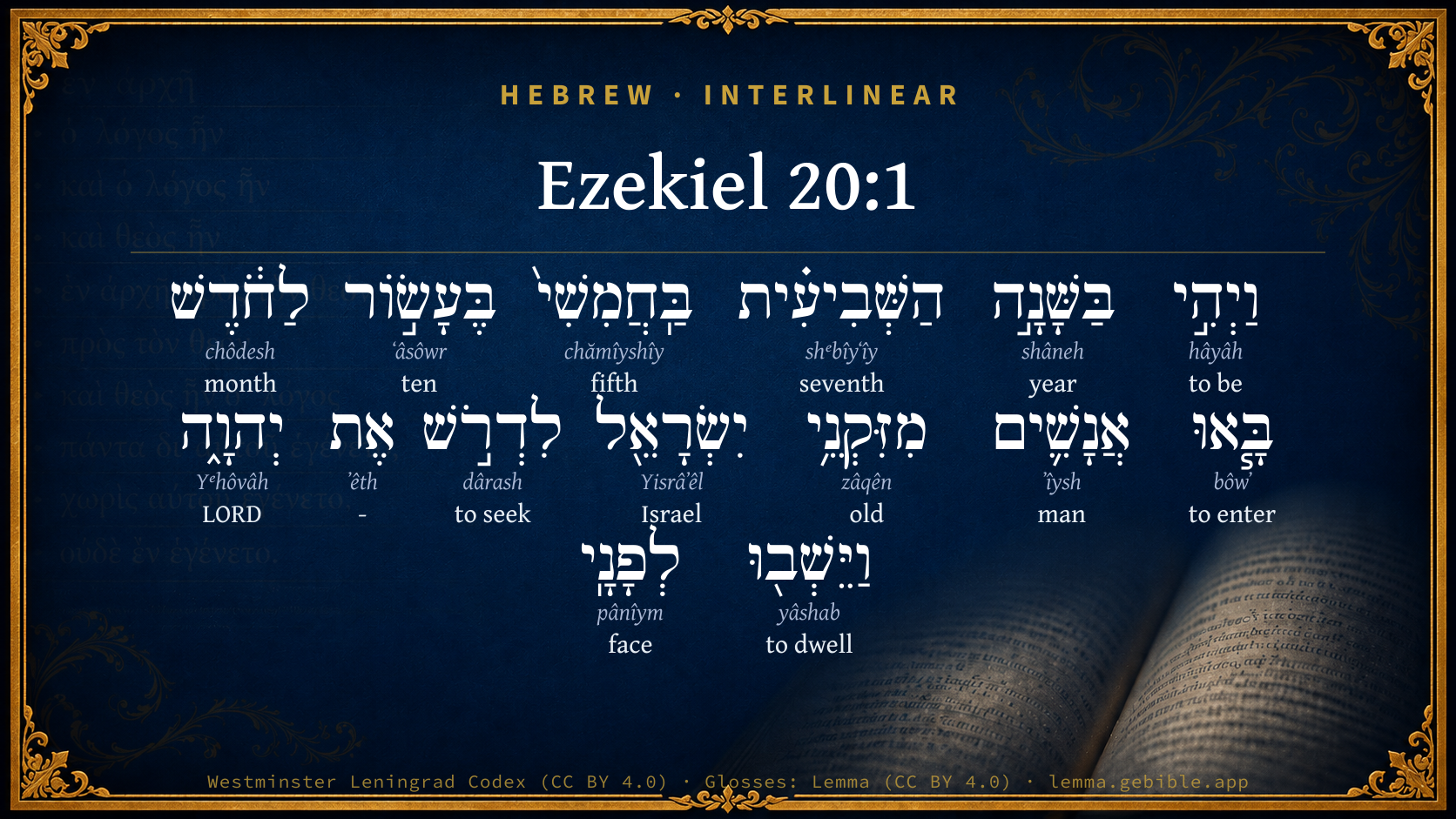
Ezekiel 20:1

Hebrew (Westminster Leningrad Codex) Ezekiel 20:1 appears in the Hebrew Old Testament. The text above is from the Westminster Leningrad Codex. Each word links to its Strong’s number, a concise gloss, and parsing drawn from the Open Scriptures Hebrew Bible morphology. Click any word for its full Brown-Driver-Briggs (BDB) entry.
Download image
Cite this verse

Ezekiel 20:1 (World English Bible). Public Domain. Lemma interlinear Bible study tool, https://lemma.gebible.app/v/ezekiel/20/1.

Show BibTeX & RIS
BibTeX
RIS
English Translation
It happened in the seventh year, in the fifth [month], the tenth [day] of the month, that certain of the elders of Israel came to inquire of Yahweh, and sat before me.
World English Bible · Public Domain
Download a study sheet

One document with this verse’s original text, its word-by-word gloss line, the meaning frame, cross-references with their text, attributed commentary, and full source and license credits — printable, and it pastes into notes with its structure intact.

This verse Autodidact and up

Study sheet (.html) Plain text (.txt)

A passage Seminary Student

Up to 50 verses in one chapter. A passage sheet keeps up to 6 commentary sources and 12 cross-references per verse, in the order this page ranks them, and says so on the sheet whenever that leaves anything out. Ask for a single verse and you get the Autodidact verse sheet above.

Everything on this page stays free to read, with no account — the sheet is a download of what is already on screen, not access to it.

Want to remove ads? Support Godless Engineer
Compare translations 3

The same verse in 3 English versions, stacked beneath the original-language interlinear above. Click any original word for its lexicon entry.

Each is an independent rendering of the whole verse — the interlinear is not word-aligned to these translations.

Highlighted words mark where these versions differ — a whole-verse word diff, not a word-by-word alignment.

  • World English Bible Public Domain
    It happened in the seventh year, in the fifth [month], the tenth [day] of the month, that certain of the elders of Israel came to inquire of Yahweh, and sat before me.
  • King James Version Public Domain
    And it came to pass in the seventh year, in the fifth month, the tenth day of the month, that certain of the elders of Israel came to enquire of the LORD, and sat before me.
  • unfoldingWord Literal Text CC BY-SA 4.0
    It came about in the seventh year, on the tenth day of the fifth month, that elders of Israel came to inquire of Yahweh and sat before me.

unfoldingWord Literal Text — © unfoldingWord, licensed CC BY-SA 4.0. Word-aligned USFM3 via Door43 (git.door43.org/unfoldingWord/en_ult).

Versions to compare (up to 4)

3 of 4 selected

Show all 18 translations

Every available English version of this verse, each an independent rendering of the whole verse.

  • World English Bible Public Domain
    It happened in the seventh year, in the fifth [month], the tenth [day] of the month, that certain of the elders of Israel came to inquire of Yahweh, and sat before me.
  • Berean Standard Bible Public Domain
    In the seventh year, on the tenth day of the fifth month, some of the elders of Israel came to inquire of the LORD, and they sat down before me.
  • Majority Standard Bible Public Domain
    In the seventh year, on the tenth day of the fifth month, some of the elders of Israel came to inquire of the LORD, and they sat down before me.
  • King James Version Public Domain
    And it came to pass in the seventh year, in the fifth month, the tenth day of the month, that certain of the elders of Israel came to enquire of the LORD, and sat before me.
  • American Standard Version (1901) Public Domain
    And it came to pass in the seventh year, in the fifth `month', the tenth `day' of the month, that certain of the elders of Israel came to inquire of Jehovah, and sat before me.
  • Revised Version (1885) Public Domain
    And it came to pass in the seventh year, in the fifth month, the tenth day of the month, that certain of the elders of Israel came to inquire of the LORD, and sat before me.
  • Geneva Bible (1599) Public Domain
    And in the seuenth yeere, in the fift moneth, the tenth day of the moneth, came certaine of the elders of Israel to enquire of the Lord, and sate before me.
  • Douay-Rheims (1899) Public Domain
    And it came to pass in the seventh year, in the fifth month, the tenth day of the month: there came men of the ancients of Israel to inquire of the Lord, and they sat before me.
  • Young's Literal Translation Public Domain
    And it cometh to pass, in the seventh year, in the fifth `month', in the tenth of the month, come in have certain of the elders of Israel to seek Jehovah, and they sit before me;
  • Literal Standard Version CC BY-SA 4.0
    And it comes to pass, in the seventh year, in the fifth [month], on the tenth of the month, men from [the] elderly of Israel have come in to seek YHWH, and they sit before me;
  • Unlocked Literal Bible CC BY-SA 4.0
    It came about in the seventh year, on the tenth day of the fifth month, that elders of Israel came to inquire of Yahweh and sat before me.
  • unfoldingWord Literal Text CC BY-SA 4.0
    It came about in the seventh year, on the tenth day of the fifth month, that elders of Israel came to inquire of Yahweh and sat before me.
  • Darby Bible Public Domain
    And it came to pass in the seventh year, in the fifth [month], the tenth of the month, [that] certain of the elders of Israel came to inquire of Jehovah, and they sat before me.
  • World Messianic Bible Public Domain
    In the seventh year, in the fifth month, the tenth day of the month, some of the elders of Israel came to inquire of the LORD, and sat before me.
  • Webster's Bible Public Domain
    And it came to pass in the seventh year, in the fifth month, the tenth day of the month, that certain of the elders of Israel came to inquire of the LORD, and sat before me.
  • Free Bible Version CC BY-SA 4.0
    On the tenth day of the fifth month of the seventh year, some of the elders of Israel came to ask advice from the Lord, and they sat down with me.
  • Bible in Basic English Public Domain
    Now it came about in the seventh year, in the fifth month, on the tenth day of the month, that certain of the responsible men of Israel came to get directions from the Lord and were seated before me.
  • JPS Tanakh (1917) Public Domain
    And it came to pass in the seventh year, in the fifth month, the tenth day of the month, that certain of the elders of Israel came to inquire of the LORD, and sat before me.

Literal Standard Version (2020), Covenant Press — licensed CC BY-SA 4.0. Text via the HelloAO Bible API (eBible.org). Unlocked Literal Bible (unfoldingWord) — licensed CC BY-SA 4.0. Text via the HelloAO Bible API (eBible.org). unfoldingWord Literal Text — © unfoldingWord, licensed CC BY-SA 4.0. Word-aligned USFM3 via Door43 (git.door43.org/unfoldingWord/en_ult). Free Bible Version, Dr. Jonathan Gallagher — licensed CC BY-SA 4.0. Text via the HelloAO Bible API (eBible.org).

Word by word

More ways to search: Search by grammar → Find every occurrence → Compare this word →

Practice this passage: Drill this verse → Learn its vocabulary →

בֶּעָשׂ֣וֹר
ʻâsôwr
H6218
“in/at the · ten”
Preposition, Determined + Noun, Common, Masculine, Singular, Absolute
Part of Speech
Preposition + Noun
Type
Common
Gender
Masculine
Number
Singular
State
Absolute
Full BDB Definition

Origin: from H6235

TWOT: 1711d

ten, decade - ten, tenth - ten-stringed, harp
  1. וַיְהִ֣י hâyâh H1961 “and · to be” Conjunction + Verb, Qal, Sequential Imperfect, 3rd Person, Masculine, Singular
  2. בַּשָּׁנָ֣ה shâneh H8141 “in/at the · year” Preposition, Determined + Noun, Common, Feminine, Singular, Absolute
  3. הַשְּׁבִיעִ֗ית shᵉbîyʻîy H7637 “the · seventh” Particle, Definite Article + Adjective, Ordinal number, Feminine, Singular, Absolute
  4. בַּֽחֲמִשִׁי֙ chămîyshîy H2549 “in/at the · fifth” Preposition, Determined + Adjective, Ordinal number, Masculine, Singular, Absolute
  5. לַחֹ֔דֶשׁ chôdesh H2320 “to/for the · month” Preposition, Determined + Noun, Common, Masculine, Singular, Absolute
  6. בָּ֧אוּ bôwʼ H935 “to enter” Verb, Qal, Perfect, 3rd Person, Common, Plural
  7. אֲנָשִׁ֛ים ʼîysh H376 “men” Noun, Common, Masculine, Plural, Absolute
  8. מִזִּקְנֵ֥י zâqên H2205 “from · old of” Preposition + Adjective, Adjective, Masculine, Plural, Construct
  9. יִשְׂרָאֵ֖ל Yisrâʼêl H3478 “Israel” Noun, Proper
  10. לִדְרֹ֣שׁ dârash H1875 “to seek” Preposition + Verb, Qal, Infinitive Construct
  11. אֶת ʼêth H853 “-” Particle, Direct Object
  12. יְהוָ֑ה Yᵉhôvâh H3068 “LORD” Noun, Proper
  13. וַיֵּשְׁב֖וּ yâshab H3427 “and · to dwell” Conjunction + Verb, Qal, Sequential Imperfect, 3rd Person, Masculine, Plural
  14. לְפָנָֽי pânîym H6440 “to/for · face(s) · my” Preposition + Noun, Common, Both, Plural, Construct + Suffix, Personal, 1st Person, Common, Singular

About this verse

These counts appear in no published source. They are computed here, from the morphology-tagged text and Lemma’s own curated glosses. What Lemma adds →

15
words
15
distinct lemmas
Prophets
section

Notable vocabulary

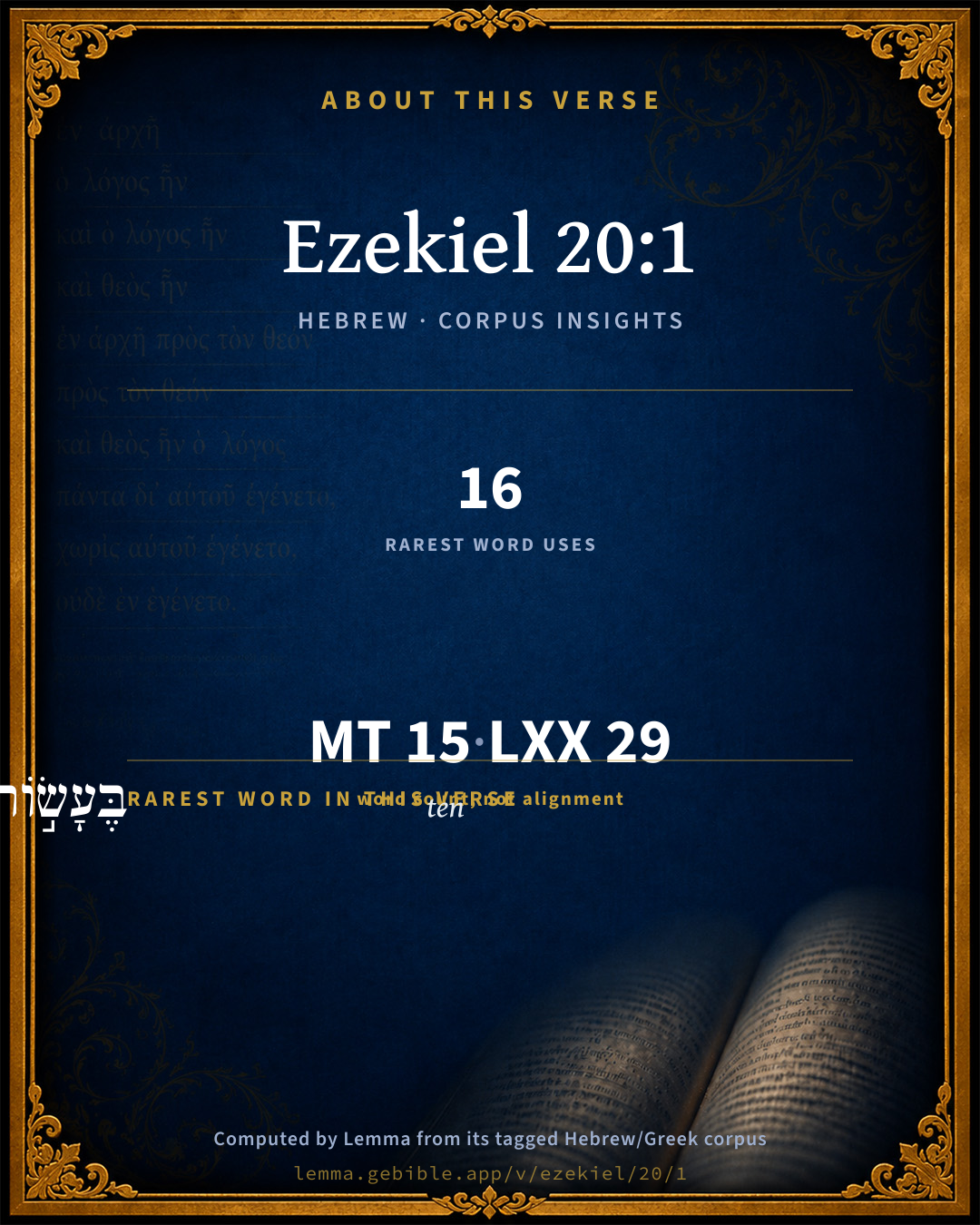
The rarest word here is בֶּעָשׂ֣וֹר ten H6218 — appearing just 16 times in the whole Hebrew Bible.

Shared distinctive vocabulary

בֶּעָשׂ֣וֹר ten H6218 occurs in 16 verses of the Hebrew Bible. Also found in:

Grammatical profile

  • 4 verbs
  • 7 nouns
  • 3 adjectives
  • 1 particle

Verb forms

  • וַיְהִ֣י Qal · Sequential Imperfect
  • בָּ֧אוּ Qal · Perfect
  • לִדְרֹ֣שׁ Qal · Infinitive Construct
  • וַיֵּשְׁב֖וּ Qal · Sequential Imperfect

Hebrew & Septuagint length

In English translation the verse runs 32 words from the Hebrew and 37 from the Septuagint (LXX English) — closely comparable.

A rough comparison of the two English renderings, which tokenize alike — not a word-level alignment.

Word counts can differ between the Hebrew and the Greek without any difference in meaning — e.g. the Hebrew direct-object marker אֵת has no separate Greek word, and Greek often adds the article ὁ.

In the original languages it is 15 Hebrew tokens and 29 Greek tokens — but the two are counted differently (Hebrew bundles its prefixes and suffixes into one token; the Greek is in lemma form), so that isn’t a like-for-like length.

Cross-references

23

Topical passages linked to Ezekiel 20:1 in the Treasury of Scripture Knowledge — connected by theme and wording, ordered by reader-vote popularity; previews shown in the World English Bible.

  • Ezekiel 8:1 It happened in the sixth year, in the sixth [month], in the fifth [day] of the month, as I sat in my house, and the elders of Judah sat before me, that the hand of the Lord Yahweh fell there on me.
  • Ezekiel 24:1 Again, in the ninth year, in the tenth month, in the tenth [day] of the month, the word of Yahweh came to me, saying,
  • Ezekiel 26:1 It happened in the eleventh year, in the first [day] of the month, that the word of Yahweh came to me, saying,
  • Ezekiel 29:1 In the tenth year, in the tenth [month], in the twelfth [day] of the month, the word of Yahweh came to me, saying,
  • Ezekiel 29:17 It came to pass in the seven and twentieth year, in the first [month], in the first [day] of the month, the word of Yahweh came to me, saying,
  • Ezekiel 30:20 It happened in the eleventh year, in the first [month], in the seventh [day] of the month, that the word of Yahweh came to me, saying,
  • Ezekiel 31:1 It happened in the eleventh year, in the third [month], in the first [day] of the month, that the word of Yahweh came to me, saying,
  • Ezekiel 32:1 It happened in the twelfth year, in the twelfth month, in the first [day] of the month, that the word of Yahweh came to me, saying,
  • Ezekiel 40:1 In the five and twentieth year of our captivity, in the beginning of the year, in the tenth [day] of the month, in the fourteenth year after that the city was struck, in the same day, the hand of Yahweh was on me, and he brought me there.
  • 1 Kings 14:2–6 Jeroboam said to his wife, Please get up and disguise yourself, that you not be known to be the wife of Jeroboam; and get you to Shiloh: behold, there is Ahijah the prophet, who spoke concerning me that I should be king over this people.
  • 1 Kings 22:15–28 When he was come to the king, the king said to him, Micaiah, shall we go to Ramoth-gilead to battle, or shall we forbear? He answered him, Go up and prosper; and Yahweh will deliver it into the hand of the king.
  • 2 Kings 3:13 Elisha said to the king of Israel, What have I to do with you? get you to the prophets of your father, and to the prophets of your mother. The king of Israel said to him, No; for Yahweh has called these three kings together to deliver them into the hand of Moab.
  • Isaiah 29:13 The Lord said, Because this people draw near [to me], and with their mouth and with their lips to honor me, but have removed their heart far from me, and their fear of me is a commandment of men which has been taught [them];
  • Isaiah 58:2 Yet they seek me daily, and delight to know my ways: as a nation that did righteousness, and didn't forsake the ordinance of their God, they ask of me righteous judgments; they delight to draw near to God.
  • Jeremiah 37:17 Then Zedekiah the king sent, and fetched him: and the king asked him secretly in his house, and said, Is there any word from Yahweh? Jeremiah said, There is. He said also, You shall be delivered into the hand of the king of Babylon.
  • Ezekiel 1:2 In the fifth [day] of the month, which was the fifth year of king Jehoiachin's captivity,
  • Ezekiel 14:1–3 Then came certain of the elders of Israel to me, and sat before me.
  • Ezekiel 33:30–33 As for you, son of man, the children of your people talk of you by the walls and in the doors of the houses, and speak one to another, everyone to his brother, saying, Please come and hear what is the word that comes forth from Yahweh.
  • Matthew 22:16 They sent their disciples to him, along with the Herodians, saying, "Teacher, we know that you are honest, and teach the way of God in truth, no matter who you teach, for you aren't partial to anyone.
  • Luke 2:46 It happened after three days they found him in the temple, sitting in the midst of the teachers, both listening to them, and asking them questions.
  • Luke 8:35 People went out to see what had happened. They came to Jesus, and found the man from whom the demons had gone out, sitting at Jesus' feet, clothed and in his right mind; and they were afraid.
  • Luke 10:39 She had a sister called Mary, who also sat at Jesus' feet, and heard his word.
  • Acts 22:3 "I am indeed a Jew, born in Tarsus of Cilicia, but brought up in this city at the feet of Gamaliel, instructed according to the strict manner of the law of our fathers, being zealous for God, even as you all are this day.

Cross-references courtesy of OpenBible.info (CC BY 4.0).

Hebrew and Greek witnesses Masoretic Hebrew ↔ Greek Septuagint

The same verse in the two great witnesses to the Old Testament, shown verse-for-verse.

These are two independent witnesses, not word-aligned to each other, and the Septuagint is shown in lemma (dictionary) form.

Hebrew Ezekiel 20:1 Masoretic · Westminster Leningrad Codex

וַיְהִ֣י בַּשָּׁנָ֣ה הַשְּׁבִיעִ֗ית בַּֽחֲמִשִׁי֙ בֶּעָשׂ֣וֹר לַחֹ֔דֶשׁ בָּ֧אוּ אֲנָשִׁ֛ים מִזִּקְנֵ֥י יִשְׂרָאֵ֖ל לִדְרֹ֣שׁ אֶת יְהוָ֑ה וַיֵּשְׁב֖וּ לְפָנָֽי

It happened in the seventh year, in the fifth [month], the tenth [day] of the month, that certain of the elders of Israel came to inquire of Yahweh, and sat before me.

World English Bible · Public Domain

Greek LXX Ezekiel 20:1 Septuagint · lemma form

καί γίγνομαι ἐν ὁ ἔτος ὁ ἕβδομος ἐν ὁ πέμπτος μήν δέκατος ὁ μήν ἔρχομαι ἀνήρ ἐκ ὁ πρεσβύτερος οἶκος ἰσραήλ ἐπιἐρωτάω ὁ κύριος καί καταἵζω πρό πρόσωπον ἐγώ

And it came to pass in the seventh year, on the fifteenth day of the month, there came men of the elders of the house of Israel to enquire of the Lord, and they sat before me.

LXX2012 (modern English Septuagint) · Public Domain

On this verse, Lange's Commentary on the Holy Scriptures discusses the Septuagint’s reading. Read the note in Commentary ↓

Hebrew: Westminster Leningrad Codex (CC BY 4.0). Greek: Septuagint (public domain); English from LXX2012 (modern English Septuagint) (Public Domain). How the Septuagint differs from the Hebrew →

Targum (Aramaic paraphrase)

1

The Targum is the ancient Jewish Aramaic paraphrase of the Hebrew Scriptures — an interpretive translation, not the Hebrew text itself. Onkelos (literal) and Pseudo-Jonathan (expansive) render the Torah, and Jonathan the Prophets. Coverage is partial: where no permissively-licensed English translation exists for a verse, only the Aramaic is shown. This is verse-level text, not a word-by-word alignment to the Hebrew.

  1. Targum Jonathan Prophets (Joshua–Malachi)
    וַהֲוָה בְשַׁתָּא שְׁבִיעֲתָא בְּחַמְשָׁא בְּעַסְרָא לְיַרְחָא אֲמַר נְבִיָא אֲתוֹ גַבְרִין מִסָבֵי יִשְׂרָאֵל לְמִתְבַּע אוּלְפַן מִן קֳדָם יְיָ וִיתִיבוּ קֳדָמַי:

    (no public-domain English translation for this verse)

    Targum Jonathan — Aramaic: “Mikraot Gedolot” (public domain). English: “Sefaria Community Translation” (CC0 1.0 (public-domain dedication)); “London "Chaldee Paraphrase," 1871” (public domain). Text via Sefaria.

Commentary

Notes on Ezekiel 20:1 from classic Christian and Jewish commentators (each source and its license shown beneath its notes). The classic Christian expositions comment on the surrounding passage and are grouped to its opening verse, so a note may address several verses; the Jewish commentaries on the Tanakh (Rashi and others) are per-verse, so they appear only where the commentator wrote on this verse.

Lemma curates 59 commentaries, every one of them public domain or Creative Commons licensed, each selected and text-cleaned for this edition rather than reprinted as found. About our sources →

Trapp's Complete Commentary

John Trapp

Eze 20:1 And it came to pass in the seventh year, in the fifth [month], the tenth [day] of the month, [that] certain of the elders of Israel came to enquire of the LORD, and sat before me.

Ver. 1. And it came to pass.] This chapter fitly followeth the former. There these malcontents had complained that the fathers had sinned and the children suffered. Here is evinced that there was never a better of them, that a viperous brood they had been from the first, that they were some of them naught all. {a}

In the seventh year,] scil., Of Jeconiah’s captivity: and every year seemed seven, till the seventy were expired. The years of our misery we reckon; not so of our prosperity, which yet we should duly prize and improve.

That certain of the elders of Israel.] Not Ananias, Azarias, and Misael, as the Jews fable: but worse men, rank hypocrites.

Came to inquire.] But were resolved of their course, and had made their conclusion before they came. {Eze 20:32} Either the prophet should chime in with the false prophets, who told them they should be sent home ere long, or else they would, for peace sake, worship idols and comport with the Babylonians; which yet, if they had done, it might have proved nothing better with them than it did with those renegade Christians in Turkey, who, falling down, many thousands of them, before Solyman II, and holding up the forefinger, as their manner is, in token of their conversion to Mohammedanism, he asked what moved them to turn? they replied, it was to be eased of their heavy taxations. He, disdaining that baseness, or not willing to lose in tribute for an unsound accession in religion, rejected their conversion, and doubled their taxations. {b}

{a} κακοι μεν θριπες, κακοι ηδε και ιπες. - Eras. Adag.

{b} Sir Henry Blunt’s Voy. into Levant p. 111.

John Trapp, A Commentary or Exposition upon All the Books of the Old and New Testament (1647–1656) — public domain. Text from a community e-Sword module.

The Biblical Illustrator

Joseph S. Exell

Eze_20:1-4

Certain of the elders . . . sat before me.

The elders before Ezekiel

1. True religion is emphatically a walking with God, not a mere occasional coming to Him. The precise manner in which the date is given may possibly be taken as conveying a reproof to those who, instead of making it their constant business to know Gods will, were contented to let a year elapse between two successive visits to the prophet.

2. The need of leaving our sins behind us when we come to inquire of God. The severe answer which the elders received was due chiefly to the fact that they canto without first repenting and bringing forth fruits worthy of repentance

3. Prayer, or indeed coming to God in any way, must not be made a mere matter of convenience, but must be regarded as a matter of constant spiritual necessity. These elders came when they thought it would answer their purpose; they forgot God when all went well, they sought Him when they were at their wits end; they did not look upon communion with God as the one great spiritual need of their souls. Were they singular in this? The habitual lives of nine out of ten persons in this Christian country would rise up and contradict us if we said that they were. I am not now contemplating the case of notoriously evil men, but only that of easy-going worldly persons who live without church, prayer, Scriptures, passing a quiet animal kind of life, with no cares except those of getting daily bread. These persons will, many of them, cry to the Lord in trouble; put them upon a sickbed, and they will say their prayers for the most part vigorously enough, and the prayers so offered up may possibly be the beginning of a more Christian life, yet I do not at all the less maintain that this is no right use of prayer, but a most egregious and unchristian abuse. (Bp. Harvey Goodwin.)

Cherished sin disqualifies for prayer

Manton says, Empty the bucket before you go to the fountain. Wise advice. If the pail be full of the best and cleanest water it is idle to carry it to the well, for its fulness disqualifies it for being a receiver. Those who think themselves full of grace are not likely to pray aright, for prayer is a beggars trade, and supposes the existence of need. What does a full bucket want with the well? Let it stay where it is. Fitness for mercy is not found in self-sufficiency, but in emptiness and want. He can and will receive most of the Lord who has least of his own. If the bucket is full of foul water, it is wise to throw it away as we go to the crystal spring. We must not come to the Lord with our minds full of vanity, lust, covetousness, and pride. If I regard iniquity in my heart, the Lord will not hear me. He will not make His grace the medium of floating our unclean desires. (C. H. Spurgeon.)

The Biblical Illustrator, edited by Joseph S. Exell (c. 1880s–1900s) — public domain. Text from a community e-Sword module.

Joseph Benson's Commentary

Eze 20:1-3. It came to pass in the seventh year, &c. — Namely, of Jehoiakim’s captivity. All the prophecies recorded from the eighth chapter to this, probably belong to the sixth year of that captivity. Certain of the elders came to inquire, &c. — Came to me, as the prophet of God, to inquire what would be the event of their affairs; when they might expect deliverance from their calamities, and by what means. I will not be inquired of by you — I will give you no information concerning the things about which you come to inquire: or, you shall not receive such an answer as you expect, but such as your hypocrisy deserves.

Joseph Benson's Commentary on the Old and New Testaments (1811–1818) — public domain. Text from a community e-Sword module.

Dummelow's Commentary on the Holy Bible

J. R. Dummelow

§ 5. A Final series of Prophecies on the necessity of Israel's Punishment and the Destruction of Jerusalem (Ezekiel 20-24)

Date, Aug.-Sept. 590 b.c. to Jan.-Feb. 587 b.c.

This group includes a warning to the exiles against idolatry (Eze_20:1-44), a description of the sword of the Lord directed against Jerusalem (Eze_20:45 to Eze_21:27), a short prophecy against the Ammonites, connected with the foregoing (Eze_21:28-32) an indictment of Jerusalem (Ezekiel 22), an allegorical history of the sins of Samaria and Jerusalem (Ezekiel 23), a fresh parable of the coming siege and destruction of Jerusalem (Eze_24:1-14), and an account of the death of Ezekiel's wife, and of his significant conduct in his bereavement (Eze_24:15-27).

History Repeating itself

Some four years before the fall of Jerusalem the elders of Tel-abib again came to consult Ezekiel, who declared that God had no answer to give them. The reason was that their enquiry was insincere, and this passage is consequently an illustration of the principle of Eze_14:3. The exiles were beginning to avow idolatrous tendencies (Eze_20:32), with which the elders were in secret sympathy. Ezekiel recounted how God had dealt with Israel's idolatrous spirit in the past, and announced that He would deal in the same way with those who still cherished it.

Israel had been idolatrous in Egypt and yet had been brought forth (Eze_20:5-12). Suecessive generations had been idolatrous in the wilderness, and of these the first had been shut out of the Promised Land, while the second had been brought into it under a warning of exile and dispersion should they continue unfaithful (Eze_20:13-26). They had not heeded the warning, but had adopted the worship of the Canaanites, and God's threat had now been fulfilled (Eze_20:27-29). In all this course of mercy and judgment God had 'wrought for His name's sake,' that His character might be truly known to Israel and to the world.

The present exiles were no better than their fathers. They too were resolving to be like the heathen (Eze_20:30-32). But God would frustrate their purpose. He would bring them also into a wilderness, and would deal with them there as He had dealt with those who came out of Egypt (Eze_20:33-36). The persistent sinners among them would not enter the land of Israel, but the others would again be brought into a covenant with God, and restored to their own country, where they would worship God acceptably in humble penitence (Eze_20:37-43). In all this God would act from the same great motive as before (Eze_20:44).

1. The seventh year.. the fifth month] July-August, 590 b.c.

5. Lifted up mine hand] i.e. sware, and so in Eze_20:6, Eze_20:15, Eze_20:23, Eze_20:42.

8. Ezekiel speaks more definitely than any other OT. writer about the idolatry of the Israelites in Egypt: see Eze_23:8.

9. For my name's sake] God's consistent motive was that His character should be known to the world. When He was patient with Israel it was because sudden judgment upon them would have been misunderstood by the heathen: see Eze_20:22.

11. Referring to the Law given at Sinai.

12. My sabbaths, to be a sign] Though Ezekiel attached great importance to the sabbath, he regarded it not as one of the moral ordinances, obedience to which brings life (Eze_20:11), but rather as a special sign of God's covenant which Israel was bound to observe.

15. The first generation in the wilderness was shut out of Canaan (Num_14:24-30; Psa_95:11).

23. The second generation was warned that unfaithfulness would be punished by captivity (Lev_26:33-34).

25. Statutes that were not good] The reference (as Eze_20:26 shows) is to the practice of child sacrifice, which might seem to be justified by such a law as that in Exo_22:29. The firstborn of men, however, were expressly excepted (Exo_13:12-13; Num_3:46-47) and Jeremiah declared that human sacrifice had never been commanded by God (Jer_7:31; Jer_19:5). God did not impose sinful laws, but some of His laws could be perverted by sinful men and made an excuse for their wrongdoing. Both the ambiguity of the Law and the blindness which led to the misunderstanding of it were the penalty for previous sin.

29. A play upon words, 'What (mah).. go (ba)?' Bamah is the Hebrew for 'high place,' and by this punning derivation of the word (not of course the true one) Ezekiel expresses his contempt for the thing itself.

32. God's zeal for His name is stronger even than the purpose of the human will to rebel.

34. People] RV 'peoples': so in Eze_20:35, Eze_20:41.

35. Wilderness of the people] the desert between Babylon and Palestine, corresponding to the desert between Egypt and Palestine which had been the scene of Israel's former discipline.

37. The rod] the shepherd's rod, used in counting the flock (Lev_27:32). The bond of the covenant] The old covenant made at Sinai will be renewed. Ezekiel does not contemplate such a difference between the past and the future as is expressed in Jeremiah's prophecy of the New Covenant (Jer_31:32).

38. Obstinate transgressors will perish in the wilderness like the first generation who came out of Egypt.

39. Pollute ye.. no more] RV 'My holy name shall ye profane no more.' Those who wished to choose idolatry might do so, but they would no longer have any connexion with God and His cause.

40. In the land, serve me] RV 'serve me in the land,' a promise of restoration.

44. When God does not deal with men as they deserve, it is for the sake of His own glory. This really means that His mercy is the highest aspect of His character, and that which He is most desirous to display to the world.

J. R. Dummelow, A Commentary on the Holy Bible (Macmillan, 1909) — public domain. Text from a community e-Sword module.

Whedon's Commentary on the Bible

Daniel D. Whedon

THE ELDERS OF ISRAEL AGAIN INQUIRE IN VAIN OF JEHOVAH, Eze_20:1-4. (Compare Eze_14:1-5.)

1. The date given shows that the inquiry from the elders came some four years before Jerusalem fell — August, 590 B.C.

Daniel D. Whedon (gen. ed.), Commentary on the Old and New Testaments (1874–1909) — public domain. Text from a community e-Sword module.

The Preacher's Complete Homiletical Commentary

Joseph S. Exell (gen. ed.)

THE PAST, PRESENT, AND FUTURE OF ISRAEL (Chap. 20.)

EXEGETICAL NOTES.—The date given in Eze_20:1 applies also to chap. 20–23. (compare chap. Eze_24:1). These four chapters are bound together by their contents into one group of connected words of God, and also by the threefold repetition of the expression, “wilt thou judge?” (chap. Eze_20:4; Eze_22:2; Eze_23:36). The prophet is appointed to judge the people, i.e., to make manifest their sin to them, and to predict the punishment. In Eze_20:1-4, we have the date, occasion, and subject of the prophetical discourse.

Eze_20:1. “In the seventh year, in the fifth month, the tenth day of the month.” There is a Jewish tradition that the tenth day of the fifth month was the day on which the “Sentence of Wandering” was passed (Num_14:29). It is remarkable that this was also the same day on which the Temple was burnt both by the Chaldeans (Jer_52:12-13), and according to the testimony of Josephus, by the Romans. This chapter (in which Numbers 14 is several times referred to) announces a new and a far heavier “Sentence of Wandering” (Eze_20:35-38). “If we compare the date given in Eze_20:1 with chap. Eze_8:1, we shall find that this word of God was uttered only eleven months and five days after the one in chap. 8.; two years, one month, and five days after the call of Ezekiel to be a prophet (chap. Eze_1:2); and two years and five months before the blockading of Jerusalem by the Chaldeans (chap. Eze_24:1). Consequently it falls almost in the middle of the first section of Ezekiel’s prophetic work.”—(Keil). “To enquire of the Lord.” Heb. “to seek Jehovah,” i.e., to ask, a revelation from Him.

Eze_20:3. “As I live, saith the Lord God, I will not be enquired of by you.” “The Lord’s answer is similar to that in chap. Eze_14:3. Instead of giving a revelation concerning the future, especially with regard to the termination of the penal sufferings, which the elders had, no doubt, come to solicit, the prophet is to judge them, i.e., as the following clause explains, not only in the passage before us, but also in chap. Eze_22:3, and Eze_23:36, to hold up before them the sins and abominations of Israel. It is in anticipation of the following picture of the apostacy of the nation from time immemorial that the sins of the fathers are mentioned here.”—(Keil). “No reply is given to the sinners, but chiding for their sins; and He adds the oath, ‘As I live,’ that the sentence of refusal may be all the stronger.”—(Jerome). When Saul “enquired of the Lord,” we are told that “the Lord answered him not” (1Sa_28:6).

Eze_20:4. “Wilt thou judge them, son of man wilt thou judge them?” The repeated question has the force of a command, yea, even implies that a necessity is laid upon the prophet to pronounce judgment. “The Hebrew word signifies, not merely to judge, but also frequently, as here, to conduct a cause before a tribunal by adducing or hearing such evidence as bears upon it, and shall lead to the delivery of a righteous sentence.” (Henderson.) “The question is repeated in the liveliness of emotion. It is a question of impatience, to which things go too slowly, and show how little right they have to look for grace, or expect a pleasing answer. The son of man cannot go soon enough for the Lord to the work of judgment and punishment for sin, which is here alone announced, and is to be executed in his name. Those who wish to have another answer, must repent beforehand. The summons to make known to them the sins of their fathers, points to this, that the evil is deep-seated, and a radical cure is to be desired, which can only be effected by a judgment of inflexible rigour.”—(Hengstenberg.) “Cause them to know the abominations of their fathers.” The evil which called for judgment had entered the very life of the nation. They inherited it like a disease—like a bad name. But the prophet not only mentions the sins of their fathers in order to show the magnitude of their guilt, but also that they might see how great was the patience and long-suffering of the Lord.

HOMILETICS

THE ELDERS BEFORE EZEKIEL

This is a very different result from that which we might have expected. We might have been inclined to say of the elders, that they could not have inquired of the Lord once, but they have learned wisdom from adversity, and they are come to enquire now. And so Ezekiel would also have said to these elders had they come in the right spirit and temper of mind; as penitents, with sorrow and contrition of heart, bemoaning their past obstinacy and rebellion, and beseeching God to receive their cries of earnest sorrow and their promises to do better things in the future. Had they so come they would have been well received. That prophet who was commissioned to say, “When the wicked man turneth away from his wickedness that he hath committed, and doeth that which is lawful and right he shall save his soul alive,” and again, “As I live, saith the Lord, I have no pleasure in the death of him that dieth,” and the like—the prophet who was charged with such messages as these could never have been commissioned to drive away with hard reproachful words any true penitent, who came to enquire of the Lord by him.

This is the point in which the elders failed. There is no evidence of their penitence. They came to enquire of the Lord without first repenting and bringing forth works meet for repentance. Look at Eze_20:35, and the great reason will be seen why the enquirers were rebuffed, “When ye offer your gifts, when ye make your sons to pass through the fire, ye pollute yourselves with all your idols, “even unto this day”—even to this day; you perceive that their sins were not events of the past, but things going on in full vigour up to this very time. It was in the midst of these unrepented sins that they were come to enquire of the Lord; “and shall I be enquired of by you, O house of Israel?”—so the verse continues—“As I live, saith the Lord God, I will not be enquired of by you.” Here you have the repetition of the words of the text. The prophet is then commissioned to make known the abominations of their fathers. He shows them that they were as guilty as their fathers, and more guilty, because they had more teaching, more experience, more examples. And yet without any repentance, they expect that they are to be permitted to enquire of the Lord acceptably, but no—God will not be mocked; He will hear the penitent, but not the self-satisfied sinner.

There was nothing harsh and unreasonable in the answer which Ezekiel gave to the elders. He did not send the hungry empty away, but only as God’s ambassador refused to answer those who would not leave their sins behind them when they entered into the Temple of God. These elders wished to make a mere convenience of the oracle of God. They might have enquired of God continually, but they did nothing of the kind. But when they found themselves in distress, and knew not which way to turn, then they presented themselves before God’s prophet. They were brought to enquire of God not by love, not by a sense of duty, not even by habit, but merely by a desire to find their way out of difficulties from which they were unable to discover any human means of escape.

We see, in the first place, that they were not hardly dealt with; and, secondly, that the whole story may be useful by way of parable to teach people how they must enquire of God if they would enquire aright. It is well that we should look into this matter carefully; for we are apt to give an unlimited interpretation to what we read of God’s mercy in hearing prayer, that we perhaps forget that there are very important limitations, and that a prayer may sometimes obtain no answer because there is something amiss in him who makes it. The parable of the Pharisee and the Publican is an instance. The Pharisee who went up to the Temple to pray was a very respectable elder apparently, something much more than respectable if we attend to his own account of himself,—yet this Pharisee received no answer, was not justified as the Gospel has it. God would not be enquired of by such. This is an instance of unsuccessful prayer. Let us consider what the true conditions of successful prayer are—

I. True religion is emphatically a walking with God. It is not a mere occasional coming to Him. A certain amount of reproach seems to be implied in the manner in which the day of the visit of the elders, is accurately set down; it was “in the seventh year, in the fifth month, the tenth day of the month.” These visits of the elders were few and far between, there was no danger of confounding one with another. In chap. 8, we read, that “in the sixth year, in the sixth month, in the fifth day of the month,” there was a similar visit to the prophet, and there appears to have been none between; so that nearly a year separated the one visit from the other. The precise manner in which the date is given may be taken as conveying a reproof to those who, instead of making it their constant business to know God’s will, were contented to let a year elapse between two successive visits to the prophet. Walking with God is the scripture phrase which well describes that constant nearness to God, that affinity of heart and affections, which the really religious man strives for. The notion of life, too, expresses the same thing. Religion is a life, by which word we intend to express, that it is not a series of irregular spasmodic efforts, not an enquiry of God now and then, not a coming to His prophet in the sixth year and the sixth month, and again in the seventh year and the fifth month, but an enquiry in all years and all months and all days, a habit of opening our hearts and consciences to Him, and of guiding our conduct by the answers which we are able to obtain.

II. We must leave our sins behind us when we come to enquire of God. The severe answer which the elders received was due to the fact that they came without first repenting. As a further illustration of this we find, that in their former visit, their presence at once brought upon the prophet a vision of the sins of the people. The prophet’s eyes wandered in spirit to Jerusalem, and there he saw all the abominations of the house of Israel; there were men offering their incense to idols, and saying, “The Lord seeth us not;” there were women weeping for Tammuz; worse than all, there were men bowing down in worship to the sun of the creation, not the Creator. These visions rose to Ezekiel’s prophetic eye when the elders came and sat before him; and because they contained precisely the explanation of all the misery under which the people groaned. The elders may come and sit before the prophet and bemoan their captivity, but of what profit will that be? That will not cure the disease. The disease is unrepented sin, and without a change here there can be no acceptance, no answer to prayer. Self-examination, earnest efforts to forsake the evil and to do the good, must ever be the preparations for successful inquiry of God. Prayer is not a thing which is at our command at any moment. Sinners can come to Christ, but they must leave their sins. John the Baptist came as the herald of Christ, and because he did so, his chief text was: “Repent ye, for the kingdom of heaven is at hand.” No other way is sure but this; nothing else can save us from the possibility of such a rebuke as that in the text, “As I live,” etc. The history brings before us this lesson also, that—

III. Prayer, or coming to God in any way, must not be made a mere matter of convenience, but must be regarded as a matter of constant spiritual necessity. These elders came when they thought it would answer their purpose. They forgot God when all went well, they sought Him when they were at their wit’s end; they did not look upon communion with God as the one great spiritual need of their souls. They were a type of the mass of mankind. Large numbers of our fellow creatures do live in utter neglect of God. They live without prayer, and without the Scriptures—passing a quiet, animal kind of life, with no cares except those of getting daily bread. And yet many of these persons will cry to the Lord in trouble; put them upon a sick-bed, and they will say their prayers, for the most part, vigorously enough. This is no right use of prayer, but a most unchristian abuse. It was never intended that man should be careless while in health, and religious in sickness; never intended that young men should be dissipated and only old men sober and chaste; never intended that the best of a Christian’s life and strength should be given to the world, the flesh, and the devil, and only the dross and refuse to Him who made him and redeemed him. Prayer was never intended to be made use of as a convenience when earthly aid fails, but to be the medium of communication with God. the means of gaining continual aid and daily blessing from Him. “Pray without ceasing” is the best text to enforce our duty. These did not “pray without ceasing.” It was but an occasional work, a remedy resorted to in the last extremity, a death-bed cry for help. If we were independent creatures and lived by our own strength and energy, then we might be content to make our approaches to Him rare and exceptional, and only necessary when called for by special circumstances. But what a false view would this be of our relation to Him in whom we live and move and have our being, who alone is able to help us, whom to know is life eternal! And how comforting, how satisfying is that view which represents God as a Father ever ready to bless us, and to whom, therefore, if we pray at all, we can scarcely fail to pray without ceasing!—(Goodwin’s “Parish Sermons.”)

Eze_20:1. It is enough to say merely that they came to inquire, for from the prophet’s mode of answering them we see that they made no inquiry as to deliverance and the way of salvation; they were troubled as to political things, the duration of the exile, the end of the Babylonish power, the issue of Zedekiah’s faithlessness. We, too, ask, Watchman, what of the night? rather than, How shall I find grace? Why are we so concerned about the future? It will be like our past. We should be deeply concerned on account of our past. In our approaches to God, humility and reverence should be combined with a strong and assured faith, which must acquiesce in the authority of the one God, and yet must not object to hear God speak through his servants. Summon thyself to the study of the prophets and apostles through whom God has spoken! God will be inquired of, but still more should His will, which is sufficiently known to us, be done. To call on God, and yet not to obey Him is an abomination in His sight. “He heareth not sinners” (Joh_9:31; Isa_1:15). Eze_20:2-3. God’s suggestive silence, and His more suggestive answer. God in the mouth, and idols in the heart, a most critical condition. God speaks not the smallest word of comfort to hypocrites. For hypocrites there is in the heart of God, and in the Holy Scriptures, no other counsel but to sincere repentance (Isa_55:7). Thus these elders were not in a condition to hear God’s word. God hides Himself from those who hear His word with their gaze fixed only on their idols. They have no part in God’s word.—(Lange).

(Eze_20:1.)

1. The Lord keeps an exact account of his people’s sufferings. Be the time long or short, He observes, “In the seventh year, fifth month, and tenth day;” that was of their captivity. The Lord forgot not how long they had been in Babylon, He notes how the time of their trouble passes. They were captives in Babylon, suffered hard things; but God took notice of the time, and how the years ran out. It is not said only that the woman had a spirit of infirmity, but the time is recorded also, she had it eighteen years (Luk_13:11). Also in Joh_5:5, not only the man and his infirmity is mentioned, but the time also how long, thirty-eight years. God tells the years, months, and days that His people endure adversity. Seventy years were determined that they should be in Babylon (Jer_29:10-11), and God gave them to see; He observed as well, yea, better than they, how they passed.

2. The time of men’s doing some things is specially noted by the Lord. The time of these elders coming to inquire of the Lord is recorded. See how the actions of Josiah are observed (2Ch_34:3). When Jeroboam feasted and sacrificed to the calves he had made, God took notice of the month and day (1Ki_12:32). When the persecution of the Church was, God took notice of it; “at that time” (Act_8:1).

3. Hypocrisy is a close sin, and is in those ofttimes we little think. It is found where it was not expected, “in the elders of Israel:” those who here came to Ezekiel, pretending piety, sat before him, as if they would hearken to whatsoever the Lord should say, and do it; yet they intended no such thing, but were resolved to go on in their own ways, and to be as the Babylonians and heathens (Eze_20:32), so that they might enjoy peace and safety. So those who came to Christ (Mat_22:16-18), they carried a foul business very smoothly. There are many who will be found hypocrites at last, who now frequent the assemblies and come to hear the word of God, but do it not.

4. To inquire and ask counsel of the prophets and man of God, is of ancient standing and warrantable. Their coming was not unlawful, but their coming sinfully. It was a frequent practice of old to consult with the prophets (1Sa_9:9; 1Ki_22:15; 2Ki_8:8; Jer_21:2; Jer_37:7); and their coming to them was coming to the Lord. What though, now there are no prophets nor apostles immediately inspired and infallible to consult withal, yet there are pastors and teachers with whom Christ hath promised to be to the end of the world.

5. The prophets were to give out the Lord’s mind in His name and words. “Speak unto the elders of Israel, and say, thus saith the Lord God.” He must not say, thus saith Ezekiel, but, “Thus saith the Lord.” That which is from the Lord hath a divine stamp upon it, a divine power in it; but that which is man’s is like himself, frail and feeble.

6. When men come to God or His ordinances with hypocritical hearts, they get nothing of Him. “Come ye to inquire of me? as I live, I will not be inquired of by you.” Job, speaking of a hypocrite, saith, “Will God hear his cry when trouble cometh upon him?” (Job_32:9). If men’s hearts be not upright, sincere, let them pray and cry in prayer, let them come to a prophet and ask counsel and wait, God respects them not, will not answer them. “The way of the Lord is strength to the upright” (Pro_10:29). What is the way of the Lord? Prayer, hearing of the word, asking counsel of His prophets and servants, are the ways of the Lord. In these He appears, is found, lets out strength; but it is when men are upright, not hypocritical.

7. Hypocrites may deceive the prophets and servants of God. Ezekiel thought that they were good men, and worthy of a better entertainment at the hands of God, but he was deceived. Simon Magus demeaned himself so that he begat a good esteem in the heart of Philip, and was admitted to baptism (Act_8:13). False apostles had got into the church at Ephesus, and had for a time gained too much upon the angel thereof (Rev_2:2).

7. Hypocrites are not to be pleaded for. “Wilt thou judge them, son of man, wilt thou judge them? God would not have the prophet to plead for or excuse them. Hypocrites are not always the greatest of sinners, but they are ever the worst of sinners. The devil is never more devil than when he transforms himself into an angel of light. The Jews were “a hypocritical nation” (Isa_10:6; Jer_7:9-10); and, therefore, God forbids Jeremiah to pray for them (Jer_14:11). And what if they should pray themselves? You have an answer in Job_13:16; God tells you that “an hypocrite shall not come before Him,” that is to have acceptance of His person, or hear any comfortable answer from Him.

9. The prophets and servants of God, when they are inquired of by men, must not proceed according to their desires, but they must wait for the mind of God and do answerably thereunto. “Wilt thou judge them, son of man? Cause them to know the abominations of their fathers?” They would have thee inquire of Me for them, but I will not be inquired of, they shall not have their desires. Go thy ways, lay before them the abominable things their fathers have done. Not the people’s desires, nor the prophet’s fancies, must be his direction, when he is to make answer to those that inquire; but the will of God made known by His word and Spirit.—(Greenhill.)

The Preacher's Complete Homiletical Commentary (gen. ed. Joseph S. Exell; Funk & Wagnalls, c. 1892) — public domain (pre-1929). A full-Bible homiletical/sermon-outline anthology covering 65 of 66 books (2 John is absent from the source module). Text from a community e-Sword module.

Keil & Delitzsch

C. F. Keil & F. Delitzsch

The date given in Eze 20:1 applies not only to Ezekiel 20, but also to Ezekiel 20-23 (compare Eze 24:1); the prophetic utterances in these four chapters being bound together into a group of connected words of God, both by their contents and by the threefold repetition of the expression, "wilt thou judge?" (vid., Eze 20:4; Eze 22:2, and Eze 23:36). The formula התשׁפּוט, which is only omitted from the threat of punishment contained in Ezekiel 21, indicates at the same time both the nature and design of these words of God. The prophet is to judge, i.e., to hold up before the people once more their sinful abominations, and to predict the consequent punishment. The circumstance which occasioned this is narrated in Eze 20:1-3. Men of the elders of Israel came to the prophet to inquire of the Lord. The occasion is therefore a similar one to that described in the previous group; for we have already been informed, in Eze 14:1, that elders had come to the prophet to hear God's word from him; but they had not gone so far as to inquire. Here, however (Ezekiel 20), they evidently address a question to the prophet, and through him to the Lord; though the nature of their inquiry is not given, and can only be gathered from the answer, which was given to them by the Lord through the prophet. The ground for the following words of God is therefore essentially the same as for those contained in Ezekiel 14-19; and this serves to explain the relation in which the two groups stand to each other, namely, that Ezekiel 20-24 simply contain a further expansion of the reproachful and threatening addresses of Ezekiel 14-19.

In Ezekiel 20 the prophet points out to the elders, in the form of a historical survey, how rebellious Israel had been towards the Lord from the very first, even in Egypt (Eze 20:5-9) and the desert (Eze 20:10-17 and Eze 20:18-26), both the older and the later generations, how they had sinned against the Lord their God through their idolatry, and how it was only for His own name's sake that the Lord had not destroyed them in His anger (Eze 20:27-31). And as Israel hath not given up idolatry even in Canaan, the Lord would not suffer Himself to be inquired of by the idolatrous generation, but would refine it by severe judgments among the nations (Eze 20:32-38), and sanctify it thereby into a people well-pleasing to Him, and would then gather it again out of the dispersion, and bring it into the land promised to the fathers, where it would serve Him with sacrifices and gifts upon His holy mountain (Eze 20:39-44). This word of God is therefore a more literal repetition of the allegorical description contained in Ezekiel 16.

Date, occasion, and theme of the discourse which follows. - Eze 20:1. And it came to pass in the seventh year, in the fifth (moon), on the tenth of the moon, there came men of the elders of Israel, to inquire of Jehovah, and sat down before me. Eze 20:2. Then the word of Jehovah came to me, saying, Eze 20:3. Son of man, speak to the elders of Israel, and say to them, Thus saith the Lord Jehovah, Have ye come to inquire of me? As I live, if I suffer myself to be inquired of by you, is the saying of the Lord Jehovah. Eze 20:4. Wilt thou judge them? Wilt thou judge, O son of man? Make known the abominations of their fathers to them. - If we compare the date given in Eze 20:1 with Eze 8:1, we shall find that this word of God was uttered only eleven months and five days after the one in Ezekiel 8; two years, one month, and five days after the call of Ezekiel to be a prophet (Eze 1:2); and two years and five months before the blockading of Jerusalem by the Chaldeans (Eze 24:1). Consequently it falls almost in the middle of the first section of Ezekiel's prophetic work. דּרשׁ את , to seek Jehovah, i.e., to ask a revelation from Him. The Lord's answer in Eze 20:3 is similar to that in Eze 14:3. Instead of giving a revelation concerning the future, especially with regard to the speedy termination of the penal sufferings, which the elders had, no doubt, come to solicit, the prophet is to judge them, i.e., as the following clause explains, not only in the passage before us, but also in Eze 22:3 and Eze 23:36, to hold up before them the sins and abominations of Israel. It is in anticipation of the following picture of the apostasy of the nation from time immemorial that the sins of the fathers are mentioned here. "No reply is given to the sinners, but chiding for their sins; and He adds the oath, 'as I live,' that the sentence of refusal may be all the stronger" (Jerome). The question התשׁפּוט, which is repeated with emotion, "gives expression to an impatient wish, that the thing could have been done already" (Hitzig). The interrogative form of address is therefore adopted simply as a more earnest mode of giving expression to the command to go and do the thing. Hence the literal explanation of the word התשׁפּוט is also appended in the form of an imperative (הודיעם). - The prophet is to revert to the sins of the fathers, not merely for the purpose of exhibiting the magnitude of the people's guilt, but also to hold up before the sinners themselves, the patience and long-suffering which have hitherto been displayed by the Lord.

Keil & Delitzsch — Biblical Commentary on the Old Testament (1861–1891) — public domain (CC PDM 1.0). Text via the HelloAO Bible API. (Old Testament only.)

Lange's Commentary on the Holy Scriptures

9. The Survey of the Leading of the People from of old (Ezekiel 20.)

1And it came to pass in the seventh year, in the fifth [month] on the tenth [day] of the month, that men of the elders of Israel came to enquire of 2Jehovah, and sat [down] before me. And the word of Jehovah came to me, saying: 3Son of man, speak to the elders of Israel, and say unto them, Thus saith the Lord Jehovah, Do ye come to enquire of Me? As I live, if I will be enquired of by you! Sentence of the Lord Jehovah. 4Wilt thou judges 5 them? Wilt thou judge, son of man? Make them to know the abominations of their fathers. And say to them, Thus saith the Lord Jehovah; In the day that I chose Israel, then I lifted up My hand to the seed of the house of Jacob, and made Myself known to them in the land of Egypt, and lifted up 6My hand to them, saying, I [am] Jehovah [am] your God. In that day I lifted up My hand to them, to bring them out of the land of Egypt, into the land which I had sought out for them, flowing with milk and honey,—which is a 7glory [ornament] to all lands. And I said to them, Cast ye away, every man, the abominations of his eyes, and defile not yourselves with the idols of 8Egypt. I, Jehovah your God. And they rebelled against Me, and would not hearken unto Me; they did not cast away every man the abominations of his eyes, nor forsake the idols of Egypt. And I said that I would pour out My fury upon them, that I would accomplish My anger in them, in the 9midst of the land of Egypt. And I wrought for My name’s sake, that it might not be polluted before the eyes of the heathen, among whom they were, in whose sight I made Myself known to them, to bring them out of the 10land of Egypt. And I led them out of the land of Egypt, and brought them into the wilderness. 11And I gave them My statutes, and made known to them 12My judgments, which, if a man do, he shall live in them. And I also gave them my Sabbaths, to be a sign between Me and them, so that it might be 13known [they knew] that I Jehovah do sanctify them. And the house of Israel rebelled against Me in the wilderness; they walked not in My statutes, and they despised [cast away] My judgments, which if a man do, he shall live in them, and they grievously profaned My sabbaths. And I said that I would 14pour out My fury upon them in the wilderness to destroy [uproot] them. And I wrought for My name’s sake, that it should not be polluted before the 15heathen, in whose sight I brought them out. And also I lifted up My hand to them in the wilderness, that I would not bring them into the land which I had given, flowing with milk and honey—which is a glory to all lands,—16Because they despised My judgments, and walked not in My statutes, and 17profaned My sabbaths, for their heart went after their idols. And [yet] Mine eye pitied, instead of destroying them, and I did not make an end of them in 18the wilderness. And I said to their sons in the wilderness, Ye shall not walk in your fathers’ statutes, nor observe their judgments, nor defile yourselves 19with their idols. I am Jehovah, your God; walk in My statutes and keep My judgments, and do them. 20And hallow My sabbaths, and they are for a sign between Me and you, that ye may know that I am Jehovah your God. 21And the sons rebelled against Me; they walked not in My statutes, and they kept not My judgments to do them, which if a man do, he shall live in them; they profaned My sabbaths; and I said that I would pour out My fury upon 22them, that I would accomplish My anger in them in the wilderness. And [yet] I turned My hand, and wrought for My name’s sake, that it should not 23be polluted before the heathen, in whose sight I brought them out. I also lifted up My hand to them in the wilderness, that I would scatter them 24among the heathen, and disperse them in the countries; Because they executed not My judgments, and despised My statutes, and profaned My 25sabbaths, and their eyes were after their fathers’ idols. And I also gave them statutes that were not good, and judgments in which they could not live; 26And I polluted them in their gifts, inasmuch as they caused all that openeth the womb to pass through, that I might desolate them, that they might know 27that I am Jehovah. Therefore speak to the house of Israel, son of man, and say to them, Thus saith the Lord Jehovah; In this again your fathers mocked 28[blasphemed] Me, in dealing faithlessly with Me. And I brought them into the land, which I lifted up My hand to give them, and they saw every high hill, and every thick [dark] tree, and there they offered their sacrifices, and gave there the provocation of their offering, and there they presented their 29sweet savours, and there they poured out their drink-offerings. And I said to them, What is the high place to which ye go? And its name was called 30“Bamah” to this day. Therefore say to the house of Israel, Thus saith the Lord Jehovah; In the way of your fathers do ye pollute yourselves, and do ye 31go wantonly after their abominations? And in the offering of your gifts, in making your sons to pass through the fire, do ye pollute yourselves according to all your idols to this day, and shall I be enquired of by you, O house of Israel? As I live,—sentence of the Lord Jehovah,—if I shall be enquired of by you! … 32And that which has come up in your mind shall not at all happen, that ye say, We shall be as the heathen, as the families of the countries, to serve wood and stone. 33As I live,—sentence of the Lord Jehovah,—if I shall not rule over you with strong hand, and with outstretched arm, and with fury poured out! … 34And I will lead you out from the peoples, and gather you out of the countries in which ye have been dispersed, with strong hand, and with outstretched arm, and with fury poured out, 35And I will bring you into 36the wilderness of the peoples, and contend with you there face to face. As I contended with your fathers in the wilderness of the land of Egypt, so will I contend with you,—sentence of the Lord Jehovah. 37And I will cause you to pass under the staff [sceptre], and bring you into the bond of the covenant. 38And I will purge [separate] out from among you the rebels, and the transgressors against Me; out of the land of their wanderings [strangerhood] will I lead them forth, and [yet] he [they] shall not come to the land of Israel, and ye shall 39know that I Jehovah. And ye, house of Israel, thus saith the Lord Jehovah,—Go, serve every one his idols. Yet afterwards,—if ye will not [now] hearken unto Me, ye shall not further pollute My holy name with [in] your offerings 40and with [in] your idols. For upon My holy mountain, upon the high mountain of Israel,—sentence of the Lord Jehovah,—there shall they serve Me, the whole house of Israel, the whole of it in the land; there will I accept them graciously, and there will I require your [heave] offerings, and the first-fruits 41of your oblations, with all your holy things. As a sweet savour will I accept you graciously, when I lead you out from the peoples, and gather you out of the countries, in which ye have been dispersed, and sanctify Myself in you before the eyes of the heathen. 42And ye shall know that I am Jehovah, when I bring you to the land of Israel, to the land which I lifted up My hand to give to your fathers. 43And there shall ye remember your ways, and all your doings, in [with] which ye have been defiled, and loathe yourselves in your own sight, for all your wicked things [evil deeds] which ye have done. 44And ye shall know that I am Jehovah, in My dealing with you for My name’s sake, not according to your wicked ways, and your corrupt doings, O house of Israel. Sentence of the Lord Jehovah.

Eze_20:3. Sept.: ... ζω ἐγω εἰ ἀποκριθησομαι ὑμιν... εἰ (4) ἐκδικησω αὐτους ἐκδικησει.—(Another reading, Ezekiel 3 : אל זקני.)

Eze_20:5. ... ὠφ ἡς ἡμετισς ἡρετισα... κ. ἐγνωρισθην τω σπερματι... κ. ἀντεγαβομην τη κειρι μου αὐτων—

Eze_20:12. The LXX add: Κ εἰτα προς τ. οἰκ. τ. ʼΙσρ ἐν τ. ἐρημωʼ ʼΕν τοι; προσταγμκσιν μου πορευεσθε κ. τ. δικαιωματα μου φυγασσετε του ποιειν αὐτα, ἁ τοιησει αὐτα ἀνθρωτος κ. ζησεται ἐν αὐτοις.

Eze_20:18. ... μη συικναμιγνυσθε κ. μη μικινεσθε.

Eze_20:22. Κ. οὐκ ἐποιησα, ὀπως το ὀνομα μου—

Eze_20:26. Κ. μιαινω αὐτους... ἐν τω διαπορευεσθαι με παν... ὁπως ἀφανισω αὐτους.—Vulg.: Et pollui … cum offerrent omne quod—

Eze_20:27. ... ʼΕως τουτου παρωργισαν με—

Eze_20:28. ... κ. ἐθυσαν ἐκει τοις θεοις αὐτων—

Eze_20:30. Sept.: Εἰ ἐν. τ. ἀνομιαις τ. πατερων ὑμων.—

Eze_20:31. κ. ἑν τ. ἀπαρχαις τ. ὸομκτων ὑμων κ. ἐν τ. ἀφορισμοις υἱων ὑμ. ἐν πυρι—(Another reading: בניכם ובנתיכם.)

Eze_20:32. κ. εἰ ἀναβησετα ἐπι τ. πνευμκ ὑμ. τουτο. Κ. οὐκ ἑωται ὁν τροπον ὑμεις λεγετε—

Eze_20:36. Another reading: אשפוט את׳. S pt., Vulg., Arabs: judicabo vos.

Eze_20:37. ... κ. εἰσαξω ὑμας ἐν ἀριθμω. (Targ. et versiones.)

Eze_20:38. Another reading: לא יבאו.

Eze_20:39. Sept.: ... ἑκαστος... ἑξαρατε, κ. μετα ταυτα εἰ μη ὑ μεις εἰσακουετε μου, κ. τ. ὀνομα—

Eze_20:40. ... ἐκει δουλευσουσιν μοι... εἰς τελος—

Eze_20:43. ... τ. ὁδους... κ. τ. ἐπιτηδευματα ὑμ. ἐν οἱς ἐμιαινεσθε.—Vulg.: … et displicebitis vobis in conspectu vestro—

Eze_20:44. ... ὁπως τ. ὀνομα μου μη βεβηλωθη κατα τ. ὁδους ὑμ.... κ. κατα τ. ἐπιτηδευματα ὑμ. τα διεφθαρμενα—

EXEGETICAL REMARKS

Eze_20:1-4. The Occasion and Theme of the Discourse

Eze_20:1. A date is prefixed to the occasion of the following prophetic discourse, which points us back to Ezekiel 8, and which at the same time applies to Ezekiel 21-23 [Klief. reckons 11 months 5 days since Eze_8:1; Ezekiel 2 years 1 month 5 days since Eze_1:2 (adhering to the captivity of king Jehoiachin): and 2 years 5 months before Eze_24:1.]—The parallel to Eze_14:1 is evident. There, indeed, we have אֵלַי ווַיָּבוֹא, and here only בָּאוּ. But they are called men of the elders of Israel in both places. That they were the same persons (Klief.) is questionable; probably not. Rather can they be considered as the successors of that deputation, and they may be distinguished from it by the fact that they mentioned the purpose of their visit, to inquire, etc., although what they asked is not stated, while the former deputation can be depicted as sitting before the prophet in speechless amazement. That a middle, a turning point in Ezekiel’s labours is indicated, as Klief. thinks, by the fact of a spirit of inquiry being excited in the minds of his hearers, is too much to draw from the words. Hengst. sees in the men “representatives, not of the totality of the exiles, but of the great mass of those only externally fearing God, while internally addicted to the spirit of the world and of the age,” as in Ezekiel 14, and conjectures a special occasion in a favourable turn which the affairs of the coalition had taken.(?) Owing to the interest felt in Judah and Jerusalem by all the exiles, nothing prevents us understanding here also, as in Ezekiel 14, envoys (if not elders themselves?) from the elders of the exiles of the ten tribes. As these had been so long in a state of exile, the existence of the elder-organization is the more intelligible. That the divine message of the prophet is addressed to the whole people, does not prevent its being coloured with a special regard to the ten tribes, as the details of our exposition may possibly show.

Eze_20:3. Comp. Eze_2:1; Eze_14:3.

Eze_20:4. The repeated question, Wilt thou, etc., is connected with the appearance of the men of Israel, who are thereby represented as if standing before a tribunal, but at the same time destitute of an advocate, and of any ground for self-justification. Hitzig rightly perceives in the repetition evidence of the emotion which the presence of unworthy persons had excited. “The form of a question makes apparent the impatient wish that the thing, should happen, and so includes a command.” Therefore the imperative: Make them to know the abominations, etc. The theme of the discourse is a review of the objective [leading], and over against that, the subjective [behaviour] conduct of the people from the days of old (Eze_22:2; Eze_23:36). The reference to the fathers points to an ancient and deep-rooted evil which demands a radical cure (Hengst., Calvin). Mat_23:32; Act_7:51; Eze_16:2.R

Eze_20:5-9. Israel in Egypt

Eze_20:5. בָּחַר with בְּ, as Israel is subjected to examination, so Israel remains the object of the divine election. “Choosing in the sense of divine, prevenient love and grace, Deu_7:6; Deu_14:2” (Häv.).—The lifting up of the hand, as the gesture of one making oath (Deu_32:40; Exo_6:8), assured and confirmed the choosing of Israel as the people of God (Deu_7:6; Deu_14:2) with reference to Canaan (Eze_20:6; Eze_20:15; Eze_20:28).—Israel is significantly interchanged with Jacob. The former points to the grace of their election to the position of Jehovah’s warriors; the latter points to their natural origin.—As interpreted by the clause: and made myself known, etc., the day was the period when Jehovah in point of fact revealed Himself to the people in Egypt as that which He had called Himself to Moses (Exo_3:14, etc.) by signs and wonders, as by an actual, renewed oath (therefore the very significant repetition of the lifting up of the hand).

Eze_20:6. A sort of conclusion. Once again, I lifted up, etc., and emphasizing of the day, in order to mark God’s solemn determination, as well as what had taken place. The imaginations of priests and vain sayings of the people are not the point in question. The object was “bringing out,” therefore freedom, redemption, which is described according to its issue and goal.—Sought out (comp. Num_10:33), ere ever they had spied it out.—Exo_3:8.—The לְ in לְבָל׳, either, datively, that all lands reckon it so; or with respect to or, above all lands (?).

Eze_20:7. The Sinaitic law also said this plainly, as it rested expressly upon the אֲנִי יְהוָֹה׳, Exo_20:2. But from the beginning the same was proclaimed by the fact of election, which involved a reciprocal obligation on the part of the people.

[“The very form given to the commission of Moses to go and vindicate the children of Israel for God, that they might come forth and serve Him, was itself a proof how much the worship of Jehovah had fallen into abeyance, and how generally the people had allowed themselves to sink into the prevailing idolatries. They must go out of the polluted region, where other lords, spiritual as well as temporal, have had dominion over them, that they may stand free to worship and serve Jehovah. And so the whole design and purport of the commission of Moses might be regarded as a protest against their connection with the abominations of Egypt, and a call not only to Pharaoh, to let the people go, but also to the people themselves, to come out and be separate, as a seed whom the Lord had chosen.”—P. F.—W. F.]

Of the eyes, not merely which the eyes see, but whereon they fix, with which they become familiar, etc.

Eze_20:8. Israel’s further rebelliousness in the wilderness would even justify a similar inference as to their behaviour in Egypt. Compare further Jos_24:14; Exo_32:3; Lev_17:7 (Psa_106:7).—And I said; not to them, nor to Moses, but to Myself. It corresponded to the character of God and the actual condition of the people. Comp. Exo_20:5; Exo_32:10.—Eze_7:8; Eze_5:13; Eze_6:12; and besides, Exo_5:3.

Eze_20:9. And I wrought, forms a contrast to: “and I said;” consequently the thing contrasted with what was said,—the object of the verb “wrought,”—which can be gathered from what follows, may also be assumed as known.—For My name’s sake, etc. (Psa_106:8); they were unworthy of it, had not merited it. But the revelation which I had given of Myself before the eyes of the heathen among whom they were was not to be desecrated before these same eyes, especially before the Egyptians, as if to wish well to My name were present with Me, but not the power of performance (regard being had at the same time to the heathen, as Israel was placed in a peculiar position in regard to humanity as a whole). Comp. Num_14:13 sq.; Exo_32:12 (Num_23:19).

Eze_20:10-24. Israel in the Wilderness. Eze_20:10-17, The First; 18–24, The Second Generation

Eze_20:10-17. The First Generation in the Wilderness

Eze_20:10. Transition from the foregoing to the following.

Eze_20:11. The giving of the law on Sinai, as introduction to the present leading of the people, after being brought out, Exodus 20. sq.—Statutes and judgments, as often, comprehending the general idea of the law. Live includes prosperity and blessedness, body and spiritual, temporal and eternal. Comp. Deu_4:1.—The law was given for life, Rom_7:10; Mat_19:17; Exo_20:12, etc. Which if a man do. The leading through the wilderness served to test them as to this. [Keil translates: “Which a man shall do in order to live through them.”]

Eze_20:12. Exo_20:8; Exo_31:13. A sign must denote something, so the Sabbath repeating itself (therefore the plural with each week’s close betokened the rest of God, into which the people of God are to enter after all their works, Hebrews 4. This is a common element to Jehovah and Israel on the ground of the covenant. As the Sabbaths of Jehovah are to be hallowed by Israel, and to be separated from the other days of the week, it would thereby be made evident that Jehovah sanctifies Israel, and separates them from the world-peoples to be His own peculiar people. This is the reciprocal relation of the Sabbath to Jehovah and Israel. Therefore the Sabbath was so characteristic for Israel.—As the prophetic sense of the law, and of the Sabbath-law in particular, reaches far beyond a formal, outward observance of it, so the prophet is speaking not of the mere letter of the law as a whole, nor in Eze_20:13 of merely external desecration of the Sabbath (Isa_58:13-14). Compare further Exo_16:27 sq.; Num_15:32 sq. Also Eze_5:6-7

Eze_20:11

Eze_20:8—With Eze_20:14 comp. Eze_20:9

Eze_20:15. And also = and even; for after the contrast to: “and I said,” in Eze_20:13 has been expressed in Eze_20:14 by: “and I wrought,” וְגַם׳ resumes the thread. The thought as to the destruction of the rebellious expressed itself even in the oath which excluded the first wilderness generation from Canaan; Num_14:11 sq.; Psa_95:11, etc. [Hengst. interprets וגם׳ of retribution; so they, and I also!]

Eze_20:6

Eze_20:17 carries out the idea of Eze_20:14 (Eze_16:5).—Eze_11:13. The sequel shows what is meant.

Eze_20:18-24. The Second Generation in the Wilderness

Eze_20:18. The contents of the fifth book of Moses belonged peculiarly to the sons (children)—the spared second generation in the wilderness. The fathers in question are represented in their constant disobedience to the laws which Jehovah gave (which even necessitated their repetition and renewal in Deuteronomy), as in some sort lawgivers according to their own ideas and on their own authority.

Eze_20:7

Eze_20:19. But!—Comp. Eze_20:11

Eze_20:20. Comp. Eze_20:12

Eze_20:21. Num_15:16-17

Eze_20:8; Eze_20:13

Eze_20:22. Contrast to Eze_20:21; Num_16:21 sq., Eze_17:9 sq.

Eze_20:14; Eze_20:9

Eze_20:23. I also, as in Eze_20:15, here in relation to Eze_20:21—Eze_12:15; Eze_6:8. The threatening with exile, Deu_28:30; Lev_26:33 sq.; and as an oath, Deu_29:13; Deu_29:18.

Eze_20:24. As Eze_20:16.

Eze_20:25-31. Israel in Canaan. Eze_20:25-29. The Fathers. Eze_20:30-31. The People of the Present

Eze_20:25-29. The Fathers in Canaan

Eze_20:25. Transition, linked to the foregoing with וְגַם׳, as in Eze_20:23 גַּם׳ hinted at what succeeds. The threat of exile, the fulfilment of which had begun in the people of the present, could be denounced against the second generation in the wilderness, because they were brought into Canaan, and along with the following generations, in so far as they could come into account as “your fathers” (Eze_20:27), they are set over against the existing people. The second generation, in the wilderness was therefore the medium of transition to, and at the same time became, Israel in Canaan. Therefore, although it was not executed against the second generation in the wilderness, the threat of exile remains in its original force and form. The reference to Canaan, which Eze_20:28 formally makes, determines the peculiar forms of expression in Eze_20:25-26. Such a progress in sin is made, that at last God makes sin its own punishment. Thus

Eze_20:7. They are warned against idolatry in Egypt, which is followed up in Eze_20:11 sq. by the Sinaitic legislation in the wilderness.—In Eze_20:18 sq., over against their own law-making, of which the first generation was guilty, there is the renewal of the Sinaitic law with reference to Canaan, but even already under the threat of exile (Eze_20:23). Finally—in Canaan as a beginning of the judgment of God, there were given to Israel for chastisement the wicked statutes and the death-bringing judgments of Canaan. Because they would not have My good law, I gave them Canaan’s law, which is not good, etc. Thus the force of: I gave, etc., is to be maintained, and by no means to be weakened to permission or any similar idea, as Jewish and Christian interpreters wish.—Not good is sufficiently explained by לָהֶם going before, and by the parallel לאֹ יִתְיוּ׳.

Eze_20:26 shows clearly what sort of “statutes” and “judgments” are meant, from the result which they produced, more precisely describing: “I gave,” as: I polluted them. The pollution of Israel was very notably exhibited in that which they did with their first-born male children, who in virtue of Exo_13:12-13 required to be redeemed. This ordinance, according to the connection in Exodus 13, being characteristically associated with the redemption of the people from Egypt, the allusion in our verse is most significant. Comp. also Exo_13:11, which introduces the statute in question. As a guide to the understanding of לַיהוָֹה ,בְּהַעֲבִיר, which is associated with הַעֲבַרְתָּ in Exodus 13, is here omitted, and בָּאֵשׁ is added in Eze_20:31, so that the Canaanitish Moloch - worship is undoubtedly meant. (Lev_18:21, comp. Eze_20:3; Deu_18:10; Deu_18:9) Comp. Eze_16:21. So the life, the continuous life which the people of Israel should have enjoyed in their sons, became its opposite, death. How could these be good statutes! [Cocceius also connects הַעֲבַרְתָּ with Exo_13:12, and understands the pollution of Israel as a declaration of the uncleanness of the people (Häv., on account of the heathenish turn which had been given to the law), since Aaron and the Levites had been installed by Jehovah in the sacred office instead of the first-born, Num_3:45!] Comp. as to the whole, Rom_1:24 sq.; Act_7:42; 2Th_2:11.—As to the “desolation,” comp. Eze_14:8. Others render it: to be benumbed, shocked, so that if possible they might be brought to reflection from what was so abhorrent to parental feeling. According to our rendering of the word, preparation is here made for the idea of the wilderness, which is afterwards so prominent in the chapter: they came to resemble a wilderness people even before they were brought into the wilderness of the peoples (Eze_20:35).

Eze_20:27. The people of the present are addressed, although the matter itself still concerns the fathers in Canaan. Eze_20:30 sq. will define more precisely the meaning of this address.—In this again (Eze_16:29), besides what was formerly adduced. The thing meant is first of all indicated more generally as mockery and faithlessness (Eze_15:8; Eze_14:13), and is then in Eze_20:28 stated more in detail. Comp. with Eze_6:13; Eze_16:16.—כַּעַס׳ refers to the forementioned mockery, whereby they aroused the displeasure and wrath of Jehovah (Deu_32:16; Deu_32:21); רֵיחַ׳ (comp. Eze_6:13; Eze_16:19) to the faithlessness which could present sweet savours of various kinds to idols.

Eze_20:29. And I said, etc. By the question there is recalled to mind God’s ever-repeated opposition to and condemnation of the worship of the high places (therefore the collective singular: הַבָּמָה, in contrast to the one sanctuary—the temple), with all that He had said against it. [Häv. adopts the explanation of Kimchi, who refers it to the high place at Gibeon, 1Ki_3:4; 2Ch_1:3.]—וַיִּקָּרֵא, the thing itself, as well as its name, continued to this day.

Eze_20:30-31. The People of the Present

Eze_20:30. לָכֵן, resuming the strain of Eze_20:27, and substituting אֱמֹר for דַּבֵּר, directly addresses the people of the present, i.e. the inquirers of Israel who had come to the prophet in the interest of those who still remained in Canaan.

Eze_20:31. The note struck in the question of Eze_20:29 is still maintained, not merely to express astonishment, but still more to compel self-reflection. I ask what further communication you would have?—Comp. Eze_7:20.—Eze_6:9.

Eze_20:26.—Comp. Eze_14:3.

Eze_20:32-44. Prophetic Survey of the yet Future Dealing with the People. Eze_20:32-38. In Judgment. Eze_20:39-44. In Mercy

Eze_20:32-38. The Impending Judgment

Eze_20:32. Transition to what follows.—Comp. Eze_14:3; Eze_11:5.—However much the people had become like the heathen, yet they were not to become heathen, which the inquirers of Eze_20:1 may have said to themselves, with a feeling of satisfaction or of despair, Deu_4:28; Deu_28:36; Deu_28:64. Such was not to be the end of the people of God. But Jehovah will manifest Himself to them as their King.

Eze_20:33. Backward glance at His mighty, royal dealing in former times, when they were redeemed from Egypt (Deu_4:34; Exo_6:6, etc). Comp. Eze_6:14. But it is immediately added, in order to point to retributive judgment (see Exo_6:6): and with fury poured out, which is repeated in Eze_20:34 in connection with the “leading out,” and “gathering,” by which the aforesaid (Eze_20:33) royal authority will also manifest itself, so that these too must be regarded as acts of divine judgment. A future leading into Canaan (against which see also Eze_20:35), after the conversion of all Israel, is thereby strictly excluded. But: out from the peoples, and: out of the countries, when rightly taken, namely, in contrast to: “into the wilderness of the peoples,” by no means excludes a reference to the existing Babylonish captivity. That Israel was then dispersed in one land only, and among one people (Klief., Keil), is not in the least to the point, when the empire of the king of Babylon could be described in such a manner as, e.g., in Jer_27:5 sq.! The exile, says Jehovah, the King whose supreme power they were to experience, shall not be mere dispersion among “peoples” and in “countries” (different from the fatherland, Canaan), where the external relations of life may be to some extent of an agreeable character, as was the case (see Introd). I will lead you thence and conduct you into another exile, for

Eze_20:35—I will bring you into the wilderness of the peoples,—an expression whose deepest interpretation is immediately added, viz.: and contend with you, etc.; a change of condition is meant—an intensifying of exile to “a wilderness of the peoples,” which must be taken figuratively (comp. Hos_2:16), like the leading out and gathering of the previous verse, and the “wilderness” in Eze_19:13. (Häv. compares Eze_6:14.) In the form of the word, the previous expressions (Eze_20:34): “countries,” and: “peoples,” coalesce. As “the bringing into” corresponds to: “the leading out,” so Jehovah’s “contending” corresponds to the “gathering.” The “dispersion” becomes a gathering face to face, i.e., person opposite person—the people opposite the King who contends with them. In such a connection the idea of Hitzig and others is weak. They refer the expression to the great wilderness which separates Babylon from the lands on the shore of the Mediterranean, which lay in the way of the exiles who ultimately returned. It is almost analogous to the word “world” in the New Testament. Although Keil explains the “leading out,” etc. of Eze_20:34 as neither local nor material, yet we do not understand it with him “of a spiritual separation from the heathen world” (to which they are immediately brought, Eze_20:35), “lest they should be absorbed in it,” etc., but of an aggravation of their exiled condition, a spiritual experience of it, so that they should know and feel that they as the people of God were once more in the wilderness, but not at all in the same sense as before (Deu_8:15; Deu_32:10). [Cocceius with perfect right here points still farther forward to the Roman period.] The future “contending” (comp. Eze_17:20) is compared in Eze_20:36 to a former contention with their fathers in the wilderness of the land of Egypt. As the fathers, according to Eze_20:27, are the second generation, which reached Canaan from the wilderness, the “contending” with them is to be referred not to Num_14:28 sq., but rather to such judicial scenes as Num_17:5-6; Num_17:10. The Babylonish exile was formerly called “wilderness of the peoples,” in relation to the “peoples” from among whom Israel (Eze_20:34) was to be led thither; in like manner the Arabian wilderness, to which the expression “wilderness of the peoples” alludes, is called the wilderness of the land of Egypt, because the people had been led out into it from Egypt. They were not led thither as a punishment, although on account of their disobedience it often became a place of punishment; but the divine intention was to try them (to prove, Deu_8:2 sq.), from which resulted separation of individuals, purification, which was so strongly urged upon them in reference to Egypt, whither they were always looking back (Num_20:5; Num_21:5). While, therefore, the “contending” of Eze_20:36 also includes chastisement, yet in the application of it to the future, Eze_20:37, the idea of the separation—the purification of the people through divine chastisement is the prevailing one. The judgments which God brought on Israel (Num_16:17; Num_16:20, affecting even Moses and Aaron!) were only purifying separations. The question is not that of a possible re-entrance into Canaan, so that, with reference to this result, the future guidance of Israel is represented as a repetition of their former guidance (Keil), nor with Neteler can we understand by: “the wilderness of the peoples,” Palestine (?); but Eze_20:33 as well as Eze_20:36 point back to Egypt, to the exodus thence, which Keil also on the other hand admits. [Hengst. supposes that the part taken by the exiles in the political intrigues of the home country brought upon them also severe sufferings (Jer_29:21-22); but that by true repentance many may have been freed from participation in the punishment here threatened!!] They shall go out of the state of exile (Eze_20:38), but this going out shall be a passing under the staff (the “contending,” in Eze_20:35 sq., is here viewed in a new way). The underlying figure is that of the shepherd (Lev_27:32; Mic_7:14; Jer_33:13), under whose staff the sheep were required to go individually in order to be inspected and numbered (Hitz.); but its application is here to be understood of the royal sceptre of Jehovah, agreeably to the expression: “rule over,” in Eze_20:33. Comp. further Exo_13:12; 1Sa_16:8. The meaning of the figurative expression is neither subjection to the government of God (Hengst.), nor a special guardianship of God (Keil), nor anything similar, but choice, with a very narrow inspection of individuals, the idea distinctly expressed in Eze_20:38 as to separation and purification being the prominent one. The result intended by this royal inspection, as the parallel sentence: and bring you, etc., brings out more fully, alludes to the giving of the covenant-law at Sinai after the passage of the Red Sea (comp. Exo_14:16). Under the bond (קָסֹרֶת, contr. for קָאֲסֹרֶת, from the root אָסַר) is a much preferable rendering to: under “the discipline (יָסַר?) of the covenant,” whether the penalties of the covenant only, or its promises also, be thought of. The law, which must not be conceived of apart from its promises and penalties, and which may be either a bond of love or an oppressive chain according to one’s personality, became, from the fact of men turning to it and observing its statutes, a medium of separation between heathenism and Judaism, and also between the people themselves. The extent to which this was the case is shown especially by the history of Pharisaism since the exile, both on its bright and its shady side.

Eze_20:38 now states explicitly what end is contemplated by the impending leading forth of the people in judgment. Hävern. notes a paronomasia in וּבָרוֹתִי and הַבְּרִית.—Comp. Eze_2:3.—Land of their wanderings, i.e. wherein they were strangers, Canaan is elsewhere called, Gen_36:7; Exo_6:4. Here, with a fine antithesis, it is the land of their exile.—לאֹ יָבוֹא, Hengst.: “the rebels are here collected into one ideal person.” Keil, who understands the “leading forth” as an utter sweeping of them away, takes the singular in a distributive sense: not one of the transgressors shall enter in. It accords better with the context to regard: I will lead them forth, as containing a retrospective reference to Eze_20:34, so that the rebels and transgressors in the close of the paragraph are again taken together with the whole people. Yet not to the land of Israel, would then say negatively what the “wilderness of the peoples” in Eze_20:35 said positively, consequently that Jehovah will enter into judgment with them all (Eze_20:35). The singular subject to לאֹ יָבוֹא can therefore from אַדְמַת יִשְׂרָאֵל be Israel. (Possibly even, with an eye to the inquirers of Eze_20:1, with a reference to the always doubtful question of the return of the ten tribes!?) With: and ye shall know, etc., the message is again directed to the persons who spoke to the prophet; if not to Israel in a special sense, at least to Israel in general.

Eze_20:39-44. The Promised Mercy of God

Eze_20:39. Since judgment, as has been stated, approaches the house of Israel, every man who will not do otherwise may be commanded to go and serve his idols. The impending judgment will make a separation, and the future will belong to the people of God. Comp. Rev_22:11. The holy irony of Him who knows that mercy is laid up for the future.—וְאַחַר is not to be translated: “also afterwards,” and coupled with serve, nor yet can it be joined with what follows imperatively, but it stands by itself, as if with a—.אִס־ can be simply a conditional particle: if ye will not hearken (in the present) unto Me, then (וְ takes up וְאַחַר again) ye shall not farther, etc. The majority of expositors take it as a particle of swearing, introducing with the negative (אין, with Part) an affirmative sentence, so that the sense would be: and afterwards ye will surely hearken unto Me, and ye will no longer profane My holy name, etc. (comp. Eze_36:20).

Eze_20:40. The positive ground. Comp. Psa_2:6, and Eze_17:23.—They shall serve Me, in contrast to: “serve . … idols,” Eze_20:39.—בָּל׳, and again כֻּלֹּה׳, point to the healing of the breach between Judah and Israel. Comp. also Eze_11:15. The emphatically repeated: there, just as in the contrasted Eze_20:38, remains within the horizon of the Old Testament (comp. the New Testament expansion, Joh_4:20 sq.), as the form and clothing of the thought in the rest of the verse maintains the phraseology of the Old Testament worship.

Eze_20:41. The previous steps are now recapitulated. Through the leading out and gathering already brought into view in Eze_20:34, the people, purified by judgment, shall be acceptable to Jehovah as a sweet savour (comp. Eze_6:13), and in them as a holy people, anew consecrated to God, shall be exhibited to the heathen the holiness of Jehovah.

Eze_20:42. But then shall they also, as was assumed in Eze_20:40 (“in the land”), return to the land of Israel (Eze_20:38).

Eze_20:43 finally adds a portrait of the inner condition of the people—the complement to Eze_20:40. Comp. Eze_6:9; Eze_14:22-23 (Eze_16:61).

Eze_20:44. Conclusion. The knowledge of Jehovah from an experience of His gracious dealings with them for His name’s sake (comp. Eze_20:9; Eze_20:14).

DOCTRINAL REFLECTIONS

1. The prophet may judge (Eze_20:4), for Jehovah will manifest Himself as King to His people. Prophetic activity in interpreting and applying the divine law was always based on the royal might of God in relation to Israel.

2. The exile was a political and a religious question of the day. The former might easily be confounded with the latter. Therefore in the chapter before us the history of the people is simply opened up, and the exile is exhibited to their conscience as the righteous result of their own conduct.

3. The experience which succeeded to Egypt was the wandering in the wilderness, where the people were purified. The exile which followed Canaan was designed by God to accomplish a similar result, only deeper and more essential in its character, as an ever-increasing corruption had fastened upon Israel’s inner being. If, therefore, the wilderness of Egypt was especially an external experience, and the testing came from without, the exile was to be more decidedly an internal exile—a wilderness of the peoples—to the people of God, in order to give them a felt experience of the “world,” and of “anguish” in the world.

4. Since the still existing kingdom of Judah, and the people as a whole, were to be upbraided with sin, the kingdom of Israel, which had already sunk into the condition of exile, supplied the most appropriate materials for colouring the accusation. It had from the beginning adopted the way of the heathen, and maintained it almost without interruption. Because it had become like the heathen, it at last fell completely under the dominion of the heathen. And thus there was at hand a course pursued up to the point of judgment, from which a demonstrative argument could be deduced.

5. Already, with their self-willed abandonment of the sanctuary at Jerusalem, but above all with their enforced removal from the Holy Land, the kingdom of Israel became the “Diaspora,” instar omnium, the “dispersed among the Gentiles,” and “scattered in the countries.”

6. That which the history of the people testifies regarding their conduct is stated in the ever-repeated refrain of our chapter: “and they rebelled against Me,” etc. (Eze_20:8; Eze_20:13; Eze_20:21). God’s leading (the objective in opposition to the subjective conduct just mentioned) shows itself throughout, on the other hand, as law according to Eze_20:37, i.e. as a judicial statement (Eze_20:7), as a formal enunciation of law (Eze_20:11 sq.), as a recapitulation of the law which had been given (Eze_20:18 sq.). Therewith threatening is connected (Eze_20:8; Eze_20:13; Eze_20:21, also 33 sq., 38). God’s threat strengthens itself to an oath (Eze_20:15; Eze_20:23; Eze_20:31; Eze_20:33), had even been fulfilled as punishment (Eze_20:15; Eze_20:23; Eze_20:25 sq.), and still remains to be similarly fulfilled (Eze_20:34 sq., 38). But the patience and long-suffering of God (Eze_20:9 sq., 14, 22, 28), His mercy (Eze_20:17), walk side by side with the law from the beginning to the end; and just as life was promised to the people in the law itself (vers.11 sq., 21), so mercy promises the ultimate purification of the people (Eze_20:32; Eze_20:35; Eze_20:37-38), so as to make them a sanctified “all” Israel, well-pleasing to God (Eze_20:39 sq.). As Ewald expresses it: “In order to bring the redeemed to a proper recognition of their former great transgressions, and thus to confirm the other and still greater truth which lies in the ancient history, namely, that in the end, grace is still the deepest and the all-surviving element in Jehovah.”

7. “I am Jehovah, your God.”—On this the law is based, and this underlies the whole history of the people from the beginning to the end. (Eze_20:5; Eze_20:7; Eze_20:9; Eze_20:14; Eze_20:19-20; Eze_20:22; Eze_20:44.) The history of God’s people is the evolution of the name of Jehovah, the people of God being in regard to it after the flesh, what the Son of God was after the Spirit.

8. “Not the old race, adhering to idolatry, but a race spiritually new, devoted to Jehovah in profound love and dependence, was to leave Egypt” (Häv.).

9. The divine discourse of the prophet does not draw its materials from tradition apart from the Pentateuch, as from very different standpoints has been assumed by a Vitringa and a Vatke, in order to explain what the prophet states as to the condition of Israel in Egypt. Criticism would fain show therein a conflict between Ezekiel and the Pentateuch. But the evident dependence of the prophetic statements on the Pentateuch is made prominent throughout, and here also in Ezekiel 20. We note, besides what has been brought out in our exegesis, that the spirit of the prophets knew how to read “between the lines” of the history, while criticism attempts, at the most, to import its own spirit into the Holy Scriptures.

10. For the theological understanding of the chapter, the emphatic reiteration of the expression “wilderness” is important. Neteler has entitled the passage: “The people in two wildernesses.” Hengst. and Häv. define the idea of the wilderness as “calamity, spiritual and bodily need.” As to the kernel of the matter, this, however, would be better: alone with God, when the judicial character of the leading of the people in question would not so distinctly refer to experiences of which the heathen peoples could be eye-witnesses.

11. “The precepts which God gave His people also imply, above all things, that they shall confess their sins, and seek forgiveness in the blood of atonement. This is required by the laws concerning the sin-offerings, which in the Mosaic law form the root of all the other offerings; the pass-over, which so strictly requires us to strive after the forgiveness of sins, and connects all salvation with it; the great day of atonement.” (Hengst.).

12. “The fundamental feature of life through sincere devotion to the law is holiness, and God, as the sanctifier of Israel, is therefore the law’s centre. This idea of the sanctification of the people through their God comes notably to the front in the Sabbath. It is the sign of God’s creative activity, as well as the expression of man’s relation to God: rest in God after life’s toil” (Häv.). The life of man is therefore a divine one,—the life of God, just as the justifying righteousness which appeases the conscience and satisfies the law is also the righteousness of God. See Bähr’s Symbolism. (“From the expression: ‘and also My Sabbaths,’ they could learn that the commands as to works in which the man lives who does them were not given with the view of making them attempt to live by works, but that they might renounce their own righteousness after learning what kind of a righteousness is essential to life; and since God had declared that it was His will to sanctify them, that they might believe that He who cannot make void His own law (the reward of life is connected with the doing of the commandments, to show that an obedience of this sort is required in order to gain life) would provide an offering by which their conscience could be cleansed, and a priest through whose obedience they could be made righteous, so that they might keep God’s commands, hate and avoid all that is opposed to them, from a spirit of grateful love,” Cocc.)

13. “Only those who truly fear God celebrate the Sabbath in a right sense, so that all that in the books of Moses attests the want of true godliness among the people in the wilderness involves at the same time the charge of desecrating the Sabbath” (Hengst.). “The Jews were careful to observe the Sabbath, but they missed its meaning and end” (Calv.), “for they perverted it to their corrupt, dead righteousness” (Cocc.).

14. [The command as to the Jewish Sabbath “must have been, and it was, intended not only to separate the people from their worldly employments, but also to call out their hearts in suitable exercises of faith and love to God, and in brotherly acts of kindness and good-will toward those around them. On no other account could its faithful observance be represented as indicative of a sound and healthful state of religion generally. And we might ask, without the least fear of contradiction, if the same practical value is not attached to the careful observance of the Lord’s day now by those who have an enlightened regard to the interests of religion? When this day ceases to be devoutly observed, all experience and observation testify that there never fails to ensue a corresponding decline in the life and actings of religion.”—P. F.—W. F.]

15. “God has so constituted human nature, that revolt from Him must be followed by total darkness and disorder; that no moderation in error and sin, no standing still at the middle point, is possible; that man, however willing he may be to stand still, must, against his will, sink from step to step. Revolt from God is the crime, excess in error and moral degradation the merited doom, from which all would willingly escape if it were in their power” (Hengst.).

16. The temptation (Genesis 22), in which Abraham, as representing all his descendants, the people who were to settle down in the land in which he wandered as a stranger, was taught experimentally the difference between Jehovah and Moloch, did not influence them as it ought to have done—they surrendered their first-born to the bloody cultus of the land; Abraham’s temptation became Israel’s judgment.

17. That Israel should become like the heathen would be repugnant to the nature of God, especially to His name Jehovah. The very reverse would be much more in harmony with it, namely, that the heathen should become like Israel. For the idea informed in this people, and for which it was chosen out of all peoples, is the idea of the people of God, with God as King and Lord (the idea of the theocracy), whereby Israel is at the same time the bearer of the idea of humanity as a whole; and just as this idea, conformably to creation, is, to be of God (τοῦ θεοῦ, Luk_3:38), so is it realized through the restoration of man to God by redemption, whereby God becomes all in all (1Co_15:28), and men become His willing subjects as He becomes their God (Rev_21:3). Now, as the realization of this idea of Israel, and of humanity generally, takes place in the fulness of time in the One Man, who is both Israel and “the Son of Man,” so His historical appearance is linked, according to the flesh, to Israel (this is the meaning of the genealogies of Jesus); but according to the Spirit there is developed out of Him the new humanity, which He Himself is in Spirit and truth, and which it was the office of Israel to prefigure. The pouring out of the Spirit promised by Him, shows that Israel had not become heathen (unless in so far as the languages were concerned), but that the heathen had been incorporated in Israel, Acts 2. Only this can be the spiritual fulfilment of Eze_20:40, according to the idea of the “all” Israel (כלה). Every other would apply to a privileged nationality, and therefore to the flesh. That for a long time after the dissolution of the kingdom of Israel, Judah gave the tone to the Old Testament people of God; that from the very first the theocratic elements of the kingdom of Israel were attracted to Judah (2Ch_11:13 sq.); that, like Benjamin, many from the other tribes returned with Judah from exile, so that it thereafter furnished a name for the whole people,—all that was a transient historical manifestation, as it was nothing more than that when the kingdom of Israel, on account of its size, its greater populalation, and in the consciousness of more fully representing the whole people, appropriated the name of the whole, and called itself Israel, under which name it was acknowledged by King Mesa on the recently discovered Moabitish stone. Eze_20:40 sq. is undoubtedly Messianic, and in this sense apocalyptic. Klief., who includes in the idea of the Babylonish exile the present dispersion of the Jews, seeing in this the real wilderness of the peoples, makes Eze_20:40-44 prophesy the gathering of the Jews, their conversion to Christ, and their return as a Christian people to their own land, and holds that God, after the θλῖψις μεγάλη of the and (Revelation 12.) shall have intervened, will separate this believing Israel, together with all other believers, from the wicked, and openly establish them in the life everlasting.

18. “The heathen stood under the divine long-suffering (Rom_3:25); not so Israel, to whom God had so gloriously made Himself known. Wherein the heathen prosper, therein must Israel decline” (Hengst.).

19. Cocceius remarks on our chapter, that, “when the Jews had returned from Babylon under Zerubbabel and Ezra, along with those who adhered to them from all the tribes, they formed a unity, possessed a temple at Jerusalem, and became a single people under the same presidency. Thus matters continued under the rule of the Persians and also of the Greeks. But God freed them from all foreign authority, so that He alone was their King, and made them greater than in the days of their fathers, and the Asmonæaus ventured to assume the royal diadem,” etc.

20. Calvin’s prelections on Ezekiel end with the twentieth chapter, as to which Schipper says: “After he had completed this last prelection, that distinguished man Dr. John Calvin, who was previously ailing, began to feel himself much worse, which is the reason that he left off at the end of the twentieth chapter, and never finished the work so well begun.”

HOMILETIC HINTS

Eze_20:1. “Here we see that the people of God, even in exile, did not repair to magi, star-gazers, enchanters, and such like, but to the prophet, Deu_30:12 sq.” (C.)—“The fifth month is our month July. Thus the Spirit of God notes day and date” (Stck.).—It is enough to say merely that they came to inquire, for from the prophet’s mode of answering them we see that they made no inquiry as to deliverance and the way of salvation; they were troubled as to political things, the duration of the exile, the end of the Babylonish power, the issue of Zedekiah’s faithlessness. We too ask, Watchman, what of the night? rather than, How shall I find grace?—Why are we so concerned about the future? It will be like our past. We should be deeply concerned on account of the past.—“In our approaches to God, humility and reverence should be combined with a strong and assured faith, which must acquiesce in the authority of the one God, and yet must not object to hear God speak through His servants” (C.).—Summon thyself to the study of the prophets and apostles through whom God has spoken!—God will be inquired of, but still more should His will, which is sufficiently known to us, be done.—“To call on God, and yet not to obey Him, is an abomination in His sight. He heareth not sinners, Joh_9:31; Isa_1:15” (Tüb. Bib.).

Eze_20:2 sq. God’s suggestive silence, and His more suggestive answer.—God in the mouth, and idols in the heart, a most critical condition.—God speaks not the smallest word of comfort to hypocrites. “For hypocrites there is in the heart of God, and in the Holy Scriptures, no other counsel but to sincere repentance, Isa_55:7” (St.).—“Thus they were not in a condition to hear God’s word. God hides Himself from those who hear His word with their gaze fixed only on their idols. They have no part in God’s word” (Cocc.).

Eze_20:4. That is an upbraiding grounded on their ancestral sin, which therefore (Ezekiel 18) cannot be denied.—One should not merely touch (Ezekiel 20) ulcers, after the manner of the moral preacher, but cut them out according to the law of God. The former tickles, the latter causes pain. Here God impels to judge, and in the new covenant the word is always, Judge not! But the Son of God Himself, who yet was not sent into the world for judgment, becomes to the unbelieving a self-judgment. Here Ezekiel sets in motion God’s, and not man’s, judgment.—Fathers are judged in their sons, but sons may also be judged in their fathers.

Eze_20:5 sq. Three witnesses against Israel,—Egypt, the wilderness, Canaan.—“God anticipates men with His grace” (O.).—God’s election in relation to merit and demerit; not resting on the one, nor hindered by the other.—Circumcision was the sign of the election. The substance consisted in God’s willingness to be their God. The result of Israel’s election was the whole leading of the people; the choosing of a people for the preparation of humanity to be a praise to God’s glorious name,—an Israel out of all peoples.—“By no act of God’s good-will do we acquire desert, but by each we come under obligation” (Stck.).—If God is to be anything to a man, He must give him an experimental knowledge of Himself. The first experience of God is the recognition of His revelation in the word: the various experiences of His requiring, chastising, forgiving love, follow.—“Oh how many are the ways in which God makes Himself known to men as a gracious God! Act_17:27-28” (St.).—“God lifts up His hand to swear; one day His hand will execute what He has sworn, the threatening as well as the promise” (C.).—“We call God our God by faith” (Stck.).—“The time when faith in Christ is bestowed on us, and we as it were hear the assurance, I, the Lord, am your God, is the day of our election. He who is assured of his election by God is sufficiently armed against flesh and blood. There is no other way of throwing off the abominations of sin, but by being assured of the love of God. Through faith alone is the heart cleansed from idols” (H. H.).

Eze_20:6-7. Men are chosen of God not to uncleanness, but to redemption from sin and the power of the devil.—“God must be our God, else we make a god of ourselves, or serve the devil as God” (C.).—“God is indeed the God of all men; but by promise, covenant, and grace, He becomes our God, that our faith may embrace Him as such” (B. B.).

Eze_20:6. “God is ever mindful of His promise, but we forget it” (Stck.).—“Once an ornament, now a desert” (B. B.).

Eze_20:7. The idolatry of the eyes. We never merely contract guilt by sinning, we pollute ourselves at the same time; just as, on the other hand, forgiveness and sanctification always go together.

Eze_20:8. “In Exo_5:21 only their repute in the eyes of Pharaoh and his servants is in question. Had they believed in the name of Jehovah, they would have rendered a better obedience. But they were infected with the Egyptian idolatrous spirit, as all of us are naturally inclined to idolatry, and they were anxious to stand well with the Egyptians” (C.).—“A worse yoke for Israel than that of the Egyptians was the yoke of their idols” (Cocc.).—Note the increased oppression, and in the end the persecution of Israel by the Egyptians, as a sign of God’s anger.

Eze_20:9. “God’s honour and the welfare of the Church are bound together” (C.).—With God, word and deed, promise and fulfilment agree, Num_23:19.—The holiness of God’s name our safety.

Eze_20:11. The law is designed for life, not only according to its idea as the revealed will of God, so that he who should keep it would live a divine life, but also in reality, for in him who is led by the law to the knowledge of sin and conversion unto God, it does not tend to death, but rather to life, as our conversion is God’s will, and results in life; the law is therefore the will of God, and the medium of its fulfilment.—“He makes mention of the promise along with the law, where He might justly have made mention of the law alone; this shows His fatherly love” (C).

Eze_20:12. The Sabbath pointed directly to the life which the law promises, to the rest of God, that man should be in God, and that God desires to be in man. It pointed beyond the works of the law, as such, to the rest of faith which is in Christ.—“But we rest from our works, when, self being dead, we allow ourselves to be led by the Spirit of God; thus the Sabbath when rightly observed involves the death of self” (C.).—The Sabbath the key of the whole law, according to its highest intention.—The lighting up of the Mosaic law by the ante-Mosaic Sabbath.

Eze_20:13 sq. Idleness and good cheer are neither Sabbath-sanctification nor Sunday-observance.—“Let it be observed that the disobedience happened in the wilderness, where they were wholly dependent on God every moment! Usually men revolt from God in the arrogance of prosperity; here it happened when Israel had death before their eyes” (C.).—“What will become of those who in Christian times spend their Sabbaths in drinking, amusement, and such like!?” (B. B.)

Eze_20:15. “It depends on the will of every one what position he will take towards God; but he must be prepared for this, that his act will be attended by a corresponding divine act” (Hengst.).

Eze_20:17. The lifted-up hand and the compassionate eye of God.

Eze_20:18. “The one standard of our whole life should be, not human opinion and ancient custom, but the word of God, Psa_119:105” (St.).—“Godlessness has such authority that it is respected as a law. For the devil and the world have also their statutes and ordinances, which are more accounted of than God’s command” (B. B.).—“If the Church is to be truly reformed, a beginning must be made with the youth” (St.).

Eze_20:23. The threatening with exile a set-off to the wilderness.—The scattering threatened amid outward gathering, and carried out to the inward gathering of the people.—How fruitlesslove, suffering, and everything else may be!

Eze_20:25. He who makes himself like the world is punished by God through the world.—“The true doctrine of God is peace, joy, and life in the Holy Ghost. Man’s doctrine is nothing but unrest, pain of heart, and death. For it gives the consciences of men neither rest nor peace, although they do great things, making even their loved children pass through the fire,” etc. (Randgl.)—“That which brings evil on them, and is fraught with death and ruin, has nevertheless the greatest attraction for men” (Stck.).

Eze_20:26. To be forsaken of God means to be compelled to recognise, in the state of desolation into which one falls, who God is, and what He is.—He who will not present his offerings to God must present them to the devil.—Religious desolation is a judgment from God.

Eze_20:27 sq. A self-invented religious worship pretends to be something lofty, and yet it casts down the glory of God, and exalts man’s unreason only.—In departing from God, one never rests with the first, nor yet with the second step, but step follows step. To combine God and idols in one’s religion is blasphemy.—Faithlessness to the word of God in our worship.—Mockery of God in many an act of adoration.

Eze_20:28. Even Canaan may become a place of corruption, if we there seek high places, and if God is not to us the highest and the only high place.—“If one will present to God a sweet savour, one must offer up to Him heart, soul, and spirit, feeling and desires, otherwise prayer is offensive to Him” (B. B.).—Let one neither add to nor take from the word of God, and thus avoid lighting on dubious high places!

Eze_20:29. The irony of all our high places.—God’s laughter on hearing His enemies without, and perceiving their earnest proceedings. Not on the heights of human philosophy, but in the high and holy place dwells the Lord, who abides with him who is humble and of a contrite spirit (Isa_57:15).

Eze_20:30 sq. Why does God hide Himself from us when we profess to seek truth? Because the truth which we seek is only an idol-picture. God reveals not Himself to those who serve idols.—Idolatry gradually obscures man’s natural knowledge of God.—“How powerfully men are influenced by bad examples! how easily the sensuous pomp of false religions stirs them! How soon the heart is carried captive by the outward, forgetting the true, inward worship of God!” (St.)

Eze_20:32. “The world of the heathen was to them an object of greater interest than the exiled Church, just as in our days also many regard an irreligious condition as preferable to the struggles of a religious life. To others, God’s sincere solicitude for His house appears as hardness and severity, and therefore they prefer freer relations with less control. Thus Israel thought of its redemption when among the heathen” (C.).—Let us leave the heathen to their heathenism, and not only that, but let us ourselves become like the heathen, has all been already desired, said, and carried out in action. Our modern method is no new wisdom.—Dreadful as it sounds, a child of God can be reduced to the melancholy condition of exclaiming, Oh that I had never known God!—“The despair of the Jews was their unbelief,—that they did not believe that Christ would arise from among them” (Cocc.).

Eze_20:33-35. God will not withdraw from His obligations. He watches over us, and leads us out of the world when He leads us into it, i.e. gives us an inner experience of it, that it may be known if we will still be as the heathen.—“God withdraws the sinner from the opportunity of sinning” (Stck.).—“Oh how good it is for men when God compels them to obedience, and brings them by means of affliction when they will not come of their own accord!” (B. B.)—“To bring the Jews under His own authority, God must needs gather them out of the peoples, as they were there scattered in exile. This He did, not without anger, as the house of his master seems to a recaptured slave like a sepulchre because he is either thrust into a deep dungeon or there is required of him threefold more than he can bear. And so, after they were brought back from Chaldea, they lived a lonely life as if they were in a corner of the earth, or in a desert in the midst of the peoples; and the great majority wandered about virtually in the wilderness, as only a small proportion returned to the fatherland. He led them forth as King, He ceased not to reveal Himself to them as Judge. Then He showed His wrath to them” (C.).—“The wilderness of the peoples was their incorporation with the Roman Empire,—a wilderness in contrast to the vanished Canaan-glory under the Maccabees. In this wilderness, Canaan now lay” (Cocc.).—“Among great crowds one may feel oneself lonely and desolate, as, on the other hand, one may feel in waste places as if he were in a circle of friends” (L.).—“Face to face indicates confidential discourse, for God can come nearer the heart in the wilderness, Hos_2:14”(B. B.).—As to the “contending,” read also the books of Nehemiah and Ezra

Eze_20:36. “Ancient examples of chastisement are not written in vain” (St.).—The wilderness a type and picture of the exile.—Egypt and Babylon in their significance for the people of God.—Psa_82:1.—Rev_11:8; Rev_17:3.

Eze_20:37. “Points to Christ, Joh_10:14. He came for the sake of the sheep of the house of Israel, but they only are Israel whom Christ reckons so, touching them with the point of His staff and numbering them” (Cocc.).—Jehovah, who spoke to Israel face to face through Moses on Mount Sinai (Deu_5:4), who appeared to Ezekiel (Ezekiel 1) in the form of man, would plead with them in the flesh when He came to the lost sheep in the wilderness of the land of Judah (Matthew 3), where the Baptist had prepared His way. Comp. Isa_52:8.—“They may have thought in the state of exile, that they would become free and uncontrolled, if they could obliterate from their souls the name of Jehovah; but He, on the other hand, is mindful of that which is His own, that not even one should be snatched from Him, since He claims authority over all without exception” (C.).—“His covenant stands, His love is for ever.” God had left the heathen to go on in their own way, Israel’s way was always brought back again to the covenant.—Still Christ asks that His yoke be taken, Mat_11:29.—“For the docile, who patiently bear the yoke, the bands are cords of love, Hos_11:4” (Schm.).

Eze_20:38. Transgressors stand not in the judgment, nor sinners in the congregation of the righteous, Psalms 1.—This purifying process with Israel foreshadowed the still severer process which was to succeed, when Christ appeared and the gospel was preached. This purification was the sanctification of the Church from among the Jews.—Israel so-called did not inherit the land, which is promised only to the meek (Mat_5:5), who learn of the Meek One (Mat_11:29).

Eze_20:39. Decision; to this all God’s leadings point.—However many run after idols, God has still a people. “Thus God gives them up to a perverted mind” (B. B.).—In the end, all tongues, even involuntarily, must hallow His name.—“Go! is sounded out by God’s voice, as the condemned shall one day hear” (St.).

Eze_20:40 sq. “When a renewing of the gracious covenant is in question, God first sifts His Church, and casts out the hypocrites. This needs no external force” (Schm.).—The spiritual worship of the New Testament can be well described in the phraseology of the Old Testament worship, by which it was symbolized and prefigured. We still speak of the heavenly “Jerusalem.”—There is high place and high place. Here the high mountain of Israel; in Eze_20:28 sq. the high places on the mountains of Canaan.

Eze_20:41. In Christ we are made acceptable to God.

Eze_20:43. “When believers are admitted to the grace of God, and lovingly treated by Him, they remember their transgressions with shame, and perceive for the first time their real greatness and enormity. After his conversion, Paul regarded himself as one born out of due season, as the least of the apostles, because he had persecuted the Church of God. This remembrance gives birth to the song of grateful praise, ‘By the grace of God I am what I am.’ Thus our sins exalt the glory of God. Comp. Deuteronomy 8, 9. Hence it follows that Christian life is a perpetual repentance, from which the life of grace received from God shines forth” (H. H.).

Eze_20:44. Not unto us, not unto us, but to Thy holy name be praise and glory!—“All salvation is founded on God’s grace and the forgiveness of sins, but not without repentance” (Schm.).

Lange's Commentary on the Holy Scriptures (Critical, Doctrinal, and Homiletical), ed. John Peter Lange, English translation edited by Philip Schaff (1864–1880) — public domain. Text from a community e-Sword module.

Fairbairn on Ezekiel, Jonah & the Pastoral Epistles

Patrick Fairbairn

CHAPTER 20:1-44.

A DISPLAY OF THE PEOPLE’S LONG-CONTINUED SINFULNESS AND THE LORD’S LONG-SUFFERING MERCY AND GOODNESS.

A NEW series of prophecies begins here, and stretches to the close of the twenty-third chapter. It commences with a definite period of time, marked as the seventh year, fifth month, and tenth day of the month (nearly a year later than the last previous date given), and took its rise in a specific occasion. The entire series is of a peculiarly dark, objurgatory, and threatening character, interspersed with only some occasional gleams of light and distant prospects of a still coming good. No substantial amendment had been produced by the earlier communications of the prophet, and the contemporary efforts of other servants of God. Hence the guilt having become so much greater, and the time drawn nearer for the execution of judgment, the burden which the prophet had to deliver was but the more fearfully charged with intimations of brooding woe.

The occasion of this series of discourses was furnished by certain of the elders of Israel coming to inquire of the Lord at the mouth of the prophet. What might be the precise object of their inquiry is kept in the background, as it was also on a former occasion (Ezekiel 14). There can be little doubt, however, that it had respect in some shape to the then depressed and suffering condition of the covenant-people, and implied, at least, if it did not openly express, a desire to ascertain some thing more definite about God’s purposes respecting them. But here, again, a preliminary objection arose from the moral state of the persons inquiring, which was such as precluded them from any right to expect a friendly response from God to their desire for further information. Regarding, as they did, iniquity in their heart, the Lord could not hear them. He therefore, at the outset, denounced the presumption of such persons in corning to inquire at his servant, and called upon the prophet to do toward them the part of a judge, by charging upon them the rebellious spirit of their fathers, and showing how little either they or their fathers had received in chastisement from God compared with what they had deserved.

Eze 20:1. And it came to pass in the fifth (month) of the seventh year, in the tenth of the month, that some of the elders of Israel came to inquire of the Lord, and they sat before me.

Eze 20:2. And the word of Jehovah came to me saying, o. Son of man, speak to the elders of Israel, and say to them, Thus saith the Lord Jehovah, Have ye come to inquire of me? As I live, I shall not be inquired of by you, saith the Lord Jehovah.

Eze 20:4. Wilt thou not judge them? wilt thou not judge, son of man? (The interrogative has here the force of a command, the הֲ being equivalent to the usual הזלֹא, Wilt thou not? And the interrogation is repeated to show the strength of feeling on the part of God, and the urgency of the occasion: Wilt thou not do it? Wilt thou not do it? Why delay? There is here the loudest call for the exercise of judgment; do it promptly.) Make them to know the abominations of their fathers.

Eze 20:5. And thou shalt say to them, Thus saith the Lord Jehovah: In the day that I chose Israel, and lifted up my hand to the seed of the house of Jacob, and made myself known to them in the land of Egypt, and lifted up my hand to them, saying, I am Jehovah, your God.

Eze 20:6. In that day I lifted up my hand to them, that I should bring them forth from the land of Egypt to a land that I had espied for them, flowing with milk and honey, the most beautiful of all lands. (It is, literally, the ornament or beauty of all lands; and from being applied to Canaan before the Israelites took possession of it, the epithet must, of course, be understood in its natural sense, as denoting the native excellence and desirableness of the country. The same epithet is applied in Isa 13:19 to Babylon as a kingdom, and several times in Daniel to Palestine (Dan 8:9; Dan 11:16). We may understand by it, not so properly the absolute superiority of Canaan, as its relative superiority, considered as the abode and heritage of the Lord’s people.)

Eze 20:7. And I said to them, Cast ye, every man, away the pollution of his eyes, and defile not yourselves with the idols of Egypt; I am Jehovah, your God.

Eze 20:8. And they rebelled against me, and were not willing to hearken to me; they did not, every man, cast away the pollutions of his eyes, nor forsake the idols of Egypt; and I said that I would pour out my wrath upon them, that I would accomplish my anger in them within the land of Egypt.

Eze 20:9. But I wrought for my name’s sake, that it might not be polluted in the eyes of the heathen, among whom they were, in whose sight I made myself known, to bring them forth from the land of Egypt.

Eze 20:10. And I led them forth from the land of Egypt, and brought them into the wilderness.

Eze 20:11. And I gave to them my statutes, and my judgments I made known to them, which if a man do, he shall live in them.

Eze 20:12. And I also gave them my sabbaths, to be a sign between me and them, that they might know that I am Jehovah, who sanctifies them.

Eze 20:13. But the house of Israel rebelled against me in the wilderness; they did not walk in my statutes, and they despised my judgments, which if a man do, he shall live in them; and they grievously profaned my sabbaths; and I said that I should pour out my wrath upon them in the wilderness to consume them.

Eze 20:14. But I wrought for my name’s sake, that it might not be polluted before the heathen, in whose sight I brought them out.

Eze 20:15. And also I lifted up my hand to them in the wilderness, that I would not bring them into the land which I had given, flowing with milk and honey, the most beautiful of all lands.

Eze 20:16. Because they acted despitefully against my judgments, and did not walk in my statutes, and profaned my sabbaths—for their heart went after its idols:

Eze 20:17. Yet mine eye spared them from being destroyed, neither did I make an end of them in the wilderness.

Eze 20:18. And 1 said to their children in the wilderness, Walk ye not in the statutes of your fathers, and do not keep their judgments, and with their idols defile not yourselves.

Eze 20:19. I Jehovah am your God; walk in my statutes and keep my judgments, and do them.

Eze 20:20. And sanctify my sabbaths, and they shall be a sign between me and you, that ye may know that I Jehovah am your God.

Eze 20:21. But the children rebelled against me; they did not walk in my statutes, and kept not my judgments to do them, which if a man do, he shall live in them; they profaned my sabbaths; and I said that I would pour out my wrath upon them, that I would accomplish my anger in them, in the wilderness.

Eze 20:22. But I turned back my hand, and wrought for my name’s sake, that it might not be polluted among the heathen, in whose sight I brought them forth.

Eze 20:23. Also I lifted up my hand to them in the wilderness, that I would scatter them among the nations, and that I would disperse them among the countries;

Eze 20:24. Because they did not execute my judgments, and despised my statutes, and profaned my sabbaths, and their eyes were after the idols of the heathen.

Eze 20:25. And I also gave to them statutes that were not good, and judgments by which they should not live.

Eze 20:26. And I polluted them in their gifts, in the presentation (literally, the causing to pass over) of all their firstborn (The expression here, of “making to pass over,” does not refer to the horrid practice of making children pass through the fire to Moloch, as our translators have unhappily understood it. That was a later abomination, and as such is mentioned in Eze 20:31, where subsequent corruptions are historically related; but what is here meant, is the consecration of the firstborn to the Lord. It is the same term that is used to express the act of consecration in Exo 13:12, where the original ordinance is given: “The firstborn shall all be made to pass over to the Lord.” Here, however, to the Lord is omitted, and on purpose. As if to say: They kept up the ceremony, indeed, the outward service was still gone through; but I did not own it as done to me, since it was mingled with such pollutions.) that I might make them desolate, that they might know that I am Jehovah.

Eze 20:27. Therefore, son of man, speak to the house of Israel, and say to them, Thus saith the Lord Jehovah, In this again your fathers have dishonoured me in their treacherous dealings toward me.

Eze 20:28. And I brought them into the land which I lifted up my hand to give to them, and they saw every high hill, and every thick tree, and they offered there their sacrifices, and there they presented the provocation of their offering, and there they set forth their sweet savours, and there they poured out their drink-offerings.

Eze 20:29. And I said to them, What is the high place to which ye come? And its name was called Bamah (high place) unto this day. (Such is the literal translation of this passage, and that also which yields the best meaning. Various interpretations and renderings have been given. Hävernick would regard it as charging them with having confounded the difference between God’s temple and other places of worship; but it seems rather to indicate what God himself held their worship to be: he gave the name Bamah to every place of their worship, and held by that as the proper name, for the worship was essentially of a polluted and heathenish character. Quite parallel is Hos 4:15, where Bethel, God’s house, is changed into Bethaven, the House of Iniquity.)

Eze 20:30. Therefore say to the house of Israel, Thus saith the Lord Jehovah, In the way of your fathers ye have polluted yourselves, and after their abominations have ye wantonly gone.

Eze 20:31. And in the offering of your gifts, in making your children to pass through the fire, ye have polluted yourselves with all your idols to this day:—and shall I be inquired of by you, house of Israel? As I live, saith the Lord Jehovah, I shall not be inquired of by you.

Eze 20:32. And that which has come up in your minds shall not be at all, that ye say, We will be as the heathen, as the families of the nations, to serve wood and stone.

33. As I live, saith the Lord Jehovah, Surely with a strong hand, and with a stretched-out arm, and with fury poured out, will I rule over you.

Eze 20:34. And I will bring you out from among the peoples, and will gather yon from the countries wherein ye were scattered, with a strong hand, and with a stretched-out arm, and with fury poured out.

Eze 20:35. And I will bring you into the wilderness of the peoples, and will contend with you there face to face.

Eze 20:36. Like as I contended with your fathers in the wilderness of the land of Egypt, so will I contend with you, saith the Lord Jehovah.

Eze 20:37. And I will cause you to pass under the rod, and will bring you into the bond of the covenant.

Eze 20:38. And I will purge out from among you the rebels and them that transgress against me: I will bring them forth out of the country where they sojourn, and they shall not enter into the land of Israel; and ye shall know that I am Jehovah.

Eze 20:39. And you, house of Israel, thus saith the Lord Jehovah, Go, serve ye every one his idols; but afterward if ye will not (i.e. surely ye will the usual form of strong asseveration) hearken unto me, and ye will not pollute my holy name with your gifts and your idols.

Eze 20:40. For in my holy mountain, in the mountain -height of Israel, there shall all the house of Israel, all of them in the land, serve me; there will I accept them, and there will I require your offerings, and the first-fruits of your oblations, with all your holy things.

Eze 20:41. I will accept you with your sweet savour, when I shall have brought you out from the peoples, and gathered you from the countries wherein ye have been scattered, and I will be sanctified in you before the heathen.

Eze 20:42. And ye shall know that I am Jehovah, when I shall have brought you into the land of Israel, to the country which I lifted up my hand that I would give it to your fathers.

Eze 20:43. And there shall ye remember your ways, and all your doings wherewith ye have been defiled; and ye shall loathe yourselves in your own sight for all your evils that ye have committed.

Eze 20:44. And ye shall know that I am Jehovah, when I have wrought with you for my name’s sake, not according to your wicked ways, nor according to your corrupt doings, house of Israel, saith the Lord Jehovah.

I. The chapter naturally falls into two great portions, the first of which consists of what fell from the prophet in the execution of his office of judgment. It extends to the close of Eze 20:32, and proceeds historically, dividing the entire course of Israel into so many sections, in each of which substantially the same spirit of rebelliousness is charged upon the people, and the same purpose of severity is ascribed to God, but constantly tempered and restrained by manifestations of mercy. Five distinct periods are thus rehearsed in order,—the first, when the Lord came to visit the children of Israel in Egypt; the second, when they were brought into the wilderness; the third, when, near the close of their sojourn there, a new generation had come into being; a fourth, when they were settled in the land of Canaan; and the last, the period comprehending the generation now addressed by the prophet. There is no difficulty in discovering the import of what is said, either with respect to the people’s behaviour during those successive periods, or to the manifestations of God’s mind and will concerning them. The language throughout is remarkably plain, and free from ambiguity or darkness of any sort, so that verbal criticism has here scarcely any occasion for its exercise. But, on the other hand, there is not a little that calls for explanation or remark in the things that are affirmed both respecting the people’s sinfulness and the manner in which this was dealt with on the part of God. We must therefore look at what is written of each period in succession.

1. In regard to the earliest period named, we find a very specific charge not only of idolatry, but even of obstinate and perverse attachment to the corruptions of idolatry, brought against the Israelites as a people. In that mere infancy of their national existence, “the day,” as it is called, “when God chose Israel, and lifted up his hand (or swore) unto the seed of Jacob, and made himself known unto them in the land of Egypt, to bring them forth out of the land of Egypt into a land that he had espied for them,” then he said to them, “Cast ye every man away the pollutions of his eyes, and defile not yourselves with the idols of Egypt: I am Jehovah, your God. But,” it is added, “they rebelled against me, and were not willing to hearken to me; they did not every man cast away the pollutions of their eyes, neither did they forsake the idols of Egypt. And I said that I would pour out my wrath upon them, that I would accomplish my anger in them within the land of Egypt” (Eze 20:5-8).

There is nothing in the history of the period referred to, to countenance the idea that the words here attributed to the Lord were actually spoken to the Israelites in Egypt, or that the injunctions upon the one side and the disobedience on the other took the formal and definite shape here given to them. The description is according to the prophet’s usual manner, whose vivid imagination, when transporting him either into the past or the future, constantly seeks to give a living and embodied form to the truths exhibited to his view. Moses has not even left any direct notice of the people’s addictedness to idolatry in Egypt, nor has he spoken of any resistance made by them to the Divine injunctions issued regarding it. The only kind of resistance to the word of God, which he expressly mentions, is that which arose out of the cruel treatment practised upon them. “They hearkened not unto Moses for anguish of spirit and for cruel bondage” (Exo 6:9). In more than one passage, however, he has given no doubtful indication of the real state of matters in this respect; as when in Exodus 32 he represents the whole people as so speedily lapsing again into the practice of Egyptian idolatry; or when, in Lev 17:7, contrasting what should now be done with what had previously existed, he says, “And they shall no more offer their sacrifices unto devils (literally, Seirim, he-goats), after whom they have gone a lusting.” (Καλέεται δὲ τε τράγος, καὶ ὁ Πὰν αἰγυκτιστὶ, (Herod, ii. 46). And this Pan was one of the chief gods of Egypt, viewed as personified, incarnate in the he-goat, which was hence deemed sacred. (See Hengst. Beitr. ii. p. 119.)) Indeed the very form given to the commission of Moses, to go and vindicate the children of Israel for God that they might come forth and serve him, was itself a proof how much the worship of Jehovah had fallen into abeyance, and how generally the people had allowed themselves to sink into the prevailing idolatries. They must go out of the polluted region, where other lords, spiritual as well as temporal, have had dominion over them, that they may stand free to worship and serve Jehovah. And so the whole design and purport of the commission of Moses might be regarded as a protest against their connection with the abominations of Egypt, and a call, not only to Pharaoh to let the people go, but also to the people themselves to come out and be separate, as a seed whom the Lord had chosen.

Now that they did not properly respond to this call of God that,—oppressed and afflicted as they were, they would rather have remained where they were than gone forth to join themselves to the pure worship and service of Jehovah—is but too manifest from the subsequent history. They were not themselves, indeed, at the time fully aware of the contrariety that existed in their heart and ways to what was to be required of them in the Lord’s service; for as yet their views were very crude and imperfect. But the Lord knew well how matters actually stood, and could easily descry, through the apathy, the impatience, and partial opposition that discovered themselves in their behaviour, the signs of a deep-rooted opposition to his righteous and just demands. Nor can we doubt, especially from what afterwards occurred, that the thing most grievous to the eye of Jehovah during the whole of that dreadful conflict which was maintained with the powers of evil in Egypt, was the debased and corrupt state of those in whose behalf it was more immediately maintained—the comparatively slight difference, in a spiritual respect, that existed between them and the people of Egypt. They evinced no intelligent or hearty sympathy with the high ends and purposes for which such a conflict was waged; so that if the Lord had acted toward them according to the strict requirements of justice, he would even have poured out his anger upon them. And nothing but a regard to his own name,—that he might appear true to the promises he had made to the seed of Israel, and that the heathen themselves might see what a glorious thing it was to have an interest in his covenant-love and faithfulness, nothing but this could have moved God in such circumstances to work so marvellously for the deliverance of his people from the house of bondage. Such is the testimony of the prophet regarding the first period brought under consideration.

2. The next period embraces the first part of the sojourn in the wilderness. When conducted thither, the Lord gave them, it is testified, “his statutes, and showed them his judgments, which if a man do, he shall live in them.” There is nothing properly new or peculiar in this part of the statement, though it has not unfrequently been perverted to a wrong purpose. The same thing substantially had been said by Moses, when in respect to the laws and ordinances, which through his ministration had been imposed on Israel, he declared he had set before the people life and death,—life if they loved the Lord, and walked in his ways, and kept his commandments and statutes and judgments, but if otherwise, death (Deu 30:16). But neither Moses nor Ezekiel, it is obvious, meant that the life spoken of, which comprehends whatever is really excellent and good, was to be acquired by means of such conformity to the enactments of Heaven; for life in that sense was already theirs, freely given and secured by the goodness of God in the covenant of promise. What they meant was, that only thus could the children of Israel retain possession of what was given, or attain to the secure and continued enjoyment of it. For as the statutes and ordinances, which God enjoined them to keep, were to constitute the out ward form and expression of their spiritual being, so by the measure of their conformity to these must necessarily be determined what should belong to them, either of the goodness or of the blessedness of life. If life existed at all, this was the channel through which it was to flow, these were the signs and exhibitions which it was to give of itself. And just as in the natural sphere the exercise and discharge of all the appropriate functions is the way to sustain and invigorate, as well as to exhibit, the principle of life; so it might be said of Israel in respect to their covenant life, that by following the appointed channel of God’s institutions, it was to preserve itself in healthfulness and vigour. Doing those things, they lived in them; because life thus had its due exercise and nourishment, and was in a condition to enjoy the manifold privileges and blessings secured in the covenant. And the very same may be said of the precepts and ordinances of the gospel: a man lives after the higher life of faith, only in so far as he walks in conformity with these; for though he gets life by a simple act of faith in Christ, he cannot exercise, maintain, and enjoy it but in connection with the institutions and requirements of the gospel.

It was manifestly the design of Ezekiel here, as also of Moses in the passage referred to in Deuteronomy, in coupling life so expressly with the observance of the laws and ordinances of the old covenant, to show the necessary connection between what was required of God and what was to be enjoyed by the people. They were thus taught to regard it as an act of kindness that he should have set before them such laws and ordinances and could not fret and turn aside from them without wronging their own souls. But there is one ordinance in particular, of which special mention is made by the prophet, in connection with this period of Israel’s history: “And also my Sabbaths I gave them, to be a sign between me and them, that they might know that I am Jehovah who sanctifies them.” Along with Neh 9:14, this passage is often appealed to as a proof of the later origin of the Sabbath, and its essentially Jewish character, as if from its being given to the Israelites, and made to stand as a sign between the Lord and them, it must then for the first time have come into existence. But one might as well affirm, that up till that period they were altogether without the statutes and judgments by which they could live; for these too are connected with the same period, and of necessity were also, to a certain extent, signs between God and Israel. The proper view rather is, that the Sabbatical institution was then brought more prominently out, and more formally enacted, than it had hitherto been; and that, from its very nature, as requiring for its proper observance the general ascendancy of religious principle, it was specially fitted to serve as a sign of the people’s faithfulness to the covenant of God. If they kept the Sabbaths of the Lord, whether in their weekly recurrence, or as connected with the annual feasts, as he required them to be kept, it would be a living and palpable proof of their having entered into the spirit of the dispensation they were under, while their neglect and profanation of the Sabbath would equally serve as a proof of their unfaithfulness. Hence the observance of the Sabbath is here so expressly mentioned in connection with their sanctification: “a sign between me and them, that they might know that I am Jehovah who sanctifies them.” It was, in truth, their sanctification, or their holiness in heart and conduct, which was the grand sign and evidence of Israel’s being the chosen people of God. In so far as they complied with the exhortation, “Be ye holy, for I am holy,” they possessed the mark of his children. And the proper observance of the Sabbatical rest being so specially designated a sign in this respect, could only have arisen from its singular importance to the interests of religion and morality. These, it was virtually said, would thrive and flourish if the Sabbath was duly observed, but would languish and die if it fell into desuetude. And for this reason the prophet Isaiah, at the close of a long expostulation with the people regarding sin, presses the dutiful observance of the Sabbath, as sure to carry along with it the remedy of the evil: “If thou turn away thy foot from the Sabbath, from doing thy pleasure on my holy day; and call the Sabbath a delight, the holy of the Lord, and honourable; and shalt honour him, not doing thine own ways, nor finding thine own pleasure, nor speaking thine own words: then shalt thou delight thyself in the Lord; and I will cause thee to ride upon the high places of the earth, and feed thee with the heritage of Jacob thy father: for the mouth of the Lord hath spoken it” (Isa 58:13-14). This passage may justly be taken as an explanation of the sense in which the Lord meant the people to regard his Sabbaths as a sign between them and him. Such paramount importance could never have been attached by the prophet to this sacred institution, nor could it have been so peculiarly connected with the blessing of the covenant, if the mere outward rest had been all that the institution contemplated. This is what those who hold mistaken views on this subject almost uniformly take for granted, as if the people should have been properly sanctified by simply resting every Sabbath from their usual labours. The command must have had a far deeper import, and required a great deal more at the hands of the people, in order to prove an adequate sign between them and God. It must have been, and it was, intended not only to separate them from their worldly employments, but also to call out their hearts in suitable exercises of faith and love to God, and in brotherly acts of kindness and good-will toward those around them. On no other account could its faithful observance be represented as indicative of a sound and healthful state of religion generally. And we might ask, without the least fear of contradiction, if the same practical value is not attached to the careful observance of the Lord’s day now by those who have an enlightened regard to the interests of religion? When this day ceases to be devoutly observed, all experience and observation testify that there never fails to ensue a corresponding decline in the life and actings of religion. (We cannot help noticing with regret, that Hävernick here contents himself with expressing his concurrence in the view of Bähr, who regards the Jewish Sabbath as simply a day of outward rest, in memorial of creation, and in token of the people’s looking to God as the final resting-place of their souls. But something of a more positive nature was necessary to secure the design of the Sabbath; it required spiritual employments and holy convocations. See Typology of Scripture, vol. ii. p. 118, where the subject is more fully discussed. Herbert only expressed the sentiment that pervades the bosoms of pious men in every age when he wrote: “Sundays the pillars are On which heaven’s palace arched lies; The other days fill up the spare And hollow room with vanities. They are the fruitful beds and borders In God’s rich garden: that is bare Which parts their ranks and orders.” )

But, to return to the subject more immediately before us, the prophet brings, in regard to these statutes and ordinances which the Lord imposed upon the Israelites, as soon as he had led them into the wilderness, substantially the same charge that had been already brought against them in regard to the period of their sojourn in Egypt. He declares that they showed the same spirit of rebellion as formerly, but in a more directly offensive manner, as there was now more of positive precept to transgress. They did not walk in his judgments, they despised his statutes, they polluted his Sabbaths, of which the historical records of the period contain but too ample evidence. These also relate how, as is testified here, the Lord once and again threatened to pour out his fury upon them, and consume them, but was again restrained by a regard to his own glory, that his name might not be polluted among the heathen, especially those of them in whose sight he had brought out Israel, and set them in a state of freedom (Exo 32:10-11; Num 14:11, etc.). So far he did allow his righteous displeasure to proceed, that he would not permit the generation that came out of Egypt to enter the land of Canaan, but caused them to sojourn and die in the wilderness, though he did not there make an end of the people themselves. There was a visitation of judgment, but one so light when compared with the sins which provoked it, that it might rather be characterised as the triumph of mercy over judgment!

3. The next period of special dealing mentioned by the prophet is that which comprises the latter part of the sojourn in the wilderness, and has respect to the younger generation, the children of those who had come out of Egypt as full-grown men. To them, it is said, the Lord repeated the charge he had given to their fathers respecting his statutes and judgments and Sabbaths, and had also distinctly warned them not to follow the ways, nor defile themselves with the idols, of their fathers. But neither did this new generation keep the charge of the Lord; they rebelled against him, by setting at nought his commandments and ordinances, so that the Lord again said he would pour out his fury upon them, to accomplish his anger against them in the wilderness. There is an apparent contrariety in what is thus said of the generation that grew up in the wilderness, to the testimony borne partly respecting them, and partly respecting the former generation, by Jeremiah, at the beginning of the second chapter of his writings: “I remember thee, the kindness of thy youth, the love of thine espousals, when thou wentest after me in the wilderness, in a land that was not sown. Israel was holiness to the Lord, the first-fruits of his increase; all that devour him shall offend; evil shall come upon them, saith the Lord.” But this testimony is not to be understood of the actual condition of Israel; it rather indicates what they were in appearance, what, in the freshness and ardour of their youthful zeal, they professed and seemed to be, than what they really were. At the very most, it cannot be regarded as more than a comparative statement; for the prophet himself, immediately afterwards, represents them as beginning to defile the land, as soon as they entered it; and the historical records also of the period too clearly show, that the congregation as a whole were far from being what they should have been. It was near the close of the sojourn in the wilderness that the rebellion of Korah and his company appears to have taken place; as also the murmuring for water in Kadesh, which proved the occasion to Moses and Aaron of their losing the prospect of entering Canaan. And worse than all, the fearful apostasy on the plains of Moab belongs to this period, and did not occur till after the congregation had finally left the wilderness. Such facts decisively show, that however this new generation excelled the one that had come out of Egypt, elements of corruption were still plentifully at work in it; and it was not without ample reason that Moses spoke of them as, notwithstanding the many signs and wonders they had witnessed, not having got a heart to perceive, or eyes to see, or ears to hear, unto this day (Deu 29:4). It was also to that generation peculiarly, and no doubt because they needed the warning, that the threatening was proclaimed of a future dispersion among the heathen, as recorded in Deuteronomy 28, and referred to here by Ezekiel in Eze 20:23.

Our prophet, however, not only represents God as lifting up his hand, threatening a dispersion to them on account of sin, but adds further: “Wherefore I gave them also statutes that were not good, and judgments whereby they should not live,”—words which from the earliest times have been variously misunderstood. Among the Fathers, the opinion was so common as to be almost universal (Jerome alone tries to qualify it), that the law in general, and in particular its sacrificial rites, must be understood by those statutes not good, and judgments in which men could not live although the prophet expressly opposes them to those which God had given in the wilderness, and which must have comprehended all the sacrificial institutions. Others, again, have sought to distinguish between one part of the law and another, giving to the decalogue especially the honour of being accounted good and life-sustaining; while the other and more burdensome parts of the ritual are assigned to the class of not good, and tending to death (so Spencer, Warburton, etc.). As if only the decalogue had been given to the generation that had come out of Egypt, and at the commencement of the wilderness sojourn, while all the rest had been reserved to the close, and made known to the generation that succeeded! On the contrary, all the distinctive laws and ordinances of the old covenant were imposed during the first and second year after the deliverance from Egypt; and consequently were given, not principally to the generation here spoken of by the prophet, but to their fathers, who had been brought out of Egypt. It was also of these laws and ordinances, of the whole legislation of God by Moses, that Moses himself spake when he told the people that they had therein the way of life set before them.

It must therefore be something quite diverse and opposite; it can only, indeed, be the polluted customs and observances of heathenism that the prophet here characterizes as statutes not good, and judgments in which life was not to be found. By a strong expression (and yet not so strong as that in Isa 63:17: “O Lord, why hast thou made us to err from thy ways and hardened our heart from thy fear?”), God is said to have given death-bringing ordinances to the Israelites, when he saw their wayward and perverse behaviour in regard to the commandments and duties of his service; since, to punish their unfaithfulness, he subjected them to influences which carried them still farther astray, and brought on, first spiritual, then also, in due time, outward desolation and ruin. We have precisely the same process described, and in still stronger language, in 2 Thessalonians 2, where, of those who “received not the love of the truth,” it is said, “And for this cause God shall send them strong delusion, that they should believe a lie, and that they might be damned,”—first, the corrupting influences that bring spiritual blighting and disaster let loose upon them, and then, when these have wrought their full effect, the doom executed upon them of final perdition. Such entirely was the case with the Israelites, who were led into the land of Canaan. And as a proof of what might be expected there—a solemn pre-intimation and warning of the future—the troubles were allowed to befall them, which took place on the plains of Moab, in the matter of Baal-peor. It was in chastisement for existing unfaithfulness to God’s covenant that the votaries of Baal were permitted on that occasion to ply them with solicitations to apostasy, as is but too clearly evinced by the melancholy success which attended the experiment; a widespread degeneracy alone could have accounted for this. The very direction of events, therefore, so as to expose them to this unhappy temptation, was itself an act of judgment, and a judgment exactly of the kind now under consideration; it surrendered the people to influences which were sure, as matters then stood, to entangle them in the abominations of heathenism, as these, again, were sure to bring down upon them the stroke of Divine retribution. The first step in the Divine procedure was necessary to render manifest the corruption they were secretlv harbouring in their bosom; and the second, to drive it out by the rod of chastisement. Would that succeeding generations had sufficiently considered the solemn lesson! How many renewals of the same severe and wholesome discipline might have been spared them! But to their own shame and confusion, they constantly forgot the works of the Lord, and remembered not his judgments.

That the view now given of Eze 20:25 is the correct one, becomes still more evident when we look at the next verse, which ought to be regarded as explanatory of the other: “And I polluted them in their gifts (viz. as the results of the bad statutes and judgments now brought in upon them); in the presentation of all their firstborn, that I might make them desolate, that they might know that I am the Lord.” When the Lord speaks of polluting them in their gifts, something more is to be understood than Hävernick’s, “I declared them to be impure, I treated them as such.” They really were impure, and God had, in righteous judgment, ordered his providence so as to render this impurity palpable. He speaks, therefore, as if he himself had polluted them, that he might lead the people to regard the blindness and infatuation of mind, which disposed them to submit to heathenish influences, as the result of his just displeasure. Whence also it further came to pass that the Lord’s face was turned away from them—that even when they brought their gifts according to the law, in particular when they presented their firstborn, by which each succeeding generation should have been consecrated to the Lord, all was regarded by him as defiled through the heathenish admixture, nor would he even own it as properly done to himself. But in proportion as such feelings were entertained by God, he must make it manifest by the outward executions of judgment; he must render their condition desolate, that, thus chastened and humbled, they might come to know the Lord, and return to him in truth.

4. The next period in this religious history is the somewhat indefinite one that followed the settlement in the land of Canaan; it comprehends generally the procedure of the fathers of the generation who lived in the prophet’s time, from the era of their settlement in Canaan downwards. It is characterized as substantially of the same nature with those which had preceded it; their fathers still went on, it is stated by the prophet, trespassing against God, and blaspheming his name: “For when I had brought them into the land, which I lifted up my hand to give to them, then they saw every high hill, and every thick tree, and they offered there their sacrifices, and there they presented the provocation of their offering, and there they set forth their sweet savours, and there they poured out their drink-offerings. And I said to them, What is the high place to which ye come? And its name was called Bamah (high-place) unto this day.” That is, their worship (viewed generally) has been still a mere high-place celebration, a mongrel combination of the false and the true; and that wherever performed, whether on Mount Zion or on the other places chosen for the purpose throughout the land, the scene of their dovotions has ever been, in my sight, but a high-place—its name is Bamah—it has no proper sacredness about it, nor have the services presented come with acceptance before me.

5. Nothing more is said of the fathers who had hitherto been occupying the land of Canaan. The prophet is impatient to get at the children, the generation who then lived, and with whom he had more immediately to do. He is anxious to bring home to them the charge of being of the same spirit with their fathers, and therefore having no right to expect that the Lord would deal with them on friendly terms, and return a peaceful answer to their inquiries. “Therefore say unto the house of Israel, Thus saith the Lord Jehovah, In the way of your fathers ye have polluted yourselves; and after their abominations have ye wantonly gone. And in the offering of your gifts, in the making pass (or presentation) of your children through the fire, are ye defiled with all your idols to this day. And shall I be inquired of by you, O house of Israel? As I live, saith the Lord Jehovah, I shall not be inquired of by you. And that which comes up into your mind shall not be at all, in that ye say, We shall be like the heathen, like the families of the nations, to serve wood and stone” (Eze 20:30-32).

Thus he describes the spirit of apostasy as reaching its climax in the existing generation. They were not satisfied with treading generally in the footsteps of their fathers, but they must even aspire to a perfect conformity to heathen customs, as if it was a privilege they were ambitious to reach, or a consummation they desired. And so the dedication of the children, which of old had been done with so much of foreign admixture that the Lord could not own it as done to him, now takes the hideous form of a committing of them to the flames in honour of their false deities; and instead of simply mingling up Jehovah and Baal together, as their fathers had done, they must now be altogether on a footing with the wretched idolaters, who bowed down to wood and stone.

II. Now, having thus fulfilled the office of judgment, and disclosed with all plainness the estimation in which the Lord held the people of Israel, represented by the inquiring elders before him, the prophet thenceforth proceeds to the second great division of his message. It stretches from vers. Eze 20:33-44, where, in the Hebrew Bible, the chapter terminates, as it manifestly should have done also in the English Bible. And the leading purport of what is said is to make known the mingled goodness and seventy with which the Lord was now going to deal with them, to the end that he might thoroughly wean them from their abominations, and bring them into a state in which he could return to bless them and do them good.

The chief peculiarity in the representation consists in the historical form into which it is thrown; what was to be is exhibited as a doing over again of what had already been done in the earlier periods of their history. A striking example of this species of representation has previously come under our notice, when at Ezekiel 4 we found the prophet disclosing the awful period of iniquity-bearing, or chastisement for sins, that was ready to befall them, under the double form of a return of Egyptian bondage and oppression, and of the sojourn in the wilderness. Here, again, it is precisely the same periods that are represented as returning, but under a somewhat different aspect not so much as ages of gloom and desolation rolling over them, as rather successive stages of providential dealing, of the same nature, but more perfect in their kind than those formerly experienced. In the carnal and idolatrous state into which they had sunk, they were beginning to think of abandoning all their distinctive privileges and hopes, as the chosen people of God, and amalgamating themselves with the heathen nations around them. This was what formerly had, to a large extent, been done in the land of Egypt, where, as we had occasion already to notice, the distinction in a spiritual respect between Israel and their oppressors became in process of time all but obliterated. The Lord declares, however, he will not suffer this contemplated amalgamation to take place—he will no more do so now than he did formerly; and to prevent it, he will resort to the same kind of stern and wholesome discipline. “As I live, saith the Lord Jehovah, surely with a strong hand, and with a stretched out arm, and with fury poured out, will I rule over you.” And being thus held under the grasp of Almightiness, and made to feel in their peeled and scattered condition how powerful a Sovereign ruled over them, and was reckoning with them for their iniquities, they were also to know for what holy and beneficent ends he held them bound by this special lordship. “And I will bring you out from among the peoples (it is presupposed they had been dispersed among these), and will gather you out of the countries wherein ye are scattered, with a strong hand, and with a stretched out arm, and with fury poured out. And I will bring you into the wilderness of the peoples, and there will I contend with you face to face. Like as I contended with your fathers in the wilderness of the land of Egypt, so will I contend with you, saith the Lord Jehovah. And I will cause you to pass under the rod (the shepherd rod or staff of the Lord), and I will bring you into the bond (or discipline) of the covenant. And I will purge out from among you the rebels, and them that transgress against me. And I will bring them forth out of the country where they sojourn, and they shall not enter into the land of Israel; and ye shall know that I am Jehovah” (Eze 20:34-38).

Here the state of dispersion and exile, which was soon to be consummated, and which was of necessity a state of subjection and trouble, corresponds to the period of affliction in Egypt; on which account also the region of exile is in the last verse called “the country of their sojourn,” the very common designation of Egypt in the Pentateuch (Exo 12:40; Lev 19:33-34; Deu 26:5; Psa 105:23, etc.). (By a strange misapprehension of this part of the description, Hävernick supposes here a reference to the sojournings of the patriarchs in the land of Canaan, and considers the land of exile to be called “the country of their sojourn” by a bitter irony. A very forced and unnatural idea. Egypt, in such a connection as this, was manifestly the historical place of the people’s sojourn.) And between the calling out of the people from this Egyptian-like condition, between the termination of their sojourn in the enemies land and their entrance into their own land, lies now, just as of old, a temporary abode in the wilderness, where the Lord enters into very close and special dealing with them, refines them as in the fire, purges out from among them the rebels, who, though delivered from the land of exile, are not suffered to come into the land of blessing, and so prepares the people for fulfilling aright their covenant obligations. Now, what precisely is to be understood by this wilderness? The prophet expressly distinguishes it from the “wilderness of the land of Egypt,” in which of old the people had been thus dealt with by God; so that we are not to think of an actual return to the desert that lay between Egypt and Canaan. He further calls it “the wilderness of the peoples,” or nations, which many, and still some of the latest interpreters (most recently, Hitzig), understand of the desert that lies between Babylon and Judea, on account of its being frequented by wandering tribes;—as if the wilderness on the other side, between Judea and Egypt, were not equally and even more frequented by such! The correct view is given by Hengstenberg in his Christology, on Hos 2:16, where God’s future dealings with his people are presented under the very same image of a re-enacting of the scenes of the wilderness: “I will bring you into the wilderness of the nations, stands in direct reference to, I will bring you out from the nations. Hence it appears that the peoples to whom the Israelites were brought could be no other than those out of the midst of whom they were to be led forth. In the earlier leading of the Israelites, the two spiritual conditions also outwardly existed; the first belonged to Egypt, the second to the desert. But it is not to be so in the above-predicted repetition of this leading. At the commencement of the second condition, the Israelites are only spiritually led forth out of the midst of the people, among whom outwardly they still remain. The desert is in the second Egypt itself. The residence in the desert is repeated only as to its essential, not its accidental outward form. Hence we acquire the important result, that the leading of God predicted here is not limited to one place.” So far from that, it was to be looked for on as extensive a scale as the dispersion itself; this was to bring them into the wilderness of the nations, and while they were there—no matter whether locally in Babylon or in Egypt, on the banks of the Chebar, or in the cities of Greece or Rome—the Lord was to meet with them for the purpose of judgment, separation, and cleansing.

But such being the case—the wilderness in this new aspect of Jehovah’s dealings being, as to its outward position, identified with the new Egypt out of which they were to be delivered—it would evidently be to put an entirely false construction upon such a prediction to surround it on every side with local and definite landmarks, as if all now must have the same outward and ostensible realization as of old. The prophet has guarded against this error by throwing the wilderness and Egypt, as it were, together; so that it would be impossible to mark precisely where the one ended and the other began. And as thus a certain degree of indefiniteness was made to inhere in the prediction in one respect, the same might also to some extent be looked for in others; the more especially as we see indications of it at the very outset. According to the representation of the prophet, the new Egypt-state of bondage and affliction is the exile into other countries; and yet how plainly did such a state begin before the exile was actually consummated! It did not take place all at once, as the descent of old into Egypt, but by many successive strokes and fresh removals. Even before some of the later deportations, the remnant that still existed in the land of Canaan, enfeebled and sore broken as it was, crippled in its resources, and overridden by the might of heathen powers, had become in a manner subject to the yoke of Egypt. And if, in point of fact, Egypt did thus begin in Canaan, and the wilderness was to begin while they still continued to reside in the countries of their dispersion, might not this wilderness-condition (i.e. the period of trial, discipline, and purification) be prolonged also beyond the outward sojourn in the nations, and extend into Canaan again? It is not precise boundaries the prophet seeks to determine, but rather successive spiritual conditions on the part of the people, and corresponding methods of dealing on the part of God. Hence, as Calvin justly remarks, they might even be in exile, though in the land of Judea itself; and in reality, God did come anew to plead with them after he had led them back thither from the Babylonish exile. The writings of the three last prophets, but especially those of Malachi, conclusively show, that as the Egypt-state began before they left Canaan, so the wilderness-state, to a large extent, continued even after the return. The separation between the precious and the vile was still far from being complete, and the bond of the covenant was never more than imperfectly entered into. Canaan could not, therefore, properly be to them what it is described in the word of promise; for in spirit they had not properly emerged from the wilderness, and God could not be present with the full bestowal of his gifts and blessings. Nay, as if scarcely anything in these respects had yet been done, Malachi, after severe but comparatively ineffectual reproofs against the prevailing evils, hands over the returned remnant of the children of the covenant generally to the searching ministry of the Baptist, and the personal dealings of the Lord himself, who were still to find them as in the wilderness, and were to effect, in another manner than hitherto, the still needed separation between sin and holiness among the people.

But Ezekiel, in the passage before us, does not go into detail. He merely sketches the general outline. The children of Israel, he virtually says, by reason of their sinful craving after heathen ish pollutions, must have the old things in their history revived again, only with such variations in outward form as the altered circumstances of the time might require. They are already sinking anew into the bondage and affliction of Egypt, out of which they shall in process of time be brought, that they may be sifted and purged and prepared for the heritage of Jacob by earnest pleadings and sharp discipline, such as belonged of old to the period of Israel’s sojourn in the wilderness. Then shall they reach the state of peace and rest which they desire, and then shall they be in a condition for attaining to the blessed end of their calling. Therefore, on the ground of this fixed determination of God, and in the prospect of this coming good, the prophet addresses himself to the present generation: “As for you, O house of Israel, thus saith the Lord God, Go ye, serve ye every one his idols (do so, if you have a mind; I am prepared to expect no better from you); but afterwards, surely ye will hearken unto me, and ye will not pollute my holy name with your gifts and your idols. For (this is the reason why they should not do so—the Lord will accomplish his gracious purpose) in my holy mountain, in the mountain of the height of Israel (high, because holy, spiritually, not outwardly pre-eminent; see Eze 17:23), there shall all the house of Israel, all of them in the land, serve me: there will I accept them, and there will I require your offerings, and the first-fruits of your oblations, with all your holy things,” etc. (Eze 20:39-44.)

Thus the perfected condition to which matters were to be brought, takes also to the prophet’s view the form of a revival of the old; the regenerated people, the pure and acceptable worship, the glorious inheritance of blessing, presented themselves as the return, and more than the return, of the best in the past—it was to be the full realization of what should have been, yet never was more than in part. How far, however, similar qualifications to those connected with the other points in the prediction were to have place here, could only be determined by the event. But since such a compass was given in the earlier part to the wilderness, there can be no reason, from the nature of the prophecy, why a like enlargement might not also be given to the land, and mountain, and people of the latter part. By the new and better state of things introduced through the gospel, Mount Zion has risen to a nobler elevation than of old, and Canaan has burst its ancient bounds, and the elect people have spread themselves far and wide in the earth. Wherever there is a true believer in Christ, there also is a genuine member of the house of Israel, a pure worshipper coming to Mount Zion, a free-born citizen, who feeds on the heritage of Jacob his father; for they who are Christ’s are Abraham’s seed, and heirs according to the promise. But other and more fitting opportunites will occur for considering how far the promised good to Israel is to be understood as merging in the good of the Christian Church. See especially at chap. 34, and at the beginning of chap. 40, where the principles of interpretation applicable to such prophecies are more fully discussed.

Patrick Fairbairn — An Exposition of Ezekiel (1851), Jonah (1849), and The Pastoral Epistles (1874) — public domain. Text from a community e-Sword module.

The Annotated Bible

Arno C. Gaebelein

CHAPTERS 20-24

Further and Final Predictions Concerning the judgment of Jerusalem

1. Jehovah rehearses His mercies bestowed upon Israel (Eze 20:1-49)

2. The impending judgment announced (Eze 21:1-32)

3. Jerusalem’s sins and whoredom (Eze 22:1-31; Eze 23:1-49)

4. The parable of the boiling pot and the last word (Eze 24:1-27)

Eze 20:1-49. The chapter contains a divine retrospect and an arraignment of the people for their national sins. The following division will greatly assist in an analytical study of this chapter. Eze 20:1-9 describe the nation’s sins in Egypt. Eze 20:10-17 give the history of the first generation which came out of Egypt. It is a wonderful condensed rehearsal of all they were and what the Lord had done for them. The record of the second generation is contained in Eze 20:18-26. This is followed by a description of their unfaithfulness and sins in the land (Eze 20:27-32). Judgment then is announced and a future restoration promised. Eze 20:40-44 are yet to be fulfilled. The fire of judgment to sweep over the south field (Judah) is announced in the final paragraph (Eze 20:45-49).

Arno C. Gaebelein, The Annotated Bible (1913–1922) — public domain. Text from a community e-Sword module.

The Sermon Bible

William Robertson Nicoll (ed.)

Eze 20:1-3

I. There is no evidence that the elders showed penitence in coming to inquire of the Lord. Ezekiel did not send the hungry empty away; he alone as God’s ambassador refused to answer those who would not leave their sins behind them when they entered into the temple of God. But there is another thing also to be said concerning the visit of these elders: they made a mere convenience of the oracle of God; whereas they had a prophet always amongst them, and might if they pleased have inquired of God often or continually, they did nothing of the kind; but when they found themselves in distress and knew not which way to turn, then they presented themselves before God’s prophet.

II. True religion is emphatically a walking with God, not a mere occasional coming to Him. We say that religion is a life, and we rightly describe it so—it is not a series of spasmodic efforts, not an inquiry of God now and then, not a coming to His prophet in the sixth year and the sixth month, and again in the seventh year and the fifth month, but an inquiry in all years and all months and all days, a habit of opening our hearts and consciences to Him, and of guiding our conduct by the answers which we are able to obtain.

III. The example of the elders of Israel shows us most plainly the need of leaving our sins behind us when we come to inquire of God. Self-examination and self-condemnation, perhaps, and earnest efforts to forsake the evil and do the good, must ever be the preparations for successful inquiry of God.

IV. Another lesson which this history brings before us is that prayer, or indeed coming to God in any way, must not be made a mere matter of convenience, but must be regarded as a matter of constant spiritual necessity.

Bishop Harvey Goodwin, Parish Sermons, 3rd series, p. 106.

Eze 20:25

The prophet Ezekiel in the text announces a very solemn judgment of God upon those who refuse truth. The chiefs of the nation are before the prophet, requiring to know how God might be propitiated, so as to bring them again to their country and their homes. Possessed by the Awful Indweller, Ezekiel recapitulates the history of the Jews from the beginning, and amongst God’s mingled visitations of wrath and mercy, is described that of the text. There is an obvious difficulty in this passage. That the Almighty should under any circumstances give false precepts to His people, is at the outset hard to understand.

I. The fact we glean from the prophet’s words is this, that God having first promulgated to the Israelites laws of life, upon their indifference to these, gave them laws of death; and the general principle here involved is, that the punishment of transgressing or refusing holy laws, is to have unholy laws assigned us. If we reject truth we shall be called to take falsehood for our guide.

II. We may trace one grand principle pervading and colouring all the visitations of Divine vengeance; the principle is this, that the punishment should in its quality bear a resemblance to the sin. When Adam and Eve presumed to eat the fruit of the tree of good and evil, they were debarred access to the tree of life. The punishment of sin is to preach against sin. And it is obvious how much more striking this preaching becomes, when the penalty inflicted is of a sort to call to remembrance the precise iniquity of which it is the penalty. When, therefore, the sin is the refusing to hear, what should the punishment be but the withdrawal of the power to hear? The closing our eyes to the light of true religion must naturally issue in their being darkened to it for ever.

Bishop Woodford, Occasional Sermons, vol. i., p. 227.

References: Eze 20:32.—H. M. Butler, Harrow School Sermons, vol. ii., p. 275. Eze 20:34-38.—Spurgeon, Sermons, vol. xxxi., No. 1840. Eze 20:35.—J. Keble, Sermons on Various Occasions, p. 405. Eze 20:41.—Spurgeon, Sermons, vol. xii., No. 688; Ibid., Evening by Evening, p. 88. Eze 20:43.—J. Keble, Sermons for Sundays after Trinity, part ii., p. 207.

Eze 20:49

Nothing is more disheartening, if we must believe it to be true, than the language in which some persons talk of the difficulties of the Scriptures, and the absolute certainty that different men will ever continue to understand them differently. It seems desirable that every student of Scripture should know as well as may be, what the exact state of this question is; for if the subject of his studies is really so hopelessly uncertain, it is scarcely possible that his zeal in studying it should not be abated.

I. We read many books written in dead languages, most of them more ancient than any part of the New Testament, some of them older than several books of the old. We know well enough that these ancient books are not without their difficulties; that time and thought and knowledge, are required to master them; but still we do not doubt that with the exception of particular passages here and there, the true meaning of these books may be discovered with undoubted certainty. When we come to passages which cannot be interpreted or understood, we leave them at once as a blank, but we enjoy no less, and understand with no less certainty, the greatest portions of the book which contain them. And this experience with regard to the works of heathen antiquity, makes it a startling proposition at the outset, when we are told that, with the works of Christian antiquity the case is otherwise.

II. The differences between Christian and Christian by no means arise generally from the difficulty of understanding the Scripture aright, but from disagreement as to some other point, quite independent of the interpretation of the Scriptures, or it may be considerations of another kind, as to the inherent reasonableness of a doctrine. One of the greatest men of our time has declared that in the early part of his life he did not believe in the Divinity of our Lord; but he has stated expressly that he never for a moment persuaded himself that St. Paul or St. John did not believe it; their language he thought was clear enough upon the point, but the notion appeared to him so unreasonable in itself, that he disbelieved it in spite of their authority. The same pains which enable us to understand heathen writings, whose meaning is of infinitely less value to us, will enable us, with God’s blessing, to understand the Scriptures also. Supposing us to seek honestly to know God’s will, and to pray devoutly for His help to guide us to it, then our study is not vain nor uncertain: the mind of Scripture may be discovered: we may distinguish plainly between what is clear and what is not clear; what is not clear will be found far less in amount, and infinitely less in importance, than what is clear.

T. Arnold, Sermons, vol. iv., p. 281.

I. There are two objections that men of the world make to the preacher; they object to two kinds of religious speech; the speech of religious doctrine, and the speech of religious experience. The Christian creed contains mysterious words, and these are parables both to those who believe and those who do not. Christian experience expresses itself also in mysterious words that are only understood by Christians. It speaks of conversion, faith, assurance, perseverance, justification, sanctification; and men who have not experienced these states of mind call these words unmeaning; they class them together under the head of cant. What the age specially dislikes in the teaching of the Church are these two things: dogma and cant, mystery and unreality. As regards the objection to mystery in religion, perhaps the simplest way of considering this would be to ask whether it is possible to comply with it; whether it is possible to teach any kind of religion which shall be entirely free from mystery. When you bring together these two great mysteries—God and man, the Creator and the creature; the Creator with His Almighty will, and the creature with his mysterious and awful power of rebelling against that will; the Almighty love that wills our happiness and yet that seems ever to will it in vain, and the desperate recklessness of the creature that seems ever bent upon his own destruction; the living and the loving God who heareth prayer, and the changeless, terrible law to which all prayer seems spoken in vain: we find ourselves all surrounded with mysteries; they rise up like mists out of the earth, and gather round the meeting-place where men would draw nigh to God. The mysteries of Christianity are mysteries of all time and all humanity. Those cant phrases that men so dislike, we cannot give them up for just the same reason; they express, not notions, but facts. If a fact be a peculiar one, then the name of it must be peculiar too. Every science, every profession, every art has its own cant—has its own technical expressions which are only understood by those who know the science or practise the art. Religion is a science; it is the knowledge of God. Religion is an art; it is the art of holy living, and of happy dying; it must therefore have its cant words.

II. But though we may not give up our dogmas, there is a request that all men have a right to make of us, and that we should do well to ponder when they make it. You hearers have a right to say to us teachers, "Take care what parables you give us. Take care how you add your words to God’s, and then call both of them His word. Give us God’s message. Give us all God’s message. Give us nothing but God’s message." You have the right to bid us take good heed that those peculiar religious expressions which we use shall be real and living on our lips; that they shall not be merely words.

Bishop Magee, The Gospel and the Age, p. 139.

I. Those to whom Ezekiel ministered were not the only beings who have returned this reply to the Divine message—this mocking taunt of unbelief, which to my mind is one of the saddest features of any age in which it may find an expression. In the very first temptation, the father of lies struck out the monster scheme that he and his since then in thousands of instances have adopted to the detriment and destruction of those who have yielded to his influence, and have responded to his power. We find it so today. Men scorn the Gospel, presuming to tell us that it is a cunningly devised fable, laughing its threatenings to scorn, and trampling its Divine provisions under foot; or they profess to believe it, and pay no practical regard to it at the same time,—they allow it to have no influence upon their minds—to exert no power upon their spirits.

II. The words of Divine truth are no parables in this sense of the text. It is true that the Gospel is full of parables—parables that are inspired by the Divine purpose and enriched by the Divine love, but not in the sense in which the reproach was implied and the words were uttered in the case of the text. The truths of the Bible are not parables, but eternal realities, Divine revelations for us all.

III. There are truths in which every soul has an interest—that involve the destruction or salvation of every spirit to whom they are addressed. They are truths whose lightest whisper is weighted by Divine meaning and commended by Divine truthfulness; and heaven and earth may pass away, but not a jot or tittle of these till all shall be fulfilled. As you see the wicked pass from the left hand of the Judge into everlasting death you feel that it is no parable. As you hear the crowd of those who call on the rocks and mountains to fall on them, and, though they crush them, to hide them from the presence of Him who sits upon the throne, you feel that it is no parable. And as you see at last the separation of the righteous and the wicked, and those ascending with their Saviour and these departing to reap the dreadful harvest of their own folly, you feel that there is stern truth—no parable there; but that which demands your careful attention and is worthy of your most devout regard.

J. P. Chown, Penny Pulpit, No. 580.

References: Eze 20:49.—H. M. Butler, Harrow Sermons, p. 377; G. Brooks, Outlines of Sermons, p. 158; Preacher’s Monthly, vol. x., p. 210; D. Moore, Penny Pulpit, No. 3155; Bishop Magee, Old Testament Outlines, p. 252. Eze 21:27.—J. Foster, Lectures, 2nd series, p. 78. Eze 21:31.—Fountain, May 5th, 1881. Eze 24:15-18.—A. Mackennal, Homiletic Magazine, vol. xii., p. 45. Eze 24:16.—Clergyman’s Magazine,vol. xi., p. 145. Eze 24:19.—S. Cox, Expositions, 1st series, p. 442. Eze 27:3.—G. Brooks, Outlines of Sermons, p. 64. Eze 28:14.—Homiletic Magazine, vol. ix., p. 361. Ezek 29—P. Thomson, Expositor, 1st series, vol. x., p. 397. Eze 32:31, Eze 32:32.—Preacher’s Monthly, vol. iv., p. 327. Eze 33:5.—Spurgeon, Sermons, vol. iv., No. 165. Eze 33:6.—S. Cox, Expositions, 3rd series, p. 16.

The Sermon Bible, ed. William Robertson Nicoll (1888–1900) — public domain. Text from a community e-Sword module.

F. W. Grant's Numerical Bible

Section 1 (Eze 20:1-44).

Rebellion from the beginning hitherto, though still God’s purpose as to them abides.

We have now, therefore, their history given from the beginning. We have had it already in various aspects, but here it is shown how consistent, alas, had been the conduct of the people from their very birth as a nation in Egypt to the present time. Constant grace had been shown them; on their part constantly resisted, and thus made ineffectual. Still the purpose of that grace abides, as we see in the end here. God would not leave His gracious purpose to end in failure, whatever may be man’s sin against it. Once more, therefore, we are reminded that the promise abides, and that God will perform it in His own wonderful way.

1. We have a new date now, which is significant. "It came to pass in the seventh year, in the fifth month, the tenth of the month, that certain of the elders of Israel came to inquire of Jehovah, and they sat before me." This seventh year with the numbers of responsibility attaching to the month and day, with which we are already familiar, naturally connects itself with the subject before us. We have once more a deputation of elders to inquire of Jehovah, and once again their inquiry is unanswered -it is not even uttered, one would say. They represent, as we see by their inquiry, the professed orthodoxy of the people of whom they are the leaders. But God has nothing to say to them; that is, He has nothing that will answer to their expectations. They are looking for good, and there is nothing but evil that can be announced to them. They fully represent those fathers who, according to the current proverb, had set their teeth on edge and the prophet is commissioned only to set before them the way in which they were repeating their fathers’ abominations. We cannot but remember how in the Lord’s time, the scribes and Pharisees were pleading, in the same way as was done here, their right of exemption from the judgment coming for their fathers, deeds, and how the Lord meets them at that time: "Ye are witnesses," He says, "that ye are the children of them who killed the prophets. Fill ye up, then, the measure of your fathers" (Mat 23:31-32).

What is most manifest here is the moral unity of the generations which succeeded one another. There is a perfect monotony of evil all the way through, from the nation’s birth in Egypt to Ezekiel’s time, and nothing else can be expected until God acts in the sovereignty of His Own grace, at last to fulfil His promises in spite of this continuous rebellion.

The elders here are not spoken of as the same company that had previously come to inquire of the prophet, but they are met in the same way, for there is no moral difference. God will not suffer any more inquiry from them. What right have they to inquire, when the terms upon which He alone can be with them have been fully before them, so continually pressed upon them also by the voices of the prophets whom God raised up, and violated all the time? Their own consciences would witness that their hearts were untrue in the inquiry itself. There was no need, therefore, but to remind them of their fathers, abominations: they would find in them a mirror of their own. For this cm the long history is brought before them, beginning from the time God had chosen them, making Himself known in the land of Egypt, to bring them out of it into the land He had selected for them, a land flowing with milk and honey, the glory of all lands. But they were all defiled with the abominations of Egypt, and God had warned them from the outset that these must be put away. Yet with His judgments upon the gods of Egypt before their very eyes, they had not put them away so that in Egypt itself He had threatened to pour out His wrath upon them. What an inside picture of the condition of things already in the people whom His grace was taking up! Yet He had taken them up, and for His name’s sake still wrought, that it should not be profaned in the sight of the nations among whom they were, with whom God was dealing through them, and with purposes of mercy towards those also who might listen to His powerful voice. Israel was thus a witness of the living God, proclaiming Himself in the sight of all in bringing them out of the land of Egypt.*

{*It is to be remembered that in all this historical review of Israel’s sin, God’s controversy with them is not primarily for their sinful acts, but for that which lay at the root of all those acts -their apostasy from Him, and their idolatry. All else is the fruit of this. So it ever is: sin, in principle, is departure from God, a departure which produces actual transgressions. So God wrought for the glory of His name, and will eventually magnify that name, in the recovery of the apostate, but finally penitent people. The chapter is strikingly correspondent to chapter 16. -S. Ridout.}

2. The wilderness begins another portion of their history yet how thoroughly it resembled that which had come to an end! What deliverances God had wrought for them how thoroughly He had declared Himself to them. Question there could not be, one would say, as to the power or grace of One who was among them, making Himself known in constant miracles. Yet it is not of these that He speaks here, but rather of the statutes and judgments which He had given them, which pointed to the way of life. His sabbaths were the seal upon all these, a sign between God and them of the rest which He designed for them. Not a hard taskmaster was He, but their gracious Deliverer: He ever would point them to the rest, for themselves and the very cattle with them, the memorial of that creation-rest when, satisfied with the perfect goodness of all that He had created, Himself rested. But man’s sin had soon broken in upon it, and they continually repeated this: "They walked not in my statutes, and they rejected my judgments, which if a man do, he shall live by them and my sabbaths they greatly profaned." Thus again, as in His words to Moses, He had to threaten them with the wrath which could so easily have consumed them; but still His mercy held back the merited reward of their sins, and again it was for His name’s sake that He wrought, that it should not be profaned in the sight of the nations before whose eyes He had brought them out. How much depended upon the preservation of the witness of what He was amid the idols with which everywhere men had surrounded themselves!

But God could not bring, as He had been ready to bring, that generation into the land which He had promised them; for their hearts yet were after the idols they had seen smitten by Him blow after blow. How useless that man’s mind should be convinced when his heart is deliberately astray! God’s eye had spared them so as not to destroy them, not to make a full end of them in the wilderness; and once again He took their children by the hand, saying: "Walk not in the statutes of your fathers, neither observe their judgments, nor defile yourselves with their idols: I am Jehovah your God;" but was answered after their former manner. They again refused the statutes which commended themselves to their consciences. They profaned the sabbaths, the sign of the rest which He desired for them; and even before the land was reached, He had again to threaten them with the wrath which love and pity held back from a people who were to be the bearers of His name before the nations; for how could He destroy that which alone remained as a witness at all? Yet, through all that time, as the prophet Amos bears distinct witness, they deserted Him for the false gods around them. His own words by the prophet appeal to them: "Have ye offered unto Me sacrifices and offerings in the wilderness forty years, O house of Israel? Nay, ye have borne the tabernacle of your Moloch and Chiun your images, the star of your god which ye made to yourselves. Therefore will I cause you to go into captivity beyond Damascus, saith the Lord, whose name is the God of hosts" (Amo 5:25-27). Thus the wilderness had decided as to the issue which only now in Ezekiel’s time was becoming history; and since they had rejected His statutes, and their eyes were after their fathers, idols, He had to "give them," as in strong language He puts it here -give them over to "statutes that were not good, and judgments whereby they should not live:" that is, give them over to statutes of the heathen around them, as we see immediately when He adds: "And I polluted them with their own gifts in that they caused to pass through the fire all that opened the womb" (every first-born whom the Lord had sanctified to Himself), "that I might make them desolate, to the end that they might know that I am Jehovah." People ask still for evidences of Christianity, as if God had not been heaping evidence upon evidence; and here was a people before whose eyes were constant miracles, which forbade men to doubt the reality and power of their Deliverer, yet the answer given to Him was only in unfaithfulness and blasphemy.

3. There is but a glance at their history in the land. What would come upon them, as we have seen, was already pronounced; and this in itself declared what would be their conduct, which God foresaw. Fresh privileges would be only fresh opportunity for evil; and the high hills of the land to which they were now brought, and the trees which showed its fertility, became for them the places of idolatrous resort where they lifted up, professedly to Him, offerings that provoked Him, or would fain have hid amongst the trees the sin from which they could not be divorced. Their sweet savor was for others than Himself. Their drink-offerings of joy became but drunken revels in honor of their multitudinous deities. This worship in the high places had left its marks upon the land in the very names by which they were known. Thus everywhere, upon the face of the country and the city alike, they had written out their sentence.

4. As to all their history, therefore, there was nothing more to say. Reformations attempted here and there by some of their kings, and all that was accomplished by the prophets whom God had raised up amongst them, altered in no wise the character of things below the surface. What a witness against man it is! And the history of the Church on earth has still been a viler history, when we think of the higher privileges perverted, and the sweeter communications of God’s grace -a grace now fully declared. We are today, as a mass, just where Ezekiel was in his day, although we may hide it from ourselves, as they would fain have hidden it also. A spiritual captivity may be more easily denied, of course, than their external one; but "as in water face answereth face, so the heart of man to man." We may worship silver and gold still, while we do not make it into the hideous shapes which once were made. We may civilize and refine, while altering nothing as to the terrible reality of hearts that are away from God; and we are surely now, at the very end, face to face with an impending judgment to which Scripture bears fullest witness. An outbreak of evil is at hand which will fill the world once more with a darkness of which the prophets of Israel bore witness: "Darkness shall cover the earth, and gross darkness the peoples" -and this at the time when it is said as to Israel, "The Lord shall arise upon thee, and His glory shall be seen upon thee" (Isa 60:2).

We have cause, therefore, to enter into the feelings of the prophet as God’s voice denounces those who, with the light that He had given them, deliberately preferred darkness, who said: "We will be as the nations, as the families of the countries in serving wood and stone." They had plenty of evidence of this before their eyes; but whatever presents itself as a hiding from God has always been, alas, acceptable to those whose hearts wander from Him. If He reigns at all, it must be in power, therefore: "As I live, saith the Lord Jehovah, surely with a mighty hand, and with an. outstretched arm, and with wrath poured out will I reign over you. And I will bring you out from the peoples, and will gather you out from the countries wherein ye are scattered, with a mighty hand and with an out-stretched arm, and with wrath poured out. And I will bring you into the wilderness, and there will I enter into judgment with you face to face." Here we are plainly carried on to what is still future. They are now indeed scattered in the countries and among many peoples, yet they are with reviving hope turning once more to the land which God is indeed keeping vacant for them, expecting to find quiet possession, to obtain it as a mere matter of merchandise and by successful politics. But that is not what God has in mind for them; for the record of their history has yet to be faced, and that record, unrepented of, can only be faced in judgment.

Thus, God will gather out, but only into a condition of things such as when He brought Jacob their father out of Padan-aram to meet the consequences of the sin which had driven him there, and for which, if God is to interfere for him, He must wrestle with him Himself. Thus Peniel must be known by the nation also before they can know Bethel. And "like as I entered into judgment with your fathers in the wilderness of the land of Egypt, so will I enter into judgment with you, saith the Lord Jehovah; and I will cause you to pass under the rod, and I will bring you into the bond of the covenant."

It is for mercy, and yet through judgment; for mercy will once more rejoice against judgment. But the judgment must itself do a necessary work: "I will purge out from among you the rebels, and them that transgress against Me, and I will bring them forth out of the land where they sojourn, but they shall not enter into the land of Israel; and ye shall know that I am Jehovah." This is not, of course, the whole history of the people in that day soon to come. There will be those who doubtless will return to their land and get a certain possession of it for a while, but only to end in a worse condition than ever, as they yield themselves to an idolatry more terrible than all that has been seen among them yet. People may scout even the possibility of this, while false christs and false prophets are everywhere rising up, leading men captives with unblushing delusions.

We do not enter into the details here, which the book of Daniel is to bring fully before us but the issue is given by the prophet Isaiah in words that cannot be mistaken, except wilfully. Thus he speaks: "In that day shall the Branch of the Lord be beautiful and glorious, and the fruit of the earth shall be excellent and comely for them that are escaped of Israel. And it shall come to pass that he that is left in Zion and he that remaineth in Jerusalem shall be called holy, even every one that is written among the living in Jerusalem, when the Lord shall have washed away the filth of the daughters of Zion, and shall have purged the blood of Jerusalem from the midst thereof, by the spirit of judgment and by the spirit of burning." There is no room to say that this has been fulfilled in any time of their previous history, for the prophet goes immediately on to what is certainly still future: "And the Lord will create upon every dwelling place of Mount Zion and upon her assemblies a cloud and smoke by day, and the shining of a flaming fire by night; for upon all the glory shall be a defence. And there shall be a tabernacle for a shadow in the daytime from the heat, and for a place of refuge, and for a covert from storm and from rain" (Isa 4:2-6). To the time pictured here, Ezekiel will bring us before his prophecy is run out. Here what we have is the intervening judgment, the judgment which has scattered and will scatter, the judgment which has overturned and will overturn, "until He come whose right it is," and the kingdom shall be His to whose hands it belongs.

5. Even here a brief glance is permitted forward at the blessing that shall be. Israel is dismissed, as it were, for the time present, to go and serve every one his idols as he lists. Only, let them do it openly, and not with the profanation of His holy name as attached to it. For once again God will, and finally, sanctify His name, and that in the grace which is His, and which we cannot wonder at when we know how it has dealt with ourselves: "For in my holy mountain, in the mountain of the height of Israel" (that is, when the mountain of the house shall finally be lifted up, and exalted above the top of the mountains, as God has declared, Isa 2:2), "there shall all the house of Israel serve Me -the whole of it, in the land. There will I accept them, and there will I require your heave offerings and the firstfruits of your offerings, with all your holy things. As a sweet savor will I accept you, when I bring you out from the peoples and gather you out of the countries wherein ye have been scattered, and am sanctified in you in the sight of the nations." Yes, if He is sanctified in judgment first, as He must be, yet will He only be sanctified fully in blessing, as becomes Him. What a time when the people who have been Ms witnesses in spite of themselves, in all the scattering by which they have fulfilled the words of their ancient prophets, and still by their preservation in which is contemplated the mercy that awaits them! "And ye shall know that I am Jehovah, when I shall bring you into the land of Israel, into the country which I lifted up my hand to give to your fathers; and there ye shall remember your ways and all your doings wherein ye have polluted yourselves, and ye shall loathe yourselves in your own sight for all your evils which ye have committed. And ye shall know that I am Jehovah when I have wrought with you for my name’s sake, not according to your evil ways, nor according to your corrupt doings, O house of Israel, saith the Lord Jehovah."

This, then, is how the story ends. There is no triumph of man in it, but there is the triumph of God’s own sovereign grace. The view of their history given here is morally complete. We have not details, but for its purpose what is more suited, the character of that history as a whole. Whatever the individual exceptions, and the superficial and momentary revivals which we know have been, God has not yet interpreted by the event what He means by working for His name’s sake. Then His name, so long profaned, shall be indeed honored, according to the psalmist’s words of praise, anticipating those of the nation: "Then shall the earth yield her increase; and God, even our own God, shall bless us. God shall bless us, and all the ends of the earth shall fear Him" Psa 67:6-7).

F. W. Grant, The Numerical Bible (4th ed., 1903) — public domain. Text from a community e-Sword module.

Tyndale Open Study Notes

Tyndale Open Resources

20:1-3 the seventh year of King Jehoiachin’s captivity: Five more years would pass before the destruction of Jerusalem. • The leaders (literally elders) of Israel—the leaders of the community in exile—came to Ezekiel once again, looking for a word from the Lord (cp. 8:1; 14:1). Normally, seeking a message from the Lord is a good thing. But these leaders had already been condemned for their mixed motives (see ch 14), and the Lord would not receive their request. The question they asked Ezekiel is not recorded—perhaps they never had the opportunity to ask it.

Tyndale Open Study Notes — © Tyndale Open Resources, licensed CC BY-SA 4.0. Text via the HelloAO Bible API.

Geneva Bible (1599)

Geneva Bible translators

Of the captivity of Jeconiah.

Geneva Bible (1599) marginal notes — public domain. Text via Bolls.life.

Matthew Henry's Commentary

Here is, 1. The occasion of the message which we have in this chapter. That sermon which we had ch. 18 was occasioned by their presumptuous reflections upon God; this was occasioned by their hypocritical enquiries after him. Each shall have his own. This prophecy is exactly dated, in the seventh year of the captivity, about two years after Ezekiel began to prophesy. God would have them to keep account how long their captivity lasted, that they might see how the years went on towards their deliverance, though very slowly. Certain of the elders of Israel came to enquire of the Lord, not statedly (as those Eze 8:1), but, as it should seem, occasionally, and upon a particular emergency. Whether they were of those that were now in captivity, or elders lately come from Jerusalem upon business to Babylon, is not certain; but, by what the prophet says to them (Eze 20:32), it should seem, their enquiry was whether now that they were captives in Babylon, at a distance from their own country, where they had not only no temple, but no synagogue, for the worship of God, it was not lawful for them, that they might ingratiate themselves with their lords and masters, to join with them in their worship and do as the families of these countries do, that serve wood and stone. This matter was palliated as well as it would bear, like Naaman's pleading with Elisha for leave to bow in the house of Rimmon, in compliment to the king; but we have reason to suspect that their enquiry drove at this. Note, Those hearts are wretchedly hardened which ask God leave to go on in sin, and that when they are suffering for it. They came and sat very demurely and with a show of devotion before the prophet, Eze 33:31. 2. The purport of this message. (1.) They must be made to know that God is angry with them; he takes it as an affront that they come to enquire of him when they are resolved to go on still in their trespasses: As I live, saith the Lord God, I will not be enquired of by you, Eze 20:3. Their shows of devotion shall be neither acceptable to God nor advantageous to themselves. God will not take notice of their enquiries, nor give them any satisfactory answers. Note, A hypocritical attendance on God and his ordinances is so far from being pleasing to him that it is provoking. (2.) They must be made to know that God is justly angry with them (Eze 20:4): "Wilt thou judge them, son of man, wilt thou judge them? Thou art a prophet, surely thou wilt not plead for them, as an intercessor with God; but surely thou wilt pass sentence on them as a judge for God. See, I have set thee over the nation; wilt thou not declare to them the judgments of the Lord? Cause them therefore to know the abominations of their fathers." So the orders run now, as before (Eze 16:2) he must cause them to know their own abominations. Though their own abominations were sufficient to justify God in the severest of his proceedings against them, yet it would be of use for them to know the abominations of their fathers, that they might see what a righteous thing it was with God now at last to cut them off from being a people, who from the first were such a provoking people.

Matthew Henry's Commentary on the Whole Bible (1708–1710) — public domain (CC PDM 1.0). Text via the HelloAO Bible API.

Adam Clarke's Commentary

CHAPTER XX

A deputation of the elders of Israel, as usual, in their

distress, came to request Ezekiel to ask counsel of God, 1.

In reply to this, God commands the prophet to put them in mind

of their rebellion and idolatry: In Egypt, 2-9,

in the wilderness, 10-27,

and in Canaan, 28-32.

Notwithstanding which the Lord most graciously promises to

restore them to their own land, after they should be purged

from their dross, 33-44.

The five last verses of this chapter ought to begin the next,

as they are connected with the subject of that chapter, being a

prophecy against Jerusalem, which lay to the south of Chaldea,

where the prophet then was, and which here and elsewhere is

represented under the emblem of a forest doomed to be destroyed

by fire, 45-49.

NOTES ON CHAP. XX

Verse 1. In the seventh year] Of the captivity of Jeconiah, (see Eze 8:1,) and the seventh of the reign of Zedekiah.

The fifth month, the tenth day] That is, according to Abp. Usher, Monday, August 27, A.M. 3411.

Certain of the elders of Israel] What these came to inquire about is not known. They were doubtless hypocrites and deceivers, from the manner in which God commands the prophet to treat them. It seems to have been such a deputation of elders as those mentioned Eze 8:1; Eze 14:1.

Adam Clarke's Commentary on the Bible (1810–1826) — public domain. Text from a community e-Sword/MySword module.

John Calvin's Commentaries

Here he does not narrate a vision but an event which really happened. It is a simple historical narrative, that some of the elders of Israel were chosen to interrogate him. We know this to be customary, and when God separates His people from the profane nations, he opposes his prophets to the soothsayers and magi, augurs and astrologers. For he says that the Gentiles inquire what concerns them in various ways, and so interrogate their deities; but that he prescribes to the chosen people but one method: I will raise for them a prophet from the midst of their brethren, says Moses, (Deuteronomy 18:18;) that is, they need not wander about, like the wretched gentiles, destitute of counsel, first to their soothsayers, then to magi, and then to astrologers: there is no end to them’ but I will meet them, says he, by my prophets, who shall always exist among the people. In this sense Ezekiel says that the elders of Israel came to consult God. The verb, דרש, deresh, properly signifies “to seek” but it is here received for “to consult” or “inquire into,” as in many other places. Now it is not surprising that the elders came by public consent to the Prophet: for the Israelites were already worn out by long weariness, and thought that they had almost perished through their long exile. But there was another reason, since false prophets, as we saw, tickled the ears of the simple by offering them daily some new hope. Since therefore they were agitated between hope and fear, and the devil scattered false prophecies which distracted the minds of the vulgar, it is probable that the elders of Israel came and were sent to inquire concerning either the prosperous or disastrous event of their captivity. They come therefore to the prophets; he says it happened in the seventh year, that is, after the captivity of Jehoiakim. They reckoned the years from that change, and deservedly so: for so remarkable an act of God’s vengeance ought to be kept constantly in remembrance. There was also another reason, since God gave some hope of restoration. The reckoning of the years, then, which the Israelites dated from Jehoiakim’s exile, had a twofold use and end, first, that God’s judgment might remain fixed in their minds, and next, that they might nevertheless refresh their spirits by the hope of good. Hence as often as they dated the first year or the second, it was just as if they kept before their eyes that slaughter by which God testified himself grievously offended. But for another reason they ought to cheer their spirits by good hopes, because if the kingdom had been utterly abolished and no promise added to lighten their sorrow, that reckoning was superfluous, since in a state of desperation we do not take an account of years: but when seventy years were fixed, they nourished and cherished hope in this way, because they renewed the remembrance of their liberty, which had been promised them by the mouth of Jeremiah. (Jeremiah 25:12, 13, and Jeremiah 29:10.) Now therefore we understand why he simply says the seventh year he mentions also the day and the month.

Now the Clause which I have noticed contains some useful instruction, — the elders of Israel came to consult God and sat before the Prophet. We see, then, as far as concerns outward forms, that they followed what God had commanded in his law; lest you should say, Who shall ascend above the clouds? who shall descend into the abyss? who shall cross the sea? The word is ever there, in thy heart and in thy mouth. (Deuteronomy 30:12-14; Romans 10:6-8.) Since therefore God in some way brought himself forward whenever he instructed his servants by the spirit of prophecy, so when the elders of Israel came to the Prophet, they are said to come to God himself, because God was unwilling to utter his own oracles either from heaven or by means of angels, but he appointed his servant by whom he would speak, and suggested what he should say. Hence we gather that our faith is not rightly founded unless when we listen to God alone, who only deserves and claims us as listeners. But at the same time, we must remark that faith was joined with humility and modesty. Hence if any one desires to ascend to the clouds to inquire what God will answer, he departs far from him, although he pretends to approach him. Hence this moderation is to be observed, that our faith may acquiesce in the authority of the one God, and not be carried hither and thither by the will of men; and yet it should not object to here God speak through his servants, but calmly submit itself to the prophets. It now follows —

John Calvin's Commentaries (1540-1563) — public domain. Text from the Calvin Translation Society English edition (1840s-50s) via the Christian Classics Ethereal Library (ccel.org). Calvin's coverage is partial (roughly two-thirds of the Bible); uncommented books and verses are honest gaps, never fabricated. The 19th-century editor's footnotes and remarks are omitted so the notes are faithfully Calvin's own voice.

Ellicott's Commentary for English Readers

(1) Came to enquire.—It does not appear that the elders actually proposed their enquiry. It doubtless had relation not to personal affairs, but to the welfare of the nation, and in this prophecy the Lord meets their unspoken question.

A Bible Commentary for English Readers, edited by Charles John Ellicott (1878–1897) — public domain. Text from a community e-Sword module.

The Cambridge Bible for Schools and Colleges

gen. ed. J. J. S. Perowne

1–4. Introductory. Certain elders came to the prophet to enquire of the Lord, in the seventh year of the captivity of Jehoiachin and tenth day of the fifth month—Aug. 590 b.c., four years before Jerusalem fell.

The Cambridge Bible for Schools and Colleges (gen. ed. J. J. S. Perowne; Cambridge University Press, 1878–1918) — public domain. Text from a community e-Sword module.

John Gill's Exposition

And it came to pass in the seventh year,.... Of Zedekiah's reign, and of the captivity of Jeconiah; from whence the dates of Ezekiel's visions and prophecies are taken, Eze 1:2; two years, one month, and five days, after Ezekiel began to prophesy, and eleven months and five days after the preceding prophecy:

in the fifth month, the tenth day of the month; the month Ab, which answers to our July and August; on this day afterwards Jerusalem was twice destroyed, first by the Chaldeans, and then by the Romans:

that certain of the elders of Israel came to inquire of the Lord; by the prophet; these were either some of the elders that were carried captive, who came to inquire how long they should continue in this state; or what methods they should use to free themselves from it; or what they should do while they were in it; whether it would be advisable that they should conform to the customs of the Heathens among whom they were; or what would be the case of those that were left in Judea: or else these were sent by Zedekiah to pay the king of Babylon his tax, or to negotiate some affair with him relating to the captives; and who took this opportunity of consulting the Lord by the prophet what methods should be taken to throw off the yoke, and to know what was the mind of God in it; but these things are uncertain, as are also the persons the inquirers; though the Jews say (e) they were Ananias, Azarias, and Misael; which is not probable, since they were good men, whereas these seem to be hypocritical persons:

and sat before me; with great seriousness and devotion seemingly, waiting for an answer.

(e) Seder Olam Rabba apud Abarbinel in loc.

John Gill's Exposition of the Whole Bible (1746–1763) — public domain (CC PDM 1.0). Text via the HelloAO Bible API.

Albert Barnes' Notes on the Bible

The elders of Israel - These were as in Eze 14:1, some of Ezekiel’s fellow-exiles, designated in general terms by the name of Israel, though more properly belonging to the kingdom of Judah.

Albert Barnes' Notes on the Bible (1834–1885) — public domain. Text from a community e-Sword/MySword module.

Haydock's Catholic Bible Commentary

Month: the year of the world 3411, August 27. (Usher) --- Ezechiel had prophesied in the fourth year; they was silent a year and two months, or 430 days. He opened his mouth again in the sixth year, (chap. viii. 1.) and now in the seventh year he is ordered not to answer. (Worthington) --- We know not what the ancients wanted to know; but their design was evil. (Calmet)

George Leo Haydock (1774–1849), Haydock's Catholic Family Bible and Commentary, 1859 edition — public domain. Excludes Psalms (Douay-Rheims chapter numbering differs from Protestant) and Deuterocanonical books (Catholic canon only).

Matthew Poole's English Annotations

The seventh year of Jeconiah’s captivity and Zedekiah’s reign, two years and five months before Nebuchadnezzar did besiege Jerusalem.

The fifth month; August.

The tenth day; which answers to cur twenty-seventh.

Certain, Heb. men. Some of note among the elders and rulers of Israel. Either some of the captives in Babylon, as most likely they were who, Eze 8:1, came to him, or some of those who were sent from Zedekiah to compliment or carry tribute to Nebuchadnezzar, as most likely they were, Eze 14:1.

Of the elders; not of the priests or Levites, but of the laity, civil magistrates and officers, who might be sent to view the state of Babylon, and to observe what posture things were in, the better to resolve on that Zedekiah and his councils were forming, whether it will be advisable to shake off the yoke of the king of Babylon by a rebellion, or patiently bear it: and I conjecture this might be the main inquiry they made now, which was two years and five months before the siege began, during which two years and five months I suppose the design was resolved on, framed, provision made of all sorts, and at last a rebellion raised.

Came to inquire of the Lord; yet resolved beforehand what they would do, as will appear. Prophets neither did pretend to, nor could they, resolve such inquiries, but the Lord whom the prophets did consult.

Sat before me: whether it speak the quality of the persons, that did not stand as mean persons, or their resolution to wait for answer, or be a phrase proper with the Jews to express the common deportment of the country, I leave you to guess.

Matthew Poole's English Annotations on the Holy Bible (1683–1685) — public domain. Text from a community e-Sword/MySword module.

The Pulpit Commentary

A new date is given, and includes what follows to Eze_23:49. The last note of time was in Eze_8:1, and eleven months and five days had passed, during which the prophecies of the intervening chapters had been written or spoken. We may note further that it was two years one month and five days after the prophet"s call to his work (ch. 1.), and two years and five months before the Chaldeans besieged Jerusalem. (Eze_24:1) The immediate occasion here, as in Eze_8:1, was that some of the elders of Israel bad come to the prophet to inquire what message of the Lord he had to give them in the present crisis. Whether any stress is to be laid on the fact that here the elders are said to be "of Israel," Eze_8:1 "of Judah," is doubtful. (see note on Eze_14:1) Ezekiel seems to use the two words as interchangeable. Here, however, it is stated more definitely that they came to inquire, probably in the hope that he would tell them, as other prophets were doing, that the time of their deliverance, and of that of Jerusalem, was at hand. Passing into the prophetic state, Ezekiel delivers the discourse that follows.

Vers. 1-3. The silent oracle.

An embassy of elders is sent to Ezekiel to make an inquiry of the Lord through the prophet as to what is to be expected at a new juncture of national affairs, and Ezekiel is instructed to tell them that God will vouchsafe no answer.

I THOSE WHO REFUSE TO HEAR WHAT GOD DESIRES TO TEACH THEM ARE ANXIOUS FOR LIGHT ON LESS IMPORTANT QUESTIONS. This was the peculiar, the anomaluus, position of Israel. God had not been keeping silence. On the contrary, he had been sending repeated messages to his people, and the Prophet Ezekiel had been busy in teaching what God had revealed to him. This was not a time, like that of Samuel, when the word of the Lord was rare. But the people had not cared to receive the Divine messages. Here was Ezekiel"s trouble. He had to preach to deaf ears and to exhibit his prophetic signs to blind eyes. (Eze_12:2) The perversity of his audience had driven him to novel and startling symbolical representations of truth in a last, despairing endeavour to arrest attention. And yet even these efforts seemed to have been all in vain. Then there came to him an embassy, innocently ignoring all these neglected oracles, and blandly requesting a Divine answer to certain inquiries of their own. Was there ever a more insolent approach to God? Now, we have a full and rich Divine revelation in the Bible, and especially in the gospel of Christ. Here we may see God"s message to man and God"s answer to the most momentous inquiries of the soul. Yet there are men who set aside these voices of God, and then plead piteously for light. No doubt these elders of Israel did not wish to be troubled about their sins; they were anxious for light on their fate. They were like those people who discuss the problem of future punishment, and with keen interest, but who are indifferent to the voice of conscience and the Divine call to repentance.

Yet there is a pathetic side to this subject. Those who reject God still feel driven to him for refuge in trouble.

II GOD WILL GIVE NO ANSWER TO THE NEW QUESTIONS OF THOSE WHO REFUSE TO GIVE HEED TO HIS WORD ALREADY RECEIVED. We cannot be surprised that Ezekiel"s oracle was silenced. Such insolence as that of the elders of Israel could meet with no more gracious reception.

1. If we refuse to hear God"s Word, we must expect to be left in darkness. Before we cry for more light, let us use the light we have. We may indeed pray for God"s Spirit to help our interpretation of the Bible, and having read the written Word we may crave more light still. But first to reject the Divine revelation and then to seek for new light is not the way to receive more truth.

2. God will not give light to those who harden themselves in impenitence. The Jews had been charged with sin and called to repentance. They had refused to admit the charge and had declined to repent. Thus they had shut the door against further Divine communications. The spiritual vision is best purged by the tears of penitence. A hard heart is deaf to God"s Word.

3. It is useless to be informed about the future unless we listen to the spiritual teachings of God. Men resorted to oracles to satisfy idle curiosity or to seek mere worldly guidance. God does not speak for such comparatively worthless ends. We most need spiritual instruction for the guidance of our souls into the way of life. Till we have received and obeyed that instruction any other form of revelation must be irrelevant, distracting, and therefore positively injurious.

HOMILIES BY J.R. THOMSON Vers. 1-4. A rejected application.

It is evident that Ezekiel held a position of honour and of some kind of moral authority among his fellow captives. Although he was not given to prophesying smooth things, his countrymen still resorted to him, evincing a certain confidence in his mission. On the occasion here described, an application made to the prophet was upon Divine authority rejected with reason given. So unusual an incident leads to further consideration.

I MAN"S NEED OF A DIVINE ORACLE. The elders of Israel may be taken as representatives of mankind generally. They approached the prophet in order to inquire of the Lord. And in this they were right.

1. For human ignorance needs Divine enlightenment and teaching.

2. Human uncertainty and perplexity need Divine guidance, wise andauthoritative.

3. Human sinfulness, clouding, as it does, the spiritual vision, needsauthoritative precept as to the path of duty.

4. Human fear and foreboding need the consolation of Divine kindness andthe promise of Divine support.

II GOD"S WILLINGNESS TO REPLY FULLY AND GRACIOUSLY TO THE APPLICATION OF EARNEST INQUIRERS. if there is one lesson more than another inculcated with frequency and constancy in the pages of Scripture, it is this that the eternal Father is accessible to his children, that there is no need which they can bring unto him which he is not ready to supply from his infinite fulness and according to his infinite compassion. Revelation itself is a proof of this. The commission given to prophets and apostles was with a view to a suitable and sufficient response to the inquiries of men. The supreme Gift of God, his own Son, is just a provision intended to meet the wants, the deep spiritual cravings, of the human heart; he is "God with us." To question God"s willingness to receive those who inquire of him is to cast a doubt upon the genuine: hess of the economies alike of the Law and of the gospel.

III THE MORAL CONDITIONS INDISPENSABLY NECESSARY IN ORDER TO RECEIVING A RESPONSE FROM THE ORACLE OF GOD. Two such conditions may especially be mentioned.

1. Teachableness and humility; the disposition of the little child, without which none can enter the kingdom of heaven; the new birth, which is the entrance upon the new life.

2. Repentance. Whilst living in sin and loving sin men cannot receive the righteousness, the blessing, which the heavenly Father waits to bestow. "Your iniquities have separated between you and your God." Sin is as a cloud which hides the sunlight from shining upon the soul; it is like certain conditions of atmosphere, it hinders the sound of God"s voice from reaching the spiritual ear. This is the action, not of arbitrary will, but of moral law.

IV THE PRACTICAL LESSONS TO BE LEARNT BY APPLICANTS.

1. Here, many, in the same position as that occupied by the elders of Israelwho came to Ezekiel, may learn the reason of their rejection. "As I live, saith the Lord God, I will not be inquired of by you!

2. Here all suppliants may learn a lesson of encouragement. It is not inGod"s ill will that the obstacle to our reception is to be sought; lot there is no ill wilt in him. "Wash you, make you clean!" Draw near with a sense of need, with confessions of unworthiness, with requests based upon the revealed loving kindness of the heavenly Father; draw near in the name of him who has himself shown the vastness of the obstacle of sin, and who has himself removed that obstacle; and be assured of a gracious reception and a free and sufficient response. In Christ, the Eternal addresses the sons of men, saying, "Seek ye my face!" and in Christ the lowly and penitent may approach the throne of grace with the exclamation, "Thy face, Lord, will I seek! T.

HOMILIES BY J.D. DAVIES Vers. 1-32. Unacceptable prayer.

The exact date is given as a voucher for truthfulness. The prophet committed to writing at once what had occurred. The people are yet divided by distance part dwell in Judaea and tart in Chaldea. In a spirit of vain curiosity the eiders of the exiled part approach the prophet to inquire after the destined fortunes and fate of their nation. Had they sought for guidance or help to amend their lives, their prayer had been successful. God does not pander to a spirit of curiosity.

I DISTRESS USUALLY DRIVES MEN TO SEEK GOD. The bulk of men are self-confident. They will not seek God until they discover their insufficiency to meet misfortune or death. As the sailor does not seek harbour until driven by tempest, so men avoid God. Yet, in the hour of peril or pain, an inborn instinct leads them to rest on an arm mightier than theirs. Sorrow is God"s home call.

II PRAYER LEADS TO THE RESURRECTION OF OUR SINS. It is impossible to do good to a man so long as he stifles the voice of conscience; and the first duty of a true prophet is to bring sin to our remembrance. Unrepented sin is man"s chief foe, and to dislodge this foe from the heart"s citadel is God"s prime endeavour. The barrier that shuts out the light of heaven is the shutter of our own impenitence. The obdurate man destroys his own hope. He bars heaven"s door against himself; he writes his own failure. It is kindness on God"s part to show us our sins, for his hops is that we may loathe them and abandon them.

III THE HISTORY OF OUR FATHERS" SINS OFTEN BECOMES THE HISTORY OF OUR OWN SINS. He who hears of his father"s sin and does not hate it soon adopts it as his own child. The history of the past is compressed into our own experience. The Fall in Eden is repeated in our own history. All the history and development of a tree is condensed into each fruit kernel; so the moral history is incorporated in us. We may use it for our profit or for our injury. If we continue the same line of conduct as our guilty forefathers, we re-enact their sins, we endorse their guilty deeds. The entailment of moral qualities is a pregnant truth. On this ground it was that all the martyrs" blood, from Abel downward, accumulated upon the men in our Lord"s age.

IV NEGLECT OF DIVINE ADMONITION IS FRESH SIN. The knowledge of past admonition adds to our responsibility. Warnings addressed to our ancestors are warnings addressed to us. Every item in the revelation of God"s will is intended for our profit; for revelations of the eternal God have an abiding force. If we are not moved or awed by judgments passed upon our ancestors, ours is the greater sin. As our light is greater than was our forefathers", so is our sin, unless we repudiate it by repentance.

V GOD"S PERMISSIONS ARE OFTEN CHASTISEMENTS. "Wherefore I gave them also statutes that were not good, and judgments whereby they should not live." The self-blindness and obduracy of men is such that oftentimes God cannot give them the best laws: such would be above their comprehension above their appreciation. Good law can never be much in advance of a people"s moral condition. God allowed Lot to retire to Zoar, but the permission became a curse. God yielded to the Jews" demand for a king, but their kings led them to civic strife and idolatry. Jesus Christ yielded to the demand of the Gadarenes to leave their province, but their loss was great. How much need have we to merge our wills in God"s will!

VI GOD"S MEMORY OF OUR MISDEEDS NEVER FAILS. We may forget, or regard as trivial, some deed of the past; yet it lives, in complete reality, in the memory of God. Likely enough these elders were astounded with this long recital of their evil deeds. This, however, is a sample of God"s treatment of all men. The reappearance of our old sins the reappearance before the public gaze will be one element in our punishment. The future publicity of our follies will form a great ingredient in our shame. The world already knows the aggravated sins of the Hebrews.

VII GOD"S WILL OVERREACHES AND OVERMASTERS MAN"S WILL. "And that which cometh into your mind shall not be at all, that ye say, We will be as the heathen!" Man resolves; God overrules. Mighty as man"s will is, it is feeble in comparison with God"s will. It may be as iron, but even iron is treated as a plaything by the electric force. Even wickedness shall be restrained of God. Satan shall be bound with chains. Many men are guiltier than the measure of their deeds. There are murderers that never slew a man, felons that never stole. The intention is as guilty as the act. Man"s intended wickedness shall be held in check.

VIII GOD"S REGARD FOR HIS NAME IS COINCIDENT WITH MAN"S BEST WELFARE. "I wrought for my Name"s sake." One great purpose our God has in view, in all his government among men, is to reveal himself to unfold the qualities of his character. This is essential to the highest good of his creature man. He will be patient and tender, or judicial and severe, in order to bring into view all the excellences of his majestic character. The more his saints see of his personal characteristics, the more they admire him, the more they become like him. No one will conclude that the human family has yet seen all the aspects of God"s character or all the perfections of his nature. Without doubt, eternity will be spent in spelling out the meaning of that great Name. D.

HOMILIES BY W. JONES Vers. 1-4. On inquiring of the Lord.

it came to pass in the seventh year, in the fifth month, the tenth day of the month, that certain of the elders of Israel came to inquire of the Lord," etc. We here enter upon a new division of this book, which extends to the close of ch. 23. The prophecies of this section were occasioned by a visit of the elders of Israel to the prophet, to inquire of the Lord through him. The paragraph now before us, which may be compared with Eze_14:1-5, suggests

I THAT IT IS RIGHT AND LAUDABLE TO INQUIRE OF THE LORD. These elders of Israel who came to inquire of the Lord, and sat before the prophet, were of the exiles. Like Ezekiel, they had been carried away from their own land to Babylon. Neither the occasion which gave rise to their inquiry, nor the inquiry itself, is stated. Hengstenberg conjectures that "the embassy had probably a special occasion in the circumstances of the time, in a favourable turn which the affairs of the coalition had taken. They wish to obtain confirmation of their joyful hopes from the mouth of the prophet." Or they wanted to ascertain from him if there was a prospect of the deliverance of Zedekiah from the Chaldean power. (cf. Jer_21:1, Jer_21:2) It seems clear from the answer which they received that their inquiry was political, not moral; that it related to the state of their country in relation to other nations, not to their personal relations to God. But our present point is that it is right and commendable to inquire of the Lord. We may inquire of him by searching the Scriptures in an earnest and devout spirit, by prayer for the illumination and direction of the Holy Spirit, and by engaging in public worship and attending the ministration of his Word. Thus David desired "to inquire in his temple." This is often profitable to those who wait upon him in a true spirit. Asaph found it so. (Psa_73:16, Psa_73:17) And so did Hezekiah King of Judah. (2Ki_19:14-37) And so have millions besides.

II THAT MEN SOMETIMES INQUIRE OF THE LORD IN A WRONG SPIRIT. These elders did so (cf. ch. 14:1-3). Their outward act was right; their inward motive was wrong. Moreover, while it was right to inquire of the Lord, that which they wanted to know was not commendable. They wanted the satisfaction of their political curiosity, not direction in the way of duty. So far were they from desiring to conform to the wilt of God, that they were in their heart proposing to themselves an opposite course of conduct (cf. ver. 32). "They did here," says Greenhill, "like many that are bent upon marriage, who will go to two or three to inquire and have counsel, but are resolved to go on whatever is said unto them; so whatever counsel they should have had given them from the Lord, they meant to go on in their wicked ways; and this was profound hypocrisy, whose wont it is to veil the foulest things with the fairest pretences." And in these days men may inquire of the Lord perversely. They may consult him by means of his Word in a wrong spirit. They may examine that Word with strong prejudices; or not to learn his mind and will, but to obtain sanctions and supports for their own opinions; or from curiosity rather than piety. Men may attend church, not "to inquire in his temple," but from very different and very inferior motives. They may even seek him in prayer in a wrong spirit in an unbelieving, unsubmissive, selfish, worldly spirit. If we would draw near to him acceptably and profitably, we "must believe that he is, and that he is a Rewarder of them that seek after him;" we must be humble and reverent; we must bow loyally to his supreme authority, and we must sincerely desire to do his will. "If any man willeth to do his will, he shall know of the teaching," etc.. (Joh_7:17) By earnestly desiring and endeavoring to do the will of God, as far as it is known unto you, you are qualifying yourself to receive further revelations from him.

III THAT THE LORD OBSERVES THE SPIRIT IN WHICH MEN INQUIRE OF HIM. He knew the real feelings and motives of these elders of Israel, and spake to them accordingly through his servant Ezekiel. And he was fully cognizant of the idols in the hearts of the elders who waited upon the prophet on a former occasion. (Eze_14:3) The most plausible words and the most specious forms cannot impose upon him. "Man looketh on the outward appearance, but God looketh on the heart;" "The Lord searcheth all hearts;" "I know also, my God, that thou triest the heart;" "The righteous God trieth the hearts and reins;" "O Lord, thou hast searched me and known me. Thou knowest my downsitting and mine uprising; thou understandest my thought afar off," etc.. (Psa_139:1-5) "He knows," says Greenhill, "upon what grounds, with what purpose, intentions, resolutions, men come to hear his Word, to ask counsel of his servants. Look to yourselves, spirits, and all your ways; God seeth and knoweth all, and if you be not sincere, without guile and hypocrisy, he will find you out and detect you" (cf. Joh_4:23, Joh_4:24)

IV THAT THE LORD WILL NOT ANSWER THE INQUIRIES OF THOSE WHO APPROACH HIM IN A WRONG SPIRIT. "Thus saith the Lord God; Are ye come to inquire of him? As I live, saith the Lord God, I will not be inquired of by you." Bishop Lowth states the truth clearly and forcibly: "You shall not receive such an answer as you expect, but such as your hypocrisy deserves." The Lord would not reply to their questionings. They were not in a condition to receive enlightening or edifying communications from God. Deeply insincere as they were, they could not receive revelations of Divine truth. The only message suited to them was a rebuke or warning because of their sin, or a summons to repentance. This principle is universally and abidingly true. "If I regard iniquity in my heart, the Lord will not hear me;" "When ye spread forth your hands, I will hide mine eyes from you," etc.; (Isa_1:15) "Then shall they cry unto the Lord, but he will not answer them," etc.; (Mic_3:4) "We know that God heareth not sinners; but if any man be a worshipper of God, and do his will, him he heareth.

V THOUGH THE LORD WILL NOT ANSWER THE INQUIRIES OF THOSE WHO APPROACH HIM IN A WRONG SPIRIT, YET HE WILL ADDRESS TO THEM WORDS SUITED TO THEIR MORAL CONDITION. He did so on a former occasion (ch. 14.). He does so here.

1. Here is their personal condemnation. "Wilt thou judge them, son of man, wilt thou judge them?" The prophet is thus summoned to "pronounce sentence upon them. The repetition of the phrase is expressive of a strong desire that the act should be begun, and thus gives the force of an imperative." God would not reply to them for the gratification of their curiosity, but he speaks to them for the salvation of their souls. This condemnation might awaken them to reflection and repentance.

2. Here is the exhibition of their national sins. "Cause them to know the abominations of their fathers." By the declaration of these the Lord would vindicate the righteousness of his dealings with them as a people. He would also show them "that the evil is deep-seated, and a radical cure is to be desired, which can only be effected by a judgment of inflexible rigour" (Hengstenberg).

CONCLUSION. Our subject forcibly impresses the necessity of true heartedness as a condition of approaching God, so as to meet with his acceptance and to obtain his blessing. W.J.

The Pulpit Commentary (1880–1919), ed. H.D.M. Spence-Jones & Joseph S. Exell — public domain. Text from a community e-Sword module.

John Wesley's Explanatory Notes

The prophet consulted by the elders, signifies God's displeasure against them, ver. 1-3. Gives them a history of God's dealings with their fathers, and their treacherous dealings with God in Egypt, ver. 4-9. In the wilderness, ver. 10-26. In Canaan, ver. 27-32. Judgments denounced against them, ver. 33-36. Mercy promised to a remnant, ver. 37-44. A word dropt toward Jerusalem, ver. 45-49.

The seventh year - Of Zedekiah's reign, two years and five months before Nebuchadnezzar besieged Jerusalem. Came - Yet resolved before-hand what they would do.

John Wesley, Explanatory Notes Upon the Whole Bible (1754–1765) — public domain. Text via the GEBible commentary corpus.

Scofield Reference Notes

C. I. Scofield

fifth month

i.e. August.

The Scofield Reference Bible (1917 edition), notes by C. I. Scofield — public domain. Text from a community e-Sword module.

Kretzmann's Popular Commentary

Paul E. Kretzmann

In the Early Days

v. 1. And it came to pass in the seventh year, in the fifth month, the tenth day of the month, about in the middle of the first period of Ezekiel’s prophetic activity, that certain of the elders of Israel, who were their spiritual leaders also in the captivity, came to enquire of the Lord, as on a former occasion, seeking a special revelation, very likely concerning the speedy termination of their captivity, and sat before me, according to the custom of such delegations.

v. 2. Then came the word of the Lord unto me, saying,

v. 3. Son of man, speak unto the elders of Israel, giving them information which was verbally the expression of the will of God, and say unto them, Thus saith the Lord God, the supreme Ruler of the universe, at the same time the God of the covenant, Are ye come to enquire of Me? Was their impudence such as to cause them to appear before Jehovah without previous change of heart, in an excess of bold hypocrisy? As I live, saith the Lord God, I will not be enquired of by you, this emphatic declaration being made chiefly on account of their inability, in their present moral state, to understand the will of the Lord. In connection with this inquiry, therefore, the Lord takes occasion to charge his servant with a message of earnest rebuke addressed to the disobedient and hard-hearted Jews.

v. 4. Wilt thou judge them, son of man, wilt thou judge them? the question showing the impatience of the Lord in pronouncing sentence upon the unrepentant sinners. Cause them to know the abominations of their fathers, this rehearsal having the purpose not only of presenting the greatness of Israel’s guilt, but also of emphasizing the patience which the Lord had till now exhibited in dealing with His people.

v. 5. And say unto them, Thus saith the Lord God, In the day when I chose Israel, selecting them, on the basis of His grace and mercy, from among the nations of the world, and lifted up Mine hand unto the seed of the house of Jacob, in the gesture of a solemn oath to the children of His servant Israel, and made Myself known unto them in the land of Egypt, under the name of Jehovah, the God of the covenant, Exo 6:3, when I lifted up Mine hand unto them, saying, I am the Lord, your God, Exo 6:8;

v. 6. in the day that I lifted up Mine hand unto them to bring them forth of the land of Egypt into a land that I had espied for them, seeking it out and choosing it for them as the best of all lands for His special purpose, Deu 8:7-8, flowing with milk and honey, which is the glory of all lands, the most lovely and delightful of all lands, Dan 8:9,

v. 7. then said I unto them, this being the gist of the entire message of Moses, Cast ye away every man the abominations of his eyes, that which was loathsome in God’s eyes and should have been so in theirs, and defile not yourselves with the idols of Egypt, for such. idolatry was still carried on in secret, Cf Lev 17:7; Jos 24:14. I am the Lord, your God.

v. 8. But they rebelled against Me and would not hearken unto Me, being filled even in those days with the obstinacy which proved their undoing; they did not every man cast away the abominations of their eyes, neither did they forsake the idols of Egypt, Cf Exodus 32. Then I said, I will pour out My fury upon them, having reached this conclusion concerning them even before they left Egypt, to accomplish My anger against them in the midst of the land of Egypt, to punish them even at that time.

v. 9. But I wrought for My name’s sake, He refrained from executing His wrath for the sake of His own honor, that it should not be polluted before the heathen, who would have taken occasion to blaspheme if Israel had been severely punished by the Lord at that time, while the Egyptians were witnesses, among whom they were, in whose sight I made Myself known unto them, as by the ten great plagues, in bringing them forth out of the land of Egypt. That was the first stage of Israel’s national existence, or rather the preparation for this stage. Even in those days the children of Israel had been so stubborn and willful that the Lord felt constrained to punish them severely, and only His great mercy had saved them from the well-merited punishment.

Paul E. Kretzmann, Popular Commentary of the Bible (1921–1924) — public domain. Text from a community e-Sword module.

The Expositor's Bible

JEHOVAHS CONTROVERSY WITH ISRAEL

Ezekiel 20

BY far the hardest trial of Ezekiels faith must have been the conduct of his fellow-exiles. It was amongst them that he looked for the great spiritual change which must precede the establishment of the kingdom of God; and he had already addressed to them words of consolation based on the knowledge that the hope of the future was theirs. {Eze_11:18} Yet the time passed on without bringing any indications that the promise was about to be fulfilled. There were no symptoms of national repentance; there was nothing even to show that the lessons of the Exile as interpreted by the prophet were beginning to be laid to heart. For these men, among whom he lived, were still inveterately addicted to idolatry. Strange as it must seem to us, the very men who cherished a fanatical faith in Jehovahs power to save His people were assiduously practising the worship of other gods. It is too readily assumed by some writers that the idolatry of the exiles was of the ambiguous kind which had prevailed so long in the land of Israel, that it was the worship of Jehovah under the form of images-a breach of the second commandment, but not of the first. The people who carried Jeremiah down to Egypt were as eager as Ezekiels companions to hear a word from Jehovah; yet they were devoted to the worship of the "Queen of Heaven," and dated all their misfortunes from the time when their women had ceased to pay court to her. There is no reason to believe that the Jews in Babylon were less catholic in their superstitions than those of Judaea; and indeed the whole drift of Ezekiels expostulations goes to show that he has the worship of false gods in view. The ancient belief, that the worship of Jehovah was specially associated with the land of Canaan, is not likely to have been without influence on the minds of those who felt the fascination of idolatry, and must have strengthened the tendency to seek the aid of foreign gods in a foreign land.

The twentieth chapter deals with this matter of idolatry; and the fact that this important discourse was called forth by a visit from the elders of Israel shows how heavily the subject weighed on the prophets mind. Whatever the purpose of the deputation may have been (and of that we have no information), it was certainly not to consult Ezekiel about the propriety of worshipping false gods. It is only because this great question dominates all his thoughts concerning them and their destiny that he connects the warning against idolatry with a casual inquiry addressed to him by the elders. The circumstances are so similar to those of chapter 14 that Ewald was led to conjecture that both oracles originated in one and the same incident, and were separated from each other in writing because of the difference of their subjects. Chapter 14on that view justifies the refusal of an answer from a consideration of the true function of prophecy, while chapter 20 expands the admonition of the sixth verse of chapter 14 into art elaborate review of the religious history of Israel. But there is really no good reason for identifying the two incidents. In neither passage does the prophet think it worth while to record the object of the inquiry addressed to him, and therefore conjecture is useless.

But the very fact that a definite date is given for this visit leads us to consider whether it had not some peculiar significance to lodge it so firmly in Ezekiels mind. Now the most suggestive hint which the chapter affords is the idea put into the lips of the exiles in Eze_20:32 : "And as for the thought which arises in your mind, it shall not be, in that ye are thinking, We will become like the heathen, like the families of the lands, in worshipping wood and stone." These words contain the key to the whole discourse. It is difficult, no doubt, to decide how much exactly is implied in them. They may mean no more than the determination to keep up the external conformity to heathen customs which already existed in matters of worship-as, for example, in the use of images. But the form of expression used,"that which is coming up in your mind," almost suggests that the prophet was face to face with an incipient tendency among the exiles, a deliberate resolve to apostatise and assimilate themselves for all religious purposes to the surrounding heathen. It is by no means improbable that, amidst the many conflicting tendencies that distracted the exiled community, this idea of a complete abandonment of the national religion should have crystallised into a settled purpose in the event of their last hope being disappointed. If this was the situation with which Ezekiel had to deal, we should be able to understand how his denunciation takes the precise form which it assumes in this chapter.

For what is, in the main, the purport of the chapter? Briefly stated the argument is as follows. The religion of Jehovah had never been the true expression of the national genius of Israel. Not now for the first time has the purpose of Israel come into conflict with the immutable purpose of Jehovah; but from the very beginning the history had been one long struggle between the natural inclinations of the people and the destiny which was forced on it by the will of God. The love of idols had been the distinguishing feature of the national character from the beginning; and if it had been suffered to prevail, Israel would never have been known as Jehovahs people. Why had it not been suffered to prevail? Because of Jehovahs regard for the honour of His name; because in the eyes of the heathen His glory was identified with the fortunes of this particular people, to whom He had once revealed Himself. And as it has been in the past, so it will be in the future. The time has come for the age-long controversy to be brought to an issue, and it cannot be doubtful what the issue will be. "That which comes up in their mind"-this new resolve to live like the heathen-cannot turn aside the purpose of Jehovah to make of Israel a people for His own glory. Whatever further judgments may be necessary for that end, the land of Israel shall yet be the seat of a pure and acceptable worship of the true God, and the people shall recognise with shame and contrition that the goal of all its history has been accomplished in spite of its perversity by the "irresistible grace" of its divine King.

I. THE LESSON OF HISTORY

(Eze_20:5-29)

It is a magnificent conception of national election which the prophet here unfolds. It takes the form of a parallel between two desert scenes, one at the beginning and the other at the close of Israels history. The first part of the chapter deals with the religious significance of the transactions in the wilderness of Sinai and the events in Egypt which were introductory to them. It starts from Jehovahs free choice of the people while they were still living as idolaters in Egypt. Jehovah there revealed Himself to them as their God, and entered into a covenant with them; and the covenant included on the one hand the promise of the land of Canaan, and on the other hand a requirement that the people should separate themselves from all forms of idolatry whether native or Egyptian. "In the day that I chose Israel and made Myself known to them in the land of Egypt, saying, I am Jehovah your God; in that day I lifted up My hand to them, to bring them out of the land of Egypt, into a land which I had sought out for them. And I said to them, Cast away each man the abomination of his eyes, and defile not yourselves with the block-gods of Egypt. I am Jehovah your God" (Eze_20:5-7). The point which Ezekiel specially emphasises is that this vocation to be the people of the true God was thrust on Israel without its consent, and that the revelation of Jehovahs purpose evoked no response in the heart of the people. By persistence in idolatry they had virtually renounced the kingship of Jehovah and forfeited their right to the fulfilment of the promise He had given them. And only from regard to His name, that it might not be profaned in the sight of the nations, before whose eyes He had made Himself known to them, did He turn from the purpose He had formed to destroy them in the land of Egypt.

In several respects this account of the occurrences in Egypt goes beyond what we learn from any other source. The historical books contain no reference to the prevalence of specifically Egyptian forms of idolatry among the Hebrews, nor do they mention any threat to exterminate the people for their rebellion. It is not to be supposed, however, that Ezekiel possessed other records of the period before the Exodus than those preserved in the Pentateuch. The fundamental conceptions are those attested by the history, that God first revealed Himself to Israel by the name Jehovah through Moses, and that the revelation was accompanied by a promise of deliverance from Egypt. That the people in spite of this revelation continued to worship idols is an inference from the whole of their subsequent history. And the conflict in the mind of Jehovah between anger against the peoples sin and jealousy for His own name is not.a matter of history at all, but is an inspired interpretation of the history in the light of the divine holiness, which embraces both these elements.

In the wilderness Israel entered on the second and decisive stage of its probation which falls into two acts, and whose determining factor was the legislation. To the generation of the Exodus Jehovah made known the way of life in a code of law which on its own intrinsic merits ought to have commended itself to their moral sense. The statutes and judgments that were then given were such that "if a man do them he shall live by them" (Eze_20:11). This thought of the essential goodness of the law as originally given reveals Ezekiels view of Gods relation to men. It derives its significance no doubt from the contrast with legislation of an opposite character afterward mentioned. Yet even that contrast expresses a conviction in the prophets mind that morality is not constituted by arbitrary enactments on the part of God, but that there are eternal conditions of ethical fellowship between God and man, and that the law first offered for Israels acceptance was the embodiment of those ethical relations which flow from the nature of Jehovah. It is probable that Ezekiel has in view the moral precepts of the Decalogue. If so, it is instructive to notice that the Sabbath law is separately mentioned, not as one of the laws by which a man lives, but as a sign of the covenant between Jehovah and Israel. The divine purpose was again defeated by the idolatrous proclivities of the people: "They despised My judgments, and they did not walk in My statutes, and they profaned My Sabbaths, because their heart went after their idols" (Eze_20:16).

To the second generation in the wilderness the offer of the covenant was renewed, with the same result (Eze_20:18-24). It should be observed that in both cases the disobedience of the people is answered by two distinct utterances of Jehovahs wrath. The first is a threat of immediate extermination, which is expressed as a momentary purpose of Jehovah, no sooner formed than withdrawn for the sake of His honour (Eze_20:14, Eze_20:21). The other is a judgment of a more limited character, uttered in the form of an oath, and in the first case at least actually carried out. For the threat of exclusion from the Promised Land (Eze_20:15) was enforced so far as the first generation was concerned. Now the parallelism between the two sections leads us to expect that the similar threat of dispersion in Eze_20:23 is meant to be understood of a judgment actually inflicted. We may conclude, therefore, that Eze_20:23 refers to the Babylonian exile and the dispersion among the nations, which hung like a doom over the nation during its whole history in Canaan, and is represented as a direct con:sequence of their transgressions in the wilderness. There seems reason to believe that the particular allusion is to the twenty-eighth chapter of Deuteronomy, where the threat of a dispersion among the nations concludes the long list of curses which will follow disobedience to the law. {Deu_28:64-68} It is true that in that chapter the threat is only conditional; but in the time of Ezekiel it had already been fulfilled, and it is in accordance with his whole conception of the history to read the final issue back into the early period when the national character was determined. But in addition to this, as if effectually to "conclude them under sin," Jehovah met the hardness of their hearts by imposing on them laws of an opposite character to those first given, and laws which accorded only too well with their baser inclinations: "And I also gave them statutes that were not good, and judgments by which they should not live; and I rendered them unclean in their offerings, by making over all that opened the womb, that I might horrify them" (Eze_20:25-26).

This division of the wilderness legislation into two kinds, one good and life-giving and the other not good, presents difficulties both moral and critical which cannot perhaps be altogether removed. The general direction in which the solution must be sought is indeed tolerably clear. The reference is to the law which required the consecration of the firstborn of all animals to Jehovah. This was interpreted in the most rigorous sense as dedication in sacrifice; and then the principle was extended to the case of human beings. The divine purpose in appearing to sanction this atrocious practice was to "horrify" the people-that is to say, the punishment of their idolatry consisted in the shock to their natural instincts and affections caused by the worst development of the idolatrous spirit to which they were delivered. We are not to infer from this that human sacrifice was an element of the original Hebrew religion, and that it was actually based on legislative enactment. The truth appears to be that the sacrifice of children was originally a feature of Canaanitish worship, particularly of the god Melek or Molech, and was only introduced into the religion of Israel in the evil days which preceded the fall of the state. The idea took hold of mens minds that this terrible rite alone revealed the full potency of the sacrificial act; and when the ordinary means of propitiation seemed to fail, it was resorted to as the last desperate expedient for appeasing an offended deity. All that Ezekiels words warrant us in assuming is that when once the practice was established it was defended by an appeal to the ancient law of the firstborn, the principle of which was held to cover the case of human sacrifices. These laws, relating to the consecration of firstborn animals, are therefore the statutes referred to by Ezekiel; and their defect lies in their being open to such all immoral misinterpretation. This view is in accordance with the probabilities of the case. When we consider the tendency of the Old Testament writers to refer all actual events immediately to the will of God, we can partly under stand the form in which Ezekiel expresses the facts; and this is perhaps all that can be said on the moral aspect of the difficulty. It is but an application of the principle that sin is punished by moral obliquity, and precepts which are accommodated to the hardness of mens hearts are by that same hardness perverted to fatal issues. It cannot even be said that there is a radical divergence of view between Ezekiel and Jeremiah on this subject. For when the older prophet, speaking of child-sacrifice, says that "Jehovah commanded it not, neither came it into His mind" (Jer_7:31; Jer_19:5), he must have in view men who justified the custom by an appeal to ancient legislation. And although Jeremiah indignantly repudiates the suggestion that such horrors were contemplated by the law of Jehovah, he hardly in this goes beyond Ezekiel, who declares that the ordinance in question does not represent the true mind of Jehovah, but belongs to a part of the law which was intended to punish sin by delusion.

In consequence of these transactions in the desert Israel entered the land of Canaan under the threat of eventual exile and under the curse of a polluted worship. The subsequent history has little significance from the point of view occupied throughout this discourse; and accordingly Ezekiel disposes of it in three verses (Eze_20:27-29). The entrance on the Promised Land, he says, furnished the opportunity for a new manifestation of disloyalty to Jehovah. He refers to the multiplication of heathen or semi-heathen sanctuaries throughout the land. Wherever they saw a high hill or a leafy tree, they made it a place of sacrifice, and there they practised the impure rites which were the outcome of their false conception of the Deity. To the mind of Ezekiel the unity of Jehovah and the unity of the sanctuary were inseparable ideas: the offence here alluded to is therefore of the same kind as the abominations practised in Egypt and the desert; it is a violation of the holiness of Jehovah. The prophet condenses his scorn for the whole system of religion which led to a multiplication of sanctuaries into a play on the etymology of the word bamah (high places), the point of which, however, is obscure.

II. THE APPLICATION

(Eze_20:30-44)

Having thus described the origin of idolatry in Israel, and having shown that the destiny of the nation had been determined neither by its deserts nor by its inclinations, but by Jehovahs consistent regard for the honour of His name, the prophet proceeds to bring the lesson of the history to bear on his contemporaries. The Captivity has as yet produced no change in their spiritual condition; in Babylon. they still defile themselves with the same abominations as their ancestors, even to the crowning atrocity of child-sacrifice. Their idolatry is if anything more conscious than before, for it takes the shape of a deliberate intention to be as other nations, worshipping wood and stone. It is necessary therefore that once for all Jehovah should assert His sovereignty over Israel, and bend their stubborn will to the accomplishment of His purpose. "As I live, saith the Lord Jehovah, surely with a strong hand, and with an outstretched arm, and wrath poured out, will I be king over you" (Eze_20:33). But how was this to be done? A heavier chastisement than that which had been inflicted on the exiles could hardly be conceived, yet it had effected nothing for the regeneration of Israel. Surely the time is come when the divine method must be changed, when those who have hardened themselves against the severity of God must be won by His goodness? Such, however, is not the thought expressed in Ezekiels delineation of the future. It is possible that the description which follows (Eze_20:34-38) may only be meant as an ideal picture of spiritual processes to be effected by ordinary providential agencies. But certain it is that what Ezekiel is chiefly convinced of is the necessity for further acts of judgment - judgment which shall be decisive, because discriminating, and issuing inthe annihilation of all who cling to the evil traditions of the past. This idea, indeed, of further chastisement in store for the exiles is a fixed element of Ezekiels prophecy. It appears in his earliest public utterance (chapter 5), although it is perhaps only in this chapter that we perceive its full significance.

The scene of Gods final dealings with Israels sin is to be the "desert of the nations." That great barren plateau which stretches between the Jordan and the Euphrates valley, round which lay the nations chiefly concerned in Israels history, occupies a place in the restoration analogous to that of the wilderness of Sinai (here called the "wilderness of Egypt") at the time of the Exodus. Into that vast solitude Jehovah will gather His people from the lands of their exile, and there He will once more judge them face to face. This judgment will be conducted on the principle laid down in chapter 18. Each individual shall be dealt with according to his own character as a righteous man or a wicked. They shall be made to "pass under the rod," like sheep when they are counted by the shepherd. The rebels and transgressors shall perish in the wilderness; for "out of the land of their sojournings will I bring them, and into the land of Israel they shall not come" (Eze_20:38). Those that emerge from the trial are the righteous remnant, who are to be brought into the land by number: these constitute the new Israel, for whom is reserved the glory of the latter days. The idea that the spiritual transformation of Israel was to be effected during a second sojourn in the wilderness, although a very striking one, occurs only here in the book of Ezekiel, and it can hardly be considered as one of the cardinal ideas of his eschatology. It is in all probability derived from the prophecies of Hosea, although it is modified in accordance with the very different estimate of the nations history represented by Ezekiel. It is instructive to compare the teaching of these two prophets on this point. To Hosea the idea of a return to the desert presents itself naturally as an element of the process by which Israel is to be brought back to its allegiance to Jehovah. The return to the desert restores the conditions under which the nation had first known and followed Jehovah. He looks back to the sojourn in the wilderness of Sinai as the time of uninterrupted communion between Jehovah and Israel-a time of youthful innocence, when the sinful tendencies which may have been latent in the nation had not developed into actual infidelity. The decay of religion and morality dates from the possession of the land of Canaan, and is traced to the corrupting influence of Canaanitish idolatry and civilisation. It was at Baalpeor that they first succumbed to the attractions of a false religion and became contaminated with the spirit of heathenism. Then the rich produce of the land came to be regarded as the gift of the deities who were worshipped at the local sanctuaries, and this worship with its sensuous accompaniments was the means of estranging the people more and more from the knowledge of Jehovah. Hence the first step towards a renewal of the relation between God and Israel is the withdrawal of the gifts of nature, the suppression of religious ordinances and political institutions; and this is represented as effected by a return to the primitive life of the desert. Then in her desolation and affliction the heart of Israel shall respond once more to the love of Jehovah, who has never ceased to yearn after His unfaithful people. "I will allure her, and bring her into the wilderness, and speak to her heart: and she shall make answer there, as in the days of her youth, and as in the day when she came up out of the land of Egypt". {Hos_2:14-15} Here there may be a doubt whether the wilderness is to be taken literally or as a figure for exile, but in either case the image naturally arises out of Hoseas profoundly simple conception of religion.

To Ezekiel, on the other hand, the "wilderness" is a synonym for contention and judgment. It is the scene where the meanness and perversity of man stand out in unrelieved contrast with the majesty and purity of God. He recognises no glad springtime of promise and hope in the history of Israel, no "kindness of her youth" or "love of her espousals" when she went after Jehovah in the land that was not sown. {Jer_2:2} Thedifference between Hoseas conception and Ezekiels is that in the view of the exilic prophet there never has been any true response on the part of Israel to the call of God. Hence a return to the desert can only mean a repetition of the judgments, that had marked the first sojourn of the people in the wilderness of Sinai, and the carrying of them to the point of a final decision between the claims of Jehovah and the stubbornness of His people.

If it be asked which of these representations of the past is the true one, the only answer possible is that from the standpoint from which the prophets viewed history both are true. Israel did follow Jehovah through the wilderness, and took possession of the land of Canaan animated by an ardent faith in His power. It is equally true that the religious condition of the people had its dark side, and that they were far from understanding the nature of the God whose name they bore. And a prophet might emphasise the one truth or the other according to the idea of God which it was given him to teach. Hosea, reading the religious symptoms of his own time, sees in it a contrast to the happier period when life was simple and religion comparatively pure, and finds in the desert sojourn an image of the purifying process by which the national life must be renewed. Ezekiel had to do with a more difficult problem. He saw that there was a power of evil which could not be eradicated merely by banishment from the land of Israel-a hard bed-rock of unbelief and superstition in the national characterwhich had never yielded to the influence of revelation; and he dwells on all the manifestations of this which he read in the past. His hope for the future of the cause of God rests no longer on the moral influence of the divine love on the heart of man, but on the power of Jehovah to accomplish his purpose in spite of the resistance of human sin. That was not the whole truth about Gods relation to Israel, but it was the truth that needed to be impressed on the generation of the Exile.

Of the final issue at all events Ezekiel is not doubtful. He is a man who is "very sure of God" and sure of nothing else. In man he finds nothing to inspire him with confidence in the ultimate victory of the true religion over polytheism and superstition. His own generation has shown itself fit only to perpetuate the evils of the past-the love of sensuous worship, the insensibility to the claims and nature of Jehovah, which had marked the whole history of Israel. He is compelled for the present to abandon them to their corrupt inclinations, expecting no signs of amendment until his appeal is enforced by signal acts of judgment.

But all this does not shake his sublime faith in the fulfilment of Israels destiny. Despairing of men, he falls back on what St. Paul calls the "purpose of God according to election". {Rom_9:11} And with an insight akin to that of the apostle of the Gentiles, he discerns through all Jehovahs dealing with Israel a principle and an ideal which must in the end prevail over the sin of men. The goal to which the history points stands out clear before the mind of the prophet; and already he sees in vision the restored Israel-a holy people in a renovated land-rendering acceptable worship to the one God of heaven and earth. "For in My holy mountain, in the mountain heights of Israel, saith the Lord Jehovah, there shall serve Me the whole house of Israel: there will I be gracious to them, and there will I require your oblations, and the first-fruits of your offerings, in all your holy things" (Eze_20:40).

There we have the thought which is expanded in the vision of the purified theocracy which occupies the closing chapters of the book. And it is important to notice this indication that the idea of that vision was present to Ezekiel during the earlier part of his ministry.

William Robertson Nicoll, ed., The Expositor's Bible (London: Hodder & Stoughton, 1887–1910) — public domain. 65 of 66 books (1 Corinthians is not separately keyed, as that volume carries no machine-parseable verse references); section-level commentary keyed to the opening verse. Introductory and overview sections not keyed to a specific passage are excluded.

unfoldingWord translationNotes

Door43 World Missions Community

It came about

This phrase is used to mark the beginning of a new part of the story.

in the seventh year

The implicit information may be supplied. AT: "in the seventh year of the exile of King Jehoiachin" (See: Ordinal Numbers and Assumed Knowledge and Implicit Information)

the tenth day of the fifth month

This is the fifth month of the Hebrew calendar. The tenth day is near the beginning of August on Western calendars. (See: Hebrew Months and Ordinal Numbers)

before me

"in front of me"

translationWords

year

day

elder

Israel

inquire

Yahweh

unfoldingWord translationNotes — © Distant Shores Media and the Door43 World Missions Community, licensed CC BY-SA 4.0. Source: git.door43.org/Door43/en_tn.

Rashi

Rabbi Shlomo Yitzchaki (Rashi)

to inquire of the Lord concerning their needs, and if He does not listen to us, neither will we be punished for the sins in our hands, for He has already sold us, and He has nothing on us. If a master has sold his slave, or a husband has divorced his wife, does one have anything on the other? And from the conclusion of the matter you learn [this], from the reply that he gave them (verse 32): “What enters your thoughts, etc.”

Rashi on the Tanakh — English translations: “The Judaica Press complete Tanach with Rashi, translated by A. J. Rosenberg” (CC BY 4.0); “Pentateuch with Rashi's commentary by M. Rosenbaum and A.M. Silbermann, 1929-1934” (public domain); “The Metsudah Tanach series, Lakewood, N.J” (CC BY 4.0); and “The Book of Joshua, Metsudah Publications, 1997” (CC BY 4.0). Text via Sefaria.

Lesson kit

Teaching starters — assembled from the data on this page, not authored interpretation. Every prompt links to the verse data it draws on. Edit before teaching.

Ezekiel, in the Prophets, opens this verse with 15 words (15 distinct Hebrew lemmas). Its most distinctive word is ʻâsôwr (“ten”). A historical commentator’s framing appears above. Read the whole chapter for the surrounding context.

Discussion questions

  1. The word ʻâsôwr carries the sense “ten.” How does it shape the verse?
  2. Genesis 24:55 shares the word «ten» with this verse. How do the two illuminate each other?
  3. These translations render this verse differently; the difference is in the English rendering, not the original. What questions does that raise?
  4. The verb «וַיְהִ֣י» is Qal Sequential Imperfect. How does its form color the action?
  5. Reading how Trapp's Complete Commentary and The Biblical Illustrator read this verse, where do the two commentators agree and where do they part?

Things to notice

Reading settings

Reading text

Shown beneath each verse's original-language words.

Old Testament
Old Testament edition

Read the OT as the Masoretic Hebrew (MT) or the Greek Septuagint (LXX).

English shown for the Greek Septuagint (in the Hebrew ↔ Greek comparison).

Comparing translations? Open the Compare panel on any verse page to stack up to four side by side.