
Ezekiel 39:12

Hebrew (Westminster Leningrad Codex) Ezekiel 39:12 appears in the Hebrew Old Testament. The text above is from the Westminster Leningrad Codex. Each word links to its Strong’s number, a concise gloss, and parsing drawn from the Open Scriptures Hebrew Bible morphology. Click any word for its full Brown-Driver-Briggs (BDB) entry.
Download image
Cite this verse

Ezekiel 39:12 (World English Bible). Public Domain. Lemma interlinear Bible study tool, https://lemma.gebible.app/v/ezekiel/39/12.

Show BibTeX & RIS
BibTeX
RIS
English Translation
Seven months shall the house of Israel be burying them, that they may cleanse the land.
World English Bible · Public Domain
Download a study sheet

One document with this verse’s original text, its word-by-word gloss line, the meaning frame, cross-references with their text, attributed commentary, and full source and license credits — printable, and it pastes into notes with its structure intact.

This verse Autodidact and up

Study sheet (.html) Plain text (.txt)

A passage Seminary Student

Up to 50 verses in one chapter. A passage sheet keeps up to 6 commentary sources and 12 cross-references per verse, in the order this page ranks them, and says so on the sheet whenever that leaves anything out. Ask for a single verse and you get the Autodidact verse sheet above.

Everything on this page stays free to read, with no account — the sheet is a download of what is already on screen, not access to it.

Want to remove ads? Support Godless Engineer
Compare translations 3

The same verse in 3 English versions, stacked beneath the original-language interlinear above. Click any original word for its lexicon entry.

Each is an independent rendering of the whole verse — the interlinear is not word-aligned to these translations.

Highlighted words mark where these versions differ — a whole-verse word diff, not a word-by-word alignment.

  • World English Bible Public Domain
    Seven months shall the house of Israel be burying them, that they may cleanse the land.
  • King James Version Public Domain
    And seven months shall the house of Israel be burying of them, that they may cleanse the land.
  • unfoldingWord Literal Text CC BY-SA 4.0
    For seven months the house of Israel will bury them in order to purify the land.

unfoldingWord Literal Text — © unfoldingWord, licensed CC BY-SA 4.0. Word-aligned USFM3 via Door43 (git.door43.org/unfoldingWord/en_ult).

Versions to compare (up to 4)

3 of 4 selected

Show all 18 translations

Every available English version of this verse, each an independent rendering of the whole verse.

  • World English Bible Public Domain
    Seven months shall the house of Israel be burying them, that they may cleanse the land.
  • Berean Standard Bible Public Domain
    For seven months the house of Israel will be burying them in order to cleanse the land.
  • Majority Standard Bible Public Domain
    For seven months the house of Israel will be burying them in order to cleanse the land.
  • King James Version Public Domain
    And seven months shall the house of Israel be burying of them, that they may cleanse the land.
  • American Standard Version (1901) Public Domain
    And seven months shall the house of Israel be burying them, that they may cleanse the land.
  • Revised Version (1885) Public Domain
    And seven months shall the house of Israel be burying of them, that they may cleanse the land.
  • Geneva Bible (1599) Public Domain
    And seuen moneths long shall the house of Israel be burying of the, that they may clense the land.
  • Douay-Rheims (1899) Public Domain
    And the house of Israel shall bury them for seven months to cleanse the land.
  • Young's Literal Translation Public Domain
    And the house of Israel have buried them -- in order to cleanse the land -- seven months.
  • Literal Standard Version CC BY-SA 4.0
    And the house of Israel has buried them—in order to cleanse the land—seven months.
  • Unlocked Literal Bible CC BY-SA 4.0
    For seven months the house of Israel will bury them in order to purify the land.
  • unfoldingWord Literal Text CC BY-SA 4.0
    For seven months the house of Israel will bury them in order to purify the land.
  • Darby Bible Public Domain
    And seven months shall the house of Israel be burying them, that they may cleanse the land;
  • World Messianic Bible Public Domain
    “‘“The house of Israel will be burying them for seven months, that they may cleanse the land.
  • Webster's Bible Public Domain
    And seven months shall the house of Israel be in burying them, that they may cleanse the land.
  • Free Bible Version CC BY-SA 4.0
    It will take the people of Israel seven months to bury them in order to make the country clean.
  • Bible in Basic English Public Domain
    And the children of Israel will be seven months putting them in the earth, so as to make the land clean.
  • JPS Tanakh (1917) Public Domain
    And seven months shall the house of Israel be burying them, that they may cleanse the land.

Literal Standard Version (2020), Covenant Press — licensed CC BY-SA 4.0. Text via the HelloAO Bible API (eBible.org). Unlocked Literal Bible (unfoldingWord) — licensed CC BY-SA 4.0. Text via the HelloAO Bible API (eBible.org). unfoldingWord Literal Text — © unfoldingWord, licensed CC BY-SA 4.0. Word-aligned USFM3 via Door43 (git.door43.org/unfoldingWord/en_ult). Free Bible Version, Dr. Jonathan Gallagher — licensed CC BY-SA 4.0. Text via the HelloAO Bible API (eBible.org).

Word by word

More ways to search: Search by grammar → Find every occurrence → Compare this word →

Practice this passage: Drill this verse → Learn its vocabulary →

טַהֵ֣ר
ṭâhêr
H2891
“to cleanse”
Verb, Piel, Infinitive Construct
Part of Speech
Verb
Stem
Piel
Form
Infinitive Construct
Full BDB Definition

Origin: a primitive root

TWOT: 792

to be clean, be pure - (Qal) - to be clean (physically - of disease) - to be clean ceremonially - to purify, be clean morally, made clean - (Piel) - to cleanse, purify - physically - ceremonially - morally - to pronounce clean - to perform the ceremony of cleansing - (Pual) to be cleansed, be pronounced clean - (Hithpael) - to purify oneself - ceremonially - morally - to present oneself for purification
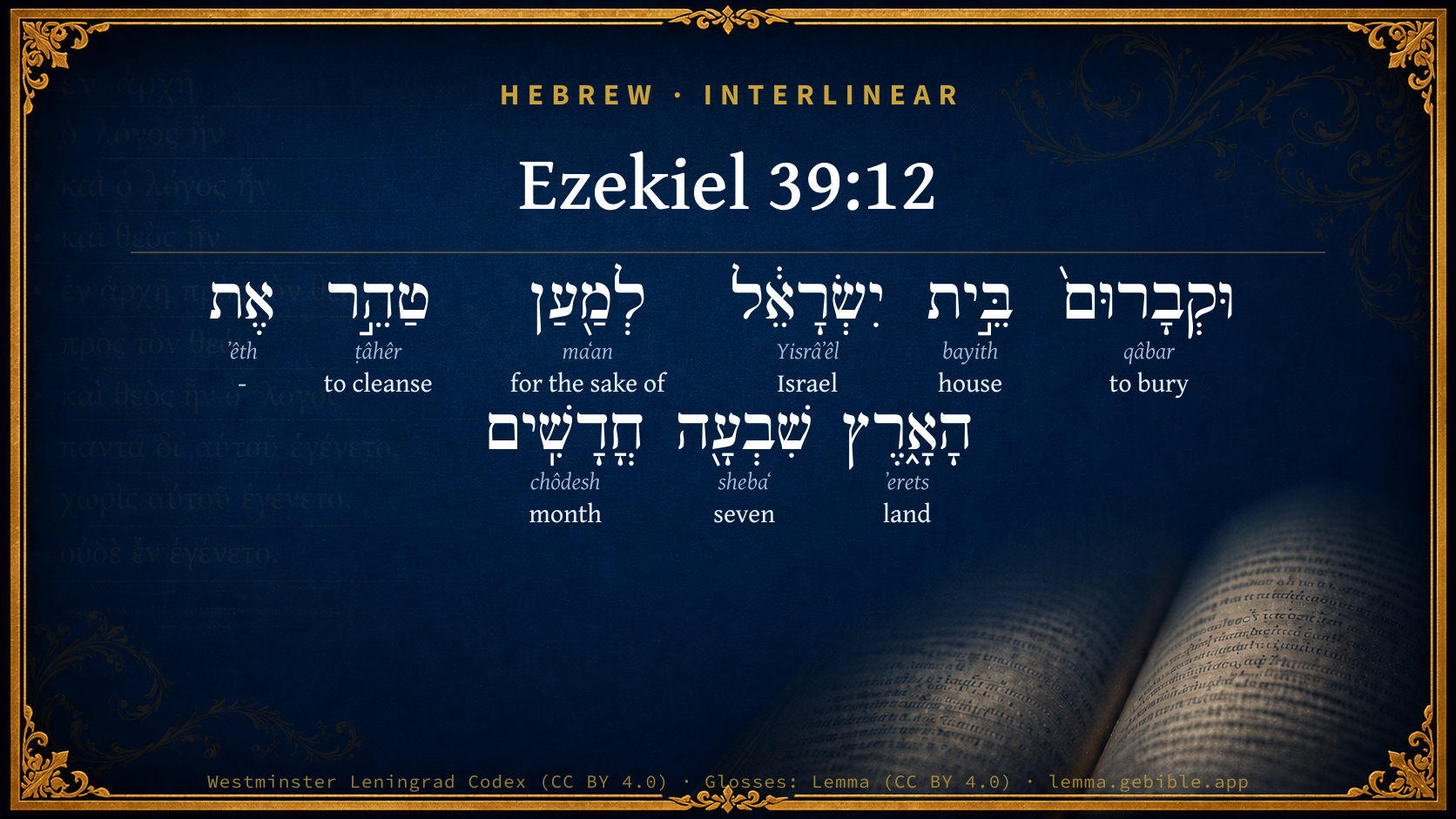
  1. וּקְבָרוּם֙ qâbar H6912 “and · to bury · them” Conjunction + Verb, Qal, Sequential Perfect, 3rd Person, Common, Plural + Suffix, Personal, 3rd Person, Masculine, Plural
  2. בֵּ֣ית bayith H1004 “house of” Noun, Common, Masculine, Singular, Construct
  3. יִשְׂרָאֵ֔ל Yisrâʼêl H3478 “Israel” Noun, Proper
  4. לְמַ֖עַן maʻan H4616 “for the sake of” Preposition
  5. אֶת ʼêth H853 “-” Particle, Direct Object
  6. הָאָ֑רֶץ ʼerets H776 “the · land” Particle, Definite Article + Noun, Common, Both, Singular, Absolute
  7. שִׁבְעָ֖ה shebaʻ H7651 “seven” Adjective, Cardinal number, Masculine, Singular, Absolute
  8. חֳדָשִֽׁים chôdesh H2320 “months” Noun, Common, Masculine, Plural, Absolute

About this verse

These counts appear in no published source. They are computed here, from the morphology-tagged text and Lemma’s own curated glosses. What Lemma adds →

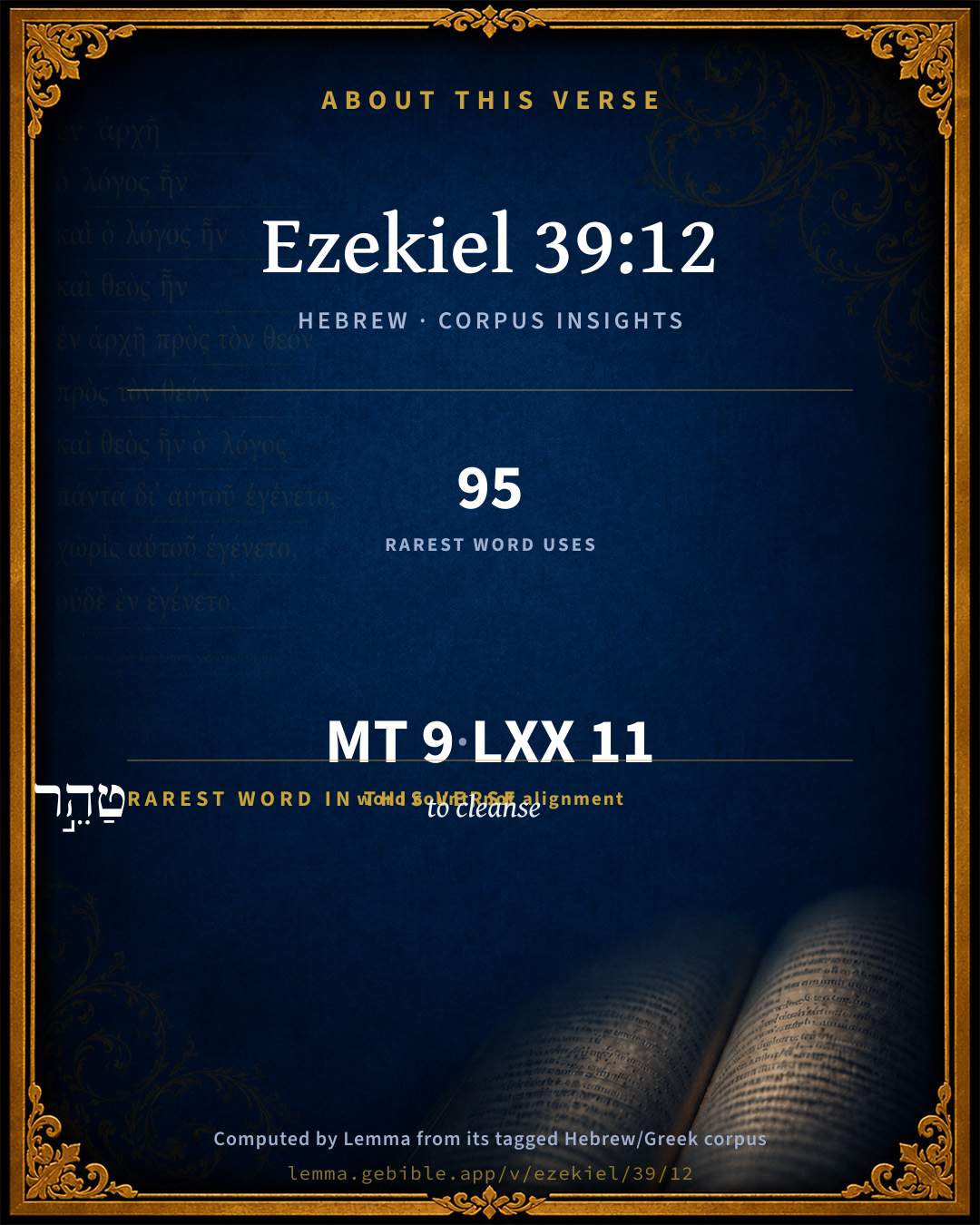
9
words
9
distinct lemmas
Prophets
section

Grammatical profile

  • 2 verbs
  • 4 nouns
  • 1 adjective
  • 1 preposition
  • 1 particle

Verb forms

  • וּקְבָרוּם֙ Qal · Sequential Perfect
  • טַהֵ֣ר Piel · Infinitive Construct

Hebrew & Septuagint length

In English translation the verse runs 16 words from the Hebrew and 20 from the Septuagint (LXX English) — closely comparable.

A rough comparison of the two English renderings, which tokenize alike — not a word-level alignment.

Word counts can differ between the Hebrew and the Greek without any difference in meaning — e.g. the Hebrew direct-object marker אֵת has no separate Greek word, and Greek often adds the article ὁ.

In the original languages it is 9 Hebrew tokens and 11 Greek tokens — but the two are counted differently (Hebrew bundles its prefixes and suffixes into one token; the Greek is in lemma form), so that isn’t a like-for-like length.

Cross-references

4

Topical passages linked to Ezekiel 39:12 in the Treasury of Scripture Knowledge — connected by theme and wording, ordered by reader-vote popularity; previews shown in the World English Bible.

  • Deuteronomy 21:23 his body shall not remain all night on the tree, but you shall surely bury him the same day; for he who is hanged is accursed of God; that you don't defile your land which Yahweh your God gives you for an inheritance.
  • Ezekiel 39:14 They shall set apart men of continual employment, who shall pass through the land, and, with those who pass through, those who bury those who remain on the surface of the land, to cleanse it: after the end of seven months shall they search.
  • Ezekiel 39:16 Hamonah shall also be the name of a city. Thus shall they cleanse the land.
  • Numbers 19:16 Whoever in the open field touches one who is slain with a sword, or a dead body, or a bone of a man, or a grave, shall be unclean seven days.

Cross-references courtesy of OpenBible.info (CC BY 4.0).

Hebrew and Greek witnesses Masoretic Hebrew ↔ Greek Septuagint

The same verse in the two great witnesses to the Old Testament, shown verse-for-verse.

These are two independent witnesses, not word-aligned to each other, and the Septuagint is shown in lemma (dictionary) form.

Hebrew Ezekiel 39:12 Masoretic · Westminster Leningrad Codex

וּקְבָרוּם֙ בֵּ֣ית יִשְׂרָאֵ֔ל לְמַ֖עַן טַהֵ֣ר אֶת הָאָ֑רֶץ שִׁבְעָ֖ה חֳדָשִֽׁים

Seven months shall the house of Israel be burying them, that they may cleanse the land.

World English Bible · Public Domain

Greek LXX Ezekiel 39:12 Septuagint · lemma form

καί καταὀρύσσω αὐτός οἶκος ἰσραήλ ἵνα καθαρίζω ὁ γῆ ἐν ἑπτάμηνος

And the house of Israel shall bury them, that the land may be cleansed in the space of seven months.

LXX2012 (modern English Septuagint) · Public Domain

Hebrew: Westminster Leningrad Codex (CC BY 4.0). Greek: Septuagint (public domain); English from LXX2012 (modern English Septuagint) (Public Domain). How the Septuagint differs from the Hebrew →

Targum (Aramaic paraphrase)

1

The Targum is the ancient Jewish Aramaic paraphrase of the Hebrew Scriptures — an interpretive translation, not the Hebrew text itself. Onkelos (literal) and Pseudo-Jonathan (expansive) render the Torah, and Jonathan the Prophets. Coverage is partial: where no permissively-licensed English translation exists for a verse, only the Aramaic is shown. This is verse-level text, not a word-by-word alignment to the Hebrew.

  1. Targum Jonathan Prophets (Joshua–Malachi)
    וְיִקְבְּרוּנוּן בֵּית יִשְׂרָאֵל בְּדִיל לְדַכָּאָה יַת אַרְעָא שִׁבְעָה יַרְחִין:

    (no public-domain English translation for this verse)

    Targum Jonathan — Aramaic: “Mikraot Gedolot” (public domain). English: “Sefaria Community Translation” (CC0 1.0 (public-domain dedication)); “London "Chaldee Paraphrase," 1871” (public domain). Text via Sefaria.

Commentary

Notes on Ezekiel 39:12 from classic Christian and Jewish commentators (each source and its license shown beneath its notes). The classic Christian expositions comment on the surrounding passage and are grouped to its opening verse, so a note may address several verses; the Jewish commentaries on the Tanakh (Rashi and others) are per-verse, so they appear only where the commentator wrote on this verse.

Lemma curates 59 commentaries, every one of them public domain or Creative Commons licensed, each selected and text-cleaned for this edition rather than reprinted as found. About our sources →

Trapp's Complete Commentary

John Trapp

Eze 39:12 And seven months shall the house of Israel be burying of them, that they may cleanse the land.

Ver. 12. And seven months shall the house of Israel be burying of them.] That is, a long while; like as the Reformed Churches were in rooting out Popery, those damnable doctrines, ceremonies, images, relics, bulls, and books. Here in England, the Romish religion stood a whole month and more after the death of Queen Mary, as before. December 27, it was permitted that the Epistles, Gospels, Ten Commandments, Lord’s Prayer, Creed, and Litany should be used in the Vulgate tongue. March 22, when the Estates of the realm were assembled, by renewing of a law of Edward VI, was granted the whole use of the Lord’s Supper - that is, under both kinds. June 24, the sacrifice of the mass was abolished, and the liturgy in the English tongue established. In July, the oath of supremacy was ministered; and in August, images were removed out of churches, broken or burnt. {a}

“ Tantae molis erat Romanam abscondere gentem. ”

{a} Camden’s Elisabeth.

John Trapp, A Commentary or Exposition upon All the Books of the Old and New Testament (1647–1656) — public domain. Text from a community e-Sword module.

Tyndale Open Study Notes

Tyndale Open Resources

39:12-16 The body count would be so large that everyone in Israel would be involved in the clean-up process for seven months. Even after that initial period, there would be a continuing need for teams of professional morticians to go through the land, tagging remains so that they could be properly disposed of.

Tyndale Open Study Notes — © Tyndale Open Resources, licensed CC BY-SA 4.0. Text via the HelloAO Bible API.

Geneva Bible (1599)

Geneva Bible translators

Meaning, a long time.

Geneva Bible (1599) marginal notes — public domain. Text via Bolls.life.

Adam Clarke's Commentary

Verse 12. And seven months] It shall require a long time to bury the dead. This is another figurative expression; which, however, may admit of a good deal of literal meaning. Many of the Syrian soldiers had secreted themselves in different places during the pursuit after the battle, where they died of their wounds, of hunger, and of fatigue; so that they were not all found and buried till seven months after the defeat of the Syrian army. This slow process of burying is distinctly related in the three following verses, and extended even to a bone, Eze 39:15; which, when it was found by a passenger, the place was marked, that the buriers might see and inter it. Seven months was little time enough for all this work; and in that country putrescency does not easily take place: the scorching winds serving to desiccate the flesh, and preserve it from decomposition.

Adam Clarke's Commentary on the Bible (1810–1826) — public domain. Text from a community e-Sword/MySword module.

The Cambridge Bible for Schools and Colleges

gen. ed. J. J. S. Perowne

12. It shall take all Israel (Eze_39:13) seven months to bury Gog’s dead. The bones scattered over the land defiled it, for it was holy to the Lord, and they must be gathered and interred, cf. Eze_39:14; Eze_39:16.

The Cambridge Bible for Schools and Colleges (gen. ed. J. J. S. Perowne; Cambridge University Press, 1878–1918) — public domain. Text from a community e-Sword module.

John Gill's Exposition

And seven months shall the house of Israel be burying of them,.... So long time will the burial of Gog's army take up, because of the multitude of it, and by reason their bones will be scattered here and there; which will require time to gather them together, and bring them to one place: the reason of the burial of them will be, partly out of humanity, which the Christian religion, which will then be embraced by the Jews, teaches and encourages; and partly because of the disagreeable sight and ill smell of the carcasses of the slain, and to prevent the air being infected therewith, which might cause noxious diseases. Jarchi gives the reason of it, because Gog is of the seed of Japheth, who covered his father's nakedness, and therefore worthy of a funeral: but a better reason follows,

that they may cleanse the land: not from ceremonial uncleanness, a place being unclean, by the ceremonial law, where dead carcasses, or the bones of dead men, lay; for the ceremonial law, as it is abrogated, will now be disused by the Jews themselves, when converted; but from natural pollution, before mentioned.

John Gill's Exposition of the Whole Bible (1746–1763) — public domain (CC PDM 1.0). Text via the HelloAO Bible API.

Haydock's Catholic Bible Commentary

Land, to prevent infection, and to comply with the law, Numbers xix. 16.

George Leo Haydock (1774–1849), Haydock's Catholic Family Bible and Commentary, 1859 edition — public domain. Excludes Psalms (Douay-Rheims chapter numbering differs from Protestant) and Deuterocanonical books (Catholic canon only).

Matthew Poole's English Annotations

Seven months shall the house of Israel, many of the house of Israel, some voluntarily, others by appointment, be burying of them; a little time would not suffice to bury so great multitude, make what haste they could.

Cleanse the land; not in a legal sense, but in a natural, to clear the land of hurtful stinks.

Matthew Poole's English Annotations on the Holy Bible (1683–1685) — public domain. Text from a community e-Sword/MySword module.

Whedon's Commentary on the Bible

Daniel D. Whedon

12-15. It shall take seven months to gather up all the bones which defile the holy soil (compare Eze_19:11-12; Eze_32:19; Eze_36:33) and bury them, and they shall get for themselves great “renown,” not only because of this victory of Jehovah, but because of their holy zeal in cleansing the land.

Men shall be chosen who shall do nothing else than “to bury them that pass through the land,” that is, probably the invaders (A.V., passengers, Eze_39:14). Modern commentators generally suppose that the special search party (Eze_39:14) was divided into two parts, one to find the bones and the other to bury them; but this is very unnatural and is not suggested by the amended text of Eze_39:14. The search party was authorized also “to bury” the unburied (Eze_39:14), and certainly when “a man’s bone” was found it would have taken longer to set up (Hebrews, build) a sign by it (Eze_39:15)

than to bury the bone! It is easy to see, however, that the ordinary Israelite, who would hesitate to touch one of the bones, but who was now zealous for the land’s purification (Eze_39:13), would be very likely to set up such a sign. “They that pass through the land” (R.V.) may therefore refer to “passengers” (A.V.), who did not belong to the official burial party. Toy repudiates R.V. and translates the passengers (Eze_39:15) as searchers, declaring there were two parties, and that the expression “those who pass through” cannot be understood of the invaders. For Hamon-gog see Eze_39:11.

Daniel D. Whedon (gen. ed.), Commentary on the Old and New Testaments (1874–1909) — public domain. Text from a community e-Sword module.

The Pulpit Commentary

Vers. 12, 13 The time that should be occupied in Gog"s funeral should be seven months so great should be the number of the dead the sacred number seven recalling the seven years consumed in the burning of the weapons (ver. 9), and reminding one of the "seven times heated" furnace into which the Hebrew children were cast, and of the "seven times" of Nebuchadnezzar"s humiliation. (Dan_3:19 Dan_4:23) The parties who should conduct his obsequies should be the house of Israel, even all the people of the land, indicating the common joy occasioned by the barbaric chieftain"s overthrow. The motive which should impel them in their work would be a desire to cleanse the land from the defilement it had contracted from the corpses of the slain; (comp. Num_19:11, 22 31:19 35:33) and the end should be that the work should be to them, not for "a remembrance" (Ewald), but a renown, not because they should have helped to bury Gog (Hengstenberg), or through burying Gog should have proved themselves his conquerors (Smend), and in virtue of Jehovah"s protection the possessors of his grave (Hitzig), but because in the day when Jehovah glorified himself through Gog"s destruction, he (Jehovah) should also be glorified by their (Israel"s) zeal "to show themselves a holy people by sweeping all uncleanness away" (Keil).

The Pulpit Commentary (1880–1919), ed. H.D.M. Spence-Jones & Joseph S. Exell — public domain. Text from a community e-Sword module.

unfoldingWord translationNotes

Door43 World Missions Community

Connecting Statement:

Yahweh continues to tell Ezekiel what will happen to Gog.

seven months

"7 months." (See: Numbers)

the house of Israel

The word "house" is a metonym for the family that lives in the house, in this case the Israelites, the descendants of Jacob over many years. See how you translated this in Ezekiel 3:1. AT: "the Israelites" or "the Israelite people group" (See: Metonymy)

will bury them in order to purify the land

In Jewish law, a dead body defiled anything it touched and made it "unclean." Burying these bodies is spoken of as cleansing or purifying the land. (See: Assumed Knowledge and Implicit Information)

bury them

"bury the soldiers of Gog's army"

this is the Lord Yahweh's declaration

Yahweh speaks of himself by name to express the certainty of what he is declaring. See how you translated this in Ezekiel 5:11. AT: "this is what the Lord Yahweh has declared" or "this is what I, the Lord Yahweh, have declared" (See: First, Second, or Third Person)

translationWords

month

house

Israel

pure

people group

glory

Lord Yahweh

unfoldingWord translationNotes — © Distant Shores Media and the Door43 World Missions Community, licensed CC BY-SA 4.0. Source: git.door43.org/Door43/en_tn.

Lesson kit

Teaching starters — assembled from the data on this page, not authored interpretation. Every prompt links to the verse data it draws on. Edit before teaching.

Ezekiel, in the Prophets, opens this verse with 9 words (9 distinct Hebrew lemmas). Its most distinctive word is ṭâhêr (“to cleanse”). A historical commentator’s framing appears above. Read the whole chapter for the surrounding context.

Discussion questions

  1. What does “to cleanse” (ṭâhêr) contribute to the verse as a whole?
  2. Deuteronomy 21:23 shares this passage’s theme. How do the two illuminate each other?
  3. These translations render this verse differently. What is at stake in choosing one wording over another?
  4. The verb «וּקְבָרוּם֙» is Qal Sequential Perfect. How does its form color the action?
  5. Reading how Trapp's Complete Commentary and Tyndale Open Study Notes read this verse, where do the two commentators agree and where do they part?

Things to notice

Reading settings

Reading text

Shown beneath each verse's original-language words.

Old Testament
Old Testament edition

Read the OT as the Masoretic Hebrew (MT) or the Greek Septuagint (LXX).

English shown for the Greek Septuagint (in the Hebrew ↔ Greek comparison).

Comparing translations? Open the Compare panel on any verse page to stack up to four side by side.