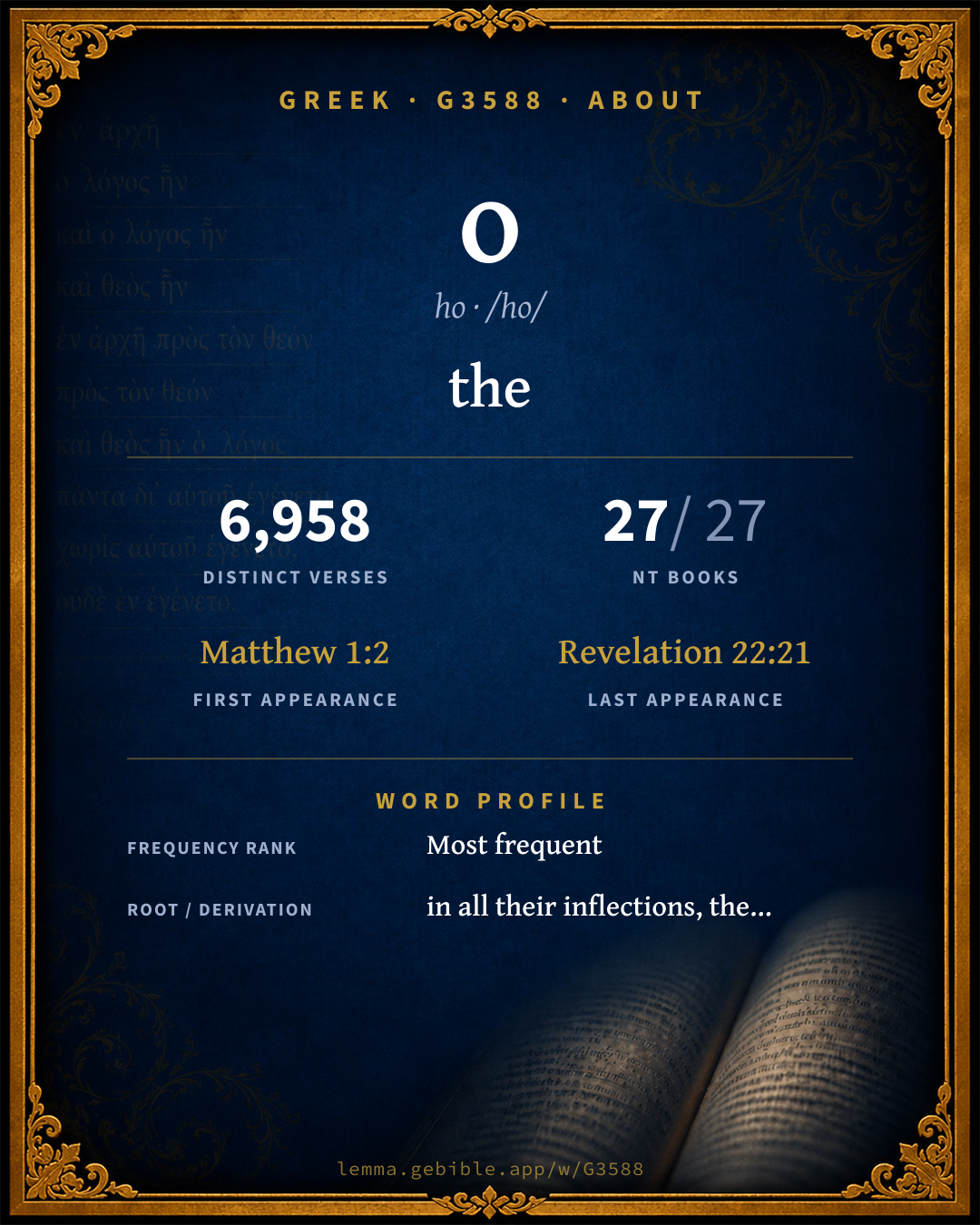
ο
the
Full lexicon entry — Thayer's Greek Lexicon
From Thayer's Greek Lexicon
Where this word appears
See every Nominative-case word in the Greek New Testament →
Grammar key — what these labels mean
Part of speech
- Article
- The Greek definite article (“the”), agreeing with its noun in case, number, and gender.
Case
- Nominative
- The case of the subject (and the predicate nominative).
- Genitive
- The case of source, possession, or “of” — answers “whose / from what.”
- Accusative
- The case of the direct object and of extent.
- Dative
- The case of the indirect object, means, or location — “to / for / with / in.”
Gender
- Masculine
- Grammatically masculine.
- Feminine
- Grammatically feminine.
- Neuter
- Grammatically neuter.
Number
- Singular
- One.
- Plural
- More than one.
Page 13 of 20 — showing verses 2,401–2,600 of 3,939 distinct verses where G3588 appears in the Nominative case, across 27 books. Filtered view — show all forms. Click any verse to open its interlinear word-by-word view. Verse text shown in the World English Bible for context — . Each verse’s Greek form is shown with its reference; the English is not keyword-highlighted, since the data carries no word-level English alignment. Use “Compare translations” on any verse to read it across multiple English versions. This concordance covers the Greek New Testament; Septuagint (Greek Old Testament) occurrences of this word are not indexed here.
Acts 452 verses
- Acts 17:32 οἱ οἱ art nom pl masc art nom pl masc Now when they heard of the resurrection of the dead, some mocked; but others said, "We want to hear you again concerning this."
- Acts 17:33 ὁ art nom sg masc Thus Paul went out from among them.
- Acts 17:34 ὁ art nom sg masc But certain men joined with him, and believed, among whom also was Dionysius the Areopagite, and a woman named Damaris, and others with them.
- Acts 18:5 τῆς ὅ ὁ τῷ ὁ τοῖς τὸν art gen sg fem art nom sg masc art nom sg masc art dat sg masc art nom sg masc art dat pl masc art acc sg masc But when Silas and Timothy came down from Macedonia, Paul was compelled by the Spirit, testifying to the Jews that Jesus was the Christ.
- Acts 18:6 τὰ τὸ τὴν τοῦ τὰ art acc pl neut art nom sg neut art acc sg fem art gen sg masc art acc pl neut When they opposed him and blasphemed, he shook out his clothing and said to them, "Your blood be on your own heads! I am clean. From now on, I will go to the Gentiles!"
- Acts 18:7 τὸν ἡ τῇ art acc sg masc art nom sg fem art dat sg fem He departed there, and went into the house of a certain man named Justus, one who worshiped God, whose house was next door to the synagogue.
- Acts 18:8 ὁ τῷ τῷ τῶν art nom sg masc art dat sg masc art dat sg masc art gen pl masc Crispus, the ruler of the synagogue, believed in the Lord with all his house. Many of the Corinthians, when they heard, believed and were baptized.
- Acts 18:9 ὁ τῷ art nom sg masc art dat sg masc The Lord said to Paul in the night by a vision, "Don't be afraid, but speak and don't be silent;
- Acts 18:12 τῆς οἱ τῷ τὸ art gen sg fem art nom pl masc art dat sg masc art acc sg neut But when Gallio was proconsul of Achaia, the Jews with one accord rose up against Paul and brought him before the judgment seat,
- Acts 18:14 τοῦ τὸ ὁ τοὺς art gen sg masc art acc sg neut art nom sg masc art acc pl masc But when Paul was about to open his mouth, Gallio said to the Jews, "If indeed it were a matter of wrong or of wicked crime, you Jews, it would be reasonable that I should bear with you;
- Acts 18:18 Ὁ τοῖς τὴν τὴν art nom sg masc art dat pl masc art acc sg fem art acc sg fem Paul, having stayed after this many more days, took his leave of the brothers, and sailed from there for Syria, together with Priscilla and Aquila. He shaved his head in Cenchreae, for he had a vow.
- Acts 18:27 τὴν οἱ τοῖς τοῖς τῆς art acc sg fem art nom pl masc art dat pl masc art dat pl masc art gen sg fem When he had determined to pass over into Achaia, the brothers encouraged him, and wrote to the disciples to receive him. When he had come, he greatly helped those who had believed through grace;
- Acts 19:2 οἱ art nom pl masc He said to them, "Did you receive the Holy Spirit when you believed?" They said to him, "No, we haven't even heard that there is a Holy Spirit."
- Acts 19:3 ὁ οἱ τὸ art nom sg masc art nom pl masc art acc sg neut He said, "Into what then were you baptized?" They said, "Into John's baptism."
- Acts 19:6 τοῦ τὸ τὸ art gen sg masc art nom sg neut art nom sg neut When Paul had laid his hands on them, the Holy Spirit came on them, and they spoke with other languages and prophesied.
- Acts 19:7 οἱ art nom pl masc They were about twelve men in all.
- Acts 19:11 τὰς ὁ τῶν art acc pl fem art nom sg masc art gen pl fem God worked special miracles by the hands of Paul,
- Acts 19:15 τὸ τὸ τὸν τὸν art nom sg neut art nom sg neut art acc sg masc art acc sg masc The evil spirit answered, "Jesus I know, and Paul I know, but who are you?"
- Acts 19:16 ὁ τὸ τὸ τοῦ art nom sg masc art nom sg neut art nom sg neut art gen sg masc The man in whom the evil spirit was leaped on them, and overpowered them, and prevailed against them, so that they fled out of that house naked and wounded.
- Acts 19:20 τοῦ ὁ art gen sg masc art nom sg masc So the word of the Lord was growing and becoming mighty.
- Acts 19:21 ὁ τῷ τὴν τὸ art nom sg masc art dat sg neut art acc sg fem art acc sg neut Now after these things had ended, Paul determined in the spirit, when he had passed through Macedonia and Achaia, to go to Jerusalem, saying, "After I have been there, I must also see Rome."
- Acts 19:25 τοὺς τὰ τῆς ἡ art acc pl masc art acc pl neut art gen sg fem art nom sg fem whom he gathered together, with the workmen of like occupation, and said, "Sirs, you know that by this business we have our wealth.
- Acts 19:26 τῆς ὁ οἱ art gen sg fem art nom sg masc art nom pl masc You see and hear, that not at Ephesus alone, but almost throughout all Asia, this Paul has persuaded and turned away many people, saying that they are no gods, that are made with hands.
- Acts 19:27 τὸ τὸ τῆς τῆς ἡ ἡ art acc sg neut art acc sg neut art gen sg fem art gen sg fem art nom sg fem art nom sg fem Not only is there danger that this our trade come into disrepute, but also that the temple of the great goddess Artemis will be counted as nothing, and her majesty destroyed, whom all Asia and the world worships."
- Acts 19:28 ἡ art nom sg fem When they heard this they were filled with anger, and cried out, saying, "Great is Artemis of the Ephesians!"
- Acts 19:29 ἡ τῆς τὸ art nom sg fem art gen sg fem art acc sg neut The whole city was filled with confusion, and they rushed with one accord into the theater, having seized Gaius and Aristarchus, men of Macedonia, Paul's companions in travel.
- Acts 19:30 τὸν οἱ art acc sg masc art nom pl masc When Paul wanted to enter in to the people, the disciples didn't allow him.
- Acts 19:32 ἡ οἱ art nom sg fem art nom pl masc Some therefore cried one thing, and some another, for the assembly was in confusion. Most of them didn't know why they had come together.
- Acts 19:33 τοῦ τῶν ὁ τὴν τῷ art gen sg masc art gen pl masc art nom sg masc art acc sg fem art dat sg masc They brought Alexander out of the multitude, the Jews putting him forward. Alexander beckoned with his hand, and would have made a defense to the people.
- Acts 19:34 ἡ art nom sg fem But when they perceived that he was a Jew, all with one voice for a time of about two hours cried out, "Great is Artemis of the Ephesians!"
- Acts 19:35 ὁ τὸν τὴν τῆς τοῦ art nom sg masc art acc sg masc art acc sg fem art gen sg fem art gen sg masc When the town clerk had quieted the multitude, he said, "You men of Ephesus, what man is there who doesn't know that the city of the Ephesians is temple-keeper of the great goddess Artemis, and of the image which fell down from Zeus?
- Acts 19:38 οἱ art nom pl masc If therefore Demetrius and the craftsmen who are with him have a matter against anyone, the courts are open, and there are proconsuls. Let them press charges against one another.
- Acts 20:1 τὸ τὸν ὁ τοὺς art acc sg neut art acc sg masc art nom sg masc art acc pl masc After the uproar had ceased, Paul sent for the disciples, took leave of them, and departed to go into Macedonia.
- Acts 20:7 τῇ τῶν ὁ τῇ τὸν art dat sg fem art gen pl neut art nom sg masc art dat sg fem art acc sg masc On the first day of the week, when the disciples were gathered together to break bread, Paul talked with them, intending to depart on the next day, and continued his speech until midnight.
- Acts 20:10 ὁ ἡ art nom sg masc art nom sg fem Paul went down, and fell upon him, and embracing him said, "Don't be troubled, for his life is in him."
- Acts 20:16 ὁ τὴν τῇ τὴν τῆς art nom sg masc art acc sg fem art dat sg fem art acc sg fem art gen sg fem For Paul had determined to sail past Ephesus, that he might not have to spend time in Asia; for he was hastening, if it were possible for him, to be in Jerusalem on the day of Pentecost.
- Acts 20:23 τὸ τὸ art nom sg neut art nom sg neut except that the Holy Spirit testifies in every city, saying that bonds and afflictions wait for me.
- Acts 20:28 τῷ τὸ τὸ τὴν τοῦ τοῦ τοῦ art dat sg neut art nom sg neut art nom sg neut art acc sg fem art gen sg masc art gen sg neut art gen sg masc Take heed, therefore, to yourselves, and to all the flock, in which the Holy Spirit has made you overseers, to shepherd the assembly of the Lord and God which he purchased with his own blood.
- Acts 20:34 ταῖς τοῖς αἱ art dat pl fem art dat pl masc art nom pl fem You yourselves know that these hands ministered to my necessities, and to those who were with me.
- Acts 21:3 τὴν τὸ τὸν art acc sg fem art nom sg neut art acc sg masc When we had come in sight of Cyprus, leaving it on the left hand, we sailed to Syria, and landed at Tyre, for there the ship was to unload her cargo.
- Acts 21:11 τὴν τοῦ τοὺς τὰς τὸ τὸ τὸν ἡ οἱ art acc sg fem art gen sg masc art acc pl masc art acc pl fem art nom sg neut art nom sg neut art acc sg masc art nom sg fem art nom pl masc Coming to us, and taking Paul's belt, he bound his own feet and hands, and said, "Thus says the Holy Spirit: 'So will the Jews at Jerusalem bind the man who owns this belt, and will deliver him into the hands of the Gentiles.'"
- Acts 21:12 οἱ τοῦ art nom pl masc art gen sg neut When we heard these things, both we and they of that place begged him not to go up to Jerusalem.
- Acts 21:13 ὁ τὴν τοῦ τοῦ art nom sg masc art acc sg fem art gen sg neut art gen sg masc Then Paul answered, "What are you doing, weeping and breaking my heart? For I am ready not only to be bound, but also to die at Jerusalem for the name of the Lord Jesus."
- Acts 21:14 τοῦ τὸ art gen sg masc art nom sg neut When he would not be persuaded, we ceased, saying, "The Lord's will be done."
- Acts 21:17 οἱ art nom pl masc When we had come to Jerusalem, the brothers received us gladly.
- Acts 21:18 τῇ ὁ οἱ art dat sg fem art nom sg masc art nom pl masc The day following, Paul went in with us to James; and all the elders were present.
- Acts 21:19 ὁ τοῖς τῆς art nom sg masc art dat pl neut art gen sg fem When he had greeted them, he reported one by one the things which God had worked among the Gentiles through his ministry.
- Acts 21:20 οἱ τὸν τῶν τοῦ art nom pl masc art acc sg masc art gen pl masc art gen sg masc They, when they heard it, glorified God. They said to him, "You see, brother, how many thousands there are among the Jews of those who have believed, and they are all zealous for the law.
- Acts 21:26 ὁ τοὺς τῇ τὸ τὴν τῶν τοῦ ἡ art nom sg masc art acc pl masc art dat sg fem art acc sg neut art acc sg fem art gen pl fem art gen sg masc art nom sg fem Then Paul took the men, and the next day, purified himself and went with them into the temple, declaring the fulfillment of the days of purification, until the offering was offered for every one of them.
- Acts 21:27 αἱ οἱ τῆς τῷ τὸν τὰς art nom pl fem art nom pl masc art gen sg fem art dat sg neut art acc sg masc art acc pl fem When the seven days were almost completed, the Jews from Asia, when they saw him in the temple, stirred up all the multitude and laid hands on him,
- Acts 21:28 ὁ ὁ τοῦ τοῦ τοῦ τὸ τὸν art nom sg masc art nom sg masc art gen sg masc art gen sg masc art gen sg masc art acc sg neut art acc sg masc crying out, "Men of Israel, help! This is the man who teaches all men everywhere against the people, and the law, and this place. Moreover, he also brought Greeks into the temple, and has defiled this holy place!"
- Acts 21:29 τὸν τῇ τὸ ὁ art acc sg masc art dat sg fem art acc sg neut art nom sg masc For they had seen Trophimus, the Ephesian, with him in the city, and they supposed that Paul had brought him into the temple.
- Acts 21:30 ἡ τοῦ τοῦ τοῦ αἱ art nom sg fem art gen sg masc art gen sg masc art gen sg neut art nom pl fem All the city was moved, and the people ran together. They seized Paul and dragged him out of the temple. Immediately the doors were shut.
- Acts 21:32 οἱ τὸν τοὺς τὸν art nom pl masc art acc sg masc art acc pl masc art acc sg masc Immediately he took soldiers and centurions, and ran down to them. They, when they saw the chief captain and the soldiers, stopped beating Paul.
- Acts 21:33 ὁ art nom sg masc Then the commanding officer came near, arrested him, commanded him to be bound with two chains, and inquired who he was and what he had done.
- Acts 21:36 τὸ τοῦ art nom sg neut art gen sg masc for the multitude of the people followed after, crying out, "Away with him!"
- Acts 21:37 τὴν ὁ τῷ ὁ art acc sg fem art nom sg masc art dat sg masc art nom sg masc As Paul was about to be brought into the barracks, he asked the commanding officer, "May I speak to you?" He said, "Do you know Greek?
- Acts 21:38 ὁ ὁ τῶν τὴν τοὺς τῶν art nom sg masc art nom sg masc art gen pl fem art acc sg fem art acc pl masc art gen pl masc Aren't you then the Egyptian, who before these days stirred up to sedition and led out into the wilderness the four thousand men of the Assassins?"
- Acts 21:39 ὁ τῆς τὸν art nom sg masc art gen sg fem art acc sg masc But Paul said, "I am a Jew, from Tarsus in Cilicia, a citizen of no insignificant city. I beg you, allow me to speak to the people."
- Acts 21:40 ὁ τῶν τῇ τῷ τῇ art nom sg masc art gen pl masc art dat sg fem art dat sg masc art dat sg fem When he had given him permission, Paul, standing on the stairs, beckoned with his hand to the people. When there was a great silence, he spoke to them in the Hebrew language, saying,
- Acts 22:5 ὁ τὸ τοὺς τοὺς art nom sg masc art nom sg neut art acc pl masc art acc pl masc As also the high priest and all the council of the elders testify, from whom also I received letters to the brothers, and traveled to Damascus to bring them also who were there to Jerusalem in bonds to be punished.
- Acts 22:8 ὁ art nom sg masc I answered, 'Who are you, Lord?' He said to me, 'I am Jesus of Nazareth, whom you persecute.'
- Acts 22:9 οἱ τὸ τὴν τοῦ art nom pl masc art acc sg neut art acc sg fem art gen sg masc "Those who were with me indeed saw the light and were afraid, but they didn't understand the voice of him who spoke to me.
- Acts 22:10 ὁ art nom sg masc I said, 'What shall I do, Lord?' The Lord said to me, 'Arise, and go into Damascus. There you will be told about all things which are appointed for you to do.'
- Acts 22:14 ὁ ὁ τῶν τὸ τὸν τοῦ art nom sg masc art nom sg masc art gen pl masc art acc sg neut art acc sg masc art gen sg neut He said, 'The God of our fathers has appointed you to know his will, and to see the Righteous One, and to hear a voice from his mouth.
- Acts 22:20 τὸ τοῦ τὰ τῶν art nom sg neut art gen sg masc art acc pl neut art gen pl masc When the blood of Stephen, your witness, was shed, I also was standing by, and consenting to his death, and guarding the cloaks of those who killed him.'
- Acts 22:24 ὁ τὴν art nom sg masc art acc sg fem the commanding officer commanded him to be brought into the barracks, ordering him to be examined by scourging, that he might know for what crime they shouted against him like that.
- Acts 22:25 τοῖς τὸν ὁ art dat pl masc art acc sg masc art nom sg masc When they had tied him up with thongs, Paul asked the centurion who stood by, "Is it lawful for you to scourge a man who is a Roman, and not found guilty?"
- Acts 22:26 ὁ τῷ ὁ art nom sg masc art dat sg masc art nom sg masc When the centurion heard it, he went to the commanding officer and told him, "Watch what you are about to do, for this man is a Roman!"
- Acts 22:27 ὁ ὁ art nom sg masc art nom sg masc The commanding officer came and asked him, "Tell me, are you a Roman?" He said, "Yes."
- Acts 22:28 ὁ τὴν ὁ art nom sg masc art acc sg fem art nom sg masc The commanding officer answered, "I bought my citizenship for a great price." Paul said, "But I was born a Roman."
- Acts 22:29 οἱ ὁ art nom pl masc art nom sg masc Immediately those who were about to examine him departed from him, and the commanding officer also was afraid when he realized that he was a Roman, because he had bound him.
- Acts 23:1 τῷ ὁ τῷ τῆς art dat sg neut art nom sg masc art dat sg masc art gen sg fem Paul, looking steadfastly at the council, said, "Brothers, I have lived before God in all good conscience until this day."
- Acts 23:2 ὁ τοῖς τὸ art nom sg masc art dat pl masc art acc sg neut The high priest, Ananias, commanded those who stood by him to strike him on the mouth.
- Acts 23:3 ὁ ὁ τὸν art nom sg masc art nom sg masc art acc sg masc Then Paul said to him, "God will strike you, you whitewashed wall! Do you sit to judge me according to the law, and command me to be struck contrary to the law?"
- Acts 23:4 οἱ τὸν τοῦ art nom pl masc art acc sg masc art gen sg masc Those who stood by said, "Do you malign God's high priest?"
- Acts 23:5 ὁ τοῦ art nom sg masc art gen sg masc Paul said, "I didn't know, brothers, that he was high priest. For it is written, 'You shall not speak evil of a ruler of your people.'"
- Acts 23:6 ὁ τὸ τὸ τῷ art nom sg masc art nom sg neut art nom sg neut art dat sg neut But when Paul perceived that the one part were Sadducees and the other Pharisees, he cried out in the council, "Men and brothers, I am a Pharisee, a son of Pharisees. Concerning the hope and resurrection of the dead I am being judged!"
- Acts 23:7 τῶν τὸ art gen pl masc art nom sg neut When he had said this, an argument arose between the Pharisees and Sadducees, and the assembly was divided.
- Acts 23:10 ὁ ὁ τὸ τὴν art nom sg masc art nom sg masc art acc sg neut art acc sg fem When a great argument arose, the commanding officer, fearing that Paul would be torn in pieces by them, commanded the soldiers to go down and take him by force from among them, and bring him into the barracks.
- Acts 23:11 τῇ ὁ τὰ art dat sg fem art nom sg masc art acc pl neut The following night, the Lord stood by him, and said, "Cheer up, Paul, for as you have testified about me at Jerusalem, so you must testify also at Rome."
- Acts 23:12 οἱ τὸν art nom pl masc art acc sg masc When it was day, some of the Jews banded together, and bound themselves under a curse, saying that they would neither eat nor drink until they had killed Paul.
- Acts 23:13 οἱ τὴν art nom pl masc art acc sg fem There were more than forty people who had made this conspiracy.
- Acts 23:16 ὁ τῆς τὴν τὴν τῷ art nom sg masc art gen sg fem art acc sg fem art acc sg fem art dat sg masc But Paul's sister's son heard of their lying in wait, and he came and entered into the barracks and told Paul.
- Acts 23:17 ὁ τῶν τὸν τὸν art nom sg masc art gen pl masc art acc sg masc art acc sg masc Paul summoned one of the centurions, and said, "Bring this young man to the commanding officer, for he has something to tell him."
- Acts 23:18 ὁ τὸν ὁ τὸν art nom sg masc art acc sg masc art nom sg masc art acc sg masc So he took him, and brought him to the commanding officer, and said, "Paul, the prisoner, summoned me and asked me to bring this young man to you, who has something to tell you."
- Acts 23:19 τῆς ὁ art gen sg fem art nom sg masc The commanding officer took him by the hand, and going aside, asked him privately, "What is it that you have to tell me?"
- Acts 23:20 οἱ τοῦ τὸν τὸ art nom pl masc art gen sg neut art acc sg masc art acc sg neut He said, "The Jews have agreed to ask you to bring Paul down to the council tomorrow, as though intending to inquire somewhat more accurately concerning him.
- Acts 23:22 ὁ τὸν art nom sg masc art acc sg masc So the commanding officer let the young man go, charging him, "Tell no one that you have revealed these things to me."
- Acts 23:31 Οἱ τὸ τὸν τὴν art nom pl masc art acc sg neut art acc sg masc art acc sg fem So the soldiers, carrying out their orders, took Paul and brought him by night to Antipatris.
- Acts 23:35 οἱ τῷ τοῦ art nom pl masc art dat sg neut art gen sg masc "I will hear you fully when your accusers also arrive." He commanded that he be kept in Herod's palace.
- Acts 24:1 ὁ τῷ τοῦ art nom sg masc art dat sg masc art gen sg masc After five days, the high priest, Ananias, came down with certain elders and an orator, one Tertullus. They informed the governor against Paul.
- Acts 24:2 ὁ art nom sg masc When he was called, Tertullus began to accuse him, saying, "Seeing that by you we enjoy much peace, and that excellent measures are coming to this nation,
- Acts 24:9 οἱ art nom pl masc The Jews also joined in the attack, affirming that these things were so.
- Acts 24:10 ὁ τοῦ τῷ τὰ art nom sg masc art gen sg masc art dat sg neut art acc pl neut When the governor had beckoned to him to speak, Paul answered, "Because I know that you have been a judge of this nation for many years, I cheerfully make my defense,
- Acts 24:22 ὁ τὰ τῆς ὁ τὰ art nom sg masc art acc pl neut art gen sg fem art nom sg masc art acc pl neut But Felix, having more exact knowledge concerning the Way, deferred them, saying, "When Lysias, the commanding officer, comes down, I will decide your case."
- Acts 24:24 ὁ τῇ τὸν τῆς art nom sg masc art dat sg fem art acc sg masc art gen sg fem But after some days, Felix came with Drusilla, his wife, who was a Jewess, and sent for Paul, and heard him concerning the faith in Christ Jesus.
- Acts 24:25 τοῦ τοῦ ὁ τὸ art gen sg neut art gen sg neut art nom sg masc art acc sg neut As he reasoned about righteousness, self-control, and the judgment to come, Felix was terrified, and answered, "Go your way for this time, and when it is convenient for me, I will summon you."
- Acts 24:27 ὁ τοῖς ὁ τὸν art nom sg masc art dat pl masc art nom sg masc art acc sg masc But when two years were fulfilled, Felix was succeeded by Porcius Festus, and desiring to gain favor with the Jews, Felix left Paul in bonds.
- Acts 25:2 οἱ οἱ τῶν τοῦ art nom pl masc art nom pl masc art gen pl masc art gen sg masc Then the high priest and the principal men of the Jews informed him against Paul, and they begged him,
- Acts 25:4 ὁ τὸν art nom sg masc art acc sg masc However Festus answered that Paul should be kept in custody at Caesarea, and that he himself was about to depart shortly.
- Acts 25:5 οἱ τῷ art nom pl masc art dat sg masc "Let them therefore," said he, "that are in power among you go down with me, and if there is anything wrong in the man, let them accuse him."
- Acts 25:7 οἱ art nom pl masc When he had come, the Jews who had come down from Jerusalem stood around him, bringing against him many and grievous charges which they could not prove,
- Acts 25:9 ὁ τοῖς τῷ art nom sg masc art dat pl masc art dat sg masc But Festus, desiring to gain favor with the Jews, answered Paul and said, "Are you willing to go up to Jerusalem, and be judged by me there concerning these things?"
- Acts 25:10 ὁ τοῦ art nom sg masc art gen sg neut But Paul said, "I am standing before Caesar's judgment seat, where I ought to be tried. I have done no wrong to the Jews, as you also know very well.
- Acts 25:12 ὁ τοῦ art nom sg masc art gen sg neut Then Festus, when he had conferred with the council, answered, "You have appealed to Caesar. To Caesar you shall go."
- Acts 25:13 ὁ τὸν art nom sg masc art acc sg masc Now when some days had passed, Agrippa the King and Bernice arrived at Caesarea, and greeted Festus.
- Acts 25:14 ὁ τῷ τὰ τὸν art nom sg masc art dat sg masc art acc pl neut art acc sg masc As he stayed there many days, Festus laid Paul's case before the king, saying, "There is a certain man left a prisoner by Felix;
- Acts 25:15 οἱ οἱ τῶν art nom pl masc art nom pl masc art gen pl masc about whom, when I was at Jerusalem, the chief priests and the elders of the Jews informed me, asking for a sentence against him.
- Acts 25:16 ὁ τοὺς τοῦ art nom sg masc art acc pl masc art gen sg neut To whom I answered that it is not the custom of the Romans to give up any man to destruction, before the accused has met the accusers face to face, and has had opportunity to make his defense concerning the matter laid against him.
- Acts 25:18 οἱ art nom pl masc Concerning whom, when the accusers stood up, they brought no charge of such things as I supposed;
- Acts 25:19 τῆς ὁ art gen sg fem art nom sg masc but had certain questions against him about their own religion, and about one Jesus, who was dead, whom Paul affirmed to be alive.
- Acts 25:23 Τῇ τοῦ τῆς τὸ τοῖς τῆς τοῦ ὁ art dat sg fem art gen sg masc art gen sg fem art acc sg neut art dat pl masc art gen sg fem art gen sg masc art nom sg masc So on the next day, when Agrippa and Bernice had come with great pomp, and they had entered into the place of hearing with the commanding officers and principal men of the city, at the command of Festus, Paul was brought in.
- Acts 25:24 ὁ οἱ τὸ τῶν art nom sg masc art nom pl masc art nom sg neut art gen pl masc Festus said, "King Agrippa, and all men who are here present with us, you see this man, about whom all the multitude of the Jews petitioned me, both at Jerusalem and here, crying that he ought not to live any longer.
- Acts 26:1 τὸν ὁ τὴν art acc sg masc art nom sg masc art acc sg fem Agrippa said to Paul, "You may speak for yourself." Then Paul stretched out his hand, and made his defense.
- Acts 26:4 τὴν τὴν τὴν τῷ οἱ art acc sg fem art acc sg fem art acc sg fem art dat sg neut art nom pl masc "Indeed, all the Jews know my way of life from my youth up, which was from the beginning among my own nation and at Jerusalem;
- Acts 26:7 τὸ art nom sg neut which our twelve tribes, earnestly serving night and day, hope to attain. Concerning this hope I am accused by the Jews, King Agrippa!
- Acts 26:8 ὁ art nom sg masc Why is it judged incredible with you, if God does raise the dead?
- Acts 26:15 ὁ art nom sg masc "I said, 'Who are you, Lord?' "He said, 'I am Jesus, whom you are persecuting.
- Acts 26:22 τῆς τοῦ τῆς οἱ art gen sg fem art gen sg masc art gen sg fem art nom pl masc Having therefore obtained the help that is from God, I stand to this day testifying both to small and great, saying nothing but what the prophets and Moses said would happen,
- Acts 26:23 ὁ τῷ τοῖς art nom sg masc art dat sg masc art dat pl neut how the Christ must suffer, and how, by the resurrection of the dead, he would be first to proclaim light both to these people and to the Gentiles."
- Acts 26:24 ὁ τῇ τὰ art nom sg masc art dat sg fem art nom pl neut As he thus made his defense, Festus said with a loud voice, "Paul, you are crazy! Your great learning is driving you insane!"
- Acts 26:25 ὁ art nom sg masc But he said, "I am not crazy, most excellent Festus, but boldly declare words of truth and reasonableness.
- Acts 26:26 ὁ art nom sg masc For the king knows of these things, to whom also I speak freely. For I am persuaded that none of these things is hidden from him, for this has not been done in a corner.
- Acts 26:28 ὁ τὸν art nom sg masc art acc sg masc Agrippa said to Paul, "With a little persuasion are you trying to make me a Christian?"
- Acts 26:29 ὁ τῷ τοὺς τῶν art nom sg masc art dat sg masc art acc pl masc art gen pl neut Paul said, "I pray to God, that whether with little or with much, not only you, but also all that hear me this day, might become such as I am, except for these bonds."
- Acts 26:30 ὁ ὁ ἥ οἱ art nom sg masc art nom sg masc art nom sg fem art nom pl masc The king rose up with the governor, and Bernice, and those who sat with them.
- Acts 26:31 ὁ art nom sg masc When they had withdrawn, they spoke one to another, saying, "This man does nothing worthy of death or of bonds."
- Acts 26:32 τῷ ὁ art dat sg masc art nom sg masc Agrippa said to Festus, "This man might have been set free if he had not appealed to Caesar."
- Acts 27:3 τῇ ὁ τῷ τοὺς art dat sg fem art nom sg masc art dat sg masc art acc pl masc The next day, we touched at Sidon. Julius treated Paul kindly, and gave him permission to go to his friends and refresh himself.
- Acts 27:6 ὁ τὴν art nom sg masc art acc sg fem There the centurion found a ship of Alexandria sailing for Italy, and he put us on board.
- Acts 27:9 τοῦ τὸ τὴν ὁ art gen sg masc art acc sg neut art acc sg fem art nom sg masc When much time had passed and the voyage was now dangerous, because the Fast had now already gone by, Paul admonished them,
- Acts 27:11 ὁ τῷ τῷ τοῖς art nom sg masc art dat sg masc art dat sg masc art dat pl neut But the centurion gave more heed to the master and to the owner of the ship than to those things which were spoken by Paul.
- Acts 27:12 τοῦ οἱ τῆς art gen sg masc art nom pl masc art gen sg fem Because the haven was not suitable to winter in, the majority advised going to sea from there, if by any means they could reach Phoenix, and winter there, which is a port of Crete, looking northeast and southeast.
- Acts 27:14 ὁ art nom sg masc But before long, a tempestuous wind beat down from shore, which is called Euroclydon.
- Acts 27:21 ὁ τῆς τὴν τὴν art nom sg masc art gen sg fem art acc sg fem art acc sg fem When they had been long without food, Paul stood up in the middle of them, and said, "Sirs, you should have listened to me, and not have set sail from Crete, and have gotten this injury and loss.
- Acts 27:24 ὁ τοὺς art nom sg masc art acc pl masc saying, 'Don't be afraid, Paul. You must stand before Caesar. Behold, God has granted you all those who sail with you.'
- Acts 27:27 τῷ τῆς οἱ art dat sg masc art gen sg fem art nom pl masc But when the fourteenth night had come, as we were driven back and forth in the Adriatic Sea, about midnight the sailors surmised that they were drawing near to some land.
- Acts 27:31 ὁ τῷ τοῖς τῷ art nom sg masc art dat sg masc art dat pl masc art dat sg neut Paul said to the centurion and to the soldiers, "Unless these stay in the ship, you can't be saved."
- Acts 27:32 οἱ τὰ τῆς art nom pl masc art acc pl neut art gen sg fem Then the soldiers cut away the ropes of the boat, and let it fall off.
- Acts 27:33 ὁ art nom sg masc While the day was coming on, Paul begged them all to take some food, saying, "This day is the fourteenth day that you wait and continue fasting, having taken nothing.
- Acts 27:37 αἱ τῷ art nom pl fem art dat sg neut In all, we were two hundred seventy-six souls on the ship.
- Acts 27:41 τὴν ἡ ἡ τῆς art acc sg fem art nom sg fem art nom sg fem art gen sg fem But coming to a place where two seas met, they ran the vessel aground. The bow struck and remained immovable, but the stern began to break up by the violence of the waves.
- Acts 27:43 ὁ τὸν τοῦ τοὺς τὴν art nom sg masc art acc sg masc art gen sg neut art acc pl masc art acc sg fem But the centurion, desiring to save Paul, stopped them from their purpose, and commanded that those who could swim should throw themselves overboard first to go toward the land;
- Acts 28:1 ἡ art nom sg fem When we had escaped, then they learned that the island was called Malta.
- Acts 28:2 οἵ τὴν τὸν τὸν τὸ art nom pl masc art acc sg fem art acc sg masc art acc sg masc art acc sg neut The natives showed us uncommon kindness; for they kindled a fire, and received us all, because of the present rain, and because of the cold.
- Acts 28:4 οἱ τὸ τῆς ὁ τῆς ἡ art nom pl masc art acc sg neut art gen sg fem art nom sg masc art gen sg fem art nom sg fem When the natives saw the creature hanging from his hand, they said one to another, "No doubt this man is a murderer, whom, though he has escaped from the sea, yet Justice has not allowed to live."
- Acts 28:5 ὁ τὸ τὸ art nom sg masc art acc sg neut art acc sg neut However he shook off the creature into the fire, and wasn't harmed.
- Acts 28:6 οἱ art nom pl masc But they expected that he would have swollen or fallen down dead suddenly, but when they watched for a long time and saw nothing bad happen to him, they changed their minds, and said that he was a god.
- Acts 28:8 τὸν τοῦ ὁ τὰς art acc sg masc art gen sg masc art nom sg masc art acc pl fem It happened that the father of Publius lay sick of fever and dysentery. Paul entered in to him, prayed, and laying his hands on him, healed him.
- Acts 28:9 οἱ οἱ τῇ art nom pl masc art nom pl masc art dat sg fem Then when this was done, the rest also who had diseases in the island came, and were cured.
- Acts 28:15 οἱ τὰ ὁ τῷ art nom pl masc art acc pl neut art nom sg masc art dat sg masc From there the brothers, when they heard of us, came to meet us as far as The Market of Appius and The Three Taverns. When Paul saw them, he thanked God, and took courage.
- Acts 28:21 οἱ τῆς τῶν art nom pl masc art gen sg fem art gen pl masc They said to him, "We neither received letters from Judea concerning you, nor did any of the brothers come here and report or speak any evil of you.
- Acts 28:24 οἱ τοῖς οἱ art nom pl masc art dat pl neut art nom pl masc Some believed the things which were spoken, and some disbelieved.
- Acts 28:25 τοῦ τὸ τὸ τοῦ τοὺς art gen sg masc art nom sg neut art nom sg neut art gen sg masc art acc pl masc When they didn't agree among themselves, they departed after Paul had spoken one word, "The Holy Spirit spoke rightly through Isaiah, the prophet, to our fathers,
- Acts 28:27 ἡ τοῦ τοῖς τοὺς τοῖς τοῖς τῇ art nom sg fem art gen sg masc art dat pl neut art acc pl masc art dat pl masc art dat pl neut art dat sg fem For this people's heart has grown callous. Their ears are dull of hearing. Their eyes they have closed. Lest they should see with their eyes, Hear with their ears, Understand with their heart, And would turn again, And I would heal them.'
- Acts 28:28 τοῖς τὸ τοῦ art dat pl neut art nom sg neut art gen sg masc "Be it known therefore to you, that the salvation of God is sent to the Gentiles. They will also listen."
Romans 205 verses
- Romans 1:8 τῷ ἡ τῷ art dat sg masc art nom sg fem art dat sg masc First, I thank my God through Jesus Christ for all of you, that your faith is proclaimed throughout the whole world.
- Romans 1:9 ὁ τῷ τῷ τοῦ art nom sg masc art dat sg neut art dat sg neut art gen sg masc For God is my witness, whom I serve in my spirit in the Gospel of his Son, how unceasingly I make mention of you always in my prayers,
- Romans 1:15 τὸ τοῖς art nom sg neut art dat pl masc So, as much as is in me, I am eager to preach the Gospel to you also who are in Rome.
- Romans 1:17 ὁ art nom sg masc For in it is revealed God's righteousness from faith to faith. As it is written, "But the righteous shall live by faith."
- Romans 1:19 τὸ τοῦ ὁ art nom sg neut art gen sg masc art nom sg masc because that which is known of God is revealed in them, for God revealed it to them.
- Romans 1:20 τὰ τοῖς ἥ τὸ art nom pl neut art dat pl neut art nom sg fem art acc sg neut For the invisible things of him since the creation of the world are clearly seen, being perceived through the things that are made, even his everlasting power and divinity; that they may be without excuse.
- Romans 1:21 τὸν τοῖς ἡ art acc sg masc art dat pl masc art nom sg fem Because, knowing God, they didn't glorify him as God, neither gave thanks, but became vain in their reasoning, and their senseless heart was darkened.
- Romans 1:24 ὁ ταῖς τῶν τοῦ τὰ art nom sg masc art dat pl fem art gen pl fem art gen sg neut art acc pl neut Therefore God also gave them up in the lusts of their hearts to uncleanness, that their bodies should be dishonored among themselves,
- Romans 1:26 ὁ αἵ τὴν τὴν art nom sg masc art nom pl fem art acc sg fem art acc sg fem For this reason, God gave them up to vile passions. For their women changed the natural function into that which is against nature.
- Romans 1:27 οἱ τὴν τῆς τῇ τὴν τὴν τῆς art nom pl masc art acc sg fem art gen sg fem art dat sg fem art acc sg fem art acc sg fem art gen sg fem Likewise also the men, leaving the natural function of the woman, burned in their lust toward one another, men doing what is inappropriate with men, and receiving in themselves the due penalty of their error.
- Romans 1:28 τὸν ὁ τὰ art acc sg masc art nom sg masc art acc pl neut Even as they refused to have God in their knowledge, God gave them up to a reprobate mind, to do those things which are not fitting;
- Romans 1:32 τὸ τοῦ οἱ τὰ τοῖς art acc sg neut art gen sg masc art nom pl masc art acc pl neut art dat pl masc who, knowing the ordinance of God, that those who practice such things are worthy of death, not only do the same, but also approve of those who practice them.
- Romans 2:1 ὁ τὸν τὰ ὁ art nom sg masc art acc sg masc art acc pl neut art nom sg masc Therefore you are without excuse, O man, whoever you are who judge. For in that which you judge another, you condemn yourself. For you who judge practice the same things.
- Romans 2:2 τὸ τοῦ τοὺς τὰ art nom sg neut art gen sg masc art acc pl masc art acc pl neut We know that the judgment of God is according to truth against those who practice such things.
- Romans 2:3 ὁ τοὺς τὰ τὸ τοῦ art nom sg masc art acc pl masc art acc pl neut art acc sg neut art gen sg masc Do you think this, O man who judges those who practice such things, and do the same, that you will escape the judgment of God?
- Romans 2:4 τοῦ τῆς τῆς τῆς τὸ τοῦ art gen sg masc art gen sg fem art gen sg fem art gen sg fem art nom sg neut art gen sg masc Or do you despise the riches of his goodness, forbearance, and patience, not knowing that the goodness of God leads you to repentance?
- Romans 2:13 οἱ τῷ οἱ art nom pl masc art dat sg masc art nom pl masc For it isn't the hearers of the law who are righteous before God, but the doers of the law will be justified
- Romans 2:14 τὰ τὰ τοῦ art nom pl neut art acc pl neut art gen sg masc (for when Gentiles who don't have the law do by nature the things of the law, these, not having the law, are a law to themselves,
- Romans 2:16 ὁ τὰ τῶν τὸ art nom sg masc art acc pl neut art gen pl masc art acc sg neut in the day when God will judge the secrets of men, according to my Gospel, by Jesus Christ.
- Romans 2:21 ὁ ὁ art nom sg masc art nom sg masc You therefore who teach another, don't you teach yourself? You who preach that a man shouldn't steal, do you steal?
- Romans 2:22 ὁ ὁ τὰ art nom sg masc art nom sg masc art acc pl neut You who say a man shouldn't commit adultery, do you commit adultery? You who abhor idols, do you rob temples?
- Romans 2:24 τὸ τοῦ τοῖς art nom sg neut art gen sg masc art dat pl neut For "the name of God is blasphemed among the Gentiles because of you," just as it is written.
- Romans 2:25 ἡ art nom sg fem For circumcision indeed profits, if you are a doer of the law, but if you are a transgressor of the law, your circumcision has become uncircumcision.
- Romans 2:26 ἡ τὰ τοῦ ἡ art nom sg fem art acc pl neut art gen sg masc art nom sg fem If therefore the uncircumcised keep the ordinances of the law, won't his uncircumcision be accounted as circumcision?
- Romans 2:27 ἡ τὸν τὸν art nom sg fem art acc sg masc art acc sg masc Won't the uncircumcision which is by nature, if it fulfills the law, judge you, who with the letter and circumcision are a transgressor of the law?
- Romans 2:28 ὁ τῷ ἡ τῷ art nom sg masc art dat sg neut art nom sg fem art dat sg neut For he is not a Jew who is one outwardly, neither is that circumcision which is outward in the flesh;
- Romans 2:29 ὁ τῷ ὁ τοῦ art nom sg masc art dat sg neut art nom sg masc art gen sg masc but he is a Jew who is one inwardly, and circumcision is that of the heart, in the spirit not in the letter; whose praise is not from men, but from God.
- Romans 3:1 τὸ τοῦ ἡ τῆς art nom sg neut art gen sg masc art nom sg fem art gen sg fem Then what advantage does the Jew have? Or what is the profit of circumcision?
- Romans 3:3 ἡ τὴν τοῦ art nom sg fem art acc sg fem art gen sg masc For what if some were without faith? Will their lack of faith nullify the faithfulness of God?
- Romans 3:4 ὁ τοῖς τῷ art nom sg masc art dat pl masc art dat sg neut May it never be! Yes, let God be found true, but every man a liar. As it is written, "That you might be justified in your words, And might prevail when you come into judgment."
- Romans 3:5 ἡ ὁ ὁ τὴν art nom sg fem art nom sg masc art nom sg masc art acc sg fem But if our unrighteousness commends the righteousness of God, what will we say? Is God unrighteous who inflicts wrath? I speak like men do.
- Romans 3:6 ὁ τὸν art nom sg masc art acc sg masc May it never be! For then how will God judge the world?
- Romans 3:7 ἡ τοῦ τῷ τὴν art nom sg fem art gen sg masc art dat sg neut art acc sg fem For if the truth of God through my lie abounded to his glory, why am I also still judged as a sinner?
- Romans 3:8 τὰ τὰ τὸ art acc pl neut art nom pl neut art nom sg neut Why not (as we are slanderously reported, and as some affirm that we say), "Let us do evil, that good may come?" Those who say so are justly condemned.
- Romans 3:11 ὁ ὁ τὸν art nom sg masc art nom sg masc art acc sg masc There is no one who understands. There is no one who seeks after God.
- Romans 3:12 ὁ art nom sg masc They have all turned aside. They have together become unprofitable. There is no one who does good, No, not, so much as one."
- Romans 3:13 ὁ ταῖς τὰ art nom sg masc art dat pl fem art acc pl neut "Their throat is an open tomb. With their tongues they have used deceit." "The poison of vipers is under their lips;"
- Romans 3:14 τὸ art nom sg neut "Whose mouth is full of cursing and bitterness."
- Romans 3:15 οἱ art nom pl masc "Their feet are swift to shed blood.
- Romans 3:19 ὁ τοῖς τῷ ὁ τῷ art nom sg masc art dat pl masc art dat sg masc art nom sg masc art dat sg masc Now we know that whatever things the law says, it speaks to those who are under the law, that every mouth may be closed, and all the world may be brought under the judgment of God.
- Romans 3:25 ὁ τῷ τῆς τὴν τῶν art nom sg masc art dat sg neut art gen sg fem art acc sg fem art gen pl neut whom God set forth to be an atoning sacrifice, through faith in his blood, for a demonstration of his righteousness through the passing over of prior sins, in God's forbearance;
- Romans 3:27 ἡ τῶν art nom sg fem art gen pl neut Where then is the boasting? It is excluded. By what manner of law? Of works? No, but by a law of faith.
- Romans 3:29 ὁ art nom sg masc Or is God the God of Jews only? Isn't he the God of Gentiles also? Yes, of Gentiles also,
About this entry
At a glance — auto-summarized from this page’s data, not written by a person. Every figure links to its source below. This summary describes the numbers; it doesn’t interpret them.
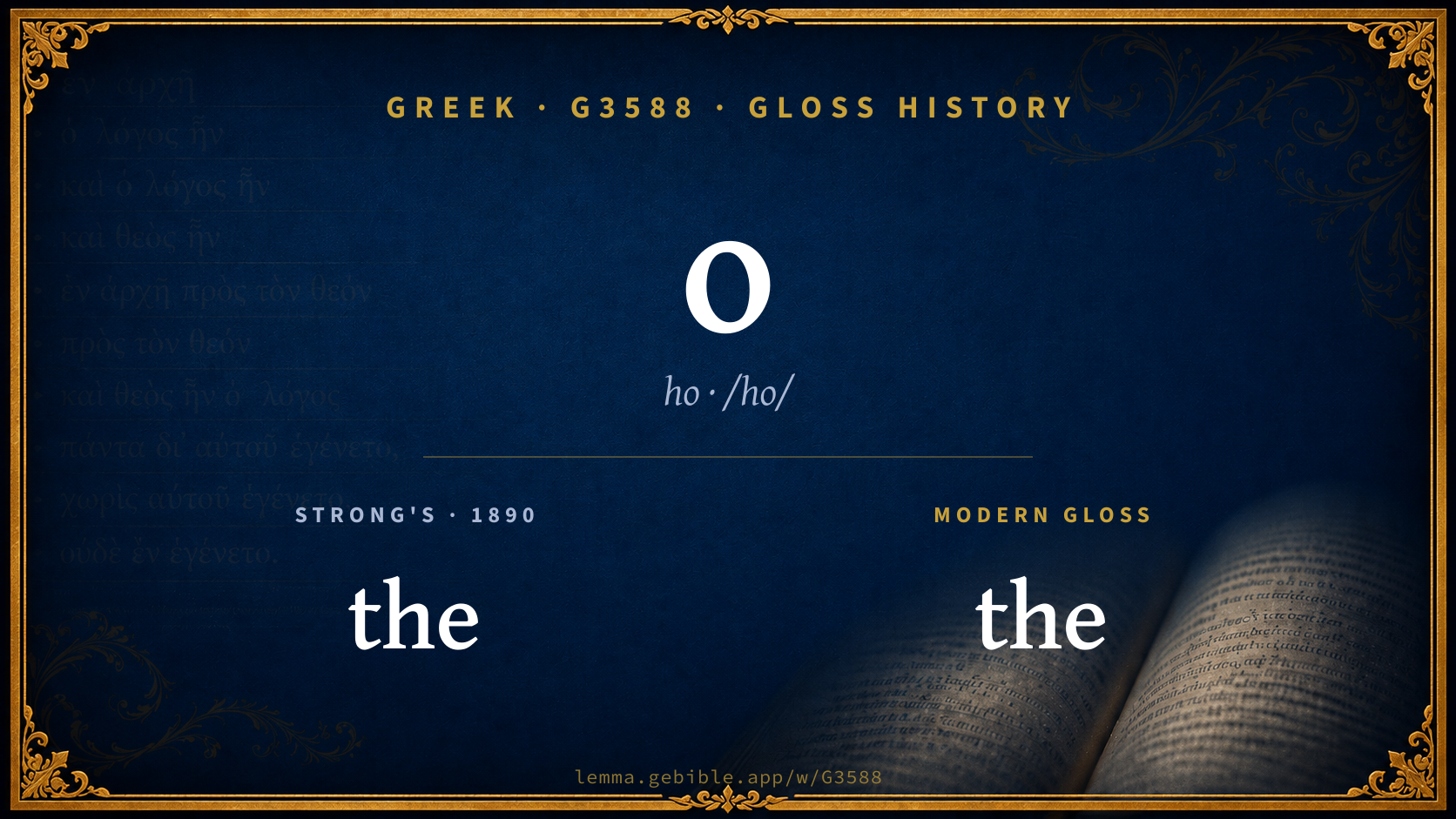
ο (ho) is a Greek word most often rendered “the.” Its English rendering has broadened — “which” classically, “the” (Berean Standard Bible) in modern versions; see the renderings breakdown. Spanning 6,958 verses in 27 books, it ranks among the most common words of the Greek New Testament. It first appears in Matthew 1:2. Related forms include τανυν, οδε and οιος. For the data behind this summary, explore the sense tree and the renderings breakdown below.
Gloss history
Strong's 1890 vs modern scholarship
About this word
Strong's G3588 catalogs a Greek word from the Greek New Testament.
These counts are not copied from any lexicon or concordance. They are computed here, from the morphology-tagged Greek New Testament. What Lemma adds →
- 6,958
- distinct verses
- The word appears in 6,958 distinct verses.
- 27 / 27
- NT books
- The word appears in 27 of 27 New Testament books.
- #1
- by frequency
- Most frequent Greek word — of 5,347 Greek words by occurrence.
View all 6,958 occurrences in the concordance →
By section of the New Testament
By traditional corpus
Conventional, traditional groupings — biblical authorship is debated, so this is a traditional corpus grouping, not an authorship claim. Some books belong to more than one corpus (Luke is in both the Gospels and the Lukan corpus, and so on), so these shares overlap and need not total 100%. Each figure is a share of the word’s 6,958 distinct verses.
- Gospels 3,366 verses · 48%
- Lukan (Luke–Acts) 1,951 verses · 28%
- Pauline corpus 1,635 verses · 23%
- Johannine 1,309 verses · 19%
- Revelation 386 verses · 6%
- General (Catholic) Epistles 371 verses · 5%
- Hebrews 263 verses · 4%
How translations render this word
Counts come from each version’s own published word-to-Strong’s tagging or interlinear alignment — an approximate guide to how each version renders this word, not a word-level alignment the data otherwise carries. Because each total is that version’s own tagged count, the per-version totals vary from one another and need not match the appearance or distinct-verse counts above. These counts may also differ from a printed concordance because Lemma counts each distinctly tagged rendering and does not collapse phrase taggings into a single head-word total. This is a fixed set of word-tagged versions (KJV, ASV, BSB, ULT) and does not change with the reading translation you choose elsewhere. Each version’s license is shown beside its name below (and on Sources).
- King James Version: Which 391×, Who 79×, Things 12×
- American Standard Version: That 206×, Who 79×, Which 73×
- Berean Standard Bible: The 7,625×, Who 563×, Of 346×
- unfoldingWord Literal Text: The 7,661×, God 966×, One 603×
King James Version Public Domain
Renders G3588 across 542 tagged occurrences — most commonly:
Plus other, less common renderings. Plus 22 renderings that appear only once — usually multi-word phrases or single function words the recovered tagging swept in, not distinct renderings. Not rendered by a distinct English word in 1 further occurrence.
American Standard Version Public Domain
Renders G3588 across 1,005 tagged occurrences — most commonly:
Plus other, less common renderings. Plus 68 renderings that appear only once — usually multi-word phrases or single function words the recovered tagging swept in, not distinct renderings. Not rendered by a distinct English word in 2 further occurrences.
Berean Standard Bible Public Domain
Renders G3588 across 9,912 tagged occurrences — most commonly:
Plus other, less common renderings. Plus 107 renderings that appear only once — usually multi-word phrases or single function words the recovered tagging swept in, not distinct renderings. Not rendered by a distinct English word in 9,622 further occurrences.
unfoldingWord Literal Text CC BY-SA 4.0
Renders G3588 across 20,796 tagged occurrences — most commonly:
Plus other, less common renderings. Plus 1,052 renderings that appear only once — usually multi-word phrases or single function words the recovered tagging swept in, not distinct renderings. Not rendered by a distinct English word in 3 further occurrences.
Senses in Thayer's
The 1 sense Thayer's distinguishes for this word, in lexicon order (not ranked by frequency or importance). The full entry — with sub-senses — is in the Lexicon Entry tab.
- this, that, these, etc.
Word origin
Origin: in all their inflections, the definite article
the masculine feminine (second) and neuter (third) forms in all their inflections; the definite article; the (sometimes to be supplied at others omitted in English idiom): - the this that one he she it etc.
— Strong’s Exhaustive Concordance (1890), public domain.
Forms in the corpus
The 42 distinct written forms G3588 takes in the Greek New Testament, most frequent first — each parse links to that case’s occurrences in the concordance.
Same root — word family
Other Thayer's entries built from the same root as G3588, grouped by Strong’s listed origin. These share a root / origin per the lexicon — not necessarily a shared meaning. Each links to that word’s own entry.
Derived from this word
- τανυν tanŷn G3569 present
- οδε hóde G3592 this
- οιος hoîos G3634 what sort of
- ος hós G3739 who
- ουτος hoûtos G3778 this
- σημερον sḗmeron G4594 this day
- ταυτα tautá G5024 thus
- τηλικουτος tēlikoûtos G5082 of such size
- τοι toí G5104 truly
- τοσουτος tosoûtos G5118 so great
- τοτε tóte G5119 then
- του toû G5120 his
- τουναντιον tounantíon G5121 on the contrary
- τουνομα toúnoma G5122 by name
Proper names from this root
People and places named from this root — a name, not an additional meaning of the word.
- θεος theós G2316 God
- ο ων και ο ην και ο ερχομενος ho ṑn kaí ho ēn kaí ho erchómenos G3801 He who is
Compare all same-root words → Showing 4 of 17 — not the complete family. 2 of the same-root words are proper names (people or places). They share a root, not necessarily a meaning.
Septuagint usage
The same Greek word ο appears 68,018 times in the Greek Old Testament (Septuagint), across 19,787 verses in 38 books.
- 68,018
- LXX occurrences
- Tagged occurrences of this Greek word in the Septuagint.
- 19,787
- verses
- Distinct Septuagint verses containing this word.
- 38 / 39
- OT books
- The word appears in 38 of the 39 Old Testament books.
Sample Septuagint occurrences
- Genesis 1:1 ὁ
- Exodus 1:1 ὁ
- Leviticus 1:1 ὁ
- Numbers 1:1 ὁ
- Deuteronomy 1:1 ὁ
- Joshua 1:1 ὁ
- Judges 1:1 ὁ
- Ruth 1:1 ὁ
- 1 Samuel 1:2 ὁ
- 2 Samuel 1:1 ὁ
- 1 Kings 1:1 ὁ
- 2 Kings 1:1 ὁ
Septuagint occurrences (same lexeme)
Every verse where the same Strong’s number (G3588) appears in the Greek Septuagint — showing the first 50 of 19,787. Verse text shown in the World English Bible for context; the Greek form is the matched word — the English is not keyword-highlighted.
- Genesis 1:1 ὁ In the beginning God created the heavens and the earth.
- Genesis 1:2 ὁ Now the earth was formless and empty. Darkness was on the surface of the deep. God's Spirit was hovering over the surface of the waters.
- Genesis 1:3 ὁ God said, "Let there be light," and there was light.
- Genesis 1:4 ὁ God saw the light, and saw that it was good. God divided the light from the darkness.
- Genesis 1:5 ὁ God called the light Day, and the darkness he called Night. There was evening and there was morning, one day.
- Genesis 1:6 ὁ God said, "Let there be an expanse in the midst of the waters, and let it divide the waters from the waters."
- Genesis 1:7 ὁ God made the expanse, and divided the waters which were under the expanse from the waters which were above the expanse, and it was so.
- Genesis 1:8 ὁ God called the expanse sky. There was evening and there was morning, a second day.
- Genesis 1:9 ὁ God said, "Let the waters under the sky be gathered together to one place, and let the dry land appear," and it was so.
- Genesis 1:10 ὁ God called the dry land Earth, and the gathering together of the waters he called Seas. God saw that it was good.
- Genesis 1:11 ὁ God said, "Let the earth put forth grass, herbs yielding seed, and fruit trees bearing fruit after their kind, with its seed in it, on the earth," and it was so.
- Genesis 1:12 ὁ The earth brought forth grass, herbs yielding seed after their kind, and trees bearing fruit, with its seed in it, after their kind: and God saw that it was good.
- Genesis 1:14 ὁ God said, "Let there be lights in the expanse of sky to divide the day from the night; and let them be for signs, and for seasons, and for days and years;
- Genesis 1:15 ὁ and let them be for lights in the expanse of sky to give light on the earth," and it was so.
- Genesis 1:16 ὁ God made the two great lights: the greater light to rule the day, and the lesser light to rule the night. He also made the stars.
- Genesis 1:17 ὁ God set them in the expanse of sky to give light to the earth,
- Genesis 1:18 ὁ and to rule over the day and over the night, and to divide the light from the darkness. God saw that it was good.
- Genesis 1:20 ὁ God said, "Let the waters swarm with swarms of living creatures, and let birds fly above the earth in the open expanse of sky."
- Genesis 1:21 ὁ God created the large sea creatures, and every living creature that moves, with which the waters swarmed, after their kind, and every winged bird after its kind. God saw that it was good.
- Genesis 1:22 ὁ God blessed them, saying, "Be fruitful, and multiply, and fill the waters in the seas, and let birds multiply on the earth."
- Genesis 1:24 ὁ God said, "Let the earth bring forth living creatures after their kind, cattle, creeping things, and animals of the earth after their kind," and it was so.
- Genesis 1:25 ὁ God made the animals of the earth after their kind, and the cattle after their kind, and everything that creeps on the ground after its kind. God saw that it was good.
- Genesis 1:26 ὁ God said, "Let us make man in our image, after our likeness: and let them have dominion over the fish of the sea, and over the birds of the sky, and over the cattle, and over all the earth, and over every creeping thing that creeps on the earth."
- Genesis 1:27 ὁ God created man in his own image. In God's image he created him; male and female he created them.
- Genesis 1:28 ὁ God blessed them. God said to them, "Be fruitful, multiply, fill the earth, and subdue it. Have dominion over the fish of the sea, over the birds of the sky, and over every living thing that moves on the earth."
- Genesis 1:29 ὁ God said, "Behold, I have given you every herb yielding seed, which is on the surface of all the earth, and every tree, which bears fruit yielding seed. It will be your food.
- Genesis 1:30 ὁ To every animal of the earth, and to every bird of the sky, and to everything that creeps on the earth, in which there is life, I have given every green herb for food." And it was so.
- Genesis 1:31 ὁ God saw everything that he had made, and, behold, it was very good. There was evening and there was morning, the sixth day.
- Genesis 2:1 ὁ The heavens and the earth were finished, and all the host of them.
- Genesis 2:2 ὁ On the seventh day God finished his work which he had made; and he rested on the seventh day from all his work which he had made.
- Genesis 2:3 ὁ God blessed the seventh day, and made it holy, because he rested in it from all his work which he had created and made.
- Genesis 2:4 ὁ This is the history of the generations of the heavens and of the earth when they were created, in the day that Yahweh God made earth and the heavens.
- Genesis 2:5 ὁ No plant of the field was yet in the earth, and no herb of the field had yet sprung up; for Yahweh God had not caused it to rain on the earth. There was not a man to till the ground,
- Genesis 2:6 ὁ but a mist went up from the earth, and watered the whole surface of the ground.
- Genesis 2:7 ὁ Yahweh God formed man from the dust of the ground, and breathed into his nostrils the breath of life; and man became a living soul.
- Genesis 2:8 ὁ Yahweh God planted a garden eastward, in Eden, and there he put the man whom he had formed.
- Genesis 2:9 ὁ Out of the ground Yahweh God made every tree to grow that is pleasant to the sight, and good for food; the tree of life also in the midst of the garden, and the tree of the knowledge of good and evil.
- Genesis 2:10 ὁ A river went out of Eden to water the garden; and from there it was parted, and became four heads.
- Genesis 2:11 ὁ The name of the first is Pishon: this is the one which flows through the whole land of Havilah, where there is gold;
- Genesis 2:12 ὁ and the gold of that land is good. There is aromatic resin and the onyx stone.
- Genesis 2:13 ὁ The name of the second river is Gihon: the same river that flows through the whole land of Cush.
- Genesis 2:14 ὁ The name of the third river is Hiddekel: this is the one which flows in front of Assyria. The fourth river is the Euphrates.
- Genesis 2:15 ὁ Yahweh God took the man, and put him into the garden of Eden to dress it and to keep it.
- Genesis 2:16 ὁ Yahweh God commanded the man, saying, "Of every tree of the garden you may freely eat:
- Genesis 2:17 ὁ but of the tree of the knowledge of good and evil, you shall not eat of it: for in the day that you eat of it you will surely die."
- Genesis 2:18 ὁ Yahweh God said, "It is not good that the man should be alone; I will make him a helper suitable for him."
- Genesis 2:19 ὁ Out of the ground Yahweh God formed every animal of the field, and every bird of the sky, and brought them to the man to see what he would call them. Whatever the man called every living creature, that was its name.
- Genesis 2:20 ὁ The man gave names to all cattle, and to the birds of the sky, and to every animal of the field; but for man there was not found a helper suitable for him.
- Genesis 2:21 ὁ Yahweh God caused a deep sleep to fall on the man, and he slept; and he took one of his ribs, and closed up the flesh in its place.
- Genesis 2:22 ὁ He made the rib, which Yahweh God had taken from the man, into a woman, and brought her to the man.
These are occurrences of the same Greek lexeme (G3588) in the Septuagint — not a translation of any one Hebrew word. The store carries no word-level Hebrew↔Greek alignment, so no Hebrew original is asserted here. Counts come from the recovered LXX Strong's tagging — high-frequency vocabulary is well covered, while rare or late forms may be untagged — so they reflect tagged occurrences and may slightly undercount.