
Acts 26:4

Greek (Tischendorf 8th ed.) Acts 26:4 appears in the Greek New Testament. The text above is from the Tischendorf 8th edition. Each word links to its Strong’s number and a concise gloss. Click any word for its full Thayer’s Greek Lexicon entry.
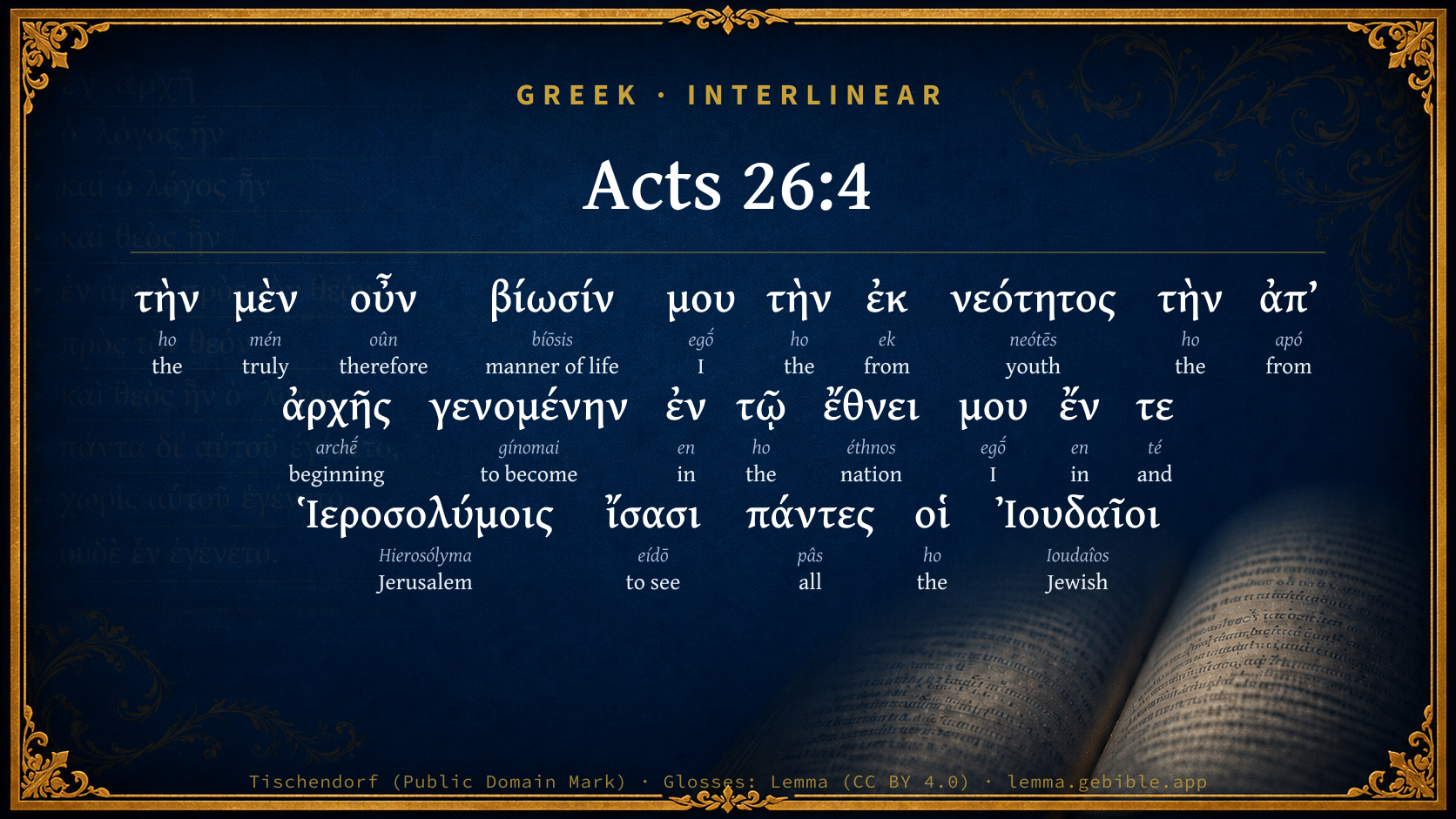
Download image
Cite this verse

Acts 26:4 (World English Bible). Public Domain. Lemma interlinear Bible study tool, https://lemma.gebible.app/v/acts/26/4.

Show BibTeX & RIS
BibTeX
RIS
English Translation
"Indeed, all the Jews know my way of life from my youth up, which was from the beginning among my own nation and at Jerusalem;
World English Bible · Public Domain
Highlights
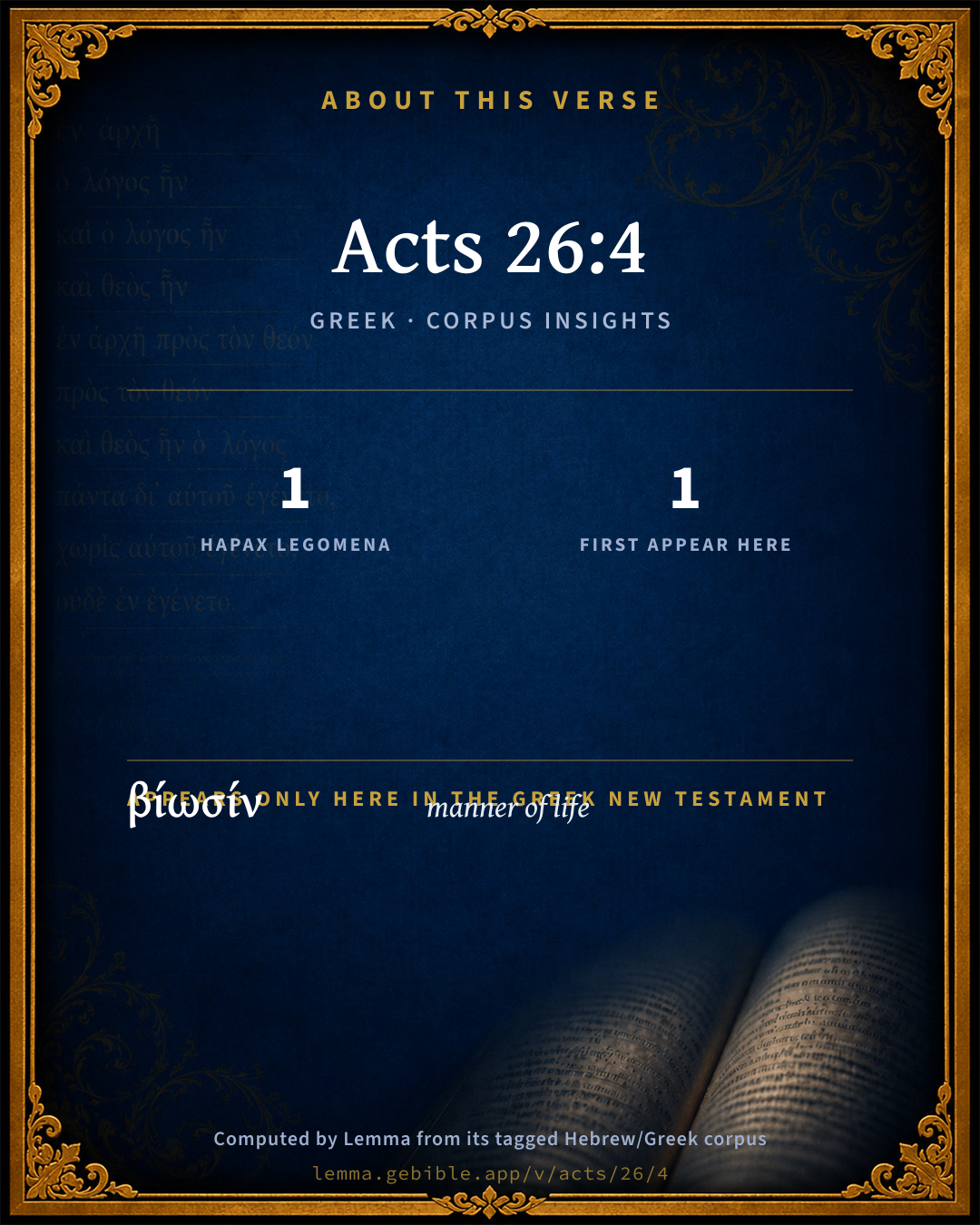
  • 1 hapax legomenon — only here in the Greek New Testament
  • 1 first appearance in the Greek New Testament
Full analysis ↓
Download a study sheet

One document with this verse’s original text, its word-by-word gloss line, the meaning frame, cross-references with their text, attributed commentary, and full source and license credits — printable, and it pastes into notes with its structure intact.

This verse Autodidact and up

Study sheet (.html) Plain text (.txt)

A passage Seminary Student

Up to 50 verses in one chapter. A passage sheet keeps up to 6 commentary sources and 12 cross-references per verse, in the order this page ranks them, and says so on the sheet whenever that leaves anything out. Ask for a single verse and you get the Autodidact verse sheet above.

Everything on this page stays free to read, with no account — the sheet is a download of what is already on screen, not access to it.

Want to remove ads? Support Godless Engineer
Compare translations 3

The same verse in 3 English versions, stacked beneath the original-language interlinear above. Click any original word for its lexicon entry.

Each is an independent rendering of the whole verse — the interlinear is not word-aligned to these translations.

Highlighted words mark where these versions differ — a whole-verse word diff, not a word-by-word alignment.

  • World English Bible Public Domain
    "Indeed, all the Jews know my way of life from my youth up, which was from the beginning among my own nation and at Jerusalem;
  • King James Version Public Domain
    My manner of life from my youth, which was at the first among mine own nation at Jerusalem, know all the Jews;
  • unfoldingWord Literal Text CC BY-SA 4.0
    Indeed, then, all the Jews know the manner of my life from my youth, having happened from the beginning in my nation and in Jerusalem,

unfoldingWord Literal Text — © unfoldingWord, licensed CC BY-SA 4.0. Word-aligned USFM3 via Door43 (git.door43.org/unfoldingWord/en_ult).

Versions to compare (up to 4)

3 of 4 selected

Show all 19 translations

Every available English version of this verse, each an independent rendering of the whole verse.

  • World English Bible Public Domain
    "Indeed, all the Jews know my way of life from my youth up, which was from the beginning among my own nation and at Jerusalem;
  • Berean Standard Bible Public Domain
    Surely all the Jews know how I have lived from the earliest days of my youth, among my own people and in Jerusalem.
  • Majority Standard Bible Public Domain
    Surely all the Jews know how I have lived from my earliest childhood among my own people in Jerusalem.
  • King James Version Public Domain
    My manner of life from my youth, which was at the first among mine own nation at Jerusalem, know all the Jews;
  • American Standard Version (1901) Public Domain
    My manner of life then from my youth up, which was from the beginning among mine own nation and at Jerusalem, know all the Jews;
  • Revised Version (1885) Public Domain
    My manner of life then from my youth up, which was from the beginning among mine own nation, and at Jerusalem, know all the Jews;
  • Geneva Bible (1599) Public Domain
    As touching my life from my childhood, and what it was from the beginning among mine owne nation at Hierusalem, know all the Iewes,
  • Douay-Rheims (1899) Public Domain
    And my life indeed from my youth, which was from the beginning among my own nation in Jerusalem, all the Jews do know:
  • Young's Literal Translation Public Domain
    `The manner of my life then, indeed, from youth -- which from the beginning was among my nation, in Jerusalem -- know do all the Jews,
  • Literal Standard Version CC BY-SA 4.0
    The manner of my life then, indeed, from youth—which from the beginning was among my nation, in Jerusalem—all the Jews know,
  • Unlocked Literal Bible CC BY-SA 4.0
    Truly, all the Jews know how I lived from my youth in my own nation and at Jerusalem.
  • unfoldingWord Literal Text CC BY-SA 4.0
    Indeed, then, all the Jews know the manner of my life from my youth, having happened from the beginning in my nation and in Jerusalem,
  • Darby Bible Public Domain
    My manner of life then from my youth, which from its commencement was passed among my nation in Jerusalem, know all the Jews,
  • World Messianic Bible Public Domain
    “Indeed, all Jews know my way of life from my youth up, which was from the beginning among my own nation and at Jerusalem;
  • Webster's Bible Public Domain
    My manner of life from my youth, which was at the first among my own nation at Jerusalem, know all the Jews,
  • Free Bible Version CC BY-SA 4.0
    All the Jews know my life story—from my earliest days beginning in my own country and then in Jerusalem.
  • Bible in Basic English Public Domain
    All the Jews have knowledge of my way of life from my early years, as it was from the start among my nation, and at Jerusalem;
  • Text-Critical English NT CC BY 4.0
    “All the Jews know about my manner of life from my youth up, which was spent from the beginning among my own nation in Jerusalem.
  • Tyndale New Testament (1534) Public Domain
    My lyvynge of a chylde which was at the fyrst amonge myne awne nacion at Ierusalem knowe all the Iewes

Literal Standard Version (2020), Covenant Press — licensed CC BY-SA 4.0. Text via the HelloAO Bible API (eBible.org). Unlocked Literal Bible (unfoldingWord) — licensed CC BY-SA 4.0. Text via the HelloAO Bible API (eBible.org). unfoldingWord Literal Text — © unfoldingWord, licensed CC BY-SA 4.0. Word-aligned USFM3 via Door43 (git.door43.org/unfoldingWord/en_ult). Free Bible Version, Dr. Jonathan Gallagher — licensed CC BY-SA 4.0. Text via the HelloAO Bible API (eBible.org).

Word by word

More ways to search: Search by grammar → Find every occurrence → Compare this word →

Practice this passage: Drill this verse → Learn its vocabulary →

βίωσίν
bíōsis
G981
“manner of life”
Noun, Accusative, Singular, Feminine
Part of Speech
Noun
Case
Accusative
Number
Singular
Gender
Feminine
Full Thayer's Definition

Origin: from G980

TDNT: None

1. manner of living and acting, way of life
  1. τὴν ho G3588 “the” Article, Accusative, Singular, Feminine
  2. μὲν mén G3303 “truly” Particle
  3. οὖν oûn G3767 “therefore” Conjunction
  4. μου egṓ G1473 “I” Personal pronoun, 1st person, Genitive, Singular
  5. τὴν ho G3588 “the” Article, Accusative, Singular, Feminine
  6. ἐκ ek G1537 “from” Preposition
  7. νεότητος neótēs G3503 “youth” Noun, Genitive, Singular, Feminine
  8. τὴν ho G3588 “the” Article, Accusative, Singular, Feminine
  9. ἀπ’ apó G575 “from” Preposition
  10. ἀρχῆς archḗ G746 “beginning” Noun, Genitive, Singular, Feminine
  11. γενομένην gínomai G1096 “to become” Verb, Aorist, Middle deponent, Participle, Accusative, Singular, Feminine
  12. ἐν en G1722 “in” Preposition
  13. τῷ ho G3588 “the” Article, Dative, Singular, Neuter
  14. ἔθνει éthnos G1484 “nation” Noun, Dative, Singular, Neuter
  15. μου egṓ G1473 “I” Personal pronoun, 1st person, Genitive, Singular
  16. ἔν en G1722 “in” Preposition
  17. τε té G5037 “and” Particle
  18. Ἱεροσολύμοις Hierosólyma G2414 “Jerusalem” Noun, Dative, Plural, Neuter
  19. ἴσασι eídō G1492 “to see” Verb, Perfect, Active, Indicative, 3rd person, Plural
  20. πάντες pâs G3956 “all” Adjective, Nominative, Plural, Masculine
  21. οἱ ho G3588 “the” Article, Nominative, Plural, Masculine
  22. Ἰουδαῖοι Ioudaîos G2453 “Jewish” Adjective, Nominative, Plural, Masculine

About this verse

These counts appear in no published source. They are computed here, from the morphology-tagged text and Lemma’s own curated glosses. What Lemma adds →

23
words
17
distinct lemmas
Acts
section

Notable vocabulary

1 hapax legomenon — a word that appears only here in the entire Greek New Testament:

  • βίωσίν manner of life G981

First appearance in Scripture

This word makes its first canonical appearance in the Greek New Testament here:

  • βίωσίν manner of life G981

Shared distinctive vocabulary

νεότητος youth G3503 occurs in 4 verses of the Greek New Testament. Also found in:
Repetition

Words recur within this verse:

Cross-references

4

Topical passages linked to Acts 26:4 in the Treasury of Scripture Knowledge — connected by theme and wording, ordered by reader-vote popularity; previews shown in the World English Bible.

  • Galatians 1:13 For you have heard of my way of living in time past in the Jews' religion, how that beyond measure I persecuted the assembly of God, and ravaged it.
  • Acts 22:3 "I am indeed a Jew, born in Tarsus of Cilicia, but brought up in this city at the feet of Gamaliel, instructed according to the strict manner of the law of our fathers, being zealous for God, even as you all are this day.
  • Philippians 3:5 circumcised the eighth day, of the stock of Israel, of the tribe of Benjamin, a Hebrew of Hebrews; concerning the law, a Pharisee;
  • 2 Timothy 3:10 But you did follow my teaching, conduct, purpose, faith, patience, love, steadfastness,

Cross-references courtesy of OpenBible.info (CC BY 4.0).

Commentary

Notes on Acts 26:4 from classic Christian and Jewish commentators (each source and its license shown beneath its notes). The classic Christian expositions comment on the surrounding passage and are grouped to its opening verse, so a note may address several verses; the Jewish commentaries on the Tanakh (Rashi and others) are per-verse, so they appear only where the commentator wrote on this verse.

Lemma curates 59 commentaries, every one of them public domain or Creative Commons licensed, each selected and text-cleaned for this edition rather than reprinted as found. About our sources →

Joseph Benson's Commentary

Act 26:4-7. My manner of life from my youth, which was at first — Την απ’ αρχης, which from the beginning, that is, from the beginning of my youth; was among mine own nation at Jerusalem — He was not born among the Jews at Jerusalem, but he was bred among them. And though he had of late years been conversant with the Gentiles, which had given great offence to the Jews, yet, at his setting out in the world, he was intimately acquainted with the Jewish nation, and entirely in their interests. His education was neither foreign nor obscure; it was among his own people at Jerusalem, where religion and learning flourished; as was well known to all the Jews there, for he had made himself remarkable betimes. Who knew me from the beginning — Of my education, under that celebrated master, Gamaliel; if they would testify — But they would not, for they well knew what weight his former life must add to his present testimony; that after the most straitest — That is, the strictest, sect of our religion, I lived a Pharisee — Observing all the rules enjoined among them, respecting every thing that relates not only to the written law of God, but likewise the traditions of the fathers. And now I stand and am judged — Not for any crime that I have committed; but for the hope of the promise made unto our fathers — The promise of a resurrection to eternal life and happiness, by means of the Messiah, that is, of the resurrection of Christ; and of all the dead, in consequence of his resurrection. So the case was in reality; for unless Christ had risen, there could have been no resurrection of the dead. And it was chiefly for bearing witness to the resurrection of Christ, that the Jews still persecuted him. Unto which promise our twelve tribes — So he speaks: for a great part of the ten tribes, which had been carried captive into Assyria by Shalmaneser, (see 2 Kings 17.,) had, at various times, returned from the East (as well as the remains of the two tribes, Judah and Benjamin, from Babylon) to their own country; Jas 1:1; 1Pe 1:1. Instantly serving — Or worshipping God, day and night — That is, continually, or in the stated and constant performance of their morning and evening devotions, whether in the temple or in other places, in which they present their prayers; hope to come — To attain that resurrection and eternal life; that is, this is what they aim at in all their public and private worship: and by the expectation they have of it, they are animated in all their labours and sufferings for religion. For which hope’s sake — Reasonable and glorious as it is; I am accused of the Jews — The doctrine which I preach containing the fullest assurance and demonstration of a resurrection that ever was given to the world. And it is this that provokes those of mine enemies, who disbelieve it, to prosecute me with so much malice.

Joseph Benson's Commentary on the Old and New Testaments (1811–1818) — public domain. Text from a community e-Sword module.

Bengel's Gnomon

Johann Albrecht Bengel

Act 26:4. Μὲν οὖν) Οὖν makes an addition to the discussion: μὲν, when δὲ does not follow, softens the language; Act 26:9. This narrative has in it great ἐνάργεια, distinctness.—βίωσιν, my manner of life) mode of action in life.—τὴν ἐκ νεότητος, τὴν ἀπʼ ἀρχῆς, which was from my youth, which was from the beginning) that is, from the beginning of my youth. So ἄνωθεν, from the first, in the foll. verse.

Bengel's Gnomon of the New Testament — English translation (T&T Clark, Edinburgh, 1860) — public domain. Text from a community e-Sword module.

Meyer's Critical & Exegetical Commentary

Heinrich August Wilhelm Meyer

Act_26:4-5. Μὲν οὖν] introduces, in connection with the preceding exordium, the commencement now of the defence itself. See Bäumlein, Partik. p. 181.

βίωσιν] manner of life. Ecclus. Praef. 1, Symm. Psa_38:6. Not preserved in Greek writers.

τὴν ἀπʼ ἀρχῆς … Ἱεροσ.] a significant epexegesis of τὴν ἐκ νεότητος, for the establishment of the following ἴσασι κ.τ.λ.

προγινώσκοντες … Φαρισαῖος] my manner of life … know all Jews, since they knew me from the outset (since the first time of my becoming known)namely, that I, according to the strictest (Act_22:3) sect of our religion (θρησκείας), have lived as Pharisee. This Φαρισαῖος, calling that ἀκριβ. αἵρεσιν by its name, stands with great emphasis at the close. Notice generally the intentional definiteness with which Paul here describes all the circumstances of the case, to which belongs also the emphatic repetition of τήν (see Bornemann in loc.).

In προγινώσκ., προ, before, contains the same conception, which is afterwards still more definitely denoted by ἄνωθεν. They knew Paul earlier than merely since the present encounter, and that indeed ἄνωθεν, from the beginning (Luk_1:3), which therefore, as it refers to the knowing, and not to ἔζησα, may not be explained: from my ancestors (Beza).

ἐὰν θέλωσι μαρτυρεῖν] if they do not conceal or deny, but are willing to testify it. Nolebat autem, quia persentiscebant, in conversione Pauli, etiam respectu vitae ante actae, efficacissimum esse argumentum pro veritate fidei Christianae, Bengel. Comp. Act_22:19 f.

Meyer — Critical and Exegetical Commentary on the New Testament — English translation by Peter Christie, edited by Frederick Crombie (T&T Clark, 1880) — public domain. Text from a community e-Sword module.

Expositor's Greek Testament

ed. W. Robertson Nicoll

Act 26:4 . μὲν οὖν : with no formal antithesis, but as marking the opposition between his present and former mode of life, a contrast dropped for the moment, and resumed again in Act 26:9 ; see Rendall, Appendix on μέν οὖν , but also Page, in loco , and notes below on Act 26:9 . βίωσιν : vivendi et agendi ratio , Grimm; cf. the same word used in the description of a life very similar to that of Paul before he became a Christian, Ecclus., Prol. , 12, διὰ τῆς ἐννόμου βιώσεως (Symm., Psa 38 (39):6). νεότητος , 1Ti 4:12 , only elsewhere in N.T. in Luk 18:21 , and in parallel passage, Mar 10:20 , in LXX Gen 43:33 , Job 31:18 , etc. From its use with reference to Timothy it is evident that the word did not imply the earliest years of life, and although Paul may probably have removed to Jerusalem at an early age, the context does not require a reference to the years he had lived before his removal. τὴν ἀπʼ ἀρχῆς γεν .: explanatory of preceding, the commencement of his training, which was not only amongst his own nation, but also specially τε , at Jerusalem, cf. Act 22:3 . The Apostle presses the point to show that he was most unlikely to act in violation of Jewish feeling he is still a Jew. ἴσασι : only here in N.T., perhaps a conscious classicism, Simcox, Language of the N.T. , p. 33; on the classical forms in this speech see Blass, Proleg. , p. 14, and Gram. , p. 49, and especially p. 5, Philology of the Gospels , p. 9. These literary forms are what we should have expected the Apostle to employ before an audience so distinguished. Ἰουδαῖοι : Blass gives a further reason for the omission of article, “abest ut 2, 3, 7, 21, sec. usum Atticorum, cf. Act 17:21 ”.

The Expositor's Greek Testament, edited by W. Robertson Nicoll (1897–1910) — public domain. Text from a community e-Sword module.

Geneva Bible (1599)

Geneva Bible translators

Paul divideth the history of his life into two times: for the first [he] calleth his adversaries witnesses: for the latter, the fathers and prophets.

Geneva Bible (1599) marginal notes — public domain. Text via Bolls.life.

Jamieson, Fausset & Brown

Robert Jamieson, A. R. Fausset & David Brown

from my youth, which was at the first . . . at Jerusalem, know all the Jews; which knew me from the beginning--plainly showing that he received his education, even from early youth, at Jerusalem. See on Act 22:3.

Jamieson, Fausset & Brown — Commentary Critical and Explanatory on the Whole Bible (1871) — public domain (CC PDM 1.0). Text via the HelloAO Bible API.

Adam Clarke's Commentary

Verse 4. My manner of life, c.] The apostle means to state that, though born in Tarsus, he had a regular Jewish education, having been sent up to Jerusalem for that purpose but at what age does not appear; probably about twelve, for at this age the male children were probably brought to the annual solemnities. See Clarke on Lu 2:41.

Adam Clarke's Commentary on the Bible (1810–1826) — public domain. Text from a community e-Sword/MySword module.

John Calvin's Commentaries

4. My life which I have led. He doth not as yet enter into the state of the cause; but because he was wrongfully accused and burdened with many crimes, lest king Agrippa should envy the cause through hatred of the person, he doth first avouch his innocency. For we know that when a sinister suspicion hath once possessed the minds of men, all their senses are so shut up that they can admit nothing. Therefore, Paul doth first drive away the clouds of an evil opinion which were gathered of false reports, that he may be heard of pure and well purged ears. By this we see that Paul was enforced by the necessity of the cause to commend his life which he had led before. But he standeth not long upon that point, but passeth over straightway unto the resurrection of the dead, when he saith that he is a Pharisee. And I think that that is called the most strait sect, not in respect of holiness of life, but because there was in it more natural sincerity of doctrine, and greater learning. For they did boast that they knew the secret meaning of the Scripture. And surely forasmuch as the Sadducees did vaunt that they did stick to the letter, they fell into filthy and gross ignorance after they had darkened the light of the Scripture. The Essenes, contenting themselves with an austere and strait kind of life, did not greatly care for doctrine. Neither doth that any whit hinder, because Christ inveigheth principally against the Pharisees, as being the worst corrupters of the Scripture (Matthew 23:13). For seeing they did challenge to themselves authority to interpret the Scripture according to the hidden and secret meaning, hence came that boldness to change and innovate, wherewith the Lord is displeased. But Paul doth not touch those inventions which they had rashly invented, and which they urged with tyrannous rigor. For it was his purpose to speak only of the resurrection of the dead. For though they had corrupted the law in many points, yet it was meet that the authority of that sect should be of more estimation in defending the sound and true faith, than of the other, which were departed farther from natural purity. Moreover, Paul speaketh only of the common judgment, which did respect the color of more subtile knowledge.

John Calvin's Commentaries (1540-1563) — public domain. Text from the Calvin Translation Society English edition (1840s-50s) via the Christian Classics Ethereal Library (ccel.org). Calvin's coverage is partial (roughly two-thirds of the Bible); uncommented books and verses are honest gaps, never fabricated. The 19th-century editor's footnotes and remarks are omitted so the notes are faithfully Calvin's own voice.

Ellicott's Commentary for English Readers

(4) My manner of life from my youth.—The Apostle refers, of course, to the time when he first came up to Jerusalem to study the Law and the traditions at the fees, of Gamaliel. (Comp. his account of the same period in Gal_1:14; Php_3:5-6.)

Know all the Jews.—The noun seems to be used in its more limited meaning, as including chiefly, if not exclusively, the Jews of Judæa.

A Bible Commentary for English Readers, edited by Charles John Ellicott (1878–1897) — public domain. Text from a community e-Sword module.

The Cambridge Bible for Schools and Colleges

gen. ed. J. J. S. Perowne

4. at the first] Better (with Rev. Ver.) “from the beginning.” The Apostle though born in Tarsus yet came early to Jerusalem for his education, and it was in the Holy City that his character was formed and his manner of life shewed itself.

among mine own nation at Jerusalem] The oldest MSS. say “and at Jerusalem.” This would imply that even before coming to Jerusalem, the Apostle had always dwelt among his own people, and so was not likely to be one who would undervalue Jewish privileges or offend against Jewish prejudices.

know all the Jews] Because in the persecution of the Christians he had made himself a conspicuous character, had been in favour with the chief priests and allowed to undertake the mission to Damascus.

The Cambridge Bible for Schools and Colleges (gen. ed. J. J. S. Perowne; Cambridge University Press, 1878–1918) — public domain. Text from a community e-Sword module.

John Gill's Exposition

My manner of life, from my youth,.... That is, his conduct and deportment, his behaviour among men, from the time that he was capable of performing religious exercises, and of knowing the difference between one sect and another, and of being observed and taken notice of by men:

which was at the first among mine own nation at Jerusalem; for though he was born in Tarsus in Cilicia, he was very early brought, or sent by his parents to Jerusalem, where he had his education under Gamaliel; so that the first part of his life was spent in Jerusalem, the metropolis of Judea, and among the Jews there; the more learned and knowing part of them, Gamaliel's pupils, and the wise men and their disciples: and his course of life must be well known to them, as he says,

this know all the Jews; that had any knowledge of him, and conversation with him.

John Gill's Exposition of the Whole Bible (1746–1763) — public domain (CC PDM 1.0). Text via the HelloAO Bible API.

Trapp's Complete Commentary

John Trapp

4 My manner of life from my youth, which was at the first among mine own nation at Jerusalem, know all the Jews;

Ver. 4. My manner of life from my youth] And although with some, Principium fervet, medium leper, exitus alget, their best is at first, as Nero (who now reigned at Rome) for his first five years was very hopeful; yet that is not ordinary. A good beginning hath for the most part a good ending, and a young saint proves an old angel.

John Trapp, A Commentary or Exposition upon All the Books of the Old and New Testament (1647–1656) — public domain. Text from a community e-Sword module.

Albert Barnes' Notes on the Bible

My manner of life - My opinions, principles, and conduct.

From my youth - Paul was born in Tarsus; but at an early period he had been sent to Jerusalem for the purpose of education in the school of Gamaliel, Act 22:3.

Which was at the first - Which was from the beginning; the early part of which; the time when the opinions and habits are formed.

Know all the Jews - It is not at all improbable that Paul was distinguished in the school of Gamaliel for zeal in the Jewish religion. The fact that he was early entrusted with a commission against the Christians Acts 9 shows that he was known. Compare Phi 3:4-6. He might appeal to them, therefore, in regard to the early part of his life, and, doubtless, to the very men who had been his violent accusers.

Albert Barnes' Notes on the Bible (1834–1885) — public domain. Text from a community e-Sword/MySword module.

Matthew Poole's English Annotations

Paul appeals to his enemies, the Jews themselves, whether they could tax him with any enormity whilst he was of their persuasion; whereby he vindicates his holy religion from being the sink and offscouring of other religions, as some would make it; as also to intimate, that it was his religion which made him so hateful unto them, and not any ill practices done by him.

Matthew Poole's English Annotations on the Holy Bible (1683–1685) — public domain. Text from a community e-Sword/MySword module.

The Pulpit Commentary

Then from my youth up for for my youth. A.V.; from the beginning for at the first. A.V.; and at for at, A.V. and T.R. My manner of life, etc. The same testimony of a good conscience as that in Act_23:1 and Act_24:16. The word biwsiv occurs only here in the New Testament. But we find the phrase, thv ejnnomou biwsewv, "the manner of life according to the Law," in the Prologue to Ecclesiasticus and in Symmachus, (Psa_38:6) though not in classical Greek. The verb biow occurs in 1Pe_4:2, and not infrequently in the LXX From my youth up, which was from the beginning among my own nation, etc., having knowledge of me from the first (in ver. 5). No appeal could be stronger as to the notoriety of his whole life spent in the midst of his own people, observed and known of all. The T.R. implies that his youth was spent at Jerusalem, according to what he himself tells us in Act_22:3. The R.T. does so less distinctly. (For St. Paul"s account of his early Pharisaism, comp. Gal_1:13, Gal_1:14; Php_3:5, 6)

The Pulpit Commentary (1880–1919), ed. H.D.M. Spence-Jones & Joseph S. Exell — public domain. Text from a community e-Sword module.

John Wesley's Explanatory Notes

From my youth, which was from the beginning - That is, which was from the beginning of my youth.

John Wesley, Explanatory Notes Upon the Whole Bible (1754–1765) — public domain. Text via the GEBible commentary corpus.

Kretzmann's Popular Commentary

Paul E. Kretzmann

v. 4. My manner of life from my youth, which was at the first among mine own nation at Jerusalem, know all the Jews;

v. 5. which knew me from the beginning, if they would testify, that after the most straitest sect of our religion I lived a Pharisee.

v. 6. and now I stand and am judged for the hope of the promise made of God unto our fathers,

v. 7. unto which promise our twelve tribes, instantly serving God day and night, hope to come. for which hope’s sake, King Agrippa, I am accused of the Jews.

v. 8. Why should it be thought a thing incredible with you that God should raise the dead?

Early in life, at the beginning of the period of his youth, Paul had come to Jerusalem. And his manner of living, the habits of his life, how he comported himself in every way: all this, since it had taken place from the very beginning of his formal education, from his early youth, in the midst of his nation and in Jerusalem itself, all the Jews knew and were familiar with, for they knew him before and from the beginning. If they would but choose to testify, they might say the truth, that in accordance with the most severe sect, the strictest body of men in their own midst (Paul here includes himself and Agrippa with the Jews), he lived the principles. followed the religious cult, as a Pharisee. The point which the apostle here makes is that he was most unlikely to violate the Jewish feeling, for their customs were inbred and ingrained in him. and according to the strictest interpretation at that. And now, with his whole life before the people like an open book and with his thorough Jewish training as an argument for his orthodoxy. he stood condemned on account of his hope in the promise made by God to the fathers. For that he was on trial in the Roman court, for that he was condemned by the Jews. And yet the twelve tribes of Israel together hoped to gain, to attain to, this same promise by a service in all intentness both by night and by day; regarding which hope he was being accused by Jews. as he emphatically declares to the king. That was to Paul the strangest feature of the whole affair, that Jews could be so blind as to deny their own teaching and belief in the attempt to do him harm. It causes him to cry out: Why is it considered incredible by you that God should raise the dead? Why should they oppose it with all the force of unbelief if God raises the dead? This puzzled question might well be repeated in our days concerning this greatest truth of revealed religion, the fact upon which the Christian religion is based. The opposition of the unbelievers results in their losing the most glorious assurance that may come to man, and we cannot see their reason for such obstinacy.

Paul E. Kretzmann, Popular Commentary of the Bible (1921–1924) — public domain. Text from a community e-Sword module.

Burkitt's Expository Notes on the New Testament

William Burkitt

Here the apostle begins his defence, with a relation of the innocency and strictness of his life before his conversion: he did and could appeal to all that knew him, concerning the unblamableness of his conversion.

Thence note, That an innocent and blameless life from our youth upwards, is a singular support and encouragement to us in a suffering hour, especially when we are called forth to suffer for religion and righteousness’ sake.

Observe farther, The instance which the apostle gives of his strictness in religion: After the most straitest sect of our religion I lived a Pharisee. Of all the sects among the Jews, there was none that took up such an extraordinary strict way of religion as the Pharisees; of this sect was St. Paul, before converted to Christianity, and in this he rested for salvation.

Thence learn, 1. That an extraordinary strict way taken up in religion, is thought by many a sure and sufficient foundation for their eternal salvation.

Learn, 2. That many may rest upon a strict way of religion, which yet cometh not up to, but is oft-times besides, the appointment of the word of God.

The Pharisees, for their unusual and supererogating way of exactness, concluded that they should certainly go to heaven, if any did; when, alas! many things which they practised with extraordinary zeal and strictness, were never required by God at their hands.

William Burkitt's Expository Notes on the New Testament (1700–1703) — public domain. Text from a community e-Sword module.

McGarvey & Pendleton's Commentaries

J. W. McGarvey

4-8. After the exordium, he proceeds to state, first, his original position among the Jews, and to show that he was still true to the chief doctrine which he then taught. (4) " My manner of life from my youth, which was from the beginning among my own nation in Jerusalem, all the Jews know, (5) who knew me from the beginning, if they were willing to testify, that, according to the strictest sect of our religion, I lived a Pharisee. (6) Even now, it is for the hope of the promise made by God to the fathers, that I stand here to be judged; (7) to which promise our twelve tribes, by earnest worshiping night and day, hope to attain. Concerning this hope, King Agrippa, I am accused by the Jews. (8) What! Is it judged a thing incredible among you, that God should raise the dead? " The Pharisees were the least likely of all the Jewish sects to be unfaithful to Jewish institutions. It was, therefore, much in Paul's favor that he was able to call even his enemies to witness that from his youth he had lived in the strict discipline of that sect. It was yet more so, to say that he was still a firm believer in the leading doctrine of the party, and to reiterate the assertion made on two former occasions, that it was on account of the hope of a resurrection that he was accused. This was not the avowed cause, but it was the real cause of their accusations; for the assumptions that Christ had risen from the dead was the ground-work of all Jewish opposition and persecution. He interprets the promise made by God to the fathers, by which he doubtless means the promise, "In thee and in thy seed shall all the families of the earth be blessed," as referring to the resurrection, because that is the consummation of all the blessings of the gospel. He exposes the inconsistency of his enemies by observing, that it was even Jews who were accusing him of crime in demonstrating this great hope so cherished by the twelve tribes. Then, turning from Agrippa to the whole multitude. he asks, with an air of astonishment, if they really deem it an incredible thing that God should raise the dead. If not, why should he be accused of crime for declaring that it had been done?

J. W. McGarvey (with Philip Y. Pendleton), Commentaries on the New Testament (The Fourfold Gospel, 1914; Acts; and the epistles) — public domain. Text from a community e-Sword/MySword module.

The People's New Testament

B. W. Johnson

4–8. My manner of life from my youth. He appeals to his life to show that it had been consistent with the law. The Jews all knew that he had been educated and had lived a Pharisee, the strictest of Jewish sects. It was not because of a departure from the faith of his fathers that he was accused, but he was judged for the hope of the promise made of God unto the fathers. That glorious promise, running through all the Jewish Scriptures, was that the Messiah should come. For examples of the promise, see Gen. 22:18; 49:10; Deut. 18:15–19; Isa. 9:6, 7. Paul not only believed in Moses and the prophets, but believed that the promise God made to them was fulfilled.

Unto which promise. This promise was the hope of Israel. The twelve tribes, in their constant, never-ceasing service of God, were simulated by the hope that they would enjoy the fulfillment of the promise. Our twelve tribes. Paul, like James (Jas. 1:1), speaks of the twelve tribes as having the same glorious hope. Since the Captivity, the tribal existence of the ten northern tribes had not been preserved, but descendants of all the tribes were mingled in the Jewish nation. Paul was of the tribe of Benjamin, John the Baptist of Levi, Joseph and Mary of Judah, Anna (Luke 2:36) of the tribe of Asher.

Why should it be thought incredible with you? This hope of Israel involved the resurrection of Christ. This Moses and the prophets taught. His countrymen accepted Moses and the prophets, but denied the resurrection as a thing incredible. It was for this hope's sake, of a risen Redeemer, that he was called in question. There was no doubt much said which our record does not preserve, as we have only the outlines of addresses.

B. W. Johnson's The People's New Testament with Notes (1889–1891) — public domain. Electronic text from the Christian Classics Ethereal Library (CCEL) ThML edition.

unfoldingWord translationNotes

Door43 World Missions Community

all the Jews

This is a generalization. Possible meanings are 1) this refers to Jews in general who knew about Paul. AT: "the Jews" or 2) this refers to Pharisees who knew Paul. AT: "the Jewish leaders" (See: Hyperbole and Generalization)

in my own nation

Possible meanings are 1) among his own people, not necessarily in the geographical land of Israel or 2) in the land of Israel.

the strictest party of our religion

"a group within Judaism who live by very strict rules"

translationWords

amen

Jew

nation

Jerusalem

Pharisee

unfoldingWord translationNotes — © Distant Shores Media and the Door43 World Missions Community, licensed CC BY-SA 4.0. Source: git.door43.org/Door43/en_tn.

Cambridge Greek Testament for Schools and Colleges

4. τὴν μὲν οὖν βίωσίν μου, now my manner of life. βίωσις is only found here in N.T. and nowhere in profane authors. We have the word in the prologue to Ecclus., ὅπως … ἐπιπροσθῶσι διὰ τῆς ἐννόμου βίωσεως, ‘that … they may profit in living according to the Law.’ This is said of exactly such a life as St Paul led before his conversion.

ἀπ’ ἀρχῆς, from the beginning. The Apostle though born in Tarsus yet came early to Jerusalem for his education, and it was in the Holy City that his character was formed and his manner of life shewed itself.

ἔν τε Ἱεροσολύμοις, and at Jerusalem. This addition of τε implies that even before coming to Jerusalem the Apostle had always dwelt among his own people, and so was not likely to be one who would undervalue Jewish privileges or offend against Jewish prejudices.

ἴσασι πάντες οἱ Ἰουδαῖοι, know all the Jews. Because in the persecutions of the Christians Saul had made himself a conspicuous character, and so had been in favour with the chief priests and allowed to undertake the mission to Damascus.

Cambridge Greek Testament for Schools and Colleges (Cambridge University Press, 1896; 21 vols, various authors incl. Carr, Maclear, Plummer, Farrar, Lumby, Moule, M. R. James, Simcox) — public domain. Text from a community e-Sword module.

Alford’s Greek Testament

Henry Alford

4.] The μὲν οὖν takes up ἀπολογεῖσθαι: q. d. ‘well, then, to begin my apology.’

Henry Alford, The Greek Testament (1849–1861) — public domain. Text from a community e-Sword module.

Vincent's Word Studies in the New Testament

Marvin R. Vincent

My manner of life, etc. The repeated articles give additional precision to the statement : "the manner of life, that which was from my youth; that which was from the beginning."

Marvin R. Vincent, Word Studies in the New Testament (1887–1900) — public domain. Text from a community e-Sword/MySword module.

Lesson kit

Teaching starters — assembled from the data on this page, not authored interpretation. Every prompt links to the verse data it draws on. Edit before teaching.

Acts, in the Acts, opens this verse with 23 words (17 distinct Greek lemmas). Its most distinctive word is bíōsis (“manner of life”). A historical commentator’s framing appears above. Read the whole chapter for the surrounding context.

Discussion questions

  1. The word bíōsis carries the sense “manner of life.” How does it shape the verse?
  2. 1 word here appears nowhere else in the Greek New Testament. Why might the author reach for such rare wording?
  3. This is the first place “manner of life” appears in Scripture (first appears here). What does its debut here establish?
  4. How does Mark 10:20, which shares the word «youth», read alongside this verse?
  5. What does the repetition of “the” (5× in this one verse) do in this verse?
  6. These translations render this verse differently. What is at stake in choosing one wording over another?
  7. Compare how Joseph Benson's Commentary and Bengel's Gnomon read this verse. Where do they agree or differ?

Things to notice

  • 1 word in this verse appears nowhere else in the Greek New Testament.
  • 1 word makes its first canonical appearance in Scripture here.
  • These translations choose different wording for 12 words in this verse.
  • “the” occurs 5× in this single verse.
  • 17 distinct Greek lemmas span 23 words in this verse.

Reading settings

Reading text

Shown beneath each verse's original-language words.

Old Testament
Old Testament edition

Read the OT as the Masoretic Hebrew (MT) or the Greek Septuagint (LXX).

English shown for the Greek Septuagint (in the Hebrew ↔ Greek comparison).

Comparing translations? Open the Compare panel on any verse page to stack up to four side by side.