
Acts 28:6

Greek (Tischendorf 8th ed.) Acts 28:6 appears in the Greek New Testament. The text above is from the Tischendorf 8th edition. Each word links to its Strong’s number and a concise gloss. Click any word for its full Thayer’s Greek Lexicon entry.
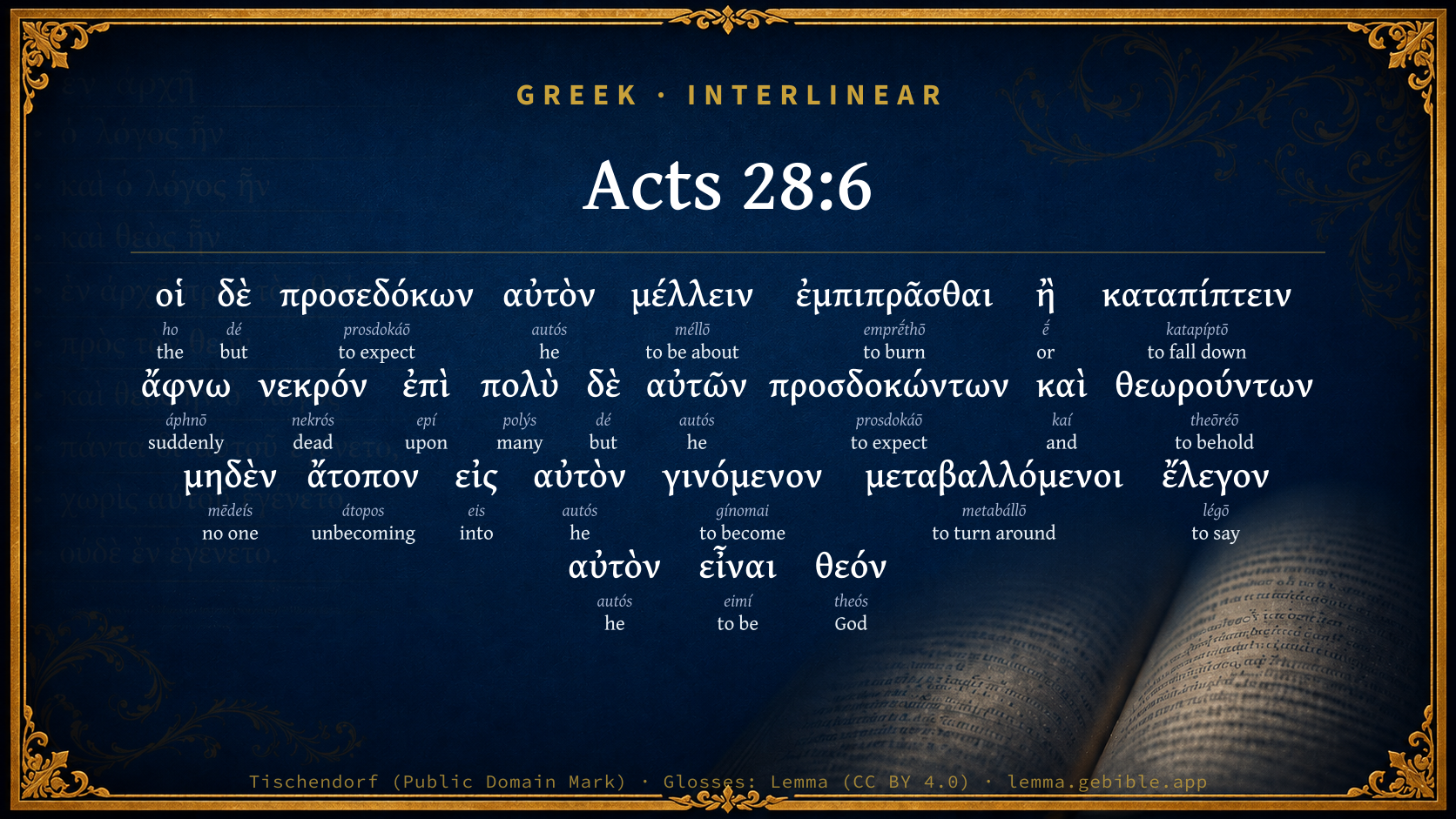
Download image
Cite this verse

Acts 28:6 (World English Bible). Public Domain. Lemma interlinear Bible study tool, https://lemma.gebible.app/v/acts/28/6.

Show BibTeX & RIS
BibTeX
RIS
English Translation
But they expected that he would have swollen or fallen down dead suddenly, but when they watched for a long time and saw nothing bad happen to him, they changed their minds, and said that he was a god.
World English Bible · Public Domain
Highlights
  • 1 hapax legomenon — only here in the Greek New Testament
  • 1 first appearance in the Greek New Testament
Full analysis ↓
Download a study sheet

One document with this verse’s original text, its word-by-word gloss line, the meaning frame, cross-references with their text, attributed commentary, and full source and license credits — printable, and it pastes into notes with its structure intact.

This verse Autodidact and up

Study sheet (.html) Plain text (.txt)

A passage Seminary Student

Up to 50 verses in one chapter. A passage sheet keeps up to 6 commentary sources and 12 cross-references per verse, in the order this page ranks them, and says so on the sheet whenever that leaves anything out. Ask for a single verse and you get the Autodidact verse sheet above.

Everything on this page stays free to read, with no account — the sheet is a download of what is already on screen, not access to it.

Want to remove ads? Support Godless Engineer
Compare translations 3

The same verse in 3 English versions, stacked beneath the original-language interlinear above. Click any original word for its lexicon entry.

Each is an independent rendering of the whole verse — the interlinear is not word-aligned to these translations.

Highlighted words mark where these versions differ — a whole-verse word diff, not a word-by-word alignment.

  • World English Bible Public Domain
    But they expected that he would have swollen or fallen down dead suddenly, but when they watched for a long time and saw nothing bad happen to him, they changed their minds, and said that he was a god.
  • King James Version Public Domain
    Howbeit they looked when he should have swollen, or fallen down dead suddenly: but after they had looked a great while, and saw no harm come to him, they changed their minds, and said that he was a god.
  • unfoldingWord Literal Text CC BY-SA 4.0
    But they were expecting him to begin to be inflamed or suddenly to fall down dead. But as they watched for a long time and saw nothing unusual happening to him, turning themselves around, they said he was a god.

unfoldingWord Literal Text — © unfoldingWord, licensed CC BY-SA 4.0. Word-aligned USFM3 via Door43 (git.door43.org/unfoldingWord/en_ult).

Versions to compare (up to 4)

3 of 4 selected

Show all 19 translations

Every available English version of this verse, each an independent rendering of the whole verse.

  • World English Bible Public Domain
    But they expected that he would have swollen or fallen down dead suddenly, but when they watched for a long time and saw nothing bad happen to him, they changed their minds, and said that he was a god.
  • Berean Standard Bible Public Domain
    The islanders were expecting him to swell up or suddenly drop dead. But after waiting a long time and seeing nothing unusual happen to him, they changed their minds and said he was a god.
  • Majority Standard Bible Public Domain
    The islanders were expecting him to swell up or suddenly drop dead. But after waiting a long time and seeing nothing unusual happen to him, they changed their minds and said he was a god.
  • King James Version Public Domain
    Howbeit they looked when he should have swollen, or fallen down dead suddenly: but after they had looked a great while, and saw no harm come to him, they changed their minds, and said that he was a god.
  • American Standard Version (1901) Public Domain
    But they expected that he would have swollen, or fallen down dead suddenly: but when they were long in expectation and beheld nothing amiss came to him, they changed their minds, and said that he was a god.
  • Revised Version (1885) Public Domain
    But they expected that he would have swollen, or fallen down dead suddenly: but when they were long in expectation, and beheld nothing amiss came to him, they changed their minds, and said that he was a god.
  • Geneva Bible (1599) Public Domain
    Howbeit they wayted whe he should haue swolne, or fallen downe dead suddenly: but after they had looked a great while, and sawe no inconuenience come to him, they changed their mindes, and said, That he was a God.
  • Douay-Rheims (1899) Public Domain
    But they supposed that he would begin to swell up, and that he would suddenly fall down and die. But expecting long, and seeing that there came no harm to him, changing their minds, they said, that he was a god.
  • Young's Literal Translation Public Domain
    and they were expecting him to be about to be inflamed, or to fall down suddenly dead, and they, expecting `it' a long time, and seeing nothing uncommon happening to him, changing `their' minds, said he was a god.
  • Literal Standard Version CC BY-SA 4.0
    and they were expecting him to be about to be inflamed, or to suddenly fall down dead, and they, expecting [it] a long time, and seeing nothing uncommon happening to him, changing [their] minds, said he was a god.
  • Unlocked Literal Bible CC BY-SA 4.0
    They were waiting for him to become inflamed with a fever or to suddenly drop dead. But after they watched him for a long time and saw that nothing was unusual with him, they changed their minds and said that he was a god.
  • unfoldingWord Literal Text CC BY-SA 4.0
    But they were expecting him to begin to be inflamed or suddenly to fall down dead. But as they watched for a long time and saw nothing unusual happening to him, turning themselves around, they said he was a god.
  • Darby Bible Public Domain
    But *they* expected that he would have swollen or fallen down suddenly dead. But when they had expected a long time and saw nothing unusual happen to him, changing their opinion, they said he was a god.
  • World Messianic Bible Public Domain
    But they expected that he would have swollen or fallen down dead suddenly, but when they watched for a long time and saw nothing bad happen to him, they changed their minds and said that he was a god.
  • Webster's Bible Public Domain
    Yet they looked when he would have swelled, or fallen down dead suddenly: but after they had looked a great while, and saw no harm come to him, they changed their minds, and said that he was a god.
  • Free Bible Version CC BY-SA 4.0
    They were expecting him to swell up, or suddenly fall down dead. But after waiting a long time, they saw that nothing bad had happened to him so they changed their minds and decided he must be a god.
  • Bible in Basic English Public Domain
    But they had the idea that they would see him becoming ill, or suddenly falling down dead; but after waiting a long time, and seeing that no damage came to him, changing their opinion, they said he was a god.
  • Text-Critical English NT CC BY 4.0
    The people were expecting that he would soon swell up or suddenly fall down dead. But after waiting expectantly for a long time and seeing nothing unusual happen to him, they changed their minds and said that he was a god.
  • Tyndale New Testament (1534) Public Domain
    Howbeit they wayted when he shuld have swolne or fallen doune deed sodenly. But after they had loked a greate whyle and sawe no harme come to him they chaunged their myndes and sayde that he was a God.

Literal Standard Version (2020), Covenant Press — licensed CC BY-SA 4.0. Text via the HelloAO Bible API (eBible.org). Unlocked Literal Bible (unfoldingWord) — licensed CC BY-SA 4.0. Text via the HelloAO Bible API (eBible.org). unfoldingWord Literal Text — © unfoldingWord, licensed CC BY-SA 4.0. Word-aligned USFM3 via Door43 (git.door43.org/unfoldingWord/en_ult). Free Bible Version, Dr. Jonathan Gallagher — licensed CC BY-SA 4.0. Text via the HelloAO Bible API (eBible.org).

Word by word

More ways to search: Search by grammar → Find every occurrence → Compare this word →

Practice this passage: Drill this verse → Learn its vocabulary →

μεταβαλλόμενοι
metabállō
G3328
“to turn around”
Verb, Present, Middle, Participle, Nominative, Plural, Masculine
Part of Speech
Verb
Tense
Present
Voice
Middle
Mood
Participle
Case
Nominative
Number
Plural
Gender
Masculine
Full Thayer's Definition

Origin: from G3326 and G906

TDNT: None

1. to turn around, to turn about 2. to turn one's self about, or transform one's self 3. to change one's opinion
  1. οἱ ho G3588 “the” Article, Nominative, Plural, Masculine
  2. δὲ dé G1161 “but” Conjunction
  3. προσεδόκων prosdokáō G4328 “to expect” Verb, Imperfect, Active, Indicative, 3rd person, Plural
  4. αὐτὸν autós G846 “he” Personal pronoun, Accusative, Singular, Masculine
  5. μέλλειν méllō G3195 “to be about” Verb, Present, Active, Infinitive
  6. ἐμπιπρᾶσθαι emprḗthō G1714 “to burn” Verb, Present, Passive, Infinitive
  7. ἢ ḗ G2228 “or” Particle
  8. καταπίπτειν katapíptō G2667 “to fall down” Verb, Present, Active, Infinitive
  9. ἄφνω áphnō G869 “suddenly” Adverb
  10. νεκρόν nekrós G3498 “dead” Adjective, Accusative, Singular, Masculine
  11. ἐπὶ epí G1909 “upon” Preposition
  12. πολὺ polýs G4183 “many” Adjective, Accusative, Singular, Neuter
  13. δὲ dé G1161 “but” Conjunction
  14. αὐτῶν autós G846 “he” Personal pronoun, Genitive, Plural, Masculine
  15. προσδοκώντων prosdokáō G4328 “to expect” Verb, Present, Active, Participle, Genitive, Plural, Masculine
  16. καὶ kaí G2532 “and” Conjunction
  17. θεωρούντων theōréō G2334 “to behold” Verb, Present, Active, Participle, Genitive, Plural, Masculine
  18. μηδὲν mēdeís G3367 “no one” Adjective, Accusative, Singular, Neuter, Negative
  19. ἄτοπον átopos G824 “unbecoming” Adjective, Accusative, Singular, Neuter
  20. εἰς eis G1519 “into” Preposition
  21. αὐτὸν autós G846 “he” Personal pronoun, Accusative, Singular, Masculine
  22. γινόμενον gínomai G1096 “to become” Verb, Present, Middle or Passive deponent, Participle, Accusative, Singular, Neuter
  23. ἔλεγον légō G3004 “to say” Verb, Imperfect, Active, Indicative, 3rd person, Plural
  24. αὐτὸν autós G846 “he” Personal pronoun, Accusative, Singular, Masculine
  25. εἶναι eimí G1510 “to be” Verb, Present, Active, Infinitive
  26. θεόν theós G2316 “God” Noun, Accusative, Singular, Masculine

About this verse

These counts appear in no published source. They are computed here, from the morphology-tagged text and Lemma’s own curated glosses. What Lemma adds →

27
words
22
distinct lemmas
Acts
section

Notable vocabulary

1 hapax legomenon — a word that appears only here in the entire Greek New Testament:

  • μεταβαλλόμενοι to turn around G3328

First appearance in Scripture

This word makes its first canonical appearance in the Greek New Testament here:

  • μεταβαλλόμενοι to turn around G3328

Shared distinctive vocabulary

ἐμπιπρᾶσθαι to burn G1714 occurs in 2 verses of the Greek New Testament. Also found in:
Repetition

Words recur within this verse:

  • προσεδόκων to expect G4328 ×2
  • αὐτὸν he G846 ×4
  • δὲ but G1161 ×2

Cross-references

3

Topical passages linked to Acts 28:6 in the Treasury of Scripture Knowledge — connected by theme and wording, ordered by reader-vote popularity; previews shown in the World English Bible.

  • Acts 12:22 The people shouted, "The voice of a god, and not of a man!"
  • Matthew 21:9 The multitudes who went before him, and who followed kept shouting, "Hosanna to the son of David! Blessed is he who comes in the name of the Lord! Hosanna in the highest!"
  • Acts 14:11–13 When the multitude saw what Paul had done, they lifted up their voice, saying in the language of Lycaonia, "The gods have come down to us in the likeness of men!"

Cross-references courtesy of OpenBible.info (CC BY 4.0).

Commentary

Notes on Acts 28:6 from classic Christian and Jewish commentators (each source and its license shown beneath its notes). The classic Christian expositions comment on the surrounding passage and are grouped to its opening verse, so a note may address several verses; the Jewish commentaries on the Tanakh (Rashi and others) are per-verse, so they appear only where the commentator wrote on this verse.

Lemma curates 59 commentaries, every one of them public domain or Creative Commons licensed, each selected and text-cleaned for this edition rather than reprinted as found. About our sources →

Bengel's Gnomon

Johann Albrecht Bengel

Act 28:6. Προσεδόκων, they were expecting) They knew what were wont to be the effects of such bites.—μεταβαλλόμενοι, being changed) The instability of human reasoning is herein showed. He is either an assassin, say they, or a god. So at one time bulls were about to be sacrificed to Paul at Lystra, and presently after stones were thrown at him: ch. Act 14:13; Act 14:19. There is a third alternative admissible: he is a man of GOD. As to no class of men do natural men commit greater errors, than as to the saints.

Bengel's Gnomon of the New Testament — English translation (T&T Clark, Edinburgh, 1860) — public domain. Text from a community e-Sword module.

Meyer's Critical & Exegetical Commentary

Heinrich August Wilhelm Meyer

Act_28:6. But when they waited long (not: expectassent), and saw, etc. On ἄτοπον of abnormal corporeal changes, see examples in Wetstein and Kypke. Not even the expected swelling (πιμπρ.) occurred.

εἰς αὐτὸν γινόμ.] taking place on him. See on Luk_4:23; comp. Plut. Mor. p. 786 C: αἱ εἰς σάρκα … γινόμεναι κινήσεις.

μεταβάλλεσθαι] to turn themselves round, to change, often used even by classical writers to express change of view or opinion (without, however, supplying τὴν γνώμην). Dem. 205. 19, 349. 25, and see Kypke.

θεὸν αὐτὸν εἶναι] The good-natured people, running immediately into extremes with the inferiority of their rational training, think that he is a god appearing in human form, because they could not reconcile the complete want of result from the poisonous bite of the viper, well known to them in its effects, with the knowledge which they had derived from experience of the constitution of an ordinary human body. Ὑπερβολὴ τιμῆς ὥσπερ καὶ τῶν ὄχλων τῶν ἐν Λυκαονίᾳ (Act_14:11 ff.), Chrysostom. Bengel well remarks aut latro inquiunt aut Deus …; datur tertium; homo Dei. The people themselves do not say (θεόν) that they meant a definite, particular god (Grotius, Heinsius, Alberti conjecture Hercules ἀλεξίκακος; Wetstein, Aesculapius; Sepp, one of the two). Zeller finds in Act_28:6 simply an unhistorical addition in the miraculous style of our chap. 16., which character belongs still more decidedly to the cures in Act_28:8-9.

Meyer — Critical and Exegetical Commentary on the New Testament — English translation by Peter Christie, edited by Frederick Crombie (T&T Clark, 1880) — public domain. Text from a community e-Sword module.

Expositor's Greek Testament

ed. W. Robertson Nicoll

Act 28:6 . οἱ δέ …: Paul shook off the viper the natives looked for a fatal result. They knew the deadly nature of the bite, and their subsequent conduct shows that they regarded it as nothing short of miraculous that Paul escaped. So St. Luke evidently wishes to describe the action, see on μέν οὖν , Act 28:5 , and δέ , Rendall, Acts , p. 161, Appendix. προσεδόκων , see below. πίμπρασθαι , from the form πίμπρημι , present infinitive passive, see critical note, and Winer-Schmiedel, p. 122; cf. in LXX, Num 5:21-22 ; Num 5:27 , πρήθειν , H. and R., of parts of the body becoming swollen. In classical Greek πίμπρασθαι means “to take fire,” and πρήθειν “to cause to swell,” and those two ideas are combined, as in the word πρηστήρ ; “a venomous snake, the bite of which caused both inflammation and swelling” (Page, in loco ), cf. Lucan, ix. 790. In the N.T. the verb is peculiar to St. Luke, and it is the usual medical word for inflammation (Hobart, Zahn) in Hipp., Aret., Galen. καταπίπτειν : only in Luke in N.T., cf. Luk 8:6 , Act 26:14 , it was used by medical writers of persons falling down suddenly from wounds, or in epileptic fits; Hipp., Galen (Hobart, Zahn), cf. the asp-bitten Charmian in Ant. and Cleo. (Shakespeare), Act 5 , Scene 2. ἄφνω : only in Act 2:2 ; Act 16:26 . προσδ .… ἄτοπον : the two words are described by Hobart as exactly those which a medical man would use (so too Zahn), and he gives two instances of the latter word from Galen, in speaking of the bite of a rabid dog, or of poison, p. 289. The word is used elsewhere in N.T. of something morally amiss; cf. Luk 23:41 , Act 25:5 , 2Th 3:2 , but here evidently of something amiss physically. In R.V. it is rendered in each passage “amiss”. The word in N.T. is confined to Luke and Paul, but it is found several times in LXX in an ethical sense (as in N.T., except in loco ), cf. Job 4:8 ; Job 11:11 ; Job 27:6 ; Job 34:12 ; Job 35:13 , Prov. 24:55 (Pro 30:20 ), cf. 2Ma 14:23 ; so too in Thucydides, Josephus, Plutarch, etc.; but it is used of any harm happening to a person as here, cf. Jos., Ant. , viii., 14, 4; xi., 5, 2; Herodian, iv., 11. προσδοκία , peculiar to St. Luke in N.T.; cf. Luk 21:26 , Act 12:11 , and προσδοκάω , in Luke six times, in Acts five, was, no doubt, frequently used in medical language (Hobart, Zahn) for the expectation of the result of a disease or paroxysm “when they were long in expectation,” R.V.), but in Jos., Ant. , viii., 14, 4, we have καὶ μηδὲν τῶν ἀτόπων προσδοκᾷν , and in Herodian, iv., 11, μηδὲν ἄτοπον προσδοκοῦντες · εἰς αὐτὸν γιν ., cf. Luk 4:23 (Klostermann, Weiss). μεταβαλλόμενοι , so frequently in classics without τὴν γνώμην , cf. Jos., B. J. , v., 9, 3. θεὸν αὐτὸν εἶναι : it is perhaps fanciful to suppose with Grotius and Wetstein that they compared him to the infant Hercules, or to Æsculapius represented with the serpent, but the latter is undoubtedly right in adding, “eleganter autem hic describitur vulgi inconstantia”; we naturally compare with Chrysostom the startling change in the people of Lystra, Act 14:11 ; Act 14:19 , “Aut latro inquiunt aut deus … datur tertium: homo Dei” (Bengel).

The Expositor's Greek Testament, edited by W. Robertson Nicoll (1897–1910) — public domain. Text from a community e-Sword module.

Geneva Bible (1599)

Geneva Bible translators

The Greek word signifieth, to be inflamed, or to swell: moreover Dioscorides in book 6, chap. 38, witnesseth, that the biting of a viper causeth a swelling of the body, and so saith Nicander, in his remedies against poisons.

There is nothing more unconstant, every way, than they which are ignorant of true religion.

Geneva Bible (1599) marginal notes — public domain. Text via Bolls.life.

Jamieson, Fausset & Brown

Robert Jamieson, A. R. Fausset & David Brown

they looked--"continued looking."

when he should have swollen or fallen down dead--familiar with the effects of such bites.

and saw no harm come to him, they changed their minds, and said . . . he was a god--from "a murderer" to "a god," as the Lycaonian greeting of Paul and Silas from "sacrificing to them" to "stoning them" (Act 14:13, Act 14:19). What has not the Gospel done for the uncultivated portion of the human family, while its effects on the educated and refined, though very different, are not less marvellous! Verily it is God's chosen restorative for the human spirit, in all the multitudinous forms and gradations of its lapsed state.

Jamieson, Fausset & Brown — Commentary Critical and Explanatory on the Whole Bible (1871) — public domain (CC PDM 1.0). Text via the HelloAO Bible API.

Adam Clarke's Commentary

Verse 6. When he should have swollen] πιμπρασθαι, When he should have been inflamed: by means of an acrid poison introduced into the blood, it is soon coagulated; and, in consequence, the extremities of the vessels become obstructed, strong inflammation takes place, and all the parts become most painfully swollen.

Lucan, ix. v. 791, gives a terrible account of this effect of the bite of a serpent:-

__________________illi rubor igneus ora

Succendit, tenditque cutem, pereunte figura

Miscens cuncta tumor jam toto corpore major:

Humanumque egressa modum super omnia membra

Efflatur sanies late tollente veneno.

Ipse latet penitus, congesto corpore mersus;

Nec lorica tenet distenti corporis auctum.

And straight a sudden flame began to spread,

And paint his visage with a glowing red.

With swift expansion swells the bloated skin,

Nought but an undistinguished mass is seen;

While the fair human form lies lost within,

The puffy poison spreads and heaves around,

Till all the man is in the monster drown'd.

ROWE.

See other ensamples, in Clarke's notes on "Nu 21:6".

Said that he was a god.] As Hercules was one of the gods of the Phoenicians, and was worshipped in Malta under the epithet of αλεξικακος, the dispeller of evil, they probably thought that Paul was Hercules; and the more so, because Hercules was famous for having destroyed, in his youth, two serpents that attacked him in his cradle.

Adam Clarke's Commentary on the Bible (1810–1826) — public domain. Text from a community e-Sword/MySword module.

John Calvin's Commentaries

6. Changing their minds, they said. This so wonderful and sudden a change ought to have inwardly touched the men of Melita, and to have moved them to give the glory to the mercy of God, as they did before to vengeance. But as man’s reason is always carried amiss unto extremities, they make Paul at a sudden a god, whom they took before to be a wicked murderer. But if he could not choose but be the one, it had been better for him to be counted a murderer than a god. And surely Paul would rather have wished to be condemned, not only of one crime, but also to have sustained all shame, and to have been thrust down into the deep pit of hell, than to take to himself the glory of God, which thing those knew full well who had heard him preach amidst the storms. Notwithstanding, it may be, that, being taught afterward, they did confess that God was the author of the miracle.

Furthermore, let us learn by this history, with patient and quiet minds, to wait for the prosperous event of things, which seem at the first to tend toward the robbing of God of his honor. Which of us would not have been terrified with this spectacle which did arm the wicked to slander with all manner of slanderous speeches the glory of the gospel? Yet we see how God did in good time prevent this inconvenience; therefore, let us not doubt but that after he hath suffered his to be darkened with clouds of slanders, he will send remedy in his good time, and will turn their darkness into light. In the mean season, let us remember that we must beware of the judgment of the flesh. And because men do always forget themselves, let us beg of God the Spirit of moderation, that he may keep us always in the right mean. Furthermore, let us learn by this how ready the world is to fall to superstition. Yea, this wickedness is in a manner born with us, to be desirous to adorn creatures with that which we take from God.

Wherefore, no marvel if new errors have come abroad in all ages, seeing every one of us is, even from his mother’s womb, expert in inventing idols. But lest men excuse themselves therewithal, this history doth witness that this is the fountain of superstitions, because men are unthankful to God, and do give his glory to some other.

John Calvin's Commentaries (1540-1563) — public domain. Text from the Calvin Translation Society English edition (1840s-50s) via the Christian Classics Ethereal Library (ccel.org). Calvin's coverage is partial (roughly two-thirds of the Bible); uncommented books and verses are honest gaps, never fabricated. The 19th-century editor's footnotes and remarks are omitted so the notes are faithfully Calvin's own voice.

Ellicott's Commentary for English Readers

(6) They looked when he should have swollen . . .—Better, and they were expecting that . . . The verb for “swollen” implies literally “inflammation,” and one of the enormous serpents of Africa took its name. Prestes (“the inflamer”), from it. Lucan (ix. 790) describes the effect of its bite—

“Percussit Prestes, illi ruber igneus ora

Succendit, tenditque cutem, pereunte figurâ.”

[“ The Prestes bit him, and a fiery flush

Lit up his face, and set the skin a-stretch,

And all its comely grace had passed away.”]

They changed their minds, and said that he was a god.—The miraculous escape naturally made an even stronger impression on the minds of the Melitese than what had seemed a supernatural judgment. Their thoughts may have travelled quickly to the attributes of the deities who, like Apollo or Æsculapius, were depicted as subduing serpents. The sudden change of belief may be noted as presenting a kind of inverted parallelism with that which had come over the people of Lystra. (See Notes on Act_14:11; Act_14:19.)

A Bible Commentary for English Readers, edited by Charles John Ellicott (1878–1897) — public domain. Text from a community e-Sword module.

The Cambridge Bible for Schools and Colleges

gen. ed. J. J. S. Perowne

6. Howbeit they looked when he should have swollen] Better (with R.V.) “But they expected that he would have swollen.” Such being the usual effect of the viper’s bite, and making itself apparent in a very short time.

but after they had looked a great while] [R. V. “but when they were long in expectation.”] The verb is the same as in the first clause of the verse, and does not express merely the gazing upon Paul, but the thought in their minds of what was to come. The pluperfect of the A.V. is the better English. So read “when they had been long in expectation.”

saw no harm] [R.V. “beheld nothing amiss.”] The adjective is the same which is used, Luk_23:41, “This man hath done nothing amiss,” and can be applied to anything abnormal, whether it be as there a breach of a law, or as here a change of condition.

and said that he was a god] Compare the conduct of the Lycaonians in Lystra (Act_14:11 seqq.), whose behaviour afterwards shews that the opinion quickly formed was unstable, and liable to change as suddenly as it came.

The Cambridge Bible for Schools and Colleges (gen. ed. J. J. S. Perowne; Cambridge University Press, 1878–1918) — public domain. Text from a community e-Sword module.

John Gill's Exposition

Howbeit they looked when he should have swollen,.... With the venomous bite of the viper; swelling is one of the symptoms following the bite of this creature; and if the bite does not issue in death, yet the swelling continues inflamed for some time. The symptoms following the bite of a viper are said to be (r) an acute pain in the place wounded; swelling, first red, afterwards livid, spreading by degrees; great faintness; a quick, low, and sometimes interrupted pulse; sickness at the stomach; bilious convulsions: vomiting; cold sweats; sometimes pains about the navel; and death itself, if the strength of the patient, or the slightness of the bite, do not overcome it: if he does overcome it, the swelling continues inflamed for some time; and the symptoms abating, from the wound runs a sanious liquor, little pustules are raised about it, and the colour of the skin is as if the patient were icterical or jaundice; or had the jaundice: the Arabic and Ethiopic versions render it, "that he should burn", or "burnt"; that is, inflamed, for the bite of the viper causes an inflammation, a hot swelling, which rises up in pustules or blisters:

or fallen down dead suddenly; for immediate death is sometimes the effect of such poison. Pliny (s) relates, that the Scythians dip their arrows in the sanies or corrupt matter of vipers, and in human blood, which by the least touch causes immediate death; and Pausanias (t) reports from a certain Phoenician, that a man fleeing from a viper got up into a tree, where the viper could not reach him, but it blew, or breathed out its poison on the tree, and the man immediately died: though the force of this creature's poison does not always, and in all places, and in all persons operate alike; some die within a few hours, and others live some days, some to the third day, and some to the seventh (u):

but after they had looked a great while; upon the apostle, to observe whether any inflammation or swelling arose, or death ensued, as they expected: when they had waited some time, perhaps an hour or two,

and saw no harm come to him; that he was neither inflamed, nor swelled, nor dead; that it had no manner of effect upon him, and no evil of punishment was inflicted on him hereby, from whence they could conclude that he was guilty of any notorious crime:

they changed their minds, and said that he was a god: before they took him to be a murderer, and now they even ascribe deity to him, as was usual with the Gentiles, when anything extraordinary was performed by men: so the Lystrians took Paul for Mercury, and Barnabas for Jupiter, upon the apostle's curing the cripple, Act 14:11; but what god the inhabitants of Melita thought him to be, is not certain; some think Hercules, who was worshipped in this island. The inhabitants of this island now believe that the apostle expelled all poison and venom out of it when he was there; and it is reported, that the children born in this place fear not any snakes, neither are hurt by anything that is venomous, insomuch that they will take scorpions, and eat them without danger; although, in all other parts of the world, those kind of creatures are most pernicious, and yet do no manner of hurt to men in this island; yea, it is affirmed, that there is a sort of earth found here, which kills serpents: as for the eating of them, the viper itself may be eaten; most authors agree (w), that there is no part, humour, or excrement, not even the gall itself, of a viper, but may be swallowed without much harm; accordingly the ancients, and, as several authors assure us, the Indians at this day, both of the east and west, eat them as we do eels--viper's flesh either roasted or boiled, physicians unanimously prescribe as an excellent restorative, particularly in the elephantiasis, incurable consumptions, leprosy, &c.

(r) Chambers's Cyclopaedia, ut supra. (the word "Viper") (s) L. 11. c. 53. (t) Boeotica, vel, l. 9. p. 583. (u) Alberus de Animal. l. 25. c. ult. (w) Chambers's Cyclopaedia, ut supra. (the word "Viper")

John Gill's Exposition of the Whole Bible (1746–1763) — public domain (CC PDM 1.0). Text via the HelloAO Bible API.

Trapp's Complete Commentary

John Trapp

6 Howbeit they looked when he should have swollen, or fallen down dead suddenly: but after they had looked a great while, and saw no harm come to him, they changed their minds, and said that he was a god.

Ver. 6. That he should have swollen] Or, have been inflamed, πιμπρασθαι, viz. with the viper’s venom. The devil’s darts are called fiery for the dolour and distemper they work, Eph 6:16; in allusion likely to the poisoned darts that the Scythians of old and other nations now use in war, dipped in the blood and gall of vipers, the venomous heat of which, like a fire in their flesh, killed the wounded with torments; the likest hell of any other, saith one. These fiery darts sting the wicked, as the fiery serpents did the Israelites. The saints shake them off without hurt, though not always without smart.

John Trapp, A Commentary or Exposition upon All the Books of the Old and New Testament (1647–1656) — public domain. Text from a community e-Sword module.

Albert Barnes' Notes on the Bible

When he should have swollen - When they expected that he would have swollen from the bite of the viper. The poison of the viper is rapid, and they expected that he would die soon. The word rendered “swollen” πίμπρασθαι pimprasthai means properly “to burn; to be inflamed,” and then “to be swollen from inflammation.” This was what they expected here, that the poison would produce a violent inflammation.

Or fallen down dead suddenly - As is sometimes the case from the bite of the serpent when a vital part is affected.

They changed their minds - They saw that he was uninjured, and miraculously preserved; and they supposed that none but a god could be thus kept from death.

That he was a god - That the Maltese were idolaters there can be no doubt; but what gods they worshipped is unknown, and conjecture would be useless. It was natural that they should attribute such a preservation to the presence of a divinity. A similar instance occurred at Lystra. See the notes on Act 14:11.

Albert Barnes' Notes on the Bible (1834–1885) — public domain. Text from a community e-Sword/MySword module.

Haydock's Catholic Bible Commentary

That he would suddenly fall down and die. It is not then by the natural situation and temper of the air, that this island has no venomous creature. (Witham)

George Leo Haydock (1774–1849), Haydock's Catholic Family Bible and Commentary, 1859 edition — public domain. Excludes Psalms (Douay-Rheims chapter numbering differs from Protestant) and Deuterocanonical books (Catholic canon only).

Matthew Poole's English Annotations

Should have swollen; the word signifies primarily to be burnt, and then by burning or scalding to swell, which is accounted the ordinary symptom of the biting of a viper; to swell or blister, as if the part was burnt with fire.

Or fallen down dead suddenly; in those places where there is much more heat, there is more venom in these vipers. And though some are said to live several days after they are bit by them, yet others die very suddenly upon their biting; as the known story of Cleopatra testifies; and condemned persons were sometimes put to death by vipers set unto their breasts.

And said that he was a god; a strange extreme; so uncertain and unequal are men’s minds.

Matthew Poole's English Annotations on the Holy Bible (1683–1685) — public domain. Text from a community e-Sword/MySword module.

Whedon's Commentary on the Bible

Daniel D. Whedon

6. Swollen… dead suddenly—The two stages of dissolution from the bite of the viper are: First, a highly inflamed swelling beginning at the bitten place, and then a rapid death. The pain is exquisite, especially when the patient is touched. Lucian, the satirist, says of the viper, “His bite is violent, his venom thick, quickly bringing on agonies, for it burns and rots and swells, and the victim screams as if burned in fire.” The Scythians dipped their weapons in vipers’ venom, and, says Pliny, “they brought death by a light touch.”

A god—A supernatural of any class.

Daniel D. Whedon (gen. ed.), Commentary on the Old and New Testaments (1874–1909) — public domain. Text from a community e-Sword module.

The Pulpit Commentary

But they expected that he would for howbeit, they looked when he should, A.V.; when they were long in expectation for after they had looked a great while, A.V.; beheld nothing amiss for stay no harm, A.V.. They expected; prosedokwn. This word is used eleven times by St. Luke, twice by St. Matthew, and three times in the Second Epistle of Peter (Act_3:5; Luk_1:21, etc.) It is also common in the LXX But it is a word much employed by medical writers in speaking of the course they expect a disease to take, and the results they look for. And this is the more remarkable here because there are no fewer than three other medical phrases in this verse, timprasqai katapiptein, and mhden atopon, be sides those immediately preceding diexercesqai (according to several good manuscripts anti editions) qermh kaqaptein, and qhrion. So that it looks as if, having once got into a medical train of thought from the subject he was writing about, medical language naturally came uppermost in his mind. Have swollen; pimprasqai, only here in the Bible, and not found in this sense in older classical writers. But it is the usual medical word for "inflammation" in any part of the body. Fallen down; katapiptein, only here and intopon). Act_26:14, and twice in the LXX; but common in Homer and elsewhere, and especially frequent in medical writers of persons falling down in fits, or weakness, or wounded, or the like. Nothing amiss (mhden a) Mr. Hobart quotes a remarkable parallel to this phrase from Damocrites, quoted by Galen. He says that whosoever, having been bitten by a mad dog, drinks a certain antidote (eijv oujdewv), "shall suffer no harm." It is used in medical writers in two senses unusual symptoms," and of fatal consequences. In the New Testament it only occurs elsewhere in Luk_23:41, "Nothing amiss;" and pwn 2Th_3:2, jAto kaipwn. It is also used in the LXX for wickedness, doing wickedly, etc. They changed their minds; as in an opposite direction the Lycaonians did. (Act_14:11, Act_14:19) It is a graphic picture of the fickleness of an untutored mind yielding to every impulse. The impunity with which St. Paul endured the bite of the viper was a direct fulfillment of our Lord"s promise in Mar_16:18 (see further note on ver. 8).

The Pulpit Commentary (1880–1919), ed. H.D.M. Spence-Jones & Joseph S. Exell — public domain. Text from a community e-Sword module.

John Wesley's Explanatory Notes

They changed their minds, and said he was a God - Such is the stability of human reason! A little before he was a murderer; and presently he is a God: (just as the people of Lystra; one hour sacrificing, and the next stoning:) nay, but there is a medium. He is neither a murderer nor a God, but a man of God. But natural men never run into greater mistakes, than in judging of the children of God.

John Wesley, Explanatory Notes Upon the Whole Bible (1754–1765) — public domain. Text via the GEBible commentary corpus.

McGarvey & Pendleton's Commentaries

J. W. McGarvey

See notes on verse 3

J. W. McGarvey (with Philip Y. Pendleton), Commentaries on the New Testament (The Fourfold Gospel, 1914; Acts; and the epistles) — public domain. Text from a community e-Sword/MySword module.

Cambridge Greek Testament for Schools and Colleges

6. οἱ δὲ προσεδόκων αὐτὸν μέλλειν πίμπρασθαι, but they expected that he would have swollen. Such being the usual effect of the viper’s bite, and making itself apparent in a very short time.

The verb πίμπρημι in classical Greek means ‘to burn,’ ‘to burn up,’ and in the passive ‘to be inflamed,’ but in the LXX. we have the verb used in the sense of ‘to swell’ in Num 5:21; Num 5:23; Num 5:27, καὶ πρηθήσεται τὴν κοιλίαν.

ἐπὶ πολὺ δὲ αὐτῶν προσδοκώντων, but when they had been long in expectation. Keeping the same rendering for προσδοκέω in both places in the verse. The people had seen cases of viper-bite before, and they had no doubt about what was going to happen.

καὶ θεωρούντων μηδὲν ἄτοπον εἰς αὐτὸν γινόμενον, and beheld nothing amiss come to him. For the word cf. Luk 23:41; Act 25:5. It can be applied to anything abnormal whether it be a breach of the law or a change of bodily condition. For the latter sense, see Joseph. Ant. XI. 5. 2 ὅπως εὐχὰς ποιήσωνται τοῦ μηδὲν κατὰ τὴν ὁδὸν παθεῖν ἄτοπον.

μεταβαλλόμενοι, changing their minds. For the word cf. Test. xii. Patr. Daniel 4, καὶ ἐάν τις ἐπαινῇ ὑμᾶς ὡς ἁγαθοὺς μὴ ἐπαίρεσθε μηδὲ μεταβάλλεσθε. The previous clause speaks of anger, and the last verb indicates the change to the contrary.

ἔλεγον αὐτὸν εἶναι θεόν, they said that he was a god. Compare the conduct of the Lycaonians in Lystra (Act 14:11 seqq.), whose behaviour afterwards shews that the opinion quickly formed was unstable, and liable to change as suddenly as it came.

Chrysostom’s comment here is: ἄρα καὶ τὸν περὶ προνοίας λόγον εἶχον καὶ πολλῷ τῶν φιλοσόφων οὗτοι οἱ βάρβαροι φιλοσοφώτεροι ἐτύγχανον. αὐτοὶ μὲν γὰρ οὐκ ἁφίασι προνοίας ἀπολαύειν τὰ ὑπὸ σελήνην· οἱ δὲ πανταχοῦ νομίζουσι παρεῖναι τὸν θεόν.

Cambridge Greek Testament for Schools and Colleges (Cambridge University Press, 1896; 21 vols, various authors incl. Carr, Maclear, Plummer, Farrar, Lumby, Moule, M. R. James, Simcox) — public domain. Text from a community e-Sword module.

Alford’s Greek Testament

Henry Alford

6.] Both these, the inflammation of the body, and the falling down dead suddenly, are recorded as results of the bite of the African serpents. Mr. Humphry quotes from Lucan, ix. 790, ‘Nasidium Marsi cultorem torridus agri Percussit Prester (an African serpent named from this very verb πίμπρασθαι): illi rubor igneus ora Succendit, tenditque cutem, pereunte figura:’ and, of the bite of the asp, ix. 815: ‘At tibi, Leve miser, fixus præcordia pressit Niliaca serpente cruor: nulloque dolore Testatus morsus, subita caligine mortem Accipis, et somno Stygias descendis ad umbras.’

προσδοκώντων] not, as E. V., ‘when they had looked,’—but when they were long looking.

μεταβαλ.] There is no need to supply τ. γνώμην, though it is sometimes expressed:—so οἱ πλεῖστοι τῶν ἀνθρώπων κ. μεταβάλλονται πρὸς τὰ παρόντα, κ. ταῖς τύχαις εἴκουσι, Lysias, pro Nicia fratre (Wetst.): μεταβάλλεσθαι δοκεῖ καὶ οὐδὲν ἔχειν πιστὸν ἡ πόλις, Demosth. pro Megalop. (id.),—in neither of which places can τ. γνώμην well be understood.

θεόν] “Comparabant vel Herculi qui in ulnis adhuc jacens angues superavit: vel Æsculapio, qui cum serpente pingitur.” Wetst. and so also Grot. But so much as this can hardly be inferred: nor are we sure of the theogony of these Phœnician barbarians.

Henry Alford, The Greek Testament (1849–1861) — public domain. Text from a community e-Sword module.

Vincent's Word Studies in the New Testament

Marvin R. Vincent

Swollen [πιμπρασθαι] . Only here in New Testament. The usual medical word for inflammation.

Looked [προσδοκωντων] . Occurring eleven times in Luke, and only five times in the rest of the New Testament. Frequent in medical writers, to denote expectation of the fatal result of illness.

No harm [μηδεν ατοπον] . Lit., nothing out of place. The word atopov occurs three times in Luke, and only once elsewhere in the New Testament (2Th 3:2). Used by physicians to denote something unusual in the symptoms of disease and also something fatal or deadly as here. Rev., nothing amiss. Compare Luk 23:41; and Act 25:5, where the best texts insert the word.

Said [ελεγον] . The imperfect, denoting current talk.

A God. "Observe," says Bengel, "the fickleness of human reasoning. He is either an assassin, say they, or a God. So, at one time bulls, at another stones" (Act 14:13, 19).

Marvin R. Vincent, Word Studies in the New Testament (1887–1900) — public domain. Text from a community e-Sword/MySword module.

Lesson kit

Teaching starters — assembled from the data on this page, not authored interpretation. Every prompt links to the verse data it draws on. Edit before teaching.

Acts, in the Acts, opens this verse with 27 words (22 distinct Greek lemmas). Its most distinctive word is metabállō (“to turn around”). A historical commentator’s framing appears above. Read the whole chapter for the surrounding context.

Discussion questions

  1. How does “to turn around” (metabállō) shape what this verse is saying?
  2. 1 word here appears nowhere else in the Greek New Testament. Why might the author reach for such rare wording?
  3. This is the first place “to turn around” appears in Scripture (first appears here). What does its debut here establish?
  4. How does Matthew 22:7, which shares the word «to burn», read alongside this verse?
  5. What does the repetition of “to expect” (2× in this one verse) do in this verse?
  6. These translations render this verse differently; the difference is in the English rendering, not the original. What questions does that raise?
  7. Compare how Bengel's Gnomon and Meyer's Critical & Exegetical Commentary read this verse. Where do they agree or differ?

Things to notice

  • 1 word in this verse appears nowhere else in the Greek New Testament.
  • 1 word makes its first canonical appearance in Scripture here.
  • These translations choose different wording for 32 words in this verse.
  • “to expect” occurs 2× in this single verse.
  • 22 distinct Greek lemmas span 27 words in this verse.

Reading settings

Reading text

Shown beneath each verse's original-language words.

Old Testament
Old Testament edition

Read the OT as the Masoretic Hebrew (MT) or the Greek Septuagint (LXX).

English shown for the Greek Septuagint (in the Hebrew ↔ Greek comparison).

Comparing translations? Open the Compare panel on any verse page to stack up to four side by side.