Acts 25:9

Greek (Tischendorf 8th ed.) Acts 25:9 appears in the Greek New Testament. The text above is from the Tischendorf 8th edition. Each word links to its Strong’s number and a concise gloss. Click any word for its full Thayer’s Greek Lexicon entry.
Download image
Cite this verse

Acts 25:9 (World English Bible). Public Domain. Lemma interlinear Bible study tool, https://lemma.gebible.app/v/acts/25/9.

Show BibTeX & RIS
BibTeX
RIS
English Translation
But Festus, desiring to gain favor with the Jews, answered Paul and said, "Are you willing to go up to Jerusalem, and be judged by me there concerning these things?"
World English Bible · Public Domain
Download a study sheet

One document with this verse’s original text, its word-by-word gloss line, the meaning frame, cross-references with their text, attributed commentary, and full source and license credits — printable, and it pastes into notes with its structure intact.

This verse Autodidact and up

Study sheet (.html) Plain text (.txt)

A passage Seminary Student

Up to 50 verses in one chapter. A passage sheet keeps up to 6 commentary sources and 12 cross-references per verse, in the order this page ranks them, and says so on the sheet whenever that leaves anything out. Ask for a single verse and you get the Autodidact verse sheet above.

Everything on this page stays free to read, with no account — the sheet is a download of what is already on screen, not access to it.

Want to remove ads? Support Godless Engineer
Compare translations 3

The same verse in 3 English versions, stacked beneath the original-language interlinear above. Click any original word for its lexicon entry.

Each is an independent rendering of the whole verse — the interlinear is not word-aligned to these translations.

Highlighted words mark where these versions differ — a whole-verse word diff, not a word-by-word alignment.

  • World English Bible Public Domain
    But Festus, desiring to gain favor with the Jews, answered Paul and said, "Are you willing to go up to Jerusalem, and be judged by me there concerning these things?"
  • King James Version Public Domain
    But Festus, willing to do the Jews a pleasure, answered Paul, and said, Wilt thou go up to Jerusalem, and there be judged of these things before me?
  • unfoldingWord Literal Text CC BY-SA 4.0
    But Festus, wanting to lay down a favor for the Jews, answering Paul, said, “Are you willing, having gone up to Jerusalem, to be judged before me there about these things?”

unfoldingWord Literal Text — © unfoldingWord, licensed CC BY-SA 4.0. Word-aligned USFM3 via Door43 (git.door43.org/unfoldingWord/en_ult).

Versions to compare (up to 4)

3 of 4 selected

Show all 19 translations

Every available English version of this verse, each an independent rendering of the whole verse.

  • World English Bible Public Domain
    But Festus, desiring to gain favor with the Jews, answered Paul and said, "Are you willing to go up to Jerusalem, and be judged by me there concerning these things?"
  • Berean Standard Bible Public Domain
    But Festus, wishing to do the Jews a favor, said to Paul, “Are you willing to go up to Jerusalem to stand trial before me on these charges?”
  • Majority Standard Bible Public Domain
    But Festus, wishing to do the Jews a favor, said to Paul, “Are you willing to go up to Jerusalem to stand trial before me on these charges?”
  • King James Version Public Domain
    But Festus, willing to do the Jews a pleasure, answered Paul, and said, Wilt thou go up to Jerusalem, and there be judged of these things before me?
  • American Standard Version (1901) Public Domain
    But Festus, desiring to gain favor with the Jews, answered Paul and said, Wilt thou go up to Jerusalem, and there be judged of these things before me?
  • Revised Version (1885) Public Domain
    But Festus, desiring to gain favour with the Jews, answered Paul, and said, Wilt thou go up to Jerusalem, and there be judged of these things before me?
  • Geneva Bible (1599) Public Domain
    Yet Festus willing to get fauour of the Iewes, answered Paul and saide, Wilt thou goe vp to Hierusalem, and there be iudged of these things before mee?
  • Douay-Rheims (1899) Public Domain
    But Festus, willing to shew the Jews a pleasure, answering Paul, said: Wilt thou go up to Jerusalem, and there be judged of these things before me?
  • Young's Literal Translation Public Domain
    And Festus willing to lay on the Jews a favour, answering Paul, said, `Art thou willing, to Jerusalem having gone up, there concerning these things to be judged before me?'
  • Literal Standard Version CC BY-SA 4.0
    And Festus willing to lay on the Jews a favor, answering Paul, said, “Are you willing, having gone up to Jerusalem, to be judged before me there concerning these things?”
  • Unlocked Literal Bible CC BY-SA 4.0
    But Festus wanted to gain the favor of the Jews, and so he answered Paul and said, “Do you want to go up to Jerusalem and to be judged by me about these things there?”
  • unfoldingWord Literal Text CC BY-SA 4.0
    But Festus, wanting to lay down a favor for the Jews, answering Paul, said, “Are you willing, having gone up to Jerusalem, to be judged before me there about these things?”
  • Darby Bible Public Domain
    But Festus, desirous of obliging the Jews, to acquire their favour, answering Paul, said, Art thou willing to go up to Jerusalem, there to be judged before me concerning these things?
  • World Messianic Bible Public Domain
    But Festus, desiring to gain favor with the Judeans, answered Paul and said, “Are you willing to go up to Jerusalem and be judged by me there concerning these things?”
  • Webster's Bible Public Domain
    But Festus, willing to do the Jews a pleasure, answered Paul, and said, Wilt thou go to Jerusalem, and there be judged concerning these things before me?
  • Free Bible Version CC BY-SA 4.0
    But Festus, who was looking to gain favor with the Jews, asked Paul, “Are you willing to go to Jerusalem and be tried before me there about these matters?”
  • Bible in Basic English Public Domain
    But Festus, desiring to get the approval of the Jews, said to Paul, Will you go up to Jerusalem, and be judged before me there in connection with these things?
  • Text-Critical English NT CC BY 4.0
    But Festus, wishing to gain favor with the Jews, responded to Paul, “Are yoʋ willing to go up to Jerusalem and stand trial before me there on these charges?”
  • Tyndale New Testament (1534) Public Domain
    Festus willinge to do the Iewes a pleasure answered Paul and sayde: wilt thou goo to Ierusalem and there be iudged of these thinges before me?

Literal Standard Version (2020), Covenant Press — licensed CC BY-SA 4.0. Text via the HelloAO Bible API (eBible.org). Unlocked Literal Bible (unfoldingWord) — licensed CC BY-SA 4.0. Text via the HelloAO Bible API (eBible.org). unfoldingWord Literal Text — © unfoldingWord, licensed CC BY-SA 4.0. Word-aligned USFM3 via Door43 (git.door43.org/unfoldingWord/en_ult). Free Bible Version, Dr. Jonathan Gallagher — licensed CC BY-SA 4.0. Text via the HelloAO Bible API (eBible.org).

Word by word

More ways to search: Search by grammar → Find every occurrence → Compare this word →

Practice this passage: Drill this verse → Learn its vocabulary →

καταθέσθαι
katatíthēmi
G2698
“to deposit”
Verb, Aorist, Middle, Infinitive
Part of Speech
Verb
Tense
Aorist
Voice
Middle
Mood
Infinitive
Full Thayer's Definition

Origin: from G2596 and G5087

TDNT: None

1. to lay down, deposit, lay up 2. to lay by or up for one's self, for future use 3. to lay up favour for one's self with any one, to gain favour with (to do something for one which may win favour)
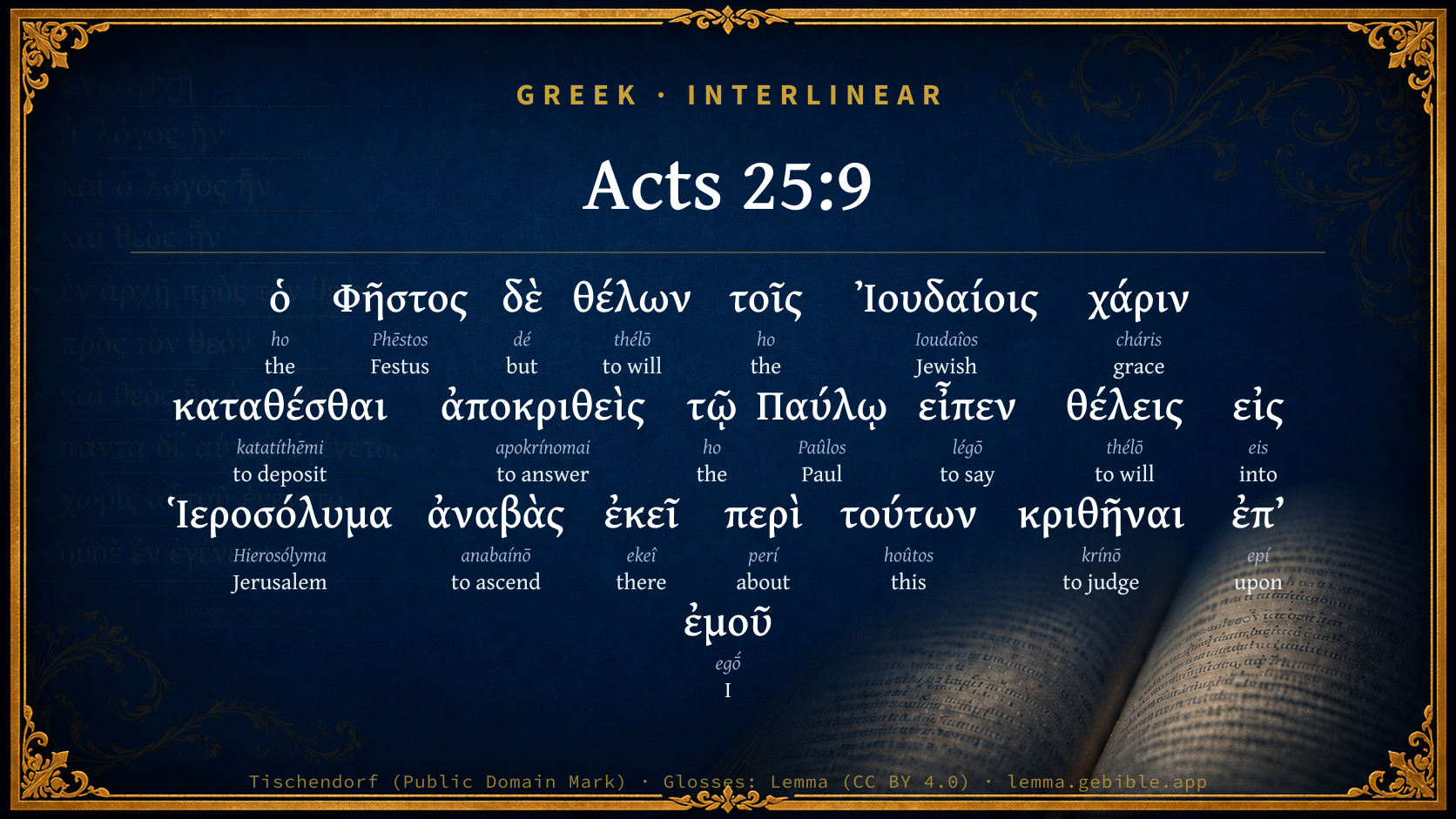
  1. ὁ ho G3588 “the” Article, Nominative, Singular, Masculine
  2. Φῆστος Phēstos G5347 “Festus” Noun, Nominative, Singular, Masculine
  3. δὲ dé G1161 “but” Conjunction
  4. θέλων thélō G2309 “to will” Verb, Present, Active, Participle, Nominative, Singular, Masculine
  5. τοῖς ho G3588 “the” Article, Dative, Plural, Masculine
  6. Ἰουδαίοις Ioudaîos G2453 “Jewish” Adjective, Dative, Plural, Masculine
  7. χάριν cháris G5485 “grace” Noun, Accusative, Singular, Feminine
  8. ἀποκριθεὶς apokrínomai G611 “to answer” Verb, Aorist, Passive deponent, Participle, Nominative, Singular, Masculine
  9. τῷ ho G3588 “the” Article, Dative, Singular, Masculine
  10. Παύλῳ Paûlos G3972 “Paul” Noun, Dative, Singular, Masculine
  11. εἶπεν légō G3004 “to say” Verb, Aorist, Active, Indicative, 3rd person, Singular
  12. θέλεις thélō G2309 “to will” Verb, Present, Active, Indicative, 2nd person, Singular
  13. εἰς eis G1519 “into” Preposition
  14. Ἱεροσόλυμα Hierosólyma G2414 “Jerusalem” Noun, Accusative, Singular, Feminine
  15. ἀναβὰς anabaínō G305 “to ascend” Verb, Aorist, Active, Participle, Nominative, Singular, Masculine
  16. ἐκεῖ ekeî G1563 “there” Adverb
  17. περὶ perí G4012 “about” Preposition
  18. τούτων hoûtos G3778 “this” Demonstrative pronoun, Genitive, Plural, Neuter
  19. κριθῆναι krínō G2919 “to judge” Verb, Aorist, Passive, Infinitive
  20. ἐπ’ epí G1909 “upon” Preposition
  21. ἐμοῦ egṓ G1473 “I” Personal pronoun, 1st person, Genitive, Singular

About this verse

These counts appear in no published source. They are computed here, from the morphology-tagged text and Lemma’s own curated glosses. What Lemma adds →

22
words
19
distinct lemmas
Acts
section

Notable vocabulary

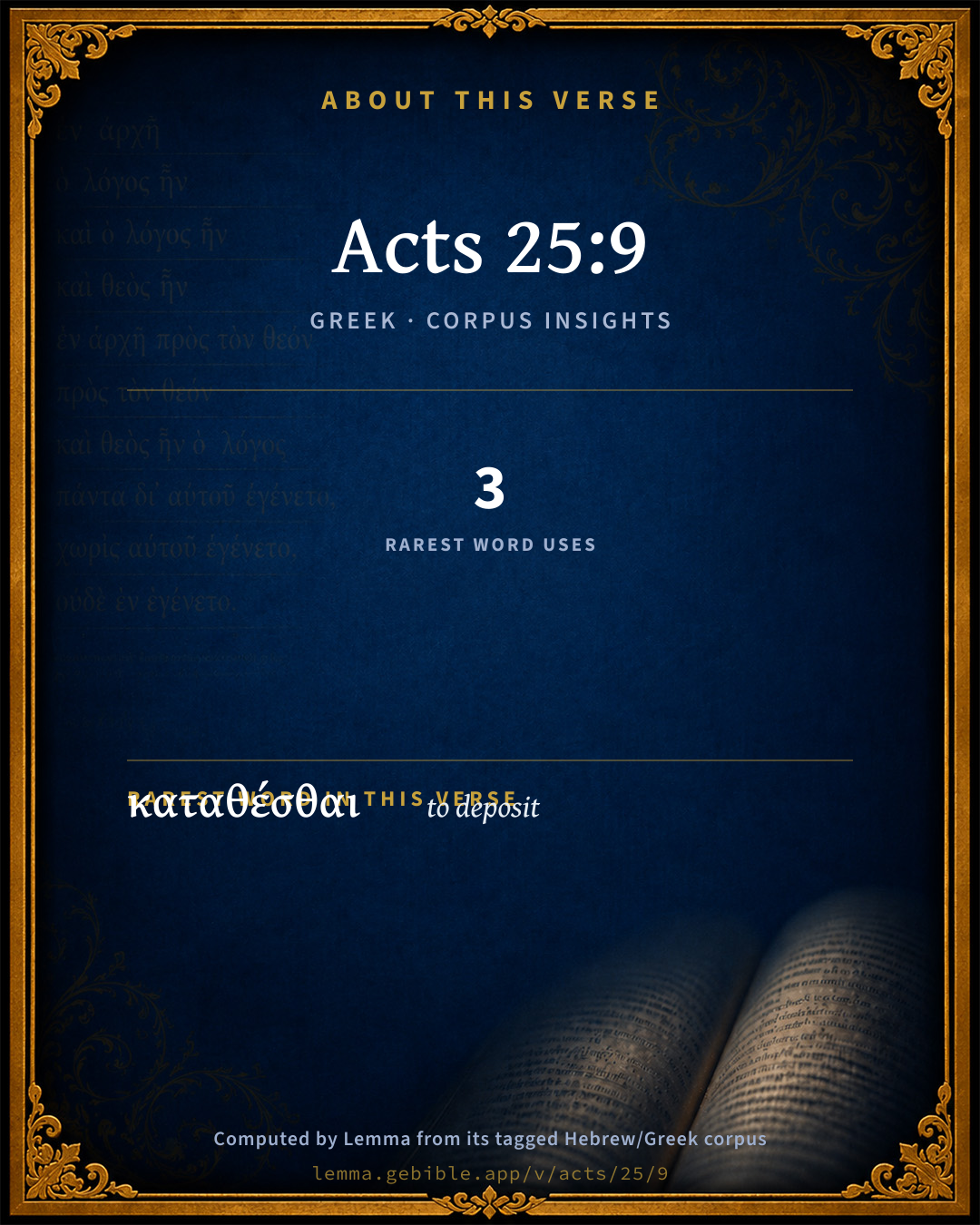
The rarest word here is καταθέσθαι to deposit G2698 — appearing just 3 times in the whole Greek New Testament.

Shared distinctive vocabulary

καταθέσθαι to deposit G2698 occurs in 3 verses of the Greek New Testament. Also found in:

Repetition

Words recur within this verse:

Cross-references

5

Topical passages linked to Acts 25:9 in the Treasury of Scripture Knowledge — connected by theme and wording, ordered by reader-vote popularity; previews shown in the World English Bible.

  • Acts 24:27 But when two years were fulfilled, Felix was succeeded by Porcius Festus, and desiring to gain favor with the Jews, Felix left Paul in bonds.
  • Acts 12:3 When he saw that it pleased the Jews, he proceeded to seize Peter also. This was during the days of unleavened bread.
  • Acts 25:20 Being perplexed how to inquire concerning these things, I asked whether he was willing to go to Jerusalem and there be judged concerning these matters.
  • Mark 15:15 Pilate, wishing to please the multitude, released Barabbas to them, and handed over Jesus, when he had flogged him, to be crucified.
  • Acts 25:3 asking a favor against him, that he would summon him to Jerusalem; plotting to kill him on the way.

Cross-references courtesy of OpenBible.info (CC BY 4.0).

Commentary

Notes on Acts 25:9 from classic Christian and Jewish commentators (each source and its license shown beneath its notes). The classic Christian expositions comment on the surrounding passage and are grouped to its opening verse, so a note may address several verses; the Jewish commentaries on the Tanakh (Rashi and others) are per-verse, so they appear only where the commentator wrote on this verse.

Lemma curates 59 commentaries, every one of them public domain or Creative Commons licensed, each selected and text-cleaned for this edition rather than reprinted as found. About our sources →

Joseph Benson's Commentary

Act 25:9-12. But Festus, willing to do the Jews a pleasure — To ingratiate himself with them by a popular action, at the beginning of his government; to gratify the prosecutors rather than the prisoner, as far as he could go with safety against one that was a citizen of Rome; answered Paul, Wilt thou go up to Jerusalem and there be judged? — Festus could have ordered this without asking Paul. But God secretly overruled the whole, that he might have an occasion of appealing to Rome. In suffering times the prudence of the Lord’s people is tried as well as their patience. Being sent forth as sheep in the midst of wolves, they have need to be wise as serpents. Then said Paul — Apprehensive of the attempt which might be made upon his life in his journey, or in the city itself; I stand at Cesar’s judgment-seat — For all the courts of the Roman governors were held in the name of the emperor, and by commission from him; where — As a Roman citizen; I ought to be judged — And I insist upon my privilege of having my cause decided there; to the Jews have I done no wrong — In any respect whatever; as thou very well knowest — As thou must have perceived clearly by what has this day been examined before thee. Or, Festus might know that Paul had done the Jews no wrong, from the relation Felix had made unto him, as also from such as were present with Felix when Paul’s cause was heard. Thus it very well becomes those that are innocent to plead their innocence, and to insist upon it; it is a debt we owe to our own good name, not only not to bear false witness against ourselves, but to maintain our own integrity against those who bear false witness against us. For if I be an offender, &c. — If I have injured the Jews, and my fault be such as by law deserves death, I ask no favour; I refuse not to die — But will willingly accept the punishment of mine iniquity. But if — As I know in my own conscience, and as thou, from the course of this trial, hast the greatest reason to believe; there be none of these things — That is, that these things, whereof they accuse me — Have had no existence, and that their accusations proceed from malice, and are founded on falsehood; no man may deliver me unto them — Nor can, without palpable injustice. He expresses himself modestly, but his meaning is, Thou canst not deliver me to them; it being a governor’s business, as much to protect the innocent, as to punish the guilty. I appeal unto Cesar — Which any Roman citizen might do before sentence was passed. Then Festus, when he had conferred with the council — It was customary for a considerable number of persons of distinction to attend the Roman governors into the provinces. These constituted a kind of council, with whom they frequently advised; answered — Having called in the prisoner; Hast thou appealed unto Cesar? unto Cesar shalt thou go — For how desirous soever I am to oblige the people of my province, I will never allow myself, upon any occasion, to violate the privileges of a Roman citizen. Festus, therefore, gave proper orders for conveying him to Rome as soon as possible, that he might be there presented before the emperor himself; and, in the mean time, Paul was remanded to his confinement, and his accusers returned to Jerusalem a second time, with the mortification of not having been able to accomplish their purpose against him.

Joseph Benson's Commentary on the Old and New Testaments (1811–1818) — public domain. Text from a community e-Sword module.

Tyndale Open Study Notes

Tyndale Open Resources

25:9 Festus, wanting to please the Jews: The governor would later state his official reason for delaying Paul’s trial and asking to move it to Jerusalem (25:17-20). His request was driven by politics, however, not justice.

Tyndale Open Study Notes — © Tyndale Open Resources, licensed CC BY-SA 4.0. Text via the HelloAO Bible API.

Bengel's Gnomon

Johann Albrecht Bengel

Act 25:9. Θέλεις; wilt thou?) Festus could have given the decree without asking Paul; but conscience kept him back, and the matter was divinely so ordered, that Paul should be given cause for making an appeal.—ἐπʼ ἐμοῦ, before me) This Festus adds plausibly. Paul answers presently, ἐπὶ τοῦ βήματος, κ.τ.λ., before the tribunal, etc.

Bengel's Gnomon of the New Testament — English translation (T&T Clark, Edinburgh, 1860) — public domain. Text from a community e-Sword module.

Meyer's Critical & Exegetical Commentary

Heinrich August Wilhelm Meyer

Act_25:9. Χάριν καταθέσθαι] see on Act_24:27.

θέλεις … ἐπʼ ἐμοῦ;) Grotius correctly renders: visne a Synedrio judicari me praesente? For that Festus meant a κρίνεσθαι by the Sanhedrim, is evident of itself from εἰς Ἱεροσ. ἀναβ. and ἐκεῖ.

ἐπʼ ἐμοῦ] coram me. Bengel aptly observes: hoc Festus speciose addit.

Paul must be asked the question, θέλεις, because he had already been delivered over to the higher Roman authority, and accordingly as a Roman citizen could not be compelled again to renounce the Roman tribunal.

If Festus had previously (Act_25:4) without ceremony refused the request of the Jews, which was at variance with the course of Roman law, he now shows, on the other hand, after they had conformed to the ordinary mode of procedure, that he was quite willing to please them. Certainly he could not doubt beforehand that his θέλεις would be answered in the negative by Paul; yet by his question he made the Jews sensible at least that the frustration of their wish did not proceed from any indisposition on his part.

Meyer — Critical and Exegetical Commentary on the New Testament — English translation by Peter Christie, edited by Frederick Crombie (T&T Clark, 1880) — public domain. Text from a community e-Sword module.

Expositor's Greek Testament

ed. W. Robertson Nicoll

Act 25:9 . χάριν καταθέσθαι , Act 24:27 . τοῖς Ἰ ., best placed emphatically before χάριν κατ . (W.H [391] ), so as to show that it was the compliance of Festus to the Jews which caused the turn which things took (Weiss). θέλεις εἰς Ἱ .: “injustum videbatur condemnare, incommodum absolvere,” Blass. ἐκεῖ : he makes himself the same proposal to the prisoner which had previously been suggested by the accusers, Act 25:3 . ἐπʼ ἐμοῦ : “me præsente,” for the Sanhedrists would be the judges; otherwise, where would be the favour to the Jews? Felix may have added the words speciose , so as to reassure Paul and to obtain his acquiescence to the proposal; in Act 25:20 omitted, but evidently from their close connection with περὶ τούτ . κρίν . they indicate that Festus would play some judicial part in the matter; cf. Act 24:21 and 1Co 6:1 . But Paul’s answer plainly shows that he thought from the words of Felix that a Jewish and not a Roman tribunal awaited him: ἐπʼ ἐμοῦ would therefore seem to mean that the Sanhedrim would judge, whilst Festus would ratify their judgment or not as seemed good to him, as Pilate had acted in the case of Christ. On the other hand it is possible that Festus may have been quite sincere in his proposal: his words at least showed that in his judgment there was no case against Paul of a political nature, and he may have thought that religious questions could be best decided before the Sanhedrim in Jerusalem, whilst he could guarantee a safe-conduct for Paul as a Roman citizen.

[391] Westcott and Hort’s The New Testament in Greek: Critical Text and Notes.

The Expositor's Greek Testament, edited by W. Robertson Nicoll (1897–1910) — public domain. Text from a community e-Sword module.

Geneva Bible (1599)

Geneva Bible translators

God doth not only turn away the counsel of the wicked, but also turneth it upon their own heads.

Geneva Bible (1599) marginal notes — public domain. Text via Bolls.life.

Jamieson, Fausset & Brown

Robert Jamieson, A. R. Fausset & David Brown

Festus, willing to do the Jews a pleasure--to ingratiate himself with them.

said, Wilt thou go up to Jerusalem, and . . . be judged . . . before me--or, "under my protection." If this was meant in earnest, it was temporizing and vacillating. But, possibly, anticipating Paul's refusal, he wished merely to avoid the odium of refusing to remove the trial to Jerusalem.

Jamieson, Fausset & Brown — Commentary Critical and Explanatory on the Whole Bible (1871) — public domain (CC PDM 1.0). Text via the HelloAO Bible API.

Adam Clarke's Commentary

Verse 9. Willing to do the Jews a pleasure] This was merely to please them, and conciliate their esteem; for he knew that, as Paul was a Roman citizen, he could not oblige him to take a new trial at Jerusalem.

Adam Clarke's Commentary on the Bible (1810–1826) — public domain. Text from a community e-Sword/MySword module.

John Calvin's Commentaries

9. And Festus. Whether Festus knew somewhat of their laying await, (which we may well conjecture) or whether he were altogether ignorant thereof, he dealeth unjustly with Paul; and we see how soon those are drawn unto all corruption which are not guided by the Spirit of God. For Festus doth not openly contemn or hate Paul; but ambition, and peradventure also desire of gain, got the upper hand, so that, for pleasing the other part, he doth unjustly bring him in danger of death; also, it is likely that he was enticed with the smell [hope] of some reward to hearken so courteously to the priests. Notwithstanding, I marvel that he giveth Paul leave to choose, and doth not rather, according to this authority, command them to carry him whether he would or no. Surely we gather that he was kept back with fear, lest he should infringe the privilege of the city of Rome, which was a very odious crime. Notwithstanding, he studied craftily to persuade Paul not to refuse to be judged at Jerusalem. For he was not ignorant of that which indeed came to pass, that a citizen of Rome might lawfully appeal, so that he could then go no farther. Nevertheless, it was no thank to him that he was not delivered into the hands of murderers.

John Calvin's Commentaries (1540-1563) — public domain. Text from the Calvin Translation Society English edition (1840s-50s) via the Christian Classics Ethereal Library (ccel.org). Calvin's coverage is partial (roughly two-thirds of the Bible); uncommented books and verses are honest gaps, never fabricated. The 19th-century editor's footnotes and remarks are omitted so the notes are faithfully Calvin's own voice.

Ellicott's Commentary for English Readers

(9) Willing to do the Jews a pleasure.—See Note on Act_24:27. The invitation was in itself plausible enough. It practically admitted that there was no evidence on the last head of the accusation of which he, as procurator, need take cognizance. It offered the prisoner a trial before his own national tribunal, with the presence of the procurator as a check upon violence and injustice. It is manifest from St. Paul’s answer that this was practically what Festus meant. The proposed trial would, he says, not be before Caesar’s judgment seat, and he, for his part, preferred the secular to the ecclesiastical tribunal.

A Bible Commentary for English Readers, edited by Charles John Ellicott (1878–1897) — public domain. Text from a community e-Sword module.

The Cambridge Bible for Schools and Colleges

gen. ed. J. J. S. Perowne

9. But Festus, willing to do the Jews a pleasure] Better (with R. V.) “desiring to gain favour with the Jews.” Cp. Act_24:27. Though he had not consented to their request when he was in Jerusalem, he now went some way towards doing so by his question to Paul.

Wilt thou … before me] What Festus proposed was equivalent to acquitting the Apostle of any charge which would come under Roman law. He is therefore appealed to on the other accusations. The offences against the law of the Jews and against the Temple must be heard before the Sanhedrin. Would Paul accept an acquittal on one count and submit to a trial before his own people on the rest? And Festus would be present to see that right was done.

The Cambridge Bible for Schools and Colleges (gen. ed. J. J. S. Perowne; Cambridge University Press, 1878–1918) — public domain. Text from a community e-Sword module.

John Gill's Exposition

But Festus, willing to do the Jews a pleasure,.... As did his predecessor Felix, Act 24:27 he being just entered upon his new government, and having met with some caresses and civilities from the Jews at Jerusalem, by whom he had been much pressed and urged about the affair of the apostle:

answered Paul, and said, wilt thou go up to Jerusalem, and there be judged of these things before me? meaning by the Jewish sanhedrim, he Festus being present: this was what the Jews had requested of him when he was at Jerusalem, that he would send for Paul thither, and there let him be judged, and which request he had denied; but having been solicited and importuned by the Jews, perhaps as, they came down together, he was inclined to gratify them, and to admit of it that he should be tried at Jerusalem, before the sanhedrim, he being present; and yet he was unwilling to do this without the prisoner's consent, he being a freeman of a Roman city; fearing he should be charged with delivering up a Roman into the hands of the Jews, which might be resented by the emperor and the Roman senate, should it come to their knowledge.

John Gill's Exposition of the Whole Bible (1746–1763) — public domain (CC PDM 1.0). Text via the HelloAO Bible API.

Trapp's Complete Commentary

John Trapp

9 But Festus, willing to do the Jews a pleasure, answered Paul, and said, Wilt thou go up to Jerusalem, and there be judged of these things before me?

Ver. 9. Wilt thou go up to Jerusalem?] Irreligious persons that are not acted by the Spirit of God, we see how flexible and inclinable they are to corrupt counsels and courses. Before, he would not yield to the Jews’ motion; now he would. "A double minded man is unstable in all his ways," αστατος, Jas 1:6.

" Et tantum constans in levitate sua."

But should not the chief posts in a building be heart of oak? should not the standard be made of metal of proof? Fabricius is famous for his well knit resolution; sooner might a man turn the sun out of his course than draw him to do anything that was not just and equal. As, on the other side, those Athenian judges shall be infamous to all posterity, who when they had determined to condemn Phryne (that stinking strumpet), were yet drawn to acquit her, after that they beheld her beautiful bosom, which Hyperides (her advocate) had purposely laid open (pulling her clothes aside) to move them to show her mercy. (Plut. in Hyperid.)

John Trapp, A Commentary or Exposition upon All the Books of the Old and New Testament (1647–1656) — public domain. Text from a community e-Sword module.

Albert Barnes' Notes on the Bible

But Festus, willing to do the Jews a pleasure - Desirous of securing their favor, as he had just entered on his administration. Compare Act 24:27. In this he evinced rather a desire of popularity than an inclination to do justice. Had he been disposed to do right at once, he would have immediately discharged Paul. Festus perceived that the case was one that did not come fairly within the jurisdiction of a Roman magistrate; that it pertained solely to the customs and questions among the Jews Act 25:18-20; and he therefore proposed that the case should be tried before him at Jerusalem. It is remarkable, however, that he had such a sense of justice and law as not to suffer the case to go out of his own hands. He proposed still to hear the cause, but asked Paul whether he was willing that it should be tried at Jerusalem. As the question which he asked Paul was one on which he was at liberty to take his own course, and as Paul had no reason to expect that his going to Jerusalem would facilitate the cause of justice, it is not remarkable that he declined the offer, as perhaps Festus supposed he would.

Albert Barnes' Notes on the Bible (1834–1885) — public domain. Text from a community e-Sword/MySword module.

Matthew Poole's English Annotations

Willing to do the Jews a pleasure; as his predecessor, Felix, before him, Act 24:27, to gain popular applause, and the good will of that nation; especially Felix having been displaced upon the complaint of the Jews against him.

Answered, or spake to Paul; as Act 3:12.

Wilt thou go up to Jerusalem, &c.: Festus apparently inclines to favour the Jews, though he does not command, but ask this of Paul; he being privileged as a Roman, could not against his will be forced to acknowledge the Jews for competent judges.

Matthew Poole's English Annotations on the Holy Bible (1683–1685) — public domain. Text from a community e-Sword/MySword module.

Whedon's Commentary on the Bible

Daniel D. Whedon

9. Wilt thou—Festus is aware that as a Roman citizen Paul cannot be obliged to undergo trial by the Jews. He probably does not expect that Paul will consent. But he will do the Jews the pleasure of making the query.

Before me—He offers to preside at the trial before the Sanhedrin as a safeguard of justice. But Paul has had enough of Jewish treachery, and knows whither his Providential destiny points.

Daniel D. Whedon (gen. ed.), Commentary on the Old and New Testaments (1874–1909) — public domain. Text from a community e-Sword module.

The Pulpit Commentary

Desiring to gain favor with the Jews for willing to do the Jews a pleasure, A.V. To gain favor, etc. (see above. (Act_24:27, note) It was not unnatural that Festus, ignorant as he still was of Jewish malice and bigotry and violence, in the ease of Paul, and anxious to conciliate a people so difficult to govern as the Jews had showed themselves to be, should make the proposal. In doing so he still insisted that the trial should be before him. Before me; ejp ejmou, as Act_23:30 and 26:2; ejpi sou "before thee," viz. King Agrippa in the last case, and Felix in the former. The expression is somewhat ambiguous, and may merely mean that Festus would be present in the court to ensure fair play, while the Sanhedrim judged Paul according to their Law, and so Paul seems, by his answer, to have understood it.

The Pulpit Commentary (1880–1919), ed. H.D.M. Spence-Jones & Joseph S. Exell — public domain. Text from a community e-Sword module.

John Wesley's Explanatory Notes

Art thou willing to go up to Jerusalem - Festus could have ordered this without asking Paul. But God secretly overruled the whole, that he might have an occasion of appealing to Rome.

John Wesley, Explanatory Notes Upon the Whole Bible (1754–1765) — public domain. Text via the GEBible commentary corpus.

Kretzmann's Popular Commentary

Paul E. Kretzmann

Paul’s appeal:

v. 9. But Festus, willing to do the Jews a pleasure, answered Paul and said, Wilt Thou Go up to Jerusalem, and there be judged of these things before me?

v. 10. Then said Paul, I stand at Caesar’s judgment-seat, where I ought to be judged. To the Jews have I done no wrong, as thou very well knowest.

v. 11. For if I be an offender, or have committed anything worthy of death, I refuse not to die; but if there be none of these things whereof these accuse me, no man may deliver me unto them. I appeal unto Caesar.

v. 12. Then Festus, when he had conferred with the council, answered, Hast thou appealed unto Caesar? Unto Caesar shalt thou go.

Evidently the Jews, with the persistence that characterizes them, had not quite given up their project of having Paul brought to Jerusalem. at any rate, the idea that he might gain popularity by the suggestion caused Festus to ask Paul whether he wanted to go up to Jerusalem, there to be tried before him concerning these things. The real favor which Festus intended to show the Jews seems to have consisted in this, that the members of the Sanhedrin would conduct the trial in his presence. It was a most unusual suggestion, altogether at variance with Roman proceedings at law, and seems to have come as a surprise to Paul. But his answer came without hesitation. He wanted to be tried by no Jewish court; standing before the tribunal of Caesar, he was where right and justice demanded that he be tried. The court of the Roman procurator was a lower court, removed but one step from the imperial court, and the governor held court as a representative of Caesar. Paul adds that he had not harmed the Jews, that he had done them no wrong, "as thou also understandest very well," he boldly says. Festus was finding out for himself better with each minute that the charges of the Jews were mere pretense and had no basis of fact. So far as he himself was concerned, Paul was ready to face any just trial. If he was a wrong-doer, guilty of some crime, if he had done anything that merited death according to Roman law, he would not refuse, literally, he would not beg off from, death. But if there were no matters concerning which the Jews accused him, if they were unable to substantiate their charges against him, no man had the right to deliver him up to them, to make them a present of the prisoner, to do with as they chose. And Paul closed his ringing defense of his innocence with the words: I appeal to Caesar. A Roman citizen, tried for a crime and sentenced, had the right to appeal to the emperor if he believed the ruling of the court to be unjust; but in criminal cases he might resort to this appeal at any time, if he thought that the judge was exceeding his authority and acting at variance with the laws. Such an appeal instantly suspended proceedings in the case, its effect being to condemn all magistrates and persons in authority as violators of the public peace who had put to death, tortured, scourged, imprisoned, or condemned any Roman citizen who had appealed to Caesar in Paul’s case, therefore, the trial stopped at once. Festus merely had a short consultation with the assessors of the court, counselors or officials that were consulted in the administration of the law, the question in this instance probably being whether the appeal should be accepted, since Paul had not yet been formally tried. But the outcome of the discussion was stated by Festus: To Caesar hast thou appealed; to Caesar shalt thou go! There seems to be something of a sneer in the words, occasioned, no doubt, by the fact that the appeal at this time indicated the prisoner’s mistrust of the judge’s impartiality But this expedient may, incidentally, have proved a relief to Festus; for now the Jews would not be able to say that he had not been willing to grant them their boon, and he was rid of the whole disagreeable matter. Thus the unbelief, the hatred of Christ on the part of the Jews and the injustice on the part of the Roman governor combined in enabling Paul to preach the Gospel also in Rome, the capital of the world. Even today the wickedness and enmity of the world often serve to spread the kingdom of Christ on earth.

Paul E. Kretzmann, Popular Commentary of the Bible (1921–1924) — public domain. Text from a community e-Sword module.

Burkitt's Expository Notes on the New Testament

William Burkitt

Observe here, How Festus,being willing to gratify the Jews, asks Paul if he would go to Jerusalem, and be tried there, in the Jewish court, about those matters?

The apostle replied, that he was his proper judge, under the Roman emperor, and not the Jews; and that being a Roman, he might clain the privilege of a Roman, which accordingly he did by appealing unto Cesar.

Festus, hearing that, not only admitted his appeal, but was glad of it to get rid of him without peril on the one hand, or ill will on the other.

Here we may remark, 1. That carnal politicians do not so much consider what is just and righteous in its own nature, as what is of use and advantage to themselves, be it right or wrong. The apostle had cleared himself from all slanderous accusations; and yet Festus, willing to do the Jews a pleasure, will not set him at liberty. It is too often the practice of corrupt judges, that they may please the people, to deliver up truth to be injuriously crucified; considering more their own interest, than the prisoner’s innocency.

Note, 2. How the apostle appeals from Jerusalem to Rome, from his own countrymen to heathens; from the high-priest to the emperor Nero; expecting to find more justice at the hands of infidels, than from the Jewish Sanhedrin. And to this the apostle was in some sort divinely admonished by Christ himself, to make his appeal. Be of good cheer, Paul, thou shalt bear witness to me at Rome. Act 23:11

Doubtless, this was a mighty support and strong consolation to him, to know that he appealed and desired to go to Rome, where God had appointed to have him go.

William Burkitt's Expository Notes on the New Testament (1700–1703) — public domain. Text from a community e-Sword module.

McGarvey & Pendleton's Commentaries

J. W. McGarvey

9. The accusers not being able to prove their charges, and the prisoner having plead not guilty to each specification, he should have been unconditionally released. But Festus, notwithstanding the fairness of his answer to their demands in Jerusalem, was now disposed to yield to the clamor of the Jews. (9) " But Festus, wishing to do the Jews a favor, answered Paul and said, Are you willing to go up to Jerusalem, there to be judged concerning these things before me? " It is possible that Festus still knew nothing of the plot to murder Paul by the roadside; but he knew that the Jews desired his death, and he here exhibited a willingness to give them the opportunity which they desired.

J. W. McGarvey (with Philip Y. Pendleton), Commentaries on the New Testament (The Fourfold Gospel, 1914; Acts; and the epistles) — public domain. Text from a community e-Sword/MySword module.

The People's New Testament

B. W. Johnson

9. Festus, willing to do the Jews a pleasure. He desired to avoid a difficulty with them at the very beginning of his government. He therefore proposed to Paul to go to Jerusalem for trial. This was the request of the Jews. The charges were in great part concerning a violation of the Jewish law, and the Sanhedrim claimed jurisdiction in that case. But Paul was a Roman, hence Festus could not, without his consent, send him up to the stronghold of his enemies. He perhaps thought that Paul would appeal to his rights as a citizen, and that would prevent the necessity of a refusal to comply with the wishes of the Jews.

I stand at Cæsar's judgment seat. Before a Roman tribunal. The governor was the representative of Cæsar. To be delivered over to the Sanhedrim was to be sent to certain death. Hence, he falls back on the right of every Roman citizen to appeal to Cæsar himself, or to the imperial tribunal in Rome, a right granted by law to all Romans in the provinces, an essential for protection against unjust governors.

When he had conferred with the council. His own counsellors, men called “assessors,” whose duty it was to advise the governor. He then announces the decision, I suppose, in the legal language used in such cases, Hast thou appealed unto Cæsar? unto Cæsar thou shalt go.

B. W. Johnson's The People's New Testament with Notes (1889–1891) — public domain. Electronic text from the Christian Classics Ethereal Library (CCEL) ThML edition.

unfoldingWord translationNotes

Door43 World Missions Community

Connecting Statement:

Paul asks to be taken before Caesar for judgment.

wanted to gain the favor of the Jews

Here "the Jews" means the Jewish leaders. AT: "wanted to please the Jewish leaders" (See: Synecdoche)

to go up to Jerusalem

Jerusalem was higher geographically than Caesarea. It was common to speak of going up to Jerusalem.

and to be judged by me about these things there

This can be stated in active form. AT: "where I will judge you with regard to these charges" (See: Active or Passive)

I stand before the judgment seat of Caesar where I must be judged

The "judgment seat" refers to Caesar's authority to judge Paul. This can be stated in active form. AT: "I ask to go before Caesar, so he can judge me" (See: Metonymy and Active or Passive)

translationWords

favor

Jew

Paul

Jerusalem

judge

Caesar

unfoldingWord translationNotes — © Distant Shores Media and the Door43 World Missions Community, licensed CC BY-SA 4.0. Source: git.door43.org/Door43/en_tn.

Cambridge Greek Testament for Schools and Colleges

9. ὁ Φῆστος δὲ θέλων τοῖς Ἰουδαίοις χάριν καταθέσθαι, but Festus desiring to gain favour with the Jews. See above, Act 24:27. Though he had not consented to their request when in Jerusalem Festus now went some way towards doing so by his question to Paul.

θέλεις εἰς Ἱεροσόλυμα ἀναβὰς κ.τ.λ., wilt thou go up to Jerusalem, &c. What Festus proposed was equivalent to acquitting the Apostle of any charge which would come under Roman law. He is therefore appealed to on the other accusations. The offences against the Law of the Jews and against the Temple must be heard before the Sanhedrin. Would Paul accept an acquittal on one count and submit to a trial before his own people on the rest? And Festus would be present to see that right was done.

Cambridge Greek Testament for Schools and Colleges (Cambridge University Press, 1896; 21 vols, various authors incl. Carr, Maclear, Plummer, Farrar, Lumby, Moule, M. R. James, Simcox) — public domain. Text from a community e-Sword module.

Alford’s Greek Testament

Henry Alford

9.] κριθῆναι, the aor., refers to the one act, of deciding finally concerning these charges. This not having been seen, the later mss. have substituted κρίνεσθαι, which is more ‘going to law,’ ‘being involved in a trial.’

The question is asked of Paul as a Roman citizen, having a right to be tried by Roman law: and more is contained in it, than at first meets the eye. It seems to propose only a change of place; but doubtless in the ἐκεῖ κριθῆναι was contained by implication a sentence pronounced by the Sanhedrim. ἐπʼ ἐμοῦ may mean no more than ἐπὶ σοῦ, ch. 26:2, viz., that the procurator would be present and sanction the trial: so Grot., “visne a synedrio judicari me præsente?” Otherwise, a journey to Jerusalem would be superfluous. Festus may very probably have anticipated the rejection of this proposal by Paul, and have wished to make it appear that the obstacle in the way of Paul being tried by the Sanhedrim arose not from him, but from the prisoner himself.

Henry Alford, The Greek Testament (1849–1861) — public domain. Text from a community e-Sword module.

Vincent's Word Studies in the New Testament

Marvin R. Vincent

Do a pleasure. See on ch. Act 24:27. Rev., better, to gain favor.

Before me [επ εμου] . Not with him as judge, but by the Sanhedrim in his presence.

Marvin R. Vincent, Word Studies in the New Testament (1887–1900) — public domain. Text from a community e-Sword/MySword module.

Lesson kit

Teaching starters — assembled from the data on this page, not authored interpretation. Every prompt links to the verse data it draws on. Edit before teaching.

Acts, in the Acts, opens this verse with 22 words (19 distinct Greek lemmas). Its most distinctive word is katatíthēmi (“to deposit”). A historical commentator’s framing appears above. Read the whole chapter for the surrounding context.

Discussion questions

  1. What does “to deposit” (katatíthēmi) contribute to the verse as a whole?
  2. How does Mark 15:46, which shares the word «to deposit», read alongside this verse?
  3. What does the repetition of “to will” (2× in this one verse) do in this verse?
  4. The translations on this page render this verse differently — a whole-verse word diff, not a word-by-word alignment. What might account for the different wordings?
  5. Compare how Joseph Benson's Commentary and Tyndale Open Study Notes read this verse. Where do they agree or differ?

Things to notice

Reading settings

Reading text

Shown beneath each verse's original-language words.

Old Testament
Old Testament edition

Read the OT as the Masoretic Hebrew (MT) or the Greek Septuagint (LXX).

English shown for the Greek Septuagint (in the Hebrew ↔ Greek comparison).

Comparing translations? Open the Compare panel on any verse page to stack up to four side by side.