
Acts 18:6

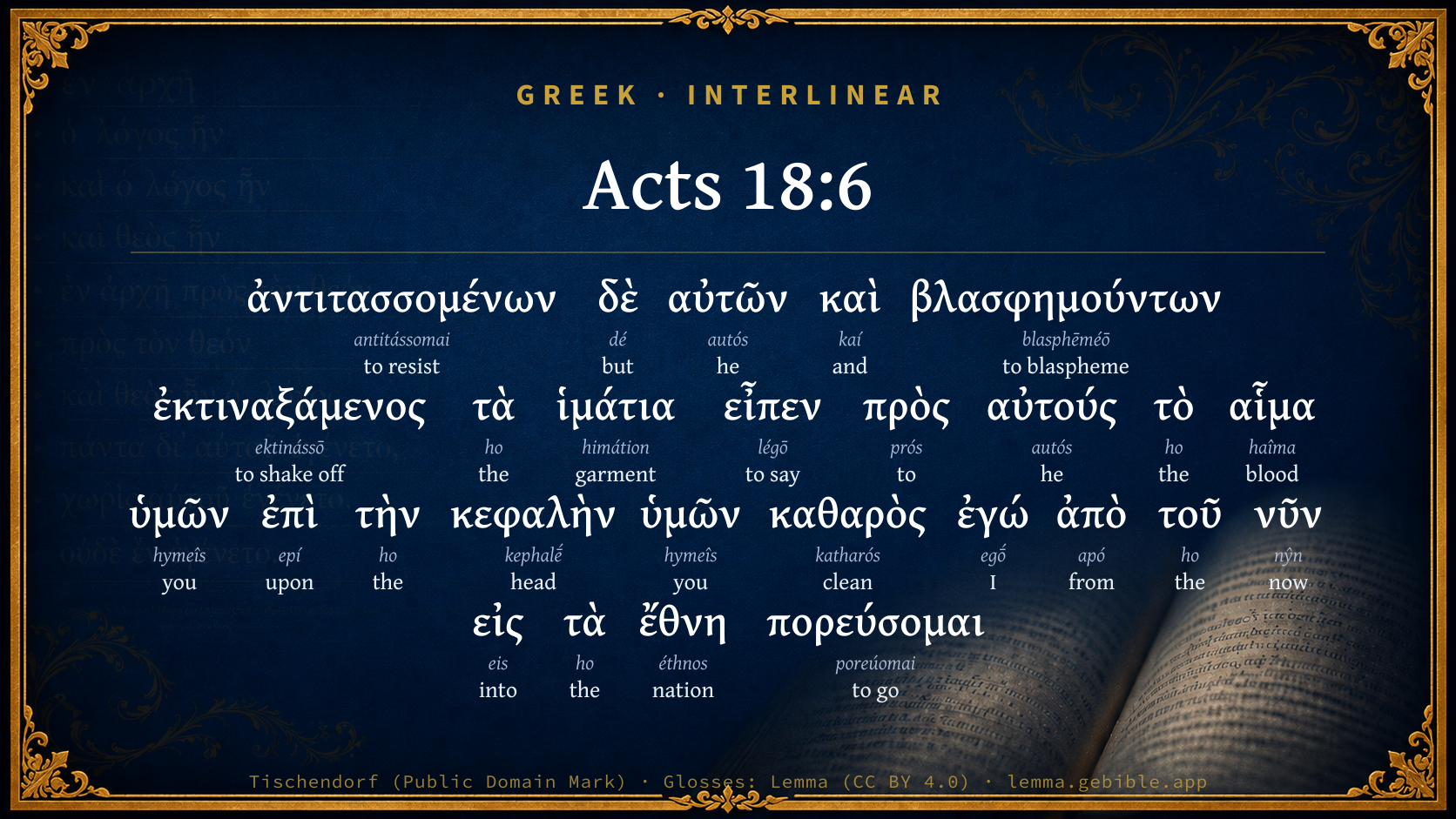
Greek (Tischendorf 8th ed.) Acts 18:6 appears in the Greek New Testament. The text above is from the Tischendorf 8th edition. Each word links to its Strong’s number and a concise gloss. Click any word for its full Thayer’s Greek Lexicon entry.
Download image
Cite this verse

Acts 18:6 (World English Bible). Public Domain. Lemma interlinear Bible study tool, https://lemma.gebible.app/v/acts/18/6.

Show BibTeX & RIS
BibTeX
RIS
English Translation
When they opposed him and blasphemed, he shook out his clothing and said to them, "Your blood be on your own heads! I am clean. From now on, I will go to the Gentiles!"
World English Bible · Public Domain
Highlights
  • 1 first appearance in the Greek New Testament
Full analysis ↓
Download a study sheet

One document with this verse’s original text, its word-by-word gloss line, the meaning frame, cross-references with their text, attributed commentary, and full source and license credits — printable, and it pastes into notes with its structure intact.

This verse Autodidact and up

Study sheet (.html) Plain text (.txt)

A passage Seminary Student

Up to 50 verses in one chapter. A passage sheet keeps up to 6 commentary sources and 12 cross-references per verse, in the order this page ranks them, and says so on the sheet whenever that leaves anything out. Ask for a single verse and you get the Autodidact verse sheet above.

Everything on this page stays free to read, with no account — the sheet is a download of what is already on screen, not access to it.

Want to remove ads? Support Godless Engineer
Compare translations 3

The same verse in 3 English versions, stacked beneath the original-language interlinear above. Click any original word for its lexicon entry.

Each is an independent rendering of the whole verse — the interlinear is not word-aligned to these translations.

Highlighted words mark where these versions differ — a whole-verse word diff, not a word-by-word alignment.

  • World English Bible Public Domain
    When they opposed him and blasphemed, he shook out his clothing and said to them, "Your blood be on your own heads! I am clean. From now on, I will go to the Gentiles!"
  • King James Version Public Domain
    And when they opposed themselves, and blasphemed, he shook his raiment, and said unto them, Your blood be upon your own heads; I am clean; from henceforth I will go unto the Gentiles.
  • unfoldingWord Literal Text CC BY-SA 4.0
    But as they were opposing and insulting him, shaking out garments, he said to them, “Your blood upon your head! I am clean! From now on I will go to the Gentiles.”

unfoldingWord Literal Text — © unfoldingWord, licensed CC BY-SA 4.0. Word-aligned USFM3 via Door43 (git.door43.org/unfoldingWord/en_ult).

Versions to compare (up to 4)

3 of 4 selected

Show all 19 translations

Every available English version of this verse, each an independent rendering of the whole verse.

  • World English Bible Public Domain
    When they opposed him and blasphemed, he shook out his clothing and said to them, "Your blood be on your own heads! I am clean. From now on, I will go to the Gentiles!"
  • Berean Standard Bible Public Domain
    But when they opposed and insulted him, he shook out his garments and told them, “Your blood be on your own heads! I am innocent of it. From now on I will go to the Gentiles.”
  • Majority Standard Bible Public Domain
    But when they opposed and insulted him, he shook out his garments and told them, “Your blood be on your own heads! I am innocent of it. From now on I will go to the Gentiles.”
  • King James Version Public Domain
    And when they opposed themselves, and blasphemed, he shook his raiment, and said unto them, Your blood be upon your own heads; I am clean; from henceforth I will go unto the Gentiles.
  • American Standard Version (1901) Public Domain
    And when they opposed themselves and blasphemed, he shook out his raiment and said unto them, Your blood `be' upon your own heads; I am clean: from henceforth I will go unto the Gentiles.
  • Revised Version (1885) Public Domain
    And when they opposed themselves, and blasphemed, he shook out his raiment, and said unto them, Your blood be upon your own heads; I am clean: from henceforth I will go unto the Gentiles.
  • Geneva Bible (1599) Public Domain
    And when they resisted and blasphemed, he shooke his raiment, and saide vnto them, Your blood be vpon your owne head: I am cleane: from henceforth will I goe vnto the Gentiles.
  • Douay-Rheims (1899) Public Domain
    But they gainsaying and blaspheming, he shook his garments, and said to them: Your blood be upon your own heads; I am clean: from henceforth I will go unto the Gentiles.
  • Young's Literal Translation Public Domain
    and on their resisting and speaking evil, having shaken `his' garments, he said unto them, `Your blood `is' upon your head -- I am clean; henceforth to the nations I will go on.'
  • Literal Standard Version CC BY-SA 4.0
    and on their resisting and slandering, having shaken [his] garments, he said to them, “Your blood [is] on your head—I am clean; from now on I will go on to the nations.”
  • Unlocked Literal Bible CC BY-SA 4.0
    When the Jews opposed and insulted him, Paul shook out his garment at them and said to them, “May your blood be upon your own heads; I am innocent. From now on I will go to the Gentiles.”
  • unfoldingWord Literal Text CC BY-SA 4.0
    But as they were opposing and insulting him, shaking out garments, he said to them, “Your blood upon your head! I am clean! From now on I will go to the Gentiles.”
  • Darby Bible Public Domain
    But as they opposed and spoke injuriously, he shook his clothes, and said to them, Your blood be upon your own head: *I* [am] pure; from henceforth I will go to the nations.
  • World Messianic Bible Public Domain
    When they opposed him and blasphemed, he shook out his clothing and said to them, “Your blood be on your own heads! I am clean. From now on, I will go to the Gentiles!”
  • Webster's Bible Public Domain
    And when they opposed themselves, and blasphemed, he shook his raiment, and said to them, Your blood be upon your own heads: I am clean: from henceforth I will go to the Gentiles.
  • Free Bible Version CC BY-SA 4.0
    When they opposed him and cursed him, he shook out his clothes and told them, “Your blood is on your own heads! I am innocent of any guilt, and from now on I will go to the foreigners.”
  • Bible in Basic English Public Domain
    And when they put themselves against him, and said evil words, he said, shaking his clothing, Your blood be on your heads, I am clean: from now I will go to the Gentiles.
  • Text-Critical English NT CC BY 4.0
    But when the Jews opposed him and reviled him, he shook out his garments and said to them, “Your blood be upon your own heads! I am innocent. From now on I will go to the Gentiles.”
  • Tyndale New Testament (1534) Public Domain
    And when they sayde cotrary and blasphemed he shoke his rayment and sayde vnto the: youre bloud apon youre awne heeddes and from hence forth I goo blamelesse vnto the gentyls.

Literal Standard Version (2020), Covenant Press — licensed CC BY-SA 4.0. Text via the HelloAO Bible API (eBible.org). Unlocked Literal Bible (unfoldingWord) — licensed CC BY-SA 4.0. Text via the HelloAO Bible API (eBible.org). unfoldingWord Literal Text — © unfoldingWord, licensed CC BY-SA 4.0. Word-aligned USFM3 via Door43 (git.door43.org/unfoldingWord/en_ult). Free Bible Version, Dr. Jonathan Gallagher — licensed CC BY-SA 4.0. Text via the HelloAO Bible API (eBible.org).

Word by word

More ways to search: Search by grammar → Find every occurrence → Compare this word →

Practice this passage: Drill this verse → Learn its vocabulary →

ἐκτιναξάμενος
ektinássō
G1621
“to shake off”
Verb, Aorist, Middle, Participle, Nominative, Singular, Masculine
Part of Speech
Verb
Tense
Aorist
Voice
Middle
Mood
Participle
Case
Nominative
Number
Singular
Gender
Masculine
Full Thayer's Definition

Origin: from G1537 and tinasso (to swing)

TDNT: None

1. to shake off so that something adhering shall fall a. by this symbolic act a person, expresses extreme contempt for another and refuses to have any further dealings with him b. to shake off for (the cleansing of) one's self
  1. ἀντιτασσομένων antitássomai G498 “to resist” Verb, Present, Middle, Participle, Genitive, Plural, Masculine
  2. δὲ dé G1161 “but” Conjunction
  3. αὐτῶν autós G846 “he” Personal pronoun, Genitive, Plural, Masculine
  4. καὶ kaí G2532 “and” Conjunction
  5. βλασφημούντων blasphēméō G987 “to blaspheme” Verb, Present, Active, Participle, Genitive, Plural, Masculine
  6. τὰ ho G3588 “the” Article, Accusative, Plural, Neuter
  7. ἱμάτια himátion G2440 “garment” Noun, Accusative, Plural, Neuter
  8. εἶπεν légō G3004 “to say” Verb, Aorist, Active, Indicative, 3rd person, Singular
  9. πρὸς prós G4314 “to” Preposition
  10. αὐτούς autós G846 “he” Personal pronoun, Accusative, Plural, Masculine
  11. τὸ ho G3588 “the” Article, Nominative, Singular, Neuter
  12. αἷμα haîma G129 “blood” Noun, Nominative, Singular, Neuter
  13. ὑμῶν hymeîs G5210 “you” Personal pronoun, 2nd person, Genitive, Plural
  14. ἐπὶ epí G1909 “upon” Preposition
  15. τὴν ho G3588 “the” Article, Accusative, Singular, Feminine
  16. κεφαλὴν kephalḗ G2776 “head” Noun, Accusative, Singular, Feminine
  17. ὑμῶν hymeîs G5210 “you” Personal pronoun, 2nd person, Genitive, Plural
  18. καθαρὸς katharós G2513 “clean” Adjective, Nominative, Singular, Masculine
  19. ἐγώ egṓ G1473 “I” Personal pronoun, 1st person, Nominative, Singular
  20. ἀπὸ apó G575 “from” Preposition
  21. τοῦ ho G3588 “the” Article, Genitive, Singular, Masculine
  22. νῦν nŷn G3568 “now” Adverb
  23. εἰς eis G1519 “into” Preposition
  24. τὰ ho G3588 “the” Article, Accusative, Plural, Neuter
  25. ἔθνη éthnos G1484 “nation” Noun, Accusative, Plural, Neuter
  26. πορεύσομαι poreúomai G4198 “to go” Verb, Future, Middle deponent, Indicative, 1st person, Singular

About this verse

These counts appear in no published source. They are computed here, from the morphology-tagged text and Lemma’s own curated glosses. What Lemma adds →

27
words
21
distinct lemmas
Acts
section

Notable vocabulary

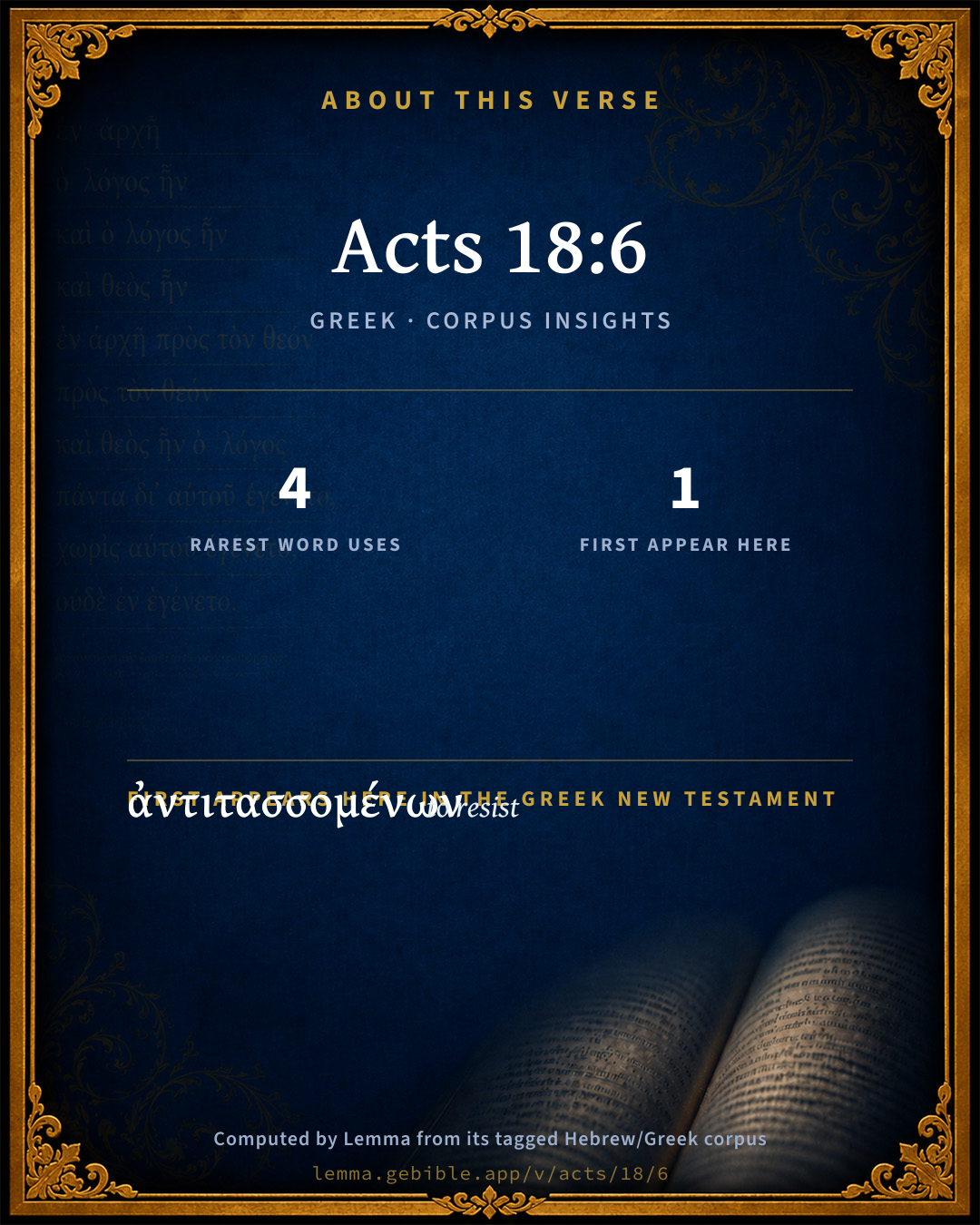
The rarest word here is ἐκτιναξάμενος to shake off G1621 — appearing just 4 times in the whole Greek New Testament.

First appearance in Scripture

This word makes its first canonical appearance in the Greek New Testament here:

  • ἀντιτασσομένων to resist G498

Shared distinctive vocabulary

ἐκτιναξάμενος to shake off G1621 occurs in 4 verses of the Greek New Testament. Also found in:
Repetition

Words recur within this verse:

  • τὰ the G3588 ×5
  • αὐτῶν he G846 ×2
  • ὑμῶν you G5210 ×2

Cross-references

34

Topical passages linked to Acts 18:6 in the Treasury of Scripture Knowledge — connected by theme and wording, ordered by reader-vote popularity; previews shown in the World English Bible.

  • Ezekiel 33:4 then whoever hears the sound of the trumpet, and doesn't take warning, if the sword come, and take him away, his blood shall be on his own head.
  • 2 Samuel 1:16 David said to him, Your blood be on your head; for your mouth has testified against you, saying, I have slain Yahweh's anointed.
  • Ezekiel 33:8–9 When I tell the wicked, O wicked man, you shall surely die, and you don't speak to warn the wicked from his way; that wicked man shall die in his iniquity, but his blood will I require at your hand.
  • Ezekiel 18:13 has given forth on interest, and has taken increase; shall he then live? he shall not live: he has done all these abominations; he shall surely die; his blood shall be on him.
  • Nehemiah 5:13 Also I shook out my lap, and said, So God shake out every man from his house, and from his labor, that doesn't perform this promise; even thus be he shaken out, and emptied. All the assembly said, Amen, and praised Yahweh. The people did according to this promise.
  • Acts 13:51 But they shook off the dust of their feet against them, and came to Iconium.
  • 1 Peter 4:4 They think it is strange that you don't run with them into the same excess of riot, blaspheming:
  • Luke 9:5 As many as don't receive you, when you depart from that city, shake off even the dust from your feet for a testimony against them."
  • Luke 10:10–11 But into whatever city you enter, and they don't receive you, go out into the streets of it and say,
  • Acts 13:45–47 But when the Jews saw the multitudes, they were filled with jealousy, and contradicted the things which were spoken by Paul, and blasphemed.
  • 1 Thessalonians 2:14–16 For you, brothers, became imitators of the assemblies of God which are in Judea in Christ Jesus; for you also suffered the same things from your own countrymen, even as they did from the Jews;
  • 1 Peter 4:14 If you are insulted for the name of Christ, blessed are you; because the Spirit of glory and of God rests on you. On their part he is blasphemed, but on your part he is glorified.
  • Ezekiel 3:18–19 When I tell the wicked, You shall surely die; and you give him no warning, nor speak to warn the wicked from his wicked way, to save his life; the same wicked man shall die in his iniquity; but his blood will I require at your hand.
  • Matthew 27:25 All the people answered, "May his blood be on us, and on our children!"
  • Acts 28:28 "Be it known therefore to you, that the salvation of God is sent to the Gentiles. They will also listen."
  • Romans 3:29 Or is God the God of Jews only? Isn't he the God of Gentiles also? Yes, of Gentiles also,
  • 2 Timothy 2:25 in gentleness correcting those who oppose him: perhaps God may give them repentance leading to a full knowledge of the truth,
  • Matthew 10:14 Whoever doesn't receive you, nor hear your words, as you go out of that house or that city, shake off the dust from your feet.
  • Matthew 22:10 Those servants went out into the highways, and gathered together as many as they found, both bad and good. The wedding was filled with guests.
  • Acts 19:9–10 But when some were hardened and disobedient, speaking evil of the Way before the multitude, he departed from them, and separated the disciples, reasoning daily in the school of Tyrannus.
  • Acts 20:26–27 Therefore I testify to you this day that I am clean from the blood of all men,
  • Acts 26:11 Punishing them often in all the synagogues, I tried to make them blaspheme. Being exceedingly enraged against them, I persecuted them even to foreign cities.
  • Acts 26:20 but declared first to them of Damascus, at Jerusalem, and throughout all the country of Judea, and also to the Gentiles, that they should repent and turn to God, doing works worthy of repentance.
  • Romans 10:12–13 For there is no distinction between Jew and Greek; for the same Lord is Lord of all, and is rich to all who call on him.
  • James 2:6–7 But you have dishonored the poor man. Don't the rich oppress you, and personally drag you before the courts?
  • Leviticus 20:9 "'For everyone who curses his father or his mother shall surely be put to death: he has cursed his father or his mother; his blood shall be upon him.
  • Leviticus 20:11–12 The man who lies with his father's wife has uncovered his father's nakedness: both of them shall surely be put to death; their blood shall be upon them.
  • Matthew 8:11 I tell you that many will come from the east and the west, and will sit down with Abraham, Isaac, and Jacob in the Kingdom of Heaven,
  • Matthew 21:43 "Therefore I tell you, the Kingdom of God will be taken away from you, and will be given to a nation bringing forth its fruits.
  • Luke 22:65 They spoke many other things against him, insulting him.
  • Romans 11:11–15 I ask then, did they stumble that they might fall? May it never be! But by their fall salvation has come to the Gentiles, to provoke them to jealousy.
  • Romans 9:25–26 As he says also in Hosea, "I will call them 'my people,' which were not my people; And her 'beloved,' who was not beloved."
  • Romans 9:30–33 What shall we say then? That the Gentiles, who didn't follow after righteousness, attained to righteousness, even the righteousness which is of faith;
  • 1 Timothy 5:22 Lay hands hastily on no one, neither be a participant in other men's sins. Keep yourself pure.

Cross-references courtesy of OpenBible.info (CC BY 4.0).

Commentary

Notes on Acts 18:6 from classic Christian and Jewish commentators (each source and its license shown beneath its notes). The classic Christian expositions comment on the surrounding passage and are grouped to its opening verse, so a note may address several verses; the Jewish commentaries on the Tanakh (Rashi and others) are per-verse, so they appear only where the commentator wrote on this verse.

Lemma curates 59 commentaries, every one of them public domain or Creative Commons licensed, each selected and text-cleaned for this edition rather than reprinted as found. About our sources →

Bengel's Gnomon

Johann Albrecht Bengel

Act 18:6. Ἐκτιναξάμενος, having shaken) The meaning of this gesture (significant act) is understood from the words with which he accompanied it.—αἷμα, your blood) souls. “Life” and death are put in antithesis: also, “life” and soul on the one hand, and death and the shedding of the blood on the other: comp. 1Sa 22:22, εἰμι αἴτιος τῶν ψυχῶν, “I am the occasion of the lives” (being taken).—ἐπὶ) The Hebrew על, upon. This denotes guilt resting or falling upon.—καθαρὸς ἐγὼ, I am clean) No one can say so, who has not previously fulfilled (the duty of giving) his testimony.—πορεύσομαι, I will go) So Paul changed his lodging: and yet he did not entirely withdraw himself from the better class of Jews, whom he made by this very act the more earnestly attentive.

Bengel's Gnomon of the New Testament — English translation (T&T Clark, Edinburgh, 1860) — public domain. Text from a community e-Sword module.

Meyer's Critical & Exegetical Commentary

Heinrich August Wilhelm Meyer

Act_18:6. The refractoriness (Rom_13:2) and reviling, which he experienced from them amidst this increased activity, induced him to turn to the Gentiles.

ἐκτιναξ. τὰ ἱμάτ.] he shook out his garments, ridding himself of the dust, indicating contempt, as in Act_13:51.

τὸ αἷμα ὑμῶν … ὑμῶν] sc. ἐλθέτω (Mat_23:35), i.e. let the blame of the destruction, which will as a divine punishment reach you, light on no other than yourselves. Comp. 2Sa_1:16; 1Ki_2:33; Eze_3:16 ff; Eze_33:4; Eze_33:7 ff. On ἐπὶ or εἰς τ. κεφάλην, see Dem. p. 323, ult. 381. 15. On the elliptical mode of expression, see Mat_27:25; 2Sa_1:16; Plat. Euthyd. p. 283 E; Arist. Plut. 526. The expression is not to be explained from the custom of laying the hands on the victim (Lev_16:31; comp. Herod. ii. 39), as Elsner and others suppose, or on the accused on the part of the witnesses (so Piscator); but in all languages (comp. Heinsius, ad Ov. Her. xx. 127) the head is the significant designation of the person himself. The significance here lies particularly in the conception of the divine punishment coming from above, Rom_1:18.

What Paul intends by the destruction which he announces as certainly coming, and the blame of which he adjudges to themselves, is not moral corruption (de Wette, who sees here an un-Pauline expression), but eternal ἀπώλεια, which is conceived as θάνατος (Rom_1:32; Rom_6:16; Rom_6:21; Rom_6:23; Rom_7:5; Rom_7:10; Rom_7:13; Rom_7:24; Rom_8:2; Rom_8:6 al.), and therefore symbolized as αἷμα (to be shed), because the blood is the seat of life (comp. on Act_15:20). The setting in of this ἀπώλεια occurs at the Parousia (2Th_1:8). Thus Paul, as his conduct was already in point of fact for his adversaries an ἐνδείξις ἀπωλείας (Php_1:28), expressly gives to them such an ἐνδείξις.

καθαρὸς ἐγώ] comp. Act_20:26.

ἀπὸ τοῦ νῦν κ.τ.λ.] as in Act_13:46.

Meyer — Critical and Exegetical Commentary on the New Testament — English translation by Peter Christie, edited by Frederick Crombie (T&T Clark, 1880) — public domain. Text from a community e-Sword module.

Expositor's Greek Testament

ed. W. Robertson Nicoll

Act 18:6 . ἀντιτασσ .: classical use, of an army ranged in hostile array, or of those opposed to each other in opinion, Thuc., iii., 83. So in later Greek, in Polyb-generally to oppose, to resist. Ramsay renders “and when they began to form a faction against him,” but cf. Rom 13:2 , Jas 4:6 ; Jas 5:6 , 1Pe 5:5 , Pro 3:34 . βλασφ ., cf. Act 13:45 , or it may be used generally as in Act 19:9 , and 2Pe 2:2 . ἐκτιναξ ., cf. Act 13:51 , note; cf. Mat 10:14 , and LXX, Neh 5:13 , “undoubtedly a very exasperating gesture,” Ramsay, St. Paul , p. 256; but we must remember that the opposition at Corinth seems to have been unusally great, as Ramsay himself points out, u. s. , pp. 143, 256. τὸ αἶμα ὑμῶν , cf. Act 20:26 , Hebraistic, cf., e.g. , Mat 27:25 , and in LXX, Lev 20:16 , 2Sa 1:16 , 1Ki 2:37 , Eze 3:18 , etc., i.e. , ἐλθέτω , Mat 23:35 . Both here and in Act 20:26 we can scarcely doubt that St. Paul had in mind the words of the prophet, Eze 33:6 . ἐπὶ τὴν κεφ ., i.e. , upon yourselves, the head being used for the person for other ideas of the word see Wendt (1888), in loco . De Wette interprets of moral ruin, and others of the eternal ἀπωλεία , but we cannot refine so much upon a figurative phrase. In Act 18:5 b and 6 Spitta and Jüngst see the hand of a Reviser, the former holding that the whole passage runs smoothly with these omissions, whilst Jüngst ascribes also the word ἐκεῖθεν , Act 18:7 , to the Reviser. According to Clemen, 4 and 5 b , the preaching in the synagogue belongs to Redactor Judaicus, the Jewish persecution in Act 18:6 to the Redactor Antijudaicus. Hilgenfeld agrees with Spitta in so far that he ascribes 5 b and 6 b to “the author to Theophilus”. καθαρὸς ἐγὼ : scarcely enough to say “I am pure,” have discharged my duty with a clear conscience, cf. Act 20:26 , the same idea here, better to punctuate at ἐγώ , but see Blass, in loco . ἀπὸ τοῦ νῦν : from henceforth, i.e. , so far as he is concerned. It is evident that the words did not apply to other places, for in Act 19:8 St. Paul goes to the synagogue according to his wont. The phrase is found five times in St. Luke’s Gospel, but only here in Acts. It is used once elsewhere in N.T, and there by St. Paul, 2Co 5:16 ( cf. Joh 8:11 ). See Friedrich, p. 16, and Hawkins, Horæ Synopticæ , p. 29.

The Expositor's Greek Testament, edited by W. Robertson Nicoll (1897–1910) — public domain. Text from a community e-Sword module.

Geneva Bible (1599)

Geneva Bible translators

This is a kind of speech taken from the Hebrews, whereby he meaneth, that the Jews are cause of their own destruction: and as for him, that he is without fault in forsaking them and going to other nations.

Although we have assayed all means possible, and yet in vain, we must not leave off from our work, but forsake the rebellious, and go to them that be more obedient.

Geneva Bible (1599) marginal notes — public domain. Text via Bolls.life.

Jamieson, Fausset & Brown

Robert Jamieson, A. R. Fausset & David Brown

Your blood be upon your own heads, &c.--See Eze 33:4, Eze 33:9.

from henceforth I will go unto the Gentiles--Compare Act 13:46.

Jamieson, Fausset & Brown — Commentary Critical and Explanatory on the Whole Bible (1871) — public domain (CC PDM 1.0). Text via the HelloAO Bible API.

Adam Clarke's Commentary

Verse 6. When they opposed] αντιτασσομενων, Systematically opposing, putting themselves in warlike order against him: so the word implies.

And blasphemed] This is precisely the way in which they still act. They have no arguments against Jesus being the Messiah; but, having made a covenant with unbelief, as soon as they are pressed on this point, they rail and blaspheme.-See the Tela ignea Satanae, by Wagenseil.

He shook his raiment] This was an action similar to that of shaking the dust of the feet; See Clarke on Mt 10:14. See a parallel act, and its signification, in Ne 5:13: Also I SHOOK MY LAP, and said, So shall God SHAKE every man FROM HIS HOUSE and FROM his LABOUR; even thus shall he be SHAKEN OUT and EMPTIED. St. Paul's act on this occasion seems to have been the same with this of Nehemiah, and with the same signification; and it is likely that he was led by a Divine impulse to do it-thus signifying the shaking and emptying out of this disobedient people, which took place about sixteen years afterwards.

Your blood be upon your own heads] That is, ye alone are the cause of the destruction that is coming upon yourselves and upon your country.

I am clean] καθαρος εγω, I am pure or innocent of your death and ruin. I have proposed to you the Gospel of Jesus Christ-the only means by which ye can be saved, and ye have utterly rejected it. I shall labour no more with you; and, from henceforth, shall confine my labours to the Gentiles. St. Paul must refer to the Jews and Gentiles of Corinth particularly; for he preached to the Jews occasionally in other places; see Ac 19:8; Ac 19:9; and several were brought to the knowledge of the truth. But it seems as if the Jews from this time systematically opposed the Gospel of Christ; and yet, general tenders of this salvation were made to them wherever the apostles came; and when they rejected them, the word was sent to the Gentiles; see Ac 19:8; Ac 19:9.

Pure from blood, or pure from guilt, is commonly expressed by καθαρος; thus Heliodorus, lib. i. p. 49: Εις δευρο διετελεσα καθαραν εμαυτην απο σης ὁμιλιας φυλαττουσα, Until now I have lived, preserving myself pure: and Alciphron, lib. i. epist. 7, ad. fin.: Ουδε μιαναι λυθρῳ τας χειρας, ἁς ἡ θαλαττα εκ παιδος εις δευρο καθαρας αδικηματων εφυλαξε, Nor to stain with pollution the hands which a seafaring life has kept from a child until now pure from iniquity.

Adam Clarke's Commentary on the Bible (1810–1826) — public domain. Text from a community e-Sword/MySword module.

John Calvin's Commentaries

6. When they gainsayed. The Jews suffered Paul after a sort until he came unto the manifest preaching of Christ. And here brake out their rage. And we must note the speech, that they go from gainsaying unto blaspheming and railing. For it falleth out thus for the most part, when men take to themselves such liberty, that the devil doth inflame them by little and little unto greater madness. For which cause, we must take good heed that no wicked lust or desire provoke us to resist the truth; and, above all, let that horrible judgment terrify us which the Spirit of God thundereth out by the mouth of Paul against all rebels. For undoubtedly, in that Paul by shaking his garments gave some token of detestation, it was no human or private indignation, but zeal kindled by God in his heart; yea, God raised him up to be a preacher and setter forth of his vengeance, to the end the enemies of the word might know that they should not escape scot free for their stubbornness. We spake somewhat touching this sign of execration or cursing in the thirteenth chapter, (Acts 13:51.) Let the readers repair thither. The sum is, that God is sorer displeased with contempt of his word than with any wickedness. And surely, men be quite past hope when they tread under foot, or drive from them, the only remedy of all evils and maladies. Now, as the Lord cannot abide rebellion against his word, so it ought to sting and nettle us full sore. My meaning is this, that when the wicked enter combat with God, and, as it were, arm themselves to resist, we are called, as it were, by the heavenly trumpet unto the conflict, because there is nothing more filthy than that the wicked should mock God to his face, whilst we say nothing, and that they should even break out into reproaches and blasphemies.

Your blood. He denounceth to them vengeance, because they be without excuse. For they can shift no part of their fault from themselves, after that despising the calling of God they have endeavored to put out the light of life. Therefore, seeing they bear the blame of their own destruction, he doth also affirm that they shall be punished. And in saying that he is clean, he testifieth that he hath done his duty, it is well known what the Lord giveth all his ministers in charge in Ezekiel, (Ezekiel 3:18.) If thou show not unto the wicked that he may convert, I will require his blood at thy hand. Therefore Paul (because he did what he could to bring the Jews to repentance) doth acquit himself of all guiltiness. And by these words, teachers are warned that unless they will be guilty of blood before the Lord, they must do what in them lieth to bring those which go astray into the way, and that they suffer nothing to perish through ignorance.

I will go undo the Gentiles. Though the Jews had showed themselves to be most ready to be taught, yet ought Paul to have employed himself to teach the Gentiles, whose apostle and minister he was made; but here he expresseth the passage whereby he withdrew himself from the stubborn Jews for all. For he observed this course in teaching, that beginning with the Jews he might couple the Gentiles with them in the society of faith, and so might make of both together one body of the Church. When there remained no hope to do any good among the Jews, then the Gentiles only remained. Therefore, the sense is this, that they must be deprived of their own inheritance, that it may be given to the Gentiles, and so be wounded, partly that being stricken with fear, yea, being cast down, they might come to soundness of mind; partly that the emulation or striving of the Gentiles might prick them forward unto repentance. But because they were incurable, reproach and shame served for this purpose only to bring them into despair.

John Calvin's Commentaries (1540-1563) — public domain. Text from the Calvin Translation Society English edition (1840s-50s) via the Christian Classics Ethereal Library (ccel.org). Calvin's coverage is partial (roughly two-thirds of the Bible); uncommented books and verses are honest gaps, never fabricated. The 19th-century editor's footnotes and remarks are omitted so the notes are faithfully Calvin's own voice.

Ellicott's Commentary for English Readers

(6) And when they opposed themselves, and blasphemed.—The latter word includes the reviling of which the Apostle himself was the object, as well as blaspheming against God. Assuming what has been suggested in the Note on Act_18:2, we may think of these disturbances as reproducing what had already taken place at Rome. We may, perhaps, trace an echo of such blasphemies in the words “Anathema be Jesus,” of which St. Paul speaks in 1Co_12:3 as having been uttered as with the vehemence of a simulated inspiration, against which men needed to be warned.

He shook his raiment.—On the symbolic significance of the act, see Note on Mat_10:14. As done by a Jew to Jews no words and no act could so well express the Apostle’s indignant protest. It was the last resource of one who found appeals to reason and conscience powerless, and was met by brute violence and clamour.

Your blood be upon your own heads.—The phrase and thought were both essentially Hebrew. (See Note on Mat_27:25.) We can hardly think of the Apostle as using them without a distinct recollection of the language which defined the responsibility of a prophet of the truth in Eze_3:18-19.

From henceforth I will go unto the Gentiles.—The words are almost identical with those in Act_13:46, and are explained by them. It is obvious in each case that the words have a limited and local application. The Apostle did not renounce all future work among the Jews, but gave up preaching to those at Corinth.

A Bible Commentary for English Readers, edited by Charles John Ellicott (1878–1897) — public domain. Text from a community e-Sword module.

The Cambridge Bible for Schools and Colleges

gen. ed. J. J. S. Perowne

6. opposed themselves] The word implies very strong opposition, as of a force drawn up in battle array. It was an organized opposition.

and blasphemed] The same word is used in 2Pe_2:2, “The way of truth shall be evil spoken of.” And the same conduct, though the word is different, is described in the next chapter (Act_19:9), “speaking evil of the Way before the multitude.”

he shook out his raiment] Figurative of entire renunciation of them. Nothing that pertained to them should cling to him; and in like manner he would cast them off from his thoughts (cp. Act_13:51). For the action cp. Neh_5:13.

Your blood be upon your own heads] He says “blood” in the sense of “destruction,” using figuratively the language which in Jos_2:19 is used literally.

I will go unto the Gentiles] i.e. the Gentiles in Corinth. For in future preaching elsewhere (see Act_19:8) he addressed the Jews and went to the synagogue, as had been his custom from the first.

The Cambridge Bible for Schools and Colleges (gen. ed. J. J. S. Perowne; Cambridge University Press, 1878–1918) — public domain. Text from a community e-Sword module.

John Gill's Exposition

And when they opposed themselves,.... To the truth, and contradicted themselves in many instances, and their own prophecies; or those books which they themselves allowed to be the oracles of God, and blasphemed both Christ, and the apostle, and the doctrine which he taught; and railed at him, and spoke evil of him, and used him in a very contumelious and reproachful manner, as they were used from contradicting to go to blaspheming; see Act 13:45

he shook his raiment; his outer garment, and the dust off from it, as a testimony against them; see Mat 10:14

and said unto them, your blood be upon your heads; meaning, that they were the authors of their own ruin and destruction; that they could not impute it to any other, when it came upon them; and that they were left inexcusable, and must bear their own iniquities, and the punishment of them: this clause is wanting in the Syriac version.

I am clean; meaning from their blood; see Act 20:26. The apostle seems to allude to Eze 33:4 signifying, that he had discharged his duty as a preacher, and so had delivered his own soul from their blood being required at his hands; and that it rested entirely on themselves, and they were answerable for all their impenitence, unbelief, and blasphemy:

from henceforth I will go unto the Gentiles; in that city, and preach the Gospel to them, and no more enter into their synagogue, as it is very likely he afterwards never did; for though Crispus, the chief ruler of the synagogue, was afterwards converted, yet his conversion seems to have been not in the synagogue, but in the house of Justus, which was hard by it. Compare with this Act 13:46.

John Gill's Exposition of the Whole Bible (1746–1763) — public domain (CC PDM 1.0). Text via the HelloAO Bible API.

Trapp's Complete Commentary

John Trapp

6 And when they opposed themselves, and blasphemed, he shook his raiment, and said unto them, Your blood be upon your own heads; I am clean: from henceforth I will go unto the Gentiles.

Ver. 6. And when they opposed] Gr. Αντιτασσομενων, And when they bade him battle. A military term.

Your blood be upon your own heads] Answerable to their wish, Mat 27:25, and according to their manner of putting their sins upon the head of the sacrificed creature, Lev 1:4; Lev 3:2.

John Trapp, A Commentary or Exposition upon All the Books of the Old and New Testament (1647–1656) — public domain. Text from a community e-Sword module.

Albert Barnes' Notes on the Bible

And when they opposed themselves - To him and his message.

And blasphemed - See the notes on Act 13:45.

He shook his raiment - As an expressive act of shaking off the guilt of their condemnation. Compare Act 13:45. He shook his raiment to show that he was resolved henceforward to have nothing to do with them; perhaps, also, to express the fact that God would soon slake them off, or reject them (Doddridge).

Your blood ... - The guilt of your destruction is your own. You only are the cause of the destruction that is coming upon you. See the notes on Mat 27:25.

I am clean - I am not to blame for your destruction. I have done my duty. The gospel had been fairly offered and deliberately rejected; and Paul was not to blame for their ruin, which he saw was coming upon them.

I will go ... - See Act 13:46.

Albert Barnes' Notes on the Bible (1834–1885) — public domain. Text from a community e-Sword/MySword module.

Haydock's Catholic Bible Commentary

Shaking his garments. See Matthew x. 14. Your blood be upon your own heads: that is, you are guilty of your own perdition: we have discharged our duty by preaching to you. (Witham)

George Leo Haydock (1774–1849), Haydock's Catholic Family Bible and Commentary, 1859 edition — public domain. Excludes Psalms (Douay-Rheims chapter numbering differs from Protestant) and Deuterocanonical books (Catholic canon only).

Matthew Poole's English Annotations

Blasphemed; they blasphemed Paul, miscalling of him, but especially Christ, whose dishonour grieved Paul most.

He shook his raiment; his upper garment, as the manner was, Mat 26:65, that none of the dust of that place where such blasphemy was spoken might stick unto him. See Act 13:51.

Your blood be upon your own heads; or, You are guilty of your own deaths and damnation, 2Sa 1:16; Mat 27:25;

Felo de se. This expression is borrowed from the witnesses laying their hands on the head of the guilty person; or the sacrificer’s laying his hand on the head of the beast which was to be slain; Exo 29:10; Lev 1:4.

I am clean; free from their blood, or the loss of their souls, having warned them, and shown the way of life unto them. Eze 33:4; he had blown the trumpet, and warned the people.

Matthew Poole's English Annotations on the Holy Bible (1683–1685) — public domain. Text from a community e-Sword/MySword module.

Whedon's Commentary on the Bible

Daniel D. Whedon

6. Shook his raiment—A symbolical action indicating that not even a particle of dust belonging to them should adhere to him; hence entire departure.

Your blood… heads—The term blood here signifies penalty for the blood shed. (See note on Act_20:26.) The reference is to Eze_3:18, where Ezekiel is set as a spiritual watchman over the spiritual life of Israel. If any man were negligently left by Ezekiel unwarned he would die, but for the blood of his death Ezekiel should be answerable. As Paul had faithfully warned these Jews, their blood, the responsibility and penalty for their destruction, would rest upon themselves. Upon their heads, as being the object on which divine retribution would descend and rest.

Daniel D. Whedon (gen. ed.), Commentary on the Old and New Testaments (1874–1909) — public domain. Text from a community e-Sword module.

The Pulpit Commentary

Shook out for shook, A.V. For this action of shaking his raiment, Act_13:51. It was in accordance with our Lord"s direction inssein Mat_10:14, where the same word (ejktina) is used. It is "much employed in medical language" (Hobart, "Medical Language of St. Luke," p. 240). The idea seems to be having nothing henceforth in common with them. Your blood, etc.. (see Eze_33:4-9) St. Paul"s keen sense of the perverseness of the Jews breaks out in his First Epistle to the Thessalonians, (1Th_4:14-16) written about this time. See hole to ver. 5.

Personal religious responsibility.

blood be upon your own heads." Introduce by reference to St. Paul"s relations with the Jews. Up to this time he had been strictly loyal to the Jews, and wherever he went he had taken the gospel first to them. No doubt the hindrance of their prejudices, and the violence of their opposition, had weaned him from them and prepared the way for the separation of the Gentile from the Jewish Christians, which took place at Ephesus. (Act_19:9) The terms that are used to describe the conduct of the Jewish party are very strong ones, and help to explain the intense feeling of indignation excited in the apostle. "Opposed themselves" is a military term, implying organized and systematic opposition, How strong St. Paul"s feelings were is indicated in his act of "shaking his raiment." "As done by a Jew to Jews, no words and no act could so well express the apostle"s indignant protest. It was the last resource of one who found appeals to reason and conscience powerless, and was met by brute violence and clamor." The phrase which the apostle used is evidently a proverbial one; it must not be regarded as a mere passionate imprecation; it is a last solemn warning. With it should be compared such passages as 1Ki_2:32, 1Ki_2:33, 1Ki_2:37; Eze_3:18 Eze_33:4 Mat_23:35. St. Paul did not from this time entirely give up preaching to the Jews, but he gave up preaching to those who lived at Corinth. The point on which we fix attention is that St. Paul had recognized and borne responsibility for them as their teacher; but that responsibility he refused to bear any longer; he cast it back altogether on themselves.

I THE RESPONSIBILITY OF THE TEACHER. This is fully dealt with, in relation to the ancient prophets, by Ezekiel (3:17-21; 33:1-19). The prophet, or teacher, or preacher, is:

1. A man set in relation with others who is one of them; who can speak to, or influence, others.

2. A man with a message to be given to others. He is a recipient of Divine truth for the sake of others. He has a sphere and a message. Out of these two things comes his responsibility. For the time and occasion, he actually takes upon himself the responsibility of the souls of those to whom he is sent, since their eternal well-being may be dependent on his faithfulness in the delivery of his message. Illustrate that Jonah took upon himself the fate of Nineveh as a nation. So every true preacher now, who has a message from God, finds that the secret of his power lies in the measure in which he can take the responsibility of his audience upon himself, and feel that his testimony will be a savor of "life unto life," or of "death unto death." He can only be cleared of his responsibility before God in two ways.

(1) By fully delivering his message.

(2) By the willful rejection of his message.

Impress what a burden on the Christian preacher"s heart is the burden of souls; and with what an agony of feeling he sometimes would cast off the burden, saying, "Who is sufficient for these thins?" But what is overwhelming responsibility from one point of view is holy joy of service from another point of view. Who would not willingly stand with Christ, and feel how "he bare our infirmities and carried our sorrows"? "It is enough for the servant that he be as his Lord.

II THE RESPONSIBILITY OF THE HEARER. It may be said s it not better to have the people without the knowledge of the truth, if such knowledge increases their responsibility and final judgment? The answer is:

(1) We must preach the gospel, whatever may prove to be the issues of our work.

(2) Bearing responsibilities, and lifting ourselves to meet them well, are the conditions of moral growth.

No man can reach a full manhood save under the pressure of responsibilities. Those of the hearer are:

(1) To listen to the teacher of Divine truth.

(2) To recognize the personal relations of the truth he hears.

(3) To decide for himself the acceptance or rejection of the message.

(4) To bear all the present and future consequences of whatever decision he may make.

Impress that the most painful thing about the woe of lost souls will be the conviction that they were themselves to blame. "Their blood was upon their own heads. R.T.

The Pulpit Commentary (1880–1919), ed. H.D.M. Spence-Jones & Joseph S. Exell — public domain. Text from a community e-Sword module.

John Wesley's Explanatory Notes

He shook his raiment - To signify he would from that time refrain from them: and to intimate, that God would soon shake them off as unworthy to be numbered among his people. I am pure - None can say this but he that has born a full testimony against sin. From henceforth I will go to the Gentiles - But not to them altogether. He did not break off all intercourse with the Jews even at Corinth. Only he preached no more in their synagogue.

John Wesley, Explanatory Notes Upon the Whole Bible (1754–1765) — public domain. Text via the GEBible commentary corpus.

MacLaren's Expositions of Holy Scripture

Alexander MacLaren

Acts

PAUL AT CORINTH

Act 18:1 - Act 18:11.

Solitude is a hard trial for sensitive natures, and tends to weaken their power of work. Paul was entirely alone in Athens, and appears to have cut his stay there short, since his two companions, who were to have joined him in that city, did not do so till after he had been some time in Corinth. His long stay there has several well-marked stages, which yield valuable lessons.

I. First, we note the solitary Apostle, seeking friends, toiling for bread, and withal preaching Christ.

Corinth was a centre of commerce, of wealth, and of moral corruption. The celebrated local worship of Aphrodite fed the corruption as well as the wealth. The Apostle met there with a new phase of Greek life, no less formidable in antagonism to the Gospel than the culture of Athens. He tells us that he entered on his work in Corinth ‘in weakness, and in fear, and in much trembling,’ but also that he did not try to attract by adaptation of his words to the prevailing tastes either of Greek or Jew, but preached ‘Jesus Christ, and Him crucified,’ knowing that, while that appeared to go right in the teeth of the demands of both, it really met their wants. This ministry was begun, in his usual fashion, very unobtrusively and quietly. His first care was to find a home; his second, to provide his daily bread; and then he was free to take the Sabbath for Christian work in the synagogue.

We cannot tell whether he had had any previous acquaintance with Aquila and his wife, nor indeed is it certain that they had previously been Christians. Paul’s reason for living with them was simply the convenience of getting work at his trade, and it seems probable that, if they had been disciples, that fact would have been named as part of his reason. Pontus lay to the north of Cilicia, and though widely separated from it, was near enough to make a kind of bond as of fellow-countrymen, which would be the stronger because they had the same craft at their finger-ends.

It was the wholesome practice for every Rabbi to learn some trade. If all graduates had to do the same now there would be fewer educated idlers, who are dangerous to society and burdens to themselves and their friends. What a curl of contempt would have lifted the lips of the rich men of Corinth if they had been told that the greatest man in their city was that little Jew tent-maker, and that in this unostentatious fashion he had begun to preach truths which would be like a charge of dynamite to all their social and religious order! True zeal can be patiently silent.

Sewing rough goat’s-hair cloth into tents may be as truly serving Christ as preaching His name. All manner of work that contributes to the same end is the same in worth and in recompense. Perhaps the wholesomest form of Christian ministry is that after the Apostolic pattern, when the teacher can say, as Paul did to the people of Corinth, ‘When I was present with you and was in want, I was not a burden on any man.’ If not in letter, at any rate in spirit, his example must be followed. If the preacher would win souls he must be free from any taint of suspicion as to money.

II. The second stage in Paul’s Corinthian residence is the increased activity when his friends, Silas and Timothy, came from Beroea.

We learn from Php 4:15, and 2Co 11:9, that they brought gifts from the Church at Philippi; and from 1Th 3:6, that they brought something still more gladdening namely, good accounts of the steadfastness of the Thessalonian converts. The money would make it less necessary to spend most of the week in manual labour; the glad tidings of the Thessalonians’ ‘faith and love’ did bring fresh life, and the presence of his helpers would cheer him. So a period of enlarged activity followed their coming.

The reading of Act 18:5, ‘Paul was constrained by the word,’ brings out strikingly the Christian impulse which makes speech of the Gospel a necessity. The force of that impulse may vary, as it did with Paul; but if we have any deep possession of the grace of God for ourselves, we shall, like him, feel it pressing us for utterance, as soon as the need of providing daily bread becomes less stringent and our hearts are gladdened by Christian communion. It augurs ill for a man’s hold of the word if the word does not hold him. He who never felt that he was weary of forbearing, and that the word was like a fire, if it was ‘shut up in his bones,’ has need to ask himself if he has any belief in the Gospel. The craving to impart ever accompanies real possession.

The Apostle’s solemn symbolism, announcing his cessation of efforts among the Jews, has of course reference only to Corinth, for we find him in his subsequent ministry adhering to his method, ‘to the Jew first.’ It is a great part of Christian wisdom in evangelical work to recognise the right time to give up efforts which have been fruitless. Much strength is wasted, and many hearts depressed, by obstinate continuance in such methods or on such fields as have cost much effort and yielded no fruit. We often call it faith, when it is only pride, which prevents the acknowledgment of failure. Better to learn the lessons taught by Providence, and to try a new ‘claim,’ than to keep on digging and washing when we only find sand and mud. God teaches us by failures as well as by successes. Let us not be too conceited to learn the lesson or to confess defeat, and shift our ground accordingly.

It is a solemn thing to say ‘I am clean.’ We need to have been very diligent, very loving, very prayerful to God, and very persuasive in pleading with men, before we dare to roll all the blame of their condemnation on themselves. But we have no right to say, ‘Henceforth I go to’ others, until we can say that we have done all that man-or, at any rate, that we-can do to avert the doom.

Paul did not go so far away but that any whose hearts God had touched could easily find him. It was with a lingering eye to his countrymen that he took up his abode in the house of ‘one that feared God,’ that is, a proselyte; and that he settled down next door to the synagogue. What a glimpse of yearning love which cannot bear to give Israel up as hopeless, that simple detail gives us! And may we not say that the yearning of the servant is caught from the example of the Master? ‘How shall I give thee up, Ephraim?’ Does not Christ, in His long-suffering love, linger in like manner round each closed heart? and if He withdraws a little way, does He not do so rather to stimulate search after Him, and tarry near enough to be found by every seeking heart?

Paul’s purpose in his solemn warning to the Jews of Corinth was partly accomplished. The ruler of the synagogue ‘believed in the Lord with all his house.’ Thus men are sometimes brought to decision for Christ by the apparently impending possibility of His Gospel leaving them to themselves. ‘Blessings brighten as they take their flight.’ Severity sometimes effects what forbearance fails to achieve. If the train is on the point of starting, the hesitating passenger will swiftly make up his mind and rush for a seat. It is permissible to press for immediate decision on the ground that the time is short, and that soon these things ‘will be hid from the eyes.’

We learn from 1Co 1:14, that Paul deviated from his usual practice, and himself baptized Crispus. We may be very sure that his doing so arose from no unworthy subserviency to an important convert, but indicated how deeply grateful he was to the Lord for giving him, as a seal to a ministry which had seemed barren, so encouraging a token. The opposition and blasphemy of many are outweighed, to a true evangelist, by the conversion of one; and while all souls are in one aspect equally valuable, they are unequal in the influence which they may exert on others. So it was with Crispus, for ‘many of the Corinthians hearing’ of such a signal fact as the conversion of the chief of the synagogue, likewise ‘believed.’ We may distinguish in our estimate of the value of converts, without being untrue to the great principle that all men are equally precious in Christ’s eyes.

III. The next stage is the vision to Paul and his consequent protracted residence in Corinth.

God does not waste visions, nor bid men put away fears which are not haunting them. This vision enables us to conceive Paul’s state of mind when it came to him. He was for some reason cast down. He had not been so when things looked much more hopeless. But though now he had his friends and many converts, some mood of sadness crept over him. Men like him are often swayed by impulses rising within, and quite apart from outward circumstances. Possibly he had reason to apprehend that his very success had sharpened hostility, and to anticipate danger to life. The contents of the vision make this not improbable.

But the mere calming of fear, worthy object as it is, is by no means the main part of the message of the vision. ‘Speak, and hold not thy peace,’ is its central word. Fear which makes a Christian dumb is always cowardly, and always exaggerated. Speech which comes from trembling lips may be very powerful, and there is no better remedy for terror than work for Christ. If we screw ourselves up to do what we fear to do, the dread vanishes, as a bather recovers himself as soon as his head has once been under water.

Why was Paul not to be afraid? It is easy to say, ‘Fear not,’ but unless the exhortation is accompanied with some good reason shown, it is wasted breath. Paul got a truth put into his heart which ends all fear-’For I am with thee.’ Surely that is enough to exorcise all demons of cowardice or despondency, and it is the assurance that all Christ’s servants may lay up in their hearts, for use at all moments and in all moods. His presence, in no metaphor, but in deepest inmost reality, is theirs, and whether their fears come from without or within, His presence is more than enough to make them brave and strong.

Paul needed a vision, for Paul had never seen Christ ‘after the flesh,’ nor heard His parting promise. We do not need it, for we have the unalterable word, which He left with all His disciples when He ascended, and which remains true to the ends of the world and till the world ends.

The consequence of Christ’s presence is not exemption from attacks, but preservation in them. Men may ‘set on’ Paul, but they cannot ‘hurt’ him. The promise was literally fulfilled when the would-be accusers were contemptuously sent away by Gallio, the embodiment of Roman even-handedness and despising of the deepest things. It is fulfilled no less truly to-day; for no hurt can come to us if Christ is with us, and whatever does come is not hurt.

‘I have much people in this city.’ Jesus saw what Paul did not, the souls yet to be won for Him. That loving Eye gladly beholds His own sheep, though they may be yet in danger of the wolves, and far from the Shepherd. ‘Them also He must bring’; and His servants are wise if, in all their labours, they cherish the courage that comes from the consciousness of His presence, and the unquenchable hope, which sees in the most degraded and alienated those whom the Good Shepherd will yet find in the wilderness and bear back to the fold. Such a hope will quicken them for all service, and such a vision will embolden them in all peril.

Alexander MacLaren, Expositions of Holy Scripture (1904–1910) — public domain. Text from a community e-Sword module.

Godbey's Commentary on the New Testament

William B. Godbey

6. You see the rupture long brewing and sorrowfully anticipated by Paul is bound to come: He divides the church. They drive him out of the synagogue, just like you see going on all around you this day: some receive the gospel of holiness and others reject it. So the church is divided; some go into holiness and others oppose it. Paul is fortunate. Titius Justus, one of his converts, owns a house adjoining the synagogue, into which he invites Paul and all of the holiness people.

William B. Godbey, Commentary on the New Testament (1896–1900) — public domain. Text from a community e-Sword module.

McGarvey & Pendleton's Commentaries

J. W. McGarvey

6, 7. The increase of Paul's earnestness was responded to by an increased virulence in the opposition of the unbelieving Jews. (6) " But when they resisted and blasphemed, he shook his raiment, and said to them, Your blood be upon your own head; I am clean. Henceforth I will go to the Gentiles. (7) And he departed thence, and went into the house of a man named Justus, a worshiper of God, whose house was adjacent to the synagogue. " When they began to resist his preaching with passion and violent imprecations, he could no longer hope to do them good, and to press the subject further upon them would be to cast pearls before swine. Upon leaving the synagogue, he was not driven into the streets for a meeting-place; but, as was usually the case, while he was urging, with so little success, the claims of Jesus upon the Jews, at least one Gentile, who had learned to worship the true God, heard him more favorably, and offered him the use of his private dwelling, which stood close by. Justus was not yet a disciple, but, as suits the meaning of his name, he was disposed to see justice done to the persecuted apostle.

J. W. McGarvey (with Philip Y. Pendleton), Commentaries on the New Testament (The Fourfold Gospel, 1914; Acts; and the epistles) — public domain. Text from a community e-Sword/MySword module.

The People's New Testament

B. W. Johnson

6. When they … blasphemed. Against Jesus Christ. The opposition became malignant. He shook his raiment. See note on 13:51. Your blood be upon your own heads. “I have done my duty. The responsibility is now yours.”

B. W. Johnson's The People's New Testament with Notes (1889–1891) — public domain. Electronic text from the Christian Classics Ethereal Library (CCEL) ThML edition.

Cambridge Greek Testament for Schools and Colleges

6. ἀντιτασσομένων δὲ αὐτῶν, but when they opposed themselves. The word implies a strong organized opposition. They resisted like a force drawn up for battle.

καὶ βλασφημούντων, and blasphemed. The same word is used in 2Pe 2:2, ‘The way of truth shall be evil spoken of.’ And the same conduct, though the word is different, is described in the next chapter (Act 19:9), ‘speaking evil of the Way before the multitude.’

ἐκτιναξάμενος τὰ ἱμάτια εἶπεν, he shook out his raiment and said. Cf. LXX. Neh 5:13, καὶ τὴν ἀναβολήν μου ἐξετίναξα καὶ εἶπα Οὕτως ἐκτινάξαι ὁ θεὸς πάντα ἄνδρα ὂς οὐ στήσει τὸν λόγον τοῦτον ἐκ τοῦ οἴκου αὐτοῦ καὶ ἐκ κόπου αὐτοῦ. The act is figurative of entire renunciation. Nothing which pertained to them should cling to him. In like manner he would cast them from his thoughts. Cf. Act 13:51.

τὸ αἶμα ὑμῶν ἐπὶ τὴν κεφαλὴν ὑμῶν, your blood be upon your own heads. For the phrase cf. LXX. 2Sa 1:16; 1Ki 2:37; Eze 33:4. The verb to be supplied is ἔστω or ἐλθέτω. The Apostle uses the O.T. expression ‘blood’ in the figurative sense of ‘destruction.’

εἰς τὰ ἔθνη πορεύσομαι, I will go unto the Gentiles, i.e. the Gentiles in Corinth. For in his future preaching elsewhere (see Act 19:8) he addressed the Jews and went to the synagogue, as had been his custom from the first.

Cambridge Greek Testament for Schools and Colleges (Cambridge University Press, 1896; 21 vols, various authors incl. Carr, Maclear, Plummer, Farrar, Lumby, Moule, M. R. James, Simcox) — public domain. Text from a community e-Sword module.

Alford’s Greek Testament

Henry Alford

6.] αἷμα as in ch. 20:26. The image and nearly the words, are from Eze 33:4. De Wette should have known better than to call a citation from the LXX an ‘unpaulinischer Sprachgebrauch.’

ἀπὸ τοῦ νῦν] Not absolutely, only at Corinth: for ver. 19 we find him arguing with the Jews again in the synagogue at Ephesus. I have adopted the punctuation of Lachmann, erasing the colon after ἐγώ: I shall henceforth with a pure conscience go to the Gentiles.

Henry Alford, The Greek Testament (1849–1861) — public domain. Text from a community e-Sword module.

Vincent's Word Studies in the New Testament

Marvin R. Vincent

Opposed themselves [αντιτασσομενων] . Implying an organized or concerted resistance. See on resisteth, 1Pe 5:5.

Marvin R. Vincent, Word Studies in the New Testament (1887–1900) — public domain. Text from a community e-Sword/MySword module.

Lesson kit

Teaching starters — assembled from the data on this page, not authored interpretation. Every prompt links to the verse data it draws on. Edit before teaching.

Acts, in the Acts, opens this verse with 27 words (21 distinct Greek lemmas). Its most distinctive word is ektinássō (“to shake off”). A historical commentator’s framing appears above. Read the whole chapter for the surrounding context.

Discussion questions

  1. How does “to shake off” (ektinássō) shape what this verse is saying?
  2. The word “to resist” first appears here in Scripture. What is being introduced at this debut?
  3. Matthew 10:14 shares the word «to shake off» with this verse. How do the two illuminate each other?
  4. “the” occurs 5× in this one verse. What is the effect of the repetition?
  5. The translations on this page render this verse differently — a whole-verse word diff, not a word-by-word alignment. What might account for the different wordings?
  6. Reading how Bengel's Gnomon and Meyer's Critical & Exegetical Commentary read this verse, where do the two commentators agree and where do they part?

Things to notice

  • 1 word makes its first canonical appearance in Scripture here.
  • These translations choose different wording for 19 words in this verse.
  • “the” occurs 5× in this single verse.
  • 21 distinct Greek lemmas span 27 words in this verse.

Reading settings

Reading text

Shown beneath each verse's original-language words.

Old Testament
Old Testament edition

Read the OT as the Masoretic Hebrew (MT) or the Greek Septuagint (LXX).

English shown for the Greek Septuagint (in the Hebrew ↔ Greek comparison).

Comparing translations? Open the Compare panel on any verse page to stack up to four side by side.