

Acts 23:12
Greek (Tischendorf 8th ed.) Acts 23:12 appears in the Greek New Testament. The text above is from the Tischendorf 8th edition. Each word links to its Strong’s number and a concise gloss. Click any word for its full Thayer’s Greek Lexicon entry.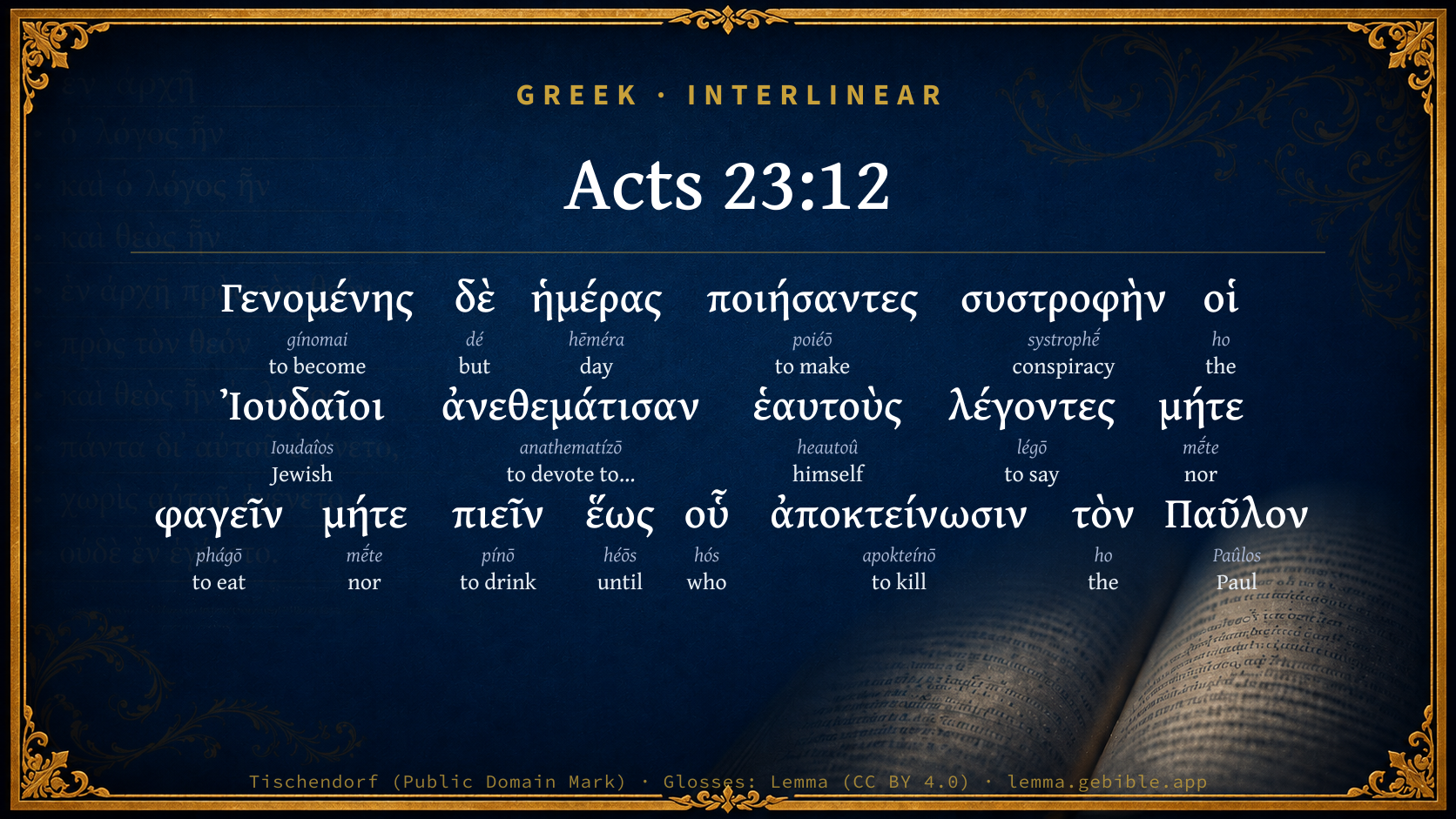
When it was day, some of the Jews banded together, and bound themselves under a curse, saying that they would neither eat nor drink until they had killed Paul.
Download a study sheet
One document with this verse’s original text, its word-by-word gloss line, the meaning frame, cross-references with their text, attributed commentary, and full source and license credits — printable, and it pastes into notes with its structure intact.
This verse Autodidact and up
A passage Seminary Student
Up to 50 verses in one chapter. A passage sheet keeps up to 6 commentary sources and 12 cross-references per verse, in the order this page ranks them, and says so on the sheet whenever that leaves anything out. Ask for a single verse and you get the Autodidact verse sheet above.
Everything on this page stays free to read, with no account — the sheet is a download of what is already on screen, not access to it.
Compare translations 3
The same verse in 3 English versions, stacked beneath the original-language interlinear above. Click any original word for its lexicon entry.
Each is an independent rendering of the whole verse — the interlinear is not word-aligned to these translations.
Highlighted words mark where these versions differ — a whole-verse word diff, not a word-by-word alignment.
-
World English Bible Public Domain
When it was day, some of the Jews banded together, and bound themselves under a curse, saying that they would neither eat nor drink until they had killed Paul.
-
King James Version Public Domain
And when it was day, certain of the Jews banded together, and bound themselves under a curse, saying that they would neither eat nor drink till they had killed Paul.
-
unfoldingWord Literal Text CC BY-SA 4.0
And when day came, the Jews, making a conspiracy, cursed themselves, saying neither to eat nor to drink until they had killed Paul.
unfoldingWord Literal Text — © unfoldingWord, licensed CC BY-SA 4.0. Word-aligned USFM3 via Door43 (git.door43.org/unfoldingWord/en_ult).
Show all 19 translations
Every available English version of this verse, each an independent rendering of the whole verse.
-
World English Bible Public Domain
When it was day, some of the Jews banded together, and bound themselves under a curse, saying that they would neither eat nor drink until they had killed Paul.
-
Berean Standard Bible Public Domain
When daylight came, the Jews formed a conspiracy and bound themselves with an oath not to eat or drink until they had killed Paul.
-
Majority Standard Bible Public Domain
When daylight came, some of the Jews formed a conspiracy and bound themselves with an oath not to eat or drink until they had killed Paul.
-
King James Version Public Domain
And when it was day, certain of the Jews banded together, and bound themselves under a curse, saying that they would neither eat nor drink till they had killed Paul.
-
American Standard Version (1901) Public Domain
And when it was day, the Jews banded together, and bound themselves under a curse, saying that they would neither eat nor drink till they had killed Paul.
-
Revised Version (1885) Public Domain
And when it was day, the Jews banded together, and bound themselves under a curse, saying that they would neither eat nor drink till they had killed Paul.
-
Geneva Bible (1599) Public Domain
And when the day was come, certaine of the Iewes made an assemblie, and bounde themselues with a curse, saying, that they woulde neither eate nor drinke, till they had killed Paul.
-
Douay-Rheims (1899) Public Domain
And when day was come, some of the Jews gathered together, and bound themselves under a curse, saying, that they would neither eat, nor drink, till they killed Paul.
-
Young's Literal Translation Public Domain
And day having come, certain of the Jews having made a concourse, did anathematize themselves, saying neither to eat nor to drink till they may kill Paul;
-
Literal Standard Version CC BY-SA 4.0
And day having come, certain of the Jews having made a concourse, cursed themselves, saying neither to eat nor to drink until they may kill Paul;
-
Unlocked Literal Bible CC BY-SA 4.0
When it became day, some Jews formed a conspiracy and called a curse down upon themselves with an oath not to eat nor drink anything until they had killed Paul.
-
unfoldingWord Literal Text CC BY-SA 4.0
And when day came, the Jews, making a conspiracy, cursed themselves, saying neither to eat nor to drink until they had killed Paul.
-
Darby Bible Public Domain
And when it was day, the Jews, having banded together, put themselves under a curse, saying that they would neither eat nor drink till they should kill Paul.
-
World Messianic Bible Public Domain
When it was day, some of the Judeans banded together and bound themselves under a curse, saying that they would neither eat nor drink until they had killed Paul.
-
Webster's Bible Public Domain
And when it was day, certain of the Jews banded together, and bound themselves under a curse, saying, that they would neither eat nor drink till they had killed Paul.
-
Free Bible Version CC BY-SA 4.0
Next day some Jews plotted together, and they took an oath not to eat or drink until they had killed Paul.
-
Bible in Basic English Public Domain
And when it was day, the Jews came together and put themselves under an oath that they would take no food or drink till they had put Paul to death.
-
Text-Critical English NT CC BY 4.0
When daybreak came, some of the Jews formed a conspiracy and bound themselves under a curse, saying that they would neither eat nor drink until they had killed Paul.
-
Tyndale New Testament (1534) Public Domain
When daye was come certayne of the Iewes gaddered them selves to geder and made a vowe sayinge that they wolde nether eate nor drinke till they had killed Paul.
Literal Standard Version (2020), Covenant Press — licensed CC BY-SA 4.0. Text via the HelloAO Bible API (eBible.org). Unlocked Literal Bible (unfoldingWord) — licensed CC BY-SA 4.0. Text via the HelloAO Bible API (eBible.org). unfoldingWord Literal Text — © unfoldingWord, licensed CC BY-SA 4.0. Word-aligned USFM3 via Door43 (git.door43.org/unfoldingWord/en_ult). Free Bible Version, Dr. Jonathan Gallagher — licensed CC BY-SA 4.0. Text via the HelloAO Bible API (eBible.org).
Word by word
More ways to search: Search by grammar → Find every occurrence → Compare this word →
Practice this passage: Drill this verse → Learn its vocabulary →
- Appears 2× in the Greek New Testament
- First appears at Acts 19:40
- Part of Speech
- Noun
- Case
- Accusative
- Number
- Singular
- Gender
- Feminine
Full Thayer's Definition
- Γενομένης gínomai G1096 “to become” Verb, Aorist, Middle deponent, Participle, Genitive, Singular, Feminine
- δὲ dé G1161 “but” Conjunction
- ἡμέρας hēméra G2250 “day” Noun, Genitive, Singular, Feminine
- ποιήσαντες poiéō G4160 “to make” Verb, Aorist, Active, Participle, Nominative, Plural, Masculine
- συστροφὴν systrophḗ G4963 “conspiracy” Noun, Accusative, Singular, Feminine
- οἱ ho G3588 “the” Article, Nominative, Plural, Masculine
- Ἰουδαῖοι Ioudaîos G2453 “Jewish” Adjective, Nominative, Plural, Masculine
- ἀνεθεμάτισαν anathematízō G332 “to devote to destruction” Verb, Aorist, Active, Indicative, 3rd person, Plural
- ἑαυτοὺς heautoû G1438 “himself” Reflexive pronoun, 3rd person, Accusative, Plural, Masculine
- λέγοντες légō G3004 “to say” Verb, Present, Active, Participle, Nominative, Plural, Masculine
- μήτε mḗte G3383 “nor” Conjunction, Negative
- φαγεῖν phágō G5315 “to eat” Verb, Aorist, Active, Infinitive
- μήτε mḗte G3383 “nor” Conjunction, Negative
- πιεῖν pínō G4095 “to drink” Verb, Aorist, Active, Infinitive
- ἕως héōs G2193 “until” Adverb
- οὗ hós G3739 “who” Relative pronoun, Genitive, Singular, Masculine
- ἀποκτείνωσιν apokteínō G615 “to kill” Verb, Aorist, Active, Subjunctive, 3rd person, Plural
- τὸν ho G3588 “the” Article, Accusative, Singular, Masculine
- Παῦλον Paûlos G3972 “Paul” Noun, Accusative, Singular, Masculine
About this verse
These counts appear in no published source. They are computed here, from the morphology-tagged text and Lemma’s own curated glosses. What Lemma adds →
- 19
- words
- 17
- distinct lemmas
- Acts
- section
Cross-references
25Topical passages linked to Acts 23:12 in the Treasury of Scripture Knowledge — connected by theme and wording, ordered by reader-vote popularity; previews shown in the World English Bible.
- Acts 23:30 When I was told that the Jews lay in wait for the man, I sent him to you immediately, charging his accusers also to bring their accusations against him before you. Farewell."
- Isaiah 8:9–10 Make an uproar, O you peoples, and be broken in pieces! And give ear, all you of far countries: gird yourselves, and be broken in pieces! Gird yourselves, and be broken in pieces!
- Acts 23:21 Therefore don't yield to them, for more than forty men lie in wait for him, who have bound themselves under a curse neither to eat nor to drink until they have killed him. Now they are ready, looking for the promise from you."
- Acts 23:14 They came to the chief priests and the elders, and said, "We have bound ourselves under a great curse, to taste nothing until we have killed Paul.
- Psalms 2:1–3 Why do the nations rage, And the peoples plot a vain thing?
- Psalms 31:13 For I have heard the slander of many, terror on every side, While they conspire together against me, They plot to take away my life.
- Jeremiah 11:19 But I was like a gentle lamb that is led to the slaughter; and I didn't know that they had devised devices against me, [saying], Let us destroy the tree with the fruit of it, and let us cut him off from the land of the living, that his name may be no more remembered.
- 2 Kings 6:31 Then he said, God do so to me, and more also, if the head of Elisha the son of Shaphat shall stand on him this day.
- Psalms 64:2–6 Hide me from the conspiracy of the wicked, From the noisy crowd of the ones doing evil;
- Matthew 26:4 They took counsel together that they might take Jesus by deceit, and kill him.
- Acts 25:3 asking a favor against him, that he would summon him to Jerusalem; plotting to kill him on the way.
- 1 Corinthians 16:22 If any man doesn't love the Lord Jesus Christ, let him be accursed. Come, Lord!
- Galatians 3:13 Christ redeemed us from the curse of the law, having become a curse for us. For it is written, "Cursed is everyone who hangs on a tree,"
- 1 Kings 19:2 Then Jezebel send a messenger to Elijah, saying, So let the gods do to me, and more also, if I don't make your life as the life of one of them by tomorrow about this time.
- 1 Samuel 14:24 The men of Israel were distressed that day; for Saul had adjured the people, saying, Cursed be the man who eats any food until it be evening, and I be avenged on my enemies. So none of the people tasted food.
- Mark 6:23–26 He swore to her, "Whatever you shall ask of me, I will give you, up to half of my kingdom."
- Leviticus 27:29 "'No one devoted, who shall be devoted from among men, shall be ransomed; he shall surely be put to death.
- Joshua 6:26 Joshua charged them with an oath at that time, saying, Cursed be the man before Yahweh, that rises up and builds this city Jericho: with the loss of his firstborn shall he lay the foundation of it, and with the loss of his youngest son shall he set up the gates of it.
- Joshua 7:15 It shall be, that he who is taken with the devoted thing shall be burnt with fire, he and all that he has; because he has transgressed the covenant of Yahweh, and because he has done folly in Israel.
- 1 Samuel 14:27–28 But Jonathan didn't hear when his father charged the people with the oath: therefore he put forth the end of the rod who was in his hand, and dipped it in the honeycomb, and put his hand to his mouth; and his eyes were enlightened.
- 1 Samuel 14:40–44 Then said he to all Israel, Be you on one side, and I and Jonathan my son will be on the other side. The people said to Saul, Do what seems good to you.
- Nehemiah 10:29 They joined with their brothers, their nobles, and entered into a curse, and into an oath, to walk in God's law, which was given by Moses the servant of God, and to observe and do all the commandments of Yahweh our Lord, and his ordinances and his statutes;
- Matthew 26:74 Then he began to curse and to swear, "I don't know the man!" Immediately the rooster crowed.
- Matthew 27:25 All the people answered, "May his blood be on us, and on our children!"
- Joshua 7:1 But the children of Israel committed a trespass in the devoted thing; for Achan, the son of Carmi, the son of Zabdi, the son of Zerah, of the tribe of Judah, took of the devoted thing: and the anger of Yahweh was kindled against the children of Israel.
Cross-references courtesy of OpenBible.info (CC BY 4.0).
Lesson kit
Teaching starters — assembled from the data on this page, not authored interpretation. Every prompt links to the verse data it draws on. Edit before teaching.
Acts, in the Acts, opens this verse with 19 words (17 distinct Greek lemmas). Its most distinctive word is systrophḗ (“conspiracy”). A historical commentator’s framing appears above. Read the whole chapter for the surrounding context.
Discussion questions
- What does “conspiracy” (systrophḗ) contribute to the verse as a whole?
- How does Acts 19:40, which shares the word «conspiracy», read alongside this verse?
- What does the repetition of “the” (2× in this one verse) do in this verse?
- These translations render this verse differently; the difference is in the English rendering, not the original. What questions does that raise?
- Compare how Matthew Henry's Commentary and Joseph Benson's Commentary read this verse. Where do they agree or differ?
Things to notice
- These translations choose different wording for 14 words in this verse.
- “the” occurs 2× in this single verse.
- 17 distinct Greek lemmas span 19 words in this verse.
Commentary
Notes on Acts 23:12 from classic Christian and Jewish commentators (each source and its license shown beneath its notes). The classic Christian expositions comment on the surrounding passage and are grouped to its opening verse, so a note may address several verses; the Jewish commentaries on the Tanakh (Rashi and others) are per-verse, so they appear only where the commentator wrote on this verse.
Lemma curates 59 commentaries, every one of them public domain or Creative Commons licensed, each selected and text-cleaned for this edition rather than reprinted as found. About our sources →
Matthew Henry's Commentary
Matthew Henry's Commentary on the Whole Bible (1708–1710) — public domain (CC PDM 1.0). Text via the HelloAO Bible API.
Joseph Benson's Commentary
Joseph Benson's Commentary on the Old and New Testaments (1811–1818) — public domain. Text from a community e-Sword module.
Whedon's Commentary on the Bible
Daniel D. Whedon
Daniel D. Whedon (gen. ed.), Commentary on the Old and New Testaments (1874–1909) — public domain. Text from a community e-Sword module.
The Preacher's Complete Homiletical Commentary
Joseph S. Exell (gen. ed.)
The Preacher's Complete Homiletical Commentary (gen. ed. Joseph S. Exell; Funk & Wagnalls, c. 1892) — public domain (pre-1929). A full-Bible homiletical/sermon-outline anthology covering 65 of 66 books (2 John is absent from the source module). Text from a community e-Sword module.
Lange's Commentary on the Holy Scriptures
Lange's Commentary on the Holy Scriptures (Critical, Doctrinal, and Homiletical), ed. John Peter Lange, English translation edited by Philip Schaff (1864–1880) — public domain. Text from a community e-Sword module.
MacLaren's Expositions of Holy Scripture
Alexander MacLaren
Alexander MacLaren, Expositions of Holy Scripture (1904–1910) — public domain. Text from a community e-Sword module.
Tyndale Open Study Notes
Tyndale Open Resources
Tyndale Open Study Notes — © Tyndale Open Resources, licensed CC BY-SA 4.0. Text via the HelloAO Bible API.
Bengel's Gnomon
Johann Albrecht Bengel
Bengel's Gnomon of the New Testament — English translation (T&T Clark, Edinburgh, 1860) — public domain. Text from a community e-Sword module.
Expositor's Greek Testament
ed. W. Robertson Nicoll
The Expositor's Greek Testament, edited by W. Robertson Nicoll (1897–1910) — public domain. Text from a community e-Sword module.
Geneva Bible (1599)
Geneva Bible translators
Geneva Bible (1599) marginal notes — public domain. Text via Bolls.life.
Jamieson, Fausset & Brown
Robert Jamieson, A. R. Fausset & David Brown
Jamieson, Fausset & Brown — Commentary Critical and Explanatory on the Whole Bible (1871) — public domain (CC PDM 1.0). Text via the HelloAO Bible API.
Adam Clarke's Commentary
Adam Clarke's Commentary on the Bible (1810–1826) — public domain. Text from a community e-Sword/MySword module.
John Calvin's Commentaries
John Calvin's Commentaries (1540-1563) — public domain. Text from the Calvin Translation Society English edition (1840s-50s) via the Christian Classics Ethereal Library (ccel.org). Calvin's coverage is partial (roughly two-thirds of the Bible); uncommented books and verses are honest gaps, never fabricated. The 19th-century editor's footnotes and remarks are omitted so the notes are faithfully Calvin's own voice.
Ellicott's Commentary for English Readers
A Bible Commentary for English Readers, edited by Charles John Ellicott (1878–1897) — public domain. Text from a community e-Sword module.
The Cambridge Bible for Schools and Colleges
gen. ed. J. J. S. Perowne
The Cambridge Bible for Schools and Colleges (gen. ed. J. J. S. Perowne; Cambridge University Press, 1878–1918) — public domain. Text from a community e-Sword module.
John Gill's Exposition
John Gill's Exposition of the Whole Bible (1746–1763) — public domain (CC PDM 1.0). Text via the HelloAO Bible API.
Trapp's Complete Commentary
John Trapp
John Trapp, A Commentary or Exposition upon All the Books of the Old and New Testament (1647–1656) — public domain. Text from a community e-Sword module.
Albert Barnes' Notes on the Bible
Albert Barnes' Notes on the Bible (1834–1885) — public domain. Text from a community e-Sword/MySword module.
Haydock's Catholic Bible Commentary
George Leo Haydock (1774–1849), Haydock's Catholic Family Bible and Commentary, 1859 edition — public domain. Excludes Psalms (Douay-Rheims chapter numbering differs from Protestant) and Deuterocanonical books (Catholic canon only).
Matthew Poole's English Annotations
Matthew Poole's English Annotations on the Holy Bible (1683–1685) — public domain. Text from a community e-Sword/MySword module.
The Pulpit Commentary
The Pulpit Commentary (1880–1919), ed. H.D.M. Spence-Jones & Joseph S. Exell — public domain. Text from a community e-Sword module.
John Wesley's Explanatory Notes
John Wesley, Explanatory Notes Upon the Whole Bible (1754–1765) — public domain. Text via the GEBible commentary corpus.
Kretzmann's Popular Commentary
Paul E. Kretzmann
Paul E. Kretzmann, Popular Commentary of the Bible (1921–1924) — public domain. Text from a community e-Sword module.
Burkitt's Expository Notes on the New Testament
William Burkitt
William Burkitt's Expository Notes on the New Testament (1700–1703) — public domain. Text from a community e-Sword module.
McGarvey & Pendleton's Commentaries
J. W. McGarvey
J. W. McGarvey (with Philip Y. Pendleton), Commentaries on the New Testament (The Fourfold Gospel, 1914; Acts; and the epistles) — public domain. Text from a community e-Sword/MySword module.
The People's New Testament
B. W. Johnson
B. W. Johnson's The People's New Testament with Notes (1889–1891) — public domain. Electronic text from the Christian Classics Ethereal Library (CCEL) ThML edition.
unfoldingWord translationNotes
Door43 World Missions Community
unfoldingWord translationNotes — © Distant Shores Media and the Door43 World Missions Community, licensed CC BY-SA 4.0. Source: git.door43.org/Door43/en_tn.
Cambridge Greek Testament for Schools and Colleges
Cambridge Greek Testament for Schools and Colleges (Cambridge University Press, 1896; 21 vols, various authors incl. Carr, Maclear, Plummer, Farrar, Lumby, Moule, M. R. James, Simcox) — public domain. Text from a community e-Sword module.
Alford’s Greek Testament
Henry Alford
Henry Alford, The Greek Testament (1849–1861) — public domain. Text from a community e-Sword module.
Vincent's Word Studies in the New Testament
Marvin R. Vincent
Marvin R. Vincent, Word Studies in the New Testament (1887–1900) — public domain. Text from a community e-Sword/MySword module.