
Acts 22:28

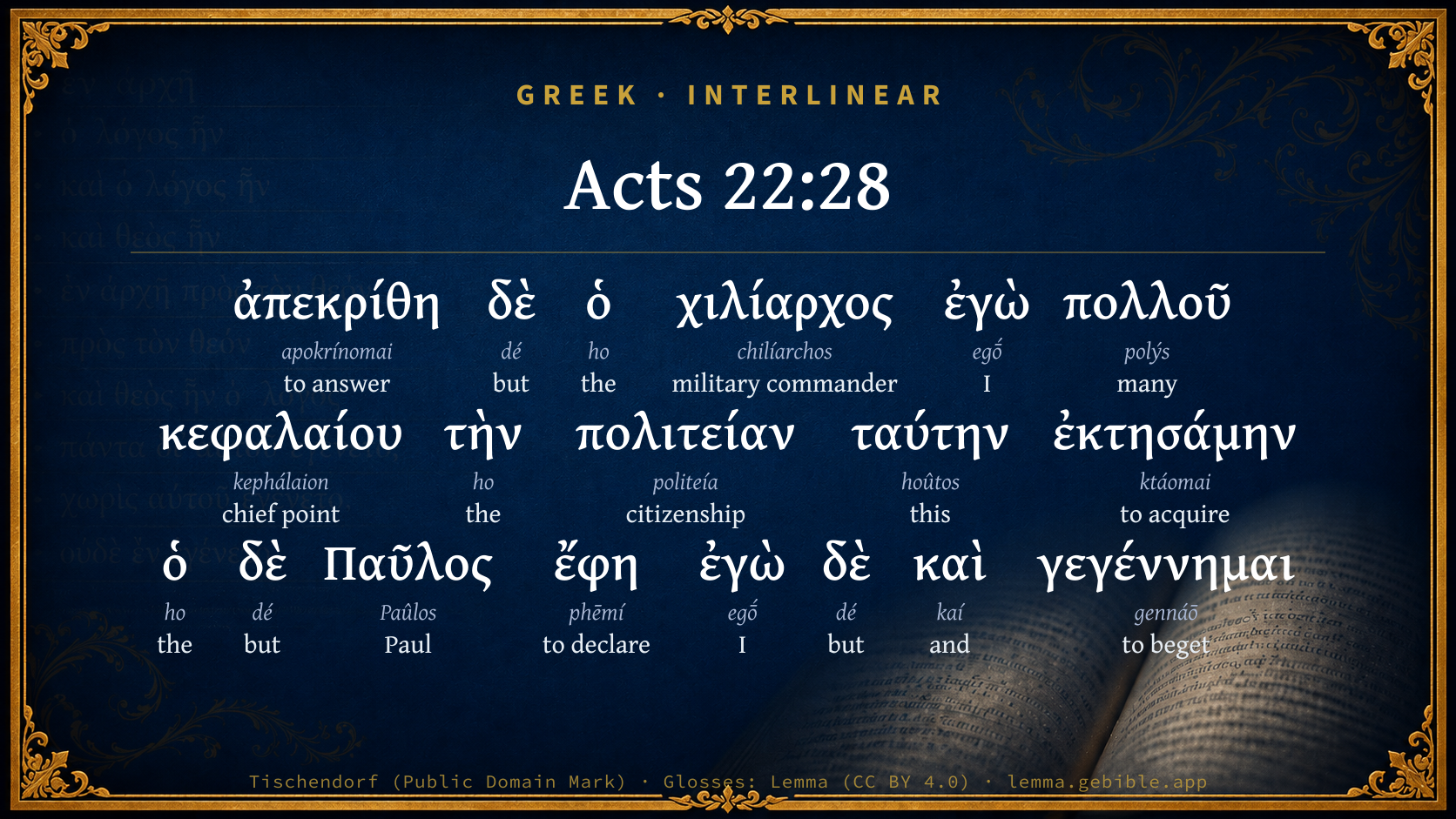
Greek (Tischendorf 8th ed.) Acts 22:28 appears in the Greek New Testament. The text above is from the Tischendorf 8th edition. Each word links to its Strong’s number and a concise gloss. Click any word for its full Thayer’s Greek Lexicon entry.
Download image
Cite this verse

Acts 22:28 (World English Bible). Public Domain. Lemma interlinear Bible study tool, https://lemma.gebible.app/v/acts/22/28.

Show BibTeX & RIS
BibTeX
RIS
English Translation
The commanding officer answered, "I bought my citizenship for a great price." Paul said, "But I was born a Roman."
World English Bible · Public Domain
Highlights
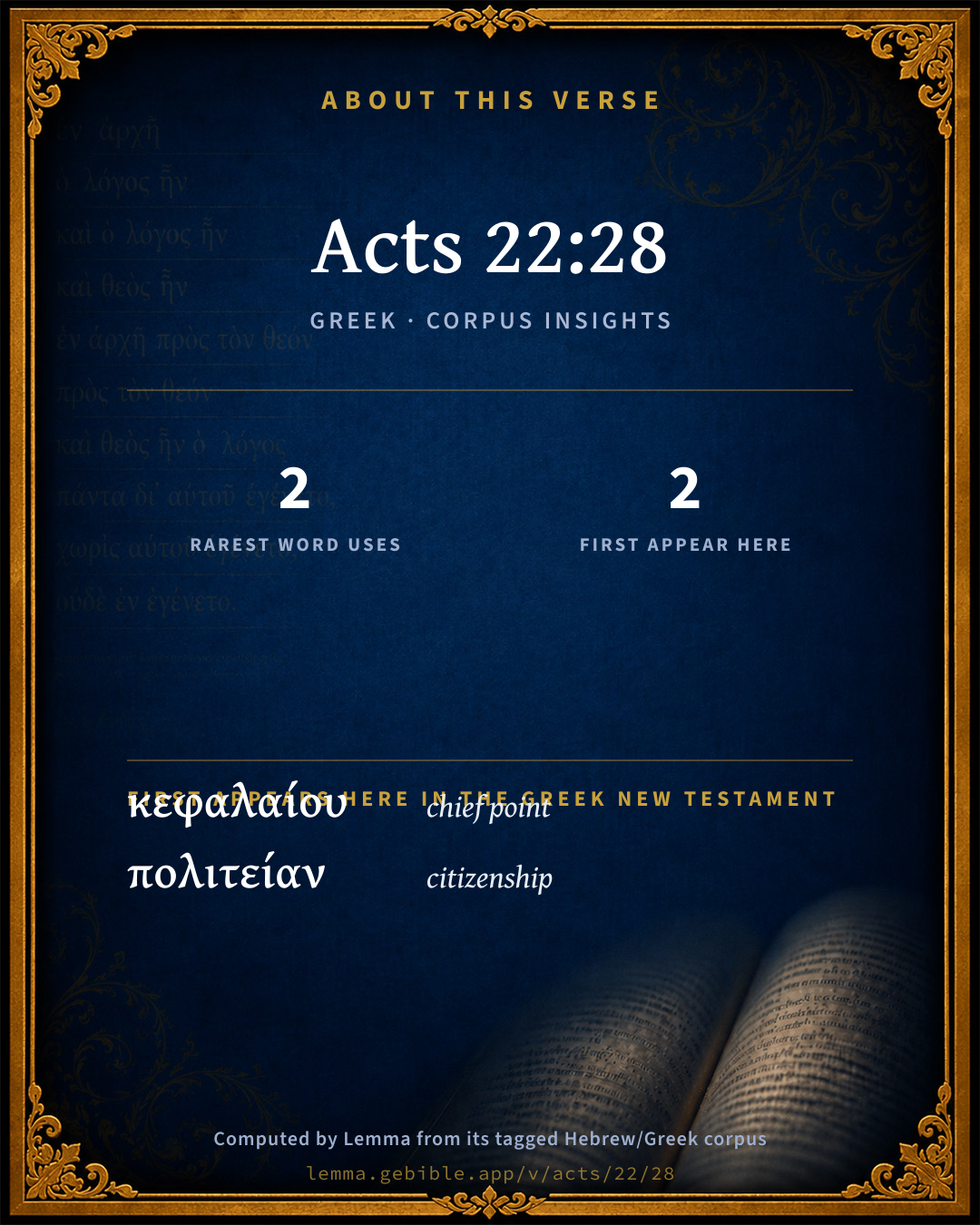
  • 2 first appearances in the Greek New Testament
Full analysis ↓
Download a study sheet

One document with this verse’s original text, its word-by-word gloss line, the meaning frame, cross-references with their text, attributed commentary, and full source and license credits — printable, and it pastes into notes with its structure intact.

This verse Autodidact and up

Study sheet (.html) Plain text (.txt)

A passage Seminary Student

Up to 50 verses in one chapter. A passage sheet keeps up to 6 commentary sources and 12 cross-references per verse, in the order this page ranks them, and says so on the sheet whenever that leaves anything out. Ask for a single verse and you get the Autodidact verse sheet above.

Everything on this page stays free to read, with no account — the sheet is a download of what is already on screen, not access to it.

Want to remove ads? Support Godless Engineer
Compare translations 3

The same verse in 3 English versions, stacked beneath the original-language interlinear above. Click any original word for its lexicon entry.

Each is an independent rendering of the whole verse — the interlinear is not word-aligned to these translations.

Highlighted words mark where these versions differ — a whole-verse word diff, not a word-by-word alignment.

  • World English Bible Public Domain
    The commanding officer answered, "I bought my citizenship for a great price." Paul said, "But I was born a Roman."
  • King James Version Public Domain
    And the chief captain answered, With a great sum obtained I this freedom. And Paul said, But I was free born.
  • unfoldingWord Literal Text CC BY-SA 4.0
    And the commander answered, “I bought this citizenship with a large sum of money.” But Paul said, “But I indeed was born.”

unfoldingWord Literal Text — © unfoldingWord, licensed CC BY-SA 4.0. Word-aligned USFM3 via Door43 (git.door43.org/unfoldingWord/en_ult).

Versions to compare (up to 4)

3 of 4 selected

Show all 19 translations

Every available English version of this verse, each an independent rendering of the whole verse.

  • World English Bible Public Domain
    The commanding officer answered, "I bought my citizenship for a great price." Paul said, "But I was born a Roman."
  • Berean Standard Bible Public Domain
    “I paid a high price for my citizenship,” said the commander. “But I was born a citizen,” Paul replied.
  • Majority Standard Bible Public Domain
    “I paid a high price for my citizenship,” said the commander. “But I was born a citizen,” Paul replied.
  • King James Version Public Domain
    And the chief captain answered, With a great sum obtained I this freedom. And Paul said, But I was free born.
  • American Standard Version (1901) Public Domain
    And the chief captain answered, With a great sum obtained I this citizenship. And Paul said, But I am `a Roman' born.
  • Revised Version (1885) Public Domain
    And the chief captain answered, With a great sum obtained I this citizenship. And Paul said, But I am a Roman born.
  • Geneva Bible (1599) Public Domain
    And the chiefe captaine answered, With a great summe obtained I this freedome. Then Paul sayd, But I was so borne.
  • Douay-Rheims (1899) Public Domain
    And the tribune answered: I obtained the being free of this city with a great sum. And Paul said: But I was born so.
  • Young's Literal Translation Public Domain
    and the chief captain answered, `I, with a great sum, did obtain this citizenship;' but Paul said, `But I have been even born `so'.'
  • Literal Standard Version CC BY-SA 4.0
    and the chief captain answered, “I, with a great sum, obtained this citizenship”; but Paul said, “But I have even been born [so].”
  • Unlocked Literal Bible CC BY-SA 4.0
    The chief captain answered, “It was only with a large amount of money that I acquired citizenship.” But Paul said, “I was born a Roman citizen.”
  • unfoldingWord Literal Text CC BY-SA 4.0
    And the commander answered, “I bought this citizenship with a large sum of money.” But Paul said, “But I indeed was born.”
  • Darby Bible Public Domain
    And the chiliarch answered, *I*, for a great sum, bought this citizenship. And Paul said, But *I* was also [free] born.
  • World Messianic Bible Public Domain
    The commanding officer answered, “I bought my citizenship for a great price.” Paul said, “But I was born a Roman.”
  • Webster's Bible Public Domain
    And the chief captain answered, With a great sum I obtained this freedom. And Paul said, But I was free born.
  • Free Bible Version CC BY-SA 4.0
    “I paid a lot of money to buy Roman citizenship,” said the commander. “But I was born a citizen,” Paul replied.
  • Bible in Basic English Public Domain
    And the chief captain said, I got Roman rights for myself at a great price. And Paul said, But I had them by birth.
  • Text-Critical English NT CC BY 4.0
    The commander responded, “I acquired this citizenship with a large sum of money.” Paul said, “But I am a citizen by birth.”
  • Tyndale New Testament (1534) Public Domain
    And the captayne answered: with a greate some obtayned I this fredome. And Paul sayde: I was fre borne.

Literal Standard Version (2020), Covenant Press — licensed CC BY-SA 4.0. Text via the HelloAO Bible API (eBible.org). Unlocked Literal Bible (unfoldingWord) — licensed CC BY-SA 4.0. Text via the HelloAO Bible API (eBible.org). unfoldingWord Literal Text — © unfoldingWord, licensed CC BY-SA 4.0. Word-aligned USFM3 via Door43 (git.door43.org/unfoldingWord/en_ult). Free Bible Version, Dr. Jonathan Gallagher — licensed CC BY-SA 4.0. Text via the HelloAO Bible API (eBible.org).

Word by word

More ways to search: Search by grammar → Find every occurrence → Compare this word →

Practice this passage: Drill this verse → Learn its vocabulary →

κεφαλαίου
kephálaion
G2774
“chief point”
Noun, Genitive, Singular, Neuter
Part of Speech
Noun
Case
Genitive
Number
Singular
Gender
Neuter
Full Thayer's Definition

Origin: from a derivative of G2776

TDNT: None

1. the chief or main point, the principal thing 2. the pecuniary sum total of a reckoning, amount a. the principal, capital, as distinguished from the interest b. a sum of money, sum
  1. ἀπεκρίθη apokrínomai G611 “to answer” Verb, Aorist, Middle deponent, Indicative, 3rd person, Singular
  2. δὲ dé G1161 “but” Conjunction
  3. ὁ ho G3588 “the” Article, Nominative, Singular, Masculine
  4. χιλίαρχος chilíarchos G5506 “military commander” Noun, Nominative, Singular, Masculine
  5. ἐγὼ egṓ G1473 “I” Personal pronoun, 1st person, Nominative, Singular
  6. πολλοῦ polýs G4183 “many” Adjective, Genitive, Singular, Neuter
  7. τὴν ho G3588 “the” Article, Accusative, Singular, Feminine
  8. πολιτείαν politeía G4174 “citizenship” Noun, Accusative, Singular, Feminine
  9. ταύτην hoûtos G3778 “this” Demonstrative pronoun, Accusative, Singular, Feminine
  10. ἐκτησάμην ktáomai G2932 “to acquire” Verb, Aorist, Middle deponent, Indicative, 1st person, Singular
  11. ὁ ho G3588 “the” Article, Nominative, Singular, Masculine
  12. δὲ dé G1161 “but” Conjunction
  13. Παῦλος Paûlos G3972 “Paul” Noun, Nominative, Singular, Masculine
  14. ἔφη phēmí G5346 “to declare” Verb, Imperfect, Active, Indicative, 3rd person, Singular
  15. ἐγὼ egṓ G1473 “I” Personal pronoun, 1st person, Nominative, Singular
  16. δὲ dé G1161 “but” Conjunction
  17. καὶ kaí G2532 “and” Conjunction
  18. γεγέννημαι gennáō G1080 “to beget” Verb, Perfect, Passive, Indicative, 1st person, Singular

About this verse

These counts appear in no published source. They are computed here, from the morphology-tagged text and Lemma’s own curated glosses. What Lemma adds →

19
words
14
distinct lemmas
Acts
section

Notable vocabulary

The rarest word here is κεφαλαίου chief point G2774 — appearing just 2 times in the whole Greek New Testament.

First appearance in Scripture

These words make their first canonical appearance in the Greek New Testament here:

  • κεφαλαίου chief point G2774
  • πολιτείαν citizenship G4174

Shared distinctive vocabulary

κεφαλαίου chief point G2774 occurs in 2 verses of the Greek New Testament. Also found in:
Repetition

Words recur within this verse:

Commentary

Notes on Acts 22:28 from classic Christian and Jewish commentators (each source and its license shown beneath its notes). The classic Christian expositions comment on the surrounding passage and are grouped to its opening verse, so a note may address several verses; the Jewish commentaries on the Tanakh (Rashi and others) are per-verse, so they appear only where the commentator wrote on this verse.

Lemma curates 59 commentaries, every one of them public domain or Creative Commons licensed, each selected and text-cleaned for this edition rather than reprinted as found. About our sources →

Adam Clarke's Commentary

Verse 28. With a great sum obtained I this freedom] So it appears that the freedom, even of Rome, might be purchased, and that it was sold at a very high price.

But I was free born.] It has been generally believed that the inhabitants of Tarsus, born in that city, had the same rights and privileges as Roman citizens, in consequence of a charter or grant from Julius Caesar. Calmet disputes this, because Tarsus was a free not a colonial city; and he supposes that Paul's father might have been rewarded with the freedom of Rome for some military services, and that it was in consequence of this that Paul was born free. But that the city of Tarsus had such privileges appears extremely probable. In Ac 21:39, Paul says he was born at Tarsus in Cilicia, and in Ac 22:28, he says he was free born; and, at Ac 22:26, he calls himself a Roman; as he does also Ac 16:37. From whence it has been concluded, with every show of reason, that Tarsus, though no Roman colony, yet had this privilege granted to it, that its natives should be citizens of Rome. PLINY, in Hist. Nat. lib. v. 27, tells us that Tarsus was a free city. And APPIAN, De Bello Civil. lib. v. p. 1077, edit. Tollii, says that Antony, Ταρσεας ελευθερους ηφιει, και ατελεις φορων, made the people of Tarsus free, and discharged them from paying tribute. DIO CASSIUS, lib. xlvii. p. 508, edit. Reimar, farther tells us, Adeo Caesari priori, et ejus gratia etiam posteriori, favebant Tarsenses, ut urbem suam pro Tarso JULIOPOLIN vocaverint: "that, for the affection which the people of Tarsus bore to Julius Caesar, and afterwards to Augustus, the former caused their city to be called Juliopolis." The Greek text is as follows:- οὑτω προσφιλως τῳ Καισαρι προτερῳ, και δι' εκεινον τῳ δευτερῳ, οἱ Ταρσεις ειχον, ὡϚε και Ιουλιοπολιν σφας απ' αυτου μετονομασαι. To which I add, that PHILO, de Virt. vol. ii. p. 587, edit. Mang., makes Agrippa say to Caligula, φιλων ενιων πατριδας ὁλας της Ῥωμαΐκης ηξιωσας πολιτειας· You have made whole countries, to which your friends belong, to be citizens of Rome. See Clarke on Ac 21:39. These testimonies are of weight sufficient to show that Paul, by being born at Tarsus, might have been free born, and a Roman. See Bishop Pearce on Ac 16:37.

Adam Clarke's Commentary on the Bible (1810–1826) — public domain. Text from a community e-Sword/MySword module.

Tyndale Open Study Notes

Tyndale Open Resources

22:28 it cost me plenty! During the early part of the reign of Emperor Claudius (AD 41–54), Roman citizenship could be purchased, but it was expensive.

Tyndale Open Study Notes — © Tyndale Open Resources, licensed CC BY-SA 4.0. Text via the HelloAO Bible API.

Bengel's Gnomon

Johann Albrecht Bengel

Act 22:28. Ἐγὼ δὲ καὶ, but I even) The freedom of speech of Paul is therein indicated.

Bengel's Gnomon of the New Testament — English translation (T&T Clark, Edinburgh, 1860) — public domain. Text from a community e-Sword module.

Meyer's Critical & Exegetical Commentary

Heinrich August Wilhelm Meyer

Act_22:28-29. Ἐγὼ πολλοῦ κεφαλ. κ.τ.λ.] The tribune, to whom it was known that a native of Tarsus had not, as such, the right of citizenship, thinks that Paul must probably have come to it by purchase, and yet for this the arrested Cilician appears to him too poor. With the sale of citizenship, it was sought at that time (Dio Cass. 60:17)by an often ridiculed abuseto fill the imperial chest. Comp. Wetstein and Jacobs, ad Del. Epigr. p. 177.

See examples of κεφάλαιον, capital, sum of money,as to the use of which in ancient Greek (Plat. Legg. v. p. 742 C) Beza was mistakenin Kypke, II. p. 116.

ἐγὼ δὲ καὶ γεγέννημαι] But I am even so (καί) born, namely, as Ῥωμαῖος, so that my πολιτεία, as hereditary, is even γενναιότερα! a bold answer, which did not fail to make its impression.

καὶ ὁ χιλ. δὲ ἐφοβ.] and the tribune also was afraid. On καὶ … δέ, atque etiam, see on Joh_6:51. Facinus est, vinciri civem Romanum; scelus, verberari; prope parricidium necari, Cic. Verr. v. 66. Comp. on Act_16:37. And the binding had taken place with arbitrary violence before any examination.[140] It is otherwise Act_26:27, Act_26:29. See on these two passages. Therefore δεδεκώς, which evidently points to Act_21:33, is not to be referred, with Böttger, Beitr. II. p. 6, to the binding with a view to scourging (on account of Act_22:30); nor, with de Wette, is the statement of the fear of the tribune to be traced back to an error of the reporter, or at all to be removed by conjectural emendation (Rinck: δεδάρκως). And that Paul was still bound after the hearing (Act_23:18), was precisely after the hearing and after the occurrences in it in due order. See Böttger, I.c.; Wieseler, p. 377.

καὶ ὅτι dependent on ἘΦΟΒ: and because he was in the position of having bound him.

[140] During imprisonment preparatory to trial binding was legally admissible, so far as it was connected with the custodia militaris.

Meyer — Critical and Exegetical Commentary on the New Testament — English translation by Peter Christie, edited by Frederick Crombie (T&T Clark, 1880) — public domain. Text from a community e-Sword module.

Expositor's Greek Testament

ed. W. Robertson Nicoll

Act 22:28 . πολλοῦ κεφ ., cf. LXX, Lev. 5:24 (Lev 6:4 ), Num 5:7 ; Jos., Ant. , xii., 2, 3 (used by Plato of capital ( caput ) as opposed to interest). Mr. Page compares the making of baronets by Jas 1 . as a means of filling the exchequer. τὴν πολιτείαν ταύτην : “this citizenship,” R.V., jus civitatis, cf. 3Ma 3:21 ; 3Ma 3:23 , so in classical Greek. Probably A.V. renders “freedom” quite as we might speak of the freedom of the city being conferred upon any one. On the advantages of the rights of Roman citizenship see Schürer, div. ii., vol. ii., pp. 277, 278, E.T., and “Citizenship,” Hastings’ B.D. ἐκτησάμην : Dio Cassius, lx., 17, tells us how Messalina the wife of Claudius and the freedmen sold the Roman citizenship, and how at one time it might be purchased for one or two cracked drinking-cups (see passage in full in Wetstein, and also Cic., Ad Fam. , xii., 36). Very probably the Chiliarch was a Greek, Lysias, Act 23:26 , who had taken the Roman name Claudius on his purchase of the citizenship under the emperor of that name. ἐγὼ δὲ καὶ γεγέννημαι : “but I am a Roman even from birth”: “item breviter et cum dignitate,” Blass. St. Paul’s citizenship of Tarsus did not make him a Roman citizen, otherwise his answer in Act 21:39 would have been sufficient to have saved him from the present indignity. Tarsus was an urbs libera , not a colonia or municipium , and the distinction made in Acts between the Roman and Tarsian citizenship of Paul is in itself an additional proof of the truthfulness of the narrative. How his father obtained the Roman citizenship we are not told; it may have been by manumission, Philo Leg. ad . , 23, or for some service rendered to the state, Jos., Vita , 76, or by purchase, but on this last supposition the contrast here implied would be rendered less forcible. However the right was obtained, it is quite certain that there is nothing strange in St. Paul’s enjoyment of it. As early as the first century B.C. there were many thousands of Roman citizens living in Asia Minor; and the doubts raised by Renan and Overbeck are pronounced by Schürer as much too weak in face of the fact that it is precisely in the most trustworthy portion of Acts that the matter is vouched for.

The Expositor's Greek Testament, edited by W. Robertson Nicoll (1897–1910) — public domain. Text from a community e-Sword module.

Jamieson, Fausset & Brown

Robert Jamieson, A. R. Fausset & David Brown

With a great sum obtained I this freedom--Roman citizenship was bought and sold in the reign of Claudius, we know, at a high price: at a subsequent date, for next to nothing. But to put in a false claim to this privilege was a capital crime.

I was free born--born to it, by purchase, or in reward of services, on the part of his father or some ancestor.

Jamieson, Fausset & Brown — Commentary Critical and Explanatory on the Whole Bible (1871) — public domain (CC PDM 1.0). Text via the HelloAO Bible API.

John Calvin's Commentaries

28. With a great sum. The chief captain objecteth this to refute him as if he should say, that the freedom of the city is not so common, and easily to be obtained. How can it be that thou, being some base fellow of the country of the Cilicians, shouldst obtain this honor, for which I paid sweetly? Whereas Paul maketh answer, that he was free born, who never saw the city, yea, whose father it may be was never there, there is no cause why this should trouble any man. For those who are skillful in the Roman history know that certain were made free of the city who dwelt in the provinces, if, having deserved well of the commonwealth, or in war, or in other weighty affairs, they did desire and crave this reward of the deputies, [proconsuls] so that it is no absurdity to say that he was born a citizen of Rome, who, descending by his ancestors of some province far distant from Rome, did never set foot in Italy. Notwithstanding, the question is, how this can hang together, that the chief captain was afraid, because he had bound a citizen of Rome, and yet he did not loose him from his bonds until the morrow? It may be that he deferred it till the next day, lest he should show some token of fear. Notwithstanding, I think that the chief captain was afraid, because Paul was bound at his commandment, that he might be scourged, because this was to do injury to the body of a citizen of Rome, and to break the common liberty, and that [although] it was lawful to put a Roman in prison.

John Calvin's Commentaries (1540-1563) — public domain. Text from the Calvin Translation Society English edition (1840s-50s) via the Christian Classics Ethereal Library (ccel.org). Calvin's coverage is partial (roughly two-thirds of the Bible); uncommented books and verses are honest gaps, never fabricated. The 19th-century editor's footnotes and remarks are omitted so the notes are faithfully Calvin's own voice.

Ellicott's Commentary for English Readers

(28) With a great sum obtained I this freedom.—Better, this citizenship, the word expressing, not the transition from bondage to freedom, but from the position of an alien to that of a citizen. Probably the translators used the word in the sense in which we still speak of the “freedom “of a city. The chiliarch was himself, apparently, an alien by birth, and, as was customary at the time, had obtained the citizenship by the payment of a large bribe. As the admission of citizens now rested with the Emperor, as holding the office of Censor, the money had probably been paid to Narcissus, or some other of Claudius’ favourite freed-men who carried on a traffic of this kind.

I was free born.—The Greek is somewhat more emphatic: I am one even from birth. This implies that St. Paul’s father or grandfather had received the citizenship; how, we cannot tell. Many of the Jews who were taken to Rome by Pompeius as slaves first obtained their freedom and became libertini, and afterwards were admitted on the register as citizens. (See Note on Act_6:9; Act_16:37.) The mention of kinsmen or friends at Rome (Rom_16:7; Rom_16:11), makes it probable, as has been said, that the Apostle’s father may have been among them.

A Bible Commentary for English Readers, edited by Charles John Ellicott (1878–1897) — public domain. Text from a community e-Sword module.

The Cambridge Bible for Schools and Colleges

gen. ed. J. J. S. Perowne

28. obtained I this freedom] Better “this citizenship” (Rev. Ver.). Probably at the time when the A. V. was made “freedom” conveyed somewhat of this sense as we speak still of bestowing on any one the “freedom” of a city, meaning thereby all the rights of a citizen. It was the Roman boast “I am a Roman citizen,” (Cic. in Verr. v. 63). The sale of the freedom of Rome was at times the perquisite of some of the Imperial parasites and favourites, who made what they could of such a privilege.

I was free born] Rev. Ver. “I am a Roman born.” How St Paul came to be a Roman citizen by birth we cannot tell, probably some ancestor for meritorious conduct had been rewarded with enfranchisement. Tarsus was a free city, and had its own laws and magistrates, but that did not constitute its inhabitants Roman citizens.

The Cambridge Bible for Schools and Colleges (gen. ed. J. J. S. Perowne; Cambridge University Press, 1878–1918) — public domain. Text from a community e-Sword module.

John Gill's Exposition

On the morrow,.... The next day; so that Paul was kept in the castle all night: because he would have known the certainty wherefore he was accused of the Jews; which, as yet, he could not come at, some saying one thing, and some another; and which he ought to have known before he had bound him, and ordered him to be scourged:

he loosed him from his bands not from his being bound with thongs to the pillar, that he had been loosed from before, but from the two chains with which he was bound, and held by two soldiers; see Act 21:33.

and commanded the chief priests, and all the council to appear, the whole Jewish sanhedrim, which was now very much under the direction and influence of the Romans: and this he the rather did, because, though he could not come at the certainty of the charge and accusation, he perceived it was a matter of religion, and so belonged to them to examine and judge of:

and brought Paul down; from the Castle of Antonia, into the temple, and to the place where the sanhedrim sat, which formerly was in the chamber Gazith, but of late years it had removed from place to place, and indeed from Jerusalem itself, and was now at Jabneh; only this was the time of Pentecost, and so the chief priests and sanhedrim were at Jerusalem on that account:

and set him before them; or "among them"; in the midst of them, to answer to what charges should be brought against him.

Next: Acts Chapter 23

John Gill's Exposition of the Whole Bible (1746–1763) — public domain (CC PDM 1.0). Text via the HelloAO Bible API.

Trapp's Complete Commentary

John Trapp

28 And the chief captain answered, With a great sum obtained I this freedom. And Paul said, But I was free born.

Ver. 28. With a great sum] Or, with long service. This privilege was first sold at a dear rate to foreigners, but afterwards for a small matter. (Dio in Claudio.)

But I was freeborn] Tarsus, Paul’s country, was a Roman colony, and made free of Rome by Mark Antony.

John Trapp, A Commentary or Exposition upon All the Books of the Old and New Testament (1647–1656) — public domain. Text from a community e-Sword module.

Albert Barnes' Notes on the Bible

With a great sum obtained I this freedom - The freedom or privilege of Roman citizenship. From this it would seem that the privilege of being a Roman citizen might be purchased, unless perhaps he refers to the expenses which were necessarily attendant in passing through the proper forms of becoming a Roman citizen. The argument of the tribune in this case is this: “I obtained this privilege at a great price. Whence did you, Paul, thus poor and persecuted, obtain the means of becoming a Roman citizen?” Paul had informed him that he was a native of Tarsus Act 21:39; and the chief captain supposed that that was not a free city, and that Paul could not have derived the privilege of citizenship from his birth.

But I was free born - I was born a Roman citizen, or I am such in virtue of my birth. Various opinions have been formed on the question in what way or for what reasons Paul was entitled to the privileges of a Roman citizen. Some have supposed that Tarsus was a Roman colony, and that he thus became a Roman citizen. But of this there does not appear to be sufficient proof. Pliny says (Act 21:27) that it was a free city. Appian says that it was endowed with the privileges of a free city by Augustus Caesar after it had been greatly afflicted and oppressed by wars. Dio Chrysost. says to the people of Tarsus, “He (Augustus) has conferred on you everything which anyone could bestow on his friends and companions, a country (that is, a free country), laws, honor, authority over the river (Cydranus) and the neighboring sea.” Free cities were permitted in the Roman empire to use their own laws, customs, and magistrates, and they were free from being subject to Roman guards. They were required only to acknowledge the supremacy and authority of the Roman people, and to aid them in their wars. Such a city was Tarsus; and, having been born there, Paul was entitled to these privileges of a free man. Many critics have supposed that this privilege of Roman citizenship had been conferred on some of the ancestors of Paul in consequence of some distinguished military service. Such a conferring of the rights of citizenship was not unusual, and possibly might have occurred in this case. But there is no direct historical proof of it; and the former fact that he was born in a free city, will amply account for his affirmation that he was free born. Compare the notes on Act 16:37.

Albert Barnes' Notes on the Bible (1834–1885) — public domain. Text from a community e-Sword/MySword module.

Haydock's Catholic Bible Commentary

Civilitatem; that is, Civitatem, Græce, Greek: politeian, the rights of citizenship. These privileges were granted by Antonius to the city of Tarsus. (Appianus civilium 5.)

George Leo Haydock (1774–1849), Haydock's Catholic Family Bible and Commentary, 1859 edition — public domain. Excludes Psalms (Douay-Rheims chapter numbering differs from Protestant) and Deuterocanonical books (Catholic canon only).

Matthew Poole's English Annotations

The historian relates, that the emperor Claudius sold this privilege to such foreigners as had not by any notable service merited to have it conferred upon them. At first it cost them very much to obtain it, as it did this chief captain; but afterwards it was more cheap and contemptible.

I was free born; though Paul was born of Hebrew parents, yet he was born at Tarsus, to the natives of which town Augustus had given this privilege, for the assistance that the citizens afforded him in his wars with Brutus and Cassius; or, as some will have it, for favouring of Julius Caesar, this privilege was granted unto that place by him: and they, on the other side, to continue the sense of his favour, caused their town to be called Juliopolis, or the city of Julius.

Matthew Poole's English Annotations on the Holy Bible (1683–1685) — public domain. Text from a community e-Sword/MySword module.

Whedon's Commentary on the Bible

Daniel D. Whedon

28. With a great sum—Messalina, the mother of the emperor Claudius, freely sold the right of citizenship for money. The article did not long require “a great sum,” and gradually became very cheap.

Free born—(See our note on Act_16:37.)

Daniel D. Whedon (gen. ed.), Commentary on the Old and New Testaments (1874–1909) — public domain. Text from a community e-Sword module.

The Pulpit Commentary

Citizenship for freedom, A.V.; am a Roman for was free, A.V. A great sum (pollou kefalaiou). The word is only found here in the New Testament in the sense of a "sum of money," but is so used in classical writers. Citizenship; politeia, for "freedom of the city," in Xenophon, Aelian, Polybius, Dion Cassius, etc., and RAPC 3Ma 3:21. Dion Cassius (9 17) relates that Messaliua, the wife of the Emperor Claudius, used to sell the freedom of the city, and that at first she sold it (megalwn xrhmatwn) for a very high price, but that afterwards it became very cheap. In all probability Lysias had so purchased it, and in consequence took the name of Claudius (Renan, "St. Paul," p. 524). I am a Roman born. It is not known how St. Paul"s family acquired the Roman citizenship.

Naturally and spiritually free born.

Rights of citizenship were obtained in various ways and on various grounds. Some men had it by birth, others by gift, others by purchase, others as the public recognition of heroic deeds. These may be illustrated in connection with the citizenship of London, Glasgow, Edinburgh, and other large cities. Roman citizenship was once sold at a very high rate, but in later times its value was lowered, and it was bartered for a trifle. It is not known how St. Paul"s parents obtained their citizen rights, but the apostle held his as an inheritance. St. Paul was not a citizen by virtue of his having been born in. Tarsus. "That city, in consideration of its sufferings under Cassius, and because of its adherence to Julius Caesar, was admitted by Antony to many privileges; but it was not a colony, only a free city, and that did not confer citizenship. Seine of the apostle"s ancestors, it may be assumed, had been admitted to citizenship in acknowledgment of good service, civil or military." A distinction is made, which men still recognize, between acquired rights and natural rights; but a far higher value is set on the rights of birth than on those which can be obtained in any other way. We fix attention on the fact that St. Paul was twice free born. He held right of birth into Roman citizenship, and right of the new Divine birth into the kingdom of Christ and of heaven.

I THE PRIVILEGES OF HUMAN BIRTH.

1. Illustrate what positions their birth puts some men in, and what consequent trusts and responsibilities come upon them.

2. Show that such privileges are not to be despised by Christian people, because they may give them noble opportunities of serving Christ.

3. Point out that any envy of those born to high station is unworthy of all who feel aright the honor of having any kind or degree of trust from God.

4. And impress that the greater the trust of position and privilege which a man may have, the heavier will be his judgment if he misuses his powers and privileges. Of him that hath much will be required.

II THE PRIVILEGES OF DIVINE BIRTH. Explain the Scripture figures of" new birth," being born again," and "regeneration." Illustrate that no man can acquire a place in Christ"s kingdom by any

(1) wealth,

(2) merit,

(3) or effort.

The only entrance is by a Divine birth: Ye must be born again;" the only possible right of the Christian is his birthright. This kind of right excludes all pride and self-satisfaction. "We are saved by grace." It gives to God all the glory; for we are born of God." It changes all the aspects and relations of our lives, so that we seem to have wakened up into a new world with new powers. It lays us under serious obligations, appoints for us high and holy duties, and holds out before us a glorious future. If the Roman citizen was bound to walk worthily of his citizenship, and honor the Roman name wherever he might go, much more should those who are born of God walk as children of light," walk worthy of the vocation by which they are called." See St. Paul"s statement, Our citizenship is in heaven. R.T.

The Pulpit Commentary (1880–1919), ed. H.D.M. Spence-Jones & Joseph S. Exell — public domain. Text from a community e-Sword module.

John Wesley's Explanatory Notes

But I was free born - Not barely as being born at Tarsus; for this was not Roman colony. But probably either his father, or some of his ancestors, had been made free of Rome, for some military service. We learn hence, that we are under no obligation as Christians to give up our civil privileges (which we are to receive and prize as the gift of God) to every insolent invader. In a thousand circumstances, gratitude to God, and duty to men, will oblige us to insist upon them; and engage us to strive to transmit them improved, rather than impaired to posterity.

John Wesley, Explanatory Notes Upon the Whole Bible (1754–1765) — public domain. Text via the GEBible commentary corpus.

Scofield Reference Notes

C. I. Scofield

freedom citizenship.

was free born am a Roman born, i.e. of a father who had obtained citizenship.

The Scofield Reference Bible (1917 edition), notes by C. I. Scofield — public domain. Text from a community e-Sword module.

Godbey's Commentary on the New Testament

William B. Godbey

28. And the kiliarch responded, “I obtained the same freedom for a great sum.” But Paul said: “But, indeed, I have been born.” We see here that Lysias unhesitatingly took Paul’s word for his Roman citizenship. We need not wonder at this, because it was a penalty of death for any person falsely to claim Roman citizenship, the fallacy in any case being easily detected and the party exposed to certain death. Paul’s father before him enjoyed this citizenship, how receiving it we know not. Consequently Paul was born a participant of this freedom, the grandest boon in the world during the Roman Empire, Lysias himself having only procured it with a great sum of money. So the kiliarch takes Paul’s word, demanding no proof, the case being entirely too risky for him to proceed, as he certainly would have lost his office and probably his head, as it was contrary to law to cowhide a Roman citizen. Not only did Lysias forbid them to whip him, but he became much alarmed on learning that he was a Roman citizen, and because he had him in custody, as it was a very delicate and responsible matter to prosecute a Roman citizen, even though guilty of crime. Lysias is anxious to do the right thing; consequently the following day he proceeds to present Paul before the high priest and all the Sanhedrim, and demand of them specifications and charges.

William B. Godbey, Commentary on the New Testament (1896–1900) — public domain. Text from a community e-Sword module.

McGarvey & Pendleton's Commentaries

J. W. McGarvey

See notes on verse 25

J. W. McGarvey (with Philip Y. Pendleton), Commentaries on the New Testament (The Fourfold Gospel, 1914; Acts; and the epistles) — public domain. Text from a community e-Sword/MySword module.

Cambridge Greek Testament for Schools and Colleges

28. τὴν πολιτιείαν ταύτην ἐκτησάμην, obtained I this citizenship. It was the Roman boast ‘I am a Roman citizen’ (Cic. in Verr. v. 63). The sale of the freedom of Rome was at times the perquisite of some of the Imperial parasites and favourites, who made what they could of such a privilege.

ἐγὼ δέ καὶ γεγένμαι, but I am a Roman born. How St Paul came to be a Roman citizen by birth we cannot tell; probably some ancestor for meritorious conduct had been rewarded with enfranchisement. Tarsus was a free city, and had its own laws and magistrates, but that did not constitute its inhabitants Roman citizens.

Cambridge Greek Testament for Schools and Colleges (Cambridge University Press, 1896; 21 vols, various authors incl. Carr, Maclear, Plummer, Farrar, Lumby, Moule, M. R. James, Simcox) — public domain. Text from a community e-Sword module.

Alford’s Greek Testament

Henry Alford

28.] Dio Cassius, lx. 17, mentions that, in the reign of Claudius, Messalina used to sell the freedom of the city, and at very various prices at different times: ἡ πολιτεία μεγάλων τὸ πρῶτον χρημάτων πραθεῖσα, ἔπειθʼ οὕτως ὑπὸ τῆς εὐχερείας ἐπευωνήθη, ὥστε καὶ λογοποιηθῆναι ὅτι κἂν ὑάλινά τις σκεύη συντετριμμένα δῷ τινί, πολίτης ἔσται.

ἐγὼ δὲ καὶ γεγ.] But I (besides having the privilege like thee of being a Roman citizen) was also born one. How was Paul a Roman citizen by birth? Certainly not because he was of Tarsus: for (1) that city had no such privilege, but was only an ‘urbs libera, not a Colonia nor a Municipium: and (2) if this had been so, the mention of his being a man of Tarsus (ch. 21:39) would have of itself prevented his being scourged. It remains, therefore, that his father or some ancestor must have obtained the civitas, either as a reward for service (‘urbes, merita erga P. R. allegantes, … civitate donavit,’ Suet. 47) or by purchase. It has been suggested that the father of Saul may have been sold into slavery at Rome, when Cassius laid a heavy fine on the city [of Tarsus] for having espoused the cause of Octavius and Antony, Appian, B. C. iv. 64, and very many of the Tarsians were sold to pay it. He may have acquired his freedom and the citizenship afterwards. See Mr. Lewin, i. p. 4. But this is mere conjecture.

Henry Alford, The Greek Testament (1849–1861) — public domain. Text from a community e-Sword module.

Vincent's Word Studies in the New Testament

Marvin R. Vincent

Sum [κεφαλαιου] . Lit., capital. The purchase of Roman citizenship was an investment. Under the first Roman emperors it was obtained only at large cost and with great difficulty; later, it was sold for a trifle. I was free born [εγω και γεγεννημαι] . Lit., I am even so born, leaving the mind to supply free or a Roman. Better, as Rev., I am a Roman born.

Marvin R. Vincent, Word Studies in the New Testament (1887–1900) — public domain. Text from a community e-Sword/MySword module.

Lesson kit

Teaching starters — assembled from the data on this page, not authored interpretation. Every prompt links to the verse data it draws on. Edit before teaching.

Acts, in the Acts, opens this verse with 19 words (14 distinct Greek lemmas). Its most distinctive word is kephálaion (“chief point”). A historical commentator’s framing appears above. Read the whole chapter for the surrounding context.

Discussion questions

  1. How does “chief point” (kephálaion) shape what this verse is saying?
  2. 2 words make their first appearance in Scripture here. What does this debut establish?
  3. How does Hebrews 8:1, which shares the word «chief point», read alongside this verse?
  4. What does the repetition of “but” (3× in this one verse) do in this verse?
  5. These translations render this verse differently; the difference is in the English rendering, not the original. What questions does that raise?
  6. Compare how Adam Clarke's Commentary and Tyndale Open Study Notes read this verse. Where do they agree or differ?

Things to notice

  • 2 words make their first canonical appearance in Scripture here.
  • These translations choose different wording for 17 words in this verse.
  • “but” occurs 3× in this single verse.
  • 14 distinct Greek lemmas span 19 words in this verse.

Reading settings

Reading text

Shown beneath each verse's original-language words.

Old Testament
Old Testament edition

Read the OT as the Masoretic Hebrew (MT) or the Greek Septuagint (LXX).

English shown for the Greek Septuagint (in the Hebrew ↔ Greek comparison).

Comparing translations? Open the Compare panel on any verse page to stack up to four side by side.