
Romans 3:15

Greek (Tischendorf 8th ed.) Romans 3:15 appears in the Greek New Testament. The text above is from the Tischendorf 8th edition. Each word links to its Strong’s number and a concise gloss. Click any word for its full Thayer’s Greek Lexicon entry.
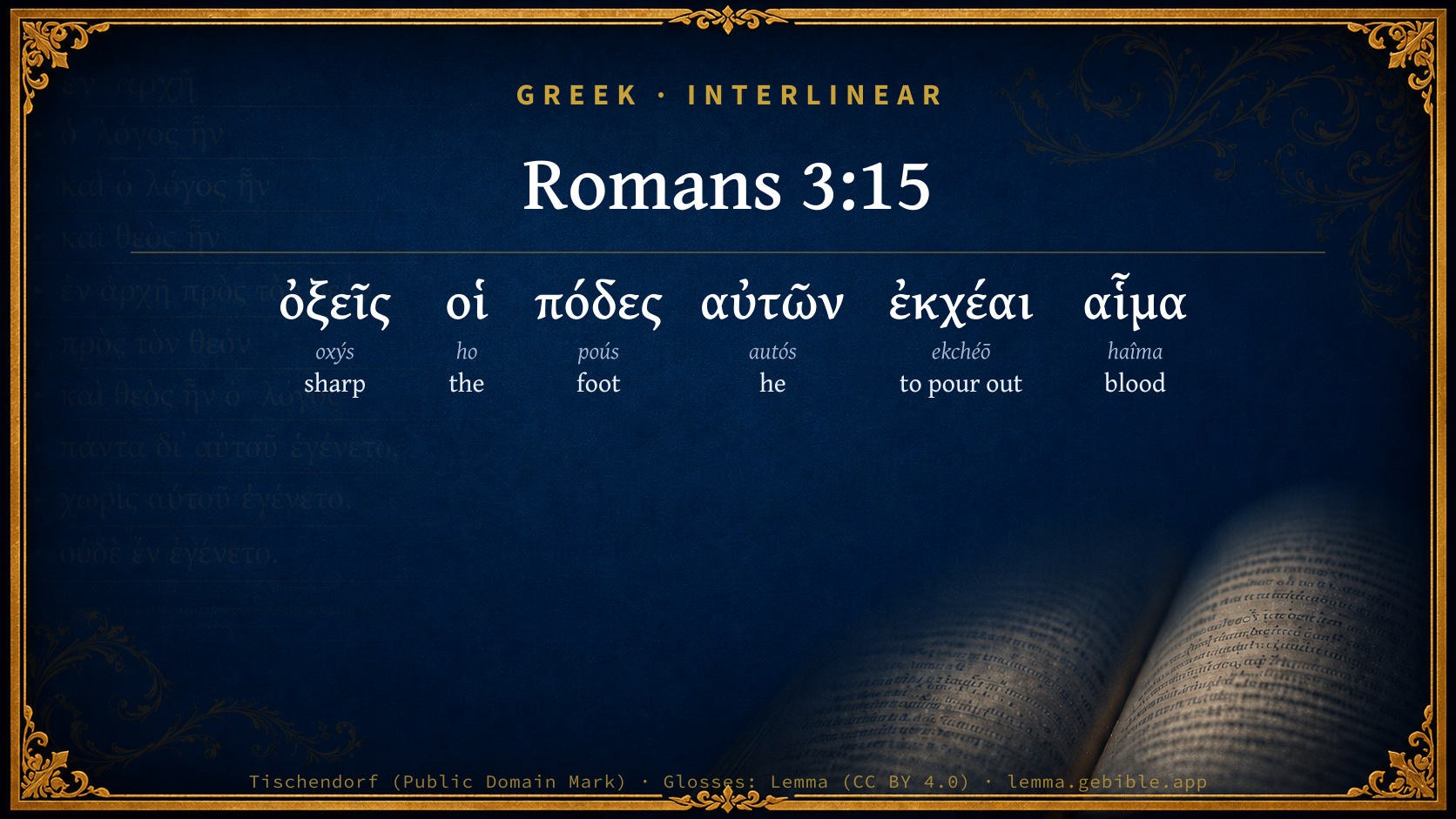
Download image
Cite this verse

Romans 3:15 (World English Bible). Public Domain. Lemma interlinear Bible study tool, https://lemma.gebible.app/v/romans/3/15.

Show BibTeX & RIS
BibTeX
RIS
English Translation
"Their feet are swift to shed blood.
World English Bible · Public Domain
Highlights
  • 1 first appearance in the Greek New Testament
Full analysis ↓
Download a study sheet

One document with this verse’s original text, its word-by-word gloss line, the meaning frame, cross-references with their text, attributed commentary, and full source and license credits — printable, and it pastes into notes with its structure intact.

This verse Autodidact and up

Study sheet (.html) Plain text (.txt)

A passage Seminary Student

Up to 50 verses in one chapter. A passage sheet keeps up to 6 commentary sources and 12 cross-references per verse, in the order this page ranks them, and says so on the sheet whenever that leaves anything out. Ask for a single verse and you get the Autodidact verse sheet above.

Everything on this page stays free to read, with no account — the sheet is a download of what is already on screen, not access to it.

Want to remove ads? Support Godless Engineer
Compare translations 3

The same verse in 3 English versions, stacked beneath the original-language interlinear above. Click any original word for its lexicon entry.

Each is an independent rendering of the whole verse — the interlinear is not word-aligned to these translations.

Highlighted words mark where these versions differ — a whole-verse word diff, not a word-by-word alignment.

  • World English Bible Public Domain
    "Their feet are swift to shed blood.
  • King James Version Public Domain
    Their feet are swift to shed blood:
  • unfoldingWord Literal Text CC BY-SA 4.0
    “Their feet swift to pour out blood.

unfoldingWord Literal Text — © unfoldingWord, licensed CC BY-SA 4.0. Word-aligned USFM3 via Door43 (git.door43.org/unfoldingWord/en_ult).

Versions to compare (up to 4)

3 of 4 selected

Show all 19 translations

Every available English version of this verse, each an independent rendering of the whole verse.

  • World English Bible Public Domain
    "Their feet are swift to shed blood.
  • Berean Standard Bible Public Domain
    “Their feet are swift to shed blood;
  • Majority Standard Bible Public Domain
    “Their feet are swift to shed blood;
  • King James Version Public Domain
    Their feet are swift to shed blood:
  • American Standard Version (1901) Public Domain
    Their feet are swift to shed blood;
  • Revised Version (1885) Public Domain
    Their feet are swift to shed blood;
  • Geneva Bible (1599) Public Domain
    Their feete are swift to shead blood.
  • Douay-Rheims (1899) Public Domain
    Their feet swift to shed blood:
  • Young's Literal Translation Public Domain
    Swift `are' their feet to shed blood.
  • Literal Standard Version CC BY-SA 4.0
    Their feet [are] swift to shed blood.
  • Unlocked Literal Bible CC BY-SA 4.0
    “Their feet are swift to pour out blood.
  • unfoldingWord Literal Text CC BY-SA 4.0
    “Their feet swift to pour out blood.
  • Darby Bible Public Domain
    swift their feet to shed blood;
  • World Messianic Bible Public Domain
    “Their feet are swift to shed blood.
  • Webster's Bible Public Domain
    Their feet are swift to shed blood.
  • Free Bible Version CC BY-SA 4.0
    and they are quick to cause pain and death.
  • Bible in Basic English Public Domain
    Their feet are quick in running after blood;
  • Text-Critical English NT CC BY 4.0
    “Their feet are swift to shed blood.
  • Tyndale New Testament (1534) Public Domain
    Their fete are swyfte to sheed bloud.

Literal Standard Version (2020), Covenant Press — licensed CC BY-SA 4.0. Text via the HelloAO Bible API (eBible.org). Unlocked Literal Bible (unfoldingWord) — licensed CC BY-SA 4.0. Text via the HelloAO Bible API (eBible.org). unfoldingWord Literal Text — © unfoldingWord, licensed CC BY-SA 4.0. Word-aligned USFM3 via Door43 (git.door43.org/unfoldingWord/en_ult). Free Bible Version, Dr. Jonathan Gallagher — licensed CC BY-SA 4.0. Text via the HelloAO Bible API (eBible.org).

Word by word

More ways to search: Search by grammar → Find every occurrence → Compare this word →

Practice this passage: Drill this verse → Learn its vocabulary →

About this verse

These counts appear in no published source. They are computed here, from the morphology-tagged text and Lemma’s own curated glosses. What Lemma adds →

6
words
6
distinct lemmas
Pauline Epistles
section

Notable vocabulary

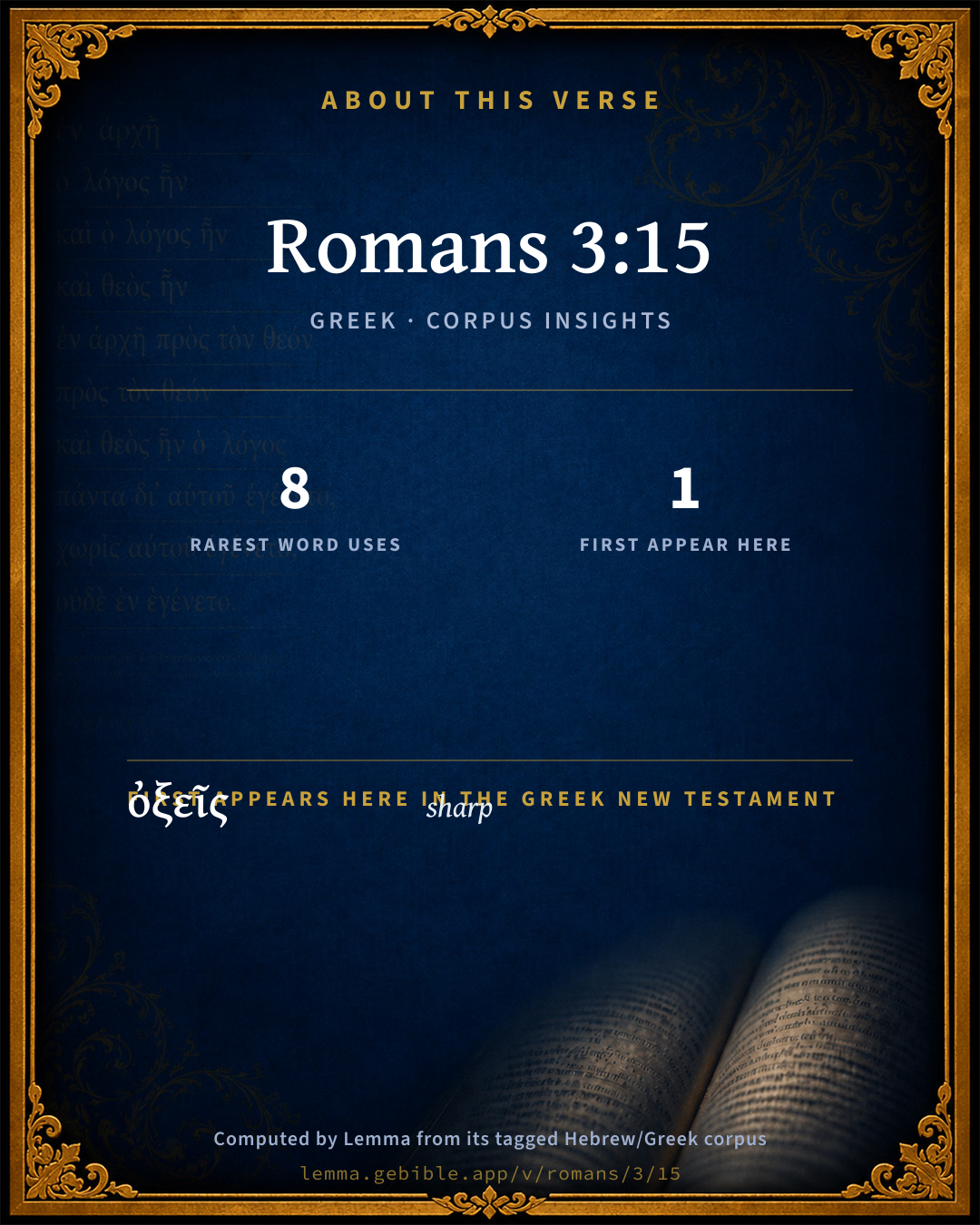
The rarest word here is ὀξεῖς sharp G3691 — appearing just 8 times in the whole Greek New Testament.

First appearance in Scripture

This word makes its first canonical appearance in the Greek New Testament here:

  • ὀξεῖς sharp G3691

Shared distinctive vocabulary

ὀξεῖς sharp G3691 occurs in 7 verses of the Greek New Testament. Also found in:
Cross-references

3

Topical passages linked to Romans 3:15 in the Treasury of Scripture Knowledge — connected by theme and wording, ordered by reader-vote popularity; previews shown in the World English Bible.

  • Isaiah 59:7–8 Their feet run to evil, and they make haste to shed innocent blood: their thoughts are thoughts of iniquity; desolation and destruction are in their paths.
  • Proverbs 1:16 For their feet run to evil. They hurry to shed blood.
  • Proverbs 6:18 A heart that devises wicked schemes, Feet that are swift in running to mischief,

Cross-references courtesy of OpenBible.info (CC BY 4.0).

Commentary

Notes on Romans 3:15 from classic Christian and Jewish commentators (each source and its license shown beneath its notes). The classic Christian expositions comment on the surrounding passage and are grouped to its opening verse, so a note may address several verses; the Jewish commentaries on the Tanakh (Rashi and others) are per-verse, so they appear only where the commentator wrote on this verse.

Lemma curates 59 commentaries, every one of them public domain or Creative Commons licensed, each selected and text-cleaned for this edition rather than reprinted as found. About our sources →

Tyndale Open Study Notes

Tyndale Open Resources

3:15-17 In this quotation from Isa 59:7-8, Paul addresses sins against others.

Tyndale Open Study Notes — © Tyndale Open Resources, licensed CC BY-SA 4.0. Text via the HelloAO Bible API.

Bengel's Gnomon

Johann Albrecht Bengel

Rom 3:15-18. Ὀξεῖς—οὐκ ἔγνωσαν) Isa 59:7-8, LXX., οἱ δὲ πόδες αὐτῶν—ταχινοὶ ἐκχέαι αἷμα—σύντριμμα οὐκ οἰδασι. So of the feet, Pro 1:16.

Bengel's Gnomon of the New Testament — English translation (T&T Clark, Edinburgh, 1860) — public domain. Text from a community e-Sword module.

Expositor's Greek Testament

ed. W. Robertson Nicoll

Rom 3:15-17 . These verses are rather a free extract from, than a quotation of, Isa 59:7-8 . They describe the moral corruption of Israel in the age of the prophet. According to Lipsius, σύντριμμα καὶ ταλαιπωρία refer to the spiritual misery which comes upon the Jews in the path of self-righteousness. But it is much more natural to suppose that the Apostle is pointing to the destruction and misery which human wickedness inflicts on others, than to any such spiritual results of it. It is as if he had said, “Wherever they go, you can trace them by the ruin and distress they leave behind”. The same consideration applies to Rom 3:17 . It does not mean, “They have failed to discover the way of salvation,” but “they tread continually in paths of violence”.

The Expositor's Greek Testament, edited by W. Robertson Nicoll (1897–1910) — public domain. Text from a community e-Sword module.

International Critical Commentary

15-17. This quotation of Isa 59:7, Isa 59:8 is freely abridged from the LXX; and as it is also of some interest from its bearing upon the text of the LXX used by St. Paul, it may be well to give the original and the quotation side by side.

Rom 3:15-17. Isa 59:7, Isa 59:8.

ὀξεῖς οἱ πόδες αὐτῶν ἐκχέαι αἷμα· σύντριμμα καὶ ταλαιπωρία ἐν ταῖς ὁδοῖς αὐτῶν, καὶ ὁδὸν εἰρήνης οὐκ ἔγνωσαν. οἱ δὲ πόδες αὐτῶν [ἐπὶ πονηρίαν τρέχουσι] ταχινοὶ ἐκχέαι αἷμα [καὶ οἱ διαλογισμοὶ αὐτῶν διαλογισμοὶ ἀπὸ φόνων]. σύντριμμα καὶ ταλαιπωρία ἐν ταῖς ὁδοῖς αὐτῶν καὶ ὁδὸν εἰρήνης οὐκ οἴδασι [καὶ οὐκ ἔστι κρίσις ἐν ταῖς ὁδοῖς αὐτῶν].

αἵμα ἀναίτιον Theodotion, and probably also Aquila and Symmachus. [From the Hexapla this reading has got into several MSS. of LXX.]

ἀφρόνων (for ἀπὸ φόνων) A א: οἴδασι א1 B Q*, &c.: ἔγνωσαν A Q1 marg. (Q = Cod. Marchalianus, XII Holmes) minusc. aliq.

International Critical Commentary — older volumes (1896–1929), various authors — public domain. Text from a community e-Sword module.

Hodge's Commentary on Romans, Ephesians & First Corinthians

Charles Hodge

Rom_3:15-17

These verses adduce the sins of violence common among men, in proof of the general depravity of the race. Their feet are swift to shed blood. That is, on the slightest provocation they commit murder. The life of their fellow-men is as nothing in their estimation, in comparison with the gratification of their pride or malice. The words are quoted from Isa_59:7 : Their feet run to evil, and they make haste to shed innocent blood. Here the Septuagint agrees with the Hebrew, and Paul again condenses the sense. Destruction and misery are in their ways. Their path through life is marked not only with blood, but with the ruin and desolation which they spread around them. In Isaiah the passage runs, Their thoughts are thoughts of iniquity; wasting and destruction are in their paths. The way of peace they have not known. The way of peace is the way that leads to peace, or pacific ways. They have not known, means they have not approved or frequented. The idea is to be taken in its most comprehensive form, as the apostle designs to prove, not from any specific form of violence, but from the general prevalence of sins of violence among men, that human nature is depraved. The tree which produces such fruit so abundantly must be evil.

Charles Hodge — Commentary on Romans (1835), First Corinthians (1857), and Ephesians (1856) — public domain. Text from a community e-Sword module.

Jamieson, Fausset & Brown

Robert Jamieson, A. R. Fausset & David Brown

Their feet are swift to shed blood-- (Pro 1:16; Isa 59:7): that is, "Those feet, which should 'run the way of God's commandments' (Psa 119:32), are employed to conduct men to deeds of darkest crime."

Jamieson, Fausset & Brown — Commentary Critical and Explanatory on the Whole Bible (1871) — public domain (CC PDM 1.0). Text via the HelloAO Bible API.

Adam Clarke's Commentary

Verse 15. Their feet are swift to shed blood] They make use of every means in their power to destroy the reputation and lives of the innocent.

Adam Clarke's Commentary on the Bible (1810–1826) — public domain. Text from a community e-Sword/MySword module.

John Gill's Exposition

There is no fear of God before their eyes. The place referred to is Psa 36:1, by the "fear of God", is not meant a fear of God's wrath, of hell and damnation; nor a fearful distrust of his presence, power, providence, and grace; much less an hypocritical fear; but a reverential affection for God, and which is peculiar to the children of God, which springs from a sense of divine goodness, is attended with holiness of heart and life, is consistent with faith, even full assurance of it, and with spiritual joy in its highest degree; it stands opposed to pride and haughtiness, and is a blessing of the covenant of grace: now this is not to be found in unregenerate men, for this springs from grace, and not nature, and is only implanted in the heart in conversion; it appears from the whole life and conversation of unconverted men, that the fear of God is not in their hearts, nor before their eyes.

, by the "fear of God", is not meant a fear of God's wrath, of hell and damnation; nor a fearful distrust of his presence, power, providence, and grace; much less an hypocritical fear; but a reverential affection for God, and which is peculiar to the children of God, which springs from a sense of divine goodness, is attended with holiness of heart and life, is consistent with faith, even full assurance of it, and with spiritual joy in its highest degree; it stands opposed to pride and haughtiness, and is a blessing of the covenant of grace: now this is not to be found in unregenerate men, for this springs from grace, and not nature, and is only implanted in the heart in conversion; it appears from the whole life and conversation of unconverted men, that the fear of God is not in their hearts, nor before their eyes.

Romans 3:19

rom 3:19

rom 3:19

rom 3:19Now we know that what things soever the law saith,.... By "the law" is meant, not the law of nature, nor the civil law of nations, nor the ceremonial law of the Jews, nor barely the five books of Moses, nor the book of Psalms, of the Prophets, or the writings of the whole Old Testament; but the moral law, as it appears in the whole word of God, which every man is bound to observe, of which all are transgressors, by which is the knowledge of sin, which no man can be justified by, and which Christ was made under, and came to fulfil. This law is represented as a person speaking, and saying many things, some of which are here mentioned; so, , "the law says" so and so, is an usual phrase with Jewish writers (y). The persons it speaks to, are

them that are under the law; the Jews were in a peculiar sense under it, as it was given to them by Moses; all mankind are under it, as to the matter of it; they are under obligation to obedience to it, and, through disobedience, come under its sentence of condemnation. The elect of God themselves were, and are in some sense under it; not indeed as a covenant of works, or as in the hands of Moses, nor as a yoke of bondage; nor are they obliged to seek for justification by it, and are entirely delivered from the curse and condemnation of it by Christ. They were under it, and that as a covenant of works, as in Adam, the federal head and representative of all mankind; and came under its sentence of condemnation and death, for his sin, and their own actual transgressions; which is consistent with the everlasting love of God to them in Christ, the covenant of grace made with them in him, as their head and surety, and their justification by him: and they are now under it, as in the hands of Christ; and look upon themselves as obliged, by the love of Christ, to yield a cheerful obedience to it: here it means such as are transgressors of the law, and so under obligation to punishment, without any regard to Jew or Gentile, or any distinction God has made in his own breast: and the things it says to such are, it charges them with sin, and convicts them of it, both of its pollution and guilt: so

that every mouth may be stopped; and have nothing to say of the purity of their nature, which appears to be so sadly stained; nor of their works of righteousness, which are so few, and so very imperfect. The law makes such a representation of things to them, that their mouths are stopped from glorying in themselves, and in their works, which are far from being adequate to the demands of the law; and from complaining against the righteous judgment of God, should he proceed against them in the most rigorous manner:

and all the world may become guilty before God; Jews and Gentiles; all the individuals of mankind are guilty before God, and will be found to be so, sooner or later: some read it, "subject to God", and understand it of a subjection to his grace, being brought to see their need of it, and of salvation by it; but this is not the case of all the world, rather signifies a subjection to that justice, vengeance, and wrath of God, to which all men are liable in their own persons; since they are all found guilty by the law, and will appear to be so, and therefore can never be justified by their obedience to it; which is what the apostle is aiming at in all he here says, as appears from what follows; all which "we know" to be true, and are fully assured of, who know the nature and spirituality of the law, and to whom it has come with light and power.

(y) T. Bab. Roshhashanah, fol. 16. 1. Taanith, fol. 21. 2.

John Gill's Exposition of the Whole Bible (1746–1763) — public domain (CC PDM 1.0). Text via the HelloAO Bible API.

Trapp's Complete Commentary

John Trapp

15 Their feet are swift to shed blood:

Ver. 15. Swift to shed blood] As Paul, till God stopped him in his cursed career.

John Trapp, A Commentary or Exposition upon All the Books of the Old and New Testament (1647–1656) — public domain. Text from a community e-Sword module.

Albert Barnes' Notes on the Bible

Their feet ... - The quotation in this and the two following verses, is abridged or condensed from Isa 59:7-8. The expressions occur in the midst of a description of the character of the nation in the time of the prophet. The apostle has selected a few expressions out of many, rather making a reference to the entire passage, than a formal quotation. The expression, “their feet are swift,” etc., denotes the eagerness of the nation to commit crime, particularly deeds of injustice and cruelty. They thirsted for the blood of innocence, and hasted to shed it, to gratify their malice, or to satisfy their vengeance.

Albert Barnes' Notes on the Bible (1834–1885) — public domain. Text from a community e-Sword/MySword module.

Matthew Poole's English Annotations

If we consider this member also, we may see the corruption of man; witness that testimony, Pro 1:16, and Isa 59:7; on both which see annotations.

Matthew Poole's English Annotations on the Holy Bible (1683–1685) — public domain. Text from a community e-Sword/MySword module.

Whedon's Commentary on the Bible

Daniel D. Whedon

15. Swift—Like the feet of a hotly pursuing murderer.

Daniel D. Whedon (gen. ed.), Commentary on the Old and New Testaments (1874–1909) — public domain. Text from a community e-Sword module.

John Wesley's Explanatory Notes

Isaiah lix, 7, 8

John Wesley, Explanatory Notes Upon the Whole Bible (1754–1765) — public domain. Text via the GEBible commentary corpus.

Godbey's Commentary on the New Testament

William B. Godbey

15. “Their feet are swift to shed blood.” Not only is this true of wicked worldly people who are ready to waylay and murder you, but it is equally true of the fallen churches; as we see through ages how eagerly they have rushed forth to shed innocent blood, beginning with our Savior, and continuing through the centuries, deluging the world with martyrs’ blood, and would today if they could. The Inquisition would revive this day if they had the power.

William B. Godbey, Commentary on the New Testament (1896–1900) — public domain. Text from a community e-Sword module.

McGarvey & Pendleton's Commentaries

J. W. McGarvey

Their feet are swift to shed blood ;

J. W. McGarvey (with Philip Y. Pendleton), Commentaries on the New Testament (The Fourfold Gospel, 1914; Acts; and the epistles) — public domain. Text from a community e-Sword/MySword module.

The People's New Testament

B. W. Johnson

15. Their feet are swift to shed blood. To carry their owners on a mission of murder.

B. W. Johnson's The People's New Testament with Notes (1889–1891) — public domain. Electronic text from the Christian Classics Ethereal Library (CCEL) ThML edition.

unfoldingWord translationNotes

Door43 World Missions Community

Their ... their ... These people ... their

These words refer to the Jews and Greeks in Romans 3:9.

Their feet are swift to pour out blood

Here "feet" is a synecdoche that represents the people themselves. The word "blood" is a metaphor that refers to killing people. AT: "They are in a hurry to harm and murder people" (See: Synecdoche and Metaphor)

Destruction and suffering are in their paths

Here "destruction and suffering" are metonyms that represent the harm that these people cause others to suffer. AT: "They try to destroy others and cause them to suffer" (See: Metonymy)

a way of peace

"how to live at peace with others." A "way" is a road or path.

There is no fear of God before their eyes

Here "fear" is a metonym that represents respect for God and willingness to honor him. AT: "Everyone refuses to give God the respect he deserves" (See: Synecdoche)

translationWords

blood

suffer

peace

fear

God

unfoldingWord translationNotes — © Distant Shores Media and the Door43 World Missions Community, licensed CC BY-SA 4.0. Source: git.door43.org/Door43/en_tn.

Alford’s Greek Testament

Henry Alford

15.] The LXX (Isa l. c.) have οἱ δὲ πόδες αὐτῶν ἐπὶ πονηρίαν τρέχουσι, ταχινοὶ ἐκχέαι αἷμα· καὶ οἱ διαλογισμοὶ αὐτῶν διαλογισμοὶ ἀπὸ φόνων (διαλ. ἀφρόνων Α)· σύντριμμα καὶ ταλαιπωρία ἐν ταῖς ὁδοῖς αὐτῶν, καὶ ὁδὸν εἰρήνης οὐκ οἴδασιν (ἔγνωσαν, Α).

Henry Alford, The Greek Testament (1849–1861) — public domain. Text from a community e-Sword module.

Godet's Commentaries

Frédéric Louis Godet

Vv. 15-18. “Their feet are swift to shed blood: oppression and misery are in their ways: the way of peace they have not known: there is no fear of God before their eyes.”

Of these four propositions the first three are borrowed from Isa 59:7-8, in which chapter the prophet confesses the corruption of Israel. The feet, as the emblem of walking, symbolize the whole conduct. Man acts without regard to his neighbor, without fear of compromising his welfare and even his life; a saying taken from Pro 1:16. He oppresses (σύντριμμα) his brother, and fills his life with misery (ταλαιπωρία), so that the way marked out by such a course is watered with the tears of others.

No peace can exist either in the heart of such men, or in their neighborhood (Rom 3:17). And this overflow of depravity and suffering arises from a void: the absence of that feeling which should have filled the heart, the fear of God (Rom 3:18). This term is the normal expression for piety in the Old Testament; it is that disposition in man which has always God present in the heart, His will and judgment. The words: before their eyes, show that it belongs to man freely to evoke or suppress this inward view of God, on which his moral conduct depends. This final characteristic is borrowed from Psa 36:1, which marks the contrast between the faithful and the wicked even in Israel.

The apostle in drawing this picture, which is only a grouping together of strokes of the pencil, made by the hands of psalmists and prophets, does not certainly mean that each of those characteristics is found equally developed in every man, Some, even the most of them, may remain latent in many men; but they all exist in germ in the selfishness and natural pride of the ego, and the least circumstance may cause them to pass into the active state, when the fear of God does not govern the heart. Such is the cause of the divine condemnation which is suspended over the human race.

This is the conclusion which the apostle reaches; but he limits the express statement of it, in Rom 3:19-20, to the Jews; for they only could attempt to protest against it, and put themselves outside this delineation of human corruption. They could object in particular, that many of the sayings quoted referred not to them, but to the Gentiles. Paul foresees this objection, and takes care to set it aside, so that nothing may impair the sweep of the sentence which God pronounces on the state of mankind.

Frédéric Louis Godet — Commentaries on Luke, John, Romans, and 1 Corinthians — English translation (T&T Clark, Edinburgh, 1870s–1890s) — public domain. Text from a community e-Sword module.

Lesson kit

Teaching starters — assembled from the data on this page, not authored interpretation. Every prompt links to the verse data it draws on. Edit before teaching.

Romans, in the Pauline Epistles, opens this verse with 6 words (6 distinct Greek lemmas). Its most distinctive word is oxýs (“sharp”). A historical commentator’s framing appears above. Read the whole chapter for the surrounding context.

Discussion questions

  1. How does “sharp” (oxýs) shape what this verse is saying?
  2. This is the first place “sharp” appears in Scripture (first appears here). What does its debut here establish?
  3. How does Revelation 1:16, which shares the word «sharp», read alongside this verse?
  4. The translations on this page render this verse differently — a whole-verse word diff, not a word-by-word alignment. What might account for the different wordings?
  5. Compare how Tyndale Open Study Notes and Bengel's Gnomon read this verse. Where do they agree or differ?

Things to notice

  • 1 word makes its first canonical appearance in Scripture here.
  • These translations choose different wording for 3 words in this verse.
  • 6 distinct Greek lemmas span 6 words in this verse.

Reading settings

Reading text

Shown beneath each verse's original-language words.

Old Testament
Old Testament edition

Read the OT as the Masoretic Hebrew (MT) or the Greek Septuagint (LXX).

English shown for the Greek Septuagint (in the Hebrew ↔ Greek comparison).

Comparing translations? Open the Compare panel on any verse page to stack up to four side by side.