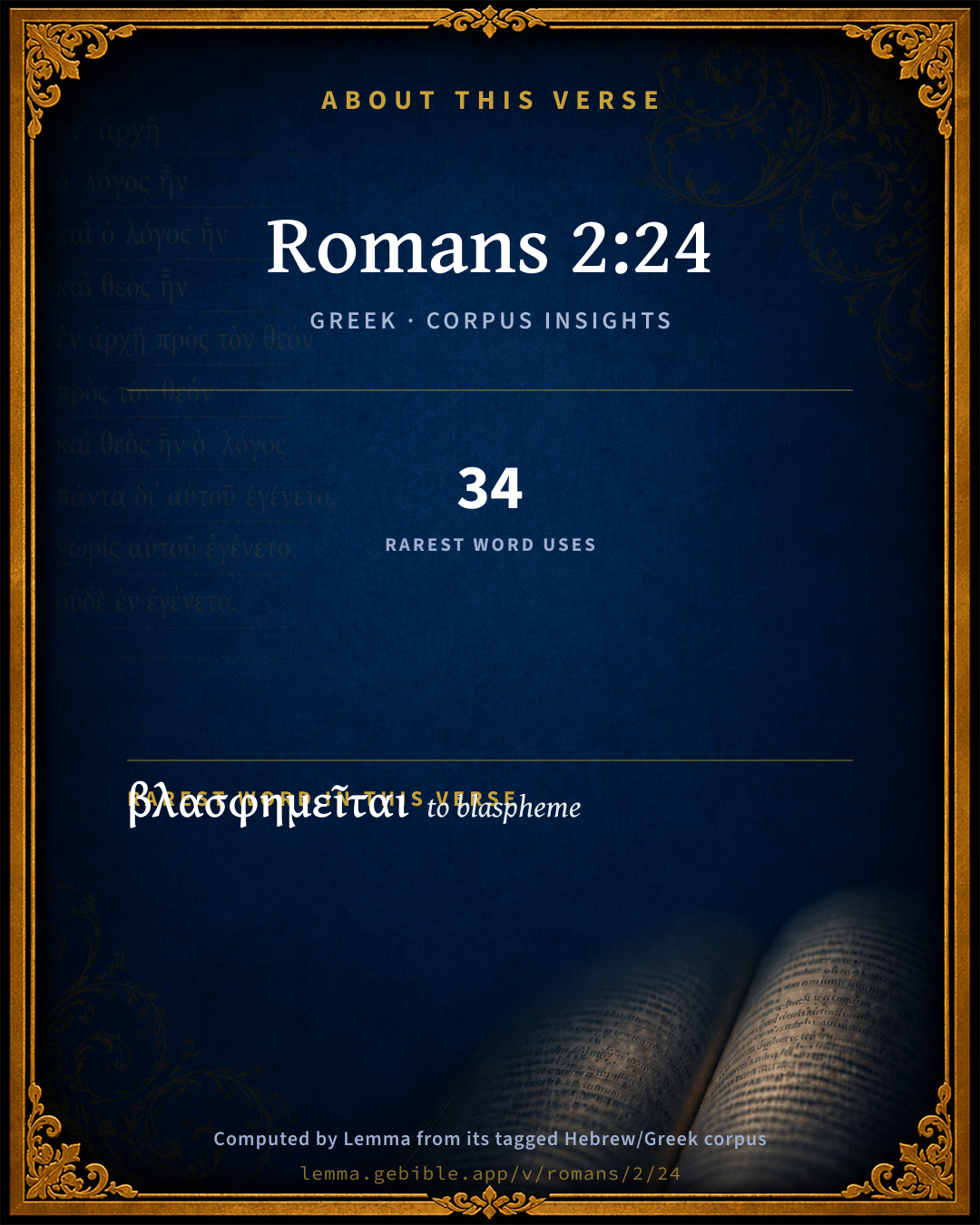
Romans 2:24

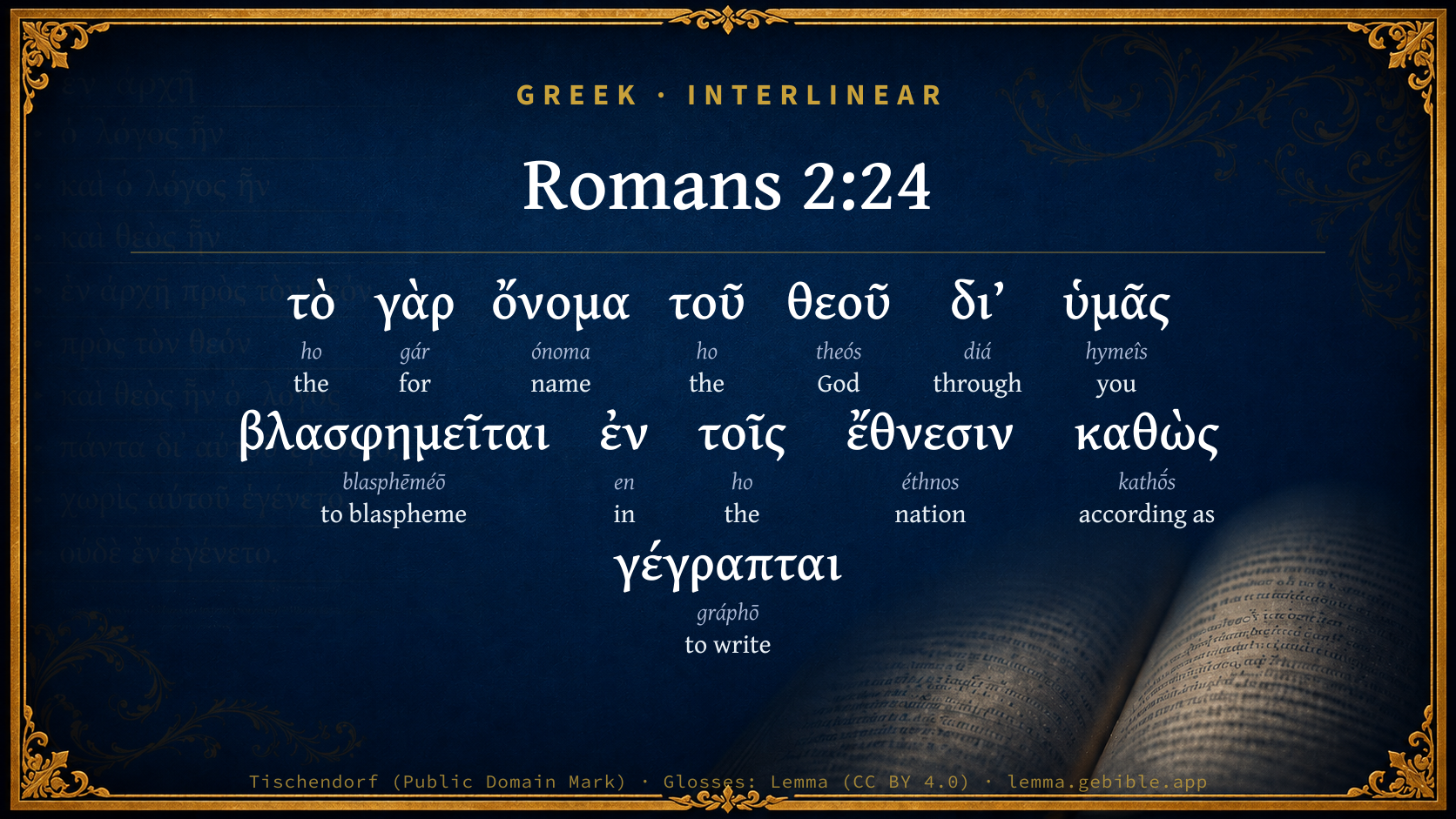
Greek (Tischendorf 8th ed.) Romans 2:24 appears in the Greek New Testament. The text above is from the Tischendorf 8th edition. Each word links to its Strong’s number and a concise gloss. Click any word for its full Thayer’s Greek Lexicon entry.
Download image
Cite this verse

Romans 2:24 (World English Bible). Public Domain. Lemma interlinear Bible study tool, https://lemma.gebible.app/v/romans/2/24.

Show BibTeX & RIS
BibTeX
RIS
English Translation
For "the name of God is blasphemed among the Gentiles because of you," just as it is written.
World English Bible · Public Domain
Download a study sheet

One document with this verse’s original text, its word-by-word gloss line, the meaning frame, cross-references with their text, attributed commentary, and full source and license credits — printable, and it pastes into notes with its structure intact.

This verse Autodidact and up

Study sheet (.html) Plain text (.txt)

A passage Seminary Student

Up to 50 verses in one chapter. A passage sheet keeps up to 6 commentary sources and 12 cross-references per verse, in the order this page ranks them, and says so on the sheet whenever that leaves anything out. Ask for a single verse and you get the Autodidact verse sheet above.

Everything on this page stays free to read, with no account — the sheet is a download of what is already on screen, not access to it.

Want to remove ads? Support Godless Engineer
Compare translations 3

The same verse in 3 English versions, stacked beneath the original-language interlinear above. Click any original word for its lexicon entry.

Each is an independent rendering of the whole verse — the interlinear is not word-aligned to these translations.

Highlighted words mark where these versions differ — a whole-verse word diff, not a word-by-word alignment.

  • World English Bible Public Domain
    For "the name of God is blasphemed among the Gentiles because of you," just as it is written.
  • King James Version Public Domain
    For the name of God is blasphemed among the Gentiles through you, as it is written.
  • unfoldingWord Literal Text CC BY-SA 4.0
    For “the name of God is blasphemed among the Gentiles because of you,” just as it is written.

unfoldingWord Literal Text — © unfoldingWord, licensed CC BY-SA 4.0. Word-aligned USFM3 via Door43 (git.door43.org/unfoldingWord/en_ult).

Versions to compare (up to 4)

3 of 4 selected

Show all 19 translations

Every available English version of this verse, each an independent rendering of the whole verse.

  • World English Bible Public Domain
    For "the name of God is blasphemed among the Gentiles because of you," just as it is written.
  • Berean Standard Bible Public Domain
    As it is written: “God’s name is blasphemed among the Gentiles because of you.”
  • Majority Standard Bible Public Domain
    As it is written: “God’s name is blasphemed among the Gentiles because of you.”
  • King James Version Public Domain
    For the name of God is blasphemed among the Gentiles through you, as it is written.
  • American Standard Version (1901) Public Domain
    For the name of God is blasphemed among the Gentiles because of you, even as it is written.
  • Revised Version (1885) Public Domain
    For the name of God is blasphemed among the Gentiles because of you, even as it is written.
  • Geneva Bible (1599) Public Domain
    For ye Name of God is blasphemed among the Gentiles through you, as it is written.
  • Douay-Rheims (1899) Public Domain
    (For the name of God through you is blasphemed among the Gentiles, as it is written.)
  • Young's Literal Translation Public Domain
    for the name of God because of you is evil spoken of among the nations, according as it hath been written.
  • Literal Standard Version CC BY-SA 4.0
    For evil is spoken of the Name of God among the nations because of you, according as it has been written.
  • Unlocked Literal Bible CC BY-SA 4.0
    For “the name of God is blasphemed among the Gentiles because of you,” just as it has been written.
  • unfoldingWord Literal Text CC BY-SA 4.0
    For “the name of God is blasphemed among the Gentiles because of you,” just as it is written.
  • Darby Bible Public Domain
    For the name of God is blasphemed on your account among the nations, according as it is written.
  • World Messianic Bible Public Domain
    For “the name of God is blasphemed among the Gentiles because of you,” just as it is written.
  • Webster's Bible Public Domain
    For the name of God is blasphemed among the Gentiles, through you, as it is written.
  • Free Bible Version CC BY-SA 4.0
    As Scripture says, “God's character is defamed among the foreigners because of you.”
  • Bible in Basic English Public Domain
    For the name of God is shamed among the Gentiles because of you, as it is said in the holy Writings.
  • Text-Critical English NT CC BY 4.0
    As it is written, “The name of God is blasphemed among the Gentiles because of you.”
  • Tyndale New Testament (1534) Public Domain
    For the name of god is evyll spoken of amonge the Gentyls thorowe you as it is written.

Literal Standard Version (2020), Covenant Press — licensed CC BY-SA 4.0. Text via the HelloAO Bible API (eBible.org). Unlocked Literal Bible (unfoldingWord) — licensed CC BY-SA 4.0. Text via the HelloAO Bible API (eBible.org). unfoldingWord Literal Text — © unfoldingWord, licensed CC BY-SA 4.0. Word-aligned USFM3 via Door43 (git.door43.org/unfoldingWord/en_ult). Free Bible Version, Dr. Jonathan Gallagher — licensed CC BY-SA 4.0. Text via the HelloAO Bible API (eBible.org).

Word by word

More ways to search: Search by grammar → Find every occurrence → Compare this word →

Practice this passage: Drill this verse → Learn its vocabulary →

βλασφημεῖται
blasphēméō
G987
“to blaspheme”
Verb, Present, Passive, Indicative, 3rd person, Singular
Part of Speech
Verb
Tense
Present
Voice
Passive
Mood
Indicative
Person
3rd person
Number
Singular
Full Thayer's Definition

Origin: from G989

TDNT: 11:21,1

1. to speak reproachfully, rail at, revile, calumniate, blaspheme 2. to be evil spoken of, reviled, railed at
  1. τὸ ho G3588 “the” Article, Nominative, Singular, Neuter
  2. γὰρ gár G1063 “for” Conjunction
  3. ὄνομα ónoma G3686 “name” Noun, Nominative, Singular, Neuter
  4. τοῦ ho G3588 “the” Article, Genitive, Singular, Masculine
  5. θεοῦ theós G2316 “God” Noun, Genitive, Singular, Masculine
  6. δι’ diá G1223 “through” Preposition
  7. ὑμᾶς hymeîs G5210 “you” Personal pronoun, 2nd person, Accusative, Plural
  8. ἐν en G1722 “in” Preposition
  9. τοῖς ho G3588 “the” Article, Dative, Plural, Neuter
  10. ἔθνεσιν éthnos G1484 “nation” Noun, Dative, Plural, Neuter
  11. καθὼς kathṓs G2531 “according as” Adverb
  12. γέγραπται gráphō G1125 “to write” Verb, Perfect, Passive, Indicative, 3rd person, Singular

About this verse

These counts appear in no published source. They are computed here, from the morphology-tagged text and Lemma’s own curated glosses. What Lemma adds →

13
words
11
distinct lemmas
Pauline Epistles
section

Shared distinctive vocabulary

βλασφημεῖται to blaspheme G987 occurs in 34 verses of the Greek New Testament. Also found in:

Repetition

A word recurs within this verse:

Cross-references

6

Topical passages linked to Romans 2:24 in the Treasury of Scripture Knowledge — connected by theme and wording, ordered by reader-vote popularity; previews shown in the World English Bible.

  • Ezekiel 36:20–23 When they came to the nations, where they went, they profaned my holy name; in that men said of them, These are the people of Yahweh, and are gone forth out of his land.
  • Isaiah 52:5 Now therefore, what do I here, says Yahweh, seeing that my people is taken away for nothing? those who rule over them do howl, says Yahweh, and my name continually all the day is blasphemed.
  • 2 Peter 2:2 Many will follow their immoral ways, and as a result, the way of the truth will be maligned.
  • Lamentations 2:15–16 All that pass by clap their hands at you; They hiss and wag their head at the daughter of Jerusalem, [saying], Is this the city that men called The perfection of beauty, The joy of the whole earth?
  • 2 Samuel 12:14 However, because by this deed you have given great occasion to Yahweh's enemies to blaspheme, the child also who is born to you shall surely die."
  • Titus 2:8 and soundness of speech that can't be condemned; that he who opposes you may be ashamed, having no evil thing to say about us.

Cross-references courtesy of OpenBible.info (CC BY 4.0).

Commentary

Notes on Romans 2:24 from classic Christian and Jewish commentators (each source and its license shown beneath its notes). The classic Christian expositions comment on the surrounding passage and are grouped to its opening verse, so a note may address several verses; the Jewish commentaries on the Tanakh (Rashi and others) are per-verse, so they appear only where the commentator wrote on this verse.

Lemma curates 59 commentaries, every one of them public domain or Creative Commons licensed, each selected and text-cleaned for this edition rather than reprinted as found. About our sources →

Tyndale Open Study Notes

Tyndale Open Resources

2:24 Paul quotes Isa 52:5, where God’s name is blasphemed because Israel is oppressed by pagan nations. Here, Paul uses that passage to demonstrate the failure of the Jews to live up to their responsibilities.

Tyndale Open Study Notes — © Tyndale Open Resources, licensed CC BY-SA 4.0. Text via the HelloAO Bible API.

Bengel's Gnomon

Johann Albrecht Bengel

Rom 2:24. Τὸ γὰρ ὄνομα) Isa 52:5, in the LXX., διʼ ὑμᾶς διὰ παντὸς τὸ ὀνομά μον βλασφημεῖται ἐν τοῖς ἔθνεσι, through you My name is continually blasphemed among the Gentiles.—Comp. Eze 36:20, etc.—καθὼς γἐγραπται, as it is written) This short clause is fittingly placed at the end, as it refers to a thing evident of itself, but it is set down for the sake of the Jews, ch. Rom 3:19.

Bengel's Gnomon of the New Testament — English translation (T&T Clark, Edinburgh, 1860) — public domain. Text from a community e-Sword module.

Meyer's Critical & Exegetical Commentary

Heinrich August Wilhelm Meyer

Rom_2:24. For confirmation of his τὸν θεὸν ἀτιμάζεις Paul subjoins a Scripture quotation, namely Isa_52:5, in substance after the LXX., not the far more dissimilar passage Eze_36:22 f. (Calvin, Ewald and others), which, according to Hofmann, he is supposed to express according to the Greek translation of Is. l.c[704] more convenient for him. But he applies the quotation in such a way that he makes it his own by the γάρ not found in the original or the LXX.; only indicating by ΚΑΘῺς ΓΈΓΡΑΠΤΑΙ at the close, that he has thus appropriated a passage of Scripture. Hence καθὼς γέγ. is placed at the end, as is never done in the case of express quotations of Scripture. The historical sense[705] of the passage is not here concerned, since Paul has not quoted it as a fulfilled prophecy, though otherwise with propriety in the sense of Rom_3:19.

ΔΙʼ ὙΜᾶς] i.e. on account of your wicked conduct.

βλασφημεῖται ἐν τοῖς ἔθνεσι] among the Gentiles, inasmuch, namely, as these infer from the immoral conduct of the Jews that they have an unholy God and Lawgiver, and are thereby moved to blaspheme His holy name. Comp Clement, Cor. I. 47.

[704] .c. loco citato or laudato.

[705] It refers to Gods name being dishonoured through the enslaving of the Jews by their tyrants.

Meyer — Critical and Exegetical Commentary on the New Testament — English translation by Peter Christie, edited by Frederick Crombie (T&T Clark, 1880) — public domain. Text from a community e-Sword module.

Expositor's Greek Testament

ed. W. Robertson Nicoll

Rom 2:24 . And this is only what Scripture bids us expect. The Scripture quoted is Isa 52:5 , LXX. The LXX interpret the Hebrew by inserting διʼ ὑμᾶς and ἐν τοῖς ἔθνεσιν . Both insertions are in the line of the original meaning. It was owing to the misery and helplessness of the people of God, in exile among the nations, that the heathen scoffed at the Divine name. “The God of Israel is not able to deliver His people: He is no God.” Paul here gives the words quite another turn. God, he says, is now blasphemed among the nations because of the inconsistency between the pretensions of the Jews and their behaviour. As if the heathen were saying: “Like God, like people; what a Divinity the patron of this odious race must be”. It is surely not right to argue (with Sanday and Headlam) that the throwing of the formula of quotation to the end shows that Paul is conscious of quoting freely: “it is almost as if it were an after-thought that the language he has just used is a quotation at all”. The quotation is as relevant as most that the Apostle uses. He never cares for the context or the original application. When he can express himself in Scripture language he feels that he has the Word of God on his side, and all through this epistle he nails his arguments so, and insists on the confirmation they thus obtain. What the closing of the sentence with καθὼς γέγραπται suggests is not that it occurred to Paul after he had finished that he had almost unconsciously been using Scripture: it is rather that there is a challenge in the words, as if he had said, Let him impugn this who dare contest the Word of God.

In Rom 2:25-29 another Jewish plea for preferential treatment in the judgment is considered. The μὲν in Rom 2:25 ( περιτομὴ μὲν γὰρ ὠφελεῖ ) implies that this plea has no doubt something in it, but it suggests that there are considerations on the other side which in point of fact make it inapplicable or invalid here. It is these considerations which the Apostle proceeds to explain, with a view to clenching the argument that the wrath of God revealed from heaven impends over Jew and Gentile alike.

The Expositor's Greek Testament, edited by W. Robertson Nicoll (1897–1910) — public domain. Text from a community e-Sword module.

Hodge's Commentary on Romans, Ephesians & First Corinthians

Charles Hodge

Rom_2:23, Rom_2:24

Another striking instance of the inconsistency between their principles and their conduct was, that while they made a boast of the law, they so disregarded its precepts as to lead the heathen to think and speak evil of that God who gave the law, of whose character they judged by the conduct of his people. This charge he expresses in the language of their own prophets; see Isa_52:5 and Eze_36:20, Eze_36:23. In the former passage we find in the lxx, nearly the same words as those used by the apostle: δἰ ὑμᾶς διαπαντὸς τὸ ὄνομά μου βλασφημεῖται ἐν τοῖς ἓθνεσι. Both Isaiah and Ezekiel, indeed, refer to that blaspheming of God by the heathen, which arose from the misery of his people, whose God they were thus led to regard as unable to protect his worshippers. This, however, does not render the reference of the apostle less appropriate; for it is the mere fact that Gods name was blasphemed among the Gentiles, on account of the Jews, that the apostle means to confirm by this reference to the Scriptures. And besides, as their sins were the cause of their captivity, their sins were the cause also of the evil speaking of God, of which their sufferings were the immediate occasion.

Charles Hodge — Commentary on Romans (1835), First Corinthians (1857), and Ephesians (1856) — public domain. Text from a community e-Sword module.

Jamieson, Fausset & Brown

Robert Jamieson, A. R. Fausset & David Brown

as it is written--(See Isa 52:5, Marginal reference).

Jamieson, Fausset & Brown — Commentary Critical and Explanatory on the Whole Bible (1871) — public domain (CC PDM 1.0). Text via the HelloAO Bible API.

Adam Clarke's Commentary

Verse 24. For the name of God is blasphemed, .] In Debarim rabba, sect. 2, fol. 251, it is said:-"The rulers destroy the influence of their own words among the people and this is done when a rabbin, sitting and teaching in the academy, says, Do not take usury, and himself takes it; do not commit rapine, and himself commits it; do not steal, and himself steals." That they were exceedingly lax in their morals, the following fact proves:- "Rabbi Ilai said, If a man see that his evil propensities are likely to prevail against him, let him go to some place where he is not known, and let him put on black clothes, and cover his head with a black veil; and then let him do whatsoever he pleases, lest the name of God should be publicly profaned." Moed katon, fol. 17. 1. In Sohar Levit. fol. 31, col. 122, it is said:- "On three accounts the Jews are obliged to remain in captivity -

1. Because they openly reproach the Shechinah -

2. Because they profane themselves before the Shechinah -

3. Because they turn away their faces from the Shechinah."

But it would be endless to collect from their history the proofs of the charges brought here against them by the apostle. See Whitby, Schoettgen, and others.

Adam Clarke's Commentary on the Bible (1810–1826) — public domain. Text from a community e-Sword/MySword module.

John Calvin's Commentaries

24. For the name of God, etc. I think this quotation is taken from Ezekiel 36:20, rather than from Isaiah 52:5; for in Isaiah there are no reproofs given to the people, but that chapter in Ezekiel is full of reproofs. But some think that it is a proof from the less to the greater, according to this import, “Since the Prophet upbraided, not without cause, the Jews of his time, that on account of their captivity, the glory and power of God were ridiculed among the Gentiles, as though he could not have preserved the people, whom he had taken under his protection, much more are ye a disgrace and dishonor to God, whose religion, being judged of by your wicked life, is blasphemed.” This view I do not reject, but I prefer a simpler one, such as the following, — “We see that all the reproaches cast on the people of Israel do fall on the name of God; for as they are counted, and are said to be the people of God, his name is as it were engraven on their foreheads: it must hence be, that God, whose name they assume, is in a manner defamed by men, through their wicked conduct.” It was then a monstrous thing, that they who derived their glory from God should have disgraced his holy name; for it behoved them surely to requite him in a different manner.

John Calvin's Commentaries (1540-1563) — public domain. Text from the Calvin Translation Society English edition (1840s-50s) via the Christian Classics Ethereal Library (ccel.org). Calvin's coverage is partial (roughly two-thirds of the Bible); uncommented books and verses are honest gaps, never fabricated. The 19th-century editor's footnotes and remarks are omitted so the notes are faithfully Calvin's own voice.

Ellicott's Commentary for English Readers

(24) Through you.—Because of you.

As it is written.—From the LXX. version of Isa_52:5. The sense of the original is that the name of God is dishonoured by the enslavement and oppression of His people. A nearer parallel in sense, though more remote in words, may be found in 2Sa_12:14; Eze_36:22-23. The Apostle is not careful as to the particular context from which he draws. He knew that he was giving the substance of Scripture, and he takes the aptest words that occur to him at the moment. Translated into our modern modes of thought, the formula “as it is written” at the end of the verse amounts to little more than “in the language of Scripture.” The intention, as so frequently with St. Paul, seems, as it were, to be divided between proof and illustration.

A Bible Commentary for English Readers, edited by Charles John Ellicott (1878–1897) — public domain. Text from a community e-Sword module.

The Cambridge Bible for Schools and Colleges

gen. ed. J. J. S. Perowne

24. as it is written] In Eze_36:20-23. In that passage the special reference is to the evil example of the dispersed Jews of the captivity.

The Cambridge Bible for Schools and Colleges (gen. ed. J. J. S. Perowne; Cambridge University Press, 1878–1918) — public domain. Text from a community e-Sword module.

John Gill's Exposition

Therefore if the uncircumcision keep,.... These words are spoken hypothetically; if any such persons could be found among the Gentiles who keep the whole law of God; and can only be absolutely understood of such, who from a principle of grace act in obedience to the law; as in the hands of Christ, and who look to Christ as the fulfilling end of it, for righteousness; in whom they keep

the righteousness of the law perfectly:

shall not his uncircumcision be counted for circumcision? by this question it is suggested, that an uncircumcised Gentile, who keeps the law as in the hands of Christ, and under the influences of his Spirit and grace, and keeps it in Christ, is reckoned a circumcised person in a spiritual sense, and must be preferable to a circumcised Jew that breaks it.

John Gill's Exposition of the Whole Bible (1746–1763) — public domain (CC PDM 1.0). Text via the HelloAO Bible API.

Trapp's Complete Commentary

John Trapp

24 For the name of God is blasphemed among the Gentiles through you, as it is written.

Ver. 24. For the name of God, &c.] Heretics and hypocrites do still with Judas deliver up the Lord Christ to the scoffs and buffetings of his enemies. Augustine (De Civ. Dei, i. 52) complains of the ancient heretics, that in them many evil-minded men found matter of blaspheming the name of Christ because they also pretended to the Christian religion. Epiphanius addeth, that for the looseness of such men’s lives, and the baseness of their tenets, many of the heathens shunned the company of Christians, and would not be drawn to hear their sermons. Origen before them both cries out, Nunc male audiunt, castiganturque vulgo Christiani, quod aliter quam sapientibus convenit vivant, et vitia sub obtentu nominis celent, &c. There is an ill report goes of Christians for their unchristian conversation, &c. Ammianus Marcellinus, a heathen historian, deeply taxeth the pride, luxury, contentions, covetousness of the bishops in his time, and the deadly hatreds of common Christians. Nullae infestae hominibus bestiae sunt, ut sibi ferales plerique Christiani, saith he. A sad thing that a heathen should see and detest such hellish miscarriages among Christians. Bellarmine telleth us of certain hereties anciently called Christianocategori, that is, accusers of Christians, because for their sakes Christians were accused as worshippers of idols. {a} Papists give the same offence to Jews, who call scandal Chillul Hesham, a profaning of God’s name, which they hold the greatest of sins.

{a} De Eccles. Triumph. lib. ii. 11.

John Trapp, A Commentary or Exposition upon All the Books of the Old and New Testament (1647–1656) — public domain. Text from a community e-Sword module.

Albert Barnes' Notes on the Bible

The name of God - The name and character of the true God.

Is blasphemed - Note, Mat 9:3. That is, your conduct is such as to lead the pagan world to blaspheme and reproach both your religion and its Author. By your hypocrisy and crimes the pagan world is led to despise a religion which is observed to have no effect in purifying and restraining its professors; and of course the reproach will terminate on the Author of your religion - that is, the true God. A life of purity would tend to honor religion and its Author; a life of impurity does the reverse. There is no doubt that this was actually the effect of the deportment of the Jews. They were scattered everywhere; everywhere they were corrupt and wicked; and everywhere they and their religion were despised.

Among the Gentiles - In the midst of whom many Jews lived.

Through you - By means of you, or as the result of your conduct. It may mean, that you Jews do it, or profane the name of God; but the connection seems rather to require the former sense.

As it is written - To what place the apostle has reference, cannot be certainly determined. There are two passages in the Old Testament; which will bear on the case, and perhaps he had them both in his view; Isa 52:5; Eze 36:22-23. The meaning is not that the passages in the Old Testament, referred to by the phrase, “as it is written,” had any particular reference to the conduct of the Jews in the time of Paul, but that this had been the character of the people, and the effect of their conduct as a nation, instances of which had been before observed and recorded by the prophets. The same thing has occurred to a most melancholy extentin regard to professed Christian nations. For purposes of commerce, and science, and war, and traffic, people from nations that are nominally Christian have gone into almost every part of the pagan world. But they have not often been real Christians. They have been intent on gain; and have to a melancholy extent been profane, and unprincipled, and profligate people. Yet the pagan have regarded them as Christians; as fair specimens of the effect of the religion of Christ. They have learned therefore, to abuse the name of Christian, and the Author of the Christian religion, as encouraging and promoting profligacy of life. Hence, one reason, among thousands, of the importance of Christian missions to the pagan. It is well to disabuse the pagan world of their erroneous opinions of the tendency of Christianity. It is well to teach them that we do not regard these people as Christians. As we have sent to them the worst part of our population, it is well to send them holy men, who shall exhibit to them the true nature of Christianity, and raise our character in their eyes as a Christian people. And were there no other result of Christian missions, it would be worth all the expense and toil attending them, to raise the national character in the view of the pagan world.

Albert Barnes' Notes on the Bible (1834–1885) — public domain. Text from a community e-Sword/MySword module.

Haydock's Catholic Bible Commentary

The apostle here only repeats the reproaches which the prophets had repeated so often before, that the Jews, by the contrast between their lives and the sanctity of their religion, had been the cause of that religion and worship being the ridicule and laughing-stock of the Gentile world. (Calmet) --- A reproach this, which also bears very heavy upon many Christians of the present day; who by their profession believe the truth of the one, holy, Catholic, and apostolic faith, and by their conduct belie the same, leading lives unworthy of pagans. (Haydock)

George Leo Haydock (1774–1849), Haydock's Catholic Family Bible and Commentary, 1859 edition — public domain. Excludes Psalms (Douay-Rheims chapter numbering differs from Protestant) and Deuterocanonical books (Catholic canon only).

Matthew Poole's English Annotations

Through you; because of your and your forefathers’ sins.

As it is written: the apostle doth not tell them where it was written; he supposeth they were not ignorant of it: see Isa 52:5; Eze 36:20,23.

Matthew Poole's English Annotations on the Holy Bible (1683–1685) — public domain. Text from a community e-Sword/MySword module.

Whedon's Commentary on the Bible

Daniel D. Whedon

24. God is blasphemed—So that the people who were selected as God’s peculiar people to spread the honour of his name had reversed their mission and spread its dishonour.

As it is written—Unwelcome charges the apostle in self-defence clothes in Scripture language, language which, though not intended for the present case, is capable of such application.

His mind seems to have blended the thought of Eze_36:22, with the phraseology of Isa_52:5.

In approaching his offensive conclusion Paul takes great care not to disparage the divine ritual, nor lower the divine mission of Israel. But he avails himself of the very superiority of the ritual and the mission to show the failure of the race.

Daniel D. Whedon (gen. ed.), Commentary on the Old and New Testaments (1874–1909) — public domain. Text from a community e-Sword module.

John Wesley's Explanatory Notes

Isaiah lii, 5

John Wesley, Explanatory Notes Upon the Whole Bible (1754–1765) — public domain. Text via the GEBible commentary corpus.

Godbey's Commentary on the New Testament

William B. Godbey

24. “For the name of God is blasphemed on account of you among the heathens, as has been written.” The unworthy lives of professors have always been the greatest impediment to religion, not only among the heathens, but in Christian lands. This arises from the fact that carnal people can not see spirituality (1Co 2:14-15). Satan is always showing his counterfeits and passing them for true saints. In Asia and Africa all people dressed in European and American costumes are recognized as Christians; even those who are there to sell whisky, and perpetrate the blackest crimes. The heathens find them worse rascals than themselves and are utterly disgusted with the name “Christian,” regarding it as synonymous with the crimes they see the people whom they call “Christians” commit. Years ago a Hindu priest that got hold of a New Testament, and was perfectly charmed with the character of Jesus Christ. As he read on he found He had gone away from Mt. Olivet up to heaven. So he concluded that he could never reach Him. Then he fell on the plan of finding some of His disciples, and receiving light and help from them. Upon inquiry, he was introduced to a number of English merchants in Bombay as disciples of Christ. When he found them bigger rascals than the heathens, he turned away with disgust, giving up the Christian altogether and serving the Hindu gods more faithfully than ever. Finally Bishop Taylor arrived there about twenty five years ago; preached four years, and built up the South India Conference. This priest happened to attend his meetings. Among many at the altar, seeking earnestly, he discovered these identical English merchants who had been introduced to him as disciples of Christ, and with whom he had become so disgusted. Then he said to himself, “I will watch and give them another chance; perhaps there was a mistake in the matter some way.” He saw them weep and mourn and seek long and earnestly at the altar. Then they rose with bright faces, testifying that they had found Jesus Christ and He had saved them. Then he said to himself, “Now I will watch them and give them another chance.” This time he found them all right, exemplifying the same beautiful characters he had read about in the New Testament. Consequently he sought and found the Lord Jesus Christ, became a witness to His wonderful salvation, turned preacher, and is now standing at the front of Immanuel’s army in India.

William B. Godbey, Commentary on the New Testament (1896–1900) — public domain. Text from a community e-Sword module.

McGarvey & Pendleton's Commentaries

J. W. McGarvey

For the name of God is blasphemed among the Gentiles because of you, even as it is written . [ Isa_52:5 ; Eze_36:20-23 . By their conduct the Jews had fulfilled the words of Isaiah and the meaning of Ezekiel. The Gentiles, judging by the principle that a god may be known by his worshipers, had, by reason of the Jews, judged Jehovah to be of such a character that their judgment became a blasphemy. (See also Eze_16:51-59 ) Thus Paul took from the Jew a confidence of divine favor, which he had because he possessed the law. But the law was not the sole confidence of the Jew, for he had circumcision also, and he regarded this rite as a seal or conclusive evidence that he belonged to the people of God, being thereby separated by an infinite distance from all other people. He looked with scorn and contempt on the uncircumcised, even using the term as an odious epithet ( Gen_34:14 ; Exo_12:48 ; 1Sa_17:26 ; 2Sa_1:20 ; Isa_52:1 ; Eze_28:10 ) The apostle, therefore, turns his fire so as to dislodge the Jew from this deceptive stronghold. He drives him from his hope and trust in circumcision.]

J. W. McGarvey (with Philip Y. Pendleton), Commentaries on the New Testament (The Fourfold Gospel, 1914; Acts; and the epistles) — public domain. Text from a community e-Sword/MySword module.

The People's New Testament

B. W. Johnson

24. For the name of God. The name of God is blasphemed among the Gentiles on account of the vices of the Jews. They make the religion which God has revealed contemptible among the heathen. They judged their religion by the scandalous conduct. Outsiders always judge a religion by the conduct of its votaries. As it is written. In Isa. 52:5 is found the passage to which Paul refers.

B. W. Johnson's The People's New Testament with Notes (1889–1891) — public domain. Electronic text from the Christian Classics Ethereal Library (CCEL) ThML edition.

Cambridge Greek Testament for Schools and Colleges

24. τὸ γὰρ ὄνομα κ.τ.λ. Isa 52:5; the words are adopted (practically in LXX[92] form), but in a new sense. Here of the contempt brought upon the Name of GOD by the lives of His professed worshippers; cf. Rom 14:16; 1Ti 6:1; Tit 2:5; 2Pe 2:2.

[92] LXX. the Septuagint Version of the Old Testament

Cambridge Greek Testament for Schools and Colleges (Cambridge University Press, 1896; 21 vols, various authors incl. Carr, Maclear, Plummer, Farrar, Lumby, Moule, M. R. James, Simcox) — public domain. Text from a community e-Sword module.

Alford’s Greek Testament

Henry Alford

24.] ‘For what is written in the prophet Isaiah [also in Ezekiel, 36:20, 36:23], is no less true now of you:’ ‘the fact is so, as it is written.’

Henry Alford, The Greek Testament (1849–1861) — public domain. Text from a community e-Sword module.

International Critical Commentary

24. A free adaptation of Isa 52:5 (LXX). Heb. ‘And continually all the day long My Name is blasphemed’: LXX adds to this διʼ ὑμᾶς and ἐν τοῖς ἔθνεσιν. St. Paul omits διαπαντός and changes μου to τοῦ Θεοῦ.

The original meant that the Name of God was reviled by the tyrants and oppressors of Israel: St. Paul, following up a suggestion in the LXX (διʼ ὑμᾶς), traces this reviling to the scandal caused by Israel’s inconsistency. The fact that the formula of quotation is thrown to the end shows that he is conscious of applying the passage freely: it is almost as if it were an after-thought that the language he has just used is a quotation at all. See the longer note on ch. 10, below.

International Critical Commentary — older volumes (1896–1929), various authors — public domain. Text from a community e-Sword module.

Lesson kit

Teaching starters — assembled from the data on this page, not authored interpretation. Every prompt links to the verse data it draws on. Edit before teaching.

Romans, in the Pauline Epistles, opens this verse with 13 words (11 distinct Greek lemmas). Its most distinctive word is blasphēméō (“to blaspheme”). A historical commentator’s framing appears above. Read the whole chapter for the surrounding context.

Discussion questions

  1. What does “to blaspheme” (blasphēméō) contribute to the verse as a whole?
  2. Matthew 9:3 shares the word «to blaspheme» with this verse. How do the two illuminate each other?
  3. “the” occurs 3× in this one verse. What is the effect of the repetition?
  4. The translations on this page render this verse differently — a whole-verse word diff, not a word-by-word alignment. What might account for the different wordings?
  5. Reading how Tyndale Open Study Notes and Bengel's Gnomon read this verse, where do the two commentators agree and where do they part?

Things to notice

Reading settings

Reading text

Shown beneath each verse's original-language words.

Old Testament
Old Testament edition

Read the OT as the Masoretic Hebrew (MT) or the Greek Septuagint (LXX).

English shown for the Greek Septuagint (in the Hebrew ↔ Greek comparison).

Comparing translations? Open the Compare panel on any verse page to stack up to four side by side.