Romans 2:26

Greek (Tischendorf 8th ed.) Romans 2:26 appears in the Greek New Testament. The text above is from the Tischendorf 8th edition. Each word links to its Strong’s number and a concise gloss. Click any word for its full Thayer’s Greek Lexicon entry.
Download image
Cite this verse

Romans 2:26 (World English Bible). Public Domain. Lemma interlinear Bible study tool, https://lemma.gebible.app/v/romans/2/26.

Show BibTeX & RIS
BibTeX
RIS
English Translation
If therefore the uncircumcised keep the ordinances of the law, won't his uncircumcision be accounted as circumcision?
World English Bible · Public Domain
Download a study sheet

One document with this verse’s original text, its word-by-word gloss line, the meaning frame, cross-references with their text, attributed commentary, and full source and license credits — printable, and it pastes into notes with its structure intact.

This verse Autodidact and up

Study sheet (.html) Plain text (.txt)

A passage Seminary Student

Up to 50 verses in one chapter. A passage sheet keeps up to 6 commentary sources and 12 cross-references per verse, in the order this page ranks them, and says so on the sheet whenever that leaves anything out. Ask for a single verse and you get the Autodidact verse sheet above.

Everything on this page stays free to read, with no account — the sheet is a download of what is already on screen, not access to it.

Want to remove ads? Support Godless Engineer
Compare translations 3

The same verse in 3 English versions, stacked beneath the original-language interlinear above. Click any original word for its lexicon entry.

Each is an independent rendering of the whole verse — the interlinear is not word-aligned to these translations.

Highlighted words mark where these versions differ — a whole-verse word diff, not a word-by-word alignment.

  • World English Bible Public Domain
    If therefore the uncircumcised keep the ordinances of the law, won't his uncircumcision be accounted as circumcision?
  • King James Version Public Domain
    Therefore if the uncircumcision keep the righteousness of the law, shall not his uncircumcision be counted for circumcision?
  • unfoldingWord Literal Text CC BY-SA 4.0
    If, then, the uncircumcision keeps the requirements of the law, will not his uncircumcision be considered as circumcision?

unfoldingWord Literal Text — © unfoldingWord, licensed CC BY-SA 4.0. Word-aligned USFM3 via Door43 (git.door43.org/unfoldingWord/en_ult).

Versions to compare (up to 4)

3 of 4 selected

Show all 19 translations

Every available English version of this verse, each an independent rendering of the whole verse.

  • World English Bible Public Domain
    If therefore the uncircumcised keep the ordinances of the law, won't his uncircumcision be accounted as circumcision?
  • Berean Standard Bible Public Domain
    If a man who is not circumcised keeps the requirements of the law, will not his uncircumcision be regarded as circumcision?
  • Majority Standard Bible Public Domain
    If a man who is not circumcised keeps the requirements of the law, will not his uncircumcision be regarded as circumcision?
  • King James Version Public Domain
    Therefore if the uncircumcision keep the righteousness of the law, shall not his uncircumcision be counted for circumcision?
  • American Standard Version (1901) Public Domain
    If therefore the uncircumcision keep the ordinances of the law, shall not his uncircumcision be reckoned for circumcision?
  • Revised Version (1885) Public Domain
    If therefore the uncircumcision keep the ordinances of the law, shall not his uncircumcision be reckoned for circumcision?
  • Geneva Bible (1599) Public Domain
    Therefore if the vncircumcision keepe the ordinances of the Lawe, shall not his vncircumcision be counted for circumcision?
  • Douay-Rheims (1899) Public Domain
    If, then, the uncircumcised keep the justices of the law, shall not this uncircumcision be counted for circumcision?
  • Young's Literal Translation Public Domain
    If, therefore the uncircumcision the righteousness of the law may keep, shall not his uncircumcision for circumcision be reckoned?
  • Literal Standard Version CC BY-SA 4.0
    If, therefore, the uncircumcision may keep the righteousness of the Law, will not his uncircumcision be reckoned for circumcision?
  • Unlocked Literal Bible CC BY-SA 4.0
    If, then, the uncircumcised person keeps the requirements of the law, will not his uncircumcision be considered as circumcision?
  • unfoldingWord Literal Text CC BY-SA 4.0
    If, then, the uncircumcision keeps the requirements of the law, will not his uncircumcision be considered as circumcision?
  • Darby Bible Public Domain
    If therefore the uncircumcision keep the requirements of the law, shall not his uncircumcision be reckoned for circumcision,
  • World Messianic Bible Public Domain
    If therefore the uncircumcised keep the ordinances of the law, won’t his uncircumcision be accounted as circumcision?
  • Webster's Bible Public Domain
    Therefore, if the uncircumcision keepeth the righteousness of the law, shall not his uncircumcision be counted for circumcision?
  • Free Bible Version CC BY-SA 4.0
    If a man who is not circumcised keeps the law, he should be considered as being circumcised even though he's not.
  • Bible in Basic English Public Domain
    If those who have not circumcision keep the rules of the law, will it not be credited to them as circumcision?
  • Text-Critical English NT CC BY 4.0
    If then an uncircumcised man keeps the ordinances of the law, will not his uncircumcision be regarded as circumcision?
  • Tyndale New Testament (1534) Public Domain
    Therfore if the vncircumcised kepe the ryght thinges contayned in the lawe: shall not his vncircumcision be counted for circumcision?

Literal Standard Version (2020), Covenant Press — licensed CC BY-SA 4.0. Text via the HelloAO Bible API (eBible.org). Unlocked Literal Bible (unfoldingWord) — licensed CC BY-SA 4.0. Text via the HelloAO Bible API (eBible.org). unfoldingWord Literal Text — © unfoldingWord, licensed CC BY-SA 4.0. Word-aligned USFM3 via Door43 (git.door43.org/unfoldingWord/en_ult). Free Bible Version, Dr. Jonathan Gallagher — licensed CC BY-SA 4.0. Text via the HelloAO Bible API (eBible.org).

Word by word

More ways to search: Search by grammar → Find every occurrence → Compare this word →

Practice this passage: Drill this verse → Learn its vocabulary →

δικαιώματα
dikaíōma
G1345
“righteous act”
Noun, Accusative, Plural, Neuter
Part of Speech
Noun
Case
Accusative
Number
Plural
Gender
Neuter
Full Thayer's Definition

Origin: from G1344

TDNT: 05:39,2

1. that which has been deemed right so as to have force of law a. what has been established, and ordained by law, an ordinance b. a judicial decision, sentence 1. of God 1b c. either the favourable judgment by which he acquits man and declares them acceptable to Him 1b d. unfavourable: sentence of condemnation 2. a righteous act or deed
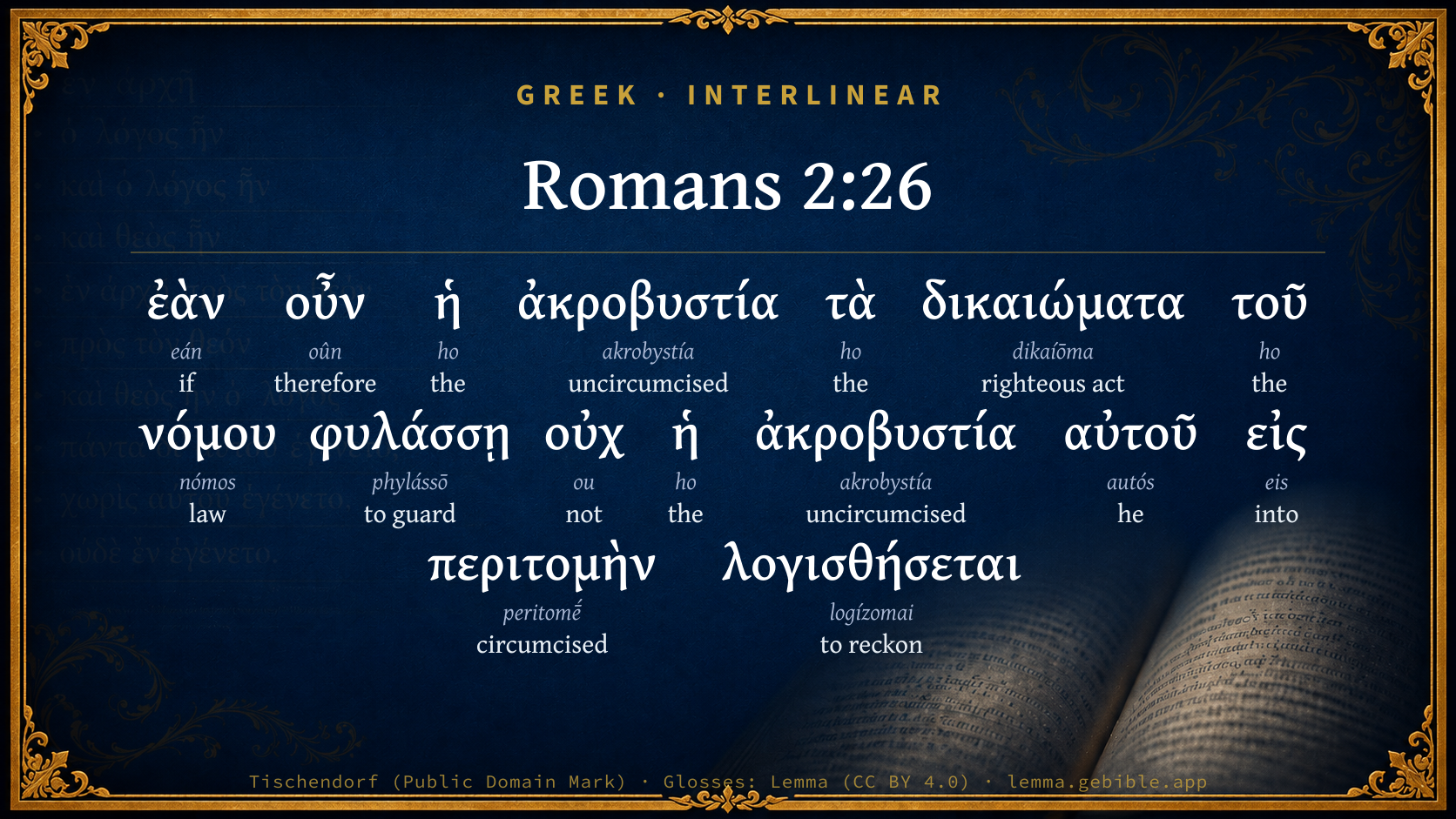
  1. ἐὰν eán G1437 “if” Conditional
  2. οὖν oûn G3767 “therefore” Conjunction
  3. ἡ ho G3588 “the” Article, Nominative, Singular, Feminine
  4. ἀκροβυστία akrobystía G203 “uncircumcised” Noun, Nominative, Singular, Feminine
  5. τὰ ho G3588 “the” Article, Accusative, Plural, Neuter
  6. τοῦ ho G3588 “the” Article, Genitive, Singular, Masculine
  7. νόμου nómos G3551 “law” Noun, Genitive, Singular, Masculine
  8. φυλάσσῃ phylássō G5442 “to guard” Verb, Present, Active, Subjunctive, 3rd person, Singular
  9. οὐχ ou G3756 “not” Particle, Negative
  10. ἡ ho G3588 “the” Article, Nominative, Singular, Feminine
  11. ἀκροβυστία akrobystía G203 “uncircumcised” Noun, Nominative, Singular, Feminine
  12. αὐτοῦ autós G846 “he” Personal pronoun, Genitive, Singular, Masculine
  13. εἰς eis G1519 “into” Preposition
  14. περιτομὴν peritomḗ G4061 “circumcised” Noun, Accusative, Singular, Feminine
  15. λογισθήσεται logízomai G3049 “to reckon” Verb, Future, Passive, Indicative, 3rd person, Singular

About this verse

These counts appear in no published source. They are computed here, from the morphology-tagged text and Lemma’s own curated glosses. What Lemma adds →

16
words
12
distinct lemmas
Pauline Epistles
section

Notable vocabulary

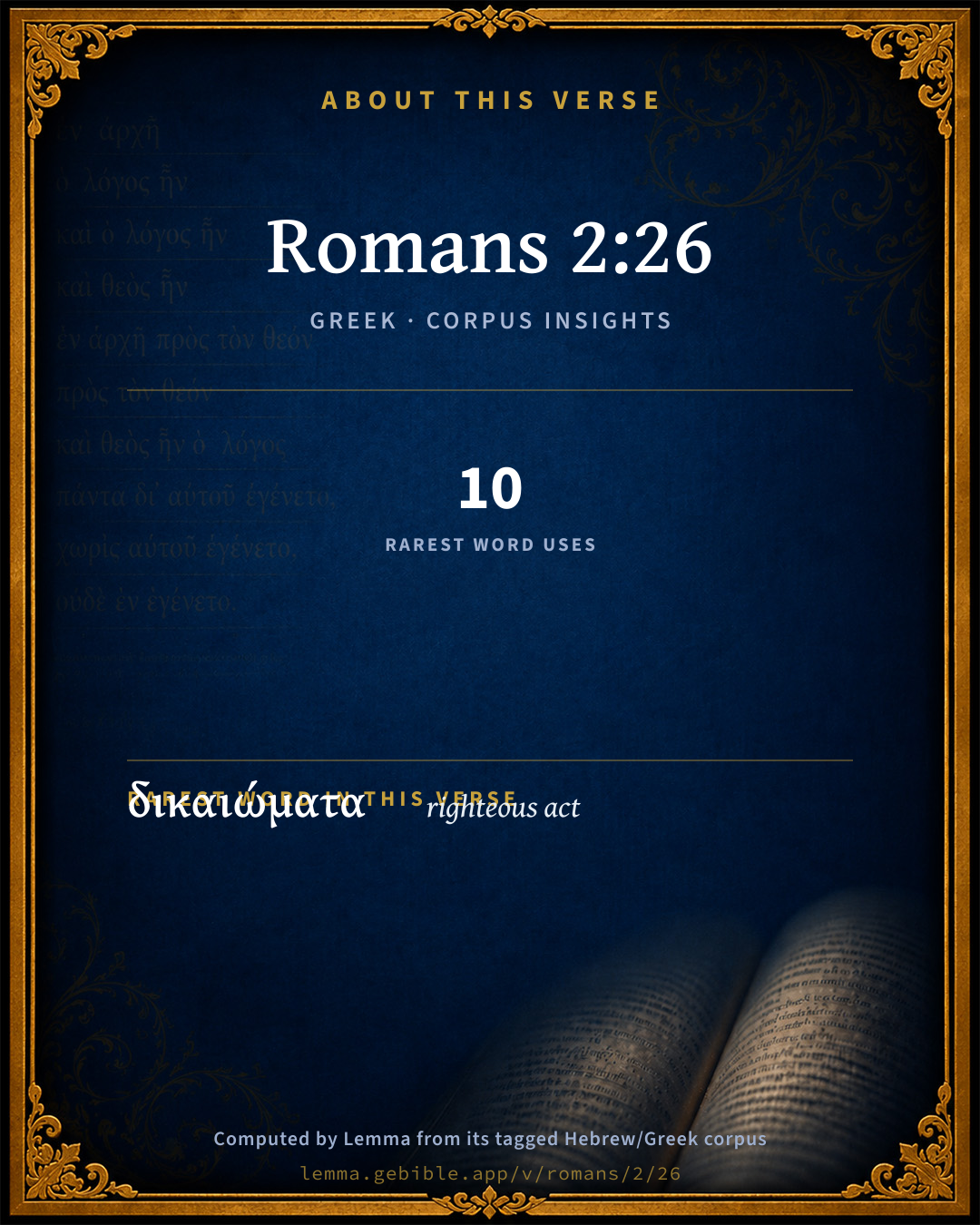
The rarest word here is δικαιώματα righteous act G1345 — appearing just 10 times in the whole Greek New Testament.

Shared distinctive vocabulary

δικαιώματα righteous act G1345 occurs in 10 verses of the Greek New Testament. Also found in:

Repetition

Words recur within this verse:

  • ἀκροβυστία uncircumcised G203 ×2
  • ἡ the G3588 ×4

Cross-references

12

Topical passages linked to Romans 2:26 in the Treasury of Scripture Knowledge — connected by theme and wording, ordered by reader-vote popularity; previews shown in the World English Bible.

  • Colossians 2:11 in whom you were also circumcised with a circumcision not made with hands, in the putting off of the body of the sins of the flesh, in the circumcision of Christ;
  • 1 Corinthians 7:18–19 Was anyone called having been circumcised? Let him not become uncircumcised. Has anyone been called in uncircumcision? Let him not be circumcised.
  • Romans 8:4 that the ordinance of the law might be fulfilled in us, who walk not after the flesh, but after the Spirit.
  • Isaiah 56:6–7 Also the foreigners who join themselves to Yahweh, to minister to him, and to love the name of Yahweh, to be his servants, everyone who keeps the Sabbath from profaning it, and holds fast my covenant;
  • Matthew 8:11–12 I tell you that many will come from the east and the west, and will sit down with Abraham, Isaac, and Jacob in the Kingdom of Heaven,
  • Matthew 15:28 Then Jesus answered her, "Woman, great is your faith! Be it done to you even as you desire." And her daughter was healed from that hour.
  • Acts 10:2–4 a devout man, and one who feared God with all his house, who gave gifts for the needy generously to the people, and always prayed to God.
  • Acts 10:34–35 Peter opened his mouth and said, "Truly I perceive that God doesn't show favoritism;
  • Acts 11:3–18 saying, "You went in to uncircumcised men, and ate with them!"
  • Romans 3:30 since indeed there is one God who will justify the circumcised by faith, and the uncircumcised through faith.
  • Ephesians 2:11 Therefore remember that once you, the Gentiles in the flesh, who are called "uncircumcision" by that which is called "circumcision," (in the flesh, made by hands);
  • Philippians 3:3 For we are the circumcision, who worship God in the Spirit, and rejoice in Christ Jesus, and have no confidence in the flesh;

Cross-references courtesy of OpenBible.info (CC BY 4.0).

Commentary

Notes on Romans 2:26 from classic Christian and Jewish commentators (each source and its license shown beneath its notes). The classic Christian expositions comment on the surrounding passage and are grouped to its opening verse, so a note may address several verses; the Jewish commentaries on the Tanakh (Rashi and others) are per-verse, so they appear only where the commentator wrote on this verse.

Lemma curates 59 commentaries, every one of them public domain or Creative Commons licensed, each selected and text-cleaned for this edition rather than reprinted as found. About our sources →

Tyndale Open Study Notes

Tyndale Open Resources

2:26 won’t God declare them to be his own people? Paul might be speaking of Gentile Christians who are God’s people because they obey God’s law, or he could be speaking hypothetically about what would happen if a Gentile perfectly obeyed God’s law.

Tyndale Open Study Notes — © Tyndale Open Resources, licensed CC BY-SA 4.0. Text via the HelloAO Bible API.

Bengel's Gnomon

Johann Albrecht Bengel

Rom 2:26. Ἡ ἀκροβυστία, uncircumcision) that is, a person uncircumcised, for to this the αὐτοῦ, his, is referred.—λογισθήσεται) The future; shall be counted, by a righteous judgment. In Rom 2:25, γέγονεν, the preterite, implies, is now made.

Bengel's Gnomon of the New Testament — English translation (T&T Clark, Edinburgh, 1860) — public domain. Text from a community e-Sword module.

Meyer's Critical & Exegetical Commentary

Heinrich August Wilhelm Meyer

Rom_2:26. Interrogative inference of the corresponding inverse relation, drawn from Rom_2:25.

ἡ ἀκροβυστία αὐτοῦ] referring to the concrete ἀκρόβυστος understood in the previous ἀκροβυστία. See Winer, p. 138 [E. T. 182].

τὰ δικαιώματα τ. νόμου φυλ.] The same as τὰ τοῦ νόμου ποιεῖν in Rom_2:14, as also the following τ. νόμον τελοῦσα of Rom_2:27.[708] A perfect, deep inner fulfilment of the law (Philippi), is a gratuitous suggestion, since there is no modal definition appended. Paul means the observance of the Mosaic legal precepts (respecting δικαιώματα comp on Rom_1:32 and Rom_5:16), which in point of fact takes place when the Gentile obeys the moral law of nature, Rom_2:14 f.

ΕἸς ΠΕΡΙΤ. ΛΟΓΙΣΘΉΣΕΤΑΙ] will be reckoned as circumcision (εἰς in the sense of the result; see Rom_9:8; Act_19:27; Isa_40:17; Wis_9:6; Theile, a[710] Jac. p. 138). The future is not that of the logical certainty (Mehring and older expositors), or of the result (Hofmann), which latter sense would be involved in a form of expression corresponding to the γέγονε; but the glance of the Apostle extends (see Rom_2:27) to the last judgment. To the uncircumcised person, who observes what the law has ordained, i.e. the moral precepts of the law, shall one day be awarded the same salvation that God has destined, subject to the obligation of fulfilment of the law, for those who through circumcision are members of His people. As to the thought comp Mat_8:11; Mat_3:9; 1Co_7:19; Gal_5:6. The reference to proselytes of the gate (Philippi) is not only arbitrary, but also incorrect, because the text has in view the pure contrast between circumcision and uncircumcision, without any hint of an intermediate stage or anything analogous thereto. The proposition is to be retained in its unlimited expression. The mediation, however, which has to intervene for the circumcised as well as for the uncircumcised, in order to the procuring of salvation through faith, is still left unnoticed here, and is reserved for the subsequent teaching of the Epistle. See especially ch. 4.

[708] τὸν νόμον τελεῖν means, as in Jam_2:8, to bring the law into execution. It is only distinguished from φύλασσειν and τηρεῖν νόμον by its representing the same thing on its practical side, so far as the law is accomplished by the action which the law demands. Comp. Plat. Legg. xi. p. 926 A, xii. p. 958 D; Xen. Cyr. viii. 1, 1; Soph. Aj. 528; Lucian. d. Morte Peregr. 33. On the whole, τελεῖν frequently answers to the idea patrare, facere. (Ellendt, Lex. Soph. II. p. 804.)

[710] d refers to the note of the commentator or editor named on the particular passage.

Meyer — Critical and Exegetical Commentary on the New Testament — English translation by Peter Christie, edited by Frederick Crombie (T&T Clark, 1880) — public domain. Text from a community e-Sword module.

Expositor's Greek Testament

ed. W. Robertson Nicoll

Rom 2:26 f. Here the inference is drawn from the principle laid down in Rom 2:25 . This being so, Paul argues, if the uncircumcision maintain the just requirements of the law, shall not his uncircumcision be accounted circumcision, sc. , because it has really done what circumcision pledged the Jew to do? Cf. Gal 5:3 . ἡ ἀκροβυστία at the beginning of the verse is equivalent to the Gentiles ( ἔθνη of Rom 2:14 ), the abstract being put for the concrete: in ἡ ἀκροβυστία αὐτοῦ , the αὐτοῦ individualises a person who is conceived as keeping the law, though not circumcised. As he has done what circumcision bound the Jew to do, he will be treated as if in the Jew’s position: his uncircumcision will be reckoned as circumcision. λογισθήσεται may be merely a logical future, but like the other futures in Rom 2:12-16 it is probably more correct to refer it to what will take place at the last judgment. The order of the words in Rom 2:27 indicates that the question is not continued: “and thus the uncircumcision shall judge thee,” etc. κρινεῖ is emphatic by position: the Jew, in the case supposed, is so far from being able to assert a superiority to the Gentile that the Gentile himself will be his condemnation. Cf. Mat 12:41 f. ἡ ἐκ φύσεως ἀκροβυστία should properly convey one idea “those who are by nature uncircumcised”. But why should nature be mentioned at all in this connection? It seems arbitrary to say with Hofmann that it is referred to in order to suggest that uncircumcision is what the Gentile is born in, and therefore involves no guilt. As far as that goes, Jew and Gentile are alike. Hence in spite of the grammatical irregularity, which in any case is not too great for a nervous writer like Paul, I prefer to connect ἐκ φύσεως , as Burnes does ( Moods and Tenses , § 427), with τελοῦσα , and to render: “the uncircumcision which by nature fulfils the law”: cf. Rom 2:14 . τὸν διὰ γράμματος καὶ περιτομῆς παραβάτην νόμου . The διὰ is that which describes the circumstances under which, or the accompaniment to which, anything is done. The Jew is a law-transgressor, in spite of the facts that he possesses a written revelation of God’s will, and bears the seal of the covenant, obliging him to the performance of the law, upon his body. He has an outward standard, which does not vary with his moral condition, like the law written in the pagan’s heart; he has an outward pledge that he belongs to the people of God, to encourage him when he is tempted to indolence or despair; in both these respects he has an immense advantage over the Gentile, yet both are neutralised by this he is a law-transgressor.

The Expositor's Greek Testament, edited by W. Robertson Nicoll (1897–1910) — public domain. Text from a community e-Sword module.

Godet's Commentaries

Frédéric Louis Godet

Vv. 26, 27 describe the opposite case: the transformation of the obedient Gentile into a Jew, according to the judgment of God. This transformation, being the logical consequence of the preceding, is connected by οὗν, then, with Rom 2:25.

The apostle is not now speaking, as in Rom 2:14-15, of a simple sporadic observance of legal duties. The phrase is more solemn: keeping the just ordinances of the law (δικαίωμα, all that the law declares righteous). In Rom 8:4, the apostle uses a similar expression to denote the observance of the law by the Christian filled with the Holy Spirit. How can he here ascribe such an obedience to a Gentile? Philippi thinks he has in view those many proselytes whom Judaism was making at this time among the Gentiles. Meyer and others seek to reduce the meaning of the phrase to that of Rom 2:14. This second explanation is impossible, as we have just seen; and that of Philippi falls to the ground before the preceding expressions of the apostle, which certainly contain more than can be expected of a proselyte (keep, fulfil the law, φυλάσσειν, τελεῖν τὸν νόμον, Rom 2:26-27). The comparison of Rom 8:4 shows the apostle’s meaning. He refers to those many Gentiles converted to the gospel who, all uncircumcised as they are, nevertheless fulfil the law in virtue of the spirit of Christ, and thus become the true Israel, the Israel of God, Gal 6:16. Paul expresses himself in abstract terms, because here he has to do only with the principle, and not with the means by which it is realized; compare what we have said on Rom 2:7; Rom 2:10. The future λογισθήσεται, will be counted, transports us to the hour of judgment, when God, in order to declare a man righteous, will demand that he be so in reality.

We might begin Rom 2:27 as an affirmative proposition: and so He will judge thee. But perhaps it is more in keeping with the lively tone of the piece to continue in Rom 2:27 the interrogation of Rom 2:26, as we have done in our translation: “And so (in virtue of this imputation) will not He judge thee”...? The thought is analogous to Luk 11:31-32, and Mat 12:41-42, though the case is different. For there it is Gentiles who condemn the Jews by the example of their repentance and their love of truth; here, it is the case of Christians of Gentile origin condemning the Jews by their fulfilment of the law.

Ostervald and Oltramare substitute for judge, used by the apostle, the term condemn. This is wrong; for the claim of the Jews is to escape, not only from condemnation, but from judgment; and it is bitter for them to hear, not only that they shall be judged like the Gentiles, but that they shall be judged by them.—Τὸν νόμον τελεῖν, to fulfil the law, is a phrase expressing real and persevering fulfilment. The love which the gospel puts into the believer’s heart is in fact the fulfilment of the law, Rom 13:10.

The preposition διά, strictly (across the length of): through, here denotes, as it often does, the state, the circumstances in which an act is accomplished; comp. 2Co 2:4; 1Ti 2:15; Heb 2:15. So: “in full possession of the letter and circumcision.”

This double transformation of the disobedient Jew into a Gentile, and of the obedient Gentile into a Jew, in the judgment of God, is explained and justified by Rom 2:28-29.

Frédéric Louis Godet — Commentaries on Luke, John, Romans, and 1 Corinthians — English translation (T&T Clark, Edinburgh, 1870s–1890s) — public domain. Text from a community e-Sword module.

Hodge's Commentary on Romans, Ephesians & First Corinthians

Charles Hodge

Rom_2:26

Therefore, if the uncircumcision keep the righteousness of the law. This verse is an inference (οὖν) from the preceding. It was there taught that everything depends upon obedience to the law. God will judge every man according to his works. If a Jew, though circumcised, break the law, he shall be condemned; and if a Gentile, though uncircumcised, keep the law, he shall be justified. The one proposition flows from the other; for if circumcision is in itself nothing, its presence cannot protect the guilty; its absence cannot invalidate the claims of the righteous. Δικαιώματα, decrees, percepts, what the law prescribes as right. The apostle does not mean to intimate that the Gentiles do in any case keep the righteousness of the law; contrary to his own explicit assertion, that there is none righteous, no not one. It is a mere hypothetical statement, designed to show that everything depends on obedience, and that circumcision cannot be the ground either of justification or condemnation. Shall not his uncircumcision be counted for circumcision? The phrase λογίζεσθαί τι εἴς τι often means to reckon or regard one thing as another (see 1Sa_1:13; Isa_29:17). Uncircumcision shall be taken for circumcision.

Charles Hodge — Commentary on Romans (1835), First Corinthians (1857), and Ephesians (1856) — public domain. Text from a community e-Sword module.

Geneva Bible (1599)

Geneva Bible translators

This is the figure Metonymy, for, if the uncircumcised.

The state and condition of the uncircumcised.

Geneva Bible (1599) marginal notes — public domain. Text via Bolls.life.

Jamieson, Fausset & Brown

Robert Jamieson, A. R. Fausset & David Brown

Therefore if the uncircumcision keep the . . . law, &c.--Two mistaken interpretations, we think, are given of these words: First, that the case here supposed is an impossible one, and put merely for illustration [HALDANE, CHALMERS, HODGE]; second that it is the case of the heathen who may and do please God when they act, as has been and is done, up to the light of nature [GROTIUS, OLSHAUSEN, &c.]. The first interpretation is, in our judgment, unnatural; the second, opposed to the apostle's own teaching. But the case here put is, we think, such as that of Cornelius (Acts 10:1-48), who, though outside the external pale of God's covenant, yet having come to the knowledge of the truths contained in it, do manifest the grace of the covenant without the seal of it, and exemplify the character and walk of Abraham's children, though not called by the name of Abraham. Thus, this is but another way of announcing that God was about to show the insufficiency of the mere badge of the Abrahamic covenant, by calling from among the Gentiles a seed of Abraham that had never received the seal of circumcision (see on Gal 5:6); and this interpretation is confirmed by all that follows.

Jamieson, Fausset & Brown — Commentary Critical and Explanatory on the Whole Bible (1871) — public domain (CC PDM 1.0). Text via the HelloAO Bible API.

Adam Clarke's Commentary

Verse 26. Therefore if the uncircumcision, &c.] If the Gentile be found to act according to the spirit and design of the law, his acting thus uprightly, according to the light which God has afforded him, will be reckoned to him as if he were circumcised and walked agreeably to the law.

Adam Clarke's Commentary on the Bible (1810–1826) — public domain. Text from a community e-Sword/MySword module.

John Calvin's Commentaries

26. If then the uncircumcision, etc. This is a very strong argument. Every thing is below its end and subordinate to it. Circumcision looks to the law, and must therefore be inferior to it: it is then a greater thing to keep the law than circumcision, which was for its sake instituted. It hence follows, that the uncircumcised, provided he keeps the law, far excels the Jew with his barren and unprofitable circumcision, if he be a transgressor of the law: and though he is by nature polluted, he shall yet be so sanctified by keeping the law, that uncircumcision shall be imputed to him for circumcision. The word uncircumcision, is to be taken in its proper sense in the second clause; but in the first, figuratively, for the Gentiles, the thing for the persons.

It must be added — that no one ought anxiously to inquire what observers of the law are those of which Paul speaks here, inasmuch no such can be found; for he simply intended to lay down a supposed case — that if any Gentile could be found who kept the law, his righteousness would be of more value without circumcision, than the circumcision of the Jew without righteousness. And hence I refer what follows, And what is by nature uncircumcision shall judge thee, etc., not to persons, but to the case that is supposed, according to what is said of the Queen of the south, that she shall come, etc., (Matthew 12:42,) and of the men of Nineveh, that they shall rise up in judgment, etc., (Luke 11:32) For the very words of Paul lead us to this view — “The Gentile,” he says, “being a keeper of the law, shall judge thee who art a transgressor, though he is uncircumcised, and thou hast the literal circumcision.”

John Calvin's Commentaries (1540-1563) — public domain. Text from the Calvin Translation Society English edition (1840s-50s) via the Christian Classics Ethereal Library (ccel.org). Calvin's coverage is partial (roughly two-thirds of the Bible); uncommented books and verses are honest gaps, never fabricated. The 19th-century editor's footnotes and remarks are omitted so the notes are faithfully Calvin's own voice.

The Cambridge Bible for Schools and Colleges

gen. ed. J. J. S. Perowne

26. Therefore, &c.] St Paul reasons from his last statement, as from what is self-evident to conscience.

the uncircumcision] i.e., probably, “the uncircumcised man;” for see below, “his uncircumcision.” The form of speech is most unusual; such a word as “uncircumcision,” when used personally, almost always referring to a class, not an individual. Perhaps even here it is so used, but then immediately (in the words “his circumcision”) an individual specimen is considered.

keep the righteousness, &c.] See above on Rom_2:25. Here again, practical piety, the will to do God’s revealed will, is in view; not sinless obedience. Cornelius (Act_10:35) is a case exactly in point. He was not sinless; he needed “saving” (a significant word there); but he “feared God, and worked righteousness,” and the Divine welcome was his.

the righteousness] Better, the ordinances; the special precepts, of whatever kind.

The Cambridge Bible for Schools and Colleges (gen. ed. J. J. S. Perowne; Cambridge University Press, 1878–1918) — public domain. Text from a community e-Sword module.

John Gill's Exposition

For he is not a Jew which is one outwardly,.... The apostle removes the plea in favour of the Jews, taken from their name and privilege, by distinguishing between a Jew and a Jew, and between circumcision and circumcision: "he is not a Jew which is one outwardly"; by mere name, nature, nation, religion, and profession:

neither is that circumcision which is outward in the flesh; which takes away the flesh of the foreskin, but not the carnality of the heart; leaves a mark upon the flesh, but no impression on the mind. This is nothing, is not the true, solid, substantial, spiritual circumcision, which only avails in the sight of God.

John Gill's Exposition of the Whole Bible (1746–1763) — public domain (CC PDM 1.0). Text via the HelloAO Bible API.

Trapp's Complete Commentary

John Trapp

26 Therefore if the uncircumcision keep the righteousness of the law, shall not his uncircumcision be counted for circumcision?

Ver. 26. If the uncircumcision] Which it can never do. But admit it could, &c.

John Trapp, A Commentary or Exposition upon All the Books of the Old and New Testament (1647–1656) — public domain. Text from a community e-Sword module.

Albert Barnes' Notes on the Bible

Therefore, if the uncircumcision - If those who are not circumcised, that is, the pagan.

Keep the righteousness of the law - Keep what the Law of Moses commands. It could not be supposed that a pagan would understand the requirements of the ceremonial law; but reference is had here to the moral law. The apostle does not expressly affirm that this was ever done; but he supposes the case, to show the true nature and value of the rites of the Jews.

Shall not his uncircumcision - Or, shall the fact that he is uncircumcised stand in the way of the acceptance of his services? Or, shall he not as certainly and as readily be accepted by God as if he were a Jew? Or in other words, the apostle teaches the doctrine that acceptance with God does not depend on a man’s external privileges, but on the state of the heart and life.

Be counted for circumcision - Shall he not be treated as if he were circumcised? Shall his being uncircumcised be any barrier in the way of his acceptance with God? The word rendered “be counted,” is what is commonly rendered “to reckon, to impute”; and its use here shows that the Scripture use of the word is not to transfer, or to charge with what is not deserved, or not true. It means simply that a man shall be treated as if it were so; that this lack of circumcision shall be no bar to acceptance. There is nothing set over to his account; nothing transferred; nothing reckoned different from what it is. God judges things as they are; and as the man, though uncircumcised, who keeps the Law, ought to be treated as if he had been circumcised, so he who believes in Christ agreeably to the divine promise, and trusts to his merits alone for salvation, ought to be treated as if he were himself righteous, God judges the thing as it is, and treats people as it is proper to treat them, as being pardoned and accepted through his Son.

Albert Barnes' Notes on the Bible (1834–1885) — public domain. Text from a community e-Sword/MySword module.

Haydock's Catholic Bible Commentary

Shall not his uncircumcision (Literally, his præputium [foreskin]) be reputed for circumcision? Nonne præputium illius in circumcisionem reputabitur? Greek: e peritome sou akrobustia gegonen. A translation may adhere to the letter too much; this seems literal enough. (Witham)

George Leo Haydock (1774–1849), Haydock's Catholic Family Bible and Commentary, 1859 edition — public domain. Excludes Psalms (Douay-Rheims chapter numbering differs from Protestant) and Deuterocanonical books (Catholic canon only).

Matthew Poole's English Annotations

The uncircumcision; i.e. the uncircumcised; a figurative and frequent way of speaking: see Rom 3:30; 4:9.

Keep the righteousness of the law; which none of them ever did; but admit they could, or else, which some of them have done, in sincerity, though with manifold imperfections; such as the two centurions, one of which is mentioned in the Gospel of Luke, the other in the Acts: if in this sense the uncircumcised keep the righteousness of the law, shall they not be all one in the account of God as if they were circumcised? See Rom 4:10.

Matthew Poole's English Annotations on the Holy Bible (1683–1685) — public domain. Text from a community e-Sword/MySword module.

Whedon's Commentary on the Bible

Daniel D. Whedon

26. Therefore—At this verse the apostle has succeeded in placing the pious Gentile on a level with the pious Jew. In the next verse he is made the superior of the defective Jew.

Daniel D. Whedon (gen. ed.), Commentary on the Old and New Testaments (1874–1909) — public domain. Text from a community e-Sword module.

John Wesley's Explanatory Notes

If the uncircumcision - That is, a person uncircumcised. Keep the law - Walk agreeably to it. Shall not his uncircumcision be counted for circumcision - In the sight of God?

John Wesley, Explanatory Notes Upon the Whole Bible (1754–1765) — public domain. Text via the GEBible commentary corpus.

Scofield Reference Notes

C. I. Scofield

righteousness

(See Scofield "Rom 10:3").

The Scofield Reference Bible (1917 edition), notes by C. I. Scofield — public domain. Text from a community e-Sword module.

Godbey's Commentary on the New Testament

William B. Godbey

26. “Therefore, if the uncircumcision may keep the commandments of the law, will not his uncircumcision be counted for circumcision?” “Man looks upon the outside, but God looketh on the heart,” and sees our intrinsical character and estimates us accordingly. He can not be deceived.

William B. Godbey, Commentary on the New Testament (1896–1900) — public domain. Text from a community e-Sword module.

McGarvey & Pendleton's Commentaries

J. W. McGarvey

If therefore the uncircumcision keep the ordinances of the law, shall not his uncircumcision be reckoned for circumcision? [In verse 25 the apostle takes up the case of the Jew; in verse 26 that of the Gentile. By circumcision the former entered into a covenant with God, and part of the terms of his covenant was an agreement to obey the law. Thus the law was superior to circumcision, so much so that it, as it were, disfranchised or expatriated an Israelite for disobedience, despite his circumcision. On the contrary, if an uncircumcised Gentile obeyed the law, then the law naturalized and received him into the spiritual theocracy, notwithstanding his lack of circumcision. The verses are not an argument, but a plain statement of the great truth that circumcision, though beneficial to the law-abiding, has no power to withstand the law when condemning the lawless. In short, the Jew and Gentile stood on equal footing, for, though the Jew had a better covenant (circumcision) and a better law, yet neither attained to salvation, for neither kept the law.]

J. W. McGarvey (with Philip Y. Pendleton), Commentaries on the New Testament (The Fourfold Gospel, 1914; Acts; and the epistles) — public domain. Text from a community e-Sword/MySword module.

The People's New Testament

B. W. Johnson

26. The converse of this is also true. If the Jewish law-breaker can annul his circumcision thus, then if the uncircumcision (the Gentiles) keep the righteousness of the law, his uncircumcised state will not be counted against him. He supposes the possible case of a Gentile who might render such an obedience to the moral precepts of the law as a pious Jews could render, and argues that his uncircumcision would not make his obedience less acceptable. Circumcision is not, then, the thing that the Gentile needs, but righteousness. The disobedient Jew virtually becomes a Gentile, and the obedient Gentile virtually becomes a Jew.

B. W. Johnson's The People's New Testament with Notes (1889–1891) — public domain. Electronic text from the Christian Classics Ethereal Library (CCEL) ThML edition.

Cambridge Greek Testament for Schools and Colleges

26 f. It follows that the formal positions of Jew and Gentile may be reversed.

ἡ ἀκροβυστία. Abstract for concrete = the Gentiles; to emphasise the absence of the formal condition.

τὰ δικαιώματα—the ordinances in detail as rules of life.

Cambridge Greek Testament for Schools and Colleges (Cambridge University Press, 1896; 21 vols, various authors incl. Carr, Maclear, Plummer, Farrar, Lumby, Moule, M. R. James, Simcox) — public domain. Text from a community e-Sword module.

Alford’s Greek Testament

Henry Alford

26. ἡ ἀκροβ.] i.e. οἱ ἐν τῇ ἀκροβυστίᾳ.

τὰ δικαίωμ.] plainly, the moral requirements, not the ceremonial: for one of the very first of the latter was, to be circumcised. The case is an impossible one: nor does the Apostle put it as possible, only as shewing manifestly, that circumcision, the sign of the covenant of the Law, was subordinate to the keeping of the Law itself. The articles shew how completely hypothetical the case is—no less than entire fulfilment of all the moral precepts of the law being contemplated.

οὐχὶ ἡ …] ‘In such a case would not he be counted as a circumcised person?’

Henry Alford, The Greek Testament (1849–1861) — public domain. Text from a community e-Sword module.

International Critical Commentary

26. εἰς περιτομὴν λογισθήσεται: λογίζεσθαι εἴς τι = λογίζεσθαι εἰς τὸ εἶναί τι, εἰς denoting result, ‘so as to be in place of,’ ‘reckoned as a substitute or equivalent for’ (Fri., Grm.-Thay. s. v. λογίζομαι 1 a).

Of the synonyms τηρεῖν, φυλάσσειν, τελεῖν; τηρεῖν = ‘to keep an eye upon,’ ‘to observe carefully’ (and then do); φυλάσσειν = ‘to guard as a deposit,’ ‘to preserve intact’ against violence from without or within; τελεῖν = ‘to bring (a law) to its proper fulfilment’ in action; τηρεῖν and φυλάσσειν are both from the point of view of the agent, τελεῖν from that of the law which is obeyed. See Westcott on Job 17:12; 1Jn 2:3.

International Critical Commentary — older volumes (1896–1929), various authors — public domain. Text from a community e-Sword module.

Lesson kit

Teaching starters — assembled from the data on this page, not authored interpretation. Every prompt links to the verse data it draws on. Edit before teaching.

Romans, in the Pauline Epistles, opens this verse with 16 words (12 distinct Greek lemmas). Its most distinctive word is dikaíōma (“righteous act”). A historical commentator’s framing appears above. Read the whole chapter for the surrounding context.

Discussion questions

  1. The word dikaíōma carries the sense “righteous act.” How does it shape the verse?
  2. Luke 1:6 shares the word «righteous act» with this verse. How do the two illuminate each other?
  3. “uncircumcised” occurs 2× in this one verse. What is the effect of the repetition?
  4. The translations on this page render this verse differently — a whole-verse word diff, not a word-by-word alignment. What might account for the different wordings?
  5. Reading how Tyndale Open Study Notes and Bengel's Gnomon read this verse, where do the two commentators agree and where do they part?

Things to notice

  • These translations choose different wording for 13 words in this verse.
  • “uncircumcised” occurs 2× in this single verse.
  • 12 distinct Greek lemmas span 16 words in this verse.

Reading settings

Reading text

Shown beneath each verse's original-language words.

Old Testament
Old Testament edition

Read the OT as the Masoretic Hebrew (MT) or the Greek Septuagint (LXX).

English shown for the Greek Septuagint (in the Hebrew ↔ Greek comparison).

Comparing translations? Open the Compare panel on any verse page to stack up to four side by side.