Acts 19:3

Greek (Tischendorf 8th ed.) Acts 19:3 appears in the Greek New Testament. The text above is from the Tischendorf 8th edition. Each word links to its Strong’s number and a concise gloss. Click any word for its full Thayer’s Greek Lexicon entry.
Download image
Cite this verse

Acts 19:3 (World English Bible). Public Domain. Lemma interlinear Bible study tool, https://lemma.gebible.app/v/acts/19/3.

Show BibTeX & RIS
BibTeX
RIS
English Translation
He said, "Into what then were you baptized?" They said, "Into John's baptism."
World English Bible · Public Domain
Download a study sheet

One document with this verse’s original text, its word-by-word gloss line, the meaning frame, cross-references with their text, attributed commentary, and full source and license credits — printable, and it pastes into notes with its structure intact.

This verse Autodidact and up

Study sheet (.html) Plain text (.txt)

A passage Seminary Student

Up to 50 verses in one chapter. A passage sheet keeps up to 6 commentary sources and 12 cross-references per verse, in the order this page ranks them, and says so on the sheet whenever that leaves anything out. Ask for a single verse and you get the Autodidact verse sheet above.

Everything on this page stays free to read, with no account — the sheet is a download of what is already on screen, not access to it.

Want to remove ads? Support Godless Engineer
Compare translations 3

The same verse in 3 English versions, stacked beneath the original-language interlinear above. Click any original word for its lexicon entry.

Each is an independent rendering of the whole verse — the interlinear is not word-aligned to these translations.

Highlighted words mark where these versions differ — a whole-verse word diff, not a word-by-word alignment.

  • World English Bible Public Domain
    He said, "Into what then were you baptized?" They said, "Into John's baptism."
  • King James Version Public Domain
    And he said unto them, Unto what then were ye baptized? And they said, Unto John's baptism.
  • unfoldingWord Literal Text CC BY-SA 4.0
    And he said, “Into what then were you baptized?” And they said, “Into the baptism of John.”

unfoldingWord Literal Text — © unfoldingWord, licensed CC BY-SA 4.0. Word-aligned USFM3 via Door43 (git.door43.org/unfoldingWord/en_ult).

Versions to compare (up to 4)

3 of 4 selected

Show all 19 translations

Every available English version of this verse, each an independent rendering of the whole verse.

  • World English Bible Public Domain
    He said, "Into what then were you baptized?" They said, "Into John's baptism."
  • Berean Standard Bible Public Domain
    “Into what, then, were you baptized?” Paul asked. “The baptism of John,” they replied.
  • Majority Standard Bible Public Domain
    “Into what, then, were you baptized?” Paul asked. “The baptism of John,” they replied.
  • King James Version Public Domain
    And he said unto them, Unto what then were ye baptized? And they said, Unto John's baptism.
  • American Standard Version (1901) Public Domain
    And he said, Into what then were ye baptized? And they said, Into John's baptism.
  • Revised Version (1885) Public Domain
    And he said, Into what then were ye baptized? And they said, Into John’s baptism.
  • Geneva Bible (1599) Public Domain
    And he said vnto them, Vnto what were ye then baptized? And they saide, Vnto Iohns baptisme.
  • Douay-Rheims (1899) Public Domain
    And he said: In what then were you baptized? Who said: In John's baptism.
  • Young's Literal Translation Public Domain
    and he said unto them, `To what, then, were ye baptized?' and they said, `To John's baptism.'
  • Literal Standard Version CC BY-SA 4.0
    and he said to them, “Into what, then, were you immersed?” And they said, “Into John’s immersion.”
  • Unlocked Literal Bible CC BY-SA 4.0
    Paul said, “Into what then were you baptized?” They said, “Into John's baptism.”
  • unfoldingWord Literal Text CC BY-SA 4.0
    And he said, “Into what then were you baptized?” And they said, “Into the baptism of John.”
  • Darby Bible Public Domain
    And he said, To what then were ye baptised? And they said, To the baptism of John.
  • World Messianic Bible Public Domain
    He said, “Into what then were you immersed?” They said, “Into Yochanan’s immersion.”
  • Webster's Bible Public Domain
    And he said to them, Into what then were ye baptized? And they said, Into John's baptism.
  • Free Bible Version CC BY-SA 4.0
    “So what baptism did you receive?” he asked. “John's baptism,” they replied.
  • Bible in Basic English Public Domain
    And he said, What sort of baptism did you have? And they said, The baptism of John.
  • Text-Critical English NT CC BY 4.0
    So Paul said to them, “Into what then were you baptized?” They said, “Into John's baptism.”
  • Tyndale New Testament (1534) Public Domain
    And he sayd vnto them: wher with were ye then baptised? And they sayd: with Iohns baptism

Literal Standard Version (2020), Covenant Press — licensed CC BY-SA 4.0. Text via the HelloAO Bible API (eBible.org). Unlocked Literal Bible (unfoldingWord) — licensed CC BY-SA 4.0. Text via the HelloAO Bible API (eBible.org). unfoldingWord Literal Text — © unfoldingWord, licensed CC BY-SA 4.0. Word-aligned USFM3 via Door43 (git.door43.org/unfoldingWord/en_ult). Free Bible Version, Dr. Jonathan Gallagher — licensed CC BY-SA 4.0. Text via the HelloAO Bible API (eBible.org).

Word by word

More ways to search: Search by grammar → Find every occurrence → Compare this word →

Practice this passage: Drill this verse → Learn its vocabulary →

βάπτισμα
báptisma
G908
“immersion”
Noun, Accusative, Singular, Neuter
Part of Speech
Noun
Case
Accusative
Number
Singular
Gender
Neuter
Full Thayer's Definition

Origin: from G907

TDNT: 10:05,9

1. immersion, submersion a. of calamities and afflictions with which one is quite overwhelmed b. of John's baptism, that purification rite by which men on confessing their sins were bound to spiritual reformation, obtained the pardon of their past sins and became qualified for the benefits of the Messiah's kingdom soon to be set up. This was valid Christian baptism, as this was the only baptism the apostles received and it is not recorded anywhere that they were ever rebaptised after Pentecost. c. of Christian baptism; a rite of immersion in water as commanded by Christ, by which one after confessing his sins and professing his faith in Christ, having been born again by the Holy Spirit unto a new life, identifies publicly with the fellowship of Christ and the church. In Rom. 6:3 Paul states we are "baptised unto death" meaning that weare not only dead to our former ways, but they are buried. To returnto them is as unthinkable for a Christian as for one to dig up a deadcorpse! In Moslem countries a new believer has little trouble withMoslems until he is publicly baptised. It is then, that the Moslems'know he means business, and then the persecution starts. See alsodiscussion of baptism under No. 907.
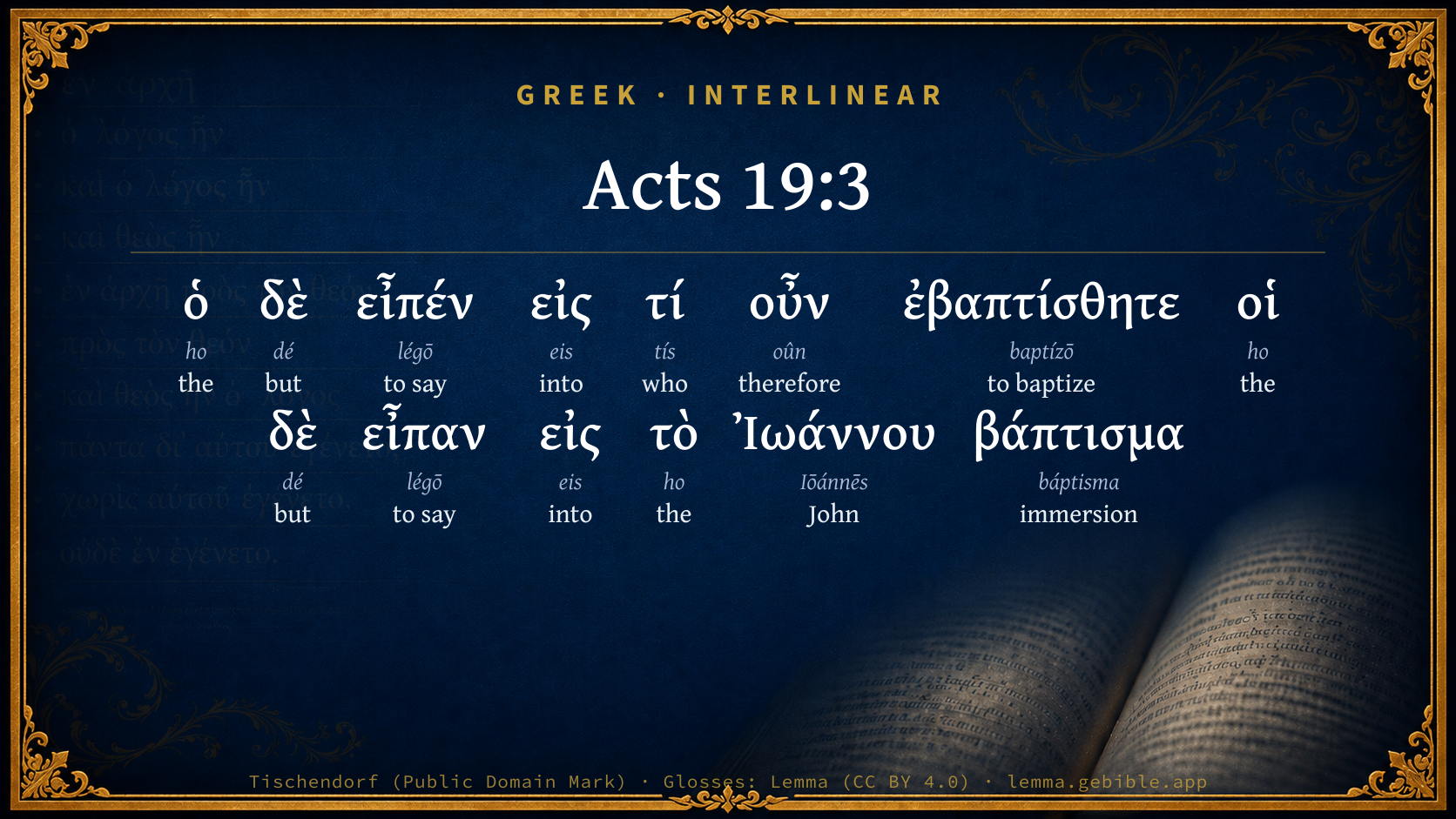
  1. ὁ ho G3588 “the” Article, Nominative, Singular, Masculine
  2. δὲ dé G1161 “but” Conjunction
  3. εἶπέν légō G3004 “to say” Verb, Aorist, Active, Indicative, 3rd person, Singular
  4. εἰς eis G1519 “into” Preposition
  5. τί tís G5101 “who” Interrogative pronoun, Accusative, Singular, Neuter
  6. οὖν oûn G3767 “therefore” Conjunction
  7. ἐβαπτίσθητε baptízō G907 “to baptize” Verb, Aorist, Passive, Indicative, 2nd person, Plural
  8. οἱ ho G3588 “the” Article, Nominative, Plural, Masculine
  9. δὲ dé G1161 “but” Conjunction
  10. εἶπαν légō G3004 “to say” Verb, Aorist, Active, Indicative, 3rd person, Plural
  11. εἰς eis G1519 “into” Preposition
  12. τὸ ho G3588 “the” Article, Accusative, Singular, Neuter
  13. Ἰωάννου Iōánnēs G2491 “John” Noun, Genitive, Singular, Masculine

About this verse

These counts appear in no published source. They are computed here, from the morphology-tagged text and Lemma’s own curated glosses. What Lemma adds →

14
words
9
distinct lemmas
Acts
section

Notable vocabulary

The rarest word here is βάπτισμα immersion G908 — appearing just 20 times in the whole Greek New Testament.

Shared distinctive vocabulary

βάπτισμα immersion G908 occurs in 20 verses of the Greek New Testament. Also found in:

Repetition

Words recur within this verse:

Cross-references

6

Topical passages linked to Acts 19:3 in the Treasury of Scripture Knowledge — connected by theme and wording, ordered by reader-vote popularity; previews shown in the World English Bible.

  • Acts 18:25 This man had been instructed in the way of the Lord; and being fervent in spirit, he spoke and taught accurately the things concerning Jesus, although he knew only the baptism of John.
  • Matthew 3:1–17 In those days, John the Baptizer came, preaching in the wilderness of Judea, saying,
  • Matthew 28:19 Therefore go, and make disciples of all nations, baptizing them in the name of the Father and of the Son and of the Holy Spirit,
  • Luke 3:1–38 Now in the fifteenth year of the reign of Tiberius Caesar, Pontius Pilate being governor of Judea, and Herod being tetrarch of Galilee, and his brother Philip tetrarch of the region of Ituraea and Trachonitis, and Lysanias tetrarch of Abilene,
  • Acts 8:16 for as yet he had fallen on none of them. They had only been baptized in the name of Christ Jesus.
  • 1 Corinthians 12:13 For in one Spirit we were all baptized into one body, whether Jews or Greeks, whether bond or free; and were all given to drink into one Spirit.

Cross-references courtesy of OpenBible.info (CC BY 4.0).

Commentary

Notes on Acts 19:3 from classic Christian and Jewish commentators (each source and its license shown beneath its notes). The classic Christian expositions comment on the surrounding passage and are grouped to its opening verse, so a note may address several verses; the Jewish commentaries on the Tanakh (Rashi and others) are per-verse, so they appear only where the commentator wrote on this verse.

Lemma curates 59 commentaries, every one of them public domain or Creative Commons licensed, each selected and text-cleaned for this edition rather than reprinted as found. About our sources →

Bengel's Gnomon

Johann Albrecht Bengel

Act 19:3. Οὖν, then, therefore) This question contains the idea of astonishment: from which it follows as a consequence, that all who were expressly baptized in the name of Jesus, received the Holy Spirit at that time. Nor does Paul inquire whether they were baptized, but εἰς τί, into what: for all were baptized.—Ἰωάννου, of John) We have received (taken up) the baptism of John, say they, so as to give ourselves up to his teaching. Therefore the baptism of John was most widely propagated, as well as his teaching; but, as often happens, in the case of those more remote and later in point of time, the ordinance was administered less purely or less fully.

Bengel's Gnomon of the New Testament — English translation (T&T Clark, Edinburgh, 1860) — public domain. Text from a community e-Sword module.

Meyer's Critical & Exegetical Commentary

Heinrich August Wilhelm Meyer

Act_19:3. Εἰς τί] reference of the baptism (Mat_3:11; Mat_28:19; Rom_6:3; 1Co_1:13; 1Co_10:2; 1Co_12:13; Gal_3:27): unto what, then, as the object of faith and confession, to which you were referred, were ye baptized?

οὖν] accordingly, since the matter so stands, since ye have not even heard of the existence of the Holy Spirit. The presupposition in this εἰς τί οὖν is, that they, baptized in the name of Christ, could not but have received the Holy Spirit.

εἰς τὸ Ἰωανν. βάπτ.] in reference to the baptism administered by John, so that thus the baptism performed in our case was to be the baptism of John, in relation to which we were baptized.

Meyer — Critical and Exegetical Commentary on the New Testament — English translation by Peter Christie, edited by Frederick Crombie (T&T Clark, 1880) — public domain. Text from a community e-Sword module.

Expositor's Greek Testament

ed. W. Robertson Nicoll

Act 19:3 . οὖν : presupposes that if they had been baptised into the name of Jesus, they would have received the Spirit at Baptism. εἰς : “to baptise into” (R.V.) may have been suggested by the original practice to baptise by dipping or plunging, see Humphry, Comment. on R. V., in loco . εἰς τὸ Ἰ . βάπτισμα , i.e. , into or unto repentance. For the strange notion that they were baptised into John as the Messiah see Hackett’s note.

The Expositor's Greek Testament, edited by W. Robertson Nicoll (1897–1910) — public domain. Text from a community e-Sword module.

Geneva Bible (1599)

Geneva Bible translators

To be baptized into John’s baptism, is to profess the doctrine which John preached and sealed with his baptism.

John did only begin to instruct the disciples whom Christ should make perfect.

In what doctrine then are you taught and instructed?

Geneva Bible (1599) marginal notes — public domain. Text via Bolls.life.

Ellicott's Commentary for English Readers

(3) Unto what then were ye baptized?—The answer of the disciples had shown (1) an imperfect instruction, falling short of that which catechumens ordinarily received before they were admitted to the new birth by water and the Spirit; (2) an imperfect spiritual experience. Could those who made it have been admitted into the Church of Christ by baptism in His name? The answer to that question showed their precise position. They were practically disciples of the Baptist, believing in Jesus as the Christ, and thinking that this constituted a sufficient qualification for communion with the Church of Christ.

A Bible Commentary for English Readers, edited by Charles John Ellicott (1878–1897) — public domain. Text from a community e-Sword module.

The Cambridge Bible for Schools and Colleges

gen. ed. J. J. S. Perowne

3. And he said] The oldest authorities omit “unto them,” and it is more natural to do so in the account of these brief questions and answers.

Into what then were ye baptized?] The New Testament phrase is “baptized in” or “into,” to express the close union with God into which men are brought by baptism.

And they said, Into John’s baptism] They may have been disciples of Apollos and have been baptized by him before his more full instruction by Aquila and Priscilla.

The Cambridge Bible for Schools and Colleges (gen. ed. J. J. S. Perowne; Cambridge University Press, 1878–1918) — public domain. Text from a community e-Sword module.

John Gill's Exposition

And he said unto them, unto what then were ye baptized?.... The apostle takes it for granted that they were baptized, since they were not only believers, but disciples; such as not only believed with the heart, but had made a profession of their faith, and were followers of Christ; but asks unto what they were baptized; either in whose name they were baptized, since Christian baptism was administered in the name of the Spirit, as well as in the name of the Father and of the Son; or what attended or followed their baptism, seeing sometimes the Holy Ghost fell upon persons, either before baptism, or at it, or after it:

and they said, unto John's baptism; some think they had never been baptized at all with water baptism, only had received the doctrine preached by John, concerning repentance and remission of sins, and so were baptized unto him, professing the same doctrine he did, just as the Israelites were baptized into Moses; others think they were baptized, but very wrongly, being baptized in the name of John, and not in the name of Jesus Christ; and so, as it was not Christian baptism they had submitted to, it was right to baptize them again: but neither of these are probable, for it is not likely that they should receive John's doctrine, and not his baptism; that they should be his disciples and followers, and not attend to the more distinguishing branch of his ministry; and it is still more unlikely that they should be baptized in his name, who preached Jesus Christ to his followers, and pointed out to them the Lamb of God, and declared him to be greater than he; it seems rather that they were baptized, and that they were baptized in the name of Christ, as John's disciples were, as the apostle affirms in the following words.

John Gill's Exposition of the Whole Bible (1746–1763) — public domain (CC PDM 1.0). Text via the HelloAO Bible API.

Trapp's Complete Commentary

John Trapp

3 And he said unto them, Unto what then were ye baptized? And they said, Unto John’s baptism.

Ver. 3. Unto John’s baptism] That is, unto John’s doctrine sealed by baptism. This Paul shows to be nothing so, Act 19:4. Whence Piscator collecteth that they were baptized by some of John’s disciples into John’s name, as if he had been the Christ. For that John had some such zealots about him, appears by Joh 3:26, &c.

John Trapp, A Commentary or Exposition upon All the Books of the Old and New Testament (1647–1656) — public domain. Text from a community e-Sword module.

Albert Barnes' Notes on the Bible

Unto what - Unto what faith or doctrine. What did you profess to believe when you were baptized?

Unto John’s baptism - See the notes on Act 18:25.

Albert Barnes' Notes on the Bible (1834–1885) — public domain. Text from a community e-Sword/MySword module.

Matthew Poole's English Annotations

Unto what then were ye baptized? What doctrine did you make profession of? And what religion did you seal unto at your baptism?

Unto John’s baptism; the doctrine that John taught, and the religion that he professed and preached. Thus the Jews are said to be

baptized unto Moses, 1Co 10:2, being engaged to believe the doctrine and observe the law delivered by Moses. Now the Baptist, as Act 18:25, preached indeed Christ; but many things concerning him he could not preach, unless as of things to come; as his death, and resurrection: the Baptist being beheaded before our Saviour’s death, and the Holy Ghost was not poured out in that extraordinary manner until after our Saviour’s resurrection and ascension; which pouring out of the Spirit, these disciples at Ephesus, having been baptized by John in Judea, and afterwards returning home, might not have heard of.

Matthew Poole's English Annotations on the Holy Bible (1683–1685) — public domain. Text from a community e-Sword/MySword module.

The Pulpit Commentary

He said for he said unto them, A.V. and T.R.; into for unto (twice), A.V. Into what then were ye baptized? Nothing can mark more strongly the connection between baptism and the reception of the Holy Spirit than this question does. For it implies, "How could you be ignorant of the giving of the Holy Ghost if you were duly baptized?" (comp. Act_2:38) The answer explains it, "We were baptized with John"s baptism, to which no promise of the gift of the Holy Ghost was attached."

The Pulpit Commentary (1880–1919), ed. H.D.M. Spence-Jones & Joseph S. Exell — public domain. Text from a community e-Sword module.

John Wesley's Explanatory Notes

Into what were ye baptized - Into what dispensation? To the sealing of what doctrine? Into John's baptism - We were baptized by John and believe what he taught.

John Wesley, Explanatory Notes Upon the Whole Bible (1754–1765) — public domain. Text via the GEBible commentary corpus.

Godbey's Commentary on the New Testament

William B. Godbey

3. “And he said, Unto what then were you baptized? And they said, Unto the baptism of John.” This is a confirmation that Apollos was one of those mighty men, ushered forth by the ministry of John the Baptist and still preaching in his dispensation. Was not this a pity? Apollos was a few years behind the age when he came to Ephesus. But what about the unsanctified preachers in all of the popular churches at the present day, who are not, like Apollos, a dozen years behind the age, but three thousand years behind, as they are preaching in the dispensation of Moses? So we can withhold our criticisms from Apollos.

William B. Godbey, Commentary on the New Testament (1896–1900) — public domain. Text from a community e-Sword module.

McGarvey & Pendleton's Commentaries

J. W. McGarvey

See notes on verse 1

J. W. McGarvey (with Philip Y. Pendleton), Commentaries on the New Testament (The Fourfold Gospel, 1914; Acts; and the epistles) — public domain. Text from a community e-Sword/MySword module.

The People's New Testament

B. W. Johnson

3. Unto what then were ye baptized? This question implies that the possession of the Holy Spirit is closely connected with a right baptism (compare 2:38). The only case in which the Spirit was received before baptism was that of Cornelius. For the reasons of this exception to the rule, see notes on 10:44–47. The fact that these disciples “know nothing of the Holy Spirit being given,” showed that there was something wrong about their baptism. Unto John's baptism. While John's baptism differed from that commanded in Christ's commission, the apostles, the one hundred and twenty, and the “five hundred brethren” (1 Cor. 15:6), as far as we know, received no other. We are to infer, therefore, that it was valid until Christ's baptism took its place. Why, then, were these disciples re-baptized? The only explanation is that their baptism took place after John's baptism had been superseded by that of Christ, or after the Savior had been crucified.

B. W. Johnson's The People's New Testament with Notes (1889–1891) — public domain. Electronic text from the Christian Classics Ethereal Library (CCEL) ThML edition.

unfoldingWord translationNotes

Door43 World Missions Community

General Information:

Here the words "They," "you," and "they" refer to certain disciples in the city of Ephesus. (See: Acts 19:1)

General Information:

The word "him" refers to John.

Into what then were you baptized?

This can be stated in active form. AT: "What kind of baptism did you receive?" (See: Active or Passive)

Into John's baptism

You can translate this as a complete sentence. AT: "We received the kind of baptism about which John taught" (See: Ellipsis)

the baptism of repentance

You can translate the abstract noun "repentance" as the verb "repent." AT: "the baptism that people requested when they wanted to repent" (See: Abstract Nouns)

the one who would come

Here "the one" refers to Jesus.

come after him

This means to come after John the Baptist in time and not following after him physically.

translationWords

Paul

baptize

John (the Baptist)

repent

believe

Jesus

unfoldingWord translationNotes — © Distant Shores Media and the Door43 World Missions Community, licensed CC BY-SA 4.0. Source: git.door43.org/Door43/en_tn.

Cambridge Greek Testament for Schools and Colleges

3. πρὸς αὐτούς omitted with אAE. Not represented in Vulg.

3. εἰς τί οὖν ἐβαπτίσθητε; into what then were ye baptized? The phrase, derived from the language of Christ (Mat 28:19), was βαπτίζειν εἰς τὸ ὄνομα. Hence the form of this question and of the answer, εἰς τὸ Ἰωάννου βάπτσμα, which means ‘We were baptized into that into which John baptized.’ These men may have been disciples of Apollos, and been baptized by him before his fuller instruction by Priscilla and Aquila.

Cambridge Greek Testament for Schools and Colleges (Cambridge University Press, 1896; 21 vols, various authors incl. Carr, Maclear, Plummer, Farrar, Lumby, Moule, M. R. James, Simcox) — public domain. Text from a community e-Sword module.

Alford’s Greek Testament

Henry Alford

3.] Paul’s question establishes the above rendering, to what then (οὖν, if ye did not so much as hear of the Holy Ghost at your first believing) were ye baptized? If the question and answer in ver. 2 regarded, as in E. V., the whole interval since their conversion, this enquiry would have been more naturally expressed in the perfect. See Gal 3:27, where there is the same necessity of preserving the historical sense of the aorists.

εἰς τί] unto (with a view to, as introductory to) what profession? They answer, unto (that indicated by) the baptism of John, viz.: repentance, and the believing on Jesus, then to come, but now (see ch. 18:25, note) the object of our faith.

Henry Alford, The Greek Testament (1849–1861) — public domain. Text from a community e-Sword module.

Vincent's Word Studies in the New Testament

Marvin R. Vincent

Unto what [εις τι] . Rev., more correctly, into. See on Mt 28:19. John. The last mention of John the Baptist in the New Testament. "Here, at last, he wholly gives place to Christ" (Bengel).

Marvin R. Vincent, Word Studies in the New Testament (1887–1900) — public domain. Text from a community e-Sword/MySword module.

Lesson kit

Teaching starters — assembled from the data on this page, not authored interpretation. Every prompt links to the verse data it draws on. Edit before teaching.

Acts, in the Acts, opens this verse with 14 words (9 distinct Greek lemmas). Its most distinctive word is báptisma (“immersion”). A historical commentator’s framing appears above. Read the whole chapter for the surrounding context.

Discussion questions

  1. What does “immersion” (báptisma) contribute to the verse as a whole?
  2. Matthew 3:7 shares the word «immersion» with this verse. How do the two illuminate each other?
  3. “to say” occurs 2× in this one verse. What is the effect of the repetition?
  4. These translations render this verse differently; the difference is in the English rendering, not the original. What questions does that raise?
  5. Reading how Bengel's Gnomon and Meyer's Critical & Exegetical Commentary read this verse, where do the two commentators agree and where do they part?

Things to notice

  • These translations choose different wording for 4 words in this verse.
  • “to say” occurs 2× in this single verse.
  • 9 distinct Greek lemmas span 14 words in this verse.

Reading settings

Reading text

Shown beneath each verse's original-language words.

Old Testament
Old Testament edition

Read the OT as the Masoretic Hebrew (MT) or the Greek Septuagint (LXX).

English shown for the Greek Septuagint (in the Hebrew ↔ Greek comparison).

Comparing translations? Open the Compare panel on any verse page to stack up to four side by side.