
Acts 20:16

Greek (Tischendorf 8th ed.) Acts 20:16 appears in the Greek New Testament. The text above is from the Tischendorf 8th edition. Each word links to its Strong’s number and a concise gloss. Click any word for its full Thayer’s Greek Lexicon entry.

Download image
Cite this verse

Acts 20:16 (World English Bible). Public Domain. Lemma interlinear Bible study tool, https://lemma.gebible.app/v/acts/20/16.

Show BibTeX & RIS
BibTeX
RIS
English Translation
For Paul had determined to sail past Ephesus, that he might not have to spend time in Asia; for he was hastening, if it were possible for him, to be in Jerusalem on the day of Pentecost.
World English Bible · Public Domain
Highlights
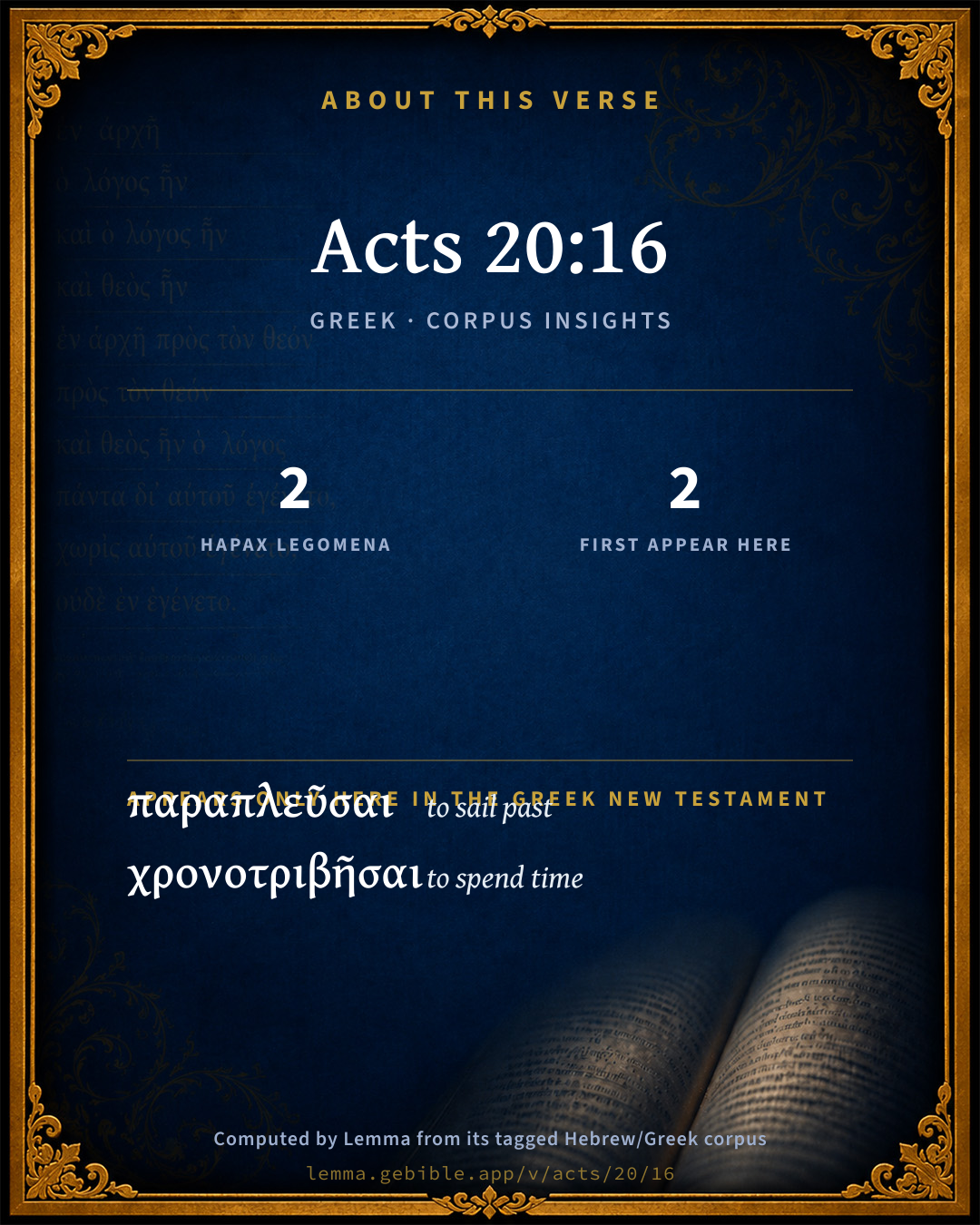
  • 2 hapax legomena — only here in the Greek New Testament
  • 2 first appearances in the Greek New Testament
Full analysis ↓
Download a study sheet

One document with this verse’s original text, its word-by-word gloss line, the meaning frame, cross-references with their text, attributed commentary, and full source and license credits — printable, and it pastes into notes with its structure intact.

This verse Autodidact and up

Study sheet (.html) Plain text (.txt)

A passage Seminary Student

Up to 50 verses in one chapter. A passage sheet keeps up to 6 commentary sources and 12 cross-references per verse, in the order this page ranks them, and says so on the sheet whenever that leaves anything out. Ask for a single verse and you get the Autodidact verse sheet above.

Everything on this page stays free to read, with no account — the sheet is a download of what is already on screen, not access to it.

Want to remove ads? Support Godless Engineer
Compare translations 3

The same verse in 3 English versions, stacked beneath the original-language interlinear above. Click any original word for its lexicon entry.

Each is an independent rendering of the whole verse — the interlinear is not word-aligned to these translations.

Highlighted words mark where these versions differ — a whole-verse word diff, not a word-by-word alignment.

  • World English Bible Public Domain
    For Paul had determined to sail past Ephesus, that he might not have to spend time in Asia; for he was hastening, if it were possible for him, to be in Jerusalem on the day of Pentecost.
  • King James Version Public Domain
    For Paul had determined to sail by Ephesus, because he would not spend the time in Asia: for he hasted, if it were possible for him, to be at Jerusalem the day of Pentecost.
  • unfoldingWord Literal Text CC BY-SA 4.0
    For Paul had decided to sail past Ephesus, so that it would not happen to him to lose time in Asia, for he was hurrying, if it might be possible for him, to be in Jerusalem for the day of Pentecost.

unfoldingWord Literal Text — © unfoldingWord, licensed CC BY-SA 4.0. Word-aligned USFM3 via Door43 (git.door43.org/unfoldingWord/en_ult).

Versions to compare (up to 4)

3 of 4 selected

Show all 19 translations

Every available English version of this verse, each an independent rendering of the whole verse.

  • World English Bible Public Domain
    For Paul had determined to sail past Ephesus, that he might not have to spend time in Asia; for he was hastening, if it were possible for him, to be in Jerusalem on the day of Pentecost.
  • Berean Standard Bible Public Domain
    Paul had decided to sail past Ephesus to avoid spending time in the province of Asia, because he was in a hurry to reach Jerusalem, if possible, by the day of Pentecost.
  • Majority Standard Bible Public Domain
    Paul had decided to sail past Ephesus to avoid spending time in the province of Asia, because he was in a hurry to reach Jerusalem, if possible, by the day of Pentecost.
  • King James Version Public Domain
    For Paul had determined to sail by Ephesus, because he would not spend the time in Asia: for he hasted, if it were possible for him, to be at Jerusalem the day of Pentecost.
  • American Standard Version (1901) Public Domain
    For Paul had determined to sail past Ephesus, that he might not have to spend time in Asia; for he was hastening, if it were possible for him, to be at Jerusalem the day of Pentecost.
  • Revised Version (1885) Public Domain
    For Paul had determined to sail past Ephesus, that he might not have to spend time in Asia; for he was hastening, if it were possible for him, to be at Jerusalem the day of Pentecost.
  • Geneva Bible (1599) Public Domain
    For Paul had determined to saile by Ephesus, because hee woulde not spend the time in Asia: for he hasted to be, if hee could possible, at Hierusalem, at the day of Pentecost.
  • Douay-Rheims (1899) Public Domain
    For Paul had determined to sail by Ephesus, lest he should be stayed any time in Asia. For he hasted, if it were possible for him, to keep the day of Pentecost at Jerusalem.
  • Young's Literal Translation Public Domain
    for Paul decided to sail past Ephesus, that there may not be to him a loss of time in Asia, for he hasted, if it were possible for him, on the day of the Pentecost to be at Jerusalem.
  • Literal Standard Version CC BY-SA 4.0
    for Paul decided to sail past Ephesus, that there may not be to him a loss of time in Asia, for he was hurrying, if it were possible for him, to be at Jerusalem on the day of the Pentecost.
  • Unlocked Literal Bible CC BY-SA 4.0
    For Paul had decided to sail past Ephesus, so that he would not spend any time in Asia; for he was hurrying to be in Jerusalem for the day of Pentecost, if it were at all possible for him to do so.
  • unfoldingWord Literal Text CC BY-SA 4.0
    For Paul had decided to sail past Ephesus, so that it would not happen to him to lose time in Asia, for he was hurrying, if it might be possible for him, to be in Jerusalem for the day of Pentecost.
  • Darby Bible Public Domain
    for Paul thought it desirable to sail by Ephesus, so that he might not be made to spend time in Asia; for he hastened, if it was possible for him, to be the day of Pentecost at Jerusalem.
  • World Messianic Bible Public Domain
    For Paul had determined to sail past Ephesus, that he might not have to spend time in Asia; for he was hastening, if it were possible for him, to be in Jerusalem on the day of Shavu`ot.
  • Webster's Bible Public Domain
    For Paul had determined to sail by Ephesus, because he would not spend the time in Asia: for he hasted, if it were possible for him, to be at Jerusalem the day of Pentecost.
  • Free Bible Version CC BY-SA 4.0
    Paul had planned to sail on past Ephesus so he wouldn't have to spend time in the province of Asia. He was keen to get to Jerusalem in time for the Day of Pentecost.
  • Bible in Basic English Public Domain
    For Paul's purpose was to go past Ephesus, so that he might not be kept in Asia; for he was going quickly, in order, if possible, to be at Jerusalem on the day of Pentecost.
  • Text-Critical English NT CC BY 4.0
    For Paul had decided to sail past Ephesus so as not to spend time in Asia, because he was hurrying to arrive in Jerusalem, if possible, by the day of Pentecost.
  • Tyndale New Testament (1534) Public Domain
    for Paul had determined to leave Ephesus as they sayled because he wolde not spende the tyme in Asia. For he hasted to be (yf he coulde possible) at Ierusalem at the daye of pentecoste.

Literal Standard Version (2020), Covenant Press — licensed CC BY-SA 4.0. Text via the HelloAO Bible API (eBible.org). Unlocked Literal Bible (unfoldingWord) — licensed CC BY-SA 4.0. Text via the HelloAO Bible API (eBible.org). unfoldingWord Literal Text — © unfoldingWord, licensed CC BY-SA 4.0. Word-aligned USFM3 via Door43 (git.door43.org/unfoldingWord/en_ult). Free Bible Version, Dr. Jonathan Gallagher — licensed CC BY-SA 4.0. Text via the HelloAO Bible API (eBible.org).

Word by word

More ways to search: Search by grammar → Find every occurrence → Compare this word →

Practice this passage: Drill this verse → Learn its vocabulary →

παραπλεῦσαι
parapléō
G3896
“to sail past”
Verb, Aorist, Active, Infinitive
Part of Speech
Verb
Tense
Aorist
Voice
Active
Mood
Infinitive
Full Thayer's Definition

Origin: from G3844 and G4126

TDNT: None

1. to sail by, sail past
  1. κεκρίκει krínō G2919 “to judge” Verb, Pluperfect, Active, Indicative, 3rd person, Singular
  2. γὰρ gár G1063 “for” Conjunction
  3. ὁ ho G3588 “the” Article, Nominative, Singular, Masculine
  4. Παῦλος Paûlos G3972 “Paul” Noun, Nominative, Singular, Masculine
  5. τὴν ho G3588 “the” Article, Accusative, Singular, Feminine
  6. Ἔφεσον Éphesos G2181 “Ephesus” Noun, Accusative, Singular, Feminine
  7. ὅπως hópōs G3704 “how” Adverb
  8. μὴ mḗ G3361 “not” Particle, Negative
  9. γένηται gínomai G1096 “to become” Verb, Aorist, Middle deponent, Subjunctive, 3rd person, Singular
  10. αὐτῷ autós G846 “he” Personal pronoun, Dative, Singular, Masculine
  11. χρονοτριβῆσαι chronotribéō G5551 “to spend time” Verb, Aorist, Active, Infinitive
  12. ἐν en G1722 “in” Preposition
  13. τῇ ho G3588 “the” Article, Dative, Singular, Feminine
  14. Ἀσίᾳ Asía G773 “Asia” Noun, Dative, Singular, Feminine
  15. ἔσπευδεν speúdō G4692 “to hasten” Verb, Imperfect, Active, Indicative, 3rd person, Singular
  16. γὰρ gár G1063 “for” Conjunction
  17. εἰ ei G1487 “if” Conditional
  18. δυνατὸν dynatós G1415 “mighty” Adjective, Nominative, Singular, Neuter
  19. εἴη eimí G1510 “to be” Verb, Present, Active, Optative, 3rd person, Singular
  20. αὐτῷ autós G846 “he” Personal pronoun, Dative, Singular, Masculine
  21. τὴν ho G3588 “the” Article, Accusative, Singular, Feminine
  22. ἡμέραν hēméra G2250 “day” Noun, Accusative, Singular, Feminine
  23. τῆς ho G3588 “the” Article, Genitive, Singular, Feminine
  24. πεντηκοστῆς pentēkostḗ G4005 “Pentecost” Noun, Genitive, Singular, Feminine
  25. γενέσθαι gínomai G1096 “to become” Verb, Aorist, Middle deponent, Infinitive
  26. εἰς eis G1519 “into” Preposition
  27. Ἱερουσαλήμ Hierousalḗm G2419 “Jerusalem” Noun, Proper, indeclinable

About this verse

These counts appear in no published source. They are computed here, from the morphology-tagged text and Lemma’s own curated glosses. What Lemma adds →

28
words
21
distinct lemmas
Acts
section

Notable vocabulary

2 hapax legomena — words that appear only here in the entire Greek New Testament:

  • παραπλεῦσαι to sail past G3896
  • χρονοτριβῆσαι to spend time G5551

First appearance in Scripture

These words make their first canonical appearance in the Greek New Testament here:

  • παραπλεῦσαι to sail past G3896
  • χρονοτριβῆσαι to spend time G5551

Shared distinctive vocabulary

πεντηκοστῆς Pentecost G4005 occurs in 3 verses of the Greek New Testament. Also found in:
Repetition

Words recur within this verse:

  • γένηται to become G1096 ×2
  • ὁ the G3588 ×5
  • γὰρ for G1063 ×2
  • αὐτῷ he G846 ×2

Cross-references

13

Topical passages linked to Acts 20:16 in the Treasury of Scripture Knowledge — connected by theme and wording, ordered by reader-vote popularity; previews shown in the World English Bible.

  • 1 Corinthians 16:8 But I will stay at Ephesus until Pentecost,
  • Acts 2:1 Now when the day of Pentecost had come, they were all with one accord in one place.
  • Acts 19:21 Now after these things had ended, Paul determined in the spirit, when he had passed through Macedonia and Achaia, to go to Jerusalem, saying, "After I have been there, I must also see Rome."
  • Acts 20:6 We sailed away from Philippi after the days of Unleavened Bread, and came to them at Troas in five days, where we stayed seven days.
  • Exodus 34:22 You shall observe the feast of weeks with the first fruits of wheat harvest, and the feast of harvest at the year's end.
  • Acts 18:19 He came to Ephesus, and he left them there; but he himself entered into the synagogue, and reasoned with the Jews.
  • Acts 18:21 but taking his leave of them, and saying, "I must by all means keep this coming feast in Jerusalem, but I will return again to you if God wills," he set sail from Ephesus.
  • Acts 20:13 But we who went ahead to the ship set sail for Assos, intending to take Paul aboard there, for he had so arranged, intending himself to go by land.
  • Acts 20:22 Now, behold, I go bound by the Spirit to Jerusalem, not knowing what will happen to me there;
  • Acts 21:4 Having found disciples, we stayed there seven days. These said to Paul through the Spirit, that he should not go up to Jerusalem.
  • Acts 24:17 Now after some years, I came to bring gifts for the needy to my nation, and offerings;
  • Romans 15:24–28 whenever I journey to Spain, I will come to you. For I hope to see you on my journey, and to be helped on my way there by you, if first I may enjoy your company for a while.
  • Acts 12:13 When Peter knocked at the door of the gate, a maid named Rhoda came to answer.

Cross-references courtesy of OpenBible.info (CC BY 4.0).

Commentary

Notes on Acts 20:16 from classic Christian and Jewish commentators (each source and its license shown beneath its notes). The classic Christian expositions comment on the surrounding passage and are grouped to its opening verse, so a note may address several verses; the Jewish commentaries on the Tanakh (Rashi and others) are per-verse, so they appear only where the commentator wrote on this verse.

Lemma curates 59 commentaries, every one of them public domain or Creative Commons licensed, each selected and text-cleaned for this edition rather than reprinted as found. About our sources →

Tyndale Open Study Notes

Tyndale Open Resources

20:16 The Festival of Pentecost was one of the three Jewish pilgrimage festivals (see study note on 2:1-4).

Tyndale Open Study Notes — © Tyndale Open Resources, licensed CC BY-SA 4.0. Text via the HelloAO Bible API.

Bengel's Gnomon

Johann Albrecht Bengel

Act 20:16. Ἔκρινε) determined. For Ephesus was in the rear.—χρονοτριβῆσαι) Not even in Asia would Paul have wasted time without fruit: but he considered that he would have been nevertheless wasting time, if (though obtaining some fruit) he neglected thereby greater fruits.—τὴν ἡμέραν, the day) The Accusative of time.—Πεντηκοστῆς, of Pentecost) Time was urgent: Act 20:6. At the feast there were great concourses of people; and therefore a great opportunity of winning souls.

Bengel's Gnomon of the New Testament — English translation (T&T Clark, Edinburgh, 1860) — public domain. Text from a community e-Sword module.

Meyer's Critical & Exegetical Commentary

Heinrich August Wilhelm Meyer

Act_20:16-17. The ship was thus entirely at his disposal, probably one hired specially for this voyage.

παραπλ. τ. Ἔφεσον] he sailed past Eph.; for in the chief church of Asia, to which Paul stood in such intimate relation, and where he also would encounter his opponents (1Co_16:9), he would have been under the necessity of tarrying too long. In order to avoid such prolonged contact with friend and foe, because on account of the aim of his journey he might not now spend the time (χρονοτρ., comp. Aristot. Rhet. iii. 3; Plut. Mor. p. 225 B) in Asia, he arranged the interview with the presbyters, which was to subserve the longing of his parting love as well as the exigency of the threatening future, not at the very near Trogyllium, but at Miletus, distant about nine geographical miles from Ephesus.

εἰ δυνατ. ἦν αὐτῷ] if it should be possible for him. Direct form of expression (Kühner, § 846). Of another nature is the conception in Act_27:39 : εἰ δύναιντο.

γένεσθαι] in the sense of coming, as in Joh_6:25; Luk_22:40, al. Comp. Act_21:17, Act_25:15.

πέμψας] as in Mat_14:10, and in the classical writers. He caused them to be summoned to him by an embassy to Ephesus.

Meyer — Critical and Exegetical Commentary on the New Testament — English translation by Peter Christie, edited by Frederick Crombie (T&T Clark, 1880) — public domain. Text from a community e-Sword module.

Expositor's Greek Testament

ed. W. Robertson Nicoll

Act 20:16 . ἔκρινε (see critical note) … παραπλεῦσαι τὴν Ἔ .: “to sail past Ephesus,” R.V., i.e. , without stopping there. The words have sometimes been interpreted as if St. Paul had control over a ship which he had hired himself, and could stop where he pleased, so Alford, Hackett, Rendall. But if so, there seems no definite reason for his going to Miletus at all, as it would have been shorter for him to have stopped at Ephesus, or to have made his farewell address there. According to Ramsay the probabilities are that Paul experienced at Troas some delay in continuing his journey. In starting from Troas he had therefore to choose a vessel making no break in its voyage except at Miletus, or a vessel intending to stop at Ephesus, perhaps as its destination, perhaps with a previous delay elsewhere. He determined for the former by the shortness of the time, and his desire to reach Jerusalem. He may no doubt have been also influenced to some extent by the thought that it would be difficult to tear himself away from a Church which had so many claims upon him, and by the reflection that hostilities might be aroused against him and his progress further impeded ( cf. McGiffert, p. 339, who thinks that the author’s reason for St. Paul’s desire not to visit Ephesus “is entirely satisfactory”). χρονοτριβ .: nowhere else in N.T. or in LXX, but in Arist., Plut. γένηται αὐτῷ , cf. Act 11:26 for construction. ἔσπευδε γὰρ : if the verb expresses as the imperfect intimates the whole character of the journey (Blass, Gram. , p. 216), the repeated long delays at first sight seem inexplicable, but we know nothing definitely of the special circumstances which may have occasioned each delay, and we must not lose sight of the fact that the Apostle would have to guard against the constant uncertainty which would be always involved in a coasting voyage. Whether St. Paul reached Jerusalem in time we are not told. St. Chrysostom maintained that he did, see also Ramsay, St. Paul , pp. 296, 297; McGiffert, p. 340 (on the other hand, Weiss, Renan, Felten). Mr. Turner, Chron. of N. T. , p. 422, holds that the Apostle probably reached Jerusalem just in time, while Farrar sees in Act 24:11 an intimation that he arrived on the very eve of the Feast. The Pentacostal Feast was the most crowded, most attended by foreigners, cf. Act 2:1 .

The Expositor's Greek Testament, edited by W. Robertson Nicoll (1897–1910) — public domain. Text from a community e-Sword module.

Geneva Bible (1599)

Geneva Bible translators

Paul an earnest and diligent follower of Christ, making haste to his bonds without any ceasing or stopping in his race, doth first of all as it were make his testament, wherein he giveth an account of his former life, defendeth the doctrine which he taught, and exhorteth the Pastors of the Church to persevere and go forward with continuance in their office.

Geneva Bible (1599) marginal notes — public domain. Text via Bolls.life.

Jamieson, Fausset & Brown

Robert Jamieson, A. R. Fausset & David Brown

For Paul had determined to sail by--or "sail past."

Ephesus--He was right opposite to it when approaching Chios.

because he would not spend time in Asia--the Asian province of which Ephesus was the chief city.

for he hasted, if . . . possible . . . to be at Jerusalem the day of Pentecost--as a suitable season for giving in the great collection from all the western churches, for keeping the feast, and clearing his apostolic position with the Church, then represented in large number at Jerusalem. The words imply that there was considerable ground to doubt if he would attain this object--for more than three of the seven weeks from Passover to Pentecost had already expired--and they are inserted evidently to explain why he did not once more visit Ephesus.

Jamieson, Fausset & Brown — Commentary Critical and Explanatory on the Whole Bible (1871) — public domain (CC PDM 1.0). Text via the HelloAO Bible API.

Adam Clarke's Commentary

Verse 16. To sail by Ephesus] Not to touch there at this time.

To be at Jerusalem the day of pentecost.] That he might have the opportunity of preaching the kingdom of God to multitudes of Jews from different places, who would come up to Jerusalem at that feast; and then he no doubt expected to see there a renewal of that day of pentecost in which the Spirit was poured out on the disciples, and in consequence of which so many were converted to God.

Adam Clarke's Commentary on the Bible (1810–1826) — public domain. Text from a community e-Sword/MySword module.

John Calvin's Commentaries

16. For Paul purposed. It is not to be doubted but that he had great and weighty causes to make haste; not that he made so great account of the day, but because strangers did then use to come together to Jerusalem out of all quarters. Forasmuch as he did hope that he might do some good in such a great assembly, he would not foreslow [neglect] the opportunity. Therefore, let us know that the worship of the law was not the cause that he made so great haste, but he set before his eyes the edifying of the Church; partly that he might show to the faithful that the kingdom of Christ was enlarged, partly that if there were any as yet strangers from Christ, he might gain them; partly that he might stop the mouths of the wicked. Notwithstanding, we must note, that he did, in the mean season, provide for other churches. For, in sending for the elders of Ephesus to Miletus, he showeth that he did not neglect Asia. And whereas they come together when they be called, it is not only a token of concord, but also of modesty; for they were many; yet doth it not irk them to obey one apostle of Christ, whom they knew to be endued with singular gifts. Moreover, it appeareth more plainly by the text, [context] that those are called elders, not which were grey-headed, but such as were rulers of the Church. And it is an usual thing almost in all tongues, that those be called elders and fathers who are appointed to govern others, though their age be not always accordingly.

John Calvin's Commentaries (1540-1563) — public domain. Text from the Calvin Translation Society English edition (1840s-50s) via the Christian Classics Ethereal Library (ccel.org). Calvin's coverage is partial (roughly two-thirds of the Bible); uncommented books and verses are honest gaps, never fabricated. The 19th-century editor's footnotes and remarks are omitted so the notes are faithfully Calvin's own voice.

Ellicott's Commentary for English Readers

(16) For Paul had determined to sail by Ephesus.—The English phrase is unfortunately ambiguous. What is meant is that he had decided to continue his voyage without going to Ephesus—to pass it by.

To be at Jerusalem the day of Pentecost.—The motives for this wish lie on the surface. (1) It was, as has been said in the Note on Act_2:1, the Feast that attracted most pilgrims from all parts of the world, and therefore gave most scope for his work as an Apostle, especially for the great task of healing the growing breach between the Jewish and Gentile Christians. (2) It revived the memories and the power of the great day which had been the birthday of the Church’s life as a distinct society. (3) St. Paul was contemplating a journey from Syria to Rome after his visit, and that would hardly have been feasible had he waited for the Feast of the Tabernacles. It might have seemed at first as if there was little gained in point of time by sending for the elders to come to him instead of going to them. We must remember, however, that had he taken the journey he would have been exposed to the accidents of travel, perhaps to a fresh riot like that of Demetrius, and might have been detained beyond the day fixed for the departure of the ship. By remaining at Miletus it was in his power to embark at any moment.

A Bible Commentary for English Readers, edited by Charles John Ellicott (1878–1897) — public domain. Text from a community e-Sword module.

The Cambridge Bible for Schools and Colleges

gen. ed. J. J. S. Perowne

16. For Paul, &c.] In the midst of a large Christian congregation, such as we know to have existed in Ephesus, there would have arisen many causes of delay which the Apostle in this rapid journey desired to avoid. Perhaps too there might have been some hostility roused against him, and either from a wish not to awaken this or from fear lest the allaying of it should consume time he resolved to send for the heads of the church to confer with him at Miletus.

because he would not spend the time in Asia] Better (with Rev. Ver.), that he might not have to spend time in Asia. He felt that he could not go to Ephesus and leave again in a day.

for he hasted] Better, was hastening. The verb expresses the whole character of his journey, and we can only conclude that there was some difficulty in finding a vessel at Troas, or he would not have stayed there so long as he did and not have given a day to Ephesus, which he felt he was hardly likely to see again.

if … Pentecost] Pentecost at Jerusalem must have been a high Christian as well as a Jewish festival. There would be at such a time an opportunity for the Apostle to meet the more prominent members of the Christian body, and, while bringing his contributions from the churches which he had founded, to gladden them with the news of what God had enabled him to do.

The Cambridge Bible for Schools and Colleges (gen. ed. J. J. S. Perowne; Cambridge University Press, 1878–1918) — public domain. Text from a community e-Sword module.

John Gill's Exposition

And from Miletus he sent to Ephesus,.... Which is said, by some, to be about four hundred furlongs from Miletus, and, by others, ten German miles.

And called the elders of the church; that is, at Ephesus; not the ancient members of the church, but the officers of it; the pastors, bishops, and overseers, as they are called, Act 20:28 and are so styled from their office, and not their age. The twelve disciples the apostle found in this place, and the numerous converts made by him here, first composed this church, which doubtless was formed into Gospel order by himself; to which he afterwards wrote an epistle, when at a distance from them, called the Epistle to the Ephesians; and in the latter end of the first century, another epistle was sent from Jesus Christ himself, by the Apostle John, to this church, Rev 2:1 and which had an angel, pastor, or bishop over it; but who he was, is not certain; Caius, who is reckoned among the seventy disciples, is said to be bishop of it; See Gill on Luk 10:1. Some say Timothy was the first bishop of this church, and after him Onesimus; but these accounts are uncertain, and not to be depended on: but certain it is, that the Apostle John dwelt here, and in the parts adjacent, unto his death, and was a superintendent and overseer in common of this church, and others near it; concerning whom Irenaeus (g), a very ancient writer near his time, says, the church at Ephesus was founded by Paul; but John remained with them to the times of Trajan. In the "second" century Ignatius (h) wrote an epistle to this church, in which he speaks highly of it, saying, there was no heresy in it; and makes mention of Onesimus as bishop of it: in the "third" century there was a church in this place, and a very memorable affair happened here in the times of Decius; he having obliged all to sacrifice to the idols in the temple, seven persons, by name Maximianus, Malchus, Martinianus, Dionysius, Johannes, Serapion, and Constantine, were accused of Christianity, which they owned; but being soldiers, they had space given them to repent until the return of the emperor, who was going elsewhere: whilst he was gone they fled and hid themselves in the caves of Mount Caelius; upon the emperor's return they were inquired after, and found to be there; who, being provoked, ordered the mouth of the caverns to be shut up with stones, that they might be famished; and it is said, that what through fear and grief they fell asleep, and slept to a great age; some pretend to say to the times of Theodosius, and then awaked; and these are they that are called the seven sleepers: in the beginning of the "fourth" century there was a bishop of this church at the council of Nice: in the "fifth" century Ephesus was famous for a general synod, convened in it against Nestorius; and in this age we read of several bishops of this place: at the time of that synod, Memnon was bishop of it, and before him Antonius and Heraclides, and after him Basil, Bassianus, Stephen, and Paul: in the "sixth" century there was a bishop of this church present at the synod of Rome and Constantinople; and in the same age Ruffinus was bishop at Ephesus, who flourished under Mauritius the emperor: in the "seventh" century a bishop of this place assisted at the sixth council at Constantinople; in this century it was a metropolitan church, and Theodorus was archbishop of it: in the "eighth" century, one Theodosius presided over the church here; to which church the emperor Constantine gave a hundred pounds of gold (i): so far down Christianity is to be traced in this place.

(g) Adv. Haeres. l. 3. c. 3. (h) Epist. p. 16, 17. (i) Magdeburg. Hist. Eccles. cent. 3. c. 2. p. 2. c. 12. p. 212. cent. 4. c. 2. p. 3. cent. 5. c. 2. p. 3. c. 10. p. 590. &c. cent. 6. c. 2. p. 4. c. 10. p. 342. cent. 7. c. 2. p. 3. c. 7. p. 111, 115. cent. 8. c. 2. p. 4.

John Gill's Exposition of the Whole Bible (1746–1763) — public domain (CC PDM 1.0). Text via the HelloAO Bible API.

Trapp's Complete Commentary

John Trapp

15 And we sailed thence, and came the next day over against Chios; and the next day we arrived at Samos, and tarried at Trogyllium; and the next day we came to Miletus.

16 For Paul had determined to sail by Ephesus, because he would not spend the time in Asia: for he hasted, if it were possible for him, to be at Jerusalem the day of Pentecost.

Ver. 16. To be at Jerusalem] Not so much to observe the legal rites, which he knew to be then abrogated (only sepelienda erat synagoga cum honore), as to edify the Church, by declaring to the faithful there how Christ’s kingdom was propagated abroad, and by confuting the slanderous aspersions cast upon him by evil-minded men.

John Trapp, A Commentary or Exposition upon All the Books of the Old and New Testament (1647–1656) — public domain. Text from a community e-Sword module.

Albert Barnes' Notes on the Bible

To sail by Ephesus - The word “by” in our translation is ambiguous. We say to go by a place, meaning either to take it in our way and to go to it, or to go past it. Here it means the latter. He intended to sail past Ephesus without going to it.

For he hasted ... - Had he gone to Ephesus, he would probably have been so delayed in his journey that he could not reach Jerusalem at the time of Pentecost.

The day of Pentecost - See the notes on Act 2:1.

Albert Barnes' Notes on the Bible (1834–1885) — public domain. Text from a community e-Sword/MySword module.

Matthew Poole's English Annotations

Ephesus was not so far from Miletus; but lest he should hinder his journey, he would not go thither.

If it were possible for him; or, as Act 18:21, if the Lord would; for his endeavour should not be wanting.

To be at Jerusalem the day of Pentecost; not that he placed any religion in the observing this feast, which was abrogated and done away by being fulfilled, Act 2:1-47; but because of the vast concourse of people at all those solemn feasts, when his opportunities to magnify Christ and his truths might be the greater.

Matthew Poole's English Annotations on the Holy Bible (1683–1685) — public domain. Text from a community e-Sword/MySword module.

The Pulpit Commentary

Past for by, A.V.; that he might not have to for because he would not, A.V.; time for the time, A.V.; was hastening for hasted, A.V. To spend time; cronotribhsai, found only here in the New Testament, but used by Aristotle and others. It has rather the sense of wasting time, spending it needlessly. The day of Pentecost. The time of year is rims very distinctly marked. Paul was at Philippi at the time of the Passover, and hoped to reach Jerusalem by Pentecost.

The Pulpit Commentary (1880–1919), ed. H.D.M. Spence-Jones & Joseph S. Exell — public domain. Text from a community e-Sword module.

John Wesley's Explanatory Notes

For Paul had determined to sail by Ephesus - Which lay on the other side of the bay. He hasted to be at Jerusalem on the day of pentecost - Because then was the greatest concourse of people.

John Wesley, Explanatory Notes Upon the Whole Bible (1754–1765) — public domain. Text via the GEBible commentary corpus.

McGarvey & Pendleton's Commentaries

J. W. McGarvey

See notes on verse 14

J. W. McGarvey (with Philip Y. Pendleton), Commentaries on the New Testament (The Fourfold Gospel, 1914; Acts; and the epistles) — public domain. Text from a community e-Sword/MySword module.

Cambridge Greek Testament for Schools and Colleges

16. κεκρίκει for ἕκρινε with אABCDE. Vulg. ‘proposuerat.’

16. κεκρίκει γὰρ ὁ Παῦλος, for Paul had determined. In the midst of a large Christian congregation, such as we know to have existed by this time in Ephesus, there would have arisen many causes of delay which the Apostle in this rapid journey desired to avoid. Perhaps too there might have been some hostility roused against him, and either from a wish not to awaken this, or from fear lest the allaying of it should consume time, he resolved to send for the heads of the Church to confer with him at Miletus.

ὅπως μὴ γένηται αὐτῷ χρονοτριβῆσαι ἐν τῇ Ἀσία, that he might not have to spend time in Asia. St Paul felt that he could not go to Ephesus and leave again in a day or two.

χρονοτριβέω is nowhere else in N.T. or LXX. and very rarely in any Greek authors, though χρόνον τρίβειν is common enough. See however Aristot. Rhet. III. 3.

ἔσπευδεν γάρ, for he was hastening. The verb expresses the whole character of his journey, and we can only conclude that there was some difficulty in finding a vessel at Troas, or he would not have stayed there so long as he did, and not have given a day to Ephesus, which he felt he was hardly likely to see again.

τὴν ἡμέραν τῆν Πεντηκοστῆς, the day of Pentecost. Pentecost at Jerusalem must have become a Christian as well as a Jewish festival. There would be at such a time an opportunity for the Apostle to meet the more prominent members of the Christian body, and, while bringing his contributions from the Churches which he had founded, he would gladden them with the news of what God had enabled him to do.

Cambridge Greek Testament for Schools and Colleges (Cambridge University Press, 1896; 21 vols, various authors incl. Carr, Maclear, Plummer, Farrar, Lumby, Moule, M. R. James, Simcox) — public domain. Text from a community e-Sword module.

Alford’s Greek Testament

Henry Alford

16. κεκρίκει] We see here that the ship was at Paul’s disposal, and probably hired at Philippi, or rather at Neapolis, for the voyage to Patara (ch. 21:1), where he and his company embark in a merchant vessel, going to Tyre. The separation of Paul and Luke from the rest at the beginning of the voyage may have been in some way connected with the hiring or out-fit of this vessel. The expression κεκρίκει (or ἔκρινε, which will amount to the same thing, only it must not be taken ‘for the pluperfect,’ here or any where else) is too subjectively strong to allow of our supposing that the Apostle merely followed the previously determined course of a ship in which he took a passage.

παραπλ. τ. Ἔφ.] He may have been afraid of detention there, owing to the machinations of those who had caused the uproar in ch. 19 F. M., in his notes, gives another reason: “He seems to have feared that, had he run up the long gulf to Ephesus, he might he detained in it by the westerly winds, which blow long, especially in the spring.” But these would affect him nearly as much at Miletus.

Henry Alford, The Greek Testament (1849–1861) — public domain. Text from a community e-Sword module.

Vincent's Word Studies in the New Testament

Marvin R. Vincent

To spend time [χρονοτριβησαι] . Only here in New Testament. The word carries the suggestion of a waste of time, being compounded with tribw, to rub; to wear out by rubbing. The sense is nearly equivalent to our expression, fritter away time.

Marvin R. Vincent, Word Studies in the New Testament (1887–1900) — public domain. Text from a community e-Sword/MySword module.

Lesson kit

Teaching starters — assembled from the data on this page, not authored interpretation. Every prompt links to the verse data it draws on. Edit before teaching.

Acts, in the Acts, opens this verse with 28 words (21 distinct Greek lemmas). Its most distinctive word is parapléō (“to sail past”). A historical commentator’s framing appears above. Read the whole chapter for the surrounding context.

Discussion questions

  1. How does “to sail past” (parapléō) shape what this verse is saying?
  2. This verse holds 2 words here found nowhere else in the Greek New Testament. What might the rare words draw attention to?
  3. 2 words here appear for the first time in Scripture. What is being introduced at this debut?
  4. Acts 2:1 shares the word «Pentecost» with this verse. How do the two illuminate each other?
  5. “to become” occurs 2× in this one verse. What is the effect of the repetition?
  6. These translations render this verse differently; the difference is in the English rendering, not the original. What questions does that raise?
  7. Reading how Tyndale Open Study Notes and Bengel's Gnomon read this verse, where do the two commentators agree and where do they part?

Things to notice

  • 2 words in this verse appear nowhere else in the Greek New Testament.
  • 2 words make their first canonical appearance in Scripture here.
  • These translations choose different wording for 13 words in this verse.
  • “to become” occurs 2× in this single verse.
  • 21 distinct Greek lemmas span 28 words in this verse.

Reading settings

Reading text

Shown beneath each verse's original-language words.

Old Testament
Old Testament edition

Read the OT as the Masoretic Hebrew (MT) or the Greek Septuagint (LXX).

English shown for the Greek Septuagint (in the Hebrew ↔ Greek comparison).

Comparing translations? Open the Compare panel on any verse page to stack up to four side by side.