
Romans 3:5

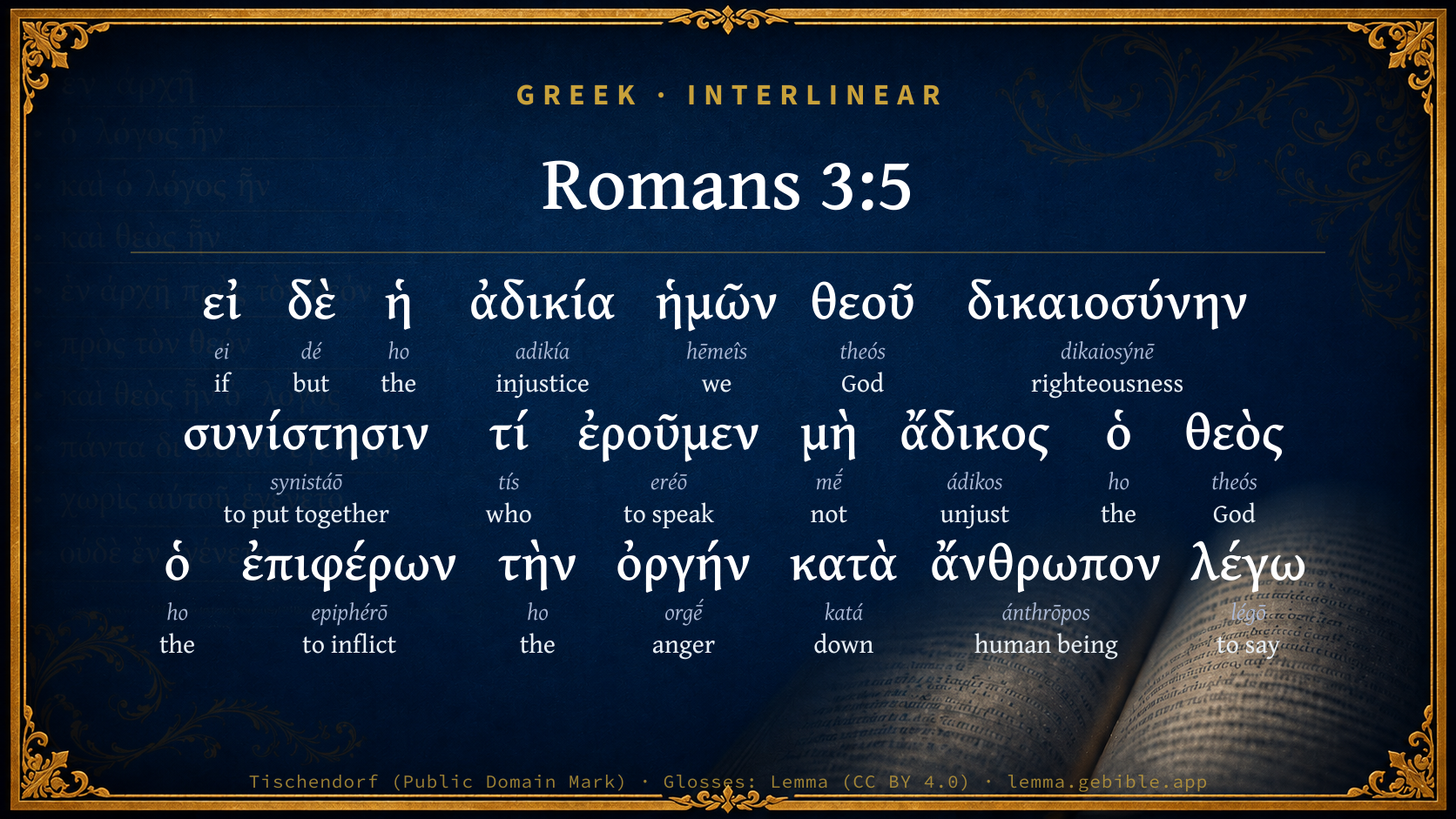
Greek (Tischendorf 8th ed.) Romans 3:5 appears in the Greek New Testament. The text above is from the Tischendorf 8th edition. Each word links to its Strong’s number and a concise gloss. Click any word for its full Thayer’s Greek Lexicon entry.
Download image
Cite this verse

Romans 3:5 (World English Bible). Public Domain. Lemma interlinear Bible study tool, https://lemma.gebible.app/v/romans/3/5.

Show BibTeX & RIS
BibTeX
RIS
English Translation
But if our unrighteousness commends the righteousness of God, what will we say? Is God unrighteous who inflicts wrath? I speak like men do.
World English Bible · Public Domain
Highlights
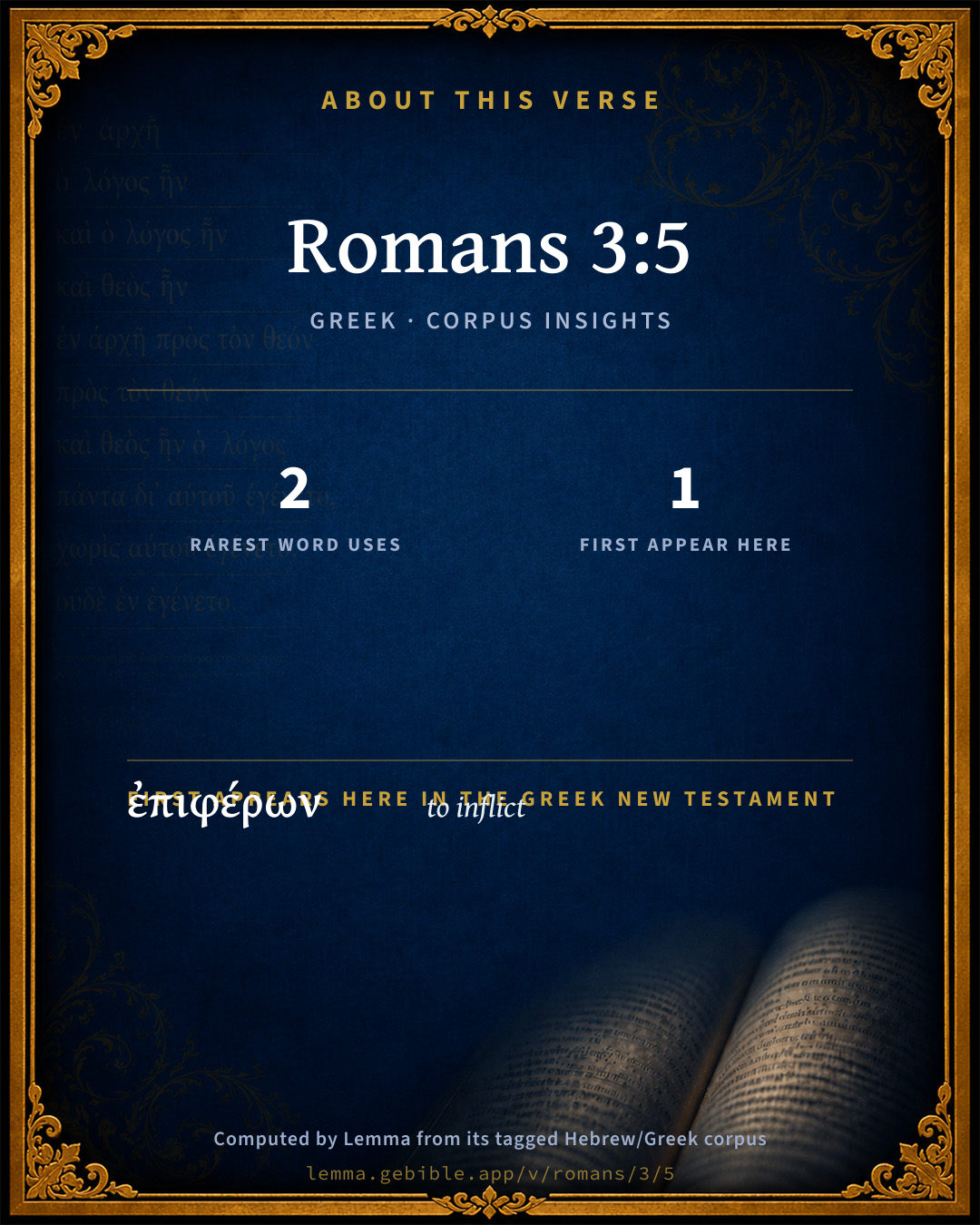
  • 1 first appearance in the Greek New Testament
Full analysis ↓
Download a study sheet

One document with this verse’s original text, its word-by-word gloss line, the meaning frame, cross-references with their text, attributed commentary, and full source and license credits — printable, and it pastes into notes with its structure intact.

This verse Autodidact and up

Study sheet (.html) Plain text (.txt)

A passage Seminary Student

Up to 50 verses in one chapter. A passage sheet keeps up to 6 commentary sources and 12 cross-references per verse, in the order this page ranks them, and says so on the sheet whenever that leaves anything out. Ask for a single verse and you get the Autodidact verse sheet above.

Everything on this page stays free to read, with no account — the sheet is a download of what is already on screen, not access to it.

Want to remove ads? Support Godless Engineer
Compare translations 3

The same verse in 3 English versions, stacked beneath the original-language interlinear above. Click any original word for its lexicon entry.

Each is an independent rendering of the whole verse — the interlinear is not word-aligned to these translations.

Highlighted words mark where these versions differ — a whole-verse word diff, not a word-by-word alignment.

  • World English Bible Public Domain
    But if our unrighteousness commends the righteousness of God, what will we say? Is God unrighteous who inflicts wrath? I speak like men do.
  • King James Version Public Domain
    But if our unrighteousness commend the righteousness of God, what shall we say? Is God unrighteous who taketh vengeance? (I speak as a man)
  • unfoldingWord Literal Text CC BY-SA 4.0
    But if our unrighteousness commends the righteousness of God, what will we say? God not unrighteous for imposing his wrath,? (I speak according to men.)

unfoldingWord Literal Text — © unfoldingWord, licensed CC BY-SA 4.0. Word-aligned USFM3 via Door43 (git.door43.org/unfoldingWord/en_ult).

Versions to compare (up to 4)

3 of 4 selected

Show all 19 translations

Every available English version of this verse, each an independent rendering of the whole verse.

  • World English Bible Public Domain
    But if our unrighteousness commends the righteousness of God, what will we say? Is God unrighteous who inflicts wrath? I speak like men do.
  • Berean Standard Bible Public Domain
    But if our unrighteousness highlights the righteousness of God, what shall we say? That God is unjust to inflict His wrath on us? I am speaking in human terms.
  • Majority Standard Bible Public Domain
    But if our unrighteousness highlights the righteousness of God, what shall we say? That God is unjust to inflict His wrath on us? I am speaking in human terms.
  • King James Version Public Domain
    But if our unrighteousness commend the righteousness of God, what shall we say? Is God unrighteous who taketh vengeance? (I speak as a man)
  • American Standard Version (1901) Public Domain
    But if our righteousness commendeth the righteousness of God, what shall we say? Is God unrighteous who visiteth with wrath? (I speak after the manner of men.)
  • Revised Version (1885) Public Domain
    But if our unrighteousness commendeth the righteousness of God, what shall we say? Is God unrighteous who visiteth with wrath? (I speak after the manner of men.)
  • Geneva Bible (1599) Public Domain
    Now if our vnrighteousnes comend the righteousnes of God, what shall we say? Is God vnrighteous which punisheth? (I speake as a man.)
  • Douay-Rheims (1899) Public Domain
    But if our injustice commend the justice of God, what shall we say? Is God unjust, who executeth wrath?
  • Young's Literal Translation Public Domain
    And, if our unrighteousness God's righteousness doth establish, what shall we say? is God unrighteous who is inflicting the wrath? (after the manner of a man I speak)
  • Literal Standard Version CC BY-SA 4.0
    And if our unrighteousness establishes God’s righteousness, what will we say? Is God unrighteous who is inflicting the wrath? (I speak after the manner of a man.)
  • Unlocked Literal Bible CC BY-SA 4.0
    But if our unrighteousness shows the righteousness of God, what can we say? Can we say that God is unrighteous to bring his wrath upon us? (I am using a human argument.)
  • unfoldingWord Literal Text CC BY-SA 4.0
    But if our unrighteousness commends the righteousness of God, what will we say? God not unrighteous for imposing his wrath,? (I speak according to men.)
  • Darby Bible Public Domain
    But if our unrighteousness commend God's righteousness, what shall we say? Is God unrighteous who inflicts wrath? I speak according to man.
  • World Messianic Bible Public Domain
    But if our unrighteousness commends the righteousness of God, what will we say? Is God unrighteous who inflicts wrath? I speak like men do.
  • Webster's Bible Public Domain
    But if our unrighteousness commendeth the righteousness of God, what shall we say? Is God unrighteous who taketh vengeance? (I speak as a man.)
  • Free Bible Version CC BY-SA 4.0
    But if the fact that we're wrong helps to show that God is right, what should we conclude? That God is wrong to pronounce judgment on us? (I'm talking from a human perspective here.)
  • Bible in Basic English Public Domain
    But if the righteousness of God is supported by our wrongdoing what is to be said? is it wrong for God to be angry (as men may say)?
  • Text-Critical English NT CC BY 4.0
    But if our unrighteousness demonstrates the righteousness of God, what shall we say? Is God, who inflicts wrath, unrighteous? (I speak in a human way.)
  • Tyndale New Testament (1534) Public Domain
    Yf oure vnrightewesnes make the rightewesnes of God more excellent: what shall we saye? Is God vnrighteous which taketh vengeauce? I speake after the maner of men.

Literal Standard Version (2020), Covenant Press — licensed CC BY-SA 4.0. Text via the HelloAO Bible API (eBible.org). Unlocked Literal Bible (unfoldingWord) — licensed CC BY-SA 4.0. Text via the HelloAO Bible API (eBible.org). unfoldingWord Literal Text — © unfoldingWord, licensed CC BY-SA 4.0. Word-aligned USFM3 via Door43 (git.door43.org/unfoldingWord/en_ult). Free Bible Version, Dr. Jonathan Gallagher — licensed CC BY-SA 4.0. Text via the HelloAO Bible API (eBible.org).

Word by word

More ways to search: Search by grammar → Find every occurrence → Compare this word →

Practice this passage: Drill this verse → Learn its vocabulary →

ἐπιφέρων
epiphérō
G2018
“to inflict”
Verb, Present, Active, Participle, Nominative, Singular, Masculine
Part of Speech
Verb
Tense
Present
Voice
Active
Mood
Participle
Case
Nominative
Number
Singular
Gender
Masculine
Full Thayer's Definition

Origin: from G1909 and G5342

TDNT: None

1. to bring upon, bring forward a. used of accusers 2. to lay upon, to inflict 3. to bring upon, i.e. in addition, to add, increase 4. to put upon, cast upon, impose
  1. εἰ ei G1487 “if” Conditional
  2. δὲ dé G1161 “but” Conjunction
  3. ἡ ho G3588 “the” Article, Nominative, Singular, Feminine
  4. ἀδικία adikía G93 “injustice” Noun, Nominative, Singular, Feminine
  5. ἡμῶν hēmeîs G2249 “we” Personal pronoun, 1st person, Genitive, Plural
  6. θεοῦ theós G2316 “God” Noun, Genitive, Singular, Masculine
  7. δικαιοσύνην dikaiosýnē G1343 “righteousness” Noun, Accusative, Singular, Feminine
  8. συνίστησιν synistáō G4921 “to put together” Verb, Present, Active, Indicative, 3rd person, Singular
  9. τί tís G5101 “who” Interrogative pronoun, Accusative, Singular, Neuter
  10. ἐροῦμεν eréō G2046 “to speak” Verb, Future, Active, Indicative, 1st person, Plural
  11. μὴ mḗ G3361 “not” Particle, Negative
  12. ἄδικος ádikos G94 “unjust” Adjective, Nominative, Singular, Masculine
  13. ὁ ho G3588 “the” Article, Nominative, Singular, Masculine
  14. θεὸς theós G2316 “God” Noun, Nominative, Singular, Masculine
  15. ὁ ho G3588 “the” Article, Nominative, Singular, Masculine
  16. τὴν ho G3588 “the” Article, Accusative, Singular, Feminine
  17. ὀργήν orgḗ G3709 “anger” Noun, Accusative, Singular, Feminine
  18. κατὰ katá G2596 “down” Preposition
  19. ἄνθρωπον ánthrōpos G444 “human being” Noun, Accusative, Singular, Masculine
  20. λέγω légō G3004 “to say” Verb, Present, Active, Indicative, 1st person, Singular

About this verse

These counts appear in no published source. They are computed here, from the morphology-tagged text and Lemma’s own curated glosses. What Lemma adds →

21
words
17
distinct lemmas
Pauline Epistles
section

Notable vocabulary

The rarest word here is ἐπιφέρων to inflict G2018 — appearing just 2 times in the whole Greek New Testament.

First appearance in Scripture

This word makes its first canonical appearance in the Greek New Testament here:

  • ἐπιφέρων to inflict G2018

Shared distinctive vocabulary

ἐπιφέρων to inflict G2018 occurs in 2 verses of the Greek New Testament. Also found in:
Repetition

Words recur within this verse:

Cross-references

24

Topical passages linked to Romans 3:5 in the Treasury of Scripture Knowledge — connected by theme and wording, ordered by reader-vote popularity; previews shown in the World English Bible.

  • Romans 6:19 I speak in human terms because of the weakness of your flesh, for as you presented your members as servants to uncleanness and to wickedness upon wickedness, even so now present your members as servants to righteousness for sanctification.
  • Galatians 3:15 Brothers, I speak like men. Though it is only a man's covenant, yet when it has been confirmed, no one makes it void, or adds to it.
  • Romans 2:5 But according to your hardness and unrepentant heart you are treasuring up for yourself wrath in the day of wrath, revelation, and of the righteous judgment of God;
  • Romans 9:18–20 So then, he has mercy on whom he desires, and he hardens whom he desires.
  • 1 Corinthians 9:8 Do I speak these things according to the ways of men? Or doesn't the law also say the same thing?
  • Deuteronomy 32:39–43 See now that I, even I, am he, There is no god with me: I kill, and I make alive; I wound, and I heal; There is none who can deliver out of my hand.
  • Nahum 1:2 Yahweh is a jealous God and avenges. Yahweh avenges and is full of wrath. Yahweh takes vengeance on his adversaries, and he maintains wrath against his enemies.
  • Romans 4:1 What then will we say that Abraham, our forefather, has found according to the flesh?
  • Romans 7:7 What shall we say then? Is the law sin? May it never be! However, I wouldn't have known sin, except through the law. For I wouldn't have known coveting, unless the law had said, "You shall not covet."
  • Psalms 94:1–2 Yahweh, you God to whom vengeance belongs, You God to whom vengeance belongs, shine forth.
  • Nahum 1:6–8 Who can stand before his indignation? Who can endure the fierceness of his anger? His wrath is poured out like fire, and the rocks are broken apart by him.
  • Romans 3:7 For if the truth of God through my lie abounded to his glory, why am I also still judged as a sinner?
  • Romans 3:19 Now we know that whatever things the law says, it speaks to those who are under the law, that every mouth may be closed, and all the world may be brought under the judgment of God.
  • Romans 3:25–26 whom God set forth to be an atoning sacrifice, through faith in his blood, for a demonstration of his righteousness through the passing over of prior sins, in God's forbearance;
  • Romans 6:1 What shall we say then? Shall we continue in sin, that grace may abound?
  • Romans 8:20–21 For the creation was subjected to vanity, not of its own will, but because of him who subjected it, in hope
  • Romans 9:13–14 Even as it is written, "Jacob I loved, but Esau I hated."
  • Romans 12:19 Don't seek revenge yourselves, beloved, but give place to God's wrath. For it is written, "Vengeance belongs to me; I will repay, says the Lord."
  • 1 Corinthians 15:32 If I fought with animals at Ephesus for human purposes, what does it profit me? If the dead are not raised, then "let us eat and drink, for tomorrow we die."
  • 2 Thessalonians 1:6–9 Since it is a righteous thing with God to repay affliction to those who afflict you,
  • Revelation 15:3 They sang the song of Moses, the servant of God, and the song of the Lamb, saying, "Great and marvelous are your works, Lord God, the Almighty; Righteous and true are your ways, you King of the nations.
  • Revelation 16:5–7 I heard the angel of the waters saying, "You are righteous, who are and who were, you Holy One, because you have judged these things.
  • Revelation 18:20 Rejoice over her, O heaven, you saints, apostles, and prophets; for God has judged your judgment on her."
  • Psalms 58:10–11 The righteous shall rejoice when he sees the vengeance. He shall wash his feet in the blood of the wicked;

Cross-references courtesy of OpenBible.info (CC BY 4.0).

Commentary

Notes on Romans 3:5 from classic Christian and Jewish commentators (each source and its license shown beneath its notes). The classic Christian expositions comment on the surrounding passage and are grouped to its opening verse, so a note may address several verses; the Jewish commentaries on the Tanakh (Rashi and others) are per-verse, so they appear only where the commentator wrote on this verse.

Lemma curates 59 commentaries, every one of them public domain or Creative Commons licensed, each selected and text-cleaned for this edition rather than reprinted as found. About our sources →

The Biblical Illustrator

Joseph S. Exell

Rom_3:5-8

But if our unrighteousness commend the righteousness of God, what shall we say?

Mans sin and Gods righteousness

1. Our unrighteousness may possibly commend the righteousness of God.

2. This result is involuntary, not meritorious.

3. Hence to suppose that sin is less punishable because good follows is a grievous error.

4. To persist in sin that good may come, is positively blasphemous and wicked.

5. Therefore God will righteously punish those who do so. (J. Lyth, D. D.)

Mans sin and Gods righteousness

1. Mans sin has occasioned the displays of Gods righteousness.

2. Does not thereby lose its enormity.

3. Must, if not repented of, be avenged.

4. Otherwise all righteous judgment must cease. (J. Lyth, D. D.)

Is God unrighteous that taketh vengeance? (text, and Gen_18:25).--

Gods attitude towards sin

1. God makes the wickedness and unbelief of men subservient to His glory.

2. Holds them responsible for their sins, notwithstanding the result.

3. Teaches that the morality of an action depends not upon the consequences of it, but upon its agreement or disagreement with His law.

4. Condemns the slanderous importation that the gospel sanctions the principle of doing evil that good may come. (J. Lyth, D. D.)

Gods attitude towards sin

He--

1. Overrules it;

2. Judges it;

3. Utterly condemns it. (J. Lyth, D. D.)

The hearts rest in the righteousness of God

Thousands of years part those two questions, yet in substance they are the same. The first occurs in a tender, sublime intercession; the second in a hard, fiery argumentation. Note--

I. That both refer to the retributive providence of God as declared in particular and decisive acts. Both acts were determined by the moral conditions of men, though their effects operated in different spheres. One was temporal, the other a spiritual judgment.

1. Let us try and get their position. Think of Abraham when God divulged to him tits appalling purpose. Think of Paul writing with the full knowledge that God had placed Israel under a ban. In different ways these two men were bidden look into the treasure house of Divine wrath. They had to stand on the shadowed side of the providence of God. And the hand of Him they knew as love placed them there.

2. Both felt the moral pressure upon their reason and conscience, and were compelled to ask, Is it right for God to do this? One tried to turn judgment aside, so forcibly did the difficulty press itself home. Pauls perplexities were more intricate, and his endeavour to extricate his reason and conscience is one great wrestling with the Spirit of Truth.

3. Now, looking into these difficulties of Abraham and Paul, do we not recognise our own? Our thoughts and feeling form themselves, almost without our will, into the old interrogation, Wilt Thou also destroy the righteous with the wicked? Are we not ready to expostulate, That be far from Thee to do after this manner? In how many sweeping calamities the righteous are slain with the wicked. Earthquake, storm, flood, fire, make no elections; they take any and all alike. In a commercial crisis often some of the best men are among the wreckage, ignominiously huddled with the rogues. Where is the answer to this? I do not find one in the Old Testament narrative. There is one streak of light. Lot was saved. Yet, in view of the after history, one is ready to ask, Why? And if we take Pauls questions of sin, responsibility, and punishment, our bafflings are, if anything, increased. The impenetrable facts are with us. The fact of sin: what theologians call original sin, and men of science heredity. Millions are born castaways, come into the world under wrath. What about their responsibility? What about their destiny?

II. The ultimate truth upon which those who put them relied for a solution. God did not leave them without answer; nor has He left us without one. Their answer is ours, for the Bible is for all time. We shall find our answer in the questions themselves; for they contain a truth quite equal to the removal of doubts, though not of difficulties.

1. Abraham and Paul grasped the eternal righteousness of God. That became a formulated conception of Gods character. Reason and conscience built on it, and could not he shaken. It is for us to make that our own. Before we pass judgment, or seek to form a judgment on any section of human history, or any problem of human life and destiny, let us take fast hold of the manifested truth--God is righteous. That is larger than the statement--God does righteously. It means more than He does no wrong things. It means, He cannot do a wrong thing. And then, moreover, His wisdom is such that He cannot commit a blunder.

2. These questions not only express a truth of Gods character, but also the moral requisition of the creature consciousness. Reason and conscience both demand that the Judge of all the earth shall be righteous. And God has not so constituted man that he may mock Him. And notice in connection with this that The Lord said, Shall I hide from Abraham that thing which I do? Does not that look as if God craved the sympathy and approval of man? He would not have those intuitive demands which He has put into souls violated by deeds of His. The Creator would be justified in the eyes of His creature. God does not rebuke the demand that He shall do right. And when we fully apprehend, as did these men, that God is righteous, every special act of His will be tried by that conclusion. The thorniest questions that can ever arise must have their answers in the righteousness of God.

III. The profound moral acquiescence in the Divine will which the texts reveal. The harassed reason of patriarch and apostle found rest in the eternal righteousness of God.

1. We must always start there, and take it as our lamp to light our feet along winding and perilous paths, and seldom shall we stumble or lose our way. It is not a truth for reflection alone, but for practical guidance, and should command our acquiescence in the Divine will.

2. Not that we are to cease inquiry. Only we should question with faith in our hearts; especially the faith that God is righteous.

3. The acquiescence spoken of does not mean unconcern as to the fate of men. It does not mean indifference to sin and sorrow, and suffering and destiny. Abraham cared. How he pleaded! Clearly we are now amid the overwhelming mysteries of moral government. We see that men may become so bad that nothing is left, even for God, but a determining stroke of wrath. But we must not be content to leave men to their doom. There must be no willingness that they should perish. Gods will is that they should be saved. Paul said, I have great heaviness and continual sorrow in my heart concerning reprobated Israel. (W. Hubbard.)

God forbid: for then how shall God judge the world?--

Gods righteousness and future judgment

Gods righteousness--

I. Is the basis of the hope of future judgment. Things are not right now if viewed from a strictly temporal standpoint; for the good often get the worst of it, and the bad the best of it. The hope that these inequalities will be adjusted at the Judgment has been the comfort and mainstay of Gods saints under both dispensations.

II. Necessitates this judgment.

1. If the worlds affairs are administered by a Righteous Governor, then the things that are now manifestly wrong must at some period be put right, and the date assigned by the Righteous Governor of the world is the Day of Judgment.

2. Having assigned that date, Gods righteousness pledged Him to keep it. God is, so to speak, committed to it, and He is not the son of man that He should repent.

III. Will govern its decisions. Men will be judged equitably. Judicial decisions are now often inequitable--because some legal technicality stands in the way; or because all the facts are not forthcoming, or some of them are not placed in their true light; or because the eloquence of the advocate, or something about the accused, influences the jury. But then the awards will be according to the merits of the case, all the circumstances of which will be naked and open. Conclusion: We may take comfort from this doctrine--

1. Amid all the perplexities of the present. We do not estimate things by their momentary appearance, nor a man by a solitary action. We must therefore estimate God and His procedure comprehensively. He has all eternity to work in, and when we take the larger view we shall acknowledge that the Judge of all the earth will do right.

2. Amid all the perplexities concerning the future. Whatever becomes of the wicked the Judge of all the earth will do right. (J. W. Burn.)

Justice and judgment

The following story is told of Judge Gray, now in the United States Supreme Court:--A man was brought before him who was justly charged with being an offender of the meanest sort. Through some technicality the judge was obliged honourably to discharge him, but as he did so he chose the time to say what he thought of the matter. I believe you guilty, he said, and would wish to condemn you severely, but through a petty technicality I am obliged to discharge you. I know you are guilty, and so do you; and I wish you to remember that you will some day pass before a better and a wiser Judge, when you will be dealt with according to justice, and not according to law.

The standard of Gods justice

In the reign of King Edward the First there was much abuse in the traffic of all sorts of drapery, much wrong done betwixt man and man by reason of the diversity of their measures, every man measuring his cloth by his own yard, which the king perceiving, being a goodly proper man, took a long stick in his hand, and having taken the length of his own arm, made proclamation through the kingdom, that ever after the length of that stick should be the measure to measure by, and no other. Thus Gods justice is nothing else but a conformity to His being, the pleasure of His wilt; so that the counsel of His will is the standard of His justice, whereunto all men should regulate themselves as well in commutative as distributive justice, and so much the more righteous than his neighbour shall every man appear, by how much he is proximate in this rule, and less righteous as he is the more remote. (J. Spencer.)

The Biblical Illustrator, edited by Joseph S. Exell (c. 1880s–1900s) — public domain. Text from a community e-Sword module.

Joseph Benson's Commentary

Rom 3:5-6. But — It may be further objected; if our unrighteousness commend the righteousness of God — Be subservient to God’s glory; or, if our infidelity be so far from making void the faithfulness of God, that it renders it more illustrious, then we ought not to be condemned for it. But Dr. Whitby understands, by the righteousness of God, the righteousness of faith, which indeed is generally the meaning of the phrase in this epistle; and, as in the first chapter the necessity of this faith is shown with respect to the Gentiles, because otherwise they, being unrighteous, could not be justified before God, or escape his wrath revealed against all unrighteousness; and in the second chapter the same is proved respecting the Jews by reason of their unrighteousness, which arguments plainly serve to commend and establish this way of righteousness by faith in Christ, from the necessity of it to the justification both of Jews and Gentiles; he therefore considers the import of the objection to be, “If the unrighteousness both of Jews and Gentiles tend so visibly to illustrate and recommend the wisdom and grace of God, in appointing this way of justification by faith in Christ, is it righteous in God to punish both Jews and Gentiles, as you say he has done and will do, for that unrighteousness that tends so highly to advance the glory of divine grace displayed in the gospel?” What shall we say — What inference shall we draw? Is God unrighteous who taketh vengeance — Must we grant that God acts unjustly in punishing those practices which so illustrate his mercy, faithfulness, and other perfections? I speak as a man — As a mere natural man, not acquainted with the revealed will of God, or not influenced by his Spirit; or as human weakness would be apt to speak. God forbid — That I should harbour such a thought, or allow such a consequence; for then — If it were unjust in him to punish that unrighteousness which is subservient to his own glory, how should God judge the world — Since all the unrighteousness in the world will then commend the righteousness of God. Add to this, the very idea of God’s judging the world, implies that it shall be done in righteousness. For if any person were to have injustice done him on that occasion, it would not be judgment, but a capricious exercise of power, whereby the Judge would be dishonoured. On this idea is founded the answer which Abraham made to God, respecting the destruction of Sodom, which answer perhaps the apostle had now in his eye, Gen 18:25; Shall not the Judge of all the earth do right?

Joseph Benson's Commentary on the Old and New Testaments (1811–1818) — public domain. Text from a community e-Sword module.

Whedon's Commentary on the Bible

Daniel D. Whedon

(d.) Nor does God’s glory derived from overruling man’s sin excuse the Jewish any more than the Gentile sinner, Rom_3:5-8.

5. Commend the righteousness of God—The Jew now makes a bold turn. He admits himself the sinner and God the righteous. But how excellent a thing has his sin accomplished! It has set God’s rectitude in a clearer light! How righteous, then, is the Jew whose very sins glorify God!

What shall we say?—How can we condemn the Jew? The apostle answers this question by retorting another. God does nevertheless take vengeance; does he so unrighteously? There is, then, a fair issue between God and the Jew. Is God unrighteous? Not only does St. Paul over and over raise the question whether there is unrighteousness with God, but the whole book of Romans is an argument to show that God’s course with the Jews is the right one; under the assumption that there are other courses which it would be wrong for God to pursue, and which he does not pursue just because they are wrong. That is, a course is not right because God pursues it, but God pursues it because it is right. The righteousness of God appears in this, that from eternity to eternity he does, with a most divine freedom, choose and determine not for the wrong, but for the right, the holy, and the best. (See our work on “The Will,” page 316.) And the apostle assumes this fundamental rightness in God as a first principle in no way to be contradicted. The predestinarian must not, therefore, grimly argue, “God has a right to do what he pleases with his creatures, even decree their sin and then damn them for it.” God has, indeed, a right to do what he pleases with his creatures, just because he, in fact, pleases to do perfectly right. Were there a God over the universe who pleased to do wrong, such a God would have no right to do as he pleases. But to say that the creature cannot be imagined to receive a treatment which would be unjust even from its Creator reverses all true idea of justice; and in fact by saying that injustice would be justice annihilates the very idea of justice.

We are bound to assume, with the apostle, that such a course must not be attributed to God, because it would be infinitely wrong, and God is infinitely right.

Speak as a man—In entertaining the question of the divine rectitude, I do for a moment speak of God as men speak of each other. The sentence is an apologetic parenthesis for the apparent irreverence.

Daniel D. Whedon (gen. ed.), Commentary on the Old and New Testaments (1874–1909) — public domain. Text from a community e-Sword module.

Tyndale Open Study Notes

Tyndale Open Resources

3:5-7 how would he be qualified to judge the world? Abraham asked a similar question: “Should not the Judge of all the earth do what is right?” (Gen 18:25). God punishes all sin, and he retains absolute righteousness as he does so. Even when God makes use of human sin for his own ends, that sin still deserves to be, and will be, punished (see Rom 9:10-24).

Tyndale Open Study Notes — © Tyndale Open Resources, licensed CC BY-SA 4.0. Text via the HelloAO Bible API.

Bengel's Gnomon

Johann Albrecht Bengel

Rom 3:5. Εὶ δὲ, but if) This new argument, urged through a Jewish person, is elicited from the verb thou mayest be justified, in the preceding verse.—ἡ ἀδικία, unrighteousness) of which a man is guilty through unbelief.—τι ἐροῦμεν, what shall we say) Paul shows that this, their peculiar advantage [Rom 3:1], does not prevent the Jews from being under sin.—ὁ ἐπιφέρων) the inflicter of wrath [taketh vengeance] upon the unbelieving Jews. The article has a particular force. The allusion is to Psa 7:11, ὁ Θεὸς κριτὴς δίκαιος, και μὴ (אַל for אֵל; the LXX. from the similarity of letters, mistaking God for not], ἑπάγων ὀργὴν καθʼ ἑκάστην ἡμέραν: God is a just judge, and (not being substituted for God) a God inflicting wrath.—κατὰ ἄνθρωπον, as a man) Man, according to the principles of human nature, might reason thus: My wickedness is subservient to the Divine glory, and makes it the more conspicuous, as darkness doth the light; therefore, I should not be punished.

Bengel's Gnomon of the New Testament — English translation (T&T Clark, Edinburgh, 1860) — public domain. Text from a community e-Sword module.

Meyer's Critical & Exegetical Commentary

Heinrich August Wilhelm Meyer

Rom_3:5-6. In Rom_3:3-4 it was declared that the unbelief of a part of the Jews would not make void the truthfulness of God, but that, on the contrary, the latter should be triumphantly justified. But how easily might this be misconstrued by a Jew of the common type as a pretext for his immorality: the unrighteousness of man in fact brings out more clearly the righteousness of God, and therefore may not be righteously punished by God! To preclude this misconception and false inference, which so abruptly run counter to his doctrine of universal human guilt, and to leave no pretext remaining (observe beforehand the τί οὖν; προεχόμεθα in Rom_3:9), Paul, having in view such thoughts of an antagonist, proposes to himself and his readers the question: But if our unrighteousness show forth the righteousness of God, what shall we say (infer)? Is God then unrighteous, who inflicteth wrath? And he disposes of it in the first instance by the categorical answer (Rom_3:6): No, otherwise God could not be judge of the world. The assumption, that this question is occasioned really and seriously by what goes before, and called forth from the Apostle himself (Hofmann), is rendered untenable by the very addition κατὰ ἄνθρωπον λέγω.

ἡ ἀδικία ἡμῶν] Quite general: our unrighteousness, abnormal moral condition. To this general category belongs also the ἀπιστία, Rom_3:3. Paul has regarded the possible Jewish misconception, the notion of which occasions his question, as a general, but for that reason all the more dangerous inference from Rom_3:3-4, in which the words ἀδικία and δικαιοσύνη are suggested by the passage from the Psalms in Rom_3:4.

ἡμῶν] is said certainly in the character of the ἀδικοί in general, and stands in relation to the πᾶς δὲ ἄνθρωπος ψεύστης in Rom_3:4. But as the whole context is directed against the Jews, and the application to these is intended in the general expressions, and indeed expressly made in Rom_3:19, Paul speaks here also in such a way that the Jewish consciousness, from which, as himself a Jew, he speaks, lies at the bottom of the general form of his representation.

The protasis εἰ.… συνίστησι is a concessum, which is in itself correct (Rom_3:4); but the inference, which the Jewish self-justification might draw from it, is rejected with horror. Observe in this protasis the emphatic juxtaposition ἡμῶν Θεοῦ; and in the apodosis the accent which lies on ἄδικος and τὴν ὀργήν.

Θεοῦ δικαιοσ. συνίστησι] proves Gods righteousness (comp Rom_5:8; 2Co_6:4; 2Co_7:11; Gal_2:18; Susann. 61; frequently in Polyb. Philo, etc.); makes it apparent beyond doubt, that God is without fault, and such as He must be. The contrast to Ἡ ἈΔΙΚΊΑ ἩΜῶΝ requires ΔΙΚΑΙΟΣ. to be taken thus generally, and forbids its being explained of a particular attribute (truth: Beza, Piscator, Estius, Koppe, and others; goodness: Chrysostom, Theodoret, Grotius, Rosenmuller), as well as its being taken in the sense of Rom_1:17 (van Hengel).

The τί ἐρούμεν (3 Esr. 8:82) is used by Paul only in the Epistle to the Romans (Rom_4:1, Rom_6:1, Rom_7:7, Rom_8:31, Rom_9:14; Rom_9:30). Compare, however, generally on such questions arousing interest and enlivening the representation, Blomfield, Gloss. in Aesch. Pers. 1013, Dissen, a[748] Dem, de cor. p. 346 f.

ΜῊ ἌΔΙΚΟς Ὁ ΘΕῸς Ὁ ἘΠΙΦ. Τ. ὈΡΓΉΝ] This question[749] is so put that (as in Rom_3:3) a negative answer is expected, since Paul has floating before his mind an impious objection conceived of κατὰ ἄνθρωπον. See Hermann, a[750] Viger. p. 789, 810; Hartung, Partikell. II. p. 159; Baeumlein, p. 302 f. Hence: God is not unrighteous then, who dealeth wrath? This in opposition to Rückert and Philippi, who make the questioner expect an affirmative answer, which can never be the case. In those passages in Greek authors, where an affirmative reply notwithstanding follows, it invariably does so contrary to the expectation of the questioner; see Kühner, II. 2, p. 1024. ἄδικος, prefixed with emphasis, is, on account of its relation to ὁ ἐπιφ. τ. ὀργήν, to be understood in the strict judicial signification unrighteous, which is confirmed by Rom_3:6-7. For examples of ἐπιφέρειν used to express the practical infliction of wrath or punishment see Raphel, Polyb.; Kypke, II. p. 160. The article with the participle indicates the relation as well-known; and τὴν ὀργήν (Sin.* adds αὐτοῦ) denotes the wrath definitely conceived of as judicial, inflicted at the judgment. Compare Ritschl, de ira Dei, p. 15.

κατὰ ἄνθρωπον λέγω] To preclude his being misunderstood, as if he were asking εἰ δὲ ἡ ἀδικία ἡμῶν.… μὴ ἄδικος κ.τ.λ[751] from his own enlightened Christian view, Paul remarks parenthetically that he says this according to a human standard (Bernhardy, p. 241), after the fashion of ordinary humanity, quite apart from his own higher standpoint of divine enlightenment, to which the idea expressed in that question would be foreign, and speaking only in accordance with mere human reason. Compare 1Co_9:8; Gal_3:15; Soph. Aj. 761: κατʼ ἄνθρωπον φρονεῖ. I say this just as an ordinary man, not under the influence of the divine Spirit, may well say it. Respecting the expression ΚΑΤᾺ ἌΝΘΡ., which is capable according to the context of great variety of meaning, compare Fritzsche in loc[752] It is wrongly inferred from ΚΑΤᾺ ἌΝΘΡ. ΛΈΓΩ that the question ΜῊ ἌΔΙΚΟς Κ.Τ.Λ[753] was meant to receive an affirmative answer, because as a negative query it would not be κατὰ ἄνθρ. (see Philippi). But this view overlooks the fact that the whole thought, which is implied in the question calculated though it is for a negative reply,the thought of the unrighteousness of God in punishingcan in fact only be put into expression κατὰ ἄνθρωπον; in the higher Christian insight a conception so blasphemous and deserving of abhorrence can find neither place nor utterance. The apology however, involved in κατὰ ἄνθρ. λέγω, is applicable only to what goes before, not to what follows, to which Mehring, Th. Schott and Hofmann refer it. This is the more obvious, since what immediately follows is merely a repudiating μὴ γένοιτο, and the ἐπεί κ.τ.λ[754], which assigns the ground for this repudiation, is by no means an idea outside the range of revelation, the application of which to a rational inference, and one too so plainly right, cannot transfer it to the lower sphere of the κατὰ ἄνθρ. λέγειν.

Rom_3:6. ἘΠΕΊ] gives the ground of the ΜῊ ΓΈΝΟΙΤΟ; for (if the God who inflicts wrath is unrighteous) how will it be possible that He shall judge the world? The future is to be left in its purely future sense, since it refers to a future act taking place at any rate, as to which the only difficulty would be to see how it was to be accomplished, if, etc. On ἐπεί, for otherwise, see Buttmann, neut. Gr. p. 308. κρινεῖ has the emphasis.

ΤῸΝ ΚΌΣΜΟΝ is to be taken, with most expositors, generally as meaning all mankind (compare Rom_3:19). To be judge of the world and yet, as ἐπιφέρων τ. ὀργ., to be ἌΔΙΚΟς, is a contradiction of terms; the certainty that God is the former would become an impossibility if He were the latter. Compare Gen_18:25. Koppe, Reiche, Schrader, Olshausen, and Jatho, following older authorities, take it only of the Gentile world (Rom_11:12; 1Co_6:2; 1Co_11:32): In that case God could not punish even the Gentile world for its idolatry, since it is only in contrast therewith that the true worship of God appears in its full value (Reiche) But, in this explanation, the very essential idea: since.… appears has first of all to be imported, an expedient which, in presence of the simplicity and clearness of our view, cannot but seem arbitrary. Even the following proof, Rom_3:7 f., does not present a reference directly to the judgment of the Gentiles. The argument itself rests on the premiss that God can carry out the judgment of the world only as One who is righteous in His decreeing of wrath. The opposite would be impossible, not only subjectively, in God Himself (Th. Schott), but also objectively, as standing in contradiction to the notion of a world-judgment. See Rom_3:7 f. This proposition however is so perfectly certain to the consciousness of faith, out of which Paul asserts it, that there is no ground either for complaining of the weakness of the proof (Rückert), or for reading the thoughts that form the proof between the lines (Fritzsche and Mehring, with varying arbitrariness); the more especially as afterwards, in Rom_3:7, a still further confirmation of the ἐπεί.… κόσμον follows.

[748] d refers to the note of the commentator or editor named on the particular passage.

[749] After μή, ἐροῦμεν is not again to be understood, and then ἄδικος κ.τ.λ. to be taken as a question ensuing thereon (Mangold, p. 106). A breaking up of the construction without due ground. Compare, rather, Rom_9:14, a passage which in form also is perfectly parallel to this one.

[750] d refers to the note of the commentator or editor named on the particular passage.

[751] .τ.λ. καὶ τὰ λοιπά.

[752] n loc. refers to the note of the commentator or editor named on the particular passage.

[753] .τ.λ. καὶ τὰ λοιπά.

[754] .τ.λ. καὶ τὰ λοιπά.

Meyer — Critical and Exegetical Commentary on the New Testament — English translation by Peter Christie, edited by Frederick Crombie (T&T Clark, 1880) — public domain. Text from a community e-Sword module.

Expositor's Greek Testament

ed. W. Robertson Nicoll

Rom 3:5 f. Here another attempt is made to invalidate the conclusion of chap. 2, that the Jew is to be judged “according to his works,” exactly like the Gentile. If the argument of Rom 3:3 f. is correct, the unbelief of the Jews actually serves to set off the faithfulness of God: it makes it all the more conspicuous; how then can it leave them exposed to judgment? This argument is generalised in Rom 3:5 and answered in Rom 3:6 . “If our unrighteousness” (in the widest sense, ἀδικία being generalised from πίστις , Rom 3:3 ) demonstrates ( cf. Rom 5:8 ) God’s righteousness (also in the widest sense, δικαιοσύνη being generalised from πίστις , Rom 3:3 ), what shall we say? i.e. , what inference shall we draw? Surely not that God, He who inflicts the wrath due to unrighteousness at the last day (Rom 1:18 ), is Himself unrighteous, to speak as men speak. Away with the thought! If this were so, how should God judge the world? That God does judge the world at last is a fixed point both for Paul and those with whom he argues; hence every inference which conflicts with it must be summarily set aside. God could not judge at all if He were unjust; therefore, since He does judge, He is not unjust, not even in judging men whose unrighteousness may have served as a foil to His righteousness. It is not thus that the conclusions of chap. 2 can be evaded by the Jew. ὁ ἐπιφέρων τὴν ὀργήν : the “attributive participle equivalent to a relative clause, may, like a relative clause, convey a subsidiary idea of cause, purpose, condition or concession” (Burton, Moods and Tenses , § 428, who renders here: is God unrighteous, who (because He) visiteth with wrath?). κατὰ ἄνθρωπον λέγω : cf. Gal 3:15 , Rom 6:19 , 1Co 9:8 . There is always something apologetic in the use of such expressions. Men forget the difference between God and themselves when they contemplate such a situation as that God should be unrighteous; obviously it is not to be taken seriously. Still, in human language such suppositions are made, and Paul begs that in his lips they may not be taken for more than they really mean.

The Expositor's Greek Testament, edited by W. Robertson Nicoll (1897–1910) — public domain. Text from a community e-Sword module.

Vincent's Word Studies in the New Testament

Marvin R. Vincent

Commend [συνιστησιν] . Only twice outside of Paul 's writings, Luk 9:32; 2Pe 3:5, both in the physical sense. Lit., to place together. Hence of setting one person with another by way of introducing or presenting him, and hence to commend. Also to put together with a vein of showing, proving, or establishing. Expositors render here differently : commend, establish, prove. Commend is the prevailing sense in the New Testament, though in some instances the two ideas blend, as Rom 5:8; 2Co 7:11; Gal 2:18. See Rom 16:1; 2Co 4:2; 2Co 6:4; 2Co 10:18.

Who taketh vengeance [ο επιφερων την οργην] . Rev., much better, who visiteth with wrath. Lit., bringeth the anger to bear. The force of the article it is difficult to render. It may be the wrath, definitely conceived as judicial, or, more probably, as in Mt 3:7, referring to something recognized - the wrath to come, the well - understood need of unrighteousness. See on Rom 12:19.

As a man [κατα ανθρωπον] . Rev., after the manner of men; i e., I use a mode of speech drawn from human affairs. The phrase is thrown in apologetically, under a sense that the mode of speech is unworthy of the subject. Morison aptly paraphrases : "When I ask the question, 'Is God unjust who inflicteth wrath ?' I am deeply conscious that I am using language which is intrinsically improper when applied to God. But in condescension to human weakness I transfer to Him language which it is customary for men to employ when referring to human relationships." Compare 1Co 9:8; Rom 6:19.

Marvin R. Vincent, Word Studies in the New Testament (1887–1900) — public domain. Text from a community e-Sword/MySword module.

Godet's Commentaries

Frédéric Louis Godet

Vv. 5, 6. “But if our unrighteousness establish the righteousness of God, what shall we say? Is not God unrighteous when He inflicts wrath? I speak as a man. Let it not be: for then how shall God judge the world?”

From the that, Rom 3:4, it seemed to follow that God wills the sin of man for His own glory. But in that case, has He the right to condemn an act from which He reaps advantage, and to be angry with him who commits it? This objection might be put in the mouth of a Jew, who, placing himself at Paul’s view-point, and hearing him say that Israel’s rejection of the Messiah will glorify God’s faithfulness, and conduce to the accomplishment of His plans, judged God highly unjust for being angry with Israel on account of such conduct. Our unbelief would then signify the unbelief of us Jews. But the contrast which prevailed in Rom 3:4 was that between God and every man, and not between Jew and Gentile. It is therefore more natural to apply the term our unrighteousness to human unrighteousness in general, undoubtedly with special application to the Jewish unrighteousness which gives rise to the objection. It is from the depths of the human conscience that the apostle fetches his question. Is it righteous on God’s part to judge an act which He turns to His own advantage? As Paul had previously substituted the idea of truth for that of (God’s) faithfulness, he here substitutes righteousness for truth. This term in its most general sense denotes the perfection in virtue of which God cannot become guilty of any wrong toward any being whatever. Now this is what He seems to do to the sinner, when He at once condemns and makes use of him. It is from the word: that Thou mayest be acknowledged righteous, Rom 3:4, that Paul derives the term righteousness, Rom 3:5.—Συνιστάναι, strictly: to cause to stand together, whence: to confirm, to establish. The question τί ἐροῦμεν, what shall we say? does not occur in any other letter of the apostle’s; but it is frequent in this (Rom 4:1, Rom 6:1, Rom 7:1, Rom 8:31, Rom 9:14; Rom 9:30). It serves to fix the mind of the reader on the state of the question, at the point which the discussion has reached. If it had been in the interest of a certain school of criticism to deny the authenticity of the Epistle to the Romans, it is easy to see what advantage it would have taken of this form so exclusively characteristic of this treatise.

The interrogative form with μή assumes, as it always does, that the answer will be negative: “God is not, however, unjust in”...? It is certainly the apostle who is speaking, and not an opponent; for the objection is thus expressed in the outset as one resolved in the negative. The phrase: to inflict wrath, alludes to Rom 2:4-5, where the apostle threatened Israel with divine wrath against the day of wrath; but the question is nevertheless put in a perfectly general sense.

There is always something revolting to a conscience enlightened from above, in joining the epithet unrighteous with the word God, even hypothetically. This is why Paul adds: I speak as a man. By man he here understands man left to himself and his own reason, speaking with lightness and presumption of the ways of God. Some commentators would join this explanatory remark with what follows. But the following exclamation (μὴ γένοιτο, let it not be so), is absolutely opposed to this.

The argument of Rom 3:6, according to Meyer, is this: How would God be disposed to judge the world, if there was no righteousness in Him? For the troublesome consequences of sin could not impel Him to it, since He can turn them to good. It must be confessed that this would be a singularly wiredrawn argument. To go to prove God’s righteousness by the fact of the judgment, while it is the fact of the judgment which rests on divine righteousness! If the apostle had reasoned thus, Rückert would have been right in declaring that the argument was insufficient. But the reasoning is quite different. Meyer might have found it clearly stated by Olshausen: “If God’s drawing a good result from a bad deed were enough to destroy His right to judge him who committed it, the final judgment would evidently become impossible; for as God is always turning to good the evil which men have devised, every sinner could plead in his defence: My sin has after all served some good end.”

One might be tempted to apply the word the world exclusively to the Gentile world, which would lead us to the explanation whereby Rom 3:5 is put into a Jewish mouth. To this Jewish interlocutor, excusing the sin of his nation by the good fruits which God will one day reap from it, Paul would then answer: But at this rate God could as little judge the Gentiles (the world). For He brings good fruits from their sins also. This meaning is very plausible in itself. But yet it does not correspond with the apostle’s thought. For the word τὸν κόσμον, the world, would then have such an emphasis (as forming an antithesis to the Jews), that it would necessarily require to be placed before the verb. The idea is therefore more general: No final judgment is any longer possible if the beneficial consequences of sin, human or Jewish, justify the sinner. This idea is exactly that which is expounded in the two following verses.

Frédéric Louis Godet — Commentaries on Luke, John, Romans, and 1 Corinthians — English translation (T&T Clark, Edinburgh, 1870s–1890s) — public domain. Text from a community e-Sword module.

Hodge's Commentary on Romans, Ephesians & First Corinthians

Charles Hodge

Rom_3:5

But if our unrighteousness commend the righteousness of God, what shall he then say? Ἀδικία is not to be taken in the restricted sense of injustice, nor as equivalent to ἀπιστία in the preceding verse, but in the comprehensive sense of unrighteousness, wickedness. It is the opposite of δικαιοσύνη, rectitude, righteousness, which includes all moral excellence. The righteousness of God is here, not his goodness, which the context does not require, and usage does not authorize, but rectitude, that attribute which is manifested in doing right. Συνίστημι in the New Testament, is to place with or before any one; and hence either to commend, to recommend, Rom_16:1; 2Co_3:1; 2Co_5:12; or to set forth, to render conspicuous; see Rom_5:8; 2Co_6:4. The latter is obviously the sense required in the present instance. That this verse is in answer to an objection is obvious; but that objection is not derived from the language of Rom_3:4. Paul had said nothing there to give any color to the suggestion, that he himself held that it would be unrighteous in God to punish the wicked. He had simply said, that the truth of God was to be admitted and acknowledged, though all men were liars. From this it could not be made an inference that we may do evil that good may come. It is not a false inference from Rom_3:4, but a new objection to his general conclusion that he is here answering: Not only is Gods fidelity pledged to our salvation, but the very fact of our being unrighteous will render his righteousness the more conspicuous; and consequently it would be unjust in him to punish us for what glorifies himself. This is the thought; the form in which it is presented is determined by the fact that the apostle does not introduce the person of the objector, but states the objection in his own person, in the form of a question. It is plain, however, that the point of the argument is that God cannot consistently punish those whose unrighteousness serves to display his own rectitude; and this is supposed to be urged to show that the Jews, notwithstanding their sins, were not exposed to condemnation. If our unrighteousness commend the righteousness of God is the suggestion; the inference, which the Jews were disposed to draw, and which Paul asks, whether they would venture to make, is that God is unjust who taketh vengeance: ὁ Θεὸς ὁ ἐπιφέρων τὴν ὁργήν, God the taker of vengeance; he whose prerogative it is to inflict the punishment due to sin. That the apostle is not in this verse expressing his own sentiments, he intimates by saying, κατὰ ἄνθρωπον λέγω, I speak as a man. This formula, which is of frequent occurrence, means to speak as men are accustomed to speak; and as men are in general wicked, to speak or act after the manner of men, is to speak or act wickedly. It depends, however, entirely on the context whether this idea is implied. When Paul asks, Are ye not carnal, and walk as men? 1Co_3:3 the case is plain. But when in Gal_3:15 he says, Brethren, I speak as a man, he means merely to appeal to what is commonly acknowledged as true among men. See also 1Co_9:8. When in Rom_6:19 he says ἀνθρώπινον λέγω, it is plain from the context that he means, in a manner adapted to the comprehension of men. And in the present case, where he is not expressing his own sentiments, κατὰ ἄνθρωπον λέγω is designed to declare that he is not speaking in his character of an apostle or Christian, but speaking as others speak, expressing their thoughts, not his own.

Charles Hodge — Commentary on Romans (1835), First Corinthians (1857), and Ephesians (1856) — public domain. Text from a community e-Sword module.

Geneva Bible (1599)

Geneva Bible translators

Therefore I speak not these words in mine own person, as though I thought so, but this is the talk of man’s wisdom, which is not subject to the will of God.

Another prevention, issuing out of the former answer: that the justice of God is in such sort commended and set forth by our unrighteousness, that therefore God forgetteth not that he is the judge of the world, and therefore a most severe revenger of unrighteousness.

Treachery, and all the fruits thereof.

Geneva Bible (1599) marginal notes — public domain. Text via Bolls.life.

Jamieson, Fausset & Brown

Robert Jamieson, A. R. Fausset & David Brown

But if, &c.--Another objection: "It would appear, then, that the more faithless we are, so much the more illustrious will the fidelity of God appear; and in that case, for Him to take vengeance on us for our unfaithfulness would be (to speak as men profanely do) unrighteousness in God."

Answer:

Jamieson, Fausset & Brown — Commentary Critical and Explanatory on the Whole Bible (1871) — public domain (CC PDM 1.0). Text via the HelloAO Bible API.

Adam Clarke's Commentary

Verse 5. JEW. But if our unrighteousness commend the righteousness of God] May we not suppose that our unrighteousness may serve to commend and illustrate the mercy of God in keeping and fulfilling to us the promise which he made to our forefathers? The more wicked we are, the more his faithfulness to his ancient promise is to be admired. And if so, would not God appear unjust in taking vengeance and casting us off?

I speak as a man] I feel for the situation both of myself and my countrymen, and it is natural for one to speak as I do.

Adam Clarke's Commentary on the Bible (1810–1826) — public domain. Text from a community e-Sword/MySword module.

John Calvin's Commentaries

5 But if our unrighteousness, etc. Though this is a digression from the main subject, it was yet necessary for the Apostle to introduce it, lest he should seem to give to the ill-disposed an occasion to speak evil, which he knew would be readily laid hold on by them. For since they were watching for every opportunity to defame the gospel, they had, in the testimony of David, what they might have taken for the purpose of founding a calumny, — “If God seeks nothing else, but to be glorified by men, why does he punish them, when they offend, since by offending they glorify him? Without cause then surely is he offended, if he derives the reason of his displeasure from that by which he is glorified.” There is, indeed, no doubt, but that this was an ordinary, and everywhere a common calumny, as it will presently appear. Hence Paul could not have covertly passed it by; but that no one should think that he expressed the sentiments of his own mind, he premises that he assumes the person of the ungodly; and at the same time, he sharply, touches, by a single expression, on human reason; whose work, as he intimates, is ever to bark against the wisdom of God; for he says not, “according to the ungodly,” but “according to man,” or as man. And thus indeed it is, for all the mysteries of God are paradoxes to the flesh: and at the same tine it possesses so much audacity, that it fears not to oppose them and insolently to assail what it cannot comprehend. We are hence reminded, that if we desire to become capable of understanding them, we must especially labor to become freed from our own reason, (proprio sensu) and to give up ourselves, and unreservedly to submit to his word. — The word wrath, taken here for judgment, refers to punishment; as though he said, “Is God unjust, who punishes those sins which set forth his righteousness?”

John Calvin's Commentaries (1540-1563) — public domain. Text from the Calvin Translation Society English edition (1840s-50s) via the Christian Classics Ethereal Library (ccel.org). Calvin's coverage is partial (roughly two-thirds of the Bible); uncommented books and verses are honest gaps, never fabricated. The 19th-century editor's footnotes and remarks are omitted so the notes are faithfully Calvin's own voice.

Ellicott's Commentary for English Readers

(5) But if our unrighteousness.—A new and profound question suggests itself to the mind of the Apostle, and his keen intellect will not let it go: “If the sin (here the unbelief) of man only tends to vindicate (commends or establishes) the righteousness of God, why should that sin be punished?” The mere raising of such a question requires an apology; it is only as a man might speak about man that he dares to utter such a thought. That, too, is an impossible objection, for if it held good there could not be any judgment. No sin would be punishable, for all sin would serve to emphasise the strict veracity of God in His denunciations of it, and therefore would ultimately conduce to His glory. It would thus cease to be sinful, and there would be nothing to hinder us from adopting the principle that is so calumniously attributed to us—that it is lawful to do evil that good may come. A calumny it is, and any such principle with all that appertains to it—i.e., with the whole of the preceding argument,—is justly condemned.

A Bible Commentary for English Readers, edited by Charles John Ellicott (1878–1897) — public domain. Text from a community e-Sword module.

The Cambridge Bible for Schools and Colleges

gen. ed. J. J. S. Perowne

5. unrighteousness … righteousness] General terms, but implying the special forms of unbelief and fidelity. Man’s mistrust is awfully unjust to God; God’s fidelity to His promise is just to Himself and His holiness.—See below on Rom_3:21 for the exceptional meaning here of “the Righteousness of God[33].”

[33] It is possible, however, that the meaning assigned to the phrase in note on Rom_1:17, may be the meaning even here: q.d., “What if our sin should illustrate (by contrast or otherwise) God’s Way of Acceptance?”

Is God unrighteous, &c.?] This question (the Opponent’s) is a serious grammatical difficulty in the Gr. The interrogative particle is that which regularly expects the answer “No.” But the turn of this argument suggests a question (from the Opponent) expecting “Yes.” (The above use of the particle in question is not quite invariable in Gr., but it holds in all other cases in St Paul.) To us it seems that the solution is as follows: The Apostle gives the Opponent’s question, but jealousy for God’s honour compels him to modify it by his own intense sense of the Divine righteousness. The Opponent demands the answer “Yes;” St Paul is forced to make him, grammatically, demand the answer “No.” Instead of his would-be “Is not God unrighteous, &c.?” it thus stands, “Is God unrighteous, &c.?”—in which at most the question is left, verbally, open.

taketh vengeance] Lit. inflicteth the wrath; i.e. the wrath merited by the special sin; the wrath which had fallen on Israel.

I speak as a man] i.e. “on merely human principles, from mere man’s point of view.” This serious questioning about right and wrong in the Eternal and His acts is, in St Paul’s view, “speaking as man.” In the light of the Holy Spirit’s teaching it is impossible, unless (as here) by way of a mere argumentative formula.

The Cambridge Bible for Schools and Colleges (gen. ed. J. J. S. Perowne; Cambridge University Press, 1878–1918) — public domain. Text from a community e-Sword module.

John Gill's Exposition

But if our unrighteousness commend the righteousness of God,.... Hence it appears, that the unrighteousness of men commends the righteousness, or faithfulness of God; and yet all unrighteousness is sin; the wrath of God is revealed against it; and would exclude from heaven, were it not for pardon through the blood of Christ; and besides, the one is contrary to the other, and of itself, of its own nature, cannot influence and affect the other: wherefore this can only be understood of the manifestation and illustration of, the righteousness of God by it; which is covered and commended, in punishing the unrighteousness of men; in setting forth Christ to be a propitiation for sin; and in fulfilling his promises, notwithstanding the failings of his people, of which the case of David is a pregnant proof; just as the love of God is illustrated and commended, by the consideration of the sins of men, for whom Christ died, and his grace and mercy in the conversion of them: but if this be true,

what shall we say? shall we allow the following question to be put? this answers to , "what is there to say", or "to be said?" a way of speaking, often used by the Talmudists (n):

is God unrighteous, who taketh vengeance? if the premises are true, this is a just consequence of them; whereas God does take vengeance on men for their unrighteousness, both here and hereafter, it must be a piece of unrighteousness in him so to do; since that for which he takes vengeance on them commends his own righteousness; but that you may know as well by what follows, that this is not an inference of his own, but another's, he adds,

I speak as a man; , "according to the language of the children of men", a phrase often used by the Jewish doctors (o). The apostle did not speak the sentiments of his own mind, he represented another man, and spoke in the language of an adversary.

(n) T. Bab. Bava Bathra, fol. 4. 1. & passim. (o) T. Bab. Ceritot, fol. 11. 1. & passim.

John Gill's Exposition of the Whole Bible (1746–1763) — public domain (CC PDM 1.0). Text via the HelloAO Bible API.

Trapp's Complete Commentary

John Trapp

5 But if our unrighteousness commend the righteousness of God, what shall we say? Is God unrighteous who taketh vengeance? (I speak as a man)

Ver. 5. Is God unrighteous] Such heart boilings there were in the rejected Jews. And Job said little less, till God, overhearing him, steps, as it were, from behind the curtains, and takes him up for it, Job 38:2; "Who is this," saith he, that talketh thus? How now?

John Trapp, A Commentary or Exposition upon All the Books of the Old and New Testament (1647–1656) — public domain. Text from a community e-Sword module.

Albert Barnes' Notes on the Bible

But if our unrighteousness - If our sin. The particular sin which had been specified Rom 3:3 was “unbelief.” But the apostle here gives the objection a general form. This is to be regarded as an objection which a Jew might make. The force of it is this:

It had been conceded that some had not believed; that is, had sinned.

(2)But God was true to his promises. Notwithstanding their sin, God’s character was the same. Nay,

In the very midst of sin, and as one of the results of it, the character of God, as a just Being, shone out illustriously. The question then was, If his glory resulted from it; if the effect of all was to show that his character was pure; how could he punish that sin from which his own glory resulted? And this is a question which is often asked by sinners.

Commend - Recommend; show forth; render illustrious.

The righteousness of God - His just and holy character. This was the effect on David’s mind, that he saw more clearly the justice of God in his threatenings against sin, in consequence of his own transgression. And if this effect followed, if honor was thus done to God, the question was, how he could consistently punish what tended to promote his own glory?

What shall we say? - What follows? or, what is the inference? This is a mode of speech as if the objector hesitated about expressing an inference which would seem to follow, but which was horrible in its character.

Is God unrighteous? - The meaning of this would be better expressed thus: “Is “not” God unrighteous in punishing? Does it not follow that if God is honored by sin, that it would be wrong for him to inflict punishment?”

Who taketh vengeance - The meaning of this is simply, “who inflicts punishment.” The idea of vengeance is not necessarily in the original ὀργήν orgēn. It is commonly rendered “wrath,” but it often means simply “punishment,” without any reference to the state of the mind of him who inflicts it, Mat 3:7; Luk 3:7; Luk 21:23; Joh 3:36. Notes, Rom 1:18; Rom 4:15.

I speak as a man - I speak after the manner of human beings. I speak as appears to be the case to human view; or as would strike the human mind. It does not mean that the language was such as wicked people were accustomed to use; but that the objector expressed a sentiment which to human view would seem to follow from what had been said. This I regard as the language of an objector. It implies a degree of reverence for the character of God, and a seeming unwillingness to state an objection which seemed to be dishonorable to God, but which nevertheless pressed itself so strong on the mind as to appear irresistible. No way of stating the objection could have been more artful or impressive.

Albert Barnes' Notes on the Bible (1834–1885) — public domain. Text from a community e-Sword/MySword module.

Haydock's Catholic Bible Commentary

But if our injustice, &c. St. Paul here puts this objection, that if men’s sins and iniquities, make the justice of God commendable, that is, make his justice more apparent and known; if the truth of God, as to his promises, be more discovered, praised, and glorified by our lies, that is, by our sins, how then can God blame, or punish men for sins, which contribute more to his honour? May we not say, (as some falsely pretend St. Paul said) let us do evil things, that good things may come of them? The apostle answers in short both this objection, and the calumny against him. As to the first; that though men’s sins give an occasion to God to shew his justice, and make known his divine perfections, yet this will not excuse them from being justly condemned, and punished, when God shall judge the wicked world; for if that were a sufficient plea, God could not judge and condemn the wicked: so that as St. John Chrysostom [1] observes, that apostle resolves their question, by asking another, and shews their reasoning absurd, by taking notice of another absurdity that follows from it. 2ndly. He tells them, they slander him, and his doctrine, by only telling them, they deserve to be condemned who say, let us do evil that good may come of it: the damnation, he says, of such men is just. (Witham)

George Leo Haydock (1774–1849), Haydock's Catholic Family Bible and Commentary, 1859 edition — public domain. Excludes Psalms (Douay-Rheims chapter numbering differs from Protestant) and Deuterocanonical books (Catholic canon only).

Matthew Poole's English Annotations

But if our unrighteousness commend the righteousness of God; an anticipation of another objection, which might be lnade upon the preceding words: that if the faithfulness of God, in keeping his promises, doth appear in and notwithstanding the unfaithfulness of men, then we gather thus much, that the fidelity of God is rendered a great deal more commendable by the perfidiousness of man.

What shall we say? Thus we object, or this will be the inconvenience.

Is God unrighteous who taketh vengeance? i.e. then God is unjust in punishing the Jews, or any other wicked men, for that which tends to his own glory, and the commendations of his veracity.

I speak as a man; this is the language of carnal men, and such blasphemy they speak; I recite the objection of some men, and speak after their carnal manner.

Matthew Poole's English Annotations on the Holy Bible (1683–1685) — public domain. Text from a community e-Sword/MySword module.

The Pulpit Commentary

Vers. 5, 6. But if our unrighteousness commend the righteousness of God, what shall We say? Is God unrighteous who taketh vengeance? (so the Authorized Version; rather, bri ngs the wrath upon us (o epiferwn thn), with reference to the Divine wrath against sin, spoken of above). I speak after the manner of men. God forbid: for then how shall God judge the world! The purport of this reply appears sufficiently in the paraphrase given above. But the intended Bearing on the argument of ver. 7 is not at once apparent.

Vers. 5-8. False conclusions concerning sin.

Like human works, Divine operations are liable to misconstruction. The serpent secretes poison from wholesome food. And the redemptive love of God may be perverted into a justification of sinful conduct by those who wish for an excuse, and fancy they find it in the very universality of unrighteousness which the apostle has demonstrated. For this universality, they say, shows that to sin is natural, and therefore not blameworthy. And they derive a further reason for the irresponsible and inculpable character of man"s sin in the splendour of the vindication of Divine righteousness, which is the outcome of human depravity. Let us state the truth in three propositions.

I SIN IS OVERRULED BY GOD TO GREATER GOOD. The work of the Law evidenced in man"s accusing conscience, and in the state of degradation and misery to which a sinful career reduces man, becomes a convincing testimony that the Governor of the universe sets his face against evil. The dark background throws into bright relief the holiness of the Most High. Man learns more of his own nature through sin than he could otherwise have known, and perhaps realizes better the vast interval between the creature and the Creator. But especially in the gospel scheme of salvation, and in its effects upon those who heartily receive its benefits, does the righteousness of God shine out conspicuous. Our weakness and folly are the theatre for the display of his transcendent grace and power. The loss of Eden is naught compared with the gain of a heavenly paradise. Like the oyster whose fretting at the noxious intrusion produces the lustrous pearl, or like the clouds which reflect and magnify the effulgence of the setting sun, so has man"s fall furnished scope for the exhibition of love that stoops to suffering in order to redeem, and righteousness that triumphs over all the ravages of sin anti-death. Man redeemed is to be raised to a higher plane; having tasted the knowledge of good and evil, he is thereby disciplined, renewed, through a more glorious manifestation of his Maker"s wisdom and self-sacrifice, to a nobler end. Like a crypt opened under an organ, deeper notes and a richer harmony shall result from the pit of destruction that yawned beneath the feet of our sinful race. Holy beings who have kept their first estate may detect a wondrous pathos in the songs of ransomed saints. The sentence, "In the sweat of thy face shalt thou eat bread," has become a blessing to our fallen humanity, for by toilsome effort we gain experience, humility, and strength. And so, by the habit of wrestling against sinful impulses, we can acquire a security of position which innocent integrity could never guarantee. Which justified believer could really wish never to have had the necessity for gazing at the cross, which melts his soul and transforms his being? Thus is man"s unrighteousness made "to commend the righteousness of God.

II WILFUL SIN IS NOT, THEREFORE, TO GO UNPUNISHED. Mark the deceitfulness of sin, trying to find a cloak for its existence, and even a motive to its further commission, in the very method whereby God demonstrates his grief at its prevalence, and his determination to root it out of his dominions. No traitor could expect to escape judgment on the plea that his rebel designs, being detected, exposed, and defeated by his sovereign, had really only contributed to his monarch"s glory. Perhaps the direction in which the apostle"s argument needs chief application today is in respect of practical antinomianism. They mistake the intent of the atonement who can live as if the superabounding grace of Christ gives liberty to the recipient to neglect righteousness of behaviour. Full forgiveness for past conduct does not imply that all the natural consequences will be averted. The wound may be healed, but the scar shall remain. Men receive in themselves the harvest resulting from their seed-crop of thoughts and practices. The reasoning of the supposed objector in the text reminds one of the self-justifying query of a thief to the policeman, "What would you do for a livelihood if it were not for the likes of us?" Paul never hesitates to bring complacent sinners into the presence of the great white throne of judgment, in whose searching light delusive pretences fall away and leave the soul naked before God.

III NOR IS SIN IN ANY FORM TO BE PERPETRATED WITH A VIEW TO GOOD EFFECTS. The condemnation is just of those who say, "Let us do evil, that good may come." Modem preachers should not be surprised if their utterances get misinterpreted, since even the apostle"s clear statements did not prevent opponents from twisting his declarations into a proposition abhorrent to his mind. To permit sin in his children would be for God to allow the roots of his moral government to be cut. The casuistry of the Middle Ages was a trifling with the plain utterances of the inner judgment. Our only safe guide is morality. To do what we know to be wrong is always hurtful, though sometimes we may do harm by what we believe to be right. Man"s reason soon begins to spin out of itself a cocoon wherein it lies in dark imprisonment. The prevention of sin is better than its cure. An unrighteous policy is never expedient. Sweet at first, it turns to bitterness at the last. For Churches to seek by unrighteous methods to further the kingdom of God is like the action of the Irish agent, who, when ordered to take measures for the preservation of a certain ancient ruin, proceeded to use the stones of the ruin for a wall of enclosure to protect it against further harm. Righteousness alone can establish any throne and exalt any people. We have need of prayer and converse with Christ, that the spiritual vision may be keen enough to detect Satan, though appearing as "an angel of light. S.R.A.

The Pulpit Commentary (1880–1919), ed. H.D.M. Spence-Jones & Joseph S. Exell — public domain. Text from a community e-Sword module.

John Wesley's Explanatory Notes

But, it may be farther objected, if our unrighteousness be subservient to God's glory, is it not unjust in him to punish us for it? I speak as a man - As human weakness would be apt to speak.

John Wesley, Explanatory Notes Upon the Whole Bible (1754–1765) — public domain. Text via the GEBible commentary corpus.

Scofield Reference Notes

C. I. Scofield

righteousness

(See Scofield "Rom 3:21").

The Scofield Reference Bible (1917 edition), notes by C. I. Scofield — public domain. Text from a community e-Sword module.

Kretzmann's Popular Commentary

Paul E. Kretzmann

God vindicated in every respect:

v. 5. But if our unrighteousness commend the righteousness of God, what shall we say? Is God unrighteous who taketh vengeance? (I speak as a man.)

v. 6. God forbid! For then how shall God judge the world?

v. 7. For if the truth of God hath more abounded through my lie unto His glory, why yet am I also judged as a sinner?

v. 8. And not rather, (as we be slanderously reported, and as some affirm that we say,) Let us do evil, that good may come? Whose damnation is just.

A new thought is here introduced by the apostle. For if the argument of verses 3 and 4 is correct, then the unbelief of the Jews actually serves as a foil to set off the faithfulness of God; it makes His truth all the more conspicuous; it actually redounds to His glory: why, then, should they still be exposed to judgment and condemnation? If our unrighteousness, our wickedness, our condition of faithlessness and proneness to lying, actually demonstrates, sets forth, the righteousness, the rectitude, the moral excellence of God, what shall we say, what follows, what conclusion may we draw? A Jew might feel that, with God’s fidelity pledged to his salvation, and his wickedness setting forth God’s rectitude, surely his condition could not be such as to place him in danger of eternal condemnation. St. Paul states such an argument: Can it be? Dare we assume or infer that God is unjust in taking vengeance? Since the entire situation so obviously results in an advantage on the part of God, then, if one wants to argue from a purely human standpoint, does it not seem that God, in inflicting punishment, is acting in a vengeful, spiteful way? But the apostle again rejects the very suggestion with an emphatic: Indeed not! By no means! For if the implication is true that God would resort to such petty forms of vengeance and thereby become unrighteous, how, then, will He judge the world? If He Himself were unrighteous, He surely could not execute His wrath on the unrighteousness of men, Gen 18:25. If God were actually unjust, it would be out of the question for Him to pass sentence upon the world.

Paul now further amplifies and confirms the answer given to the Jews in v. 6, by placing his own person into the foreground: For if the truth of God through my lie has abounded to His glorification, why should I then still be judged as sinner? He argues as a member of the human family might on the Day of Judgment. If the fact that the adherence of God to His promises is brought out so strongly by the falseness and wickedness of man, if it has made the glory of God the more conspicuous, why should man be judged and condemned as a sinner? God ought to be satisfied with the fact that man’s sin increases His own glory and honor. The answer of Paul is given in the form of his question. The fact that God still condemns is due to the guilt and the culpability of sin, that He, who is and remains the Holy and Just One, cannot do otherwise than pass sentence of condemnation upon the transgression of the sinner, even though this redounds to His honor and glory. The righteousness of God cannot possibly suffer to have him that has done evil go unpunished.

This thought is brought out still more strongly in v. 8. If the argument of the Jews were valid, then not only may every sinner claim exemption, but it would follow that one might freely do evil, with the specious plea that good would come from it: Why is not the situation so as we are being slandered and as some report that we say, Let us do the evil in order that the good may come? If the principle brought out in the objection were correct, then this conclusion would be perfectly logical and acceptable. Every further sin enhances the glory of God; therefore let us sin, by all means. Such proposals were slanderously ascribed to the Christians in those days, just as they are reported today. The conclusion drawn by the unbelievers from the doctrine of justification is that the Christians deliberately performed wicked deeds in order that the grace of God, in the forgiveness of sins, might stand out all the more gloriously. But such theory and practice is not found among the Christians, as St. Paul here emphasizes, both by the negative interrogatory particle and by the words: Whose condemnation is altogether just. People that persist in misunderstanding justification by grace through faith, as taught in Scriptures, will bring upon themselves a just punishment. Thus also this last statement of the apostle is a vindication of divine righteousness and justice, and a refutation of the false conclusion that God is unjust in condemning the sinners. Note: The Christians to this day are under suspicion on account of the doctrine of justification. The false conclusion is cast into their teeth: The worse we are, the better; for the more wicked we are, the more conspicuous will be the mercy of God in our pardon. But Christians, in spite of this slander, are fully conscious of the guilt and culpability of sin, of the fact that God’s righteous wrath will strike all transgressors, but above all of the fact that every sin is a cause of grief to the Holy Spirit of God and to Jesus Christ, the Redeemer.

Paul E. Kretzmann, Popular Commentary of the Bible (1921–1924) — public domain. Text from a community e-Sword module.

Burkitt's Expository Notes on the New Testament

William Burkitt

A third objection here followeth, namely, "That if the unrighteousness of men, that is, both of Jews and Gentiles, tends so visibly to commend, that is, to illustrate and recommend the righteousness of God, namely, his wisdom, grace, and favour, in appointing this way of justification by faith in Christ; how can it be right in God to punish them for this unrighteousness, which tends so highly to illustrate the glory of his gospel-grace?" The apostle tells us, that in making this objection, he spake as a man, that is, as natural and carnal men are ready to think and speak: But, says he, God forbid that we should entertain such a thought, as if God either were, or could be unrighteous; for then how shall God judge the world, for their unrighteousness?

Learn hence, 1. That although the unrighteousness and wickedness of men be over-ruled by God, to subserve the purposes of his glory; yet is God just in punishing all unrighteousness and wickedness whatsoever. God is never intentionally, but is sometimes accidentally glorified by the sin of man. There never was such an hellish wickedness committed, as crucifying Christ; nothing, by which God ever reaped greater glory, than by the death of his Son: Yet is the wrath of God come upon the Jews to the utmost, and that most justly, for their committing of that wickedness.

Learn, 2. That the righteous God neither doth, nor can do any iniquity or unrighteousness whatsoever; Is God unrighteous? How then shall God judge the world? God is judge of all the world, and cannot but do right; because the universality of his power puts him above all possibility of error in the exercise of his power. The very reason why God cannot exercise his power beyond the limits of justice, is because his power is altogether unlimited; he can do whatsoever he will do; and whatsoever he will do, is for that reason just: Shall not the Judge of all the earth do right?

William Burkitt's Expository Notes on the New Testament (1700–1703) — public domain. Text from a community e-Sword module.

Godbey's Commentary on the New Testament

William B. Godbey

5. “But if our unrighteousness commend the righteousness of God, what shall we say? whether is God unrighteous administering wrath? I speak after the manner of a man.

William B. Godbey, Commentary on the New Testament (1896–1900) — public domain. Text from a community e-Sword module.

McGarvey & Pendleton's Commentaries

J. W. McGarvey

But if our unrighteousness commendeth the righteousness of God, what shall we say? Is God unrighteous who visiteth with wrath? (I speak after the manner of men.) [I am not expressing my own views, but those of the man who objects to the truth I am presenting.]

J. W. McGarvey (with Philip Y. Pendleton), Commentaries on the New Testament (The Fourfold Gospel, 1914; Acts; and the epistles) — public domain. Text from a community e-Sword/MySword module.

The People's New Testament

B. W. Johnson

5–9. But if our unrighteousness commendeth the righteousness of God, etc. Here is presented the Jews' third objection to the conclusion that Israel is under judgment for sin. Paul has just shown that God's righteousness is shown forth in condemning the Jews for their unbelief. “But,” says the Jew, “if our unrighteousness demonstrates God's faithfulness, when he condemns us for unbelief, is it right that we should be punished? Our sin gives occasion for God's holiness to be shown forth. Why, then, should we be punished for furnishing such an occasion? Speaking after the manner of men, is not God unrighteous, when he sends wrath on our nation for its unbelief?”

B. W. Johnson's The People's New Testament with Notes (1889–1891) — public domain. Electronic text from the Christian Classics Ethereal Library (CCEL) ThML edition.

unfoldingWord translationNotes

Door43 World Missions Community

But if our unrighteousness shows the righteousness of God, what can we say? Can we say that God is unrighteous to bring his wrath upon us?

Paul uses these questions to present what some people were arguing and to get his readers to think about whether or not this argument is true. AT: "Some people say that since our unrighteousness shows God's righteousness, then God is unrighteous when he punishes us" (See: Rhetorical Question)

to bring his wrath upon us

Here "wrath" is a metonym for punishment. AT: "to bring his punishment upon us" or "to punish us" (See: Metonymy)

I am using a human argument

"I am saying here what some people say" or "This is what some people say"

May it never be

"We must never say that God is unrighteous"

For then how would God judge the world?

Paul uses this question to show that the arguments against the gospel are not valid, since the Jews believe that God will judge all people. AT: "We all know that God will in fact judge the world!" (See: Rhetorical Question)

the world

The "world" is a metonym for the people who live in the world. AT: "anyone in the world" (See: Metonymy)

translationWords

righteous

righteous

wrath

God

judge

world

unfoldingWord translationNotes — © Distant Shores Media and the Door43 World Missions Community, licensed CC BY-SA 4.0. Source: git.door43.org/Door43/en_tn.

Cambridge Greek Testament for Schools and Colleges

5. εἰ δὲ introduces, in order to remove, a difficulty suggested by this argument: if the confession of man’s sin has for its result the vindication of GOD’S righteousness, is not that a justification of the sin? It is met by an appeal (1) to a fundamental postulate of GOD’S judgment, (2) to a fundamental axiom of man’s conduct (Rom 3:8). It is not examined in its own elements till ch. 11.

ἡμῶν, of us men.

θ. δικ., righteousness in GOD; here of the character of GOD as a righteous judge.

συνίστησιν establishes by way of proof (cf. Rom 5:8, Gal 2:18) from the literal sense ‘construct a whole of various parts.’

τί ἐροῦμεν. Characteristic of this Ep.; cf. μὴ γένοιτο, above.

μὴ, can it really be that …? Puts a question with the implication of a decided negative. Is it a wrong thing to punish that conduct which brings into greater clearness the righteousness of GOD?

τὴν ὀργήν. The wrath which has been already described (Rom 1:18 f.) in judgment.

κατὰ ἄνθρωπον. In S. Paul only; cf. esp. 1Co 9:8; Gal 3:15; cf. the vocative in Rom 9:20: = after a merely human manner, so here ‘after an ordinary way of men’s speaking, in their bold blaming of GOD.’ Common in classical Greek (cf. Wetstein), but with a different reference: in class. Gk = the normal, truly human, what is right and proper for man; in S. Paul = the merely human, what men do and say when uninfluenced by the divine grace and not responding to their true destiny. So it strikes a note of apology.

Cambridge Greek Testament for Schools and Colleges (Cambridge University Press, 1896; 21 vols, various authors incl. Carr, Maclear, Plummer, Farrar, Lumby, Moule, M. R. James, Simcox) — public domain. Text from a community e-Sword module.

Alford’s Greek Testament

Henry Alford

5.] In the citation, the penitent regarded his sin as having been the instrument of bringing out God’s justice into clearer light. On the abuse which might be made of such a view, the Apostle founds another question:—It would almost seem as if God would be unjust in inflicting His wrath (the consequences of His wrath) on men whose very impiety has been the means whereby His own righteousness has been shewn forth, and established.’

ἡμῶν] ‘of the Jews’ (Grot., De Wette, &c.), not ‘of all men’ (Fritzsche), for only to the Jews can ver. 7 apply.

δικαιοσύνην] viz. that established by the δικαιοῦσθαι of ver. 4; not His goodness (as Chrys., Theodoret, Grot., al.),—nor His truth (Beza, al.).

κατὰ ἄνθρωπον λέγω] said, as elsewhere by Paul, to excuse a supposition bearing with it an aspect of inconsistency or impiety:—not implying that he speaks in the person of another, but that he puts himself into the place of the generality of men, and uses arguments such as they would use.

5.

οὐ πάντως] No, by no means. This would more naturally be πάντως οὐ, see reff. But we have οὐδὲν πάντως for ‘not at all,’ Herod. v. 34. The meaning ‘not in every way,’ ‘not altogether,’—as 1Co 5:10 and Theophr. de Caus. Plant. vi.24(Wetst.), ποιεῖ γὰρ οὐ πάντως, ἀλλʼ ἐὰν οὐλή τις ᾖ ὑπόκαυστος,—will not apply, for it does not agree with what follows, where the Apostle proves absolute equality in respect of his argument.

προῃτ.… εἶναι] we have before proved (chs. 1. 2.) both Jews and Gentiles all to be under sin; the construction is not acc. and inf.,—that Jews and Gentiles are under sin,—but Ἰουδ.… πάντας is acc. after the verb, and ὑφʼ ἁμ. εἶναι the matter of the charge,—q. d. ‘we have before brought in guilty Jews and Gentiles all as sinners.’

Henry Alford, The Greek Testament (1849–1861) — public domain. Text from a community e-Sword module.

International Critical Commentary

5. ἡ ἀδικία ἡμῶν: a general statement, including ἀπιστία. In like manner Θεοῦ δικαιοσύνην is general, though the particular instance which St. Paul has in his mind is the faithfulness of God to His promises.

συνίστησι: συνίστημι (συνιστάνω) has in N. T. two conspicuous meanings: (i) ‘to bring together’ as two persons, ‘to introduce’ or ‘commend’ to one another (e.g. Rom 16:1; 2Co 3:1; 2Co 4:2; 2Co 5:12, &c.; cf. συστατικαὶ ἐπιστολαί 2Co 3:1); (ii) ‘to put together’ or ‘make good’ by argument, ‘to prove,’ ‘establish’ (compositis collectisque quae rem contineant argumentis aliquid doceo Fritzsche), as in Rom 5:8; 2Co 7:11; Gal 2:18 (where see Lft. and Ell.).

Both meanings are recognized by Hesych. (συνιστόνειν· ἐπαινεῖν, φανεροῦν, βεβαιοῦν, παρατιθέναι); but it is strange that neither comes out clearly in the uses of the word in LXX; the second is found in Susann. 61 ἀνέστησαν ἐπὶ τοὺς δύο πρεσβύτας, ὅτι συνέστησεν αὐτοὺς Δανιήλ ψευδομαρτυρήσαντας (Theod.).

τί ἐροῦμεν: another phrase, like μὴ γένοιτο, which is characteristic of this Epistle, where it occurs seven times; not elsewhere in N. T.

μὴ ἄδικος: the form of question shows that a negative answer is expected (μή originally meant ‘Don’t say that,’ &c.).

ὁ ἐπιφέρων τὴν ὀργήν: most exactly, ‘the inflicter of the anger’ (Va.). The reference is to the Last Judgement: see on 1:18, 12:19.

Burton however makes ὁ ἐπιφέρων strictly equivalent to a relative clause, and like a relative clause suggest a reason (‘Who visiteth’ = ‘because He visiteth’) M. and T. § 428.

κατὰ ἄνθρωπον λέγω: a form of phrase which is also characteristic of this group of Epistles, where the eager argumentation of the Apostle leads him to press the analogy between human and divine things in a way that he feels calls for apology. The exact phrase recurs only in Gal 3:15; but comp. also 1Co 9:8 μὴ κατὰ ἄνθρωπον ταῦτα λαλῶ; 2Co 11:17 ὅ λαλῶ, οὐ κατὰ Κύριον λαλῶ.

International Critical Commentary — older volumes (1896–1929), various authors — public domain. Text from a community e-Sword module.

Lesson kit

Teaching starters — assembled from the data on this page, not authored interpretation. Every prompt links to the verse data it draws on. Edit before teaching.

Romans, in the Pauline Epistles, opens this verse with 21 words (17 distinct Greek lemmas). Its most distinctive word is epiphérō (“to inflict”). A historical commentator’s framing appears above. Read the whole chapter for the surrounding context.

Discussion questions

  1. The word epiphérō carries the sense “to inflict.” How does it shape the verse?
  2. The word “to inflict” first appears here in Scripture. What is being introduced at this debut?
  3. Jude 1:9 shares the word «to inflict» with this verse. How do the two illuminate each other?
  4. “God” occurs 2× in this one verse. What is the effect of the repetition?
  5. The translations on this page render this verse differently — a whole-verse word diff, not a word-by-word alignment. What might account for the different wordings?
  6. Reading how The Biblical Illustrator and Joseph Benson's Commentary read this verse, where do the two commentators agree and where do they part?

Things to notice

  • 1 word makes its first canonical appearance in Scripture here.
  • These translations choose different wording for 15 words in this verse.
  • “God” occurs 2× in this single verse.
  • 17 distinct Greek lemmas span 21 words in this verse.

Reading settings

Reading text

Shown beneath each verse's original-language words.

Old Testament
Old Testament edition

Read the OT as the Masoretic Hebrew (MT) or the Greek Septuagint (LXX).

English shown for the Greek Septuagint (in the Hebrew ↔ Greek comparison).

Comparing translations? Open the Compare panel on any verse page to stack up to four side by side.