
Acts 18:14

Greek (Tischendorf 8th ed.) Acts 18:14 appears in the Greek New Testament. The text above is from the Tischendorf 8th edition. Each word links to its Strong’s number and a concise gloss. Click any word for its full Thayer’s Greek Lexicon entry.
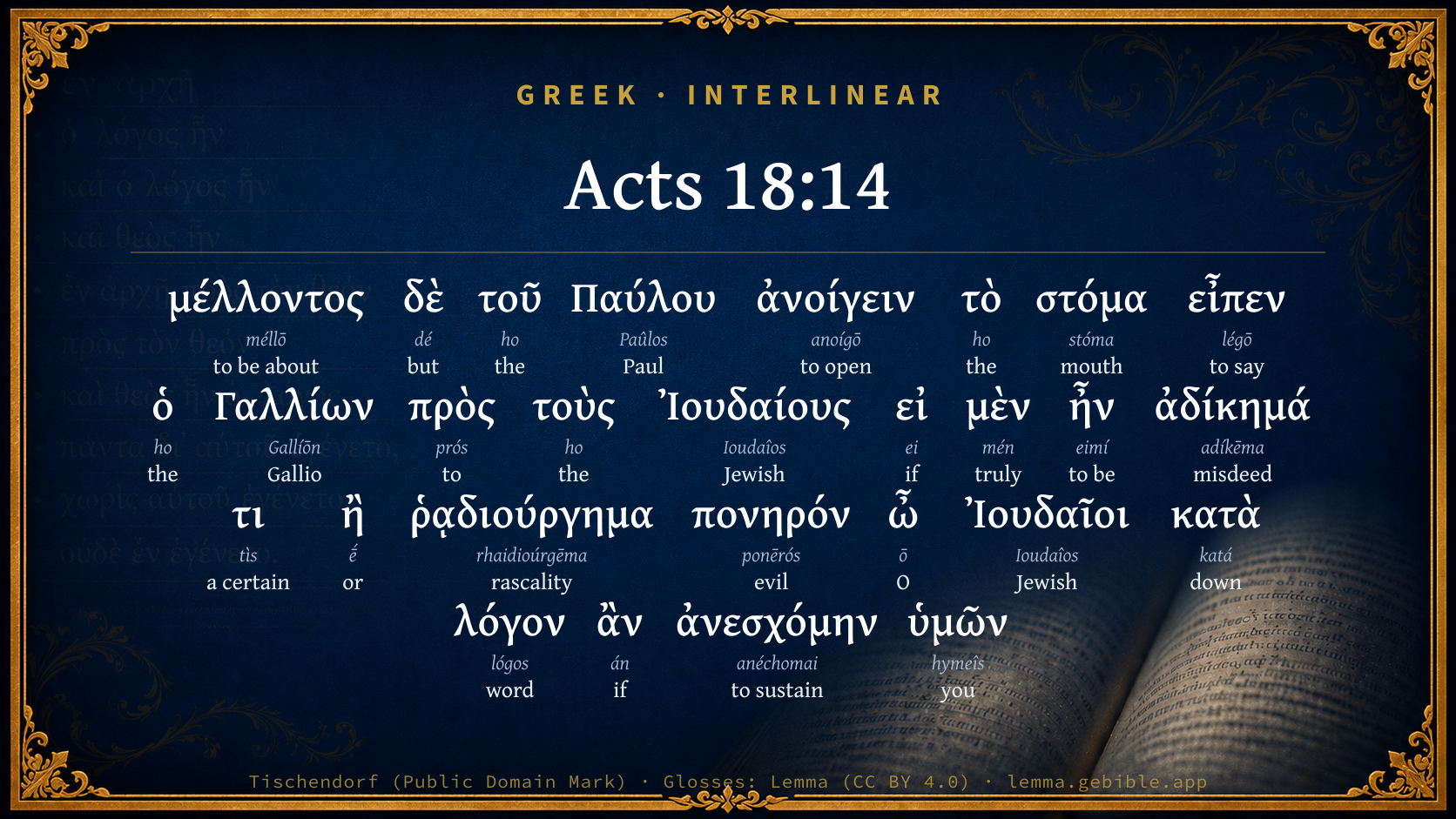
Download image
Cite this verse

Acts 18:14 (World English Bible). Public Domain. Lemma interlinear Bible study tool, https://lemma.gebible.app/v/acts/18/14.

Show BibTeX & RIS
BibTeX
RIS
English Translation
But when Paul was about to open his mouth, Gallio said to the Jews, "If indeed it were a matter of wrong or of wicked crime, you Jews, it would be reasonable that I should bear with you;
World English Bible · Public Domain
Highlights
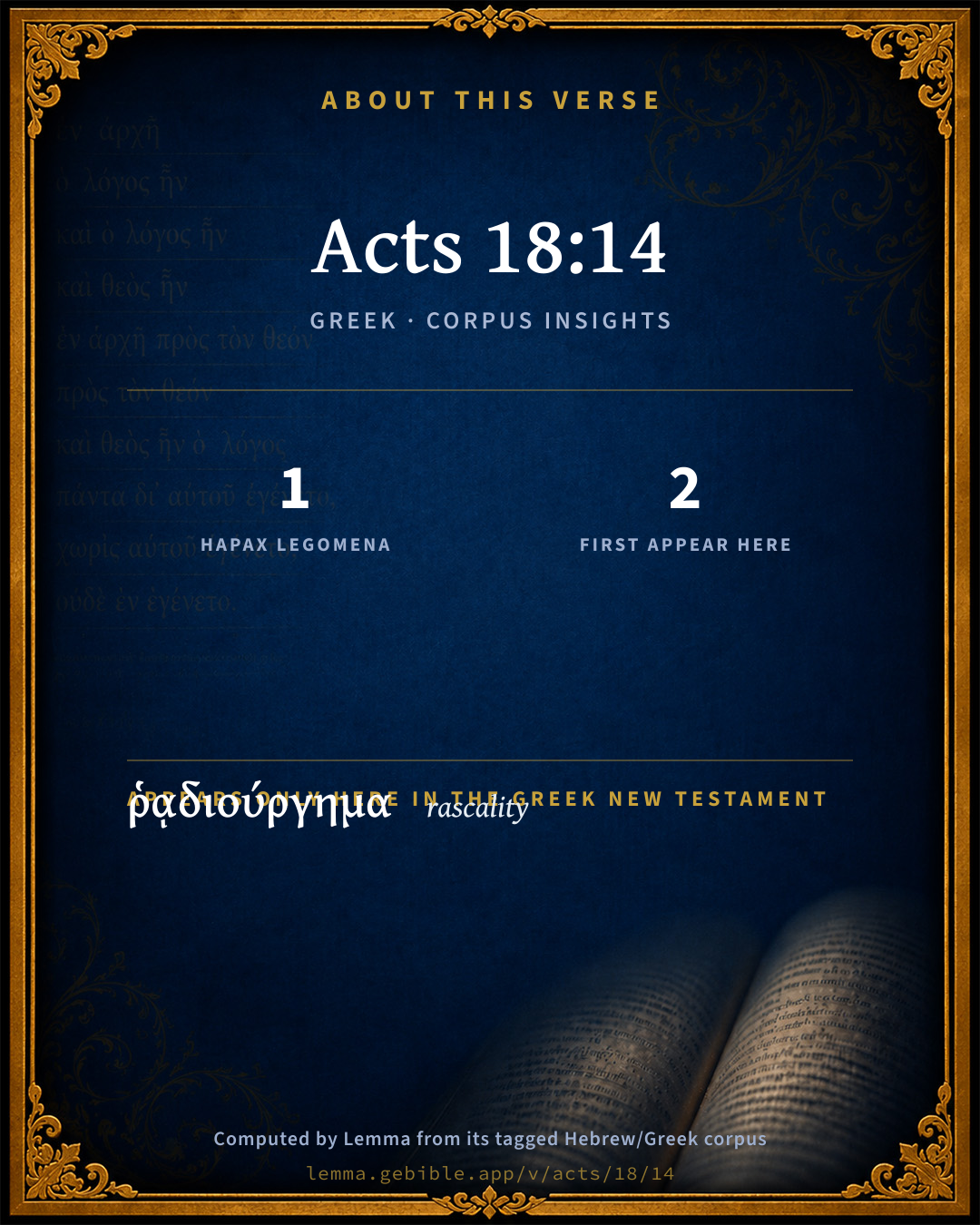
  • 1 hapax legomenon — only here in the Greek New Testament
  • 2 first appearances in the Greek New Testament
Full analysis ↓
Download a study sheet

One document with this verse’s original text, its word-by-word gloss line, the meaning frame, cross-references with their text, attributed commentary, and full source and license credits — printable, and it pastes into notes with its structure intact.

This verse Autodidact and up

Study sheet (.html) Plain text (.txt)

A passage Seminary Student

Up to 50 verses in one chapter. A passage sheet keeps up to 6 commentary sources and 12 cross-references per verse, in the order this page ranks them, and says so on the sheet whenever that leaves anything out. Ask for a single verse and you get the Autodidact verse sheet above.

Everything on this page stays free to read, with no account — the sheet is a download of what is already on screen, not access to it.

Want to remove ads? Support Godless Engineer
Compare translations 3

The same verse in 3 English versions, stacked beneath the original-language interlinear above. Click any original word for its lexicon entry.

Each is an independent rendering of the whole verse — the interlinear is not word-aligned to these translations.

Highlighted words mark where these versions differ — a whole-verse word diff, not a word-by-word alignment.

  • World English Bible Public Domain
    But when Paul was about to open his mouth, Gallio said to the Jews, "If indeed it were a matter of wrong or of wicked crime, you Jews, it would be reasonable that I should bear with you;
  • King James Version Public Domain
    And when Paul was now about to open his mouth, Gallio said unto the Jews, If it were a matter of wrong or wicked lewdness, O ye Jews, reason would that I should bear with you:
  • unfoldingWord Literal Text CC BY-SA 4.0
    But when Paul was going to open mouth, Gallio said to the Jews, “O Jews, if indeed it was some crime or evil wrongdoing, by reason I would have endured you,

unfoldingWord Literal Text — © unfoldingWord, licensed CC BY-SA 4.0. Word-aligned USFM3 via Door43 (git.door43.org/unfoldingWord/en_ult).

Versions to compare (up to 4)

3 of 4 selected

Show all 19 translations

Every available English version of this verse, each an independent rendering of the whole verse.

  • World English Bible Public Domain
    But when Paul was about to open his mouth, Gallio said to the Jews, "If indeed it were a matter of wrong or of wicked crime, you Jews, it would be reasonable that I should bear with you;
  • Berean Standard Bible Public Domain
    But just as Paul was about to speak, Gallio told the Jews, “If this matter involved a wrongdoing or vicious crime, O Jews, it would be reasonable for me to hear your complaint.
  • Majority Standard Bible Public Domain
    But just as Paul was about to speak, Gallio told the Jews, “If this matter involved a wrongdoing or vicious crime, O Jews, it would be reasonable for me to hear your complaint.
  • King James Version Public Domain
    And when Paul was now about to open his mouth, Gallio said unto the Jews, If it were a matter of wrong or wicked lewdness, O ye Jews, reason would that I should bear with you:
  • American Standard Version (1901) Public Domain
    But when Paul was about to open his mouth, Gallio said unto the Jews, If indeed it were a matter of wrong or of wicked villany, O ye Jews, reason would that I should bear with you:
  • Revised Version (1885) Public Domain
    But when Paul was about to open his mouth, Gallio said unto the Jews, If indeed it were a matter of wrong or of wicked villany, O ye Jews, reason would that I should bear with you:
  • Geneva Bible (1599) Public Domain
    And as Paul was about to open his mouth, Gallio saide vnto the Iewes, If it were a matter of wrong, or an euill deede, O ye Iewes, I would according to reason maintaine you.
  • Douay-Rheims (1899) Public Domain
    And when Paul was beginning to open his mouth, Gallio said to the Jews: If it were some matter of injustice, or an heinous deed, O Jews, I should with reason bear with you.
  • Young's Literal Translation Public Domain
    and Paul being about to open `his' mouth, Gallio said unto the Jews, `If, indeed, then, it was anything unrighteous, or an act of wicked profligacy, O Jews, according to reason I had borne with you,
  • Literal Standard Version CC BY-SA 4.0
    and Paul being about to open [his] mouth, Gallio said to the Jews, “If, indeed, then, it was anything unrighteous, or an act of wicked recklessness, O Jews, according to reason I had borne with you,
  • Unlocked Literal Bible CC BY-SA 4.0
    Yet when Paul was about to speak, Gallio said to the Jews, “You Jews, if indeed it were a matter of wrong or a crime, it would be reasonable to deal with you.
  • unfoldingWord Literal Text CC BY-SA 4.0
    But when Paul was going to open mouth, Gallio said to the Jews, “O Jews, if indeed it was some crime or evil wrongdoing, by reason I would have endured you,
  • Darby Bible Public Domain
    But as Paul was going to open his mouth, Gallio said to the Jews, If indeed it was some wrong or wicked criminality, O Jews, of reason I should have borne with you;
  • World Messianic Bible Public Domain
    But when Paul was about to open his mouth, Gallio said to the Jews, “If indeed it were a matter of wrong or of wicked crime, you Jews, it would be reasonable that I should bear with you;
  • Webster's Bible Public Domain
    And when Paul was now about to open his mouth, Gallio said to the Jews, If it were a matter of wrong, or hainous crime, O ye Jews, reason would that I should bear with you:
  • Free Bible Version CC BY-SA 4.0
    But just as Paul was about to defend himself, Gallio told the Jews, “If you Jews were bringing criminal charges or some serious legal offense, there would be a reason for me to listen to your case.
  • Bible in Basic English Public Domain
    But when Paul was about to say something, Gallio said to the Jews, If this was anything to do with wrongdoing or crime, there would be a reason for me to give you a hearing:
  • Text-Critical English NT CC BY 4.0
    But just as Paul was about to open his mouth to speak, Gallio said to the Jews, “If it were a matter of some crime or evil misdeed, O Jews, I would bear with you, as is reasonable.
  • Tyndale New Testament (1534) Public Domain
    And as Paul was about to open his mouth Gallio sayde vnto the Iewes: yf it were a matter of wronge or an evyll dede (o ye Iewes) reason wolde that I shuld heare you:

Literal Standard Version (2020), Covenant Press — licensed CC BY-SA 4.0. Text via the HelloAO Bible API (eBible.org). Unlocked Literal Bible (unfoldingWord) — licensed CC BY-SA 4.0. Text via the HelloAO Bible API (eBible.org). unfoldingWord Literal Text — © unfoldingWord, licensed CC BY-SA 4.0. Word-aligned USFM3 via Door43 (git.door43.org/unfoldingWord/en_ult). Free Bible Version, Dr. Jonathan Gallagher — licensed CC BY-SA 4.0. Text via the HelloAO Bible API (eBible.org).

Word by word

More ways to search: Search by grammar → Find every occurrence → Compare this word →

Practice this passage: Drill this verse → Learn its vocabulary →

ῥᾳδιούργημα
rhaidioúrgēma
G4467
“rascality”
Noun, Nominative, Singular, Neuter
Part of Speech
Noun
Case
Nominative
Number
Singular
Gender
Neuter
Full Thayer's Definition

Origin: from a comparative of rhaidios (easy, i.e. reckless) and G2041

TDNT: 22:13,0

1. a piece of knavery, rascality, villainy
  1. μέλλοντος méllō G3195 “to be about” Verb, Present, Active, Participle, Genitive, Singular, Masculine
  2. δὲ dé G1161 “but” Conjunction
  3. τοῦ ho G3588 “the” Article, Genitive, Singular, Masculine
  4. Παύλου Paûlos G3972 “Paul” Noun, Genitive, Singular, Masculine
  5. ἀνοίγειν anoígō G455 “to open” Verb, Present, Active, Infinitive
  6. τὸ ho G3588 “the” Article, Accusative, Singular, Neuter
  7. στόμα stóma G4750 “mouth” Noun, Accusative, Singular, Neuter
  8. εἶπεν légō G3004 “to say” Verb, Aorist, Active, Indicative, 3rd person, Singular
  9. ὁ ho G3588 “the” Article, Nominative, Singular, Masculine
  10. Γαλλίων Gallíōn G1058 “Gallio” Noun, Nominative, Singular, Masculine
  11. πρὸς prós G4314 “to” Preposition
  12. τοὺς ho G3588 “the” Article, Accusative, Plural, Masculine
  13. Ἰουδαίους Ioudaîos G2453 “Jewish” Adjective, Accusative, Plural, Masculine
  14. εἰ ei G1487 “if” Conditional
  15. μὲν mén G3303 “truly” Particle
  16. ἦν eimí G1510 “to be” Verb, Imperfect, Active, Indicative, 3rd person, Singular
  17. ἀδίκημά adíkēma G92 “misdeed” Noun, Nominative, Singular, Neuter
  18. τι tìs G5100 “a certain” Indefinite pronoun, Nominative, Singular, Neuter
  19. ἢ ḗ G2228 “or” Particle
  20. πονηρόν ponērós G4190 “evil” Adjective, Nominative, Singular, Neuter
  21. ὦ ō G5599 “O” Interjection
  22. Ἰουδαῖοι Ioudaîos G2453 “Jewish” Adjective, Vocative, Plural, Masculine
  23. κατὰ katá G2596 “down” Preposition
  24. λόγον lógos G3056 “word” Noun, Accusative, Singular, Masculine
  25. ἂν án G302 “if” Particle
  26. ἀνεσχόμην anéchomai G430 “to sustain” Verb, Aorist, Middle, Indicative, 1st person, Singular
  27. ὑμῶν hymeîs G5210 “you” Personal pronoun, 2nd person, Genitive, Plural

About this verse

These counts appear in no published source. They are computed here, from the morphology-tagged text and Lemma’s own curated glosses. What Lemma adds →

28
words
24
distinct lemmas
Acts
section

Notable vocabulary

1 hapax legomenon — a word that appears only here in the entire Greek New Testament:

  • ῥᾳδιούργημα rascality G4467

First appearance in Scripture

These words make their first canonical appearance in the Greek New Testament here:

  • ἀδίκημά misdeed G92
  • ῥᾳδιούργημα rascality G4467

Shared distinctive vocabulary

Γαλλίων Gallio G1058 occurs in 3 verses of the Greek New Testament. Also found in:
Repetition

Words recur within this verse:

  • Ἰουδαίους Jewish G2453 ×2
  • τοῦ the G3588 ×4

Cross-references

14

Topical passages linked to Acts 18:14 in the Treasury of Scripture Knowledge — connected by theme and wording, ordered by reader-vote popularity; previews shown in the World English Bible.

  • 1 Peter 3:14–15 But even if you should suffer for righteousness' sake, you are blessed. "Don't fear what they fear, neither be troubled."
  • Mark 9:19 He answered him, "Unbelieving generation, how long shall I be with you? How long shall I bear with you? Bring him to me."
  • Luke 21:12–15 But before all these things, they will lay their hands on you and will persecute you, delivering you up to synagogues and prisons, bringing you before kings and governors for my name's sake.
  • Acts 13:18 For a period of about forty years he put up with them in the wilderness.
  • Acts 21:39–22:2 But Paul said, "I am a Jew, from Tarsus in Cilicia, a citizen of no insignificant city. I beg you, allow me to speak to the people."
  • Acts 23:27–29 "This man was seized by the Jews, and was about to be killed by them, when I came with the soldiers and rescued him, having learned that he was a Roman.
  • Acts 25:11 For if I have done wrong, and have committed anything worthy of death, I don't refuse to die; but if none of those things is true that they accuse me of, no one can give me up to them. I appeal to Caesar!"
  • Acts 25:18–20 Concerning whom, when the accusers stood up, they brought no charge of such things as I supposed;
  • Acts 25:26 Of whom I have no certain thing to write to my lord. Therefore I have brought him forth before you, and especially before you, King Agrippa, that, after examination, I may have something to write.
  • Acts 26:1–2 Agrippa said to Paul, "You may speak for yourself." Then Paul stretched out his hand, and made his defense.
  • Romans 13:3 For rulers are not a terror to the good work, but to the evil. Do you desire to have no fear of the authority? Do that which is good, and you will have praise from the same,
  • 2 Corinthians 11:1 I wish that you would bear with me in a little foolishness, but indeed you do bear with me.
  • 2 Corinthians 11:4 For if he who comes preaches another Jesus, whom we did not preach, or if you receive a different spirit, which you did not receive, or a different gospel, which you did not accept, you put up with that well enough.
  • Hebrews 5:2 The high priest can deal gently with those who are ignorant and going astray, because he himself is also surrounded with weakness.

Cross-references courtesy of OpenBible.info (CC BY 4.0).

Where the printed editions differ

1 variant

Places in this verse where the major printed Greek editions disagree on the wording in a way that affects the translation — a comparison of editions, not a manuscript-by-manuscript collation. The editions are the modern critical texts (Nestlé-Aland 28/27, SBL, Westcott-Hort, Tregelles, Tyndale House) and the traditional texts behind the KJV (the Textus Receptus and the Byzantine/Majority text). It is not a claim about which reading is original.

  1. Extra text
    οὖν

    “therefore”

    In TRByz Not in NA28NA27TynSBLWHTreg

    οὖν (oun) 'therefore' is only in traditional manuscripts (TR+Byz)

Textual data: Translators Amalgamated Greek New Testament (STEPBible TAGNT) · CC BY 4.0.

Commentary

Notes on Acts 18:14 from classic Christian and Jewish commentators (each source and its license shown beneath its notes). The classic Christian expositions comment on the surrounding passage and are grouped to its opening verse, so a note may address several verses; the Jewish commentaries on the Tanakh (Rashi and others) are per-verse, so they appear only where the commentator wrote on this verse.

Lemma curates 59 commentaries, every one of them public domain or Creative Commons licensed, each selected and text-cleaned for this edition rather than reprinted as found. About our sources →

Joseph Benson's Commentary

Act 18:14-16. And when Paul was now about to open his mouth — To speak in his own defence; Gallio — Sensible of the futility of the charge; said to the Jews, If it were a matter of wrong, or wicked lewdness — With which you charged the person you have now brought before me: that is, If you accused this man of any injury done to particular persons, or of wantonly disturbing the peace of society; reason would — That is, it were reasonable; that I should bear with you — In this prosecution; and even that I should exert the power with which I am invested, to punish the offender in proportion to his crime. But if it be a question of words —

Greek, περι λογου, concerning discourse, or doctrine; and of names, and of your law — If your accusation respect opinions taught by Paul, which ye think heretical; and whether the names of the Christ, and the Son of God, which he hath given to any one, ought to be given to that person; and whether all who worship the God of the Jews, are bound to worship him according to the rites of your law; look ye to it — These are matters which belong to yourselves, and with which, as a magistrate, I have no concern. I will be no judge of such matters — Matters so foreign to my office. The apparent coolness and contempt with which Gallio speaks of the matters in debate between Paul and the Jews does not merit commendation, but the severest censure. The names of the heathen gods, and the institutions concerning their worship and service, were fables, shadows, and deceits; but the question concerning the name of Jesus, his person, character, and offices, and the worship and service of the living and true God, is of more importance than all things else under heaven. Yet, there is this singularity (among a thousand others) in the Christian religion, that human reason, curious as it is in all other things, abhors to inquire into it. And he drave them from the judgment-seat — Not regarding their clamorous importunity.

Joseph Benson's Commentary on the Old and New Testaments (1811–1818) — public domain. Text from a community e-Sword module.

MacLaren's Expositions of Holy Scripture

Alexander MacLaren

Acts

GALLIO

Act 18:14 - Act 18:15.

There is something very touching in the immortality of fame which comes to the men who for a moment pass across the Gospel story, like shooting stars kindled for an instant as they enter our atmosphere. How little Gallio dreamed that he would live for ever in men’s mouths by reason of this one judicial dictum! He was Seneca’s brother, and was possibly leavened by his philosophy and indisposed to severity. He has been unjustly condemned. There are some striking lessons from the story.

I. The remarkable anticipation of the true doctrine as to the functions of civil magistrates.

Gallio draws a clear distinction between conduct and opinion, and excepts the whole of the latter region from his sway. It is the first case in which the civil authorities refused to take cognisance of a charge against a man on account of his opinions. Nineteen hundred years have not brought all tribunals up to that point yet. Gallio indeed was influenced mainly by philosophic contempt for the trivialities of what he thought a superstition. We are influenced by our recognition of the sanctity of individual conviction, and still more by reverence for truth and by the belief that it should depend only on its own power for progress and on itself for the defeat of its enemies.

II. The tragic mistake about the nature of the Gospel which men make.

There is something very pathetic in the erroneous estimates made by those persons mentioned in Acts who some once or twice come in contact with the preachers of Christ. How little they recognise what was before them! Their responsibility is in better hands than ours. But in Gallio there is a trace of tendencies always in operation.

We see in him the practical man’s contempt for mere ideas. The man of affairs, be he statesman or worker, is always apt to think that things are more than thoughts. Gallio, proconsul in Corinth, and his brother official, Pilate, in Jerusalem, both believed in powers that they could see. The question of the one, for an answer to which he did not wait, was not the inquiry of a searcher after truth, but the exclamation of a sceptic who thought all the contradictory answers that rang through the world to be demonstrations that the question had no answer. The impatient refusal of the other to have any concern in settling ‘such matters’ was steeped in the same characteristically Roman spirit of impatient distrust and suspicion of mere ideas. He believed in Roman force and authority, and thought that such harmless visionaries as Paul and his company might be allowed to go their own way, and he did not know that they carried with them a solvent and constructive power before which the solid-seeming structure of the Empire was destined to crumble, as surely as thick-ribbed ice before the sirocco.

And how many of us believe in wealth and material progress, and regard the region of truth as very shadowy and remote! This is a danger besetting us all. The true forces that sway the world are ideas.

We see in Gallio supercilious indifference to mere ‘theological subtleties.’ To him Paul’s preaching and the Jews’ passionate denials of it seemed only a squabble about ‘words and names.’ Probably he had gathered his impression from Paul’s eager accusers, who would charge him with giving the name of ‘Christ’ to Jesus.

Gallio’s attitude was partly Stoical contempt for all superstitions, partly, perhaps, an eclectic belief that all these warring religions were really saying the same thing and differed only in words and names; and partly sheer indifference to the whole subject. Thus Christianity appears to many in this day.

What is it in reality? Not words but power: a Name, indeed, but a Name which is life. Alas for us, who by our jangling have given colour to this misconception!

We see in Gallio the mistake that the Gospel has little relation to conduct. Gallio drew a broad distinction between conduct and opinion, and there he was right. But he imagined that this opinion had nothing to do with conduct, and how wrong he was there we need not elaborate.

The Gospel is the mightiest power for shaping conduct.

III. The ignorant levity with which men pass the crisis of their lives.

How little Gallio knew of what a possibility was opened out before him! Angels were hovering unseen. We seldom recognise the fateful moments of our lives till they are past.

The offer of salvation in Christ is ever a crisis. It may never be repeated. Was Gallio ever again brought into contact with Paul or Paul’s Lord? We know not. He passes out of sight, the search-light is turned in another direction, and we lose him in the darkness. The extent of his criminality is in better hands than ours, though we cannot but let our thoughts go forward to the time when he, like us all, will stand at the judgment bar of Jesus, no longer a judge but judged. Let us hope that before he passed hence, he learned how full of spirit and of life the message was, which he once took for a mere squabble about ‘words and names,’ and thought too trivial to occupy his court. And let us remember that the Jesus, whom we are sometimes tempted to judge as of little importance to us, will one day judge us, and that His judgment will settle our fate for evermore.

Alexander MacLaren, Expositions of Holy Scripture (1904–1910) — public domain. Text from a community e-Sword module.

Tyndale Open Study Notes

Tyndale Open Resources

18:14-17 Gallio’s ruling indicated that the charges against Paul were unjustified. The Roman government had nothing to fear from acknowledging Christianity as a legal religion.

Tyndale Open Study Notes — © Tyndale Open Resources, licensed CC BY-SA 4.0. Text via the HelloAO Bible API.

Bengel's Gnomon

Johann Albrecht Bengel

Act 18:14. Εἶπεν, said) Either because he was favourable to Paul, or because he despised the Jews.—ἀδίκημα, a matter of wrong) demanding a civil action.—ῥᾳδιούργημα, wanton wickedness) worthy of a criminal action.—ἠνεσχόμην, I would bear with you) Certainly ἀνοχὴ, forbearance, is becoming in a judge, if he is rightly to discharge the duties of his office. Gallio implies that the Jews were troublesome (an annoyance) to him.

Bengel's Gnomon of the New Testament — English translation (T&T Clark, Edinburgh, 1860) — public domain. Text from a community e-Sword module.

Meyer's Critical & Exegetical Commentary

Heinrich August Wilhelm Meyer

Act_18:14-15. The mild and humane Gallio (Stat. Silv. ii. 7, 32; Seneca, Q. Nat. 4 praef.) refuses to examine into the complaint, and hands it over, as simply concerning doctrine, to the decision of the accusers themselvesto the Jewish tribunalwithout permitting Paul, who was about to begin his defence, to speak.

οὖν] namely, in pursuance of your accusation.

ῥᾳδιούργ. ὑμῶν] I should with reason (see Plat. Rep. p. 366 B; Wetstein in loc.; Bernhardy, p. 241) bear with you, i.e. according to the context: give you a patient hearing. Comp. Plat. Phil. p. 13 B; Rep. p. 367 D. Judaeos Gallion sibi molestos innuit, Bengel.

εἰ δὲ ζητήματα … ὑμᾶς] but if (as your complaint shows) there are questions in dispute (Act_15:2) concerning doctrine and names (plural of category; Pauls assertion that the name of Messiah belonged to Jesus, was the essential matter of fact in the case, see Act_18:5), and of your (and so not of Roman) law.

τοῦ καθʼ ὑμᾶς] See on Act_17:28.

κριτὴς κ.τ.λ.] Observe the order of the words, judge will I for my part, etc. Thus Gallio speaks in the consciousness of his political official position; and his wise judgmentwhich Calovius too harshly designates as ἀμέλεια atheisticais after a corresponding manner to be borne in mind in determining the limits of the ecclesiastical power of princes as bearing on the separation of the secular and spiritual government, with due attention, however, to the circumstance that Gallio was outside the pale of the Jewish religious community.

Meyer — Critical and Exegetical Commentary on the New Testament — English translation by Peter Christie, edited by Frederick Crombie (T&T Clark, 1880) — public domain. Text from a community e-Sword module.

Expositor's Greek Testament

ed. W. Robertson Nicoll

Act 18:14 . μέλλοντος : Lucan; see Burton, p. 71, on οὖν , see critical note and Alford, in loco , for its retention. ἀδίκημα , cf. Act 24:20 , only once elsewhere in N.T., Rev 18:5 , here it may perhaps mark a legal wrong, a wrong against the state the word is used in classical Greek of a breach of law ἀδίκ . τῶν νόμων , Dem., 586, 11, while ῥᾳδιούργημα marks rather the moral wrong. ῥᾳδ ., cf. Act 13:10 , not elsewhere either in classical Greek or LXX, but cf. Plut., Pyrrh. , 6, “if a misdemeanour or a crime”: so Ramsay. κατὰ λόγον : ut par est, merito; cf. use of the phrase in Polyb. and Mal 3:14Mal 3:14 ( παρὰ λ ., 2Ma 4:46 , 3Ma 7:8 ). Ἰουδαῖοι without ἄνδρες perhaps in contempt (so Knabenbauer), but see critical note. ἠνεσχόμην , cf. Luk 9:41 , and so several times in St. Paul’s Epistles, 2Co 11:1 ; 2Co 11:4 ; on the augment and construction see Blass, Gram. , pp. 39, 102, Simcox, Language of the New Testament , p. 34, note, and Burton, p. 103.

The Expositor's Greek Testament, edited by W. Robertson Nicoll (1897–1910) — public domain. Text from a community e-Sword module.

Geneva Bible (1599)

Geneva Bible translators

As much as in right I could.

Geneva Bible (1599) marginal notes — public domain. Text via Bolls.life.

Jamieson, Fausset & Brown

Robert Jamieson, A. R. Fausset & David Brown

If it were a matter of wrong or wicked lewdness--any offense punishable by the magistrate.

Jamieson, Fausset & Brown — Commentary Critical and Explanatory on the Whole Bible (1871) — public domain (CC PDM 1.0). Text via the HelloAO Bible API.

Adam Clarke's Commentary

Verse 14. Paul was now about to open his mouth] He was about to enter on his defense; but Gallio, perceiving that the prosecution was through envy and malice, would not put Paul to any farther trouble, but determined the matter as follows.

If it were a matter of wrong] αδικημα, Of injustice; any thing contrary to the rights of the subject.

Or wicked lewdness] ραδιουργημα πονηρον, Destructive mischief. (See Clarke on Ac 13:10, where the word is explained.) Something by which the subject is grievously wronged; were it any crime against society or against the state.

Reason would that I should bear with you.] κατα λογον αν ηνεσχομην υμων, According to reason, or the merit of the case, I should patiently hear you.

Adam Clarke's Commentary on the Bible (1810–1826) — public domain. Text from a community e-Sword/MySword module.

Ellicott's Commentary for English Readers

(14) When Paul was now about to open his mouth.—The phrase always implies, as has been noticed (see Note on Act_8:35), the beginning of a set discourse. St. Paul was about to begin a formal apologia. This, however, proved to be unnecessary.

Gallio said unto the Jews.—The proconsul could hardly have resided in Achaia for eighteen months without hearing of the new movement. He knew the Jews. He probably knew something of St. Paul. On the assumption already referred to (see Note on Act_18:12) the knowledge may have been fuller than appears on the surface. In any case, from his standpoint, as philosopher and statesman, it was not a matter for his tribunal. He was not anxious to draw a hard and fast line as to the relligiones licitæ recognised by the State.

A matter of wrong or wicked lewdness.—Better, a matter of crime or fraud. “Lewdness,” which to us suggests a special class of crimes, is used as “lewd” had been in Act_17:5. The Greek word is very closely connected with that translated “subtlety” in Act_13:10. Both words were probably used in a strictly forensic sense—the first for acts of open wrong, such as robbery or assault; the second for those in which a fraudulent cunning was the chief element.

Reason would that I should bear with you.—The very turn of the phrase expresses an intense impatience. Even in the case supposed, his tolerance would have required an effort. As it was, these Jews were now altogether intolerable.

A Bible Commentary for English Readers, edited by Charles John Ellicott (1878–1897) — public domain. Text from a community e-Sword module.

The Cambridge Bible for Schools and Colleges

gen. ed. J. J. S. Perowne

14. And (But) when Paul was now about to open his mouth] There is nothing in the Gk. which requires the word “now.” The Roman has too much contempt for the whole matter and all who are concerned in it to listen to any defence. For the law of the Jews, its breach or its observance, he has no care, and will not be used by either party.

Gallio said unto the Jews] He does not need to hear both sides of a question about which he will give no opinion.

If indeed it were a matter of wrong or of wicked lewdness (villany)] The old word “lewdness” has grown to have a different meaning from that which it had when the A. V. was made. The two things of which the magistrate would take account are (1) any evil doing (cp. Act_24:20), an act of injustice, or (2) any unscrupulous conduct involving moral wrong. He would be, that is, a minister of law and equity, for that was his duty.

reason would that I should bear with you] He shews by his language how far he feels the Roman citizen above the tolerated Jews. But if their case called for its exercise they should have the benefit of toleration and he would inquire into matters that were the business of his office.

The Cambridge Bible for Schools and Colleges (gen. ed. J. J. S. Perowne; Cambridge University Press, 1878–1918) — public domain. Text from a community e-Sword module.

John Gill's Exposition

But if it be a question of words,.... "Or of the word", what the Jews called the word of God, which Gallio did not pretend to understand: "and names"; as the names of God, of Jesus, and of Christ, whether he is God, and the Messiah:

and of your law; concerning circumcision, whether these Christians, and the proselytes they make, are obliged unto it:

look ye to it; suggesting that this was a matter that lay before them, and they were the proper judges of, and might determine for themselves, since they had the free exercise of their religion, and a right of judging of everything that respected that within themselves, and for which they were best furnished, as having a more competent knowledge of them; as the Arabic version renders it, "and ye are more learned in these things"; and most conversant with them:

for I will be no judge of such matters; and it would be well if every civil magistrate would act the same part, and not meddle with religious affairs, any further than to preserve the public peace.

John Gill's Exposition of the Whole Bible (1746–1763) — public domain (CC PDM 1.0). Text via the HelloAO Bible API.

Trapp's Complete Commentary

John Trapp

14 And when Paul was now about to open his mouth, Gallio said unto the Jews, If it were a matter of wrong or wicked lewdness, O ye Jews, reason would that I should bear with you:

Ver. 14. Or wicked lewdness] The Greek word, ραδιουργημα, doth elegantly set forth the disposition of a lewd man; which is to be easily drawn to any wicked way. If the devil do but hold up his finger, he may have him at his beck and obedience; he is the devil’s clay and wax, and may be wrought to anything with a wet finger.

John Trapp, A Commentary or Exposition upon All the Books of the Old and New Testament (1647–1656) — public domain. Text from a community e-Sword module.

Albert Barnes' Notes on the Bible

About to open his mouth - In self-defense, ever ready to vindicate his conduct.

A matter of wrong - Injustice, or crime, such as could be properly brought before a court of justice.

Or wicked lewdness - Any flagrant and gross offence. The word used here occurs nowhere else in the New Testament. It denotes properly an act committed by him who is skilled, facile, or an adept in iniquity an act of a veteran offender. Such crimes Gallio was willing to take cognizance of.

Reason would ... - Greek: “I would bear with you according to reason.” There would be propriety or fitness in my hearing and trying the case. Thai is, it would fall within the sphere of my duty, as appointed to guard the peace, and to punish crimes.

Albert Barnes' Notes on the Bible (1834–1885) — public domain. Text from a community e-Sword/MySword module.

Matthew Poole's English Annotations

To open his mouth; to make his apology, and to speak in his own defence.

A matter of wrong; as murder, theft, or any such injury, which judges do usually determine of.

Reason would that I should bear with you; I would endure any trouble to hear and understand it, I should think it my duty to suffer you to say as much as you would in your case.

Matthew Poole's English Annotations on the Holy Bible (1683–1685) — public domain. Text from a community e-Sword/MySword module.

Whedon's Commentary on the Bible

Daniel D. Whedon

14. Paul… mouth—Paul was not allowed a defence, because there was no charge.

Wrong—Positive crime.

Lewdness—Rather, laxity; misconduct from easy carelessness, yet often arising to presumption and recklessness.

O ye Jews—The repugnance of the easy and graceful literary philosopher appears in every clause.

Bear with you—However severe the endurance.

Daniel D. Whedon (gen. ed.), Commentary on the Old and New Testaments (1874–1909) — public domain. Text from a community e-Sword module.

The Pulpit Commentary

But for and, A.V.; about for now about, A.V.; if indeed for if, A.V.; of wicked villainy for wicked lewdness, A.V. The Greek rJadiourghma occurs only here in the New Testament or elsewhere; rJadiourgia, which is not uncommon in Greek writers, occurs in Act_13:10.

The Pulpit Commentary (1880–1919), ed. H.D.M. Spence-Jones & Joseph S. Exell — public domain. Text from a community e-Sword module.

McGarvey & Pendleton's Commentaries

J. W. McGarvey

14-16. In this case, however, they had to deal with a man of far different character from the magistrates of Philippi, or the city rulers of Thessalonica. Gallio was a brother of Seneca, the famous Roman moralist, who describes him as a man of admirable integrity, amiable, and popular. Such was the character which he exhibited on this occasion. Instead of yielding to popular clamor, as did so many provincial and municipal officers, before whom the apostles were arraigned, he examined carefully the accusation, and seeing that it had reference, not to any infraction of the Roman law, but to questions in regard to their own law, he determined at once to dismiss the case. (14) " But when Paul was about to open his mouth, Gallio said to the Jews, If it were a matter of injustice or wicked recklessness, Jews, it would be reasonable that I should bear with you. (15) But since it is a question concerning a doctrine and words, and your own law, do you see to it; for I do not intend to be a judge of these matters. (16) And he drove them from the judgment-seat. " This is the only instance, in all the persecutions of Paul, in which his accusers were dealt with summarily and justly. The incident reflects great credit upon Gallio.

J. W. McGarvey (with Philip Y. Pendleton), Commentaries on the New Testament (The Fourfold Gospel, 1914; Acts; and the epistles) — public domain. Text from a community e-Sword/MySword module.

unfoldingWord translationNotes

Door43 World Missions Community

Gallio said

Gallio was the Roman governor of the Province.

your own law

Here "law" refers to the law of Moses and as well as the Jewish customs of Paul's time.

I do not wish to be a judge of these matters

"I refuse to make a judgment about these matters"

translationWords

Paul

Jew

wrong

word

name

law, laws

judge, judges

unfoldingWord translationNotes — © Distant Shores Media and the Door43 World Missions Community, licensed CC BY-SA 4.0. Source: git.door43.org/Door43/en_tn.

Cambridge Greek Testament for Schools and Colleges

14. μέλλοντος δὲ τοῦ Παύλου ἀνοίγειν τὸ στόμα, but when Paul was about to open his mouth. The Roman proconsul has too much contempt for the whole matter and all who are concerned in it to listen to any defence. For the law of the Jews, its breach or its observance, he has no care, and will not be used by either party. Chrysostom praises Gallio’s conduct. ἐπιεικής τις ἄνθρωπος οὗτος εἶναι μοι δοκεῖ, καὶ δῆλον ἐξ ὧν ἀποκρίνεται συνετῶς.

εἶπεν ὁ Γαλλίων πρὸς τοὺς Ιουδαίους, Gallio said unto the Jews. He declines to hear any argument, for he is determined to give no opinion.

εἰ μὲν ἦν ἀδίκημά τι ἢ ῥᾳδιούργημα πονηρόν, if it had been a matter of wrong or wicked villany. The two things of which the magistrate would take account are (1) any evil-doing (cp. Act 24:20), an act of injustice, or (2) any unscrupulous conduct involving moral wrong. He would be, that is, a minister of law and equity, for that was his duty.

κατὰ λόγον ἂν ἀνεσχόμην ὑμῶν, reason would that I should have borne with you. A very happy idiomatic rendering of the Greek, like many others in the A.V. Gallio shews by his language how far he feels the Roman citizen above the tolerated Jews. But if their case had called for its exercise they should have had the benefit of toleration, and he would have inquired into matters that were the business of his office.

Cambridge Greek Testament for Schools and Colleges (Cambridge University Press, 1896; 21 vols, various authors incl. Carr, Maclear, Plummer, Farrar, Lumby, Moule, M. R. James, Simcox) — public domain. Text from a community e-Sword module.

Alford’s Greek Testament

Henry Alford

14.] Though manuscript authority is so strong against the οὖν, I have retained it, as also has Tischdf. (Exo_7 [not Exo_8]). Its omission may be easily accounted for, from the copyists finding it unnecessary and seemingly out of place: but on no supposition can its insertion be rendered probable. It stands very appropriately here, referring to the complaint of the Jews, either as uttered by them, or perhaps recapitulated by Gallio:—‘Ye have charged this man with lawless conduct. If now this had really been so.…’

κατὰ λόγον] See reff. We have the opposite παρὰ λόγον in 2 Macc. 4:36.

ἂν ἠνεσχ. ὑμ.] I should have borne with (patiently heard) you.

Henry Alford, The Greek Testament (1849–1861) — public domain. Text from a community e-Sword module.

Vincent's Word Studies in the New Testament

Marvin R. Vincent

Lewdness [ραδιουργημα] . See on mischief, ch. 13 10. Rev., villainy.

Marvin R. Vincent, Word Studies in the New Testament (1887–1900) — public domain. Text from a community e-Sword/MySword module.

Lesson kit

Teaching starters — assembled from the data on this page, not authored interpretation. Every prompt links to the verse data it draws on. Edit before teaching.

Acts, in the Acts, opens this verse with 28 words (24 distinct Greek lemmas). Its most distinctive word is rhaidioúrgēma (“rascality”). A historical commentator’s framing appears above. Read the whole chapter for the surrounding context.

Discussion questions

  1. What does “rascality” (rhaidioúrgēma) contribute to the verse as a whole?
  2. 1 word here appears nowhere else in the Greek New Testament. Why might the author reach for such rare wording?
  3. 2 words make their first appearance in Scripture here. What does this debut establish?
  4. How does Acts 18:12, which shares the word «Gallio», read alongside this verse?
  5. What does the repetition of “Jewish” (2× in this one verse) do in this verse?
  6. These translations render this verse differently; the difference is in the English rendering, not the original. What questions does that raise?
  7. Compare how Joseph Benson's Commentary and MacLaren's Expositions of Holy Scripture read this verse. Where do they agree or differ?

Things to notice

  • 1 word in this verse appears nowhere else in the Greek New Testament.
  • 2 words make their first canonical appearance in Scripture here.
  • These translations choose different wording for 19 words in this verse.
  • “Jewish” occurs 2× in this single verse.
  • 24 distinct Greek lemmas span 28 words in this verse.

Reading settings

Reading text

Shown beneath each verse's original-language words.

Old Testament
Old Testament edition

Read the OT as the Masoretic Hebrew (MT) or the Greek Septuagint (LXX).

English shown for the Greek Septuagint (in the Hebrew ↔ Greek comparison).

Comparing translations? Open the Compare panel on any verse page to stack up to four side by side.