
Romans 3:27

Greek (Tischendorf 8th ed.) Romans 3:27 appears in the Greek New Testament. The text above is from the Tischendorf 8th edition. Each word links to its Strong’s number and a concise gloss. Click any word for its full Thayer’s Greek Lexicon entry.
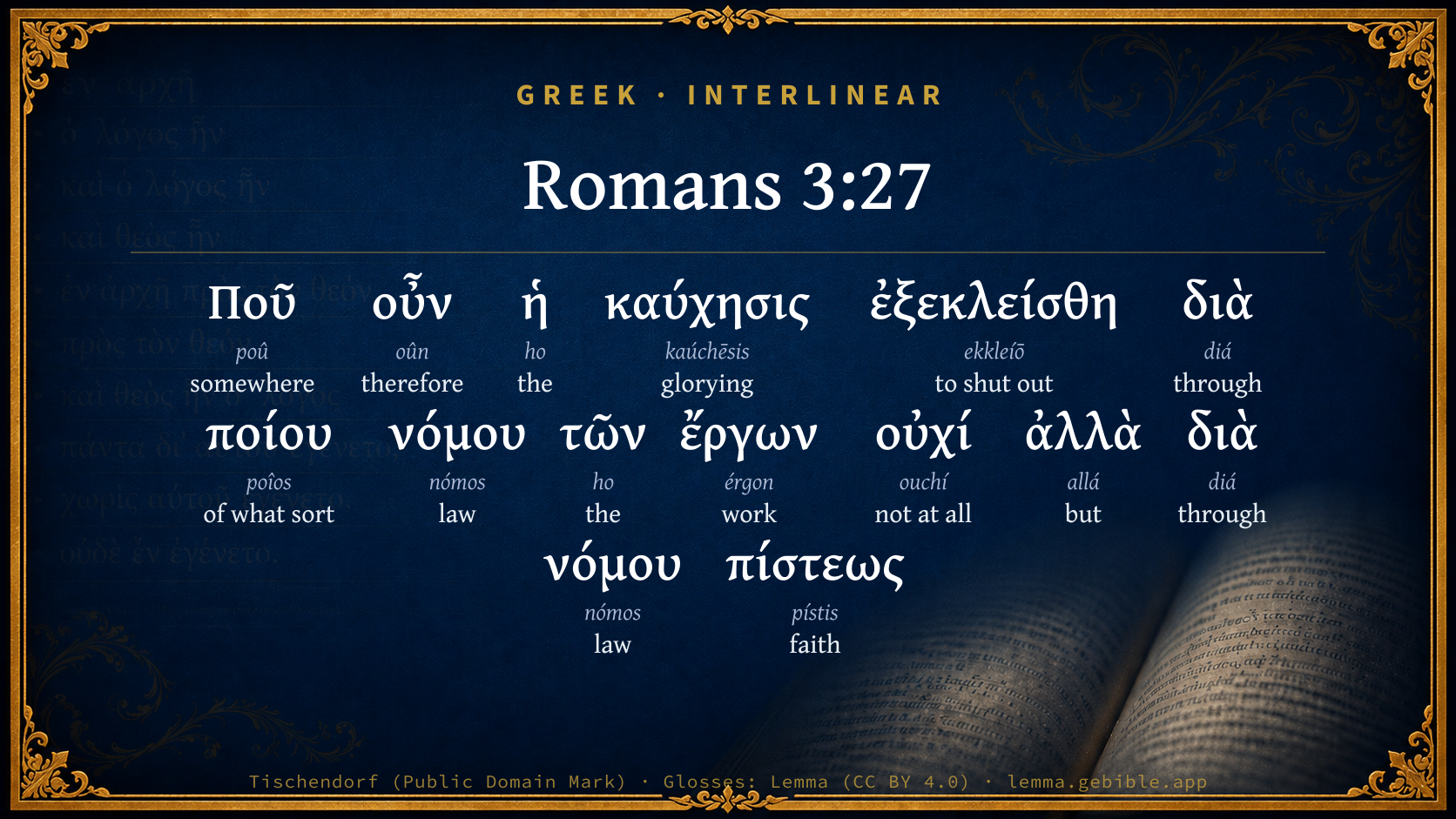
Download image
Cite this verse

Romans 3:27 (World English Bible). Public Domain. Lemma interlinear Bible study tool, https://lemma.gebible.app/v/romans/3/27.

Show BibTeX & RIS
BibTeX
RIS
English Translation
Where then is the boasting? It is excluded. By what manner of law? Of works? No, but by a law of faith.
World English Bible · Public Domain
Highlights
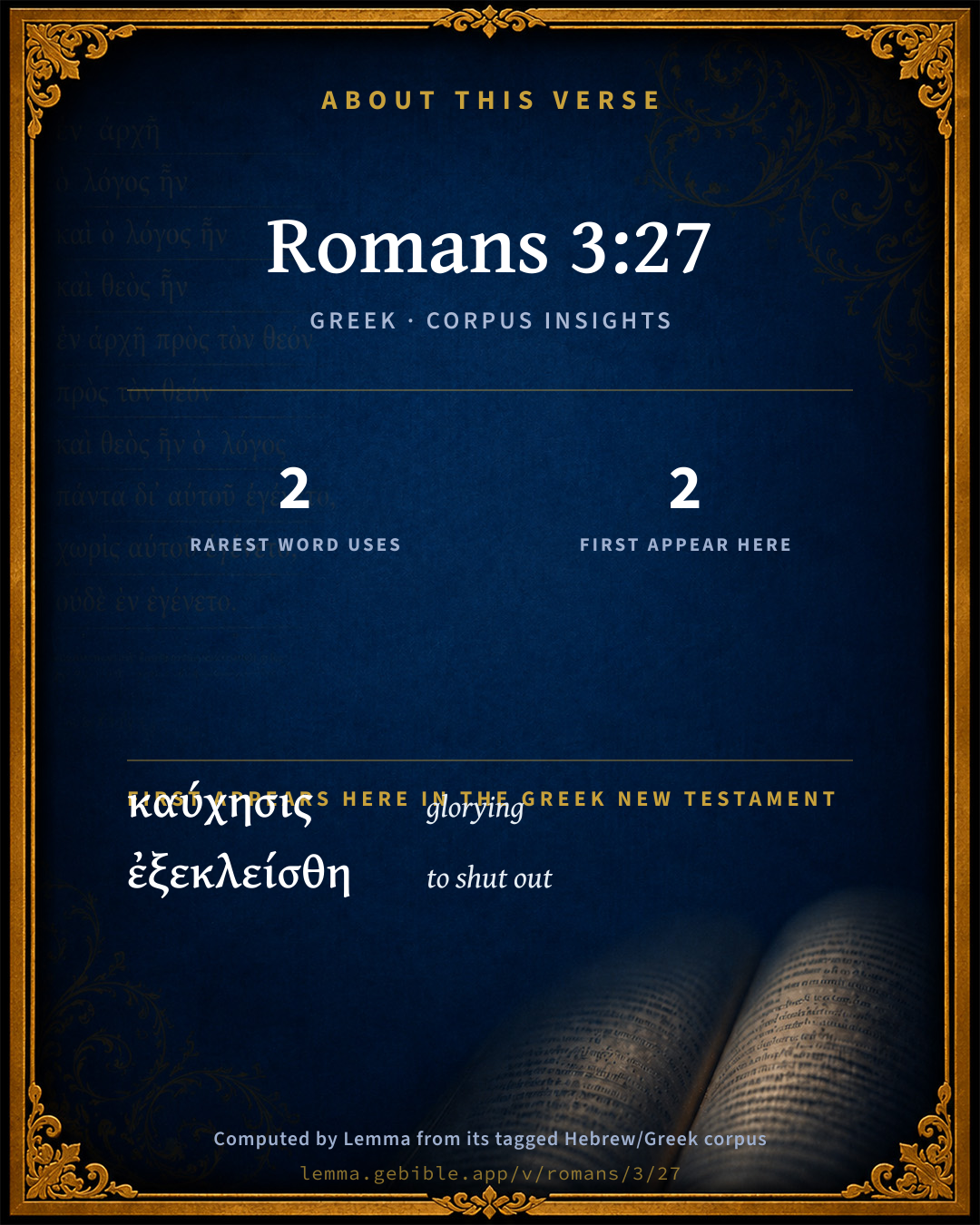
  • 2 first appearances in the Greek New Testament
Full analysis ↓
Download a study sheet

One document with this verse’s original text, its word-by-word gloss line, the meaning frame, cross-references with their text, attributed commentary, and full source and license credits — printable, and it pastes into notes with its structure intact.

This verse Autodidact and up

Study sheet (.html) Plain text (.txt)

A passage Seminary Student

Up to 50 verses in one chapter. A passage sheet keeps up to 6 commentary sources and 12 cross-references per verse, in the order this page ranks them, and says so on the sheet whenever that leaves anything out. Ask for a single verse and you get the Autodidact verse sheet above.

Everything on this page stays free to read, with no account — the sheet is a download of what is already on screen, not access to it.

Want to remove ads? Support Godless Engineer
Compare translations 3

The same verse in 3 English versions, stacked beneath the original-language interlinear above. Click any original word for its lexicon entry.

Each is an independent rendering of the whole verse — the interlinear is not word-aligned to these translations.

Highlighted words mark where these versions differ — a whole-verse word diff, not a word-by-word alignment.

  • World English Bible Public Domain
    Where then is the boasting? It is excluded. By what manner of law? Of works? No, but by a law of faith.
  • King James Version Public Domain
    Where is boasting then? It is excluded. By what law? of works? Nay: but by the law of faith.
  • unfoldingWord Literal Text CC BY-SA 4.0
    Where then the boasting? It is excluded. Through what kind of law? Of the works? No! But through a law of faith.

unfoldingWord Literal Text — © unfoldingWord, licensed CC BY-SA 4.0. Word-aligned USFM3 via Door43 (git.door43.org/unfoldingWord/en_ult).

Versions to compare (up to 4)

3 of 4 selected

Show all 19 translations

Every available English version of this verse, each an independent rendering of the whole verse.

  • World English Bible Public Domain
    Where then is the boasting? It is excluded. By what manner of law? Of works? No, but by a law of faith.
  • Berean Standard Bible Public Domain
    Where, then, is boasting? It is excluded. On what principle? On that of works? No, but on that of faith.
  • Majority Standard Bible Public Domain
    Where, then, is boasting? It is excluded. On what principle? On that of works? No, but on that of faith.
  • King James Version Public Domain
    Where is boasting then? It is excluded. By what law? of works? Nay: but by the law of faith.
  • American Standard Version (1901) Public Domain
    Where then is the glorying? It is excluded. By what manner of law? of works? Nay: but by a law of faith.
  • Revised Version (1885) Public Domain
    Where then is the glorying? It is excluded. By what manner of law? of works? Nay: but by a law of faith.
  • Geneva Bible (1599) Public Domain
    Where is then the reioycing? It is excluded. By what Lawe? of woorkes? Nay: but by the Lawe of faith.
  • Douay-Rheims (1899) Public Domain
    Where is then thy boasting? It is excluded. By what law? Of works? No, but by the law of faith.
  • Young's Literal Translation Public Domain
    Where then `is' the boasting? it was excluded; by what law? of works? no, but by a law of faith:
  • Literal Standard Version CC BY-SA 4.0
    Where then [is] the boasting? It was excluded; by what law? Of works? No, but by a law of faith:
  • Unlocked Literal Bible CC BY-SA 4.0
    Where then is boasting? It is excluded. On what grounds? Of works? No, but on the grounds of faith.
  • unfoldingWord Literal Text CC BY-SA 4.0
    Where then the boasting? It is excluded. Through what kind of law? Of the works? No! But through a law of faith.
  • Darby Bible Public Domain
    Where then [is] boasting? It has been excluded. By what law? of works? Nay, but by law of faith;
  • World Messianic Bible Public Domain
    Where then is the boasting? It is excluded. By what kind of law? Of works? No, but by a law of faith.
  • Webster's Bible Public Domain
    Where is boasting then? It is excluded. By what law? of works? No; but by the law of faith.
  • Free Bible Version CC BY-SA 4.0
    So do we have anything to boast about then? Absolutely not, there's no place for that! And why's that? Is it because we follow the law of observing requirements? No, we follow the law of trusting in God.
  • Bible in Basic English Public Domain
    What reason, then, is there for pride? It is shut out. By what sort of law? of works? No, but by a law of faith.
  • Text-Critical English NT CC BY 4.0
    Where then is boasting? It is excluded. By what kind of law? By a law of works? No, but by the law of faith.
  • Tyndale New Testament (1534) Public Domain
    Where is then thy reioysinge? It is excluded. By what lawe? by the lawe of workes? Naye: but by the lawe of fayth.

Literal Standard Version (2020), Covenant Press — licensed CC BY-SA 4.0. Text via the HelloAO Bible API (eBible.org). Unlocked Literal Bible (unfoldingWord) — licensed CC BY-SA 4.0. Text via the HelloAO Bible API (eBible.org). unfoldingWord Literal Text — © unfoldingWord, licensed CC BY-SA 4.0. Word-aligned USFM3 via Door43 (git.door43.org/unfoldingWord/en_ult). Free Bible Version, Dr. Jonathan Gallagher — licensed CC BY-SA 4.0. Text via the HelloAO Bible API (eBible.org).

Word by word

More ways to search: Search by grammar → Find every occurrence → Compare this word →

Practice this passage: Drill this verse → Learn its vocabulary →

ἐξεκλείσθη
ekkleíō
G1576
“to shut out”
Verb, Aorist, Passive, Indicative, 3rd person, Singular
Part of Speech
Verb
Tense
Aorist
Voice
Passive
Mood
Indicative
Person
3rd person
Number
Singular
Full Thayer's Definition

Origin: from G1537 and G2808

TDNT: None

1. to shut out, to turn out of doors 2. to prevent the approach of one
  1. Ποῦ poû G4226 “somewhere” Particle, Interrogative
  2. οὖν oûn G3767 “therefore” Conjunction
  3. ἡ ho G3588 “the” Article, Nominative, Singular, Feminine
  4. καύχησις kaúchēsis G2746 “glorying” Noun, Nominative, Singular, Feminine
  5. διὰ diá G1223 “through” Preposition
  6. ποίου poîos G4169 “of what sort” Interrogative pronoun, Genitive, Singular, Masculine
  7. νόμου nómos G3551 “law” Noun, Genitive, Singular, Masculine
  8. τῶν ho G3588 “the” Article, Genitive, Plural, Neuter
  9. ἔργων érgon G2041 “work” Noun, Genitive, Plural, Neuter
  10. οὐχί ouchí G3780 “not at all” Particle, Negative
  11. ἀλλὰ allá G235 “but” Conjunction
  12. διὰ diá G1223 “through” Preposition
  13. νόμου nómos G3551 “law” Noun, Genitive, Singular, Masculine
  14. πίστεως pístis G4102 “faith” Noun, Genitive, Singular, Feminine

About this verse

These counts appear in no published source. They are computed here, from the morphology-tagged text and Lemma’s own curated glosses. What Lemma adds →

15
words
12
distinct lemmas
Pauline Epistles
section

Notable vocabulary

The rarest word here is ἐξεκλείσθη to shut out G1576 — appearing just 2 times in the whole Greek New Testament.

First appearance in Scripture

These words make their first canonical appearance in the Greek New Testament here:

  • καύχησις glorying G2746
  • ἐξεκλείσθη to shut out G1576

Shared distinctive vocabulary

ἐξεκλείσθη to shut out G1576 occurs in 2 verses of the Greek New Testament. Also found in:
Repetition

Words recur within this verse:

Cross-references

24

Topical passages linked to Romans 3:27 in the Treasury of Scripture Knowledge — connected by theme and wording, ordered by reader-vote popularity; previews shown in the World English Bible.

  • Romans 4:2 For if Abraham was justified by works, he has something to boast about, but not toward God.
  • Romans 2:23 You who glory in the law, through your disobedience of the law do you dishonor God?
  • 1 Corinthians 1:29–31 that no flesh should boast before God.
  • Romans 2:17 Indeed you bear the name of a Jew, and rest on the law, and glory in God,
  • Galatians 3:22 But the Scriptures shut up all things under sin, that the promise by faith in Jesus Christ might be given to those who believe.
  • Ephesians 2:8–10 for by grace you have been saved through faith, and that not of yourselves; it is the gift of God,
  • Zephaniah 3:11 In that day you will not be disappointed for all your doings, in which you have transgressed against me; for then I will take away out of the midst of you your proudly exulting ones, and you will no more be haughty in my holy mountain.
  • Romans 7:21 I find then the law, that, to me, while I desire to do good, evil is present.
  • 1 John 5:11–12 The testimony is this, that God gave to us eternal life, and this life is in his Son.
  • Ezekiel 16:62–63 I will establish my covenant with you; and you shall know that I am Yahweh;
  • Ezekiel 36:31–32 Then shall you remember your evil ways, and your doings that were not good; and you shall loathe yourselves in your own sight for your iniquities and for your abominations.
  • Mark 16:16 He who believes and is baptized will be saved; but he who disbelieves will be condemned.
  • Luke 18:9–14 He spoke also this parable to certain people who were convinced of their own righteousness, and who despised all others.
  • John 3:36 One who believes in the Son has eternal life, but one who disobeys the Son won't see life, but the wrath of God remains on him."
  • Romans 3:19 Now we know that whatever things the law says, it speaks to those who are under the law, that every mouth may be closed, and all the world may be brought under the judgment of God.
  • Romans 7:23 but I see a different law in my members, warring against the law of my mind, and bringing me into captivity under the law of sin which is in my members.
  • Romans 7:25 I thank God through Jesus Christ, our Lord! So then with the mind, I myself serve God's law, but with the flesh, the sin's law.
  • Romans 8:2 For the law of the Spirit of life in Christ Jesus made me free from the law of sin and of death.
  • Romans 9:11 For being not yet born, neither having done anything good or bad, that the purpose of God according to election might stand, not of works, but of him who calls,
  • Romans 9:32 Why? Because they didn't seek it by faith, but as it were by works of the law. They stumbled over the stumbling stone;
  • Romans 11:6 And if by grace, then it is no longer of works; otherwise grace is no longer grace. But if it is of works, it is no longer grace; otherwise work is no longer work.
  • 1 Corinthians 4:7 For who makes you different? And what do you have that you didn't receive? But if you did receive it, why do you boast as if you had not received it?
  • Galatians 2:16 yet knowing that a man is not justified by the works of the law but through the faith of Jesus Christ, even we believed in Christ Jesus, that we might be justified by faith in Christ, and not by the works of the law, because no flesh will be justified by the works of the law.
  • Romans 10:5 For Moses writes about the righteousness of the law, "The one who does them will live by them."

Cross-references courtesy of OpenBible.info (CC BY 4.0).

Commentary

Notes on Romans 3:27 from classic Christian and Jewish commentators (each source and its license shown beneath its notes). The classic Christian expositions comment on the surrounding passage and are grouped to its opening verse, so a note may address several verses; the Jewish commentaries on the Tanakh (Rashi and others) are per-verse, so they appear only where the commentator wrote on this verse.

Lemma curates 59 commentaries, every one of them public domain or Creative Commons licensed, each selected and text-cleaned for this edition rather than reprinted as found. About our sources →

Jamieson, Fausset & Brown

Robert Jamieson, A. R. Fausset & David Brown

INFERENCES FROM THE FOREGOING DOCTRINES AND AN OBJECTION ANSWERED. (Rom 3:27-31)

Where is boasting then? . . . excluded. By what law?--on what principle or scheme?.

of works? Nay; but by the law of faith.

Jamieson, Fausset & Brown — Commentary Critical and Explanatory on the Whole Bible (1871) — public domain (CC PDM 1.0). Text via the HelloAO Bible API.

The Biblical Illustrator

Joseph S. Exell

Rom_3:27-30

Where is boasting then?

It is excluded.

Boastfulness--Jewish and Christian

I. Boastfulness was a Jewish national characteristic of a peculiar species, for it took the form of religious conceit.

1. They could not boast of being rich or strong; but when their fortunes were at the lowest they had one source of national pride left to them to buoy up their self-importance. In being the selected favourites of heaven, they found a consolation so flattering, that they looked down upon their conquerors as outcast aliens from God. Now, there was just sufficient foundation for this pride to make it very excusable in them, although in the case of many it took a shape which proved fatal to religious life.

2. Having reached the natural termination of his own argument, namely, that God, through the sacrifice of Jesus Christ, is able to justify all who trust in Him, Paul suddenly halts, as though he were looking for something that had vanished, and abruptly asks, Where, then, is the boasting of the Jews? Answer--There is no more room left for it. But what shuts it out? Not the law of works, which is understood to prescribe obedience as a means of reward; for if a man earned reward, then, of course, he has some ground for boasting. No; boasting is really excluded only under the new and better way of being just before God. That new principle of acceptance with God cuts self-righteousness down to the roots as nothing else does. That leaves him a debtor to sovereign grace alone.

II. This vicious boastfulness is not a thing essentially Jewish. At bottom, it is the child of human pride. No man likes to own that he has literally not an inch of ground to stand on before the judgment seat of God, nor a scruples weight of merit to plead there. There is nothing a man dislikes more than that. However ragged our righteousness may be, or however filthy, we cannot let it go to stand in utter shame, unscreened to the light, or defenceless before the judgment that we have deserved. Can we not? Then there is no salvation for us. Salvation is for men who trust in Gods way of finding mercy, and that principle shuts boasting out. Alone, naked, excuseless, condemned, a sinner simply you must feel and confess yourself to be.

III. This self-justifying boastfulness feeds upon every point of advantage which is supposed to lift one sinner a little above his fellow sinner. It lives by making invidious comparisons. There are diversities among men in the degree of their moral depravity, and Gods providence gives to some an immense advantage over others in respect of religious privilege. But when God singles out one race from other races, or one class in society before another class, or one individual from among others, for exceptional religious advantages, He certainly does not mean to puff up the favoured one with spiritual conceit. It is nothing but the abnormal working of mans own evil nature that perverts what God thus meant for a blessing. Therefore we can afford to throw no stones at ancient Israel. Do we Christians never boast of being far above the benighted Jew or heathen? Your Israelite long ago conceived himself safe for eternity, because he had been duly circumcised and observed the festivals. Does your Christian never build any hope of heaven upon his good churchmanship or his unchallenged Christian profession? The Jews toiled hard to deserve paradise by a great zeal for orthodoxy, and by leading a scrupulous life. Does no one ever hear of any Christian doing the like? For you, as well as the Jew, it is fatally easy to miss the humble road that leads to life through a lowly trust in Christ. For you, too, it is perilously easy to build your religious confidence upon a righteousness of your own.

IV. Against this assumption see what mighty engines Paul brings to bear.

1. The argument is one to this effect.

If I am wrong in saying that every man is to be justified apart from the law--and if you are right in thinking that the observance of Mosaic rites is the ground of your acceptance, then in that case God is only the God of the Jews, since it is only to Jews that He has given this Mosaic law. But is not this dead against the very prime point of your confession as against polytheism, that there is one living true God of all men alike? The foundation of this reasoning lies in monotheism, the doctrine of the unity of God, and His Common relation to all. The cleft which cuts the human race into Jews and Gentiles cuts far down; but it cannot cut so far as the fundamental question of the sinners acceptance with his Maker. How shall man have peace with God? is a problem which can only have one answer--not two. The same one God, just and merciful to all His children, must justly justify every sinner in the same way.

2. But the levelling argument of the apostle is good for more than Jews. Just look at our own position in the light of this argument. We are privileged men--as Christians, as Englishmen, as the children of devout parents who saw to our being early baptized in the faith and nurture of the saints. Shall we then rest with boastful confidence in this, and deem that the gate of life is less straight for us than for idolaters or outcasts? Is not that to repeat the blunder of the Jew, to postulate, as it were, a two-faced God?--one God who apportions to ignorant and wicked people their own share of grace, as a thing that they have no claim on, out of pure regard to the work of Jesus Christ, but who receives respectable Christian people on another and easier footing altogether. I have no fear that any of you will say such things. But what I fear is that some of you may gradually harbour a self-righteous confidence in your position and character, which would substantially mean the same thing. Against such a self-confident temper, therefore, I fight with the weapon of St. Paul. God has not two ways of saving men. (J. Oswald Dykes, D. D.)

Boasting excluded

1. The term law may mean more than an authoritative rule; it may signify the method of succession by which one event follows another; and it is thus that we speak of a law of nature, or of mind. Both the law of works and the law of faith may be understood here in this latter sense. The one is that by which a mans justification follows upon his having performed the works; the other is that by which a mans justification follows upon his faith--just as the law of gravitation is that upon which everybody above the surface of the earth, when its support is taken away, will fall toward its centre.

2. Now the aim of the apostle is to prove that by the law of works none is justified, and I want you to notice how those who dislike the utter excluding of works endeavour to evade this.

I. They hold that the affirmation of Paul is of the ceremonial and not of the moral law. They are willing enough to discard obedience to the former, but not to the latter. All rites, be they Jewish or Christian, have a greatly inferior place in their estimation to the virtues of social life, or to the affections of an inward and enlightened piety in a man, even though a stranger to the puritanical rigours of the Sabbath and of the sacrament.

1. We are far from disputing the justness of their preference; but we would direct them to the use that they should make of it when applying to it the statement that from justification all boasting is excluded. Does not the statement point the more to that of which men are inclined to boast the more? To set aside the law of works is not to exclude boasting, if only those works are set aside which beget no reverence when done by others, and no complacency when done by themselves. The exclusion of boasting might appear to an old Pharisee as that which swept away the whole ceremonial in which he gloried. But for the same reason should it appear to the tasteful admirer of virtue to sweep away the moral accomplishments in which he glories. In a word, this verse has the same force now that it had then. It then reduced the boastful Jew to the same ground of nothingness before God with the Gentile whom he despised. And it now reduces the boastful moralist to the same ground with the slave of rites, whom he so thoroughly despises.

2. But that Paul means the moral law is plain, because in the theft and adultery and sacrilege of chap. 2, and in the impiety and deceit and slander and cruelty of chap. 3, we see that it was the offence of a guilty world against it which the apostle chiefly had in his eye; and when he says that by the law is the knowledge of sin, how could he mean the ceremonial law, when they were moral sins that he had all along been specifying?

3. This distinction between the moral and ceremonial is, in fact, a mere device for warding off a doctrine by which alienated nature feels herself to be humbled. It is an opiate by which she would fain regale the lingering sense that she so fondly retains of her own sufficiency. It is laying hold of a twig by which she may bear herself up, in her own favourite attitude of independence of God. But this is a propensity to which the apostle grants no quarter whenever it appears; and never will your mind and his be at one till reduced to a sense of your own nothingness, and leaning your whole weight on the sufficiency of another, you receive justification as wholly of grace, and feel on this ground that every plea of boasting is overthrown.

II. They at times allow justification to be of faith wholly, but make a virtue of faith. All the glorifying to the law associated with obedience they would now transfer to acquiescence in the gospel. The docility, attention, love of truth, and preference of light to darkness confer a merit upon believing; and here would they make a last and a desperate stand for the credit of a share in their own salvation.

1. Now if this verse be true, there must be an error in this also. It eaves the sinner nothing to boast of at all; and should he continue to associate any glorying with his faith, then is he turning this faith to a purpose directly the reverse of that which the apostle intends by it. There is no glory, you will allow, in seeing the sun with your eyes open, whatever glory may accrue to Him who arrayed this luminary in his brightness and endowed you with that wondrous mechanism which conveys the perception of it. And be assured that in every way there is just as little to boast of on the part of him who sees the truth of the gospel, or who relies on its promises after he perceives them to be true. His faith, which has been aptly termed the hand of the mind, may apprehend the offered gift and may appropriate it; but there is just as little of moral praise to be rendered on that account, as to the beggar for laying hold of the offered alms.

2. And to cut away all pretensions to glorying, the faith itself is a gift. The gospel is like an offer made to one who has a withered hand; and power must go forth with the offer ere the hand can be extended to take hold of it. It is not enough for God to present an object, He must also awaken the eye to the perception of it. (T. Chalmers, D. D.)

Grace exalted--boasting excluded

Pride is most obnoxious to God. As a sin, His holiness hates it; as a treason, His sovereignty detests it, and the whole of His attributes stand leagued to put it down. The first transgression had in its essence pride. The ambitious heart of Eve desired to be as God, and Adam followed; and we know the rest. Remember Babel, Pharaoh, Nebuchadnezzar, Sennacherib, and Herod. God loves His servants, but pride even in them He abhors. Think of David and Hezekiah. And God has uttered the most solemn words as well as issued the most awful judgment against pride. But to put an everlasting stigma upon it He has ordained that the only way in which He will save men shall be a way by which mans pride shall be humbled in the dust. Note here--

I. The rejected plan. There are two ways by which a man might have been forever blessed. The one was by works--This do and thou shalt live; be obedient and receive the reward; the other plan was--Receive grace and blessedness as the free gift of God.

1. Now God has not chosen the system of works, because it is impossible for us.

(1) For the law requires of us--

(2) Perfect obedience. One single flaw, one offence, and the law condemns without mercy. And if it were possible to keep the law in its perfection outwardly, it is required to keep it in the heart as well.

(3) Because if up to this moment your heart and life have been altogether without offence, yet it is required that it should be so even to your dying day. But think of the temptations to which you will be subject!

(4) Remember, too, that we are not sure that even this life would end that probation, for long as thou shouldst live duty would still be due, and the law still thine insatiable creditor. Now in the face of all this, will any of you prefer to be saved by your works? Or, rather, will you prefer to be damned by your works? for that will certainly be the issue, let you hope what you may.

2. Now I suppose that very few indulge a hope of being saved by the law in itself; but there is a delusion abroad that perhaps God will modify the law.

(1) That He will accept a sincere obedience even if it be imperfect. Now against this Paul declares, By the works of the law shall no flesh living be justified, so that that is answered at once. But more than this, Gods law cannot alter, it can never be content to take less than it demands. God, therefore, cannot accept anything but a perfect obedience.

(2) But some say, could it not be partly by grace and partly by works? No. The apostle says that boasting is excluded; but if we let in the law of works, then man has an opportunity for self-gratification as having saved himself.

(3) Well, says another, I dont expect to be saved by my morality; but then, I have been baptized; I receive the Lords Supper; I go to church. These ordinances are blessed means of grace to saved souls; but to the unsaved they can have no avail for good, but may increase their sin, because they touch unworthily the holy things of God.

(4) Others suppose that at least their feelings, which are only their works in another shape, may help to save them; but if you rely upon what you feel, you shall as certainly perish as if you trust to what you do.

(5) There are others who rely upon their knowledge. They have a sound creed, and hold the theory of justification by faith and exult over their fellow professors because they hold the truth. Now this is nothing but salvation by works, only they are works performed by the head instead of by the hand.

II. Boasting is excluded--God has accepted the second plan, namely, the way of salvation by faith through grace. The first man that entered heaven entered by faith. By faith Abel, etc. Over the tombs of all the godly who were accepted of God you may read the epitaph--These all died by faith. By faith they received the promise; and among all yonder bright and shining throng, there is not one who does not confess, We have washed our robes and made them white in the blood of the Lamb. As Calvin says, Not a particle of boasting can be admitted, because not a particle of work is admitted into the covenant of grace; it is not of man nor by man, not of him that willeth, nor of him that runneth, but of God that showeth mercy, and, therefore, boasting is excluded by the law of faith.

III. Have no merits of their own. The very gate which shuts out boasting shuts in hope for the worst of sinners. You say, I never attend the house of God, and up to this time I have been a thief and a drunkard. Well, you stand today on the same level as the most moral sinner and the most honest unbeliever in the matter of salvation. They are lost, since they believe not, and so are you. When we come to God the best can bring nothing, and the worst can bring no less. I know some will say, Then what is the good of morality? I will tell you. Two men are overboard there; one man has a dirty face, and the other a clean one. There is a rope thrown over from the stern of the vessel, and only that rope will save the sinking men, whether their faces be fair or foul. Do I therefore underrate cleanliness. Certainly not; but it will not save a drowning man, nor will morality save a dying man. Or take this case. Here we have two persons, each with a deadly cancer. One of them is rich and clothed in purple, the other is poor and wrapped about with a few rags; and I say to them, You are both on a par now, here comes the physician, his touch can heal you both; there is no difference between you whatever. Do I therefore say that the one mans robes are not better than the others rags? Of course they are better in some respects, but they have nothing to do with the matter of curing disease. So morality is a neat cover for foul venom, but it does not alter the fact that the heart is vile and the man himself under condemnation. Suppose I were an army surgeon. There is one man there--he is a captain, and a brave man--and he is bleeding out his life from a terrible gash. By his side there lies a private, and a great coward too, wounded in the same way. I say to them, You are both in the same condition, and I can heal you both. But if the captain should say, I do not want you; I am a captain, go and see to that poor dog yonder. Would his courage and rank save his life? No; they are good things, but not saving things. So it is with good works.

IV. The same plan which shuts out boasting leads us to a gracious gratitude to Christ. (C. H. Spurgeon.)

By what law?…the law of faith.

Boasting excluded by the law of faith

I. Faith a law.

1. As Gods appointed way of acceptance.

2. As an economy according to which God deals with men.

3. As a binding rule to which we owe subjection.

4. As having justification connected with it as a sure result.

II. This law excludes boasting.

1. From the nature of faith. Faith simply trusts, accepts a proffered gift. There can be no boasting in believing that God speaks the truth; nor in a helpless sinner leaning on omnipotence; nor in a beggar receiving alms. Faith looks entirely away from itself to another, viz., Christ. Eyes only Christs righteousness, not its own; comes empty-handed and receives out of Christs fulness (Joh_1:16); is the window through which the light passes, not the light; glories in Christs obedience, but not in its own. Therefore faith is a humble, depending, self-renouncing grace.

2. From Gods procedure in justifying by it. All are regarded on the same footing as guilty sinners, for men are justified as ungodly (Rom_4:5), the greatest sinner as freely and fully as the least (1Ti_1:15). Crimson, double-dyed sins are no hindrance to acceptance (Isa_1:18; 1Co_6:9-11); nor natures highest attainments a furtherance of it (Mar_10:17-22). All equally need salvation and all are welcome to it. The one ground of acceptance for all is Christs righteousness, for the wedding garment was for the poorest as well as for the richest (Mat_22:11-12).

3. From the origin of faith itself. Faith to receive is Christs gift (Heb_12:2; Eph_2:8; Php_1:20). The withered hand restored to accept the proffered bounty. (J. Robinson, D. D.)

The Biblical Illustrator, edited by Joseph S. Exell (c. 1880s–1900s) — public domain. Text from a community e-Sword module.

Joseph Benson's Commentary

Rom 3:27. Where is boasting then? — The boasting of the Gentiles in their philosophy, or of the Jews in the rites of the law of Moses, as sufficient for their salvation. Or the boasting of the Jews against the Gentiles, or that of any one in his own righteousness, or on account of any peculiar privileges he may enjoy. It is excluded — This way of justification by free grace, through faith, leaves no room to any one for boasting of what he is, or has, or does, or can do. By what law? Of works? — By that of Moses, or any other law, promising life only to perfect obedience, and threatening all disobedience with inevitable death? Nay; this, if the fulfilling of it had been practicable, and a man could have been justified thereby, would have left him room for boasting, even that he had procured his justification by his own virtue and goodness. But by the law of faith — “The law of faith here, as opposed to the law of works, is that gracious covenant which God made with mankind immediately after the fall. It is fitly termed a law, because it is the law, or rule, by which sinners are to be justified in every age; and the law of faith, because the requisition of faith, as the means of our justification, is as much a law to men under the new covenant, as the requisition of works for the same purpose was a law under the first covenant.” This law of faith is properly said to exclude boasting, since it requires all persons, without distinction, to acknowledge themselves sinners, deserving condemnation and wrath; and, as guilty, depraved, weak, and indigent, to make an humble application to the free mercy and grace of God in Christ, for pardon, holiness, and every other blessing which is necessary to their final happiness.

Joseph Benson's Commentary on the Old and New Testaments (1811–1818) — public domain. Text from a community e-Sword module.

The Preacher's Complete Homiletical Commentary

Joseph S. Exell (gen. ed.)

CRITICAL NOTES

Rom_3:27.—Where is then the glorying? Such is the most literal and most correct rendering of the clause. Almost tantamount to the expression, Where is then their glorying?

Rom_3:30-31.—The gospel establishes the law, because it is the most sublime manifestation of the holiness and strictness of God. Sin never appears more fearful than at Golgotha, where, on account of it, “God spared not His own Son” (Olshausen).

MAIN HOMILETICS OF THE PARAGRAPH.—Rom_3:27-31

The triumphant conclusion.—St. Paul concludes the chapter with a triumphant assertion of the principles he has been establishing. He has reached a point in the course of his reasoning where it is necessary to summarise and impress upon the minds of his readers the main questions at issue. In doing this he seems to place before us a general unity.

I. One God.—The monotheistic idea was peculiar to the Jew in the early world. He stood alone as the worshipper of the one living and true God. It was not therefore a new doctrine which Paul proclaimed—it was an old doctrine with a new application. The Jew seemed to believe in a Jewish God. One God for the Jew; another God for the Gentile. Paul preaches one God, an all-God, a universal God. If Paul had lived in these days, would the mention of one God have started him on a line of defence against atheism? However, he did not, but appears to take the existence of God as an axiomatic truth, a self-evident proposition. He does not argue, but makes assertions and quotations from heathen poets when speaking to the men of Athens. With Paul and the men of those days to doubt the existence of God is synonymous with doubting their own existence. One God for all, and yet the unit not lost in the whole number, the atom not absorbed in the wide ocean of being.

II. One divine law.—One God, one mind. In the Trinity there is a blessed unity, one glorious personality, one mighty intellect, which is light, which has neither variableness nor shadow of turning, which knows neither the eclipse of uncertainty nor the obscuration of passing from one phase of truth to another, or from old positions which have to be abandoned to new positions which in course of advancing revelations may also have to be resigned. One God, one mind, one law. Superior to all laws is the law of faith. Our scientists may ignore it as having no power in the material realm. The thought world is higher than the material world. Moral forces are mighty. The law of faith reaches further than is dreamt of in our materialistic philosophies. One law for Jew and Gentile, one law of faith stretching out through all dispensations.

III. One method of justification.—One method for the Justifier, and one method for the justified. God justifies freely by His grace all those who believe in Jesus. The man is justified by faith, receives the position and the blessing of justification by faith. Whether by or through, it is of faith, not the deeds of the law. The man by sinfulness has placed himself outside the law. Justification rises to a higher plane. The law condemns. Grace justifies. The works of the law perplex the true heart that is seeking the true good. The act of faith in the propitiatory offering of Jesus removes trouble from the soul, and peace reigns in the soul kingdom, and all its powers move to harmonious measures.

IV. One attitude of mind.—Boasting is excluded, and the attitude is one of humble thankfulness. There is one attitude for the circumcised and the uncircumcised, for the educated and the uneducated, for those who have been good from their birth and for those who have never been brought up, scarcely dragged up, in any moral school. The complacent, self-satisfied mind of some does not appear to say that from them boasting is excluded. If boasting were excluded, would there be so much patronage? Some conduct themselves as if they were lords over God’s heritage, and even over God Himself.

V. One sublime plan of life.—To establish the honour and dignity and supremacy of the law of love, which will prompt to good works. The law of faith generates the law of love. He that keeps the law of love keeps all laws. He is raised above law because it has no power to condemn. Law is not a dread, but a delight. Law is not a hard taskmaster, but a gracious guide. Law is not an executioner, but an invigorating rule of action. The moralist has to spell his way through difficult lessons while the schoolmaster holds the rod. He who is learned in the law of love finds the schoolmaster, a pleasant companion, who can even beguile the tediousness of the way with merry song.

SUGGESTIVE COMMENTS ON Rom_3:27-31

How faith works.—To the importance of Christ’s death for the remission of sins we teach faith alone to be necessary, whereby it is not our meaning to separate thereby faith from any other quality or duty which God requireth to be matched therewith, but from faith to seclude, in justification, the fellowship of worth through precedent works, as St. Paul doth. Nor doth any faith justify but that therewith there is joined both hope and love; yet justified we are by faith alone, because there is no man whose works, in whole or in particular, can make him righteous in God’s sight. As St. Paul doth dispute for faith without works, so St. James is urgent for works with faith. To be justified, so far as remission of sins, it sufficeth to believe what another hath wrought for us. But whosoever will see God face to face, let him show his faith by his works; for in this sense Abraham was justified—that is to say, his life was sanctified.—Hooker.

Faith doth not shut out repentance, love, and the fear of God, to be joined with faith in any man that is justified; but it shutteth them out from the office of justifying.—Homily on Salvation.

The word “faith “is used to signify the theological virtue, or gracious habit, whereby we embrace with our minds and affections the Lord Jesus Christ as the only begotten Son of God, and alone Saviour of the world, casting ourselves wholly upon the mercy of God, through His merits, for remission and everlasting salvation. It is that which is commonly called “justifying faith” whereunto are ascribed in Holy Writ many gracious effects, not as to their primary cause, but as to the instrument whereby we apprehend and apply Christ, whose merits and spirit are the true causes of all those blessed effects.—Bishop Sanderson.

Boasting excluded.—The change from condemnation to justification is very great. Must awaken many new feelings in one’s breast—gratitude, hope, joy. One feeling which it will not awaken—pride. It cuts the tap-root of pride. It leaves no room for boasting. For God is everything here, and man is nothing.

I. Boasting is excluded by the knowledge of the condition of the persons justified.—All who are saved have sinned (Rom_3:23). Some flagrantly. All more than enough to bring condemnation. Certainly failed to keep the commandment, “Thou shalt love the Lord with all thy heart.” All have sinned to such a degree as that they come short of the glory of God. Cannot secure His approbation, for He will not be satisfied with obedience less than perfect. Some come further short than others. A plank needed to bridge over a chasm. One two feet short, another six inches. The larger one as useless as the shorter for the purpose. The best of men cannot cross the gulf which separates a sinner from the righteous God.

II. Boasting excluded because all are justified freely.—“Justified” means “pronounced righteous.” “Justified” in Rom_3:20 opposed to “pronounced guilty” in Rom_3:19. Justification the act of a judge. When God justifies, He sits in judgment and pronounces a verdict. Every sinner condemned already. If not justified, the sentence is hanging over him, waiting the expiry of day of grace. Yet God is saying, “Come, and let us reason together,” etc. If we ask Him, He is ready. If we agree to His terms, the sentence is at once removed. Not only pardoned, but accepted. Sentence of death cancelled, and receive a title to the kingdom of heaven. He justifies freely—gratis—in the way of a gift. Thus the case of all met. Bibles are cheap, yet some too poor to buy one. None too poor to receive freely. But boasting goes.

III. Boasting excluded because the moving cause of justification is His own grace.—Finds in Himself the reason. Comes out of the goodness of His own heart. This disposes of all pretexts for delay, for God not more gracious to-day than He will be to-morrow. But it takes away all ground for boasting.

IV. Boasting excluded in view of the means by which grace operates: viz., the propitiatory redemption in Christ Jesus.—Justification is part, not all, of the redemptive work of the Lord Jesus Christ. No justification without the payment of His life as the ransom. It is the result of an obedience already given, and to which we can add nothing. This ought to remove the thought that God may be unwilling to justify. If any unwillingness on His part, it would have manifested itself before His Son humbled to death. He cannot be unwilling to see the results produced for which He gave up His Son. This gives another knockdown blow to boasting.

V. Boasting excluded when we know the way in which we receive an interest in that redemption: viz., by simply believing God’s word.—Through faith the propitiatory offering is ours. An Israelite brought a lamb for sacrifice, believing that through its blood being shed his sin would be forgiven. God says, Look at My Lamb as offered for you, and believe that His blood cleanses from all sins. God justifies the man who trusts in Jesus (Rom_3:26). All that is Christ’s becomes ours; His obedience, His sacrifice, is as efficacious as if we had obeyed and suffered. There is no more condemnation. Our trial is just, and we cannot be condemned until He is condemned. The reason of this may not be clear to us. The way of works seems perfectly intelligible. The law of works we can fully understand. But there is a law of faith also, which is as manifestly from God as is the law of works for the sinless. And by it sinners are justified freely. It is a glorious salvation, for which there ought to be much praise to God, but no boasting as regards ourselves.—G. Wallace, D.D.

Many of the fathers were accustomed to use the expression “by faith only” when discoursing on justification. For example, Ambrosiaster, in commenting on Rom_4:5, uses the expression twice over. Such were some of the pleas that were put in, and appropriately and powerfully urged, in defence of Luther. Bengel stands true to the German Megalander, and fell on an ingenious method of vindicating the “only.” He applies arithmetic to the case. Two things only are referred to:

Faith and works

2

Works are excluded

1

Faith remains alone

1

One being subtracted from two, there remains but one. “It is,” says Bengel, “an arithmetical demonstration.” Tholuck says that Erasmus remarks, “Vox SOLA, tot clamoribus lapidata hoc seculo in Luthero, reverenter in patribus auditor”—“The word ‘alone,’ which has been received with such a shower of stones when uttered in our times by Luther, is yet reverently listened to when spoken by the fathers.” Hodge repeats the quotation and the reference. We do not know where Tholuck picked it up. But while the observation seems to bespeak, by its peculiar felicity and piquancy, an Erasmian origin, it is certainly not to be found in that great respository of felicities, and wisdom, and wit, and semi-garrulities—the Liber Concionandi. Now his doctrine of justification by faith in the propitiation of Christ not only meets the wants of men in the direction of pardon for the past—it also meets their wants in the direction of purity for the future. It involves provision for the establishment of the moral influence of moral law. Into whatever soul it finds an entrance, in that soul it raises up, as from the dust, the prostrate law, and makes it stand. It sets-up that which was up-set by sin. It establishes, in the sphere of the soul’s inner and outer activities, an ethical influence, which is really, when we let down our line into the depths of the subject, nothing more, nor less, nor else than the native moral influence of the moral law. There is a point of unity whence both propitiation and legislation respectively start, and whither they return.—Dr. Morrison.

“Do we then make void the law through faith? God forbid: yea, we establish the law.”

I. Justification by faith without the works of the law is distinctly proclaimed in the former part of this chapter.—

1. This is a wholesome doetrine, and very full of comfort (Art. XI.): full of comfort to the believer in Christ, wholesome in its influence on the believer’s own life.

2. This great gospel truth has been opposed by the enemy of man, for it upsets his kingdom; rejected by man’s pride, for it destroys his self-righteousness (Rom_10:3); perverted by man’s licentiousness, and made even a minister of sin (Gal_2:17; Jud_1:4).

3. If this doctrine did make void the law, it would not be of God; for God’s law must stand and be magnified. Christ came not to destroy the law, but to fulfil it (Mat_5:17).

4. This doctrine establishes the law.

(1) The law is established, confirmed, honoured, when it is perfectly obeyed.

(2) The law is established, confirmed, honoured, when the transgression of it is visited with God’s just condemnation.

II. The law is thus established in Jesus Christ.—The believer in Jesus rests on Him as his surety, his substitute, who has perfectly obeyed the law and obtained a perfect righteousness for him, who has paid the penalty of the broken law for him by His death. How wonderfully has the law of God been magnified and honoured in the life and death of Jesus!

1. Thus the believer in Jesus has an, answer

(1) for the accuser who takes up the law against him;

(2) for his own conscience, which speaks with the voice of the law. There is no condemnation to them that are in Christ Jesus (Rom_8:1).

2. Thus again he has confidence and boldness towards God. God is not only merciful, but faithful and just to forgive. What an encouragement to believers! All God’s perfections are on their side.

3. Perversions and excuses. However good and true this doctrine is, it is not liked by men until they are taught by the Holy Spirit. Men naturally want to be saved by their own goodness, their own righteousness. Hence

(1) attempts are made to bring down God’s law to the level of man’s sinful nature;

(2) outward observances are rested on and made much of;

(3) resolutions and endeavours put for true obedience.

III. The law is also established in the believer’s heart and life.—The law of God reaches to the thoughts of the heart, and requires a loving obedience. The believer in Christ is led by the Holy Spirit of God, given to him, abiding in him. The love of God is shed abroad in his heart. He loves God’s law. He is enabled to obey it by the power of the Spirit dwelling in him. True, his obedience is not perfect. He may at times “be sore let and hindered in the Christian race.” But he desires and aims at nothing short of perfect obedience. He consciously walks after the Spirit, and not according to his own natural, selfish, sinful desires. Hence St. Paul declares that the very purpose of our justification by faith is that the righteousness of the law may be fulfilled in us (Rom_8:4). And St. James reminds us that a faith without works is dead, and that a believer’s life must testify before men the reality of his faith in Christ and the righteousness which that faith receives. Let us never forget

(1) that by grace we have been saved through faith;

(2) and that we are created in Christ Jesus unto good works, which God hath before ordained that we should walk in them (Eph_2:8-10).—Dr. Jacob.

The Preacher's Complete Homiletical Commentary (gen. ed. Joseph S. Exell; Funk & Wagnalls, c. 1892) — public domain (pre-1929). A full-Bible homiletical/sermon-outline anthology covering 65 of 66 books (2 John is absent from the source module). Text from a community e-Sword module.

Bengel's Gnomon

Johann Albrecht Bengel

Rom 3:27. Ποῦ, where) A particle showing the argument to be complete and unanswerable. 1Co 1:20; 1Co 15:55; comp. 2Pe 3:4.—ἡ χαύχησις, boasting) of the Jew, over the Gentiles, towards God, ch. Rom 2:17, etc., Rom 4:2. He may boast, who can say, I am such as [all that] I ought to be, having fully attained to righteousness and life. The Jews sought for that ground for boasting in themselves.—διὰ ποίον νόμου) by what law, supply ἐξεκλείσθη ἡ καύχησις, is boasting excluded; or rather, by what law is the thing [justification] accomplished? A similar ellipsis is found at ch. Rom 4:16, [διὰ τοῦτο ἐχ πίστεως, therefore it is accomplished of or by faith].—οὐχὶ, nay) Although a man, according to the law, might have [i.e., supposing he might have] righteousness and a reward, yet he could not boast before God; comp. Luk 17:10; now as it is, seeing that there is no righteousness to be had by the law, there remains much less room for boasting; and boasting is much more excluded by the law of faith, than by the law of works.—νόμον πίστεως, the law of faith) An appropriate catachresis [change[39] in the application] of the word law. This [justification by faith] is also a law, inasmuch as being of Divine appointment, to which subjection [submission] is due, ch. Rom 10:3. [They have not submitted themselves to the righteousness of God].

[39] See Appendix.

Bengel's Gnomon of the New Testament — English translation (T&T Clark, Edinburgh, 1860) — public domain. Text from a community e-Sword module.

Meyer's Critical & Exegetical Commentary

Heinrich August Wilhelm Meyer

Rom_3:27. Paul now infers (οὖν) from Rom_3:21-26in lively interchange of question and answer, like a victor who has kept the fieldthat Jewish boasting (not human boasting generally, Fritzsche, Krehl, Th. Schott) is excluded.[916] The article indicates that which is known, and has been before mentioned (Rom_2:17 ff.), looking back to Rom_3:9; Rom_3:1.

ποῦ] As it were, seeking that which has vanished from the sphere of vision, Luk_8:25; 1Co_1:20; 1Co_15:55; 1Pe_4:18; 2Pe_3:4; also frequently used thus by classic writers.

The καύχησις is not the object of boasting (Reiche), which would be καύχημα, but the vaunting itself, which is presented with vivid clearness as that which no longer exists.

ἐξεκλείσθη] οὐκ ἔτι χώραν ἔχει, Theodoret.

διὰ ποίου νόμου;] scil. ἐξεκλείσθη, not δικαιούμεθα, which Mehring, following Michaelis, wholly without logical ground wishes to be supplied. The exclusion, namely, must necessarily have ensued through a law no longer allowing the καύχησις; but through what sort of a law? of what nature is it? Is it one that demands works? No, but a law of faith. In these attributes lies the ποιότης of the law, which is the subject of inquiry. This cannot have the quality of the Mosaic law, which insists upon works, but thereby fosters and promotes the parade of work-righteousness (Rom_2:17); it must, on the contrary, be a law that requires faith, as is done by the Christian plan of salvation, which prescribes the renunciation of all merit through works, and requires us to trust solely in the grace of God in Christ. The Christian plan of salvation might be included under the conception of a νόμος, because the will of God is given in it by means of the Gospel (comp 1Jn_3:23), just as in the O. T. revelation by means of the Mosaic law. And the expression was necessary in the connection, because the question διὰ ποίου νόμου; required both the old and new forms of the religious life to be brought under the one conception of νόμος. Therefore the literal sense of νόμος remains unchanged, and it is neither doctrine (Melancthon and many others) nor religious economy. Comp Rom_9:31.

[916] Hofmanns misconception of ver. 9 still affects him, so as to make him think here of Christian καύχησις. Comp., for the right view, especially Chrysostom.

Meyer — Critical and Exegetical Commentary on the New Testament — English translation by Peter Christie, edited by Frederick Crombie (T&T Clark, 1880) — public domain. Text from a community e-Sword module.

Expositor's Greek Testament

ed. W. Robertson Nicoll

Rom 3:27-31 . In these verses the positive exposition of the righteousness of God as offered to faith through the redemption in Christ Jesus, is concluded. The Apostle points out two inferences which can be drawn from it, and which go to commend it to religious minds. The first is, that it excludes boasting. A religious constitution under which men could make claims, or assume anything, in the presence of God, must necessarily be false; it is at least one mark of truth in the Christian doctrine of justification that by it such presumption is made impossible. The second is, that in its universality and its sameness for all men, it is consistent with (as indeed it flows from) the unity of God. There can be no step-children in the family of God; a system which teaches that there are, like that current among the Jews, must be wrong; a system like the Christian, which excludes such an idea, is at least so far right. In Rom 3:31 an objection is raised. The whole system just expounded may be said to make Law void to stultify and disannul all that has ever been regarded as in possession of Divine moral authority in the world. In reality, the Apostle answers in a word, its effect is precisely the reverse: it establishes law.

Rom 3:27 . ποῦ οὖν , where, since this is the case, is boasting? ἐξεκλείσθη : for the use of the tense, cf. ἐβλήθη and ἐξηράνθη in Joh 15:6 ; it is equivalent to, “is peremptorily, or once for all, shut out”. διὰ ποίου νόμου ; By what kind of law? In other words, How is the “law,” the divinely appointed spiritual order, or constitution, which excludes boasting, to be characterised? Is it by “the works” which it prescribes, and which those who live under it perform? No: its character is given when we call it a constitution or law of “faith”. Νόμος in these brief questions is evidently used in a wide sense to denote the religious order or system under which men live, regarded as established by God, and having His authority; the O.T. religion and the N.T. religion, unlike, and in some ways opposed, as they are, are alike νόμος divine institutes.

The Expositor's Greek Testament, edited by W. Robertson Nicoll (1897–1910) — public domain. Text from a community e-Sword module.

Cambridge Greek Testament for Schools and Colleges

27. ποῦ οὖν ἡ καύχησις; Cf. Rom 2:17; Rom 2:22. This whole practice and temper of mind is here set aside, as inconsistent with the truth of man’s common relation to GOD. The class of words is almost confined to S. Paul.

διὰ ποίου νόμου; under what kind of law? So better than by …; cf. Rom 4:3; n. on Rom 3:27. The law which required for its satisfaction works might leave room for assertion of personal superiority; but a law of which the only requirement is faith or trust can leave no room for such; all that is done in that case is done by GOD. With τῶν ἔργων τοῦ νόμου must be supplied, and the reference is to the claim of the Jew. But in νόμου π. a wider sense of νόμος is introduced.

διὰ νόμου πίστεως. A unique phrase. S. Paul cuts to the nerve of νόμος here, as = GOD’s revealed will. That will is now revealed in Christ Jesus; He is now GOD’s law. Man does law only as Christ is it and does it in him, and this requires faith in Christ; so it is a law requiring not works but faith. The essence of faith as a basis of morals is the acceptance of Another’s works and a recognition that all personal achievement is due to that Other. For a similar appeal, as it were, to the deepest meaning of the word, cf. Rom 8:1, as startling after the argument of c. 7, as it is here. Cf. for a similar paradox Jas 1:25; Joh 6:29; 1Jn 3:23.

Cambridge Greek Testament for Schools and Colleges (Cambridge University Press, 1896; 21 vols, various authors incl. Carr, Maclear, Plummer, Farrar, Lumby, Moule, M. R. James, Simcox) — public domain. Text from a community e-Sword module.

Godet's Commentaries

Frédéric Louis Godet

Ninth Passage (3:27-31). The Harmony of this Mode of Justification with the true Meaning of the Law.

The apostle had asserted, Rom 3:21, that the law and the prophets themselves bear witness to the mode of justification revealed in the gospel. This he demonstrates, first generally, from the spirit of the law, then specially, from the example of Abraham, in the two following pieces: chap. Rom 3:27-31 and chap. 4. As the theme of the preceding piece was expressed in the words of Rom 3:21-22 : righteousness of God revealed without law...by faith in Jesus Christ, that of the following development is found in the words of Rom 3:21 : witnessed by the law and by the prophets. We see how rigorously the apostle adheres to order in his work.

The piece, Rom 3:27-31, argues from all that precedes to the harmony of justification by faith with the Old Testament—1. Inasmuch as the law and the gospel equally exclude justification by works, Rom 3:27-28; this is the negative demonstration; and 2. Inasmuch as only justification by faith harmonizes with the Monotheism which is the doctrinal basis of the whole Old Testament, Rom 3:29-31; such is the positive demonstration.

Vv. 27, 28. “Where is the boasting then? It is excluded. By what law? of works? Nay, but by that of faith. For we judge that man is justified by faith without works of law.”—Οὖν, then: in consequence of the great fact which has been explained, and of the means of justification which it implies (Rom 3:23-26).—Καύχησις, boasting, vainglory; this term denotes not the object boasted of, but the act of self-glorification. The article ἡ, the, marks this boasting as well known; it is therefore the boasting of the Jews which is referred to. The word might be connected with the καυχᾶσθαι ἐν Θεῷ, Rom 2:17, and understood of the glory which the Jews sought to borrow from their exceptional position; but the context, and especially the following verse, prove that the apostle has in view the pretension of the Jews to justify themselves by their own works, instead of deriving their righteousness from the work of Christ.

This pretension has been excluded forever by the work described, Rom 3:24-26. There remains nothing else for man to do than to lay hold of it by faith. This question has something of a triumphant character; comp. the similar form, 1Co 1:20. The self-righteousness of the Jews is treated here as the wisdom of the Greeks is in that passage. The apostle seeks it, and before the cross it vanishes. Hofmann understands this exclamation of the vainglory to which even Christians might give themselves up: “Have we then, we Christians, thus justified, whereof to boast?” This interpretation is bound up with that of the same author, according to which the question, Rom 3:9 : “Have we any advantage (over those whom judgment will overtake)?” is also put in the mouth of Christians. But it is evident that, like the question of Rom 3:9, this refers specially to Jewish prejudice; for it is expressly combated in the following words, Rom 3:29, and it is alluded to by the article ἡ, the, before καύχησις.

Only the question arises, What leads the apostle to put such a question here? The answer seems to us to be this. His intention in these few verses is to show the profound harmony between the law and the gospel. Now the conclusion to which he had been led by the searching study of the law, Rom 3:9-20, was, that it was intended to shut the mouths of all men, and of the Jews in particular, before God, by giving them the knowledge of sin. Hence it followed that the mode of justification which best agreed with the law was that which traced the origin of righteousness not to the works of the law, by means of which man thinks that he can justify himself, but to faith; for, like the law itself, the righteousness of faith brings all boasting to silence, so that the righteousness of works, which lays a foundation for boasting, is contrary to the law, while that of faith, which excludes it, is alone in harmony with the law. And this is exactly what Paul brings out in the following questions.

In these two questions the term law is taken in a general sense. This word is often used by Paul to denote a mode of action which is imposed on the individual, a rule to which he is subject, a principle which determines his conduct. Sometimes when thus understood it is taken in a good sense; for example, Rom 8:2: “the law of the spirit of life which is in Jesus Christ;” again it is used in a bad sense; so Rom 7:23 : “the law which is in my members;” or, again, it is applied in both ways, good and bad at once; comp. Rom 7:21. As Baur well says, the word law denotes in general “a formula which serves to regulate the relation between God and man.” The genitive τῶν ἔργων, of works, depends on a νόμου understood, as is proved by the repetition of this word before πίστεως.

That glory which man derives from his self-righteousness, and which the law had already foreclosed, has been finally excluded. And by what means? By a rule of works? Certainly not, for such a means would rather have promoted it, but by that of faith (Rom 3:26.) The apostle thus reaches the striking result that the rule of works would contradict the law, and that the rule of faith is that which harmonizes with it.

He here uses the word νόμος, rule, probably because he was speaking of excluding, and this requires something firm.

Frédéric Louis Godet — Commentaries on Luke, John, Romans, and 1 Corinthians — English translation (T&T Clark, Edinburgh, 1870s–1890s) — public domain. Text from a community e-Sword module.

Hodge's Commentary on Romans, Ephesians & First Corinthians

Charles Hodge

Rom_3:27

Where is boasting then? It is excluded. By what law? of works? Nay; but by the law of faith. In this and the following verses the apostle presents the tendency and results of the glorious plan of salvation, which he had just unfolded. It excludes boasting, Rom_3:27. It presents God in his true character, as the God and Father of the Gentiles as well as of the Jews, Rom_3:29, Rom_3:30; and it establishes the law, Rom_3:31. The word καύχησις (boasting), is used to express the idea of self-gratulation with or without sufficient reason. In the former case, it is properly rendered rejoicing, as when Paul speaks of the Thessalonians being his crown of rejoicing. In the latter, the word boasting is the correct version. The word properly means the act of boasting or rejoicing; at times, by metonymy, the ground or reason of boasting, as in Rom_15:17. Either sense suits this passage. The article ης καύχησις, the boasting, may have its appropriate force. The reference, however, is not specially to Rom_3:1 of this chapter, the boasting of the Jews over the Gentiles, but the boasting of the sinner before God. The latter, however, includes the former. A plan of salvation which strips every man of merit, and places all sinners on the same level before God, of course cuts off all assumption of superiority of one class over another. Paul means to say that the result of the gospel plan of salvation is to prevent all self-approbation, self-gratulation, and exaltation on the part of the sinner. He is presented as despoiled of all merit, and as deserving the displeasure of God. He can attribute, in no degree, his deliverance from this displeasure to himself, and he cannot exalt himself either in the presence of God, or in comparison with his fellow-sinners. As sin is odious in the sight of God, it is essential, in any scheme of mercy, that the sinner should be made to feel this, and that nothing done by or for him should in any measure diminish his sense of personal ill-desert on account of his transgressions. This result obviously could not follow from any plan of justification that placed the ground of the sinners acceptance in himself, or his peculiar advantages of birth or ecclesiastical connection; but it is effectually secured by that plan of justification which not only places the ground of his acceptance entirely out of himself, but which also requires, as the very condition of that acceptance, an act involving a penitent acknowledgment of personal ill-desert, and exclusive dependence on the merit of another. In this connection, the phrases by what law, the law of works, and the law of faith, are peculiar, as the word νόμος (law) is not used in its ordinary sense. The general idea, however, of a rule of action is retained. By what rule? By that which requires works? Nay; by that which requires faith: By the law of faith, therefore, is obviously meant the gospel. Compare Rom_9:31.

Charles Hodge — Commentary on Romans (1835), First Corinthians (1857), and Ephesians (1856) — public domain. Text from a community e-Sword module.

Geneva Bible (1599)

Geneva Bible translators

An argument to prove this conclusion, that we are justified by faith without works, taken from the end of Justification. The end of Justification is the glory of God alone: therefore we are justified by faith without works: for if we were justified either by our own works only, or partly by faith, and partly by works, the glory of this justification should not be wholly given to God.

By what doctrine? now the doctrine of works hath [this] condition joined with it, If thou doest: and the doctrine of faith hath this condition, If thou believest.

Geneva Bible (1599) marginal notes — public domain. Text via Bolls.life.

Adam Clarke's Commentary

Verse 27. JEW. Where is boasting, then?] 'η καυχησις, This glorying of ours. Have we nothing in which we can trust for our acceptance with God? No merit of our own? Nothing accruing to us from our circumcision and being in covenant with God.

APOSTLE, It is excluded] εξεκλεισθη, It is shut out; the door of heaven is shut against every thing of this kind.

JEW. By what law?] By what rule, doctrine, or reason is it shut out? by the law of works? The rule of obedience, which God gave to us, and by which obedience we are accepted by him?

APOSTLE. Nay] Not by the law of works; glorying is not cut off or shut out by that; it stands in full force as the rule of life; but you have sinned and need pardon. The law of works grants no pardon, it requires obedience, and threatens the disobedient with death. But all glorying in the expectation of salvation, through your own obedience, is excluded by the law, the doctrine of faith: faith alone, in the mercy of God, through the propitiation made by the blood of Jesus, (Ro 3:25,) is that by which you can be justified, pardoned, and taken into the Divine favour.

Adam Clarke's Commentary on the Bible (1810–1826) — public domain. Text from a community e-Sword/MySword module.

John Calvin's Commentaries

27. Where then is glorying? The Apostle, after having, with reasons abundantly strong, cast down men from their confidence in works, now triumphs over their folly: and this exulting conclusion was necessary; for on this subject, to teach us would not have been enough; it was necessary that the Holy Spirit should loudly thunder, in order to lay prostrate our loftiness. But he says that glorying is beyond all doubt excluded, for we cannot adduce anything of our own, which is worthy of being approved or commended by God. If the material of glorying be merit, whether you name that of congruity or of condignity, by which man would conciliate God, you see that both are here annihilated; for he treats not of the lessening or the modifying of merit, but Paul leaves not a particle behind. Besides, since by faith glorying in works is so taken away, that faith cannot be truly preached, without wholly depriving man of all praise by ascribing all to God’s mercy — it follows, that we are assisted by no works in obtaining righteousness.

Of works? In what sense does the Apostle deny here, that our merits are excluded by the law, since he has before proved that we are condemned by the law? For if the law delivers us over to death, what glorying can we obtain from it? Does it not on the contrary deprive us of all glorying and cover us with shame? He then indeed showed, that our sin is laid open by what the law declares, for the keeping of it is what we have all neglected: but he means here, that were righteousness to be had by the law of works, our glorying would not be excluded; but as it is by faith alone, there is nothing that we can claim for ourselves; for faith receives all from God, and brings nothing except an humble confession of want.

This contrast between faith and works ought to be carefully noticed: works are here mentioned without any limitation, even works universally. Then he neither speaks of ceremonies only, nor specifically of any external work, but includes all the merits of works which can possibly be imagined.

The name of law is here, with no strict correctness, given to faith: but this by no means obscures the meaning of the Apostle; for what he understands is, that when we come to the rule of faith, the whole glorying in works is laid prostrate; as though he said — “The righteousness of works is indeed commended by the law, but that of faith has its own law, which leaves to works, whatever they may be, no righteousness.”

John Calvin's Commentaries (1540-1563) — public domain. Text from the Calvin Translation Society English edition (1840s-50s) via the Christian Classics Ethereal Library (ccel.org). Calvin's coverage is partial (roughly two-thirds of the Bible); uncommented books and verses are honest gaps, never fabricated. The 19th-century editor's footnotes and remarks are omitted so the notes are faithfully Calvin's own voice.

Ellicott's Commentary for English Readers

(27) It is excluded.—Strictly, It was excluded—at the moment when the law of faith—i.e., the gospel—was brought in.

By what law?—Properly, By what kind of law? Is this law which gets rid of boasting one which calls for works; or is it one that calls for faith?

The law of faith.—Another name for the gospel.

(27-31) A review of the consequences of this process of justification. How does it affect the pretensions of the Jew? It shuts them out by laying stress no longer on works, which were the proper fulfilment of the first law as it stood, but upon faith. Faith is the true medium of justification. And faith belongs as much to Gentile as to Jew. For faith is the appointed means by which all mankind will be justified; and they will all be justified before the same tribunal, whether they be circumcised or not. Still this involves no abrogation of the Law, but rather a confirmation of it.

A Bible Commentary for English Readers, edited by Charles John Ellicott (1878–1897) — public domain. Text from a community e-Sword module.

The Cambridge Bible for Schools and Colleges

gen. ed. J. J. S. Perowne

27. boasting] Lit. the boasting; i.e. probably “the boasting of the Jew in his pride of privilege.” This reference is supported by the next three verses, especially if “for” is read in Rom_3:28 (q.v.).

It is excluded] Lit. It was excluded, by the “declaration” made in the Redeemer’s death.

the law of faith] The word “law,” in Greek as in English, is elastic in its reference. In English it is freely used for two almost opposite conceptions, a moral law and a law of nature; of which the first is a precept of duty à priori, the second a statement of observed facts à posteriori. Here the word, connected with faith, evidently means not a moral code but a rule of procedure; the Divine institute that justification is reached only by faith.

The Cambridge Bible for Schools and Colleges (gen. ed. J. J. S. Perowne; Cambridge University Press, 1878–1918) — public domain. Text from a community e-Sword module.

John Gill's Exposition

Do we then make void the law through faith?.... Which question is answered by way of detestatation,

God forbid! and by asserting the contrary,

yea, we establish the law. The law is not made void, neither by the grace nor doctrine of faith: not by the grace of faith; for that faith is not right which is not attended with works of righteousness; and those works are not right which do not flow from filth. Such a connection there is between faith and works; and so much do the one depend upon the other. Moreover, none but believers are capable of performing good works aright, and they do them, and they ought to do them: besides, faith, as a grace, looks to Christ, as the end of the law for righteousness, and therefore do not make it void. Nor is it made void by the doctrine of faith, and by the particular doctrine of a sinner's justification by faith in Christ's righteousness, which is here more especially intended; for though it is made void by it, as to any use of it for justification by the deeds thereof; yet its use in other respects is not set aside, such as to inform us of the mind and will of God, to discover and convince of sin, to show believers their deformity and imperfection, to render Christ and his righteousness more valuable, and to be a rule of walk and conversation to them; and it still remains a cursing and condemning law to Christless sinners, though justified ones are delivered from it as such: yea, the law is so far from being made void, that it is established by this doctrine; for by it the perpetuity of it is asserted, the spirituality of it is acknowledged, the perfect righteousness of it is secured: according to this doctrine all its demands are answered; whatever it requires it has, such as holiness of nature, perfect obedience to its precepts, and its full penalty borne: it is placed in the best hands, where it will ever remain; and a regard to it is enforced under the best influence, by the best of motives, and from the best of principles. It is indeed abolished as a covenant of works, and in this sense is made void to believers; and it is done away as to the form of administration of it by Moses; and it is destroyed as a yoke of bondage; and the people of God are free from the malediction of it, and condemnation by it, and so from its terror; yet it remains unalterable and unchangeable in the hands of Christ; the matter of it is always the same, and ever obligatory on believers, who, though they are freed from the curse of it, are not exempted from obedience to it: wherefore the law is not made void, so as to be destroyed and abolished in every sense, or to be rendered idle, inactive, useless, and insignificant; but, on the contrary, is made to stand, is placed on a sure basis and firm foundation, as the words used signify.

Next: Romans Chapter 4

John Gill's Exposition of the Whole Bible (1746–1763) — public domain (CC PDM 1.0). Text via the HelloAO Bible API.

Trapp's Complete Commentary

John Trapp

27 Where is boasting then? It is excluded. By what law? of works? Nay: but by the law of faith.

Ver. 27. Where is boasting then, &c.] A certain sophister would hence prove the authority of the Church. He read the words thus, by a mistake of their shorthand writing, Ubi est gloriatio? Ecclesia est, Where is boasting, it is the church, for exclusa est. it is excluded.

John Trapp, A Commentary or Exposition upon All the Books of the Old and New Testament (1647–1656) — public domain. Text from a community e-Sword module.

Albert Barnes' Notes on the Bible

Where is boasting then? - Where is there ground or occasion of boasting or pride? Since all have sinned, and since all have failed of being able to justify themselves by obeying the Law, and since all are alike dependent on the mere mercy of God in Christ, all ground of boasting is of course taken away. This refers particularly to the Jews, who were much addicted to boasting of their special privileges; See the note at Rom 3:1, etc.

By what law? - The word “law “here is used in the sense of “arrangement, rule, or economy.” By what arrangement, or by the operation of what rule, is boasting excluded? “(Stuart).” See Gal 3:21; Act 21:20.

Of works - The Law which commands works, and on which the Jews relied. If this were complied with, and they were thereby justified, they would have had ground of self-confidence, or boasting, as being justified by their own merits. But a plan which led to this, which ended in boasting, and self-satisfaction, and pride, could not be true.

Nay - No.

The law of faith - The rule, or arrangement which proclaims that we have no merit; that we are lost sinners; and that we are to be justified only by faith.

Albert Barnes' Notes on the Bible (1834–1885) — public domain. Text from a community e-Sword/MySword module.

Matthew Poole's English Annotations

Where is boasting then? the apostle doth, as it were, insult over them: q.d. Where is now the former boasting cf the Jews, as if they were so much better than the Gentiles? Or what is become of the ground of boasting, that they, or either of them, might think they had in the law, or philosophy, or any moral performances? See Jer 9:23,24.

It is excluded. By what law? of works? If it be inquired upon what account this boasting is excluded, we answer plainly, It cannot be by that law that commands works, as the condition of acceptance and justification, and tells us nothing by whom that condition should be fulfilled; the law being become weak to us, for such a purpose. by reason of sin, Rom 8:3.

Nay: but by the law of faith; i.e. the gospel law which requires faith, by which the righteousness of Christ is imputed to us, and attained by us. And this is called a law of faith, as some think, in condescension to the Jews’ custom of speaking, who are so much delighted with the name of the law; and so that he might not be suspected of novelty: but, as most, it is a Hebraism, denoting no more than the doctrine or prescript of faith.

Matthew Poole's English Annotations on the Holy Bible (1683–1685) — public domain. Text from a community e-Sword/MySword module.

Whedon's Commentary on the Bible

Daniel D. Whedon

27. Boasting—The Jew need no longer be solicitous about his advantage, (Rom_3:1,) nor his being better, (Rom_3:9.) The law of salvation by faith is a complete leveller of men in comparison with each other, and of men as claiming to earn or merit justification from God.

Of works?—By WORKS is meant not merely the ritual performances of the Mosaic law, (though these are included,) but every action of body or mind by which we assume to justly earn salvation, or claim to compensate or PAY God for kindnesses done by him to us. That grace or salvation cannot be bestowed by God for works in such a sense is plain, for,

1. God does not need us, and can do entirely without us. He can drop us any moment into non-existence without any real loss to himself. Nay, the angel who has lived trillions of years in perfect obedience to God has no claim for another moment of existence.

2. Far less can any works of man be any equivalent for the eternal weight of glory prepared for the elect of God. Be it that our works are excellent, how high must the excellence be in order to be an equivalent for endless blessedness? If wherever we find the word works in the epistle we read it adequate compensation, we shall at once see the conclusiveness of the apostle’s reasoning. (See note on Rom_4:4.)

3. And especially that our works of the law are no purchase of God’s favour is clear; for since all find themselves transgressors, so on the ground of pure law, as the apostle conclusively maintains, can no flesh be justified. (See notes on Rom_14:2; Rom_10:4.) The only way for man as a sinner is to fall back from the platform of law upon the platform of grace and mercy.

4. Grace in salvation does not, as predestinarians do vainly think, imply that faith is omnipotently or sovereignly planted in a man, (see note on Rom_3:24;) but in the fact that the conditions of salvation are not compensative works, but faith. And faith being a complete self-surrender to God, by him to be ruled and saved, does of itself confess that all salvation comes by grace, and not by works, wages, pay, or compensation to God. Thus faith is the non-meritorious condition of salvation.

5. And yet, after all, under the gospel system works are meritorious! We are required to work; to work out our salvation. We are rewarded according to our works. (See note on Rom_2:6.) And St. James tells us most truly that we are justified by works. For, after the soul has by faith submitted itself to God, God does accept it and its imperfect works, which then, indeed, are acts of faith. Even in the unregenerate state, right doings are intrinsically excellent. (Note on Mat_5:7.) They are better than wrong doings. And in the man of faith God accepts them as done to and for him; conferring on them a higher excellency than belongs to them—even a rewardable merit.

6. The battle of the apostle against works in this epistle is part of his great battle against circumcision as a means of salvation, against the claim of the power of the Jewish Ritual to save without Christ, and against the proud pretences of heathen moralism. It is, indeed, the great battle of the gospel against all Antichristianity. When Christianity itself becomes overloaded with a pile of rituals and performances, prescribed as works for salvation, the whole is overthrown by appealing to the doctrine of justification by simple heart-deep faith without the works of the law. To this Luther appealed against the ritualism of the Church of Rome; to this Wesley appealed against the formalism of the Church of England.

Daniel D. Whedon (gen. ed.), Commentary on the Old and New Testaments (1874–1909) — public domain. Text from a community e-Sword module.

The Pulpit Commentary

Where then is the boasting? (that of the Jew, referred to in Ro 2, of his superiority to the Gentile with regard to justification). It is excluded. By what manner of (poiou) law? Of works? Nay, but by the law of faith. Is it, then, here implied that the law of works would allow of boasting? Not so practically. But its theory would leave room for it, on the supposition of its conditions being fulfilled; it is a kind of law (observe poiou nomou ;) which does not exclude it; for if a man could say, "I have fulfilled all the righteousness of the Law," he would have something wherein to glory. But the principle of the law of faith, which has been shown to be the only one available for the justification of either Jew or Gentile, in itself excludes it. It will be observed that the strict sense of the word nomov , hitherto preserved, is extended in nomov pistewv . (For the various applications of which the word is capable, see especially Ro 7)

Vers. 27-31. (with Jam_2:24) Faith and works.

One of the most fruitful sources of discussion and strife among Christians has been the selection of particular passages of Scripture and building doctrines upon them, without at all considering what other passages of Scripture may have to say on the same subject. Truth is many-sided. Two views, which appear contradictory, may both be right. There may be an element of truth in both; and they may both be different sides of the same truth. The statements of Paul and James on the subject of justification are an instance of this. They appear at first sight contradictory, but they are in reality two sides of the same great truth. This great truth is justification by Jesus Christ. One side of this truth is found in the words of St. Paul, "A man is justified by faith without the deeds of the Law" (ver. 28); that is to say, faith in Jesus Christ is sufficient to justify a man in God"s sight. That is very true, says James, but let us be sure that we have a real faith. There is no real faith except works go along with it. Thus James brings out his side of the truth: "Ye see then how that by works a man is justified, and not by faith only." It is the exaggeration of this latter truth that mainly divides the Roman Catholic Church from the Protestant Church as a whole. This exaggeration was the immediate origin of the Reformation. Instead of teaching men to put their faith in Christ, the Church of Rome taught them to place their confidence in their own good works. By the performance of certain penances and mortifications merit was laid up for them in heaven. By the payment of certain sums of money absolution was obtained for past sins. Clearly this was very far from being the teaching of Scripture. Then Martin Luther arose, and, in words that soon rang throughout all Europe, proclaimed the doctrine of justification by faith. It was time that a check should be placed on the progress of error; that men should be taught to rest their hopes of salvation no longer on a priest, on works of merit, or on sums of money, but on the Lord Jesus Christ. On the other hand, the doctrine of justification by faith has been so much insisted on that there has sometimes been a neglect of good works. This error has not been committed by any Protestant Church as a whole, in its formal teaching at any rate, for all the reformed Churches have insisted on the necessity of good works and a holy life as the evidence and fruit of true faith. But there has been sometimes an undue attention to beliefs combined with an undue neglect of practice. It is a well-known fact that very often the persons who are most dogmatic in their assertion of certain doctrines, and most fierce in their denunciation of those who differ from them, are among the most irreligious and most godless persons in their parish. With them the belief is everything; the practice is nothing. But this is not Christianity. To believe certain doctrines is not true faith. If the life is not changed, it matters little what we believe. When a man says that he believes in Christ, meaning that he believes certain doctrines about him, and is confident that therefore he is justified and safe for ever, while at the same time he lives in the practice of sin, that man"s justification is very doubtful. It is important to keep before us the twofold meaning and influence of the doctrine of justification.

I THE TEACHING OF ST. PAUL. "A man is justified by faith without the deeds of the Law." We are to remember that Paul, in this Epistle, was writing to a Church largely composed of Christians of a Jewish origin. In the Christian Church at Rome there was, consequently, a considerable tendency to magnify the importance of good works a tendency which was fostered by Judaizing teachers. It is easy to see, from many expressions in the Epistle, that Paul has Jewish Christians largely in his mind. He speaks, for instance, of "Abraham our father;" he deals with positions which were peculiarly Jewish as, for instance, the necessity of circumcision, and the exclusion of the Gentiles from the Church of God. "Is he the God of the Jews only? is he not also of the Gentiles?" (ver. 29). It was natural, therefore, for the apostle to lay special emphasis on the necessity for faith in Christ. He wants to show that something more than good works was needed for justification. Abraham, it is true, was a good man; but the works he did would not have saved him, were it not for the faith that he exhibited. "Abraham believed God, and it was counted unto him for righteousness." We cannot be justified by our own deeds, says Paul, because our best deeds come far short of the standard of righteousness which the Law lays down. Our own deeds are powerless to justify us. We need the righteousness of Christ. If we take hold of that righteousness believingly, and trust in it, we are justified. We are justified by faith, is the clear teaching of the apostle. But does he therefore do away with good works? Certainly not. Most forcibly he himself repudiates such an idea. "Do we then make void the Law through faith?" he asks (ver. 31). "God forbid: yea, we establish the Law." That is to say, the necessity for good works, for holy life, is still as great as ever. So, also, in the sixth chapter he protests against the idea that any one who professed faith in Christ should continue in sin. If we are made free from the guilt of sin, because we have believed on Christ, then we have become the servants of righteousness. (Rom_6:18) In the eighth chapter he brings out even more fully the duty of holy life. We are not to rest content in the assurance that there is no condemnation to us. There must be active life. The spirit is life because" of righteousness, and through the Spirit we must mortify the deeds of the body. Hence we see that, by the faith which leads to justification, the apostle plainly means only such faith as directly results in good works. True justification implies sanctification.

II THE TEACHING OF ST. JAMES. "Ye see then how that by works a man is justified, and not by faith only." From what we have seen of Paul"s teaching, it is clear that this statement, which at first sight appeared to contradict it, is really in harmony with it. The teaching of James is, in fact, the complement of the teaching of Paul. What St. Paul brings out in the sixth and eighth chapters of Romans, namely, the necessity of good works as the evidence and fruit of faith, that is the purport of the whole Epistle of St. James. James, noticing the inconsistency which prevailed in his time, and which still prevails in the Christian Church, between the profession of many Christians and their daily conduct, especially in regard to others, in very clear and forcible language calls attention to the necessary connection of faith with practice. A faith which does not influence practice is useless. It is dead. Such faith cannot save a man. It may be said that Abraham was justified by faith. That is true. But was his faith a mere belief in a particular doctrine, such as the mere belief in the existence of a God? No. Even the devils believe that; but it brings them no confidence, but rather fear. Something more than that is necessary, if we are to be sure that we have true faith, and that we are therefore justified. We must act. And so Abraham"s faith was a faith that included action. He offered Isaac his son upon the altar. Thus by works was faith made perfect. In this sense it is evident that a man is justified by works, and not by faith only. (Jam_2:14-26)

To sum up: Paul shows the uselessness of works without faith; James shows the uselessness of faith without works. Both are agreed that Christ alone can deliver us from the condemnation which our sins deserve. Both are agreed that he who is truly conscious of this salvation will strive against sin; that he who believes that Christ can save him from the guilt of sin must believe also that Christ can save him from its power in his heart. Both are equally strong in insisting upon the uselessness of profession without practice. The two sides of this great truth both need to be strongly emphasized in our own day. On the one hand, the necessity for a living, personal faith in Jesus Christ alone, needs to be emphasized in opposition to the substitution of forms and ceremonies for the gospel. And, on the other hand, the necessity for a life of practical godliness needs to be emphasized where there is so much of barren profession orthodox belief, but fruitless and sometimes careless life. C.H.I.

Vers. 27-30. "Where is the glorying?

The Jews were a glorying people; they gloried in God, (see Rom_2:17) and they gloried in the Law. (Rom_2:23) But now? All glorying was shut out.

I THE FALSE GLORYING. Man"s almost universal perversion of religion. Religion should humble him, but he makes it the occasion of boasting. So eminently with the Jews.

1. In the Law. The Law was designed to teach sin, and quicken their longings for holiness. It had become an apparatus of self-righteousness.

2. In God. God made himself known to them, that through them he might be made known to others. And God was one. They, however, rested in him as theirs alone; and the very doctrine of the oneness of God was made the badge of separateness, and an instrument of bigotry.

II GLORYING EXCLUDED. God will teach man humility; as towards himself, as towards man"s fellow-men. And the gospel is a potent instrumentality to this end. So, "Blessed are the poor in spirit.

1. The law of faith: to which "the Law" must logically lead. We receive, as suppliants, on bended knee. "Not of works, lest any man should beast". (Eph_2:9)

2. The God of all. The very truth they held belied their pretensions; the God of all must be a God to all. So, then, the gospel was God"s gift of grace to men, to be accepted by man"s faith. None could do more; none might do less.

Our Christian knowledge and belief, our name of Christ, an occasion of glorying? Yes, in a true sense, (Gal_6:14) but not boastfully. For the one should teach us a deep humility, with faith; the other a large, unfailing charity. "He is Lord of all. T.F.L.

The Pulpit Commentary (1880–1919), ed. H.D.M. Spence-Jones & Joseph S. Exell — public domain. Text from a community e-Sword module.

John Wesley's Explanatory Notes

Where is the boasting then of the Jew against the gentile? It is excluded. By what law? of works? Nay - This would have left room for boasting. But by the law of faith - Since this requires all, without distinction, to apply as guilty and helpless sinners, to the free mercy of God in Christ. The law of faith is that divine constitution which makes faith, not works, the condition of acceptance.

John Wesley, Explanatory Notes Upon the Whole Bible (1754–1765) — public domain. Text via the GEBible commentary corpus.

Kretzmann's Popular Commentary

Paul E. Kretzmann

The great conclusion of the apostle:

v. 27. Where is boasting then? It is excluded. By what law? of works? Nay; but by the law of faith.

v. 28. Therefore we conclude that a man is justified by faith, without the deeds of the Law.

v. 29. Is he the God of the Jews only? Is he not also of the Gentiles? Yes, of the Gentiles also;

v. 30. seeing it is one God, which shall justify the circumcision by faith and uncircumcision through faith.

v. 31. Do we, then, make void the Law through faith? God forbid! Yea, we establish the Law.

Here the apostle offers the conclusion of the glorious plan of salvation as he has just unfolded it. Since this is the case, where, then, is the act of glorying? What reason for indulging in boasting have men? All men by nature, not only the Jews, have a proud heart, which delights in boasting every one’s own virtues and deeds. But now boasting is absolutely, once and for all, shut out, it is not admissible. Through what law, by what rule or order, speaking generally? By the rule which requires works? The rule of works is identical with the Law of God. Here, indeed, there would be some chance of glorying, since carnal-minded persons are addicted to self-approbation and self-congratulation on account of an outward, literal fulfillment of the Law’s demands. All boasting is, however, effectually excluded by the rule or norm of faith, by the order of salvation as it is presented in the Gospel and includes faith. The Gospel continually speaks of the necessity of faith, not in the sense of demanding faith, as a meritorious work, but in the sense of an invitation extended to all men to accept the promise of God. Justifying faith can in no way be construed or understood as an act by which the salvation of Jesus is merited, no more than a beggar can be said to earn the slice of bread or the coin for which he has extended his hand. So far as the Gospel, therefore, is concerned, all boasting is excluded, eliminated, for (v. we conclude that a man is justified by faith, without, apart from, the deeds of the Law. That is the conclusion which every true Christian must reach with Paul. Justification, the forensic act of God by which He pronounces a sinner righteous, pure, holy, acceptable before Him, is received by faith, the sinner simply believing the fact of Christ’s redemption and applying it to himself. Works of man, works of the Law, any personal merits are excluded. The ground of our justification is placed entirely outside of ourselves. The contrast, as one commentator remarks, is between what is done by us, whether in a state of nature or in a state of grace, and what Christ has done for us. By faith, and by faith alone, which is altogether and alone a gift of God, do we enter into that relation to God that we are acceptable before Him and become His dear children.

The apostle had purposely and emphatically written: A man is justified; any man, every person, regardless of race or nationality. But he feels that it is necessary to bring out the universality of justification by an express declaration, and thus exclude the idea of a particular grace, of racial or national distinction before God. Or of Jews only is He God? not also of Gentiles? (Are the Jews entitled to any advantage? Have they any prerogative with reference to the content of faith?) Paul answers: Yes, of Gentiles also. And why? Since God is one. From the unity of God, as an axiom, Paul argues the universality of the salvation presented in the Gospel. Consequently He will justify the circumcision on the ground of faith and the uncircumcision by means of faith. All men, Jews and Gentiles, are justified and saved in the same way, namely, by faith. Faith is the means of justification; faith alone is necessary for the appropriation of the righteousness of God, for the righteousness which is valid before God. One God and one Mediator, one salvation and one way of salvation for all mankind, all members of which are in the same condemnation, that is the preaching of Paul, that is the fundamental teaching of Christianity.

In concluding this section, Paul meets a possible objection, one which has ever been made against this central doctrine of Christianity. Do we then make void, annul, put out of commission, the Law? For the present he is satisfied to reject the very idea with a curt: Indeed not, rather we establish, confirm, the Law. Not a single moral obligation is weakened, not a single sanction is disregarded, 1Ti 1:8-9. Just how the new obedience follows out of faith he shows in another part of his epistle. "Faith fulfills all laws; the works do not fulfill a single tittle of the Law. " (Luther.)

Man is and remains culpable before God, even though the falseness of men does not invalidate the truth of God, and though the sins of men redound to God’s glory; and so man is justified without the deeds of the Law, without all boasting and merit, only through grace, through the redemption of Christ, this being the only way of salvation for all men, both Jews and Gentiles.

Paul E. Kretzmann, Popular Commentary of the Bible (1921–1924) — public domain. Text from a community e-Sword module.

Burkitt's Expository Notes on the New Testament

William Burkitt

The apostle having laid down in the foregoing verses, the nature of justification exactly in the several and respective causes of it, declares in this verse, what is the consequence of this doctrine, namely, the excluding of all self-confidence and boasting in ourselves, or in any works done by ourselves: Where is boasting then?

Learn hence, That man is naturally a very proud creature, prone to boast of, and glory in, any excellency, either real or supposed, belonging to himself.

Learn, 2. That God has taken care to give a check to this insolent pride of man, and to cut off all occasion of boasting from him, That no flesh should glory in his sight 1Co 1:29. Whilst God intended man glory, he took a course to cut off all glorying from man.

Learn, 3. That the course which the wisdom of God has taken to hide pride from man’s eyes, and to cut off all occasion of boasting from him, is by denying him justification by his own works; and ordaining, that the meritorious cause of justification should not lie in himself, but in another.

Grace must have all the glory; not the law of works, but the law of faith justifieth and saveth all believers.

William Burkitt's Expository Notes on the New Testament (1700–1703) — public domain. Text from a community e-Sword module.

Godbey's Commentary on the New Testament

William B. Godbey

27. “Where then is boasting? It is excluded. By what law? of works? No; but through the law of faith.

William B. Godbey, Commentary on the New Testament (1896–1900) — public domain. Text from a community e-Sword module.

McGarvey & Pendleton's Commentaries

J. W. McGarvey

Where then is the glorying? [ Rom_2:17 ; Rom_2:23 ] It is excluded. By what manner of law? of works? Nay: but by a law of faith . [In all that portion of this Epistle embraced between 2:17-3:20, Paul has been demolishing the boastful spirit of the Jew. As he ends his successful argument, he pauses now to ask, triumphantly, What is left of this boasting? If a man is saved not as a righteous person, but as a pardoned criminal, where is there room for boastfulness? There is none at all; it is excluded. But by what law or principle is it excluded? by that of works? No; for such a law tends to foster it; but by the law or principle of faith. The law of works, which says, "Do this if thou wouldst live," tended to develop a spirit of self-righteousness; but the law of faith, which says, "Believe on the Lord Jesus, and thou shalt be saved," silences all boasting.]

J. W. McGarvey (with Philip Y. Pendleton), Commentaries on the New Testament (The Fourfold Gospel, 1914; Acts; and the epistles) — public domain. Text from a community e-Sword/MySword module.

The People's New Testament

B. W. Johnson

27–31. Where is boasting then? If we are justified, not by our own righteous works, not by the law of Moses, but as a free gift of God through a law of faith, where is the ground for Jew or Gentile to boast?

B. W. Johnson's The People's New Testament with Notes (1889–1891) — public domain. Electronic text from the Christian Classics Ethereal Library (CCEL) ThML edition.

unfoldingWord translationNotes

Door43 World Missions Community

Where then is boasting? It is excluded

Paul asks this question to show that there is no reason for people to boast about obeying the law. AT: "So there is no way that we can boast that God favors us because we obeyed those laws. Boasting is excluded" (See: Rhetorical Question)

On what grounds? Of works? No, but on the grounds of faith

Paul asks and answers these rhetorical questions to emphasize that each point he is making is certainly true. You can translate this by including the words that Paul implies, and by using an active form. AT: "On what grounds should we exclude boasting? Should we exclude it because of our good works? No, rather, we should exclude it because of faith" (See: Rhetorical Question and Ellipsis and Active or Passive)

a person is justified by faith

Here "faith" is an abstract noun that refers to the person believing in God. The "person" here is any person. This can be translated in active form. AT: "God justifies any person who believes in God" or "when God justifies a person, he does so because the person believes in God"

without works of the law

"even if he has done no works of the law"

translationWords

boast

works

faith

just

law

unfoldingWord translationNotes — © Distant Shores Media and the Door43 World Missions Community, licensed CC BY-SA 4.0. Source: git.door43.org/Door43/en_tn.

Alford’s Greek Testament

Henry Alford

27-4:25.] Jewish boasting altogether removed by this truth, not however by making void the law, nor by degrading Abraham from his pre-eminence, but by establishing the law, and shewing that Abraham was really justified by faith, and is the father of the faithful.

27.] ἡ καύχησις, the boasting, viz. of the Jews, of which he had spoken before, ch. 2, not ‘boasting’ in general, which will not suit ver. 29. (So Theodoret, τὸ ὑψηλὸν τῶν Ἰουδαίων φρόνημα,—Chrys., Theophyl., Œc.:—Vulg.: gloriatio tua: Bengel, Rückert, Meyer, De Wette, al.)

ἐξεκλ.] οὐκ ἔτι χώραν ἔχει, Theodoret.

διὰ π. ν. κ.τ.λ.] By what law (is it excluded)? (is it by that) of works? No, but by the law (norma, the rule) of faith. The contrast is not here between the law and the Gospel as two dispensations, but between the law of works and the law of faith, whether found under the law, or the Gospel, or (if the case admitted) any where else. This is evident by the Apostle proving below that Abraham was justified, not by works, so as to have whereof to boast, but by faith.

Henry Alford, The Greek Testament (1849–1861) — public domain. Text from a community e-Sword module.

International Critical Commentary

27. ἐξεκλείσθη: an instance of the ‘summarizing’ force of the aorist; ‘it is shut out once for all,’ ‘by one decisive act.’

St. Paul has his eye rather upon the decisiveness of the act than upon its continued result. In English it is more natural to us to express decisiveness by laying stress upon the result—‘is shut out.’

διὰ ποίου νόμου: νόμου here may be paraphrased ‘system,’ ‘Law’ being the typical expression to the ancient mind of a ‘constituted order of things.’—Under what kind of system is this result obtained? Under a system the essence of which is Faith.

Similar metaphorical uses of νόμος would be ch. 7:21, 23; 8:2; 10:31, on which see the Notes.

International Critical Commentary — older volumes (1896–1929), various authors — public domain. Text from a community e-Sword module.

Lesson kit

Teaching starters — assembled from the data on this page, not authored interpretation. Every prompt links to the verse data it draws on. Edit before teaching.

Romans, in the Pauline Epistles, opens this verse with 15 words (12 distinct Greek lemmas). Its most distinctive word is ekkleíō (“to shut out”). A historical commentator’s framing appears above. Read the whole chapter for the surrounding context.

Discussion questions

  1. The word ekkleíō carries the sense “to shut out.” How does it shape the verse?
  2. 2 words here appear for the first time in Scripture. What is being introduced at this debut?
  3. Galatians 4:17 shares the word «to shut out» with this verse. How do the two illuminate each other?
  4. “through” occurs 2× in this one verse. What is the effect of the repetition?
  5. These translations render this verse differently; the difference is in the English rendering, not the original. What questions does that raise?
  6. Reading how Jamieson, Fausset & Brown and The Biblical Illustrator read this verse, where do the two commentators agree and where do they part?

Things to notice

  • 2 words make their first canonical appearance in Scripture here.
  • These translations choose different wording for 4 words in this verse.
  • “through” occurs 2× in this single verse.
  • 12 distinct Greek lemmas span 15 words in this verse.

Reading settings

Reading text

Shown beneath each verse's original-language words.

Old Testament
Old Testament edition

Read the OT as the Masoretic Hebrew (MT) or the Greek Septuagint (LXX).

English shown for the Greek Septuagint (in the Hebrew ↔ Greek comparison).

Comparing translations? Open the Compare panel on any verse page to stack up to four side by side.