Romans 2:16

Greek (Tischendorf 8th ed.) Romans 2:16 appears in the Greek New Testament. The text above is from the Tischendorf 8th edition. Each word links to its Strong’s number and a concise gloss. Click any word for its full Thayer’s Greek Lexicon entry.
Download image
Cite this verse

Romans 2:16 (World English Bible). Public Domain. Lemma interlinear Bible study tool, https://lemma.gebible.app/v/romans/2/16.

Show BibTeX & RIS
BibTeX
RIS
English Translation
in the day when God will judge the secrets of men, according to my Gospel, by Jesus Christ.
World English Bible · Public Domain
Download a study sheet

One document with this verse’s original text, its word-by-word gloss line, the meaning frame, cross-references with their text, attributed commentary, and full source and license credits — printable, and it pastes into notes with its structure intact.

This verse Autodidact and up

Study sheet (.html) Plain text (.txt)

A passage Seminary Student

Up to 50 verses in one chapter. A passage sheet keeps up to 6 commentary sources and 12 cross-references per verse, in the order this page ranks them, and says so on the sheet whenever that leaves anything out. Ask for a single verse and you get the Autodidact verse sheet above.

Everything on this page stays free to read, with no account — the sheet is a download of what is already on screen, not access to it.

Want to remove ads? Support Godless Engineer
Compare translations 3

The same verse in 3 English versions, stacked beneath the original-language interlinear above. Click any original word for its lexicon entry.

Each is an independent rendering of the whole verse — the interlinear is not word-aligned to these translations.

Highlighted words mark where these versions differ — a whole-verse word diff, not a word-by-word alignment.

  • World English Bible Public Domain
    in the day when God will judge the secrets of men, according to my Gospel, by Jesus Christ.
  • King James Version Public Domain
    In the day when God shall judge the secrets of men by Jesus Christ according to my gospel.
  • unfoldingWord Literal Text CC BY-SA 4.0
    on the day when God will judge the secrets of men, according to my gospel, through Christ Jesus.

unfoldingWord Literal Text — © unfoldingWord, licensed CC BY-SA 4.0. Word-aligned USFM3 via Door43 (git.door43.org/unfoldingWord/en_ult).

Versions to compare (up to 4)

3 of 4 selected

Show all 19 translations

Every available English version of this verse, each an independent rendering of the whole verse.

  • World English Bible Public Domain
    in the day when God will judge the secrets of men, according to my Gospel, by Jesus Christ.
  • Berean Standard Bible Public Domain
    on the day when God will judge men’s secrets through Christ Jesus, as proclaimed by my gospel.
  • Majority Standard Bible Public Domain
    on the day when God will judge men’s secrets through Jesus Christ, as proclaimed by my gospel.
  • King James Version Public Domain
    In the day when God shall judge the secrets of men by Jesus Christ according to my gospel.
  • American Standard Version (1901) Public Domain
    in the day when God shall judge the secrets of men, according to my gospel, by Jesus Christ.
  • Revised Version (1885) Public Domain
    in the day when God shall judge the secrets of men, according to my gospel, by Jesus Christ.
  • Geneva Bible (1599) Public Domain
    At the day when God shall iudge the secretes of men by Iesus Christ, according to my Gospel.
  • Douay-Rheims (1899) Public Domain
    In the day when God shall judge the secrets of men by Jesus Christ, according to my gospel.
  • Young's Literal Translation Public Domain
    in the day when God shall judge the secrets of men, according to my good news, through Jesus Christ.
  • Literal Standard Version CC BY-SA 4.0
    in the day when God will judge the secrets of men, according to my good news, through Jesus Christ.
  • Unlocked Literal Bible CC BY-SA 4.0
    and also to God. That will happen on the day when God will judge the secrets of all people, according to my gospel, through Jesus Christ.
  • unfoldingWord Literal Text CC BY-SA 4.0
    on the day when God will judge the secrets of men, according to my gospel, through Christ Jesus.
  • Darby Bible Public Domain
    in [the] day when God shall judge the secrets of men, according to my glad tidings, by Jesus Christ.
  • World Messianic Bible Public Domain
    in the day when God will judge the secrets of men, according to my Good News, by Yeshua the Messiah.
  • Webster's Bible Public Domain
    In the day when God shall judge the secrets of men by Jesus Christ, according to my gospel.
  • Free Bible Version CC BY-SA 4.0
    The good news I share is that a day is coming when God will judge, through Jesus Christ, everyone's secret thoughts.
  • Bible in Basic English Public Domain
    In the day when God will be a judge of the secrets of men, as it says in the good news of which I am a preacher, through Jesus Christ.
  • Text-Critical English NT CC BY 4.0
    on the day when, according to my gospel, God will judge the secret thoughts of men through Jesus Christ.
  • Tyndale New Testament (1534) Public Domain
    at the daye when god shall iudge the secretes of men by Iesus Christ accordinge to my Gospell.

Literal Standard Version (2020), Covenant Press — licensed CC BY-SA 4.0. Text via the HelloAO Bible API (eBible.org). Unlocked Literal Bible (unfoldingWord) — licensed CC BY-SA 4.0. Text via the HelloAO Bible API (eBible.org). unfoldingWord Literal Text — © unfoldingWord, licensed CC BY-SA 4.0. Word-aligned USFM3 via Door43 (git.door43.org/unfoldingWord/en_ult). Free Bible Version, Dr. Jonathan Gallagher — licensed CC BY-SA 4.0. Text via the HelloAO Bible API (eBible.org).

Word by word

More ways to search: Search by grammar → Find every occurrence → Compare this word →

Practice this passage: Drill this verse → Learn its vocabulary →

κρυπτὰ
kryptós
G2927
“hidden”
Adjective, Accusative, Plural, Neuter
Part of Speech
Adjective
Case
Accusative
Number
Plural
Gender
Neuter
Full Thayer's Definition

Origin: from G2928

TDNT: 18:57,5

1. hidden, concealed, secret
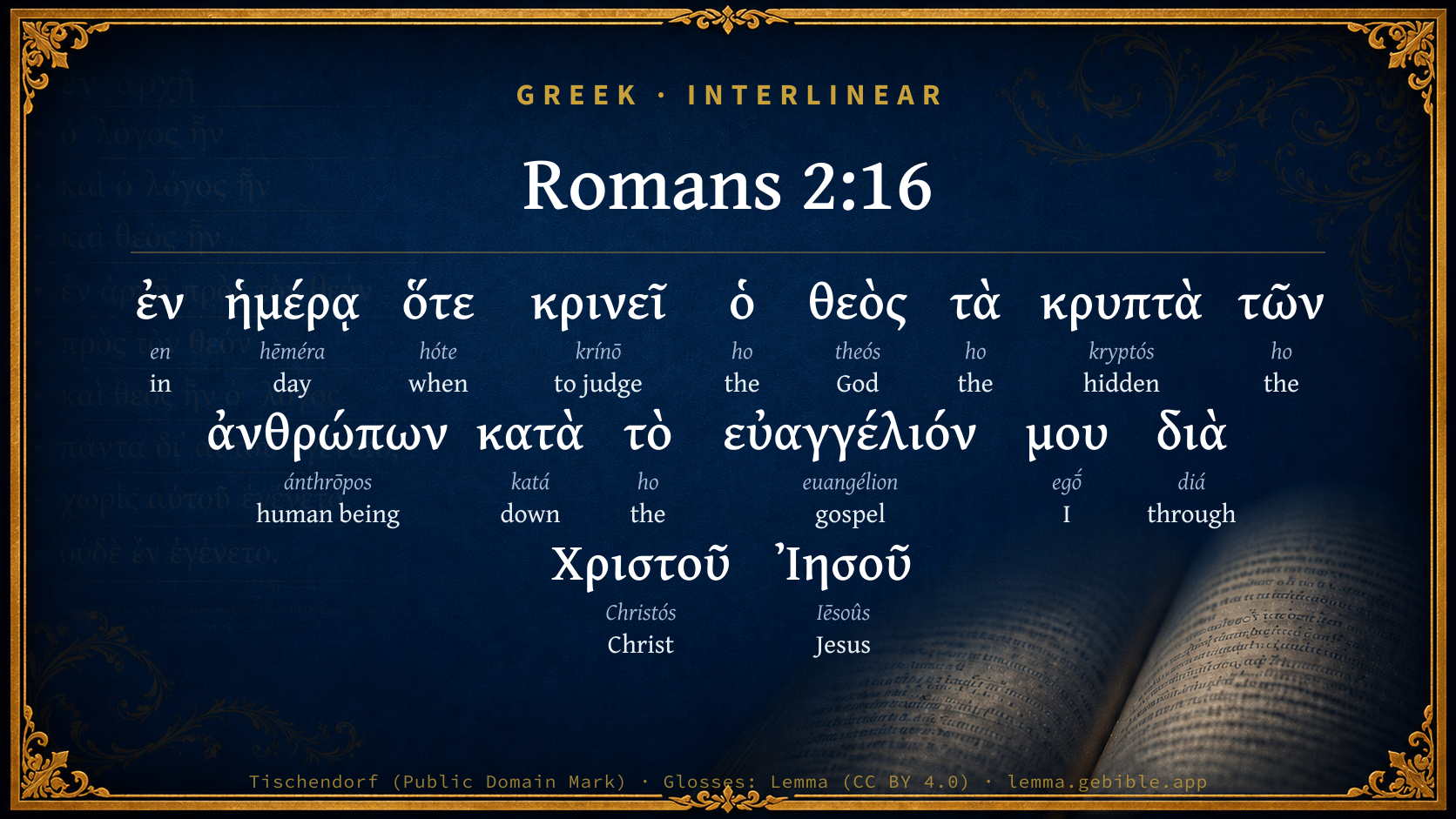
  1. ἐν en G1722 “in” Preposition
  2. ἡμέρᾳ hēméra G2250 “day” Noun, Dative, Singular, Feminine
  3. ὅτε hóte G3753 “when” Adverb
  4. κρινεῖ krínō G2919 “to judge” Verb, Present, Active, Indicative, 3rd person, Singular
  5. ὁ ho G3588 “the” Article, Nominative, Singular, Masculine
  6. θεὸς theós G2316 “God” Noun, Nominative, Singular, Masculine
  7. τὰ ho G3588 “the” Article, Accusative, Plural, Neuter
  8. τῶν ho G3588 “the” Article, Genitive, Plural, Masculine
  9. ἀνθρώπων ánthrōpos G444 “human being” Noun, Genitive, Plural, Masculine
  10. κατὰ katá G2596 “down” Preposition
  11. τὸ ho G3588 “the” Article, Accusative, Singular, Neuter
  12. εὐαγγέλιόν euangélion G2098 “gospel” Noun, Accusative, Singular, Neuter
  13. μου egṓ G1473 “I” Personal pronoun, 1st person, Genitive, Singular
  14. διὰ diá G1223 “through” Preposition
  15. Χριστοῦ Christós G5547 “Christ” Noun, Genitive, Singular, Masculine
  16. Ἰησοῦ Iēsoûs G2424 “Jesus” Noun, Genitive, Singular, Masculine

About this verse

These counts appear in no published source. They are computed here, from the morphology-tagged text and Lemma’s own curated glosses. What Lemma adds →

17
words
14
distinct lemmas
Pauline Epistles
section

Notable vocabulary

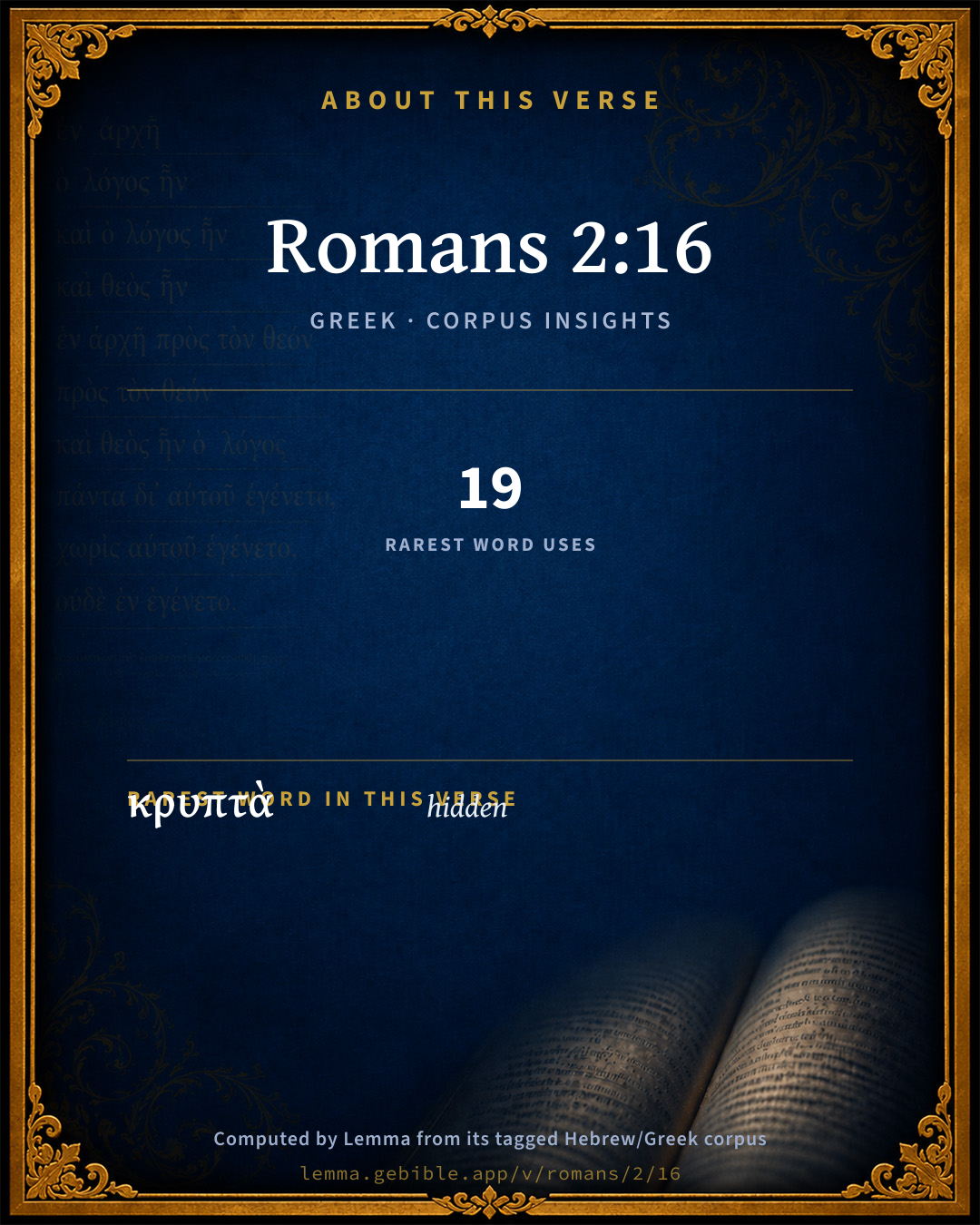
The rarest word here is κρυπτὰ hidden G2927 — appearing just 19 times in the whole Greek New Testament.

Shared distinctive vocabulary

κρυπτὰ hidden G2927 occurs in 16 verses of the Greek New Testament. Also found in:

Repetition

A word recurs within this verse:

Cross-references

30

Topical passages linked to Romans 2:16 in the Treasury of Scripture Knowledge — connected by theme and wording, ordered by reader-vote popularity; previews shown in the World English Bible.

  • Ecclesiastes 12:14 For God will bring every work into judgment, with every hidden thing, whether it is good, or whether it is evil.
  • 1 Corinthians 4:5 Therefore judge nothing before the time, until the Lord comes, who will both bring to light the hidden things of darkness, and reveal the counsels of the hearts. Then each man will get his praise from God.
  • Acts 17:31 because he has appointed a day in which he will judge the world in righteousness by the man whom he has ordained; of which he has given assurance to all men, in that he has raised him from the dead."
  • Luke 8:17 For nothing is hidden, that will not be revealed; nor anything secret, that will not be known and come to light.
  • Acts 10:42 He charged us to preach to the people and to testify that this is he who is appointed by God as the Judge of the living and the dead.
  • John 5:22–29 For the Father judges no one, but he has given all judgment to the Son,
  • Romans 14:10–12 But you, why do you judge your brother? Or you again, why do you despise your brother? For we will all stand before the judgment seat of Christ.
  • Romans 3:6 May it never be! For then how will God judge the world?
  • 1 Peter 4:5 who will give account to him who is ready to judge the living and the dead.
  • Psalms 98:9 Let them sing before Yahweh, For he comes to judge the earth. He will judge the world with righteousness, And the peoples with equity.
  • Matthew 25:31–46 "But when the Son of Man comes in his glory, and all the holy angels with him, then he will sit on the throne of his glory.
  • John 12:48 He who rejects me, and doesn't receive my sayings, has one who judges him. The word that I spoke, the same will judge him in the last day.
  • Romans 16:25
  • 2 Corinthians 5:10 For we must all be revealed before the judgment seat of Christ; that each one may receive the things in the body, according to what he has done, whether good or bad.
  • 1 Timothy 1:11 according to the Gospel of the glory of the blessed God, which was committed to my trust.
  • 2 Timothy 2:8 Remember Jesus Christ, risen from the dead, of the seed of David, according to my Gospel,
  • 2 Timothy 4:1 I charge you therefore before God and the Lord Jesus Christ, who will judge the living and the dead at his appearing and his Kingdom:
  • 2 Peter 2:9 the Lord knows how to deliver the godly out of temptation and to keep the unrighteous under punishment for the day of judgment;
  • Revelation 20:11–15 I saw a great white throne, and him who sat on it, from whose face the earth and the heaven fled away. There was found no place for them.
  • Psalms 9:7–8 But Yahweh reigns forever. He has prepared his throne for judgment.
  • Psalms 50:6 The heavens shall declare his righteousness, For God himself is judge. Selah.
  • Psalms 96:13 Before Yahweh; for he comes, For he comes to judge the earth. He will judge the world with righteousness, The peoples with his truth.
  • Ecclesiastes 3:17 I said in my heart, "God will judge the righteous and the wicked; for there is a time there for every purpose and for every work."
  • Ecclesiastes 11:9 Rejoice, young man, in your youth, And let your heart cheer you in the days of your youth, And walk in the ways of your heart, And in the sight of your eyes; But know that for all these things God will bring you into judgment.
  • Matthew 16:27 For the Son of Man will come in the glory of his Father with his angels, and then he will render to everyone according to his deeds.
  • Romans 2:5 But according to your hardness and unrepentant heart you are treasuring up for yourself wrath in the day of wrath, revelation, and of the righteous judgment of God;
  • 2 Timothy 4:8 From now on, there is stored up for me the crown of righteousness, which the Lord, the righteous judge, will give to me on that day; and not to me only, but also to all those who have loved his appearing.
  • Hebrews 9:27 Inasmuch as it is appointed for men to die once, and after this, judgment,
  • Genesis 18:25 Be it far from you to do things like that, to kill the righteous with the wicked, that so the righteous should be as the wicked. May that be far from you. Shouldn't the Judge of all the earth do right?"
  • Galatians 1:11 But I make known to you, brothers, concerning the Gospel which was preached by me, that it is not according to man.

Cross-references courtesy of OpenBible.info (CC BY 4.0).

Commentary

Notes on Romans 2:16 from classic Christian and Jewish commentators (each source and its license shown beneath its notes). The classic Christian expositions comment on the surrounding passage and are grouped to its opening verse, so a note may address several verses; the Jewish commentaries on the Tanakh (Rashi and others) are per-verse, so they appear only where the commentator wrote on this verse.

Lemma curates 59 commentaries, every one of them public domain or Creative Commons licensed, each selected and text-cleaned for this edition rather than reprinted as found. About our sources →

The Cambridge Bible for Schools and Colleges

gen. ed. J. J. S. Perowne

16. in the day, &c.] This sentence is often connected with the close of Rom_2:12. But the parenthesis is thus, even in the style of St Paul, highly difficult and peculiar; and Rom_2:13 stands in close natural connexion with Rom_2:12. Meanwhile the sequence of Rom_2:16 on Rom_2:15 is not hard to trace; the allusion to the Great Day is anticipatory; q. d., “These moral convictions and verdicts have their good and final confirmation in the day, &c.;” “all that was true in them will be recognized and carried out in Divine action then.”

the secrets of men] i.e. of men in general, heathens as well as Jews. The “secret things” are here named, as implying also of course the judgment of all that is “open beforehand.” Perhaps the word alludes too to the “cloke” of Jewish formality, and faith in privileges.

by Jesus Christ according to my gospel] The word “Gospel” is here used (a deeply significant use) of the entire contents of the Apostle’s teaching; of holy principles and threats of condemnation as well as holy promises of life.—“My Gospel:”—same word as Rom_16:25. The original of the phrase is not strongly emphatic, but certainly not without point. It indicates on one hand St Paul’s deep certainty of his direct Divine commission and its precise import, and on the other his consciousness (much more strongly expressed in the Galatian Epistle) of opposition to his position and doctrine. Cf. e.g. Gal_1:6-12.—“By Jesus Christ:”—the words emphatically close the sentence; perhaps with implicit reference to the rejection, by the unbelieving Jews whom the Apostle now more distinctly addresses, of Him who is to judge the world.

The Cambridge Bible for Schools and Colleges (gen. ed. J. J. S. Perowne; Cambridge University Press, 1878–1918) — public domain. Text from a community e-Sword module.

The Biblical Illustrator

Joseph S. Exell

Rom_2:16

In the day when God shall Judge the secrets of men.

The future judgment

I. The grand subject of inquiry. The secrets of men. A phrase to be understood in its utmost latitude, including not only matters known only to God and our own consciences, but also things which escape ourselves, or the nature of which may be undiscovered. The hypocrite, who either deceived others or deluded himself, shall then be laid open. And the good actions of the sincere Christian, uncharitably mistaken by the world, or unreasonably censured by his own conscience, shall be vindicated. The expression does not exclude public actions (Ecc_12:14), which are, in a sense, a secret as to their nature, motives and consequences. Our secret sufferings will also be judged; what we have endured, and in what spirit, whether with resignation toward God, and with gentleness towards men; all which is difficult to determine now.

II. The person who will judge the secrets of men.

1. God who alone--

(1) Has a right to judge them; it is His law that is broken.

(2) Can judge them; none other has power to assemble the living and the dead; wisdom, to know all the individuals and their actions, words, thoughts, etc.; holiness to hate sin; justice to pass an equitable sentence.

2. By Jesus Christ (Joh_5:22; Mat_28:18; Rev_1:18; Mat_16:27; Mat_25:31; Act_10:42; Act_17:31; 2Th_1:7).

(1) This appointment is reasonable, as a reward of His obedience and sufferings. If He reward us for ours, how much more is He, who was made a little lower than the angels for the suffering of death, worthy to be crowned with glory and honour (Php_2:6-10).

(2) This perfect honour is appropriate to Him. The powers of hell employed their force and fraud in opposing the kingdom of Christ, and it is fit He should pass sentence upon them (Rev_17:13-14).

(3) With respect to His followers also, it is fit that He should acquit them, who bore their sins; that He should determine their happiness, who purchased heaven for them with its various mansions; that He should present them faultless, who preserved them from falling; that He should judge those who were under His government while on earth. (Joseph Benson.)

Coming judgment of the secrets of men

I. On a certain day God will judge men.

1. A judgment is going on daily. Every deed is recorded in the register of doom.

(1) This session of the heavenly court is like the daily sessions of our local magistrates, and does not prevent but rather necessitates the holding of an ultimate great assize.

(2) As each man passes into another world an immediate judgment is passed upon him; but this is only the foreshadowing of the final judgment.

(3) There is a judgment also passing upon nations, for as nations will not exist as nations in another world, they have to be judged now, and history shows how sternly justice has dealt with empire after empire, when they have become corrupt. Where is Assyria, Babylon, Rome, etc.? The world is full of monuments of the mercy and justice of God: the very monuments of His justice being proofs of His goodness; for it is mercy to put an end to evil systems when, like a nightmare, they weigh heavily upon mankind. We have often laughed at the idea of the New Zealander sitting on the broken arch of London Bridge sketching the ruins of St. Pauls. But is it quite so ridiculous as it looks? What is there about London that it should be more enduring than Rome? If we rebel, God will not hold us guiltless.

2. Though such judgments proceed every day, yet there is to be a day in which more distinctly and finally God will judge men. We might have guessed this by the light of nature and of reason. Even heathen peoples have had a dim notion of a day of doom; but we are solemnly assured of it in Holy Scripture.

(1) By judging is here meant all that concerns the proceedings of trial and award.

(a) There will be a session of majesty, and the appearing of a great white throne, surrounded with pomp of angels and glorified beings.

(b) Then a summons will be issued, bidding all men come to judgment.

(c) Then the indictment will be read, and each one examined.

(d) Then the books shall be opened, and everything recorded there read.

(e) Then the great Judge shall give the decision, pronounce sentence and execute it.

(2) This will be so, and it ought to be so: God should judge the world, because He is the universal ruler and sovereign.

(a) There has been a day for sinning, there ought to be a day for punishing.

(b) It ought to be so for the sake of the righteous. The best have had the worst of it, and there ought to be a judgment to set these things right. Besides, the festering iniquities of each age cry out to God that He should deal with them.

(3) Why doth it not come at once? And when will it come? It is idle and profane to guess at it, since even the Son of Man, as such, knoweth not the time. It is sufficient that it will surely come; sufficient also to believe that it is postponed.

(a) To give space for repentance.

(b) That the Church may be completed. The Lord keeps the scaffold standing till He hath built up the fabric. Not yet are all the redeemed with blood redeemed with power and brought forth into the holiness in which they walk with God. But do not deceive yourselves. The great day of His wrath cometh on apace, and days of reprieve are numbered.

II. God will judge the secrets of men.

1. By these are meant--

(1) Those secret crimes which hide themselves away by their own infamy, which are too vile to be spoken of.

(2) The hidden motives of every action; for a man may do that which is right from a wrong motive, and so the deed may be evil in the sight of God, though it seem right in the sight of men. Oh, think what it will be to have it proven that you were godly for the sake of gain, that you were generous out of ostentation, or for love of praise, etc.

(3) The sensual desires and imaginings.

(4) Secrets, that were secrets even to the sinners themselves, for there is sin in us which we have never yet discovered.

2. Why God should judge the secrets of men. Because--

(1) There is really nothing secret from God; for all things are naked and open to the eyes of Him with whom we have to do.

(2) Often the greatest of moral acts are done in secret. The brightest deeds that God delights in are those that are done by His servants when they have no motive but to please Him, and when they studiously avoid publicity. It were a pity that such deeds should be left out at the great audit. Thus, too, secret vices are also of the very blackest kind, and to exempt them were to let the worst of sinners go unpunished.

(3) Besides, the secret things of men enter into the very essence of their actions. An action is, after all, good or bad very much according to its motive. So, if God did not judge the secret part of the action He would not judge righteously.

(4) The secret thing is the best evidence of the mans condition. Many a man will not do in public that which would bring him shame. That which a man does when he thinks that he is entirely by himself is the best revelation of the man.

III. God will judge the secrets of men by Jesus Christ. This will be--

1. For the display of His glory. What a difference there will be then between the Babe of Bethlehems manger and the King of kings and Lord of lords; between the weary man and full of woes, and He that shall then be girt with glory, sitting on a throne encircled with a rainbow! From the derision of men to the throne of the universal judgment, what an ascent! This, too, will finally settle the controversy about our Lords Deity.

2. Because men have been under His mediatorial sway, and He is their King. We have been placed by an act of Divine clemency, not under the immediate government of an offended God, but under the reconciling rule of the Prince of Peace.

3. That there may never be a cavil raised concerning that judgment. Men shall not be able to say, Vie were judged by a superior being who did not know our weaknesses and temptations, and therefore judged us without a generous consideration of our condition. The Judge was tempted in all points like as we are, yet without sin. He is our brother, bone of our bone, and flesh of our flesh, partaker of our humanity, and therefore understands and knows what is in men.

4. This judgment by Christ puts beyond possibility all hope of any after-interposition. If the Saviour condemns, and such a Saviour, who can plead for us? If He that bled to save men at last comes to this conclusion, that there is no more to be done, but they must be driven from His presence, then farewell hope.

5. Does not this also show how certain the sentence will be? for this Christ of God is too much in earnest to play with men. If He says, Come, ye blessed, He will not fail to bring them to their inheritance. If He be driven to say, Depart, ye cursed, He will see it done, and into the everlasting punishment they must go.

6. It seems as if God in this intended to give a display of the unity of all His perfections. In Christ you behold justice and love, mercy and righteousness, combined in equal measure. He turns to the right, and says, Come, ye blessed, and with the same lip, as He glances to the left, He says, Depart, ye cursed,

IV. All this is according to the gospel. There is nothing in the gospel contrary to this solemn teaching. Men gather to hear us preach of infinite mercy, and our task is joyful; but oh, remember that nothing in our message makes light of sin! There is grace for the man who quits his sin, but there is tribulation and wrath upon every man that doeth evil. The gospel is all tenderness to the repenting, but all terror to the obstinate offender. The background of the Cross is the judgment seat of Christ. According to my gospel, saith Paul; and he meant that the judgment is an essential part of the gospel creed, and in times of righteous indignation its terrible significance seems a very gospel to the pure in heart. I have read this and that concerning oppression, slavery, the treading down of the poor, and the shedding of blood, and I have rejoiced that there is a righteous Judge. Thousands of men have been hanged for much less crimes than those which now disgrace gentlemen whose names are on the lips of rank and beauty. Where this is not preached, I am bold to say the gospel is not preached. It is absolutely necessary to the preaching of the gospel that men be warned as to what will happen if they continue in their sins. Surgeon, you hope to heal the sick without their knowing it. You therefore flatter them; and they die! Your delicacy is cruelty; you are a murderer. Shall we keep men in a fools paradise? Shall we lull them into soft slumbers from which they will awake in hell? (C. H. Spurgeon.)

The secrets of men disclosed and judged

Secrets of--

I. Conduct. Those actions we concealed from friendship and from man, proclaimed on the housetop. How many secrets are now in progress in the world! Secrets of--

1. Ambition, where the man is sacrificing all for it.

2. Covetousness; call them secrets of trade if you like, but there are many practices countenanced which cannot bear the light. How have you held back from the widow, and passed by the orphan?

3. Sensuality. In darkness, not to be named in public. Look in your closets; how have your consciences been contaminated.

4. Envy: I cannot go into your closets; but what has God seen there!

II. Character. Character is formed by principle. Now this can only be known to Him who searches the heart. I know not the springs of your conduct, nor the principles on which your character is formed. Though Jesus says we may know the tree by the fruit, yet there is not always a faithful correspondence between principles and practice. How few seek only the glory of God. Self is a subtle principle. In private a man will blush at his own hypocrisy; and Satan, helping him, may make him a self-deceiver. But every motive will then start up! How many actions now under the garb of humility will then be seen to have originated in pride! How many blazoned deeds from self-love! How many actions, which seem under the motive of zeal to God, like those of Jehu, are prompted by interest!

III. Inattention. A large portion of our actions are thought to be venial, trifling, etc. For every idle word which men shall speak, they shall give account in the day of judgment.

IV. Influence. We are members one of another. We are always, when in society, doing either good or harm.

1. Little do we know how many are they on whom we have in some way exerted an unhallowed influence. In that day the author of blasphemous works will answer for all the evil he has done.

2. At the same time, many secrets of prayer will then be found, many tears, etc.

Conclusion:

1. This subject requires deep self-examination. What secrets will this night conceal!

2. What will be the effects of this judgment?

(1) The shame of exposure. What would you not give here to avoid exposure?

(2) Besides shame, the agony of remorse, the horror of despair. Some shall awake to shame and everlasting contempt. (J. Summerfield, A. M.)

Judgment of our thoughts

1. Thoughts are amongst the secrets of men. They are what men cannot be sure of in each other. They are what men often seem to imagine that even God cannot behold.

2. Whence is it that the thoughts arise which will be called to account? Out of the heart proceed evil thoughts (Mat_15:19). Out of the heart also it is that good thoughts, by Gods good grace, spring up.

3. And this make it so needful for them to be judged hereafter. They prove what is the inward disposition of the soul, what there is of good or evil there.

4. But though it is easy to see why the thoughts must be judged; yet it is not easy to think as if they would be. How few think continually such thoughts as they would wish to have entirely laid open unto those amongst whom they live! How few such as are fit to be beholden by Him to whom all thoughts are open! How few that God will judge them!

I. What are the thoughts that will be judged.

1. Selfish thoughts. For what are the thoughts which God commands us to cherish towards each other? (see Mat_19:19; Rom_12:10; Php_2:4). Consider how far are your thoughts guided by these rules?

2. Proud thoughts. The pattern set before it Christian is as follows: Learn of My, for I am meek and lowly in heart (Mat_11:29). The rule laid down for his thoughts of others is, In lowliness of mind, etc. (Php_2:3). How often is this rule violated; how seldom this pattern followed! There is, indeed, a great variety in rank, ability, etc., and it would be but a pretence to humility for a man to profess himself inferior in a point where he cannot help to know his own advantages. But whatsoever be his comparative advantages, let him fix his attention rather on his own actual defects--his sins, wasted opportunities--and he will scarcely think highly of himself.

3. Angry thoughts. These are closely connected with pride and selfishness. He that thinks highly of himself covets largely for himself, and must, therefore, often be disappointed and affronted. Thus spring up angry thoughts; and though neither unkind words or actions follow, the thoughts alone are sinful, and will be judged. The most secret thoughts Christ would have to be now gentle and charitable.

4. Impure thoughts (Mat_5:27-28). Let no one imagine himself innocent, merely because his conduct is respectable. The fear of shame, the lack of opportunity, may preserve the outward character, but they cannot secure the favourable judgment of Him who sees the heart to be sensual. Thus not only he who follows after strong drink in excess, but he also who fain would do so if he could is a drunkard in the sight of the Almighty. Thus in another sin, Whosoever hateth his brother is a murderer (1Jn_3:15).

5. Worldly thoughts. We learn that a Christian should set his affections on things above (Col_3:2), and not be anxious for this worlds morrow (Mat_6:25-34). How, then, can they answer for it hereafter, whose whole minds are occupied with the business of the world they live in; with scarcely one reflection in the day on the world which they so soon must enter? Are not these things among those secrets of men which God will judge?

II. What should we do in view of this?

1. Besides the times which you set apart for prayer, etc., you must endeavour to cherish thoughts of heaven in the midst of your attention to the business of earth. Say you are engaged in work. Why should you not relieve your toil by thinking of what awaits you when life shall end?

2. Set before yourselves your Christian calling. Keep in view the condemnation from which you have been delivered, and the dealings of Him who has delivered you (Php_4:8). And think further of what God has yet in store for us in the world which now we see not. Let us more stedfastly believe that we shall dwell in heaven, and we shall think more frequently of dwelling there. Let us believe more firmly that Christ died for our sins, and we shall think of Him both more often and more thankfully. Then shall we less fear to have our secrets judged, when we have not a thought which is not beforehand submitted to our Judge, suggested by His Spirit, guided by His Word, or devoutly surrendered to His will. (C. Girdlestone, M. A.)

The secrets of the soul

I. We live is a strange secrecy, even hidden from our most intimate friends.

1. If any one of us were asked to relate his own life, he might relate two lives which would seem all but independent of each other. He might tell when he was born, where he had lived, what he had done, etc. He might anticipate the future, calculate what were his chances of success, and how he expected to end his days. Or, again, he might tell quite a different story. What he remembered of his own early character; what were his real affections; what did he secretly like, and pursue, and hope for; what changes had passed over him; what events had influenced the general current of his thoughts; what struggles he had been engaged in, and their issue. He might tell of the very beginnings, unknown to all save himself, of habits of sin never since quite shaken off; of deeds done in darkness; why some names, associations, memories make him uncomfortable without any visible reason; why he wishes, in his secret heart, some subjects to be forbidden, and is always conscious of an effort to seem indifferent when they are mentioned.

2. Now how different these two lives would often be! How events of the highest importance, and persons who play a large part in the one would disappear in the other! How strange it would be to see that a man who had succeeded in the eyes of his friends in a particular path had meanwhile been cherishing within him quite foreign thoughts and other longings! How strange to find that a fair character was only fair outwardly! Those who had been praised would, in many cases, win pity; and some few who now suffer from showing ill would be found to rank far above the level at which they had always been placed. Often the recital of a mans secret life would completely change our opinion of him. But still more often we should be astonished to see how these two lives seemed to run side by side almost without mingling.

II. The revelation will one day be made, and Christ will decide, and he alone can decide, on the evidence which each will give.

1. Neither tells the whole man.

(1) The outer life only tells what we are under all the influences of the eyes of others, which eyes call into use a completely different set of faculties and motives--the desire to be thought well of, to please, to win popularity or love, then begin to act. Our consciences, too, are strengthened in some ways by the sight of each other; and there are some duties which we see much more clearly.

(2) On the other hand, the inner life tells what we are when quite left to ourselves, but no man is complete when alone. There is a large part of his nature which is made to fit into the society of his fellows; and if this part of him does not find its proper complement, the nature of the man is not all called out. Moreover, what goes on in our secret lives is, to a great extent, the very consequence of our believing that it will end where it begins. Many a man indulges passing thoughts, who would not put them into deeds even if tempted by the certainty of perpetual concealment. It would not be possible, therefore, to judge a man either by the secret life or by the public. But Christ will unveil them both, and we shall see and feel the justice of His decision.

2. Now we can see why God has thus shut up a large and important part of our lives in this absolute secrecy. God has made us to be members one of another; but He will not have us to be nothing but members one of another. Every soul shall have an individual life, with an individual history, and shall come at last to an individual judgment. God requires that each soul shall have a separate strength supplied by Himself alone. The Church is much. But the Church shall not be everything. You shall, if you are to call yourself a servant of Christ, give something which you and you alone can give, which you and you alone can know whether you give or not. From this responsibility you cannot escape. Another may ask you whether you have done it, but he must depend for his answer on what you tell him, and he cannot know whether your answer is the whole truth. God alone can tell that; and between yourself and God the secret must remain till the judgment day.

3. God has hidden a part of our lives; and this concealment we can cast over much more than He has hidden. But again and again are we warned against it. It is the man whose deeds are evil that loves darkness rather than light. And what is the voice of Gods Word is also the voice of natural feeling. The man who is fair outside and foul within is condemned of all men as a hypocrite. Men reserve all their strongest terms of reprobation for the dark, reserved, and secret sinner. Men refuse their love to the reserved and secret character. Nature and revelation both warn us against the danger we run if we pollute our inner and secret life with what we dare not tell.

4. In view of this awful coming judgment let us determine to force all our faults outwards. At whatever cost let us keep sacred to God that inner shrine which He has thus hidden with a secrecy of His own making. Let us avoid a secret sin with a hundred times more eager avoidance, just because it is secret. If we can be fair anywhere let it be in that which God has reserved for Himself, and where Christ is willing to dwell. (Bp. Temple.)

According to my gospel.

St. Paul and his gospel

It is impossible to tell what it cost Paul to write Chapter

1. It is a shame even to speak of the things, but Paul felt that it was necessary to break through his shame, and to speak out concerning the hideous vices of the heathen. Monsters that revel in darkness must be dragged into the open, that they may be withered up by the light. After Paul has thus written in anguish he bethought himself of his chief comfort. He clings to the gospel with a greater tenacity than ever. Here he did not speak of it as the gospel, but as my gospel. He felt that he could not live in the midst of so depraved a people without holding the gospel with both hands, and grasping it as his very own. My gospel. Not that Paul was the author of it, not that Paul had an exclusive monopoly of its blessings, but that he had so received it from Christ Himself, and so fully taken it into himself that he could not do less than call it my gospel. In another place he speaks of our gospel; to show how believers identify themselves with the truth which they preach.

1. He had a definite form of truth, and he believed in it beyond all doubt; and therefore he spoke of it as my gospel. Herein we hear the voice of faith, which seems to say, Though others reject it, I am sure of it, Should all the forms that men devise, etc.

2. Is not this word my gospel the voice of love? Does he not by this word embrace the gospel as the only love of his soul--for the sake of which he had suffered the loss of all things, and for the sake of which he was willing to proclaim, even in Caesars palace, the message from heaven? Though each word should cost him a life, he was willing to die a thousand deaths for the holy cause.

3. Does not this show his courage! As much as to say, I am not ashamed of the gospel of Christ.

4. There is a touch of discrimination about the expression. Paul perceives that there are other gospels, and he makes short work with them. (C. H. Spurgeon.)

The Pauline gospel

Twice in this epistle the apostle uses this remarkable expression; here and in Rom_16:25. Now, it would be obviously arrogant for any ordinary preacher to use such an expression. We dare not speak of it so as to imply that it has acquired some distinctive character from our way of putting it. But in Pauls case we may feel sure that this expression was not used presumptuously.

1. Not only was he a chosen apostle, but there was given to him such excellency of knowledge in the mystery of Christ, that it is impossible to see how Christianity could have become the religion of all men but for Paul. Peter may have been qualified to open the door of faith to the Gentiles, and may have struck the first blow at the middle wall of partition, but it was through Pauls preaching that this middle wall was broken down effectually and finally, and the last trace of the long inferiority of the Gentile to the Jew completely effaced.

2. Then, again, it is Paul who has shaped all our formal theology as such, and given the life of Christ in the soul that articulate form without which it would soon die away into a vague and bodiless sentiment. It is Paul who has opened up the types, and linked Old Testament and New together.

3. All philosophy and all history may be said to stream out of the teaching of this the greatest of the apostles, like those rivers which flowed out of Eden and parted into four heads. As for the philosophy of history, it may be said to take its rise from the Epistle to the Romans, in the same way as it has been said that history itself was born on the night of the Exodus.

4. I dare not make use of this expression. And yet I feel irresistibly attracted to use it, though in a much lower sense. My justification for preaching at all is, that there is a sense in which any true teacher has a message from God which may be said to be distinctively his own. Every man must be fully persuaded in his own mind, and then declare his own mind to others. (J. B. Heard, M. A.)

The Biblical Illustrator, edited by Joseph S. Exell (c. 1880s–1900s) — public domain. Text from a community e-Sword module.

Joseph Benson's Commentary

Rom 2:16. In the day, &c. — This relates to Rom 2:12, the intermediate verses, from the 13th, being a parenthesis; when God shall judge the secrets of men — Not only their outward actions, good and evil, which are manifest to all men, but their most secret and hidden ones, with their internal desires and designs, their intentions, purposes, schemes, contrivances, with the various workings of their passions, imaginations, and thoughts; for he will bring every work into judgment, with every secret thing, whether it be good, or whether it be evil, Ecc 12:14; will bring to light the hidden things of darkness, and will make manifest the counsels of the heart, 1Co 4:5. On secret circumstances depends the real quality of actions, frequently unknown to the actors themselves, Rom 2:29. Men generally form their judgments, even of themselves, merely from what is apparent. By Jesus Christ — To whom the Father hath committed all judgment; according to my gospel — According to the tenor of that gospel which is committed to my trust, and is preached by me: or as I testify in my preaching the gospel, Act 17:31; 2Ti 2:8. For it is not the apostle’s intention to signify that all men shall be judged by the gospel, but only that the gospel teaches such a judgment.

Joseph Benson's Commentary on the Old and New Testaments (1811–1818) — public domain. Text from a community e-Sword module.

Tyndale Open Study Notes

Tyndale Open Resources

2:16 secret life (literally the hidden things): Scripture frequently stresses that God will judge people according to their thoughts and intentions (see 1 Sam 16:7; Ps 139:1-2; Jer 17:10).

Tyndale Open Study Notes — © Tyndale Open Resources, licensed CC BY-SA 4.0. Text via the HelloAO Bible API.

Bengel's Gnomon

Johann Albrecht Bengel

Rom 2:16. Ἐν ἡμέρᾳ, in the day) It is construed with show, for the present tense is no objection; Rom 2:5 employs the present in the same general way. And Paul often says, in the day of the Lord, which implies more than against [or unto the day] 1Co 5:5—comp. before, or in the presence of 1Ti 5:21, note. Such as each thing was, such it shall then be seen, be determined, and remain. In that day, that writing of the law on the hearts of men will be manifest, having also joined with it some defence of upright acts, although the man be condemned [fall] in the judgment, himself being his own accuser, on account of other offences. And that circumstance implies, as a consequence, [infers] (reasoning, from the greater to the less, i.e., from the final judgment, to the judgments of conscience in the present life), accusation, or even defence, exercised in this life also, as often as either the future judgment itself is vividly presented before a man, or its anticipations, without the man’s own privity (consciousness), are at work in the conscience.—Comp. 1Jn 4:17. And Scripture often speaks so of the future, especially of the last things, as that it presupposes those which precede them. The Jews at Rom 2:5, as the Gentiles in this passage, are threatened with the future judgment.—τὰ κρυπτὰ, the secrets) the conscience, and the thoughts.—Comp. 1Co 4:5. This confirms the connection of this verse with the preceding. The true quality of actions, generally unknown even to the agents themselves, depends on the secrets.—See Rom 2:29. Men judge by outward manifestations, even concerning themselves. Outward manifestations of good or evil will also be judged, but not then for the first time; for they are judged, even from the time in which they are wrought; deeds, that are secret, are then at length brought to judgment.—τῶν ἀνθρώπων, of men) even of the Gentiles.—κατὰ, according to) i.e. as my Gospel teaches. Paul adds this short clause, because he is here dealing with a man, who does not yet know Jesus Christ. The Gospel is the whole preaching as to Christ; and Christ will be the Judge; and the judgment in regard to the Gentiles, is not so expressly declared in the Old, as in the New Testament. And it is called the Gospel of Paul, as it was preached by Paul, even to the Gentiles.—Act 17:31. All the articles of evangelical doctrine, and the article concerning the final judgment, greatly illustrate one another; and moreover, this very article, even in respect of believers, is altogether evangelical.—Act 10:42; 1Pe 4:5.

Bengel's Gnomon of the New Testament — English translation (T&T Clark, Edinburgh, 1860) — public domain. Text from a community e-Sword module.

Meyer's Critical & Exegetical Commentary

Heinrich August Wilhelm Meyer

Rom_2:16 has its connection with what goes before very variously defined. While Ewald goes so far as to join it with Rom_2:5, and regards everything intervening as a parenthesis, many, and recently most expositors, have connected it with the immediately preceding συμμαρτ.… ἀπολογ.; in which case, however, ἐν ἡμέρᾳ cannot be taken for εἰς ἡμέραν (Calvin), nor the present participles in a future sense (Fritzsche), since, in accordance with the context, they are contemporary with ἐνδείκνυνται. And for that very reason we must reject the view, which has been often assumed, that Paul suddenly transports himself from the present into the time of the judgment, when the exercise of conscience in the Gentiles will be specially active, and that for this reason he at once adds ἐν ἡμέρᾳ κ.τ.λ[666] directly without inserting a ΚΑῚ ΤΟῦΤΟ ΜΆΛΙΣΤΑ, or ΚΑῚ ΤΟῦΤΟ ΓΕΝΉΣΕΤΑΙ, or the like (Rückert; Tholuck, de Wette, Reithmayr, Philippi, van Hengel, Umbreit; comp Estius). The supposition of such an illogical and violent leap of thought in so clear and steady a thinker as Paul is thoroughly arbitrary and wholly without analogy. Moreover, the simple temporal self-judgment of the Gentiles fits into the connection so perfectly, that Paul cannot even have conceived of it as an anticipation of the last judgment (Mehring). Quite an incorrect thought, repugnant to Rom_2:12 and to the whole doctrinal system of the Apostle, is obtained by Luthardt (v. freien Willen, p. 410 f.), when, very arbitrarily joining it only with ἢ καὶ ἀπολογουμένων, he discovers here the hope that to such the reconciling grace of Christ shall one day be extended. This is not confirmed by Rom_2:26. A relative natural morality never in the N. T. supplies the place of faith, which is the absolutely necessary condition of reconciling grace. Compare Rom_3:9; Rom_3:22, Rom_7:14 ff. al[668] Lastly Hofmann, who formerly held a view similar to Luthardts (see Schriftbew. I. p. 669), now connects ἐν ἡμέρᾳ Κ.Τ.Λ[669] to ἐνδείκνυνται in such a way, that he explains Rom_2:16 not at all of the final judgment, but, in contrast even to the latter, of every day on which God causes the Gospel to be proclaimed among the Gentiles; every such day shall be for all, who hear the message, a day of inward judgment; whoever believingly accepts it, and embraces salvation, thereby proves that he himself demands from himself what the revealed law enjoins on those who possess it. This interpretation, which would require us to read with Hofmann κρίνει (the present) instead of κρινεῖ, is as novel as it is erroneous. For the expressions in Rom_2:16 are so entirely those formally used to denote the last judgment (comp on ἡμέρᾳ 1Co_1:8; 1Co_5:5; 2Co_1:14 al[671]; on κρινεῖ, Rom_2:2-3; Rom_2:5; Rom_3:6 al[672]; on Θεός as the Jdg_3:6; Jdg_14:10; Jdg_14:12 al[673]; on τὰ κρυπτά, 1Co_4:5; on διὰ ʼΙησοῦ Χ. 2Co_5:10; Act_17:31), that nothing else could occur to any reader than the conception of that judgment, which moreover has been present to the mind since Rom_2:2, and from which even κατὰ τὸ εὐαγγ. μου does not draw away the attention. Every element in Hofmanns exposition is subjectively introduced, so that Paul could not have wrapped up the simple thought, which is supposed to be expressed in so precious a manner, in a more strange disguisea thought, moreover, which is here utterly irrelevant, since Paul has to do simply with the natural law of the Gentiles in its relation to the revealed νόμος of Judaism, and apart as yet from all reference to the occurrence of their conversion; and hence also the comparison with Heb_4:12 is here out of place. The proper view of the passage depends on our treating as a parenthesis, not (with Winer and others) Rom_2:13-15, but with Lachmann, Rom_2:14-15. This parenthetical insertion is already indicated as such by the fact, that the great judicial proposition previously expressed: οἱ ποιηταὶ νόμου δικαιωθήσονται is in Rom_2:14-15 proved only with reference to a part of mankind, with regard to which it might seem possibly doubtful: it is required by the circumstance, that without it ἐν ἡμέρᾳ has no proper logical reference whatever; and lastly, it is confirmed by the consideration that, if it is adopted, the whole is wound up not with an illustration having reference to the Gentiles, butand how emphatically and solemnly!with the leading thought of the whole discussion.[674]

τὰ κρυπτὰ τῶν ἀνθρ.] The hidden things of men, i.e. everything in their inner or outer life which does not come to the knowledge of others at all, or not according to its moral quality. This special characteristic of the judgment is given with reference to Rom_2:13, inasmuch as it is just such a judging that is necessary for, and the preliminary to, the realisation of what is affirmed in Rom_2:13.

κατὰ τὸ εὐαγγέλ. μου] contains, according to the usual view, the accordance of the assertion κρινεῖ ὁ Θεός τὰ κρυπτὰ τ. ἀνθρ. διὰ ʼΙ. Χρ. with the Apostles official proclamation of salvation. But the fact that God will judge, etc., was so universally known and so entirely undoubted, that the addition in that sense would have been in the highest degree superfluous; and indeed the μου in that case would have no significance bearing on the matter, since no one proclaiming the Gospel could call in question that truth. We must therefore explain it, with Pareus, Calovius, and many others, including Umbreit and Hofmann, as referring to the manner of the κρινεῖ. Paul was so certain of the sole truth of the Gospel committed to him (Rom_16:25; Eph_4:20 f.) which he had by revelation of God (Gal_1:11 f.), that he could not but be equally certain that the future judgment would not be held otherwise than according to his Gospel, whose contents are conceived as the standard of the sentence. In that same Gospel he knew it to be divinely determined, to whom the στέφανος τῆς δικαιοσύνης, the eternal life and its δόξα, or on the other hand its opposite, eternal ἀπώλεια, should be awarded by the judge. But he knew at the same time the axiom announced in Rom_2:13, with which Rom_2:16 connects itself, to be not at variance therewith (comp Rom_3:31); as indeed on the contrary, it is just in the Gospel that perfection in the fulfilment of the law is demanded, and accordingly (see ch. Rom_6:8, Rom_13:8 ff.) the judicial recompense is determined conformably to the conduct, Rom_8:4; 2Co_5:10; Eph_5:5; 1Co_6:9 f.; Gal_5:19-23. On μου Calvins note suffices: suum appellat ratione ministerii, and that, to distinguish it from the preaching not of other apostles, but of false, and especially of Judaizing teachers. Comp Rom_16:25; 2Ti_2:8. The mistaken view is held by Origen, Jerome and other Fathers (see Fabricius, Cod. apocr. p. 371 f.), that Paul meant by his Gospel that of Luke.

διὰ Ιησοῦ Χρ.] As He is the Mediator of eternal salvation, so also it is He who is commissioned by God to hold the judgment. Comp Act_17:30-31; 1Co_4:5; 2Co_5:10 al[678]; Joh_5:27; Mat_25:31.

[666] .τ.λ. καὶ τὰ λοιπά.

[668] l. and others; and other passages; and other editions.

[669] .τ.λ. καὶ τὰ λοιπά.

[671] l. and others; and other passages; and other editions.

[672] l. and others; and other passages; and other editions.

[673] l. and others; and other passages; and other editions.

[674] There is therefore the less reason for assuming with Laurent that ver. 16 was a marginal note of the Apostle on ver. 13, which was copied into the text at the wrong place.

[678] l. and others; and other passages; and other editions.

Meyer — Critical and Exegetical Commentary on the New Testament — English translation by Peter Christie, edited by Frederick Crombie (T&T Clark, 1880) — public domain. Text from a community e-Sword module.

Expositor's Greek Testament

ed. W. Robertson Nicoll

Rom 2:16 . The day meant here is the same as that in Rom 2:5 . Westcott and Hort only put a comma after ἀπολογουμένων , but a longer pause is necessary, unless we are to suppose that only the day of judgment wakes the conscience and the thoughts of man into the moral activity described in Rom 2:15 . This supposition may have some truth in it, but it is not what the Apostle’s argument requires. The proof he gives that Gentiles are “a law to themselves” must be capable of verification now, not only at the last day. Hence Rom 2:16 is really to be taken with the main verbs of the whole paragraph, ἀπολοῦνται , κριθήσονται , δικαιωθήσονται : the great principle of Rom 2:6 ἀποδώσει ἑκάστῳ κατὰ τὰ ἔργα αὐτοῦ will be exhibited in action on the day on which God judges the secret things of men through Christ Jesus. A final judgment belonged to Jewish theology, and perhaps, though this is open to question, one in which the Messiah acted as God’s representative; but what Paul teaches here does not rest merely on the transference of a Jewish Messianic function to Jesus. If there is anything certain in the N.T. it is that this representation of Jesus as judge of the world rests on the words of our Lord Himself (Mat 7:22 f., Mat 25:31 ff.). To assert it was an essential part of the Gospel as preached by Paul: cf. Act 17:31 . (Baldensperger, Das Selbstbewusstsein Jesu , . 85 f., thinks that in the circles of Jewish Pietism, in the century before Christ, the Messiah was already spoken of as the Divine judge, and as sharing the titles and attributes of Jehovah.)

In Rom 2:17-24 the Apostle brings to a point the argument for which he has been clearing the way in Rom 2:1-16 . The Jew makes much of the possession of the law, but when we pass from possession to practice, he is not a whit better than the “lawless” Gentile. The construction is not quite regular, but the meaning is clear. The natural order would be: If thou bearest the name of Jew, and restest upon the law, and yet in thy conduct settest the law at nought , art not thou equally under condemnation with sinners of the Gentiles? But the construction is interrupted at the end of Rom 2:20 , and what ought in logic to be part of the protasis if in thy conduct thou settest the law at nought is made a sort of apodosis, at least grammatically and rhetorically: dost thou, in spite of all these privileges, nevertheless set the law at nought? The real conclusion, which Paul needs for his argument, Art not thou then in the same condemnation with the Gentiles? is left for conscience to supply.

The Expositor's Greek Testament, edited by W. Robertson Nicoll (1897–1910) — public domain. Text from a community e-Sword module.

Godet's Commentaries

Frédéric Louis Godet

Vv. 16. “In the day when God shall judge the hidden things of men by Jesus Christ according to my gospel.”

In this final proposition there is expressed and summed up the idea of the whole preceding passage (from Rom 2:6), that of the final judgment. But what is the grammatical and logical connection of this dependent proposition? It would seem natural to connect it with what immediately precedes (Rom 2:15), as Calvin does: “Their inward thoughts condemn or approve them in the day when”...for: “till the day when”...But this sense would have required ἕως τῆς ἡμέρας. Tholuck and Philippi employ another expedient; they understand: “and that especially in the day when”...; or: “and that more completely still in the day when”...Others: “as will be seen clearly in the day when”...But if Paul had meant to say all that, he would have said it. Hofmann and Lange, also connecting this proposition with Rom 2:15 (Hofmann especially with ἐνδείκνυνται, manifest), regard the judgment of Rom 2:16 as being only the internal and purely moral judgment which is produced in the human conscience every time the gospel is preached to man. They read κρίνει, judges, and not κρινεῖ, will judge. The phrase: in the day when, would therefore denote, not the last judgment, but every day that a man hears the gospel for the first time. There is a context in which this explanation would be possible; but here, where the dominant idea from Rom 2:6 has been the final judgment, it is inadmissible. Besides, the phrase: by Jesus Christ, is not exactly suitable to any but the last judgment; comp. the words, Act 10:42; Act 17:31; Mat 25:31 et seq.; and especially the very similar phrases in 1Co 4:5. Moreover, Rom 2:29 can leave no doubt as to the apostle’s meaning. The only tolerable explanation, if it were wished to connect Rom 2:16 with Rom 2:15, would be to take the verbs of Rom 2:15 as expressing the permanent present of the idea: “The manifestation of the presence of the law, written within their hearts, takes place, for: will certainly take place, in the day when”...; but this meaning of the verbs in the present in Rom 2:15 could not be guessed till after reading Rom 2:16. The time of the manifestation would have required to be indicated immediately to prevent a misunderstanding. The only natural connection of the words: in the day when, is to join them to the end of Rom 2:13 : “The doers of the law shall be justified...in the day when”...No doubt Rom 2:14-15 thus become a sort of parenthesis. But, notwithstanding, Paul has not deviated for a moment from his principal thought. These two verses contained an explanatory remark, such as we nowadays would put in a note; it was intended to show that the Gentiles also would be entitled to believe themselves justified, if all that was necessary for this end were to possess and hear a law without doing it. This false idea set aside, Paul resumes the thread of his discourse at Rom 2:16. To explain this verse, there is clearly no need of the two expedients proposed, the one by Ewald, to join it with Rom 2:4, the other by Laurent, to regard it as an interpolation.

The phrase: hidden things, is to be explained only by the understood contrast to external works, legal or ceremonial, in which the Jews put their confidence. None of those fine externals of piety or morality will deceive the eye of God in that day of truth. He will demand holiness of heart; comp. the expression, Rom 2:29; ὁ ἐν τῷ κρυπτῷ ᾿Ιουδαῖος, the Jew who is one inwardly, and: the circumcision of the heart; comp. also, in the Sermon on the Mount, Mat 5:20-48; Mat 6:1-18. This idea was indispensable to complete what had been said of judgment according to deeds.

The word men sets the whole body of the judged face to face with the Judge, and reminds the Jews that they also will be there, and will form no exception.

At the first glance the phrase: according to my gospel, is surprising, for the expectation of the final judgment by Jesus Christ belongs to the apostolic teaching in general, and not to Paul’s gospel in particular. Nevertheless, it is this apostle who, in consequence of his personal experience, and of the revelation which had been made to him, has brought out most powerfully the contrast between the ἔργα νόμου, legal and purely external works, wanting the truly moral principle of love and good works, the fruits of faith working by love (Eph 2:9-10; Gal 5:6). This antithesis was one of the foundations of Paul’s preaching.

The last words: by Jesus Christ, recall all the sayings in which Jesus announced His advent as judge. If it is really He who is to preside in the great act of final judgment, it is plain that, being such as He has made Himself known to us, He will not be satisfied with a parade of external righteousness, and that He will demand a holiness like that which He realized Himself, which, taking its origin in consecration of heart, extends over the whole life.

Frédéric Louis Godet — Commentaries on Luke, John, Romans, and 1 Corinthians — English translation (T&T Clark, Edinburgh, 1870s–1890s) — public domain. Text from a community e-Sword module.

Hodge's Commentary on Romans, Ephesians & First Corinthians

Charles Hodge

Rom_2:16

The greatest difficulty in relation to this verse is to determine its connection with the preceding context. In the common copies of our Bible, Rom_2:13, Rom_2:14, Rom_2:15, are marked as a parenthesis, and Rom_2:16 is placed in connection with Rom_2:12 : The heathen shall be judged without the law, and the Jews by the law, in the day when God shall judge the secrets of men. Thus the passage is arranged by Griesbach and Knapp; a mode of connection adopted also by Beza, Grotius, Reiche, and others. The objections to this explanation are, first, the distance at which this verse stands from Rom_2:12; and secondly, that the intervening verses have not the nature of a parenthesis, but are intimately connected with the idea contained in Rom_2:12. Calvin, Bengel, Rückert, Fritzsche, De Wette, Meyer, Tholuck, etc., connect this verse with Rom_2:15. The difficulty then is, that the verb and participles of Rom_2:15 are in the present tense, whereas κρινεῖ of this verse is future: Their thoughts accusing or excusing in the day when God shall judge the secrets of men. To meet this difficulty, Calvin proposes to give ἐν ἡμέρᾳ, the force of εἰς ἡμέραν, in the sense of until, or in reference to the day. Tholuck modifies this by making ἐν include εἰς, until on that day. Not only does conscience now exercise its office, but will do so especially on the day of judgment. Rückert, De Wette, and others, suppose that the apostle thought only of the present when he wrote ἐνδείκνυνται, but extends the reference to the future, in the latter part of the verse. That is, the present participles express what will be present on the day of judgment: The heathen show the work of the law written on their hearts, and their conscience also bearing witness, etc., on the day of judgment. But the main objection to this connection is, that the sense thus expressed is not suited to the apostles object. He designs to prove that the Gentiles are a law to themselves. This is proved by the present operation of conscience, which approves or condemns their conduct. But it seems forced to bring that proof from what conscience will do on the day of judgment. It seems best therefore to refer this verse back to Rom_2:12. God, it is said, will judge the secrets of men; the things which have escaped the knowledge of others; those hidden deeds of the heart and life, which are the surest criterion of character. The searching character of this judgment; its justice, as not guided by mere external appearance; and its contrast with mere human judgments, are all intimated by this expression. The clause, according to my gospel, is not to be connected with κρινεῖ, as though the gospel was to be the rule of this divine judgment; for this would contradict the apostles doctrine, that men are to be judged by the light they possess. It refers to the fact of a final judgment, which is declared to be in accordance with the gospel, or a part of that message which Paul was commissioned to deliv. By Jesus Christ is to be connected with κρινεῖ. God will judge the world through Jesus Christ, agreeably to our Saviors own declaration, The Father judgeth no man, but hath committed all judgment unto the Son. Sometimes this judgment is referred directly to the Messiah, as in 1Co_4:5; 2Co_5:10; 2Ti_4:1; sometimes indirectly, as though he were but the representative of God, as in Act_17:31. These representations, however, are perfectly consistent. The preposition διά in such cases only expresses the idea that the power or authority which belongs to the Godhead is specially exercised through the Son. Thus sometimes it is said, God created all things through the Son, Heb_1:2; and sometimes that the Son himself is the Creator, Col_1:16.

Such then are the principles on which Paul assures us that all men are to be judged. They commend themselves irresistibly to every mans conscience as soon as they are announced, and yet every false hope of heaven is founded on their denial or neglect. It may be proper to repeat them, that it may be seen how obviously the hopes of the Jews, to which Paul, from Rom_2:17 onward, applies them, are at variance with these moral axioms.

1. He who condemns in others what he does himself, ipso facto condemns himself.

2. Gods judgments are according to the real character of men.

3. The goodness of God, being designed to lead us to repentance, is no proof that he will not punish sin. The perversion of that goodness will increase our guilt, and aggravate our condemnation.

4. God will judge every man according to his works, not according to his professions, his ecclesiastical connections or relations.

5. Men shall be judged by the knowledge of duty which they severally possess.

God is therefore perfectly impartial. These are the principles on which men are to be tried, in the last day, by Jesus Christ; and those who expect to be dealt with on any other plan, will be dreadfully disappointed.

Doctrine

1. The leading doctrine of this section is, that God is just. His judgments are infinitely removed above all those disturbing causes of ignorance and partiality, by which the decisions of men are perverted, Rom_2:1, Rom_2:16.

2. The refuge which men are always disposed to seek in their supposed advantages of ecclesiastical connection, as belonging to the true Church, etc., is a vain refuge. God deals with men according to their real character, Rom_2:2, Rom_2:3.

3. The goodness of God has both the design and tendency to lead men to repentance. If it fails, the fault must be their own, Rom_2:4.

4. It is a great abuse of the divine goodness and forbearance to derive encouragement from them to continue in sin. Such conduct will certainly aggravate our condemnation, Rom_2:3-5.

5. None but the truly good, no matter what the professions, connections or expectations of others may be, will be saved; and none but the truly wicked, whether Gentile or Jew, Christian or heathen, will be lost, Rom_2:6-10.

6. The goodness which the Scriptures approve consists, in a great degree, in the pursuit of heavenly things: it is a seeking after glory, honor and immortality, by a persevering continuance in well-doing. It is the pursuit of the true end of our being, by the proper means, Rom_2:7.

7. The responsibility of men being very different in this world, their rewards and punishment will, in all probability, be very different in the next. Those who knew not their Lords will, shall be beaten with few stripes. And those who are faithful in the use of ten talents, shall be made rulers over ten cities, Rom_2:9, Rom_2:10.

8. The heathen are not to be judged by a revelation of which they never heard. But as they enjoy a revelation of the divine character in the works of creation, Rom_1:19, Rom_1:20, and of the rule of duty in their own hearts, Rom_2:14, Rom_2:15, they are inexcusable. They can no more abide the test by which they are to be tried, than we can stand the application of the severer rule by which we are to be judged. Both classes, therefore, need a Savior, Rom_2:12.

9. The moral sense is an original part of our constitution, and not the result of education, Rom_2:14.

10. Jesus Christ, who is to sit in judgment upon the secrets of all men, must be possessed of infinite knowledge, and therefore be divine, Rom_2:16.

Remarks

1. The deceitfulness of the human heart is strikingly exhibited in the different judgments which men pass upon themselves and others; condemning in others what they excuse in themselves. And it not infrequently happens that the most censorious are the most criminal, Rom_2:1, Rom_2:3.

2. How does the goodness of God affect us? If it does not lead us to repentance, it will harden our hearts, and aggravate our condemnation, Rom_2:4, Rom_2:5.

3. Genuine repentance is produced by discoveries of Gods mercy, legal repentance by fear of his justice, Rom_2:4.

4. Any doctrine which tends to produce security in sin, must be false. The proper effect of the enjoyment of peculiar advantages is to increase our sense of responsibility, and our gratitude to God, and not to make us suppose that we are his special favorites. God is no respecter of persons, Rom_2:3-10.

5. How vain the hopes of future blessedness, indulged by the immoral, founded upon the expectation either that God will not deal with them according to their works, or that the secrets of their hearts will not be discovered! Rom_2:6-10, Rom_2:16.

6. If God is a just God, his wrath is not to be escaped by evasions, but in the way of his own appointment. If we have no righteousness of our own, we must seek that of the Savior, vv. 1-16.

7. He who died for the sins of men is to sit in judgment upon sinners. This is a just ground of fear to those who reject his offered mercy, and of confidence to those who trust in his righteousness, Rom_2:16.

Charles Hodge — Commentary on Romans (1835), First Corinthians (1857), and Ephesians (1856) — public domain. Text from a community e-Sword module.

Geneva Bible (1599)

Geneva Bible translators

As this my doctrine witnesseth, which I am appointed to preach.

God deferreth many judgments, which notwithstanding he will execute at their convenient time by Jesus Christ, with a most straight examination, not only of words and deeds, but of thoughts also, be they never so hidden or secret.

Geneva Bible (1599) marginal notes — public domain. Text via Bolls.life.

Jamieson, Fausset & Brown

Robert Jamieson, A. R. Fausset & David Brown

In the day, &c.--Here the unfinished statement of Rom 2:12 is resumed and closed.

shall judge the secrets of men--here specially referring to the unfathomed depths of hypocrisy in the self-righteous whom the apostle had to deal with. (See Ecc 12:14; Co1 4:5).

according to my gospel--to my teaching as a preacher of the Gospel.

Jamieson, Fausset & Brown — Commentary Critical and Explanatory on the Whole Bible (1871) — public domain (CC PDM 1.0). Text via the HelloAO Bible API.

Adam Clarke's Commentary

Verse 16. In the day when God shall judge] And all this shall be farther exemplified and proved in the day when God shall judge the secrets of men by Jesus Christ; which judgment shall be according to my Gospel-according to what I am now laying down before you, relative to the impartiality of God, and his righteous procedure in judging men, not according to their opinions or prejudices, not according to revelations which they never possessed, but according to the various advantages or disadvantages of their political, religious, or domestic situation in life.

Much stress has been laid on the word, φυσει, by nature, in Ro 2:14, as if the apostle designed to intimate that nature, independently of the influence of Divine grace, possessed such principles as were sufficient to guide a man to glory. But certainly the term cannot be so understood here. I rather think that the sense given to it in Suicer's Thesaurus, vol ii. col. 1475, reipsa, revera, CERTAINLY, TRULY, is its sense here: for when the Gentiles, which have not the law, φυσει ποιη, TRULY, or in effect, DO the things contained in the law, c. This seems to be its sense in Ga 4:8: When ye knew not God, ye did service to them which φυσει, CERTAINLY are no gods i.e. are false gods. Suicer quotes Cyril of Alexandria, (sub Anathematismo iii. in Actis Ephesinis, p. 212,) speaking of the union of the two natures in Christ; he calls this union φυσικην, natural; that is, says he, αληθη, true, or real. He adds, that the word should be thus understood in Eph 2:3: We were by nature, φυσει, children of wrath; and says, φυσει αντι του αληθως. φυσει is here used for αληθως, TRULY; We were TRULY, INCONTESTABLY, the children of wrath, even as others. That is, like the rest of mankind, we have all sinned and come short of the glory of God, and, consequently are exposed to punishment. Some think that this text refers to the natural corruption of man; but, although it is true that man comes into the world corrupt, and that all men, since the fall, are very far gone from original righteousness, yet it is not clear that the text in Eph 2:3, speaks of any other thing than the effects of this degeneracy.

I prefer this sense, in the passage in question, to that which says the light of nature, or natural instinct, is here meant; for I know of no light in nature that is not kindled there by the grace of God. But I have no objection to this sense: "When the Gentiles, which have not the law, do, by the influence of God upon their hearts, the things contained in the law, they are a law unto themselves; that light and influence serving instead of a Divine revelation." That the Gentiles did really do the things contained in the law, in reference to what is termed natural justice, and made the wisest distinctions relative to the great principles of the doctrine of civil RIGHTS and WRONGS, every man conversant with their writings will admit. And in reference to this the word φυσει may be legitimately understood thus-they incontestably did the things contained in the law, c.

The passage in Ro 2:15, Their thoughts-accusing or excusing one another, certainly does not refer to any expostulations or operations of conscience for this is referred to in the preceding clause. The words accusing, κατηγορουντων, and excusing, απολογουμενων, answering or defending one another, μεταζυαλληλων, among themselves, are all forensic or law terms, and refer to the mode of conducting suits of law in courts of justice, where one is plaintiff, who produces his accusation; another is defendant, who rebuts the charge and defends himself; and then the business is argued before the judges. This process shows that they have a law of their own, and that to this law it belongs to adjust differences-to right those who have suffered wrong, and to punish the guilty.

As to the phrase written in their hearts, it is here opposed to the Jewish laws, which were written on tables of stone. The Jews drew the maxims by which their conduct was regulated from a Divine revelation: the GENTILES theirs from what God, in the course of his providence and gracious influence, had shown them to be right, useful, and necessary. And with them this law was well known and affectionately regarded; for this is one meaning of the phrase, written in the heart. It was from this true light, enlightening the Gentiles, that they had so many wise and wholesome laws; laws which had been among them from time immemorial, and of which they did not know the origin. Thus Sophocles, in the noble speech which he puts in the mouth of Antigone:-

Ου γαρ τι νυν γε κὐχθες, αλλ' αει ποτε

Ζη ταυτα, κοὑδεις οιδεν εξ ὁτου φανη.

"Not now, nor yesterday, but evermore

These laws have lived: nor know we whence they came."

Antig. ver. 463-4.

These are the laws, νομινα, which the Spirit of God wrote originally on their hearts; and which, in different forms, they had committed to writing.

Adam Clarke's Commentary on the Bible (1810–1826) — public domain. Text from a community e-Sword/MySword module.

John Calvin's Commentaries

16. In which God shall judge the secrets of men Most suitable to the present occasion is this periphrastic definition of judgment: it teaches those, who willfully hide themselves in the recesses of insensibility, that the most secret thoughts and those now completely hid in the depths of their hearts, shall then be brought forth to the light. So he speaks in another place; in order to show to the Corinthians what little value belongs to human judgment, which regards only the outward action, he bids them to wait until the Lord came, who would bring to light the hidden things of darkness, and reveal the secrets of the heart. (1 Corinthians 4:5) When we hear this, let it come to our minds, that we are warned that if we wish to be really approved by our Judge, we must strive for sincerity of heart.

He adds, according to my gospel, intimating, that he announced a doctrine, to which the judgments of men, naturally implanted in them, gave a response: and he calls it his gospel, on account of the ministry; for the authority for setting forth the gospel resides in the true God alone; and it was only the dispensing of it that was committed to the Apostles. It is indeed no matter of surprise, that the gospel is in part called the messenger and the announcer of future judgment: for if the fulfillment and completion of what it promises be deferred to the full revelation of the heavenly kingdom, it must necessarily be connected with the last judgment: and further, Christ cannot be preached without being a resurrection to some, and a destruction to others; and both these things have a reference to the day of judgment. The words, through Jesus Christ, I apply to the day of judgment, though they are regarded otherwise by some; and the meaning is, — that the Lord will execute judgment by Christ, for he is appointed by the Father to be the Judge of the living and of the dead, — which the Apostles always mention among the main articles of the gospel. Thus the sentence will be full and complete, which would otherwise be defective.

John Calvin's Commentaries (1540-1563) — public domain. Text from the Calvin Translation Society English edition (1840s-50s) via the Christian Classics Ethereal Library (ccel.org). Calvin's coverage is partial (roughly two-thirds of the Bible); uncommented books and verses are honest gaps, never fabricated. The 19th-century editor's footnotes and remarks are omitted so the notes are faithfully Calvin's own voice.

Ellicott's Commentary for English Readers

(16) This verse takes up the main thread of the subject. “God will judge Jew and Gentile alike at the last day.” It cannot refer (as some would make it) to what immediately precedes, because there the Apostle is referring to the daily process that goes on whenever doubtful actions are submitted to the law of conscience, here he is speaking expressly of the final judgment held by God and not by man.

By Jesus Christ.—As the Son of God is the Mediator of salvation, so also is He the Mediator of judgment. The function of judgment is specially committed to Him. This is the consistent teaching of Scripture. (Comp. Joh_5:27, “the Father hath given Him authority to execute judgment also, because He is the Son of Man”; Act_17:31, “He hath appointed a day in the which He will judge the world . . . by that Man whom He hath ordained”; 1Co_4:5; 2Co_5:10, et. al.)

According to my gospel.—How is this to be taken? To what is it that the gospel, as preached by St. Paul, testifies? It may be either to the simple fact that God will judge the secrets of men, or to the particular law or standard by which He will judge them. Probably, on the whole, the former is the preferable explanation. “In the day when, as I teach, God will judge the secrets of men by Jesus Christ.”

A Bible Commentary for English Readers, edited by Charles John Ellicott (1878–1897) — public domain. Text from a community e-Sword module.

John Gill's Exposition

And knowest his will,.... Not the secret will or purpose of God; nor his revealed will in the Gospel, for of this they were ignorant; but his declared will in the law, showing what is to be done, and what is not to be done: to know which in express terms was a privilege, that other people had not; but then the bare knowledge of this will be of no avail: for persons may know their Lord's will, as the Jews did, and not do it, and so be worthy to be beaten with many stripes:

and approvest the things that are more excellent: or "triest the things that differ"; from one another, and from the will and law of God; or as the Syriac, "discernest" "things that are convenient"; agreeable, which are fit and ought to be done: and having tried and discerned them, they approved of them in their judgment as the things more excellent; but then they did not put these excellent things in practice which they approved of; and the knowledge and approbation they had of these things, arose from their

being instructed out of the law, and not the Gospel; for the excellent things of the Gospel, they had no discerning, knowledge and approbation of; see Phi 1:10.

John Gill's Exposition of the Whole Bible (1746–1763) — public domain (CC PDM 1.0). Text via the HelloAO Bible API.

Trapp's Complete Commentary

John Trapp

16 In the day when God shall judge the secrets of men by Jesus Christ according to my gospel.

Ver. 16. According to my gospel] Which promiseth heaven to believers. This is comfort to those that are faithful in weakness, though but weak in faith. The sentence of the last day shall be but a more manifest declaration of that judgment that the Lord in this life, most an end, hath passed upon men. Heathens shall be judged by the law of nature; profligate professors by the law written, and the word preached; believers by the gospel, which saith, "If there be a willing mind, God accepteth," &c.

John Trapp, A Commentary or Exposition upon All the Books of the Old and New Testament (1647–1656) — public domain. Text from a community e-Sword module.

Albert Barnes' Notes on the Bible

In the day - This verse is doubtless to be connected with Rom 2:12, and the intermediate verses are a parenthesis, and it implies that the pagan world, as well as the Jews, will be arraigned at the bar of judgment. At that time God will judge all in righteousness, the Jew by the Law which he had, and the pagan by the Law which he had.

When God shall judge - God is often represented as the Judge of mankind; Deu 32:36; Psa 50:4; 1Sa 2:10; Ecc 3:17; Rom 3:6; Heb 13:4. But this does not militate against the fact that he will do it by Jesus Christ. God has appointed his Son to administer judgment; and it will be not by God directly, but by Jesus Christ that it will be administered.

The secrets of men - See Luk 8:17; Ecc 12:14, “For God shall bring every work into judgment, with every secret thing,” etc., Mat 10:26; 1Co 4:5. The expression denotes the hidden desires, lusts, passions, and motives of people; the thoughts of the heart, as well as the outward actions of the life. It will be a characteristic of the day of judgment, that all these will he brought out, and receive their appropriate reward. The propriety of this is apparent, for,

It is by these that the character is really determined. The motives and principles of a man constitute his character, and to judge him impartially, these must be known. They are not judged or rewarded in this life. The external conduct only can be seen by people, and of course that only can be rewarded or punished here. People of pure motives and pure hearts are often here basely aspersed and calumniated. They are persecuted, traduced, and often overwhelmed with ignominy. It is proper that the secret motives of their conduct should be brought out and approved.

On the other hand, people of base motives, people of unprincipled character, and who are corrupt at the heart, are often lauded, flattered, and exalted into public estimation. It is proper that their secret principles should be detected, and that they should take their proper place in the government of God. In regard to this expression, we may further remark,

(1) That the fact that all secret thoughts and purposes will be brought into judgment, invests the judgment with an awful character. Who should not tremble at the idea that the secret plans and desires of his soul, which he has so long and so studiously concealed, should be brought out into noon-day in the judgment? All his artifices of concealment shall be then at an end. He will be able to practice disguise no longer. He will be seen as he is; and he will receive the doom he deserves. There will be one place, at least, where the sinner shall be treated as he ought.

(2) To execute this judgment implies the power of searching the heart; of knowing the thoughts; and of developing and unfolding all the purposes and plans of the soul. Yet this is intrusted to Jesus Christ, and the fact that he will exercise this, shows that he is divine.

Of men - Of all people, whether Jew or Gentile, infidel or Christian. The day of judgment, therefore, may be regarded as a day of universal development of all the plans and purposes that have ever been entertained in this world.

By Jesus Christ - The fact that Jesus Christ is appointed to judge the world is abundantly taught in the Bible, Act 17:31; 2Ti 4:1; 1Pe 4:5; Joh 5:22, Joh 5:27; 1Th 4:16-18; Mat. 25:31-46.

According to my gospel - According to the gospel which I preach. Compare Act 17:31; 2Ti 4:8. This does not mean that the gospel which he preached would be the rule by which God would judge all mankind, for he had just said that the pagan world would be judged by a different rule, Rom 2:12. But it means that he was intrusted with the gospel to make it known; and that one of the great and prime articles of that gospel was, that God would judge the world by Jesus Christ. To make this known he was appointed; and it could be called his gospel only as being a part of the important message with which he was intrusted.

Albert Barnes' Notes on the Bible (1834–1885) — public domain. Text from a community e-Sword/MySword module.

Matthew Poole's English Annotations

These words may be referred to Rom 2:12, and so they express the time when Jews and Gentiles shall be judged. Though some annex them to the words immediately preceding: q.d. Now the consciences of men do testify for or against them, and their thoughts accuse or excuse them; but in the day of judgment they will do it more especially. Shall judge the secrets of men; so that the most secret sins shall not escape the notice and censure of the Judge: see Ecc 12:14; 1Co 4:5.

My gospel; i.e. the gospel which I preach. So, Joh 12:48, our Saviour calls his word, his disciples word. He calls it his gospel, not as the author, but as the publisher of it; it was not his in respect of revelation, but in regard of dispensation, Rom 16:25; 1Co 9:17; 2Co 5:18,19; 2Ti 2:8. As for the fiction of a Gospel written by Paul, as was by Matthew, Mark, &c., the papists themselves begin to be ashamed of it.

Matthew Poole's English Annotations on the Holy Bible (1683–1685) — public domain. Text from a community e-Sword/MySword module.

Whedon's Commentary on the Bible

Daniel D. Whedon

16. In the day—The parenthesis including Rom_2:13-15, and so connecting this verse with Rom_2:12, makes the sense clear. But it is the whole doctrine of retribution (6-15) which is to be consummated in that day.

Secrets of men—All the hidden thoughts, words, and deeds which constitute their moral history and character. Wickedness can be concealed in the breast, or in the darkness; but the dread day of Christ will uncover it.

Daniel D. Whedon (gen. ed.), Commentary on the Old and New Testaments (1874–1909) — public domain. Text from a community e-Sword module.

The Pulpit Commentary

In the day when God shall judge the secrets of men, according to my gospel, by Jesus Christ. About this verse the main question is, what previous assertion the "when" refers to. The time denoted by "when" (whether we suppose krinei or krineii.e. the present or future tense to have been intended by the writer) is certainly the hmera of 1Co_3:13, and ether passages the day of doom, when "every man"s work shall be made manifest." Hence immediate connection of this verse with the preceding one, which would otherwise have been the natural one, seems to be precluded; for in ver. 15 the present operation of conscience, during this present life, was described. One way of making the connection obvious is by understanding ver. 15 as itself denoting the manifestation reserved for the day of judgment, when all will stand self-convicted. But not only the verb ekdeiknuntaai in the present tense, but also the fact of the whole verse being so obvious a description of present human consciousness, seems to preclude this view. Some would connect ver. 16 with ver. 12, of which it is in itself a natural sequence; and this connection is intimated in the Authorized Version, which includes the three verses that come between in a parenthesis. The objection to it is the length of the parenthesis. Probably the apostle, in his characteristic way, paid little regard to precise logical sequence; he only desired to express, in this concluding verse, that in the great day full justice would be done, and all that he had been speaking of would be made plain. My gospel means "the gospel committed unto me to preach". (cf. Rom_16:25 2Co_4:3 2Th_2:14 2Ti_2:8) The idea that it means "the Gospel according to St. Luke," said to have been written under St. Paul"s superintendence, is too improbable to call for serious notice.

The Pulpit Commentary (1880–1919), ed. H.D.M. Spence-Jones & Joseph S. Exell — public domain. Text from a community e-Sword module.

John Wesley's Explanatory Notes

In the day - That is, who show this in the day. Everything will then be shown to be what it really is. In that day will appear the law written in their hearts as it often does in the present life. When God shall judge the secrets of men - On secret circumstances depends the real quality of actions, frequently unknown to the actors themselves, ver. 29. Men generally form their judgments, even of themselves merely from what is apparent. According to my gospel - According to the tenor of that gospel which is committed to my care. Hence it appears that the gospel also is a law.

John Wesley, Explanatory Notes Upon the Whole Bible (1754–1765) — public domain. Text via the GEBible commentary corpus.

Burkitt's Expository Notes on the New Testament

William Burkitt

As if the apostle had said, If any shall ask, when shall rewards and punishments be distributed to Jew or Gentile? The answer is, In that day when God shall judge the secrets of mens hearts by Jesus Christ, according to my gospel: That is, as my gospel testifies, he will most certainly do.

Here observe, 1. A fundamental doctrine asserted That there will be a day of judgment, in which the secrets of all mens hearts shall be judged by Jesus Christ, as Mediator. All the thoughts, words, and works of men that lived from the beginning of the world, or shall live to the end of the world, will then be produced in judgment; and if so, may we not infer, that the day of judgment must certainly and necessarily take up a vast space of time? For if all records and registers now made shall then be opened and read, and all the witnesses for and against man, shall be then examined and heard, what a vast space of time then must that great day take up! Some divines are of opinion, that the day of judgment may last as long as the world hath lasted: This we may depend upon, that things will not be huddled up, nor shuffled over in haste; but as sinners have taken their time for sinning, so God will take his time for judging.

Observe, 2. The proof and confirmation of this doctrine of a future judgment. According to my gospel; that is, as certainly as I have foretold you of it in the doctrine which I have preached, so certainly shall all men, and the secrets of all men’s hearts, be judged by Jesus Christ.

But was it not a presumption in St. Paul, to call the gospel his gospel?

Answer, He means that he was the publisher, not the author of it; it was God’s in respect to authority, St. Paul’s in respect of ministry: It was God’s in respect of revelation; his only in respect of dispensation.

William Burkitt's Expository Notes on the New Testament (1700–1703) — public domain. Text from a community e-Sword module.

McGarvey & Pendleton's Commentaries

J. W. McGarvey

in the day when God shall judge the secrets of men, according to my gospel, by Jesus Christ . [This verse relates to the thought interrupted by the parenthesis; i. e., the thought of Rom_2:13 . Not hearers, but doers, shall be justified in the judgment-day, that day when God shall judge the secrets of men's lives and judge them, as my gospel further reveals, through Jesus Christ as judge. The Jewish Scriptures revealed a judgment-day, and the thought was not unfamiliar to the Gentiles; but it remained for Paul's gospel to reveal the new truth that Jesus was to be the Judge. Paul started with the thought that, in judging another, a sinner condemned himself ( Rom_2:3 ). Having discussed that thought and shown that it is applicable to the Jew, because God's judgments rest on moral and not on national or ceremonial ground, the apostle here resumes it once more, in connection with Rom_2:13 ; that he may show that if the law of Moses did not shield from condemnation, neither would circumcision.]

J. W. McGarvey (with Philip Y. Pendleton), Commentaries on the New Testament (The Fourfold Gospel, 1914; Acts; and the epistles) — public domain. Text from a community e-Sword/MySword module.

The People's New Testament

B. W. Johnson

16. In the day. These principles of judgment shall prevail in the day when God shall judge the world. The secrets of men. Men's lives are often hidden from their fellow-men, but at the judgment every secret shall be made manifest. He now adds that this judgment, which all are ready to admit, will be through Jesus Christ. He shall be the Judge; and it will be according to the gospel which Paul preached. The gospel will save or condemn men. By the words of Christ shall men be judged.

B. W. Johnson's The People's New Testament with Notes (1889–1891) — public domain. Electronic text from the Christian Classics Ethereal Library (CCEL) ThML edition.

Cambridge Greek Testament for Schools and Colleges

16. ἐν ἧ ἡμέρᾳ κ.τ.λ. = at the assize (by the judgment) of GOD who judges not by privilege or appearance but by the secret contents of a man’s heart: to be taken with the whole of the preceding sentence, as supporting the analysis of the Gentile state by appeal to the method by which GOD judges. Gentiles clearly have this knowledge, etc., if judged as GOD judges by the unseen state of their hearts.

For ἡμέρᾳ in this sense cf. 1Co 4:3, perh. also above, Rom 2:5.

If to avoid the obvious difficulties of this interpretation we look for some other connexion for ἐν ᾗ ἡ., we must go back to Rom 2:12 and regard the two clauses introduced by γὰρ as parenthetic. The objections to such a conception of the passage may be modified, if we remember that it was in all probability dictated, and we can imagine that in the speaker’s pause, while these two clauses were being written down, his mind recurred to the main subject of the paragraph, and he concludes with the thought of the final assize.

κρίνει. If we read the present, the stress is laid on the general principles of GOD’S judgment; if the future (κρινεῖ, cf. Rom 3:6) on the certain judgment itself.

κατὰ τὸ εὐαγγέλιόν μου. The judgment was a primary element of the Gospel as presented to Gentiles (Act 17:31; Act 24:25), and as a judgment of character, rather than of acts: and this quality of the judgment was involved in its being administered through the agency of Christ Jesus, who is Himself the judge, as being Himself the standard, of human goodness.

Cambridge Greek Testament for Schools and Colleges (Cambridge University Press, 1896; 21 vols, various authors incl. Carr, Maclear, Plummer, Farrar, Lumby, Moule, M. R. James, Simcox) — public domain. Text from a community e-Sword module.

Alford’s Greek Testament

Henry Alford

16.] To what has this verse reference? Hardly to that just preceding, which surely speaks of a process going on in this life (so however Chrys. takes it. See also a fine passage in Bourdaloue’s Sermons, Vol. i. Serm. ii. p. 27, ed. Paris, 1854): nor, as commonly assumed, to κριθήσονται (ver. 12), which only terminates one in a series of clauses connected by γάρ:—but to the great affirmation of the passage, concluding with ver. 10. To this it is bound, it appears to me, by the τὰ κρυπτὰ τῶν ἀνθρώπων, answering to πᾶσαν ψυχὴν ἀνθρώπου, ver. 9. This affirmation is the last sentence which has been in the dogmatic form:—after it we have a series of quasi-parenthetic clauses οὐ γάρ—ὅσοι γάρ—οὐ γάρ—ὅταν γάρ; i.e., the reasons, necessitated by the startling assertion, are one after another given, and, that having been done, the time is specified when the great retribution shall take place.

κατὰ τὸ εὐαγγ. μου] See reff.

according to (not belonging to κρινεῖ as the rule of judgment, but to the whole declaration, ‘as taught in,’ ‘as forming part of’) the Gospel entrusted to me to teach.

διὰ Ἰης. χρ.] by Jesus Christ, viz. as the Judge—see Joh 5:22:—belongs to κρινεῖ. See also Act 17:31.

Henry Alford, The Greek Testament (1849–1861) — public domain. Text from a community e-Sword module.

International Critical Commentary

16. The best way to punctuate is probably to put (in English) a colon after ver. 13, and a semi-colon at the end of ver. 15: ver. 16 goes back to δικαιωθήσονται in ver. 13, or rather forms a conclusion to the whole paragraph, taking up again the ἐν ἡμέρᾳ of ver. 5. The object of vv. 13-15 is to explain how it comes about that Gentiles who have no law may yet be judged as if they had one: they have a second inferior kind of law, if not any written precepts yet the law of conscience; by this law they will be judged when quick and dead are put upon their trial.

Orig., with his usual acuteness, sees the difficulty of connecting ver. 16 with ver. 15, and gives an answer which is substantially right. The ‘thoughts accusing and condemning’ are not conceived as rising up at the last day but now. They leave however marks behind, velut in ceris, ita in corde nostro. These marks God can see (ed. Lomm. p. 109).

ἐν ἡμέρᾳ ὅτε (et WH. marg.): ἐν ᾗ ἡμέρᾳ B, WH. text: ἐν ἡμέρᾳ ᾗ A, Pesh. Boh. al., WH. marg.

διὰ Ἰησοῦ Χριστοῦ (et WH. marg.): διὰ Χριστοῦ Ἰησοῦ א B, Orig., Tisch. WH. text.

κρινεῖ: might be κρίνει, as RV. marg., fut. regarded as certain.

κατὰ τὸ εὐαγγέλιόν μου. The point to which St. Paul’s Gospel, or habitual teaching, bears witness is, not that God will judge the world (which was an old doctrine), but that He will judge it through Jesus Christ as His Deputy (which was at least new in its application, though the Jews expected the Messiah to act as Judge, Enoch xlv, xlvi, with Charles’ notes).

The phrase κατὰ τὸ εὐαγγ. μου occurs Rom 16:25, of the specially Pauline doctrine of ‘free grace’; 2Ti 2:8, (i) of the resurrection of Christ from the dead, (ii) of His descent from the seed of David.

We note in passing the not very intelligent tradition (introduced by φασὶ δέ, Eus. H. E. III. 4:8), that wherever St. Paul spoke of ‘his Gospel’ he meant the Gospel of St. Luke.

FAILURE OF THE JEWS

2:17-29. The Jew may boast of his possession of a special Revelation and a written Law, but all the time his practice shows that he is really no better than the Gentile (vv. 17-24). And if he takes his stand on Circumcision, that too is of value only so far as it is moral and spiritual. In this moral and spiritual circumcision the Gentile also may share (vv. 25-29).

17Do you tell me that you bear the proud name of Jew, that you repose on a written law as the charter of your salvation? Do you boast that Jehovah is your God, 18that you are fully acquainted with His revealed Will, that you adopt for yourself a high standard and listen to the reading of the Law every Sabbath-day? 19Do you give yourself out with so much assurance as a guide to the poor blind Gentile, a luminary to enlighten his darkness? 20Do you call your pupils dullards and yourself their schoolmaster? Are they mere infants and you their teacher? You, who have all knowledge and all truth visibly embodied for you in the Law? 21Boastful Jew! How does your practice comport with your theory? So ready to teach others, do you need no teaching yourself? The eighth 22and seventh commandments which you hold up to others—do you yourself keep them? You profess to loathe and abhor idols; but do you keep your hands from robbing their temples? 23You vaunt the possession of a law; and by the violation of that law you affront and dishonour God Who gave it. 24As Isaiah wrote that the Gentiles held the Name of God in contempt because they saw His people oppressed and enslaved, so do they now for a different reason—because of the gross inconsistency in practice of those who claim to be His people.

25True it is that behind the Law you have also the privilege of Circumcision, which marks the people of Promise. And Circumcision has its value if you are a law-performer. But if you are a law-breaker you might as well be uncircumcised. 26Does it not follow that if the uncircumcised Gentile keeps the weightier statutes of the Moral Law, he will be treated as if he were circumcised? 27And uncircumcised as he is, owing to his Gentile birth, yet if he fulfils the Law, his example will (by contrast) condemn you who with the formal advantages of a written law and circumcision, only break the law of which you boast. 28For it is not he who has the outward and visible marks of a Jew who is the true Jew; neither is an outward and bodily circumcision the true circumcision. 29But he who is inwardly and secretly a Jew is the true Jew; and the moral and spiritual circumcision is that which really deserves the name. The very word ‘Jew’—descendant of Judah—means ‘praise’ (Gen 29:35). And such a Jew has his ‘praise,’ not from man but from God.

International Critical Commentary — older volumes (1896–1929), various authors — public domain. Text from a community e-Sword module.

Vincent's Word Studies in the New Testament

Marvin R. Vincent

My gospel. As distinguished from false teaching Paul 's assurance of the truth of the Gospel is shown in his confident assertion that it will form the standard of judgment in the great day.

Marvin R. Vincent, Word Studies in the New Testament (1887–1900) — public domain. Text from a community e-Sword/MySword module.

Lesson kit

Teaching starters — assembled from the data on this page, not authored interpretation. Every prompt links to the verse data it draws on. Edit before teaching.

Romans, in the Pauline Epistles, opens this verse with 17 words (14 distinct Greek lemmas). Its most distinctive word is kryptós (“hidden”). A historical commentator’s framing appears above. Read the whole chapter for the surrounding context.

Discussion questions

  1. What does “hidden” (kryptós) contribute to the verse as a whole?
  2. How does Matthew 6:4, which shares the word «hidden», read alongside this verse?
  3. What does the repetition of “the” (4× in this one verse) do in this verse?
  4. These translations render this verse differently; the difference is in the English rendering, not the original. What questions does that raise?
  5. Compare how The Cambridge Bible for Schools and Colleges and The Biblical Illustrator read this verse. Where do they agree or differ?

Things to notice

Reading settings

Reading text

Shown beneath each verse's original-language words.

Old Testament
Old Testament edition

Read the OT as the Masoretic Hebrew (MT) or the Greek Septuagint (LXX).

English shown for the Greek Septuagint (in the Hebrew ↔ Greek comparison).

Comparing translations? Open the Compare panel on any verse page to stack up to four side by side.