
Romans 3:4

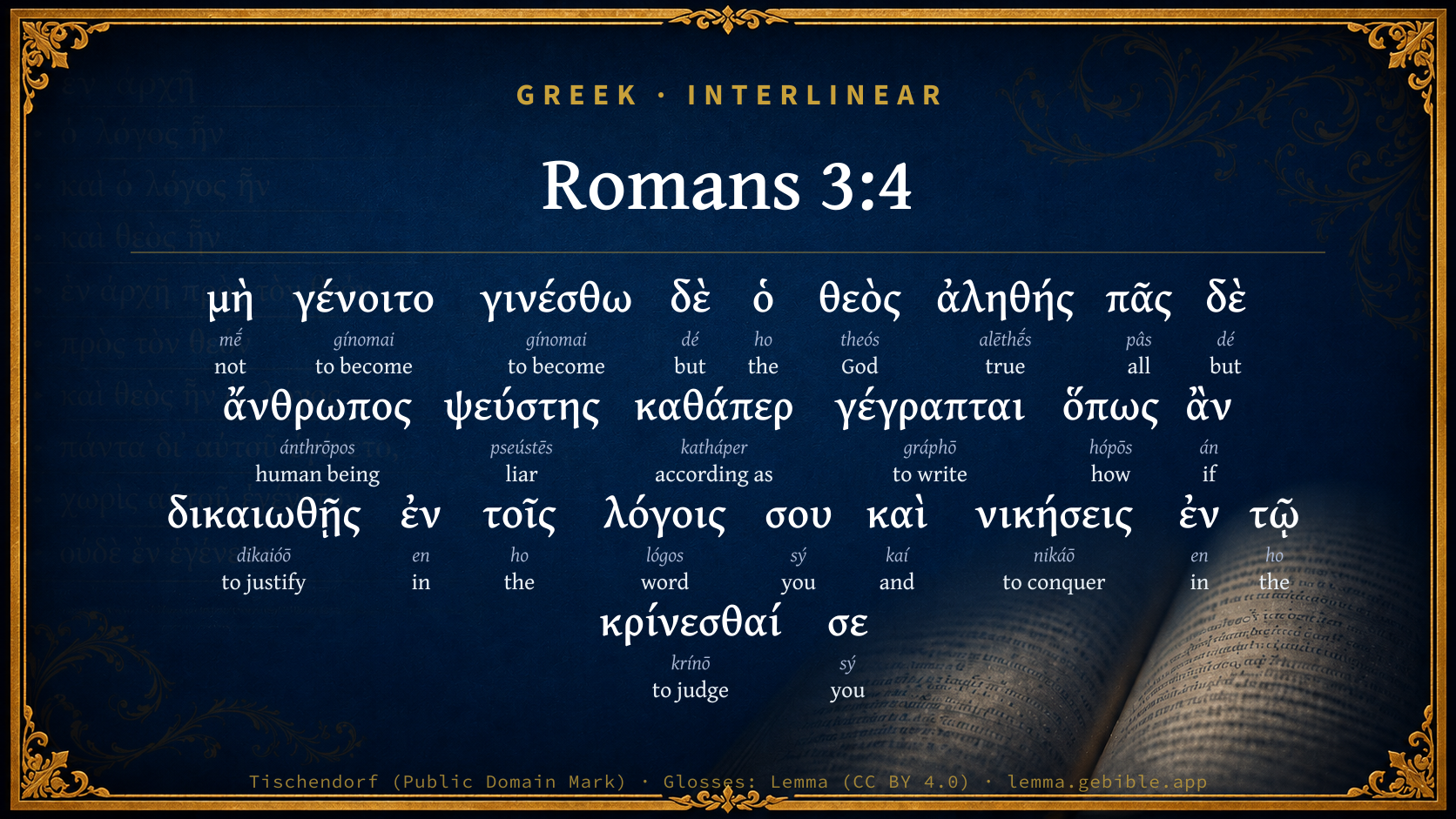
Greek (Tischendorf 8th ed.) Romans 3:4 appears in the Greek New Testament. The text above is from the Tischendorf 8th edition. Each word links to its Strong’s number and a concise gloss. Click any word for its full Thayer’s Greek Lexicon entry.
Download image
Cite this verse

Romans 3:4 (World English Bible). Public Domain. Lemma interlinear Bible study tool, https://lemma.gebible.app/v/romans/3/4.

Show BibTeX & RIS
BibTeX
RIS
English Translation
May it never be! Yes, let God be found true, but every man a liar. As it is written, "That you might be justified in your words, And might prevail when you come into judgment."
World English Bible · Public Domain
Highlights
  • 1 first appearance in the Greek New Testament
Full analysis ↓
Download a study sheet

One document with this verse’s original text, its word-by-word gloss line, the meaning frame, cross-references with their text, attributed commentary, and full source and license credits — printable, and it pastes into notes with its structure intact.

This verse Autodidact and up

Study sheet (.html) Plain text (.txt)

A passage Seminary Student

Up to 50 verses in one chapter. A passage sheet keeps up to 6 commentary sources and 12 cross-references per verse, in the order this page ranks them, and says so on the sheet whenever that leaves anything out. Ask for a single verse and you get the Autodidact verse sheet above.

Everything on this page stays free to read, with no account — the sheet is a download of what is already on screen, not access to it.

Want to remove ads? Support Godless Engineer
Compare translations 3

The same verse in 3 English versions, stacked beneath the original-language interlinear above. Click any original word for its lexicon entry.

Each is an independent rendering of the whole verse — the interlinear is not word-aligned to these translations.

Highlighted words mark where these versions differ — a whole-verse word diff, not a word-by-word alignment.

  • World English Bible Public Domain
    May it never be! Yes, let God be found true, but every man a liar. As it is written, "That you might be justified in your words, And might prevail when you come into judgment."
  • King James Version Public Domain
    God forbid: yea, let God be true, but every man a liar; as it is written, That thou mightest be justified in thy sayings, and mightest overcome when thou art judged.
  • unfoldingWord Literal Text CC BY-SA 4.0
    May it never be! Instead, let God be true, but every man a liar. Just as it is written, “So that you might be justified in your words and you will prevail when you are judged.”

unfoldingWord Literal Text — © unfoldingWord, licensed CC BY-SA 4.0. Word-aligned USFM3 via Door43 (git.door43.org/unfoldingWord/en_ult).

Versions to compare (up to 4)

3 of 4 selected

Show all 19 translations

Every available English version of this verse, each an independent rendering of the whole verse.

  • World English Bible Public Domain
    May it never be! Yes, let God be found true, but every man a liar. As it is written, "That you might be justified in your words, And might prevail when you come into judgment."
  • Berean Standard Bible Public Domain
    Certainly not! Let God be true and every man a liar. As it is written: “So that You may be proved right when You speak and victorious when You judge.”
  • Majority Standard Bible Public Domain
    Certainly not! Let God be true and every man a liar. As it is written: “So that You may be proved right when You speak and victorious when You judge.”
  • King James Version Public Domain
    God forbid: yea, let God be true, but every man a liar; as it is written, That thou mightest be justified in thy sayings, and mightest overcome when thou art judged.
  • American Standard Version (1901) Public Domain
    God forbid: yea, let God be found true, but every man a liar; as it is written, That thou mightest be justified in thy words, And mightest prevail when thou comest into judgment.
  • Revised Version (1885) Public Domain
    God forbid: yea, let God be found true, but every man a liar; as it is written, That thou mightest be justified in thy words, And mightest prevail when thou comest into judgment.
  • Geneva Bible (1599) Public Domain
    God forbid: yea, let God be true, and euery man a lyar, as it is written, That thou mightest be iustified in thy words, and ouercome, when thou art iudged.
  • Douay-Rheims (1899) Public Domain
    But God is true; and every man a liar, as it is written, That thou mayest be justified in thy words, and mayest overcome when thou art judged.
  • Young's Literal Translation Public Domain
    let it not be! and let God become true, and every man false, according as it hath been written, `That Thou mayest be declared righteous in Thy words, and mayest overcome in Thy being judged.'
  • Literal Standard Version CC BY-SA 4.0
    Let it not be! And let God become true, and every man false, according as it has been written: “That You may be declared righteous in Your words, and may overcome in Your being judged.”
  • Unlocked Literal Bible CC BY-SA 4.0
    May it never be. Instead, let God be found to be true, even though every man is a liar. As it has been written, “That you might be shown to be righteous in your words, and that you might prevail when you come into judgment.”
  • unfoldingWord Literal Text CC BY-SA 4.0
    May it never be! Instead, let God be true, but every man a liar. Just as it is written, “So that you might be justified in your words and you will prevail when you are judged.”
  • Darby Bible Public Domain
    Far be the thought: but let God be true, and every man false; according as it is written, So that thou shouldest be justified in thy words, and shouldest overcome when thou art in judgment.
  • World Messianic Bible Public Domain
    May it never be! Yes, let God be found true, but every man a liar. As it is written, “that you might be justified in your words, and might prevail when you come into judgment.”
  • Webster's Bible Public Domain
    By no means: verily let God be true, but every man a liar; as it is written, That thou mayest be justified in thy sayings, and mayest overcome when thou art judged.
  • Free Bible Version CC BY-SA 4.0
    Of course not! Even if everyone else is proved to be lying, God always tells the truth. As Scripture says, “What you say will be proved right, and you will win your case when you are judged.”
  • Bible in Basic English Public Domain
    In no way: but let God be true, though every man is seen to be untrue; as it is said in the Writings, That your words may be seen to be true, and you may be seen to be right when you are judged.
  • Text-Critical English NT CC BY 4.0
    Certainly not! Rather, let God be true even if every man is a liar, just as it is written, “So that yoʋ may be justified in yoʋr words, and prevail when yoʋ are judged.”
  • Tyndale New Testament (1534) Public Domain
    God forbid. Let god be true and all men lyars as it is written: That thou myghtest be iustifyed in thy sayinge and shuldest overcome when thou arte iudged.

Literal Standard Version (2020), Covenant Press — licensed CC BY-SA 4.0. Text via the HelloAO Bible API (eBible.org). Unlocked Literal Bible (unfoldingWord) — licensed CC BY-SA 4.0. Text via the HelloAO Bible API (eBible.org). unfoldingWord Literal Text — © unfoldingWord, licensed CC BY-SA 4.0. Word-aligned USFM3 via Door43 (git.door43.org/unfoldingWord/en_ult). Free Bible Version, Dr. Jonathan Gallagher — licensed CC BY-SA 4.0. Text via the HelloAO Bible API (eBible.org).

Word by word

More ways to search: Search by grammar → Find every occurrence → Compare this word →

Practice this passage: Drill this verse → Learn its vocabulary →

ψεύστης
pseústēs
G5583
“liar”
Noun, Nominative, Singular, Masculine
Part of Speech
Noun
Case
Nominative
Number
Singular
Gender
Masculine
Full Thayer's Definition

Origin: from G5574

TDNT: 18:54,1

1. a liar 2. one who breaks faith 3. a false and faithless man
  1. μὴ mḗ G3361 “not” Particle, Negative
  2. γένοιτο gínomai G1096 “to become” Verb, Aorist, Middle deponent, Optative, 3rd person, Singular
  3. γινέσθω gínomai G1096 “to become” Verb, Present, Middle or Passive deponent, Imperative, 3rd person, Singular
  4. δὲ dé G1161 “but” Conjunction
  5. ὁ ho G3588 “the” Article, Nominative, Singular, Masculine
  6. θεὸς theós G2316 “God” Noun, Nominative, Singular, Masculine
  7. ἀληθής alēthḗs G227 “true” Adjective, Nominative, Singular, Masculine
  8. πᾶς pâs G3956 “all” Adjective, Nominative, Singular, Masculine
  9. δὲ dé G1161 “but” Conjunction
  10. ἄνθρωπος ánthrōpos G444 “human being” Noun, Nominative, Singular, Masculine
  11. καθάπερ katháper G2509 “according as” Adverb
  12. γέγραπται gráphō G1125 “to write” Verb, Perfect, Passive, Indicative, 3rd person, Singular
  13. ὅπως hópōs G3704 “how” Adverb
  14. ἂν án G302 “if” Particle
  15. δικαιωθῇς dikaióō G1344 “to justify” Verb, Aorist, Passive, Subjunctive, 2nd person, Singular
  16. ἐν en G1722 “in” Preposition
  17. τοῖς ho G3588 “the” Article, Dative, Plural, Masculine
  18. λόγοις lógos G3056 “word” Noun, Dative, Plural, Masculine
  19. σου sý G4771 “you” Personal pronoun, 2nd person, Genitive, Singular
  20. καὶ kaí G2532 “and” Conjunction
  21. νικήσεις nikáō G3528 “to conquer” Verb, Future, Active, Indicative, 2nd person, Singular
  22. ἐν en G1722 “in” Preposition
  23. τῷ ho G3588 “the” Article, Dative, Singular, Neuter
  24. κρίνεσθαί krínō G2919 “to judge” Verb, Present, Passive, Infinitive
  25. σε sý G4771 “you” Personal pronoun, 2nd person, Accusative, Singular

About this verse

These counts appear in no published source. They are computed here, from the morphology-tagged text and Lemma’s own curated glosses. What Lemma adds →

26
words
20
distinct lemmas
Pauline Epistles
section

Notable vocabulary

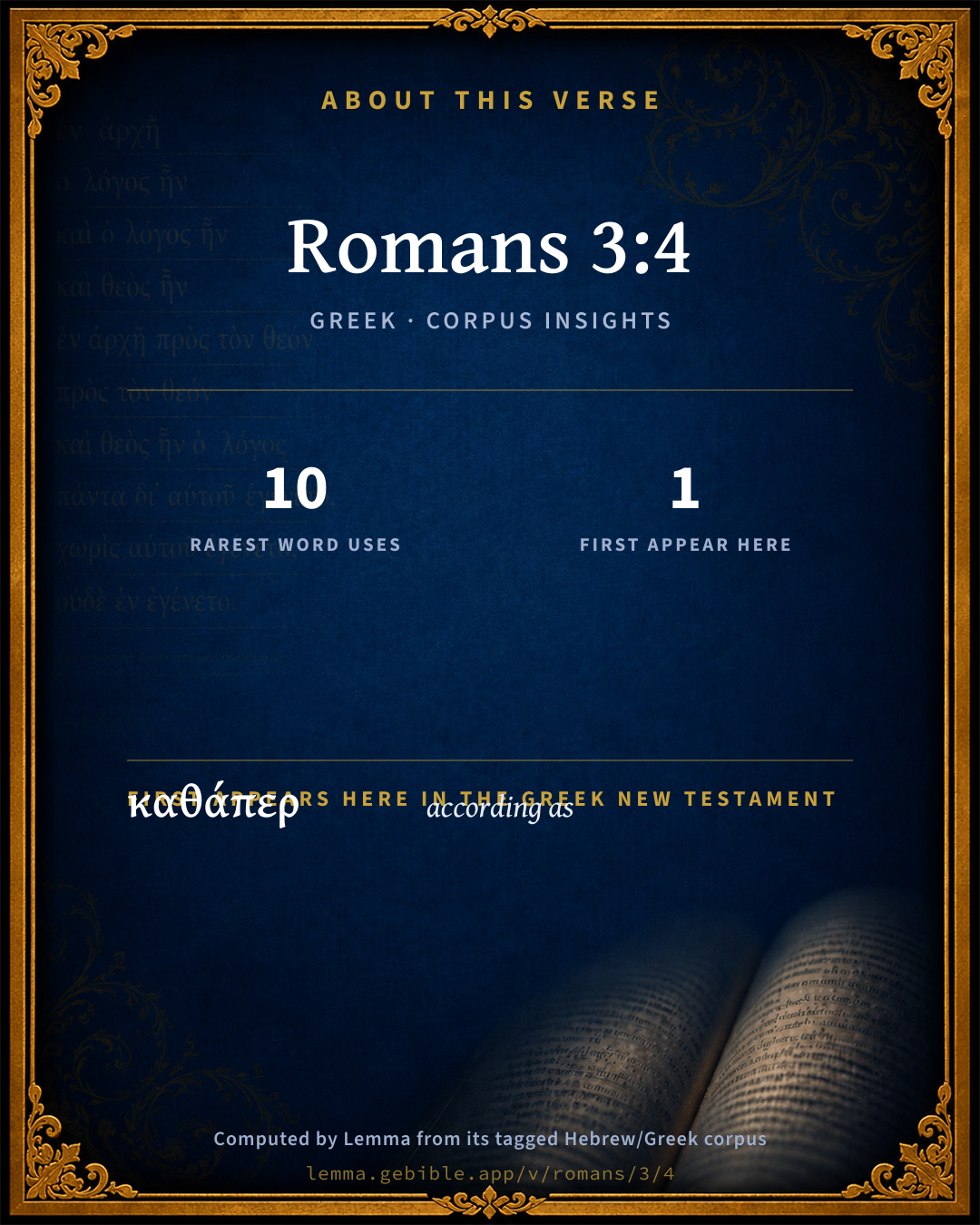
The rarest word here is ψεύστης liar G5583 — appearing just 10 times in the whole Greek New Testament.

First appearance in Scripture

This word makes its first canonical appearance in the Greek New Testament here:

  • καθάπερ according as G2509

Shared distinctive vocabulary

ψεύστης liar G5583 occurs in 10 verses of the Greek New Testament. Also found in:
Repetition

Words recur within this verse:

Cross-references

31

Topical passages linked to Romans 3:4 in the Treasury of Scripture Knowledge — connected by theme and wording, ordered by reader-vote popularity; previews shown in the World English Bible.

  • Psalms 51:4 Against you, and you only, have I sinned, And done that which is evil in your sight; That you may be proved right when you speak, And justified when you judge.
  • Psalms 116:11 I said in my haste, "All men are liars."
  • Galatians 2:17 But if, while we sought to be justified in Christ, we ourselves also were found sinners, is Christ a servant of sin? Certainly not!
  • Hebrews 6:18 that by two immutable things, in which it is impossible for God to lie, we may have a strong encouragement, who have fled for refuge to take hold of the hope set before us.
  • Deuteronomy 32:4 The Rock, his work is perfect; For all his ways are justice: A God of faithfulness and without iniquity, Just and right is he.
  • Titus 1:2 in hope of eternal life, which God, who can't lie, promised before eternal times;
  • John 3:33 He who has received his witness has set his seal to this, that God is true.
  • Job 36:3 I will get my knowledge from afar, And will ascribe righteousness to my Maker.
  • Psalms 119:160 All of your words are truth. Every one of your righteous ordinances endures forever.
  • Psalms 138:2 I will bow down toward your holy temple, And give thanks to your Name for your loving kindness and for your truth; For you have exalted your Name and your Word above all.
  • Revelation 3:7 "To the angel of the assembly in Philadelphia write: "He who is holy, he who is true, he who has the key of David, he who opens and no one can shut, and who shuts and no one opens, says these things:
  • Romans 9:14 What shall we say then? Is there unrighteousness with God? May it never be!
  • Galatians 2:21 I don't make void the grace of God. For if righteousness is through the law, then Christ died for nothing!"
  • 1 John 5:20 We know that the Son of God has come, and has given us an understanding, that we know him who is true, and we are in him who is true, in his Son Jesus Christ. This is the true God, and eternal life.
  • Job 40:8 Will you even annul my judgment? Will you condemn me, that you may be justified?
  • Psalms 100:5 For Yahweh is good. His loving kindness endures forever, His faithfulness to all generations.
  • Micah 7:20 You will give truth to Jacob, and mercy to Abraham, As you have sworn to our fathers from the days of old.
  • 1 John 5:10 He who believes in the Son of God has the testimony in himself. He who doesn't believe God has made him a liar, because he has not believed in the testimony that God has given concerning his Son.
  • Matthew 11:19 The Son of Man came eating and drinking, and they say, 'Behold, a gluttonous man and a drunkard, a friend of tax collectors and sinners!' But wisdom is justified by her children."
  • Romans 3:31 Do we then nullify the law through faith? May it never be! No, we establish the law.
  • Romans 6:15 What then? Shall we sin, because we are not under law, but under grace? May it never be!
  • Romans 11:1 I ask then, Did God reject his people? May it never be! For I also am an Israelite, a descendant of Abraham, of the tribe of Benjamin.
  • Galatians 6:14 But far be it from me to boast, except in the cross of our Lord Jesus Christ, through which the world has been crucified to me, and I to the world.
  • Luke 20:16 He will come and destroy these farmers, and will give the vineyard to others." When they heard it, they said, "May it never be!"
  • Romans 3:6–7 May it never be! For then how will God judge the world?
  • Romans 6:2 May it never be! We who died to sin, how could we live in it any longer?
  • Romans 7:7 What shall we say then? Is the law sin? May it never be! However, I wouldn't have known sin, except through the law. For I wouldn't have known coveting, unless the law had said, "You shall not covet."
  • Romans 11:11 I ask then, did they stumble that they might fall? May it never be! But by their fall salvation has come to the Gentiles, to provoke them to jealousy.
  • 2 Corinthians 1:18 But as God is faithful, our word toward you was not "Yes and no."
  • Psalms 62:9 Surely men of low degree are just a breath, And men of high degree are a lie. In the balances they will go up. They are together lighter than a breath.
  • Romans 7:13 Did then that which is good become death to me? May it never be! But sin, that it might be shown to be sin, by working death to me through that which is good; that through the commandment sin might become exceeding sinful.

Cross-references courtesy of OpenBible.info (CC BY 4.0).

Commentary

Notes on Romans 3:4 from classic Christian and Jewish commentators (each source and its license shown beneath its notes). The classic Christian expositions comment on the surrounding passage and are grouped to its opening verse, so a note may address several verses; the Jewish commentaries on the Tanakh (Rashi and others) are per-verse, so they appear only where the commentator wrote on this verse.

Lemma curates 59 commentaries, every one of them public domain or Creative Commons licensed, each selected and text-cleaned for this edition rather than reprinted as found. About our sources →

Tyndale Open Study Notes

Tyndale Open Resources

3:4 Of course not! The Greek mē genoito is an emphatic negation, popular in the diatribe style that Paul uses here and in several other passages in Romans (see 3:6, 31; 6:2, 15; 7:7, 13; 9:14; 11:1, 11). • As the Scriptures say: Paul quotes Ps 51:4, where David confessed his sin in having an adulterous relationship with Bathsheba (see 2 Sam 11:1-27). God punished David, and David admitted that God was proved right and would win his case in court—his punishment was entirely just. God is faithful to what he has said in the past—his entire revelation—and his words warn of punishment for sin even as they promise reward for obedience.

Tyndale Open Study Notes — © Tyndale Open Resources, licensed CC BY-SA 4.0. Text via the HelloAO Bible API.

Bengel's Gnomon

Johann Albrecht Bengel

Rom 3:4. Μὴ γένοιτο) Paul alone uses this form of expression, and only in his epistles to the Romans and the Galatians.—γινέσθω, let him be made) in judgement.—ὁ Θεὸς ἀληθὴς, God true) See Psa 116:12, where God’s most faithful retribution is set in opposition to man’s perfidy. This fact, and the term lying, are referred to again, in verse 7.—πᾶς ἄνθρωπος, every man), not even excepting David. Psa 116:11, the LXX. have πᾶς ἄνθρωπος ψεύστης, every man a liar. Hence David, 1Sa 24:9, speaks of man’s words, that is, falsehood.—ὄπως—κρίνεσθαί σε) So the LXX., Psa 51:6 [4]. Those things are also [besides their application at David’s time] Prophetical, which David prayed in the agony [conflict] of his repentance.—ἂν), if only it [God’s faithfulness] were to be had recourse to, and if man would dare to put it to the test.—δικαιωθῇς—νικήσῃς, thou mayest be justified—mayest overcome), in the name of faithfulness and truth. The human judge judges so, as that the offence of the guilty is the only consideration weighed [regarded] by him, nor is he otherwise concerned as regards [vindicating] his own righteousness; but God exercises judgement so, as that the unrighteousness of men is not more demonstrated thereby, than His own righteousness: νικᾷν is generally said of a victory after the hazard of war, or of a lawsuit for money, or of a contest in the public games. In this passage, it is said of a judicial victory, which cannot but come to God [i.e. God is sure to be the victor].—ἐν τοῖς λόγοις σου) Hebr. בדברך, in which one passage דבר occurs in Kal, without the participle, that is, when thou beginnest to speak, and judicially to answer man, who accuses thee, or to proceed against him. [In a general way, indeed, men acknowledge that GOD is just, but when the question refers to special cases, then they are wont [they love] to defend their own cause, V. g.]—ἐν τῷ κρίνεσθαί σε) Hebr. בשפטך God at once both Κρίνει and Κρίνεται. Κρίνεται [implead in judgment] has the meaning of the middle voice, such as verbs of contending usually have: κρίνοντας applies to those who dispute in a court of law. LXX., Isa 43:26; Jdg 4:5; Jer 25:31. An instance in illustration is to be found in Mic 6:2, etc.; also in 1Sa 12:7. It is inexpressible loving-kindness in God to come down [condescend to stoop] to man for the purpose of pleading with him.

Bengel's Gnomon of the New Testament — English translation (T&T Clark, Edinburgh, 1860) — public domain. Text from a community e-Sword module.

Meyer's Critical & Exegetical Commentary

Heinrich August Wilhelm Meyer

Rom_3:4. Let it not be (far be it)! but God is to be truthful, i.e. His truthfulness is to be the actual result produced (namely, in the carrying out of His Messianic plan of salvation), and every man a liar. To this it shall come; the development of the holy divine economy to this final state of the relation between God and men, is what Paul knows and wishes.

μὴ γένοιτο] The familiar formula of negation by which the thing asked is repelled with abhorrence, corresponding to the חָלִילָה (Gen_44:17; Jos_22:29; 1Sa_20:2), is used by Paul particularly often in our Epistle, elsewhere in Gal_2:17; Gal_3:21, 1Co_6:15, always in a dialectic discussion. In the other writings of the N. T. it occurs only at Luk_20:16, but is current in later Greek authors (Raphel, Arrian. in loc[742]; Sturz, de dial. Al. p. 204).

γινέσθω] not equivalent to ΦΑΝΕΡΟΎΣΘΩ, ἈΠΟΔΕΙΚΝΎΣΘΩ (Theophylact), but the historical result which shall come to pass, the actual Theodicée that shall take place. This indeed in reality amounts to a φανεροῦσθαι, but it is expressed by ΓΙΝΈΣΘΩ, according to its objective reality, which demonstrates itself. In that which God (and man) does, He becomes actually what according to His nature He is.

πᾶς δὲ ἄνθρ. ψεύστ.] By no means unessential (Rückert), or merely a concomitant circumstance (Th. Schott), is designed, and that all the more forcibly without a preceding ΜΈΝ, to appropriate the ἈΛΉΘΕΙΑ exclusively to God, in contrast to ἠπίστ. τινες, Rom_3:3, outbidding this ΤΙΝΈς by Πᾶς. Every man is a liar, if he does not perform the service to which he has become bound, as is brought to light in the case of the τινές by their ἈΠΙΣΤΊΑ, since as members of the people of God they had bound themselves to faith in the divine promises. That Paul had Psa_116:11 in view (Calvin, Wolf, and many others) is the more doubtful, seeing that he immediately quotes another passage.

ὅπως ἂν δικ. Κ.Τ.Λ[743]] Psa_51:6 exactly after the LXX. Independently of the more immediate connection and sense of the original text, Paul seizes on the type of the relation discussed by him, which is involved in the words of the Psalm, in the form in which they are reproduced by the LXX.[744] and that in the sense: that thou mayest be justified, i.e. acknowledged as faultless and upright, in thy words, and prevail (in substance the same as the previous δικαιωθῇς) when thou disputest, namely, with men against whom thou defendest and followest out thy right. From this second clause results that Πᾶς ΔῈ ἌΝΘΡ. ΨΕΎΣΤΗς. The exact appropriateness of this view in the connection is decisive against the explanation commonly adopted formerly after the Vulgate and Luther, and again preferred by Mehring, which takes ΚΡΊΝΕΣΘΑΊ as passive (when thou art subjected to judgment). On the use of the middle, to dispute with, compare LXX. Job_9:3; Job_13:19, and other passages in Schleusner, Thes. III. p. 385 f. This use has been properly maintained by Beza, Bengel, and others; also Matthias, Tholuck, Philippi, van Hengel, Ewald, Hofmann, and Morison. Compare 1Co_6:1; Mat_5:40.

ἐν τοῖς λόγοις σου] i.e. in that which thou hast spoken. And that is the category to which those ΛΌΓΙΑ belong, as to which the Apostle has just repelled the idea that God will not keep them on account of the ἈΠΙΣΤΊΑ of the ΤΙΝΈς and will thereby prove untrue. The sense in sententia ferenda, when thou passest a sentence (Philippi), cannot be taken out of ἐν τ. λόγ. σου, since God is not represented as judge, but as litigant, over whom the justifying judicial decision is pronounced. The view of Hofmann is also erroneous: that it denotes the accusations, which God may bring against men. For the text represents God indeed as the party gaining the verdict and prevailing, but not as the accuser preferring charges; and the λόγοι, in respect of which He is declared justified, point back so directly to the λόγια in Rom_3:2, that this very correlation has occasioned the selection of the particular passage from Psalms 51

νικᾶν, like vincere, used of prevailing in a process; compare Xen. Mem. iv. 4, 17; Dem. 1436, 18 al[745] The opposite: ἩΤΤᾶΣΘΑΙ

On ὍΠΩς (here in order that in the event of decision) see Hartung, Partikell. II. p. 286, 289; Klotz, a[746] Devar. p. 685.

[742] n loc. refers to the note of the commentator or editor named on the particular passage.

[743] .τ.λ. καὶ τὰ λοιπά.

[744] The inaccuracies in the translation of the LXX. must be candidly acknowledged; still they do not yield any essential difference of sense from the idea of the original text. These inaccuracies consist in תִּזְכֶּה (insons sis) being rendered in the LXX. by νικήσης, and בְשָׁפְטֶךָ (cum judicas) being translated ἐν τῷ κρίνεσθαί σε.

[745] l. and others; and other passages; and other editions.

[746] d refers to the note of the commentator or editor named on the particular passage.

Meyer — Critical and Exegetical Commentary on the New Testament — English translation by Peter Christie, edited by Frederick Crombie (T&T Clark, 1880) — public domain. Text from a community e-Sword module.

Hodge's Commentary on Romans, Ephesians & First Corinthians

Charles Hodge

Rom_3:4

Let it not be; the frequently recurring formula to express strong aversion or denial. The objection presented in the preceding verse is, that the apostles doctrine as to the condemnation of the Jews is inconsistent with the faithfulness of God. Is the faith of God without effect? asks the objector. By no means, answers the apostle; that is no fair inference from my doctrine. There is no breach of the promises of God involved in the condemnation of wicked Jews. How the condemnation of the Jews is consistent with the promises of God, he shows in a subsequent part of his epistle, chaps. 9-11; here he merely asserts the fact, and shows that the opposite assumption leads to an absurdity. Let God be true, but every man a liar. That is, the truth and fidelity of God must be acknowledged, whatever be the consequence. This is said to express the strongest aversion to the consequence charged on his doctrine. Γινέσθω has its proper sense, fiat, let him become, i.e., be seen and acknowledged as true. This disposition to justify God under all circumstances, the apostle illustrates by the conduct and language of David, who acknowledged the justice of God even in his own condemnation, and said, Against thee only have I sinned; that thou mightest be justified in thy sayings, and overcome when thou art judged; i.e., that thy rectitude, under all circumstances, might be seen and acknowledged. In the Hebrew, the last verb of the verse is active, when thou judgest; in the Septuagint, a passive form is used, when thou art judged. This latter Paul follows, because the sentiment in either case is the same. God is seen and acknowledged to be just. The sacred writers of the New Testament often depart from the words of the Old Testament in their citations, being careful only to give the mind of the Spirit. Scimus, says Calvin, apostolos in recitandis Scripturae verbis saepe esse liberiores; quia satis habebant si ad rem apposite citarent; quare non tanta illis fuit verborum religio.

Charles Hodge — Commentary on Romans (1835), First Corinthians (1857), and Ephesians (1856) — public domain. Text from a community e-Sword module.

Geneva Bible (1599)

Geneva Bible translators

That thy justice might be plainly seen.

Forasmuch as thou showest forth an evident token of thy righteousness, constancy and faith, by preserving him who had broken his covenant.

Geneva Bible (1599) marginal notes — public domain. Text via Bolls.life.

Jamieson, Fausset & Brown

Robert Jamieson, A. R. Fausset & David Brown

God forbid--literally, "Let it not be," that is, "Away with such a thought"--a favorite expression of our apostle, when he would not only repudiate a supposed consequence of his doctrine, but express his abhorrence of it. "The Scriptures do not authorize such a use of God's name as must have been common among the English translators of the Bible" [HODGE].

yea, let God be--held

true, and every man a liar--that is, even though it should follow from this that every man is a liar.

when thou art judged--so in Psa 51:4, according to the Septuagint; but in the Hebrew and in our version, "when thou judgest." The general sentiment, however, is the same in both--that we are to vindicate the righteousness of God, at whatever expense to ourselves.

Jamieson, Fausset & Brown — Commentary Critical and Explanatory on the Whole Bible (1871) — public domain (CC PDM 1.0). Text via the HelloAO Bible API.

Adam Clarke's Commentary

Verse 4. APOSTLE. God forbid] μηγενοιτο, Let it not be, far from it, by no means. Yea, let God be true, but every man a liar, c. We must ever maintain that God is true, and that if, in any case, his promise appear to fail, it is because the condition on which it was given has not been complied with which is the sense of what is written, Ps 51:4: I acknowledge my sin, and condemn myself that the truth of thy promise (2Sa 7:15-16) to establish my house and throne for ever, may be vindicated when thou shalt execute that dreadful threatening, (2Sa 12:10,) that the sword shall never depart from my house, which I own I have brought upon myself by my own iniquity. Should any man say that the promise of God had failed toward him, let him examine his heart and his ways, and he will find that he has departed out of that way in which alone God could, consistently with his holiness and truth, fulfil the promise.

Adam Clarke's Commentary on the Bible (1810–1826) — public domain. Text from a community e-Sword/MySword module.

John Calvin's Commentaries

4. But let God be true, etc. Whatever may be the opinion of others, I regard this as an argument taken from the necessary consequence of what is opposed to it, by which Paul invalidates the preceding objection. For since these two things stand together, yea, necessarily accord, that God is true and that man is false, it follows that the truth of God is not nullified by the falsehood of men; for except he did now set those two things in opposition, the one to the other, he would afterwards have in vain labored to refute what was absurd, and show how God is just, though he manifests his justice by our unjustice. Hence the meaning is by no means ambiguous, — that the faithfulness of God is so far from being nullified by the perfidy and apostasy of men that it thereby becomes more evident. “God,” he says, “is true, not only because he is prepared to stand faithfully to his promises, but because he also really fulfills whatever he declares; for he so speaks, that his command becomes a reality. On the other hand, man is false, not only because he often violates his pledged faith, but because he naturally seeks falsehood and shuns the truth.”

The first clause contains the primary axiom of all Christian philosophy; the latter is taken from Psalm 116:11, where David confesses that there is nothing certain from man or in man.

Now this is a remarkable passage, and contains a consolation that is much needed; for such is the perversity of men in rejecting and despising God’s word, that its truth would be often doubted were not this to come to our minds, that God’s verity depends not on man’s verity. But how does this agree with what has been said previously — that in order to make the divine promise effectual, faith, which receives it, is on the part of men necessary? for faith stands opposed to falsehood. This seems, indeed, to be a difficult question; but it may with no great difficulty be answered, and in this way — the Lord, notwithstanding the lies of men, and though these are hinderances to his truth, does yet find a way for it through a pathless track, that he may come forth a conqueror, and that is, by correcting in his elect the inbred unbelief of our nature, and by subjecting to his service those who seem to be unconquerable. It must be added, that the discourse here is concerning the corruption of nature, and not the grace of God, which is the remedy for that corruption.

That thou mightest be justified, etc. The sense is, So far is it that the truth of God is destroyed by our falsehood and unfaithfulness, that it thereby shines forth and appears more evident, according to the testimony of David, who says, that as he was sinner, God was a just and righteous Judge in whatever he determined respecting him, and that he would overcome all the calumnies of the ungodly who murmured against his righteousness. By the words of God, David means the judgments which he pronounces upon us; for the common application of these to promises is too strained: and so the particle that, is not so much final, nor refers to a far-fetched consequence, but implies an inference according to this purport, “Against thee have I sinned; justly then dost thou punish me.” And that Paul has quoted this passage according to the proper and real meaning of David, is clear from the objection that is immediately added, “How shall the righteousness of God remain perfect if our iniquity illustrates it?” For in vain, as I have already observed, and unseasonable has Paul arrested the attention of his readers with this difficulty, except David meant, that God, in his wonderful providence, elicited from the sins of men a praise to his own righteousness. The second clause in Hebrew is this, “And that thou mightest be pure in thy judgment;” which expression imports nothing else but that God in all his judgments is worthy of praise, how much soever the ungodly may clamor and strive by their complaints disgracefully to efface his glory. But Paul has followed the Greek version, which answered his purpose here even better. We indeed know that the Apostles in quoting Scripture often used a freer language than the original; for they counted it enough to quote what was suitable to their subject: hence they made no great account of words.

The application then of this passage is the following: Since all the sins of mortals must serve to illustrate the glory of the Lord, and since he is especially glorified by his truth, it follows, that even the falsehood of men serves to confirm rather than to subvert his truth. Though the word κρίνεσθαι, may be taken actively as well as passively, yet the Greek translators, I have no doubt, rendered it passively, contrary to the meaning of the Prophet.

John Calvin's Commentaries (1540-1563) — public domain. Text from the Calvin Translation Society English edition (1840s-50s) via the Christian Classics Ethereal Library (ccel.org). Calvin's coverage is partial (roughly two-thirds of the Bible); uncommented books and verses are honest gaps, never fabricated. The 19th-century editor's footnotes and remarks are omitted so the notes are faithfully Calvin's own voice.

Ellicott's Commentary for English Readers

(4) Impossible! Rather let God be seen to be true though all mankind should be proved false, even as the Psalmist looked upon his own sin as serving to enhance the triumph of God’s justice. Speaking of that justice for the moment as if it could be arraigned before the bar of a still higher tribunal, he asserts its absolute and complete acquittal.

That thou mightest be justified.—Strictly, in order that, here as in the Hebrew of the Psalm. Good is, in some way inscrutable to us, educed out of evil, and this is clearly foreseen by God, and forms part of His design, though so as not to interfere with the free-will of man. Religion assumes that the two things, free-will and omnipotence, are reconcilable, though how they are to be reconciled seems an insoluble problem. The same difficulty attaches to every system but one of blank fatalism and atheism. But the theory of fatalism if logically carried out would simply destroy human society.

Psalms 51, in which the quotation occurs, is commonly (in accordance with the heading), though perhaps wrongly, ascribed to David after his sin with Bathsheba. The effect of this sin is to throw out into the strongest relief the justice of the sentence by which it is followed and punished. The original is, “That thou mightest be just in thy speaking; that thou mightest be pure in thy judging.” St. Paul adopts the rendering of the LXX., who make the last word passive instead of active, thus making it apply, not to the sentence given by God, but to the imaginary trial to which by a figure of speech that sentence itself is supposed to be submitted.

A Bible Commentary for English Readers, edited by Charles John Ellicott (1878–1897) — public domain. Text from a community e-Sword module.

The Cambridge Bible for Schools and Colleges

gen. ed. J. J. S. Perowne

4. God forbid] Lit. may it not be; be it not; and so always where the words “God forbid” occur in the Eng. N. T.—The Apostle more than accepts the opponent’s position, but not in his sense. God’s promise should indeed stand; the mere thought of a failure there is shocking. But that promise had never said that impenitent individuals of the chosen race should be safe from doom.

let God be true, &c.] Q. d., “If there is failure, it is safer and truer to believe the truest man false, than ‘God who cannot lie.’ ”—It is a profound characteristic of all Scripture to be always on the side of God. In this lies one pregnant evidence, to those who will think it out, of the “Supernatural Origin of the Bible.”

that thou mightest, &c.] The Gr. words are verbatim the LXX. of Psalms 51 (LXX. 50):4. The lit. Hebrew is exactly as E. V. there, “clear when thou judgest;” and probably the Gr. of LXX. and of St Paul here is really the same, or nearly so, in effect: “clear when thou impleadest; when thou procurest judgment.” Same word as “go to law,” 1Co_6:1. On the special force of this thought in Psalms 51 see paraphrase above.

The Cambridge Bible for Schools and Colleges (gen. ed. J. J. S. Perowne; Cambridge University Press, 1878–1918) — public domain. Text from a community e-Sword module.

John Gill's Exposition

God forbid, yea, let God be true, but every man a liar,.... Let no such thing ever enter into the minds of any, that the truth of God can be, or will be made of none effect by the want of faith in man; let it be always asserted and abode by; that God is true, faithful to his word, constant in his promises, and will always fulfil his purposes; though "every man is a liar", vain, fallacious, and inconstant: referring to Psa 116:11;

as it is written, Psa 51:4;

that thou mightest be justified in thy sayings, and mightest overcome when thou art judged. This is a proof that God is true, and stands to his word, though men are fallacious, inconstant, and wicked. God made a promise to David, that of the fruit of his body he would set upon his throne; that the Messiah should spring from him; that he would of his seed raise up unto Israel a Saviour. Now David sinned greatly in the case of Bathsheba, Sa2 11:3 (title), but his sin did not make of no effect the truth and faithfulness of God: though David showed himself to be a weak sinful man, yet God appeared true and faithful to every word of promise which he had sworn in truth to him; and therefore when he was brought to a sense of his evil, and at the same time to observe the invariable truth and faithfulness of God, said, "I acknowledge my transgression, &c. against thee, thee only have I sinned and done this evil in thy sight", Psa 51:3, which confession of sin I make, "that thou mightest be justified in thy sayings"; or "when thou speakest", Psa 51:4, which is all one; that is, that thou mightest appear to be just, and faithful, and true in all thy promises, in every word that is gone out of thy mouth, which shall not be recalled and made void, on account of my sins; for though I have sinned, thou abidest faithful; and this also I declare with shame to myself, and with adoring views of thine unchangeable truth and goodness: "that thou mightest overcome"; that is, put to silence all such cavils and charges, as if the faith of God could be made void by the unfaithfulness of men: "when thou art judged"; when men will be so bold and daring to arraign thy truth and faithfulness, and contend with thee about them. This now is brought as a full proof, and is a full proof of this truth, that God is always true to his word, though men fail in theirs, and fall into sin. God kept his word with David concerning the stability of his kingdom, his successor, and the Messiah that should spring from him, though he acted a bad part against God. There is some little difference between these words as they stand in the Hebrew text of Psa 51:4; and as they are cited and rendered by the apostle, in the last clause of them; in the former it is, "that thou mightest be clear"; in the latter, "that thou mightest overcome". Now to vindicate the apostle's version, let it be observed, that the Hebrew word signifies to "overcome", as well as to "be clear"; of which instances may be given out of the Jewish writings. Says (l) Rabba; concerning an argument used by R. Chanina, in a controversy with other Rabbins, by this R. Chanina ben Antigonus, "hath overcome" them: and in another place (m), whosoever "overcomes" a king, they cast him into an empty ditch; where the gloss upon it is, he that overcomes a king by words, that is, by disputing with him, which is a disgrace to a king. So the word is used in the Syriac language in Joh 16:33. Moreover, the sense is the same, be it rendered either way; for as a man, when he overcomes his adversary, and carries his point against him, is clear of his charges and cavils, so God, when he overcomes in judgment, is clear of the imputations of wicked men. Another difference in the citation is, that what in the psalm is rendered "when thou judgest", is by the apostle, "when thou art judged", Psa 51:4, the word, which is used by the Psalmist, may be rendered either way; either "when thou judgest", as a word of the same form is rendered, when "thou speakest", in Psa 51:4; or "when anyone judges of thee", or "when thou art judged": a like instance is in Psa 46:2; and so it is rendered by the Septuagint, and followed by the apostle, though the word he uses may be considered in the middle voice, and may have an active signification in it; and the phrase, , may be rendered, "when thou judgest", and then both agree.

(l) T. Bab. Niddah, fol. 52. 2. (m) T. Bab. Avoda Zara, fol. 10. 2. Sanhedrim, fol. 39. 1. & Becorot, fol. 8. 2.

John Gill's Exposition of the Whole Bible (1746–1763) — public domain (CC PDM 1.0). Text via the HelloAO Bible API.

Trapp's Complete Commentary

John Trapp

4 God forbid: yea, let God be true, but every man a liar; as it is written, That thou mightest be justified in thy sayings, and mightest overcome when thou art judged.

Ver. 4. Every man a liar] viz. By nature. But, Isa 63:8, God’s people are "children that will not lie," they will die rather. Non ideo negare volo ne peream, sed ideo mentiri nolo ne peccem, saith she upon the rack, of whom St Jerome writeth. The officers of Merindol answered the bishop that moved them to abjure, that they marvelled much that he would persuade them to lie to God and the world. And albeit that all men by nature are liars, yet they had learned by the word of God that they ought diligently to take heed of lying in any matter, be it never so small, &c.

Every man a liar] So he is either by imposture, and so in purpose, or by impotence, and so in the event, deceiving those that rely upon him, Psa 62:9.

That thou mayest be justified in thy sayings] David speaketh of the truth of Nathan’s reprehension; Paul applies it to the truth of God in his promises also. Let us give him a testimonial, Joh 3:33; such as is that Deu 32:4; "A God of truth and without iniquity, just and right is he."

And mightest overcome] Mayest be pure, saith David, Psa 51:4. Zacah in the Syriac is used for overcoming. Vincit veritas, et dare non dignis res mage digna Deo est.

John Trapp, A Commentary or Exposition upon All the Books of the Old and New Testament (1647–1656) — public domain. Text from a community e-Sword module.

Albert Barnes' Notes on the Bible

God forbid - Greek. Let not this be. The sense is, “let not this by any means be supposed.” This is the answer of the apostle, showing that no such consequence followed from his doctrines; and that “if” any such consequence should follow, the doctrine should be at once abandoned, and that every man, no matter who, should be rather esteemed false than God. The veracity of God was a great first principle, which was to be held, whatever might be the consequence. This implies that the apostle believed that the fidelity of God could be maintained in strict consistency with the fact that any number of the Jews might be found to be unfaithful, and be cast off. The apostle has not entered into an explanation of this, or shown how it could be, but it is not difficult to understand how it was. The promise made to Abraham, and the fathers, was not unconditional and absolute, that all the Jews should be saved. It was implied that they were to be obedient; and that if they were not, they would be cast off; Gen 18:19. Though the apostle has not stated it here, yet he has considered it at length in another part of this Epistle, and showed that it was not only consistent with the original promise that a part of the Jews should be found unfaithful, and be east off, but that it had actually occurred according to the prophets; Rom 10:16-21; 11. Thus, the fidelity of God was preserved; at the same time that it was a matter of fact that no small part of the nation was rejected and lost.

Let God be true - Let God be esteemed true and faithful, whatever consequence may follow. This was a first principle, and should be now, that God should be believed to be a God of truth, whatever consequence it might involve. How happy would it be, if all people would regard this as a fixed principle, a matter not to be questioned in their hearts, or debated about, that God is true to his word! How much doubt and anxiety would it save professing Christians; and how much error would it save among sinners! Amidst all the agitations of the world, all conflicts, debates, and trials, it would be a fixed position where every man might find rest, and which would do more than all other things to allay the tempests and smooth the agitated waves of human life.

But every man a liar - Though every man and every other opinion should be found to be false. Of course this included the apostle and his reasoning; and the expression is one of those which show his magnanimity and greatness of soul. It implies that every opinion which he and all others held; every doctrine which had been defended; should be at once abandoned, if it implied that God was false. It was to be assumed as a first principle in all religion and all reasoning, that if a doctrine implied that God was not faithful, it was of course a false doctrine. This showed his firm conviction that the doctrine which he advanced was strictly in accordance with the veracity of the divine promise. What a noble principle is this! How strikingly illustrative of the humility of true piety, and of the confidence which true piety places in God above all the deductions of human reason! And if all people were willing to sacrifice their opinions when they appeared to impinge on the veracity of God; if they started back with instinctive shuddering at the very supposition of such a lack of fidelity in him; how soon would it put an end to the boastings of error, to the pride of philosophy, to lofty dictation in religion! No man with this feeling could be for a moment a universalist; and none could be an infidel.

As it is written - Psa 51:4. To confirm the sentiment which he had just advanced and to show that it accorded with the spirit of religion as expressed in the Jewish writings, the apostle appeals to the language of David, uttered in a state of deep penitence for past transgressions. Of all quotations ever made, this is one of the most beautiful and most happy. David was overwhelmed with grief; he saw his crime to be awful; he feared the displeasure of God, and trembled before him. Yet “he held it as a fixed, indisputable principle that” God was right. This he never once thought of calling in question. He had sinned against God, God only; and he did not once think of calling in question the fact that God was just altogether in reproving him for his sin, and in pronouncing against him the sentence of condemnation.

That thou mightest be justified - That thou mightest be regarded as just or right, or, that it may appear that God is not unjust. This does not mean that David had sinned against God for the purpose of justifying him, but that he now clearly saw that his sin had been so directly against him, and so aggravated, that God was right in his sentence of condemnation.

In thy sayings - In what thou hast spoken; that is, in thy sentence of condemnation; in thy words in relation to this offence. It may help us to understand this, to remember that the psalm was written immediately after Nathan, at the command of God, had gone to reprove David for his crime; (see the title of the psalm.) God, by the mouth of Nathan, had expressly condemned David for his crime. To this expression of condemnation David doubtless refers by the expression “in thy sayings;” see 2Sa 12:7-13.

And mightest overcome - In the Hebrew, “mightest be pure,” or mightest be esteemed pure, or just. The word which the Septuagint and the apostle have used, “mightest overcome,” is sometimes used with reference to litigations or trials in a court of justice. He that was accused and acquitted, or who was adjudged to be innocent, might be said to overcome, or to gain the cause. The expression is thus used here. As if there were a trial between David and God, God would overcome; that is, would be esteemed pure and righteous in his sentence condemning the crime of David.

When thou art judged - The Hebrew is, “when thou judgest;” that is, in thy judgment pronounced on this crime. The Greek may also be in the middle voice as well as the passive, and may correspond, therefore, in meaning precisely with the Hebrew. So the Arabic renders it. The Syriac renders it, “when they (that is, people) shall judge thee.” The meaning, as expressed by David, is, that God is to be esteemed right and just in condemning people for their sins, and that a true penitent, that is, a man placed in the best circumstances to form a proper estimate of God, will see this, though it should condemn himself. The meaning of the expression in the connection in which Paul uses it, is, that it is to be held as a fixed, unwavering principle, that God is right and true, whatever consequences it may involve; whatever doctrine it may overthrow; or whatever man it may prove to be a liar.

Albert Barnes' Notes on the Bible (1834–1885) — public domain. Text from a community e-Sword/MySword module.

Haydock's Catholic Bible Commentary

God only is essentially true. All men in their own capacity are liable to lies and errors: nevertheless God, who is the truth, will make good his promise of keeping his Church in all truth. See St. John, xvi. 13. (Challoner) --- The Greek text has, "may God be true;" that is, may all men acknowledge him as such; let the whole world know, that he neither can be unfaithful to his word, nor his promises; and that, on the contrary, all men of themselves have but lies and vanity for their portion. --- That thou mayest be justified, &c. The particle that, is not casual in this place, but only marks the event. Thy conduct shews that thou art faithful and true to thy promises, and that, notwithstanding the judgments of men, thou art always unchangeable and infallible. Thou art victorious, when judged by them; thou shewest them the falsity and injustice of their judgments. (Calmet) --- And that the infidelity of man, so far from affecting the fidelity of God, will only serve to set it off in a more striking and clearer light. (Bible de Vence)

George Leo Haydock (1774–1849), Haydock's Catholic Family Bible and Commentary, 1859 edition — public domain. Excludes Psalms (Douay-Rheims chapter numbering differs from Protestant) and Deuterocanonical books (Catholic canon only).

Matthew Poole's English Annotations

God forbid; the negation that was closely couched in the former verse, is in this expressed by a note of indignation, and of the greatest detestation.

Let God be true; let him remain or appear faithful to his promises and covenant; or, let him be acknowledged to be so, according to the frequent testimonies of Scripture: see Num 23:19; Tit 1:2; Heb 6:17,18.

But every man a liar; or, although every man should be a liar; or, whatsoever we say of men, who are all mutable creatures, who are liable to mistakes in their own natures, and so may easily deceive others: see Psa 116:11.

That thou mightest be justified in thy sayings; that thou tnightest be acknowledged just in thy promises and threatenings; in which sense the word is used in divers places, Mat 11:19; Luk 7:29,35; Lu 10:29.

Mightest overcome; that thou mightest be clear or pure, so it is in the Psalm. The apostle honours the Seventy, which was the common translation, and minds the sense rather than the words. He that is clear, is like to overcome in a just judgment.

When thou art judged; or, when thou judgest: the word may be taken actively or passively; i.e. when thou dost execute judgment upon any, or, when any do presume to censure you.

Matthew Poole's English Annotations on the Holy Bible (1683–1685) — public domain. Text from a community e-Sword/MySword module.

Whedon's Commentary on the Bible

Daniel D. Whedon

4. God forbid—Literally, It may not be so. It is not a permissible thing. The divine name is not used in the apostle’s Greek phrase, but a divine impossibility of the thing is powerfully implied in thought.

God be true— The apostle here assumes two things: First, that falsehood in God would be infinitely wrong. But, second, God is surely infinitely right, and therefore falsehood or unfaithfulness must by no manner of means be admitted of God. The apostle’s ground is not that whatever a God is supposed to do (as, for instance, commit falsehood) is right because He does it; but, it is not to be admitted that the true God—the God we have— will commit that wrong. The apostle does not reason that because God is absolute sovereign therefore any thing supposably done by him is made right thereby. His argument is, that God is right and holy because of all possible courses he takes, not those courses which are unholy, but just the one that is holy; and of all possible doings, He ever does and will do not that which is unrighteous, but solely and truly that which is righteous. It is one of the moral perfections of God—nay, the sum of all his moral perfections—that He holds himself infinitely bound to all the obligations of truth, justice, and holiness, far above what man can conceive. Hence the wisdom of our perfect trust in Him, and of our feeling that perfect self-commitment to Him is a perfect self-commitment to all goodness.

True… liar—Terms used in regard to fidelity or unfaithfulness to the covenant. By let be the apostle means let it be assumed as primarily true.

Written—David had transgressed against the divine covenant in the murder of Uriah. Instead of justifying himself in his unfaithfulness he proclaims himself the sinner, (Psa_51:7,) and justifies God in inflicting evil upon himself.

Thou art judged—The Divine Being (reverently be it spoken) does more than once place himself and his administration before the tribunal of man’s moral sense in order to have its rectitude tested. He allows even Abraham to assume that certain courses would not be right in the Judge of all the earth. (Gen_18:25.) But as it became David, their sinful type, so it became the apostate Jews, to assume that in the matter of the failure of the Jewish dispensation, when justice made up its verdict, God would be found the faithful and man the traitor. To “reply against God,” therefore, (Rom_9:20,) is not (with the Arminian) to assume that a course cannot be pursued by God because it would be a wrong course; it is (as the Calvinist) to assume the wrong course to be the real one, and either to reproach God with it, or to defend God by maintaining that wrong is right, and thus pervert the very foundations of all rectitude.

Daniel D. Whedon (gen. ed.), Commentary on the Old and New Testaments (1874–1909) — public domain. Text from a community e-Sword module.

The Pulpit Commentary

God forbid (there is no better English phrase for expressing the indignant repudiation of mh genoito): yea, let God be true (ginesyw alhyhv ; i.e. "let his truth be established;" "Fiat, in judicio," Bengel), but every man a liar; as it is written, That thou mightest be justified in thy sayings, and mightest overcome when thou art judged, We can hardly avoid recognizing a reference to Psa_116:11 in "every man a liar, the words of the LXX being exactly given, though the general purport of that psalm does not bear upon the present argument. The apostle takes this phrase from it as expressing well what he wants to say, viz. that though all men were false (in the sense expressed and implied by the previous hpisthsan), yet God"s truth stands. But it only leads up to the second quotation from Ps 51, which is the important one, introduced by kaywraptai . In its final words, nikhshv en tw krinesyai se , the LXX is followed (so also Vulgate, cum judicaris), though the Hebrew may be more correctly rendered, as in the Authorized Version, "be clear when thou judgest." The krinesyai of the LXX may be understood passively in the sense of God being called to account, as men might be, for the justice of his dealings; or, perhaps, in a middle sense for entering into a suit or controversy with his people. Krinesyai means "going to law" in 1Co_6:1, 1Co_6:6, (cf. also Mat_5:40) and in the LXX, with especial reference to a supposed controversy or pleading of God with men, Jer_25:31Jo Jer_9:2 Jer_13:19. (See also Hos_2:2, Kriyhte prora uwn) The meaning of this concluding expression does not, however, affect the main purport of the verse, or its relevancy as here quoted. Occurring in what is believed to be David"s penitential psalm after his sin. in the matter of Uriah, it declares, in conjunction with the preceding verse, that, sin having been committed, man alone is guilty, and that God"s truth and righteousness can never be impugned. But it seems to imply still more than this, viz. that man"s sin has the establishment of God"s righteousness as its consequence, or even, it may be, as its purpose; for the conclusion of ver. 4 in the psalm, naturally connected with "against thee only have I sinned" preceding, is so connected by opwv an (in Hebrew, ml); and it is not out of keeping with scriptural doctrine that David should have intended to express even Divine purpose in that he had been permitted, for his sins, to fall into that deeper sin with the view of establishing God"s righteousness all the more. It does not, however, seem certain (whatever some grammarians may say) that the conjunction need of necessity be understood as relic; it may be embatic only. However this be, it is the inference from opwv an that suggests the new objection of the following verse.

The Pulpit Commentary (1880–1919), ed. H.D.M. Spence-Jones & Joseph S. Exell — public domain. Text from a community e-Sword module.

John Wesley's Explanatory Notes

Psalm ii, 4.

John Wesley, Explanatory Notes Upon the Whole Bible (1754–1765) — public domain. Text via the GEBible commentary corpus.

Godbey's Commentary on the New Testament

William B. Godbey

4. “For it could not be so; let God be true and every man a liar; as has been written: In order that thou mayest be justified in thy words and shall prevail when thou art judged.” Here the apostle, constantly affirming the gracious possibility of universal salvation, finds the heathens not only alienated from God, first into proud rationalism, secondly into silly idolatry, and finally into revolting brutality; and the Jews, who represent the visible church in all ages, with all their munificent endowments through the wonderful light and blessing of God’s revealed Word, corroborated and symbolized by the ecclesiastical ordinances, rites and ceremonies, nevertheless en masse not only utterly destitute of God’s saving grace in the heart, but actually puffed up with spiritual pride and disgusting vanity, believing themselves to be the elect of God and looking with contempt upon the Gentiles, whereas they themselves are in the deeper and more terrible condemnation, because of grace depreciated and light not only rejected but actually metamorphosed into darkness black as the midnight of perdition. Amid this deplorable wholesale ruin appertaining both to Jews and Gentiles, i. e., to church members and outsiders, despite the universal redeeming grace of God in Christ, thus populating hell with countless millions, both church members and worldlians, yet the truth, mercy, and grace of God are in no way invalidated by this awful state of things. God is just as true amid a world of liars as if all the people on the earth were true and appreciative of His salvation. In the grand finale, when the universe faces the great white throne, every one will stand for himself and be judged according to his intrinsical spiritual, practical personality.

William B. Godbey, Commentary on the New Testament (1896–1900) — public domain. Text from a community e-Sword module.

McGarvey & Pendleton's Commentaries

J. W. McGarvey

God forbid: yea, let God be found true, but every man a liar; as it is written [ Psa_51:4 ], That thou mightest be justified in thy words, And mightest prevail when thou comest into judgment . [True, the Jew, by unbelief, had failed to improve his advantage in possessing the Scriptures; but that did not alter the fact that he had had the advantage. He had failed, but God had not failed. Had the unbelief of the Jew caused God to break his promises, then indeed might the advantage of the Jew have been questioned, for in that case it would have proven a vanishing quantity. But, on the contrary, God had kept faith, and so the advantage, though unimproved, had been an abiding quantity. And this accords with the holiness and sinlessness of God. He is ever blameless, and because he is so, he must ever be assumed to be so, even though such an assumption should involve the presumption that all men are false and untrue, as, indeed, they are in comparison with him: for David testified to the incomparable righteousness of God, that it was a righteousness which acquitted God of all unfaithfulness to his words, and which causes him to prevail whenever men call him to account or pass judgment upon him.]

J. W. McGarvey (with Philip Y. Pendleton), Commentaries on the New Testament (The Fourfold Gospel, 1914; Acts; and the epistles) — public domain. Text from a community e-Sword/MySword module.

The People's New Testament

B. W. Johnson

4. God forbid. The Greek means, literally, “Not so.” It does not follow that God is unfaithful, because he rejects unbelieving Israel, for his covenant with Israel and his promise to Abraham were conditional. Let God be true, but every man a liar. That is, Let us believe all men to have broken their word, rather than God his. As it is written. Psalm 51:4. One of the penitential psalms, in which David mourns over his own sins. God's sayings, his threatenings, are justified by his judgments. They were in the case of David. They were also in the rejection of the Jewish nation, in spite of the promise, when it had rejected the Holy One of Israel.

B. W. Johnson's The People's New Testament with Notes (1889–1891) — public domain. Electronic text from the Christian Classics Ethereal Library (CCEL) ThML edition.

Cambridge Greek Testament for Schools and Colleges

4. μὴ γὲνοιτο. Cf. S. H.; characteristic of S. Paul, and esp. of this group of epistles; expresses the vehement rejection of a possible but false inference.

γινέσθω δὲ κ.τ.λ. Let GOD prove or be proved.… ἀληθής, only here and Joh 3:33; Joh 8:26, of GOD = true to His word.

πᾶς ἄνθρ. ψ. Psa 115:2 (Psa 116:10).

ὅπως ἄν κ.τ.λ. Psa 50:6 (51.) (here νικὴσεις for νικὴσῃς). N. that LXX[101] mistranslate the Hebrew = ‘when thou judgest.’ S. Paul adopts the mistranslation, which puts it as though GOD Himself were on trial. Cf. S. H. δικαιωθῇς = be acquitted. For coord. of aor. subj. and fut. indic. see Blass, p. 212. Burton, §§ 198, 199.

[101] LXX. the Septuagint Version of the Old Testament

Cambridge Greek Testament for Schools and Colleges (Cambridge University Press, 1896; 21 vols, various authors incl. Carr, Maclear, Plummer, Farrar, Lumby, Moule, M. R. James, Simcox) — public domain. Text from a community e-Sword module.

Alford’s Greek Testament

Henry Alford

4.] μὴ γέν., let it not be: see reff. The Apostle uses this expression of pious horror, when he has supposed or mentioned any thing by which the honour, truth, or justice of God would be compromised, as here by His covenant-word being broken. It is often found in Polybius, Arrian, and the later Greek writers.

γινέσθω κ.τ.λ.] ‘rather let us believe all men on earth to have broken their word and truth, than God His. Whatever becomes of men and their truth, His truth must stand fast.’

The citation which follows goes to the depth of the matter. It is the penitent confession of a sinner, that he is sensible how entirely against God his sin has been, and how clearly his own unworthiness sets God’s judgment against sin vindicated before him. And to this meaning the objection in the next verses is addressed,—see below. That thou mightest be justified (shewn to be just) in thy sayings (sentences, words of judgment), and mightest conquer when Thou art judged,—בְּשָׁפְטְךָ ‘in thy judging,’ which cannot well be our rendering of ἐν τῷ κρίνεσθαί σε,—i.e. ‘when thy dealings are called in question by men.’

Henry Alford, The Greek Testament (1849–1861) — public domain. Text from a community e-Sword module.

International Critical Commentary

4. μὴ γένοιτο: a formula of negation, repelling with horror something previously suggested. ‘Fourteen of the fifteen N. T. instances are in Paul’s writings, and in twelve of them it expresses the Apostle’s abhorrence of an inference which he fears may be falsely drawn from his argument’ (Burton, M. and T. § 177; cf. also Lft. on Gal 2:17).

It is characteristic of the vehement impulsive style of this group of Epp. that the phrase is confined to them (ten times in Rom., once in 1 Cor., twice in Gal.). It occurs five times in LXX, not however standing alone as here, but worked into the body of the sentence (cf. Gen 44:7, Gen 44:17; Jos 22:29, Jos 22:24:16; 1Ki 20:3, 1Ki 21:3).

γινέσθω: see on 1:3 above; the transition which the verb denotes is often from a latent condition to an apparent condition, and so here, ‘prove to be,’ ‘be seen to be.’

ἀληθής: as keeping His plighted word.

ψεύστης: in asserting that God’s promises have not been fulfilled.

καθὼς γέγραπται: ‘Even as it stands written.’ The quotation is exact from LXX of Psa 51:6 [50:6]. Note the mistranslations in LXX (which St. Paul adopts), νικήσῃς (or νικήσεις) for insons sis, ἐν τῷ κρίνεσθαι (pass.) for in iudicando or dum iudicas. The sense of the original is that the Psalmist acknowledges the justice of God’s judgement upon him. The result of his sin is that God is pronounced righteous in His sentence, free from blame in His judging. St. Paul applies it as if the Most High Himself were put upon trial and declared guiltless in respect to the promises which He has fulfilled, though man will not believe in their fulfilment.

ὅπως ἄν: ἄν points to an unexpressed condition, ‘in case a decision is given.’

δικαιωθῇς: ‘that thou mightest be pronounced righteous’ by the judgement of mankind; see p. 30 f. above, and compare Mat 11:19 καὶ ἐδικαιώθη ἡ σοφία ἀπὸ τῶν ἔργων (v. l. τέκνων: cf. Luk 7:35) αὐτῆς. Test. XII Patr. Sym. 6 ὅπως δικαιωθῶ ἀπὸ τῆς ἁμαρτίας τῶν ψυχῶν ὑμῶν. Ps. Son 2:16 ἐγὼ δικαιώσω σε ὁ Θεός. The usage occurs repeatedly in this book; see Ryle and James ad loc.

ἐν τοῖς λόγοις σου: not ‘pleadings’ (Va.) but ‘sayings,’ i. e. the λόγια just mentioned. ב probably = ‘judicial sentence.’

νικήσῃς: like vincere, of ‘gaining a suit,’ opp. to ἡττᾶσθαι: the full phrase is νικᾶν τὴν δίκην (Eur. El. 955, &c.).

νικήσῃς, B G K L &c.; νικἠσεις א A D E, minusc. aliq. Probably νικήσεις is right, because of the agreement of א A with the older types of Western Text, thus representing two great families. The reading νικήσῃς in B apparently belongs to the small Western element in that MS., which would seem to be allied to that in G rather than to that in D. There is a similar fluctuation in MSS. of the LXX: νικήσῃς is the reading of א B(def. A), νικήσεις of some fourteen cursives. The text of LXX used by St. Paul differs not seldom from that of the great uncials.

κρίνεσθαι: probably not mid. (‘to enter upon trial,’ ‘go to law,’ lit. ‘get judgment for oneself’) as Mey. Go. Va. Lid., but pass. as in ver. 7 (so Vulg. Weiss Kautzsch, &c.; see the arguments from the usage of LXX and ב in Kautzsch, De Vet. Test. Locis a Paulo allegatis, p. 24 n).

International Critical Commentary — older volumes (1896–1929), various authors — public domain. Text from a community e-Sword module.

Vincent's Word Studies in the New Testament

Marvin R. Vincent

God forbid [μη γενοιτο] . Lit., may it not have come to pass. Used by Paul fourteen times. It introduces the rebuttal of an inference drawn from Paul 's arguments by an opponent. Luther renders das sey ferne that be far. Wyc. fer be it. It corresponds to the Hebrew chalilah. profane, which in the Septuagint is sometimes rendered by it, sometimes by mhdamwv by no means, sometimes by mh eih may it not be, and again by ilewv God be merciful to us (see on Mt 16:22). It indicates a feeling of strong aversion : "Away with the thought."

Let God be true [γινεσθω ο θεος αληθης] . Rev., better, "let God be found true;" thus giving the force of ginomai to become. See on was, I am, Joh 8:58. The phrase is used with reference to men's apprehension. Let God turn out to be or be found to be by His creatures.

Be justified. Acknowledged righteous. The figure is forensic. God 's justice is put on trial.

Overcome [νικησης] . Rev., prevail. Gain the case. The word occurs only three times outside of John's writings.

When thou art judged [εν τω κρινεσθαι σε] . Rev., when thou comest into judgment. 26

Marvin R. Vincent, Word Studies in the New Testament (1887–1900) — public domain. Text from a community e-Sword/MySword module.

Lesson kit

Teaching starters — assembled from the data on this page, not authored interpretation. Every prompt links to the verse data it draws on. Edit before teaching.

Romans, in the Pauline Epistles, opens this verse with 26 words (20 distinct Greek lemmas). Its most distinctive word is pseústēs (“liar”). A historical commentator’s framing appears above. Read the whole chapter for the surrounding context.

Discussion questions

  1. What does “liar” (pseústēs) contribute to the verse as a whole?
  2. This is the first place “according as” appears in Scripture (first appears here). What does its debut here establish?
  3. How does John 8:44, which shares the word «liar», read alongside this verse?
  4. What does the repetition of “to become” (2× in this one verse) do in this verse?
  5. The translations on this page render this verse differently — a whole-verse word diff, not a word-by-word alignment. What might account for the different wordings?
  6. Compare how Tyndale Open Study Notes and Bengel's Gnomon read this verse. Where do they agree or differ?

Things to notice

  • 1 word makes its first canonical appearance in Scripture here.
  • These translations choose different wording for 20 words in this verse.
  • “to become” occurs 2× in this single verse.
  • 20 distinct Greek lemmas span 26 words in this verse.

Reading settings

Reading text

Shown beneath each verse's original-language words.

Old Testament
Old Testament edition

Read the OT as the Masoretic Hebrew (MT) or the Greek Septuagint (LXX).

English shown for the Greek Septuagint (in the Hebrew ↔ Greek comparison).

Comparing translations? Open the Compare panel on any verse page to stack up to four side by side.