Acts 27:32

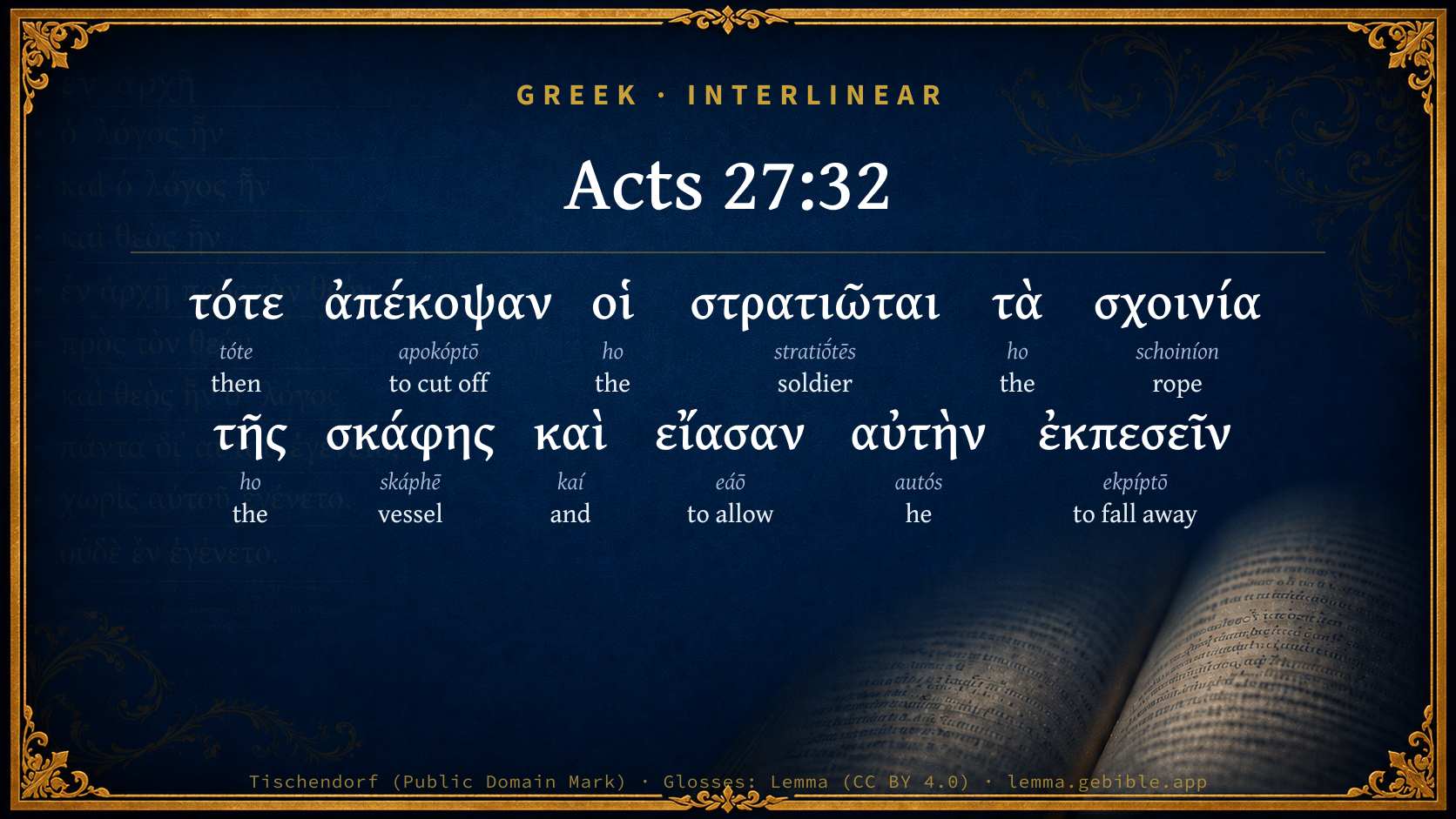
Greek (Tischendorf 8th ed.) Acts 27:32 appears in the Greek New Testament. The text above is from the Tischendorf 8th edition. Each word links to its Strong’s number and a concise gloss. Click any word for its full Thayer’s Greek Lexicon entry.
Download image
Cite this verse

Acts 27:32 (World English Bible). Public Domain. Lemma interlinear Bible study tool, https://lemma.gebible.app/v/acts/27/32.

Show BibTeX & RIS
BibTeX
RIS
English Translation
Then the soldiers cut away the ropes of the boat, and let it fall off.
World English Bible · Public Domain
Download a study sheet

One document with this verse’s original text, its word-by-word gloss line, the meaning frame, cross-references with their text, attributed commentary, and full source and license credits — printable, and it pastes into notes with its structure intact.

This verse Autodidact and up

Study sheet (.html) Plain text (.txt)

A passage Seminary Student

Up to 50 verses in one chapter. A passage sheet keeps up to 6 commentary sources and 12 cross-references per verse, in the order this page ranks them, and says so on the sheet whenever that leaves anything out. Ask for a single verse and you get the Autodidact verse sheet above.

Everything on this page stays free to read, with no account — the sheet is a download of what is already on screen, not access to it.

Want to remove ads? Support Godless Engineer
Compare translations 3

The same verse in 3 English versions, stacked beneath the original-language interlinear above. Click any original word for its lexicon entry.

Each is an independent rendering of the whole verse — the interlinear is not word-aligned to these translations.

Highlighted words mark where these versions differ — a whole-verse word diff, not a word-by-word alignment.

  • World English Bible Public Domain
    Then the soldiers cut away the ropes of the boat, and let it fall off.
  • King James Version Public Domain
    Then the soldiers cut off the ropes of the boat, and let her fall off.
  • unfoldingWord Literal Text CC BY-SA 4.0
    Then the soldiers cut the ropes of the lifeboat and let it fall away.

unfoldingWord Literal Text — © unfoldingWord, licensed CC BY-SA 4.0. Word-aligned USFM3 via Door43 (git.door43.org/unfoldingWord/en_ult).

Versions to compare (up to 4)

3 of 4 selected

Show all 19 translations

Every available English version of this verse, each an independent rendering of the whole verse.

  • World English Bible Public Domain
    Then the soldiers cut away the ropes of the boat, and let it fall off.
  • Berean Standard Bible Public Domain
    So the soldiers cut the ropes to the lifeboat and set it adrift.
  • Majority Standard Bible Public Domain
    So the soldiers cut the ropes to the lifeboat and set it adrift.
  • King James Version Public Domain
    Then the soldiers cut off the ropes of the boat, and let her fall off.
  • American Standard Version (1901) Public Domain
    Then the soldiers cut away the ropes of the boat, and let her fall off.
  • Revised Version (1885) Public Domain
    Then the soldiers cut away the ropes of the boat, and let her fall off.
  • Geneva Bible (1599) Public Domain
    Then the souldiers cut off the ropes of the boat, and let it fall away.
  • Douay-Rheims (1899) Public Domain
    Then the soldiers cut off the ropes of the boat, and let her fall off.
  • Young's Literal Translation Public Domain
    then the soldiers did cut off the ropes of the boat, and suffered it to fall off.
  • Literal Standard Version CC BY-SA 4.0
    then the soldiers cut off the ropes of the boat, and permitted it to fall off.
  • Unlocked Literal Bible CC BY-SA 4.0
    Then the soldiers cut away the ropes of the boat and let it drift away.
  • unfoldingWord Literal Text CC BY-SA 4.0
    Then the soldiers cut the ropes of the lifeboat and let it fall away.
  • Darby Bible Public Domain
    Then the soldiers cut away the ropes of the boat and let her fall.
  • World Messianic Bible Public Domain
    Then the soldiers cut away the ropes of the boat and let it fall off.
  • Webster's Bible Public Domain
    Then the soldiers cut off the ropes of the boat, and let her fall off.
  • Free Bible Version CC BY-SA 4.0
    So the soldiers cut the ropes holding the ship's boat, and let it loose.
  • Bible in Basic English Public Domain
    Then the armed men, cutting the cords of the boat, let her go.
  • Text-Critical English NT CC BY 4.0
    Then the soldiers cut away the ropes of the skiff and let it drift away.
  • Tyndale New Testament (1534) Public Domain
    Then the soudiers cut of the rope of the bote and let it fall awaye.

Literal Standard Version (2020), Covenant Press — licensed CC BY-SA 4.0. Text via the HelloAO Bible API (eBible.org). Unlocked Literal Bible (unfoldingWord) — licensed CC BY-SA 4.0. Text via the HelloAO Bible API (eBible.org). unfoldingWord Literal Text — © unfoldingWord, licensed CC BY-SA 4.0. Word-aligned USFM3 via Door43 (git.door43.org/unfoldingWord/en_ult). Free Bible Version, Dr. Jonathan Gallagher — licensed CC BY-SA 4.0. Text via the HelloAO Bible API (eBible.org).

Word by word

More ways to search: Search by grammar → Find every occurrence → Compare this word →

Practice this passage: Drill this verse → Learn its vocabulary →

About this verse

These counts appear in no published source. They are computed here, from the morphology-tagged text and Lemma’s own curated glosses. What Lemma adds →

12
words
10
distinct lemmas
Acts
section

Notable vocabulary

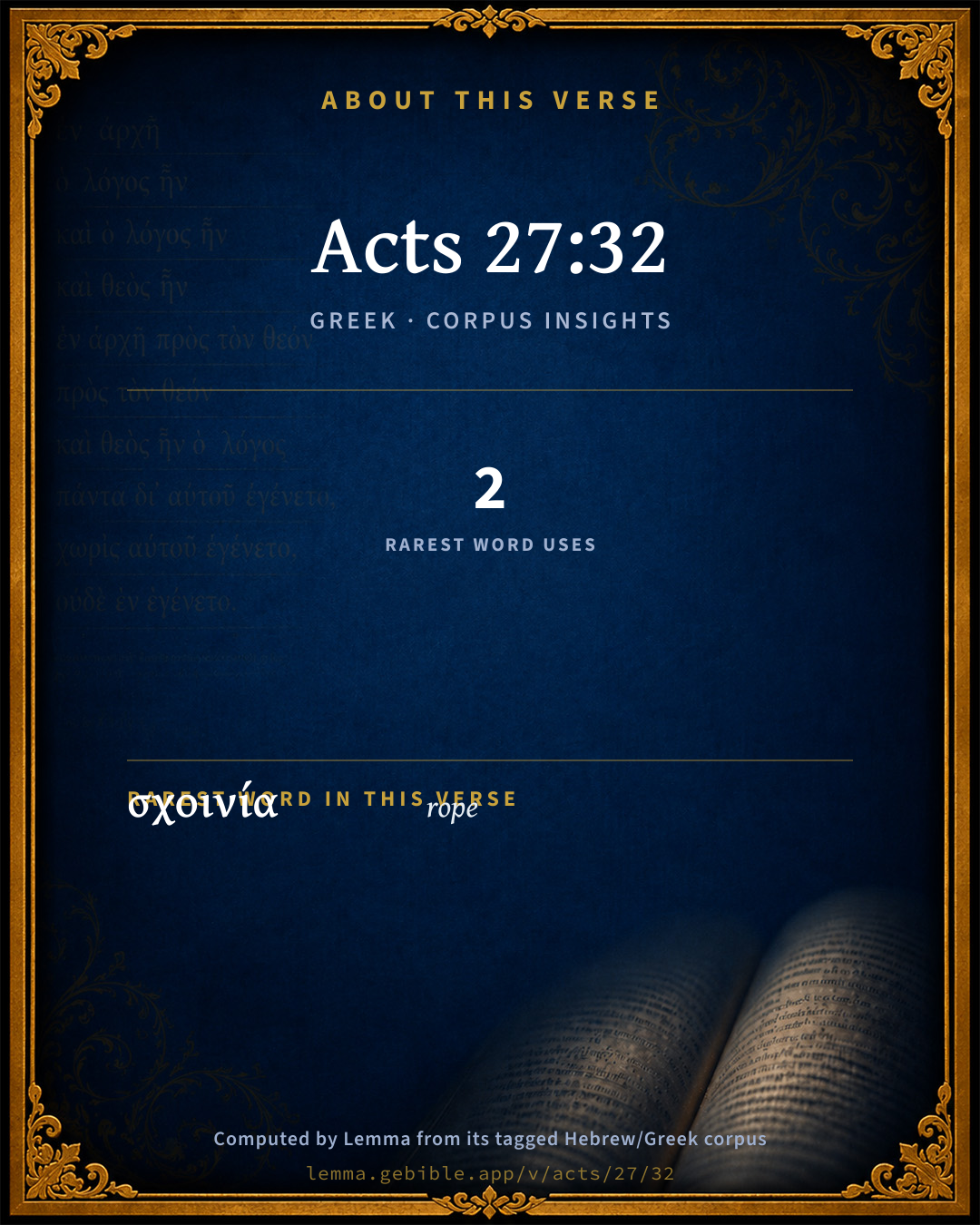
The rarest word here is σχοινία rope G4979 — appearing just 2 times in the whole Greek New Testament.

Shared distinctive vocabulary

σχοινία rope G4979 occurs in 2 verses of the Greek New Testament. Also found in:

Repetition

A word recurs within this verse:

Cross-references

2

Topical passages linked to Acts 27:32 in the Treasury of Scripture Knowledge — connected by theme and wording, ordered by reader-vote popularity; previews shown in the World English Bible.

  • Philippians 3:7–9 However, what things were gain to me, these have I counted loss for Christ.
  • Luke 16:8 "His lord commended the dishonest manager because he had done wisely, for the children of this world are, in their own generation, wiser than the children of the light.

Cross-references courtesy of OpenBible.info (CC BY 4.0).

Commentary

Notes on Acts 27:32 from classic Christian and Jewish commentators (each source and its license shown beneath its notes). The classic Christian expositions comment on the surrounding passage and are grouped to its opening verse, so a note may address several verses; the Jewish commentaries on the Tanakh (Rashi and others) are per-verse, so they appear only where the commentator wrote on this verse.

Lemma curates 59 commentaries, every one of them public domain or Creative Commons licensed, each selected and text-cleaned for this edition rather than reprinted as found. About our sources →

The Biblical Illustrator

Joseph S. Exell

Act_27:32-38

Then the soldiers cut off the ropes.

Precautions

1. By casting off the boat--the apparent means of safety--true safety in this case was secured. Thus many a soul is saved by giving up what it may have once esteemed most precious.

2. By assuming command, Paul on this occasion saved his companions. Let not the Christian shrink from taking the lead, when he can thereby bring others unto safety.

3. By partaking of food at such a time, Paul showed that eating may sometimes become a duty. God takes good care of our souls--He wants us to take good care of our bodies.

4. By giving thanks before he broke bread, on this occasion, Paul showed that there is always time to ask a blessing before even the most hurried meal. If we have time to eat at all, we have time to ask Gods blessing on what we eat. At the worst, bodily dyspepsia is better than spiritual dyspepsia.

5. By trusting Paul, the ships company was saved. By trusting Pauls Saviour, we may be saved. If we sail with Christ, and abide with Christ, we shall not see death. Because He lives, we shall live also.

6. By stopping when they bad eaten enough, Pauls companions showed their good sense. By not stopping when they have eaten enough, many Christians show their bad sense of how to use Gods blessings.

7. By casting overboard what they did not need, Pauls companions set a wise example of self-restriction. If to eat is a duty, to stop eating may become a duty. Even throw away the bodily supplies, if need be, that the soul may not suffer. (S. S. Times.)

And while the day was coming on, Paul besought them all to take meat.

Bodily care

Day after day had they been at the mercy of the pitiless winds and waves; night after night had added its darkness to their helplessness. Surely it was a time for prayer, for commending their souls to God, and imploring Divine protection. Yes; and I doubt not that Paul prayed most earnestly. But it was a time for more than prayer. He deemed it a time for paying heed to physical wants as well as for pious devotion. They lay there, held by the four anchors, and longing for the coming of day. There was little that they could do then. Yet they could do something. They could do what, in the excitement and fear and violent motion of the vessel, they had not suitably attended to for many days. They could repair in some slight measure the physical waste which each had suffered. They could do the thing best adapted to secure a favourable answer to their petitions: they could take food. And this Paul urges them to do. We are very much in the habit of thinking that the Bible is for soul culture simply; and hence men are liable to consider it strange if it is quoted as endorsing and requiring the care of the body. But we are to remember that religion is not simply soul culture: it is man culture. Some may say that religion aims to teach men to glorify God. But how can we glorify One whose gifts we are contemning and abusing? And the body is as much a gift of God as is the soul. To knowingly violate the Divine order written in the physical constitution is as really to rebel against God as it would be if one violated a law of the Decalogue. Therefore, by this definition of the purpose of religion--that it is intended to teach us to glorify God--we are required to attend to the preservation of the body. But, further, upon this definition there is much misapprehension as to the way in which God is glorified. Our blessed Master in religion has taught us that this is done not simply by psalm singing; for He has told us, Herein is My Father glorified, that ye bear much fruit. Therefore God cannot be glorified by anything which needlessly dwarfs the faculties, or cramps the energies, or incapacitates man for doing his full measure of work. Therefore we are again brought back to our conclusion: that, if religion is intended to fit us to promote Gods glory, it necessarily has to do with the care of the body. But is it to define religion more accurately to say that its purpose is to advance men in holiness? Holiness ought not to be limited to a certain reverent attitude of the mind, or to sanctity, or to purity of heart and freedom from sin. We pronounce it hol-i-ness: we perhaps should more readily realise its early significance if we pronounced it hol-ness (wholeness)

; and undoubtedly we should do well if we added to the ideas of purity and freedom from sin which it now conveys to us the idea of the symmetrical development of the whole being. While we remain here, the body is a part of our being, and an exceedingly important part. And now permit me, as I go on, to be a little more definite. If we are called to make our lives valuable to any persons on earth, certainly those nearest us have the first claim. If any one of us has a right (which I deny) to throw himself away physically, he has no right to throw away his child. If he has a right, by imprudence or excess, to bring sickness upon himself, he has no right to prepare beforehand an inheritance of feebleness or disease for his unborn offspring. On a certain day in the past you may have felt most profoundly the truth that neither fame nor position nor wealth can compensate for lack of health. And yet it may be that a moments reflection would reveal to you that you are now daily, in the general conduct of your life, sacrificing the greater for the less--saying (and that very often), I know that this will hurt me, but still I am going to eat a little of it; or, I know that this is dangerous, but still Ill do it this once and run the risk. The care of health is a duty. Those of us who mean to fulfil our obligations need often to enlarge our ideas of the breadth of the field of duty. We despise what we know about the value of oxygen; and, if compelled for present comfort to live during the summer chiefly in the fresh air, still do not, except on extraordinary occasions, suffer any of it to reach the bottom of the lungs. We treat cleanliness as a matter of decency, and not as a matter vital to health. Those cooks who are deemed among the best seem to pay little regard to the healthfulness of the viands they prepare. Many are utterly unacquainted with the sanitary usefulness of society, good cheer, merry amusements, and a hearty laugh. All these things should be made studies by us, as parts of the great whole of duty which we wish lovingly to perform. (J. E. Wright.)

Pauls wisdom

O wise Paul!--how many ills of the mind can be met, how many perils faced, how many sorrows tided over, by due and rational attention to the claims of the stomach and the equilibrium of the nervous system! How many cases which come to the vestry of the clergyman are more fit for the doctors consulting room! How often in the house of death to the bereaved, to the watcher, might the clergyman, instead of overloading the patient with spiritual consolation, instead of feeding the wasting fire of grief with too much oil of sympathy, more wisely say to the exhausted and overwrought and weary friends and relatives, in the simple and homely words of Paul, I pray you to take some meat, for this is for your health. And even as Paul spake he began to eat before them--his courage, good sense, example were infectious. A change passed over the trembling crew. There shall not a hair of your head fall, continued the great missioner; and he pointed heavenwards to the source of his prophetic consolation and good hope, giving thanks to God in the presence of them all! Then were they all of good cheer. (H. R. Haweis, M. A.)

The leading attributes of a great character

I. Social considerateness. The emaciated appearance of all on board, through lack of food, touched Pauls generous heart (Act_27:33). The alarm and anxiety of the past fourteen days and nights had, according to a physiological law, deadened their appetite. Paul, with the tact of a practical philosopher, sought to resuscitate their inclination for food by allaying their fears: For there shall not an hair fall from the head of any of you. This social considerateness Paul often displayed in his conduct and teaching, and it is an essential attribute of Christianity. Bear ye one anothers burdens, and so fulfil the law of Christ.

II. Calm self-control. He was in the midst of the most agitating scenes--the furious hurricane--the reeling, plunging, shattered ship--the 276 terror-stricken men--yet how sublimely calm this man is (Act_27:35)! A finer picture of moral majesty can scarcely be conceived. The philosophy of his tranquillity was faith in that God whose he was and whom he served.

III. Practical religiousness. He gave thanks to God in presence of them all. This was according to the Christian practice (Mat_15:36; Mat_26:27; Joh_6:11-23; Rom_14:6; 1Co_10:13; 1Co_11:24; 1Co_14:17; Eph_5:20; 1Th_5:18).

IV. Commanding influence. What he said and what he did struck new energy into the heart of all (Act_27:36). He animated all with the energy of hope. A soul strong with goodness can energise others. (D. Thomas, D. D.)

Bodily health to be maintained

Nothing that God has made is to be despised; least of all this body that now holds us. It has in it all the wonder and glory of creation, and is an epitome of all previous creations--a harp of more than a thousand strings; it is so strong it can level mountains; so fine that in its automatic skill it almost thinks; so nearly spiritual that we cannot see where sense joins thought; so coarsely material that chemical law runs riot in it; a mere forge for the fire of oxygen, yet so delicate that it reflects in every turn and gesture the spirit and temper of the mind; so one with us that if it is sound we can hardly fail of being happy, and if it is weak we can hardly fail of being miserable; so one with us that we cannot think of ourselves as separate from it, yet are conscious that it is no part of us--such a thing as this is not to be despised or treated otherwise than as sacred. We have hardly any more imperative work than to secure for the body its highest possible vigour and health. How to feed and clothe and house it; how to use it; how to keep it safe from weakening and poisoning gases; how to secure that rhythmic action of its functions that turns physical existence into music--this is the immediate question before civilisation, the discussion of which will drive out much of the vice of society and revolutionise its systems of education. The gospel of the body is yet to be heard and believed. (T. Munger, D. D.)

The Biblical Illustrator, edited by Joseph S. Exell (c. 1880s–1900s) — public domain. Text from a community e-Sword module.

Bengel's Gnomon

Johann Albrecht Bengel

Act 27:32. Τότε, then) Paul left it to the soldiers to consider what they ought to do.

Bengel's Gnomon of the New Testament — English translation (T&T Clark, Edinburgh, 1860) — public domain. Text from a community e-Sword module.

Expositor's Greek Testament

ed. W. Robertson Nicoll

Act 27:32 . τότε οἱ στρ . ἀπέκ .: Lewin, Saint Paul , ii., 202, sees in this the absolute ascendency which St. Paul had gained; he had said that their lives should be spared, and although, humanly speaking, the boat offered the best prospect of reaching land, yet at a word from St. Paul the soldiers deprived themselves even of this last resource. σχοινία : only elsewhere in N.T. in Joh 2:15 ; in classical Greek, and also frequently in LXX. For the terrible scene which would doubtless have ensued if the soldiers had not thus acted, Breusing and Vars (so Wetstein, in loco ) strikingly compare the description of a shipwreck in Achilles Tatius, iii. 3; the whole passage is cited by Breusing, p. 194.

The Expositor's Greek Testament, edited by W. Robertson Nicoll (1897–1910) — public domain. Text from a community e-Sword module.

Jamieson, Fausset & Brown

Robert Jamieson, A. R. Fausset & David Brown

Then the soldiers cut off the ropes of the boat--already lowered.

and let her fall off--let the boat drift away.

Jamieson, Fausset & Brown — Commentary Critical and Explanatory on the Whole Bible (1871) — public domain (CC PDM 1.0). Text via the HelloAO Bible API.

Adam Clarke's Commentary

Verse 32. The soldiers cut off the ropes] These were probably the only persons who dared to have opposed the will of the sailors: this very circumstance is an additional proof of the accuracy of St. Luke.

Adam Clarke's Commentary on the Bible (1810–1826) — public domain. Text from a community e-Sword/MySword module.

Ellicott's Commentary for English Readers

(32) Then the soldiers cut off the ropes of the boat.—The act had to be the work of an instant. The boat was already lowered, the sailors were on the point of leaping into it. We can picture their mortification on finding their selfish plat at once detected and frustrated. Even in this, however, there was a new element of danger. Men, under such circumstances, were likely to be sullen and unwilling workers.

A Bible Commentary for English Readers, edited by Charles John Ellicott (1878–1897) — public domain. Text from a community e-Sword module.

The Cambridge Bible for Schools and Colleges

gen. ed. J. J. S. Perowne

32. cut off [R. V. away] the ropes of the boat] i.e. cut asunder the ropes which attached the boat to the ship.

The Cambridge Bible for Schools and Colleges (gen. ed. J. J. S. Perowne; Cambridge University Press, 1878–1918) — public domain. Text from a community e-Sword module.

John Gill's Exposition

And while the day was coming on,.... Between midnight and break of day: Paul besought them all to take meat; to sit down and eat a meal together:

saying, this day is the fourteenth day that ye have tarried; or have been waiting for, or expecting; that is, as the Arabic version expresses it, a shipwreck; for fourteen days past, ever since the storm begun, they had expected nothing but shipwreck and death:

and continued fasting, having taken nothing: not that they had neither ate nor drank all that while, for without a miracle they could never have lived so long without eating something; but the meaning is, they had not eaten anyone regular meal all that while, had only caught up a bit now and then, and ate it, and that but very little.

John Gill's Exposition of the Whole Bible (1746–1763) — public domain (CC PDM 1.0). Text via the HelloAO Bible API.

Trapp's Complete Commentary

John Trapp

32 Then the soldiers cut off the ropes of the boat, and let her fall off.

Ver. 32. Then the soldiers] According to St Paul’s counsel, who was now somebody with them. Indeed he was grown, by much exercise and experience, harum rerum callentissimus, et vir in omnibus rebus excellentissimus, as one saith of him, a most gallant man, and every way accomplished.

John Trapp, A Commentary or Exposition upon All the Books of the Old and New Testament (1647–1656) — public domain. Text from a community e-Sword module.

Albert Barnes' Notes on the Bible

Cut off the ropes ... - It is evident that the mariners had not yet got on board the boat. They had let it down into the sea Act 27:30, and were about to go on board. By thus cutting the ropes which fastened the boat to the ship, and letting it go, all possibility of their fleeing from the ship was taken away, and they were compelled to remain on board.

Albert Barnes' Notes on the Bible (1834–1885) — public domain. Text from a community e-Sword/MySword module.

Matthew Poole's English Annotations

The centurion and soldiers, agreeing to what Paul had said, did this to take away all thoughts of escaping from the mariners, and leaving all upon what Paul had promised to them in the name of his God.

Matthew Poole's English Annotations on the Holy Bible (1683–1685) — public domain. Text from a community e-Sword/MySword module.

Whedon's Commentary on the Bible

Daniel D. Whedon

Early breakfast and renewed cheer, Act_27:33-38.

For the third time Paul takes command. With the natural ascendency of strong character in emergencies he secures the prompt obedience of every class and rank. He sees, while the day is breaking, that for the enterprise of passing through the shipwreck and escape, the reinvigoration of exhausted nature by food is necessary.

32. Cut off the ropes—The soldiers severed the ropes, the boat drifted into the sea, and the sailors were fast in the ship. However impressive had been the assurances of safety given by Paul, the sailors trusted more to their own villainy than to the promise of God. The surface of a depraved nature may thus be touched while its depths remain unchanged. The soldiers will soon prove worse than the sailors.

Daniel D. Whedon (gen. ed.), Commentary on the Old and New Testaments (1874–1909) — public domain. Text from a community e-Sword module.

The Pulpit Commentary

Cut away for cut off, A.V. Fall off (ejkpesein, vers. 17, note, 26, and 29). The action of the soldiers in cutting the rope and letting the boat loose was very prompt, but rather rash, as the boat might have been useful in landing those on board. But it showed their implicit confidence in Paul"s word.

The Pulpit Commentary (1880–1919), ed. H.D.M. Spence-Jones & Joseph S. Exell — public domain. Text from a community e-Sword module.

Godbey's Commentary on the New Testament

William B. Godbey

32. “Then the soldiers cut off the ropes of the boat and let it fall out” [into the sea]. This settled the matter; no possible means now of getting away from the ship.

William B. Godbey, Commentary on the New Testament (1896–1900) — public domain. Text from a community e-Sword module.

McGarvey & Pendleton's Commentaries

J. W. McGarvey

See notes on verse 30

J. W. McGarvey (with Philip Y. Pendleton), Commentaries on the New Testament (The Fourfold Gospel, 1914; Acts; and the epistles) — public domain. Text from a community e-Sword/MySword module.

Cambridge Greek Testament for Schools and Colleges

32. τότε ἀπέκοψαν οἱ στρατιῶται τὰ σχοινία τῆς σκάφης, then the soldiers cut away the ropes of the boat, i.e. cut asunder the ropes which attached the boat to the ship. Thus the boat was cast away.

Cambridge Greek Testament for Schools and Colleges (Cambridge University Press, 1896; 21 vols, various authors incl. Carr, Maclear, Plummer, Farrar, Lumby, Moule, M. R. James, Simcox) — public domain. Text from a community e-Sword module.

Lesson kit

Teaching starters — assembled from the data on this page, not authored interpretation. Every prompt links to the verse data it draws on. Edit before teaching.

Acts, in the Acts, opens this verse with 12 words (10 distinct Greek lemmas). Its most distinctive word is schoiníon (“rope”). A historical commentator’s framing appears above. Read the whole chapter for the surrounding context.

Discussion questions

  1. The word schoiníon carries the sense “rope.” How does it shape the verse?
  2. How does John 2:15, which shares the word «rope», read alongside this verse?
  3. What does the repetition of “the” (3× in this one verse) do in this verse?
  4. The translations on this page render this verse differently — a whole-verse word diff, not a word-by-word alignment. What might account for the different wordings?
  5. Compare how The Biblical Illustrator and Bengel's Gnomon read this verse. Where do they agree or differ?

Things to notice

Reading settings

Reading text

Shown beneath each verse's original-language words.

Old Testament
Old Testament edition

Read the OT as the Masoretic Hebrew (MT) or the Greek Septuagint (LXX).

English shown for the Greek Septuagint (in the Hebrew ↔ Greek comparison).

Comparing translations? Open the Compare panel on any verse page to stack up to four side by side.