
Romans 1:9

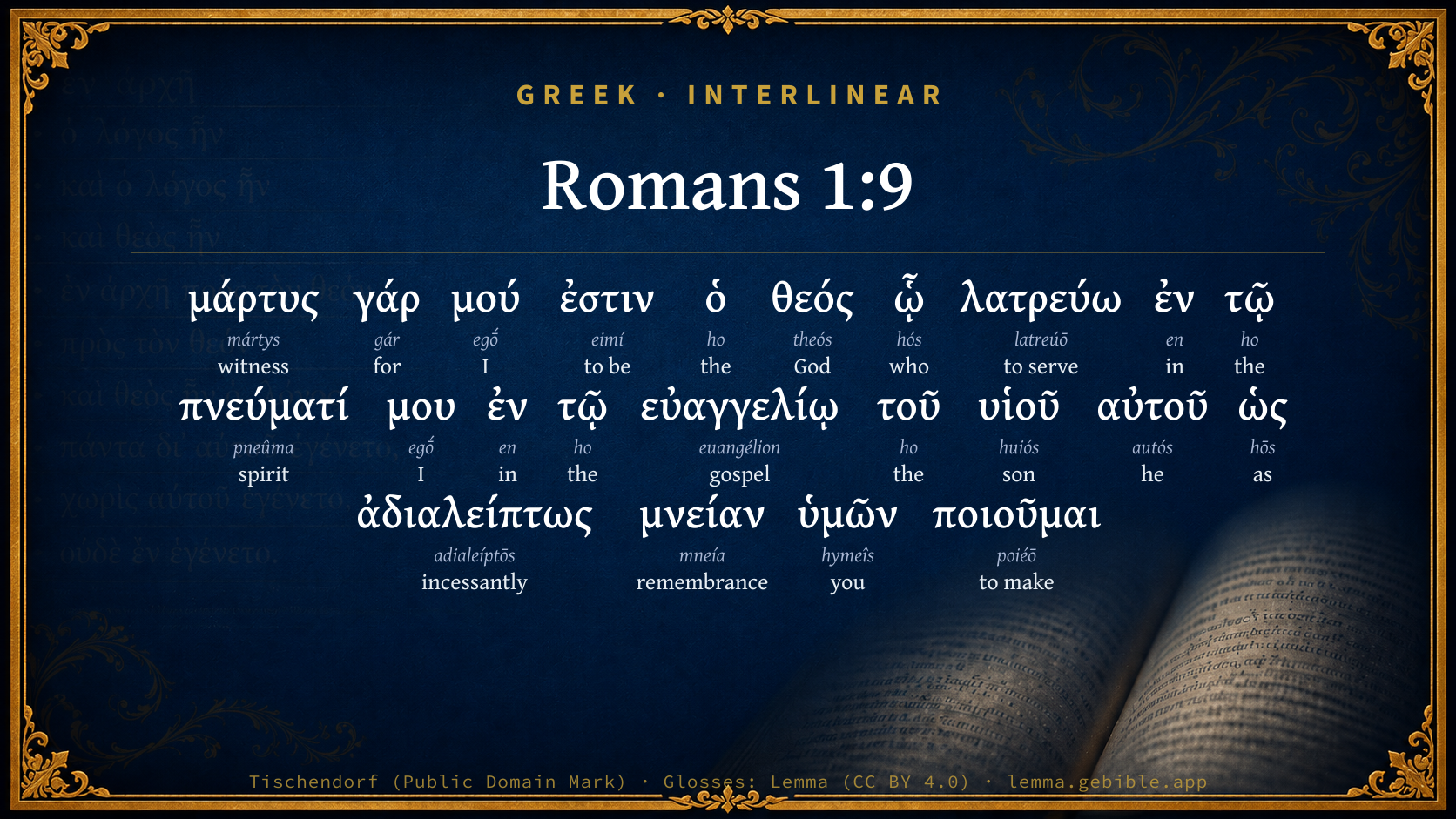
Greek (Tischendorf 8th ed.) Romans 1:9 appears in the Greek New Testament. The text above is from the Tischendorf 8th edition. Each word links to its Strong’s number and a concise gloss. Click any word for its full Thayer’s Greek Lexicon entry.
Download image
Cite this verse

Romans 1:9 (World English Bible). Public Domain. Lemma interlinear Bible study tool, https://lemma.gebible.app/v/romans/1/9.

Show BibTeX & RIS
BibTeX
RIS
English Translation
For God is my witness, whom I serve in my spirit in the Gospel of his Son, how unceasingly I make mention of you always in my prayers,
World English Bible · Public Domain
Highlights
  • 2 first appearances in the Greek New Testament
Full analysis ↓
Download a study sheet

One document with this verse’s original text, its word-by-word gloss line, the meaning frame, cross-references with their text, attributed commentary, and full source and license credits — printable, and it pastes into notes with its structure intact.

This verse Autodidact and up

Study sheet (.html) Plain text (.txt)

A passage Seminary Student

Up to 50 verses in one chapter. A passage sheet keeps up to 6 commentary sources and 12 cross-references per verse, in the order this page ranks them, and says so on the sheet whenever that leaves anything out. Ask for a single verse and you get the Autodidact verse sheet above.

Everything on this page stays free to read, with no account — the sheet is a download of what is already on screen, not access to it.

Want to remove ads? Support Godless Engineer
Compare translations 3

The same verse in 3 English versions, stacked beneath the original-language interlinear above. Click any original word for its lexicon entry.

Each is an independent rendering of the whole verse — the interlinear is not word-aligned to these translations.

Highlighted words mark where these versions differ — a whole-verse word diff, not a word-by-word alignment.

  • World English Bible Public Domain
    For God is my witness, whom I serve in my spirit in the Gospel of his Son, how unceasingly I make mention of you always in my prayers,
  • King James Version Public Domain
    For God is my witness, whom I serve with my spirit in the gospel of his Son, that without ceasing I make mention of you always in my prayers;
  • unfoldingWord Literal Text CC BY-SA 4.0
    For God is my witness, whom I serve in my spirit in the gospel of his Son, how I continually make mention of you,

unfoldingWord Literal Text — © unfoldingWord, licensed CC BY-SA 4.0. Word-aligned USFM3 via Door43 (git.door43.org/unfoldingWord/en_ult).

Versions to compare (up to 4)

3 of 4 selected

Show all 19 translations

Every available English version of this verse, each an independent rendering of the whole verse.

  • World English Bible Public Domain
    For God is my witness, whom I serve in my spirit in the Gospel of his Son, how unceasingly I make mention of you always in my prayers,
  • Berean Standard Bible Public Domain
    God, whom I serve with my spirit in preaching the gospel of His Son, is my witness how constantly I remember you
  • Majority Standard Bible Public Domain
    God, whom I serve with my spirit in preaching the gospel of His Son, is my witness how constantly I remember you
  • King James Version Public Domain
    For God is my witness, whom I serve with my spirit in the gospel of his Son, that without ceasing I make mention of you always in my prayers;
  • American Standard Version (1901) Public Domain
    For God is my witness, whom I serve in my spirit in the gospel of his Son, how unceasingly I make mention of you, always in my prayers
  • Revised Version (1885) Public Domain
    For God is my witness, whom I serve in my spirit in the gospel of his Son, how unceasingly I make mention of you, always in my prayers
  • Geneva Bible (1599) Public Domain
    For God is my witnesse (whom I serue in my spirit in the Gospel of his Sonne) that without ceasing I make mention of you
  • Douay-Rheims (1899) Public Domain
    For God is my witness, whom I serve in my spirit in the gospel of his Son, that without ceasing I make a commemoration of you;
  • Young's Literal Translation Public Domain
    for God is my witness, whom I serve in my spirit in the good news of His Son, how unceasingly I make mention of you,
  • Literal Standard Version CC BY-SA 4.0
    for God is my witness, whom I serve in my spirit in the good news of His Son, how unceasingly I make mention of you,
  • Unlocked Literal Bible CC BY-SA 4.0
    For God is my witness, whom I serve in my spirit in the gospel of his Son, of how continually I make mention of you.
  • unfoldingWord Literal Text CC BY-SA 4.0
    For God is my witness, whom I serve in my spirit in the gospel of his Son, how I continually make mention of you,
  • Darby Bible Public Domain
    For God is my witness, whom I serve in my spirit in the glad tidings of his Son, how unceasingly I make mention of you,
  • World Messianic Bible Public Domain
    For God is my witness, whom I serve in my spirit in the Good News of his Son, how unceasingly I make mention of you always in my prayers,
  • Webster's Bible Public Domain
    For God is my witness, whom I serve with my spirit in the gospel of his Son, that without ceasing I make mention of you always in my prayers,
  • Free Bible Version CC BY-SA 4.0
    I'm always praying for you, as God can confirm—the God I serve with the whole of my being as I share the good news about his Son.
  • Bible in Basic English Public Domain
    For God is my witness, whose servant I am in spirit in the good news of his Son, that you are at all times in my memory and in my prayers,
  • Text-Critical English NT CC BY 4.0
    For God is my witness, whom I serve with my spirit in the gospel of his Son, that I continually remember you,
  • Tyndale New Testament (1534) Public Domain
    For God is my witnes whom I serve with my sprete in the Gospell of his sonne that with out ceasinge I make mencion of you alwayes in my prayers

Literal Standard Version (2020), Covenant Press — licensed CC BY-SA 4.0. Text via the HelloAO Bible API (eBible.org). Unlocked Literal Bible (unfoldingWord) — licensed CC BY-SA 4.0. Text via the HelloAO Bible API (eBible.org). unfoldingWord Literal Text — © unfoldingWord, licensed CC BY-SA 4.0. Word-aligned USFM3 via Door43 (git.door43.org/unfoldingWord/en_ult). Free Bible Version, Dr. Jonathan Gallagher — licensed CC BY-SA 4.0. Text via the HelloAO Bible API (eBible.org).

Word by word

More ways to search: Search by grammar → Find every occurrence → Compare this word →

Practice this passage: Drill this verse → Learn its vocabulary →

ἀδιαλείπτως
adialeíptōs
G89
“incessantly”
Adverb
Part of Speech
Adverb
Full Thayer's Definition

Origin: from G88

TDNT: None

1. without intermission, incessantly, without ceasing
  1. μάρτυς mártys G3144 “witness” Noun, Nominative, Singular, Masculine
  2. γάρ gár G1063 “for” Conjunction
  3. μού egṓ G1473 “I” Personal pronoun, 1st person, Genitive, Singular
  4. ἐστιν eimí G1510 “to be” Verb, Present, Active, Indicative, 3rd person, Singular
  5. ὁ ho G3588 “the” Article, Nominative, Singular, Masculine
  6. θεός theós G2316 “God” Noun, Nominative, Singular, Masculine
  7. ᾧ hós G3739 “who” Relative pronoun, Dative, Singular, Masculine
  8. λατρεύω latreúō G3000 “to serve” Verb, Present, Active, Indicative, 1st person, Singular
  9. ἐν en G1722 “in” Preposition
  10. τῷ ho G3588 “the” Article, Dative, Singular, Neuter
  11. πνεύματί pneûma G4151 “spirit” Noun, Dative, Singular, Neuter
  12. μου egṓ G1473 “I” Personal pronoun, 1st person, Genitive, Singular
  13. ἐν en G1722 “in” Preposition
  14. τῷ ho G3588 “the” Article, Dative, Singular, Neuter
  15. εὐαγγελίῳ euangélion G2098 “gospel” Noun, Dative, Singular, Neuter
  16. τοῦ ho G3588 “the” Article, Genitive, Singular, Masculine
  17. υἱοῦ huiós G5207 “son” Noun, Genitive, Singular, Masculine
  18. αὐτοῦ autós G846 “he” Personal pronoun, Genitive, Singular, Masculine
  19. ὡς hōs G5613 “as” Adverb
  20. μνείαν mneía G3417 “remembrance” Noun, Accusative, Singular, Feminine
  21. ὑμῶν hymeîs G5210 “you” Personal pronoun, 2nd person, Genitive, Plural
  22. ποιοῦμαι poiéō G4160 “to make” Verb, Present, Middle, Indicative, 1st person, Singular

About this verse

These counts appear in no published source. They are computed here, from the morphology-tagged text and Lemma’s own curated glosses. What Lemma adds →

23
words
18
distinct lemmas
Pauline Epistles
section

Notable vocabulary

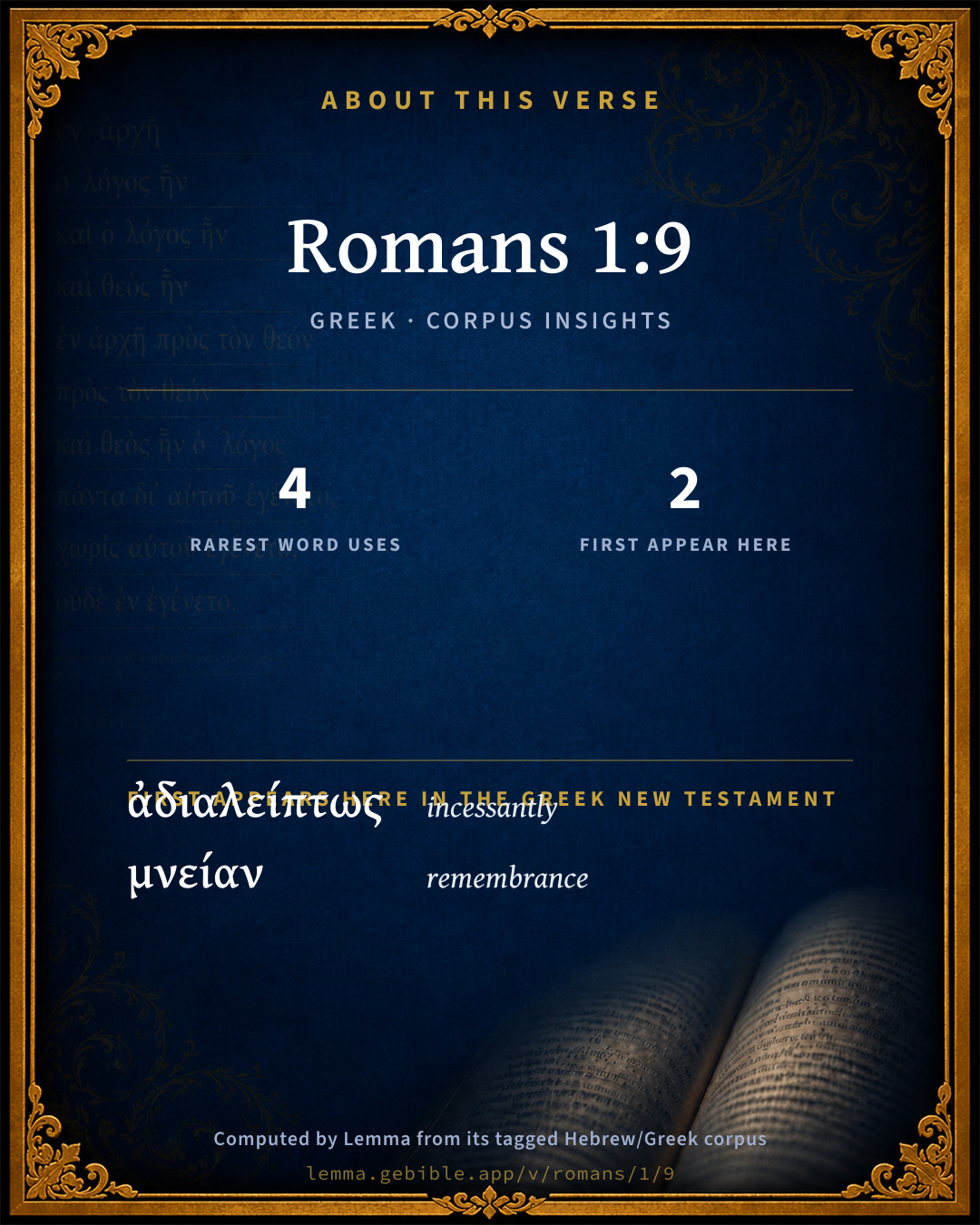
The rarest word here is ἀδιαλείπτως incessantly G89 — appearing just 4 times in the whole Greek New Testament.

First appearance in Scripture

These words make their first canonical appearance in the Greek New Testament here:

  • ἀδιαλείπτως incessantly G89
  • μνείαν remembrance G3417

Shared distinctive vocabulary

ἀδιαλείπτως incessantly G89 occurs in 4 verses of the Greek New Testament. Also found in:
Repetition

Words recur within this verse:

Cross-references

33

Topical passages linked to Romans 1:9 in the Treasury of Scripture Knowledge — connected by theme and wording, ordered by reader-vote popularity; previews shown in the World English Bible.

  • Ephesians 6:18 with all prayer and requests, praying at all times in the Spirit, and being watchful to this end in all perseverance and requests for all the saints:
  • 2 Timothy 1:3 I thank God, whom I serve as my forefathers did, with a pure conscience. How unceasing is my memory of you in my petitions, night and day
  • Romans 9:1 I tell the truth in Christ. I am not lying, my conscience testifying with me in the Holy Spirit,
  • Ephesians 1:16–19 don't cease to give thanks for you, making mention of you in my prayers,
  • 2 Corinthians 1:23 But I call God for a witness to my soul, that I didn't come to Corinth to spare you.
  • 1 Thessalonians 5:17 Pray without ceasing.
  • John 4:23–24 But the hour comes, and now is, when the true worshippers will worship the Father in spirit and truth, for the Father seeks such to be his worshippers.
  • Acts 19:21 Now after these things had ended, Paul determined in the spirit, when he had passed through Macedonia and Achaia, to go to Jerusalem, saying, "After I have been there, I must also see Rome."
  • Acts 27:23 For there stood by me this night an angel, belonging to the God whose I am and whom I serve,
  • 1 Corinthians 14:14–15 For if I pray in another language, my spirit prays, but my understanding is unfruitful.
  • 2 Corinthians 11:10–11 As the truth of Christ is in me, no one will stop me from this boasting in the regions of Achaia.
  • Ephesians 3:14–21 For this cause, I bow my knees to the Father of our Lord Jesus Christ,
  • Philippians 1:4 always in every request of mine on behalf of you all making my requests with joy,
  • Philippians 3:3 For we are the circumcision, who worship God in the Spirit, and rejoice in Christ Jesus, and have no confidence in the flesh;
  • 1 Thessalonians 1:2 We always give thanks to God for all of you, mentioning you in our prayers,
  • 1 Thessalonians 3:10 night and day praying exceedingly that we may see your face, and may perfect that which is lacking in your faith?
  • 1 Samuel 12:23 Moreover as for me, far be it from me that I should sin against Yahweh in ceasing to pray for you: but I will instruct you in the good and the right way.
  • Job 16:19 Even now, behold, my witness is in heaven. He who vouches for me is on high.
  • Mark 1:1 The beginning of the Gospel of Jesus Christ, the Son of God.
  • Luke 18:1 He also spoke a parable to them that they must always pray, and not give up,
  • Acts 3:26 God, having raised up his servant, Jesus, sent him to you first, to bless you, in turning away everyone of you from your wickedness."
  • Acts 12:5 Peter therefore was kept in the prison, but constant prayer was made by the assembly to God for him.
  • Acts 24:14 But this I confess to you, that after the Way, which they call a sect, so I serve the God of our fathers, believing all things which are according to the law, and which are written in the prophets;
  • 2 Corinthians 11:31 The God and Father of the Lord Jesus Christ, he who is blessed forevermore, knows that I don't lie.
  • Galatians 1:20 Now about the things which I write to you, behold, before God, I'm not lying.
  • Philippians 1:8–11 For God is my witness, how I long after all of you in the tender mercies of Christ Jesus.
  • Philippians 2:22 But you know the proof of him, that, as a child serves a father, so he served with me in furtherance of the Gospel.
  • Colossians 1:9–13 For this cause, we also, since the day we heard this, don't cease praying and making requests for you, that you may be filled with the knowledge of his will in all spiritual wisdom and understanding,
  • Colossians 1:28–29 whom we proclaim, admonishing every man and teaching every man in all wisdom, that we may present every man perfect in Christ Jesus;
  • 1 Thessalonians 2:5–10 For neither were we at any time found using words of flattery, as you know, nor a cloak of covetousness (God is witness),
  • 1 Timothy 2:7 to which I was appointed a preacher and an apostle (I am telling the truth in Christ, not lying), a teacher of the Gentiles in faith and truth.
  • 1 John 5:9–12 If we receive the witness of men, the witness of God is greater; for this is God's testimony which he has testified concerning his Son.
  • Philemon 1:4 I thank my God always, making mention of you in my prayers,

Cross-references courtesy of OpenBible.info (CC BY 4.0).

Commentary

Notes on Romans 1:9 from classic Christian and Jewish commentators (each source and its license shown beneath its notes). The classic Christian expositions comment on the surrounding passage and are grouped to its opening verse, so a note may address several verses; the Jewish commentaries on the Tanakh (Rashi and others) are per-verse, so they appear only where the commentator wrote on this verse.

Lemma curates 59 commentaries, every one of them public domain or Creative Commons licensed, each selected and text-cleaned for this edition rather than reprinted as found. About our sources →

The Biblical Illustrator

Joseph S. Exell

Rom_1:9

For God is my witness, whom I serve with my spirit in the gospel of His Son.

Pauls appeal to God

I. Its ground is the consciousness of entire consecration to the service of that God whom he had found in the revelation of His Son.

1. These are the two thoughts which are stamped on the whole of this introduction, and which everywhere else are prominent.

(1) Before he knew Christ his God was always the object of his fear and devotion. But how different was that God and his knowledge of Him--without his love in Christ, and His Triune essence. The service he offered was sincere, but ignorant and bigoted, a service which rejected Christ and persecuted His saints. But now in Christ all this had undergone a change. It had pleased God to reveal His Son in Him, and the Son had revealed the Father, and both revelations had been made perfect in the gift of the Holy Ghost. God in Christ became the Alpha and Omega of Divine things to Him.

(2) To that God whom the gospel revealed the apostle gave the service of his renewed spirit. Not merely in the sphere of his intellect, because that was convinced, nor in the sphere of the emotions, because they had been stirred, but in the very inmost self of his self he had given his life to the God of the gospel.

2. Let the richest treasure of your experience be God is my Witness. Paul had no grace that we may not claim. But the real secret which enables us to dare this Omniscient scrutiny is the habitual revelation of the Fatherly love of God in Christ which enables us to say, My God. If Thou, Lord, shouldst mark iniquity! carried to an extreme would take away all confidence. God is my witness, but He is my God in Christ.

II. Its special emphasis rests upon the words in my Spirit.

1. The terms are liturgical, for Paul never forgot the ancient temple. The soul is regenerate because inhabited by God. Where He dwells must be a temple; and all glorious things spoken about the ancient dwelling place of Jehovah may be transferred to the spirit of the believer. But He is Priest as well as Temple. Sanctify the Lord Christ in your hearts. The great concern of our life must be to preserve our spirit inviolate for the sacred Indweller. The apostle lived in his body as in a temple: an earthly house which should be dissolved, but then built again. He lived in his spirit, however, as in a temple which should never be dissolved; and he lived in hope that both should be reunited and glorified as the eternal dwelling place of God in Christ.

2. This service that he offered in his spirit was the service of God in the gospel of His Son.

(1) He served God for himself. In a certain sense he was a solitary worshipper, presenting in secret his whole devotion before it was translated to the outer sanctuary and the visible life. Habituate yourself to an interior life, hid with Christ in God.

(2) With this, however, we must connect his supplications for others. In the temple of his spirit he offered a systematic, persevering intercession with thanksgiving for the Churches of Christ. It was a house of prayer for all nations.

3. Cultivate this habit of prayer for yourself, your own communion, Christendom and the world in general; cultivate also the habit of mixing mutual prayer with all your engagements.

4. Remember that God alone is the witness of your fidelity, but men will be the witnesses of its results. (W. B. Pope, D. D.)

The true service of God

I. Respects the spread of the gospel.

II. Is rendered with the Spirit.

III. Is constant.

IV. Prayerful.

V. Is discharged as in the sight of God. (J. Lyth, D. D.)

The nature of Christian obedience

We all serve something or someone, self, passion, prejudice, sin, business, ambition, etc., and we find the service pleasant enough. But the only service worth entering upon is that of Christ.

I. The claims which God has upon our service. These are--

1. Self-interest. God is a good Master.

2. Gratitude. A child that turns his back on a kind parent, a servant who repays affection by insult, a rebel who plots against a munificent king--all these is the man who forgets God.

II. The principles which should direct and govern our service to God. Whom I serve with my spirit, implies--

1. Voluntariness. We are not so much influenced by the command which addresses the ear, or the threatening which alarms the conscience, as by love.

2. Sincerity. The spirit is that which commands the whole of man. Often we see the affections dormant and the will persevering. How much of Gods worship is performed outwardly when it is inwardly disliked. The body without the spirit is dead; service without love is hypocrisy.

3. Universality. It had respect to every precept of Gods Word. The carnal mind will only obey such commands as seem pleasing to us.

4. Perpetuity. Not in prosperity only nor in adversity only. It is only by continuousness that perfection is arrived at.

III. The rule by which the service should be governed. The gospel is not only the means of salvation, but it is the rule which regulates our life. To serve God in the gospel is to--

1. Serve God in light. The gospel is the light which shows the Christians safety and danger.

2. To serve God in faith. The whole principle of the gospel is faith, the principle of life, thought, and action.

3. To serve God in love. Love is the great rule of life and sanctification.

4. To be rewarded by God according to the gospel. (J. J. S. Bird, B. A.)

My spirit

1. There was an auction one day of the books and furniture of a very celebrated author, and a vain but rich young man, having induced the auctioneer to offer them in one lot, paid several thousand pounds for the books, shelves, carpet, and in fact everything except the room itself. He directed the things to be taken carefully to his house and fitted up in a room, and placed in the same positions as in the authors study. The young man then sat down with reverence on the authors chair, took up the authors pen, dipped it in the authors ink, and bent his head over the paper on the authors table. But nothing came; the paper remained a blank. The genius of the author was in neither his pen nor his surrounding, but in his spirit--the gift of God. We may be unable to create in our spirit the genius of a celebrated man; but we may develop our own faculty; and, if we do this, we shall bless the world exactly as God wishes us to do. The little forget-me-nots which grow in the quiet nook of the steep rock do their work as effectively as the great oaks which grace the park of a king; and as the tiny flower does its best, it is as worthy of praise as the gigantic tree that does no more.

2. But though we cannot obtain the special genius of another mans spirit, we can receive as our own the disposition of the greatest man who ever lived--Christ can be received by all, and the breathings of His Spirit within us shall mould our thoughts, fashion our desires, and develop our lives like His own. If a man would occupy the place in the world for which he has been specially created, it is absolutely needful for him to have the breathings of Christ in his own spirit; and when undertaking any sacred mission for the benefit of our fellow men, our inquiry should not be, Have I bags of money? but, Is my spirit influenced by Christ? Christ direction is the first and most important step in the kingdom of God.

3. One day a young soldier went to visit the tomb of Scandenberg and the sword of the famous warrior was placed in his hand. The soldier lifted it saying, Is this really Scandenbergs sword? Why there is nothing in it more than mine! The old clerk exclaimed, You see only the sword; you should have seen the hand that grasped it! Likewise, the preacher may be only an ordinary man, he is only an earthen vessel; but in his spirit there should be a power which can move mens hearts and influence their lives--God should breathe within him.

4. Christ and the angels do not look on us as we look on each other. We value a mans surroundings rather than the man himself, An artist whose soul loves beauty does not value a picture by its frame. Seeing the picture to be a gem, he buys it, and does not care twopence for the frame, So, when the Lord looks on you, He does not value your bank book, your dress, your bodily strength and beauty; he values you--your spirit. A man is measured by his soul! (W. Birch.)

The Biblical Illustrator, edited by Joseph S. Exell (c. 1880s–1900s) — public domain. Text from a community e-Sword module.

Joseph Benson's Commentary

Rom 1:9-12. For God is my witness — In saying I am thankful for your conversion, I might be well supposed to speak the truth, such an event being perfectly agreeable to the continual tenor of my petitions to God; whom I serve — Not only as a Christian, but as an apostle; with my spirit — With my understanding and conscience, will and affections, yea, with all the faculties of my soul, as well as with all the members of my body. Or, as the expression may be rendered, in my spirit, exercising faith in him, love to him, humility before him, resignation to his will, and zeal for his glory; in the gospel of his Son — To promote the success of which is the whole business of my life; that without ceasing I make mention of you in my prayers — In my solemn addresses to God; making request — Δεομενος, entreating; if by any means, now at length — This accumulation of particles declares the strength of his desire; that I may impart to you — Face to face, by laying on of my hands, preaching the gospel, prayer, private conversation; some spiritual gift — With such gifts the Corinthians, who had enjoyed the presence of St. Paul, abounded, 1Co 1:7; 1Co 12:1, &c.; Rom 14:1. So did the Galatians likewise, Gal 3:5. And indeed all those churches which had the presence of any of the apostles, had peculiar advantages in this kind from the laying on of their hands, Act 19:6; Act 8:17, &c.; 2Ti 1:6. But, as yet, the Christians at Rome were greatly inferior to them in this respect; for which reason the apostle, in the 12th chapter, where he has occasion to mention gifts, says little, if any thing, of any extraordinary spiritual gifts possessed by any of them. He therefore desires to impart some to them, that they might be established in their Christian faith, and fortified against all temptations, either to renounce or dishonour it. For by these gifts the testimony of Christ was confirmed to the members of the churches. That Peter had no more been at Rome than Paul, at the time when this epistle was written, appears from the general tenor thereof, and from this place in particular. For otherwise, the gifts which Paul wishes to impart to the believers at Rome, would have been imparted already by Peter. That is, that I may be comforted together with you — As I have great reason to believe we shall be; by the mutual faith both of you — Whose faith will be strengthened and confirmed by these gifts; and me — Whose faith will be encouraged and increased when I see believers established, and unbelievers converted by these gifts. As often as the apostles communicated spiritual gifts to their disciples, it was a new proof to themselves of God’s presence with them, and an additional confirmation of their mission from God in the eyes of others, both of which, no doubt, gave them great joy. In this passage, we see the apostle not only associates the Romans with, but even prefers them before, himself. How different is this style of the apostle from that of the modern court of Rome!

Joseph Benson's Commentary on the Old and New Testaments (1811–1818) — public domain. Text from a community e-Sword module.

Tyndale Open Study Notes

Tyndale Open Resources

1:9 When Paul uses the phrase with all my heart (or in my spirit), he might be describing the influence of God’s Holy Spirit on his own inner person. The word spirit also refers to the deepest part of a person, which the phrase all my heart expresses well.

Tyndale Open Study Notes — © Tyndale Open Resources, licensed CC BY-SA 4.0. Text via the HelloAO Bible API.

Bengel's Gnomon

Johann Albrecht Bengel

Rom 1:9. Μάρτυς, witness) A pious asseveration respecting a matter necessary [Paul’s secret prayer for them], and hidden from men, especially from those, who were remote and unknown,—2Co 11:31.—λατρεύω, I serve), as an apostle, ch. Rom 15:16. The witness of God resounds [is often appealed to] in spiritual service; and he who serves God, desires and rejoices, that as many as possible should serve God, 2Ti 1:3.—μνείαν ὑμῶν, mention of you) Paul was wont to make distinct and explicit mention of the churches, and of the souls of their members.

Bengel's Gnomon of the New Testament — English translation (T&T Clark, Edinburgh, 1860) — public domain. Text from a community e-Sword module.

Meyer's Critical & Exegetical Commentary

Heinrich August Wilhelm Meyer

Rom_1:9. Γάρ] The pith of the following proof of the assurance conveyed in Rom_1:8 lies in ἀδιαλείπτως, not in the desire to come to Rome, which is not subjoined till Rom_1:10 (Th. Schott). The interest felt by the Apostle in the Romans, which was so vivid that he unceasingly remembered them, etc., had even now urged him to his εὐχαριστῶ τῷ Θεῷ κ.τ.λ[348]

μάρτυς.… Θεὸς] The asseveration in the form of an oath (comp 2Co_1:23; 2Co_11:31; Php_1:8) is intended solemnly to strengthen the impression of what he has to say; viewed with reference to the circumstance which might readily excite surprise, that he, the Apostle of the Gentiles, had never yet laboured in the churchwhich nevertheless was Paulineof the capital of the Gentile world. See Rom_1:10-13. The hypothesis of iniquos rumores, that had reached his ears from Rome (van Hengel), is unnecessary and unsupported by any trace in the letter.

ᾧ λατρεύω κ.τ.λ[350]] added to strengthen the asseveration with respect to its sacred conscientiousness: to whom I render holy service in my spirit, i.e. in my moral self-consciousness, which is the living inner sphere of that service.[351] This ἐν τῷ πν. μου, on which lies the practical stress of the relative clause, excludes indeed all ΛΑΤΡΕΎΕΙΝ of a merely external kind, exercising itself in works, or even impure; but is not intended to suggest a definite contrast to this, which would here be without due motive. It is rather the involuntary expression of the profoundly vivid feeling of inward experience. The Apostle knows and feels that the depths of his innermost life are pervaded by his λατρεύειν. Comp ᾯ ΛΑΤΡΕΎΩ.… ἘΝ ΚΑΘΑΡᾷ ΣΥΝΕΙΔΉΣΕΙ, in 2Ti_1:3; also Heb_12:28. ΤῸ ΠΝΕῦΜΑ ΜΟΥ cannot be the Holy Spirit (Theodoret),[353] but Paul bore the witness of that Spirit in his own spirit (Rom_8:16; Rom_9:1.).

ἐν τῷ εὐαγγ. τ. υἱοῦ αὐτοῦ] in the gospel of His Son, which I preach, defend, etc. That is the great sphere to which He is called in the service of God, in the consciousness of which he is impelled by an inward necessity to devote to his readers that fervent sympathy of which he assures them. Grotius and Reiche think there is an implied contrast to the λατρεία ἐν τῷ νόμῳ, which however is quite foreign to the connection. Can we think of a side-glance at the Jewish style of teachingwhen the discourse breathes only love and warmth of affection?

ὡς ἀδιαλ.] ὡς does not stand for ὅτι (as following the Vulgate, the majority, including Fritzsche, think), but expresses the manner (the degree). God is my witness, how unceasingly, etc. Comp Php_1:8; 2Co_7:15; 1Th_2:10; Act_10:28; Calvin; Philippi; van Hengel; see also Ellendt, Lex. Soph. II. p. 1000. The idea of modality must be everywhere retained, where ὡς takes the place of ὅτι. See the passages in Heindorf, a[355] Plat. Hipp. maj. p. 281, Jacobs. a[356] Ach. Tat. p. 566.

μν. ὑμ. ποιοῦμ.] make mention of you, viz. in my prayers. See Rom_1:10. Comp Eph_1:16; Php_1:3; 1Th_1:2.

[348] .τ.λ. καὶ τὰ λοιπά.

[350] .τ.λ. καὶ τὰ λοιπά.

[351] Comp. Ernesti, Urspr. d. Sünde, II. p. 89 f.; see also on Joh_4:23.

[353] Holsten also (z. Ev. d. Paul. u. Petr. p. 386) understands it of the Holy Spirit as bestowed on the Apostle (μου). See, against this view, Rich. Schmidt, Paul. Christol. p. 33 ff.

[355] d refers to the note of the commentator or editor named on the particular passage.

[356] d refers to the note of the commentator or editor named on the particular passage.

Meyer — Critical and Exegetical Commentary on the New Testament — English translation by Peter Christie, edited by Frederick Crombie (T&T Clark, 1880) — public domain. Text from a community e-Sword module.

Expositor's Greek Testament

ed. W. Robertson Nicoll

Rom 1:9 f. μάρτυς γάρ μού ἐστιν ὁ θεός (Phi 1:8 ): at a distance the Apostle cannot directly prove his love, but he appeals to God, who hears his ceaseless prayers for the Romans, as a witness of it. λατρεύω in the LXX is always used of religious service worship, whether of the true God or of idols. ἐν τῷ πνεύματί μου : Paul’s ministry is spiritual and rendered with his spirit not like that of the ministers in the ἅγιον κοσμικὸν at Jerusalem. ἐν τῷ εὐαγγελίῳ : in preaching the glad tidings of His Son. ὡς ἀδιαλείπτως : the ὡς may either be “how” or “that”: looking to 1Th 2:10 , “how” seems more probable. μνείαν ὑμῶν ποιοῦμαι : I remember you. Cf. Job 14:13 (O that Thou wouldst appoint me χρόνον ἐν ᾧ μνείαν μου ποιήσῃ ). ἐπὶ τῶν προσευχῶν μου : at my prayers. (Winer, p. 470.) For εἴ πως , see Act 27:12 and Burton, Moods and Tenses , § 276. ἤδη is “now at length,” “now, after all this waiting”. (S. and H.) The ποτὲ , which can hardly be conveyed in English, marks the indefiniteness which even yet attaches in the writer’s mind to the fulfilment of this hope. εὐοδωθήσομαι : the R.V. gives “I may be prospered”; the A.V. “I might have a prosperous journey”. The latter brings in the idea of the ὁδὸς , which was no doubt present to consciousness when the word εὐοδοῦσθαι was first used; but it is questionable whether any feeling for the etymology remained in the current employment of the word. The other N.T. examples (1Co 16:2 , 1Co 16:3 John Rom 1:2 ), as well as the LXX, suggest the contrary. Hence the R.V. is probably right. ἐν τῷ θελήματι τοῦ θεοῦ : his long cherished and often disappointed hope had taught Paul to say, “if the Lord will” (Jas 4:15 ).

The Expositor's Greek Testament, edited by W. Robertson Nicoll (1897–1910) — public domain. Text from a community e-Sword module.

Hodge's Commentary on Romans, Ephesians & First Corinthians

Charles Hodge

Rom_1:9

In confirmation of his declaration of gratitude for their conversion, and for the eminence of their faith, Paul appeals to his constant remembrance of them in his prayers. For God is my witness. This reverent appeal to God as the searcher of hearts, is not uncommon in the apostles writings. 2Co_1:23; Gal_1:20; Phi_1:8. It is an act of worship, a devout recognition of Gods omnipresence and omniscience. Whom I serve. The word λατρεύω is in the New Testament always used of religious service, either as rendered to God or to creatures Who worship and serve the creature more than the Creator, Rom_1:25. This service may consist either in worship, or in the performance of external duties of a religious nature. The service of which Paul here speaks is characterized in the following clause; in my spirit. This is opposed at once to an insincere, and to a mere external service. In the gospel of his Son. That is, it was a service rendered in preaching the gospel. The priests served, ἐλάτρευσαν, when performing the duties of their office; and Paul served in performing the duties of an apostle. The gospel of his Son, may mean either the gospel concerning his Son, or which his Son himself taught. The former, perhaps, is more in accordance with the use of this and similar phrases, as, gospel of the kingdom, gospel of the grace of God, etc. That I constantly make mention of you. It is plain, from the occurrence of the word δεόμενος in the next verse, and from the use of this expression in other places, Phi_1:3; 1Th_1:2 that Paul here refers to his remembering the Roman Christians in his prayers, and not to his bearing them in his mind, or talking about them. The particle ὡς may be connected with ἀδιαλείπτως, how uninterruptedly; or with the clause, God is my witness that, etc. Comp. Act_10:28; 1Th_2:10.

Charles Hodge — Commentary on Romans (1835), First Corinthians (1857), and Ephesians (1856) — public domain. Text from a community e-Sword module.

Geneva Bible (1599)

Geneva Bible translators

Very willingly and with all my heart.

In preaching his Son.

Geneva Bible (1599) marginal notes — public domain. Text via Bolls.life.

Jamieson, Fausset & Brown

Robert Jamieson, A. R. Fausset & David Brown

For God . . . whom I serve--the word denotes religious service.

with my spirit--from my inmost soul.

in the gospel of his Son--to which Paul's whole religious life and official activity were consecrated.

is my witness, that without ceasing I make mention of you always in my prayers--so for the Ephesians (Eph 1:15-16); so for the Philippians (Phi 1:3-4); so for the Colossians (Col 1:3-4); so for the Thessalonians (Th1 1:2-3). What catholic love, what all-absorbing spirituality, what impassioned devotion to the glory of Christ among men!

Jamieson, Fausset & Brown — Commentary Critical and Explanatory on the Whole Bible (1871) — public domain (CC PDM 1.0). Text via the HelloAO Bible API.

Adam Clarke's Commentary

Verse 9. Whom I serve with my spirit] λατπευω Whom I worship with the profoundest religious reverence; for so the original certainly means: I not only employ all the powers of my body in this service, but all those of my soul; being thoroughly convinced of the absolute truth of the religion I preach. Probably St. Paul opposes, in this place, the spiritual worship of the Gospel to the external, or what some call the carnal, worship of the Jews. Mine is not a religion of ceremonies, but one in which the life and power of the eternal Spirit are acknowledged and experienced.

Adam Clarke's Commentary on the Bible (1810–1826) — public domain. Text from a community e-Sword/MySword module.

John Calvin's Commentaries

9. For God is my witness, etc. He proves his love by its effects; for had he not greatly loved them, he would not have so anxiously commended them to the Lord, and especially he would not have so ardently desired to promote their welfare by his own labors. His anxiety then and his ardent desire were certain evidences of his love; for had they not sprung from it, they would never have existed. And as he knew it to be necessary for establishing confidence in his preaching, that the Romans should be fully persuaded of his sincerity, he added an oath — a needful remedy, whenever a declaration, which ought to be received as true and indubitable vacillates through uncertainty. For since an oath is nothing else but an appeal to God as to the truth of what we declare, most foolish is it to deny that the Apostle used here an oath. He did not notwithstanding transgress the prohibition of Christ.

It hence appears that it was not Christ’s design (as the superstitious Anabaptists dream) to abolish oaths altogether, but on the contrary to call attention to the due observance of the law; and the law, allowing an oath, only condemns perjury and needless swearing. If then we would use an oath aright, let us imitate the seriousness and the reverent manner exhibited by the Apostles; and that you may understand what it is, know that God is so called as a witness, that he is also appealed to as an avenger, in case we deceive; which Paul expresses elsewhere in these words,

“God is a witness to my soul.” (2 Corinthians 1:23.)

Whom I serve with my spirit, etc. It is usual with profane men, who trifle with God, to pretend his name, no less boldly than presumptuously; but the Apostle here speaks of his own piety, in order to gain credit; and those, in whom the fear of God and reverence for his name prevail, will dread to swear falsely. At the same time, he sets his own spirit in opposition to the outward mask of religion; for as many falsely pretend to be the worshippers of God, and outwardly appear to be so, he testifies that he, from the heart served, God. It may be also that he alluded to the ancient ceremonies, in which alone the Jews thought the worship of God consisted. He then intimates, that though he retained not observance of these, he was yet a sincere worshipper of God, according to what he says in Philippians 3:3,

“We are the true circumcision, who in spirit serve God, and glory not in the flesh.”

He then glories that he served God with sincere devotion of heart, which is true religion and approved worship.

But it was expedient, as I have said, in order that his oath might attain more credit, that Paul should declare his piety towards God; for perjury is a sport to the ungodly, while the pious dread it more than a thousand deaths; inasmuch as it cannot be, but that where there is a real fear of God, there must be also a reverence for his name. It is then the same thing, as though Paul had said, that he knew how much sacredness and sincerity belonged to an oath, and that he did not rashly appeal to God as a witness, as the profane are wont to do. And thus, by his own example, he teaches us, that whenever we swear, we ought to give such evidence of piety, that the name of God, which we use in our declarations, may retain its sacredness. And further, he gives a proof, even by his own ministry, that he worshipped not God feignedly; for it was the fullest evidence, that he was a man devoted to God’s glory, when he denied himself, and hesitated not to undergo all the hardships of reproach, poverty, and hatred, and even the peril of death, in advancing the kingdom of God.

Some take this clause, as though Paul intended to recommend that worship which he said he rendered to God, on this account, — because it corresponded with what the gospel prescribes. It is indeed certain that spiritual worship is enjoined on us in the gospel; but the former interpretation is far the most suitable, — that he devoted his service to God in preaching the gospel. He, however, makes at the same time a difference between himself and hypocrites, who have something else in view rather than to serve God; for ambition, or some such thing, influences most men; and it is far from being the case, that all engage cordially and faithfully in this office. The meaning is, that Paul performed sincerely the office of teaching; for what he says of his own devotion he applies to this subject.

But we hence gather a profitable doctrine; for it ought to add no little encouragement to the ministers of the gospel, when they hear that, in preaching the gospel, they render an acceptable and a valuable service to God. What, indeed, is there to prevent them from regarding it an excellent service, when they know that their labor is pleasing to God, and is approved by him? Moreover, he calls it the gospel of the Son of God; for Christ is in it made known, who has been appointed by the Father for this end, — that he, being glorified, should also glorify the Father.

That continually, etc. He still further sets forth the ardor of his love by his very constancy in praying for them. It was, indeed, a strong evidence, when he poured forth no prayers to the Lord without making mention of them. That the meaning may be clearer, I render παντοτε, “always;” as though it was said, “In all my prayers,” or, “whenever I address God in prayer, I join a mention of you.” Now he speaks not of every kind of calling on God, but of those prayers to which the saints, being at liberty, and laying aside all cares, apply their whole attention to the work; for he might have often expressed suddenly this or that wish, when the Romans did not come into his mind; but whenever he had previously intended, and, as it were, prepared himself to offer up prayers to God, among others he remembered them. He then speaks peculiarly of those prayers, for which the saints deliberately prepare themselves; as we find to have been the case with our Lord himself, who, for this purpose, sought retirement. He at the same time intimates how frequently, or rather, how unceasingly he was engaged in such prayers, since he says that he prayed continually.

John Calvin's Commentaries (1540-1563) — public domain. Text from the Calvin Translation Society English edition (1840s-50s) via the Christian Classics Ethereal Library (ccel.org). Calvin's coverage is partial (roughly two-thirds of the Bible); uncommented books and verses are honest gaps, never fabricated. The 19th-century editor's footnotes and remarks are omitted so the notes are faithfully Calvin's own voice.

Ellicott's Commentary for English Readers

(9) Proof that the Apostle takes this lively interest in the Roman Church conveyed through a solemn adjuration.

Whom I serve.—The word for “serve” is strictly used for voluntary service paid to God, especially in the way of sacrifice and outward worship. Here it is somewhat metaphorical: “Whom I serve, not so much with outward acts as with the ritual of the spirit.”

With my spirit.—“Spirit” is with St. Paul the highest part or faculty in the nature of man. It is the seat of his higher consciousness—the organ by which he communicates with God. “Certainly man is of kin to the beasts by his body; and if he be not of kin to God by his spirit, he is a base and ignoble creature.” (Bacon, Essay on Atheism.) Of itself the “spirit” of man is neutral. When brought into contact with the Spirit of God, it is capable of a truly religious life; but apart from this influence, it is apt to fall under the dominion of the “flesh”—i.e., of those evil appetites and desires to which man is exposed by his physical organisation.

In the gospel of his Son.—The sphere to which the Apostle feels himself called, and in which this heart-worship of his finds its field of operation, is the defence and preaching, &c., of the gospel.

(9-11) It is the constant subject of the Apostle’s prayers that he may succeed in making his way to Rome; so anxious is he to open his heart to that Church in personal- apostolic intercourse.

A Bible Commentary for English Readers, edited by Charles John Ellicott (1878–1897) — public domain. Text from a community e-Sword module.

The Cambridge Bible for Schools and Colleges

gen. ed. J. J. S. Perowne

9. For God is my witness] A characteristic appeal. Cp. 2Co_1:23; 2Co_11:31; 2Co_12:19; Gal_1:20; Php_1:8; 1Th_2:5; 1Th_2:10. This is traceable in part, perhaps, to the incessant calumnies against his sincerity and veracity which grieved St Paul’s heart.

whom I serve] The word here rendered “serve” has special reference to religious worship, whether paid by priests or by people. But it naturally implies also active obedience to the God so worshipped, and its classical usage points entirely this way.

with my spirit] Lit. in my spirit. Much has been said on the risk of confounding “in” and the instrumental “with,” in such cases; and this risk must never be slighted. But in Heb. both ideas have the same sign, and the Hebraistic tinge of N. T. Greek makes it highly likely that in many instances there will be no practical distinction of “in” and “with.” We may well explain the present phrase, “I serve Him with my spirit as the instrument.” The spirit was used in every various way in the Master’s work.

in the gospel of his Son] Here obviously, on the other hand, “in” bears its proper meaning. The Gospel was the field of energy and effort; in it, in expounding and spreading its message, St Paul spent his spiritual powers.—“Of His Son:”—see for the same idea in fuller terms, 2Co_4:4, where lit. “The Gospel of the glory of Christ, who is the image of God.” The Eternal Son is Himself “the Gospel.” The Gospel is His, because He is not only the great Teacher but the essential Doctrine.

without ceasing] As a continual and diligent habit. The same word occurs 1Th_5:17, in the same sense.

always in my prayers] Lit. always, upon my prayers; i.e., “on every occasion of prayer.”—“My prayers;”—no doubt specially “my private prayers.” The Apostle did indeed “labour fervently in prayer” for his beloved converts and brethren, in his hours of direct intercourse with God. From ch. 16 we gather how individual and detailed his remembrance at such times would be.

The Cambridge Bible for Schools and Colleges (gen. ed. J. J. S. Perowne; Cambridge University Press, 1878–1918) — public domain. Text from a community e-Sword module.

John Gill's Exposition

For God is my witness, whom I serve,.... These words are an appeal to God, and carry in them the nature and form of an oath; the reason of the apostle's using it was, because he was personally unknown to the Romans, and they to him, and so might doubt of his affectionate regard unto them; and therefore for the confirmation thereof he uses it: this was a case which was only known to God and himself, and hence he appeals to him for the truth of it. The object of his oath or appeal, or by which he speaks, is not himself, or anything that belonged to him, nor any creature in heaven or on earth, but God; who in a solemn oath is only to be appealed to and sworn by: he describes him as the God "whom he served", to distinguish him from all false gods, and to show that he that takes an oath, should be one that fears and serves the Lord; what he served him in was not the law, but

the Gospel of his Son; Jesus Christ, who is the author, minister, and subject matter of it: he served him in it, by preaching, spreading, and defending it. This is a service, and a very laborious one, and makes for the honour and glory of God. The manner in which he served him was, as he says,

with my Spirit; either with the Spirit of God, which was given to him; or in a spiritual manner, in opposition to the carnal worship of the Jews; internally, in opposition to bodily exercise only, and voluntarily, with his whole heart, soul, and spirit. The matter or substance of his appeal or oath was,

that without ceasing I make mention of you always in my prayers; whence may be observed, that prayer to God ought to be constant; and that we should be concerned for others as well as for ourselves; all the saints should share therein.

John Gill's Exposition of the Whole Bible (1746–1763) — public domain (CC PDM 1.0). Text via the HelloAO Bible API.

Trapp's Complete Commentary

John Trapp

9 For God is my witness, whom I serve with my spirit in the gospel of his Son, that without ceasing I make mention of you always in my prayers;

Ver. 9. Whom I serve in my spirit] That is, with all the faculties of my soul concentred and co-united.

John Trapp, A Commentary or Exposition upon All the Books of the Old and New Testament (1647–1656) — public domain. Text from a community e-Sword module.

Albert Barnes' Notes on the Bible

For God is my witness - The reason of this strong appeal to God is, to show to the Romans the deep interest which he felt in their welfare This interest was manifested in his prayers, and in his earnest desires to see them. A deep interest shown in this way was well suited to prepare them to receive what he had to say to them.

Whom I serve - See Rom 1:1; compare Act 17:23. The expression denotes that he was devoted to God in this manner; that he obeyed him; and had given himself to do his will in making known his gospel.

With my spirit - Greek, ἐν en, in my spirit, that is, with my “heart.” It is not an external service merely; it is internal, real, sincere. He was really and sincerely devoted to the service of God.

In the gospel of his Son - In making known the gospel, or as a minister of the gospel.

That without ceasing - ἀδιαλείπτως adialeiptōs. This word means constantly, always, without intermission. It was not only once, but repeatedly. It had been the burden of his prayers. The same thing he also mentions in regard to other churches, 1Th 1:3; 1Th 2:13.

I make mention - I call you to remembrance, and present your case before God. This evinced his remarkable interest in a church which he had never seen, and it shows that Paul was a man of prayer; praying not for his friends and kindred only, but for those whom he had never seen. If with the same intensity of prayer all Christians, and Christian ministers, would remember the churches, what a different aspect would the Christian church soon assume!

Always - This word should be connected with the following verse, “Always making request,” etc.

Albert Barnes' Notes on the Bible (1834–1885) — public domain. Text from a community e-Sword/MySword module.

Haydock's Catholic Bible Commentary

God is my witness. I call God to witness. It is an oath. (Witham)

George Leo Haydock (1774–1849), Haydock's Catholic Family Bible and Commentary, 1859 edition — public domain. Excludes Psalms (Douay-Rheims chapter numbering differs from Protestant) and Deuterocanonical books (Catholic canon only).

Matthew Poole's English Annotations

God is my witness; in these words there is the force, if not the form, of an oath. See the like, 2Co 1:18; 11:31; Gal 1:20. His great love and care of them was a hidden thing, and known only to God; to him therefore he appeals for the truth thereof. Oaths, in certain cases, are allowable under the New Testament, as well as the Old.

With my spirit, i.e. sincerely, or with my whole heart: see Eph 6:6; 2Ti 1:3.

Without ceasing, i.e. as often as he prayed. This was a great indication of his hearty affection to them.

Matthew Poole's English Annotations on the Holy Bible (1683–1685) — public domain. Text from a community e-Sword/MySword module.

Whedon's Commentary on the Bible

Daniel D. Whedon

9. Without ceasing—Regularly remembering the unseen Roman Church.

Daniel D. Whedon (gen. ed.), Commentary on the Old and New Testaments (1874–1909) — public domain. Text from a community e-Sword module.

The Pulpit Commentary

For God is my witness, whom I serve in my spirit in the gospel of his Son, that without ceasing I make mention of you in my prayers. A like solemn asseveration is made with a like intention. (Php_1:8; cf. also 2Co_11:31) It expresses the writer"s earnestness, and is in place for attestation of a fact known only to himself and God. The word latreuw , ("I serve"), when used in a religious sense, most usually denotes "worship," and specifically the priestly services of the temple. (Heb_8:5 Heb_9:9 Heb_10:2 Heb_13:10) St. Paul"s latreia intended here is not ceremonial function, but a spiritual one (en tw pneumati mou) an inward devotion of himself to God"s service in proclaiming and furthering "the gospel of his Son." A similar view of the essential latreia of Christians is found in Rom_12:1 Rom_15:16 Php_3:3 2Ti_1:3 Heb_9:14.

An appeal and a parenthesis.

To the full and ardent mind the statement of one fact or thought calls up many associated ideas, and a parenthesis is the result. In the widespread recognition of the faith of the Roman Christians (ver. 8) Paul discerned an answer to his prayers. How constant those intercessions were only God could know, and to him the apostle appealed, justifying the appeal by a parenthetical reference to his life of faithful service. The text, therefore, suggests reflection on three topics.

I THE PROPRIETY OF INVOKING THE TESTIMONY OF GOD. Too frequently have public utterances and conversation been interlarded with the mention of the Divine Name, violating the third commandment and the Saviour"s instructions. The tendency of modern legislation to restrict the occasions on which the taking of an oath is obligatory should be welcomed. It is allowable to call God to witness in solemn matters, befitting the dignity of the Most High. Especially in matters that lie within God"s cognizance only, as here respecting the frequency of the apostle"s petitions at the mercy-seat. The invocation of the Divine witness is seemliest from the lips of his servants. With what show of reason can others demand his presence to confirm their statements? Profane swearers convict themselves of inconsistency. Even a regard for others" feelings will sometimes lead men to abstain from trifling with the sacred Name of our Father and Friend.

II THE IMPORTANCE OF INTERCESSORY PRAYER. Largeness of heart contributes much to the enjoyment and prevalence of our prayers. When we seem dull in respect of our own needs, the remembrance of another"s wants may "unlock the scaled fountain." We may gauge our interest in our fellows by the regularity of our petitions on their behalf. If we pray not often for them, how can we be said to care for their welfare? Speak of them where it shall be of most avail. "For what are men better than sheep or goats, That nourish a blind life within the brain, If, knowing God, they lift not hands of prayer Both for themselves and those who call them friend?

The apostle evidently thinks of praying as a real part of Christian service. Like the incense which it was the honourable duty of the priests to offer, so did Paul daily "lift up holy hands" as his continual sacrifice and ministration. It is a law of God"s paternal government that his children"s requests should, though so simple and feeble in themselves, link them with Omnipotence, and achieve mightiest effects. What ails us that we are so slow to visit this "wishing-gate"? God measures the constancy and fervency of our prayers. They are not a small performance soon forgotten. They constitute a revelation of our condition, a spiritual thermometer whose readings are registered.

III THE QUALITIES THAT RENDER SERVICE ACCEPTABLE TO GOD. It must be spiritual, that is, not formal or ceremonial, but an expression of the inner life; not rendered as a burdensome task, but according to "the spirit that giveth life rather than the letter which killeth." The apostle was constrained by love, for Christ had laid hold of his heart"s affections and made him conscious of a new inward impulse, which transfigured obedience and made it liberty, and altered wearisome duty into gladsome service. It was the difference between the mechanical elevation and motion of a kite by the wind, and the soaring flight of the bird joying in its vital powers. Spiritual service is not blind, unreasoning devotion, but a ministration approved of by the noblest faculties of the soul. It is evangelical, arising from and moving in the sphere of the glorious revelation of the Son of God. Through Christ had the apostle "received grace and apostleship for obedience to the faith among all nations, for his Name"s sake" (ver. 5). The knowledge and reception of the gospel imply privilege and responsibility. The true Christian life is filled with gospel motives and aims, nor is any condition inapt for gospel service, its priesthood and sacrifices. S.R.A.

The Pulpit Commentary (1880–1919), ed. H.D.M. Spence-Jones & Joseph S. Exell — public domain. Text from a community e-Sword module.

John Wesley's Explanatory Notes

God, whom I serve - As an apostle. In my spirit - Not only with my body, but with my inmost soul. In the gospel - By preaching it.

John Wesley, Explanatory Notes Upon the Whole Bible (1754–1765) — public domain. Text via the GEBible commentary corpus.

Burkitt's Expository Notes on the New Testament

William Burkitt

Here we have observable, 1. The apostle’s solemn protestation of his affectionate love unto, and great care and concern for, these Roman converts, whom he was now absent from, yea, whose faces he had never yet seen; Without ceasing, says the apostle, I make mention of you always in my prayers.

Observe, 2. That because the apostle was yet a stranger to them, had never seen them, and it was impossible for them to know the outgoings of his heart toward them, he solemnly appeals to the heart-searching God, calls him to witness how affectionately he loved them, and how frequently he prayed for them; God is my witness. The words have the force, if not the form of an oath, and teach us, that it is unquestionably lawful in important affairs to swear, to appeal to God, and call him to be a witness of what we either say or do. We find St. Paul did it often, and our Saviour himself did not refuse to answer upon oath, when solemnly adjured.

Observe, 3. How the apostle swears by God, not by the creatures, which is the swearing condemned by our Saviour and by St. James, Matthew 5 and James 5.

Note farther, How St. Paul appeals to that God, whom he served in or with his spirit; that is, with the apostle’s own spirit, with his heart unfeignedly.

From whence we may remark, That no service can be performed acceptable to almighty God, except the heart and spirit of a Christian be engaged in it. True, the body has its part and share in divine worship, as well as the soul; but the service of the body is never accepted by God, unless animated and quickened by an obedient soul.

Oh Christian, serve thy God with thy soul and spirit, as well as with thy tongue and knee! and then thy offering will be more acceptable to God, than the most adorned temples, the most pompous ceremonies, and most costly devotions whatever, with the want of these.

William Burkitt's Expository Notes on the New Testament (1700–1703) — public domain. Text from a community e-Sword module.

Godbey's Commentary on the New Testament

William B. Godbey

9. “For God is my witness, whom I serve in my spirit in the gospel of his Son, how I incessantly make mention of you always in my prayers;

William B. Godbey, Commentary on the New Testament (1896–1900) — public domain. Text from a community e-Sword module.

McGarvey & Pendleton's Commentaries

J. W. McGarvey

For God is my witness, whom I serve in my spirit in the gospel of his Son, how unceasingly I make mention of you, always in my prayers

J. W. McGarvey (with Philip Y. Pendleton), Commentaries on the New Testament (The Fourfold Gospel, 1914; Acts; and the epistles) — public domain. Text from a community e-Sword/MySword module.

The People's New Testament

B. W. Johnson

9. For. This introduces a reason for his thankfulness. He feels so deep an interest in the cause of Christ in that great center that he prays for them daily. Serve with my spirit. Not an outward service, but of the whole heart, soul and life, in the gospel to which he is consecrated. The spirit is the highest part of a man's nature, and service with the spirit is the highest service. Make mention of you always. So, too, of the Ephesians, Philippians, Colossians and Thessalonians. See Eph. 1:15; Phil. 1:3; Col. 1:3; 1 Thess. 1:2. Such statements show the deep solicitude of the apostle for the saints.

B. W. Johnson's The People's New Testament with Notes (1889–1891) — public domain. Electronic text from the Christian Classics Ethereal Library (CCEL) ThML edition.

Cambridge Greek Testament for Schools and Colleges

9. γὰρ introduces the personal reasons for his writing. He establishes personal relations with his readers before communicating his message, as he bases his commission on personal relations with the Lord. Cf. Col 1:3 ff. (the other unvisited church to which he wrote); 2Ti 1:3. Note also the force of Rom 15:14-30.

μάρτυς … ὁ θεὸς κ.τ.λ. This form of emphatic assertion is specially used by S. Paul (only), when asserting the state of his own mind, 2Co 1:23; Php 1:8; 1Th 2:5; 1Th 2:10; cf. Wis 1:6; and is no doubt occasioned by the misrepresentations of his motives made by opponents.

ᾧ λατρεύω κ.τ.λ. adds emphasis by express assertion of his wholehearted devotion to GOD’s service.

λατρεύω. cf. Westcott on Hebr. p. 232, “marks the service of perfect subjection to a sovereign power”; uniformly expresses religious service, voluntarily offered.

ἐν τῷ πνεύματί μου. The service rendered is spiritual, not ritual (cf. Php 3:3), and offered by means of the central function of man’s personality. The connexion seems to be, the Gospel absorbs my activity in the service of GOD, and it is therefore easy to understand my interest in you.

ἐν τ. εὐ. τ. υ. α. The sphere of activity: GOD’s Gospel (Rom 1:1) is also the Gospel of His Son, whose name is its epitome (Rom 1:5) and who Himself is the author and commissioner (Rom 1:5).

ὡς, how. μνείαν ὑ. ποι., make mention of; cf. 1Th 1:2, Eph 1:16 alibi; always of prayer.

Cambridge Greek Testament for Schools and Colleges (Cambridge University Press, 1896; 21 vols, various authors incl. Carr, Maclear, Plummer, Farrar, Lumby, Moule, M. R. James, Simcox) — public domain. Text from a community e-Sword module.

Alford’s Greek Testament

Henry Alford

9.] “Asseveratio pia, de re necessaria, et hominibus, remotis præsertim et ignotis, occulta.” Bengel. There could be no other witness to his practice in his secret prayers, but God: and as the assertion of a habit of incessantly praying for the Roman Christians, whom he had never seen, might seem to savour of an exaggerated expression of affection, he solemnly appeals to this only possible testimony. To the Eph., Phil., (see however Php 1:8), Col., Thess., he gives the same assurance, but without the asseveration. The thus calling God to witness is no un-common practice with Paul: see reff. in E. V.

ᾧ λατρ.] The serving God in his spirit was a guarantee that his profession was sincere, and that the oath just taken was no mere form, but a solemn and earnest appeal of his spirit. See also Php 3:3 (present text), and Joh 4:24. “The LXX use λατρεύω generally (not so, but only in a few places, e.g. Num 16:9, Eze 20:32; it is mostly rendered by λειτουργεῖν; λατρεύειν for the most part rendering עָבַד) for the Heb. שֵׁרֵת, which mostly implies the service of the priests in the temple: e.g. Num 3:31; Num 4:12; Num 18:2, &c. The Apostle means then, that he is an intelligent, true priest of his God, not in the temple, but in his spirit,—not at the altar, but at the gospel of His Son.” Umbreit.

ἐν τῷ εὐαγ.] ἡ τοῦ εὐαγγελίου προσθήκη τὸ εἶδος δηλοῖ τῆς διακονίας, Chrys. Hom. iii. p. 438. His peculiar method of λατρεία was concerned with the gospel of the Son of God. “Quidam accipiunt hanc particulam, quasi voluerit Paulus cultum illum, quo se prosequi Deum dixerat, ex eo commendare, quod Evangelii præscripto respondeat: certum est autem, spiritualem Dei cultum in Evangelio nobis præcipi. Sed prior interpretatio longe melius quadrat, nempe quod suum Deo obsequium addicat in Evangelii prædicatione.” Calvin. See εὐαγγελίον, Php 4:15.

[ὡς ἀδιαλείπτως] how unceasingly: the words may also mean ‘that without ceasing,’ but the former rendering seems the better of the two.]

πάντοτε belongs to the following, not to the preceding words. This latter construction would not be without example,—ἐν παντὶ καιρῷ ἀδιαλείπτως, 1 Macc. 12:11, but this very example shews that if so, its natural place would be close to ἀδιαλείπτως. The whole phrase is a favourite one with Paul, see reff. “πάντοτε vice nominis accipio, ac si dictum foret, ‘In omnibus meis orationibus, seu quoties precibus Deum appello, adjungo vestri mentionem.’ ” Calvin.

αἱ προσευχαί μου must be understood of his ordinary stated prayers, just in our sense of my prayers: “quoties ex professo et quasi meditatus Deum orabat, illorum quoque habebat rationem inter alios.” Calv.

Henry Alford, The Greek Testament (1849–1861) — public domain. Text from a community e-Sword module.

International Critical Commentary

9. λατρεύω connected with λάτρις, ‘hired servant,’ and λάτρον, ‘hire’: (i) already in classical Gk. applied to the service of a higher power (διὰ τὴν τοῦ θεοῦ λατρείαν Plato, Apol. 23 B); (ii) in LXX always of the service either of the true God or of heathen divinities. Hence Augustine: Λατρεία … aut semper aut tam frequenter ut fere semper, ea dicitur servitus quae pertinet ad colendum Deum (Trench, Syn. p. 120 f.).

Λατρεύειν is at once somewhat wider and somewhat narrower in meaning than λειτουργεῖν: (i) it is used only (or almost wholly) of the service of God where λειτουργεῖν (λειτουργός) is used also of the service of men (Jos 1:1 v. l; 1Ki 1:4, 1Ki 1:19:21; 2Ki 4:43, 2Ki 4:6:15, &c.); (ii) but on the other hand it is used of the service both of priest and people, esp. of the service rendered to Jahveh by the whole race of Israel (Act 26:7 τὸ δωδεκάφυλον ἐν ἐκτενείᾳ λατρεῦον, cf. Rom 9:4); λειτουργεῖν is appropriated to the ministrations of priests and Levites (Heb 10:11, &c.). Where λειτουργεῖν (λειτουργός) is not strictly in this sense, there is yet more or less conscious reference to it (e. g. in Rom 13:6 and esp. 15:16).

ἐν τῷ πνεύματί μου. The πνεῦμα is the organ of service; the εὐαγγέλιον ( = τὸ κήρυγμα τοῦ εὐαγγελίου) the sphere in which the service is rendered.

ἐπὶ τῶν προσευχῶν μου: ‘at my prayers,’ at all my times of prayer (cf. 1Th 1:2; Eph 1:16; Phm 1:4).

International Critical Commentary — older volumes (1896–1929), various authors — public domain. Text from a community e-Sword module.

Vincent's Word Studies in the New Testament

Marvin R. Vincent

I serve [λατρευω] . See on Luk 1:74. The word was used in a special sense to denote the service rendered to Jehovah by the Israelites as His peculiar people. See Rom 9:4; Act 26:7. Compare Heb 9:1, 6. As in his Philippian letter, Paul here appropriates the Jewish word for the spiritual Christian service. See on Phi 3:3.

Marvin R. Vincent, Word Studies in the New Testament (1887–1900) — public domain. Text from a community e-Sword/MySword module.

Godet's Commentaries

Frédéric Louis Godet

Vv. 9, 10. “For God is my witness, whom I serve with my spirit in the gospel of His Son, how without ceasing I make mention of you, making request in all my prayers, if perhaps now at length I might have a prosperous journey by the will of God to come unto you.”

This thanksgiving of the apostle was an inward action of which none but God could have knowledge; and as the words, Rom 1:8, might seem chargeable with exaggeration, he appeals to the one witness of his inner life. Paul thinks of those times of intimate intercourse which he has daily with his God in the exercise of his ministry; for it is at His feet, as it were, that he discharges this task. He says: “in my spirit, that is to say, in the most intimate part of his being, where is the organ by which his soul communicates with the divine world. The spirit is therefore here one of the clements of his human nature (1Th 5:23); only it is evidently thought of as penetrated with the Divine Spirit. When Paul says: in the gospel of His Son, it is clear that he is not thinking of the matter, but of the act of evangelical preaching. This is for him a continual act of worship which he performs only on his knees. The words: of His Son, bring out the supreme gravity of the act. How, in fact, can one take part in a work which concerns the Son, otherwise than in concert with God Himself! The ὡς need be translated neither by that (the fact), which expresses too little, nor by how much (the degree), which is too strong, but by how. The word refers to the mode of this inward worship, as it is developed in what follows. The expression: without ceasing, explains the: “I give thanks for you all,” which had preceded (Rom 1:8). Hence the for at the beginning of the verse.

Frédéric Louis Godet — Commentaries on Luke, John, Romans, and 1 Corinthians — English translation (T&T Clark, Edinburgh, 1870s–1890s) — public domain. Text from a community e-Sword module.

Lesson kit

Teaching starters — assembled from the data on this page, not authored interpretation. Every prompt links to the verse data it draws on. Edit before teaching.

Romans, in the Pauline Epistles, opens this verse with 23 words (18 distinct Greek lemmas). Its most distinctive word is adialeíptōs (“incessantly”). A historical commentator’s framing appears above. Read the whole chapter for the surrounding context.

Discussion questions

  1. How does “incessantly” (adialeíptōs) shape what this verse is saying?
  2. 2 words here appear for the first time in Scripture. What is being introduced at this debut?
  3. 1 Thessalonians 1:3 shares the word «incessantly» with this verse. How do the two illuminate each other?
  4. “the” occurs 4× in this one verse. What is the effect of the repetition?
  5. The translations on this page render this verse differently — a whole-verse word diff, not a word-by-word alignment. What might account for the different wordings?
  6. Reading how The Biblical Illustrator and Joseph Benson's Commentary read this verse, where do the two commentators agree and where do they part?

Things to notice

  • 2 words make their first canonical appearance in Scripture here.
  • These translations choose different wording for 7 words in this verse.
  • “the” occurs 4× in this single verse.
  • 18 distinct Greek lemmas span 23 words in this verse.

Reading settings

Reading text

Shown beneath each verse's original-language words.

Old Testament
Old Testament edition

Read the OT as the Masoretic Hebrew (MT) or the Greek Septuagint (LXX).

English shown for the Greek Septuagint (in the Hebrew ↔ Greek comparison).

Comparing translations? Open the Compare panel on any verse page to stack up to four side by side.