Romans 2:3

Greek (Tischendorf 8th ed.) Romans 2:3 appears in the Greek New Testament. The text above is from the Tischendorf 8th edition. Each word links to its Strong’s number and a concise gloss. Click any word for its full Thayer’s Greek Lexicon entry.
Download image
Cite this verse

Romans 2:3 (World English Bible). Public Domain. Lemma interlinear Bible study tool, https://lemma.gebible.app/v/romans/2/3.

Show BibTeX & RIS
BibTeX
RIS
English Translation
Do you think this, O man who judges those who practice such things, and do the same, that you will escape the judgment of God?
World English Bible · Public Domain
Download a study sheet

One document with this verse’s original text, its word-by-word gloss line, the meaning frame, cross-references with their text, attributed commentary, and full source and license credits — printable, and it pastes into notes with its structure intact.

This verse Autodidact and up

Study sheet (.html) Plain text (.txt)

A passage Seminary Student

Up to 50 verses in one chapter. A passage sheet keeps up to 6 commentary sources and 12 cross-references per verse, in the order this page ranks them, and says so on the sheet whenever that leaves anything out. Ask for a single verse and you get the Autodidact verse sheet above.

Everything on this page stays free to read, with no account — the sheet is a download of what is already on screen, not access to it.

Want to remove ads? Support Godless Engineer
Compare translations 3

The same verse in 3 English versions, stacked beneath the original-language interlinear above. Click any original word for its lexicon entry.

Each is an independent rendering of the whole verse — the interlinear is not word-aligned to these translations.

Highlighted words mark where these versions differ — a whole-verse word diff, not a word-by-word alignment.

  • World English Bible Public Domain
    Do you think this, O man who judges those who practice such things, and do the same, that you will escape the judgment of God?
  • King James Version Public Domain
    And thinkest thou this, O man, that judgest them which do such things, and doest the same, that thou shalt escape the judgment of God?
  • unfoldingWord Literal Text CC BY-SA 4.0
    But do you think this, O man, the one judging the ones practicing such things and you are doing the same things, that you will escape from the judgment of God?

unfoldingWord Literal Text — © unfoldingWord, licensed CC BY-SA 4.0. Word-aligned USFM3 via Door43 (git.door43.org/unfoldingWord/en_ult).

Versions to compare (up to 4)

3 of 4 selected

Show all 19 translations

Every available English version of this verse, each an independent rendering of the whole verse.

  • World English Bible Public Domain
    Do you think this, O man who judges those who practice such things, and do the same, that you will escape the judgment of God?
  • Berean Standard Bible Public Domain
    So when you, O man, pass judgment on others, yet do the same things, do you think you will escape God’s judgment?
  • Majority Standard Bible Public Domain
    So when you, O man, pass judgment on others, yet do the same things, do you think you will escape God’s judgment?
  • King James Version Public Domain
    And thinkest thou this, O man, that judgest them which do such things, and doest the same, that thou shalt escape the judgment of God?
  • American Standard Version (1901) Public Domain
    And reckonest thou this, O man, who judgest them that practise such things, and doest the same, that thou shalt escape the judgment of God?
  • Revised Version (1885) Public Domain
    And reckonest thou this, O man, who judgest them that practise such things, and doest the same, that thou shalt escape the judgment of God?
  • Geneva Bible (1599) Public Domain
    And thinkest thou this, O thou man, that condemnest them which doe such thinges, and doest the same, that thou shalt escape the iudgement of God?
  • Douay-Rheims (1899) Public Domain
    And thinkest thou this, O man, that judgest them who do such things, and dost the same, that thou shalt escape the judgment of God?
  • Young's Literal Translation Public Domain
    And dost thou think this, O man, who art judging those who such things are practising, and art doing them, that thou shalt escape the judgment of God?
  • Literal Standard Version CC BY-SA 4.0
    And do you think this, O man, who are judging those who such things are practicing, and are doing them, that you will escape the judgment of God?
  • Unlocked Literal Bible CC BY-SA 4.0
    But consider this, you person, you who judge those who practice such things although you do the same things. Will you escape from the judgment of God?
  • unfoldingWord Literal Text CC BY-SA 4.0
    But do you think this, O man, the one judging the ones practicing such things and you are doing the same things, that you will escape from the judgment of God?
  • Darby Bible Public Domain
    And thinkest thou this, O man, who judgest those that do such things, and practisest them [thyself], that *thou* shalt escape the judgment of God?
  • World Messianic Bible Public Domain
    Do you think this, O man who judges those who practice such things, and do the same, that you will escape the judgment of God?
  • Webster's Bible Public Domain
    And thinkest thou this, O man, that judgest them who do such things, and doest the same, that thou shalt escape the judgment of God?
  • Free Bible Version CC BY-SA 4.0
    When you judge them do you really think that you however can avoid God's judgment?
  • Bible in Basic English Public Domain
    But you who are judging another for doing what you do yourself, are you hoping that God's decision will not take effect against you?
  • Text-Critical English NT CC BY 4.0
    Do yoʋ suppose, O man—yoʋ who judge those who do such things and yet do them yoʋrself—that yoʋ will escape the judgment of God?
  • Tyndale New Testament (1534) Public Domain
    Thinkest thou this O thou man that iudgest them which do soche thinges and yet doest even the very same that thou shalt escape the iudgement of God?

Literal Standard Version (2020), Covenant Press — licensed CC BY-SA 4.0. Text via the HelloAO Bible API (eBible.org). Unlocked Literal Bible (unfoldingWord) — licensed CC BY-SA 4.0. Text via the HelloAO Bible API (eBible.org). unfoldingWord Literal Text — © unfoldingWord, licensed CC BY-SA 4.0. Word-aligned USFM3 via Door43 (git.door43.org/unfoldingWord/en_ult). Free Bible Version, Dr. Jonathan Gallagher — licensed CC BY-SA 4.0. Text via the HelloAO Bible API (eBible.org).

Word by word

More ways to search: Search by grammar → Find every occurrence → Compare this word →

Practice this passage: Drill this verse → Learn its vocabulary →

ἐκφεύξῃ
ekpheúgō
G1628
“to flee away”
Verb, Future, Middle deponent, Indicative, 2nd person, Singular
Part of Speech
Verb
Tense
Future
Voice
Middle deponent
Mood
Indicative
Person
2nd person
Number
Singular
Full Thayer's Definition

Origin: from G1537 and G5343

TDNT: None

1. to flee out of, flee away a. to seek safety in flight b. to escape
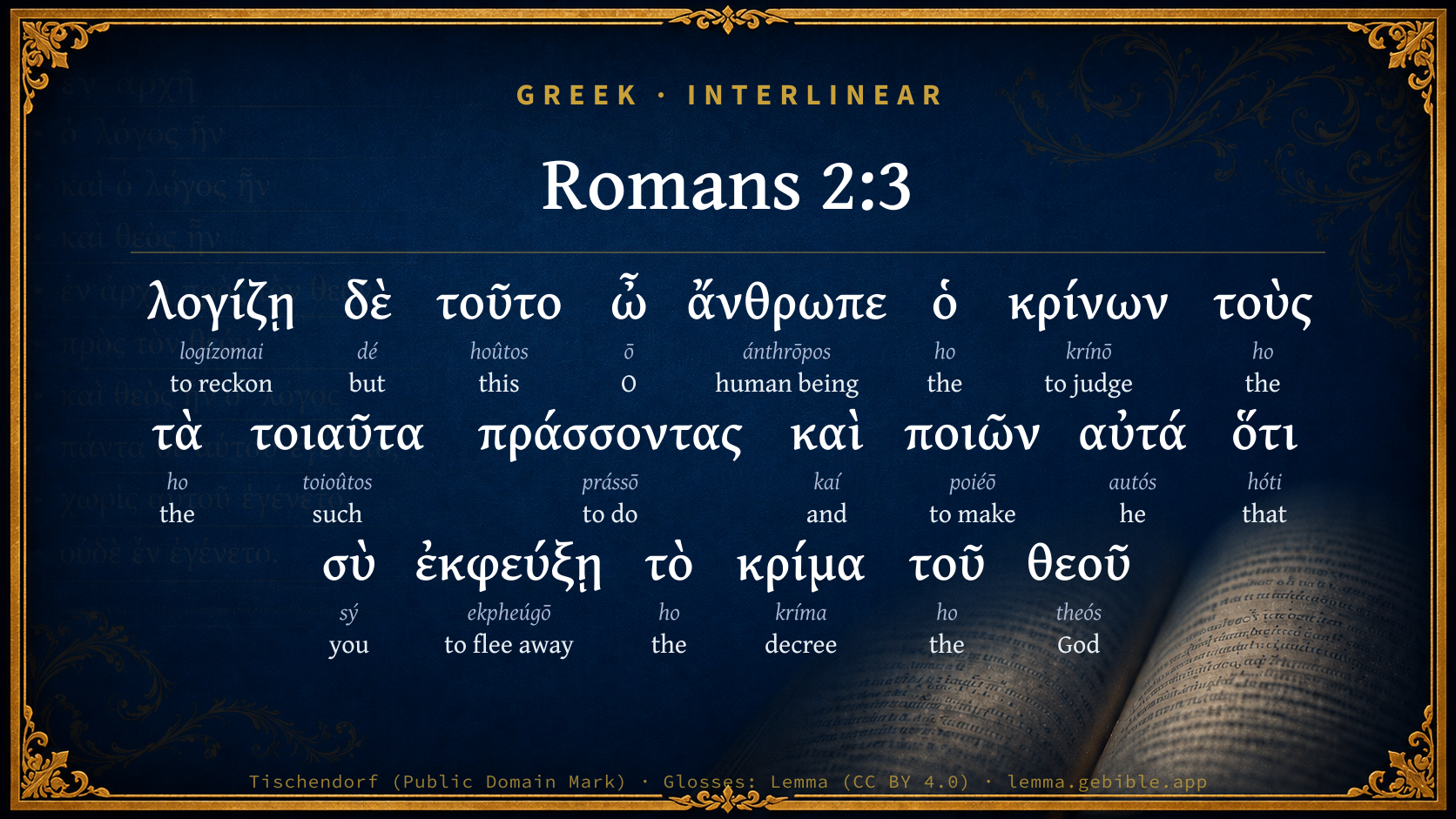
  1. λογίζῃ logízomai G3049 “to reckon” Verb, Present, Middle or Passive deponent, Indicative, 2nd person, Singular
  2. δὲ dé G1161 “but” Conjunction
  3. τοῦτο hoûtos G3778 “this” Demonstrative pronoun, Accusative, Singular, Neuter
  4. ὦ ō G5599 “O” Interjection
  5. ἄνθρωπε ánthrōpos G444 “human being” Noun, Vocative, Singular, Masculine
  6. ὁ ho G3588 “the” Article, Nominative, Singular, Masculine
  7. κρίνων krínō G2919 “to judge” Verb, Present, Active, Participle, Nominative, Singular, Masculine
  8. τοὺς ho G3588 “the” Article, Accusative, Plural, Masculine
  9. τὰ ho G3588 “the” Article, Accusative, Plural, Neuter
  10. τοιαῦτα toioûtos G5108 “such” Demonstrative pronoun, Accusative, Plural, Neuter
  11. πράσσοντας prássō G4238 “to do” Verb, Present, Active, Participle, Accusative, Plural, Masculine
  12. καὶ kaí G2532 “and” Conjunction
  13. ποιῶν poiéō G4160 “to make” Verb, Present, Active, Participle, Nominative, Singular, Masculine
  14. αὐτά autós G846 “he” Personal pronoun, Accusative, Plural, Neuter
  15. ὅτι hóti G3754 “that” Conjunction
  16. σὺ sý G4771 “you” Personal pronoun, 2nd person, Nominative, Singular
  17. τὸ ho G3588 “the” Article, Accusative, Singular, Neuter
  18. κρίμα kríma G2917 “decree” Noun, Accusative, Singular, Neuter
  19. τοῦ ho G3588 “the” Article, Genitive, Singular, Masculine
  20. θεοῦ theós G2316 “God” Noun, Genitive, Singular, Masculine

About this verse

These counts appear in no published source. They are computed here, from the morphology-tagged text and Lemma’s own curated glosses. What Lemma adds →

21
words
17
distinct lemmas
Pauline Epistles
section

Notable vocabulary

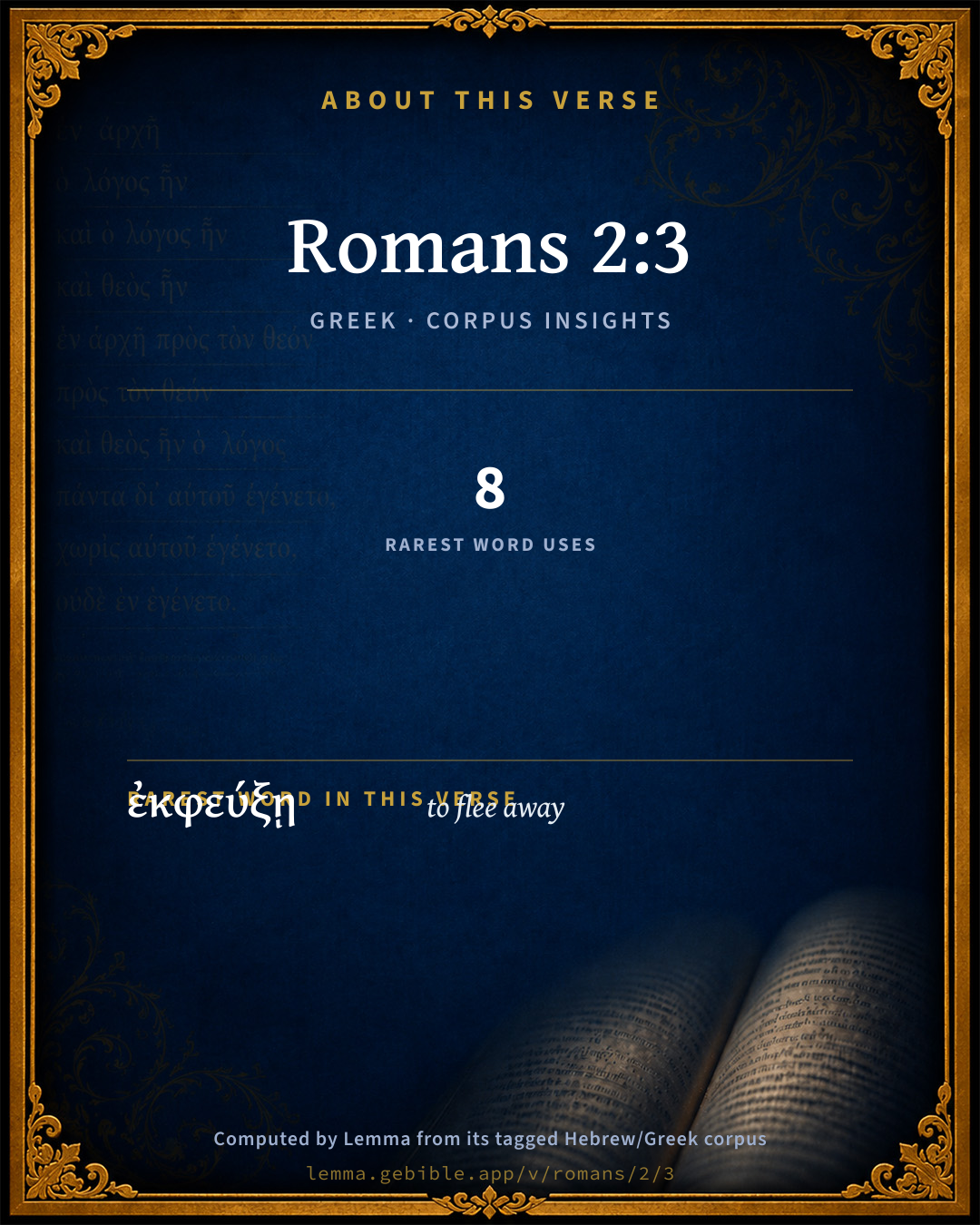
The rarest word here is ἐκφεύξῃ to flee away G1628 — appearing just 8 times in the whole Greek New Testament.

Shared distinctive vocabulary

ἐκφεύξῃ to flee away G1628 occurs in 8 verses of the Greek New Testament. Also found in:

Repetition

A word recurs within this verse:

Cross-references

18

Topical passages linked to Romans 2:3 in the Treasury of Scripture Knowledge — connected by theme and wording, ordered by reader-vote popularity; previews shown in the World English Bible.

  • Proverbs 16:5 Everyone who is proud in heart is an abomination to Yahweh: They shall assuredly not be unpunished.
  • Luke 12:14 But he said to him, "Man, who made me a judge or an arbitrator over you?"
  • Romans 1:32–2:1 who, knowing the ordinance of God, that those who practice such things are worthy of death, not only do the same, but also approve of those who practice them.
  • Matthew 23:33 You serpents, you offspring of vipers, how will you escape the judgment of Gehenna?
  • 2 Samuel 10:3 But the princes of the children of Ammon said to Hanun their lord, Do you think that David honors your father, in that he has sent comforters to you? Hasn't David sent his servants to you to search the city, and to spy it out, and to overthrow it?
  • Job 35:2 "Do you think this to be your right, Or do you say, 'My righteousness is more than God's,'
  • Psalms 50:21 You have done these things, and I kept silent. You thought that the "I AM" was just like you. I will rebuke you, and accuse you in front of your eyes.
  • Proverbs 11:21 Most assuredly, the evil man will not be unpunished, But the seed of the righteous will be delivered.
  • Ezekiel 17:15 But he rebelled against him in sending his ambassadors into Egypt, that they might give him horses and much people. Shall he prosper? shall he escape who does such things? shall he break the covenant, and yet escape?
  • Daniel 10:19 He said, "Greatly beloved man, don't be afraid: peace be to you, be strong, yes, be strong." When he spoke to me, I was strengthened, and said, "Let my lord speak; for you have strengthened me."
  • Matthew 26:53 Or do you think that I couldn't ask my Father, and he would even now send me more than twelve legions of angels?
  • Luke 22:58 After a little while someone else saw him, and said, "You also are one of them!" But Peter answered, "Man, I am not!"
  • 1 Thessalonians 5:3 For when they are saying, "Peace and safety," then sudden destruction will come on them, like birth pains on a pregnant woman; and they will in no way escape.
  • Psalms 56:7 Shall they escape by iniquity? In anger cast down the peoples, God.
  • Ezekiel 17:18 For he has despised the oath by breaking the covenant; and behold, he had given his hand, and yet has done all these things; he shall not escape.
  • Luke 22:60 But Peter said, "Man, I don't know what you are talking about!" Immediately, while he was still speaking, a rooster crowed.
  • Hebrews 2:3 how will we escape if we neglect so great a salvation-- which at the first having been spoken through the Lord, was confirmed to us by those who heard;
  • Hebrews 12:25 See that you don't refuse him who speaks. For if they didn't escape when they refused him who warned on the Earth, how much more will we not escape who turn away from him who warns from heaven,

Cross-references courtesy of OpenBible.info (CC BY 4.0).

Commentary

Notes on Romans 2:3 from classic Christian and Jewish commentators (each source and its license shown beneath its notes). The classic Christian expositions comment on the surrounding passage and are grouped to its opening verse, so a note may address several verses; the Jewish commentaries on the Tanakh (Rashi and others) are per-verse, so they appear only where the commentator wrote on this verse.

Lemma curates 59 commentaries, every one of them public domain or Creative Commons licensed, each selected and text-cleaned for this edition rather than reprinted as found. About our sources →

The Biblical Illustrator

Joseph S. Exell

Rom_2:3

And thinkest thou … that thou shalt escape the judgment of God?

The sinners folly

I. Their conduct.

1. They judge others.

2. Forget themselves.

3. Dream of impunity.

II. Its folly. There is but--

1. One law.

2. One judge.

3. One judgment. (J. Lyth, D. D.)

No escaping Gods judgment

I. The Jews thought to escape it, on the grounds of--

1. Their relation to Abraham.

2. Their possession of the law.

3. Their circumcision.

4. Benefits already received.

5. Their own good works.

6. The merits of their ancestors.

7. Their ceremonies such as the Day of Atonement, etc.

II. Men in general think to escape it. With as little reason, through--

1. Wealth, power, or exalted position.

2. Poverty or insignificance.

3. Religious profession, Church membership, or sacred office.

4. Personal conduct.

5. Pious ancestry.

6. Practice of religious rites.

7. Prayers, fastings, almsgivings.

8. Afflictions.

III. The impossibility of this.

1. The Jews were solemnly warned that they should not escape (Amo_9:1-4; Psa_50:7-22).

2. The only escape is through Christ (Act_4:12), just as the only refuge from the flood was in the provided ark (1Pe_3:20-21).

3. The guilty flee, the pardoned alone escape the judgment of God. (T. Robinson, D. D.)

The gradual but inevitable advance of Divine judgment

Slow goes the hand of justice, like the shadow on the sundial; ever moving, yet slowly creeping on, with a motion all but imperceptible. Still stand in awe. The hand of justice has not stopped, although imperceptible it steadily advances; by and by it reaches the tenth, eleventh, and twelfth hour. And now the bell strikes. Then unless you have fled to Christ, the blow which was so slow to fall, shall descend over the head of impenitence with accumulated force. (T. Guthrie, D. D.)

The Biblical Illustrator, edited by Joseph S. Exell (c. 1880s–1900s) — public domain. Text from a community e-Sword module.

Bengel's Gnomon

Johann Albrecht Bengel

Rom 2:3. σύ, thou) as distinguished from the Gentile; every one, even without a cause, makes his own self an exception [as regards condemnation]; and flatters himself, although he knows not himself, on what grounds.—ἐκφεύξη, shalt thou escape?) through the loopholes, which thou seekest. Every one, that is arraigned, φεύγει, tries to escape [ὁ φεύγων is the technical term for a defendant; ὁ διώκων, the accuser]; he who is acquitted, ἐκφεύγει, escapes.

Bengel's Gnomon of the New Testament — English translation (T&T Clark, Edinburgh, 1860) — public domain. Text from a community e-Sword module.

Meyer's Critical & Exegetical Commentary

Heinrich August Wilhelm Meyer

Rom_2:3. Antithesis of Rom_2:2, That God judges evildoers according to truth, we know (Rom_2:2); but judgest thou (in the face of that proposition) that thou shalt.… escape? This would indeed be at variance with the ἀλήθεια of the judgment. Comp Mat_3:7; and the passages from profane writers in Grotius. The non-interrogative rendering of Rom_2:3-4 (Hofmann) is not called for by the connection with the assertive declaration in Rom_2:5; it weakens the lively force of the discourse, and utterly fails to suit the ἤ in Rom_2:4, so prevalent in double questions.

ΤΟῦΤΟ] preparing with emphasis (here: of surprise) for the following ὍΤΙ ΣῪ ἘΚΦ. Κ.Τ.Λ[588]; Bernhardy, p. 284.

σὺ] Thou on thy side, as if thou madest an exception; opposed to the Jewish self-conceit (Mat_3:7 ff.; Luk_3:7 f.). The emphasis is not on Θεοῦ (Chrysostom, Theophylact, and others).

ἐκφεύξῃ] not: through acquittal (Bengel), comp Dem. 602, 2, Aristoph. Vesp. 157 al[590], but inasmuch as thou shalt not be subjected to the κρῖμα of God, but shalt on the contrary escape it and be secure afar off from it. Comp 2Ma_6:26; 2Ma_7:35; 1Th_5:3; Heb_2:3. According to the Jewish illusion only the Gentiles were to be judged (Bertholdt, Christol. p. 206 ff.), whereas all Israel were to share in the Messianic kingdom as its native children (Mat_8:12).

[588] .τ.λ. καὶ τὰ λοιπά.

[590] l. and others; and other passages; and other editions.

Meyer — Critical and Exegetical Commentary on the New Testament — English translation by Peter Christie, edited by Frederick Crombie (T&T Clark, 1880) — public domain. Text from a community e-Sword module.

Expositor's Greek Testament

ed. W. Robertson Nicoll

Rom 2:3 . σὺ has strong emphasis. The Jew certainly thought, in many cases, that the privilege of his birth would of itself ensure his entrance into the kingdom (Mat 3:8-9 ): this was his practical conviction, whatever might be his proper creed. Yet the σὺ indicates that of all men the Jew, so distinguished by special revelation, should least have fallen into such an error. He is “the servant who knew his Lord’s will,” and whose judgement will be most rigorous if it is neglected.

The Expositor's Greek Testament, edited by W. Robertson Nicoll (1897–1910) — public domain. Text from a community e-Sword module.

Cambridge Greek Testament for Schools and Colleges

3. The nexus seems to be this: do you calculate that this correct attitude towards sin in others will exempt your case from being considered by GOD, or are you merely indifferent to His merciful dealing with you? The case is put in the most general way and applies to all theoretic judgment of others; but the crucial instance in mind is the Jew; cf. Rom 2:17 ff.

ἐκφεύξῃ, shalt clean escape; cf. Luk 21:36; Heb 2:3.

Cambridge Greek Testament for Schools and Colleges (Cambridge University Press, 1896; 21 vols, various authors incl. Carr, Maclear, Plummer, Farrar, Lumby, Moule, M. R. James, Simcox) — public domain. Text from a community e-Sword module.

Hodge's Commentary on Romans, Ephesians & First Corinthians

Charles Hodge

Rom_2:3

But thinkest thou this, O man, that judgest, etc. The truth that Gods judgment is just, and will fall on those who themselves commit the sins which they condemn in others, is so plain, that the apostle exclaims at the folly of those who seem to deny it. The emphasis lies on the word thou, in the middle of the verse. Dost thou think that thou, a Jew, and because a Jew, shalt escape the righteous judgment of God? Shalt escape, ἐκφεύξῃ. Every one, says Bengel, who is arraigned, φεύγει, tries to escape; he who is acquitted, ἐκφεύγει, escapes. In Rom_2:1, the apostle had shown that the man who did what he condemned in others, condemned himself. If then, as Theophylact says, he cannot escape his own judgment, how can he escape the judgment of God? If forced to condemn ourselves, how much more will the infinitely Holy condemn us? The ground on which this false and absurd expectation rested is mentioned in the following verse:

Charles Hodge — Commentary on Romans (1835), First Corinthians (1857), and Ephesians (1856) — public domain. Text from a community e-Sword module.

John Calvin's Commentaries

3. And thinkest thou, O man, etc. As rhetoricians teach us, that we ought not to proceed to give strong reproof before the crime be proved, Paul may seem to some to have acted unwisely here for having passed so severe a censure, when he had not yet proved the accusation which he had brought forward. But the fact is otherwise; for he adduced not his accusation before men, but appealed to the judgment of conscience; and thus he deemed that proved which he had in view — that they could not deny their iniquity, if they examined themselves and submitted to the scrutiny of God’s tribunal. And it was not without urgent necessity, that he with so much sharpness and severity rebuked their fictitious sanctity; for men of this class will with astonishing security trust in themselves, except their vain confidence be forcibly shaken from them. Let us then remember, that this is the best mode of dealing with hypocrisy, in order to awaken it from its inebriety, that is, to draw it forth to the light of God’s judgment.

That thou shalt escape, etc. This argument is drawn from the less; for since our sins are subject to the judgment of men, much more are they to that of God, who is the only true Judge of all. Men are indeed led by a divine instinct to condemn evil deeds; but this is only an obscure and faint resemblance of the divine judgment. They are then extremely besotted, who think that they can escape the judgment of God, though they allow not others to escape their own judgment. It is not without an emphatical meaning that he repeats the word man; it is for the purpose of presenting a comparison between man and God.

John Calvin's Commentaries (1540-1563) — public domain. Text from the Calvin Translation Society English edition (1840s-50s) via the Christian Classics Ethereal Library (ccel.org). Calvin's coverage is partial (roughly two-thirds of the Bible); uncommented books and verses are honest gaps, never fabricated. The 19th-century editor's footnotes and remarks are omitted so the notes are faithfully Calvin's own voice.

Ellicott's Commentary for English Readers

(3) That thou shalt escape.—Emphatic. “Are you—because you are a Jew—to be the only exception to this rule?”

A Bible Commentary for English Readers, edited by Charles John Ellicott (1878–1897) — public domain. Text from a community e-Sword module.

The Cambridge Bible for Schools and Colleges

gen. ed. J. J. S. Perowne

3. that thou shalt escape] “Thou” is, of course, emphatic. We must remember how often the Jews of that age clung to national privilege as if it were personal immunity. It was a saying, that to live in Palestine was “equal to the observance of all the commandments.” “He that hath his permanent abode in Palestine,” so taught the Talmud, “is sure of the life to come.” (Edersheim’s Sketches of Jewish Life, p. 5.) The tendency betrayed in such thoughts is deep as the fall of man, but it has its times and ways of special manifestation.

The Cambridge Bible for Schools and Colleges (gen. ed. J. J. S. Perowne; Cambridge University Press, 1878–1918) — public domain. Text from a community e-Sword module.

John Gill's Exposition

And thinkest thou this, O man, that judgest them which do such things, and doest the same,.... Some men may be so vain as to imagine, that though they do the same things which they condemn in others, they

shall escape the judgment of God: but such will find themselves most sadly mistaken; there is no avoiding the general judgment; all men must come to it; there will be no eluding it through craftiness and deceit, through bribery and corruption; there will be no escaping condign punishment, through might in the criminal, or through the judge's ignorance of his crimes, or want of ability and power to punish.

John Gill's Exposition of the Whole Bible (1746–1763) — public domain (CC PDM 1.0). Text via the HelloAO Bible API.

Trapp's Complete Commentary

John Trapp

3 And thinkest thou this, O man, that judgest them which do such things, and doest the same, that thou shalt escape the judgment of God?

Ver. 3. Thinkest thou] This is preaching to the conscience, to the quick. Our exhortations should be as forked arrows to stick in men’s hearts; and not wound only, as other arrows. A poor hermit came to our Richard I, A. D. 1195, and preaching to him the words of eternal life, bade him be mindful of the subversion of Sodom, and to abstain from things unlawful: otherwise, said he, the deserved vengeance of God will come upon thee. The hermit being gone, the king neglected his words. But afterwards falling sick, he more seriously bethought himself, and waxing sound in soul as well as in body, he grew more devout, and charitable to the poor. (Hoveden. Speed.)

John Trapp, A Commentary or Exposition upon All the Books of the Old and New Testament (1647–1656) — public domain. Text from a community e-Sword module.

Albert Barnes' Notes on the Bible

And thinkest thou ... - This is an appeal to their common sense, to their deep and instinctive conviction of what was right. If they condemned those who practiced these things; if, imperfect and obscure as their sense of justice was; if, unholy as they were, they yet condemned those who were guffey of these offences, would not a holy and just God be far more likely to pronounce judgment? And could they escape who had themselves delivered a similar sentence? God is of “purer eyes than to behold evil, and cannot look upon iniquity, Hab 1:13. And if people condemned their fellow-men, how much more would a pure and holy God condemn iniquity. This appeal is evidently directed against the Jew. It was doubtless a prevalent sentiment among them, that provided they adhered to the rites of their religion, and observed the ceremonial law, God would not judge them with the same severity as he would the abandoned and idolatrous Gentiles: compare Mat 3:9; Joh 8:33. The apostle shows them that crime is crime, wherever committed: that sin does not lose its essential character by being committed in the midst of religious privileges; and that those who professed to be the people of God have no special license to sin. Antinomians in all ages, like the Jews, have supposed that they, being the friends of God, have a right to do many things which would not be proper in others; that what would be sin in others, they may commit with impunity; and that God will not be strict to mark the offences of his people. Against all this Paul is directly opposed, and the Bible uniformly teaches that the most aggravated sins among people are those committed by the professed people of God; compare Isa 1:11-17; Isa 65:2-5; Rev 3:16.

Albert Barnes' Notes on the Bible (1834–1885) — public domain. Text from a community e-Sword/MySword module.

Matthew Poole's English Annotations

When other men’s facts escape not thy censure, who art but a man; what folly and madness is it to imagine, that thine own evil deeds should escape the judgment of God! See 1Jo 3:20.

Matthew Poole's English Annotations on the Holy Bible (1683–1685) — public domain. Text from a community e-Sword/MySword module.

Whedon's Commentary on the Bible

Daniel D. Whedon

3. Judgest… thou—One of the most striking proofs of the reality of a human conscience, and of its real acuteness in breasts apparently most depraved and obtuse, is not its power of self-condemnation, but its keenness in the condemnation of others. The most reckless and unconscientious wretch will be critically and delicately sharp in analyzing and severely condemning the aberration of some good man. Paul, therefore, shows singular skill in turning the analysis of these moral critics to a keen practice upon their own cases. Shalt escape—On account of the moderate amount of thy viciousness. Doubtless a less deep penalty awaits a less deep guilt. But no degree of guilt can escape by self-excuse or self-disregard; the only outlet is by confessed ruin, human repentance, and divine mercy. To that repentance Paul did not press the abandoned dregs of chapter i as being out of hearing and perhaps hopeless; but to that repentance he now presses this class, whose great danger is a denial of their own ruin, and a consequent impenitent persistence in it. They are near enough to listen, they are delicate enough to judge, and the very work to which the apostle rightly applies himself is to reveal to them their danger.

Daniel D. Whedon (gen. ed.), Commentary on the Old and New Testaments (1874–1909) — public domain. Text from a community e-Sword module.

The Pulpit Commentary

Vers. 3, 4. And thinkest thou this, O man, that judgest them which practise such things, and doest the same, that thou (su , emphatic) shalt escape the judgment of God? Or despisest thou the riches of his goodness and forbearance and long-suffering; not knowing that the goodness of God leadeth thee to repentance? Two possible mental attitudes of o krinwn are supposed that of really calculating (logizh) on escaping the judgment, or that of obduration, consequent on God"s long forbearance towards him, in that "sentence is not executed speedily." (For a similar view of God"s merciful purpose in delaying the final judgment, and of man"s abuse of his forbearance, cf. 2Pe_3:9)

The Pulpit Commentary (1880–1919), ed. H.D.M. Spence-Jones & Joseph S. Exell — public domain. Text from a community e-Sword module.

John Wesley's Explanatory Notes

That thou shalt escape - Rather than the gentile.

John Wesley, Explanatory Notes Upon the Whole Bible (1754–1765) — public domain. Text via the GEBible commentary corpus.

Godbey's Commentary on the New Testament

William B. Godbey

3. “But O man, that condemneth those doing such things and art doing the same thyself, do you consider this, that you shall escape the condemnation of God?” The answer is an awful negative. The church member by his very attitude condemns the worldlian for sin, at the same time actually making a profession of a sinning religion. The inconsistency literally makes him a laughing-stock for devils, because his very attitude as a sinning Christian puts him under the same condemnation along with the sinful world, and sends him to the same hell.

William B. Godbey, Commentary on the New Testament (1896–1900) — public domain. Text from a community e-Sword module.

McGarvey & Pendleton's Commentaries

J. W. McGarvey

And reckonest thou this, O man, who judgest them that practise such things, and doest the same, that thou shalt escape the judgment of God? [The argument may be paraphrased thus: Yielding to the force of argument, that like sin deserves like condemnation, even you, though most unwillingly, condemn yourself. How much more freely, therefore, will God condemn you ( 1Jo_3:20 ). And we know that you can not escape, for the judgment of God is according to truth; i. e., without error or partiality against the doers of evil. And do you vainly imagine, O man, that when thine own moral sense is so outraged at evil that thou must needs condemn others for doing it, that thou, though doing the same evil thyself, shalt escape the judgment of God through any partiality on his part? Self-love, self-pity, self-justification, and kindred feeling, have, in all ages, caused men to err in applying the warnings of God to themselves. Among the Jews this error took the form of a doctrine. Finding themselves especially favored and privileged as children of Abraham, they expected to be judged upon different principles from those of truth, which would govern the judgment and condemnation of the rest of mankind. This false trust is briefly announced and rebuked by John the Baptist ( Mat_3:7-9 ), and afterwards more clearly and fully defined in the Talmud in such expressions as these: "Every one circumcised has part in the kingdom to come." "All Israelites will have part in the world to come." "Abraham sits beside the gates of hell, and does not permit any wicked Israelite to go down to hell." The same error exists to-day in a modified form. Many expect to be saved because they are the children of wealth, culture, refinement; because they belong to a civilized people; because their parents are godly; or even, in some cases, because they belong to a certain lodge, or order.]

J. W. McGarvey (with Philip Y. Pendleton), Commentaries on the New Testament (The Fourfold Gospel, 1914; Acts; and the epistles) — public domain. Text from a community e-Sword/MySword module.

The People's New Testament

B. W. Johnson

3. Thinkest thou. It seems to us strange folly for the Jew to regard Gentile sinners under condemnation, but fancy that he might do the same things, and yet escape the judgment of God. Still this error is not confined to the Jews. Many a sinner persuades himself that his own sins, the very sins he condemns in others, will go unpunished.

B. W. Johnson's The People's New Testament with Notes (1889–1891) — public domain. Electronic text from the Christian Classics Ethereal Library (CCEL) ThML edition.

unfoldingWord translationNotes

Door43 World Missions Community

But consider this

"So consider this" or "Therefore, consider this"

consider this

"think about what I am going to tell you"

person

Use the general word for a human being "whoever you are"

you who judge those who practice such things although you do the same things

"you who say someone deserves God's punishment while you do the same wicked deeds"

Will you escape from the judgment of God?

This remark appears in the form of a question to add emphasis. You can also translate this question as a strong negative statement. AT: "You will certainly not escape God's judgment!" (See: Rhetorical Question)

Or do you think so little of the riches of his goodness, his delayed punishment, and his patience ... repentance?

This remark appears in the form of a question to add emphasis. You can also translate this as a strong statement. AT: "You should not act like it does not matter that God is good and that he patiently waits a long time before he punishes people, so that his goodness will cause them to repent!" (See: Rhetorical Question)

think so little of the riches ... patience

"consider the riches ... patience unimportant" or "consider ... not good"

Do you not know that his goodness is meant to lead you to repentance?

This remark appears in the form of a question to add emphasis. You can also translate this as a strong statement. AT: "You must know that God shows you he is good so that you might repent!" (See: Rhetorical Question)

translationWords

judge

good

punish

repent

unfoldingWord translationNotes — © Distant Shores Media and the Door43 World Missions Community, licensed CC BY-SA 4.0. Source: git.door43.org/Door43/en_tn.

Alford’s Greek Testament

Henry Alford

3.] Here he approximates nearer to the Jews. They considered that because they were the children of Abraham they should be saved, see Mat 3:7, Mat 3:9.

τοῦτο, viz. ὅτι σὺ ἐκφ., following.

σύ has the emphasis on it, thou thyself,—‘thou above all others.’

Henry Alford, The Greek Testament (1849–1861) — public domain. Text from a community e-Sword module.

International Critical Commentary

3. σύ emphatic; ‘thou, of all men.’ There is abundant illustration of the view current among the Jews that the Israelite was secure simply as such by virtue of his descent from Abraham and of his possession of the Law: cf. Mat 3:8, Mat 3:9 ‘Think not to say within yourselves, We have Abraham to our father’; Joh 8:33; Gal 2:15; the passages quoted by Gif.; Weber, Altsyn. Theol. p. 69 f.

There may be an element of popular misunderstanding, there is certainly an element of inconsistency, in some of these passages. The story of Abraham sitting at the gate of Paradise and refusing to turn away even the wicked Israelite can hardly be a fair specimen of the teaching of the Rabbis, for we know that they insisted strenuously on the performance of the precepts of the Law, moral as well as ceremonial. But in any case there must have been a strong tendency to rest on supposed religious privileges apart from the attempt to make practice conform to them.

International Critical Commentary — older volumes (1896–1929), various authors — public domain. Text from a community e-Sword module.

Vincent's Word Studies in the New Testament

Marvin R. Vincent

Reckonest [λογιζη] . See on 1Pe 5:12. Intimating a process of reasoning.

Thou shalt escape. Thou emphatic, opposed to Jewish self - conceit.

Marvin R. Vincent, Word Studies in the New Testament (1887–1900) — public domain. Text from a community e-Sword/MySword module.

Godet's Commentaries

Frédéric Louis Godet

Vv. 3. “But thou countest upon this, O man, that judgest them which do such things, and doest the same, that thou shalt escape the judgment of God?”

We might, with Hofmann, take the verbs λογίζῃ and καταφρονεῖς (thou countest, thou despisest) in an affirmative sense. But the ἤ, or indeed, at the beginning of Rom 2:4 would rather incline us, following Paul’s ordinary usage, to interpret these words in the interrogative sense; not, however, that we need translate the former in the sense of: thinkest thou? The interrogation is less abrupt: “thou thinkest no doubt?” The word λογίζεσθαι, to reason, well describes the false calculations whereby the Jews persuaded themselves that they would escape the judgment with which God would visit the Gentiles. Observe the σύ, thou: “that thou wilt escape, thou,” a being by thyself, a privileged person! It was a Jewish axiom, that “every one circumcised has part in the kingdom to come.” A false calculation. Such, then, is the first supposition serving to explain the security of the Jew; but there is a graver still. Perhaps this false calculation proceeds from a moral fact hidden in the depths of the heart. Paul drags it to the light in what follows.

Frédéric Louis Godet — Commentaries on Luke, John, Romans, and 1 Corinthians — English translation (T&T Clark, Edinburgh, 1870s–1890s) — public domain. Text from a community e-Sword module.

Lesson kit

Teaching starters — assembled from the data on this page, not authored interpretation. Every prompt links to the verse data it draws on. Edit before teaching.

Romans, in the Pauline Epistles, opens this verse with 21 words (17 distinct Greek lemmas). Its most distinctive word is ekpheúgō (“to flee away”). A historical commentator’s framing appears above. Read the whole chapter for the surrounding context.

Discussion questions

  1. How does “to flee away” (ekpheúgō) shape what this verse is saying?
  2. How does Luke 21:36, which shares the word «to flee away», read alongside this verse?
  3. What does the repetition of “the” (5× in this one verse) do in this verse?
  4. These translations render this verse differently; the difference is in the English rendering, not the original. What questions does that raise?
  5. Compare how The Biblical Illustrator and Bengel's Gnomon read this verse. Where do they agree or differ?

Things to notice

Reading settings

Reading text

Shown beneath each verse's original-language words.

Old Testament
Old Testament edition

Read the OT as the Masoretic Hebrew (MT) or the Greek Septuagint (LXX).

English shown for the Greek Septuagint (in the Hebrew ↔ Greek comparison).

Comparing translations? Open the Compare panel on any verse page to stack up to four side by side.