Acts 21:19

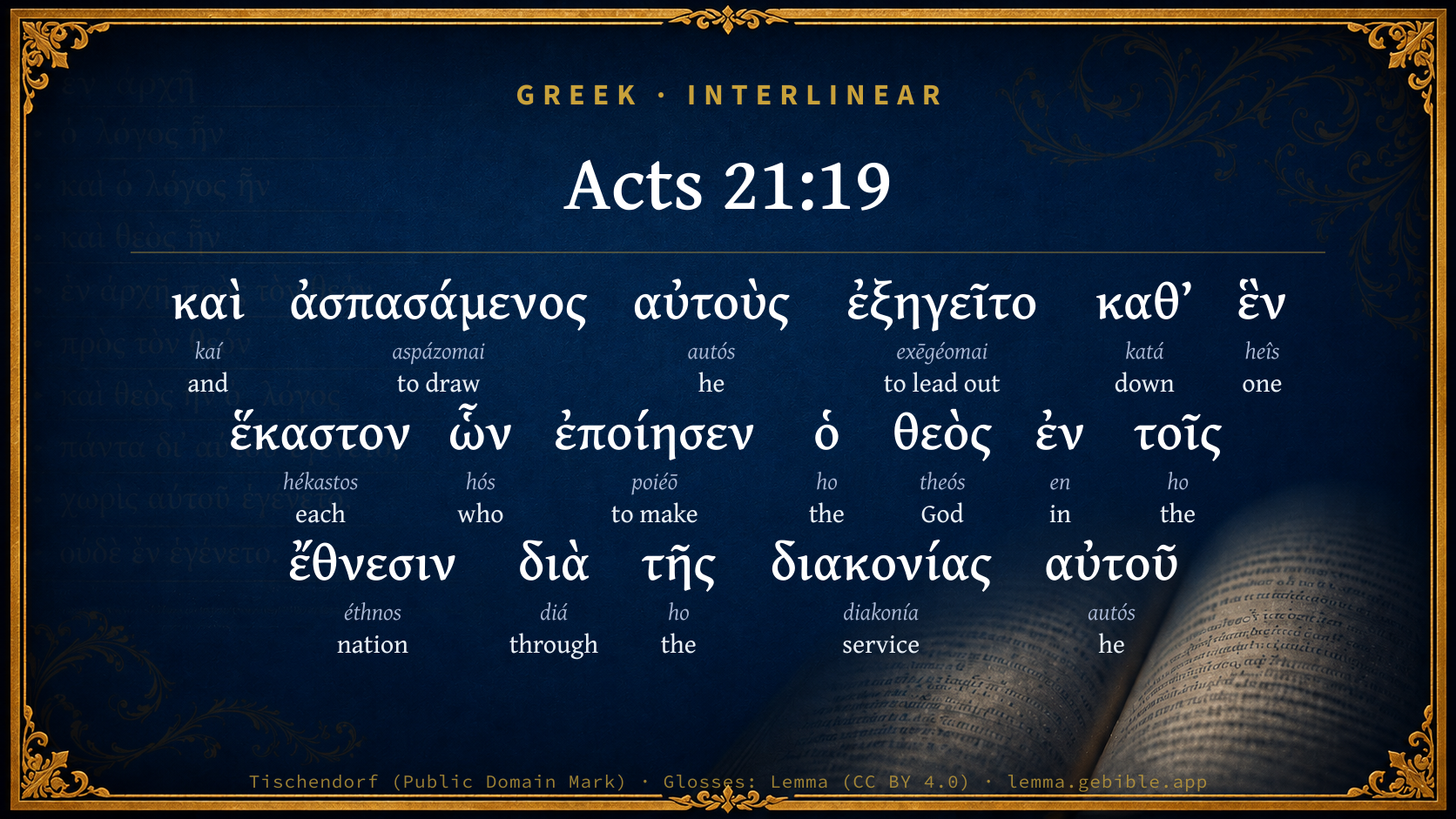
Greek (Tischendorf 8th ed.) Acts 21:19 appears in the Greek New Testament. The text above is from the Tischendorf 8th edition. Each word links to its Strong’s number and a concise gloss. Click any word for its full Thayer’s Greek Lexicon entry.
Download image
Cite this verse

Acts 21:19 (World English Bible). Public Domain. Lemma interlinear Bible study tool, https://lemma.gebible.app/v/acts/21/19.

Show BibTeX & RIS
BibTeX
RIS
English Translation
When he had greeted them, he reported one by one the things which God had worked among the Gentiles through his ministry.
World English Bible · Public Domain
Download a study sheet

One document with this verse’s original text, its word-by-word gloss line, the meaning frame, cross-references with their text, attributed commentary, and full source and license credits — printable, and it pastes into notes with its structure intact.

This verse Autodidact and up

Study sheet (.html) Plain text (.txt)

A passage Seminary Student

Up to 50 verses in one chapter. A passage sheet keeps up to 6 commentary sources and 12 cross-references per verse, in the order this page ranks them, and says so on the sheet whenever that leaves anything out. Ask for a single verse and you get the Autodidact verse sheet above.

Everything on this page stays free to read, with no account — the sheet is a download of what is already on screen, not access to it.

Want to remove ads? Support Godless Engineer
Compare translations 3

The same verse in 3 English versions, stacked beneath the original-language interlinear above. Click any original word for its lexicon entry.

Each is an independent rendering of the whole verse — the interlinear is not word-aligned to these translations.

Highlighted words mark where these versions differ — a whole-verse word diff, not a word-by-word alignment.

  • World English Bible Public Domain
    When he had greeted them, he reported one by one the things which God had worked among the Gentiles through his ministry.
  • King James Version Public Domain
    And when he had saluted them, he declared particularly what things God had wrought among the Gentiles by his ministry.
  • unfoldingWord Literal Text CC BY-SA 4.0
    And having greeted them, he was declaring, one by one, each of the things God had done among the Gentiles through his ministry.

unfoldingWord Literal Text — © unfoldingWord, licensed CC BY-SA 4.0. Word-aligned USFM3 via Door43 (git.door43.org/unfoldingWord/en_ult).

Versions to compare (up to 4)

3 of 4 selected

Show all 19 translations

Every available English version of this verse, each an independent rendering of the whole verse.

  • World English Bible Public Domain
    When he had greeted them, he reported one by one the things which God had worked among the Gentiles through his ministry.
  • Berean Standard Bible Public Domain
    Paul greeted them and recounted one by one the things that God had done among the Gentiles through his ministry.
  • Majority Standard Bible Public Domain
    Paul greeted them and recounted one by one the things that God had done among the Gentiles through his ministry.
  • King James Version Public Domain
    And when he had saluted them, he declared particularly what things God had wrought among the Gentiles by his ministry.
  • American Standard Version (1901) Public Domain
    And when he had saluted them, he rehearsed one by one the things which God had wrought among the Gentiles through his ministry.
  • Revised Version (1885) Public Domain
    And when he had saluted them, he rehearsed one by one the things which God had wrought among the Gentiles by his ministry.
  • Geneva Bible (1599) Public Domain
    And when he had embraced them, hee tolde by order all things, that God had wrought among the Gentiles by his ministration.
  • Douay-Rheims (1899) Public Domain
    Whom when he had saluted, he related particularly what things God had wrought among the Gentiles by his ministry.
  • Young's Literal Translation Public Domain
    and having saluted them, he was declaring, one by one, each of the things God did among the nations through his ministration,
  • Literal Standard Version CC BY-SA 4.0
    and having greeted them, he was expounding, one by one, each of the things God did among the nations through his ministry,
  • Unlocked Literal Bible CC BY-SA 4.0
    When he had greeted them, he reported one by one the things that God had done among the Gentiles through his ministry.
  • unfoldingWord Literal Text CC BY-SA 4.0
    And having greeted them, he was declaring, one by one, each of the things God had done among the Gentiles through his ministry.
  • Darby Bible Public Domain
    And having saluted them, he related one by one the things which God had wrought among the nations by his ministry.
  • World Messianic Bible Public Domain
    When he had greeted them, he reported one by one the things which God had worked among the Gentiles through his ministry.
  • Webster's Bible Public Domain
    And when he had saluted them, he declared particularly what things God had wrought among the Gentiles by his ministry.
  • Free Bible Version CC BY-SA 4.0
    After greeting them, Paul went through in detail everything God had done for the foreigners through his ministry.
  • Bible in Basic English Public Domain
    And when he had said how glad he was to see them, he gave them a detailed account of the things which God had done through his work among the Gentiles.
  • Text-Critical English NT CC BY 4.0
    After greeting them, he reported in detail what God had done among the Gentiles through his ministry.
  • Tyndale New Testament (1534) Public Domain
    And when he had saluted them he tolde by order all thinges that God had wrought amonge the getyls by his ministracion.

Literal Standard Version (2020), Covenant Press — licensed CC BY-SA 4.0. Text via the HelloAO Bible API (eBible.org). Unlocked Literal Bible (unfoldingWord) — licensed CC BY-SA 4.0. Text via the HelloAO Bible API (eBible.org). unfoldingWord Literal Text — © unfoldingWord, licensed CC BY-SA 4.0. Word-aligned USFM3 via Door43 (git.door43.org/unfoldingWord/en_ult). Free Bible Version, Dr. Jonathan Gallagher — licensed CC BY-SA 4.0. Text via the HelloAO Bible API (eBible.org).

Word by word

More ways to search: Search by grammar → Find every occurrence → Compare this word →

Practice this passage: Drill this verse → Learn its vocabulary →

ἐξηγεῖτο
exēgéomai
G1834
“to lead out”
Verb, Imperfect, Middle or Passive deponent, Indicative, 3rd person, Singular
Part of Speech
Verb
Tense
Imperfect
Voice
Middle or Passive deponent
Mood
Indicative
Person
3rd person
Number
Singular
Full Thayer's Definition

Origin: from G1537 and G2233

TDNT: 17:08,3

1. to lead out, be leader, go before 2. metaph., to draw out in narrative, unfold a teaching a. to recount, rehearse b. to unfold, declare 1. the things relating to God 2. used in Greek writing of the interpretation of things sacred and divine, oracles, dreams, etc.
  1. καὶ kaí G2532 “and” Conjunction
  2. ἀσπασάμενος aspázomai G782 “to draw” Verb, Aorist, Middle deponent, Participle, Nominative, Singular, Masculine
  3. αὐτοὺς autós G846 “he” Personal pronoun, Accusative, Plural, Masculine
  4. καθ’ katá G2596 “down” Preposition
  5. ἓν heîs G1520 “one” Adjective, Accusative, Singular, Neuter
  6. ἕκαστον hékastos G1538 “each” Adjective, Accusative, Singular, Neuter
  7. ὧν hós G3739 “who” Relative pronoun, Genitive, Plural, Neuter
  8. ἐποίησεν poiéō G4160 “to make” Verb, Aorist, Active, Indicative, 3rd person, Singular
  9. ὁ ho G3588 “the” Article, Nominative, Singular, Masculine
  10. θεὸς theós G2316 “God” Noun, Nominative, Singular, Masculine
  11. ἐν en G1722 “in” Preposition
  12. τοῖς ho G3588 “the” Article, Dative, Plural, Neuter
  13. ἔθνεσιν éthnos G1484 “nation” Noun, Dative, Plural, Neuter
  14. διὰ diá G1223 “through” Preposition
  15. τῆς ho G3588 “the” Article, Genitive, Singular, Feminine
  16. διακονίας diakonía G1248 “service” Noun, Genitive, Singular, Feminine
  17. αὐτοῦ autós G846 “he” Personal pronoun, Genitive, Singular, Masculine

About this verse

These counts appear in no published source. They are computed here, from the morphology-tagged text and Lemma’s own curated glosses. What Lemma adds →

18
words
15
distinct lemmas
Acts
section

Notable vocabulary

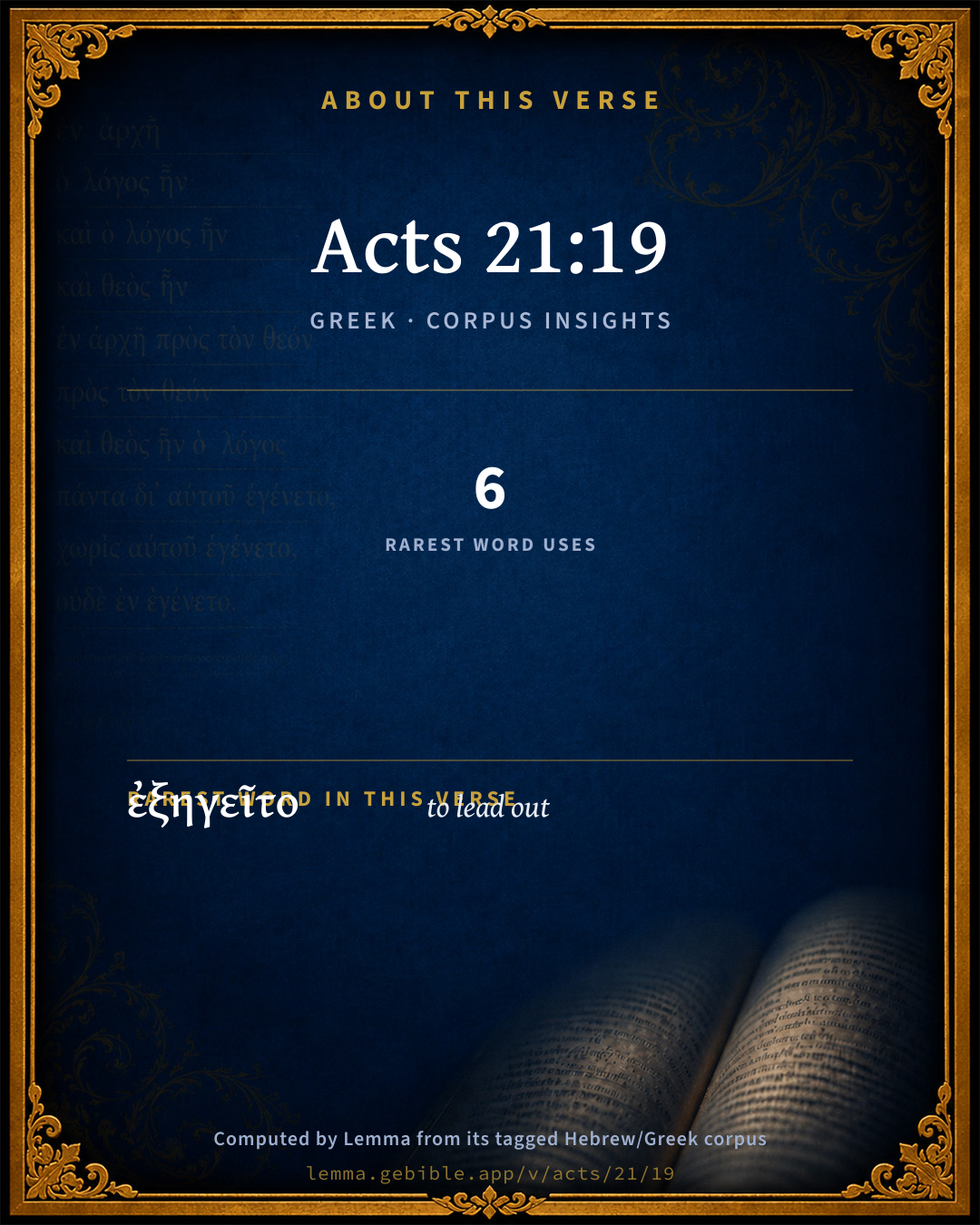
The rarest word here is ἐξηγεῖτο to lead out G1834 — appearing just 6 times in the whole Greek New Testament.

Shared distinctive vocabulary

ἐξηγεῖτο to lead out G1834 occurs in 6 verses of the Greek New Testament. Also found in:

Repetition

Words recur within this verse:

  • ὁ the G3588 ×3
  • αὐτοὺς he G846 ×2

Cross-references

12

Topical passages linked to Acts 21:19 in the Treasury of Scripture Knowledge — connected by theme and wording, ordered by reader-vote popularity; previews shown in the World English Bible.

  • Acts 14:27 When they had arrived, and had gathered the assembly together, they reported all the things that God had done with them, and that he had opened a door of faith to the Gentiles.
  • Acts 1:17 For he was numbered with us, and received his portion in this ministry.
  • Romans 15:18–19 For I will not dare to speak of any things except those which Christ worked through me, for the obedience of the Gentiles, by word and deed,
  • Acts 20:24 But these things don't count; nor do I hold my life dear to myself, so that I may finish my race with joy, and the ministry which I received from the Lord Jesus, to fully testify to the Gospel of the grace of God.
  • 1 Corinthians 15:10 But by the grace of God I am what I am. His grace which was bestowed on me was not futile, but I worked more than all of them; yet not I, but the grace of God which was with me.
  • Acts 11:4–18 But Peter began, and explained to them in order, saying,
  • Acts 15:4 When they had come to Jerusalem, they were received by the assembly and the apostles and the elders, and they reported all things that God had done with them.
  • Acts 15:12 All the multitude kept silence, and they listened to Barnabas and Paul reporting what signs and wonders God had done among the Gentiles through them.
  • 1 Corinthians 3:5–9 Who then is Apollos, and who is Paul, but servants through whom you believed; and each as the Lord gave to him?
  • 2 Corinthians 6:1 Working together, we entreat also that you not receive the grace of God in vain,
  • 2 Corinthians 12:12 Truly the signs of an apostle were worked among you in all patience, in signs and wonders and mighty works.
  • Colossians 1:29 for which I also labor, striving according to his working, which works in me mightily.

Cross-references courtesy of OpenBible.info (CC BY 4.0).

Commentary

Notes on Acts 21:19 from classic Christian and Jewish commentators (each source and its license shown beneath its notes). The classic Christian expositions comment on the surrounding passage and are grouped to its opening verse, so a note may address several verses; the Jewish commentaries on the Tanakh (Rashi and others) are per-verse, so they appear only where the commentator wrote on this verse.

Lemma curates 59 commentaries, every one of them public domain or Creative Commons licensed, each selected and text-cleaned for this edition rather than reprinted as found. About our sources →

Expositor's Greek Testament

ed. W. Robertson Nicoll

Act 21:19 . ἀσπαζ .: used of farewell greetings, Act 20:1 , Act 21:6 , and of greetings on arrival, Act 18:22 , Act 21:7 , for its use here cf. 1Ma 11:6 . ἐξηγ ., see on Act 10:8 , etc. καθʼ ἕν ἕκαστον : “one by one,” R.V., cf. Eph 5:33 . διακονίας , see note on Act 6:1-2 .

The Expositor's Greek Testament, edited by W. Robertson Nicoll (1897–1910) — public domain. Text from a community e-Sword module.

Geneva Bible (1599)

Geneva Bible translators

God is to be praised, who is the Author of all good sayings and deeds.

Geneva Bible (1599) marginal notes — public domain. Text via Bolls.life.

Jamieson, Fausset & Brown

Robert Jamieson, A. R. Fausset & David Brown

he declared particularly--in detail.

what God had wrought among the Gentiles by his ministry--as on previous occasions (Act 14:27; and see Rom 15:15); no doubt referring to the insidious and systematic efforts of the Judaizing party in a number of places to shrivel the Church of Christ into a Jewish sect, and his own counter-procedure.

Jamieson, Fausset & Brown — Commentary Critical and Explanatory on the Whole Bible (1871) — public domain (CC PDM 1.0). Text via the HelloAO Bible API.

Adam Clarke's Commentary

Verse 19. Declared particularly, c.] He no doubt had heard that they were prejudiced against him and, by declaring what God had done by him among the Gentiles, showed how groundless this prejudice was: for, were he a bad man, or doing any thing that he should not do, God would not have made him such a singular instrument of so much good.

Adam Clarke's Commentary on the Bible (1810–1826) — public domain. Text from a community e-Sword/MySword module.

John Calvin's Commentaries

19. And now Paul showeth his modesty when he doth not make himself the author of those things which he had done, but giving the praise to God, doth call himself only the minister whose industry [agency] God had used. As we must grant, that whatsoever thing is excellent and worthy of praise, it is not done by our own power, but forasmuch as God doth work in us; and especially touching the edifying of the Church. Again, it appeareth how far off the elders were from envy, when they glorify God for the joyful success. But because mention is made of no other apostle besides James, we may conjecture that they were gone into diverse places to spread abroad and preach the gospel as their calling did require; for the Lord had not appointed them to stay still at Jerusalem; but after they had made a beginning there, he commanded them to go into Judea and other parts of the world. Moreover, the error of those men, who think that James was one of the disciples whom Paul numbereth among the three pillars of the Church, is refuted before in the fifteenth chapter. And though the same commandment was given to him which was given to the rest of his fellows in office; yet I do not doubt but that they did so divide themselves, that James stood still at Jerusalem, whither many strangers were wont daily to resort. For that was all one as if he had preached the gospel far and wide in strange places.

Thou seest, brother, how many thousands. This oration or speech hath two members. For, first, the elders say, that so many of the Jews as were converted, seeing they be earnest followers of the law, are evil affected towards Paul, because they think that he endeavoreth, with might and main, to abolish the law. Secondly, they exhort him that making a solemn vow he purge himself, that he may not be had in suspicion any longer. They object to Paul, the multitude of believers, that he may the more willingly yield to them. For if they had been a few stubborn fellows, he would not have been so much moved. But now he may not neglect both much people, and the whole body of the Church.

Undoubtedly, that zeal of the law, which was in them, was corrupt, and assuredly even the very elders declare sufficiently that they like it not. For though they do not condemn it openly, neither sharply complain of the same, yet because they separate themselves from their affection, they secretly confess that they err. If it had been a zeal according to knowledge, it ought to have begun at them; [selves] but they contend not for the law itself, neither do they pretend the due reverence thereof, neither do they subscribe to those who are earnest followers of it. Therefore, they both signify that they are of another mind, and also that they do not allow [approve] the superstition of the people.

Notwithstanding it is objected, that they say that Paul was burdened with a false report or slander; again, when they require at his hands satisfaction, they seem to nourish that zeal. I answer, that though that were a true report, in some respect, wherewith the Jews were offended, yet was it mixed with a slander. Paul did so teach the abrogating of the law, that notwithstanding by this means the authority thereof did not only continue sound and perfect, but it was more holy. For as we said, in the seventh chapter, the ceremonies should be vain, unless the effect thereof had been showed in Christ. Therefore, those who say that they were abolished by the coming of Christ, are so far from being blasphemous against the law, that they rather confirm the truth thereof. We must consider two things in ceremonies; the truth, whereto is annexed the efficacy; secondly, the external use. Furthermore, the abrogating of the external use, which Christ brought, dependeth hereupon, in that he is the sound body, and that nothing was shadowed in times past which is not fulfilled in him. This differeth much from the falling away from the law, to show the true end thereof, that the figures may have an end, and that the spiritual truth thereof may always be in force. Wherefore we see that they were malicious and unjust interpreters, who laid apostacy to Paul’s charge, though he did call away the faithful from the external worship of the law. And whereas they command Paul to make a vow to that end, that he may prove himself to be a keeper of the law, it tendeth to no other end, saving that he may testify that he doth not detest the law like a wicked apostate, who did himself shake off the Lord’s yoke, and move others unto the like rebellion.

That they ought not to circumcise. It was so indeed; for Paul taught that both Jews and Gentiles were set at liberty. For these sentences are general with him. Circumcision is nothing (1 Corinthians 7:19). Again, We be circumcised by baptism in Christ, not with circumcision made with hands; again, Let no man judge you in meat or drink, or in the choice of feasts, which are shadows of things to come; but the body is in Christ (Colossians 2:11, 16). Again, Whatsoever cometh into the shambles, and whatsoever is set before you, that eat, asking no question for conscience sake (1 Corinthians 10:25). Again, Be not inwrapped again in the yoke of bondage (Galatians 5:1). Seeing that he spake thus everywhere without exception, he freed the Jews from the necessity of keeping the law.

And lest I stand too long upon this, one place shall be sufficient, where he compareth the law to a tutor, under which the old Church was, as in the childhood thereof; but now knowing the grace of Christ, it is grown up, that it may be free from ceremonies. In that place he speaketh undoubtedly both of the Jews and Gentiles. Also, when he saith that the hand-writing of the law, which did consist in decrees, (Colossians 2:14) is blotted out and nailed to the cross by Christ, he setteth free the Jews, as well as the Gentiles, from the ceremonies, which he calleth in that place decrees. But seeing that he did not precisely reject ceremonies, in teaching that the coming of Christ did make an end of the observing thereof, that was no revolting, as the envious Jews thought it to be.

Neither were the elders ignorant of Paul’s liberty. Therefore, seeing they understand the matter very well, their meaning is, to have this alone made known to the rude and unskillful, that Paul meant nothing less than to persuade the Jews to contemn the law. Therefore, they behold not the bare matter, but knowing what the common sort thought of Paul, by reason of the reports which went about concerning him, they seek to cure the same. Though I wot not whether this were more importunate than equal, [just] which they required at Paul’s hands. And by this it appeareth how preposterous the cruelty [credulity] of men is in receiving false reports, and how fast a false opinion, once rashly received, doth stick. It is certain that James and his fellows in office did endeavor to maintain and defend Paul’s good report, and to put away those lies which did hurt his estimation; yet let them do what they can, they will speak evil of Paul. Unless, peradventure, they were too slack in the beginning, that they might gratify their countrymen, so that they were not their own men [free] afterward.

John Calvin's Commentaries (1540-1563) — public domain. Text from the Calvin Translation Society English edition (1840s-50s) via the Christian Classics Ethereal Library (ccel.org). Calvin's coverage is partial (roughly two-thirds of the Bible); uncommented books and verses are honest gaps, never fabricated. The 19th-century editor's footnotes and remarks are omitted so the notes are faithfully Calvin's own voice.

Ellicott's Commentary for English Readers

(19) He declared particularly . . .—Better, one by one, or, in detail, the adverb of the Authorised version having acquired in modern English a slightly different meaning. This must, it is obvious, have implied a narrative of considerable length, including an outline of all that had passed since the visit of Act_18:22, and ending with an account of the contribution which he and his companions had brought with them from well-nigh all the churches of the Gentiles.

A Bible Commentary for English Readers, edited by Charles John Ellicott (1878–1897) — public domain. Text from a community e-Sword module.

John Gill's Exposition

And when he had saluted them,.... James and the elders with him; which was either done by a kiss, as the Arabic version adds; or by asking of their health, and wishing a continuance of it, and all prosperity to attend them: the Ethiopic version reads,

they saluted him; and no doubt the salutations were reciprocal:

he declared particularly what things God had wrought among the Gentiles by his ministry; it is very likely that this account begins where that ends, which he had delivered in the presence of James, and others, some years ago, Act 15:12 and takes in all his travels and ministry, and the success of it; not only in Syria, Cilicia, and Lycaonia, after he had set out from Antioch again, but in Macedonia, Achaia, and Asia; as at Philippi, Thessalonica, Berea, Athens, Corinth, Ephesus, and elsewhere: he declared, what multitudes of souls were converted, and what numbers of churches were planted; and this he ascribes not to himself, but to the power and grace of God, which had attended his ministry; he was only an instrument, God was the efficient, and ought to have the glory.

John Gill's Exposition of the Whole Bible (1746–1763) — public domain (CC PDM 1.0). Text via the HelloAO Bible API.

Trapp's Complete Commentary

John Trapp

19 And when he had saluted them, he declared particularly what things God had wrought among the Gentiles by his ministry.

Ver. 19. He declared partlcularly] Gr. καθ εν εκαστον, "one by one." So Moses tells Jethro all things one by one what God had done for Israel, Exo 18:8. We must not relate God’s lovingkindness in the lump or by wholesale, but be punctual and particular.

John Trapp, A Commentary or Exposition upon All the Books of the Old and New Testament (1647–1656) — public domain. Text from a community e-Sword module.

Albert Barnes' Notes on the Bible

Had saluted them - With the usual tokens of respect and affection.

He declared particularly ... - As an evidence that God had been with him. It is not improbable that there might have been some suspicion in regard to Paul among the disciples at Jerusalem, and he might have heard that they were prejudiced against him. This prejudice would be removed by his stating what had actually occurred under his ministry.

Albert Barnes' Notes on the Bible (1834–1885) — public domain. Text from a community e-Sword/MySword module.

Matthew Poole's English Annotations

God had so done those marvellous works, that they ought to be had in remembrance; and this was said by the apostle, that God might not lose the glory, nor the church the benefit, of any of those great things which God had wrought: otherwise, St. Paul acknowledges that he was the least of the apostles, and not meet to be called an apostle, 1Co 15:9; and all his power was ministerial, he was only an instrument in God’s hand, to be acted by him, as Act 20:24.

Matthew Poole's English Annotations on the Holy Bible (1683–1685) — public domain. Text from a community e-Sword/MySword module.

Whedon's Commentary on the Bible

Daniel D. Whedon

19. He… saluted… declared—It was seven years before this that young Paul, as second to Barnabas, yet fresh in his unproved apostolate, had appeared at the Jerusalem Council to discuss the same question. He had now grown in years, in labours, and achievements, and in a widespread and singular renown. Where were the twelve? Save Peter, little is heard of their labours or names. But this Christian hero, now grown a veteran, comes, relating his own wonderful history, pointing to the monuments of his success, yet meekly bearing a peace-offering in his hand.

Daniel D. Whedon (gen. ed.), Commentary on the Old and New Testaments (1874–1909) — public domain. Text from a community e-Sword module.

The Pulpit Commentary

Rehearsed one by one for declared particularly, A.V.; the things which for what things, A.V. The things which God had wrought, etc.. (comp. Act_15:12) It was a noble account to render. Since he had saluted the Church, (Act_18:22) when he had probably seen James last, he had labored at Antioch, in Galatia and Phrygia, and had wrought a mighty revolution in Asia. He had consolidated his work in Macedonia and Achaia; he had held his visitation of Gentile eiders in Miletus; he had visited Tyre, Ptolemais, and Caesarea, great Gentile cities, and had seen everywhere astonishing tokens of the grace of God which was with him. And now he pours his tale into the ears of the chief pastor of the mother Church of Jerusalem, and those of the Jewish elders. A tale of wonder indeed!

The Pulpit Commentary (1880–1919), ed. H.D.M. Spence-Jones & Joseph S. Exell — public domain. Text from a community e-Sword module.

McGarvey & Pendleton's Commentaries

J. W. McGarvey

See notes on verse 18

J. W. McGarvey (with Philip Y. Pendleton), Commentaries on the New Testament (The Fourfold Gospel, 1914; Acts; and the epistles) — public domain. Text from a community e-Sword/MySword module.

Cambridge Greek Testament for Schools and Colleges

19. καὶ ἀσπασάμενος αὐτούς, and having saluted them. ἀσπάζομαι is used of the greetings both at parting and arrival. For the latter, cf. 1Ma 11:6, ἠσπάσαντο ἀλλήλους καὶ ἐκοιμήθησαν ἐκεῖ. For parting see above, Act 21:1. Oriental greetings are of a much more formal character than is common in Western countries.

ἐξηγεῖτο καθ’ ἕν ἕκαστον ὦν, he rehearsed one by one the things which. Such a narrative must have consumed much time, though St Luke, having given us before a sketch of St Paul’s work, omits here any speech of the Apostle.

For the attraction of the relative into the case of its antecedent see note on Act 1:1. Here however the antecedent τούτων is not expressed.

ἐποίησεν ὁ θεὸς … διὰ τῆς διακονίας αὐτοῦ, God had wrought among the Gentiles by his ministry. We cannot doubt, from what remains to us of St Paul’s writings, that this was the tone of all that he would say. God had been pleased to use him, and for His own glory had made Paul’s weakness effective.

Cambridge Greek Testament for Schools and Colleges (Cambridge University Press, 1896; 21 vols, various authors incl. Carr, Maclear, Plummer, Farrar, Lumby, Moule, M. R. James, Simcox) — public domain. Text from a community e-Sword module.

Alford’s Greek Testament

Henry Alford

19.] On the particular kind of attraction (reff.), in a gen. plur. after a partitive adjective, see Winer, edn. 6, § 24. 2. b.

Henry Alford, The Greek Testament (1849–1861) — public domain. Text from a community e-Sword module.

Lesson kit

Teaching starters — assembled from the data on this page, not authored interpretation. Every prompt links to the verse data it draws on. Edit before teaching.

Acts, in the Acts, opens this verse with 18 words (15 distinct Greek lemmas). Its most distinctive word is exēgéomai (“to lead out”). A historical commentator’s framing appears above. Read the whole chapter for the surrounding context.

Discussion questions

  1. What does “to lead out” (exēgéomai) contribute to the verse as a whole?
  2. Luke 24:35 shares the word «to lead out» with this verse. How do the two illuminate each other?
  3. “the” occurs 3× in this one verse. What is the effect of the repetition?
  4. These translations render this verse differently. What is at stake in choosing one wording over another?
  5. Reading how Expositor's Greek Testament and Geneva Bible (1599) read this verse, where do the two commentators agree and where do they part?

Things to notice

Reading settings

Reading text

Shown beneath each verse's original-language words.

Old Testament
Old Testament edition

Read the OT as the Masoretic Hebrew (MT) or the Greek Septuagint (LXX).

English shown for the Greek Septuagint (in the Hebrew ↔ Greek comparison).

Comparing translations? Open the Compare panel on any verse page to stack up to four side by side.