
Romans 1:17

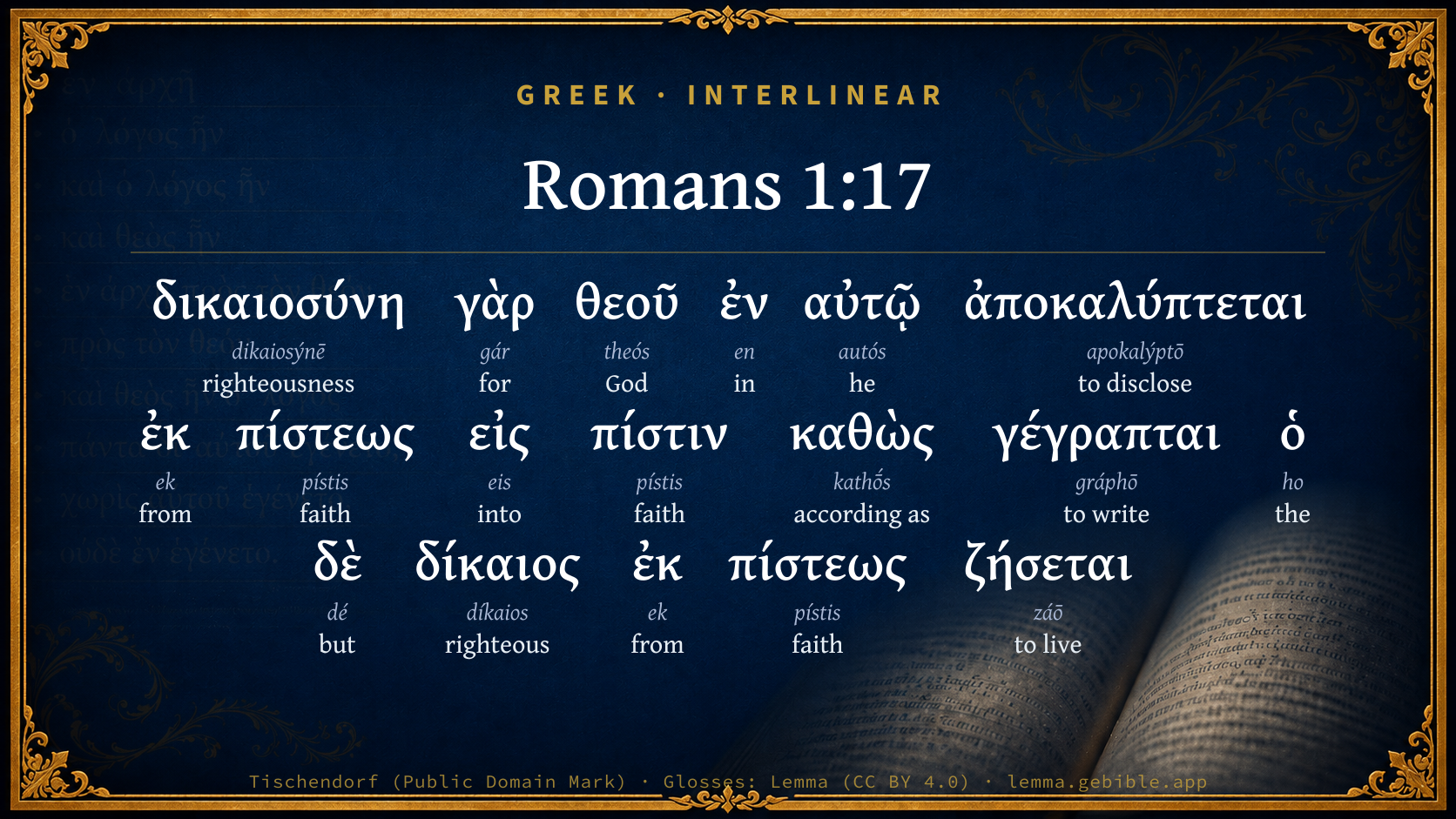
Greek (Tischendorf 8th ed.) Romans 1:17 appears in the Greek New Testament. The text above is from the Tischendorf 8th edition. Each word links to its Strong’s number and a concise gloss. Click any word for its full Thayer’s Greek Lexicon entry.
Download image
Cite this verse

Romans 1:17 (World English Bible). Public Domain. Lemma interlinear Bible study tool, https://lemma.gebible.app/v/romans/1/17.

Show BibTeX & RIS
BibTeX
RIS
English Translation
For in it is revealed God's righteousness from faith to faith. As it is written, "But the righteous shall live by faith."
World English Bible · Public Domain
Download a study sheet

One document with this verse’s original text, its word-by-word gloss line, the meaning frame, cross-references with their text, attributed commentary, and full source and license credits — printable, and it pastes into notes with its structure intact.

This verse Autodidact and up

Study sheet (.html) Plain text (.txt)

A passage Seminary Student

Up to 50 verses in one chapter. A passage sheet keeps up to 6 commentary sources and 12 cross-references per verse, in the order this page ranks them, and says so on the sheet whenever that leaves anything out. Ask for a single verse and you get the Autodidact verse sheet above.

Everything on this page stays free to read, with no account — the sheet is a download of what is already on screen, not access to it.

Want to remove ads? Support Godless Engineer
Compare translations 3

The same verse in 3 English versions, stacked beneath the original-language interlinear above. Click any original word for its lexicon entry.

Each is an independent rendering of the whole verse — the interlinear is not word-aligned to these translations.

Highlighted words mark where these versions differ — a whole-verse word diff, not a word-by-word alignment.

  • World English Bible Public Domain
    For in it is revealed God's righteousness from faith to faith. As it is written, "But the righteous shall live by faith."
  • King James Version Public Domain
    For therein is the righteousness of God revealed from faith to faith: as it is written, The just shall live by faith.
  • unfoldingWord Literal Text CC BY-SA 4.0
    For the righteousness of God is revealed in it from faith to faith, just as it is written, “But the righteous one will live by faith.”

unfoldingWord Literal Text — © unfoldingWord, licensed CC BY-SA 4.0. Word-aligned USFM3 via Door43 (git.door43.org/unfoldingWord/en_ult).

Versions to compare (up to 4)

3 of 4 selected

Show all 19 translations

Every available English version of this verse, each an independent rendering of the whole verse.

  • World English Bible Public Domain
    For in it is revealed God's righteousness from faith to faith. As it is written, "But the righteous shall live by faith."
  • Berean Standard Bible Public Domain
    For the gospel reveals the righteousness of God that comes by faith from start to finish, just as it is written: “The righteous will live by faith.”
  • Majority Standard Bible Public Domain
    For the gospel reveals the righteousness of God that comes by faith from start to finish, just as it is written: “The righteous will live by faith.”
  • King James Version Public Domain
    For therein is the righteousness of God revealed from faith to faith: as it is written, The just shall live by faith.
  • American Standard Version (1901) Public Domain
    For therein is revealed a righteousness of God from faith unto faith: as it is written, But the righteous shall live by faith.
  • Revised Version (1885) Public Domain
    For therein is revealed a righteousness of God by faith unto faith: as it is written, But the righteous shall live by faith.
  • Geneva Bible (1599) Public Domain
    For by it the righteousnesse of God is reueiled from faith to faith: as it is written, The iust shall liue by faith.
  • Douay-Rheims (1899) Public Domain
    For the justice of God is revealed therein, from faith unto faith, as it is written: The just man liveth by faith.
  • Young's Literal Translation Public Domain
    For the righteousness of God in it is revealed from faith to faith, according as it hath been written, `And the righteous one by faith shall live,'
  • Literal Standard Version CC BY-SA 4.0
    For the righteousness of God in it is revealed from faith to faith, according as it has been written: “And the righteous one will live by faith,”
  • Unlocked Literal Bible CC BY-SA 4.0
    For in it God's righteousness is revealed from faith to faith, as it has been written, “The righteous will live by faith.”
  • unfoldingWord Literal Text CC BY-SA 4.0
    For the righteousness of God is revealed in it from faith to faith, just as it is written, “But the righteous one will live by faith.”
  • Darby Bible Public Domain
    for righteousness of God is revealed therein, on the principle of faith, to faith: according as it is written, But the just shall live by faith.
  • World Messianic Bible Public Domain
    For in it is revealed God’s righteousness from faith to faith. As it is written, “But the righteous shall live by faith.”
  • Webster's Bible Public Domain
    For in this is the righteousness of God revealed from faith to faith: as it is written, The just shall live by faith.
  • Free Bible Version CC BY-SA 4.0
    For in the good news God is revealed as good and right, trustworthy from start to finish. As Scripture says, “Those who are right with God live by trusting him.”
  • Bible in Basic English Public Domain
    For in it there is the revelation of the righteousness of God from faith to faith: as it is said in the holy Writings, The man who does righteousness will be living by his faith.
  • Text-Critical English NT CC BY 4.0
    For in it the righteousness of God is revealed from faith to faith, just as it is written, “The righteous will live by faith.”
  • Tyndale New Testament (1534) Public Domain
    For by it the rightewesnes which cometh of god is opened from fayth to fayth. As it is written: The iust shall live by fayth.

Literal Standard Version (2020), Covenant Press — licensed CC BY-SA 4.0. Text via the HelloAO Bible API (eBible.org). Unlocked Literal Bible (unfoldingWord) — licensed CC BY-SA 4.0. Text via the HelloAO Bible API (eBible.org). unfoldingWord Literal Text — © unfoldingWord, licensed CC BY-SA 4.0. Word-aligned USFM3 via Door43 (git.door43.org/unfoldingWord/en_ult). Free Bible Version, Dr. Jonathan Gallagher — licensed CC BY-SA 4.0. Text via the HelloAO Bible API (eBible.org).

Word by word

More ways to search: Search by grammar → Find every occurrence → Compare this word →

Practice this passage: Drill this verse → Learn its vocabulary →

ἀποκαλύπτεται
apokalýptō
G601
“to disclose”
Verb, Present, Passive, Indicative, 3rd person, Singular
Part of Speech
Verb
Tense
Present
Voice
Passive
Mood
Indicative
Person
3rd person
Number
Singular
Full Thayer's Definition

Origin: from G575 and G2572

TDNT: 12:23,4

1. to uncover, lay open what has been veiled or covered up a. disclose, make bare 2. to make known, make manifest, disclose what before was unknown
  1. δικαιοσύνη dikaiosýnē G1343 “righteousness” Noun, Nominative, Singular, Feminine
  2. γὰρ gár G1063 “for” Conjunction
  3. θεοῦ theós G2316 “God” Noun, Genitive, Singular, Masculine
  4. ἐν en G1722 “in” Preposition
  5. αὐτῷ autós G846 “he” Personal pronoun, Dative, Singular, Neuter
  6. ἐκ ek G1537 “from” Preposition
  7. πίστεως pístis G4102 “faith” Noun, Genitive, Singular, Feminine
  8. εἰς eis G1519 “into” Preposition
  9. πίστιν pístis G4102 “faith” Noun, Accusative, Singular, Feminine
  10. καθὼς kathṓs G2531 “according as” Adverb
  11. γέγραπται gráphō G1125 “to write” Verb, Perfect, Passive, Indicative, 3rd person, Singular
  12. ὁ ho G3588 “the” Article, Nominative, Singular, Masculine
  13. δὲ dé G1161 “but” Conjunction
  14. δίκαιος díkaios G1342 “righteous” Adjective, Nominative, Singular, Masculine
  15. ἐκ ek G1537 “from” Preposition
  16. πίστεως pístis G4102 “faith” Noun, Genitive, Singular, Feminine
  17. ζήσεται záō G2198 “to live” Verb, Future, Middle deponent, Indicative, 3rd person, Singular

About this verse

These counts appear in no published source. They are computed here, from the morphology-tagged text and Lemma’s own curated glosses. What Lemma adds →

18
words
15
distinct lemmas
Pauline Epistles
section

Shared distinctive vocabulary

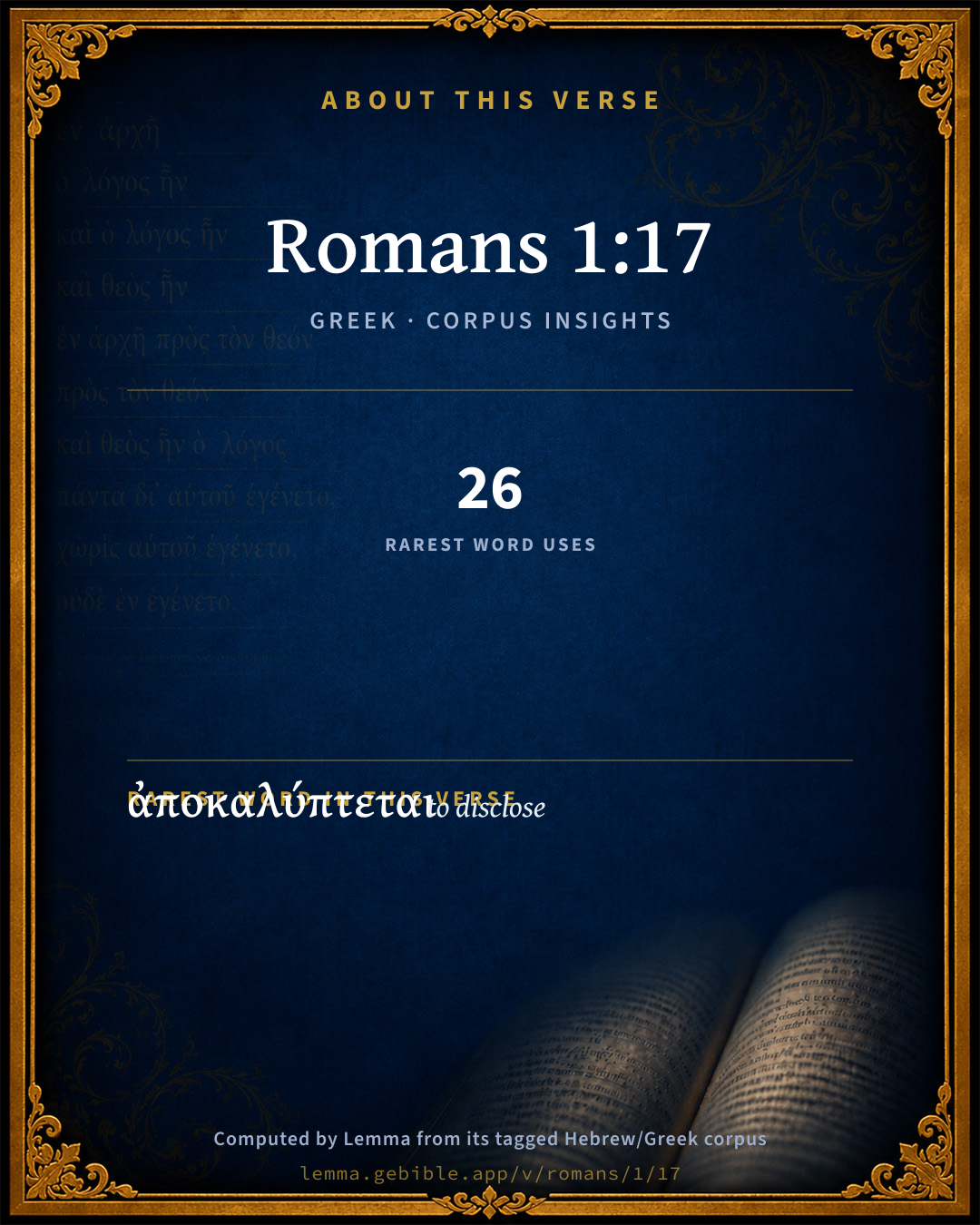
ἀποκαλύπτεται to disclose G601 occurs in 26 verses of the Greek New Testament. Also found in:
Repetition

Words recur within this verse:

  • πίστεως faith G4102 ×3
  • ἐκ from G1537 ×2

Cross-references

9

Topical passages linked to Romans 1:17 in the Treasury of Scripture Knowledge — connected by theme and wording, ordered by reader-vote popularity; previews shown in the World English Bible.

  • Habakkuk 2:4 Behold, his soul is puffed up. It is not upright in him, but the righteous will live by his faith.
  • Galatians 3:11 Now that no man is justified by the law before God is evident, for, "The righteous will live by faith."
  • Hebrews 10:38 But the righteous will live by faith. If he shrinks back, my soul has no pleasure in him."
  • Philippians 3:9 and be found in him, not having a righteousness of my own, that which is of the law, but that which is through faith in Christ, the righteousness which is from God by faith;
  • Hebrews 11:6–7 Without faith it is impossible to be well pleasing to him, for he who comes to God must believe that he exists, and that he is a rewarder of those who seek him.
  • Romans 9:30 What shall we say then? That the Gentiles, who didn't follow after righteousness, attained to righteousness, even the righteousness which is of faith;
  • Romans 3:21 But now apart from the law, a righteousness of God has been revealed, being testified by the law and the prophets;
  • Romans 3:3 For what if some were without faith? Will their lack of faith nullify the faithfulness of God?
  • John 3:36 One who believes in the Son has eternal life, but one who disobeys the Son won't see life, but the wrath of God remains on him."

Cross-references courtesy of OpenBible.info (CC BY 4.0).

Commentary

Notes on Romans 1:17 from classic Christian and Jewish commentators (each source and its license shown beneath its notes). The classic Christian expositions comment on the surrounding passage and are grouped to its opening verse, so a note may address several verses; the Jewish commentaries on the Tanakh (Rashi and others) are per-verse, so they appear only where the commentator wrote on this verse.

Lemma curates 59 commentaries, every one of them public domain or Creative Commons licensed, each selected and text-cleaned for this edition rather than reprinted as found. About our sources →

The Biblical Illustrator

Joseph S. Exell

Rom_1:17

For therein is the righteousness of God revealed from faith to faith.

Righteousness revealed

I. The gospel is a revelation of Gods righteousness.

1. Righteousness is a regard to what is right.

2. God is essentially a righteous Being. He knows what is due from each to the rest, and from all to Himself, and also sees and acknowledges what is due from Him to them. The foundation and standard of all righteousness are to be found in His nature and character. He has no desire, and can have no temptation to do that which is unjust. The Judge of all the earth must do right.

3. He loves righteousness in others, and hates iniquity. Whether we rob God or our neighbours, it is alike abhorrent to Him. He shows His love of righteousness--

(1) By rewarding it; this He has done among the angels in heaven.

(2) By punishing unrighteousness; this He has done among the lost spirits in hell.

(3) By seeking the recovery of those who have fallen from righteousness; and this He is doing upon earth through the gospel of His Son.

4. The gospel is not merely a display of mercy, but of righteousness. He could not bestow forgiveness on sinners in violation of righteousness.

(1) He must therefore devise some way of satisfying the demands of justice before He can deliver the ungodly from the doom which they deserve. This He has done in the surrender of His Son as a sin offering for the world.

(2) He must provide--which He has done through the Holy Ghost--for the restoration of pardoned rebels to personal purity and holiness; and so will His righteousness be displayed and His law magnified in the salvation of a ruined race. Shall we say that His righteousness is the handmaid of His love, or that His love is subservient to His righteousness? Let us not attempt to settle the law of precedence; it is enough for us to know that in the salvation of sinful men both Gods righteousness and Gods love are resplendently revealed--the righteousness through His love, and the love through His righteousness.

II. The object of the gospel is to raise man to righteousness.

1. Man was at first made upright. In the enjoyment of this righteousness he possessed life. But by transgression he fell. Instantly his understanding was darkened, his conscience perverted, his heart disordered, and his happiness destroyed. He lost his life.

2. Gods purpose in the gospel is to make us again righteous; to deliver us from condemnation and renew our souls in virtue and truth. This is the same thing as to recover us from death to life. By being righteous we live, by being unrighteous we die.

III. Faith, as the instrument of mans recovery to righteousness.

1. Faith is mentioned in opposition to legal works. We might be righteous if we could keep the whole law unfalteringly and unceasingly. But we have not, and cannot do so. Hence we are shut out from works, and shut up to faith. We cannot acquire a righteousness of our own, but must be content to let God give us one.

2. Faith is not to be confounded with feelings. It may lead to certain emotions of the soul, but it does not consist of them. The object of faith is not to be found within ourselves; it lies without.

3. What, then, is faith?

(1) It is belief, and nothing more, when it is directed to a doctrinal statement or alleged fact of the past, and then we may call it intellectual or historical faith.

(2) But suppose its object to have some immediate and powerful bearing upon our duty and interests; then will our faith necessarily lead to action. Such faith may be called practical or ethical.

(3) But the object of faith may be something more than either statements or precepts: it may be a living person. We then have faith in him, or on him, as well as belief about him; our faith takes the form of confidence, reliance, trust. It is through faith in all its forms, but especially through the last one, that we lay hold on the righteousness of God in the gospel, and appropriate it as our own.

4. Faith is a noble and worthy instrument of our salvation. It is not to be disdained as inferior to reason. Rather it is reasons highest and most enlightened exercise. Faith gives reason wings, wherewith she mounts to regions of truth otherwise beyond her reach.

5. Faith is necessary as the means of salvation. It is not an arbitrary condition of salvation, but indispensable in the very nature of things; and, being such, it is all that is demanded, for whosoever believeth, whatever else he lacks or hath, shall not perish, but have everlasting life. (T. G. Horton.)

The righteousness of God

The two statements of the previous verse are here explained and confirmed. The gospel is the saving power of God, because it reveals a Divine righteousness which is itself salvation. The first of these propositions declares to us what gives the gospel its saving property. It has many excellences which may well recommend it. It inculcates a morality which in purity and completeness is unapproached. It presents us with its historical embodiment in a character equally lofty and unique. It contains the noblest and most attractive conception of God which has ever dawned upon the world, while it invests men with a new and unspeakable dignity by bringing life and immortality to light. Yet while all this is true, it remains that what constitutes the gospel saving power is that revelation of righteousness of which the apostle here speaks, Whatever else it may do for you in awakening conscience, in haunting you with an ideal which you have never really embraced, in sobering you with convictions of judgment and eternity, it will not save you unless this righteousness be apprehended. And what in the last resort will it have done for you if it has failed to save you?

I. What, then, is the righteousness of God?

1. The ostensible meaning might seem to be the righteousness which is an attribute of God. But it cannot be said that this in any special sense is a revelation of the gospel, for it was the great theme of Old Testament teaching. Moreover, it is impossible to see how the revelation of it could constitute a saving power. We can understand how it might awaken conscience and deepen the conviction of sin. But this would only make our condemnation more obvious and inevitable.

2. The righteousness of God, as is evident from the quotation in Habakkuk, as well as from other parallel expressions, is the righteousness of which God is the author, which He provides and bestows, so that the man who acquires it becomes thereby a righteous man. Now, this is precisely what we need.

(1) The testimony of the apostle is that the whole world is guilty before God. None, accordingly, is clear in the eye of the law. God cannot count us as anything else than transgressors until we stand guiltless in His sight. The great question is, How can this be accomplished? And the only answer, independently of the gospel, is, By our own efforts or not at all. It is no part of the righteous judge, as such, to assoil the transgressor. It might be a palpable breach of his duty to do so. Hence man has never looked to God alone to clear him but always to some sacrifice or endeavour of his own, which might cancel or atone for his offence. But no sacrifice could ever assure him that his relation to God had been rendered satisfactory, because he has never received any Divine promise to that effect. The same is true of every effort after repentance or amendment of life. At the best, therefore, one could only hope that such expedients might attain their object. And this hope has been the root and spring of almost all religions. But the gospel shows that the desired prospect is not to be secured by any such means.

(2) But what the world could not do for itself God did for it. And if the gospel passes its sentence of impotence upon us, it is only to direct us to its provision of saving grace. This position has been secured by the mediation of Christ, whom God gave to be the Saviour of the world. Every demand of the law was satisfied in His life of obedience. And He gave Himself for us, to bear, as our Representative and Substitute, the penalty of our disobedience, so that everything the law might claim at our hands might be infallibly and fully met. By His resurrection the Divine satisfaction was openly declared, and He passed through the heavens to enter into the presence of God on our behalf. There He appears, the eternal pledge of a righteousness fulfilled, presenting to His Father a humanity clear of every ground of accusation, and securing to everyone who will trust in Him a safe standing in His sight. He is the Lord our righteousness. This, then, is what the apostle means when he says that in the gospel is revealed a righteousness of God.

3. Thus understood, it is not difficult to see how the gospel becomes thereby the power of God to salvation. For--

(1) It lays the foundation of fellowship with God. So long as sin is unforgiven fellowship is impossible. Sin compels Him to treat us as offenders. Therefore it is that the broad foundation and starting point of all religion lies in being right with God.

(2) Further, if being right with God is essential to fellowship with Him, so also it is fellowship with Him that secures the growth of spiritual life. As the branch must abide in the vine to receive the sap and nourishment that circulates through the tree, we must abide in connection with God to be partakers of His Spirit and power. This it is that enables us to bring forth the fruits of holiness. The expulsive power of the new affection will purge the soul of its fleshly desires. As the soiled and crumpled leaves are pushed off the tree by the rising sap that swells the buds with the foliage of the coming summer, so it will cleanse us from dead works to serve the living God.

II. The gospel is the saving power of God because it is from faith to faith.

1. This righteousness of which the apostle has spoken is not due to our own works, which do not contribute to it anything whatever. When it becomes ours it is due entirely to faith, which appropriates Christ, and by resting upon Him enters into it and invests us with all its prerogatives. We are found in Him, not having our own righteousness, etc.

2. And just as it is due to faith, so also it is designed to produce faith. The more thoroughly its character is understood, the more perfectly its completeness and satisfactoriness in all points is perceived, the more will faith be confirmed. For if anything weakens faith it is just our not being sure of our rightness with God, or of the foundation on which that rightness depends. On the other hand, if the ground of our acceptance be clearly distinguished and seen in its length and breadth in Christ Jesus, we learn more boldly to appropriate the contents of His salvation. Here lies the secret of its power to transform you and lift you up. There is no other sure foothold for us. But this is sure. (C. Moinet, M. A.)

The righteousness of God for justification revealed in the gospel as being by faith

I. There is a righteousness of God available foe sinful men. This righteousness is revealed as a free gift of God (Rom_5:16-17), of which they become possessed in Christ (2Co_5:21), and this, not as a result of their own striving or legal obedience (Rom_10:3; Php_3:8-9), but simply by faith in Him (Rom_3:21-22).

1. It is manifest therefore that this righteousness of God does not denote--

(1) That perfect personal righteousness which is required of us by law. That can exist only where there has been maintained perfect innocence and obedience. But there is none righteous, no; not one. And therefore, by the deeds of the law there shall no flesh be justified (Rom_3:9-20).

(2) That righteousness which is implanted and perfected in believers by the grace of God. Clearly, indeed, there is such a righteousness, but it is surely not one which is so by faith as to be not of works, and without the law.

(3) Gods method of saving sinners, nor that authorised and attested method of justifying the ungodly, which is revealed in the gospel. For how manifestly absurd to declare that God hath made Him who knew no sin to be sin for us, that we might be made Gods method of justifying sinners in Him!

(4) The active obedience or positive righteousness of our Lord Jesus Christ, as distinguished from His negative righteousness, or innocence, and His sufferings and death. The Scriptures know nothing of such a parting and distribution of the Redeemers one seamless robe of righteousness. They do not teach that a believer, as such, has a right, in the positive righteousness of Christ, to the rewards of eternal glory. A right, in Him, every believer has to the position and immunities of innocence, but the positive rewards of righteousness are to be conferred on each according as his work shall be.

(5) The justification which is of God. For that fails to bring out the most central thought of the expression, viz., the ground upon which God saves or justifies. It confounds effect with cause.

2. What then is this righteousness of God? It is that one righteousness of Christ which He affected for us in His obedience unto death. To establish valid ground for the justification of the sinner, it is obvious that mere innocence was not enough; nor the most splendid achievements of active righteousness. That which law demands, in regard to an offender, is the endurance of penalty. When that has been endured, the law relaxes its grasp, and sets the prisoner free. Then he goes forth justified, so as that he cannot be again legally touched on account of the offences for which he has already suffered. It is quite true that such a righteousness could never be won for himself by a sinful man; for a sinful act in him induces at once a sinful character, and the fact and guilt of sin go on increasing with the progress of his being. Hence, in the Scriptures, the possibility of any man being justified before God on the ground of his own righteousness, however accomplished, is never once imagined. But these Scriptures do maintain that as by the offence of one judgment came upon all men to condemnation, even so by the righteousness of One, the free gift (namely, of righteousness) came upon all men unto (or for) justification of life (Rom_5:18). But that righteousness is preeminently the righteousness of suffering. Therefore it is written that He was delivered [namely, to suffer unto death] on account of our offences, and [that having so suffered, and thereby earned the legal claim for our discharge, He] was raised again on account of our justification (Rom_4:25). This, then, we apprehend, is the righteousness of God which is by faith of Jesus Christ unto all and upon all them that believe (Rom_3:22). It is this which, being conferred upon believers as a free gift of grace, secures for them the legal ground on which they can be justified. To impute this to them is to put them in possession of that which insures for them a full discharge from all liability to arrest, imprisonment, or punishment on account of their own past offences. In Christ, the demand of the law has been met on their behalf. They were arrested in Him, condemned in Him, led forth to be crucified in Him, suffered the extreme penalty of the law in Him, and are now also made the righteousness of God in Him.

II. This righteousness is revealed in the gospel, not indeed exclusively, but specially, preeminently, and perfectly. The righteousness itself, in its true ground and nature, had not been before revealed. Indeed, till the Holy One and the Just had given exhibition of it in His own actual human history, it could not be. Yet, even in the Old Testament times, thus much was known, namely--

1. That no man could, in his own right, claim to be legally justified--he had no righteousness which could command that result; and yet--

2. That some men should, through gracious Divine provision, inherit the rewards of righteousness; righteousness should be imputed to them; they should be justified and treated as righteous (Psa_24:5; Isa_45:24-25; Isa_61:10). What constituted that righteousness had not yet been disclosed. It was indeed faintly foreshadowed by those perpetual sacrifices, which could not make the offerers perfect, but without reference to which the plea for mercy could not be successfully urged. This plea failed indeed to supply any solid ground of hope, and yet there was hope, a hope which in some sense was sustained by it (Psa_51:16-17). But that hope was ever reaching onward into the coming age, for that One who would make an end of transgression and bring in an everlasting righteousness, and whose name was fore announced as The Lord our righteousness (Dan_9:24; Jer_23:6). But now, in the gospel of Christ, this Hope of Israel has actually come, and accomplished His work of righteousness for sinners.

III. This righteousness is here revealed to be from faith to faith, or by faith for belief.

1. Of faith, or by faith. Men attain possession of it by faith, and by faith only (Rom_4:16). Hence the protest of St. Paul to the dissembling Peter (Gal_2:15-16).

2. By faith for belief. The righteousness of God, as the ground of justification, is proclaimed to men in the gospel, as being by faith, in order that they may believe and be justified. So the testimony that the faith of Abraham was counted to him for righteousness, had been put upon record, not for his sake alone, but for ours also (Rom_4:23-25). And the whole mystery concerning the righteousness of God is made known to all nations for the obedience of faith (Rom_16:25-26).

Conclusion:

1. A salvation grounded in the righteousness of God must, when clearly apprehended, afford an equal satisfaction to reason, judgment, and conscience.

2. A salvation which is by faith is possible to all.

3. Salvation on any other terms would be impossible. (W. Tyson.)

Gods righteousness of faith

It is a righteousness because on it the acquittal of accused and sinful men justly proceeds. It is Gods righteousness because provided by the Triune God through the human passion of the Second Person. It is Gods-righteousness-of-faith, because, in order to our becoming justified by it, faith is the solitary condition. The relation of gospel righteousness is thus expressed by its very name on both sides. As it respects God, it is His, as opposed to its being mine: He is its Author, Achiever, Proprietor. But it comes to me, stands me in stead, is reckoned to me for acquittal by faith. This expression stands opposed to another often recurring--by law-works (Rom_3:20), i.e., personal acts of obedience carrying with them some merit in Gods sight. If men could accomplish these they would have a righteousness of their own, not Gods, arising out of such law works. But in sharp contrast to this self-provided righteousness stands the gospel righteousness provided by Another. Thus the whole of this composite title, Gods-righteousness-by-faith, is at every point clean contrary to Mans-righteousness-by-works, and accordingly the apostle through nearly three following chapters endeavours to abolish the latter that he may establish the former, and shut us up to accept it. (J. Oswald Dykes, D. D.)

The righteousness of God

All our conceit about our past righteousness must be completely overthrown. Perhaps we flatter ourselves that all is well, because we have been baptized, or have come to the communion, like one who was visited, a few days ago, by an elder. Seeing that she was sick, and near to die, he asked her: Have you a good hope? Oh, sir, yes; a good and blessed hope. And pray, said he, what is it? Well, she said, I have taken the sacrament regular for fifty years. What think ye of that in a Christian country, from the lips of one who had attended a gospel ministry? Her confidence was built upon the mere fact of her having attended to an outward ceremony, to which, probably, she had no right whatever! There are hundreds and thousands who are thus resting upon mere ceremonies. They have been churchgoers or chapel goers from their youth up. They have never been absent, except under sickness, from their regular place of worship. Good easy souls! if these are the bladders upon which they hope to swim in eternity, they will surely burst, to their everlasting destruction. Some base their confidence on the fact that they have never indulged in the grosser vices; others that they have been scrupulously honest in their commercial transactions. Some that they have been good husbands; others that they have been charitable neighbours. I know not of what poor flimsy tissue men will not make a covering to hide their natural nakedness. But all this must be unravelled--every stitch of it. No man can put on the robes of Christs righteousness till he has taken off his own. Christ will never go shares in our salvation. God will not have it said that He partly made the heavens, but that some other spirit came in to conclude the gigantic work of creation, much less will He divide the work of our salvation with any other. He must be the alone Saviour, as He was the alone Creator. In the wine press of His sufferings Jesus stood alone; of the people none were with Him: no angel could assist Him in the mighty work; in the fight He stood alone, the solitary Champion, the sole Victor. So too thou must be saved by Him alone, resting on Him entirely, and counting thine own righteousness to be but dross and dung, or else thou canst never be saved at all. It must be down with Shebna, or else it cannot be up with Eliakim. It must be down with self, or it can never be up with Christ. Self-righteousness must be set aside to make room for the righteousness of Jesus; otherwise it can never be ours. (C. H. Spurgeon.)

From faith to faith indicates

I. The exclusiveness of faith. Faith all in all in a mans justification. Works not in the account. Not from faith to worlds, but from faith to faith (Rom_3:22; Rom_3:28).

II. The growth of faith. From one degree of faith to another. Advance made in clearness, simplicity, strength.

III. The many sidedness of faith. From one kind of faith to another. From faith which saves to faith for still further blessings. From faith which justifies to faith which sanctifies. From faith of the intellect to faith of the heart. (T. Robinson, D. D.)

The just shall live by faith.

The life of faith. The harmony of the Old Testament teaching and the New

The apostle quotes from Habakkuk, who mourns the vileness and lawlessness around. He foresees as its retribution the rapid and complete conquest by the Chaldeans. He appeals to the character of God; and expresses for himself and the godly in Judaea an assurance of deliverance grounded on Gods character, We shall not die. He betakes himself to the watchtower, and awaits the reply of God. In solemn tones God proclaims the destruction of the proud Chaldeans; and declares that while others perish, the righteous man shall live, shall live by his faith. In the Old Testament, as in chap. 3:3, the words faith and faithful denote, not belief--as almost always in the New Testament--but faithfulness, that constancy and stability of character which makes a man an object of reliance to others. In these words God assumes that faithfulness is an element of the righteous mens character; and declares that by his faithfulness he shall survive. It is quite evident that this faithfulness arises from belief of the Word of God. Hab_1:12 is an expression of belief. The prophet is unmoved because he leans upon the veracity of God. Shall live refers primarily to the present life. The righteous shall escape when others perish. But in this sense the promise is only partially fulfilled. And the incompleteness of its fulfilment in the present life was a sure proof that there is a life to come. Thus in the Old Testament God proclaims in face of the coming storm, that the righteous man will survive by his faith. In Pauls day God spoke again. In face of the tempest so soon to overwhelm the Jewish nation, and some day to overwhelm the world, God proclaims that the man of faith shall live. Therefore Gods word in the gospel is in harmony with His word to Habakkuk. This harmony, amid so much divergence, confirms the words both of prophet and apostle. (Prof. J. A. Beet.)

The life of faith

1. The soul is the life of the body.

2. Faith is the life of the soul.

3. Christ is the life of faith. (J. Flavel.)

High living

The secret of all living is living by faith. Faith is the Christians vital principle. No mans religion, it has been said, survives his morals; and it is equally true to assert that no mans religion survives his faith, for the just shall live by faith, if he lives at all in the higher sense of the word. Other graces may be necessary to his comfort, to his completeness as a man of God, but faith is necessary to his very existence.

1. This faith by which the just are to live is to be in continual operation from first to last. The just shall live by faith, and that not at any one stage of their career, but all the way through, from the moment they leave the house of bondage till they plant their footstep on Canaans happy shore. Faith is not to be exercised only occasionally. It is not to be kept for great occasions, or for dire emergencies. It is to resemble not the rushing torrent of Kishons brook, sweeping all before it for the time, but the steady flow of Siloahs quiet waters, which make glad perpetually the city of God.

2. Faith as a principle of living is intensely practical. It is not a garment to be worn on Sundays, but the ordinary workday garb, which we are to wear in the farmyard and the field, in the shop and in the marketplace.

3. This principle of faith is exclusive of every other that may compete with it. There is not a word here in favour of living by feeling. Our feelings are too variable to rely on. Such a one must needs live jerkily, inconsistently, uncomfortably. But, behold, I show unto you a more excellent way. The just shall live by faith. That is a form of living which is not liable to the ebbs and flows incident to a state of emotionalism, for faith fixes on a Saviour who never alters, on a righteousness which is always the same, and on a promise which is forever sure. There is another class who are accustomed to live by experience. The same objection applies here. There are so many ups and downs, even in the best experience, that to build upon it is to build upon a quaking bog. The just have more stable comforts, for they live by faith, and faith walks above experience, singing of heavens brightness when earth is dark around her, and boasting of pardon when sin makes itself felt most consciously. When Ralph Erskine lay upon his death bed one of the bystanders said to him, I hope, sir, you have some blinks of sunshine to cheer you in the valley. The answer was: I had rather have one promise of my God than all the blinks of sunshine that ever shone. The just shall live by faith.

4. The faith here spoken of is applicable to all kinds of living. If the just are to live by faith, the faith must be capable of adjustment to every variety of life that the just may be called upon to lead. We talk of human life as a journey, says Sydney Smith, but how variously is the journey performed. Variously indeed. It is a Pilgrims Progress to us all, but to no two pilgrims is the progress the same.

(1) Whether it be high life or life on a lower plane it is to be lived by faith. I have seen a bird on the topmost bough of a tree, and very sweetly he sang. But I have seen another bird perched on the lowest bough of that same tree, and he sang just as sweetly. And so you may put the just person on the uppermost branch or the undermost, but in either position he will live by faith.

(2) Whether life be ordinary and commonplace, or exalted and heroic, it is to be lived by faith. Those humble duties of yours--you must look up to Heaven for strength to discharge them with fidelity. Your little cares--you must cast them all on Him who careth for you. It has been beautifully said, that while God is great in great things, He is greatest in little things. Take to Him, therefore, the ounces of trouble as well as the pounds and the tons. But assuming your life to be lived on a more elevated platform and on a much grander scale--what then? Living by faith is still the rule. If you are summoned to Abrahamic duty, you have need of Abrahamic faith.

(3) Whether life is long or short it is to be lived by faith. Length of life is a great blessing, but it is also a great trial. To hold out is often a harder thing than to hold fast or to hold on. How the unjust get on with that problem I do not know, but as for the just--I can speak for them--they live by faith; and there is nothing so strengthening as faith. In the case of short life I do not alter the prescription.

(4) May we not add to this, that life at its highest pitch is to be lived by faith. There are periods of inspiration when we are alive at every point in our character, when there is no death in us at all, and we feel forceful, triumphant. We are strong for service, we are brave for endurance. Faith provides the channel by which Gods life flows into our life. It is the link between our weakness and His almightiness.

5. But it is time to ask the question, By faith in what?

(1) I answer, first and foremost, by faith in God. Sever my connection with God, says Prince Bismarck, and I am the man to pack up my trunks tomorrow, and go back to my country residence. The great statesman feels that he cannot occupy his difficult position, unless he has God to fall back upon.

(2) Do not the just live also by their faith in Providence? It would be a great mainstay to us if we could only resign all things into Gods hands and sweetly rest upon the promise. During the American war a poor coloured soldier came to General Grant in a state of great anxiety and asked him, How are things getting on, General? The Generals answer was, Everything is going right, sir. These words acted like magic. They were passed round the whole camp as a watchword, and one soldier might be heard cheering his fellow soldier with the assurance, Everything is going right, sir. Christian, let that be a watchword with you also. Cherish a stronger faith in Providence.

(3) Do we not also live by our faith in prayer?

(4) Above all, let us live by faith in the Son of God. When we can trust in nothing else we can trust in Him: and when no comfort can be quarried out of our own hearts, we can always find comfort at the Cross. (S. L. Wilson, M. A.)

Faith: life

(text and Hab_2:4; Gal_3:11; Heb_10:38):--When the Spirit frequently repeats Himself, He thereby appeals for special attention. A doctrine so often declared--

1. Must be of the first importance.

2. Should be constantly preached.

3. Should be unhesitatingly received by the hearer. We will treat the four texts--

I. As one:

1. Life is received by the faith which makes a man just. A man begins to live--

(1) By a full acquittal from condemnation and penal death so soon as he believes in Christ.

(2) As one raised from out of spiritual death so soon as he has faith in Christ o form of works, or profession, or knowledge, or natural feelings, can prove him to be an absolved and quickened man; but faith does this.

2. Life is sustained by the faith which keeps a man just.

(1) He who is forgiven and quickened lives ever after as he began to live, viz., by faith. Neither his feelings, devotions, nor acquirements ever become his trust; he still looks out of himself to Jesus. He is nothing except so far as he is a believer.

(2) He lives by faith as to all the forms of life.

(a) As a child and as a servant.

(b) As a pilgrim proceeding and a warrior contending.

(c) As a pensioner enjoying, and as an heir expecting.

(3) He lives by faith in every condition.

(a) In joy and sorrow.

(b) In wealth and poverty.

(c) In strength and weakness.

(d) In labouring and languishing.

(e) In life and death.

(4) He lives best when faith is at its best, even though in other respects he may be sorely put to it. He lives the life of Christ most blessedly when most intensely he believes in Christ.

3. Hearty belief in God, His Son, His promises, His grace, is the souls life, neither can anything take its place. Believe and live is a standing precept both for saint and sinner (1Co_13:13).

II. Separately.

1. Habakkuk exhibits faith as enabling a man to live on in peace and humility, while as yet the promise has not come to its maturity. While waiting, we live by faith and not by sight. We are thus--

(1) Able to bear up under the temporary triumphs of the wicked (Hab_1:1-17).

(2) Preserved from proud impatience at delay.

(3) Filled with delight in confident expectation of good things to come.

2. Paul in the text exhibits faith as working salvation from the evil which is in the world through lust. The chapter presents an awful view of human nature, and implies that only faith in the gospel can bring us life in the form of--

(1) Mental enlightenment of life as to the true God (verses 19-23).

(2) Moral purity of life (verses 24, etc.).

(3) Spiritual life and communion with that which is Divine and holy. Naturally men are corrupt. The law reveals our death (Rom_3:10-20); but the gospel imparts spiritual life to those who receive it by faith.

3. Galatians exhibits faith as bringing us that justification which saves us from the sentence of death. Nothing can be plainer than the declaration that no man is justified before God except by faith.

4. Hebrews exhibits faith as the life of final perseverance.

(1) There is need of faith while waiting for heaven (verses 32-36).

(2) The absence of such faith would cause us to draw back (verse 38).

(3) That drawing back would be a fatal sign.

(4) From that drawing back we are saved by faith.

Conclusion:

1. What can you do who have no faith? In what other way can you be accepted with God?

2. On what ground can you excuse your unbelief?

3. Will you perish sooner than believe? (C. H. Spurgeon.)

Rectitude and faith

The just man is the righteous man--the man who is right--right with God, with man, with his environments, with himself. Faith is what keeps a man right in every department of life. A man can only live rightly as he lives by faith.

I. On what may be called his secular side.

1. Intellectually. Faith is necessary to mental soundness, and to efficient mental work. First principles must be taken for granted; results of previous workers must be accepted. To be ever digging foundations and discussing axioms not only wastes time, but unsettles and enervates the mind, and incapacitates it for healthy work. The just thinker works from established conclusions to first results.

2. Commercially. All business would be at a standstill but for faith--faith in self, faith in others, faith in success. The distrustful man is unjust to himself and all concerned, and eventually dies in bankruptcy.

3. Domestically. Family life is dead where the members distrust each other, but flourishes in full vigour when there is honest and implicit faith between husband and wife, etc.

4. Politically. Where there is no faith in principles, but only a scramble after place and power, political injustice supervenes and political life dies.

II. His spiritual side.

1. As a religious character.

(1) Faith makes a man right.

(2) Faith keeps him right.

2. As a Christian worker. His is preeminently a work of faith, and only as such can he rightly perform it. He requires faith which--

(1) Lays hold of Divine strength.

(2) Supports him in the midst of discouragements.

(3) Relies on the Divine promise.

(4) Confidently anticipates future results.

3. As a Bible student. Faith--

(1) Accepts its mysteries without questioning.

(2) Transunites its truths into spiritual food. Without faith he is both unjust to the Bible and to himself. Instead of the Word of life it becometh the letter which killeth.

4. As an immortal being. Faith links the future with the present, makes both one, and sets the believer right with both. (J. W. Burn.)

The office of faith

It is not dead: but living and active. It is not something by which we conceive of ourselves as interested in that which is infinitely removed from us. It is the hand by which we grasp the Saviour near to us; making Him, with all His wealth and all His righteousness, our own; so that, in having Him, we become both righteous and rich. It is the tendrils by which the branches of the vine do cling around their all-supporting stem; it is also the common vessels by which, from the root, the sap is conducted to the branches and leaves. It is that system of nerves by which all the parts of the body are consciously connected with the head. It is very artery, the aorta, by which from the heart life is conveyed; so that by its habitual action the very lowest extremities are continually invigorated and warmed. (Wm. Elliott.)

The conversion of Martin Luther

Near the splendid church of St. John de Lateran is the famous Scala Sancta, or Sacred Stair, supposed to have been brought from Jerusalem--the same steps down which our Saviour walked from Pilates hall of judgment to the hill of Calvary. These steps are twenty-five in number, made of solid marble, and covered with wood to keep them from being worn away by the knees of the climbing pilgrims. These pilgrims on Easter week come from all parts of the world. They are of different colours, and ranks, and ages, and I watched them beginning to climb this holy stair, slowly creeping up, counting their beads, crossing their faces, and muttering their Ave Marias and Paternosters as they went. Near the top was a full-sized image of the Saviour made of wood, crowned with thorns, and wearing the marks of His wounds on His temples, and hands, and side, and feet. Around this image of Jesus a group, of women were gathered. It was sad to see their pitiful looks and hear their groaning prayers, as they beat their breasts and kissed each wound, from the pierced feet to the thorn-crowned head. Poor people! they were quite in earnest, but they were sadly self-deceived. They thought that for every step they climbed, they received indulgence or pardon for the sins of a year! Therefore, when they reached the top, they thought that sins of twenty-five years were blotted out; so that, taking their average life at fifty, two visits to the Sacred Stair would carry them to the gates of heaven. I thought of a noble man--namely, Martin Luther--who, three centuries ago, found the light of the gospel on that same stair. Dressed as a monk, with his shaven head and bare knees, he was creeping up those marble steps, hoping thereby to calm his troubled conscience and work his way to heaven, when all at once the voice of God was heard crying in his soul, The just shall live by faith. Obedient to the heavenly voice, he saw his error of trying to earn his title to salvation by his own pains and works; and leaving the city in disgust, he went home to nail his Theses to the church door at Wittenberg, and to kindle the fire of the glorious Reformation.

Faith

Now we talk so much in Christian teaching about this faith that, I fancy, like a worn sixpence in a mans pocket, its very circulation from band to hand has worn off the lettering. And many of us, from the very familiarity of the Word, have only a dim conception of what it means. It may not be profitless, then, to remind you, first of all, that this faith is neither more nor less than a very familiar thing which you are constantly exercising in reference to one another, that is to say, simple confidence. You trust your husband, your wife, your child, your parent, your friend, your guide, your lawyer, your doctor, your banker. Take that very same emotion and attitude of the mind by which you put your well-being, in different aspects and provinces, into the hands of men and women round about you; lift the trailing flowers that go all straggling along the ground, and twine them round the pillars of Gods throne, and you get the confidence, the trust of praises and glories of which this New Testament is full. There is nothing mysterious in it, it is simply the exercise of confidence, the familiar cement that binds all human relationship together, and makes men brotherly and kindred with their kind. Faith is trust, and trust saves a mans soul. Then remember, further, that the faith which is the foundation of everything is essentially the personal trust reposing upon a person, upon Jesus Christ. You cannot get hold of a man in any other way than by that. The only real bond that binds people together is the personal bond of confidence, manifesting itself in love. And it is no mere doctrine that we present for a mans faith, but it is the Person about which the doctrine speaks. We say, indeed, that we can only know the Person on whom we must trust by the revelation of the truths concerning Him which make the Christian doctrines; but a man may believe the whole of them, and have no faith. And what is the step in advance which is needed in order to turn credence into faith--belief in a doctrine into trust? In one view it is the step from the doctrine to the Person. When you grasp Christ, the living Christ, and not merely the doctrine, for yours, then you have faith. (A. Maclaren D. D.)

The Biblical Illustrator, edited by Joseph S. Exell (c. 1880s–1900s) — public domain. Text from a community e-Sword module.

Joseph Benson's Commentary

Rom 1:17. For therein is the righteousness of God revealed — This expression sometimes means God’s essential, eternal righteousness, including both his holiness and justice, especially the latter, of which, together with his mercy, the word is explained, Rom 3:26; where we read, To declare his righteousness: that he might be just and the justifier of him that believeth in Jesus; this his essential righteousness being eminently shown in condemning sin, and in justifying the penitent, believing sinner. But frequently the expression means that righteousness by which a man, through the grace of God, is accounted and constituted righteous, or is pardoned and renewed, namely, the righteousness of faith, of which the apostle speaks, Php 3:9, terming it the righteousness which is through faith in Christ, the righteousness of God (Gr. εκ θεου, from God) by faith: namely, acquittance from guilt, remission of sins, or justification through faith in Christ; or, as he expresses himself, Rom 4:5-8, faith imputed for righteousness, namely, through Christ’s obedience unto death, who was delivered for our offences, and raised for our justification. See this matter more fully explained in the notes on Rom 3:20-25; Rom 9:30-31; and Rom 10:3-9. The meaning of the apostle, in the verse now under consideration, would be more manifest if his words were more literally translated, which they are by Doddridge and Macknight, thus: For in it (namely, the gospel) the righteousness of God by faith is revealed to our faith, or, in order to faith. “This translation,” says the latter of these divines, “which results from construing the words properly, affords a clear sense of a passage which, in the common translation, is absolutely unintelligible. Besides, it is shown to be the right translation by other passages of Scripture, in which the expression, δικαιοσυνη εκ πιστεως, righteousness by faith, is found, Rom 3:22; Rom 9:30; Rom 10:6; Php 3:9. Righteousness by faith is called the righteousness of God, 1st, Because God hath enjoined faith as the righteousness which he will count to sinners, [through the mediation of his Son,] and hath declared that he will accept and reward it as righteousness. 2d, Because it stands in opposition to the righteousness of men: which consists in sinless obedience to the law of God. For if men gave that obedience, it would be their own righteousness, and they might claim reward as a debt.” We may observe, further, the righteousness of faith is termed the righteousness of God, because God appointed and prepared it, reveals and gives, approves and crowns it. It is said to be revealed, because, whereas it was but obscurely intimated to the Jews, in the covenant with Abraham, and in the types of the Mosaic law; it is now clearly manifested in the gospel to all mankind. The expression, in our translation, from faith to faith, is interpreted by some of a gradual series of still clearer and clearer discoveries; but the translation of the clause given above, namely, the righteousness of God by faith is revealed in order to faith, seems evidently to express better the apostle’s meaning. As it is written — St. Paul had just laid down three propositions: 1st, Righteousness is by faith, Rom 1:17; Romans 2 d, Salvation is by righteousness, Rom 1:16; Romans 3 d, Both to the Jews and to the Gentiles, Rom 1:16. Now all these are confirmed by that single sentence, The just shall live by faith: which was primarily spoken of those who preserved their lives, when the Chaldeans besieged Jerusalem, by believing the declarations of God, and acting according to them. Here it means, he shall obtain the favour of God, and continue therein, by believing. The words, however, may with propriety be rendered, The just by faith, that is, they who by faith are just, or righteous, (as δικαιοι signifies,) shall live. “This translation is agreeable both to the order of the words in the original, and the apostle’s design; which is to show that the doctrine of the gospel, concerning a righteousness by faith, is attested even by the prophets. Besides, it represents Habakkuk’s meaning more truly than the common translation. For in the passage from which the quotation is made, Habakkuk describes the different dispositions of the Jews about the time they were threatened by the Chaldeans. Some of their souls were lifted up; they presumptuously trusted in their own wisdom and power, and, contrary to God’s command, refused to submit to the Chaldeans, and were destroyed. But the just, or righteous, by faith, who believed God and obeyed his command, lived. However, as the reward of faith is not confined to the present life, persons who are just or good, by believing and obeying God, shall certainly live eternally.” — Macknight.

Joseph Benson's Commentary on the Old and New Testaments (1811–1818) — public domain. Text from a community e-Sword module.

Tyndale Open Study Notes

Tyndale Open Resources

1:17 how God makes us right in his sight (literally the righteousness of God): This key phrase appears eight times in Romans (see also 3:5, 21, 22, 25, 26; 10:3; the only other occurrence in Paul’s writings is 2 Cor 5:21). The expression has Old Testament roots, where God’s righteousness refers to his character (as holy or faithful) or to an act of declaring his people sinless and perfect in his eyes (see especially Isa 46:13; 51:5-8). Paul uses the second meaning in this verse. The Good News has the power to save because it is the fulfillment of God’s promise to vindicate his people. • The phrase makes us right comes from the law court. It does not mean “makes us good people”; it means “puts us in right standing before God.” • “It is through faith that a righteous person has life”: The prophet Habakkuk had struggled to understand how God could use pagan nations to judge his own people Israel. God reminded Habakkuk that his true people—the righteous—need to live by faith (Hab 2:4). In Rom 1–4, Paul repeatedly insists that only through faith can human beings be made right in God’s sight.

Tyndale Open Study Notes — © Tyndale Open Resources, licensed CC BY-SA 4.0. Text via the HelloAO Bible API.

Bengel's Gnomon

Johann Albrecht Bengel

Rom 1:17. Δικαιοσὑνη Θεο͂υ, the righteousness of God) The righteousness of God is frequently mentioned in the New Testament, often in the books of Isaiah and Daniel, most often in the Psalms. It sometimes signifies that righteousness, by which God Himself is righteous, acts righteously, and is acknowledged to be righteous, ch. Rom 3:5; and also that righteousness, as it is termed in the case of [when applied to] men, either particular or universal, in which grace, and mercy also, are included, and which is shown principally in the condemnation of sin, and in the justification of the sinner; and thus, in this view, the essential righteousness of God is evidently not to be excluded from the business of justification, ch. Rom 3:25, etc. Hence it sometimes signifies this latter righteousness, by which a man (in consequence of the gift of God, Mat 6:33) becomes righteous, and is righteous; and that, too, either by laying hold of the righteousness of Jesus Christ through faith, ch. Rom 3:21-22, or by imitating that [the former spoken of] righteousness of God, in the practice of virtue, and in the performance of good works, Jas 1:20. That righteousness of faith is called the righteousness of God by Paul, when he is speaking of justification; because God has originated and prepared it, reveals and bestows it, approves and crowns it with completion (comp. 2Pe 1:1), to which, therefore, men’s own righteousness is opposed, Rom 10:3; with which comp. Php 3:9. Moreover, we ourselves are also called the righteousness of God, 2Co 5:21. In this passage, as well as in the statement of the subject [Proposition], the righteousness of God denotes the entire scheme of beneficence of God in Jesus Christ, for the salvation of the sinner.—ἀποκαλύπτεται, is revealed) Hence the necessity of the Gospel is manifest, without which neither righteousness nor salvation is capable of being known. The showing forth [‘declare.’—Engl. vers.] of the righteousness of God was made in the death of Christ, ch. Rom 3:25, etc. [ἔνδειξιν τ. δικαιοσύνης]; the manifestation and revelation of that righteousness of God, which is through faith, are made in the Gospel: ch. Rom 3:21, and in this passage. Thus there is here a double revelation made; (comp. Rom 1:18 with this verse) namely, of wrath and of righteousness. The former by the law, which is but little known to nature; the latter, by the Gospel, which is altogether unknown to nature. The former precedes and prepares the way; the latter follows after. Each is a matter of revelation (ἀποκαλύπτεται), the word being expressed in the present tense, in opposition to the times of ignorance, Act 17:30.—ἐκ πίστεως εἰς πίστιν, from faith to faith) Construe the righteousness which is of or from faith, as we have presently after the just from faith [i.e. he who is justified,—whose righteousness is, of faith]. The phrase, from faith to faith, expresses pure faith; for righteousness of, or from faith, subsists in faith, without works. Εἰς denotes the destination, the boundary, and limit; see ch. Rom 12:3, and notes on Chrysostom’s work, De Sacerd, p. 415. So 1Ch 17:5. I have gone [lit. in the Heb. I was or have been] מאהל אל אהל from tent to tent, where one and another tent [different tents] are not intended; but a tent [the tabernacle] as distinguished from [or independently of] a house or temple. Faith, says Paul, continues to be faith; faith is all in all [lit. the prow and stern] in the case of Jews and Gentiles; in the case of Paul also, even up to its very final consummation, Php 3:7-12. Thus εἰς sounds with a beautiful effect after ἐκ, as ἀπὸ and εἰς, 2Co 3:18, concerning the purest glory. It is to avoid what might be disagreeable to his readers, that Paul does not yet expressly exclude works, of which, however, in this Statement of Subject [Proposition], an exclusion of some kind should otherwise have appeared. Furthermore, the nature of a proposition, thus set forth, bears, that many other things may be inferred from this; for inasmuch as it is not said, ἐκ τῆς πίστεως εἰς τὴν πίστιν, from the faith to the faith, but indefinitely ἐκ πίστεως εἰς πίστιν from faith to faith, so we shall say [we may say by inference] from one faith to another, from the faith of God, who makes the offer, to the faith of men, who receive it, ch. Rom 3:2, etc.; from the faith of the Old Testament, and of the Jews, to the faith of the New Testament, and of the Gentiles also, ch. Rom 3:30; from the faith of Paul to the faith of the Romans, ch. Rom 1:12; from one degree of faith to still higher degrees, 1Jn 5:13; from the faith of the strong to the faith of the weak, ch. Rom 14:1, etc.; from our faith, which is that of expectation, to the faith, which is to be divinely made good to us, by the gift of life [“The just shall live by faith”].—καθως, as) Paul has just laid down three principles: I. Righteousness is [of, or] from faith, Rom 1:17: II. Salvation is by righteousness, Rom 1:16: III. To the Jew and to the Greek, Rom 1:16. What follows confirms the whole, viz., the clause, the just by faith, shall live, which is found in the prophetical record, Hab 2:4; see notes on Heb 10:36, etc. It is the same Spirit, who spoke by the prophets the Words, that were to be quoted by Paul; and under whose guidance Paul made such apposite and suitable quotations, especially in this epistle.—ζήσεται, shall live) some of the Latins, in former times, wrote the present ‘lives’ for the future “shall live” (vivit for vivet);[10] an obvious mistake in one small letter, and not worthy of notice or refutation. Baumgarten, following Whitby, refutes it, and observes, that I have omitted to notice it.

[10] ‘Vivit’ fg Vulg. and Iren. But ABCΛG have ζήσεται.—ED.

Bengel's Gnomon of the New Testament — English translation (T&T Clark, Edinburgh, 1860) — public domain. Text from a community e-Sword module.

Meyer's Critical & Exegetical Commentary

Heinrich August Wilhelm Meyer

Rom_1:17 illustrates and gives a reason for the foregoing affirmation: δύναμις Θεοῦ ἐστιν εἰς σωτ. π. τ. πιστ., which could not be the case, unless δικαιοσύνη Θεοῦ κ.τ.λ[400]

δικαιοσύνη Θεοῦ] That this does not denote, as in Rom_3:5, an attribute of God,[401] is plain from the passage cited in proof from Hab_2:4, where, by necessity of the connection, ὁ δίκαιος must denote the person who is in the state of the δικαιοσύνη Θεοῦ. Comp Rom_3:21 ff. It must therefore be an ethical relation of man that is meant; and the genitive Θεοῦ must (otherwise in Jam_1:20)[403] be rendered as the genitive of emanation from, consequently: rightness which proceeds from God, the relation of being right into which man is put by God (i.e. by an act of God declaring him righteous). Comp Chrysostom, Bengel, and others, including Rückert, Olshausen, Reiche, de Wette, Winer, p. 175 [E. T. 232]; Winzer (de vocib. δίκαιος, δικαιοσύνη, et δικαιοῦν in ep. ad p. 10); Bisping, van Hengel, Ernesti, Urspr. d. Sünde, I. p. 153; Mehring; also Hofmann (comp his Schriftbew. I. p. 627); Holsten, z. Ev. d. Paul. u. Petr. p. 408 f.; Weiss, bibl. Theol. p. 330 f.; Rich. Schmidt, Paulin. Christol. p. 10. This interpretation of the genitive as gen. originis, acutely and clearly set forth anew by Pfleiderer (in Hilgenfelds Zeitschr. 1872, p. 168 ff.), is more specially evident from Rom_3:23, where Paul himself first explains the expression δικαιοσύνη Θεοῦ, and that by δικαιούμενοι δωρεὰν τῇ αὐτοῦ χάριτι, which is turned in Rom_1:26 to the active form: δικαιοῦντα τὸν ἐκ πίστεως; comp Rom_1:30; Rom_8:33, according to which the genitive appears equivalent to ἐκ Θεοῦ (Php_3:9), in contrast to the ἐμή and ἰδία δικαιοσύνη (Rom_10:3), and to the δικαιοῦν ἐαυτόν (Luk_12:15). The passage in 2Co_5:21 is not opposed to this view (as Fritzsche thinks); see in loc[407]; nor are the expressions δικαιοῦσθαι ἐνώπιον Θεοῦ (Rom_3:20), and παρὰ Θεῷ (Gal_3:11), for these represent a special form under which the relation is conceived, expressing more precisely the judicial nature of the matter. Hence it is evident that the interpretation adopted by many modern writers (including Köllner, Fritzsche, Philippi, Umbreit), following Luther: righteousness before God, although correct in point of substance, is unsuitable as regards the analysis of the genitive, which they take as genitive of the object. This remark applies also against Baur, who (Paulus, II. p. 146 ff.) takes the genitive objectively as the δικαιοσύνη determined by the idea of God, adequate to that idea; whilst in his neutest. Theol. p. 134, he prefers to take the genitive subjectively: the righteousness produced through God, i.e. the manner in which God places man in the adequate relation to Himself.

The following remarks may serve exegetically to illustrate the idea of δικαιοσύνη Θεοῦ, which in the Gospel is revealed from faith:

Since God, as the holy Lawgiver and Judge, has by the law imposed on man the task of keeping it entirely and perfectly (Gal_3:10), He can only receive and treat as a δίκαιος (who is such, as he should be)as one normally guiltless and upright, who should be so, therefore, habituallythe person who keeps the whole law; or, in other words, only the man who is perfectly obedient to the law can stand to God in the relation of δικαιοσύνη. Such perfection however no man could attain; not merely no Gentile, since in his case the natural moral law was obscured through immorality, and through disobedience to it he had fallen into sin and vice; but also no Jew, for natural desire, excited by the principle of sin in him through the very fact of legal prohibition, hindered in his case the fulfilment of the divine law, and rendered him also, without exception, morally weak, a sinner and object of the divine wrath. If therefore man was to enter into the relation of a righteous person and thereby of a future participator in the Messianic blessedness, it was necessary that this should be done by means of an extraordinary divine arrangement, through which grace and reconciliation should be imparted to the object of wrath, and he should be put forward for the judgment of God as righteous. This arrangement has been effected through the sending of His Son and His being given up to His bloody death as that of a guiltless sacrifice; whereby Gods counsel of redemption, formed from eternity, has been accomplished,objectively for all, subjectively to be appropriated on the part of individuals through faith, which is the ὄργανον ληπτικόν. And, as this plan of salvation is the subject-matter of the Gospel, so in this Gospel that which previously, though prefigured by the justification of Abraham, was an unrevealed μυστήριον, namely, righteousness from God, is revealed (ἀποκαλύπτεται), inasmuch as the Gospel makes known both the accomplished work of redemption itself and the means whereby man appropriates the redemption, namely, faith in Christ, which, imputed to him as righteousness (Rom_4:5), causes man to be regarded and treated by God out of grace and δωρεάν (Rom_3:24) as righteous (δίκαιος), so that he, like one who has perfectly obeyed the law, is certain of the Messianic bliss destined for the δικαιοί.[408] The so-called obedientia Christi activa is not to be included in the causa meritoria of the divine justification; but is to be regarded as the fulfilment of a preliminary condition necessary to the death of Jesus, so far as the justification of man was objectively based on the latter; without the complete active obedience of Christ (consequently without His sinlessness) His passive obedience could not have been that causa meritoria (2Co_5:21).

ἀποκαλύπτεται] is revealed; for previously, and in the absence of the Gospel, the δικαιοσύνη Θεοῦ was and is something quite hidden in the counsel of God, the knowledge of which is first given in the Gospel (comp Rom_16:25; Act_17:30). The prophecies of the Old Testament were only preparatory and promissory (Rom_1:2), and therefore were only the means of introducing the evangelical revelation itself (Rom_16:26). The present is used, because the Gospel is conceived of in its continuous proclamation. Comp the perfect, πεφανέρωται, Rom_3:21, and on the other hand the historical aorist φανερωθέντος in Rom_16:26. Through the ἀποκάλυψις ensues the φανεροῦσθαι, through the revelation the being manifest as object of knowledge.

ἐκ πίστεως εἰς πίστιν] may not be connected with δικαιοσ. (Luther, Hammond, Bengel, Koppe, Rückert, Reiche, Tholuck, Philippi, Mehring, and others), but ratheras the only arrangement which the position of the words admits without arbitrarinesswith ἀποκαλύπτεται. So also van Hengel and Hofmann; comp Luk_2:35. The δικαιοσύνη Θεοῦ, namely, is revealed in the Gospel ἐκ πίστεως, inasmuch as in the Gospel faith on Christ is made known as the subjective cause from which righteousness comes. Thus the Gospel, as the ῥῆμα τῆς πίστεως (Rom_10:8) and λόγος τῆς καταλλαγῆς (2Co_5:19), makes the divine righteousness become manifest from faith, which it in fact preaches as that which becomes imputed; for him who does not believe the ἀκοὴ πίστεως (Gal_3:2), it leaves this δικαιοσύνη to remain a locked-up unrevealed blessing. But it is not merely ἐκ πίστεως, but also εἰς πίστιν; to faith (comp 2Co_2:16). Inasmuch, namely, as righteousness is revealed in the Gospel from faith, faith is aimed at, i.e. the revelation spoken of proceeds from faith and is designed to produce faith. This sense, equivalent to ut fides habeatur, and rightly corresponding alike with the simple words and the context, is adopted by Heumann, Fritzsche, Tholuck, Krehl, Nielsen, and van Hengel. It is not too meaningless (de Wette), nor saying pretty nearly nothing (Philippi); but is on the contrary emphatically appropriate to the purpose of representing faith as the Fac totum (prora et puppis, Bengel, Comp Baur, II. p. 161). See also Hofmann, Schriftbew. I. p. 629 f. comp Rom_6:19; 2Co_2:16. Therefore εἰς πίστιν is not to be taken as equivalent to εἰς τὸν πιστεύοντα, for the believer (Oecumenius, Seb. Schmid, Morus, Rosenmüller, Rückert, Reiche, de Wette, Olshausen, Reithmayr, Maier, and Philippi), a rendering which should have been precluded by the abstract correlative ἐκ πίστεως. Nor does it mean: for the furtherance and strengthening of faith (Clem. Al. Strom. v. 1, II. p. 644 Pott., Theophylact, Erasmus, Luther, Melancthon, Beza, Cornelius à Lapide, and others, including Köllner; comp Baumgarten-Crusius, Klee, and Stengel); for the thought: from an ever new, never tiring, endlessly progressive faith (Ewald; comp Lipsius, Rechtfertigungsl. p. 7, 116, and Umbreit), is here foreign to the connection, which is concerned only with the great fundamental truth in its simplicity; the case is different in 2Co_3:18. Quite arbitrary, moreover, was the interpretation: ex fide legis in fidem evangelii (Tertullian; Comp Origen, Chrysostom, Theodoret: δεῖ γὰρ πιστεῦσαι τοῖς προφήταις, καὶ διʼ ἐκείνων εἰς τὴν τοῦ εὐαγγελίου πίστιν ποδηγηθῆναι, Zeger, and others). Finally, to take πίστιν as faithfulness, and to understand πίστις εἰς πίστιν in the sense of faith in the faithfulness of God (Mehring), is to introduce what is neither in the words nor yet suggested by the context. Ewald in his Jahrb. IX. p. 87 ff., interprets: faith in faith, the reference being to the faith with which man meets the divine faith in his power and his good will (?). But the idea of faith from beneath on the faith from above, as well as the notion generally of God believing on men, would be a paradox in the N. T., which no reader could have discovered without more clear and precise indication. After ἐκ πίστ. every one could not but understand εἰς πίστ. also as meaning human faith; and indeed everywhere it is man that believes, not God.

καθὼς γέγραπται] represents what has just been stated, δικαιοσύνη.… πίστιν, as taking place in accordance with a declaration of Scripture, consequently according to the necessity of the divine counsel of salvation. He who from faith (on Christ) is righteous (transferred into the relation of the δικαιοσύνη Θεοῦ) shall live (be partaker of the Messianic eternal life). This, as the Messianic sense intended to be conveyed by the Spirit of God (2Pe_1:21) in the prophetic words, Hab_2:4, the righteous shall by his faithfulnessl[418] live (attain the theocratic life-blessedness), is recognised by Paul, and expressed substantially in the language of the LXX., rightly omitting the μου, which they inaccurately add to πίστεως. In doing so Paul might, in accordance with the Messianic reference of the passage, connect ἘΚ ΠΊΣΤΕΩς (בֶאֱמוּנָתוֹ)seeing that on this causal definition the stress of the expression lieswith ὁ δίκαιος; because, if the life of the righteous has ΠΊΣΤΙς as its cause, his ΔΙΚΑΙΟΣΎΝΗ itself can have no other ground or source. That he has really so connected the words, as Beza and others rightly perceived (see especially Hölemann, de justitiae ex fide ambab. in V. T. sedibus, Lips. 1867), and not, as most earlier expositors have supposed (also de Wette, Tholuck, Delitzsch, on Hab. l.c[419], Philippi, Baumgarten-Crusius, van Hengel, Ewald, and Hofmann), ἐκ πίστ. ζήσεται, is plain from the connection, according to which it is not the life ἐκ πίστ., but the revelation of righteousness ἐκ πίστ. that is to be confirmed by the Old Testament. The case is different in Heb_10:38. See further, generally, on Gal_3:11.

The δέ is, without having any bearing on the matter, adopted along with the other words from the LXX. Comp on Act_2:17. A contrast to the unrighteous who shall die (Hofmann) is neither here nor in Hab_2:4 implied in the text.

[400] .τ.λ. καὶ τὰ λοιπά.

[401] It has been understood as the truthfulness of God (Ambrosiaster); as the justitia Dei essentialis (Osiander); as the justitia distributiva (Origen, and several of the older expositors, comp. Flatt); as the goodness of God (Schoettgen, Semler, Morus, Krehl); as the justifying righteousness of God (Märcker). According to Ewald it is the divine righteousness regarded as power and life-blessing, in the goodness of which man may and must fully participate, if he would not feel its sting and its penalty. Comp. Matthias on Rom_3:21 : a righteousness, such as belongs to God, consequently, a righteousness which exists also inwardly and is in every respect perfect.

[403] Where what is meant is the rightness required by God, which man is supposed to realise through exerting himself in works.

[407] n loc. refers to the note of the commentator or editor named on the particular passage.

[408] Justification is simply imputative, an actus forensis, not inherent, and therefore not a gradual process, as Romang anew maintains, but produced by the imputation of faith. The new moral life in Christ is the necessary consequence (Rom_6:8), so that regeneration comes after justificationa divine order of salvation inconsistent with all Osiandrian views. See Ritschl, in the Jahrb. f. Deutsche Theol. 1857, p. 795 ff., altkath. Kirche, p. 76 ff. The regenerate life is neither a part (Baumgarten-Crusius) nor the positive side (Baur) of justification, the conception of which is not to be referred either to the consciousness of liberation from guilt given with conversion (Schleiermacher); or to the unity of forgiveness with the instilling of love (Marheineke); or to an anticipation of the judgment of God on faith in respect to the divine life which develops itself from it as its fruit (Rothe, Martensen, Hundeshagen, and others, including Tholuck on Rom_5:9, and Catholics like Döllinger, see on Rom_4:3)so that, with regard to its truth it would have to be made dependent on sanctification (Nitzsch), or the dying out of sin (Beck), and so forth,or to the establishment of the new sanctified humanity in the person of Christ (Menken-Hofmann). The Form. Conc., p. 687, rightly warns: ne ea, quae fidem praecedunt et ea quae eam sequuntur, articulo de justificatione, tanquam ad justificationem pertinentia, admisceantur. Respecting the sensus forensis of justification, which is by no means a product of mediæval scholasticism (in opposition to Sabatier, p. 263), comp. Köstlin in the Jahrb. f. Deutsche Theol. 1856, p. 89 ff.; and in its purely exegetical aspect, especially Wieseler on Gal_2:16, Pfleiderer in Hilgenfelds Zeitschr. 1872, p. 161 ff., and Weiss, bibl. Theol. § 112. We may add that with Luthers doctrine of justification Zwingli substantially concurs. See, for defence of the latter (against Stahl), Ritschl, Rechtfert. u. Versöhnung, 1870, I. p. 165 ff.

[418] This faithfulness, in the prophets sense, the אֱמֶוּנָה, and the πίστις in the Christian sense, have the same fundamental idea, trustful self-surrender to God: Comp. Umbreit, p. 197.

[419] .c. loco citato or laudato.

Meyer — Critical and Exegetical Commentary on the New Testament — English translation by Peter Christie, edited by Frederick Crombie (T&T Clark, 1880) — public domain. Text from a community e-Sword module.

International Critical Commentary

17. δικαιοσύνη Θεοῦ. For some time past it has seemed to be almost an accepted exegetical tradition that the ‘righteousness of God’ means here ‘a righteousness of which God is the author and man the recipient,’ a righteousness not so much ‘of God’ as ‘from God,’ i. e. a state or condition of righteousness bestowed by God upon man. But quite recently two protests have been raised against this view, both English and both, as it happens, associated with the University of Durham, one by Dr. Barmby in the Pulpit Commentary on Romans, and the other by Dr. A. Robertson in The Thinker for Nov. 1893* ; comp. also a concise note by Dr. T. K. Abbott ad loc. There can be little doubt that the protest is justified; not so much that the current view is wrong as that it is partial and incomplete.

The ‘righteousness of God’ is a great and comprehensive idea which embraces in its range both God and man; and in this fundamental passage of the Epistle neither side must be lost sight of. (1) In proof that the righteousness intended here is primarily ‘the righteousness of God Himself’ it may be urged: (i) that this is consistently the sense of the righteousness of God in the Old Testament and more particularly in passages closely resembling the present, such as Psa_98. [97], 2, ‘The Lord hath made known His salvation: His righteousness hath He revealed (ἀπεκάλυψεν) in the sight of the nations,’ which contains the three key-words of the verse before us; (ii) that elsewhere in the Epistle δικ. Θεοῦ = ‘the righteousness of God Himself’ (several of the passages, e. g. 3:21, 22, 10:3, have the same ambiguity as the text, but 3:5, 25, 26 are quite clear); (iii) that the marked antithesis ἀποκαλύπτεται γὰρ ὀργὴ Θεοῦ in ver. 18 compared with δικαιοσύνη γὰρ Θεοῦ ἀποκαλύπτεται in ver. 17 requires that the gen. Θεοῦ shall be taken in the same sense in both places. These are arguments too strong to be resisted.

(2) But at the same time those which go to prove that δικ. Θεοῦ is a gift of righteousness bestowed upon man are hardly less convincing. (i) The righteousness in question is described as being revealed ἐκ πίστεως εἰς πίστιν; and in the parallel passage 3:22 it is qualified as δικ. Θεοῦ διὰ πίστεως Ἰησοῦ Χριστοῦ εἰς πάντας τοὺς πιστεύοντας, where its relation to the human recipient is quite unmistakable. (ii) This relation is further confirmed by the quotation from Habakkuk where the epithet δίκαιος is applied not to God but to man. Observe the logical connexion of the two clauses, δικαιοσύνη γὰρ Θεοῦ ἀποκαλύπτεται ̣ ̣ ̣ καθὼς γέγραπται, Ὁ δὲ δίκαιος ἐκ πίστεως ζησεται. (iii) Lastly, in the parallel Php 3:9 the thought of the Apostle is made quite explicit: μὴ ἔχων ἐμὴν δικαιοσύνην τὴν ἐκ νόμου, ἀλλὰ τὴν διὰ πίστεως Χριστοῦ, τὴν ἐκ Θεοῦ δικαιοσύνην ἐπὶ τῇ πίστει. The insertion of the preposition ἐκ transfers the righteousness from God to man, or we may say traces the process of extension by which it passes from its source to its object.

For (3) the very cogency of the arguments on both sides is enough to show that the two views which we have set over against each other are not mutually exclusive but rather inclusive. The righteousness of which the Apostle is speaking not only proceeds from God but is the righteousness of God Himself: it is this, however, not as inherent in the Divine Essence but as going forth and embracing the personalities of men. It is righteousness active and energizing; the righteousness of the Divine Will as it were projected and enclosing and gathering into itself human wills. St. Paul fixes this sense upon it in another of the great key-verses of the Epistle, ch. 3:26 εἰς τὸ εἶναι αὐτὸν δίκαιον καὶ δικαιοῦντα τὸν ἐκ πίστεως Ἰησοῦ. The second half of this clause is in no way opposed to the first, but follows from it by natural and inevitable sequence: God attributes righteousness to the believer because He is Himself righteous. The whole scheme of things by which He gathers to Himself a righteous people is the direct and spontaneous expression of His own inherent righteousness: a necessity of His own Nature impels Him to make them like Himself. The story how He has done so is the burden of the ‘Gospel.’ For a fuller development of the idea contained in ‘the righteousness of God’ see below.

ἐκ πίστεως. This root-conception with St. Paul means in the first instance simply the acceptance of Jesus of Nazareth as Messiah and Son of God; the affirmation of that primitive Christian Creed which we have already had sketched in vv. 3, 4. It is the ‘Yes’ of the soul when the central proposition of Christianity is presented to it. We hardly need more than this one fact, thus barely stated, to explain why it was that St. Paul attached such immense importance to it. It is so characteristic of his habits of mind to go to the root of things, that we cannot be surprised at his taking for the centre of his system a principle which is only less prominent in other writers because they are content, if we may say so, to take their section of doctrine lower down the line and to rest in secondary causes instead of tracing them up to primary. Two influences in particular seem to have impelled the eager mind of St. Paul to his more penetrative view. One was his own experience. He dated all his own spiritual triumphs from the single moment of his vision on the road to Damascus. Not that they were all actually won there, but they were all potentially won. That was the moment at which he was as a brand plucked from the burning: anything else that came to him later followed in due sequence as the direct and inevitable outcome of the change that was then wrought in him. It was then that there flashed upon him the conviction that Jesus of Nazareth, whom he had persecuted as a pretender and blasphemer, was really exalted to the right hand of God, and really charged with infinite gifts and blessings for men. The conviction then decisively won sank into his soul, and became the master-key which he applied to the solution of all problems and all struggles ever afterwards.

But St. Paul was a Jew, an ardent Jew, a Pharisee, who had spent his whole life before his conversion in the study of the Old Testament. And it was therefore natural to him, as soon as he began to reflect on this experience of his that he should go back to his Bible, and seek there for the interpretation of it. When he did so two passages seemed to him to stand out above all others. The words πίστις, πιστεύω are not very common in the LXX, but they occurred in connexion with two events which were as much turning-points in the history of Israel as the embracing of Christianity had been a turning-point for himself. The Jews were in the habit of speculating about Abraham’s faith, which was his response to the promise made to him. The leading text which dealt with this was Gen 15:6: and there it was distinctly laid down that this faith of Abraham’s had consequences beyond itself: another primary term was connected with it: ‘Abraham believed God and it (his belief) was reckoned unto him for righteousness.’ Again just before the beginning of the great Chaldaean or Babylonian invasion, which was to take away their ‘place and nation’ from the Jews but which was at the same time to purify them in the furnace of affliction, the Prophet Habakkuk had announced that one class of persons should be exempted on the ground of this very quality, ‘faith.’ ‘The just or righteous man shall live by faith.’ Here once more faith was brought into direct connexion with righteousness. When therefore St. Paul began to interrogate his own experience and to ask why it was that since his conversion, i. e. since his acceptance of Jesus as Messiah and Lord, it had become so much easier for him to do right than it had been before; and when he also brought into the account the conclusion, to which the same conversion had led him, as to the significance of the Life and Death of Jesus for the whole Church or body of believers; what could lie nearer at hand than that he should associate faith and righteousness together, and associate them in the way of referring all that made the condition of righteousness so much more possible under Christianity than it had been under Judaism, objectively to the work of the Messiah, and subjectively to the appropriation of that work by the believer in the assent which he gave to the one proposition which expressed its value?

It will be seen that there is more than one element in this conception which has to be kept distinct. As we advance further in the Epistle, and more particularly when we come to the great passage 3:21-26, we shall become aware that St. Paul attached to the Death of Christ what we may call a sacrificial efficacy. He regarded it as summing up under the New Covenant all the functions that the Mosaic Sacrifices had discharged under the Old. As they had the effect, as far as anything outward could have the effect, of placing the worshipper in a position of fitness for approach to God; so once for all the sacrifice of Christ had placed the Christian worshipper in this position. That was a fact objective and external to himself of which the Christian had the benefit simply by being a Christian; in other words by the sole act of faith. If besides this he also found by experience that in following with his eye in loyal obedience (like the author of Psa 123) his Master Christ the restraint of selfishness and passion became far easier for him than it had been, that was indeed a different matter; but that too was ultimately referable to the same cause; it too dated from the same moment, the moment of the acceptance of Christ. And although in this case more might be said to be done by the man himself, yet even there Christ was the true source of strength and inspiration; and the more reliance was placed on this strength and inspiration the more effective it became; so much so that St. Paul glories in his infirmities because they threw him back upon Christ, so that when he was weak, then he became strong.

On this side the influence of Christ upon the Christian life was a continuous influence extending as long as life itself. But even here the critical moment was the first, because it established the relation. It was like magnetism which begins to act as soon as the connexion is complete. Accordingly we find that stress is constantly laid upon this first moment—the moment of being ‘baptized into Christ’ or ‘putting on Christ,’ although it is by no means implied that the relation ceases where it began, and on the contrary it is rather a relation which should go on strengthening. Here too the beginning is an act of faith, but the kind of faith which proceeds ἐκ πίστεως εἰς πίστιν. We shall have the process described more fully when we come to chapters 6-8.

ἐκ πίστεως εἰς πίστιν. The analogy of Psa 83:8 (84:7) ἐκ δυνάμεως εἰς δύναμιν, and of 2Co 2:16 ἐκ θανάτου εἰς θάνατον … ἐκ ζωῆς εἰς ζωήν, seems to show that this phrase should be taken as widely as possible. It is a mistake to limit it either to the deepening of faith in the individual or to its spread in the world at large (ex fide predicantium in fidem credentium Sedulius): both are included: the phrase means ‘starting from a smaller quantity of faith to produce a larger quantity,’ at once intensively and extensively, in the individual and in society.

ὁ δίκαιος ἐκ πίστεως. Some take the whole of this phrase together. ‘The man whose righteousness is based on faith,’ as if the contrast (not expressed but implied) were between the man whose righteousness is based on faith and one whose righteousness is based on works. It is true that this is quite in harmony with St. Paul’s teaching as expressed more fully in Rom 3:22, Rom 3:25; Gal 2:16: but it was certainly not the meaning of Habakkuk, and if St. Paul had intended to emphasize the point here it lay very near at hand to write ὁ δὲ ἐκ πίστεως δίκαιος, and so remove all ambiguity. It is merely a question of emphasis, because in the ordinary way of taking the verse it is implied that the ruling motive of the man, the motive which gives value to his righteousness and gains for him the Divine protection, is his faith.

A few authorities (C*, Vulg. codd. non opt. Harcl., Orig.-lat. Hieron) insert μου (ὁ δὲ δίκ. μου ἐκ πίστεως, or ὁ δὲ δίκ. ἐκ πίστεως μου ζήσεται) from the LXX. Marcion, as we should expect, seems to have omitted not only πρῶτον but the quotation from Habakkuk; this would naturally follow from his antipathy to everything Jewish, though he was not quite consistent in cutting out all quotations from the O. T. He retains the same quotation (not, however, as a quotation) in Gal 3:4, the context of which he is able to turn against the Jews. For the best examination of Marcion’s text see Zahn, Gesch. d. Neutest. Kanons, ii. 515 ff.

The word δίκαιος and its cognates

δίκαιος, δικαιοσύνη. In considering the meaning and application of these terms it is important to place ourselves at the right point of view—at the point of view, that is, of St. Paul himself, a Jew of the Jews, and not either Greek or mediaeval or modern. Two main facts have to be borne in mind in regard to the history of the words δίκαιος and δικαιοσύνη. The first is that although there was a sense in which the Greek words covered the whole range of right action (Eth. Nic. V. i. 15 δικαιοσύνη = τελεία ἀρετή with the single qualification that it is πρὸς ἕτερον, the duty to one’s neighbour* ), yet in practice it was far more commonly used in the narrower sense of Justice (distributive or corrective ibid.2 ff.). The Platonic designation of δικαιοσύνη as one of the four cardinal virtues (Wisdom, Temperance, and Courage or Fortitude, being the others) had a decisive and lasting influence on the whole subsequent history of the word in the usage of Greek philosophy, and of all those moral systems which have their roots in that fertile soil. In giving a more limited scope to the word Plato was only following the genius of his people. The real standard of Greek morals was rather τὸ καλόν—that which was morally noble, impressive, admirable—than τὸ δίκαιον. And if there was this tendency to throw the larger sense of δικαιοσύνη into the background in Greek morals, that tendency was still more intensified when the scene was changed from Greece to Rome. The Latin language had no equivalent at all for the wider meaning of δικαιοσύνη. It had to fall back upon justitia, which in Christian circles indeed could not help being affected by the dominant use in the Bible, but which could never wholly throw off the limiting conditions of its origin. This is the second fact of great and outstanding significance. We have to remember that the Middle Ages derived one half of its list of virtues through Cicero from the Stoics and Plato, and that the four Pagan virtues were still further thrown into the shade by the Christian triad.

Happily for ourselves we have in English two distinct words for the two distinct conceptions, ‘justice’ and ‘righteousness.’ And so especially from the time of the translation of the Bible into the vernacular, the conception ‘righteousness’ has gone far to recover its central importance. The same may perhaps be said of the Teutonic nations generally, though the strength of the Biblical influence, though the German branch has but the single word Gerechtigkeit to express the two ideas. With them it is probably true that the wider sense takes precedence of the narrower. But at the time when St. Paul wrote the Jew stood alone in maintaining the larger sense of the word full and undiminished.

It is a subordinate question what was the origin of the fundamental idea. A recent writer (Smend, Alttest. Religionsgesch. p. 410 ff.) puts forward the view that this was the ‘being in the right,’ as a party to a suit in a court of law. It may well be true that as δίκη meant in the first instance ‘usage,’ and then came to mean ‘right’ because usage was the earliest standard of right, in like manner the larger idea of ‘righteousness’ may have grown up out of the practice of primitive justice. It may have been first applied to the litigant who was adjudged to be ‘in the right,’ and to the judge, who awarded ‘the right’ carefully and impartially.

This is matter, more or less, of speculation. In any case the Jew of St. Paul’s day, whatever his faults, assigned no inadequate place to Righteousness. It was with him really the highest moral ideal, the principle of all action, the goal of all effort.

If the Jew had a fault it was not that righteousness occupied an inadequate place in his thoughts; it was rather that he went a wrong way to attain to it. Ἰσραὴλ δὲ διώκων νόμον δικαιοσύνης εἰς νόμον οὐκ ἔφθασε, is St. Paul’s mournful verdict (Rom 9:31). For a Jew the whole sphere of righteousness was taken up by the Mosaic Law. His one idea of righteousness was that of conformity to this Law. Righteousness was for him essentially obedience to the law. No doubt it was this in the first instance out of regard to the law as the expressed Will of God. But the danger lay in resting too much in the code as a code and losing sight of the personal Will of a holy and good God behind it. The Jew made this mistake; and the consequence was that his view of obedience to the law became formal and mechanical. It is impossible for an impartial mind not to be deeply touched by the spectacle of the religious leaders of a nation devoting themselves with so much earnestness and zeal to the study of a law which they believed to come, and which in a certain sense and measure really did come, from God, and yet failing so disastrously as their best friends allow that they did fail in grasping the law’s true spirit. No one felt more keenly than St. Paul himself the full pathos of the situation. His heart bleeds for them (Rom 9:2); he cannot withhold his testimony to their zeal, though unhappily it is not a zeal according to knowledge (Rom 10:2).

Hence it was that all this mass—we must allow of honest though ill-directed effort—needed reforming. The more radical the reformation the better. There came One Who laid His finger upon the weak place and pointed out the remedy—at first as it would seem only in words in which the Scripture-loving Rabbis had been before Him: ‘Thou shalt love the Lord thy God with all thy heart and with all thy soul and with all thy mind … and … Thou shalt love thy neighbour as thyself’ (Mat 22:37, Mat 22:39 ||), and then more searchingly and with greater fulness of illustration and application, ‘There is nothing from without the man that going into him can defile him: but the things which proceed out of the man are those that defile the man’ (Mar 7:15 ||); and then yet again more searchingly still, ‘Come unto me all ye that labour and are heavy laden … Take My yoke upon you and learn of Me … For My yoke is easy, and My burden is light’ (Mat 11:28-30).

So the Master; and then came the disciple. And he too seized the heart of the secret. He too saw what the Master had refrained from putting with a degree of emphasis which might have been misunderstood (at least the majority of His reporters might leave the impression that this had been the case, though one, the Fourth Evangelist, makes Him speak more plainly). The later disciple saw that, if there was to be a real reformation, the first thing to be done was to give it a personal ground, to base it on a personal relationship. And therefore he lays down that the righteousness of the Christian is to be a ‘righteousness of faith.’ Enough will have been said in the next note and in those on ἐκ πίστεως and δικαιοσύνη Θεοῦ as to the nature of this righteousness. It is sharply contrasted with the Jewish conception of righteousness as obedience to law, and of course goes far deeper than any Pagan conception as to the motive of righteousness. The specially Pauline feature in the conception expressed in this passage is that the ‘declaration of righteousness’ on the part of God, the Divine verdict of acquittal, runs in advance of the actual practice of righteousness, and comes forth at once on the sincere embracing of Christianity.

δικαιοῦν, δικαιοῦσθαι. The verb δικαιοῦν means properly ‘to pronounce righteous.’ It has relation to a verdict pronounced by a judge. In so far as the person ‘pronounced righteous’ is not really righteous it has the sense of ‘amnesty’ or ‘forgiveness.’ But it cannot mean to ‘make righteous.’ There may be other influences which go to make a person righteous, but they are not contained, or even hinted at, in the word δικαιοῦν. That word means ‘to declare righteous,’ ‘to treat as righteous’; it may even mean ‘to prove righteous’; but whether the person so declared, treated as, or proved to be righteous is really so, the word itself neither affirms nor denies.

This rather sweeping proposition is made good by the following considerations:—

(i) By the nature of verbs in -όω: comp. Sp. Comm. on 1Co 6:11 ‘How can δικαιοῦν possibly signify “to make righteous ?” Verbs indeed of this ending from adjectives of physical meaning may have this use, e.g. τυφλοῦν, “to make blind.” But when such words are derived from adjectives of moral meaning, as ἀξιοῦν, ὁσιοῦν, δικαιοῦν, they do by usage and must from the nature of things signify to deem, to account, to prove, or to treat as worthy, holy, righteous.’

(ii) By the regular use of the word. Godet (p. 199) makes a bold assertion, which he is hardly likely to have verified, but yet which is probably right, that there is no example in the whole of classical literature where the word = ‘to make righteous.’ The word however is not of frequent occurrence.

(iii) From the constant usage of the LXX (O. T. and Apocr.), where the word occurs some forty-five times, always or almost always with the forensic or judicial sense.

In the great majority of cases this sense is unmistakable. The nearest approach to an exception is Psa 73:13 [72:13] ἄρα ματαίως ἐδικαίωσα τὴν καρδίαν μου, where, however, the word seems to = ‘pronounced righteous,’ in other words, ‘I called my conscience clear.’ In Jer 3:11; Eze 16:51, Eze 16:52 δικ. = ‘prove righteous.’

(iv) From a like usage in the Pseudepigraphic Books: e. g. Ps. Son 2:16; Son 3:5; Son 4:9; Son 8:7, 27, 31; 9:3 (in these passages the word is used consistently of ‘vindicating’ the character of God); justifico 4 Ezr 4:18; Ezr 10:16; 12:7; 5 Ezr 2:20 (Libb. Apocr. ed. O. F. Fritzsche, p. 643)—all these passages are forensic; Apoc. Baruch. (in Ceriani’s translation from the Syriac) xxi. 9, 11; xxiv. 1—where the word is applied to those who are ‘declared innocent’ as opposed to ‘sinners.’

(v) From the no less predominant and unmistakable usage of the N. T.; Mat 11:19; Mat 12:37; Luk 7:29, Luk 7:35; Luk 10:29; Luk 16:15; Luk 18:14; Rom 2:13; Rom 3:4; 1Co 4:4; 1Ti 3:16—to quote only passages which are absolutely unambiguous.

(vi) The meaning is brought out in full in ch. 4:5 τῷ δὲ μὴ ἐργαζομένῳ, πιστεύοντι δὲ ἐπὶ τὸν δικαιοῦντα τὸν ἀσεβῆ, λογίζεται ἡ πίστις αὐτοῦ εἰς δικαιοσύνην. Here it is expressly stated that the person justified has nothing to show in the way of meritorious acts; his one asset (so to speak) is faith, and this faith is taken as an ‘equivalent for righteousness.’

We content ourselves for the present with stating this result as a philological fact. What further consequences it has, and how it fits into the teaching of St. Paul, will appear later: see the notes on δικαιοσύνη Θεοῦ above and below.

δικαίωμα. For the force of the termination -μα reference should be made to a note by the late T. S. Evans in Sp. Comm. on 1Co 5:6, part of which is quoted in this commentary on Rom 4:2. δικαίωμα is the definite concrete expression of the act of δικαίωσις: we might define it as ‘a declaration that a thing is δίκαιον, or that a person is δίκαιος.’ From the first use we get the common sense of ‘ordinance,’ ‘statute,’ as in Luk 1:6; Rom 1:32, Rom 2:26, and practically 8:4; from the second we get the more characteristically Pauline use in Rom 5:16, Rom 5:18. For the special shades of meaning in these passages see the notes upon them.

δικαίωσις. This word occurs only twice in this Epistle (4:25, 5:18), and not at all besides in the N. T. Its place is taken by the verb δικαιοῦν, just as in the Gospel of St. John the verb πιστεύειν occurs no less than ninety-eight times, while the substantive πίστις is entirely absent. In meaning δικαίωσις preserves the proper force of the termination -σις: it denotes the ‘process or act of pronouncing righteous,’ in the case of sinners, ‘the act of acquittal.’

The Meaning of Faith in the New Testament and in some Jewish Writings

The word πίστις has two leading senses, (1) fidelity and (2) belief. The second sense, as we have said, has its more exact significance determined by its object: it may mean, (i) belief in God; (ii) belief in the promises of God; (iii) belief in Christ; (iv) belief in some particular utterance, claim, of promise of God or Christ.

The last of these senses is the one most common in the Synoptic Gospels. ‘Faith’ is there usually ‘belief in the miracle-working power of Christ or of God through Christ.’ It is (α) the response of the applicant for relief— whether for himself or another—to the offer expressed or implied of that relief by means of miracles (Mar 5:34 ||; 10:52 ||). The effect of the miracle is usually proportioned to the strength of this response (Mat 9:29 κατὰ τὴν πίστιν ὑμῶν γενηθήτω ὑμῖν: for degrees of faith see Mat 8:10, Mat 8:26; Luk 17:5, &c.). In Act 3:16 the faith which has just before been described as ‘faith in the Name’ (of Christ) is spoken of as ‘faith brought into being by Christ’ (ἡ πίστις ἡ διʼ αὐτοῦ). Faith is also (β) the confidence of the disciple that he can exercise the like miracle-working power when expressly conferred upon him (Mar 11:22-24 ||). This kind of faith our Lord in one place calls ‘faith in God’ (Mar 11:22). There is one instance of ‘faith’ used in a more general sense. When the Son of Man asks whether when He comes He shall find faith on the earth (Luk 18:8) He means ‘faith in Himself.’

Faith in the performance of miracles is a sense which naturally passes over into the Acts (Act 3:16; Act 14:9). We find in that book also ‘the faith’ (ἡ πίστις Act 6:7; Act 13:8; Act 14:22; Act 16:5; Act 24:24), i.e. ‘the faith distinctive of Christians,’ belief that Jesus is the Son of God. ‘A door of faith’ (Act 14:27) means ‘an opening for the spread of this belief.’ When πίστις is used as an attribute of individuals (πλήρης πίστεως Act 6:5 of Stephen; 11:24 of Barnabas) it has the Pauline sense of the enthusiasm and force of character which come from this belief in Jesus.

In the Epistle of St. James πίστις is twice applied to prayer (Jas 1:6; Jas 5:15), where it means the faith that God will grant what is prayed for. Twice it means ‘Christian faith’ (Jas 1:3; Jas 2:1). In the controversial passage, Jas 2:14-26, where Faith is contrasted with Works, the faith intended is ‘faith in God.’ One example of it is the ‘belief that God is One’ (Jas 2:19); another is the trust in God which led Abraham to sacrifice Isaac (Jas 2:21), and to believe in the promise of his birth (Jas 2:23). Faith with St. James is more often the faith which is common to Jew and Christian; even where it is Christian faith, it stops short of the Christian enthusiasm.

In St. Jude, whose Epistle must on that account be placed late in the Apostolic age, faith has got the concrete sense of a ‘body of belief’—not necessarily a large or complete body, but, as we should say, ‘the essentials of Christianity.’ As the particular point against which the saints are to contend is the denial of Christ, so the faith for which they are to contend would be the (full) confession of Christ (Jud 1:3 f., Jud 1:20).

In the two Epistles of St. Peter faith is always Christian faith (1Pe 1:5, 1Pe 1:7-9; 1Pe 2:6; 2Pe 1:1, 2Pe 1:5), and usually faith as the foundation of character. When St. Peter speaks of Christians as ‘guarded through faith unto salvation’ (1Pe 1:5) his use approaches that of St. Paul; faith is treated as the ‘one thing needful.’

St. John, as we have seen, very rarely uses the word πίστις (1Jn 5:4), though he makes up by his fondness for πιστεύω. With him too faith is a very fundamental thing; it is the ‘victory which overcometh the world.’ It is defined to be the belief ‘that Jesus is the Son of God’ (1Jn 5:5). Compared with St. Paul’s conception we may say that faith with St. John is rather contemplative and philosophic, where with St. Paul it is active and enthusiastic. In the Apocalypse faith comes nearer to fidelity; it is belief steadfastly held (Rev 2:13, Rev 2:19; Rev 13:10; Rev 14:12; cf. also πιστός 1:5; 2:10, &c.).

The distinctive use of ‘faith’ in the Epistle to the Hebrews is for faith in the fulfilment of God’s promises, a firm belief of that which is still future and unseen (ἐλπιζομένων ὑπόστασις, πραγμάτων ἔλεξσγχος οὐ βλεπομένων Heb 11:1). This use not only runs through ch. 11, but is predominant in all the places where the word occurs (Heb 4:2; Heb 6:1; Heb 10:22 f.; Heb 12:2; Heb 13:7): it is not found in St. Paul of promises the fulfilment of which is still future (for this he prefers ἐλπίς: cf. Rom 8:25 εἰ δὲ ὃ οὐ βλέπομεν ἐλπίζομεν, διʼ ὑπομονῆς ἀπεκδεχόμεθα). St. Paul does however use ‘faith’ for the confidence of O.T. saints in the fulfilment of particular promises made to them (so of Abraham in Rom_4).

Going outside the N. T. it is natural that the use of ‘faith’ should be neither so high nor so definite. Still the word is found, and frequently enough to show that the idea ‘was in the air’ and waiting only for an object worthy of it. ‘Faith’ enters rather largely into the eschatological teaching respecting the Messianic time. Here it appears to have the sense of ‘fidelity to the O. T. religion.’ In the Psalms of Solomon it is characteristic of the Messiah Himself: Ps. Sol. 17:45 ποιμαίνων τὸ ποίμνιον Κυρίου ἐν πίστει καὶ δικαιοσύνῃ. In the other Books it is characteristic of His subjects. Thus 4 Ezr. 6:28 florebit autem fides et vincetur corruptela; 7:34 veritas stabit et fides convalescet; 44 (114) soluta est intemperantia, abscissa est incredulitas (= ἀπιστία). In Apoc. Baruch. and Assump. Moys. the word has this sense, but not quite in the same connexion: Apoc. Bar. liv. 5 revelas abscondita immaculatis qui in fide subiecerunt se tibi et legi tuae; 21 glorificabis fideles iuxta fidem corum; lix. 2 incredulis tormentum ignis reservatum; Ass. Moys. iv. 8 duae autem tribus permanebunt in praeposita fide. In Apoc. Bar Lev_2 we have it in the sense of faith in the prophecy of coming judgement: fides iudicii futuri tunc gignebatur. Several times, in opposition to the use in St. Paul, we find opera et fides combined, still in connexion with the ‘last things’ but retrospectively with reference to the life on earth. So 4 Ezr 9:7, Ezr 9:8 et erit, omnis qui salvus factus fuerit et qui poterit effugere per opera sua vel per fidem in qua credidit, is relinquetur de praedictis periculis et videbit salutare meum in terra mea et in finibus meis; xiii. 23 ipse custodibit qui in periculo inciderint, hi sunt qui habent opera et fidem ad Fortissimum. We might well believe that both these passages were suggested, though perhaps somewhat remotely, by the verse of Habakkuk which St. Paul quotes. The same may be said of 5 Ezr. 15:3, 4 nec turbent te incredulitates dicentium, quoniam omnis incredulus in incredulitate sua morietur (Libb. Apocr. p. 645, ed. O. F. Fritzsche).

Among all these various usages, in Canonical Books as well as Extracanonical, the usage of St. Paul stands out markedly. It forms a climax to them all with the single exception of St. John. There is hardly one of the ordinary uses which is not represented in the Pauline Epistles. To confine ourselves to Ep. to Romans; we have the word (i) clearly used in the sense of ‘fidelity’ or ‘faithfulness’ (the faithfulness of God in performing His promises), Rom 3:3; also (ii) in the sense of a faith which is practically that of the miracle-worker, faith as the foundation for the exercise of spiritual gifts, Rom 12:3, Rom 12:6. We have it (iii) for a faith like that of Abraham in the fulfilment of the promises of which he was the chosen recipient, Rom_4. passim. The faith of Abraham however becomes something more than a particular attitude in regard to particular promises; it is (iv) a standing attitude, deliberate faith in God, the key-note of his character; in ch. 4. the last sense is constantly gliding into this. A faith like Abraham’s is typical of the Christian’s faith, which has however both a lower sense and a higher: sometimes (v) it is in a general sense the acceptance of Christianity, Rom 1:5; Rom 10:8, Rom 10:17; Rom 16:26; but it is also (vi) that specially strong and confident acceptance, that firm planting of the character upon the service of Christ, which enables a man to disregard small scruples, Rom 14:1, Rom 14:22 f.; cf. 1:17. The centre and mainspring of this higher form of faith is (vii) defined more exactly as ‘faith in Jesus Christ,’ Rom 3:22 q. v., 26. This is the crowning and characteristic sense with St. Paul; and it is really this which he has in view wherever he ascribes to faith the decisive significance which he does ascribe to it, even though the object is not expressed (as in 1:17; 3:27 ff. ; v. 1, 2). We have seen that it is not merely assent or adhesion but enthusiastic adhesion, personal adhesion; the highest and most effective motive-power of which human character is capable. It is well to remember that St. Paul has all these meanings before him; and he glances from one to another as the hand of a violin-player runs over the strings of his violin.

The Righteousness of God

The idea of the righteousness of God, imposing as it is in the development given to it in this Epistle, is by no means essentially a new one. It is one of those fundamental Biblical ideas which run through both Testaments alike and appear in a great variety of application. The Hebrew prophets were as far as possible from conceiving of the Godhead as a metaphysical abstraction. The I AM THAT I AM of the Book of Exodus is very different from the ὄντως ὄν, the Pure Being, without attributes because removed from all contact with matter, of the Platonizing philosophers. The essential properties of Righteousness and Holiness which characterized the Lord of all spirits contained within themselves the springs of an infinite expansiveness. Having brought into existence a Being endowed with the faculty of choice and capable of right and wrong action they could not rest until they had imparted to that Being something of themselves. The Prophets and Psalmists of the Old Testament seized on this idea and gave it grand and far-reaching expression. We are apt not to realize until we come to look to what an extent the leading terms in this main proposition of the Epistle had been already combined in the Old Testament. Reference has been made to the triple combination of ‘righteousness,’ ‘salvation’ and ‘revelation’ in Psa_98. [2]: similarly Isa 56:1 ‘My salvation is near to come, and My righteousness to be revealed.’ The double combination of ‘righteousness’ and ‘salvation’ is more common. In Psa_24. [23:5.] it is slightly obscured in the LXX: ‘He shall receive a blessing from the Lord and righteousness (ἐλεημοσύνην) from the God of his salvation (παρὰ Θεοῦ σωτῆρος αὐτοῦ).’ In the Second Part of Isaiah it occurs frequently: Isa 45:21-25 ‘There is no God beside Me; a just God and a Saviour (δίκαιος καὶ σωτήρ). Look unto Me and be ye saved … the word is gone forth from My mouth in righteousness and shall not return (or righteousness is gone forth from My mouth, a word which shall not return R. V. marg.)… Only in the Lord shall one say unto Me is righteousness and strength.… In the Lord shall all the seed of Israel be justified (ἀπὸ Κυρίου δικαιωθήσονται), and shall glory’: Isa 46:13 ‘I bring near My righteousness; it shall not be far off, and My salvation shall not tarry: and I will place salvation in Zion for Israel My glory’: Isa 51:5, Isa 51:6 ‘My righteousness is near, My salvation is gone forth … My salvation shall be for ever, and My righteousness shall not be abolished.’

In all these passages the righteousness of God is conceived as ‘going forth,’ as projected from the Divine essence and realizing itself among men. In Isa 54:17 it is expressly said, ‘Their righteousness [which] is of Me’; and in Isa 45:25 the process is described as one of justification (‘in the Lord shall all the seed of Israel be justified’: see above). In close attendance on the righteousness of God is His salvation; where the one is the other immediately follows.

These passages seem to have made a deep impression upon St. Paul. To him too it seems a necessity that the righteousness of God should be not only inherent but energizing, that it should impress and diffuse itself as an active force in the world.

According to St. Paul the manifestation of the Divine righteousness takes a number of different forms. Four of these may be specified. (1) It is seen in the fidelity with which God fulfils His promises (Rom 3:3, Rom 3:4). (2) It is seen in the punishment which God metes out upon sin, especially the great final punishment, the ἡμέρα ὀργῆς καὶ ἀποκαλύψεως δικαιοκρισίας τοῦ Θεοῦ (Rom 2:5). Wrath is only the reaction of the Divine righteousness when it comes into collision with sin. (3) There is one signal manifestation of righteousness, the nature of which it is difficult for us wholly to grasp, in the Death of Christ. We are going further than we have warrant for if we set the Love of God in opposition to His Justice; but we have the express warrant of Rom 3:25, Rom 3:26 for regarding the Death on Calvary as a culminating exhibition of the Divine righteousness, an exhibition which in some mysterious way explains and justifies the apparent slumbering of Divine resentment against sin. The inadequate punishment hitherto inflicted upon sin, the long reprieve which had been allowed mankind to induce them to repent, all looked forward as it were to that culminating event. Without it they could not have been; but the shadow of it was cast before, and the prospect of it made them possible. (4) There is a further link of connexion between what is said as to the Death of Christ on Calvary and the leading proposition laid down in these verses (1:16, 17) as to a righteousness of God apprehended by faith. The Death of Christ is of the nature of a sacrifice (ἐν τῷ αὐτοῦ αἵματι) and acts as an ίλαστήριον (3:25 q. v.) by virtue of which the Righteousness of God which reaches its culminating expression in it becomes capable of wide diffusion amongst men. This is the great ‘going forth’ of the Divine Righteousness, and it embraces in its scope all believers. The essence of it, however, is—at least at first, whatever it may be ultimately—that it consists not in making men actually righteous but in ‘justifying’ or treating them as if they were righteous.

Here we reach a fundamental conception with St. Paul, and one which dominates all this part of the Epistle to the Romans, so that it may be well to dwell upon it in some detail.

We have seen that a process of transference or conversion takes place; that the righteousness of which St. Paul speaks, though it issues forth from God, ends in a state or condition of man. How could this be? The name which St. Paul gives to the process is δικαίωσις (4:25, 5:18). More often he uses in respect to it the verb δικαιοῦσθαι (3:24, 28, 5:1, 9, 8:30, 33). The full phrase is δικαιοῦσθαι ἐκ πίστεως: which means that the believer, by virtue of his faith, is ‘accounted or treated as if he were righteous’ in the sight of God. More even than this: the person so ‘accounted righteous’ may be, and indeed is assumed to be, not actually righteous, but ἀσεβής (Rom 4:5), an offender against God.

There is something sufficiently startling in this. The Christian life is made to have its beginning in a fiction. No wonder that the fact is questioned, and that another sense is given to the words —that δικαιοῦσθαι is taken to imply not the attribution of righteousness in idea but an imparting of actual righteousness. The facts of language, however, are inexorable: we have seen that δικαιοῦν, δικαιοῦσθαι have the first sense and not the second; that they are rightly said to be ‘forensic’; that they have reference to a judicial verdict, and to nothing beyond. To this conclusion we feel bound to adhere, even though it should follow that the state described is (if we are pressed) a fiction, that God is regarded as dealing with men rather by the ideal standard of what they may be than by the actual standard of what they are. What this means is that when a man makes a great change such as that which the first Christians made when they embraced Christianity, he is allowed to start on his career with a clean record; his sin-stained past is not reckoned against him. The change is the great thing; it is that at which God looks. As with the Prodigal Son in the parable the breakdown of his pride and rebellion in the one cry, ‘Father, I have sinned’ is enough. The father does not wait to be gracious. He does not put him upon a long term of probation, but reinstates him at once in the full privilege of sonship. The justifying verdict is nothing more than the ‘best robe’ and the ‘ring’ and the ‘fatted calf’ of the parable (Luk 15:22 f.).

When the process of Justification is thus reduced to its simplest elements we see that there is after all nothing so very strange about it. It is simply Forgiveness, Free Forgiveness. The Parable of the Prodigal Son is a picture of it which is complete on two of its sides, as an expression of the attitude of mind required in the sinner, and of the reception accorded to him by God. To insist that it must also be complete in a negative sense, and that it excludes any further conditions of acceptance, because no such conditions are mentioned, is to forget the nature of a parable. It would be as reasonable to argue that the father would be indifferent to the future conduct of the son whom he has recovered because the curtain falls upon the scene of his recovery and is not again lifted. By pressing the argument from silence in this way we should only make the Gospels inconsistent with themselves, because elsewhere they too (as we shall see) speak of further conditions besides the attitude and temper of the sinner.

We see then that at bottom and when we come to the essence of things the teaching of the Gospels is not really different from the teaching of St. Paul. It may be said that the one is tenderly and pathetically human where the other is a system of Jewish Scholasticism. But even if we allow the name it is an encouragement to us to seek for the simpler meaning of much that we may be inclined to call ‘scholastic.’ And we may also by a little inspection discover that in following out lines of thought which might come under this description St. Paul is really taking up the threads of grand and far-reaching ideas which had fallen from the Prophets of Israel and had never yet been carried forwards to their legitimate issues. The Son of Man goes straight, as none other, to the heart of our common humanity; but that does not exclude the right of philosophizing or theologizing on the facts of religion, and that is surely not a valueless theology which has such facts as its foundation.

What has been thus far urged may serve to mitigate the apparent strangeness of St. Paul’s doctrine of Justification. But there is much more to be said when we come to take that doctrine with its context and to put it in its proper place in relation to the whole system.

In the first place it must be remembered that the doctrine belongs strictly speaking only to the beginning of the Christian’s career. It marks the initial stage, the entrance upon the way of life. It was pointed out a moment ago that in the Parable of the Prodigal Son the curtain drops at the readmission of the prodigal to his home. We have no further glimpse of his home life. To isolate the doctrine of Justification is to drop the curtain at the same place, as if the justified believer had no after-career to be recorded.

But St. Paul does not so isolate it. He takes it up and follows every step in that after-career till it ends in the final glory (οὓς δὲ ἐδικαίωσε, τούτους καὶ ἐδόξασε 8:30). We may say roughly that the first five chapters of the Epistle are concerned with the doctrine of Justification, in itself (1:16-3:30), in its relation to leading features of the Old Covenant (3:31-4:25) and in the consequences which flowed from it (5:1-21). But with ch. 6 another factor is introduced, the Mystical Union of the Christian with the Risen Christ. This subject is prosecuted through three chapters, 6-8, which really cover (except perhaps the one section 7:7-25)—and that with great fulness of detail—the whole career of the Christian subsequent to Justification. We shall speak of the teaching of those chapters when we come to them.

It is no doubt an arguable question how far these later chapters can rightly be included under the same category as the earlier. Dr. Liddon for instance summarizes their contents as ‘Justification considered subjectively and in its effects upon life and conduct. Moral consequences of Justification. (A) The Life of Justification and sin (6:1-14). (B) The Life of Justification and the Mosaic Law (6:15-7:25). (C) The Life of Justification and the work of the Holy Spirit (8.).’ The question as to the legitimacy of this description hangs together with the question as to the meaning of the term Justification. If Justification = Justitia infusa as well as imputata, then we need not dispute the bringing of chaps. 6-8 under that category. But we have given the reasons which compel us to dissent from this view. The older Protestant theologians distinguished between Justification and Sanctification; and we think that they were right both in drawing this distinction and in referring chaps. 6-8 to the second head rather than to the first. On the whole St. Paul does keep the two subjects separate from each other; and it seems to us to conduce to clearness of thought to keep them separate.

At the same time we quite admit that the point at issue is rather one of clearness of thought and convenience of thinking than anything more material. Although separate the two subjects run up into each other and are connected by real links. There is an organic unity in the Christian life. Its different parts and functions are no more really separable than the different parts and functions of the human body. And in this respect there is a true analogy between body and soul. When Dr. Liddon concludes his note (p. 18) by saying, ‘Justification and sanctification may be distinguished by the student, as are the arterial and nervous systems in the human body; but in the living soul they are coincident and inseparable,’ we may cordially agree. The distinction between Justification and Sanctification or between the subjects of chaps. 1:16-5, and chaps. 6-8 is analogous to that between the arterial and nervous systems; it holds good as much and no more—no more, but as much.

A further question may be raised which the advocates of the view we have just been discussing would certainly answer in the affirmative, viz. whether we might not regard the whole working out of the influences brought to bear upon the Christian in chaps. 6-8, as yet a fifth great expression of the Righteousness of God as energizing amongst men. We too think that it might be so regarded. It stands quite on a like footing with other manifestations of that Righteousness. All that can be said to the contrary is that St. Paul himself does not explicitly give it this name.

THE UNIVERSAL NEED: FAILURE OF THE GENTILES

1:18-32. This revelation of Righteousness, issuing forth from God and embracing man, has a dark background in that other revelation of Divine Wrath at the gross wickedness of men (ver. 18).

There are three stages: (1) the knowledge of God which all might have from the character imprinted upon Creation (vv. 19-20); (2) the deliberate ignoring of this knowledge and idle speculation ending in idolatry (vv. 21-23); (3) the judicial surrender of those who provoke God by idolatry to every kind of moral degradation (vv. 24-32).

18This message of mine is the one ray of hope for a doomed world. The only other revelation, which we can see all around us, is a revelation not of the Righteousness but of the Wrath of God breaking forth—or on the point of breaking forth—from heaven, like the lightning from a thundercloud, upon all the countless offences at once against morals and religion of which mankind are guilty. They stifle and suppress the Truth within them, while they go on still in their wrong-doing (ἐν ἀδικ.). 19It is not merely ignorance. All that may be known of God He has revealed in their hearts and consciences. 20For since the world has been created His attributes, though invisible in themselves, are traced upon the fabric of the visible creation. I mean, His Power to which there is no beginning and those other attributes which we sum up under the common name of Divinity.

So plain is all this as to make it impossible to escape the responsibility of ignoring it. 21The guilt of men lay not in their ignorance; for they had a knowledge of God. But in spite of that knowledge, they did not pay the homage due to Him as God: they gave Him no thanks; but they gave the rein to futile speculations; they lost all intelligence of truth, and their moral sense was obscured. 22While they boasted of their wisdom, they were turned to folly. 23In place of the majesty of the Eternal God, they worshipped some fictitious representation of weak and perishable man, of bird, of quadruped or reptile.

24Such were the beginnings of idolatry. And as a punishment for it God gave them up to moral corruption, leaving them to follow their own depraved desires wherever they might lead, even to the polluting of their bodies by shameful intercourse. 25Reprobates, who could abandon the living and true God for a sham divinity, and render divine honours and ritual observance to the creature, neglecting the Creator (Blessed be His name for ever!).

26Because of this idolatry, I repeat, God gave them up to the vilest passions. Women behaved like monsters who had forgotten their sex. 27And men, forsaking the natural use, wrought shame with their own kind, and received in their physical degradation a punishment such as they deserved.

28They refused to make God their study: and as they rejected Him, so He rejected them, giving them over to that abandoned mind which led them into acts disgraceful to them as men: 29replete as they were with every species of wrong-doing; with active wickedness, with selfish greed, with thorough inward depravity: their hearts brimming over with envy, murderous thoughts, quarrelsomeness, treacherous deceit, rank ill-nature; backbiters, 30slanderers; in open defiance of God, insolent in act, arrogant in thought, braggarts in word towards man; skilful plotters of evil, bad sons, 31dull of moral apprehension, untrue to their word, void of natural duty and of humanity: 32Reprobates, who, knowing full well the righteous sentence by which God denounces death upon all who act thus, are not content with doing the things which He condemns themselves but abet and applaud those who practise them.

International Critical Commentary — older volumes (1896–1929), various authors — public domain. Text from a community e-Sword module.

Godet's Commentaries

Frédéric Louis Godet

Vv. 17. “For therein is the righteousness of God revealed by faith for faith: as it is written, But the just shall live by faith.”

The first part of this verse is a repetition of Rom 1:16, in more precise language. Paul explains how this power unto salvation, which should save the believer, acts: it justifies him. Such is the fundamental idea of the Epistle.

The term righteousness of God cannot here mean, as it sometimes does, for example, Rom 3:5; Rom 3:25, an attribute of God, whether His perfect moral purity, or His retributive justice. Before the gospel this perfection was already distinctly revealed by the law; and the prophetic words which Paul immediately quotes: “The just shall live by faith,” prove that in his view this justice of God is a condition of man, not a divine attribute.

In what does this state consist? The term δικαιοσύνη, justice, strictly designates the moral position of a man who has fully met all his obligations (comp. Rom 6:13; Rom 6:16; Eph 5:9; Mat 5:17, etc.). Only here the complement: of God, and the expression: is revealed by the gospel, lead us to give the term a more particular sense: the relation to God in which a man would naturally be placed by his righteousness, if he were righteous, and which God bestows on him of grace on account of his faith. Two explanations of this notion meet us. They are well stated by Calvin: “Some think that righteousness consists not merely in the free pardon of sins, but partly also in the grace of regeneration.” “For my part,” he adds, “I take the meaning to be that we are restored to life, because God freely reconciles us to Himself.” On the one hand, therefore, an inward regeneration on the ground of which God pardons; on the other, a free reconciliation on the ground of which God regenerates. In the former case: God acting first as Spirit to deposit in the soul the germ of the new life (to render man effectually just, at least virtually), and afterwards as judge to pardon; in the latter, God acting first as judge to pardon (to declare man just), and afterwards as Spirit to quicken and sanctify.

The first of these views is that of the Catholic Church, formulated by the Council of Trent, and professed by a number of Protestant theologians (among the earlier, Osiander; Beck, in our day). It is the point of view defended by Reuss and Sabatier. The latter defines justification: “the creation of spiritual life.” The second notion is that round which the Protestant churches in general have rallied. It was the soul of Luther’s religious life; and it is still the centre of doctrinal teaching in the church which claims the name of this Reformer. We have not here to treat the subject from a dogmatical or moral point of view. We ask ourselves this one thing: Which of the two views was the apostle’s, and best explains his words?

In our verse the verb reveals itself, or is revealed, applies more naturally to a righteousness which is offered, and which God attributes to man in consequence of a declaration, than to a righteousness which is communicated internally by the gift of the Spirit. The instrument of appropriation constantly insisted on by the apostle, faith, also corresponds better to the acceptance of a promise than to the acceptance of a real communication. The contrast between the two evidently parallel phrases: “The righteousness of God is revealed,” Rom 1:17, and: “The wrath of God is revealed,” Rom 1:18, leads us equally to regard the righteousness of God as a state of things which He founds in His capacity of judge, rather than a new life conveyed by His Spirit. The opposite of the new life is not the wrath of the judge, but the sin of man.

In Rom 4:3, Paul justifies his doctrine of the righteousness of God by the words of Moses: “Now Abraham believed God, and it was counted to him for righteousness” (counted as the equivalent of a righteous and irreproachable life). The idea of counting or imputing applies better to a sentence which ascribes than to an act of real communication.

In the same chapter, Rom 1:7-8, the notion of the righteousness of God is explained by the terms pardon and non-imputation of sin. There is evidently no question there of positive communication, of a gift of spiritual life.

In chap. Rom 5:9-10, Paul contrasts with justification by the blood of Christ and with reconciliation by His death, as the foundation of salvation, deliverance from wrath (in the day of judgment), by the communication of His life, as the consummation of salvation. Unless we are to convert the copestone into the basis, we must put justification by the blood first, and the communication of life by the Spirit second; the one, as the condition of entrance into the state of salvation here below; the other, as the condition of entrance into the state of glory above.

The very structure of the Epistle to the Romans forbids us to entertain a doubt as to the apostle’s view. If the communication of spiritual life were, in his judgment, the condition of pardon, he must have begun his Epistle with chaps. 6-8, which treat of the destruction of sin and of the gift of the new life, and not with the long passage, Rom 1:18 to Rom 5:21, which refers wholly to the removal of condemnation, and to the conditions, objective and subjective, of reconciliation.

Finally, it is contrary to the fundamental principle of Paul’s gospel, entire freeness of salvation, to put regeneration in any degree whatever as the basis of reconciliation and pardon. It is to make the effect the cause, and the cause the effect. According to St. Paul, God does not declare man righteous after having made him righteous; He does not make him righteous till He has first declared him righteous. The whole Epistle to the Romans excludes the first of these two principles (which is no other than the Judaizing principle ever throwing man back on himself), and goes to establish the second (the evangelical principle which detaches man radically from himself and throws him on God). See on the transition from chap. 5 to chap. 6

We add here, as a necessary supplement, a study on the meaning of the word δικαιοῦν, to justify.

Excursus on the use of the word δικαιοῦν, to justify.

Excursus on the use of the word δικαιοῦν, to justify.

The question is this: Are we to understand the word δικαιοῦν, to justify, in the sense of making just or declaring just?

Verbs in οω have sometimes the meaning of making: δηλόω, to make clear; δουλόω, to make a slave; τυφλόω, to make blind. But this use of the termination οω does not form the rule; this is seen in the verbs ζημιόω, to punish; μισθόω, to hire; λουτρόω, to bathe; μαστιγόω, to scourge.

As to δικαιόω, there is not an example in the whole of classic literature where it signifies: to make just. With accusative of things it signifies: to think right. The following are examples: Thucyd. 2:6 : “Thinking it right (δικαιοῦντες) to return to the Lacedemonians what these had done them.” 4:26: “He will not form a just idea of the thing (οὐκ ὀρθῶς δικαιώσει).” Herod. 1.133: “They think it good (δικαιεῦσι) to load the table.” Justin, Cohort. ad Gentil. (2:46, ed. Otto): “When he thought good (ἐδικαἱωσε) to bring the Jews out of Egypt.” Finally, in ecclesiastical language: “It has been found good (δεδικαίωται) by the holy Council.”

With accusative of persons this verb signifies: to treat justly, and most frequently sensu malo, to condemn, punish. Aristotle, in Nicom.Rom 5:9, contrasts ἀδικεῖσθαι, to be treated unjustly, with δικαιοῦσθαι, to be treated according to justice. Eschylus, Agam. 391-393, says of Paris, that he has no right to complain if he is judged unfavorably (δικαίωθείς); let him reap what is his due. Thucyd. 3:40: “You will condemn your own selves (δικαιώσεσθε).” Herod. 1.100: “When any one had committed a crime, Dejoces sent for him and punished him (ἐδικαίευ).” On occasion of the vengeance which Cambyses wreaked on the Egyptian priests, Herodotus says (Rom 3:29): “And the priests were punished (ἐδικαιεῦντο).” So we find in Dion Cassius: δικαιοῦν; and in Elian: δικαιοῦν τῷ θανάτῳ, in the sense of punishing with death.

Thus profane usage is obvious: to think just, or treat justly (most frequently by condemning or punishing); in both cases establishing the right by a sentence, never by communicating justice. Hence it follows that, of the two meanings of the word we are examining, that which comes nearest classical usage is undoubtedly to declare, and not to make just.

But the meaning of the verb δικαιοῦν, to justify, in the New Testament, depends less on profane Greek than on the use of the Old Testament, both in the original Hebrew and in the version of the LXX. This, therefore, is what we have, above all, to examine. To the term justify there correspond in Hebrew the Piel and Hiphil of tsadak, to be just. The Piel tsiddek, in the five cases where it is used, signifies not to make just inwardly, but to show or declare just. The Hiphil hits’dik appears twelve times; in eleven cases the meaning to justify judicially is indisputable; for example, Exo 23:7: “For I will not justify the wicked,” certainly means: I will not declare the wicked just; and not: I will not make him just inwardly; Pro 17:15 : “He that justifieth the wicked, and he that condemneth the just, are abomination to the Lord.” Any other meaning than that of declaring just is absurd. So with the others. In the twelfth passage only, Dan 12:3, the word may be understood either in the sense of making just, or of presenting as just. (The LXX. translate differently altogether, and without using the word δικαιοῦν.)

It is on this almost uniform meaning of the verb tsadak in the Piel and Hiphil that Paul and the other writers of the New Testament founded their use of the word δικαιοῦν, to justify. For this word δικαιοῦν is that by which the Hebrew word was constantly rendered by the LXX.

The use of the word δικαιοῦν, to justify, in the New Testament, appears chiefly from the following passages:

Rom 2:13: the subject is the last judgment; then, one is not made, but recognized and declared just; 3.4: God is the subject; God is not made, but recognized or declared just by man; Rom 3:20: to be justified before God cannot signify: to be made just by God; the phrase before God implies the judicial sense; Rom 4:2: to be justified by works; this phrase has no meaning except in the judicial sense of the word justify; 1Co 4:4: Paul is not conscious of any unfaithfulness; but for all that he is not yet justified; a case where it is impossible to apply any other meaning than the judicial. The reader will do well to consult also Mat 11:19 and Luk 7:35 (“wisdom [God’s] is justified of her children”); Luk 7:29 (the publicans justified God); Mat 12:37 (“by thy words thou shalt be justified, and by thy words thou shalt be condemned”); Luk 10:29 (“he, wishing to justify himself”), Luk 16:15 (“ye are they who justify yourselves”), Luk 18:14 (“the justified publican”); Act 13:39 (“to be justified from the things from which they could not have been justified by the law”); Jas 2:21; Jas 2:24-25 (“to be justified by works”).

There is not a single one of these passages where the idea of an inward communication of righteousness would be suitable. In favor of this meaning the words, 1Co 6:11, have sometimes been quoted. If the passage be carefully examined in its context, Rom 6:1-10, it will clearly appear that it forms no exception to the constant usage of the New Testament, as it has been established by the collective showing of the passages just quoted.

That from a dogmatic point of view this notion of justification should be rejected as too external and forensic, we can understand, though we are convinced that thereby the very sinews of the gospel are destroyed. But that, exegetically speaking, there can possibly be two ways of explaining the apostle’s view, is what surprises us.

The notion of the righteousness of God, according to Paul, embraces two bestowals of grace: man treated—(1) as if he had never committed any evil; (2) as if he had always accomplished all the good God could expect from him. The sentence of justification which puts man in this privileged state in relation to God is the δικαίωσις, the act of justification. In virtue of this act “man has henceforth,” as Hofmann says, “the righteousness of God for him, and not against him.”

What is the meaning of the genitive Θεοῦ, of God, in the phrase: righteousness of God? Luther’s interpretation, maintained by Philippi, is well known: a righteousness valid before God (Rom 3:20; Gal 3:11). But this meaning of the complement is very forced. Baur makes it a genitive of quality: a righteousness agreeable to the nature of God. Is it not simpler to take it as a genitive of origin: a justice which has God Himself for its author? We are led to this sense also by the parallel expressions: “The righteousness that cometh from God” (ἡ ἐκ Θεοῦ δικαιοσύνη), Php 3:9; “the righteousness of God” (ἡ τοῦ Θεοῦ δικαιοσύνη) opposed to our own righteousness, Rom 10:3. Of course a righteousness of which God is the author must correspond to His essence (Baur), and be accepted by Him (Luther).

The word ἀποκαλύπτεται, is revealed or reveals itself, denotes the act whereby a thing hitherto veiled now bursts into the light; compare the parallel but different expression, πεφανέρωται, has been manifested, Rom 3:21. The present, is being revealed, is explained here by the regimen in it, ἐν αὐτῷ—that is to say, in the gospel. This substantive should still be taken in the active sense which we have given it: the act of evangelical preaching. It is by this proclamation that the righteousness of God is daily revealed to the world.

The expression ἐκ πίστεως εἰς πίστιν, from faith to faith, has been interpreted very variously. Most frequently it has been thought to signify the idea of the progress which takes place in faith itself, and in this sense it has been translated: from faith on to faith. This progress has been applied by some Fathers (Tert., Origen, Chrysost.) to the transition from faith in the Old Testament to faith as it exists in the New. But there is nothing here to indicate a comparison between the old and new dispensations. The Reformers have taken the progress of faith to be in the heart of the individual believer. His faith, weak at first, grows stronger and stronger. Calvin: Quotidianum in singulis fidelibus progressum notat. So also thought Luther and Melanchthon; Schaff: “Assimilation by faith should be continually renewed.” But the phrase thus understood does not in the least correspond with the verb is revealed; and, what is graver still, this idea is utterly out of place in the context. A notion so special and secondary as that of the progress which takes place in faith is inappropriate in a summary which admits only of the fundamental ideas being indicated. It would even be opposed to the apostle’s aim to connect the attainment of righteousness with this objective progress of the believer in faith. It is merely as a curiosity of exposition that we mention the view of those who understand the words thus: by faith in faith—that is to say, in the faithfulness of God (Rom 3:3). Paul’s real view is certainly this: the righteousness of God is revealed by means of the preaching of the gospel as arising from faith (ἐκ πίστεως), in this sense, that it is nothing else than faith itself reckoned to man as righteousness. The ἐκ, strictly speaking, out of, which we can only render by means of the preposition by, expresses origin. This clause is joined to the verb is revealed by the phrase understood: as being. This righteousness of faith is revealed at the same time as being for faith, εἰς πίστιν. This second clause signifies that the instrument by which each individual must personally appropriate such a righteousness is likewise faith. To make this form of expression clear, we have only to state the opposite one: Our own righteousness is a righteousness of works and for works—that is to say, a righteousness arising from works done and revealed with a view to works to be done. Our formula is the direct opposite of that which described legal righteousness. To be exact, we need not say that to faith here is equivalent to: to the believer. Paul is not concerned with the person appropriating, but solely with the instrument of appropriation, and his view in conjoining these two qualifying clauses was simply to say: that in this righteousness faith is everything, absolutely everything; in essence it is faith itself; and each one appropriates it by faith. These two qualifying clauses meet us in a somewhat different form in other passages; Rom 3:22 : “The righteousness of God through faith in Christ unto (and upon) all them that believe;” Gal 3:22 : “That the promise by faith of Jesus may be given to them that believe;” Php 3:9 : “Having the righteousness which is by faith in Christ, the righteousness of God for faith.” We need not, however, paraphrase the words for faith, with some commentators, in the sense: to produce faith. The εἰς for, seems to us to indicate merely the destination. It is a righteousness of faith offered to faith. All it has to do is to take possession of it. Of course we must not make a merit of faith. What gives it its justifying value is its object, without which it would remain a barren aspiration. But the object laid hold of could have no effect on man without the act of apprehension, which is faith.

The apostle is so convinced of the unity which prevails between the old and new covenants, that he cannot assert one of the great truths of the gospel without quoting a passage from the Old Testament in its support. He has just stated the theme of his Epistle; now comes what we may call the text: it is a passage from Habakkuk (Rom 2:4), which had evidently played an important part in his inner life, as it did decisively in the life of Luther. He quotes it also Gal 3:11 (comp. 10:37). With all that prides itself on its own strength, whether in the case of foreign conquerors or in Israel itself, the prophet contrasts the humble Israelite who puts his confidence in God alone. The former will perish; the latter, who alone is righteous in the eyes of God, shall live. The Hebrew word which we translate by faith, emounah, comes from the verb aman, to be firm; whence in the Hiphil: to rest on, to be confident in. In the Hebrew it is: his faith (emounatho); but the LXX. have translated as if they had found emounathi, my faith (that of God), which might signify either my faithfulness, or faith in me. What the translators thought is of small importance. Paul evidently goes back to the original text, and quotes exactly when he says: “his faith,” the faith of the believer in his God. In the Hebrew text it is agreed by all that the words by his faith are dependent on the verb shall live, and not on the word the just. But from Theodore Beza onwards, very many commentators think that Paul makes this subordinate clause dependent on the word the just; “The just by faith shall live.” This meaning really seems to suit the context more exactly, the general idea being that righteousness (not life) comes by faith. This correspondence is, however, only apparent; for Paul’s saying, thus understood, would, as Oltramare acutely observes, put in contrast the just by faith, who shall live, and the just by works, who shall not live. But such a thought would be inadmissible in Paul’s view. For he holds that, if one should succeed in being righteous by his works, he would certainly live by them (Rom 10:5). We must therefore translate as in the Hebrew: The just shall live by faith; and the meaning is this: “the just shall live by faith” (by which he has been made just). Paul might have said: the sinner shall be saved by faith. But the sinner, in this case, he calls just by anticipation, viewing him in the state of righteousness into which his faith shall bring him. If he lives by his faith, it is obviously because he has been made just by it, since no one is saved except as being just. The word ζήσεται, shall live, embraced in the prophet’s view: 1. Deliverance from present evils (those of the Chaldean invasion), and, in the case of posterity, deliverance from evils to come; 2. The possession of divine grace in the enjoyment of the blessings of the Promised Land. These two notions are, of course, spiritualized by Paul. They become: deliverance from perdition and the possession of eternal life. It is the idea of σωτηρία, salvation, Rom 1:16, reproduced. The word shall live will also have its part to play in the didactic exposition which now begins, and which will develop the contents of this text. In fact, to the end of chap. 5 the apostle analyzes the idea of the righteousness of faith; the word shall live serves as a theme to the whole part from chaps. 6-8, and afterwards, for the practical development, chaps. 12-14.

The exposition of the righteousness of faith, which begins in the following verse, comprises three great developments: the description of universal condemnation, Rom 1:18 to Rom 3:20; that of universal justification, Rom 3:21 to Rom 5:11; and, following up this great contrast as its consummation, parallel between Adam and Christ (Rom 1:12-21). The idea of this entire part, i.-v., taken as a whole, is therefore: the demonstration of justification by faith.

Frédéric Louis Godet — Commentaries on Luke, John, Romans, and 1 Corinthians — English translation (T&T Clark, Edinburgh, 1870s–1890s) — public domain. Text from a community e-Sword module.

Hodge's Commentary on Romans, Ephesians & First Corinthians

Charles Hodge

Rom_1:17

The reason why the gospel has the efficacy ascribed to it in the preceding verse, is not because of its pure morality, or because it reveals and confirms a future state of retribution, but because the righteousness of God is therein revealed. As this is one of those expressions which are employed to convey ideas peculiar to the gospel, its meaning is to be learned not merely from the signification of the words, but from parallel passages, and from the explanations given in the gospel itself of the whole subject to which it relates. That δικαιοσύνη cannot here be understood of a divine attribute, such as rectitude, justice, goodness, or veracity, is obvious, because it is a δικαιοσύνη ἐκ πίστεως, a righteousness which is by faith, i.e., attained by faith, of which the apostle speaks. Besides, it is elsewhere said to be without law, Rom_3:21 to be a gift, Rom_5:17, not to be our own, Rom_10:3, to be from God, Phi_3:9. These and similar forms of expression are inconsistent with the assumption that the apostle is speaking of a divine attribute. The righteousness of God, therefore, must mean either the righteousness of which God is the author, or which he approves. Luther, Calvin, and many others, prefer the latter. Die Gerechtigkeit die vor Gott gilt, is Luthers version. Calvin says, Justitiam Dei accipio, quae apud Dei tribunal approbatur. Beza, Reiche, De Wette, Rückert, and others, prefer the former. These ideas are not incompatible. This righteousness is at once a δικαιοσύνη ης ἐκ Θεοῦ, Phi_3:9; and a δικαιοσύνη παρὰ τῷ Θεῷ, Rom_2:13; Rom_3:20; Gal_3:11. The gospel reveals a righteousness, which God gives, and which he approves; it is a righteousness, qua quisquis donatus est, sistitur coram Deo, sanctus, inculpatus, et nullius labis possit postulari. Beza.

This interpretation is confirmed by all that the Scriptures teach respecting the manner of our justification before God. The Bible represents God in the character of a moral governor or judge. Man is placed under a law which is the rule of his duty, and the standard by which he is to be judged. This law may be variously revealed, but it is ever substantially the same, having the same precepts, the same sanction, and the same promises. Those who comply with the demands of this law are δίκαιοι, righteous; those who break the law are ἄδικοι, unrighteous; to pronounce one righteous is δικαιοῦν, to justify; the righteousness itself, or integrity which the law demands is δικαιοσύνη. Those who are righteous, or who have the righteousness which the law requires, or who are justified, have a title to the favor of God.

Now, nothing is more clearly taught in the Scriptures than that no man in himself is righteous in the sight of God. There is none righteous, no not one; for all have sinned and come short of the glory of God. It is no less clearly taught that no man can make himself righteous; that is, he cannot attain the righteousness which the law demands, and which is necessary to his acceptance with God. The reason is, that the law demands perfect obedience, which no one has rendered, or can render. It is hence plain that by the works of the law no flesh can be justified before God. Rom_3:20; Gal_2:16; δικαιοσύνη is not ἐκ νόμου, Gal_3:21 or διὰ νόμοθ, Gal_2:21, or ἐξ ἔργων, Gal_2:16. Men are not justified ἰδίᾳ δικαιοσύνῃ by their own righteousness. Rom_10:3. And yet righteousness is absolutely necessary to our justification and salvation. Such a righteousness the gospel reveals; a righteousness which is χωρὶς νόμου, without the law; which is not of works; a δικαιοσύνη πίστεως or ἐκ πίστεως, which is by faith; a righteousness which is not our own, Phi_3:9; which is the gift of God, Rom_5:17; which is ἐκ Θεοῦ from God; which is imputed χωρὶς ἔργων without works. Christ is our righteousness, 1Co_1:30 or we are righteous before God in him. 2Co_5:21.

From this contrast between a righteousness which is our own, which is of works, and that which is not our own, which is of God, from God, the gift of God, it is plain that the δικαιοσύνη Θεοῦ of which the apostle here speaks, is that δικαιοσύνη by which we are made δίκαιοι παρὰ τῷ Θεῷ; it is a righteousness which he gives and which he approves. This is the interpretation which is given substantially by all the modern commentators of note, as Tholuck, Reiche, Fritzsche, Rückert, Koellner, De Wette, etc., however much they may differ as to other points. Alle Erkläung, says De Wette, welche das Moment der Zurechnung übersehen, und das thun besonders die katholischen, auch die des Grotius, sind falsch. That is, All interpretations which overlook the idea of imputation, as is done in the explanations given by the Romanists, and also in that of Grotius, are false.

The nature of this righteousness, it is one great design of this epistle, and of the whole gospel to unfold. This, therefore, is not the place to enter fully into the examination of that point; it will present itself at every step of our progress. It is sufficient here to specify the three general views of the nature of that righteousness by which men are justified before God. The first may be called the Pelagian, according to which the apostle teaches that righteousness cannot be attained by obedience to the ritual law of the Jews, but consists in works morally good. The second view is that of the Romanists, who teach that the works meant to be excluded from our justification are legal works; works done without grace and before regeneration; but the righteousness which makes us just before God, is that inherent righteousness, or spiritual excellence which is obtained by the aid of divine grace. The third view, which is the common doctrine of Protestant churches is, that the righteousness for which we are justified is either anything done by us nor wrought in us, but something done for us and imputed to us. It is the work of Christ, what he did and suffered to satisfied the demands of the law. Hence not merely external or ceremonial works are excluded as the ground of justification; but works of righteousness, all works of whatever kind or degree of excellence. Hence this righteousness is not our own. It is nothing that we have either wrought ourselves, or that inheres in us. Hence Christ is said to be our righteousness; and we are said to be justified by his blood, his death, his obedience; we are righteous in him, and are justified by him or in his name, or for his sake. The righteousness of God, therefore, which the gospel reveals, and by which we are constituted righteous, by the perfect righteousness of Christ which completely meets and answers all the demands of what law to which all men are subject, and which all have broken.

This righteousness is said in the text to be of faith. It is obvious that the words ἐκ πίστεως are not to be connected with ἀποκαλύπτεται. They must be connected either directly or indirectly with δικαιοσύνη. It is either δικαιοσύνη ἐκ πίστεως ἀποκαλύπτεται, righteousness by faith is revealed; δικαιοσύνη ἀποκαλύπτεται ἐκ πίστεως οὖσα righteousness is revealed, being of faith, i.e., which is by faith. Not an excellence of which faith is the germinating principle, or which consists in faith, because this is inconsistent with all those representations which show that this righteousness is not subjective.

The meaning of the words εἰς πίστιν in the formula ἐκ πίστεως εἰς πίστιν; from faith to faith, is very doubtful. They must be explained in a manner consistent with their connection with δικαιοσύνη. It is a righteousness which is of faith to faith. Now it cannot be said that our justification depends on our believing first the Old Testament, and then the New, which is the interpretation of Theodoret δεῖ γὰρ πιστεῦσαι τοῖς προφήταις, καὶ δ ̓ ἐκείνων εἰς τὴν τοῦ ευσαγγελίου πίστιν ποδηγηθῆναι; nor does it seem to suit this connection to make the phrase in question express a progress from a weak or imperfect faith to that which is more perfect. This however is a very generally received interpretation. Calvin says, Quum initio gustamus evangelium, laetam quidem et exporrectam nobis cernimus Dei frontem, sed eminus; quo magis augescit pietatis eruditio, velut propiore accessu clarius ac magis familiariter Dei gratiam perspicimus. The sense is however perfectly clear and good, if the phrase is explained to mean, faith alone. As death unto death and life unto life are intensive, so faith unto faith may mean, entirely of faith. Our justification is by faith alone: works form no part of that righteousness in which we can stand before the tribunal of God. Dicit, says Bengel, fidem meram; namque justitia ex fide subsistit in fide, sine operibus … Fides, inquit Paulus, manet fides; fides est prora et puppis, apud Judaeos et Gentiles, etiam apud Paulum, usque ad ipsam ejus consummationem. Most of the modern commentators regard εἰς in the words εἰς πιστιν as indicating the terminus. Righteousness is from faith and unto faith, comes to it. This makes πίστιν here virtually equivalent to πιστεύοντας, as in Rom_3:22, the δικαιοσύνη Θεοῦ is said to be εἰς πάντας τοὺς πιστεὺοντας. Righteousness then is by faith and unto faith, i.e. is granted unto or bestowed upon believers.

This doctrine of the apostle, that the righteousness which is unto life is to be obtained by faith, he confirms by a reference to Hab_2:4 where it is said, ὁ δὲ δίκαιος ἐκ πίστεως, ζήσεται, he that is righteous by faith, shall live; or, the righteous shall live by faith. The connection of ἐκ πίστεως; with δίκαιος is certainly best suited to the apostles object, which is to show that righteousness is by faith; but in either construction the sense is substantially the same. Salvation is by faith. In the Hebrew also, either construction is allowable, as the words are The righteous in his faith shall live. The Masoretic accentuation however connects, as Paul does, the first two words together, The righteous in his faith shall live. Shall live, shall attain that life which Christ gives, which is spiritual, blessed, and everlasting; comp. Rom_5:17; Rom_8:13; Rom_10:3. This passage is cited in confirmation of the apostles own doctrine, and is peculiarly pertinent as it shows that under the old dispensation as well as under the new, the favor of God was to be secured by faith.

Doctrine

1. The apostolic office, except as to what was peculiar and extraordinary, being essentially the same with the ministerial office in general, Paul teaches,

1. That ministers are the servants of Christ, deriving their authority from him, and not from the people;

2. That their calling is to preach the gospel, to which all other avocations must be made subordinate;

3. That the object of their appointment is to bring men to the obedience of faith;

4. That their field is all nations;

5. That the design of all is to honor Christ; it is for his name, Rom_1:1-5.

2. The gospel is contained in its rudiments in the Old Testament. It is the soul of the old dispensation, Rom_1:2.

3. Christ is the Alpha and Omega of the Gospel. In stating the substance of the gospel, Paul says, It concerns Jesus Christ, Rom_1:3.

4. Christ is at once God and man; the son of David and the son of God, Rom_1:3, Rom_1:4.

5. Christ is called the Son of, God in reference to his Divine nature, and on account of the relation in which, as God, he stands to the Father. The name, therefore, is expressive of his Divine character, Rom_1:3, Rom_1:4.

6. He is the proper object of prayer, and the source of spiritual blessings, Rom_1:7.

7. He is the Mediator through whom our prayers and thanksgiving must be presented to God, Rom_1:8.

8. God is the source of all spiritual good; is to be worshipped in spirit, and agreeably to the gospel; and his providence is to be recognized in reference to the most ordinary affairs of life, Rom_1:8-10.

9. Ministers are not a class of men exalted above the people, and independent of them for spiritual benefits, but are bound to seek, as well as to impart good, in all their intercourse with those to whom they are sent, Rom_1:11, Rom_1:12.

10. Ministers are bound to preach the gospel to all men, rich as well as poor, wise as well as unwise; for it is equally adapted to the wants of all, Rom_1:14, Rom_1:15.

11. The salvation of men, including the pardon of their sins and the moral renovation of their hearts, can be elected by the gospel alone. The wisdom of men, during four thousand years previous to the advent of Christ, failed to discover any adequate means for the attainment of either of these objects; and those who, since the advent, have neglected the gospel, have been eventually unsuccessful, Rom_1:16, etc.

12. The power of the gospel lies not in its pure theism, or perfect moral code, but in the Cross, in the doctrine of justification by faith in a crucified Redeemer, Rom_1:17, etc.

Remarks

1. Ministers should remember that they are separated unto the gospel, and that any occupation which, by its demands upon their attention, or from its influence on their character or feelings, interferes with their devotion to this object, is for them wrong, Rom_1:1.

2. If Jesus Christ is the great subject of the gospel, it is evident that we cannot have right views of the one, without having correct opinions respecting the other. What think ye of Christ? cannot be a minor question. To be Christians we must recognize him as the Messiah, or Son of David; and as Divine, or the Son of God; we must be able to pray to him, to look for blessings from him, and recognize him as the Mediator between God and man, Rom_1:1-8.

3. Christians should remember that they are saints; that is, persons separated from the world and consecrated to God. They therefore cannot serve themselves or the world, without a dereliction of their character. They are saints, because called and made such of God. To all such, grace and peace are secured by the mediation of Christ, and the promise of God, Rom_1:7.

4. In presenting truth, everything consistent with fidelity should be done to conciliate the confidence and kind feelings of those to whom it is addressed; and everything avoided, which tends to excite prejudice against the speaker or his message. Who more faithful than Paul? Yet who more anxious to avoid offense? Who more solicitous to present the truth, not in its most irritating form, but in the manner best adapted to gain for it access to the unruffled minds of his readers? Rom_1:8-14.

5. As all virtues, according to the Christian system, are graces (gifts), they afford matter for thanksgiving, but never for self-complacency, Rom_1:8.

6. The intercourse of Christians should be desired, and made to result in edification, by their mutual faith, Rom_1:12.

7. He who rejects the doctrine of justification by faith, rejects the gospel. His whole method of salvation, and system of religion, must be different from those of the apostles, Rom_1:17.

8. Whether we be wise or unwise, moral or immoral, in the sight of men, orthodox or heterodox in our opinions, unless we are believers, unless we cordially receive the righteousness which is of God as the ground of acceptance, we have no part or lot in the salvation of the gospel, Rom_1:17.

Charles Hodge — Commentary on Romans (1835), First Corinthians (1857), and Ephesians (1856) — public domain. Text from a community e-Sword module.

Geneva Bible (1599)

Geneva Bible translators

From faith which increaseth daily.

The confirmation of the former proposition: we are taught in the Gospel that we are justified before God by faith which increaseth daily: and therefore also saved.

The proof as well of the first as the second proposition, out of Habakkuk, who attributeth and giveth unto faith both justice and life before God.

Geneva Bible (1599) marginal notes — public domain. Text via Bolls.life.

Jamieson, Fausset & Brown

Robert Jamieson, A. R. Fausset & David Brown

For therein is the righteousness of God revealed--that is (as the whole argument of the Epistle shows), GOD'S JUSTIFYING RIGHTEOUSNESS.

from faith to faith--a difficult clause. Most interpreters (judging from the sense of such phrases elsewhere) take it to mean, "from one degree of faith to another." But this agrees ill with the apostle's design, which has nothing to do with the progressive stages of faith, but solely with faith itself as the appointed way of receiving God's "righteousness." We prefer, therefore, to understand it thus: "The righteousness of God is in the gospel message, revealed (to be) from (or 'by') faith to (or 'for') faith," that is, "in order to be by faith received." (So substantially, MELVILLE, MEYER, STUART, BLOOMFIELD, &c.).

as it is written-- (Hab 2:4).

The just shall live by faith--This golden maxim of the Old Testament is thrice quoted in the New Testament--here; Gal 3:11; Heb 10:38 --showing that the gospel way of "LIFE BY FAITH," so far from disturbing, only continued and developed the ancient method.

On the foregoing verses, Note (1) What manner of persons ought the ministers of Christ to be, according to the pattern here set up: absolutely subject and officially dedicated to the Lord Jesus; separated unto the gospel of God, which contemplates the subjugation of all nations to the faith of Christ: debtors to all classes, the refined and the rude, to bring the gospel to them all alike, all shame in the presence of the one, as well as pride before the other, sinking before the glory which they feel to be in their message; yearning over all faithful churches, not lording it over them, but rejoicing in their prosperity, and finding refreshment and strength in their fellowship! (2) The peculiar features of the gospel here brought prominently forward should be the devout study of all who preach it, and guide the views and the taste of all who are privileged statedly to hear it: that it is "the gospel of God," as a message from heaven, yet not absolutely new, but on the contrary, only the fulfilment of Old Testament promise, that not only is Christ the great theme of it, but Christ in the very nature of God as His own Son, and in the nature of men as partaker of their flesh--the Son of God now in resurrection--power and invested with authority to dispense all grace to men, and all gifts for the establishment and edification of the Church, Christ the righteousness provided of God for the justification of all that believe in His name; and that in this glorious Gospel, when preached as such, there resides the very power of God to save Jew and Gentile alike who embrace it. (3) While Christ is to be regarded as the ordained Channel of all grace from God to men (Rom 1:8), let none imagine that His proper divinity is in any respect compromised by this arrangement, since He is here expressly associated with "God the Father," in prayer for "grace and peace" (including all spiritual blessings) to rest upon this Church (Rom 1:7). (4) While this Epistle teaches, in conformity with the teaching of our Lord Himself, that all salvation is suspended upon faith, this is but half a truth, and will certainly minister to self-righteousness, if dissociated from another feature of the same truth, here explicitly taught, that this faith in God's own gift--for which accordingly in the case of the Roman believers, he "thanks his God through Jesus Christ" (Rom 1:8). (5) Christian fellowship, as indeed all real fellowship, is a mutual benefit; and as it is not possible for the most eminent saints and servants of Christ to impart any refreshment and profit to the meanest of their brethren without experiencing a rich return into their bosoms, so just in proportion to their humility and love will they feel their need of it and rejoice in it.

Jamieson, Fausset & Brown — Commentary Critical and Explanatory on the Whole Bible (1871) — public domain (CC PDM 1.0). Text via the HelloAO Bible API.

Adam Clarke's Commentary

Verse 17. For therein] In the Gospel of Christ.

Is the righteousness of God] God's method of saving sinners.

Revealed from faith to faith] Shown to be by faith, and not by the works of any law; for Abraham, the father and founder of the Jewish people, was justified by faith, before even the law was given; and by believing, in reference to the spiritual object held forth in the various ordinances of the law, and now revealed under the Gospel, he and all his believing descendants have been justified. And thus the faith of the old covenant led on to the faith of the new covenant, which shows that salvation has been by faith from the call of Abraham to the present time. And, from the beginning, all that were just or righteous in the earth became such by faith, and by this principle alone they were enabled to persevere; as it is written, The just shall live by faith. That δικαιοσυνη, which we translate righteousness in this verse, signifies God's method of saving mankind by faith in Christ, is fully evident from the use of the term in Ro 9:30: The Gentiles which followed not after RIGHTEOUSNESS - who had no knowledge by revelation, of God's method of justifying and saving sinners, have attained to RIGHTEOUSNESS - have had imparted to them God's method of salvation by faith in Christ. Ro 9:31: But Israel, the Jews, which followed after the law of righteousness - that law, the end or object of which is CHRIST, and through him justification to all that believe (Ro 10:4,) have not attained to the law of righteousness - have not found out the genuine plan of salvation, even in that law which so strongly and generally proclaims justification by faith. And why have they not found it? Ro 9:32: Because they sought it not by faith, but as it were by the works of the law - they did not discern that even its works or prescribed religious observances were intended to lead to faith in that glorious Mediator of whom they were the types and representatives; but the Jews trusted in the observances themselves, hoping to acquire justification and final salvation by that means. For they stumbled at the stumbling-stone - at the doctrine of Christ crucified as the only sure ground on which the expectation of future salvation can be founded. Therefore, being ignorant of God's righteousness - God's method of saving sinners, and going about to establish their own righteousness - their own method of salvation, by the observance of those rites and ceremonies which should have led them by faith to Christ, they did not submit themselves to the righteousness of God - they would not submit to be saved in God's way, and therefore rejected, persecuted, and crucified the Lord Jesus; see Ro 10:3. This collation of passages most evidently shows that the word righteousness here means simply God's method of saving sinners, or God's way of salvation, in opposition to the ways and means invented by the fancies or prejudices of men.

There are few words in the sacred writings which are taken in a greater variety of acceptations than the word צדקה tsedakah in Hebrew, and δικαιοσυνη in Greek, both of which we generally translate righteousness. Our English word was originally rightwiseness, from the Anglo-Saxon, [Anglo-Saxon], justice, right, and [Anglo-Saxon], to know; and thus the righteous man was a person who was allowed to understand the claims of justice and right, and who, knowing them, acted according to their dictates. Such a man is thoroughly wise; he aims at the attainment of the best end by the use of the best means. This is a true definition of wisdom, and the righteous man is he that knows most and acts best. The Hebrew צדק tsadak, in its ideal meaning, contains the notion of a beam or scales in equipoise, what we call even balance; and it is well known that in all the personifications of Justice, both ancient and modern, she is represented as a beautiful female with a bandage on her eyes, and a beam and scales in her hand, so perfectly poised that neither end preponderates.

The Greek word δικαιοσυνη has been derived from διχαζω, to divide; and hence δικη, justice, because it is the property of this virtue to divide to each his due. With other etymologies it is useless to trouble the reader. Both the noun δικαιοσυνη and the verb δικαιοω have a great variety of meaning in the New Testament; but they are all reducible to this original idea, acting according to the requisitions of justice or right. It may not be improper to notice some of the chief of these acceptations in this place.

1. The act of distributing to each man his due is the sense of the word, Ac 17:31: He will judge the world in RIGHTEOUSNESS, i.e. according to the principles of eternal justice and rectitude. See also Re 19:2: In RIGHTEOUSNESS doth he judge and make war.

2. It signifies a holy life, as proceeding from piety towards God. Lu 1:75: Might serve him in holiness and RIGHTEOUSNESS all the days of our life.

3. It signifies benignity, liberality, and particularly almsgiving, as justice and righteousness require us, being only stewards of God's bounty, to share it with the necessitous. Mt 6:1: Take heed that ye do not your ALMS, δικαιοσυνην, your RIGHTEOUSNESS, before men. Ro 3:5: But if our unrighteousness commend the RIGHTEOUSNESS, the benignity of God. 2Co 9:10: Increase the fruits of your RIGHTEOUSNESS, i.e. of your liberality.

4. It signifies God's method of saving sinners; the way which is agreeable to his righteousness and liberality. See the former part of this note, and the scriptures there referred to.

5. It signifies the reward or issue of liberality. 2Co 9:9: He hath scattered abroad; he hath given to the poor; his RIGHTEOUSNESS - the reward of his bounty, remaineth for ever. See Ps 112:9.

6. It signifies the whole collection of graces, which constitute the complete Christian character. Mt 5:6: Blessed are they that hunger and thirst after RIGHTEOUSNESS - they who ardently long for the full salvation of God. Mt 5:10, Mt 5:20 : If your RIGHTEOUSNESS exceed not the righteousness, c. Mt 6:33: Seek the kingdom of God and his RIGHTEOUSNESS.

7. It signifies the result of faith in God and submission to his will, exemplified in a holy and useful life. Heb 11:7: By faith Noah prepared an ark, and became heir of the RIGHTEOUSNESS which is by faith - he escaped the deluge and became the instrument of repeopling the world.

8. It signifies an exact observance of religious ordinances and precepts. Php 3:6: Touching the RIGHTEOUSNESS which is of the law, blameless - having lived in an exact conformity to all the Mosaic precepts. In this sense it is to be understood, Mt 3:15: Thus it becomes us to fulfil all RIGHTEOUSNESS - to observe every precept of the law.

9. It signifies the favour or pardoning mercy of God. Ro 4:6: The blessedness of the man unto whom God imputeth RIGHTEOUSNESS - - without works - the man is happy to whom God has granted the remission of sins, without respect to his observance of the law of Moses.

10. In 2Co 5:21, δικαιοσυνη, righteousness, is put for δικαιος, righteous: That we might become the righteousness of God - that we might receive such a righteousness or holiness, such a salvation, as is worthy of God's grace to impart, and such as the necessities of mankind require.

A few of the leading acceptations of the verb δικαιοω, which we translate to justify, may be here properly subjoined, as this verb is so repeatedly used in this epistle.

1. It signifies so declare or pronounce one just or righteous or, in other words, to declare him to be what he really is. 1Ti 3:16: He was JUSTIFIED in the Spirit. - By the almighty power of the Spirit he was proved to be the TRUE MESSIAH.

2. To esteem a thing properly. Mt 11:19: Wisdom is JUSTIFIED of her children. - Wisdom, propriety of conduct, is properly estimated by wise men.

3. It signifies to approve, praise, and commend. The publicans JUSTIFIED God, Lu 7:29; praised him for calling them to such a state of salvation. Lu 16:15: Ye are they which JUSTIFY yourselves before men - Ye are self-commended, self-applauded, and self-praised. In this sense it is often used in the Greek apocryphal books. Ecclus. vii. 5: JUSTlFY not thyself before the Lord - Do not applaud thyself in the presence of thy - Maker. Ib. x. 29: Who will JUSTIFY (praise or applaud) him that sinneth against his own soul. Ib. xviii. 2: The Lord only is righteous, δικαιωθησεται, shall be JUSTIFIED, i.e. praised, because there is none other but he.

4. The verb δικαιοομαι is used to clear from all sin. 1Co 4:4: For I know nothing by myself; yet am I not hereby JUSTIFIED - A man's own consciousness of integrity is not a proof that he is clear from all sin in the sight of God.

5. A judge is said to justify not only when he condemns and punishes, but also when he defends the cause of the innocent. See EURIP. Heraclid. ver. 190. THUCYD. iii. p. 200. POLYB. iii. 31, and SCHLEUSNER on δικαιοω. Hence δικαιουσθαι is taken in a forensic sense, and signifies to be found or declared righteous, innocent, c. Mt 12:37: By thy words shalt thou be JUSTIFIED - thou shalt be declared to be righteous. Ro 3:4: That thou mightest be JUSTIFIED in thy saying - that thou mightest be proved to be true in what thou hast said.

6. It signifies to set free, to escape from. Ac 13:39: And by him all that believe are JUSTIFIED from all things, from which ye could not be JUSTIFIED by the law - by faith in Christ a man escapes those evils which, otherwise, the law of Moses would inflict upon him. Ro 6:7: For he that is dead, δεδικαιωται, is JUSTIFIED, properly rendered by our translators, is FREED from sin.

7. It signifies also to receive one into favour, to pardon sin. Ro 8:30: Whom he called, them he also JUSTIFIED - he received them into favour and pardoned their sins. Lu 18:14: This man went down to his house JUSTIFIED - he humbled himself, repented of his iniquity, and God forgave his sin. Ro 3:20: By the deeds of the law there shall no flesh be JUSTIFIED - no soul can have his sins forgiven through the observance of the Mosaic law. Ro 4:2: If Abraham were JUSTIFIED (had his sin pardoned) by works. 1Co 6:11: Such were some of you, but ye are JUSTIFIED - ye are received into the Divine favour, and have your sins forgiven. See Jas 2:21-25; Ro 3:24; Ro 3:28; Ro 5:1; Ro 5:9; Gal 2:16, Gal 2:17; Gal 3:11, Gal 3:24; Gal 5:4; Tit 3:7. In all these texts the word justify is taken in the sense of remission of sins through faith in Christ Jesus; and does not mean making the person just or righteous, but treating him as if he were so, having already forgiven him his sins.

The just shall live by faith.] This has been understood two ways:

1. That the just or righteous man cannot live a holy and useful life without exercising continual faith in our Lord Jesus: which is strictly true; for He only who has brought him into that state of salvation can preserve him in it; and he stands by faith.

2. It is contended by some able critics that the words of the original text should be pointed thus: 'ο δε δικαιος εκ πιστεως, ζησεται. The just by faith, shall live; that is, he alone that is justified by faith shall be saved: which is also true; as it is impossible to get salvation in any other way. This last meaning is probably the true one, as the original text in Hab 2:4, speaks of those who believed the declarations of God when the Chaldeans besieged Jerusalem, and, having acted conformably to them, escaped with their lives.

Adam Clarke's Commentary on the Bible (1810–1826) — public domain. Text from a community e-Sword/MySword module.

John Calvin's Commentaries

17. For the righteousness of God, etc. This is an explanation and a confirmation of the preceding clause — that the gospel is the power of God unto salvation. For if we seek salvation, that is, life with God, righteousness must be first sought, by which being reconciled to him, we may, through him being propitious to us, obtain that life which consists only in his favor; for, in order to be loved by God, we must first become righteous, since he regards unrighteousness with hatred. He therefore intimates, that we cannot obtain salvation otherwise than from the gospel, since nowhere else does God reveal to us his righteousness, which alone delivers us from perdition. Now this righteousness, which is the groundwork of our salvation, is revealed in the gospel: hence the gospel is said to be the power of God unto salvation. Thus he reasons from the cause to the effect.

Notice further, how extraordinary and valuable a treasure does God bestow on us through the gospel, even the communication of his own righteousness. I take the righteousness of God to mean, that which is approved before his tribunal; as that, on the contrary, is usually called the righteousness of men, which is by men counted and supposed to be righteousness, though it be only vapor. Paul, however, I doubt not, alludes to the many prophecies in which the Spirit makes known everywhere the righteousness of God in the future kingdom of Christ.

Some explain it as the righteousness which is freely given us by God: and I indeed confess that the words will bear this sense; for God justifies us by the gospel, and thus saves us: yet the former view seems to me more suitable, though it is not what I make much of. Of greater moment is what some think, that this righteousness does not only consist in the free remission of sins, but also, in part, includes the grace of regeneration. But I consider, that we are restored to life because God freely reconciles us to himself, as we shall hereafter show in its proper place.

But instead of the expression he used before, “to every one who believeth,” he says now, from faith; for righteousness is offered by the gospel, and is received by faith. And he adds, to faith: for as our faith makes progress, and as it advances in knowledge, so the righteousness of God increases in us at the same time, and the possession of it is in a manner confirmed. When at first we taste the gospel, we indeed see God’s smiling countenance turned towards us, but at a distance: the more the knowledge of true religion grows in us, by coming as it were nearer, we behold God’s favor more clearly and more familiarly. What some think, that there is here an implied comparison between the Old and New Testament, is more refined than well-founded; for Paul does not here compare the Fathers who lived under the law with us, but points out the daily progress that is made by every one of the faithful.

As it is written, etc. By the authority of the Prophet Habakkuk he proves the righteousness of faith; for he, predicting the overthrow of the proud, adds this — that the life of the righteous consists in faith. Now we live not before God, except through righteousness: it then follows, that our righteousness is obtained by faith; and the verb being future, designates the real perpetuity of that life of which he speaks; as though he had said, — that it would not be momentary, but continue forever. For even the ungodly swell with the false notion of having life; but when they say, “Peace and safety,” a sudden destruction comes upon them, (1 Thessalonians 5:3.) It is therefore a shadow, which endures only for a moment. Faith alone is that which secures the perpetuity of life; and whence is this, except that it leads us to God, and makes our life to depend on him? For Paul would not have aptly quoted this testimony had not the meaning of the Prophet been, that we then only stand, when by faith we recumb on God: and he has not certainly ascribed life to the faith of the godly, but in as far as they, having renounced the arrogance of the world, resign themselves to the protection of God alone.

He does not indeed professedly handle this subject; and hence he makes no mention of gratuitous justification: but it is sufficiently evident from the nature of faith, that this testimony is rightly applied to the present subject. Besides, we necessarily gather from his reasoning, that there is a mutual connection between faith and the gospel: for as the just is said to live by faith, he concludes that this life is received by the gospel.

We have now the principal point or the main hinge of the first part of this Epistle, — that we are justified by faith through the mercy of God alone. We have not this, indeed as yet distinctly expressed by Paul; but from his own words it will hereafter be made very clear — that the righteousness, which is grounded on faith, depends entirely on the mercy of God.

John Calvin's Commentaries (1540-1563) — public domain. Text from the Calvin Translation Society English edition (1840s-50s) via the Christian Classics Ethereal Library (ccel.org). Calvin's coverage is partial (roughly two-thirds of the Bible); uncommented books and verses are honest gaps, never fabricated. The 19th-century editor's footnotes and remarks are omitted so the notes are faithfully Calvin's own voice.

Ellicott's Commentary for English Readers

(17) The gospel attains its end, the salvation of the believer, by revealing the righteousness of God, i.e., the plan or process designed by Him for men to become just or righteous in His sight. The essential part on man’s side, the beginning and end of that plan, is Faith. For which there was authority in the Old Testament, where it is said, “The just shall live by faith.”

The righteousness of God.—By this is not meant, as might, perhaps, be supposed, an attribute of the divine nature—as if the essential righteousness of God were first made known through the gospel. St. Paul goes on to show in Rom_1:19-20, that so much at least of the nature of God might be known without any supernatural revelation. “Of God” means in the present instance “which proceeds from God.” And the “righteousness” which thus “proceeds from God” is that condition of righteousness in man into which he enters by his participation in the Messianic kingdom. The whole object of the coming of the Messiah was to make men “righteous” before God. This was done more especially by the death of Christ upon the cross, which, as we learn from Rom_3:24-26, had the effect of making God “propitious” towards men. The benefit of this act is secured to all who make good their claim to be considered members of the Messianic kingdom by a loyal adhesion to the Messiah. Such persons are treated as if they were “righteous,” though the righteousness that is thus attributed to them is not any actual merit of their own, but an ideal condition in which they are placed by God. This is the well-known doctrine of justification by faith. (See Excursus A: On the Meaning of the word Righteousness in the Epistle to the Romans, and Excursus E: On the Doctrine of Justification by Faith and Imputed Righteousness.)

Revealed.—God’s purpose of thus justifying men is in process of being revealed or declared in the gospel. It is revealed theoretically in the express statements of the way in which man may be justified. It is revealed practically in the heartfelt acceptance of those statements and the change of life which they involved. To the Romans the moment of revelation was that in which they first heard the gospel. St. Paul wishes them to know the full significance—the philosophy, as it might be called—of that which they had heard.

From faith to faith.—It is by faith that man first lays hold on the gospel, and its latest product is a heightened and intensified faith. Apart from faith, the gospel remains null and void for the individual. It is not realised. But when it has been once realised and taken home to the man’s self, its tendency is to confirm and strengthen that very faculty by which it was apprehended. It does that for which the disciples prayed when they said, “Lord, increase our faith” (Luk_17:5).

The just shall live by faith.—The words are part of the consolatory answer which the prophet Habakkuk receives in the stress of the Chaldean invasion. Though his irresistible hosts sweep over the land, the righteous man who puts his trust in God shall live. Perhaps St. Paul intended the words “by faith” to be taken rather with “the just” than as they stand in the English version. “The just by faith,” or “The man whose righteousness is based on faith,” shall live.

The Apostle uses the word “faith” in his own peculiar and pregnant sense. But this is naturally led up to by the way in which it was used by Habakkuk. The intense personal trust and reliance which the Jew felt in the God of his fathers is directed by the Christian to Christ, and is further developed into an active energy of devotion.

“Faith,” as understood by St. Paul, is not merely head-belief, a purely intellectual process such as that of which St. James spoke when he said “the devils also believe and tremble”; neither is it merely “trust,” a passive dependence upon an Unseen Power; but it is a further stage of feeling developed out of these, a current of emotion setting strongly in the direction of its object, an ardent and vital apprehension of that object, and a firm and loyal attachment to it. (See Excursus B: On the Meaning of the word Faith.)

A Bible Commentary for English Readers, edited by Charles John Ellicott (1878–1897) — public domain. Text from a community e-Sword module.

The Cambridge Bible for Schools and Colleges

gen. ed. J. J. S. Perowne

17. the righteousness of God] A phrase occurring elsewhere seven times in this Epistle (Rom_3:5; Rom_3:21-22; Rom_3:25-26, Rom_10:3 twice), once in the Gospels (Mat_6:33), once in 2 Cor. (Rom_5:21), once in St James (Rom_1:20), and once in 2 Pet. (Rom_1:1). As regards Pauline usage, it is plain that Romans 3 is the locus criticus for its leading meaning, which meaning we may expect to find here. Rom_3:26 appears to supply the key to this meaning: the “righteousness of God” is something which is reached, or received, “through faith in Jesus Christ;” and it is “declared” in such a way as to shew Him “just, yet justifying.” On the whole it is most consistent with most passages to explain it of the “righteousness imputed by God” to the believer. (See esp. cch. 3 and 4 for explanations of imputation.) It is “God’s righteousness,” as being provided by Him and availing with Him. (“Die Gerechtigkeit die vor Gott gilt,” “the righteousness which avails with God,” is Luther’s paraphrase.)

It is objected that the word rendered “righteousness” denotes a real moral state. But this is only partially true. It quite as much tends to denote what makes a man clear in the eye of the law, satisfactory to justice; and just such is the effect, according to this Epistle, of the Work of Christ accepted by faith. With proper caution we may thus say that “righteousness,” in this and similar phrases, is often a practical equivalent for “Justification.”—In Mat_6:33 the reference at least may be as above; in 2Co_5:21 we have another but cognate reference, viz. to the aspect of the justified before God; in 2Pe_1:1 and Jas_1:20, the meaning seems to be quite different, though equally proper to the Greek words, viz. “the will of the righteous God.” For variations in this Epistle see notes on successive passages.

revealed from faith to faith] Q. d. “is unfolded, and displays faith, and only faith, as its secret, at each disclosure.” (1) The initial step, the entrance to justification, is faith: (2) The life of the justified is maintained by faith: faith is the starting-point and the course.—“Is revealed:”—a present tense in the Gr.:—is revealing. The idea is of a perpetually recurring process: “to each fresh discoverer it is revealed.” So of the opposite “revelation,” Rom_1:18.

as it is written] The formula of quotation, sanctioned by the Saviour Himself in His own all-significant use of Scripture at the Temptation. “It is written; it is written again.” (Mat_4:4; Mat_4:7; Mat_4:10.)

This is the first direct quotation in this Epistle. In the 16 chapters the O. T. is directly quoted about 60 distinct times. See Introd. iv.

The original is in Hab_2:4, and is lit. rendered, “And [the] just man, by his faith shall he live.” The context there defines the meaning of faith to be trust, confidence in another, as opposed to self-confidence. Such humility of trust marks the “just” man, the man right in God’s sight; and thereby he stands possessed of “life,” i.e., peace and security before God. This brief but profound sentence is here taken by the Apostle as the text of his great statement of Justification. So again in Gal_3:11.—“By faith:”—lit. out of faith; i.e. in consequence of it, after it, as the condition on which “life” is given.

The Cambridge Bible for Schools and Colleges (gen. ed. J. J. S. Perowne; Cambridge University Press, 1878–1918) — public domain. Text from a community e-Sword module.

John Gill's Exposition

For therein is the righteousness of God revealed,.... By "the righteousness of God", is not meant the essential righteousness of God, the rectitude of his nature, his righteousness in fulfilling his promises, and his punitive justice, which though revealed in the Gospel, yet not peculiar to it; nor the righteousness by which Christ himself is righteous, either as God, or as Mediator; but that righteousness which he wrought out by obeying the precepts, and bearing the penalty of the law in the room of his people, and by which they are justified in the sight of God: and this is called "the righteousness of God", in opposition to the righteousness of men: and because it justifies men in the sight of God; and because of the concern which Jehovah, Father, Son, and Spirit, have in it. Jehovah the Father sent his Son to work it out, and being wrought out, he approves and accepts of it, and imputes it to his elect: Jehovah the Son is the author of it by his obedience and death; and Jehovah the Spirit discovers it to sinners, works faith in them to lay hold upon it, and pronounces the sentence of justification by it in their consciences. Now this is said to be "revealed" in the Gospel, that is, it is taught in the Gospel; that is the word of righteousness, the ministration of it; it is manifested in and by the Gospel. This righteousness is not known by the light of nature, nor by the law of Moses; it was hid under the shadows of the ceremonial law, and is brought to light only by the Gospel; it is hid from every natural man, even from the most wise and prudent, and from God's elect themselves before conversion, and is only made known to believers, to whom it is revealed:

from faith to faith; that is, as say some, from the faith of God to the faith of men; from the faith of preachers to the faith of hearers; from the faith of the Old to the faith of the New Testament saints; or rather from one degree of faith to another; for faith, as it grows and increases, has clearer sights of this righteousness, as held forth in the Gospel. For the proof of this, a passage of Scripture is cited,

as it is written, Hab 2:4;

the just shall live by faith: "a just", or righteous man is, not everyone who thinks himself, or is thought by others to be so; nor are any so by their obedience to the law of works; but he is one that is made righteous by the righteousness of Christ imputed to him, which is before said to be revealed in the Gospel. The life which this man lives, and "shall live", does not design a natural or corporeal life, and a continuance of that, for such die a natural death, as other men; nor an eternal life, for though they shall so live, yet not by faith; but a spiritual life, a life of justification on Christ, of holiness from him, of communion with him, and of peace and joy; which spiritual life shall be continued, and never be lost. The manner in which the just lives, is "by faith". In the prophet Habakkuk, the words are, "the just shall live" "by his faith" Hab 2:4); which the Septuagint render, "by my faith": and the apostle only reads, "by faith", omitting the affix, as well known, and easy to be supplied: for faith, when given by God, and exercised by the believer, is his own, and by it he lives; not upon it, but by it upon Christ the object of it; from whom, in a way of believing, he derives his spiritual life, and all the comforts of it.

John Gill's Exposition of the Whole Bible (1746–1763) — public domain (CC PDM 1.0). Text via the HelloAO Bible API.

Trapp's Complete Commentary

John Trapp

17 For therein is the righteousness of God revealed from faith to faith: as it is written, The just shall live by faith.

Ver. 17. The just shall live by faith] Hab 2:4, that is, they shall enjoy themselves by their faith, in greatest disasters or dangers, when others are at their wits’ ends. That is the prophet’s sense; and the apostle not unfitly applieth it to prove justification by faith alone, for if a man live by faith he is just by faith.

John Trapp, A Commentary or Exposition upon All the Books of the Old and New Testament (1647–1656) — public domain. Text from a community e-Sword module.

Albert Barnes' Notes on the Bible

For - This word implies that he is now about to give a “reason” for what he had just said, a reason why he was not ashamed of the gospel of Christ. That reason is stated in this verse. It embodies the substance of all that is contained in the Epistle. It is the doctrine which he seeks to establish; and there is not perhaps a more important passage in the Bible than this verse; or one more difficult to be understood.

Therein - In it, ἐν οὕτῳ en houtō, that is, in the gospel.

Is the righteousness of God - δικαιοσύνη Θεοῦ dikaiosunē Theou. There is not a more important expression to be found in the Epistle than this. It is capable of only the following interpretations.

(1) Some have said that it means that the attribute of God which is denominated righteousness or justice, is here displayed. It has been supposed that this was the design of the gospel to make this known; or to evince his justice in his way of saving people. There is an important sense in which this is true Rom 3:26. But this does not seem to be the meaning in the passage before us. For,

The leading design of the gospel is not to evince the justice of God, or the attribute of justice, but the love of God; see Joh 3:16; Eph 2:4; 2Th 2:16; 1Jo 4:8. The attribute of justice is not what is principally evinced in the gospel. It is rather mercy, “or mercy in a manner consistent with justice,” or that does not interfere with justice. The passage, therefore, is not designed to teach simply that the righteousness of God, as an attribute, is brought forth in the gospel, or that the main idea is to reveal his justice.

(2) A second interpretation which has been affixed to it is, to make it the same as goodness, the benevolence of God is revealed, etc. But to this there are still stronger objections. For.

It does not comport with the design of the apostle’s argument. It is a departure from the established meaning of the word “justice,” and the phrase “the righteousness of God.” If this had been the design, it is remarkable that the usual words expressive of goodness or mercy had not been used. Another meaning, therefore, is to be sought as expressing the sense of the phrase.

(3) The phrase “righteousness of God” is equivalent to God’s “plan of justifying people; his scheme of declaring them just in the sight of the Law; or of acquitting them from punishment, and admitting them to favor.” In this sense it stands opposed to man’s plan of justification, that is, by his own works: God’s plan is by faith. The way in which that is done is revealed in the gospel. The object contemplated to be done is to treat people as if they were righteous. Man attempted to accomplish this by obedience to the Law. The plan of God was to arrive at it by faith. Here the two schemes differ; and the great design of this Epistle is to show that man cannot be justified on his own plan, to wit, by works; and that the plan of God is the only way, and a wise and glorious way of making man just in the eye of the Law. No small part of the perplexity usually attending this subject will be avoided if it is remembered that the discussion in this Epistle pertains to the question, “how can mortal man be just with God?” The apostle shows that it cannot be by works; and that it “can be” by faith. This latter is what he calls the “righteousness of God” which is revealed in the gospel.

To see that this is the meaning, it is needful only to look at the connection; and at the usual meaning of the words. The word to “justify,” δικαιόω dikaioō, means properly “to be just, to be innocent, to be righteous.” It then means to “declare,” or treat as righteous; as when a man is charged with an offence. and is acquitted. If the crime alleged is not proved against him, he is declared by the Law to be innocent. It then means to “treat as if innocent, to regard as innocent;” that is, to pardon, to forgive, and consequently to treat as if the offence had not occurred. It does not mean that the man did not commit the offence; or that the Law might not have held him answerable for it; but that the offence is forgiven; and it is consistent to receive the offender into favor, and treat him as if he had not committed it. In what way this may be done rests with him who has the pardoning power. And in regard to the salvation of man, it rests solely with God. and must be done in that way only which he appoints and approves. The design of Paul in this Epistle is to show how this is done, or to show that it is done by faith. It may be remarked here that the expression before us does not imply any particular manner in which it is done; it does not touch the question whether it is by imputed righteousness or not; it does not say that it is on legal principles; it simply affirms “that the gospel contains God’s plan of justifying people by faith.”

The primary meaning of the word is, therefore, “to be innocent, pure, etc.” and hence, the name means “righteousness” in general. For this use of the word, see Mat 3:15; Mat 5:6, Mat 5:10, Mat 5:20; Mat 21:32; Luk 1:75; Act 10:35; Act 13:10; Rom 2:26; Rom 8:4, etc.

In the sense of pardoning sin, or of treating people as if they were innocent, on the condition of faith, it is used often, and especially in this Epistle; see Rom 3:24, Rom 3:26, Rom 3:28, Rom 3:30; Rom 4:5; Rom 5:1; Rom 8:30; Gal 2:16; Gal 3:8, Gal 3:24; Rom 3:21-22, Rom 3:25; Rom 4:3, Rom 4:6,Rom 4:13; Rom 9:30, etc.

It is called “God’s” righteousness, because it is God’s plan, in distinction from all the plans set up by people. It was originated by him; it differs from all others; and it claims him as its author, and tends to his glory. It is called his righteousness, as it is the way by which he receives and treats people as righteous. The same plan was foretold in various places where the word “righteousness” is nearly synonymous with “salvation;” Isa 56:5 “My righteousness is near, my salvation is gone forth;” Isa 56:6, “My salvation shall be forever, and my righteousness shall not be abolished;” Isa 56:1, “My salvation is near to come, and my righteousness to be revealed;” Dan 9:24, “To make reconciliation for iniquity, and to bring in everlasting righteousness.”

(There is yet another sense lying on the very surface of the passage, and adopted by nearly all the evangelical expositors, according to which “the righteousness of God” is that righteousness, which Christ worked out in his active and passive obedience. This is a righteousness which God hath devised, procured, and accepted. It is therefore eminently His. It is imputed to believers, and on account of it they are held righteous in the sight of God. It is of the highest importance that the true meaning of this leading expression be preserved; for if it be explained away, the doctrine of imputed righteousness is materially affected, as will appear in a subsequent note.

That the phrase is to be understood of the righteousness which Christ has procured by his obedience and death, appears from the general sense of the original term δικαιοσύνη dikaiosunē. Mr. Haldane in a long and elaborate comment on Rom 3:21, has satisfactorily shown that it signifies “righteousness in the abstract, and also conformity to law,” and that “Wherever it refers to the subject of man’s salvation, and is not merely a personal attribute of Deity, it signifies that righteousness which, in conformity with his justice, God has appointed and provided.”

Besides, if the expression be understood of “God’s plan of justifying men,” we shall have great difficulty in explaining the parallel passages. They will not bend to any such principle of interpretation, In Rom 5:17, this righteousness is spoken of as a “gift” which we “receive,” and in the Rom 5:18 and Rom 5:19 verses, the “righteousness of one” and “the obedience of one,” are used as convertible terms. Now it is easy to understand how the righteousness which Christ has procured by his obedience, becomes “a gift,” but “a plan of justification” is appropriately said to be declared, or promulgated. It cannot be spoken of in the light of a gift received. The same observation applies with still greater force to the passage in 2Co 5:21, “For he hath made him to be sin for us who knew no sin, that we might be made the righteousness of God in him.” How would this passage appear, if “plan of justification” were substituted for righteousness of God?

In Phi 3:9, Paul desires to be found in Christ, “not having his own righteousness, which is of the land, but what is through the faith of Christ, the righteousness which is of God by faith.” Is not his own righteousness what he could attain to by his works or obedience, and is not the righteousness of Christ what Jesus had procured by his obedience?

Lastly, in Rom 10:3, the righteousness of God is thus opposed to the righteousness of man, “they being ignorant of God’s righteousness, and going about to establish their own righteousness, have not submitted themselves to the righteousness of God.” Now what is that righteousness which natural people seek to establish, and which is especially called “their own?” Doubtless it is a righteousness founded on their own works, and therefore what is here properly opposed to it is a righteousness founded on the “work of God. See Haldane, Hodge, Scott, Guyse, etc.” This meaning of the term furnishes a key to unlock “all” the passages in which it is used in connection with the sinner’s justification, whereas any other sense, however it may suit a few places, will be found generally inapplicable.)

In regard to this plan it may be observed;

That it is not to declare that people are innocent and pure. That would not be true. The truth is just the reverse; and God does not esteem men to be different from what they are.

(2)It is not to take part with the sinner, and to mitigate his offences. It admits them to their full extent; and makes him feel them also.

(3)It is not that we become partakers of the essential righteousness of God. That is impossible.

(4)It is not that his righteousness becomes ours. This is not true; and there is no intelligible sense in which that can be understood.

(It is true indeed that the righteousness of Christ cannot be called ours in the sense of our having actually accomplished it in our own persons. This is a view of imputation easily held up to ridicule, yet there is a sense in which the righteousness of Christ may be ours. Though we have not achieved it, yet it may be so placed to our account that we shall be held righteous, and treated as such. I have said, first, we shall be held righteous, and then treated as such; for God treats none as righteous who in some sense or other are not really so. See the note at Rom 4:3.)

But it is God’s plan for pardoning sin, and for treating us as if we had not committed it; that is, adopting us as his children, and admitting us to heaven on the ground of what the Lord Jesus has done in our stead. This is God’s plan. People seek to save themselves by their own works. God’s plan is to save them by the merits of Jesus Christ.

Revealed - Made known, and communicated. The gospel states the fact that God has such a plan of justification; and shows the way or manner in which it might be done. The fact seems to have been understood by Abraham, and the patriarchs Heb. 11, but the full mode or manner in which it was to be accomplished, was not revealed until it was done in the gospel of Christ. And because this great and glorious truth was thus made known, Paul was not ashamed of the gospel. Nor should we be.

From faith - ἐκ πίστεως ek pisteōs. This phrase I take to be connected with the expression, “the righteousness of God.” Thus, the righteousness of God, or God’s plan of justifying people by faith, is revealed in the gospel. Here the great truth of the gospel is brought out, that people are justified by faith, and not by the deeds of the Law. The common interpretation of the passage has been, that the righteousness of God in this is revealed from one degree of faith to another. But to this interpretation there are many objections.

(1) It is not true. The gospel was not designed for this. It did not “suppose” that people had a certain degree of faith by nature which needed only to be strengthened in order that they might be saved.

(2) It does not make good sense. To say that the righteousness of God, meaning, as is commonly understood, his essential justice, is revealed from one degree of faith to another, is to use words without any meaning.

(3) The connection of the passage does not admit of this interpretation. The design of the passage is evidently to set forth the doctrine of justification as the grand theme of remark, and it does not comport with that design to introduce here the advance from one degree of faith to another, as the main topic.

(4) The Epistle is intended clearly to establish the fact that people are justified by faith. This is the grand idea which is kept up; and to show how this may be done is the main purpose before the apostle; see Rom 3:22, Rom 3:30; Rom 9:30; Rom 9:32; Rom 10:6, etc.

(5) The passage which he immediately quotes shows that he did not speak of different degrees of faith, but of the doctrine that people are to be justified by faith.

To faith - Unto those who believe (compare Rom 3:22); or to everyone that believeth, Rom 1:16. The abstract is here put for the concrete. It is designed to express the idea, “that God’s plan of justifying people is revealed in the gospel, which plan is by faith, and the benefits of which plan shall be extended to all that have faith, or that believe.”

As it is written - See Hab 2:4.

The just shall live by faith - The Septuagint translate the passage in Habakkuk, ‘If any man shall draw back, my soul shall have no pleasure in him, but the just by my faith,” or by faith in me, “shall live.” The very words are used by them which are employed by the apostle, except they add the word “my,” μοῦ mou, my faith. The Syriac renders it in a similar manner, “The just by faith shall live.” The meaning of the Hebrew in Habakkuk is the same. It does not refer originally to the doctrine of justification by faith; but its meaning is this, “The just man, or the righteous man, shall live by his confidence in God.” The prophet is speaking of the woes attending the Babylonish captivity. The Chaldeans were to come upon the land and destroy it, and remove the nation, Rom 1:6-10. But this was not to be perpetual. It should have an end Rom 2:3, and they who had confidence in God should live Rom 1:4; that is, should be restored to their country, should be blessed and made happy. Their confidence in God should sustain them, and preserve them. This did not refer primarily to the doctrine of justification by faith, nor did the apostle so quote it, but it expressed a general principle that those who had confidence in God should be happy, and be preserved and blessed. This would express the doctrine which Paul was defending. It was not by relying on his own merit that the Israelite would be delivered, but it was by confidence in God, by his strength and mercy. On the same principle would men be saved under the gospel. It was not by reliance on their own works or merit; it was by confidence in God, by faith, that they were to live.

Shall live - In Habakkuk this means to be made happy, or blessed; shall find comfort, and support, and deliverance. So in the gospel the blessings of salvation are represented as life, eternal life. Sin is represented as death, and man by nature is represented as dead in trespasses and sins, Eph 2:1. The gospel restores to life and salvation, Joh 3:36; Joh 5:29, Joh 5:40; Joh 6:33, Joh 6:51, Joh 6:53; Joh 20:31; Act 2:28; Rom 5:18; Rom 8:6. This expression, therefore, does not mean, as it is sometimes supposed, the “justified by faith” shall live; but it is expressive of a general principle in relation to people, that they shall be defended, preserved, made happy, not by their own merits, or strength, but by confidence in God. This principle is exactly applicable to the gospel plan of salvation. Those who rely on God the Saviour shall be justified, and saved.

Albert Barnes' Notes on the Bible (1834–1885) — public domain. Text from a community e-Sword/MySword module.

Haydock's Catholic Bible Commentary

For the justice of God. He does not here mean that justice, by which God is just in himself, but that justice, or sanctification, which he communicates to men, and by which they are justified and sanctified. --- From faith to faith. That is, by faith, and an increase in faith, inasmuch as, by increasing in faith, we advance in virtues; as it is written, (Habacuc ii. 4.) the just man liveth by faith; including the love of God, hope, and other virtues. (Witham)

George Leo Haydock (1774–1849), Haydock's Catholic Family Bible and Commentary, 1859 edition — public domain. Excludes Psalms (Douay-Rheims chapter numbering differs from Protestant) and Deuterocanonical books (Catholic canon only).

Matthew Poole's English Annotations

It will give light to this whole Epistle, to explain what is here meant by

the righteousness of God. Some do thereby understand the whole doctrine of salvation and eternal life, which is revealed in the gospel; and they make it the same with the faith of God, Rom 3:3, and with the truth of God, Rom 3:7. Others, by the righteousness of God, do understand that righteousness whereby a man is justified, or stands just and righteous in the sight of God: and it is called the righteousness of God, to distinguish it from our own righteousness, Rom 10:3, and because it is appointed, approved, and accepted by him, it being such as he himself can find no fault with. Further, it is called

the righteousness of God, because it was performed by him, who is God as well as man, and imputed unto us: hence he is said to be made righteousness unto us, and we are said to be made the righteousness of God in him; we having his righteousness, as he had our sins, viz. by imputation. This is often called the righteousness of faith, because by faith it is apprehended and applied. And again, it is called the law of righteousness, Rom 9:31, in opposition to that law of righteousness whereby the unbelieving Jews sought to be justified.

Revealed; the law of God discovers no suchway of justifying a sinner, nor is it taught by reason or philosophy: the gospel only makes a revelation of it; which occasioned the apostle’s glorying in it.

From faith to faith: this apostle seems to delight in such repetitions, and there is an elegancy in them: see Rom 6:19; 2Co 2:16; 2Co 3:18. The words are variously interpreted: from the fiath of the Old Testament to the faith of the New; so that no person ever was or shall be justified in any other way. Or, from a lesser faith to a greater; not noting two faiths, but one and the same faith increasing to perfection. He saith not, from faith to works, or from works to faith; but from faith to faith, i.e. only by faith. The words to be must be understood: q.d. The gospel reveals the righteousness of God to be from faith to faith. The beginning, the continuance, the accomplishment of our justification is wholly absolved by faith.

The just shall live by faith: some refer these words, by faith, to the subject of this proposition, the just; and thus they render it: The just by faith shall live; and so read, the foregoing proposition is the better proved thereby. There is some diffculty to understand the fitness of this testimony to prove the conclusion in hand; for it is evident, that the prophet Habakkuk, in whom these words are found, doth speak of a temporal preservation; and what is that to eternal life?

Answer. The Babylonian captivity figured out our spiritual bondage under sin and Satan; and deliverance from that calamity did shadow forth our deliverance from hell, to be procured by Christ: compare Isa 40:2-4, with Mat 3:3. Again, general sentences applied to particular cases, are not thereby restrained to those particulars, but still retain the generality of their nature: see Mat 19:6. Again, one and the same faith apprehends and gives us interest in all the promises of God; and as by it we live in temporal dangers, so by it we are freed from eternal destruction.

Matthew Poole's English Annotations on the Holy Bible (1683–1685) — public domain. Text from a community e-Sword/MySword module.

Whedon's Commentary on the Bible

Daniel D. Whedon

17. For—From treating of the Romans, himself, and the Gospel, the apostle gracefully glides into the great thesis or topic of his epistle, namely, justification by faith in Christ revealed in the Gospel. Thus the closing point of the exordium is the starting point of the whole treatise.

Righteousness of God—A phrase used in this epistle not to signify, as it usually does, the attribute of righteousness with which God is invested, but that righteousness with which God would invest man in order that man may come into likeness and unity with himself.

From faith to faith—There are three meanings, to mention no more, given by commentators to this phrase:

1. Like the phrase from glory to glory, in 2Co_3:18, it may describe the successive stages of growing faith. Yet, though approved by Tholuck, this meaning has no relevancy to the present train of thought, and does not connect well with the adjoining clauses. 2. Better is that suggested by Augustine: from the faith of those preaching to the faith of those hearing; or, in fuller terms, from the faith of a faithful Church and ministry to the faith of a listening world. This connects well with revealed, and lies in the train of thought with a forcible meaning. 3. Best of all is that of Bengel, which refers it to the righteousness of God, being revealed as both derived from faith and offered to faith. It is, as Bengel says, “by faith from bow to stern.” This blends well also with the second meaning. As faith is the source whence we obtain our righteousness, so we offer that righteousness to the faith of the world. Justification originating from faith is offered to faith.

Written—(Hab_2:4.) The words in the Old Testament promise a temporal deliverance and life from the invasion of Jerusalem by the Chaldeans to the man who trusted in Jehovah. This must not, however, be viewed as a scrap, quoted merely like a piece of poetry verbally pat to the occasion. The higher meaning developed by inspiration lies concealed in the lower by that same Spirit. Faith in God is man’s tie of unity to God under both dispensations. The man so united to God, according to the prophet’s promise, would live through the approaching judgment of God. The man so united by faith to God shall live even through the judgment trial by the Son of man. That is, true faith in God, planted in the soul, is the vital seed and principle of eternal life. Paul’s view of the passage was accepted by Jewish writers. Wetstein cites the following: “The Israelites shall in the future age (or world) sing a new song, according to Psalms 98. By whose merit will Israel sing the song? By the merit of Abraham, because he believed God. (Genesis 15.) This is the faith by which Israel will possess, of which the Scripture speaks, Habakkuk 2.” (On the Jewish belief of the salvation of all Jews, see page 350.)

If the Hebrew would permit, it would appear more suitable to Paul’s purpose to accept the rendering, The just by faith shall live. The text would then show that faith is the antecedent condition of being just. Yet, as it stands, it shows that faith is the condition of life, and so of that justification that is unto life. And so the apostle has borrowed from the prophet the motto, the proposition, the thesis of his epistle, THE JUST SHALL LIVE BY FAITH. Thenceforward to the close of the eleventh chapter extends his argument, wherein he shows the Ruin, the Remedy, the process by which the Remedy applies and operates, and the Defence of the whole.

Daniel D. Whedon (gen. ed.), Commentary on the Old and New Testaments (1874–1909) — public domain. Text from a community e-Sword module.

The Pulpit Commentary

Ver. 17 Rom_11:36. II THE DOCTRINAL PART OF THE EPISTLE.

Ver. 17 Rom_8:39. C. The doctrine of the righteousness of God propounded, established, and explained.

This verse, though connected in sequence of thought with the preceding verse, may properly be taken in conjunction with the doctrinal argument which follows, serving, in fact, as its thesis. For the righteousness of God is therein revealed from (or, by) faith unto faith: as it is written, But the righteous by (or, from) faith shall live. It is to be observed that ek is the preposition before pistewv in both clauses of the sentence, though our Authorized Version makes a difference. Further, we render, with the Authorized Version, the righteousness of God," rather than a righteousness," as in the Revised Version, notwithstanding the absence of the article. For what is meant is the definite conception, pervading the Epistle, of God"s righteousness. If there were room for doubt, it would surely be removed by orgh Yeou , also without the article, immediately following, and with the same verb, apokaluptetai . The Revisers, translating here "tins wrath," have given in the margin as tenable "a wrath," apparently for the sake of consistency with their rendering of dikaiosunh . But a wrath of God" has no intelligible meaning. The expressions seem simply to mean God"s righteousness and God"s wrath. This expression, "the righteousness of God," has been discussed in the Introduction, to which the reader is referred. Its intrinsic meaning is there taken to be God"s own eternal righteousness, revealed in Christ for reconciling the world to himself, rather than (as commonly interpreted) the forensic righteousness (so called) imputed to man. Thus there is no need to understand the genitive Yeou as gen. auctoris, or as equivalent to enwpion Yeou . The phrase is understood in the sense that would be familiar to St. Paul and his readers from the Old Testament; and it is conceived that this intrinsic sense pervades the whole Epistle even when a righteousness imputed to man is spoken of; the idea still being that of the Divine righteousness embracing man. It is not clear in what exact sense ek pistewv eiv pistin is to be understood. Most commentators, taking dikaiosunh to denote man"s imputed righteousness, connect ek pistewv with it, as if h ek had been written. (as e.g. in Rom_10:6) But the absence of h , as well as the collocation of words, seems rather to connect it with apokaluptetai . It may be meant to express the subjective condition for man"s apprehension, and appropriation, of God"s righteousness. The revelation of it to man"s own soul is said to be ek pistewv while eiv pistin expresses the result; viz. faith unto salvation. A like use of the preposition eiv is found in Rom_6:19 2Co_2:15, 16 3:18. In the last of these passages apo doxhv eiv doxan , has a close resemblance to the expression before us. The quotation from Hab_2:4 seems mainly meant to illustrate what has been said concerning faith, though the word dikaiov , which occurs in it in connection with faith, may have also suggested it as apposite, as is evidently the case in Gal_3:11, where St. Paul quotes it in proof of the position that en nomw oudei tw Yew . The prophet had in immediate view the trials of faith peculiar to his own time, and had cried, "LORD, how long?" But he had stood upon his watch to look out for what the LORD would say unto him; and an answer had come to him to the effect that, in spite of appearances, his prophetic vision would ere long be realized, God"s promises to the faithful would certainly be fulfilled, and that faith meanwhile must be their sustaining principle just shall live by his faith." So in the Hebrew. The LXX has O de dikaiov mou ek pistewv zhsetai (A.), or O de dikaiov ek pitewv mou zhsetai (B). The variations do not affect the general sense of the passage. Now some, supposing St. Paul to connect ek pistewv with dikaiov , as part of the subject of the sentence, would accuse him of giving the quotation a meaning not intended by the prophet, who evidently meant ek pistewv to go with zhsetai , as part of the predicate. But there is no reason for attributing this intention to St. Paul, except on the supposition that he had previously connected ejk pi>stewv with dikaiosu>nh, in the sense of hJ ejk pi>stewv. But we have seen reason for concluding that this was not so. The quotation, in the sense intended by the prophet, is sufficiently apposite. For it expresses that faith is the life-principle of God"s righteous ones, while the whole passage at the end of which it occurs declares the salvation of prophetic vision to be entirely of God, to be waited for and apprehended by man through faith, not brought about by his own doings.

The new righteousness.

The apostle was justified in his boasting in the gospel, because of the high end it was the means of securing nothing less than the salvation of men. This salvation it is his aim, in this Epistle, to set in its true light. It is a moral, a spiritual deliverance; an enfranchisement of the soul; an opening of the prison doors; a healing radical, thorough, and lasting. A righteous God can only be reconciled with sinful, disobedient men by communicating to them his own righteousness. The inner nature, the spiritual being, the moral character, is the sphere of the great salvation which Christ brings, which the gospel announces. There are in this verse three ideas.

I FAITH. Like his Divine Easter, Paul insisted strenuously upon the importance, the necessity, of faith. This is a sign of the spirituality of our religion, which begins with the heart, and works from within outwardly. But Scripture gives no countenance to the mystical doctrine that faith is a mere sentiment, having no definite object. On the contrary, it reveals God and his promises, and especially his Son and the truth relating to him, as the objects of faith. Paul"s aim, like that of every Christian teacher, was to awaken faith; and to this end he made known the glad tidings, that those who heard them might have an appropriate object upon which to place their confidence. If we are to believe, we must have something worthy of belief; if we are to trust, it must be in One who has a just claim upon our trust. Christianity responds to this requirement, and satisfies the desire of the soul for a sufficient ground and a suitable object for faith, in offering salvation through the Divine mercy extended through the redemption which is in Christ Jesus.

II RIGHTEOUSNESS. This Epistle may be said to be chiefly concerned with two themes sin and righteousness; the sin being man"s, and the righteousness God"s. It shows us how the Divine righteousness becomes man"s. It is faith which is the link that attaches the human soul to the just and holy Lord; the wing by which man soars from the foul atmosphere of sin into the clear and upper air of fellowship with God. The gospel, says the text, reveals the righteousness of God. It does this, first, by making known the perfect obedience of Christ, who "fulfilled all righteousness," and was "obedient unto death." It does this, further, by declaring the reason of Christ"s unmerited sufferings and death. These, which, superficially regarded, seem rather opposed to the belief in the justice of God"s government, are, to the Christian"s mind, the highest illustration of that justice. Though innocent and holy, our Lord, becoming the Representative and Redeemer of the race whose nature he assumed, submitted for our sake to the pains and the death he did not deserve. He thus displayed, not merely the heinousness of human sin, which brought him to the shameful cross; not only the magnitude of the world"s sin, the penalty of which he thus accepted and endured; but the righteousness of God, which, in the very act of providing for the pardon of the sinner, most signally and effectively condemned the sin itself. Nowhere does sin appear so sinful as in the cross of Christ, where righteousness stands in striking and sublime contrast with iniquity, revealing in all its enormity the evil which it vanquishes and slays. Christ not only revealed, he also imparted, the righteousness of God. And this in two ways by righteously forgiving, acquitting, and accepting the penitent believer in his Son; and by infusing into him a new principle of righteousness. Thus Christianity at once provides that man may be right and just with God, and that he may possess the righteousness of impulse, habit, and principle, which will produce righteousness of action in his relations with his fellow-men.

III LIFE. "The just by faith such is the teaching alike of the prophet and of the apostle live." This life is opposed to spiritual death; it is the special gift of God in Christ; it is the effective principle of renewed and hallowed activity. It includes within itself the fulness of all spiritual blessings. It is the beginning and the earnest of immortality; it is "the eternal life.

PRACTICAL LESSONS.

1. The highest good must be sought from God, and from him only; in him alone are righteousness and life.

2. To the revelation of God in and by Christ must correspond the approach of the soul to him by faith. This is the way of God"s own appointment, marked by God"s wisdom, and proved by actual experience to be divinely efficacious.

The Pulpit Commentary (1880–1919), ed. H.D.M. Spence-Jones & Joseph S. Exell — public domain. Text from a community e-Sword module.

John Wesley's Explanatory Notes

The righteousness of God - This expression sometimes means God's eternal, essential righteousness, which includes both justice and mercy, and is eminently shown in condemning sin, and yet justifying the sinner. Sometimes it means that righteousness by which a man, through the gift of God, is made and is righteous; and that, both by receiving Christ through faith, and by a conformity to the essential righteousness of God. St. Paul, when treating of justification, means hereby the righteousness of faith; therefore called the righteousness of God, because God found out and prepared, reveals and gives, approves and crowns it. In this verse the expression means, the whole benefit of God through Christ for the salvation of a sinner. Is revealed - Mention is made here, and ver. 18, of a twofold Revelation, - of wrath and of righteousness: the former, little known to nature, is revealed by the law; the latter, wholly unknown to nature, by the gospel. That goes before, and prepares the way; this follows. Each, the apostle says, is revealed at the present time, in opposition to the times of ignorance. From faith to faith - By a gradual series of still clearer and clearer promises. As it is written - St. Paul had just laid down three propositions:

1. Righteousness is by faith, ver. xvii,

2. Salvation is by righteousness, ver. xvi,

3. Both to the Jews and to the gentiles, ver. 16. Now all these are confirmed by that single sentence, The just shall live by faith - Which was primarily spoken of those who preserved their lives, when the Chaldeans besieged Jerusalem, by believing the declarations of God, and acting according to them. Here it means, He shall obtain the favour of God, and continue therein by believing. Hab. ii, 4

John Wesley, Explanatory Notes Upon the Whole Bible (1754–1765) — public domain. Text via the GEBible commentary corpus.

Burkitt's Expository Notes on the New Testament

William Burkitt

Here the apostle produces an argument, to prove that the gospel is the power of God unto salvation; Because by it the righteousness of God is revealed from faith to faith: That is, the righteousness of the Mediator, called the righteousness of God, because it is of his providing, and of his approving and accepting, and for the sake of which God pardons our unrighteousness, and receives us graciously. This righteousness is by the gospel revealed to beget faith in men, even such a faith as goes from faith to faith; that is, groweth and increaseth from one degree and measure to another: And thus the apostle falls upon his main proposition, which is the scope and design of this epistle; namely, that there is no possible way for the justification of a sinner, either Jew or Gentile, but by faith in the Mediator.

Learn hence, That the righteousness whereby we are justified in the sight of God, is discovered to us in the gospel, to be only by faith in the Lord Jesus Christ, as the appointed Mediator betwixt God and us; The righteousness of God is revealed from faith to faith: The apostles proves this by a citation out of the prophet Habakkuk; The just shall live by faith; that is, As the pious Jews in the time of the Babylonian captivity did live and find comfort in their troubles, by faith and affiance in God; in the like manner the apostle shews, that he that is evangelically just or religious, shall live a life of grace on earth, and glory in heaven, by faith in Christ; that is, depending upon the merits and righteousness of the Mediator, in the way of holiness and strict obedience to his commands.

Learn hence, That a justified man lives a more holy, useful, and excellent life than other men; his life is from God, his life is with God: yea, he lives the life of God himself.

2. That whatever life a justified man lives, (in a more excellent manner than other men) he lives that life by virtue of his faith, The just shall live by faith.

William Burkitt's Expository Notes on the New Testament (1700–1703) — public domain. Text from a community e-Sword module.

Godbey's Commentary on the New Testament

William B. Godbey

17. “For the righteousness of God is revealed in him from faith unto faith,” i. e., from the faith of justification unto the faith of sanctification, and downward to glorification, whether through translation, if so fortunate as to be on the earth when the Lord takes up his Bride, or resurrection, bearing us on to an eternal participation of the transfiguration glory. “As has been written: but the just shall live by faith.” This is the battle shout of God’s saints in all ages and dispensations. So long as the lion’s mouth and the burning stake kept Christianity low down at the feet of Jesus, she was more than a match for the world, the flesh and the devil, and so proved the first three centuries. When the Emperor Constantine suddenly promoted the church from bloody martyrdom to the imperial palace, it marks an awful epoch of retrogression in her history, plunging heedlessly into the paganized heresies of debauched Romanism, ere long eclipsing every ray from the glorious Son of Righteousness, burying every grand cardinal truth of God’s precious Word deep in the rubbish of priestcraft and legalistic idolatry. You must not think that God’s true people were not found on the earth in all by-gone ages. They were; but after the Constantian apostasy, outside of the Catholic Church, anathematized by the popes and persecuted unto death; first called Novations, A. D. 251; at a later date Waldensees, Albigenses and still later Moravians, who were instrumental in the conversion and sanctification of John Wesley. God used Martin Luther and his compeers to dig up out of papal rubbish the great cardinal truth of justification by the free grace of God, through Christ, received and appropriated through faith alone independently of popery, prelacy and priestcraft. This glorious truth flashed into his mind while doing penance at Rome under the eye of the pope, while on his bare and bleeding knees, climbing up and down the stone stairway of Pilate, up which Jesus walked when He stood at Pilate’s bar, and which they claim had been transported from Jerusalem to Rome during the Crusades. Meanwhile climbing up and down this stairway a supernatural voice, as he said and always believed, rang out from heaven this familiar Scripture: “The just shall live by faith.”

That moment Luther abandoned all of his castigatory penances, left Rome, returned to Germany, and shook the whole world by preaching this great law of God’s kingdom, utterly upsetting all the chicanery of intriguing priests who for centuries had held the world in a dark delusion. Luther spent his life in the establishment of this great fundamental doctrine. John Wesley was converted while listening to the reading of Luther’s preface to Romans, beautifully and triumphantly setting forth this great fundamental Bible doctrine. God used him not to spend his life in the old tracks of Luther, his gospel father, but to move on with his fire-baptized contemporaries in the grand evolution out of legalistic dry-bones, restoring to the world the precious vital truth of entire sanctification by the free grace of God in Christ, received and appropriated by faith alone. It is the glory of the present holiness movement not only appreciatively to walk in the track of our gospel predecessors, but under the leadership of the Holy Ghost, sitting meek and lowly at the feet of Jesus, still deeper to explore the wonders of revealed truth, bringing to the light the beautiful scriptures expository of the Lord’s return to the earth, the glorious millennial theocracy, the final and triumphant restitution under the mediatorial reign; at the same time encouraging woman’s ministry and divine healing, so prominent in the apostolic age.

William B. Godbey, Commentary on the New Testament (1896–1900) — public domain. Text from a community e-Sword module.

McGarvey & Pendleton's Commentaries

J. W. McGarvey

For therein is revealed a righteousness of God from faith unto faith: as it is written [ Hab_2:4 ], But the righteous shall live by faith . [This paragraph has been rightly called the "Theme" of the Epistle, for all from Rom_1:19 to Rom_11:36 is but an expansion of this section. Since, therefore, its meaning determines the gist of the entire Epistle, it is not to be wondered at that commentators and theologians have made it a royal battleground. Limitations of space forbid us to even give an outline of these controversies. We content ourselves with the following paraphrase, which, we think, makes plain the apostle's meaning: I am ready to preach in your imperial city, for even there, where things of such magnitude transpire that all things else seem small by comparison, I should not be ashamed of the gospel. Among the Greeks, who prided themselves on their wisdom, my gospel was demonstrated to be the superior wisdom of God ( 1Co_1:30 ; 1Co_2:7 ); and so I would come among you Romans, who compare all things with your imperial power, and I would show that I had no reason to be ashamed, for I would declare or publish unto you that gospel which is the power of God in the all-important and incomparable work of saving men, all of whom are lost in sin, and any of whom can be saved when he believes this gospel, whether he be one of God's chosen people, who have the first right to hear it, or a Gentile. It is God's power unto salvation, for it brings sinful men a righteousness which emanates from God, and which he freely gives to believers, so that they are accounted righteous, and this righteousness, from first to last, is altogether bestowed upon faith, so that whatever righteousness a man has comes by faith, just as it was predicted in the Old Testament, for God there says: The man who is declared righteous lives by faith; i. e., if his righteousness redeems him from sin and death and so entitles him to live, it does so because it is a righteousness obtained by faith.]

J. W. McGarvey (with Philip Y. Pendleton), Commentaries on the New Testament (The Fourfold Gospel, 1914; Acts; and the epistles) — public domain. Text from a community e-Sword/MySword module.

The People's New Testament

B. W. Johnson

17. For therein. In the gospel. It reveals the righteousness of God. This might mean (1) God's personal righteousness; (2) a righteousness acceptable to God; or, (3) a righteousness bestowed by God. The last is its sense in the Epistle to the Romans. The obedient believer in Christ is forgiven and clothed with Christ's righteousness. See chap. 3:21–25. From faith to faith. This clause has caused much discussion. The generally received view is thus stated by Dr. Schaff: “The righteousness is revealed from faith, or through means of faith, in order to produce faith in others.” It is revealed to us by believing (faith), and the duty of the believer is to extend the gospel, or to extend the faith. “Believing,” says Dr. Schaff, “includes knowledge and belief, assent and surrender, appropriation and application.” As it is written. Hab. 2:4. The Old Testament had predicted this system of righteousness by faith, for the prophet had said, The just shall live by faith. The just. Those who have been forgiven and justified by the gospel.

B. W. Johnson's The People's New Testament with Notes (1889–1891) — public domain. Electronic text from the Christian Classics Ethereal Library (CCEL) ThML edition.

Cambridge Greek Testament for Schools and Colleges

17. γὰρ. The Gospel is GOD’s power, with this wide range and single condition, because in it GOD’s righteousness (which man needs if he is to answer to his true destiny) is revealed for man’s acceptance as beginning, as far as the human condition is concerned, from faith and promoting faith.

δικαιοσύνη θεοῦ, not ‘a righteousness of GOD,’ but’ GOD’s righteousness,’ i.e. righteousness as belonging to the character of GOD and consequently required by Him in the character of men: so distinguished from any righteousness which man sets up for himself and thinks to acquire by himself; cf. Rom 10:3; Php 3:9; 2Co 5:21; Eph 4:24; 1Jn 2:29; Mat 6:33; and below, Rom 6:13 f. Cf. S. H. “It is righteousness active and energizing; the righteousness of the Divine Will as it were projected and enclosing and gathering into itself human wills.” Cf. Psa 18:2 ib[69]

[69] ib. ibidem

This ‘righteousness’ is in fact man’s σωτηρία, true state of health; and the Gospel, revealing it as following upon faith, puts it in the power of every faithful man to reach. Hence the Gospel is GOD’s power, etc.

As the σωτηρία is that state of man in which he has made his own the righteousness of GOD and so worked out in himself that image of GOD (cf. Joh 1:12) in which he was created, so we shall presently see the converse is true—the damnation, destruction, of man lies in his forsaking that task and reproducing in himself the image of the beasts.

ἐκ πίστεως εἰς πίστιν, resulting, as far as the individual is concerned, from faith and promoting faith. It is of the nature of personal trust in one who is worthy of trust to deepen and widen itself. Psa 83:7 (Psa 84:8) (S. H.) is a good |[70]: but 2Co 2:16 (ib[71]) is different. It is important to observe that man’s faith is the source of man’s righteousness only in a secondary degree. The primary source is GOD’s grace.

[70] | parallel to

[71] ib. ibidem

ἀποκαλύπτεται. The Gospel is not a new principle in GOD’s dealings with man, but a fresh revelation of what has always been there. This is emphasised by the quotation from Habakkuk, and the argument about Abraham in c. 4.

καθὼς γέγραπται, Hab 2:4. N. that in Hab. the reference is to dangers from external foes and loyalty to Israel’s king. This is a good instance of the way in which S. Paul applies what is occasional and local to the spiritual experience of man.

ὁ δὲ δίκαιος ἐκ πίστεως ζήσεται. The stress is on ἐκ πίστεως—the life which the man seeks to live, modelling himself, in his degree, on the righteousness of GOD, requires and results from trust in GOD.

N. S. Paul seldom reaches such a degree of abstraction in his statements as he does in these verses. It is due to his desire to state in the most summary form the character of the Gospel as he conceived it. But recalling Rom 1:2-7, we see that we are not even here dealing with merely abstract principles: the Gospel itself is essentially concrete in the Person of the Son: the power of GOD is no impersonal force, but Christ Himself quickening men (cf. Php 3:12); salvation and faith are no mere technical terms, but personal activities and conditions; GOD’s righteousness is not a system of laws or ethics, but the character revealed in Jesus Christ; our righteousness is that same character realised in ourselves.

Cambridge Greek Testament for Schools and Colleges (Cambridge University Press, 1896; 21 vols, various authors incl. Carr, Maclear, Plummer, Farrar, Lumby, Moule, M. R. James, Simcox) — public domain. Text from a community e-Sword module.

Alford’s Greek Testament

Henry Alford

17.] An explanation, how the gospel is the power of God to salvation, and how it is so to the believer:—because in it God’s righteousness (not His attribute of righteousness,—‘the righteousness of God,’ but righteousness flowing from, and acceptable to Him) is unfolded, and the more, the more we believe. I subjoin De Wette’s note on δικ. θεοῦ. “The Greek δικ. and the Heb. צְדָקָה are taken sometimes for ‘virtue’ and ‘piety’ which men possess or strive after,—sometimes imputatively, for ‘freedom from blame’ or ‘justification,’ The latter meaning is most usual with Paul: δικ. is that which is so in the sight of God (ch. 2:13), the result of His justifying forensic Judgment, or of ‘Imputation’ (ch. 4:5). It may certainly be imagined, that a man might obtain justification by fulfilling the law: in that case his righteousness is an ἰδία (δικαιοσύνη) (ch.10:3), a δικ. ἐκ τοῦ νόμου (Php 3:9). But it is impossible for him to obtain a ‘righteousness of his own,’ which at the same time shall avail before God (ch. 3:20; Gal 2:16). The Jews not only have not fulfilled the law (ch. 3:9-19), but could not fulfil it (7:7ff.): the Gentiles likewise have rendered themselves obnoxious to the divine wrath (1:24-32). God has ordained that the whole race should be included in disobedience. Now if man is to become righteous from being unrighteous,—this can only happen by God’s grace,—because God declares him righteous, assumes him to be righteous, δικαιοῖ (3:24; Gal 3:8):—δικαιοῦν is not only negative, ‘to acquit,’ as הַצְדִּיק Exo 23:7; Isa 5:23; ch. 2:13 (where however see my note), but also positive, ‘to declare righteous:’ but never ‘to make righteous’ by transformation, or imparting of moral strength by which moral perfection may be attained. Justificatio must be taken as the old protestant dogmatists rightly took it, sensu forensi, i.e. imputatively. God justifies for Christ’s sake (ch. 3:22 ff.) on condition of faith in Him as Mediator: the result of His justification is δικαιοσύνη ἐκ πίστεως, and as He imparts it freely, it is δικαιοσύνη θεοῦ (gen. subj.) or ἐκ θεοῦ, Php 3:9: so Chrys. &c. (δικ. θεοῦ is ordinarily taken for δικ. παρὰ θεῷ, as Luth.: ‘die Gerechtigfeit die vor Gott gilt:’ compare ch. 2:13; 3:20; Gal 3:11; but that this is at least not necessary, see 2Co 5:21). This justification is certainly an objective act of God: but it must also be subjectively apprehended, as its condition is subjective. It is the acquittal from guilt, and cheerfulness of conscience, attained through faith in God’s grace in Christ,—the very frame of mind which would be proper to a perfectly righteous man,—if such there were,—the harmony of the spirit with God,—peace with God. All interpretations which overlook the fact of imputation (the R.-Cath., that of Grotius, Baumgarten-Crusius, &c.) are erroneous.” To say, with Jowett, that all attempts to define δικαιος. θεοῦ are “the after-thoughts of theology, which have no real place in the interpretation of Scripture,” is in fact to shut our eyes to the great doctrinal facts of Christianity, and float off at once into uncertainty about the very foundations of the Apostle’s argument and our own faith: of which uncertainty his note here is an eminent example.

ἐν αὐτῷ] in it, ‘the gospel:’ not, in τῷ πιστεύοντι.

ἀποκαλύπτεται] generally used of making known a thing hitherto concealed: but here of that gradually more complete realization of the state of justification before God by faith in Christ, which is the continuing and increasing gift of God to the believer in the Gospel.

ἐκ πίστεως] “ἐκ points to the condition, or the subjective ground. πίστις is faith in the sense of trust, and that (a) a trustful assumption of a truth in reference to knowledge = conviction: (b) a trustful surrender of the soul, as regards the feeling. Here it is especially the latter of these: that trust reposed in God’s grace in Christ, which tranquillizes the soul and frees it from all guilt,—and especially trust in the atoning death of Jesus. Bound up with this (not by the meaning of the words, but by the idea of unconditional trust, which excludes all reserve) is humility, consisting in the abandonment of all merits of a man’s own, and recognition of his own unworthiness and need of redemption.” De Wette.

εἰς πίστιν] ἀπὸ πίστεως ἄρχεται κ. εἰς πιστεύοντα λήγει (Œcum.) seems the most probable interpretation, making πίστιν almost = τοὺς πιστεύοντας, see ch. 3:22: but not entirely,—it is still the aspect, the phase, of the man, which is receptive of the δικαιοσύνη θεοῦ, and to this it is revealed. The other interpretations,—‘for the increase of faith’ (Meyer),—‘that faith may be given to it’ (Fritzsche, Tholuck, Krebs),—‘proceeding from faith, and leading to a higher degree of faith’ (Baumg.-Crus.),—do not seem so suitable or forcible. It will be observed that ἐκ π. εἰς π. is taken with ἀποκαλύπτεται, not with δικαιοσύνη. The latter connexion would do for ἐκ π., but not for εἰς π.

καθὼς γέγρ.] He shews that righteousness by faith is no new idea, but found in the prophets. The words (ref.) are cited again in Gal 3:11; Heb 10:38, in the former place with the same purpose as here. They are used in Habakkuk with reference to credence given to the prophetic word: but properly speaking, all faith is one, in whatever word or act of God reposed: so that the Apostle is free from any charge of forcing the words to the present purpose. The two ways of arranging them, ὁ δίκαιος—ἐκ πίστεως ζήσεται, and ὁ δίκαιος ἐκ πίστεως—ζήσεται, in fact amount to the same: if the former, which is more agreeable to the Heb., be taken, ζήσεται must mean, ‘shall live on,’ endure in his δικαιοσύνη, by means of faith, which would assert that it was a δικαιοσύνη of faith, as strongly as does the latter. See by all means, on the quotation, Umbreit’s note: and Delitzsch, der Proph. Habakuk, p. 51 ff. This latter remarks (I quote from Philippi), “The Apostle rests no more on our text than it will bear. He only places its assertion, that the life of the just springs from his faith, in the light of the N. T.”

Chap.

Henry Alford, The Greek Testament (1849–1861) — public domain. Text from a community e-Sword module.

Vincent's Word Studies in the New Testament

Marvin R. Vincent

For therein is the righteousness of God revealed [δικαιοσυνη γαρ θεου εν αυτω αποκαλυπτεται] . Rev., more correctly, therein is revealed a righteousness of God. The absence of the article denotes that a peculiar kind of righteousness is meant. This statement contains the subject of the epistle : Righteousness is by faith. The subject is not stated formally nor independently, but as a proof that the Gospel is a power, etc. This word dikaiosunh righteousness, and its kindred words dikaiov righteous, and dikaiow to make righteous, play so important a part in this epistle that it is desirable to fix their meaning as accurately as possible.

CLASSICAL USAGE.

In the Greek classics there appears an eternal, divine, unwritten principle of right, dwelling in the human consciousness, shaping both the physical and the moral ordering of the world, and personified as Themis [θεμις] . This word is used as a common noun in the phrase qemiv ejsti it is right (fundamentally and eternally), like the Latin fas est. Thus Homer, of Penelope mourning for Ulysses, qemiv ejsti gunaikov it is the sacred obligation of the wife (founded in her natural relation to her husband, ordained of heaven) to mourn (" Odyssey, " 14, 130). So Antigone appeals to the unwritten law against the barbarity of refusing burial to her brother.

"Nor did I deem thy edicts strong enough, That thou, a mortal man, shouldst overpass The unwritten laws of God that know not change." SOPHOCLES, "Antigone," 453 - 455.

See, also, "Odyssey," 14, 91; Aristophanes, "Clouds," 140; "Antigone," 880.

This divine ordering requires that men should be shown or pointed to that which is according to it - a definite circle of duties and obligations which constitute right [δικη] . 16 Thus what is dikaiov righteous, is properly the expression of the eternal Themis. While dikh and qemiv are not to be distinguished as human and divine, dikh has a more distinctively human, personal character, and comes into sharper definition. It introduces the distinction between absolute right and power. It imposes the recognition of a moral principle over against an absolutely constraining natural force. The conception of dikh is strongly moral. 17 Dikaiov is right; dikaiosunh is rightness as characterizing the entire being of man. There is a religious background to the pagan conception. In the Homeric poems morality stands in a relation, loose and undeveloped indeed, but none the less real, to religion. This appears in the use of the oath in compacts; in the fear of the wrath of heaven for omission of sacrifices; in regarding refusal of hospitality as an offense against Zeus, the patron of strangers and suppliants. Certain tribes which are fierce and uncivilized are nevertheless described as dikaioi righteous. "The characteristic stand - point of the Homeric ethics is that the spheres of law, of morals, and of religion are by no means separate, but lie side by side in undeveloped unity." [ναγελσβαχη] .

In later Greek literature this conception advances, in some instances, far toward the christian ideal; as in the fourth book of Plato's "Laws," where he asserts that God holds in His hand the beginning, middle, and end of all things; that justice always follows Him, and punishes those who fall short of His laws. Those who would be dear to God must be like Him. Without holiness no man is accepted of God.

Nevertheless, however clearly the religious background and sanction of morality may be recognized, it is apparent that the basis of right is found, very largely, in established social usage. The word ethics points first to what is established by custom. While with Mr. Grote we must admit the peculiar emphasis on the individual in the Homeric poems, we cannot help observing a certain influence of social sentiment on morals. While there are cases like the suitors, Paris and Helen, where public opinion imposes no moral check, there are others where the force of public opinion is clearly visible, such as Penelope and Nausicaa. The Homeric view of homicide reveals no relation between moral sentiment and divine enactment. Murder is a breach of social law, a private and civil wrong, entailing no loss of character. Its penalty is a satisfaction to the feelings of friends, or a compensation for lost services.

Later, we find this social aspect of morality even more strongly emphasized. "The city becomes the central and paramount source of obligation. The great, impersonal authority called 'the Laws ' stands out separately, both as guide and sanction, distinct from religious duty or private sympathy" (Grote). Socrates is charged with impiety because he does not believe in the gods of the state, and Socrates himself agrees that that man does right who obeys what the citizens have agreed should be done, and who refrains from what they forbid. 18 The social basis of righteousness also appears in the frequent contrast between dikh and bia, right and force. A violation of right is that which forces its way over the social sanction. The social conception of dikaiov is not lost, even when the idea is so apprehended as to border on the christian love of one's neighbor. There is a wrong toward the gods, but every wrong is not in itself such. The inner, personal relation to deity, the absolute and constraining appeal of divine character and law to conscience, the view of duty as one's right, and of personal right as something to be surrendered to the paramount claim of love - all these elements which distinguish the christian conception of righteousness - are thus in sharp contrast with a righteousness dictated by social claims which limit the individual desire or preference, but which leave untouched the tenacity of personal right, and place obligation behind legitimacy. 19 It is desirable that the classical usage of these terms should be understood, in order to throw into sharper relief the Biblical usage, according to which God is the absolute and final standard of right, and every wrong is a sin against God (Psa 51:4). Each man stands in direct and primary relation to the holy God as He is by the law of His own nature. Righteousness is union with God in character. To the Greek mind of the legendary age such a conception is both strange and essentially impossible, since the Greek divinity is only the Greek man exaggerated in his virtues and vices alike. According to the christian ideal, righteousness is character, and the norm of character is likeness to God. This idea includes all the social aspects of right. Love and duty toward God involve love and duty to the neighbor. Here must be noted a peculiar usage of dikaiov righteous, and dikaiosunh righteousness, in the Septuagint. They are at times interchanged with ejlehmosunh mercy, and eleov kindness. The Hebrew chesed kindness, though usually rendered by eleov, is nine times translated by dikaiosunh righteousness, and once by dikaiov righteous. The Hebrew tsedakah, usually rendered by dikaiosunh, is nine times translated by ejlehmosunh mercy, and three times by eleov kindness. Compare the Heb. and Sept. at Deu 6:25; Deu 24:13 (15); Gen 19:19; Gen 24:27. This usage throws light on the reading dikaiosunhn, Rev., righteousness (kindness ?), instead of ejlehmosunhn mercy, A. V., alms, Mt 6:1. Mr. Hatch (" Essays in Biblical Greek ") says that the meaning kindness is so clear in this passage that scribes, who were unaware of its existence, altered the text. He also thinks that this meaning gives a better sense than any other to Mt 1:19 "Joseph, being a kindly (dikaiov, A. V., just) man." 20

1. In the New Testament dikaiov is used both of God and of Christ. Of God, 1Jo 1:9; Joh 17:25; Rev 16:5; Rom 3:26. Of Christ, 1Jo 2:1; 1Jo 3:7; Act 3:14; Act 7:52; Act 22:14. In these passages the word characterizes God and Christ either in their essential quality or in their action; either as righteous according to the eternal norm of divine holiness (Joh 17:25; 1Jo 3:7; Rom 3:26), or as holiness passes into righteous dealing with men (1Jo 1:9).

2. Dikaiov is used of men, denoting their normal relation to the will and judgment of God. Hence it means virtuous upright, pure in life, correct in thinking and feeling. It stands opposed to ajnomia lawlessness; aJmartia sin; ajkaqarsia impurity, a contrast wanting in classical usage, where the conception of sin is vague. See Rom 6:13, 16, 18, 20; Rom 8:10; 2Co 6:7, 14; Eph 5:9; Eph 6:14; Phi 1:11; Jas 3:18. Where dikaiosunh righteousness, is joined with oJsiothv holiness (Luk 1:75; Eph 4:24), it denotes right conduct toward men, as holiness denotes piety toward God. It appears in the wider sense of answering to the demands of God in general, Mt 13:17; Mt 10:41; Mt 23:29; Act 10:22, 35; and in the narrower sense of perfectly answering the divine demands, guiltless. So of Christ, Act 3:14; 1Pe 3:18; 1Jo 2:1.

3. It is found in the classical sense of it is right, Phi 1:7, or that which is right, Col 4:1. This, however, is included within the Christian conception.

Dikaiosunh righteousness, is therefore that which fulfills the claims of dikh right. "It is the state commanded by God and standing the test of His judgment; the character and acts of a man approved of Him, in virtue of which the man corresponds with Him and His will as His ideal and standard" [χρεμερ] .

The medium of this righteousness is faith. Faith is said to be counted or reckoned for righteousness; i e., righteousness is ascribed to it or recognized in it. Rom 4:3, 6, 9, 22; Gal 3:6; Jas 2:23. In this verse the righteousness revealed in the Gospel is described as a righteousness of God. This does not mean righteousness as an attribute of God, as in ch. 3 5; but righteousness as bestowed on man by God. The state of the justified man is due to God. The righteousness which becomes his is that which God declares to be righteousness and ascribes to him. Righteousness thus expresses the relation of being right into which God puts the man who believes. See further, on justified, ch. 2 13. Is revealed [αποκαλυπτεται] . Emphasizing the peculiar sense in which "righteousness" is used here. Righteousness as an attribute of God was revealed before the Gospel. Righteousness in this sense is a matter of special revelation through the Gospel. The present tense describes the Gospel in its continuous proclamation : is being revealed.

From faith to faith [εκ πιστεως εις πιστιν] . Rev., by faith unto faith. According to the A. V. the idea is that of progress in faith itself; either from Old to New Testament faith, or, in the individual, from a lower to a higher degree of faith; and this idea, I think, must be held here, although it is true that it is introduced secondarily, since Paul is dealing principally with the truth that righteousness is by faith. We may rightly say that the revealed righteousness of God is unto faith, in the sense of with a view to produce faith; but we may also say that faith is a progressive principle; that the aim of God 's justifying righteousness is life, and that the just lives by his faith (Gal 2:20), and enters into "more abundant" life with the development of his faith. Compare 2Co 2:16; 2Co 3:18; 2Co 4:17; Rom 6:19; and the phrase, justification of life, Rom 5:18.

THE BEGINNING OF THE DISCUSSION.

Marvin R. Vincent, Word Studies in the New Testament (1887–1900) — public domain. Text from a community e-Sword/MySword module.

Lesson kit

Teaching starters — assembled from the data on this page, not authored interpretation. Every prompt links to the verse data it draws on. Edit before teaching.

Romans, in the Pauline Epistles, opens this verse with 18 words (15 distinct Greek lemmas). Its most distinctive word is apokalýptō (“to disclose”). A historical commentator’s framing appears above. Read the whole chapter for the surrounding context.

Discussion questions

  1. The word apokalýptō carries the sense “to disclose.” How does it shape the verse?
  2. How does Matthew 10:26, which shares the word «to disclose», read alongside this verse?
  3. What does the repetition of “faith” (3× in this one verse) do in this verse?
  4. These translations render this verse differently. What is at stake in choosing one wording over another?
  5. Compare how The Biblical Illustrator and Joseph Benson's Commentary read this verse. Where do they agree or differ?

Things to notice

  • These translations choose different wording for 8 words in this verse.
  • “faith” occurs 3× in this single verse.
  • 15 distinct Greek lemmas span 18 words in this verse.

Reading settings

Reading text

Shown beneath each verse's original-language words.

Old Testament
Old Testament edition

Read the OT as the Masoretic Hebrew (MT) or the Greek Septuagint (LXX).

English shown for the Greek Septuagint (in the Hebrew ↔ Greek comparison).

Comparing translations? Open the Compare panel on any verse page to stack up to four side by side.