

Acts 19:29
Greek (Tischendorf 8th ed.) Acts 19:29 appears in the Greek New Testament. The text above is from the Tischendorf 8th edition. Each word links to its Strong’s number and a concise gloss. Click any word for its full Thayer’s Greek Lexicon entry.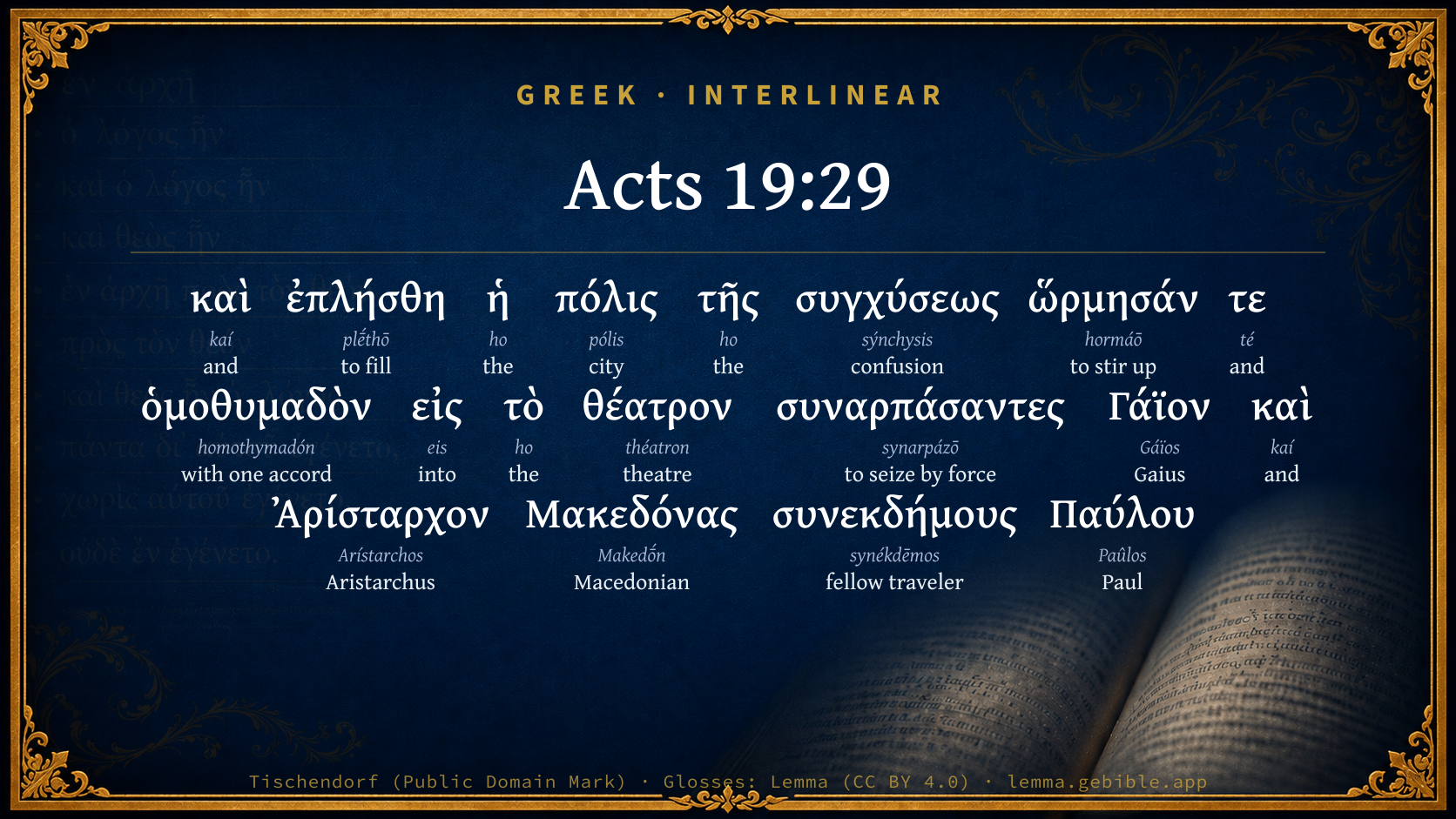
The whole city was filled with confusion, and they rushed with one accord into the theater, having seized Gaius and Aristarchus, men of Macedonia, Paul's companions in travel.
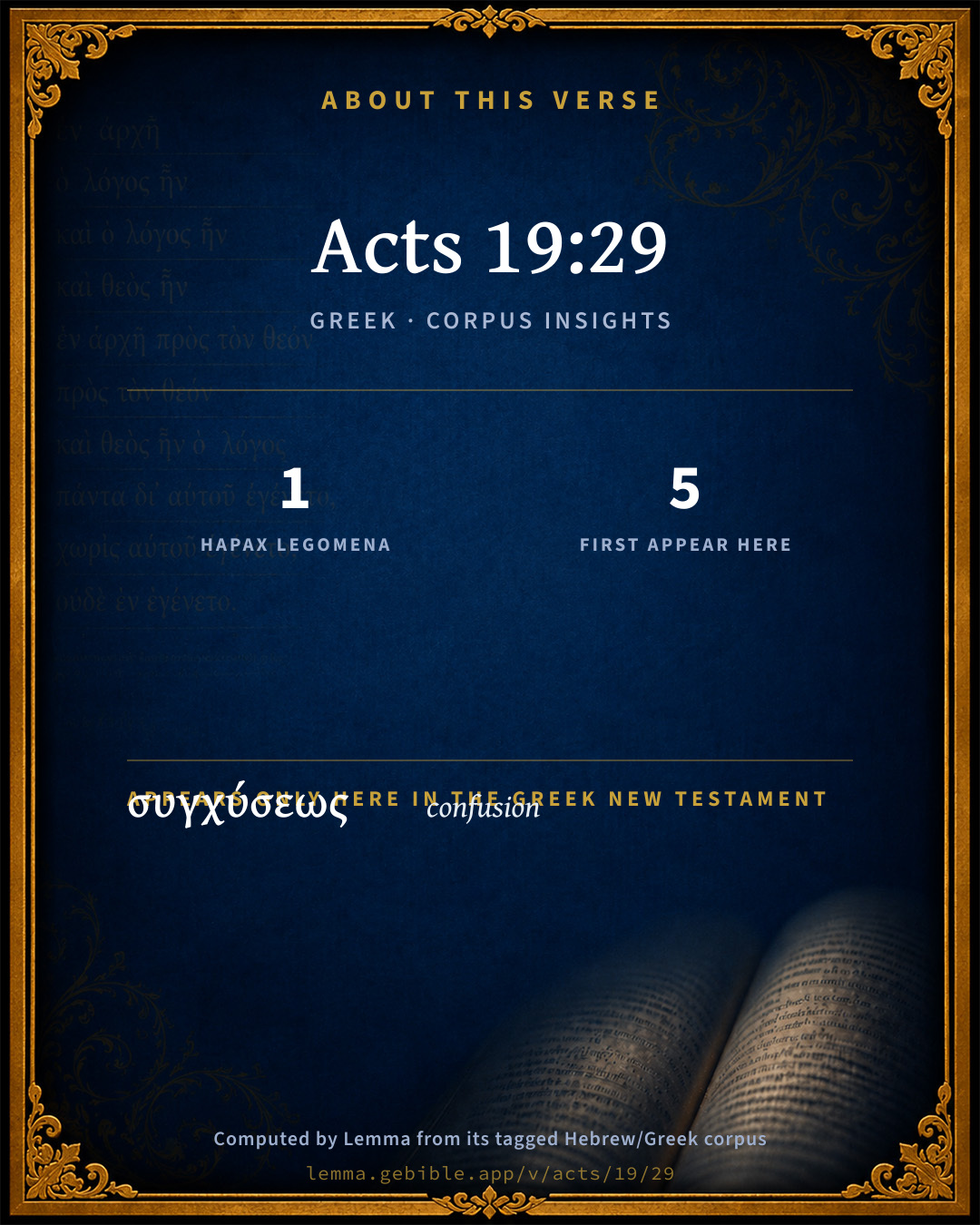
- 1 hapax legomenon — only here in the Greek New Testament
- 5 first appearances in the Greek New Testament
Download a study sheet
One document with this verse’s original text, its word-by-word gloss line, the meaning frame, cross-references with their text, attributed commentary, and full source and license credits — printable, and it pastes into notes with its structure intact.
This verse Autodidact and up
A passage Seminary Student
Up to 50 verses in one chapter. A passage sheet keeps up to 6 commentary sources and 12 cross-references per verse, in the order this page ranks them, and says so on the sheet whenever that leaves anything out. Ask for a single verse and you get the Autodidact verse sheet above.
Everything on this page stays free to read, with no account — the sheet is a download of what is already on screen, not access to it.
Compare translations 3
The same verse in 3 English versions, stacked beneath the original-language interlinear above. Click any original word for its lexicon entry.
Each is an independent rendering of the whole verse — the interlinear is not word-aligned to these translations.
Highlighted words mark where these versions differ — a whole-verse word diff, not a word-by-word alignment.
-
World English Bible Public Domain
The whole city was filled with confusion, and they rushed with one accord into the theater, having seized Gaius and Aristarchus, men of Macedonia, Paul's companions in travel.
-
King James Version Public Domain
And the whole city was filled with confusion: and having caught Gaius and Aristarchus, men of Macedonia, Paul's companions in travel, they rushed with one accord into the theatre.
-
unfoldingWord Literal Text CC BY-SA 4.0
And the city was filled with confusion, and they rushed unanimously into the theater, having seized Gaius and Aristarchus, Macedonians, travel companions of Paul.
unfoldingWord Literal Text — © unfoldingWord, licensed CC BY-SA 4.0. Word-aligned USFM3 via Door43 (git.door43.org/unfoldingWord/en_ult).
Show all 19 translations
Every available English version of this verse, each an independent rendering of the whole verse.
-
World English Bible Public Domain
The whole city was filled with confusion, and they rushed with one accord into the theater, having seized Gaius and Aristarchus, men of Macedonia, Paul's companions in travel.
-
Berean Standard Bible Public Domain
Soon the whole city was in disarray. They rushed together into the theatre, dragging with them Gaius and Aristarchus, Paul’s traveling companions from Macedonia.
-
Majority Standard Bible Public Domain
Soon the whole city was in disarray. They rushed together into the theatre, dragging with them Gaius and Aristarchus, Paul’s traveling companions from Macedonia.
-
King James Version Public Domain
And the whole city was filled with confusion: and having caught Gaius and Aristarchus, men of Macedonia, Paul's companions in travel, they rushed with one accord into the theatre.
-
American Standard Version (1901) Public Domain
And the city was filled with the confusion: and they rushed with one accord into the theatre, having seized Gaius and Aristarchus, men of Macedonia, Paul's companions in travel.
-
Revised Version (1885) Public Domain
And the city was filled with the confusion: and they rushed with one accord into the theatre, having seized Gaius and Aristarchus, men of Macedonia, Paul’s companions in travel.
-
Geneva Bible (1599) Public Domain
And the whole citie was full of confusion, and they rushed into the common place with one assent, and caught Gaius, and Aristarchus, men of Macedonia, and Pauls companions of his iourney.
-
Douay-Rheims (1899) Public Domain
And the whole city was filled with confusion; and having caught Gaius and Aristarchus, men of Macedonia, Paul's companions, they rushed with one accord into the theatre.
-
Young's Literal Translation Public Domain
and the whole city was filled with confusion, they rushed also with one accord into the theatre, having caught Gaius and Aristarchus, Macedonians, Paul's fellow-travellers.
-
Literal Standard Version CC BY-SA 4.0
And the whole city was filled with confusion; they rushed also with one accord into the theater, having caught Gaius and Aristarchus, Macedonians, Paul’s fellow-travelers.
-
Unlocked Literal Bible CC BY-SA 4.0
The whole city was filled with confusion, and the people rushed together into the theater. They had seized Paul's travel companions, Gaius and Aristarchus, who came from Macedonia.
-
unfoldingWord Literal Text CC BY-SA 4.0
And the city was filled with confusion, and they rushed unanimously into the theater, having seized Gaius and Aristarchus, Macedonians, travel companions of Paul.
-
Darby Bible Public Domain
And the [whole] city was filled with confusion, and they rushed with one accord to the theatre, having seized and carried off with [them] Gaius and Aristarchus, Macedonians, fellow-travellers of Paul.
-
World Messianic Bible Public Domain
The whole city was filled with confusion, and they rushed with one accord into the theater, having seized Gaius and Aristarchus, men of Macedonia, Paul’s companions in travel.
-
Webster's Bible Public Domain
And the whole city was filled with confusion: and having caught Gaius and Aristarchus, men of Macedonia, Paul's companions in travel, they rushed with one accord into the theater.
-
Free Bible Version CC BY-SA 4.0
The city was in complete chaos. People rushed towards the amphitheatre, dragging along with them Gaius and Aristarchus, Paul's traveling companions who were from Macedonia.
-
Bible in Basic English Public Domain
And the town was full of noise and trouble, and they all came running into the theatre, having taken by force Gaius and Aristarchus, men of Macedonia who were journeying in company with Paul.
-
Text-Critical English NT CC BY 4.0
So the whole city was filled with confusion, and they rushed with one accord into the amphitheater, seizing Gaius and Aristarchus, Macedonians who were Paul's traveling companions.
-
Tyndale New Testament (1534) Public Domain
And all the cite was on a roore and they russhed in to the comen hall with one assent and caught Gayus and Aristarcus men of Macedonia Pauls companions.
Literal Standard Version (2020), Covenant Press — licensed CC BY-SA 4.0. Text via the HelloAO Bible API (eBible.org). Unlocked Literal Bible (unfoldingWord) — licensed CC BY-SA 4.0. Text via the HelloAO Bible API (eBible.org). unfoldingWord Literal Text — © unfoldingWord, licensed CC BY-SA 4.0. Word-aligned USFM3 via Door43 (git.door43.org/unfoldingWord/en_ult). Free Bible Version, Dr. Jonathan Gallagher — licensed CC BY-SA 4.0. Text via the HelloAO Bible API (eBible.org).
Word by word
More ways to search: Search by grammar → Find every occurrence → Compare this word →
Practice this passage: Drill this verse → Learn its vocabulary →
- Appears 1× in the Greek New Testament
- First appears here
- Part of Speech
- Noun
- Case
- Genitive
- Number
- Singular
- Gender
- Feminine
Full Thayer's Definition
- καὶ kaí G2532 “and” Conjunction
- ἐπλήσθη plḗthō G4130 “to fill” Verb, Aorist, Passive, Indicative, 3rd person, Singular
- ἡ ho G3588 “the” Article, Nominative, Singular, Feminine
- πόλις pólis G4172 “city” Noun, Nominative, Singular, Feminine
- τῆς ho G3588 “the” Article, Genitive, Singular, Feminine
- συγχύσεως sýnchysis G4799 “confusion” Noun, Genitive, Singular, Feminine
- ὥρμησάν hormáō G3729 “to stir up” Verb, Aorist, Active, Indicative, 3rd person, Plural
- τε té G5037 “and” Particle
- ὁμοθυμαδὸν homothymadón G3661 “with one accord” Adverb
- εἰς eis G1519 “into” Preposition
- τὸ ho G3588 “the” Article, Accusative, Singular, Neuter
- θέατρον théatron G2302 “theatre” Noun, Accusative, Singular, Neuter
- συναρπάσαντες synarpázō G4884 “to seize by force” Verb, Aorist, Active, Participle, Nominative, Plural, Masculine
- Γάϊον Gáïos G1050 “Gaius” Noun, Accusative, Singular, Masculine
- καὶ kaí G2532 “and” Conjunction
- Ἀρίσταρχον Arístarchos G708 “Aristarchus” Noun, Accusative, Singular, Masculine
- Μακεδόνας Makedṓn G3110 “Macedonian” Noun, Accusative, Plural, Masculine
- συνεκδήμους synékdēmos G4898 “fellow traveler” Noun, Accusative, Plural, Masculine
- Παύλου Paûlos G3972 “Paul” Noun, Genitive, Singular, Masculine
About this verse
These counts appear in no published source. They are computed here, from the morphology-tagged text and Lemma’s own curated glosses. What Lemma adds →
- 19
- words
- 16
- distinct lemmas
- Acts
- section
Notable vocabulary
1 hapax legomenon — a word that appears only here in the entire Greek New Testament:
- συγχύσεως confusion G4799
First appearance in Scripture
These words make their first canonical appearance in the Greek New Testament here:
Shared distinctive vocabulary
συνεκδήμους fellow traveler G4898 occurs in 2 verses of the Greek New Testament. Also found in:
Cross-references
15Topical passages linked to Acts 19:29 in the Treasury of Scripture Knowledge — connected by theme and wording, ordered by reader-vote popularity; previews shown in the World English Bible.
- Acts 20:4 These accompanied him as far as Asia: Sopater of Beroea; Aristarchus and Secundus of the Thessalonians; Gaius of Derbe; Timothy; and Tychicus and Trophimus of Asia.
- Acts 27:2 Embarking in a ship of Adramyttium, which was about to sail to places on the coast of Asia, we put to sea; Aristarchus, a Macedonian of Thessalonica, being with us.
- Colossians 4:10 Aristarchus, my fellow prisoner greets you, and Mark, the cousin of Barnabas (concerning whom you received commandments, "if he comes to you, receive him"),
- Philemon 1:24 as do Mark, Aristarchus, Demas, and Luke, my fellow workers.
- Acts 19:22 Having sent into Macedonia two of those who ministered to him, Timothy and Erastus, he himself stayed in Asia for a while.
- Acts 21:30 All the city was moved, and the people ran together. They seized Paul and dragged him out of the temple. Immediately the doors were shut.
- Romans 16:23 Gaius, my host and host of the whole assembly, greets you. Erastus, the treasurer of the city, greets you, as does Quartus, the brother.
- 1 Corinthians 1:14 I thank God that I baptized none of you, except Crispus and Gaius,
- 1 Corinthians 4:9 For, I think that God has displayed us, the apostles, last of all, like men sentenced to death. For we are made a spectacle to the world, both to angels and men.
- Acts 16:9 A vision appeared to Paul in the night. There was a man of Macedonia standing, begging him, and saying, "Come over into Macedonia and help us."
- Acts 17:8 The multitude and the rulers of the city were troubled when they heard these things.
- Acts 19:32 Some therefore cried one thing, and some another, for the assembly was in confusion. Most of them didn't know why they had come together.
- Acts 20:34 You yourselves know that these hands ministered to my necessities, and to those who were with me.
- Acts 21:38 Aren't you then the Egyptian, who before these days stirred up to sedition and led out into the wilderness the four thousand men of the Assassins?"
- 2 Corinthians 8:19 Not only so, but who was also appointed by the assemblies to travel with us in this grace, which is served by us to the glory of the Lord himself, and to show our readiness.
Cross-references courtesy of OpenBible.info (CC BY 4.0).
Where the printed editions differ
1 variantPlaces in this verse where the major printed Greek editions disagree on the wording in a way that affects the translation — a comparison of editions, not a manuscript-by-manuscript collation. The editions are the modern critical texts (Nestlé-Aland 28/27, SBL, Westcott-Hort, Tregelles, Tyndale House) and the traditional texts behind the KJV (the Textus Receptus and the Byzantine/Majority text). It is not a claim about which reading is original.
-
Extra text
ὅλη
“all”
In TRByz Not in NA28NA27TynSBLWHTregὅλη (holē) 'all' is only in traditional manuscripts (TR+Byz)
Textual data: Translators Amalgamated Greek New Testament (STEPBible TAGNT) · CC BY 4.0.
Lesson kit
Teaching starters — assembled from the data on this page, not authored interpretation. Every prompt links to the verse data it draws on. Edit before teaching.
Acts, in the Acts, opens this verse with 19 words (16 distinct Greek lemmas). Its most distinctive word is sýnchysis (“confusion”). A historical commentator’s framing appears above. Read the whole chapter for the surrounding context.
Discussion questions
- The word sýnchysis carries the sense “confusion.” How does it shape the verse?
- This verse holds 1 word here found nowhere else in the Greek New Testament. What might the rare word draw attention to?
- 5 words here appear for the first time in Scripture. What is being introduced at this debut?
- 2 Corinthians 8:19 shares the word «fellow traveler» with this verse. How do the two illuminate each other?
- “the” occurs 3× in this one verse. What is the effect of the repetition?
- These translations render this verse differently. What is at stake in choosing one wording over another?
- Reading how The Biblical Illustrator and The Pulpit Commentary read this verse, where do the two commentators agree and where do they part?
Things to notice
- 1 word in this verse appears nowhere else in the Greek New Testament.
- 5 words make their first canonical appearance in Scripture here.
- These translations choose different wording for 13 words in this verse.
- “the” occurs 3× in this single verse.
- 16 distinct Greek lemmas span 19 words in this verse.
Commentary
Notes on Acts 19:29 from classic Christian and Jewish commentators (each source and its license shown beneath its notes). The classic Christian expositions comment on the surrounding passage and are grouped to its opening verse, so a note may address several verses; the Jewish commentaries on the Tanakh (Rashi and others) are per-verse, so they appear only where the commentator wrote on this verse.
Lemma curates 59 commentaries, every one of them public domain or Creative Commons licensed, each selected and text-cleaned for this edition rather than reprinted as found. About our sources →
The Biblical Illustrator
Joseph S. Exell
The Biblical Illustrator, edited by Joseph S. Exell (c. 1880s–1900s) — public domain. Text from a community e-Sword module.
The Pulpit Commentary
The Pulpit Commentary (1880–1919), ed. H.D.M. Spence-Jones & Joseph S. Exell — public domain. Text from a community e-Sword module.
Tyndale Open Study Notes
Tyndale Open Resources
Tyndale Open Study Notes — © Tyndale Open Resources, licensed CC BY-SA 4.0. Text via the HelloAO Bible API.
Bengel's Gnomon
Johann Albrecht Bengel
Bengel's Gnomon of the New Testament — English translation (T&T Clark, Edinburgh, 1860) — public domain. Text from a community e-Sword module.
Expositor's Greek Testament
ed. W. Robertson Nicoll
The Expositor's Greek Testament, edited by W. Robertson Nicoll (1897–1910) — public domain. Text from a community e-Sword module.
Jamieson, Fausset & Brown
Robert Jamieson, A. R. Fausset & David Brown
Jamieson, Fausset & Brown — Commentary Critical and Explanatory on the Whole Bible (1871) — public domain (CC PDM 1.0). Text via the HelloAO Bible API.
Adam Clarke's Commentary
Adam Clarke's Commentary on the Bible (1810–1826) — public domain. Text from a community e-Sword/MySword module.
John Calvin's Commentaries
John Calvin's Commentaries (1540-1563) — public domain. Text from the Calvin Translation Society English edition (1840s-50s) via the Christian Classics Ethereal Library (ccel.org). Calvin's coverage is partial (roughly two-thirds of the Bible); uncommented books and verses are honest gaps, never fabricated. The 19th-century editor's footnotes and remarks are omitted so the notes are faithfully Calvin's own voice.
Ellicott's Commentary for English Readers
A Bible Commentary for English Readers, edited by Charles John Ellicott (1878–1897) — public domain. Text from a community e-Sword module.
The Cambridge Bible for Schools and Colleges
gen. ed. J. J. S. Perowne
The Cambridge Bible for Schools and Colleges (gen. ed. J. J. S. Perowne; Cambridge University Press, 1878–1918) — public domain. Text from a community e-Sword module.
John Gill's Exposition
John Gill's Exposition of the Whole Bible (1746–1763) — public domain (CC PDM 1.0). Text via the HelloAO Bible API.
Trapp's Complete Commentary
John Trapp
John Trapp, A Commentary or Exposition upon All the Books of the Old and New Testament (1647–1656) — public domain. Text from a community e-Sword module.
Albert Barnes' Notes on the Bible
Albert Barnes' Notes on the Bible (1834–1885) — public domain. Text from a community e-Sword/MySword module.
Matthew Poole's English Annotations
Matthew Poole's English Annotations on the Holy Bible (1683–1685) — public domain. Text from a community e-Sword/MySword module.
Whedon's Commentary on the Bible
Daniel D. Whedon
Daniel D. Whedon (gen. ed.), Commentary on the Old and New Testaments (1874–1909) — public domain. Text from a community e-Sword module.
John Wesley's Explanatory Notes
John Wesley, Explanatory Notes Upon the Whole Bible (1754–1765) — public domain. Text via the GEBible commentary corpus.
McGarvey & Pendleton's Commentaries
J. W. McGarvey
J. W. McGarvey (with Philip Y. Pendleton), Commentaries on the New Testament (The Fourfold Gospel, 1914; Acts; and the epistles) — public domain. Text from a community e-Sword/MySword module.
Cambridge Greek Testament for Schools and Colleges
Cambridge Greek Testament for Schools and Colleges (Cambridge University Press, 1896; 21 vols, various authors incl. Carr, Maclear, Plummer, Farrar, Lumby, Moule, M. R. James, Simcox) — public domain. Text from a community e-Sword module.
Alford’s Greek Testament
Henry Alford
Henry Alford, The Greek Testament (1849–1861) — public domain. Text from a community e-Sword module.
Vincent's Word Studies in the New Testament
Marvin R. Vincent
Marvin R. Vincent, Word Studies in the New Testament (1887–1900) — public domain. Text from a community e-Sword/MySword module.