

Acts 21:13
Greek (Tischendorf 8th ed.) Acts 21:13 appears in the Greek New Testament. The text above is from the Tischendorf 8th edition. Each word links to its Strong’s number and a concise gloss. Click any word for its full Thayer’s Greek Lexicon entry.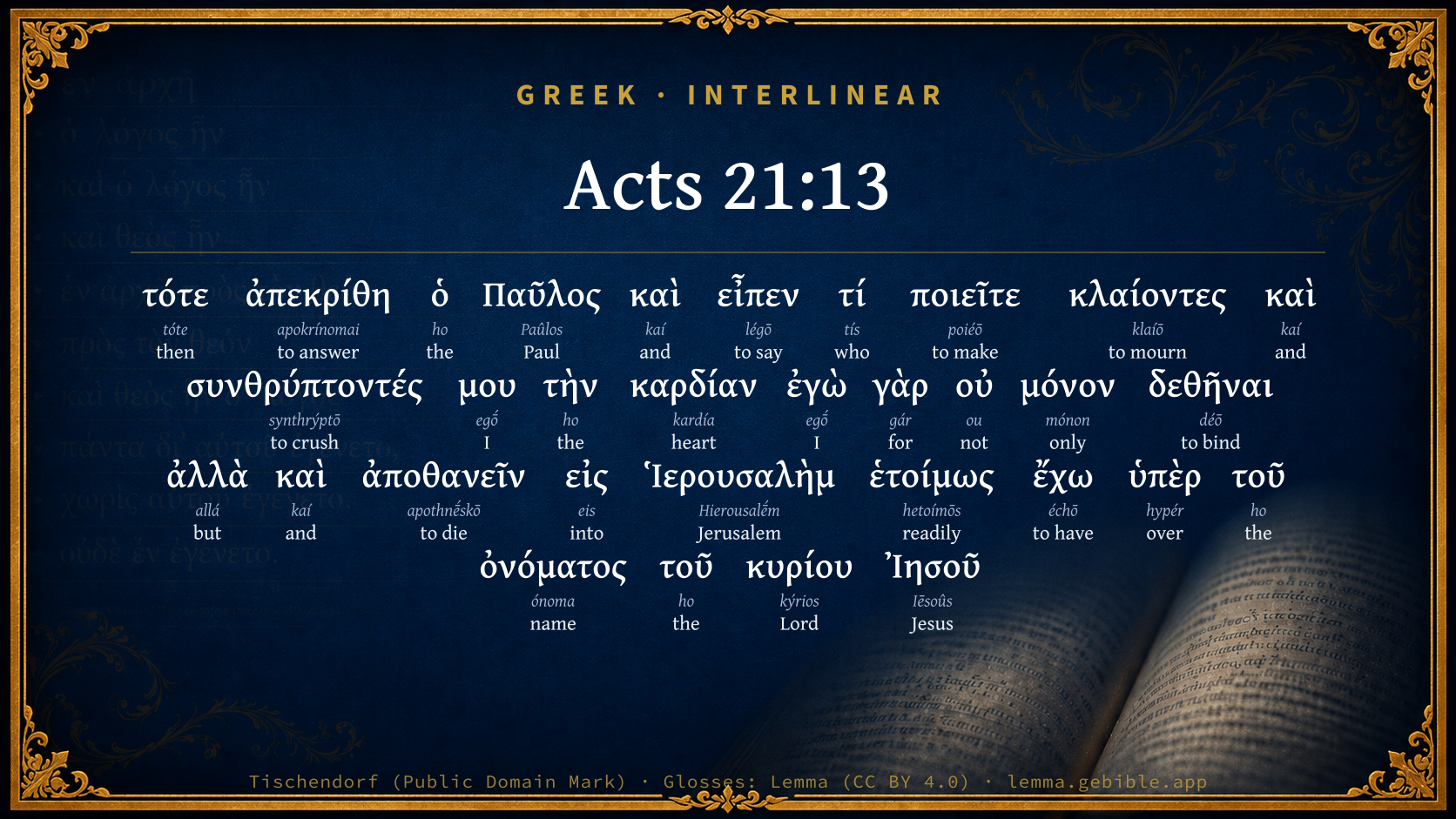
Then Paul answered, "What are you doing, weeping and breaking my heart? For I am ready not only to be bound, but also to die at Jerusalem for the name of the Lord Jesus."
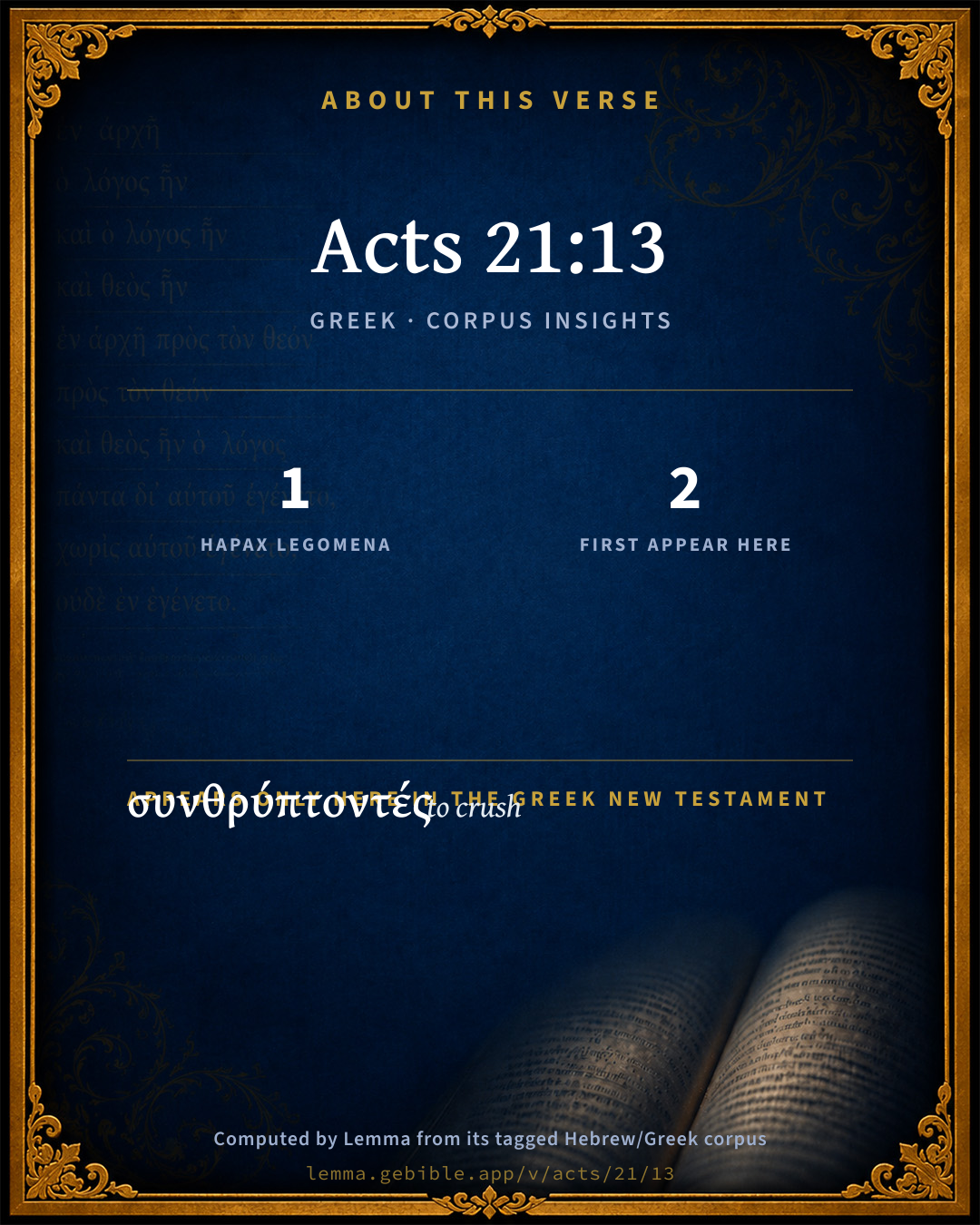
- 1 hapax legomenon — only here in the Greek New Testament
- 2 first appearances in the Greek New Testament
Download a study sheet
One document with this verse’s original text, its word-by-word gloss line, the meaning frame, cross-references with their text, attributed commentary, and full source and license credits — printable, and it pastes into notes with its structure intact.
This verse Autodidact and up
A passage Seminary Student
Up to 50 verses in one chapter. A passage sheet keeps up to 6 commentary sources and 12 cross-references per verse, in the order this page ranks them, and says so on the sheet whenever that leaves anything out. Ask for a single verse and you get the Autodidact verse sheet above.
Everything on this page stays free to read, with no account — the sheet is a download of what is already on screen, not access to it.
Compare translations 3
The same verse in 3 English versions, stacked beneath the original-language interlinear above. Click any original word for its lexicon entry.
Each is an independent rendering of the whole verse — the interlinear is not word-aligned to these translations.
Highlighted words mark where these versions differ — a whole-verse word diff, not a word-by-word alignment.
-
World English Bible Public Domain
Then Paul answered, "What are you doing, weeping and breaking my heart? For I am ready not only to be bound, but also to die at Jerusalem for the name of the Lord Jesus."
-
King James Version Public Domain
Then Paul answered, What mean ye to weep and to break mine heart? for I am ready not to be bound only, but also to die at Jerusalem for the name of the Lord Jesus.
-
unfoldingWord Literal Text CC BY-SA 4.0
Then Paul answered, “What are you doing, weeping and breaking my heart? For I am ready not only to be bound but also to die in Jerusalem for the name of the Lord Jesus.”
unfoldingWord Literal Text — © unfoldingWord, licensed CC BY-SA 4.0. Word-aligned USFM3 via Door43 (git.door43.org/unfoldingWord/en_ult).
Show all 19 translations
Every available English version of this verse, each an independent rendering of the whole verse.
-
World English Bible Public Domain
Then Paul answered, "What are you doing, weeping and breaking my heart? For I am ready not only to be bound, but also to die at Jerusalem for the name of the Lord Jesus."
-
Berean Standard Bible Public Domain
Then Paul answered, “Why are you weeping and breaking my heart? I am ready not only to be bound, but also to die in Jerusalem for the name of the Lord Jesus.”
-
Majority Standard Bible Public Domain
Then Paul answered, “Why are you weeping and breaking my heart? I am ready not only to be bound, but also to die in Jerusalem for the name of the Lord Jesus.”
-
King James Version Public Domain
Then Paul answered, What mean ye to weep and to break mine heart? for I am ready not to be bound only, but also to die at Jerusalem for the name of the Lord Jesus.
-
American Standard Version (1901) Public Domain
Then Paul answered, What do ye, weeping and breaking my heart? for I am ready not to be bound only, but also to die at Jerusalem for the name of the Lord Jesus.
-
Revised Version (1885) Public Domain
Then Paul answered, What do ye, weeping and breaking my heart? for I am ready not to be bound only, but also to die at Jerusalem for the name of the Lord Jesus.
-
Geneva Bible (1599) Public Domain
Then Paul answered, and sayd, What doe ye weeping and breaking mine heart? For I am ready not to be bound onely, but also to die at Hierusalem for the Name of the Lord Iesus.
-
Douay-Rheims (1899) Public Domain
Then Paul answered, and said: What do you mean weeping and afflicting my heart? For I am ready not only to be bound, but to die also in Jerusalem, for the name of the Lord Jesus.
-
Young's Literal Translation Public Domain
and Paul answered, `What do ye -- weeping, and crushing mine heart? for I, not only to be bound, but also to die at Jerusalem, am ready, for the name of the Lord Jesus;'
-
Literal Standard Version CC BY-SA 4.0
and Paul answered, “Why are you weeping, and crushing my heart? For I am ready, not only to be bound, but also to die at Jerusalem for the Name of the Lord Jesus”;
-
Unlocked Literal Bible CC BY-SA 4.0
Then Paul answered, “What are you doing, weeping and breaking my heart? For I am ready, not only to be tied up, but also to die in Jerusalem for the name of the Lord Jesus.”
-
unfoldingWord Literal Text CC BY-SA 4.0
Then Paul answered, “What are you doing, weeping and breaking my heart? For I am ready not only to be bound but also to die in Jerusalem for the name of the Lord Jesus.”
-
Darby Bible Public Domain
But Paul answered, What do ye, weeping and breaking my heart? for *I* am ready not only to be bound, but also to die at Jerusalem for the name of the Lord Jesus.
-
World Messianic Bible Public Domain
Then Paul answered, “What are you doing, weeping and breaking my heart? For I am ready not only to be bound, but also to die at Jerusalem for the name of the Lord Yeshua.”
-
Webster's Bible Public Domain
Then Paul answered, What mean ye to weep, and to break my heart? for I am ready not to be bound only, but also to die at Jerusalem for the name of the Lord Jesus.
-
Free Bible Version CC BY-SA 4.0
However, Paul answered, “What are you doing, crying and breaking my heart? I'm ready not only to be bound in Jerusalem, but to die in Jerusalem for the sake of the Lord Jesus.”
-
Bible in Basic English Public Domain
Then Paul said, What are you doing, weeping and wounding my heart? for I am ready, not only to be a prisoner, but to be put to death at Jerusalem for the name of the Lord Jesus.
-
Text-Critical English NT CC BY 4.0
But Paul responded, “What are you doing, weeping and breaking my heart? For I am ready not only to be imprisoned, but even to die in Jerusalem for the name of the Lord Jesus.”
-
Tyndale New Testament (1534) Public Domain
Then Paul answered and sayde: what do ye wepynge and breakinge myne hert? I am redy not to be bound only but also to dye at Ierusalem for the name of the Lorde Iesu.
Literal Standard Version (2020), Covenant Press — licensed CC BY-SA 4.0. Text via the HelloAO Bible API (eBible.org). Unlocked Literal Bible (unfoldingWord) — licensed CC BY-SA 4.0. Text via the HelloAO Bible API (eBible.org). unfoldingWord Literal Text — © unfoldingWord, licensed CC BY-SA 4.0. Word-aligned USFM3 via Door43 (git.door43.org/unfoldingWord/en_ult). Free Bible Version, Dr. Jonathan Gallagher — licensed CC BY-SA 4.0. Text via the HelloAO Bible API (eBible.org).
Word by word
More ways to search: Search by grammar → Find every occurrence → Compare this word →
Practice this passage: Drill this verse → Learn its vocabulary →
- Appears 1× in the Greek New Testament
- First appears here
- Part of Speech
- Verb
- Tense
- Present
- Voice
- Active
- Mood
- Participle
- Case
- Nominative
- Number
- Plural
- Gender
- Masculine
Full Thayer's Definition
- τότε tóte G5119 “then” Adverb
- ἀπεκρίθη apokrínomai G611 “to answer” Verb, Aorist, Middle deponent, Indicative, 3rd person, Singular
- ὁ ho G3588 “the” Article, Nominative, Singular, Masculine
- Παῦλος Paûlos G3972 “Paul” Noun, Nominative, Singular, Masculine
- καὶ kaí G2532 “and” Conjunction
- εἶπεν légō G3004 “to say” Verb, Aorist, Active, Indicative, 3rd person, Singular
- τί tís G5101 “who” Interrogative pronoun, Accusative, Singular, Neuter
- ποιεῖτε poiéō G4160 “to make” Verb, Present, Active, Indicative, 2nd person, Plural
- κλαίοντες klaíō G2799 “to mourn” Verb, Present, Active, Participle, Nominative, Plural, Masculine
- καὶ kaí G2532 “and” Conjunction
- συνθρύπτοντές synthrýptō G4919 “to crush” Verb, Present, Active, Participle, Nominative, Plural, Masculine
- μου egṓ G1473 “I” Personal pronoun, 1st person, Genitive, Singular
- τὴν ho G3588 “the” Article, Accusative, Singular, Feminine
- καρδίαν kardía G2588 “heart” Noun, Accusative, Singular, Feminine
- ἐγὼ egṓ G1473 “I” Personal pronoun, 1st person, Nominative, Singular
- γὰρ gár G1063 “for” Conjunction
- οὐ ou G3756 “not” Particle, Negative
- μόνον mónon G3440 “only” Adverb
- δεθῆναι déō G1210 “to bind” Verb, Aorist, Passive, Infinitive
- ἀλλὰ allá G235 “but” Conjunction
- καὶ kaí G2532 “and” Conjunction
- ἀποθανεῖν apothnḗskō G599 “to die” Verb, Aorist, Active, Infinitive
- εἰς eis G1519 “into” Preposition
- Ἱερουσαλὴμ Hierousalḗm G2419 “Jerusalem” Noun, Proper, indeclinable
- ἑτοίμως hetoímōs G2093 “readily” Adverb
- ἔχω échō G2192 “to have” Verb, Present, Active, Indicative, 1st person, Singular
- ὑπὲρ hypér G5228 “over” Preposition
- τοῦ ho G3588 “the” Article, Genitive, Singular, Neuter
- ὀνόματος ónoma G3686 “name” Noun, Genitive, Singular, Neuter
- τοῦ ho G3588 “the” Article, Genitive, Singular, Masculine
- κυρίου kýrios G2962 “Lord” Noun, Genitive, Singular, Masculine
- Ἰησοῦ Iēsoûs G2424 “Jesus” Noun, Genitive, Singular, Masculine
About this verse
These counts appear in no published source. They are computed here, from the morphology-tagged text and Lemma’s own curated glosses. What Lemma adds →
- 32
- words
- 26
- distinct lemmas
- Acts
- section
Notable vocabulary
1 hapax legomenon — a word that appears only here in the entire Greek New Testament:
- συνθρύπτοντές to crush G4919
First appearance in Scripture
These words make their first canonical appearance in the Greek New Testament here:
Shared distinctive vocabulary
ἑτοίμως readily G2093 occurs in 3 verses of the Greek New Testament. Also found in:
Cross-references
22Topical passages linked to Acts 21:13 in the Treasury of Scripture Knowledge — connected by theme and wording, ordered by reader-vote popularity; previews shown in the World English Bible.
- Acts 20:24 But these things don't count; nor do I hold my life dear to myself, so that I may finish my race with joy, and the ministry which I received from the Lord Jesus, to fully testify to the Gospel of the grace of God.
- Philippians 1:20–21 according to my earnest expectation and hope, that I will in no way be disappointed, but with all boldness, as always, now also Christ will be magnified in my body, whether by life, or by death.
- Philippians 2:17 Yes, and if I am poured out on the sacrifice and service of your faith, I rejoice, and rejoice with you all.
- Romans 8:35–37 Who shall separate us from the love of Christ? Could oppression, or anguish, or persecution, or famine, or nakedness, or peril, or sword?
- 2 Timothy 4:6 For I am already being offered, and the time of my departure has come.
- Acts 20:37 They all wept a lot, and fell on Paul's neck and kissed him,
- 2 Corinthians 4:10–17 always carrying in the body the putting to death of the Lord Jesus, that the life of Jesus may also be revealed in our body.
- Colossians 1:24 Now I rejoice in my sufferings for your sake, and fill up on my part that which is lacking of the afflictions of Christ in my flesh for his body's sake, which is the assembly;
- 2 Timothy 2:4–6 No soldier on service entangles himself in the affairs of life, that he may please him who enrolled him as a soldier.
- Revelation 12:11 They overcame him because of the Lamb's blood, and because of the word of their testimony. They didn't love their life, even to death.
- Acts 5:41 They therefore departed from the presence of the council, rejoicing that they were counted worthy to suffer dishonor for Jesus' name.
- Acts 9:16 For I will show him how many things he must suffer for my name's sake."
- 2 Peter 1:14 knowing that the putting off of my tent comes swiftly, even as our Lord Jesus Christ made clear to me.
- 1 Corinthians 15:31 I affirm, by the boasting in you which I have in Christ Jesus our Lord, I die daily.
- 2 Corinthians 11:23–27 Are they servants of Christ? (I speak as one beside himself) I am more so; in labors more abundantly, in prisons more abundantly, in stripes above measure, in deaths often.
- 2 Timothy 1:4 longing to see you, remembering your tears, that I may be filled with joy;
- Revelation 3:10 Because you kept my command to endure, I also will keep you from the hour of testing, which is to come on the whole world, to test those who dwell on the earth.
- Philippians 2:26 since he longed for you all, and was very troubled, because you had heard that he was sick.
- 1 Samuel 15:14 Samuel said, What means then this bleating of the sheep in my ears, and the lowing of the oxen which I hear?
- Isaiah 3:15 What do you mean that you crush my people, And grind the face of the poor?" says the Lord, Yahweh of Hosts.
- Ezekiel 18:2 What do you mean, that you use this proverb concerning the land of Israel, saying, The fathers have eaten sour grapes, and the children's teeth are set on edge?
- Jonah 1:6 So the shipmaster came to him, and said to him, "What do you mean, sleeper? Arise, call on your gods! Maybe the gods will notice us, so that we won't perish."
Cross-references courtesy of OpenBible.info (CC BY 4.0).
Lesson kit
Teaching starters — assembled from the data on this page, not authored interpretation. Every prompt links to the verse data it draws on. Edit before teaching.
Acts, in the Acts, opens this verse with 32 words (26 distinct Greek lemmas). Its most distinctive word is synthrýptō (“to crush”). A historical commentator’s framing appears above. Read the whole chapter for the surrounding context.
Discussion questions
- The word synthrýptō carries the sense “to crush.” How does it shape the verse?
- This verse holds 1 word here found nowhere else in the Greek New Testament. What might the rare word draw attention to?
- 2 words here appear for the first time in Scripture. What is being introduced at this debut?
- 2 Corinthians 12:14 shares the word «readily» with this verse. How do the two illuminate each other?
- “the” occurs 4× in this one verse. What is the effect of the repetition?
- These translations render this verse differently; the difference is in the English rendering, not the original. What questions does that raise?
- Reading how The Biblical Illustrator and Bengel's Gnomon read this verse, where do the two commentators agree and where do they part?
Things to notice
- 1 word in this verse appears nowhere else in the Greek New Testament.
- 2 words make their first canonical appearance in Scripture here.
- These translations choose different wording for 8 words in this verse.
- “the” occurs 4× in this single verse.
- 26 distinct Greek lemmas span 32 words in this verse.
Commentary
Notes on Acts 21:13 from classic Christian and Jewish commentators (each source and its license shown beneath its notes). The classic Christian expositions comment on the surrounding passage and are grouped to its opening verse, so a note may address several verses; the Jewish commentaries on the Tanakh (Rashi and others) are per-verse, so they appear only where the commentator wrote on this verse.
Lemma curates 59 commentaries, every one of them public domain or Creative Commons licensed, each selected and text-cleaned for this edition rather than reprinted as found. About our sources →
The Biblical Illustrator
Joseph S. Exell
The Biblical Illustrator, edited by Joseph S. Exell (c. 1880s–1900s) — public domain. Text from a community e-Sword module.
Bengel's Gnomon
Johann Albrecht Bengel
Bengel's Gnomon of the New Testament — English translation (T&T Clark, Edinburgh, 1860) — public domain. Text from a community e-Sword module.
Expositor's Greek Testament
ed. W. Robertson Nicoll
The Expositor's Greek Testament, edited by W. Robertson Nicoll (1897–1910) — public domain. Text from a community e-Sword module.
Jamieson, Fausset & Brown
Robert Jamieson, A. R. Fausset & David Brown
Jamieson, Fausset & Brown — Commentary Critical and Explanatory on the Whole Bible (1871) — public domain (CC PDM 1.0). Text via the HelloAO Bible API.
Adam Clarke's Commentary
Adam Clarke's Commentary on the Bible (1810–1826) — public domain. Text from a community e-Sword/MySword module.
Ellicott's Commentary for English Readers
A Bible Commentary for English Readers, edited by Charles John Ellicott (1878–1897) — public domain. Text from a community e-Sword module.
The Cambridge Bible for Schools and Colleges
gen. ed. J. J. S. Perowne
The Cambridge Bible for Schools and Colleges (gen. ed. J. J. S. Perowne; Cambridge University Press, 1878–1918) — public domain. Text from a community e-Sword module.
John Gill's Exposition
John Gill's Exposition of the Whole Bible (1746–1763) — public domain (CC PDM 1.0). Text via the HelloAO Bible API.
Trapp's Complete Commentary
John Trapp
John Trapp, A Commentary or Exposition upon All the Books of the Old and New Testament (1647–1656) — public domain. Text from a community e-Sword module.
Albert Barnes' Notes on the Bible
Albert Barnes' Notes on the Bible (1834–1885) — public domain. Text from a community e-Sword/MySword module.
Matthew Poole's English Annotations
Matthew Poole's English Annotations on the Holy Bible (1683–1685) — public domain. Text from a community e-Sword/MySword module.
Whedon's Commentary on the Bible
Daniel D. Whedon
Daniel D. Whedon (gen. ed.), Commentary on the Old and New Testaments (1874–1909) — public domain. Text from a community e-Sword module.
The Pulpit Commentary
The Pulpit Commentary (1880–1919), ed. H.D.M. Spence-Jones & Joseph S. Exell — public domain. Text from a community e-Sword module.
John Wesley's Explanatory Notes
John Wesley, Explanatory Notes Upon the Whole Bible (1754–1765) — public domain. Text via the GEBible commentary corpus.
McGarvey & Pendleton's Commentaries
J. W. McGarvey
J. W. McGarvey (with Philip Y. Pendleton), Commentaries on the New Testament (The Fourfold Gospel, 1914; Acts; and the epistles) — public domain. Text from a community e-Sword/MySword module.
Cambridge Greek Testament for Schools and Colleges
Cambridge Greek Testament for Schools and Colleges (Cambridge University Press, 1896; 21 vols, various authors incl. Carr, Maclear, Plummer, Farrar, Lumby, Moule, M. R. James, Simcox) — public domain. Text from a community e-Sword module.
Alford’s Greek Testament
Henry Alford
Henry Alford, The Greek Testament (1849–1861) — public domain. Text from a community e-Sword module.
Vincent's Word Studies in the New Testament
Marvin R. Vincent
Marvin R. Vincent, Word Studies in the New Testament (1887–1900) — public domain. Text from a community e-Sword/MySword module.