

Acts 27:41
Greek (Tischendorf 8th ed.) Acts 27:41 appears in the Greek New Testament. The text above is from the Tischendorf 8th edition. Each word links to its Strong’s number and a concise gloss. Click any word for its full Thayer’s Greek Lexicon entry.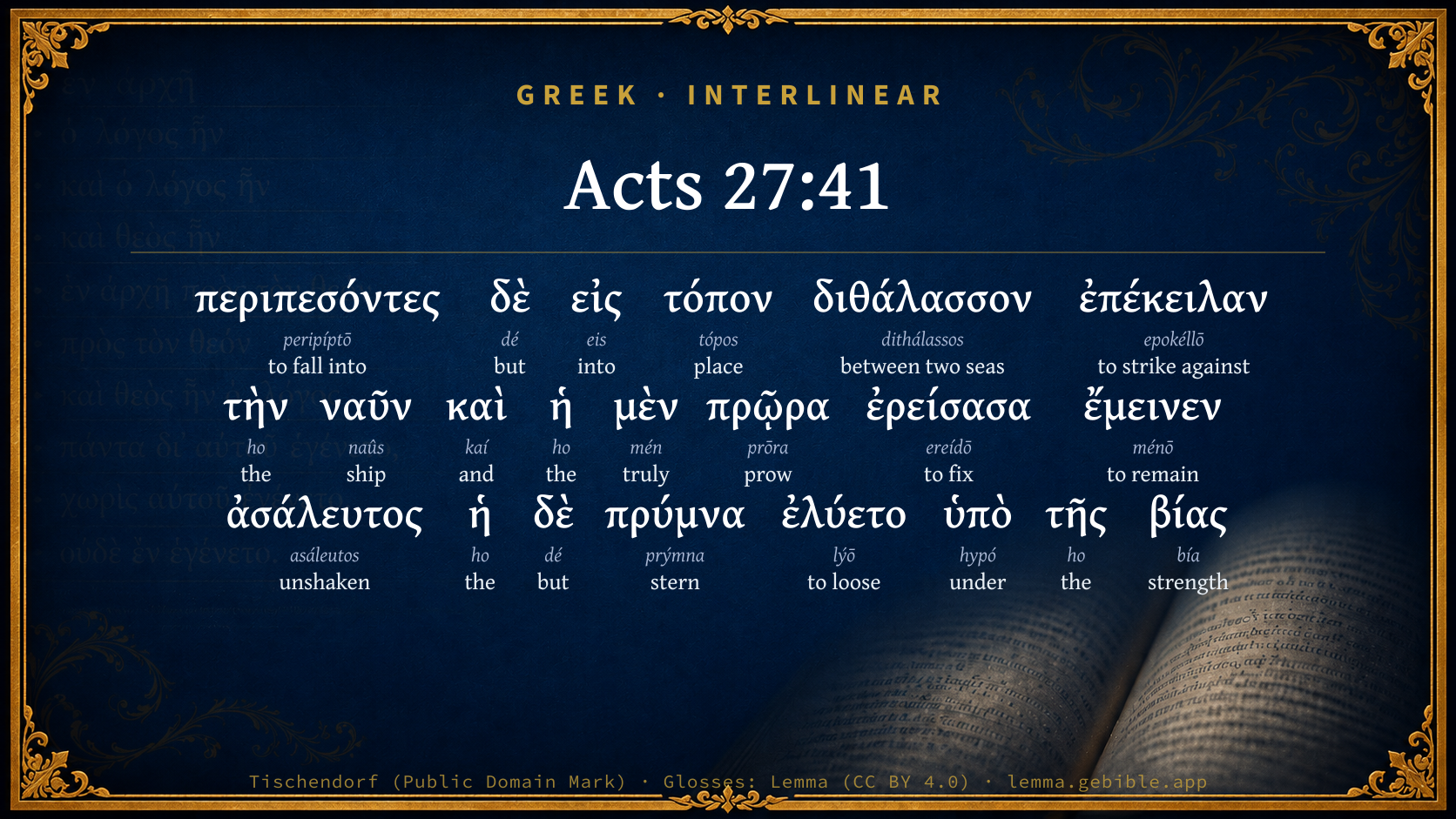
But coming to a place where two seas met, they ran the vessel aground. The bow struck and remained immovable, but the stern began to break up by the violence of the waves.
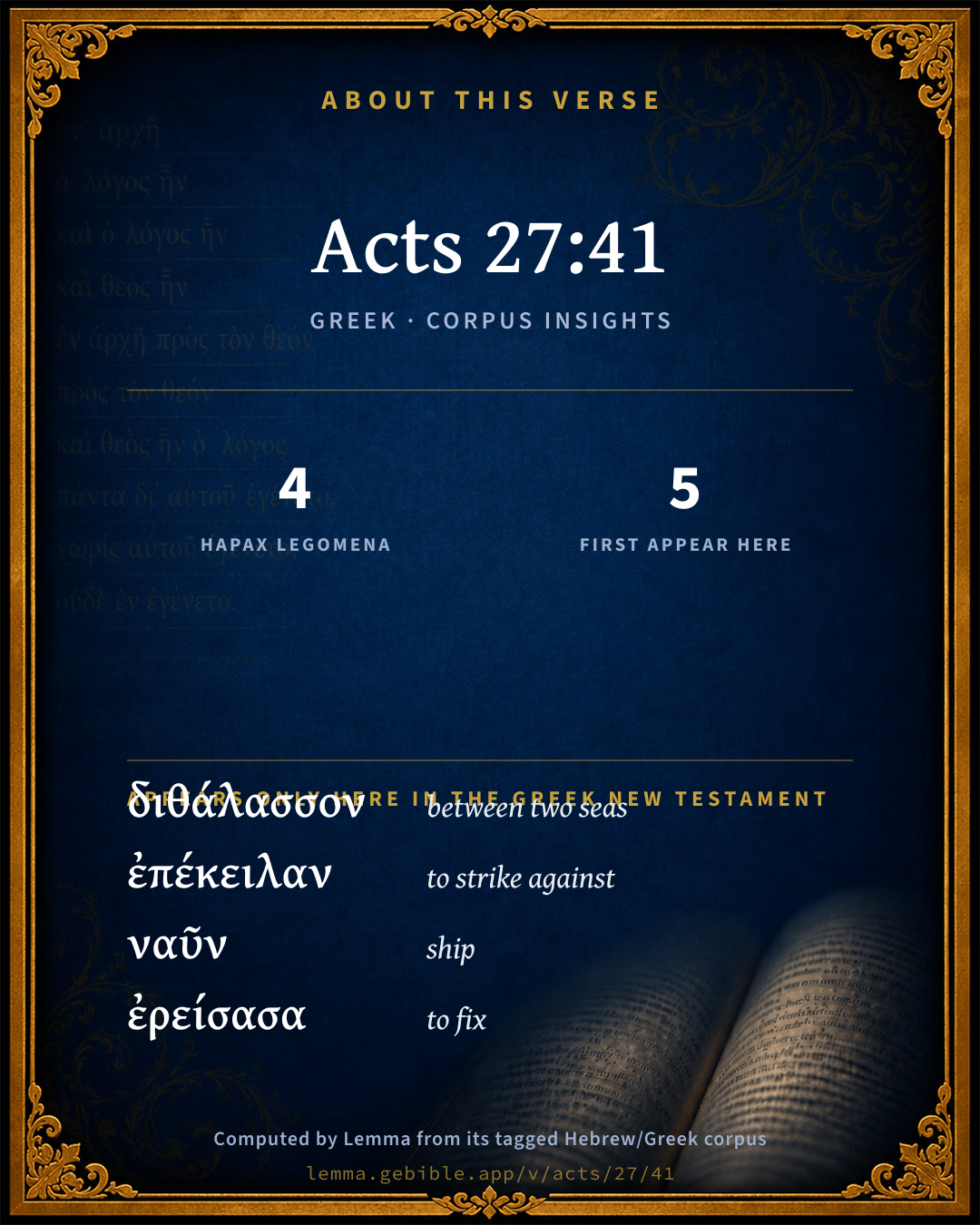
- 4 hapax legomena — only here in the Greek New Testament
- 5 first appearances in the Greek New Testament
Download a study sheet
One document with this verse’s original text, its word-by-word gloss line, the meaning frame, cross-references with their text, attributed commentary, and full source and license credits — printable, and it pastes into notes with its structure intact.
This verse Autodidact and up
A passage Seminary Student
Up to 50 verses in one chapter. A passage sheet keeps up to 6 commentary sources and 12 cross-references per verse, in the order this page ranks them, and says so on the sheet whenever that leaves anything out. Ask for a single verse and you get the Autodidact verse sheet above.
Everything on this page stays free to read, with no account — the sheet is a download of what is already on screen, not access to it.
Compare translations 3
The same verse in 3 English versions, stacked beneath the original-language interlinear above. Click any original word for its lexicon entry.
Each is an independent rendering of the whole verse — the interlinear is not word-aligned to these translations.
Highlighted words mark where these versions differ — a whole-verse word diff, not a word-by-word alignment.
-
World English Bible Public Domain
But coming to a place where two seas met, they ran the vessel aground. The bow struck and remained immovable, but the stern began to break up by the violence of the waves.
-
King James Version Public Domain
And falling into a place where two seas met, they ran the ship aground; and the forepart stuck fast, and remained unmoveable, but the hinder part was broken with the violence of the waves.
-
unfoldingWord Literal Text CC BY-SA 4.0
But having fallen into a place between two seas, the ship ran aground, and the bow of the ship, having stuck there, remained immovable, but the stern was being loosed by the violence.
unfoldingWord Literal Text — © unfoldingWord, licensed CC BY-SA 4.0. Word-aligned USFM3 via Door43 (git.door43.org/unfoldingWord/en_ult).
Show all 19 translations
Every available English version of this verse, each an independent rendering of the whole verse.
-
World English Bible Public Domain
But coming to a place where two seas met, they ran the vessel aground. The bow struck and remained immovable, but the stern began to break up by the violence of the waves.
-
Berean Standard Bible Public Domain
But the vessel struck a sandbar and ran aground. The bow stuck fast and would not move, and the stern was being broken up by the pounding of the waves.
-
Majority Standard Bible Public Domain
But the ship struck a sandbar and ran aground. The bow stuck fast and would not move, and the stern was being broken up by the pounding of the waves.
-
King James Version Public Domain
And falling into a place where two seas met, they ran the ship aground; and the forepart stuck fast, and remained unmoveable, but the hinder part was broken with the violence of the waves.
-
American Standard Version (1901) Public Domain
But lighting upon a place where two seas met, they ran the vessel aground; and the foreship struck and remained unmoveable, but the stern began to break up by the violence `of the waves'.
-
Revised Version (1885) Public Domain
But lighting upon a place where two seas met, they ran the vessel aground; and the foreship struck and remained unmoveable, but the stern began to break up by the violence of the waves.
-
Geneva Bible (1599) Public Domain
And when they fell into a place, where two seas met, they thrust in the ship: and the forepart stucke fast, and could not be moued, but the hinderpart was broken with the violence of the waues.
-
Douay-Rheims (1899) Public Domain
And when we were fallen into a place where two seas met, they run the ship aground; and the forepart indeed, sticking fast, remained unmoveable: but the hinder part was broken with the violence of the sea.
-
Young's Literal Translation Public Domain
and having fallen into a place of two seas, they ran the ship aground, and the fore-part, indeed, having stuck fast, did remain immoveable, but the hinder-part was broken by the violence of the waves.
-
Literal Standard Version CC BY-SA 4.0
and having fallen into a place of two seas, they ran the ship aground, and the prow, indeed, having stuck fast, remained immoveable, but the stern was broken by the violence of the waves.
-
Unlocked Literal Bible CC BY-SA 4.0
But they came to a place where two currents met, and the ship ran into the ground. The bow of the ship stuck there and remained unmovable, but the stern began to break up because of the waves' violence.
-
unfoldingWord Literal Text CC BY-SA 4.0
But having fallen into a place between two seas, the ship ran aground, and the bow of the ship, having stuck there, remained immovable, but the stern was being loosed by the violence.
-
Darby Bible Public Domain
And falling into a place where two seas met they ran the ship aground, and the prow having stuck itself fast remained unmoved, but the stern was broken by the force of the waves.
-
World Messianic Bible Public Domain
But coming to a place where two seas met, they ran the vessel aground. The bow struck and remained immovable, but the stern began to break up by the violence of the waves.
-
Webster's Bible Public Domain
And falling into a place where two seas met, they ran the ship aground; and the forepart stuck fast, and remained immovable, but the hinder part was broken with the violence of the waves.
-
Free Bible Version CC BY-SA 4.0
But they struck a sandbar and the ship grounded. The bow hit, and stuck so firmly it couldn't be moved, while the stern began to be broken apart by the pounding surf.
-
Bible in Basic English Public Domain
And coming to a point between two seas, they got the ship to land; and the front part was fixed in the sand and not able to be moved, but the back part was broken by the force of the waves.
-
Text-Critical English NT CC BY 4.0
But they struck a sandbar and ran the ship aground. The bow stuck fast and remained immovable, and the stern was being broken apart by the force of the waves.
-
Tyndale New Testament (1534) Public Domain
But they chaunsed on a place which had the see on bothe the sydes and thrust in the ship. And the foore parte stucke fast and moved not but the hynder brake with the violence of the waves.
Literal Standard Version (2020), Covenant Press — licensed CC BY-SA 4.0. Text via the HelloAO Bible API (eBible.org). Unlocked Literal Bible (unfoldingWord) — licensed CC BY-SA 4.0. Text via the HelloAO Bible API (eBible.org). unfoldingWord Literal Text — © unfoldingWord, licensed CC BY-SA 4.0. Word-aligned USFM3 via Door43 (git.door43.org/unfoldingWord/en_ult). Free Bible Version, Dr. Jonathan Gallagher — licensed CC BY-SA 4.0. Text via the HelloAO Bible API (eBible.org).
Word by word
More ways to search: Search by grammar → Find every occurrence → Compare this word →
Practice this passage: Drill this verse → Learn its vocabulary →
- Appears 1× in the Greek New Testament
- First appears here
- Part of Speech
- Adjective
- Case
- Accusative
- Number
- Singular
- Gender
- Masculine
Full Thayer's Definition
- περιπεσόντες peripíptō G4045 “to fall into” Verb, Aorist, Active, Participle, Nominative, Plural, Masculine
- δὲ dé G1161 “but” Conjunction
- εἰς eis G1519 “into” Preposition
- τόπον tópos G5117 “place” Noun, Accusative, Singular, Masculine
- διθάλασσον dithálassos G1337 “between two seas” Adjective, Accusative, Singular, Masculine
- ἐπέκειλαν epokéllō G2027 “to strike against” Verb, Aorist, Active, Indicative, 3rd person, Plural
- τὴν ho G3588 “the” Article, Accusative, Singular, Feminine
- ναῦν naûs G3491 “ship” Noun, Accusative, Singular, Feminine
- καὶ kaí G2532 “and” Conjunction
- ἡ ho G3588 “the” Article, Nominative, Singular, Feminine
- μὲν mén G3303 “truly” Particle
- πρῷρα prōra G4408 “prow” Noun, Nominative, Singular, Feminine
- ἐρείσασα ereídō G2043 “to fix” Verb, Aorist, Active, Participle, Nominative, Singular, Feminine
- ἔμεινεν ménō G3306 “to remain” Verb, Aorist, Active, Indicative, 3rd person, Singular
- ἀσάλευτος asáleutos G761 “unshaken” Adjective, Nominative, Singular, Feminine
- ἡ ho G3588 “the” Article, Nominative, Singular, Feminine
- δὲ dé G1161 “but” Conjunction
- πρύμνα prýmna G4403 “stern” Noun, Nominative, Singular, Feminine
- ἐλύετο lýō G3089 “to loose” Verb, Imperfect, Passive, Indicative, 3rd person, Singular
- ὑπὸ hypó G5259 “under” Preposition
- τῆς ho G3588 “the” Article, Genitive, Singular, Feminine
- βίας bía G970 “strength” Noun, Genitive, Singular, Feminine
About this verse
These counts appear in no published source. They are computed here, from the morphology-tagged text and Lemma’s own curated glosses. What Lemma adds →
- 22
- words
- 18
- distinct lemmas
- Acts
- section
Notable vocabulary
4 hapax legomena — words that appear only here in the entire Greek New Testament:
First appearance in Scripture
These words make their first canonical appearance in the Greek New Testament here:
Shared distinctive vocabulary
πρῷρα prow G4408 occurs in 2 verses of the Greek New Testament. Also found in:
Cross-references
7Topical passages linked to Acts 27:41 in the Treasury of Scripture Knowledge — connected by theme and wording, ordered by reader-vote popularity; previews shown in the World English Bible.
- Ezekiel 27:26 Your rowers have brought you into great waters: the east wind has broken you in the heart of the seas.
- 2 Corinthians 11:25–26 Three times I was beaten with rods. Once I was stoned. Three times I suffered shipwreck. I have been a night and a day in the deep.
- 1 Kings 22:48 Jehoshaphat made ships of Tarshish to go to Ophir for gold: but they didn't go; for the ships were broken at Ezion Geber.
- 2 Chronicles 20:37 Then Eliezer the son of Dodavahu of Mareshah prophesied against Jehoshaphat, saying, Because you have joined yourself with Ahaziah, Yahweh has destroyed your works. The ships were broken, so that they were not able to go to Tarshish.
- Ezekiel 27:34 In the time that you were broken by the seas in the depths of the waters, your merchandise and all your company did fall in the midst of you.
- Acts 27:17 After they had hoisted it up, they used cables to help reinforce the ship. Fearing that they would run aground on the Syrtis sand bars, they lowered the sea anchor, and so were driven along.
- Acts 27:26–29 But we must run aground on a certain island."
Cross-references courtesy of OpenBible.info (CC BY 4.0).
Lesson kit
Teaching starters — assembled from the data on this page, not authored interpretation. Every prompt links to the verse data it draws on. Edit before teaching.
Acts, in the Acts, opens this verse with 22 words (18 distinct Greek lemmas). Its most distinctive word is dithálassos (“between two seas”). A historical commentator’s framing appears above. Read the whole chapter for the surrounding context.
Discussion questions
- What does “between two seas” (dithálassos) contribute to the verse as a whole?
- 4 words here appear nowhere else in the Greek New Testament. Why might the author reach for such rare wording?
- 5 words make their first appearance in Scripture here. What does this debut establish?
- How does Acts 27:30, which shares the word «prow», read alongside this verse?
- What does the repetition of “the” (4× in this one verse) do in this verse?
- These translations render this verse differently. What is at stake in choosing one wording over another?
- Compare how Bengel's Gnomon and Meyer's Critical & Exegetical Commentary read this verse. Where do they agree or differ?
Things to notice
- 4 words in this verse appear nowhere else in the Greek New Testament.
- 5 words make their first canonical appearance in Scripture here.
- These translations choose different wording for 28 words in this verse.
- “the” occurs 4× in this single verse.
- 18 distinct Greek lemmas span 22 words in this verse.
Commentary
Notes on Acts 27:41 from classic Christian and Jewish commentators (each source and its license shown beneath its notes). The classic Christian expositions comment on the surrounding passage and are grouped to its opening verse, so a note may address several verses; the Jewish commentaries on the Tanakh (Rashi and others) are per-verse, so they appear only where the commentator wrote on this verse.
Lemma curates 59 commentaries, every one of them public domain or Creative Commons licensed, each selected and text-cleaned for this edition rather than reprinted as found. About our sources →
Bengel's Gnomon
Johann Albrecht Bengel
Bengel's Gnomon of the New Testament — English translation (T&T Clark, Edinburgh, 1860) — public domain. Text from a community e-Sword module.
Meyer's Critical & Exegetical Commentary
Heinrich August Wilhelm Meyer
Meyer — Critical and Exegetical Commentary on the New Testament — English translation by Peter Christie, edited by Frederick Crombie (T&T Clark, 1880) — public domain. Text from a community e-Sword module.
Expositor's Greek Testament
ed. W. Robertson Nicoll
The Expositor's Greek Testament, edited by W. Robertson Nicoll (1897–1910) — public domain. Text from a community e-Sword module.
Geneva Bible (1599)
Geneva Bible translators
Geneva Bible (1599) marginal notes — public domain. Text via Bolls.life.
Jamieson, Fausset & Brown
Robert Jamieson, A. R. Fausset & David Brown
Jamieson, Fausset & Brown — Commentary Critical and Explanatory on the Whole Bible (1871) — public domain (CC PDM 1.0). Text via the HelloAO Bible API.
Adam Clarke's Commentary
Adam Clarke's Commentary on the Bible (1810–1826) — public domain. Text from a community e-Sword/MySword module.
John Calvin's Commentaries
John Calvin's Commentaries (1540-1563) — public domain. Text from the Calvin Translation Society English edition (1840s-50s) via the Christian Classics Ethereal Library (ccel.org). Calvin's coverage is partial (roughly two-thirds of the Bible); uncommented books and verses are honest gaps, never fabricated. The 19th-century editor's footnotes and remarks are omitted so the notes are faithfully Calvin's own voice.
Ellicott's Commentary for English Readers
A Bible Commentary for English Readers, edited by Charles John Ellicott (1878–1897) — public domain. Text from a community e-Sword module.
The Cambridge Bible for Schools and Colleges
gen. ed. J. J. S. Perowne
The Cambridge Bible for Schools and Colleges (gen. ed. J. J. S. Perowne; Cambridge University Press, 1878–1918) — public domain. Text from a community e-Sword module.
John Gill's Exposition
John Gill's Exposition of the Whole Bible (1746–1763) — public domain (CC PDM 1.0). Text via the HelloAO Bible API.
Trapp's Complete Commentary
John Trapp
John Trapp, A Commentary or Exposition upon All the Books of the Old and New Testament (1647–1656) — public domain. Text from a community e-Sword module.
Albert Barnes' Notes on the Bible
Albert Barnes' Notes on the Bible (1834–1885) — public domain. Text from a community e-Sword/MySword module.
Haydock's Catholic Bible Commentary
George Leo Haydock (1774–1849), Haydock's Catholic Family Bible and Commentary, 1859 edition — public domain. Excludes Psalms (Douay-Rheims chapter numbering differs from Protestant) and Deuterocanonical books (Catholic canon only).
Matthew Poole's English Annotations
Matthew Poole's English Annotations on the Holy Bible (1683–1685) — public domain. Text from a community e-Sword/MySword module.
Whedon's Commentary on the Bible
Daniel D. Whedon
Daniel D. Whedon (gen. ed.), Commentary on the Old and New Testaments (1874–1909) — public domain. Text from a community e-Sword module.
The Pulpit Commentary
The Pulpit Commentary (1880–1919), ed. H.D.M. Spence-Jones & Joseph S. Exell — public domain. Text from a community e-Sword module.
John Wesley's Explanatory Notes
John Wesley, Explanatory Notes Upon the Whole Bible (1754–1765) — public domain. Text via the GEBible commentary corpus.
Godbey's Commentary on the New Testament
William B. Godbey
William B. Godbey, Commentary on the New Testament (1896–1900) — public domain. Text from a community e-Sword module.
McGarvey & Pendleton's Commentaries
J. W. McGarvey
J. W. McGarvey (with Philip Y. Pendleton), Commentaries on the New Testament (The Fourfold Gospel, 1914; Acts; and the epistles) — public domain. Text from a community e-Sword/MySword module.
Cambridge Greek Testament for Schools and Colleges
Cambridge Greek Testament for Schools and Colleges (Cambridge University Press, 1896; 21 vols, various authors incl. Carr, Maclear, Plummer, Farrar, Lumby, Moule, M. R. James, Simcox) — public domain. Text from a community e-Sword module.
Alford’s Greek Testament
Henry Alford
Henry Alford, The Greek Testament (1849–1861) — public domain. Text from a community e-Sword module.