Acts 24:22

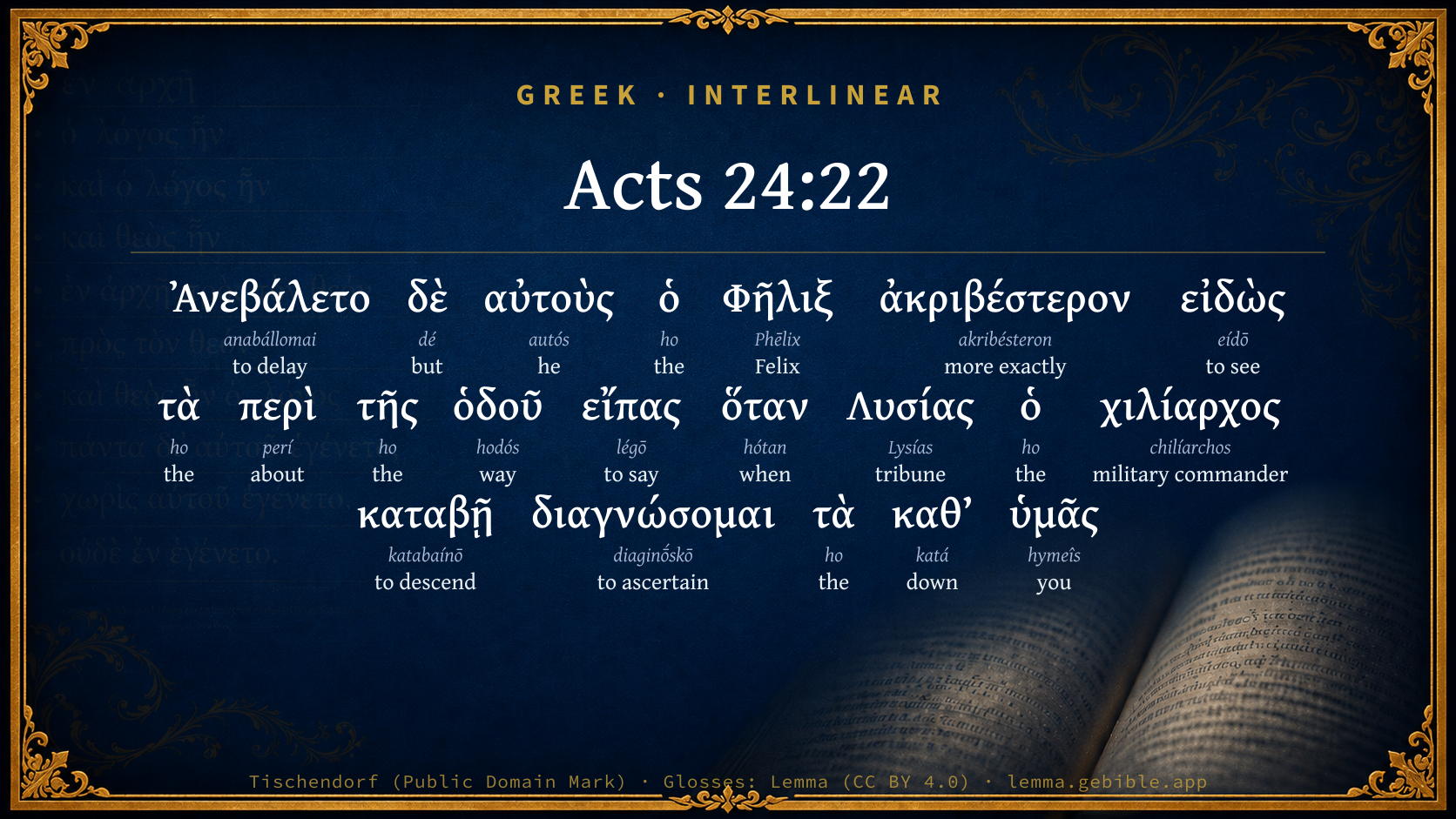
Greek (Tischendorf 8th ed.) Acts 24:22 appears in the Greek New Testament. The text above is from the Tischendorf 8th edition. Each word links to its Strong’s number and a concise gloss. Click any word for its full Thayer’s Greek Lexicon entry.
Download image
Cite this verse

Acts 24:22 (World English Bible). Public Domain. Lemma interlinear Bible study tool, https://lemma.gebible.app/v/acts/24/22.

Show BibTeX & RIS
BibTeX
RIS
English Translation
But Felix, having more exact knowledge concerning the Way, deferred them, saying, "When Lysias, the commanding officer, comes down, I will decide your case."
World English Bible · Public Domain
Highlights
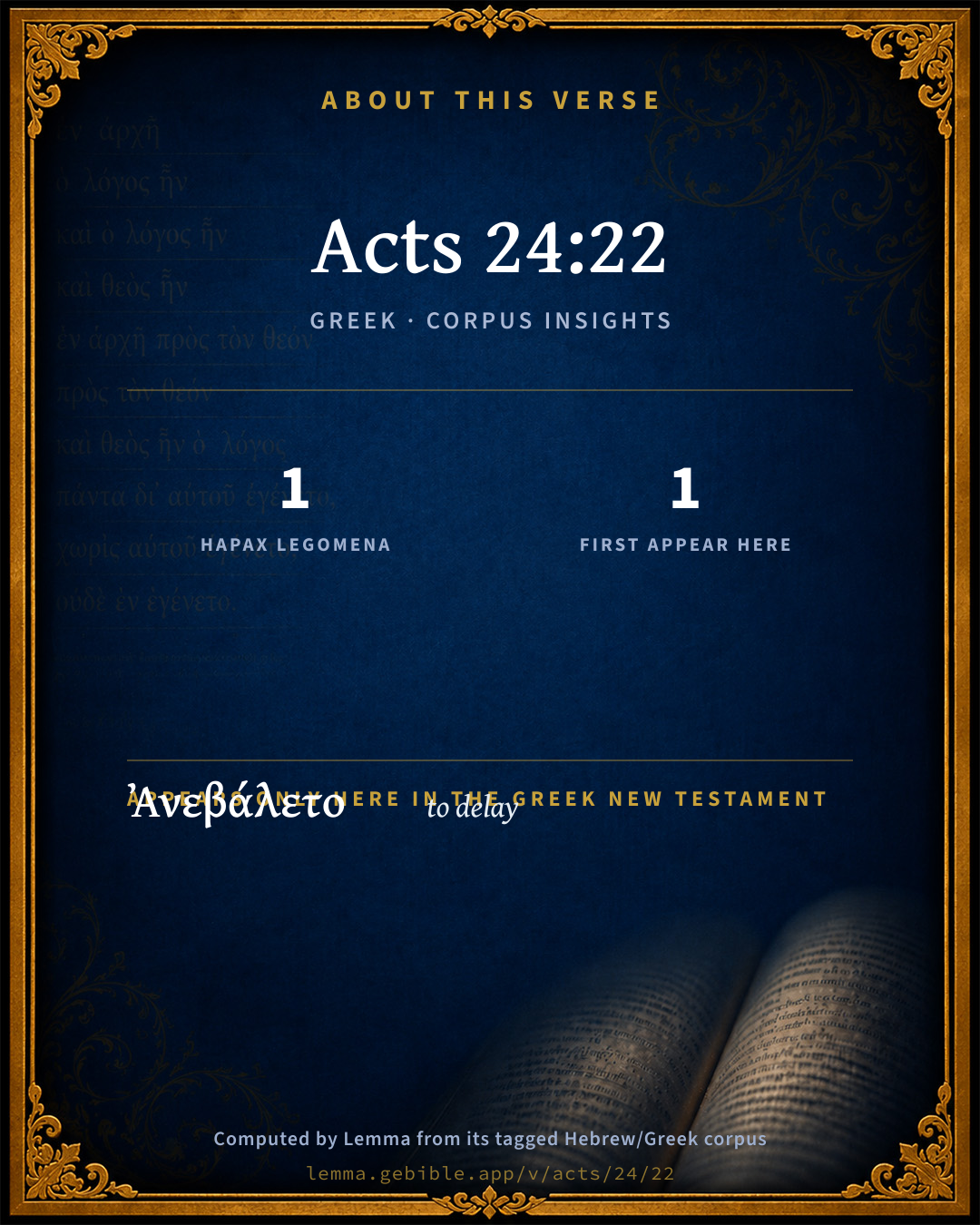
  • 1 hapax legomenon — only here in the Greek New Testament
  • 1 first appearance in the Greek New Testament
Full analysis ↓
Download a study sheet

One document with this verse’s original text, its word-by-word gloss line, the meaning frame, cross-references with their text, attributed commentary, and full source and license credits — printable, and it pastes into notes with its structure intact.

This verse Autodidact and up

Study sheet (.html) Plain text (.txt)

A passage Seminary Student

Up to 50 verses in one chapter. A passage sheet keeps up to 6 commentary sources and 12 cross-references per verse, in the order this page ranks them, and says so on the sheet whenever that leaves anything out. Ask for a single verse and you get the Autodidact verse sheet above.

Everything on this page stays free to read, with no account — the sheet is a download of what is already on screen, not access to it.

Want to remove ads? Support Godless Engineer
Compare translations 3

The same verse in 3 English versions, stacked beneath the original-language interlinear above. Click any original word for its lexicon entry.

Each is an independent rendering of the whole verse — the interlinear is not word-aligned to these translations.

Highlighted words mark where these versions differ — a whole-verse word diff, not a word-by-word alignment.

  • World English Bible Public Domain
    But Felix, having more exact knowledge concerning the Way, deferred them, saying, "When Lysias, the commanding officer, comes down, I will decide your case."
  • King James Version Public Domain
    And when Felix heard these things, having more perfect knowledge of that way, he deferred them, and said, When Lysias the chief captain shall come down, I will know the uttermost of your matter.
  • unfoldingWord Literal Text CC BY-SA 4.0
    Then Felix, knowing more accurately the things concerning the Way, adjourned them, saying, “When Lysias the chiliarch may come down, I will decide the things concerning you,”

unfoldingWord Literal Text — © unfoldingWord, licensed CC BY-SA 4.0. Word-aligned USFM3 via Door43 (git.door43.org/unfoldingWord/en_ult).

Versions to compare (up to 4)

3 of 4 selected

Show all 19 translations

Every available English version of this verse, each an independent rendering of the whole verse.

  • World English Bible Public Domain
    But Felix, having more exact knowledge concerning the Way, deferred them, saying, "When Lysias, the commanding officer, comes down, I will decide your case."
  • Berean Standard Bible Public Domain
    Then Felix, who was well informed about the Way, adjourned the hearing and said, “When Lysias the commander comes, I will decide your case.”
  • Majority Standard Bible Public Domain
    On hearing these things Felix, who was well informed about the Way, adjourned the hearing and said, “When Lysias the commander comes, I will decide your case.”
  • King James Version Public Domain
    And when Felix heard these things, having more perfect knowledge of that way, he deferred them, and said, When Lysias the chief captain shall come down, I will know the uttermost of your matter.
  • American Standard Version (1901) Public Domain
    But Felix, having more exact knowledge concerning the Way, deferred them, saying, When Lysias the chief captain shall come down, I will determine your matter.
  • Revised Version (1885) Public Domain
    But Felix, having more exact knowledge concerning the Way, deferred them, saying, When Lysias the chief captain shall come down, I will determine your matter.
  • Geneva Bible (1599) Public Domain
    Nowe when Felix heard these things, he deferred them, and said, When I shall more perfectly know the things which concerne this way, by the comming of Lysias the chiefe Captaine, I will decise your matter.
  • Douay-Rheims (1899) Public Domain
    And Felix put them off, having most certain knowledge of this way, saying: When Lysias the tribune shall come down, I will hear you.
  • Young's Literal Translation Public Domain
    And having heard these things, Felix delayed them -- having known more exactly of the things concerning the way -- saying, `When Lysias the chief captain may come down, I will know fully the things concerning you;'
  • Literal Standard Version CC BY-SA 4.0
    And having heard these things, Felix delayed them—having known more exactly of the things concerning The Way—saying, “When Lysias the chief captain may come down, I will know fully the things concerning you”;
  • Unlocked Literal Bible CC BY-SA 4.0
    Then Felix, who was well informed about the Way, ajourned the hearing. He said, “When Lysias the commander comes down from Jerusalem, I will decide your case.”
  • unfoldingWord Literal Text CC BY-SA 4.0
    Then Felix, knowing more accurately the things concerning the Way, adjourned them, saying, “When Lysias the chiliarch may come down, I will decide the things concerning you,”
  • Darby Bible Public Domain
    And Felix, knowing accurately the things concerning the way, adjourned them, saying, When Lysias the chiliarch is come down I will determine your affair;
  • World Messianic Bible Public Domain
    But Felix, having more exact knowledge concerning the Way, deferred them, saying, “When Lysias, the commanding officer, comes down, I will decide your case.”
  • Webster's Bible Public Domain
    And when Felix heard these things, having more perfect knowledge of that way, he deferred them, and said, When Lysias the chief captain shall come down, I will know the uttermost of your matter.
  • Free Bible Version CC BY-SA 4.0
    Felix who was well-informed about the Way then adjourned the trial. “When Lysias the commander comes I will make my decision regarding your case,” he said.
  • Bible in Basic English Public Domain
    But Felix, who had a more detailed knowledge of the Way, put them off, saying, When Lysias, the chief captain, comes down, I will give attention to your business.
  • Text-Critical English NT CC BY 4.0
    After hearing these things, Felix, who knew the facts concerning the Way in great detail, had them adjourn, saying, “When Lysias the commander comes down, I will decide your case.”
  • Tyndale New Testament (1534) Public Domain
    When Felix hearde these thinges he deferde them for he knewe very well of that waye and sayde: when Lisias the captayne is come I will know the vtmost of youre matters.

Literal Standard Version (2020), Covenant Press — licensed CC BY-SA 4.0. Text via the HelloAO Bible API (eBible.org). Unlocked Literal Bible (unfoldingWord) — licensed CC BY-SA 4.0. Text via the HelloAO Bible API (eBible.org). unfoldingWord Literal Text — © unfoldingWord, licensed CC BY-SA 4.0. Word-aligned USFM3 via Door43 (git.door43.org/unfoldingWord/en_ult). Free Bible Version, Dr. Jonathan Gallagher — licensed CC BY-SA 4.0. Text via the HelloAO Bible API (eBible.org).

Word by word

More ways to search: Search by grammar → Find every occurrence → Compare this word →

Practice this passage: Drill this verse → Learn its vocabulary →

Ἀνεβάλετο
anabállomai
G306
“to delay”
Verb, Aorist, Middle, Indicative, 3rd person, Singular
Part of Speech
Verb
Tense
Aorist
Voice
Middle
Mood
Indicative
Person
3rd person
Number
Singular
Full Thayer's Definition

Origin: middle voice from G303 and G906

TDNT: None

1. to throw or toss up 2. to put back or off, delay, postpone
  1. δὲ dé G1161 “but” Conjunction
  2. αὐτοὺς autós G846 “he” Personal pronoun, Accusative, Plural, Masculine
  3. ὁ ho G3588 “the” Article, Nominative, Singular, Masculine
  4. Φῆλιξ Phēlix G5344 “Felix” Noun, Nominative, Singular, Masculine
  5. ἀκριβέστερον akribésteron G197 “more exactly” Adverb, Comparative
  6. εἰδὼς eídō G1492 “to see” Verb, Perfect, Active, Participle, Nominative, Singular, Masculine
  7. τὰ ho G3588 “the” Article, Accusative, Plural, Neuter
  8. περὶ perí G4012 “about” Preposition
  9. τῆς ho G3588 “the” Article, Genitive, Singular, Feminine
  10. ὁδοῦ hodós G3598 “way” Noun, Genitive, Singular, Feminine
  11. εἴπας légō G3004 “to say” Verb, Aorist, Active, Participle, Nominative, Singular, Masculine
  12. ὅταν hótan G3752 “when” Conjunction
  13. Λυσίας Lysías G3079 “tribune” Noun, Nominative, Singular, Masculine
  14. ὁ ho G3588 “the” Article, Nominative, Singular, Masculine
  15. χιλίαρχος chilíarchos G5506 “military commander” Noun, Nominative, Singular, Masculine
  16. καταβῇ katabaínō G2597 “to descend” Verb, Aorist, Active, Subjunctive, 3rd person, Singular
  17. διαγνώσομαι diaginṓskō G1231 “to ascertain” Verb, Future, Middle deponent, Indicative, 1st person, Singular
  18. τὰ ho G3588 “the” Article, Accusative, Plural, Neuter
  19. καθ’ katá G2596 “down” Preposition
  20. ὑμᾶς hymeîs G5210 “you” Personal pronoun, 2nd person, Accusative, Plural

About this verse

These counts appear in no published source. They are computed here, from the morphology-tagged text and Lemma’s own curated glosses. What Lemma adds →

21
words
17
distinct lemmas
Acts
section

Notable vocabulary

1 hapax legomenon — a word that appears only here in the entire Greek New Testament:

  • Ἀνεβάλετο to delay G306

First appearance in Scripture

This word makes its first canonical appearance in the Greek New Testament here:

  • Ἀνεβάλετο to delay G306

Shared distinctive vocabulary

Λυσίας tribune G3079 occurs in 2 verses of the Greek New Testament. Also found in:

Repetition

A word recurs within this verse:

Cross-references

8

Topical passages linked to Acts 24:22 in the Treasury of Scripture Knowledge — connected by theme and wording, ordered by reader-vote popularity; previews shown in the World English Bible.

  • Deuteronomy 19:18 and the judges shall make diligent inquisition: and, behold, if the witness is a false witness, and has testified falsely against his brother;
  • Acts 18:20 When they asked him to stay with them a longer time, he declined;
  • Acts 24:6 He even tried to profane the temple, and we arrested him.
  • Acts 24:10 When the governor had beckoned to him to speak, Paul answered, "Because I know that you have been a judge of this nation for many years, I cheerfully make my defense,
  • Acts 24:14 But this I confess to you, that after the Way, which they call a sect, so I serve the God of our fathers, believing all things which are according to the law, and which are written in the prophets;
  • Acts 24:24 But after some days, Felix came with Drusilla, his wife, who was a Jewess, and sent for Paul, and heard him concerning the faith in Christ Jesus.
  • Acts 25:26 Of whom I have no certain thing to write to my lord. Therefore I have brought him forth before you, and especially before you, King Agrippa, that, after examination, I may have something to write.
  • Acts 26:3 especially because you are expert in all customs and questions which are among the Jews. Therefore I beg you to hear me patiently.

Cross-references courtesy of OpenBible.info (CC BY 4.0).

Where the printed editions differ

1 variant

Places in this verse where the major printed Greek editions disagree on the wording in a way that affects the translation — a comparison of editions, not a manuscript-by-manuscript collation. The editions are the modern critical texts (Nestlé-Aland 28/27, SBL, Westcott-Hort, Tregelles, Tyndale House) and the traditional texts behind the KJV (the Textus Receptus and the Byzantine/Majority text). It is not a claim about which reading is original.

  1. Extra text
    Ἀκούσας ταῦτα

    “having heard these things”

    In TRByz Not in NA28NA27TynSBLWHTreg

    Ἀκούσας ταῦτα (Akousas tauta) 'having heard these things' is only in traditional manuscripts (TR+Byz)

Textual data: Translators Amalgamated Greek New Testament (STEPBible TAGNT) · CC BY 4.0.

Commentary

Notes on Acts 24:22 from classic Christian and Jewish commentators (each source and its license shown beneath its notes). The classic Christian expositions comment on the surrounding passage and are grouped to its opening verse, so a note may address several verses; the Jewish commentaries on the Tanakh (Rashi and others) are per-verse, so they appear only where the commentator wrote on this verse.

Lemma curates 59 commentaries, every one of them public domain or Creative Commons licensed, each selected and text-cleaned for this edition rather than reprinted as found. About our sources →

Matthew Henry's Commentary

We have here the result of Paul's trial before Felix, and what was the consequence of it.

I. Felix adjourned the cause, and took further time to consider of it (Act 24:22): He had a more perfect knowledge of that way which the Jews called heresy than the high priest and the elders thought he had. He understood something of the Christian religion; for, living at Caesarea, where Cornelius, a Roman centurion, was, who was a Christian, from him and others he had got a notion of Christianity, that it was not such an evil thing as it was represented. He himself knew some of that way to be honest good men, and very conscientious, and therefore he put off the prosecutors with an excuse: "When the chief captain shall come down hither, I will know the uttermost of your matter, or I shall know the truth, whether this Paul did go about to raise sedition or no; you are parties, he is an indifferent person. Either Paul deserves to be punished for raising the tumult, or you do for doing it yourselves and then charging it upon him; and I will hear what he says, and determine accordingly between you." Now, 1. It was a disappointment to the high priest and the elders that Paul was not condemned, or remitted to their judgment, which they wished for and expected. But thus sometimes God restrains the wrath of his people's enemies by the agency, not of their friends, but of such as are strangers to them. And though they be so, if they have but some knowledge of their way, they cannot but appear for their protection. 2. It was an injury to Paul that he was not released. Felix ought to have avenged him of his adversaries, when he so plainly saw there was nothing but malice in the prosecution, and to have delivered him out of the hand of the wicked, according to the duty of a judge, Psa 82:4. But he was a judge that neither feared God nor regarded man, and what good could be expected from him? It is a wrong not only to deny justice, but to delay it.

II. He detained the prisoner in custody, and would not take bail for him; else here at Caesarea Paul had friends enough that would gladly have been his security. Felix thought a man of such a public character as Paul was had many friends, as well as many enemies, and he might have an opportunity of obliging them, or making a hand of them, if he did not presently release him, and yet did show him countenance; and therefore, 1. He continued him a prisoner, commanded a centurion or captain to keep him, Act 24:23. He did not commit him to the common jail, but, being first made an army-prisoner, he shall still be so. 2. Yet he took care he should be a prisoner at large - in libera custodia; his keeper must let him have liberty, not bind him nor lock him up, but make his confinement as easy to him as possible; let him have the liberty of the castle, and, perhaps, he means liberty to take the air, or go abroad upon his parole: and Paul was such an honest man that they might take his word for his return. The high priest and the elders grudged him his life, but Felix generously allows him a sort of liberty; for he had not those prejudices against him and his way that they had. He also gave orders that none of his friends should be hindered from coming to him; the centurion must not forbid any of his acquaintances from ministering to him; and a man's prison is as it were his own house if he has but his friends about him.

III. He had frequent conversation with him afterwards in private, once particularly, not long after his public trial, Act 24:24, Act 24:25. Observe,

1. With what design Felix sent for Paul. He had a mind to have some talk with him concerning the faith in Christ, the Christian religion; he had some knowledge of that way, but he desired to have an account of it from Paul, who was so celebrated a preacher of that faith, above the rest. Those that would enlarge their knowledge must discourse with men of their own profession, and those that would be acquainted with any profession should consult those that excel in the knowledge of it; and therefore Felix had a mind to talk with Paul more freely than he could in open court, where he observed Paul upon his guard, concerning the faith of Christ; and this only to satisfy his curiosity, or rather the curiosity of his wife Drusilla, who was a Jewess, daughter of Herod Agrippa, that was eaten of worms. Being educated in the Jewish religion, she was more inquisitive concerning the Christian religion, which pretended to be the perfection of that, and desired to hear Paul discourse of it. But it was no great matter what religion she was of; for, whatever it was, she was a reproach and scandal to it - a Jewess, but an adulteress; she was another man's wife when Felix took her to be his wife, and she lived with him in whoredom and was noted for an impudent woman, yet she desires to hear concerning the faith of Christ. Many are fond of new notions and speculations in religion, and can hear and speak of them with pleasure, who yet hate to come under the power and influence of religion, can be content to have their judgments informed but not their lives reformed.

2. What the account was which Paul gave him of the Christian religion; by the idea he had of it, he expected to be amused with a mystical divinity, but, as Paul represents it to him, he is alarmed with a practical divinity. Paul, being asked concerning the faith in Christ, reasoned (for Paul was always a rational preacher) concerning righteousness, temperance, and judgment to come. It is probable that he mentioned the peculiar doctrines of Christianity concerning the death and resurrection of the Lord Jesus, and his being the Mediator between God and man; but he hastened to his application, in which he designed to come home to the consciences of his hearers.

(1.) He discoursed with clearness and warmth of righteousness, temperance, and judgment to come; and here he showed, [1.] That the faith in Christ is designed to enforce upon the children of men the great laws of justice and temperance. The grace of God teacheth us to live soberly and righteously, Tit 2:12. Justice and temperance were celebrated virtues among the heathen moralists; if the doctrine Paul preaches, which Felix has heard of as proclaiming liberty, will but free him from an obligation to these, he will readily embrace it: "No," says Paul, "it is so far from doing so that it strengthens the obligations of those sacred laws; it binds all under the highest penalties to be honest in all their dealings, and to render to all their due; to deny themselves, and to keep under the body, and bring it into subjection." The world and the flesh being in our baptism renounced, all our pursuits of the world and all our gratifications of the desires of the body are to be under the regulations of religion. Paul reasoned of righteousness and temperance, to convince Felix of his unrighteousness and intemperance, of which he had been notoriously guilty, that, seeing the odiousness of them, and his obnoxiousness to the wrath of God for them (Eph 5:6), he might enquire concerning the faith of Christ, with a resolution to embrace it. [2.] That by the doctrine of Christ is discovered to us the judgment to come, by the sentence of which the everlasting state of all the children of men will be finally and irreversibly determined. Men have their day now, Felix hath his; but God's day is coming, when everyone shall give account of himself to God, the Judge of all. Paul reasoned concerning this; that is, he showed what reason we have to believe that there is a judgment to come, and what reason we have, in consideration thereof, to be religious.

(2.) From this account of the heads of Paul's discourse we may gather, [1.] That Paul in his preaching had no respect to persons, for the word of God, which he preached, has not: he urged the same convictions and instructions upon the Roman governor that he did upon other people. [2.] That Paul in his preaching aimed at the consciences of men, and came close to them, sought not to please their fancy nor to gratify their curiosity, but led them to a sight of their sins and a sense of their duty and interest. [3.] That Paul preferred the serving of Christ, and the saving of souls, before his own safety. He lay at the mercy of Felix, who had power (as Pilate said) to crucify him (or, which was as bad, to deliver him back to the Jews), and he had power to release him. Now when Paul had his ear, and had him in a good humour, he had a fair opportunity of ingratiating himself with him, and obtaining a release, nay, and of incensing him against his prosecutors: and, on the contrary, if he disobliged him, and put him out of humour, he might do himself a great diskindness by it; but he is wholly negligent of these considerations, and is intent upon doing good, at least discharging his duty. [4.] That Paul was willing to take pains, and run hazards, in his work, even where there was little probability of doing good. Felix and Drusilla were such hardened sinners that it was not at all likely they should be brought to repentance by Paul's preaching, especially under such disadvantages; and yet Paul deals with them as one that did not despair of them. Let the watchman give fair warning, and then they have delivered their own souls, though they should not prevail to deliver the souls they watch for.

3. What impressions Paul's discourse made upon this great but wicked man: Felix trembled, emphobos genomenos - being put into a fright, or made a terror to himself, a magor-missabib, as Pashur, Jer 20:3, Jer 20:4. Paul never trembled before him, but he was made to tremble before Paul. "If this be so, as Paul says, what will become of me in another world? If the unrighteous and intemperate will be condemned in the judgment to come, I am undone, for ever undone, unless I lead a new course of life." We do not find that Drusilla trembled, though she was equally guilty, for she was a Jewess, and depended upon the ceremonial law, which she adhered to the observance of, to justify her; but Felix for the present could fasten upon nothing to pacify his conscience, and therefore trembled. See here, (1.) The power of the word of God, when it comes with commission; it is searching, it is startling, it can strike a terror into the heart of the most proud and daring sinner, by setting his sins in order before him, and showing him the terrors of the Lord. (2.) The workings of natural conscience; when it is startled and awakened, it fills the soul with horror and amazement at its own deformity and danger. Those that are themselves the terror of the mighty in the land of the living have hereby been made a terror to themselves. A prospect of the judgment to come is enough to make the stoutest heart to tremble, as when it comes indeed it will make the mighty men and the chief captains to call in vain to rocks and mountains to shelter them.

4. How Felix struggled to get clear of these impressions, and to shake off the terror of his convictions; he did by them as he did by Paul's prosecutors (Act 24:25), he deferred them; he said, Go thy way for this time, when I have a convenient season I will call for thee. (1.) He trembled and that was all. Paul's trembling (Act 9:6), and the jailer's (Act 16:29), ended in their conversion, but this of Felix did not. Many are startled by the word of God who are not effectually changed by it. Many are in fear of the consequences of sin, and yet continue in love and league with sin. (2.) He did not fight against his convictions, nor fly in the face of the word or of the preacher of it, to be revenged on them for making his conscience fly in his face; he did not say to Paul, as Amaziah to the prophet, Forbear, why shouldst thou be smitten? He did not threaten him with a closer confinement, or with death, for touching him (as John Baptist did Herod) in the sore place. But, (3.) He artfully shifted off his convictions by putting off the prosecution of them to another time. He has nothing to object against what Paul has said; it is weighty and worth considering. But, like a sorry debtor, he begs a day; Paul has spent himself, and has tired him and his lady, and therefore, "Go thy way for this time - break off here, business calls me away; but when I have a convenient season, and have nothing else to do, I will call for thee, and hear what thou hast further to say." Note, [1.] Many lose all the benefit of their convictions for want of striking while the iron is hot. If Felix, now that he trembled, had but asked, as Paul and the jailer did when they trembled, What shall I do? he might have been brought to the faith of Christ, and have been a Felix indeed, happy for ever; but, by dropping his convictions now, he lost them for ever, and himself with them. [2.] In the affairs of our souls, delays are dangerous; nothing is of more fatal consequence than men's putting off their conversion from time to time. They will repent, and turn to God, but not yet; the matter is adjourned to some more convenient season, when such a business or affair is compassed, when they are so much older; and then convictions cool and wear off, good purposes prove to no purpose, and they are more hardened than ever in their evil way. Felix put off this matter to a more convenient season, but we do not find that this more convenient season ever came; for the devil cozens us of all our time by cozening us of the present time. The present season is, without doubt, the most convenient season. Behold, now is the accepted time. Today if you will hear his voice.

IV. After all, he detained him a prisoner, and left him so, when two years after he was removed from the government, Act 24:26, Act 24:27. He was convinced in his conscience that Paul had done nothing worthy of death or of bonds, and yet had not the honesty to release him. To little purpose had Paul reasoned with him about righteousness, though he then trembled at the thought of his own iniquity, who could thus persist in such a palpable piece of injustice. But here we are told what principles he was governed by herein; and they were such as make the matter yet much worse. 1. The love of money. He would not release Paul because he hoped to make his market of him, and that at length his friends would make a purse to purchase his liberty, and then he would satisfy his conscience by releasing him when he could withal satisfy his covetousness by it; but he cannot find in his heart to do his duty as a judge, unless he can get money by it: He hoped that money would have been given him of Paul, or somebody for him, and then he would have loosed him, and set him at liberty. In hopes of this, he detains him a prisoner, and sends for him the oftener, and communes with him; not any more about the faith of Christ (he had had enough of that, and of the judgment to come; Paul must not return to those subjects, nor go on with them), but about his discharge, or ransom rather, out of his present captivity. He cannot for shame ask Paul what he will give him to release him, but he sends for him to feel his pulse, and gives him an opportunity to ask why he would take to release him. And now we see what became of his promise both to Paul and to himself, that he would hear more of Christ at some other convenient season. Here were many seasons convenient enough to have talked that matter through, but nothing is done in it; all his business now is to get money by Paul, not to get the knowledge of Christ by him. Note, It is just with God to say concerning those who trifle with their convictions, and think they can have the grace of God at command when they please, My Spirit shall no more strive with them. When men will not hear God's voice today, while it is called today, the heart is commonly hardened by the deceitfulness of sin. Paul was but a poor man himself, silver and gold he had none to give, to purchase his liberty; but Felix knew there were those who wished well to him who were able to assist him. He having lately collected a great deal of money for the poor saints to relieve them, it might also be expected that the rich saints should contribute some to release him, and I wonder it was not done. Though Paul is to be commended that he would not offer money to Felix, nor beg money of the churches (his great and generous soul disdained both), yet I know not whether his friends are to be commended, nay, whether they can be justified, in not doing it for him. They ought to have solicited the governor as pressingly for him as his enemies did against him: and if a gift was necessary to make room for them (as Solomon speaks) and to bring them before great men, they might lawfully have done it. I ought not to bribe a man to do an unjust thing, but, if he will not do me justice without a fee, it is but doing myself justice to give it to him; and, if they might do it, it was a shame they did not do it. I blush for them, that they would let such an eminent and useful man as Paul lie in the jail, when a little money would have fetched him out, and restored him to his usefulness again. The Christians here at Caesarea, where he now was, had parted with their tears to prevent his going to the prison (Act 21:13), and could they not find in their hearts to part with their money to help him out? Yet there might be a providence of God in it; Paul's bonds must be for the furtherance of the gospel of Christ, and therefore he must continue in bonds. However, this will not excuse Felix, who ought to have released an innocent man, without demanding or accepting any thing for it: the judge that will not do right without a bribe will no doubt do wrong for a bribe. 2. Men-pleasing. Felix was recalled from his government about two years after this, and Porcius Festus was put in his place, and one should have expected he would have at least concluded his government with this act of justice, the release of Paul, but he did not; he left Paul bound, and the reason here given is because he was willing to do the Jews a pleasure. Though he would not deliver him to death, to please them, yet he would continue him a prisoner rather than offend them; and he did it in hope hereby to atone for the many offences he had done against them. He did not think Paul had either interest or inclination to complain of him at court, for detaining him so long in custody, against all law and equity; but he was jealous of the high priest and elders, that they would be his accusers to the emperor for the wrongs he had done them, and therefore hopes by gratifying them in this matter to stop their mouths. Thus those who do some base things are tempted to do more to screen themselves and bear them out. If Felix had not injured the Jews, he needed not to have done this to please them; but, when he had done it, it seems he did not gain his point. The Jews, notwithstanding this, accused him to the emperor, and some historians say he was sent bound to Rome by Festus; and, if so, surely his remembering how light he had made of Paul's bonds would help to make his own chain heavy. Those that aim to please God by doing good will have what they aim at; but so will not those that seek to please men by doing evil.

Matthew Henry's Commentary on the Whole Bible (1708–1710) — public domain (CC PDM 1.0). Text via the HelloAO Bible API.

Joseph Benson's Commentary

Act 24:22-23. When Felix heard these things — Namely, the orator’s accusation and the prisoner’s defence; having more perfect knowledge of that way — Ακριβεστερον ειδως τα περι της οδου, having known more perfectly the things concerning the way, namely, the way of worship, mentioned by Paul, (Act 24:14,) or a more perfect knowledge of Jesus and his disciples than had been given him by the high-priest, the elders, and their orator; and knowing it not to be so mischievous a thing as these accusers suggested; he deferred them — This seems to be that interpretation of the clause which best accords with the original. Beza, Grotius, and many others, however, take the meaning of the clause to be, that Felix “would take an opportunity of being more particularly informed of this sect, and of its aspect on the public tranquillity; and that when Lysias should come down and give him an account of what he had observed concerning it, as well as of the circumstances attending Paul’s apprehension, &c., he would determine the affair.” “But it seems to me evident,” says Dr. Whitby, “that the original words cannot admit of this explication, namely, that Felix deferred them that he might have a more exact knowledge of Christianity; but that, having his residence at Cesarea, where Cornelius the centurion and his friends were converted, where Philip the evangelist dwelt, and where there were many disciples, (Act 21:8; Act 21:16,) he had thus become acquainted with the way of Christianity.” But though Felix did not find any crime proved against Paul, yet he did not acquit him, because he was afraid of displeasing the Jews. Being, however, fully convinced (as it is evident he was) of his innocence, he ordered that he should not be confined too closely; but that his acquaintance should be allowed to visit him, or minister unto him; a liberty which we may be sure the brethren of Cesarea made good use of during his long imprisonment in that city.

Joseph Benson's Commentary on the Old and New Testaments (1811–1818) — public domain. Text from a community e-Sword module.

Whedon's Commentary on the Bible

Daniel D. Whedon

2. Felix’s Last Dealings with Paul, Act_24:22-27.

22. More… way—Felix had a more perfect knowledge of Christianity than would permit him to condemn Paul upon these charges. (Note Act_24:10.)

Deferred them—This court stands adjourned for want of evidence to convict and of a bribe to acquit. Lysias… shall come—The high priest departs, and no Lysias comes.

Daniel D. Whedon (gen. ed.), Commentary on the Old and New Testaments (1874–1909) — public domain. Text from a community e-Sword module.

Tyndale Open Study Notes

Tyndale Open Resources

24:22 Perhaps Felix delayed his decision hoping that Paul would bribe him (24:26).

Tyndale Open Study Notes — © Tyndale Open Resources, licensed CC BY-SA 4.0. Text via the HelloAO Bible API.

Bengel's Gnomon

Johann Albrecht Bengel

Act 24:22. Ἀνεβάλετο, he deferred them) Dilatory measures are the safe ones for the world in the case of Divine things.—ἀκριβέστερον, more accurately) Through these governors accurate knowledge of Christianity was carried to Rome.

Bengel's Gnomon of the New Testament — English translation (T&T Clark, Edinburgh, 1860) — public domain. Text from a community e-Sword module.

Meyer's Critical & Exegetical Commentary

Heinrich August Wilhelm Meyer

Act_24:22. With the frank challenge to his accusers (Act_24:20-21) Paul closes his speech. But Felix, who declares that he wished still to institute a further examination of the matter with the assistance of Lysias, decides for the present on an adjournment: ἀνεβάλετο αὐτούς, ampliavit eos (both parties). He pronounced until further investigation the non liquet (Cic. Cluent. 28, Brisson. formul.), and for the time being adjourned the settlement of the accusation. See on the judicial term ἀναβάλλεσθαι (Dem. 1042 ult.), Wetstein, and Kypke, II. p. 123 f.

ἀκριβέστερον εἰδὼς τὰ περὶ τῆς ὁδοῦ] The only correct interpretation is: because he knew more exactly what referred to Christianity (Act_24:14). As Felix had been procurator for more than six years, and as Christianity was diffused everywhere in Judaea, even in Caesarea itself, it was natural that he should have an ἀκριβέστερον knowledge of the circumstances of that religion than was given to him in the present discussion; therefore he considered it the most fitting course to leave the matter still in suspense. In doing so he prudently satisfied, on the one hand, his regard for the favour of the Jews (comp. Act_24:27) by not giving Paul his liberty; while, on the other hand, he satisfied his better intelligence about Christianity, by which, notwithstanding his badness in other respects, he felt himself precluded from pleasing the Jews and condemning the apostle. This connection, which in essentials the Vulgate, Chrysostom, Erasmus, Luther, Castalio, Wolf, and others (comp. Bengel: consilia dilatoria, tuta mundo in rebus divinis) have expressed, has been often mistaken. Beza and Grotius, followed by Rosenmüller, Heinrichs, and Ewald, regard ἀκριβέστερον … ὁδοῦ as part of the speech of Felix: Ubi exactius didicero, quid sit de hac secta, et ubi Lysias venerit, causam illam terminabo (Grotius). But so late a bringing in of the εἰπών is entirely without precedent in the N.T. (see also Bornemann, and Rosenmüller, Repert. II. p. 281 f.). Michaelis and Morus resolve εἰδώς by quamquam; notwithstanding his better knowledge of Christianity, Felix did not release Paul. But this resolution is the less suggested by the relation of the participle to the verb, as afterwards, Act_24:23, the specially mild treatment of the apostle is expressly stated. According to de Wette (comp. Wetstein), the sense is: As he needed no further hearing of the accused, and it was only necessary now to hear the tribune. But the reference to the tribune is only to be regarded as a welcome pretext and evasion; an actual hearing of Lysias would have been reported in the sequel of the history. Lastly, Kuinoel erroneously renders: when he had inquired more exactly, which εἰδώς does not mean.

τὰ καθʼ ὑμᾶς] your matters, not: your misdeeds (so Böttger, Beitr. II. p. 12, as a threat to the Jews), as if it were τὰ καθʼ ὑμῶν. On διαγνώσ., comp. Act_23:15.

Meyer — Critical and Exegetical Commentary on the New Testament — English translation by Peter Christie, edited by Frederick Crombie (T&T Clark, 1880) — public domain. Text from a community e-Sword module.

Expositor's Greek Testament

ed. W. Robertson Nicoll

Act 24:22 . ἀνεβάλετο : ampliavit eos , a technical expression, only here in N. T., the judges were wont to say Amplius in cases where it was not possible to pass at once a judgment of condemnation or acquittal before further inquiry, Cic., In Verr. , i., 29. ἀκριβ .: “having more exact knowledge concerning the Way” than to be deceived by the misrepresentation of the Jews; he may have learnt some details of the Christian sect during his years of office from his wife Drusilla, or possibly during his residence in Cæsarea, where there was a Christian community and the home of Philip the Evangelist, and where Cornelius had been converted. This knowledge, the writer indicates, was the real reason: the reason which Felix alleged was that he required the evidence of Lysias in person. Wendt, Zöckler, Bethge, Nösgen take the words to mean that the address of Paul had offended Felix’s more accurate knowledge, and on this account he put off any decision. On the comparative see Blass, Gram. , p. 139. τὰ περὶ : characteristic of Luke and Paul, see p. 481. διαγ . τὰ καθʼ ὑμᾶς : “I will determine your matter,” R.V., cf. Act 25:21 , and see above on Act 23:15 . τὰ καθʼ ὑμᾶς : probably refers to both accusers and accused. On τὰ before κατά characteristic of Luke see instance in Moulton and Geden, and Hawkins, Horæ Synopticæ , p. 38.

The Expositor's Greek Testament, edited by W. Robertson Nicoll (1897–1910) — public domain. Text from a community e-Sword module.

Geneva Bible (1599)

Geneva Bible translators

The Judge suspendeth his sentence, because the matter is doubtful.

Felix could not judge whether he had done wickedly in the matters of his religion or no, until he had better understanding of that way which Paul professed: and as for other matters touching the sedition, he thinketh good to defer it till he hears Lysias, and therefore he gave Paul somewhat more liberty.

Geneva Bible (1599) marginal notes — public domain. Text via Bolls.life.

Jamieson, Fausset & Brown

Robert Jamieson, A. R. Fausset & David Brown

having more perfect knowledge of that--"the"

way--(See on Act 19:23; and Act 24:14).

When Lysias . . . shall come . . . I will how, &c.--Felix might have dismissed the case as a tissue of unsupported charges. But if from his interest in the matter he really wished to have the presence of Lysias and others involved, a brief delay was not unworthy of him as a judge. Certainly, so far as recorded, neither Lysias nor any other parties appeared again in the case. Act 24:23, however, seems to show that at that time his prepossessions in favor of Paul were strong.

Jamieson, Fausset & Brown — Commentary Critical and Explanatory on the Whole Bible (1871) — public domain (CC PDM 1.0). Text via the HelloAO Bible API.

Adam Clarke's Commentary

Verse 22. And when Felix heard these things] There is considerable difficulty in this verse. Translators greatly vary concerning the sense; and the MSS. themselves read variously. Mr. Wakefield's translation appears to be as proper as most: Now Felix, upon hearing these things, put them off by saying, When Lysias the captain is come down, after I have gained a more exact knowledge of this doctrine, I will inquire fully into your business.

Calmet's translation is nearly to the same sense:-

Felix, having heard these things, put them off to another time, saying, When I shall have acquired a more accurate knowledge of this sect, and when the tribune Lysias shall have come from Jerusalem, I will judge of your business.

And this mode of interpretation is rendered the more likely from the circumstance, that, previously to the coming down of Lysias, Felix had sent for Paul, concerning the faith of Christ; and this he appears to have done, that he might be the better qualified to judge of the business, when it should come again before him. See Clarke on Ac 24:20.

Adam Clarke's Commentary on the Bible (1810–1826) — public domain. Text from a community e-Sword/MySword module.

Ellicott's Commentary for English Readers

(22) Having more perfect knowledge of that way . . .—Better, of the way. (See Note on Act_9:2.) The comparative implies a reference to an average standard. Felix was too well-informed to yield any answer to the declamatory statements of Tertullus. He saw that the prisoner was no common Sicarius, or leader of sedition. He knew something as to the life of the sect of Nazarenes. That knowledge may well have been acquired either at Jerusalem, which the procurator would naturally visit at the great festivals and other occasions, or at Cæsarea, where, as we know, Philip the Evangelist had, some twenty-five years before, founded a Christian community, which included among its members Cornelius and other Roman soldiers, or even, we may add, in the imperial capital itself. His wife Drusilla, also, the daughter of Herod Agrippa I., may have contributed something to his knowledge.

I will know the uttermost of your matter.—Leaving the general attack on the “way” of the Nazarenes, or Christians, Felix proposes to inquire into the actual circumstances of the case brought before him. It is remarkable that this adjournment leads to an indefinite postponement. Possibly the accusers felt that they had fired their last shot in the speech of Tertullus, and, seeing that that had failed, thought that the judge had made up his mind against them, and withdrew from the prosecution. The detention of the prisoner under such circumstances was only too common an incident in the provincial administration of justice in the Roman empire, as it has since been in other corrupt or ill-governed states.

A Bible Commentary for English Readers, edited by Charles John Ellicott (1878–1897) — public domain. Text from a community e-Sword module.

The Cambridge Bible for Schools and Colleges

gen. ed. J. J. S. Perowne

22–27. Adjournment of the cause. Felix’s treatment of St Paul

22. having more perfect knowledge of that way] Better “the way,” i.e. the Christian religion, for which this soon became the accepted name. See on Act_9:2. Felix was more likely to understand something of the relations between Judaism and Christianity, because he had a Jewish wife, Drusilla, daughter of Herod Agrippa I., one who had been brought by her position into connexion with the movements of the time.

For those introductory words of this verse represented in A.V. by “when he heard these things,” there is no Greek in the oldest MSS. Read (with Rev. Ver.) “But Felix, having, &c.”

When Lysias the chief captain shall come down] There had been nothing said in the letter of Lysias, so far as we have it, about his coming to Cæsarea, but no doubt he went often between Jerusalem and the residence of the governor. The language of this verse gives some support to the genuineness of Act_24:7. (See note there.)

I will know the uttermost of your matter] Better, “I will determine.” Cp. Act_23:15.

The Cambridge Bible for Schools and Colleges (gen. ed. J. J. S. Perowne; Cambridge University Press, 1878–1918) — public domain. Text from a community e-Sword module.

John Gill's Exposition

And he commanded a centurion to keep Paul,.... In custody, to watch and guard him, and look after him, that he went not away, since he was neither condemned nor acquitted; and therefore must be retained a prisoner, till one or other was done:

and to let him have liberty; not to go where he pleased, or out of the place of confinement, for then there would have been no need of the after direction, not to prohibit his friends from coming to him; but to free him from his bonds and close confinement; which was done, partly on account of his being a Roman, and partly because he took him to be an innocent man, and it may be because he hoped to receive money from him:

that he should forbid none of his acquaintance to minister or come unto him; but that they should have free access to him, and the liberty of conversation with him; which layouts granted show that he was inclined to the side of Paul, both through the defence that he had made for himself, and through the letter which Lysias sent him, as well as through the knowledge he had gained by long observation and experience, of the temper and disposition of the Jews, their priests and elders.

John Gill's Exposition of the Whole Bible (1746–1763) — public domain (CC PDM 1.0). Text via the HelloAO Bible API.

Trapp's Complete Commentary

John Trapp

22 And when Felix heard these things, having more perfect knowledge of that way, he deferred them, and said, When Lysias the chief captain shall come down, I will know the uttermost of your matter.

Ver. 22. He deferred them, and said] Truly and timely spake the orator, De vita hominis nulla saris diuturna cunctatio esse possit {see Deu 17:3} In a case of life and death there cannot be too much caution and cunctation. (delay)

John Trapp, A Commentary or Exposition upon All the Books of the Old and New Testament (1647–1656) — public domain. Text from a community e-Sword module.

Albert Barnes' Notes on the Bible

Having more perfect knowledge of that way - Our translation of this verse is very obscure, and critics are divided about the proper interpretation of the original. Many (Erasmus, Luther, Michaelis, Morus, etc.) render it, “Although he had a more perfect knowledge of the Christian doctrine than Paul’s accusers had, yet he deferred the hearing of the cause until Lysias had come down.” They observe that he might have obtained this knowledge not only from the letter of Lysias, but from public rumour, as there were doubtless Christians at Caesarea. They suppose that he deferred the cause either with the hope of receiving a bribe from Paul (compare Act 24:26), or to gratify the Jews with his being longer detained as a prisoner. Others, among whom are Beza, Grotius, Rosenmuller, and Doddridge, suppose that it should be rendered, “He deferred them, and said, after I have been more accurately informed concerning this way, when Lysias has come down, I will hear the cause.” This is doubtless the true interpretation of the passage, and it is rendered more probable by the fact that Felix sent for Paul, and heard him concerning the faith of Christ Act 24:24, evidently with the design to make himself better acquainted with the charges against him, and the nature of his belief.

Of that way - Of the Christian religion. This expression is repeatedly used by Luke to denote the Christian doctrine. See the notes on Act 9:2.

He deferred them - He put them off; he postponed the decision of the case; he adjourned the trial.

When Lysias ... - Lysias had been acquainted with the excitement and its causes, and Felix regarded him as an important witness in regard to the true nature of the charges against Paul.

I will know the uttermost ... - I shall be fully informed, and prepared to decide the cause.

Albert Barnes' Notes on the Bible (1834–1885) — public domain. Text from a community e-Sword/MySword module.

Haydock's Catholic Bible Commentary

Felix...knowing most certainly of this way. That is, knew even by Lysias’s letter, that Paul and the Christians were not guilty of any thing against Cæsar, but only accused of disputes relating to the Jewish law. (Witham)

George Leo Haydock (1774–1849), Haydock's Catholic Family Bible and Commentary, 1859 edition — public domain. Excludes Psalms (Douay-Rheims chapter numbering differs from Protestant) and Deuterocanonical books (Catholic canon only).

Matthew Poole's English Annotations

Some understand by that way:

1. The custom or manner of the priests to calumniate Paul; or:

2. The religion of Moses, and how and in what it differed from the religion of Christ: either of which Felix might know, and by either of them conclude Paul to be innocent. But:

3. By that way, as frequently in this book, Act 9:2, and Act 22:4, is meant the Christian religion itself, which Felix, not only from Paul’s apology, and Lysias’s account of the whole matter, but by divers other means, (it having made so great a noise in the world), could not be ignorant of.

Some read, he deferred them till he could have a more perfect knowledge of that way, and till Lysias, the chief captain, should come down. For there being two things laid to Paul’s charge;

1. His evil opinions in matters of religion; and:

2. His causing a sedition: as to the first, Felix would not determine it till he had had better information about those things which St. Paul was accused for to hold. As to the latter, it being matter of fact, which Lysias was present at, he would hear his testimony or evidence, looking upon him as one indifferent and unconcerned between them.

Matthew Poole's English Annotations on the Holy Bible (1683–1685) — public domain. Text from a community e-Sword/MySword module.

The Pulpit Commentary

But Felix, having more exact knowledge concerning the Way, deferred them, saying for and whoa Felix heard these things having more perfect knowledge of that way, he deferred them, and said, A.V. and T.R.; determine for know the uttermost of, A.V. Having more exact knowledge, etc. At Caesarea, Felix must have seen and heard something of Christianity. The conversion of Cornelius with his household and friends, men belonging to the dominant Roman power; the work of Philip the evangelist, residing probably for some years at Caesarea, and working among Romans as well as Jews, must have given Felix some knowledge of "the Way." He would learn something, too, both of Judaism and Christianity from Drusilla, his wife (ver. 24, note). When Lysias shall come (see vers. 7, 8, and note). I will determine (diagnwsomai); see Act_23:15, where the verb is in the active voice, and is rendered in the R.V. "to judge." The idea of the word is "to know with discrimination;" and this is the sense it has in medical writers, who use it very frequently; as e.g. Galen says, Prwton gar diagnwnai crh pote ejstiqov (quoted by Hobart). Hence the "diagnosis" of an illness. (Act_23:15)

Vers. 22-27 (or ver. 25)The character of Felix in the light of Christianity.

I THE CORRUPT JUDGE. Selling justice for bribes, delaying sentence in hope of gain, either from the Jews or from Paul. The influence of Christianity in purifying courts of law. Judge Hale. Room for improvement still as Christian equality banishes all distinctions between rich and poor. Justice is still too dear.

II THE MAN WITH SEARED CONSCIENCE. In contrast with him who exercises himself to have a conscience void of offence. The light of education, of contact with Judaism through Drusilla, of knowledge of facts at Caesarea, all darkened by sensuality, avarice, worldly power, constant trifling with conscience. He could tremble at truth, but even while trembling was ready to sell it for his own vicious pleasures. He felt its force, but steadfastly resisted it, and even sent again and again for Paul, in hope to make gain out of him.

III THE TRIFLER WITH OPPORTUNITY. Preaching may move the feelings without changing the heart. Behind the procrastination there is generally a moral corruption hidden. The opportunities which are trifled with harden the heart and hasten the judgment. Felix knew not the time of his visitation. Judgment fell on him, and the Jews, to whose wickedness he pandered, became his accusers before Caesar. No season is more convenient than the present, when the voice of God says, "Repent! R.

The Pulpit Commentary (1880–1919), ed. H.D.M. Spence-Jones & Joseph S. Exell — public domain. Text from a community e-Sword module.

John Wesley's Explanatory Notes

After I have been more accurately informed - Which he afterward was; and he doubtless (as well as Festus and Agrippa) transmitted a full account of these things to Rome.

John Wesley, Explanatory Notes Upon the Whole Bible (1754–1765) — public domain. Text via the GEBible commentary corpus.

Scofield Reference Notes

C. I. Scofield

of that way

concerning the Way. See, Joh 14:6.

The Scofield Reference Bible (1917 edition), notes by C. I. Scofield — public domain. Text from a community e-Sword module.

Burkitt's Expository Notes on the New Testament

William Burkitt

The sense of this is, "When Felix understood and discerned how things went, he would not pass any sentence in the case at present; but put them off, saying, When I have got a more perfect knowledge of this way of Christianity, and when I have spoken with Lysias, and understand the truth concerning the tumult, I will then determine the difference between you: in the mean time the captain of the guard shall have the prisoner in custody, to gratify the Jews."

Where observe, both the equity and clemency of Felix the judge: his equity, in that he would not pronounce sentence before he had thoroughly and fully understood the matter of fact; his clemency, in suffering the apostle to be a prisoner at large, and allowing his friends and acquaintance liberty to come and visit him.

Behold the former rigour towards the apostle mercifully relaxed; he is no more confined to a close dungeon, but goes abroad with a chain and a keeper, and none of his friends are forbidden either to visit him or relieve him.

Thus God, in an unexpected hour, casts such outward comforts to his suffering saints and servants, as he sees will do them most good; yea, and can cause his and their enemies to become contributors thereunto.

William Burkitt's Expository Notes on the New Testament (1700–1703) — public domain. Text from a community e-Sword module.

Godbey's Commentary on the New Testament

William B. Godbey

22, 23. As their prosecution proves an utter failure for two reasons —

(a) They have actually charged him with nothing criminal in Roman law but simply leadership in the Nazarene sect [when the Roman Empire was notorious for tolerating all religions], and

(b) for stirring up sedition, which they had signally failed to prove — therefore Felix dismisses the case out of court, notifying them that when Lysias the kiliarch may come down, they shall have a new hearing; meanwhile he treats Paul leniently, extending full privileges of gospel grace to him and all who come to him, either for philanthropic or evangelical purposes.

William B. Godbey, Commentary on the New Testament (1896–1900) — public domain. Text from a community e-Sword module.

McGarvey & Pendleton's Commentaries

J. W. McGarvey

22. His defense, though he had no witnesses present to prove his statements, had the desired effect upon Felix. (22) " And when Felix heard these things, knowing more accurately concerning that way, he put them off, and said, When Lysias the chiliarch comes down, I will thoroughly examine the matters between you. In this decision he took Tertullus at his word; for he had already said that he could learn all about the affair by examining Lysias. But the decision is attributed to his "knowing more accurately concerning that way," showing that he had come to the same conclusion with Lysias, that Paul was accused merely about questions of the Jewish law, and not of crime against Roman law.

J. W. McGarvey (with Philip Y. Pendleton), Commentaries on the New Testament (The Fourfold Gospel, 1914; Acts; and the epistles) — public domain. Text from a community e-Sword/MySword module.

The People's New Testament

B. W. Johnson

22, 23. Felix heard these things. The speeches on each side. Having more perfect knowledge. Understanding the real animus of the charges. He was well acquainted with the Jewish hatred of Christians, and understood something of that way, the Christian doctrine.

He commanded a centurion to keep Paul. Two reasons caused him to keep a prisoner that had done no wrong: (1) He did not like to offend the Jews; (2) he hoped to be bribed by the Christians to let Paul go. Paul was not put in confinement, but under the charge of an officer who was responsible for him. Usually in this kind of imprisonment the prisoner was bound to a soldier.

B. W. Johnson's The People's New Testament with Notes (1889–1891) — public domain. Electronic text from the Christian Classics Ethereal Library (CCEL) ThML edition.

unfoldingWord translationNotes

Door43 World Missions Community

General Information:

Felix is the Roman governor of the area who resides at Caesarea. See how you translated this name in Acts 23:24. (See: How to Translate Names)

the Way

This is a title for Christianity. See how you translated this in Acts 9:2.

When Lysias the commander comes down

"when Lysias the commander comes down" or "at the time Lysias the commander comes down"

Lysias

This is the name of the chief captain. See how you translated this name in Acts 23:26.

comes down from Jerusalem

Jerusalem was higher than Caesarea so it was normal for them to speak of coming down from Jerusalem.

I will decide your case

"I will make a decision concerning these accusations against you" or "I will judge whether you are guilty"

have some freedom

"grant Paul some freedom not otherwise granted to prisoners"

translationWords

Jerusalem

command

centurion

Paul

unfoldingWord translationNotes — © Distant Shores Media and the Door43 World Missions Community, licensed CC BY-SA 4.0. Source: git.door43.org/Door43/en_tn.

Cambridge Greek Testament for Schools and Colleges

22–27. ADJOURNMENT OF THE CAUSE. FELIX’S TREATMENT OF ST PAUL

22. ἀνεβάλετο δὲ αὐτοὺς ὁ Φῆλιξ with אABCE. Vulg. ‘distulit autem illos Felix.’

22. ἀκριβέστερον εἰδὼς τὰ περὶ τῆς ὁδοῦ, having more perfect knowledge of the Way.

On ἡ ὁδὸς = the Christian religion, see on Act 9:2. Felix was more likely to understand something of the relations between Judaism and Christianity, because he had a Jewish wife, Drusilla, daughter of Herod Agrippa I., one who had been brought by her position into connexion with the movements of the time.

ὄταν Λυσίας ὁ χιλίαρχος καταβῇ, when Lysias the chief captain shall come down. There had been nothing said in the letter of Lysias, so far as we have it, about his coming to Cæsarea, but no doubt he went often between Jerusalem and the residence of the governor. The language of this verse gives some support to the genuineness of Act 24:7. (See note there.)

διαγνώσομαι τὰ καθ’ ὑμᾶς, I will determine your matters. On διαγιγνώσκω see above, Act 23:15.

Cambridge Greek Testament for Schools and Colleges (Cambridge University Press, 1896; 21 vols, various authors incl. Carr, Maclear, Plummer, Farrar, Lumby, Moule, M. R. James, Simcox) — public domain. Text from a community e-Sword module.

Alford’s Greek Testament

Henry Alford

22. ἀνεβάλετο αὐτ.] ‘ampliavit eos:’ viz. both parties.

ἀκρ. εἰδὼς τὰ π. τ. ὁδ.] These words will bear only one philologically correct interpretation, having more accurate knowledge about the way: not, ‘till he should obtain more accurate knowledge’ (ungrammatical): nor, ‘since he had now obtained’ (viz. by Paul’s speech: but εἰδώς cannot be rendered ‘certior factus’). But this, the only right rendering, is variously understood. Chrys. says: ἐπίτηδες ὑπερέθετο (he adjourned the case purposely), οὐ δεόμενος μαθεῖν, ἀλλὰ διακρούσασθαι βουλόμενος τοὺς Ἰουδαίους. ἀφεῖναι οὐκ ἤθελε διʼ ἐκείνους. Luther and Wolf: “distulit, … non quod sectæ ignarus esset, aut pleniorem sibi notitiam ejus comparare vellet, sed quia, cum satis illam jam cognitam haberet, Judæos amplius sibi molestos esse nolebat.” But these interpretations, as De W. observes, overlook the circumstance, that such a reason for adjournment would be as unfavourable to Paul, as to the Jews. Meyer explains it, that he adjourned the case, ‘because,’ &c. But this (De W.) would imply that he was favourably disposed to Paul. The simplest explanation is that given by De W.: He put them off to another time, not as requiring any more information about ‘the way,’ for that matter he knew before,—but waiting for the arrival of Lysias. Whether Lysias was expected, or summoned, or ever came to be heard, is very doubtful. The real motive of the ‘ampliatio’ appears in ver. 26. The comparative implies, “more accurate than to need additional information.”

διαγν. τὰ καθʼ ὑμ.] I will adjudge your matters. So in reff. also.

Henry Alford, The Greek Testament (1849–1861) — public domain. Text from a community e-Sword module.

Vincent's Word Studies in the New Testament

Marvin R. Vincent

Deferred [ανεβαλετο] . Adjourned the case. Only here in New Testament.

I will know the uttermost [διαγνωσομαι] . Better, as Rev., I will determine. See on ch. Act 23:15.

Marvin R. Vincent, Word Studies in the New Testament (1887–1900) — public domain. Text from a community e-Sword/MySword module.

Lesson kit

Teaching starters — assembled from the data on this page, not authored interpretation. Every prompt links to the verse data it draws on. Edit before teaching.

Acts, in the Acts, opens this verse with 21 words (17 distinct Greek lemmas). Its most distinctive word is anabállomai (“to delay”). A historical commentator’s framing appears above. Read the whole chapter for the surrounding context.

Discussion questions

  1. What does “to delay” (anabállomai) contribute to the verse as a whole?
  2. 1 word here appears nowhere else in the Greek New Testament. Why might the author reach for such rare wording?
  3. This is the first place “to delay” appears in Scripture (first appears here). What does its debut here establish?
  4. How does Acts 23:26, which shares the word «tribune», read alongside this verse?
  5. What does the repetition of “the” (5× in this one verse) do in this verse?
  6. These translations render this verse differently; the difference is in the English rendering, not the original. What questions does that raise?
  7. Compare how Matthew Henry's Commentary and Joseph Benson's Commentary read this verse. Where do they agree or differ?

Things to notice

  • 1 word in this verse appears nowhere else in the Greek New Testament.
  • 1 word makes its first canonical appearance in Scripture here.
  • These translations choose different wording for 28 words in this verse.
  • “the” occurs 5× in this single verse.
  • 17 distinct Greek lemmas span 21 words in this verse.

Reading settings

Reading text

Shown beneath each verse's original-language words.

Old Testament
Old Testament edition

Read the OT as the Masoretic Hebrew (MT) or the Greek Septuagint (LXX).

English shown for the Greek Septuagint (in the Hebrew ↔ Greek comparison).

Comparing translations? Open the Compare panel on any verse page to stack up to four side by side.