
Romans 3:25

Greek (Tischendorf 8th ed.) Romans 3:25 appears in the Greek New Testament. The text above is from the Tischendorf 8th edition. Each word links to its Strong’s number and a concise gloss. Click any word for its full Thayer’s Greek Lexicon entry.
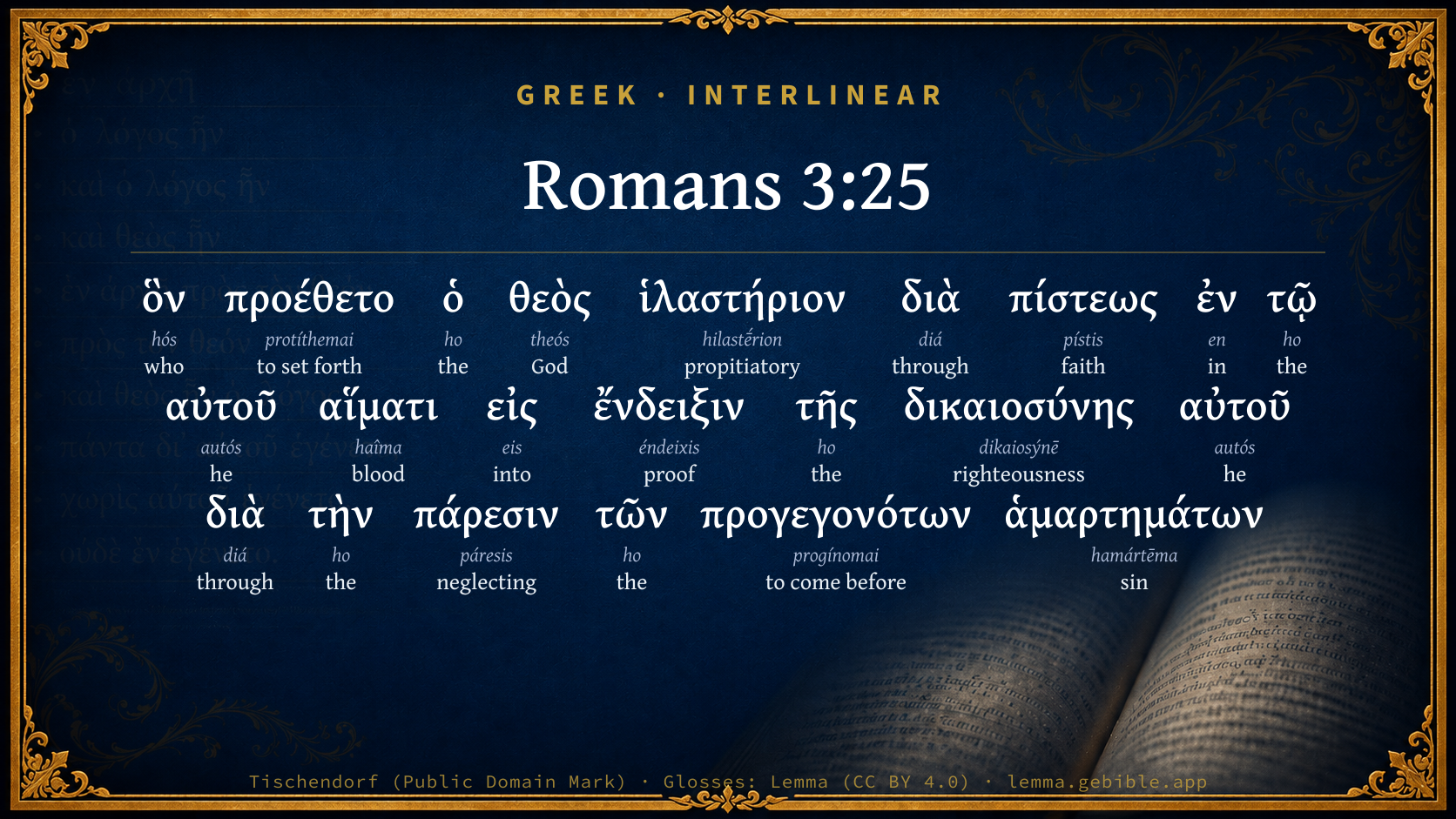
Download image
Cite this verse

Romans 3:25 (World English Bible). Public Domain. Lemma interlinear Bible study tool, https://lemma.gebible.app/v/romans/3/25.

Show BibTeX & RIS
BibTeX
RIS
English Translation
whom God set forth to be an atoning sacrifice, through faith in his blood, for a demonstration of his righteousness through the passing over of prior sins, in God's forbearance;
World English Bible · Public Domain
Highlights
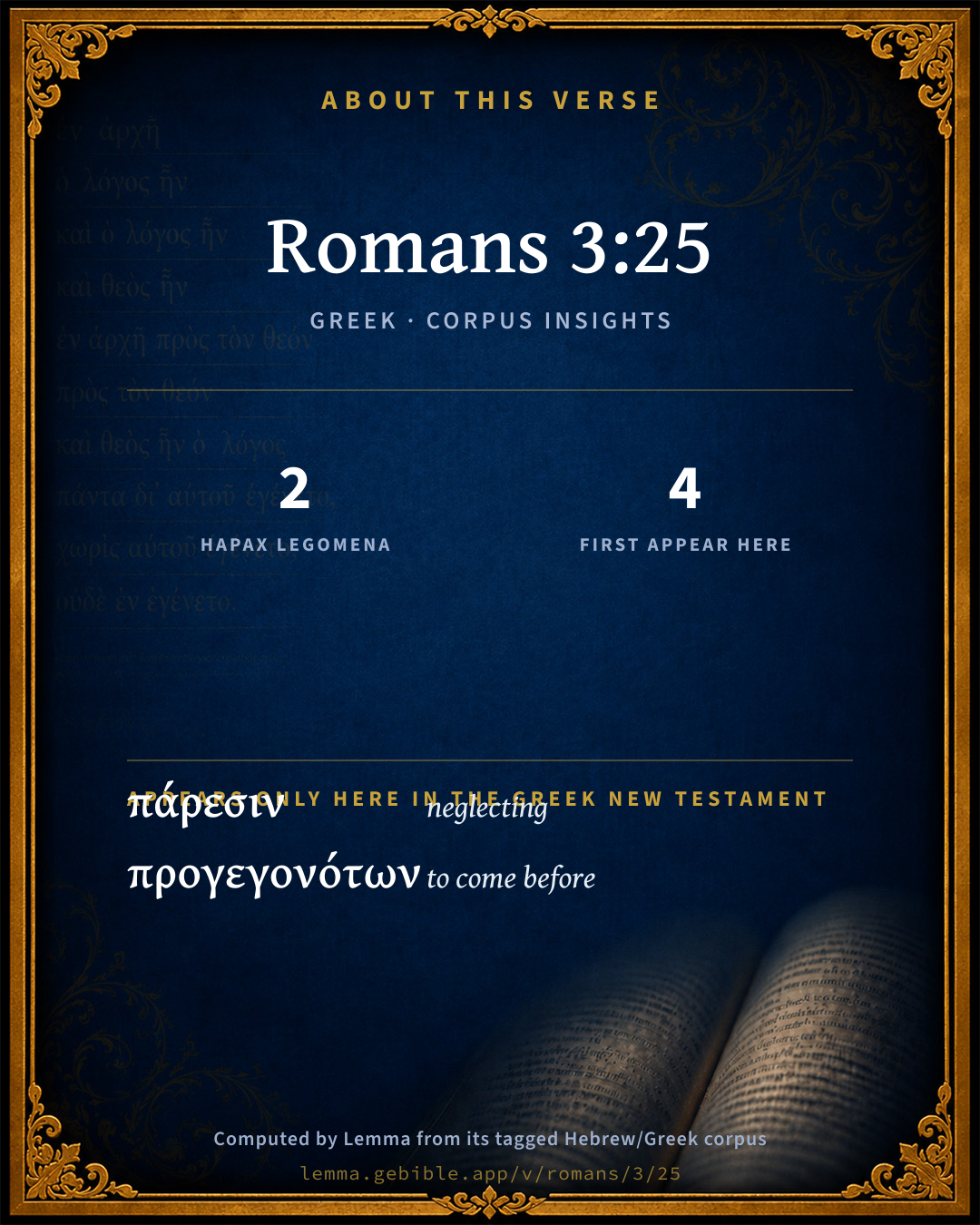
  • 2 hapax legomena — only here in the Greek New Testament
  • 4 first appearances in the Greek New Testament
Full analysis ↓
Download a study sheet

One document with this verse’s original text, its word-by-word gloss line, the meaning frame, cross-references with their text, attributed commentary, and full source and license credits — printable, and it pastes into notes with its structure intact.

This verse Autodidact and up

Study sheet (.html) Plain text (.txt)

A passage Seminary Student

Up to 50 verses in one chapter. A passage sheet keeps up to 6 commentary sources and 12 cross-references per verse, in the order this page ranks them, and says so on the sheet whenever that leaves anything out. Ask for a single verse and you get the Autodidact verse sheet above.

Everything on this page stays free to read, with no account — the sheet is a download of what is already on screen, not access to it.

Want to remove ads? Support Godless Engineer
Compare translations 3

The same verse in 3 English versions, stacked beneath the original-language interlinear above. Click any original word for its lexicon entry.

Each is an independent rendering of the whole verse — the interlinear is not word-aligned to these translations.

Highlighted words mark where these versions differ — a whole-verse word diff, not a word-by-word alignment.

  • World English Bible Public Domain
    whom God set forth to be an atoning sacrifice, through faith in his blood, for a demonstration of his righteousness through the passing over of prior sins, in God's forbearance;
  • King James Version Public Domain
    Whom God hath set forth to be a propitiation through faith in his blood, to declare his righteousness for the remission of sins that are past, through the forbearance of God;
  • unfoldingWord Literal Text CC BY-SA 4.0
    whom God presented a propitiation through faith in his blood for a demonstration of his righteousness, because of the overlooking of the sins that happened previously

unfoldingWord Literal Text — © unfoldingWord, licensed CC BY-SA 4.0. Word-aligned USFM3 via Door43 (git.door43.org/unfoldingWord/en_ult).

Versions to compare (up to 4)

3 of 4 selected

Show all 19 translations

Every available English version of this verse, each an independent rendering of the whole verse.

  • World English Bible Public Domain
    whom God set forth to be an atoning sacrifice, through faith in his blood, for a demonstration of his righteousness through the passing over of prior sins, in God's forbearance;
  • Berean Standard Bible Public Domain
    God presented Him as the atoning sacrifice through faith in His blood, in order to demonstrate His righteousness, because in His forbearance He had passed over the sins committed beforehand.
  • Majority Standard Bible Public Domain
    God presented Him as an atoning sacrifice in His blood through faith, in order to demonstrate His righteousness, because in His forbearance He had passed over the sins committed beforehand.
  • King James Version Public Domain
    Whom God hath set forth to be a propitiation through faith in his blood, to declare his righteousness for the remission of sins that are past, through the forbearance of God;
  • American Standard Version (1901) Public Domain
    whom God set forth `to be' a propitiation, through faith, in his blood, to show his righteousness because of the passing over of the sins done aforetime, in the forbearance of God;
  • Revised Version (1885) Public Domain
    whom God set forth to be a propitiation, through faith, by his blood, to shew his righteousness, because of the passing over of the sins done aforetime, in the forbearance of God;
  • Geneva Bible (1599) Public Domain
    Whom God hath set forth to be a reconciliation through faith in his blood to declare his righteousnes, by the forgiuenesse of the sinnes that are passed,
  • Douay-Rheims (1899) Public Domain
    Whom God hath proposed to be a propitiation, through faith in his blood, to the shewing of his justice, for the remission of former sins,
  • Young's Literal Translation Public Domain
    whom God did set forth a mercy seat, through the faith in his blood, for the shewing forth of His righteousness, because of the passing over of the bygone sins in the forbearance of God --
  • Literal Standard Version CC BY-SA 4.0
    whom God set forth [as] a propitiatory covering, through faith in His blood, for the showing forth of His righteousness, because of the passing over of the former sins in the forbearance of God—
  • Unlocked Literal Bible CC BY-SA 4.0
    For God provided Christ Jesus as a propitiation through faith in his blood. He offered Christ as proof of his justice, because of his disregard of previous sins
  • unfoldingWord Literal Text CC BY-SA 4.0
    whom God presented a propitiation through faith in his blood for a demonstration of his righteousness, because of the overlooking of the sins that happened previously
  • Darby Bible Public Domain
    whom God has set forth a mercy-seat, through faith in his blood, for [the] shewing forth of his righteousness, in respect of the passing by the sins that had taken place before, through the forbearance of God;
  • World Messianic Bible Public Domain
    whom God sent to be an atoning sacrifice through faith in his blood, for a demonstration of his righteousness through the passing over of prior sins, in God’s forbearance;
  • Webster's Bible Public Domain
    Whom God hath set forth to be a propitiation, through faith in his blood, to declare his righteousness for the remission of sins that are past, through the forbearance of God;
  • Free Bible Version CC BY-SA 4.0
    God openly presented Jesus as the gift that brings peace to those trusting in him, the one who shed his blood. God did this to demonstrate he is truly good and right, for previously he would hold back and pass over sins,
  • Bible in Basic English Public Domain
    Whom God has put forward as the sign of his mercy, through faith, by his blood, to make clear his righteousness when, in his pity, God let the sins of earlier times go without punishment;
  • Text-Critical English NT CC BY 4.0
    whom God put forward as a sacrifice of atonement, through faith, by his blood. He did this to demonstrate his righteousness, because in his divine forbearance he had passed over the sins that had previously been committed.
  • Tyndale New Testament (1534) Public Domain
    whom God hath made a seate of mercy thorow faith in his bloud to shewe the rightewesnes which before him is of valoure in that he forgeveth the synnes that are passed which God dyd suffre

Literal Standard Version (2020), Covenant Press — licensed CC BY-SA 4.0. Text via the HelloAO Bible API (eBible.org). Unlocked Literal Bible (unfoldingWord) — licensed CC BY-SA 4.0. Text via the HelloAO Bible API (eBible.org). unfoldingWord Literal Text — © unfoldingWord, licensed CC BY-SA 4.0. Word-aligned USFM3 via Door43 (git.door43.org/unfoldingWord/en_ult). Free Bible Version, Dr. Jonathan Gallagher — licensed CC BY-SA 4.0. Text via the HelloAO Bible API (eBible.org).

Word by word

More ways to search: Search by grammar → Find every occurrence → Compare this word →

Practice this passage: Drill this verse → Learn its vocabulary →

πάρεσιν
páresis
G3929
“neglecting”
Noun, Accusative, Singular, Feminine
Part of Speech
Noun
Case
Accusative
Number
Singular
Gender
Feminine
Full Thayer's Definition

Origin: from G2935

TDNT: 09:29,9

1. passing over, letting pass, neglecting, disregarding
  1. ὃν hós G3739 “who” Relative pronoun, Accusative, Singular, Masculine
  2. προέθετο protíthemai G4388 “to set forth” Verb, Aorist, Middle, Indicative, 3rd person, Singular
  3. ὁ ho G3588 “the” Article, Nominative, Singular, Masculine
  4. θεὸς theós G2316 “God” Noun, Nominative, Singular, Masculine
  5. ἱλαστήριον hilastḗrion G2435 “propitiatory” Noun, Accusative, Singular, Neuter
  6. διὰ diá G1223 “through” Preposition
  7. πίστεως pístis G4102 “faith” Noun, Genitive, Singular, Feminine
  8. ἐν en G1722 “in” Preposition
  9. τῷ ho G3588 “the” Article, Dative, Singular, Neuter
  10. αὐτοῦ autós G846 “he” Personal pronoun, Genitive, Singular, Masculine
  11. αἵματι haîma G129 “blood” Noun, Dative, Singular, Neuter
  12. εἰς eis G1519 “into” Preposition
  13. ἔνδειξιν éndeixis G1732 “proof” Noun, Accusative, Singular, Feminine
  14. τῆς ho G3588 “the” Article, Genitive, Singular, Feminine
  15. δικαιοσύνης dikaiosýnē G1343 “righteousness” Noun, Genitive, Singular, Feminine
  16. αὐτοῦ autós G846 “he” Personal pronoun, Genitive, Singular, Masculine
  17. διὰ diá G1223 “through” Preposition
  18. τὴν ho G3588 “the” Article, Accusative, Singular, Feminine
  19. τῶν ho G3588 “the” Article, Genitive, Plural, Neuter
  20. προγεγονότων progínomai G4266 “to come before” Verb, Perfect, Active, Participle, Genitive, Plural, Neuter
  21. ἁμαρτημάτων hamártēma G265 “sin” Noun, Genitive, Plural, Neuter

About this verse

These counts appear in no published source. They are computed here, from the morphology-tagged text and Lemma’s own curated glosses. What Lemma adds →

22
words
16
distinct lemmas
Pauline Epistles
section

Notable vocabulary

2 hapax legomena — words that appear only here in the entire Greek New Testament:

  • πάρεσιν neglecting G3929
  • προγεγονότων to come before G4266

First appearance in Scripture

These words make their first canonical appearance in the Greek New Testament here:

  • ἱλαστήριον propitiatory G2435
  • ἔνδειξιν proof G1732
  • πάρεσιν neglecting G3929
  • προγεγονότων to come before G4266

Shared distinctive vocabulary

ἱλαστήριον propitiatory G2435 occurs in 2 verses of the Greek New Testament. Also found in:
Repetition

Words recur within this verse:

  • διὰ through G1223 ×2
  • ὁ the G3588 ×5
  • αὐτοῦ he G846 ×2

Cross-references

41

Topical passages linked to Romans 3:25 in the Treasury of Scripture Knowledge — connected by theme and wording, ordered by reader-vote popularity; previews shown in the World English Bible.

  • Romans 3:23–24 for all have sinned, and fall short of the glory of God;
  • 1 Peter 1:18–20 knowing that you were redeemed, not with corruptible things, with silver or gold, from the useless way of life handed down from your fathers,
  • 1 John 4:10 In this is love, not that we loved God, but that he loved us, and sent his Son as the atoning sacrifice for our sins.
  • 1 John 2:2 And he is the atoning sacrifice for our sins, and not for ours only, but also for the whole world.
  • Romans 5:9 Much more then, being now justified by his blood, we will be saved from God's wrath through him.
  • Colossians 1:20–23 and through him to reconcile all things to himself, by him, whether things on the earth, or things in the heavens, having made peace through the blood of his cross.
  • Hebrews 9:14–22 how much more will the blood of Christ, who through the eternal Spirit offered himself without blemish to God, cleanse your conscience from dead works to serve the living God?
  • Acts 13:38–39 Be it known to you therefore, brothers, that through this man is proclaimed to you remission of sins,
  • Acts 17:30 The times of ignorance therefore God overlooked. But now he commands that all people everywhere should repent,
  • Hebrews 10:4 For it is impossible that the blood of bulls and goats should take away sins.
  • Exodus 25:17–22 You shall make a mercy seat of pure gold. Two and a half cubits shall be its length, and a cubit and a half its breadth.
  • Leviticus 16:15 "Then he shall kill the goat of the sin offering, that is for the people, and bring his blood within the veil, and do with his blood as he did with the blood of the bull, and sprinkle it on the mercy seat, and before the mercy seat:
  • Psalms 22:31 They shall come and shall declare his righteousness to a people that shall be born, For he has done it.
  • Hebrews 10:19–20 Having therefore, brothers, boldness to enter into the holy place by the blood of Jesus,
  • Hebrews 11:7 By faith, Noah, being warned about things not yet seen, moved with godly fear, prepared an ark for the saving of his house, through which he condemned the world, and became heir of the righteousness which is according to faith.
  • Hebrews 11:39–40 These all, having had testimony given to them through their faith, didn't receive the promise,
  • Revelation 13:8 All who dwell on the earth will worship him, everyone whose name has not been written from the foundation of the world in the book of life of the Lamb who has been killed.
  • Romans 5:1 Being therefore justified by faith, we have peace with God through our Lord Jesus Christ;
  • Psalms 119:142 Your righteousness is an everlasting righteousness. Your law is truth.
  • John 6:53–58 Jesus therefore said to them, "Most assuredly I tell you, unless you eat the flesh of the Son of Man and drink his blood, you don't have life in yourselves.
  • Romans 4:1–8 What then will we say that Abraham, our forefather, has found according to the flesh?
  • Hebrews 9:25–26 nor yet that he should offer himself often, as the high priest enters into the holy place year by year with blood not his own,
  • Hebrews 11:14 For those who say such things make it clear that they are seeking after a country of their own.
  • Revelation 5:9 They sang a new song, saying, "You are worthy to take the book, And to open its seals: For you were killed, And bought us for God with your blood, Out of every tribe, language, people, and nation,
  • Revelation 20:15 If anyone was not found written in the book of life, he was cast into the lake of fire.
  • Acts 3:18 But the things which God announced by the mouth of all his prophets, that Christ should suffer, he thus fulfilled.
  • Acts 4:28 to do whatever your hand and your council foreordained to happen.
  • Romans 2:4 Or do you despise the riches of his goodness, forbearance, and patience, not knowing that the goodness of God leads you to repentance?
  • Romans 3:26 to demonstrate his righteousness at this present time; that he might himself be just, and the justifier of him who has faith in Jesus.
  • Romans 5:11 Not only so, but we also rejoice in God through our Lord Jesus Christ, through whom we have now received the reconciliation.
  • Hebrews 9:5 and above it cherubim of glory overshadowing the mercy seat, of which things we can't now speak in detail.
  • Hebrews 11:17 By faith, Abraham, being tested, offered up Isaac. Yes, he who had gladly received the promises was offering up his one and only son;
  • 1 John 1:10 If we say that we haven't sinned, we make him a liar, and his word is not in us.
  • Acts 2:23 him, being delivered up by the determined counsel and foreknowledge of God, you have taken by the hand of lawless men, crucified and killed;
  • Acts 15:18 All his works are known to God from eternity.'
  • 1 Timothy 1:15 The saying is faithful and worthy of all acceptance, that Christ Jesus came into the world to save sinners; of whom I am chief.
  • Psalms 40:10 I have not hidden your righteousness within my heart. I have declared your faithfulness and your salvation. I have not concealed your loving kindness and your truth from the great assembly.
  • Psalms 50:6 The heavens shall declare his righteousness, For God himself is judge. Selah.
  • Psalms 97:6 The heavens declare his righteousness. All the peoples have seen his glory.
  • Isaiah 53:11 He shall see of the travail of his soul, [and] shall be satisfied: by the knowledge of himself shall my righteous servant justify many; and he shall bear their iniquities.
  • John 6:47 Most assuredly, I tell you, he who believes in me has eternal life.

Cross-references courtesy of OpenBible.info (CC BY 4.0).

Commentary

Notes on Romans 3:25 from classic Christian and Jewish commentators (each source and its license shown beneath its notes). The classic Christian expositions comment on the surrounding passage and are grouped to its opening verse, so a note may address several verses; the Jewish commentaries on the Tanakh (Rashi and others) are per-verse, so they appear only where the commentator wrote on this verse.

Lemma curates 59 commentaries, every one of them public domain or Creative Commons licensed, each selected and text-cleaned for this edition rather than reprinted as found. About our sources →

Albert Barnes' Notes on the Bible

Whom God hath set forth - Margin, “Fore-ordained” (προέθετο proetheto). The word properly means, “to place in public view;” to exhibit in a conspicuous situation, as goods are exhibited or exposed for sale, or as premiums or rewards of victory were exhibited to public view in the games of the Greeks. It sometimes has the meaning of decreeing, purposing, or constituting, as in the margin (compare Rom 1:13; Eph 1:9); and many have supposed that this is its meaning here. But the connection seems to require the usual signification of the word; and it means that God has publicly exhibited Jesus Christ as a propitiatory sacrifice for the sins of people. This public exhibition was made by his being offered on the cross, in the face of angels and of people. It was not concealed; it was done openly. He was put to open shame; and so put to death as to attract toward the scene the eyes of angels, and of the inhabitants of all worlds.

To be a propitiation - ἱλαστήριον hilastērion. This word occurs but in one other place in the New Testament. Heb 9:5, “and over it (the ark) the cherubim of glory shadowing the mercy-seat. It is used here to denote the lid or cover of the ark of the covenant. It was made of gold, and over it were the cherubim. In this sense it is often used by the Septuagint Exo 25:17, “And thou shalt make a propitiatory ἱλαστήριον hilastērion of gold,” Exo. 18-20, 22; Exo 30:6; Exo 31:7; Exo 35:11; Exo 37:6-9; Exo 40:18; Lev 16:2, Lev 16:13. The Hebrew name for this was כפּרת kaphoreth, from the verb כּפר kaaphar, “to cover” or “to conceal.” It was from this place that God was represented as speaking to the children of Israel. Exo 25:22, “and I will speak to thee from above the Hilasterion, the propitiatory, the mercy-seat. Lev 16:2, “For I will appear in the cloud upon the mercy-seat.” This seat, or cover, was covered with the smoke of the incense, when the high priest entered the most holy place, Lev 16:13.

And the blood of the bullock offered on the great day of atonement, was to be sprinkled “upon the mercy-seat,” and “before the mercy-seat,” “seven times,” Lev 16:14-15. This sprinkling or offering of blood was called making “an atonement for the holy place because of the uncleanness of the children of Israel,” etc. Lev 16:16. It was from this mercy-seat that God pronounced pardon, or expressed himself as reconciled to his people. The atonement was made, the blood was sprinkled, and the reconciliation thus effected. The name was thus given to that cover of the ark, because it was the place from which God declared himself reconciled to his people. Still the inquiry is, why is this name given to Jesus Christ? In what sense is he declared to be a propitiation? It is evident that it cannot be applied to him in any literal sense. Between the golden cover of the ark of the covenant and the Lord Jesus, the analogy must be very slight, if any such analogy can be perceived. We may observe, however,

(1) That the main idea, in regard to the cover of the ark called the mercy-seat, was that of God’s being reconciled to his people; and that this is the main idea in regard to the Lord Jesus whom “God hath set forth.”

(2) This reconciliation was effected then by the sprinkling of blood on the mercy-seat, Lev 16:15-16. The same is true of the Lord Jesus - by blood.

(3) In the former case it was by the blood of atonement; the offering of the bullock on the great day of atonement, that the reconciliation was effected, Lev 16:17-18. In the case of the Lord Jesus it was also by blood; by the blood of atonement. But it was by his own blood. This the apostle distinctly states in this verse.

(4) In the former case there was a sacrifice, or expiatory offering; and so it is in reconciliation by the Lord Jesus. In the former, the mercy-seat was the visible, declared place where God would express his reconciliation with his people. So in the latter, the offering of the Lord Jesus is the manifest and open way by which God will be reconciled to people.

(5) In the former, there was joined the idea of a sacrifice for sin, Lev. 16. So in the latter. And hence, the main idea of the apostle here is to convey the idea of a sacrifice for sin; or to set forth the Lord Jesus as such a sacrifice. Hence, the word “propitiation” in the original may express the idea of a propitiatory sacrifice, as well as the cover to the ark. The word is an adjective, and may be joined to the noun sacrifice, as well as to denote the mercy-seat of the ark. This meaning accords also with its classic meaning to denote a propitiatory offering, or an offering to produce reconciliation. Christ is thus represented, not as a mercy-seat, which would be unintelligible; but as the medium, the offering, the expiation, by which reconciliation is produced between God and man.

Through faith - Or by means of faith. The offering will be of no avail without faith. The offering has been made; but it will not be applied, except where there is faith. He has made an offering which may be efficacious in putting away sin; but it produces no reconciliation, no pardon, except where it is accepted by faith.

In his blood - Or in his death - his bloody death. Among the Jews, the blood was regarded as the seat of life, or vitality. Lev 17:11, “the life of the flesh is in the blood.” Hence, they were commanded not to eat blood. Gen 9:4, “but flesh with the life thereof, which is the blood thereof, shall ye not eat.” Lev 19:26; Deu 12:23; 1Sa 14:34. This doctrine is contained uniformly in the Sacred Scriptures. And it has been also the opinion of not a few celebrated physiologists, as well in modern as in ancient times. The same was the opinion of the ancient Parsees and Hindus. Homer thus often speaks of blood as the seat of life, as in the expression πορφυρεος θανατος porphureos thanatos, or “purple death.” And Virgil speaks of “purple life,”

Purpuream vomit ille animam.

AEniad, ix. 349.

Empedocles and Critias among the Greek philosophers, also embraced this opinion. Among the moderns, Harvey, to whom we are indebted for a knowledge of the circulation of the blood, fully believed it. Hoffman and Huxham believed it Dr. John Hunter has fully adopted the belief, and sustained it, as he supposed, by a great variety of considerations. See Good’s Book of Nature, pp. 102, 108, New York edition, 1828. This was undoubtedly the doctrine of the Hebrews; and hence, with them to shed the blood was a phrase signifying to kill; hence, the efficacy of their sacrifices was supposed to consist in the blood, that is, in the life of the victim. Hence, it was unlawful to eat it, as it were the life, the seat of vitality; the more immediate and direct gift of God. When, therefore, the blood of Christ is spoken of in the New Testament, it means the offering of his life as a sacrifice, or his death as an expiation. His life was given to make atonement. See the word “blood” thus used in Rom 5:9; Eph 1:7; Col 1:14; Heb 9:12, Heb 9:14; Heb 13:12; Rev 1:5; 1Pe 1:19; 1Jo 1:7. By faith in his death as a sacrifice for sin; by believing that he took our sins; that he died in our place; by thus, in some sense, making his offering ours; by approving it, loving it, embracing it, trusting it, our sins become pardoned, and our souls made pure.

To declare - εἰς ἔνδειξις eis endeixis. For “the purpose” of showing, or exhibiting; to present it to man. The meaning is, that the plan was adopted; the Saviour was given; he suffered and died: and the scheme is proposed to people, for the purpose of making a full manifestation of his plan, in contradistinction from all the plans of people.

His righteousness - His plan of justification. The method or scheme which he has adopted, in distinction from that of man; and which he now exhibits, or proffers to sinners. There is great variety in the explanation of the word here rendered “righteousness.” Some explain it as meaning veracity; others as holiness; others as goodness; others as essential justice. Most interpreters, perhaps, have explained it as referring to an attribute of God. But the whole connection requires us to understand it here as in Rom 1:17, not of an attribute of God, but of his “plan” of justifying sinners. He has adopted and proposed a plan by which people may become just by faith in Jesus Christ, and not by their own works. His acquitting people from sin; his regarding them and treating them as just, is set forth in the gospel by the offering of Jesus Christ as a sacrifice on the cross. (For the true meaning of this phrase, see the note at Rom 1:17; Rom 3:22.)

For the remission of sins - Margin, “Passing over.” The word used here πάρεσιν paresin occurs no where else in the New Testament, nor in the Septuagint. It means “passing by,” as not noticing, and hence, forgiving. A similar idea occurs in 2Sa 24:10, and Mic 7:18. “Who is a God like unto thee, that passeth by the transgression of the remnant of his inheritance?” In Romans it means for the “pardoning,” or in order to pardon past transgression.

That are past - That have been committed; or that have existed before. This has been commonly understood to refer to past generations, as affirming that sins under all dispensations of the world are to be forgiven in this manner, through the sacrifice of Christ. And it has been supposed that all who have been justified, have received pardon by the merits of the sacrifice of Christ. This may be true; but there is no reason to think that this is the idea in this passage. For,

(1) The scope of the passage does not require it. The argument is not to show how people had been justified, but how they might be. It is not to discuss an historical fact, but to state the way in which sin was to be forgiven under the gospel.

(2) The language has no immediate or necessary reference to past generations. It evidently refers to the past lives of the individuals who are justified, and not to the sins of former times. All that the passage means, therefore, is, that the plan of pardon is such as completely to remove all the former sins of the life, not of all former generations. If it referred to the sins of former times, it would not be easy to avoid the doctrine of universal salvation.

(The design of the apostle is to showy the alone ground of a sinner’s justification. That ground is “the righteousness of God.” To manifest this righteousness, Christ had been set forth in the beginning of the gospel age as a propitiatory sacrifice. But though at this time manifested or declared, it had in reality been the ground of justification all along. Believers in every past dispensation, looking forward to the period of its revelation, had built their hopes on it, and been admitted into glory.

The idea of manifestation in gospel times, seems most intimately connected with the fact that in past ages, the ground of pardon had been hidden, or at best but dimly seen through type and ceremony. There seems little doubt that these two things were associated in the apostle’s mind. Though the ground of God’s procedure in remitting the sins of his people, during the former economy, had long been concealed, it was now gloriously displayed before the eyes of the universe. Paul has the very same idea in Heb 9:15, “And for this cause he is the Mediator of the New Testament, that by means of death, for the redemption of the transgressions that were under the first testament, they which are called might receive the promise of eternal inheritance.” It may be noticed also that the expression in Heb 9:20, “at this time,” that is, in the gospel age, requires us to understand the other clause, “sins that are past,” as pointing to sin committed under former dispensations. Nor is there any fear of lending support to the doctrine of universal salvation. if we espouse this view. the sins remitted in past ages being obviously those of believers only. The very same objection might be urged against the parallel passage in Heb 9:15.)

Through the forbearance of God - Through his patience, his long-suffering. That is, he did not come forth in judgment when the sin was committed; he spared us, though deserving of punishment; and now he comes forth completely to pardon those sins concerning which he has so long and so graciously exercised forbearance. This expression obviously refers not to the remission of sins, but to the fact that they were committed while he evinced such long-suffering; compare Act 17:30. I do not know better how to show the practical value and bearing of this important passage of Scripture, than by transcribing a part of the affecting experience of the poet Cowper. It is well known that before his conversion he was oppressed by a long and dreadful melancholy; that this was finally heightened to despair; and that he was then subjected to the kind treatment of Dr. Cotton in Alban’s, as a melancholy case of derangement.

His leading thought was that he was doomed to inevitable destruction, and that there was no hope. From this he was roused only by the kindness of his brother, and by the promises of the gospel; (see Taylor’s Life of Cowper). The account of his conversion I shall now give in his own words. “The happy period, which was to shake off my fetters, and afford me a clear discovery of the free mercy of God in Christ Jesus, was now arrived. I flung myself into a chair near the window, and seeing a Bible there, ventured once more to apply to it for comfort and instruction. The first verse I saw was Rom 3:25; “Whom God hath set forth, etc.” Immediately I received strength to believe, and the full beam of the Sun of righteousness shone upon me. I saw the sufficiency of the atonement he had made for my pardon and justification. In a moment I believed, and received the peace of the gospel. Unless, the Almighty arm had been under me, I think I should have been overwhelmed with gratitude and joy. My eyes filled with tears, and my voice choked with transport. I could only look up to heaven in silent fear, overwhelmed with love and wonder. How glad should I now have been to have spent every moment in prayer and thanksgiving. I lost no opportunity of repairing to a throne of grace; but flew to it with an earnestness irresistible, and never to be satisfied.”

Albert Barnes' Notes on the Bible (1834–1885) — public domain. Text from a community e-Sword/MySword module.

The Biblical Illustrator

Joseph S. Exell

Rom_3:25

Whom God hath set forth to be a propitiation:

I.

Speak of Christ as a propitiation, or show what His being said to be a propitiation for sin may imply in it--

1. That He was appointed by God the Father to make an atonement for the sins of men.

2. That He was substituted in the room of sinners, and in suffering and making satisfaction to Divine justice for their sins, represented their persons, and was considered as one with them in the eye of the law.

3. That He condescended to take upon Him all the guilt of His people.

4. That He suffered the punishment which His people deserved on account of their sins.

5. That all who have an interest in His death, and the sacrifice which He offered, are freed from the guilt of sin, and are no more liable to the punishment of it.

6. That by suffering the death threatened in the law for the transgression of it, and satisfying the demands of justice in the room of sinners, He laid the foundation of a throne of grace, to which the most destitute, yea, the most guilty belonging to the fallen race of Adam have free access, and from which God dispenses to them all blessings, without eclipsing the glory of His justice, holiness, and other glorious perfections.

II. Christs being set forth as a propitiation, for the benefit of sinners guilty before God, and condemned to everlasting death by His law.

1. Christ may be said to have been set forth to be a propitiation in the purpose and decree of God from eternity.

2. Christ was exhibited as a propitiation in the first gospel promise (Gen_3:15).

3. Christ was set forth as a propitiation in all the types and ceremonies belonging to the Old Testament economy, particularly in the legal sacrifices, all which were typical of that great sacrifice which the Son of God, the promised Messiah, was to offer in the human nature for expiating the guilt of sin.

4. Christ was exhibited as a propitiation in the several prophecies and promises respecting Him that were delivered to the Church under the Old Testament dispensation.

5. Christ was set forth as a propitiation in His incarnation and assumption of the human nature.

6. The Lord Jesus is exhibited, or set forth, as a propitiation in the dispensation of the everlasting gospel: The very design of the gospel is to exhibit a crucified Redeemer to guilty sinners. Hence the preaching of the gospel is called the preaching of the Cross, and the preaching of Christ crucified.

7. Christ is set forth as a propitiation in the sacraments of the New Testament, particularly in the Lords Supper.

III. Confirm the doctrine, or show that as Jesus Christ is by the authority and appointment of the great Jehovah set forth to guilty sinners as a propitiation, all to whom the gospel comes, may warrantably claim the benefit of that propitiation in a way of believing. This is abundantly evident from the words of the text; for the gospel is preached by Divine appointment to every creature, and in it Christ is set forth as a propitiation to every sinner that hears it. It is further evident

1. From the types that prefigured Him under the Old Testament economy. The manna which was rained from heaven for nourishing the Israelites in the wilderness (Exo_14:13-16) was a remarkable type of Christ, who is the Bread of Life; is such as a propitiation, for He is said to have given His flesh, namely by offering it as a sacrifice to expiate the guilt of sin, for the life of the world (Joh_6:51); and it was what everyone belonging to the camp of Israel might warrantably gather and apply to his own use (Exo_16:15). The brazen serpent was also a type of Christ, and that was lifted up on a pole for the benefit of all belonging to the congregation of Israel, so that every one of them that had been wounded by the fiery serpents was authorised to look to it in order to his being healed (Num_21:8-9; Joh_3:14-15). The scapegoat was also a remarkable type of Christ, and designed to prefigure the efficacy of His death for procuring the remission of sins to all who believe in Him.

2. That all who hear the gospel may warrantably claim the benefit of the New Testament propitiation spoken of in the text, or trust in the Lord Jesus for the remission of sins, is evident from the similitudes under which Christ and His grace are set forth to us in Scripture (Zec_13:1; Rev_22:2; Isa_25:6; Pro_9:1-5; Mat_22:4).

3. The truth of the doctrine is further evident from the very nature of the gospel, which is not a system of precepts requiring of men obedience to the law of God, to any law whatsoever, as the condition of life, but consists wholly of gracious promises exhibiting life, salvation, and all spiritual blessings freely, as the gift of God to perishing sinners.

4. The same thing is evident from the declared end and design of the gospel, which is that sinners may believe in Christ revealed and exhibited in it (Joh_20:31).

5. That all who hear the gospel have a sufficient warrant to claim the benefit of the propitiation spoken of in the text, or to apply Christ and the benefits of redemption to their own souls, appears from the many gracious calls and invitations addressed to sinners in the gospel.

6. The peremptory command of God binding it upon all the hearers of the gospel, as their indispensable duty, to believe on the name of His Son, puts the matter beyond all debate (1Jn_3:23).

IV. Practical improvement of the doctrine.

1. The great error of Socinians who deny that Christ died to make an atonement for sin, and satisfy the justice of God in the room of sinners, by suffering the punishment which their sins deserved; or that the sacrifice which He offered was a proper sacrifice.

2. Hence we may learn, that men by nature are in a most wretched and deplorable condition. They are under guilt and wrath, otherwise there would have been no need to offer a propitiatory sacrifice for them.

3. Hence let us take occasion to admire the love of God toward sinners of mankind, manifested in providing such a sacrifice.

4. Hence we may see what was the great end of the Redeemers incarnation, and of His taking our nature into a personal union with Himself.

5. Hence we may learn what was the nature, end, and use of all the sacrifices that were offered by Divine appointment under the Old Testament dispensation. They had no merit or efficacy for satisfying the justice of God and appeasing His wrath. They were only typical of that sacrifice which the Messiah was to offer in the fulness of time for these ends.

6. From what has been said we may see that the dispensation of the gospel in purity is a great privilege, an inestimable blessing. (D. Wilson.)

Propitiation through faith in Christs blood

I. Christ, a propitiation. Sin draws on the sinner the holy anger of God, although it cannot quench the love of God. And that it could not quench His love is shown by His providing and setting forth as a propitiation His own Son, through whom He can look on us with anger no more, but with complacency. This He has done. It often costs us much, we have often got much to get over in order to let the affection that there is in our heart towards some human being have its way, to help and succour him on account of some waywardness in him. What would not the father or mother of a profligate child give to be able to lavish on the degraded being tokens of affection as freely as they did when they folded him in their arms a happy innocent child, if they felt they could do so without their goodness being abused by him to his own hurt and to their shame, or being regarded by him as a proof that they did not look on his vices with any great detestation or sorrow? What the sacrifice of Gods only-begotten and well-beloved Son involved to Him, we vainly attempt to conceive. He spared not His own Son, but gave Him up to the death for us all. Mark that it is not said here that the Saviour has made propitiation, but that He is a propitiation. So speaks also the Apostle John: He is the propitiation for our sins. In the Saviour Himself, in the living person of the God-man, is found the ground of pardon and acceptance. The virtue of His obedience and death is centred in His person, and radiates from it.

II. The way in which propitiation is effected. Christ is a propitiation through faith in His blood. By His blood and by faith--not faith in His blood--but by His blood, by which He expiated sin, He is a propitiation by faith as the subjective means of appropriation of this propitiation. You must look, on the one hand, to Christs sacrificial death, and on the other to faith in Christ, in order to account for the sinner being received into the favour of God and being reconciled to Him.

1. It was by the giving of His holy life in sacrifice that Jesus propitiated God on our behalf, or appeased the wrath, and delivered us from the curse of God due for sin.

2. Christ is only actually and effectually a propitiation to you and to me, if we believe in Him. He is a propitiation only through faith. In this the righteousness of God is also seen. It were unrighteous to justify any but him who believed in Jesus, or for God to be propitiated through Christ on behalf of anyone who did not believe on Christ. For through faith we come into a life-union with the Son of God.

III. Christ, as our propitiation, is set forth by God. That type of Christ of old, which furnishes the name and explains the aspect under which Christ is set forth here, the propitiation, propitiatory, or mercy seat, was hid in the innermost shrine of the dwelling place of God. It was seen by no mortal eye but that of the high priest, and that only when, once a year, he entered with awed spirit behind the veil. But Jesus Christ, the great reality, of which that golden throne of grace was the sign and shadow, is not hidden, but is openly set forth. In word and ordinance He is exhibited.

1. There is the Bible, about which such daring opinions nowadays are ventured, and of which, in their secret hearts, many have doubts and sentiments which they would not dare to utter; which many, who read so much that is deleterious, never or rarely open; which many read so carelessly and to so little purpose! My friend, hast thou ever thought that in that Book God has set forth His Son as a propitiation? This is the great end for which it is written.

2. There is the everlasting gospel, which is of small account with many, a weariness, a superfluity, which even in their view might be banished from the sanctuary; or, if it cannot be banished, may be thrust as far as possible into a corner, and its place supplied very pleasantly by something that will soothe and regale the senses and the taste. But oh! see that you are not blind to what is set forth in the garb of His words and thoughts--Jesus Christ the propitiation through faith in His blood. See above all that you do not forget that, though with mans voice, and in mans language, and often with much weakness, yet God is really setting forth Christ as a propitiation.

3. In the sacraments God so sets forth His Son. (W. Wilson, M. A.)

Christ the propitiation

I. As set forth by God.

1. The words set forth signify foreordained; and also places in public view; as goods are exposed for sale, or as rewards of victory were exhibited in the Grecian Games. So has God made conspicuous Jesus as the propitiation of sin.

(1) By Divine decree. Christ did not take upon Himself the office of High Priest without being chosen thereunto. But this was not independent of His own choice, for in the volume of the Book it is written of Him, I delight to do Thy will, O God.

(2) In His promises before the Advent did not God speak constantly, by verbal and typical promises, to multitudes of holy men the coming of Him who should bruise the serpents head, and deliver His people from the power of the curse?

(3) When Christ came God set Him forth by angelic messengers, and by the star in the East. Throughout His life, how constantly did His Father set Him forth! The voice of God was in the voice of John, Behold the Lamb of God which taketh away the sin of the world. And on the Cross itself, when it pleased the Father to bruise Him, and put Him to grief, what an exhibition was there to the eye of Jew and Gentile of the propitiation!

(4) When the Holy Ghost came down on Pentecost! And what have all conversions been since but repeated seals to the same testimony?

(5) In you God has graciously fulfilled the text.

2. What it is that God has so manifestly set forth. The Greek word may mean--

(1) A mercy seat. Now God hath said to the sinner, Do you desire to meet Me? would you be no longer My enemy? would you receive My blessing? I set forth Christ to you as being the Mercy seat, where I can meet you and you Me.

(2) A covering; as the mercy seat covered the tables of the law, and so covered that which was the cause of Divine ire, because we had broken His commandment. Wouldst thou have anything which can cover thy sin from Me, so that I need not be provoked to anger; from you so that you need not tremble? Wouldst thou have a shelter which shall hide altogether thy sins? I set it forth to thee in Jesus. Trust in His blood, and thy sin is covered.

3. God has set forth Christ before every one of you, in the preaching of the Word, and in the Inspired Book, as dying, that your sins might die; buried, that your iniquities might be buried; risen, that you might rise to newness of life; ascended, that you might ascend to God; received in triumph, that you might be received in triumph too; made to reign, that you might reign in Him; forever loved, forever crowned, that you in Him may be forever loved and forever crowned too.

II. As looked upon by the believer.

1. We may mistake the proper object of faith. We may look on--

(1) Repentance as a grace, indeed, without which there can be no salvation, but an act which may be substituted for faith in the propitiation.

(2) Evidences. Evidences are good as second things, but as first things they are usurpers, and may prove anti-Christs.

(3) Gods promises. I know many Christians who, when they are in distress, take up the Bible to find a promise--a very good plan, if they go to Christ first. There is a man who very much desires an estate, at the same time his heart is smitten with the beauty of some fair heiress. He gets the title deeds of her estate. Well, the title deeds are good, but the estates are not his, though he has got the title deeds. By and by he marries the lady, and everything is his own. Get the heiress and you have got the estate. It is so in Christ; promises are the title deeds of His estates. A man may get the promise and not get Christ, then they will be of no use to him.

2. God has set forth Christ to be the propitiation through faith in His blood, and we ought to accept that as being--

(1) An all-sufficient propitiation. We have never got the full idea of Christ till we know that every sin of thought, of word, of deed finds its death.

(2) An immutable propitiation. Our standing before God, when we have believed in Jesus, depends no more upon our frames and feelings than the sun depends upon the clouds and darkness that are here below.

III. As set forth by us and looked upon by God.

1. If in this pulpit Christ be set forth, God will look down upon that Christ set forth, and honour and bless the word. I might preach clear doctrine, but God might never look down upon doctrine, nor upon moral essays, nor upon philosophy. God will not look down on any mans ministry unless that man sets forth what God sets forth. Then His Word shall not return unto Him void; it shall prosper in the thing whereto He hath sent it.

2. As in the case of the ministry, so you in your pleadings for souls must set forth Christ. Abels blood demanded vengeance; Christs blood demands pardons and must have it.

3. As in pleading for the souls of others, so in pleading for our own we must set forth the propitiation. (C. H. Spurgeon.)

Christ the propitiation

In the only other place where the word occurs in the New Testament (Heb_9:5) it is rendered mercy seat.

I. To the institution of the mercy seat, therefore, we must look, that we may rightly understand the allusion (Exo_25:17). It is from this description that the appellation is given to Jehovah of the God that dwelleth between the cherubim, an appellation, therefore, equivalent in import to the God of mercy, the God of all grace, the God of peace: and the position of the mercy seat or propitiatory, upon the ark of the testimony, seems to indicate that His appearing, in this benign character, to commune with guilty creatures, was in full consistency with the claims and sanctions of His perfect law; so that when Jehovah thus manifested Himself. Mercy and truth met together, righteousness and peace embraced each other. All this cannot fail to remind us of Him who received from God the Father honour and glory, when there came such a voice to Him from the excellent glory, This is My beloved Son, in whom I am well pleased. It is in Him, as the subject either of promise, of prophecy, of type, or of direct testimony, that God has from the beginning made Himself known to men in the character of the God of peace. It is in Him that He reconciles sinners to Himself, not imputing their trespasses unto them.

II. Had nothing more been said of the mercy seat, we might have been led to conclude that Jehovah appeared there in the exercise of mere mercy, apart from any satisfaction for sin. We must, therefore, connect this description of the mercy seat with the account given of the manner in which it was to be approached by the worshipper (Lev_16:2; Lev_16:11-12). It was to be approached with the blood of atonement (verses 6, 30, 34), which was sprinkled on and before the mercy seat; and while the sacrificial blood was thus presented, the burning incense was to diffuse its grateful odour, in emblematic testimony of the Divine satisfaction; which is, accordingly, elsewhere expressed in connection with the sacrifice of Christ, and the offerings by which it was typified, by Jehovahs smelling a sweet savour (cf. Gen_8:21 with Eph_5:2; Rev_8:3; and see also Psa_141:2)

. The mercy seat, then, in order to Jehovahs appearing there, consistently with the glory of His name, as the God of grace, must be stained with the blood of sprinkling, the blood that maketh atonement for the soul; and in this is set before us the necessity of the shedding of the blood of Christ, in order to Gods being in Him well-pleased. And, agreeably to this, the Divine declaration from the excellent glory, of satisfaction in His well-beloved Son, was made in connection with the subject of conference on the holy mount--the decease which Jesus was to accomplish at Jerusalem.

III. The proper idea of propitiation is, rendering the Divine Being favourable.

1. We must, beware, however, of understanding by this anything like the production of a change in the Divine character; as if God required an inducement to be merciful. We ought to conceive of Jehovah as eternally compassionate and merciful. But while God is infinitely and immutably good, He is at the same time infinitely and immutably holy and just and true. Never ought we to speak of Him as acting at one time according to mercy, and at another according to justice. His attributes, though we may speak of them distinctly, are inseparable in their exercise.

2. What, then, is the light in which the idea of atonement places the Divine Being? As a righteous Governor Jehovah is displeased with His guilty creatures; while, at the same time, from the infinite benignity of His nature, He is inclined to forgiveness. But if His government is righteous, its claims, in their full extent, must of necessity be maintained inviolate. The great question, then, on this momentous subject comes to be: In what manner may forgiveness be extended to the guilty, so as to satisfy the claims of justice? The rendering of the Divine Being propitious, in this view, refers, it is obvious, not to the production of love in His character, but simply to the mode of its expression. The inquiry is, How may God express love so as to express at the same time abhorrence of sin; and thus, in making known the riches of His mercy, to display the inflexibility of justice and the unsullied perfection of holiness? When we say that God is displeased with any of His creatures, we speak of them not as creatures, but as sinners. He hath no pleasure in the death of the wicked, but He hates sin; and the punishment of it is required both by the glory of His righteousness and by a regard to the general happiness of the intelligent creation, which sin tends directly to destroy. It is in this view that the blessed God is said to be angry with the wicked every day, to hate all the workers of iniquity; to have revealed from heaven His wrath against all ungodliness and unrighteousness of men: and when He forgives iniquity He is, in consistency with such expressions, described as having His anger turned away. This is propitiation; and it is in Christ Jesus, in virtue of His atoning sacrifice, that God is thus propitious to sinners. The animal sacrifices of the Old Testament, of which the blood (because it was the life) was declared to be the atonement for the soul, were all intended to prefigure the true propitiation for sin. (R. Wardlaw, D. D.)

The history of Gods relations with human sin

I. Antecedently to the death of Christ, the sins of men were passed over in the forbearance of God, i.e., God suffered them to go by unavenged. He winked at the times of ignorance. So far was this strange toleration carried, that the very justice of the Divine Judge came in some danger, and were there no judgment to come, men really could not affirm that the world was ruled on principles of perfect righteousness. In the providence of the world vengeance limps but tardily in the footsteps of crime; while, not to speak of the impenitent who go unpunished, what shall we say of pre-Christian penitents who asked pardon for their sins, yet found no expiation for them? The blood of bulls and goats could never take away sin. The Divine policy was to leg sin pass, neither avenged nor atoned for, leaving still an open reckoning.

II. At last God cleared His clouded administration and vindicated His righteousness (verse 25). He held forth to public gaze an expiation of sin which did satisfy justice and demonstrate the severe impartial rectitude of the Divine judgments. The death of Jesus Christ is set forth as a public act done by God Himself for the illustration of His own justice. The word propitiation (or propitiatory) may either mean a victim offered in sacrifice for the recovery of Divine favour, or it may refer to the golden lid of the ark in the holy of holies, where God sat enthroned and propitious because on it was yearly sprinkled the blood of an atoning sacrifice. The death of Christ is in either case the one Sacrifice through which the sins of the world have been expiated and God has been enabled to extend favour to His guilty creatures. And this solemn and unparalleled act is at the same time the most impressive exhibition of the Divine vengeance against sin. Rather than that sins passed over so long should go altogether unavenged, God offered His Son for their expiation. By this He has cut off from men the temptation to misconstrue His earlier toleration of sins, or His unwillingness to forgive them. He did pretermit sin in His forbearance; but it was only because He had purposed in His heart one day to offer for it a satisfaction such as this. For this He could hold His peace through long centuries under injurious suspicion, because He knew that one day the awful Cross of His own Son would silence every cavil and give to the universe emphatic demonstration that He is a just God, who will by no means clear the guilty.

III. Let us look at the bearing of Christs death on this present season. The same public satisfaction for sin is adequate to justify God in forgiving sin now (verse 26). Before His attitude to sin was one of forbearance. More than that it could not be, because no proper satisfaction for sin had as yet been offered. But now, since Christ has died, God has no need to wink at sin, and pass it by. He no longer holds out to penitents as He used to do a hope that it will one day become possible for Him to blot their sins. For He is now able to deal finally and effectually with sin. Justice has received all the satisfaction it needs or can ask for. No shade of suspicion, whether of feebleness or of injustice, can rest upon the Divine character, in acquitting at once any man for whose guilt Christ has made complete atonement. Now, therefore, God is in a position, not to pretermit sins only, but to remit them; not to promise forgiveness merely, but to confer it. This new attitude it is worth while to trace out in detail.

1. This propitiation having been amply adequate to vindicate Divine justice, Christs death becomes obviously our redemption; i.e., it serves as a ransom, an offering in consideration of which we who were held in custody as sentenced prisoners of justice may now go free. The Son of Man has given His life as a ransom price in the stead of many; and that atoning ransom being adequate, we have redemption through His blood--even the forgiveness of sins. So that it is so far from being unjust in God to acquit those for whom Christs death is pleaded, that it would be plainly unjust to do anything else. The Deliverer has paid the price of blood for forfeited lives of guilty men; and Justice herself will now fling wide open her prison gates, tear across her handwriting of condemnation, and proclaim the ransomed to be justified from sin. This St. Paul terms the redemption that is in Christ Jesus (verse 24).

2. On the ground of this redemption, such a justifying must be entirely gratuitous (verse 24). It must be so, because it is obviously independent of any action of mens own. It manifested the judicial impartiality and uprightness of the Lawgiver; but it was done at the bidding of love for the condemned, and its issue is free, unstinted grace to the undeserving. God must be just; but He chose this way of manifesting His justice, that through it He might also manifest mercy; and mercy rejoiceth over judgment.

3. A way of being justified which is so entirely gratuitous must be impartial and catholic. It is offered on such easy terms, because on no harder terms could helpless and condemned men receive it. Heathen or Jew, there is no distinction between men (verse 22) such as could limit a gratuitous righteousness to one set of them rather than to another. All of them alike sinned; therefore they must be justified on a ground which cuts away every distinction of better or worse among them, of more deserving or less deserving. A righteousness which is given away gratuitously must be meant for all.

4. Yes, to all who will trust in it (verse 26). For our justification is limited to faith, and that just because it is limited to the work of Christ. Our faith is the natural counterpart to Christs atonement; it is our response to His sacrifice; it is our acceptance of Gods terms. God offers to justify us, but He does so only because Christ has propitiated for our sins. If we accept His offer, we consent to be justified on that same ground of Christs propitiation, for nothing else is offered. The very terms on which God historically vindicated His justice and wrought redemption tie us down and limit us to such faith as rests on Christ as the instrument of our justification. (J. Oswald Dykes, D. D.)

Through faith In His blood.--

The blood of Christ

Listen, apart from all argument, to what Christ says of it, and think, Is it possible that all this can mean no more than what men say who do not believe in its atoning power, as shed for us? They will sink deeper in your minds, if studied in Gods Word. But look at this barest outline of them. They will be the meditation and praise and thanksgiving of eternity; and in all eternity we shall long to thank more and more for them, when our whole being will be thanksgiving and love. We were far off [from God], but were made nigh [to Him] by the Blood of Christ (Eph_2:13); we were justified by His blood (Rom_5:9); He suffered, that He might sanctify us by His blood (Heb_13:12); we have, as a continual possession, redemption through His blood, the remission of sins (Eph_1:7); the blood of Christ who, through the Eternal Spirit, offered Himself without spot to God, purifieth our consciences from dead works to serve the living God (Heb_9:14); the blood of Christ cleanseth us from all sin (1Jn_1:7); we have been redeemed by the precious blood of Christ (1Pe_1:18-19); He has purchased the Church with His own blood (Act_20:28); God made peace through the blood of His Cross, through Him, as to the things on earth, and the things in heaven (Col_1:20): Christ, by His own blood, entered once into the holy place, having obtained eternal redemption (Heb_9:12). We, too, ever since have boldness to enter the holiest by the blood of Jesus, by a new and living way which He hath consecrated for us through His flesh (Heb_10:19-20). We are elect, according to the foreknowledge of God, in sanctification of the spirit, unto obedience and the sprinkling of the blood of Jesus Christ (1Pe_1:2). We are come to Jesus, the Mediator of the new Covenant, and the blood of sprinkling which speaketh better things than that of Abel (Heb_12:22-24). And when the beloved disciple saw heaven opened, he saw the Faithful and True, the Word of God, clothed with a vesture dyed with blood (Rev_19:13), and he heard the new song of those who sang, Thou wast slain and didst purchase us to God by Thy blood out of every tribe and tongue and people and nation (Rev_5:9); and he heard that they had washed their robes and made them white in the blood of the Lamb (Rev_7:14), and had overcome the accuser by the blood of the Lamb (Rev_12:11). And St. Johns doxology is, To Him who loveth us and hath washed us from our sins in His own blood, to Him be glory and might forever and ever. Amen (Rev_1:5). (E. B. Pusey, D. D.)

The Biblical Illustrator, edited by Joseph S. Exell (c. 1880s–1900s) — public domain. Text from a community e-Sword module.

Joseph Benson's Commentary

Rom 3:25-26. Whom God hath set forth — Before angels and men: hath in his infinite mercy exhibited to us in the gospel, to be a propitiation — Greek, ιλαστηριον, a propitiatory, or mercy-seat, where mercy may be found by the penitent, in a way consistent with divine justice. The reader will observe, the cover of the ark, in the tabernacle and temple of the Israelites, was called the mercy-seat, or propitiatory, and is termed by the LXX., Exo 25:17, ιλαστηριον επιθεμα, a propitiatory cover, “because it was the throne on which the glory of the Lord was wont to be displayed, and received the atonements made by the high-priest on the day of expiation, and from which God dispensed pardon to the people. In allusion to this ancient worship, the apostle represents Christ as a propitiatory, or mercy-seat, set forth by God for receiving the worship of men, and dispensing pardon to them. Or, if a propitiatory is, by a common metonymy, put for a propitiatory sacrifice, the apostle’s meaning will be, that, by the appointment of God, Christ died as a sacrifice for sin, and that God pardons sin through the merit of that sacrifice. Hence Christ is called ιλασμος, a propitiation, 1Jn 2:2; 1Jn 4:10. By teaching this doctrine, the apostle removed the great objection of Jews and heathen against the gospel, that it had neither a priest nor a sacrifice.” — Macknight. Through faith in his blood — Through believing that Christ’s blood was shed to expiate our sins, and trusting therein for pardon and acceptance with God, and all other benefits which he has thereby procured for us: to declare, εις ενδειξιν, for a demonstration of his, God’s, own righteousness: both his justice and mercy, especially the former, that thereby it might appear he could pardon sin, without any impeachment of his righteousness, in that he did not pardon it without full satisfaction made to the law by the sufferings of Christ, who was wounded for our transgressions, and on whom was laid that chastisement of sin which was necessary to procure our peace, and render our acceptance with God consistent with the divine perfections, and the equity of his government. For the remission of sins that are past — All the sins antecedent to their believing. Or the expression, δια την παρεσιν των προγεγονοτων αμαρτηματων, may be properly rendered, on account of the passing by, or not instantly and adequately punishing, sins which were before committed, that is, before the coming of Christ: the sins of which both Jews and Gentiles had been guilty before the gospel was promulgated, and on account of which both deserved destruction, and were unworthy of the blessings of God’s covenant. Now God’s righteousness or justice might have appeared doubtful, on account of his having so long, in his great forbearance, thus passed by the sins of men, unless in the mean time he had made a sufficient display of his hatred to sin. But such a display being made in the death of Christ, his justice is thereby fully proved. Doddridge thus paraphrases the passage: “The remission extends not only to the present but former age, and to all the offences which are long since past, according to the forbearance of God, who has forborne to execute judgment upon sinners for their repeated provocations, in reference to that atonement which he knew should in due tinge be made.” To declare, προς ενδειξιν, for a demonstration of his righteousness (see the former verse) at this time — εν τω νυν καιρω, at this period of his showing mercy to sinners. As if he had said, When he most highly magnified his mercy in finding out this way of reconciliation, he did also most eminently declare his justice, in requiring such satisfaction for the transgression of his law: that he might be just — Might evidence himself to be strictly and inviolably righteous in the administration of his government, even while he is the merciful justifier of the sinner that believeth in Jesus — Who so believes in Jesus, as to embrace this way of justification, renouncing all merit in himself, and relying entirely on the sacrifice and intercession of Christ, for reconciliation with God, and all the blessings of the new covenant. The attribute of justice must be preserved inviolate; and inviolate it is preserved, if there was a real infliction of punishment on Christ. On this plan all the attributes harmonize; every attribute is glorified, and not one superseded, nor so much as clouded.

By just, indeed, in this verse, Taylor would understand merciful, and Locke, faithful to his promises; but “either of these,” as Doddridge observes, “makes but a very cold sense, when compared with that here given. It is no way wonderful that God should be merciful, or faithful to his promises, though the justifier of believing sinners; but that he should be just in such an act, might have seemed incredible, had we not received such an account of the atonement.” This subject is set in a clear and striking light by a late writer: “The two great ends of public justice are the glory of God, and in connection with it, the general good of his creatures. It is essentially necessary to the attainment of these ends, that the authority of the government of God should be supported, in all its extent, as inviolably sacred; — that one jot or tittle should in no wise pass from the law; — that no sin, of any kind, or in any degree, should appear as venial; — that if any sinner is pardoned, it should be in such a way, as, while it displays the divine mercy, shall at the same time testify the divine abhorrence of his sins. All this is gloriously effected in the gospel, by means of atonement; — by the substitution of a voluntary surety, even of him whose name is Immanuel, to bear the curse of the law, in the room of the guilty. In his substitution we see displayed, in a manner unutterably affecting and awful, the holy purity of the divine nature; for no testimony can be conceived more impressive, of infinite abhorrence of sin, than the sufferings and death of the Son of God. Here too we behold the immutable justice of the divine government, inflicting the righteous penalty of a violated law. It is to be considered as a fixed principle of the divine government, that sin must be punished; that if the sinner is pardoned, it must be in a way that marks and publishes the evil of his offence. This is effected by substitution; and, as far as we can judge, could not be effected in any other way. In inflicting the sentence against transgression on the voluntary and all-sufficient Surety, Jehovah, while he clears the sinner, does not clear his sins; — although clothed with the thunders of vindictive justice against transgression, he wears, to the transgressor, the smile of reconciliation and peace; — he dispenses the blessings of mercy from the throne of his holiness; and, while exercising grace to the guilty, he appears in the character — equally lovely and venerable — of — the sinner’s friend, And sin’s eternal foe!

“In this way, then, all the ends of public justice are fully answered. The law retains its complete unmitigated perfection; is ‘magnified and made honourable:’ the dignity and authority of the divine government are maintained, and even elevated: all the perfections of Deity are gloriously illustrated and exhibited in sublime harmony. While the riches of mercy are displayed, for the encouragement of sinners to return to God, the solemn lesson is at the same time taught, by a most convincing example, that rebellion cannot be persisted in with impunity; and motives are thus addressed to the fear of evil, as well as to the desire of good. Such a view of the Divine Being is presented in the cross as is precisely calculated to inspire and to maintain (to maintain, too, with a power which will increase in influence the more closely and seriously the view is contemplated) the two great principles of a holy life — the LOVE, and the FEAR OF GOD; — filial attachment, freedom, and confidence, combined with humble reverence and holy dread.” See Mr. Ralph Wardlaw’s Discourses on the Principal Points of the Socinian Controversy, pp. 211-213.

Joseph Benson's Commentary on the Old and New Testaments (1811–1818) — public domain. Text from a community e-Sword module.

Tyndale Open Study Notes

Tyndale Open Resources

3:25 the sacrifice for sin (Greek hilastērion): This Greek word is used in the Greek Old Testament to refer to the “atonement cover,” the cover that rested on the Ark of the Covenant in the inner sanctuary of the Tabernacle. The atonement cover was prominent in the Day of Atonement ritual (Lev 16) and came to stand for the atonement ceremony itself. Paul characterizes Jesus Christ as God’s provision of final atonement for his people. Jesus himself satisfies, or absorbs in himself, the anger of God against all sinful people (see Rom 1:18). • those who sinned in times past: Paul refers to righteous Old Testament people who were not punished for their sins as strict justice would require. Hebrews reminds us, “it is not possible for the blood of bulls and goats to take away sins” (Heb 10:4). How, then, could God forgive people in the Old Testament? Paul answers that Jesus’ sacrifice works backward in history as well as forward—through Christ, God provided for the full satisfaction of his righteous anger against human sin.

Tyndale Open Study Notes — © Tyndale Open Resources, licensed CC BY-SA 4.0. Text via the HelloAO Bible API.

Bengel's Gnomon

Johann Albrecht Bengel

Rom 3:25. Προέθετο) hath set forth before the eyes of all. Luk 2:31. The πρὸ in προεθετο does not carry with it the idea of time, but is much the same as the Latin proponere, to set forth.—ἱλαστήριον, a propitiatory [Eng. vers. not so strictly, “propitiation”]) The allusion is to the mercy-seat [propitiatory] of the Old Testament, Heb 9:5; and it is by this Greek term that the LXX generally express the Hebrew בפדח, Exo 25:17-22. Propitiation goes on the supposition of a previous offence, which opposes the opinion of the Socinians.—ἐν τῷ αὐτο͂υ αἳματι, in His own blood) This blood is truly propitiatory. Comp. Lev 16:2; Lev 16:13, etc.—εἰς ἔνδειξιν τῆς δικαιοσύνης ἀυτο͂υ, to the declaration of [for the demonstration of] His righteousness) This is repeated in the following verse, as if it were after a parenthesis, for the purpose of continuing the train of thought; only that instead of ἐις, Latin in, there is used in the following verse προς, ad, which implies a something more immediate,[38] ch. Rom 15:2. Eph 4:12.—ἔνδειξιν [demonstration], declaration) Comp. notes at ch. Rom 1:17.—διὰ τὴν πάρεσιν, for [Engl. Vers.] the pretermission [passing by]) Paul, in the Acts, and epistles to Ephesians, Colossians, and Hebrews, along with the other apostles, often uses ἄφεσιν, remission: None but he alone, and in this single passage, uses πάρεσιν, pretermission; and certainly not without some good reason. There was remission even before the advent and death of Christ, ch. Rom 4:7; Rom 4:3; Mat 9:2, in so far as it implies the application of grace to individuals; but pretermission in the Old Testament had respect to transgressions, until (ἀπολύτρωσις) redemption of [or from] them was accomplished in the death of Christ, Heb 9:15; which redemption, ἀπολύτρωσις, itself is, however, sometimes also called ἄφεσις, Eph 1:7. Παρίεναι is nearly of the same import as ὑπεριδε͂ιν, Act 17:30. Hence, in Sir 23:3 (2) μὴ φεὶδεσθαι and μὴ παριέναι are parallel; for both imply the punishment of sin. Ed. Hoeschel, p. 65, 376. πάρεσις, pretermission [the passing over or by sins] is not an imperfect ἄφεσις, remission; but the distinction is of quite a different sort; abolition or entire putting away is opposed to the former (as to this abolition, ἀθέτησις, see Heb 9:26), retaining to the latter, Joh 20:23. Paul, at the same time, praises God’s forbearance. The object of pretermission are sins; the object of forbearance are sinners, against whom God did not prosecute His claim. So long as the one and other of these existed, the justice [righteousness] of God was not so apparent; for He did not seem to be so exceedingly angry with sin as He really is, but appeared to leave the sinner to himself, ἀμελεῖν, to regard not. Heb 8:9 [ἠμέλησα, “I regarded them not”]; but in the blood and atoning death of Christ, God’s justice [righteousness] was exhibited, accompanied with His vengeance against sin itself, that He might be Himself just, and at the same time accompanied with zeal for the deliverance of the sinner, that He might be Himself [at the same time also] the justifier; and therefore very frequent mention of this vengeance and of this zeal is made by the prophets, and especially by Isaiah, for example, Isa 9:6, and Isa 61:2. And διὰ, on account of [not for, as Eng. vers.] that pretermission in the forbearance of God, it was necessary that at some time there should be made a demonstration [a showing forth, ἔνδεοξιν] of His justice [righteousness].—προγεγονότων) of sins which had been committed, before atonement was made for them by the blood of Christ. Comp. again Heb 9:15.

[38] εἰς, towards, with a view to; πρός, for, with the effect of.—ED.

Bengel's Gnomon of the New Testament — English translation (T&T Clark, Edinburgh, 1860) — public domain. Text from a community e-Sword module.

Meyer's Critical & Exegetical Commentary

Heinrich August Wilhelm Meyer

Rom_3:25. See on Rom_3:25 f. Ritschl, in the Jahrb. f. Deutsche Theol. 1863, p. 500 ff.; Pfleiderer in Hilgenfelds Zeitschr. 1872, p. 177 ff.; the critical comparison of the various explanations in Morison, p. 268 ff.

ὃν προέθετο κ.τ.λ[843]] whom God has openly set forth for Himself.[844] This signification, familiar from the Greek usage (Herod. iii. 148, vi. 21; Plat. Phaed. p. 115 E; Eur. Alc. 667; Thuc. ii. 34, 1, 64, 3; Dem. 1071, 1; Herodian, viii. 6, 5; also in the LXX.), is decidedly to be adopted on account of the correlation with εἰς ἔνδειξιν κ.τ.λ[845] (Vulgate, Pelagius, Luther, Beza, Bengel and others; also Rückert, de Wette, Philippi, Tholuck, Hofmann and Morison); and not the equally classic signification: to propose to oneself, adopted by Chrysostom, Oecumenius, Theophylact, Toletus, Pareus, de Dieu, Elsner, Heumann, Böhme, Flatt and Fritzsche (Rom_1:13; Eph_1:9; 3Ma_2:27): quem esse voluit Deus piaculare sacrificium, Fritzsche.[846] In that case an infinitive must have been required; and it was with the publicity of the divine act before the whole world that the Apostle was here concerned, as he has already indicated by πεφανέρωται in Rom_3:21. Matthias explains it: whom He caused to be openly made known, to be preached. But the classical use of προτίθημι, in the active and middle, in the sense of promulgare is here foreign, since it refers to the summoning or proclamation of assemblies (Soph. Ant. 160, and Hermann in loc[847]; Lucian, Necyom. 19, and Hemsterhuis in loc[848]; Dion. Hal. vi. 15 al[849]; see Schoem. Comit. p. 104; Dorvill. a[850] Charit. p. 266 f.) or to the promulgation of laws. Besides the ἔνδειξις τῆς δικαιοσύνης of God rests, in fact, not on the preaching of the atoner, but on the work of atonement itself, which God accomplished by the προέθετο Κ.Τ.Λ[851]

Gods own participation therein (for it was His ἱλαστήριον, willed and instituted by Himself) which is expressed by the middle, is placed beyond question by the εἰς ἔνδειζιν κ.τ.λ[852], and decisively excludes Hofmanns conception of the death of Christ as a befalling. Compare on Rom_3:26.

ἱλαστήριον] is the neuter of the adjective ἹΛΑΣΤΉΡΙΟς, used as a substantive, and hence means simply expiatorium in general, without the word itself conveying the more concrete definition of its sense. The latter is supplied by the context. Thus, for example, in the LXX. (in the older profane Greek the word does not occur) the lid of the ark of the covenant, the Kapporeth, as the propitiatorium operculum, is called τὸ ἱλαστήριον (see below), which designation has become technical, and in Exo_25:17; Exo_37:6 receives its more precise definition by the addition of ἘΠΊΘΕΜΑ. They also designate the ledge (choir) of the altar for burnt offerings, the עֲזָרָה (Eze_43:15; Eze_43:17; Eze_43:20) in the same way, because this place also was, through the blood of reconciliation with which it was sprinkled, and generally as an altar-place, a place of atonement. When they render כַּפְת̇ר in Amo_9:1 (knob) by ἱλαστήριον, it is probable that they read בַּפֹּרֶת. See generally Schleusner, Thes. III. p. 108 f. The word in the sense of offerings of atonement does not occur in the LXX., though it is so used by other writers, so that it may be more specially defined by ἹΕΡΌΝ or ΘῦΜΑ. Thus in Dio Chrys. Orat. xi. 1, p. 355 Reiske: ἱλαστήριον Ἀχαιοὶ τῇ Ἀθηνᾷ τῇ Ἰλιάδι, where a votive gift bears this inscription, and is thereby indicated as an offering of atonement, as indeed votive gifts generally fall under the wider idea of offerings (Ewald, Alterth. p. 96; Hermann, gottesd. Alterth. § 25, 1); again in Nonnus, Dionys. xiii. p. 383: ἱλαστήρια (the true reading instead of ἱκαστήρια) Γοργοῦς. 4Ma_17:22 : διὰ τοῦ αἵματος τῶν εὐσεβῶν ἐκείνων καὶ τοῦ ἱλαστηρίου τοῦ[853] θανάτου αὐτῶν. Hesych.: ἱλαστήριον· καθάρσιον. Comp Schol. Apoll. Rhod. ii. 487, where λωφήϊα ἱερά is explained by ἐξιλαστήρια; also the corresponding expressions for sacrifices, σωτήριον (Xen. Anab. iii. 2, 9; v. 1, 1; LXX. Exo_20:24); καθάρσιον (Herod. i. 35; Aeschin. p. 4, 10); καθαρτήριον (Poll. i. 32); χαριστήριον (Xen. Cyr. iv. 1, 2; Polyb. xxi. 1, 2); εὐχαριστήριον (Polyb. v. 14, 8). Compare also such expressions as ἐπινίκια θύειν; and see generally Schaefer, a[855] Bos. Ell. p. 191 ff. Even in our passage the context makes the notion of an atoning sacrifice (comp Lev_17:11) sufficiently clear by ἐν τ. αὐτοῦ αἴματι; compare Pfleiderer l.c[857] p. 180. The interpretation expiatory sacrifice is adopted by Chrysostom (who at least represents the ἱλαστήρ. of Christ as the antitype of the animal offerings), Clericus, Bos, Eisner, Kypke, and others, including Koppe, Flatt, Klee, Reiche, de Wette, Köllner, Fritzsehe, Tholuck, Messner and Ewald; Weiss (bibl. Theol. p. 324) is in doubt between this and the following explanation.[858] Others, as Moms, Rosenmüller, Rückert, Usteri and Glöckler, keep with the Vulgate (propitiationem) and Castalio (placamentum), to the general rendering: means of propitiation. So also Hofrnann (comp Schriftbew. II. 1, p. 338 f.), comparing specially 1Jn_4:10, and σωτήριον Luk_2:30; and Rich. Schmidt, Paul. Christol. p. 84 ff. But this, after the προέθετο which points to a definite public appearance, is an abstract idea inappropriate to it (as propiatition), especially seeing that ἐν.… αἵματι belongs to προέθετο, and seeing that the view of the death of Jesus as the concrete propitiatory offering was deeply impressed on and vividly present to the Christian consciousness (Eph_5:2; 1Co_5:7; Heb_9:14; Heb_9:28; 1Pe_1:19; Joh_1:29; Joh_17:19 al[860]). Origen, Theophylact, Erasmus, Luther, Calvin, Piscator, Pareus, Hammond, Grotius, Calovius, Wolf, Wetstein, and others; also Olshausen, Tholuck (ed. 5), Philippi, Umbreit, Jatho, Ritschl in the Jahrb. f. Deutsche Theol. 1863, p. 247, and altkathol. Kirche, p. 85; Weber, vom Zorne Gottes, p. 273; Delitzsch on Heb. p. 719, and in the illustrations to his Hebrew translation, p. 79; Märcker, and others, have rendered ἱλαστήριον in quite a special sense, namely, as referring to the canopy-shaped cover suspended over the ark of the covenant (see Ewald, Alterth. p. 164 ff.), on which, as the seat of Jehovahs throne, the blood of the sacrifice was sprinkled by the high priest on the great day of atonement (Exo_25:22; Num_7:89; Lev_16:13 ff.; Keil, Arch. I. § 84, and generally Lund, Jüd. Heiligth. ed. Wolf, p. 37 ff.), and which therefore, regarded as the vehicle of the divine grace (see Bähr, Symbolik, I. p. 387 ff.; Hengstenberg, Authent. des Pentateuches, II. p. 642; Schulz, alttest. Theol. I. p. 205), typified Christ as the atoner.[861] That the Kapporeth was termed ἱλαστήριον is not only certain from the LXX.[862] (Exo_25:18-20; Exo_31:7 al[863]), but also from Heb_9:5, and Philo (vit. Mos. p. 668, D and E; de profug. p. 465 A), who expressly represents the covering of the ark as a symbol of the ἵλεω δυνάμεως of God. Compare also Joseph. Antt. iii. 6, 5. There is consequently nothing to be urged against this explanation, either as respects the usus loquendi or as respects the idea, in accordance with which Christ, the bearer of the divine glory and grace, sprinkled with His own sacrificial blood, would be regarded as the antitype of the Kapporeth. But we may urge against it: (1) that τὸ ἱλαστηρ. does not stand with the article, as in the Sept. and Heb_9:5, although Christ was to be designated as the realised idea of the definite and in fact singly existing כפרת (τὸ ἀληθινὸν ἱλαστήριον, Theodoret); (2) that even though the term ἱλαστήριον, as applied to the cover of the ark, was certainly familiar to the readers from its use by the LXX., nevertheless this name, in its application to Christ, would come in here quite abruptly, without anything in the context preparing the way for it or leading to it; (3) that ΠΡΟΈΘΕΤΟ would in that case be inappropriate, because the ark of the covenant, in the Holy of Holies, was removed from the view of the people; (4) that, if Christ were really thought of here as כפרת, the following ΕἸς ἜΝΔΕΙΞΙΝ Τῆς ΔΙΚΑΙΟΣΎΝΗς ΑὐΤΟῦ would be inappropriate, since the כפרת must have appeared rather as the ἜΝΔΕΙΞΙς of the divine grace (comp Heb_4:16); (5) and lastly, that the conception of Christ as the antitype of the cover of the ark is found nowhere else in the whole N. T., although there was frequent opportunity for such expression; and it is therefore to be assumed that it did not belong to the apostolic modes of viewing and describing the atoning work of Christ. Moreover, if it is objected that this interpretation is unsuitable, because Christ, who shed His own blood, could not be the cover of the ark sprinkled with foreign blood, it is on the other hand to be remembered that the Crucified One sprinkled with His own blood might be regarded as the cover of the ark with the same propriety as Christ offering His own blood is regarded in the Epistle to the Hebrews as High Priest. If, on the other side, it is objected to the interpretation expiatory offering (see Philippi), that it does not suit προέθετο because Christ offered Himself as a sacrifice to God, but God did not present Him as such to humanity, the objection is untenable, since the idea that God has given Christ to death pervades the whole N. T.not that God has thereby offered Christ as a sacrifice, which is nowhere asserted, but that He has set forth before the eyes of the universe Him who is surrendered to the world by the very fact of His offering Himself as a sacrifice in obedience to the Fathers counsel, as such actually and publicly, namely, on the cross. An exhibition through preaching (as Philippi objects) is not to be thought of, but rather the divine act of redemption, which took place through the sacrificial death on Golgotha.

διὰ τῆς πίστεως] may be connected either with προέθετο (Philippi, following older writers) or with ἱλαστήριον (Rückert, Matthias, Ewald, Hofmann, Morison, and older expositors). The latter is the right construction, since faith, as laying hold of the propitiation, is the very thing by which the ἱλαστήριον set forth becomes subjectively effective; but not that whereby the setting forth itself, which was an objective fact independent of faith, has been accomplished.[865] Hence: as a sacrifice producing the ἱλάσκεσθαι through faith. Without faith the ἱλαστήριον would not be actually and in result, what it is in itself; for it does not reconcile the unbeliever.

ἘΝ Τῷ ΑὐΤΟῦ ΑἽΜΑΤΙ] belongs to ΠΡΟΈΘΕΤΟ Κ.Τ.Λ[866] God has set forth Christ as an effectual expiatory offering through faith by means of His blood; i.e. in that He caused Him to shed His blood, in which lay objectively the strength of the atonement.[867] Observe the position of ΑὐΤΟῦ: quem proposuit ipsius sanguine. Krüger, § 47, 9, 12. Comp Rom_11:11; Tit_3:5; 1Th_2:19; Heb_2:4 al[869] Comp Rom_3:24. Still ἘΝ Τ. ΑὐΤ. ΑἽΜ. is not to be joined with ἹΛΑΣΤΉΡΙΟΝ in such a way as to make it the parallel of ΔΙᾺ Τ. ΠΊΣΤ. (Wolf, Schrader, Köllner, Reithmayr, Matthias, Mehring, Hofmann, Mangold, and others); for ΕἸς ἜΝΔΕΙΞΙΝ Κ.Τ.Λ[871] requires that ἐν τ. αὐτ. αἵμ. shall be the element defining more closely the divine act of the προέθετο κ.τ.λ[872], by which the divine righteousness is apparent; wherefore also ἘΝ. Τ. ΑὐΤ. ΑἽΜ. is placed immediately before ΕἸς ἜΝΔΕΙΞΙΝ Κ.Τ.Λ[873], and not before ἱλαστήριον (against Hofmanns objection). Other writers again erroneously make ἐν.… αἵματι dependent on πίστεως (Luther, Calvin, Beza, Seb. Schmid, and others; also Koppe, Klee, Flatt, Olshausen, Tholuck, Winzer, and Morison), joining διὰ τ. πίστ. likewise to ἱλαστήριον: through faith on His blood. In that case ἐν would not be equivalent to εἰς, but would indicate the basis of faith (see on Gal_3:26); nor can the absence of the article after πίστ. be urged against this rendering (see on Gal. l.c[874]): but the ἐν τῷ αὐτ. αἵμ. becomes in this connection much too subordinate a point. Just by means of the shedding of His blood was the setting forth of Christ for a propitiatory offering accomplished; in order that through this utmost, highest, and holiest sacrifice offered for the satisfaction of the divine justicethrough the blood of Christthat justice might be brought to light and demonstrated. From this connection also we may easily understand why ἐν τῷ αὐτ. αἵμ., which moreover, following ἱλαστήριον, was a matter of course, is added at all; though in itself unnecessary and self-evident, it is added with all the more weight, and in fact with solemn emphasis. For just in the blood of Christ, which God has not spared, lies the proof of His righteousness, which He has exhibited through the setting forth of Christ as an expiatory-sacrifice; that shed blood has at once satisfied His justice, and demonstrated it before the whole world. On the atoning, actually sin-effacing power of the blood of Christ, according to the fundamental idea of Lev_17:11 (compare Heb_9:22), see Rom_5:9; Mat_26:28; Act_20:28; Eph_1:7; Col_1:14; Rev_5:9 al[875]; 2Co_5:14; 2Co_5:21; Gal_3:13 al[876] Comp Kahnis, Dogm. I. p. 270 ff., 584 f. Reiche considers that διὰ τῆς πίστ. should be coupled with δικαιούμ., and ὃν.… ἱλαστ. should be a parenthesis, whilst ἐν τ. αὐτ. αἵμ. is to be co-ordinated with the διὰ τ. πίστ. But by this expedient the discourse is only rendered clumsy and overladen.

εἰς ἔνδειξ. τ. δικ. αὐτοῦ] purpose of God in the προέθετο.… αἵματι The δικαιοσύνη is righteousness, as is required by the context (διὰ τ. πάρεσιν.… ἐν τῇ ἀνοχῇ τ. Θεοῦ), not: truth (Ambrosiaster, Beza, Turretin, Hammond, Locke, Böhme), or goodness (Theodoret, Grotius, Semler, Koppe, Rosenmüller, Morus, Reiche, also Tittmann, Synon. p. 185)significations which the word never bears. It does not even indicate the holiness (Fritzsche, Reithmayr, Klaiber, Neander, Gurlitt in the Stud. u. Krit. 1840, p. 975; Lipsius, Rechtfertigungsl. p. 146 ff.); or the righteousness, including grace (Ritschl); or generally the Divine moral order of justice (Morison); or the self-equality of God in His bearing (Hofmann); but in the strict sense the opposite of ἄδικος in Rom_3:5, the judicial (more precisely, the punitive) righteousness (comp Ernesti, Urspr. d. Sünde, I. p. 169 ff.), which had to find its holy satisfaction, but received that satisfaction in the propitiatory offering of Christ, and is thereby practically demonstrated and exhibited. On ἔνδειξις, in the sense of practical proof, comp 2Co_8:24, and on εἰς Eph_2:7 : ἵνα ἐνδείξηται. Following Rom_3:26, Chrysostom and others, including Krehl and Baumgarten-Crusius, take it unsatisfactorily as justifying righteousness. Anselm, Luther, Eisner, Wolf, and others, also Usteri, Winzer, van Hengel and Mangold, hold that it is, as in Rom_3:21, the righteousness, that God gives. On the other hand, see the immediately following εἰς.… δικαιον.

διὰ τὴν πάρεσιν κ.τ.λ[880]] on account of the passing by of sins that had previously taken place, i.e. because He had allowed the pre-Christian sins to go without punishment, whereby His righteousness had been lost sight of and obscured,[881] and therefore came to need an ἔνδειξις for men.[882] Thus the atonement accomplished in Christ became the divine Theodicée for the past history of the world (Tholuck), and, in view of this ἔνδειξις, that ΠΆΡΕΣΙς ceases to be an enigma.

ΠΆΡΕΣΙς, which occurs only here in the N. T. (see however Dionys. Hal. vii. 37; Phalar. Epist. 114; Xen. de praef. eq. 7, 10; and Fritzsche in loc[883]; Loesner, p. 249); erroneously explained by Chrysostom as equivalent to ΝΈΚΡΩΣΙς, is distinguished from ἌΦΕΣΙς in so far as the omission of punishment is conceived in ΠΆΡΕΣΙς as a letting pass (ὑπεριδών, Act_17:30; comp Rom_14:16), in ἌΦΕΣΙς (Eph_1:7; Col_1:14) as a letting free. Since Paul, according to Acts l.c[885], regarded the non-punishment of pre-Christian sins as an overlooking (comp Wis_11:23), we must consider the peculiar expression, ΠΆΡΕΣΙς, here as purposely chosen. Comp ΠΑΡΙΈΝΑΙ, Sir_23:2. If he had written ἌΦΕΣΙς, the idea would be, that God, instead of retaining those sins in their category of guilt (comp Joh_20:23), had let them free, i.e. had forgiven them.[889] He has not forgiven them, however, but only let them go unpunished (comp 2Sa_24:10), neglexit. The wrath of God, which nevertheless frequently burst forth (comp Rom_1:17 ff.) in the ages before Christ over Jews and Gentiles (for Paul, in his perfectly general expressions, has not merely the former in view), was not an adequate recompense counterbalancing the sin, and even increased it (Rom_1:24 ff.); so that Gods attitude to the sin of the time before Christ, so long as it was not deleted either by an adequate punishment, or by-atonement, appears on the whole as a letting pass (comp Act_14:16) and overlooking. As the correlative of πάρεσις, there is afterwards appropriately named ἀνοχή (comp Rom_2:4), not χάρις, for the latter would correspond to ἄφεσις, Eph_1:7.

The pre-Christian sins are not those of individuals prior to their conversion (Mehring and earlier expositors), but the sum of the sins of the world before Christ. The ἱλαστήριον of Christ is the epoch and turning-point in the worlds history (comp Act_17:30; Act_14:16.

ἐν τῇ ἀνοχῇ τ. Θεοῦ] in virtue of the forbearance (tolerance, comp Rom_2:4) of God,[896] contains the ground which is the motive of the πάρεσις. It is not to be attached to ΠΡΟΓΕΓ. (Oecumenius, Luther, and many others; also Rückert, Gurlitt, Ewald, van Hengel, Ritschl, and Hofmann), which would yield the sense with or during the forbearance of God. Against this view we may urge the very circumstance that the time when the sins referred to took place is already specified by προγεγονότων, and expressed in a way simply and fully corresponding with the contrast of the ΝῦΝ ΚΑΙΡΌς that follows, as well as the special pertinent reason, that our mode of connecting ἘΝ Τ. ἈΝΟΧῇ Τ. Θ. with ΔΙᾺ Τ. ΠΆΡΕΣΙΝ Κ.Τ.Λ[897] brings out more palpably the antithetical relation of this πάρεσις to the divine δικαιοσύνη. Moreover, as ἀνοχή is a moral attribute, the temporal conception of ἐν is neither indicated nor appropriate. What is indicated and appropriate is simply the use, so common, of ἐν in the sense of the ethical ground. Reiche connects ἐν τῇ ἀνοχῇ τ. Θεοῦ with εἰς ἔνδ. τ. δικ. αὐτ., making it co-ordinate with the διὰ.… ἁμαρτ.: the δικαιοσύνη showed itself positively in the forgiveness of sins, negatively in the postponement of judgment. Incorrect, on account of the erroneous explanation of διά and δικαιοσ. thus necessitated.

Our whole interpretation of the passage from διὰ τ. πάρεσιν to Θεοῦ is not at variance (as Usteri thinks) with Heb_9:15; for, if God has allowed pre-Christian sins to pass, and then has exhibited the atoning sacrifice of Christ in proof of His righteousness, the death of Christ must necessarily be the λύτρον for the transgressions committed under the old covenant, but passed over for the time being. But there is nothing in our passage to warrant the reference to the sins of the people of Israel, as in Heb. l.c[898] (in opposition to Philippi).

[843] .τ.λ. καὶ τὰ λοιπά.

[844] Which has been done by the crucifixion. Compare the discourse of Jesus where He compares Himself with the serpent of Moses, John 3. Christ has been thus held up to view as ἱλαστήριον. In Greek authors the word προτίθεσθαι is specially often used to express the exhibition of dead bodies (Kruger on Thuc. ii. 34, 1; Stallbaum, ad Plat. Phaed. p. 115 E). We are not to suppose however that this usage influenced the Apostle in his choice of the word, since he had Christ before his eyes, not as a dead body, but as shedding His blood and dying.

[845] .τ.λ. καὶ τὰ λοιπά.

[846] Ewald has in the translation predestined, but in the explanation exhibited. Van Hengel declares for the latter.

[847] n loc. refers to the note of the commentator or editor named on the particular passage.

[848] n loc. refers to the note of the commentator or editor named on the particular passage.

[849] l. and others; and other passages; and other editions.

[850] d refers to the note of the commentator or editor named on the particular passage.

[851] .τ.λ. καὶ τὰ λοιπά.

[852] .τ.λ. καὶ τὰ λοιπά.

[853] The article is, critically, uncertain; but at all events the blood is conceived as atoning sacrifice-blood; comp. ver. 19.

[855] d refers to the note of the commentator or editor named on the particular passage.

[857] .c. loco citato or laudato.

[858] Estius also explains victimam … propitiatoriam, but yet takes ἱλαστ. as masculine. It was already taken as masculine (propitiator) in the Syriac (compare the reading propitiatorem in the Vulgate) by Thomas Aquinas and others; also Erasmus (in his translation), Melancthon and Vatablus; more recently also by Vater, Schrader, Reithmayr and van Hengel. But to this it may be objected that there is no example of ἱλαστήριος used with reference to persons. This remark also applies against Mehring, who interprets powerful for atonement. Kahnis, Dogm. I. p. 584, and similarly Mangold, properly retain the rendering: expiatory offering; and even Morison recognises the sacrificial conception of the propitiatory, although like Mehring he abides in substance by the idea of the adjective.

[860] l. and others; and other passages; and other editions.

[861] So also Funke, in the Stud. u. Krit. 1842, p. 314 f. The old writers, and before them the Fathers, have in some instances very far-fetched points of comparison. Calovius, e.g., specifies five: (1) quoad causam efficientem; (2) quoad materiam (gold and not perishable wooddivine and human nature); (3) quoad numerum (only one); (4) quoad objectum (all); (5) quoad usum et finem.

[862] The LXX. derived the word Kapporeth, in view of the idea which it represented, from כִּפֵד, condonavit. Comp. also the Vulgate (expiatorium).

[863] l. and others; and other passages; and other editions.

[865] Even had no one believed on the Crucified Onea contingency indeed, which in view of the divine πρόγνωσις could not really occurHe would still have been set forth as a propitiatory offering, though this offering would not have subjectively benefited any one.

[866] .τ.λ. καὶ τὰ λοιπά.

[867] This ἐν τῷ αὐτοῦ αἵματι secures at all events to the Apostles utterance the conception of a sacrifice atoning, i.e. doing away the guilt, whichever of the existing explanations of the word ἱλαστήριον we may adopt. This also applies against Rich. Schmidt l.c., according to whom (comp. Sabatier, p. 262 f.) the establishment of the ἱλαστήριον consisted in God actually passing sentence on sin itself in the flesh of His Son, and wholly abolishing it as an objective power exercising dominion over humanityconsequently in the destruction of the sin-principle. Regarding Rom_8:3 see on that passage.

[869] l. and others; and other passages; and other editions.

[871] .τ.λ. καὶ τὰ λοιπά.

[872] .τ.λ. καὶ τὰ λοιπά.

[873] .τ.λ. καὶ τὰ λοιπά.

[874] .c. loco citato or laudato.

[875] l. and others; and other passages; and other editions.

[876] l. and others; and other passages; and other editions.

[880] .τ.λ. καὶ τὰ λοιπά.

[881] Compare J. Müller, v. d. Sünde, I. p. 352, ed. 5.

[882] The explanation that διά here indicates that, whereby the δικαιοσύνη manifests itself (Reiche; so also Benecke, Koppe, and older expositors) is incorrect, just because Paul in all cases (even in Rom_8:11 and Gal_4:13) makes a sharp distinction between διά with the accusative and with the genitive. This interpretation has arisen from the erroneous conception of δικαιοσύνη (as goodness or truth).

[883] n loc. refers to the note of the commentator or editor named on the particular passage.

[885] .c. loco citato or laudato.

[889] In ἄφεσις the guilt and punishment are cancelled; in πάρεσις both are tacitly or expressly left undealt with, but in their case it may be said that omittance is not acquittance. For the idea of forgiveness ἄφεσις and ἀφιέναι alone form the standing mode of expression in the N. T. And beyond doubt (in opposition to the view of Luther and others, and recently Mangold) Paul would here have used this form, had he intended to convey that idea. The πάρεσις is intermediate between pardon and punishment. Compare Ritschl in the Jahrb. f. D. Th. 1863, p. 501.

[896] Paul writes Θεοῦ, not again αὐτοῦ, because he utters the διὰ τὴν πάρεσιν.… Θεοῦ from his own standpoint, so that the subject is presented objectively. Comp. Xen. Anab. i. 9, 15. But even apart from this the repetition of the noun instead of the pronoun is of very frequent occurrence in all Greek authors, and also in the N. T. (Winer, p. 136 [E. T. 180]).

[897] .τ.λ. καὶ τὰ λοιπά.

[898] .c. loco citato or laudato.

Meyer — Critical and Exegetical Commentary on the New Testament — English translation by Peter Christie, edited by Frederick Crombie (T&T Clark, 1880) — public domain. Text from a community e-Sword module.

Expositor's Greek Testament

ed. W. Robertson Nicoll

Rom 3:25 f. But the question whether the word ἀπολύτρωσις involves of itself a reference to the cost at which the thing is accomplished is after all of minor consequence: that cost is brought out unambiguously in Rom 3:25 . The ἀπολύτρωσις is in Christ Jesus, and it is in Him as One whom God set forth in propitiatory power, through faith ( or , reading διὰ τῆς πίστεως , through the faith referred to), in His blood. προέθετο in Eph 1:9 ( cf. Rom 1:13 ) is “purposed”; but here the other meaning, “set forth” (Vulg. proposuit ) suits the context much better. ἱλαστήριον has been taken in various ways. (1) In the LXX it is the rendering of כַּפֹּרֶת , (A.V.) “mercy-seat”. If one passage at least, Exo 25:16 , כַּפֹּרֶת is rendered ἱλαστήριον ἐπίθεμα , which is possibly a combination of two translations a literal one, a “lid” or “covering”; and a figurative or spiritual one, “a propitiatory”. Many scholars argue that Paul’s use must follow that of the LXX, familiarity with which on the part of his readers is everywhere assumed. But the necessity is not quite apparent; and not to mention the incongruities which are introduced if Jesus is conceived as the mercy-seat upon which the sacrificial blood His own blood is sprinkled, there are grammatical reasons against this rendering. Paul must have written, to be clear, τὸ ἱλαστήριον ἡ μ ῶ ν , or some equivalent phrase. Cf. 1Co 5:8 (Christ our passover). A “mercy-seat” is not such a self-evident, self-interpreting idea, that the Apostle could lay it at the heart of his gospel without a word of explanation. Consequently (2) many take ἱλαστήριον as an adjective. Of those who so take it, some supply θῦμα or ἱερεῖον , making the idea of sacrifice explicit. But it is simpler, and there is no valid objection, to make it masculine, in agreement with ὃν : “whom God set forth in propitiatory power”. This use of the word is sufficiently guaranteed by Jos., Ant. , xvi. 7, 1: περίφοβος δʼ αὐτὸς ἐξῄει καὶ τοῦ δέους ἱλαστήριον μνῆυα … κατεσκευάσατο . The passage in 4Ma 17:22 ( καὶ διὰ τοῦ αἵματος τῶν εὐσεβῶν ἐκείνων καὶ τοῦ ἱλαστηρίου [ τοῦ ] θανάτου αὐτῶν ἡ θεία πρόνοια τὸν Ἰσραὴλ προκακωθέντα διέσωσεν ) is indecisive, owing to the doubtful reading. Perhaps the grammatical question is insoluble; but there is no question that Christ is conceived as endued with propitiatory power, in virtue of His death. He is set forth as ἱλαστήριος ( ν ) ἐν τῷ αὐτοῦ αἵματι . It is His blood that covers sin. It seems a mere whim of rigour to deny, as Weiss does, that the death of Christ is here conceived as sacrificial. It is in His blood that Christ is endued with propitiatory power; and there is no propitiatory power of blood known to Scripture unless the blood be that of sacrifice. It is not necessary to assume that any particular sacrifice say the sin offering is in view; neither is it necessary, in order to find the idea of sacrifice here, to make ἱλαστήριον neuter, and supply θῦμα ; it is enough to say that for the Apostle the ideas of blood with propitiatory virtue, and sacrificial blood, must have been the same. The precise connection and purpose of διὰ ( τῆς ) πίστεως is not at once clear. Grammatically, it might be construed with ἐν τῷ αὐτοῦ αἴματι ; cf. Eph 1:15 , Gal 3:26 (?), Mar 1:15 ; but this lessens the emphasis due to the last words. It seems to be inserted, almost parenthetically, to resume and continue the idea of Rom 3:22 , that the righteousness of God which comes in this way, namely, in Christ, whom God has set forth in propitiatory power in virtue of His death comes only to those who believe. Men are saved freely, and it is all God’s work, not in the very least their own; yet that work does not avail for any one who does not by faith accepts it. What God has given to the world in Christ, infinitely great and absolutely free as it is, is literally nothing unless it is taken. Faith must have its place, therefore, in the profoundest statement of the Gospel, as the correlative of grace. Thus διὰ ( τῆς ) πίστεως , though parenthetic, is of the last importance. With εἰς ἔνδειξιν τῆς δικαιοσύνης αὐτοῦ κ . τ . λ . we are shown God’s purpose in setting forth Christ as a propitiation in His blood. It is done with a view to demonstrate His righteousness, owing to the passing by of the sins previously committed in the forbearance of God. God’s righteousness in this place is obviously an attribute of God, on which the sin of the world, as hitherto treated by Him, has cast a shadow. Up till now, God has “passed by” sin. He has “winked at” (Act 17:30 ) the transgressions of men perpetrated before Christ came ( προ - γεγονότων ), ἐν τῇ ἀνοχῇ αὐτοῦ . The last words may be either temporal or causal: while God exercised forbearance, or because He exercised it, men sinned, so to speak, with impunity, and God’s character was compromised. The underlying thought is the same as in Psa 50:21 : “These things hast Thou done, and I kept silence: Thou thoughtest that I was altogether such an one as Thyself ”. Such had been the course of Providence that God, owing to His forbearance in suspending serious dealing with sin, lay under the imputation of being indifferent to it.” But the time had now come to remove this imputation, and vindicate the Divine character. If it was possible once, it was no longer possible now, with Christ set forth in His Blood as a propitiation, to maintain that sin was a thing which God regarded with indifference, Paul does not say in so many words what it is in Christ crucified which constitutes Him a propitiation, and so clears God’s character of the charge that He does not care for sin: He lays stress, however, on the fact that an essential element in a propitiation is that it should vindicate the Divine righteousness. It should proclaim with unmistakable clearness that with sin God can hold no terms. (The distinction between πάρεσις , the suspension, and ἄφεσις , the revocation, of punishment, is borne out, according to Lightfoot, Notes on Epp. of St. Paul , p. 273, by classical usage, and is essential here.) In Rom 3:26 this idea is restated, and the significance of a propitiation more fully brought out. “Yes, God set Him forth in this character with a view to demonstrate His righteousness, that He might be righteous Himself, and accept as righteous him who believes in “Jesus.” The words ἐν τῷ νῦν καιρῷ refer to the Gospel Age, the time in which believers live, in contrast to the time when God exercised forbearance, and men were tempted to accuse Him of indifference to righteousness. πρὸς , as distinguished from εἰς , makes us think rather of the person contemplating the end than of the end contemplated; but there is no essential difference. τὴν ἔνδειξιν : the article means “the ἔνδειξις already mentioned in Rom 3:25 ”. But the last clause, εἰς τὸ εἶναι αὐτὸν κ . τ . λ ., is the most important. It makes explicit the whole intention of God in dealing with sin by means of a propitiation. God’s righteousness, compromised as it seemed by His for bearance, might have been vindicated in another way; if He had executed judgment upon sin, it would have been a kind of vindication. He would have secured the first object of Rom 3:26 : “that He might be righteous Himself”. But part of God’s object was to justify the ungodly (chap. Rom 4:5 ), upon certain conditions; and this could not be attained by the execution of judgment upon sin. To combine both objects, and at once vindicate His own righteousness, and put righteousness within reach of the sinful, it was necessary that instead of executing judgment God should provide a propitiation. This He did when He set forth Jesus in His blood for the acceptance of faith. (Häring takes the ἔνδειξις of God’s righteousness here to be the same as the “revelation” of δικαιοσύνη θεοῦ in Rom 1:17 , or the “manifestation” of it in Rom 3:21 ; but this is only possible if with him we completely ignore the context, and especially the decisive words, διὰ τὴν πάρεσιν τῶν προγεγονότων ἁμαρτημάτων .) The question has been raised whether the righteousness of God, here spoken of as demonstrated at the Cross, is His judicial (Weiss) or His penal righteousness (Meyer). This seems to me an unreal question; the righteousness of God is the whole character of God so far as it must be conceived as inconsistent with any indifference about sin. It is a more serious question if we ask what it is in Christ set forth by God in His blood which at once vindicates God’s character and makes it possible for Him to justify those who believe. The passage itself contains nothing explicit except in the words ἐν τῷ αὐτοῦ αἵματι . It is pedantic and inept to argue that since God could have demonstrated His righteousness either by punishment or by propitiation, therefore punishment and propitiation have no relation to each other. Christ was a propitiation in virtue of His death ; and however a modern mind may construe it, death to Paul was the doom of sin . To say that God set forth Christ as a propitiation in His blood is the same thing as to say that God made Him to be sin for us. God’s righteousness, therefore, is demonstrated at the Cross, because there, in Christ’s death, it is made once for all apparent that He does not palter with sin; the doom of sin falls by His appointment on the Redeemer. And it is possible, at the same time, to accept as righteous those who by faith unite themselves to Christ upon the Cross, and identify themselves with Him in His death: for in doing so they submit in Him to the Divine sentence upon sin, and at bottom become right with God. It is misleading to render εἰς τὸ εἶναι αὐτὸν δίκαιον κ . δικαιοῦντα , that He might be just and yet the justifier,” etc.: the Apostle only means that the two ends have equally to be secured, not that there is necessarily an antagonism between them. But it is more than misleading to render “that He might be just and therefore the justifier”: there is no conception of righteousness, capable of being clearly carried out, and connected with the Cross , which makes such language intelligible. (See Dorner, System of Christian Doctrine , iv., 14, English Translation.) It is the love of God, according to the consistent teaching of the New Testament, which provides the propitiation, by which God’s righteousness is vindicated and the justification of the ungodly made possible. τὸν ἐκ πίστεως Ἰησοῦ is every one who is properly and sufficiently characterised as a believer in Jesus. There is no difficulty whatever in regarding Ἰησοῦ as objective genitive, as the use of πιστεύειν throughout the N.T. (Gal 2:16 , e.g. ) requires us to do: such expressions as τῷ ἐκ πίστεως Ἀβραάμ (Rom 4:16 ) are not in the least a reason to the contrary: they only illustrate the flexibility of the Greek language. See on Rom 3:22 above.

The Expositor's Greek Testament, edited by W. Robertson Nicoll (1897–1910) — public domain. Text from a community e-Sword module.

Godet's Commentaries

Frédéric Louis Godet

Vv. 25, 26. “Whom He had established beforehand as a means of propitiation through faith,by His blood, for the demonstration of His justice, because of the tolerance shown toward sins done aforetime, during the forbearance of God, for the demonstration of His justice at the present time; that He might be just, and justifying him who is of the faith in Jesus.”

It is not without reason that these two verses have been called “the marrow of theology.” Calvin declares “that there is not probably in the whole Bible a passage which sets forth more profoundly the righteousness of God in Christ.” And yet it is so short that the statement seems scarcely to have begun when all is said, within so few lines are the most decisive thoughts concentrated! It is really, as Vitringa has said, “the brief summary of divine wisdom.”

It is God Himself who, according to this passage, is to be regarded as the author of the whole work of redemption. The salvation of the world is not therefore wrested from Him, as is sometimes represented by the mediation of Christ. The same thought is expressed elsewhere; for example, 2Co 5:18 : “All is of God, who hath reconciled us to Himself by Jesus Christ;” and Joh 3:16 : “God so loved the world, that He gave His only-begotten Son.” This point should never be forgotten in the idea which we form of expiation.

The verb προτιθέναι, to put before, may signify in the middle, either: to exhibit, present publicly (in view of oneself), or to set before oneself in the innermost shrine of the spirit; to decide, to design beforehand within oneself. For the preposition πρό may have the local meaning in front of, or the temporal meaning before. Both significations of the verb have been used here, and in favor of both numerous examples may be quoted in classic Greek. The second sense is obviously the prevailing one in the New Testament; comp. Rom 1:13, Eph 1:9, etc., as well as the common use of the word πρόθεσις to denote God’s eternal plan (Rom 8:28; Eph 3:11); see also Act 27:13. In favor of the first meaning, there may be quoted, indeed, the phrase ἄρτοι τῆς προθέσεως, the shewbread, in the LXX. If we use it here, it would make the apostle say: “whom God set forth publicly as a propitiatory victim.” This act of public showing forth would refer either to the exhibition of Jesus on the cross, or to the proclamation of His death by the apostolic preaching. The middle form (to set forth for oneself) would find its explanation in the clause following: “for the demonstration of His justice.” This meaning is not impossible. It is adopted by the Vulgate, Luth., Beng., Thol., de Wette, Philip., Meyer, Hofm., Morison. But this idea of a public exhibition of the person of Jesus appears to us to have it something at once theatrical and superfluous. Independently of what we have just been saying of the ordinary meaning of the words προτιθέναι, πρόθεσις, in the New Testament, the context speaks strongly in favor of the other meaning. The fundamental idea of the passage is the contrast between the time of God’s forbearance in regard to sin, and the decisive moment when at once He carried out the universal expiation. It is natural in this order of ideas to emphasize the fact that God had foreseen this final moment, and had provided Himself beforehand with the victim by means of which the expiation was to be accomplished. Thus the phrase: to set forth beforehand, already gives a hint of the contrast: at the present time, Rom 3:26. Placed as it is at the head of the whole passage, it brings out forcibly, at the same time, the incomparable gravity of the work about to be described. The middle of the verb refers to the inward resolution of God. In adopting this meaning, we find ourselves at one with the ancient Greek interpreters, Chrys., OEcum., Theoph.; see, among the moderns, Fritzsche. The word ἱλαστήριον, propitiatory, belongs to that host of Greek adjectives whose termination (ηριος) signifies what serves to. The meaning therefore is: “what serves to render propitious, favorable.” The verb ἱλάσκεσθαι corresponds in the LXX. to kipper, the Piel of kaphar, to cover. Applied to the notion of sin, this Piel has a double sense: either to pardon—the subject is then the offended one himself, who, as it were, covers the sin that he may see it no more, for example, Psa 65:4—or to expiate—the subject is then the victim which covers (effaces) the sin with its blood, that the judge may see it no more, for example, Exo 29:36. In the New Testament this verb occurs twice, Luk 18:13, where the publican says to God: ἱλάσθητι, show Thyself propitious to me, which is equivalent to: forgive me; and Heb 2:17: εἰς τὸ ἱλάσκεσθαι τὰς ἁμαρτίας, to expiate the sins of the people. We find in these same two passages the two meanings of the term in the Old Testament. The etymology of this verb ἱλάσκεσθαι is the adjective ἱλαος, favorable, propitious (probably connected with ἔλεος, merciful). To explain the word ἱλαστήριον in our text, very many commentators, Orig., Theoph., Er., Luth., Calv., Grot., Vitringa, and among the moderns, Olsh., Thol., Philip., etc., have had recourse to the technical meaning which it has in the LXX., where it denotes the propitiatory, or lid of the ark of the covenant. With this meaning the substantive understood would be ἐπίθεμα, lid, which is sometimes joined to the adjective, for example, Exo 25:17. As is well known, the high priest, on the day of atonement, sprinkled this lid with the blood of the victim (Lev 16:14 et seq.). On this account these commentators hold that it was here regarded by Paul as the type of Christ, whose shed blood covers the sin of the world. The term is found in this sense, Heb 9:5. We do not, however, think this interpretation admissible. 1. If the matter in question were a well-known definite object, the only one of its kind, the article τό could not be omitted. 2. The Epistle to the Romans is not a book which moves, like the Epistle to the Hebrews, in the sphere of Levitical symbolism; there is nothing here to indicate that the term is applied to an object belonging to the Israelitish cultus. 3. Gess justly observes that if this type had been familiar to St. Paul, it would have been found elsewhere in his letters; and if it were not so, the term would have been unintelligible to his readers. 4. In all respects the figure would be a strange one. What a comparison to make of Jesus Christ crucified with a lid sprinkled with blood! 5. Give to the verb προέθετο whichever of the two meanings you choose, the figure of the propitiatory remains unsuitable. In the sense of exhibiting publicly, there is a contradiction between this idea of publicity and the part assigned to the propitiatory in the Jewish cultus; for this object remained concealed in the sanctuary, the high priest alone could see it, and that only once a year, and through a cloud of smoke. And if the verb be explained in the sense which we have adopted, that of establishing beforehand, it is still more impossible to apply this idea of an eternal purpose, either to a material object like the propitiatory itself, or to its typical connection with Jesus Christ. We must therefore understand the word ἱλαστήριον in a very wide sense: a means of propitiation. After reading Morison, we cannot venture to define more strictly, and to translate: a victim of propitiation, as if there were to be understood the substantive θῦμα (victim). For this meaning of the term used here does not seem to be sufficiently proved by the passages alleged (see the examples quoted by Thol., de Wette, Meyer, with Morison’s criticism). The English commentator himself takes the word ἱλαστήριον as a masculine adjective, agreeing with the relative ὅν: “Jesus Christ, whom God set forth as making propitiation.” Such is the explanation of the Peshito, Thomas Aquinas, Er., Mel., etc. It is certainly allowable. But in this sense would not Paul rather have used the masculine substantive ἱλαστής? The word ἱλαστήρια is indeed found, not ἱλαστήριοι (Hofm.). We therefore hold by the generally received interpretation, which makes the term ἱλαστήριον a neuter substantive (originally the neuter of the adjective; comp. σωτήριον, χαριστήριον, etc.). As to the idea of sacrifice, if it is not in the word itself, it follows from its connection with the following clause: by His blood (see below). For what is a means of propitiation by blood, if it is not a sacrifice? A question may here be raised: if it is God himself who, as we have just said, has established this means of pardon of His free grace, what purpose then was this means to serve? For it cannot obtain for us anything else than we possessed already, the Divine love. This objection rests on the false idea that expiation is intended to originate a sentiment which did not exist in God before. What it produces is such a change in the relation between God and the creature, that God can henceforth display toward sinful man one of the elements of His nature rather than another. The feeling of the divine mind shows itself in the foundation of the expiatory work as compassion. But the propitiation once effected, it can display itself in the new and higher form of intimate communion. As Gess says: “Divine love manifests itself in the gift of the Son, that it may be able afterward to diffuse itself in the heart by the gift of the spirit.” There are therefore—1. The love which precedes the propitiation, and which determines to effect it; and 2. Love such that it can display itself, once the propitiation is effected.

The clause διὰ [τῆςb πίστεως, by faith, is wanting in the Alex., which, however is not enough to render it suspicious. Five Mjj. (Alex. and Greco-Lat.) omit the article τῆς (the, before faith). It would be impossible to explain why this word had been rejected if it existed originally in the text. It has therefore been added to give the notion of faith a more definite sense: the well-known faith in Jesus. But it was not on this or that particular faith the apostle wished here to insist; it was on faith in its very idea, in opposition to works. — On what does the clause depend: διὰ πίστεως, by faith? According to some ancients and Philippi: on προέθετο (He set forth, or established beforehand). But it is difficult to conceive what logical relation there can be between the ideas of setting forth or establishing, and a clause such as by faith. The only natural connection of this clause is with the word ἱλαστήριον (means of propitiation): “God has established Jesus beforehand as the means of propitiation through faith,” which signifies that the efficacy of this means was from the first bound by the divine decree to the condition of faith. God eternally determined within Himself the means of pardon, but as eternally He stipulated with Himself that the condition on which this means should become available for each individual should be faith, neither more nor less. This idea is important; the subjective condition of faith entered as an integral element into the very decree of amnesty (the πρόθεσις). This is what we shall find afterward expressed in the words οὓς προέγνω, whom He foreknew (as His own by faith), Rom 8:29. The clause following: in or by His blood, is connected by most commentators (Luth., Calv., Olsh., Thol., Morison) with the word faith: “by faith in His blood.” Grammatically this connection is possible; comp. Eph 1:15. And it is the interpretation, perhaps, which has led to the article τῆς being added before πίστεως. But it should certainly be rejected. The idea requiring a determining clause is not faith, which is clear of itself, but the means of propitiation. In a passage entirely devoted to the expounding of the fact of expiation, Paul could not possibly fail to indicate the manner in which the means operated. We therefore find the notion of propitiation qualified by two parallel and mutually completing clauses: the first, by faith, indicating the subjective condition; and the second, by His blood, setting forth the historical and objective condition of the efficacy of the means. Propitiation does not take place except through faith on the part of the saved, and through blood on the part of the Saviour. The attempt of Meyer, Hofmann, etc., to make this clause dependent on προέθετο (“He set Him forth or established Him beforehand...through His blood”) is unnatural. To present or establish a person through or in his blood, would not only be an obscure form of speech, but even offensively harsh. — According to Lev 17:11, the soul of man, the principle of life, is in the blood. The blood flowing forth is the life exhaling. Now the wilful sinner has deserved death. Having used the gift of life to revolt against Him from whom he holds it, it is just that this gift should be withdrawn from him. Hence the sentence: “In the day thou sinnest, thou shalt die.” Every act of sin should thus, in strict justice, be followed by death, the violent and instant death of its author. The sinner, it is true, no longer understands this; for sin stupefies the conscience at the same time that it corrupts the heart and perverts the will. Such, then, is the law which must be set in the light of day before pardon is granted, and that it may be granted. Otherwise the sovereign majesty of God on the one side, and the criminal character of the sinner on the other, would remain shrouded in the conscience of the pardoned sinner; and such a pardon, instead of laying a foundation for his restoration, would consummate his degradation and entail his eternal ruin. Thus are justified the two qualifications of the means of propitiation indicated here by the apostle: in blood and by faith; in other terms — 1. The judgment of God on sin by the shedding of blood; 2. The adherence of the guilty to this judgment by faith. The apostolic utterance may consequently be paraphrased thus: “Jesus Christ, whom God settled beforehand as the means of propitiation on the condition of faith, through the shedding of His blood.”

Blood does not certainly denote the holy consecration of life in general. It is purely arbitrary to seek any other meaning in the word than it naturally expresses, the fact of a violent and bloody death. This signification is specially obvious in a passage where the word is found in such direct connection with ἱλαστήριον (propitiation), in which there is concentrated the whole symbolism of the Jewish sacrifices.

The relation commonly maintained between propitiation (the act which renders God favorable) and blood is this: the blood of the Messiah, shed as an equivalent for that of sinners, is the indemnity offered to God’s justice to purchase the pardon granted by love. But it must be observed that this relation is not stated by the apostle himself, and that the term ἱλάσκεσθαι, to render propitious, does not necessarily contain the idea of an indemnity paid in the form of a quantitative equivalent. The word denotes in general the act, whatever it be, in consequence of which God, who was displaying His wrath, is led to display His grace, and to pardon. This propitiatory act is, Luk 18:13-14, the cry of the penitent publican; Psa 51:17, the sacrifice of a broken and contrite heart. In the supreme and final redemption which we have in Christ, the way of propitiation is more painful and decisive. The apostle has just told us in what it consists; he proceeds in the words which follow to explain to us its object: for the demonstration of His justice.

The term demonstration is remarkable. If the apostle had in view a payment offered to justice in compensation for the death which sinful men have merited, he would rather have said: “for the satisfaction of His justice.” The word manifestation seems to belong to a somewhat different order of ideas. But let us begin with fixing the meaning of the principal expression: the righteousness of God. Luther has connected it with justification. But in this case the contrast with the time of God’s long-suffering, Rom 3:26, becomes unintelligible, and the two last terms of the same verse: “that He might be just and the justifier,” could not be distinguished from one another. So all interpreters agree to take the word as indicating a divine attribute which, long veiled, was put in the light of day by the cross. Which attribute is it? Justice sometimes denoting moral perfection in general, each commentator has taken the term used by Paul as expressing the special attribute which agreed best with his system in regard to the work of redemption. It has been taken to express—(1) Goodness (Theodor., Abel., Grot., Seml., etc.); (2) Veracity or fidelity (Ambr., Beza, Turret.); (3) Holiness (Nitzsch, Neand., Hofm., Lipsius); (4) Righteousness as justifying and sanctifying (the Greek Fathers, Mel., Calv., Oltram.) — this meaning is almost identical with Luther’s; (5) Righteousness in so far as it carries the salvation of the elect to its goal; such is the meaning of Ritschl, which comes very near No. 3; (6) Retributive justice in God, considered here specially as the principle of the punishment of sin (de Wette, Mey., Philip.). The first five meanings all fall before one common objection; the Greek language, and Paul’s vocabulary in particular, have special terms terms to express each of those particular attributes: χρηστότης, goodness; ἀλήθεια, veracity; πίστις, faithfulness; χάρις, grace; ἁγιωσύνη, holiness. Why not use one of these definite terms, instead of introducing into this so important didactic passage a term fitted to occasion the gravest misunderstandings, if it was really to be taken in a sense different from its usual and natural signification? Now this signification is certainly that of No. 6: justice, as the mode of action whereby God maintains the right of every being, and consequently order throughout the whole moral universe, blessing him who has respect to this order, visiting with punishment him who violates it. The essence of God is the absolute love of the good, His holiness (Isa 6:3: “Holy, holy, holy”...). Now, the good is order, the normal relation between all free beings, from God Himself to the last of them. The attribute of justice, eternally latent in holiness, passes into the active state with the appearance of the free creature. For in the fact of freedom there was included the possibility of disorder, and this possibility soon passed into reality. God’s abhorrence of evil, His holiness, thus displays itself in the form of justice preserving order and maintaining right. Now, to maintain order without suppressing liberty, there is but one means, and that is punishment. Punishment is order in disorder. It is the revelation of disorder to the sinner’s conscience by means of suffering. It is consequently, or at least may be, the point of departure for the reestablishment of order, of the normal relation of free beings. Thus is explained the notion of the justice of God, so often proclaimed in Scripture (Joh 17:25; 2Th 1:5; 2Ti 4:8; Rev 16:5; Rev 19:2; Rev 19:11, etc.); and especially Rom 2:5 et seq., where we see the δικαιοκρισία, the just judgment, distributing among men wrath and tribulation (Rom 3:8-9), glory and peace (Rom 3:7-10).

This meaning which we give with Scripture to the word justice, and which is in keeping with its generally received use, is also the only one, as we shall see, which suits the context of this passage, and especially the words which follow.

How was the cross the manifestation of the justice of God? In two ways so closely united, that either of them separated from the other would lose its value. 1. By the very fact of Christ’s sufferings and bloody death. If Paul does not see in this punishment a quantitative equivalent of the treatment which every sinner had incurred, this is what clearly appears from such sayings as 2Co 5:21: “God made Him sin for us;” Gal 3:13 : “Christ hath redeemed us from the curse of the law, being made a curse for us.” Now, herein precisely consists the manifestation of the righteousness wrought out on the cross. God is here revealed as one against whom no creature can revolt without meriting death; and the sinner is here put in his place in the dust as a malefactor worthy of death. Such is the objective manifestation of righteousness. 2. This demonstration, however striking, would be incomplete without the subjective or moral manifestation which accompanies it. Every sinner might be called to die on a cross. But no sinner was in a condition to undergo this punishment as Jesus did, accepting it as deserved. This is what He alone could do in virtue of His holiness. The calm and mute resignation with which He allowed Himself to be led to the slaughter, manifested the idea which He Himself formed of the majesty of God and the judgment He was passing on the sin of the world; from His cross there rose the most perfect homage rendered to the righteousness of God. In this death the sin of mankind was therefore doubly judged, and the righteousness of God doubly manifested—by the external fact of this painful and ignominious punishment, and by the inward act of Christ’s conscience, which ratified this dealing of which sin was the object in His person.

But now it will be asked what rendered such a demonstration necessary: Because, says St. Paul, of the tolerance exercised in regard to sins done aforetime.

For four thousand years the spectacle presented by mankind to the whole moral universe (comp. 1Co 4:9) was, so to speak, a continual scandal. With the exception of some great examples of judgments, divine righteousness seemed to be asleep; one might even have asked if it existed. Men sinned here below, and yet they lived. They sinned on, and yet reached in safety a hoary old age!...Where were the wages of sin? It was this relative impunity which rendered a solemn manifestation of righteousness necessary. Many commentators have completely mistaken the meaning of this passage, by giving to the word πάρεσις, which we have translated tolerance, the sense of pardon (Orig., Luth., Calv., Calov.; see also the Geneva translation of 1557, and, following it, Osterv. etc.). This first mistake has led to another. There has been given to the preposition διά the meaning of by, which it cannot have when governing the accusative, or it has been translated in view of, which would have required the preposition εἰς. The first error lies in confounding the term πάρεσις (tolerance, impunity) with ἄφεσις (remission, pardon). The second of these substantives comes from the verb ἀφίεναι, to send away, dismiss, pardon (remittere); while the first used here comes from the verb παρίεναι, to let pass, neglect, not to occupy oneself with (praetermittere); nearly the same idea as that expressed by the word ὑπεριδεῖν, to close the eyes to, Acts 18:30. The signification of the verb παρίεναι appears clearly from the two following passages: Sir 23:2: “Lest sins should remain unpunished (μὴ παριῶνται τὰ ά μαρτήματα);” and Xenophon, Hipparchic. 7.10: “Such sins must not be allowed to pass unpunished (τὰ οὗν τοιαῦτα ἁμαρτήματα οὐ χρὴ παρίεναι ἀκόλαστα).” It is worthy of remark also that in these two places sin is designated by the same word ἁμάρτημα as Paul employs in our passage: sin in the form of positive fault, transgression. The real sense of πάρεσις is therefore not doubtful. It has been given by Theodor., Grot., Beng.; it is now almost universally received (Thol., Olsh., Mey., Fritzs., Rück., de Wette, Philip. etc.). The διά can thus receive its true meaning (with the accusative): on account of; and the idea of the passage becomes clear: God judged it necessary, on account of the impunity so long enjoyed by those myriads of sinners who succeeded one another on the earth, at length to manifest His justice by a striking act; and He did so by realizing in the death of Jesus the punishment which each of those sinners would have deserved to undergo.

Ritschl, who, on account of his theory regarding the righteousness of God (see on Rom 1:18), could not accept this meaning, supposes another interpretation (II. p. 217 et seq.). Tolerance (πάρεσις) is not, according to him, contrasted with merited punishment, but with the pardon which God has finally granted. Rom 3:25 would thus signify that till the coming of Jesus Christ, God had only exercised patience without pardoning, but that in Christ the justice of God (His faithfulness to the salvation of His elect) had advanced so far as to give complete pardon. But where then, asks Gess, is this only, so necessary to indicate the advance from tolerance to pardon? The natural contrast to impunity is not pardon, but punishment; comp. Rom 2:4-5, and the parallel passage to ours, Act 17:30-31: “The times of ignorance God winked at, but now commandeth men to repent, because He hath appointed a day in which He will judge the world in righteousness.” Finally, it is impossible on this interpretation to give a natural meaning to the words on account of. For pardon was not given because of the impunity exercised toward those sins. Paul would have required to say, either: because of those sins themselves, or: following up the long tolerance exercised toward them.

Several commentators (Calovius, for example) refer the expression: sins done aforetime, not to the sins of mankind who lived before Christ, but to those committed by every believer before his conversion. It is difficult in this sense to explain the words which follow: at this time, which form an antithesis to the former. We must apply them to the moment when each sinner in particular believes. But this meaning does not correspond to the gravity of the expression: at this time, in which the apostle evidently contrasts the period of completion with that of general impunity, and even with the eternal decree (the πρόθεσις).

It may be further asked if these sins done aforetime are those of all mankind anterior to Christ, or perhaps, as Philippi thinks, only those of the Jews. The argument which this commentator derives from the meaning of ἱλαστήριον, the lid of the ark, the propitiatory so called, has of course no weight with us. Might one be found in the remarkable parallel, Heb 9:15: “The transgressions that were under the first testament”? No, for this restricted application follows naturally from the particular aim of the Epistle to the Hebrews (comp. for example, Rom 2:16). It may even be said that the demonstration of which the apostle speaks was less necessary for Israel than for the rest of mankind. For the sacrifices instituted by God were already a homage rendered to his justice. But this homage was not sufficient; for there was wanting in it that which gives value to the sacrifice of Christ; the victim underwent death, but did not accept it. Hence it was that the death of the Messiah necessarily closed the long series of the Levitical sacrifices. No more can we receive the opinion of Beza, Cocceius, Morison, who think the sins that are past are those of the faithful of the Old Testament whom God pardoned from regard to the future sacrifice of Christ. The article τῶν (“the sins”) does not admit of this restriction, which there is nothing else to indicate. And the sacrifice of Christ cannot be explained here by an end so special.

But if it is asked why Paul gives as the reason for this sacrifice only the past and not the future sins of mankind, as if the death of Christ did not apply equally to the latter, the answer is easy, from the apostle’s stand-point: the righteousness of God once revealed in the sacrifice of the cross, this demonstration remains. Whatever happens, nothing can again efface it from the history of the world, nor from the conscience of mankind. Henceforth no illusion is possible: all sin must be pardoned—or judged.

Regarded from the point of view here taken by the apostle, the death of Jesus is in the history of humanity, something like what would emerge in the life of a sinner had he a time of perfect lucidity when, his conscience being miraculously brought into one with the mind of God regarding sin, he should judge himself as God judges him. Such a moment would be to this man the starting-point of a total transformation. Thus the demonstration of righteousness given to the world by the cross of Christ at the close of the long economy of sin tolerated, founded the new epoch, and with the possibility of pardon established the principle of the radical renewal of humanity.

Frédéric Louis Godet — Commentaries on Luke, John, Romans, and 1 Corinthians — English translation (T&T Clark, Edinburgh, 1870s–1890s) — public domain. Text from a community e-Sword module.

Hodge's Commentary on Romans, Ephesians & First Corinthians

Charles Hodge

Rom_3:25

Whom God hath set forth to be a propitiation through faith in his blood, etc. This clause contains the ground of our deliverance from the curse of the law, and of our acceptance with God, and constitutes therefore the second step in the apostles exhibition of the plan of salvation. He had already taught that justification was not by works, but by faith, and entirely gratuitous; he now comes to show how it is that this exercise of mercy to the sinner can be reconciled with the justice of God and the demands of his law. The word προέθετο, hath set forth, also signifies to purpose, to determine, Rom_1:13; compare Rom_8:28. If this sense be adopted here, the meaning would be, whom God hath purposed or decreed to be a propitiation. But the context refers to a fact rather than a purpose; and the words εἰς ἔνδειξιν (for the manifestation), as expressing the design of the manifestation of Christ, is decidedly in favor of the common interpretation. There are three interpretations of the word ἱλαστήριον (propitiation), which are worthy of attention. It was understood by many of the Fathers, and after them by Luther, Calvin, Grotius, Olshausen, and others, to mean the propitiatory, or mercy-seat, over the ark of the covenant, on which the high priest, on the great day of atonement, sprinkled the blood of the sacrifices. Here it was that God was propitiated, and manifested himself as reconciled to his people. The ground of this interpretation is, that the original word here used is employed in the Septuagint as the designation of the mercy-seat, Exo_25:18-20; and often elsewhere. The meaning would then be, that God had set forth Jesus Christ as a mercy-seat, as the place in which, or the person in whom he was propitiated, and ready to forgive and accept the sinner. But the objections to this interpretation are serious.

1. The use of the word by the Greek translators of the Old Testament, probably arose from a mistake of the proper meaning of the Hebrew term. The Hebrew word means properly a cover; but as the verb whence it comes means literally, to cover; and metaphorically, to atone for, to propitiate, the Greek translators incorrectly rendered the noun ἱλαστήριον, the Latin propitiatorium, and our translators, the mercy-seat, a sense which כַּפֹרֶת never has. It is, therefore, in itself a wrong use of the Greek word.

2. This interpretation is not consistent with the analogy of Scripture. The sacred writers are not accustomed to compare the Savior to the cover of the ark, nor to illustrate his work by such a reference. This passage, if thus interpreted, would stand alone in this respect.

3. According to this view, there is an obvious incongruity in the figure. It is common to speak of the blood of a sacrifice, but not of the blood of the mercy-seat. Besides, Paul in this very clause speaks of his blood. See Deylingii Observationes, Part 2, sect. 41, and Krebss New Testament, illustrated from the writings of Josephus.

The second interpretation supposes that the word θῦμα (sacrifice) is to be supplied: Whom he has set forth as a propitiatory sacrifice.

1. In favor of this interpretation is the etymology of the word. It is derived from ἱλάσκομυαι, to appease, to conciliate. Hence ἱλαστήριος, as an adjective, is applied to anything designed to propitiate; as in the expressions propitiatory monument, propitiatory death. (Josephus Ant. 16. 7. 1 Lib. de Macc., sect. 17. See Krebs on this verse.)

2. The use of analogous terms in reference to the sacrificial services under the old dispensation, as σωτήριον, sacrificium pro salute, Exo_20:24; Exo_28:29, for which we have in Exo_24:5, θυσία σωτηρίου; so χαριστήρια, thank-offerings, τὸ καθάρσιον the offering for purification. In keeping with all these terms is the use of ἱλαστήριον (θῦμα) in the sense of propitiatory sacrifice.

3. The whole context favors this explanation, inasmuch as the apostle immediately speaks of the blood of this sacrifice, and as his design is to show how the gratuitous justification of men can be reconciled with the justice of God. It is only a modification of this interpretation, if ἱλαστήριον be taken substantively and rendered propitiation, as is done in the Vulgate and by Beza.

The third interpretation assumes that i(lasth is here used in the masculine gender, and means propitiator. This is the explanation given by Semler and Wahl; but this is contrary to the usage of the word and inconsistent with the context. The obvious meaning, therefore, of this important passage is, that God has publicly set forth the Lord Jesus Christ, in the sight of the intelligent universe, as a propitiatory sacrifice for the sins of men. It is the essential idea of such a sacrifice, that it is a satisfaction to justice. It terminates on God. Its primary design is not to produce any subjective change in the offerer, but to appease God. Such is the meaning of the word, from which we have no right to depart. Such also is the idea which it of necessity would convey to every Gentile and every Jewish reader, and therefore such was the idea which the apostle intended to express. For if we are not to understand the language of the Bible in its historical sense, that is, in the sense in which the sacred writers knew it would be understood by those to whom they wrote, it ceases to have any determinate meaning whatever, and may be explained according to the private opinion of every interpreter. But if such be the meaning of these words, then they conclusively teach that the ground of our justification is no subjective change in us, but the propitiatory sacrifice of Christ. Olshausen, who elsewhere plainly teaches the doctrine of subjective justification, in his comment on this verse, admits the common Church doctrine. He denies that the work of Christ terminates on the sinner. Every sacrifice, he says, proposed to expiate the guilt of man, and to appease the wrath of God, consequently the sacrifice of all sacrifices, in which alone all others have any truth, must accomplish that which they only symbolized. The doctrine of the Scotists, he adds, of gratuita acceptatio, refutes itself, because God can never take a thing for what it is not, and therefore cannot accept as a satisfaction what is no satisfaction. Grotiuss view of an acceptilatio, which amounts to the same thing with the doctrine of Scotus, and resolves the atonement into a mere governmental display, (a popular theory reproduced as a novelty in the American Churches,) he also rejects. He says, So there remains nothing but the acute theory of Anselm, properly understood, of a satisfactio vicaria, which completely agrees with the teachings of Scripture, and meets the demands of science.‹10› According to Olshausen, therefore, (die tiefste Erörterungen,) the profoundest disclosures of modern science have at last led back to the simple old doctrine of a real vicarious satisfaction to the justice of God, as the ground of the sinners justification.

Through faith. These words, διὰ πίστεως, may be connected with δικαιούμενοι as coordinate with διὰ απολυτρώσεως: Being justified through the redemption, that is, being justified through faith. But this breaks the connection between προέθετο and εἰς ἔνδειξιν. Meyer connects both διὰ πίστεως and ἐν τῷ αἳματι with προέθετο: God hath, by means of faith, by his blood, set forth Christ as a propitiation. But the faith of man is not the means by which God set forth Christ. The most natural connection is with i(lasth, a propitiation through faith, i.e. which is received or appropriated through faith. It is a more doubtful question how the words in his blood are to be connected. The most obvious construction is that adopted in our version, as well as in the Vulgate, and by Luther, Calvin, Olshausen, and many others, Through faith in his blood; so that the blood of Christ, as a propitiatory sacrifice, is the ground of the confidence expressed in πίστις, in Christi sanguine repositam habemus fiduciam. Calvin. To this it is objected, that the construction of πίστις; with ἐν is altogether unauthorized. But there are so many cases in the New Testament in which this construction must be admitted, unless violence be resorted to, that this objection cannot be allowed much weight. See Gal_3:26; Eph_1:15; Col_1:4; 1Ti_3:13; 2Ti_3:15. Others connect both διὰ πίστεως; and ἐν τῷ αἳματι as distinctly qualifying clauses with i(lasth; the former, as De Wette says, expressing the means of the subjective appropriation, the other the means of the objective exhibition. That is, God has set forth Christ as a propitiation, which is available through faith, and he is a propitiation by his blood. Still another method is to connect ἐν τῷ αἳματι with ὃν: Whom God has set forth in his blood as a propitiation. The construction first mentioned, and sanctioned by the translators of the English Bible, gives a perfectly good sense, and is most agreeable to the collocation of the words. The blood of Christ is an expression used in obvious reference to the sacrificial character of his death. It was not his death as a witness or as an example, but as a sacrifice, that expiates sin. And by his blood, is not to be understood simply his death, but his whole work for our redemption, especially all his expiatory sufferings from the beginning to the end of his life.

This whole passage, which Olshausen happily calls the Acropolis of the Christian faith, is of special importance. It teaches that we are justified in a manner which is entirely of grace, without any merit of our own; through, or by means of faith, and on the ground of the propitiatory sacrifice of Jesus Christ. It is evident from this statement, that Paul intended to exclude from all participation in the meritorious ground of our acceptance with God, not only those works performed in obedience to the law, and with a legal spirit, but those which flow from faith and a renewed heart. The part assigned to faith in the work of our reconciliation to God is that of an instrument; it apprehends or appropriates the meritorious ground of our acceptance, the work or righteousness of Christ. It is not itself that ground, nor the means of attaining an inherent righteousness acceptable to God. This is obvious,

1. Because our justification would not then be gratuitous, or without works. Paul would then teach the very reverse of the doctrine which he has been laboring to establish, viz., that it is not on account of works of righteousness, i.e. works of the highest order of excellence, that we are accepted, since these works would then be the real ground of our acceptance.

2. Because we are said to be justified by faith, of which Christ is the object, by faith in his blood, by faith in him as a sacrifice. These expressions cannot possibly mean, that faith in Christ is, or produces, a state of mind which is acceptable to God.

Faith in a sacrifice is, by the very force of the terms, reliance on a sacrifice. It would be to contradict the sentiment of the whole ancient and Jewish world, to make the design of a sacrifice the production of a state of mind acceptable to the Being worshipped, which moral state was to be the ground of acceptance. There is no more pointed way of denying that we are justified on account of the state of our own hearts, or the character of our own acts, than by saying that we are justified by a propitiatory sacrifice. This latter declaration places of necessity the ground of acceptance out of ourselves; it is something done for us, not something experienced, or produced in us, or performed by us. There is no rule of interpretation more obvious and more important than that which requires us to understand the language of a writer in the sense in which he knew he would be understood by the persons to whom he wrote. To explain, therefore, the language of the apostle in reference to the sacrifice of Christ, and the mode of our acceptance with God, otherwise, than in accordance with the universally prevalent opinions on the nature of sacrifices, is to substitute our philosophy of religion for the inspired teachings of the sacred writers.

To declare his righteousness for the remission of sins that are past, through the forbearance of God. Having stated the nature and ground of the gospel method of justification, Paul comes, in this clause, to state its object: God has set forth Christ, as a propitiatory sacrifice, to declare his righteousness. It should be remembered that the object of the death of Christ, being very comprehensive, is variously presented in the word of God. In other words, the death of Christ answers a great number of infinitely important ends in the government of God. It displays his manifold wisdom, Eph_3:10, Eph_3:11; it was designed to purify unto himself a people zealous of good works, Tit_2:14; to break down the distinction between the Jews and Gentiles, Eph_2:15; to effect the reconciliation of both Jews and Gentiles unto God, Eph_2:16; to deliver us from this present evil world, Gal_1:4; to secure the forgiveness of sins, Eph_1:7; to vindicate his ways to men, in so long passing by or remitting their sins, Rom_3:25; to reconcile the exercise of mercy with the requirements of justice, Rom_3:26, etc. These ends are not inconsistent, but perfectly harmonious. The end here specially mentioned is, to declare his righteousness. These words here, as elsewhere, are variously explained.

1. They are understood of some one of the moral attributes of God, as his veracity, by Locke; or his mercy, by Grotius, Koppe, and many of the moderns. Both of these interpretations are forced, because they assign very unusual meanings to the word righteousness, and meanings little suited to the context.

2. Most commentators, who render the phrase righteousness, or justification of God, in Rom_1:17, Rom_3:21, Gods method of justification, adopt that sense here. The meaning would then be, that God had set forth Christ as a propitiation, to exhibit his method of justification, both in reference to the sins committed under the old dispensation, and those committed under the new. But this is inconsistent with the meaning of δικαιοσύνη, which never has the sense of method of justification, and is unsuited to the context.

3. The great majority of commentators understand the δικαιοσύνη Qeou~ here spoken of to be the justice of God. This is the proper meaning of the terms, and this the context demands. Justice is the attribute with which the remission, or passing by, of sins without punishment, seemed to be in conflict, and which therefore required vindication.

It was necessary that the justice of God should be publicly exhibited, because he forgave sin. Besides, the apostle himself explains what he means by δικαιοσύνη when he adds that God set forth Christ as a propitiation, in order that he might be just, and yet justify the ungodly. The satisfaction of justice therefore was the immediate and specific end of the death of Christ. This was indeed a means to a higher end. Justice was satisfied, in order that men might be sanctified and saved; and men are sanctified and saved, in order that might be known, in the ages to come, the exceeding riches of the grace of God.

For the remission of sins, διὰ τήν πάρεσιν κ. τ. λ. This admits of different explanations.

1. Some give διὰ with the accusative the same force as with the genitive; through the forgiveness of sins. That is, the righteousness of God was manifested by means of remitting sins. This is contrary to the proper meaning of the words, and supposes that dikaiosu_nh means goodness. Beza, however, adopts this view, and renders the words, per remissionem; so also Reiche, Koppe, and others.

2. It is taken to mean, as to, as it regards. This gives a good sense, To declare his righteousness, as to, or as it regards the remission of sins. So Raphelius (Observationes, etc., p. 241,) who quotes Polybius, Lib. 5, ch. 24, p. 517, in support of this interpretation. This view is given by Professor Stuart. But the preposition in question very rarely if ever has this force. No such meaning is assigned to it by Wahl, Bretschneider, or Winer.

3. The common force of the preposition is retained, on account of. This clause would then assign the ground or reason of the exhibition of the righteousness of God. It became necessary that there should be this exhibition, because God had overlooked or pardoned sin from the beginning. This is the most natural and satisfactory interpretation of the passage. So the Vulgate, propter remissionem, and almost all the moderns.

4. Others again make the preposition express the final cause or object, To declare his righteousness for the sake of the remission of sins, i.e., that sins might be remitted.

So Calvin, who says, Tantundem valet praepositio causalis, acsi dixisset, remissionis ergo, vel in hunc finem ut peccata deleret. Atque haec definitio vel exegesis rursus confirmat quod jam aliquoties monui, non justificari homines, quia re ipsa tales sint, sed imputatione. But this is a very questionable force of the preposition: See Winers Gram., §49, c. The third interpretation, therefore, just mentioned, is to be preferred. The word pa&resij, remission, more strictly means pretermission, a passing by, or overlooking. Paul repeatedly uses the proper term for remission (ἄφεσις) as in Eph_1:7, Heb_9:22 etc.; but the word here used occurs nowhere else in the New Testament. Many, therefore, consider the selection of this particular term as designed to express the idea, that sins committed before the advent of Christ might more properly be said to be overlooked, than actually pardoned, until the sacrifice of the Redeemer had been completed; see Wolfs Curae. Reference is made to Act_17:30, where God is said to have overlooked the times of ignorance. But as the word used by the apostle is actually used to express the idea of remission, in Greek writers (see Elsner) the majority of commentators adopt that meaning here. The words pa&resij and ἄφεσις express the same thing, but under different aspects. They differ only as not punishing, and pardoning. To say that God did not punish sins under the old dispensation, is only a different way of saying that he pardoned them. So not to impute iniquity, is the negative statement of justification. This passage, however, is one of the few which the Romanists quote in support of their doctrine that there was no real pardon, justification, or salvation, before the advent of Christ. The ancient believers at death, according to their doctrine, did not pass into heaven, but into the limbus patrum, where they continued in a semi-conscious state until Christs descensus ad inferos for their deliverance. The modern transcendental theologians of Germany, who approach Romanism in so many other points, agree with the Papists also here. Thus Olshausen says, Under the Old Testament there was no real, but only a symbolical forgiveness of sins. Our Lord, however, speaks of Abraham as in heaven; and the Psalm are filled with petitions and thanksgiving for Gods pardoning mercy.

The words, that are past, seem distinctly to refer to the times before the advent of Christ. This is plain from their opposition to the expression, at this time, in the next verse, and from a comparison with the parallel passage in Heb_9:16, He is the Mediator for the redemption of sins that were under the first testament. The words ἐν τῇ ἀνοχῇ, rendered through the forbearance of God, admit of different explanations.

1. They may be connected with the words just mentioned, and the meaning be, Sins that are past, or, which were committed during the forbearance of God; see Act_17:30, where the times before the advent are described in much the same manner.

2. Or they may be taken, as by our translators, as giving the cause of the remission of these sins, They were remitted, or overlooked through the divine forbearance or mercy.

Forgiveness however is always referred to grace, not to forbearance. The former interpretation is also better suited to the context. The meaning of the whole verse therefore is, God has set forth Jesus Christ as a propitiatory sacrifice, to vindicate his righteousness or justice, on account of the remission of the sins committed under the former dispensation; and not under the former dispensation only, but also in the remission of sins at the present time, as the apostle immediately adds. The interpretation of the latter part of this verse, given above, according to which τὰ προγεγονότα ἁμαρτήματα, (the sins before committed,) mean the sins committed before the coming of Christ, is that which both the context and the analogy of Scripture demand. In the early Church, however, there were some who held that there is no forgiveness for post-baptismal sins a doctrine recently reproduced in England by the Rever. Dr. Pusey. The advocates of this doctrine make this passage teach that Christ was set forth as a propitiation for the forgiveness of sins committed before baptism, that is, before conversion or the professed adoption of the gospel. Rückert and Reiche, among the recent German writers, give the same interpretation. This would alter the whole character of the gospel. There could be no salvation for any human being; for all men sin hourly, after as well as before baptism or conversion. No man at any moment of his life is perfectly conformed to the law of God. Conscience always pronounces sentence against us. There could be no peace in believing, no imputation or possession of righteousness. We should not now be under grace, but under law, as completely as though Christ had never died.

Charles Hodge — Commentary on Romans (1835), First Corinthians (1857), and Ephesians (1856) — public domain. Text from a community e-Sword module.

Geneva Bible (1599)

Geneva Bible translators

This name of Blood, calleth us back to the figure of the old sacrifices, the truth and substance of which sacrifices is in Christ.

Of those sins which we committed when we were his enemies.

God then is the author of that free justification, because it pleaseth him: and Christ is he, which suffered punishment for our sins, and in whom we have remission of them: and the means whereby we apprehend Christ, is faith. To be short, the end is the setting forth of the goodness of God, that by this means it may appear, that he is merciful indeed, and constant in his promises, as he that freely, and of mere grace justifieth the believers.

Geneva Bible (1599) marginal notes — public domain. Text via Bolls.life.

Jamieson, Fausset & Brown

Robert Jamieson, A. R. Fausset & David Brown

Whom God hath set forth to be a propitiation--or "propitiatory sacrifice."

through faith in his blood--Some of the best interpreters, observing that "faith upon" is the usual phrase in Greek, not "faith in" Christ, would place a "comma" after "faith," and understand the words as if written thus: "to be a propitiation, in His blood, through faith." But "faith in Christ" is used in Gal 3:26 and Eph 1:15; and "faith in His blood" is the natural and appropriate meaning here.

to declare his righteousness for the remission--rather, "pretermission" or "passing by."

of sins--"the sins."

that are past--not the sins committed by the believer before he embraces Christ, but the sins committed under the old economy, before Christ came to "put away sin by the sacrifice of Himself."

through the forbearance of God--God not remitting but only forbearing to punish them, or passing them by, until an adequate atonement for them should be made. In thus not imputing them, God was righteous, but He was not seen to be so; there was no "manifestation of His righteousness" in doing so under the ancient economy. But now that God can "set forth" Christ as a "propitiation for sin through faith in His blood," the righteousness of His procedure in passing by the sins of believers before, and in now remitting them, is "manifested," declared, brought fully out to the view of the whole world. (Our translators have unfortunately missed this glorious truth, taking "the sins that are past" to mean the past sins of believers--committed before faith--and rendering, by the word "remission," what means only a "passing by"; thus making it appear that "remission of sins" is "through the forbearance of God," which it certainly is not).

Jamieson, Fausset & Brown — Commentary Critical and Explanatory on the Whole Bible (1871) — public domain (CC PDM 1.0). Text via the HelloAO Bible API.

Adam Clarke's Commentary

Verse 25. Whom God hath set forth] Appointed and published to be a propitiation, ιλαστηριον, the mercy-seat, or place of atonement; because the blood of the sacrifice was sprinkled on and before that, in order to obtain remission of sin, punishment, c. The mercy-seat was the lid or cover of the ark of the covenant, where God was manifest in the symbol of his presence, between the cherubim therefore the atonement that was made in this place was properly made to God himself. See Clarke on Lu 18:13.

Through faith in his blood] This shows what we are to understand both by the απολυτρωσις, redemption, and the ιλαστηριον, propitiation; viz. that they refer to the sacrificial death of Jesus Christ, as the atonement made, and the price paid down, for the redemption of the souls of men.

To declare his righteousness] εις ενδειξις, for the manifestation of his righteousness; his mercy in saving sinners, by sending Jesus Christ to make an atonement for them; thereby declaring his readiness to remit all past transgressions committed both by Jews and Gentiles, during the time in which his merciful forbearance was exercised towards the world; and this applies to all who hear the Gospel now: to them is freely offered remission of all past sins.

Adam Clarke's Commentary on the Bible (1810–1826) — public domain. Text from a community e-Sword/MySword module.

John Calvin's Commentaries

25. Whom God hath set forth, etc. The Greek verb, προτίθεναι, means sometimes to determine beforehand, and sometimes to set forth. If the first meaning be taken, Paul refers to the gratuitous mercy of God, in having appointed Christ as our Mediator, that he might appease the Father by the sacrifice of his death: nor is it a small commendation of God’s grace that he, of his own good will, sought out a way by which he might remove our curse. According to this view, the passage fully harmonizes with that in John 3:16,

“God so loved the world, that he gave his only-begotten Son.”

Yet if we embrace this meaning, it will remain still true, that God hath set him forth in due time, whom he had appointed as a Mediator. There seems to be an allusion in the word, ἱλαστήριον, as I have said, to the ancient propitiatory; for he teaches us that the same thing was really exhibited in Christ, which had been previously typified. As, however, the other view cannot be disproved, should any prefer it, I shall not undertake to decide the question. What Paul especially meant here is no doubt evident from his words; and it was this, — that God, without having regard to Christ, is always angry with us, — and that we are reconciled to him when we are accepted through his righteousness. God does not indeed hate in us his own workmanship, that is, as we are formed men; but he hates our uncleanness, which has extinguished the light of his image. When the washing of Christ cleanses this away, he then loves and embraces us as his own pure workmanship.

A propitiatory through faith in his blood, etc. I prefer thus literally to retain the language of Paul; for it seems indeed to me that he intended, by one single sentence, to declare that God is propitious to us as soon as we have our trust resting on the blood of Christ; for by faith we come to the possession of this benefit. But by mentioning blood only, he did not mean to exclude other things connected with redemption, but, on the contrary, to include the whole under one word: and he mentioned “blood,” because by it we are cleansed. Thus, by taking a part for the whole, he points out the whole work of expiation. For, as he had said before, that God is reconciled in Christ, so he now adds, that this reconciliation is obtained by faith, mentioning, at the same time, what it is that faith ought mainly to regard in Christ — his blood.

For (propter) the remission of sins, etc. The causal preposition imports as much as though he had said, “for the sake of remission,” or, “to this end, that he might blot out sins.” And this definition or explanation again confirms what I have already often reminded you, — that men are pronounced just, not because they are such in reality, but by imputation: for he only uses various modes of expression, that he might more clearly declare, that in this righteousness there is no merit of ours; for if we obtain it by the remission of sins, we conclude that it is not from ourselves; and further, since remission itself is an act of God’s bounty alone, every merit falls to the ground.

It may, however, be asked, why he confines pardon to preceding sins? Though this passage is variously explained, yet it seems to me probable that Paul had regard to the legal expiations, which were indeed evidences of a future satisfaction, but could by no means pacify God. There is a similar passage in Hebrews 9:15, where it is said, that by Christ a redemption was brought from sins, which remained under the former Testament. You are not, however, to understand that no sins but those of former times were expiated by the death of Christ — a delirious notion, which some fanatics have drawn from a distorted view of this passage. For Paul teaches us only this, — that until the death of Christ there was no way of appeasing God, and that this was not done or accomplished by the legal types: hence the reality was suspended until the fullness of time came. We may further say, that those things which involve us daily in guilt must be regarded in the same light; for there is but one true expiation for all.

Some, in order to avoid what seems inconsistent, have held that former sins are said to have been forgiven, lest there should seem to he a liberty given to sin in future. It is indeed true that no pardon is offered but for sins committed; not that the benefit of redemption fails or is lost, when we afterwards fall, as Novatus and his sect dreamed, but that it is the character of the dispensation of the gospel, to set before him who will sin the judgment and wrath of God, and before the sinner his mercy. But what I have already stated is the real sense.

He adds, that this remission was through forbearance; and this I take simply to mean gentleness, which has stayed the judgment of God, and suffered it not to burst forth to our ruin, until he had at length received us into favor. But there seems to be here also an implied anticipation of what might be said; that no one might object, and say that this favor had only of late appeared. Paul teaches us, that it was an evidence of forbearance.

John Calvin's Commentaries (1540-1563) — public domain. Text from the Calvin Translation Society English edition (1840s-50s) via the Christian Classics Ethereal Library (ccel.org). Calvin's coverage is partial (roughly two-thirds of the Bible); uncommented books and verses are honest gaps, never fabricated. The 19th-century editor's footnotes and remarks are omitted so the notes are faithfully Calvin's own voice.

Ellicott's Commentary for English Readers

(25) Hath set forth.—Rather, set forth, publicly exhibited, in the single act of the death upon the cross.

A propitiation.—The Greek word properly means “that which renders propitious.” Here, “that which renders God propitious.” In some way, which is not explained at all in this passage, and imperfectly explained elsewhere, the death of Christ did act so as to render God “propitious” towards men. He became more ready to pardon as they became more anxious to be pardoned.

There is a remarkable use of the same Greek word in the LXX. version of the Old Testament to express the mercy-seat, i.e., the lid or covering of the ark which was sprinkled by the high priest with the blood of the victim on the Day of Atonement. Some have thought that there is a reference to this here. Christ is the mercy-seat of the New Covenant. It is upon Him, as it were, that the divine grace, drawn forth by His own atoning blood, resides. It would hardly be a conclusive objection to this view that, according to it, Christ would be represented as at once the victim whose blood is sprinkled and the covering of the ark on which it is sprinkled; for a similar double reference certainly occurs in Heb_9:11-12, where Christ is typified at one and the same time both by the victim whose blood is shed and by the high priest by whom it is offered. There seem to be, however, on the whole, reasons for supplying rather the idea of “sacrifice,” which is more entirely in keeping with the context, and is especially supported by the two phrases, “whom God hath set forth (i.e., exhibited publicly, whereas the ark was confined to the secrecy of the Holy of Holies), and “in His blood.” We should translate, therefore, a propitiatory or expiatory (sacrifice).

Through faith.—Faith is the causa apprehendens by which the proffered pardon takes effect upon the soul of the believer.

In his blood.—On the whole, it seems best not to join these words with “through faith,” but to refer them to the main word of the sentence. “Whom God set forth by the shedding of His blood to be a propitiatory offering through faith.” It was in the shedding of the blood that the essence of the atonement exhibited upon the cross consisted. No doubt other portions of the life of Christ led up to this one; but this was the culminating act in it, viewed as an atonement.

(25, 26) The death of Christ had a twofold object or final cause:—(1) It was to be, like the sacrifices of the old covenant, an offering propitiatory to God, and actualised in the believer through faith. (2) It was to demonstrate the righteousness of God by showing that sin would entail punishment, though it might not be punished in the person of the sinner. The apparent absence of any adequate retribution for the sins of past ages made it necessary that by one conspicuous instance it should be shown that this was in no sense due to an ignoring of the true nature of sin. The retributive justice of God was all the time unimpaired. The death of Christ served for its vindication, at the same time that a way to escape from its consequences was opened out through the justification of the believer.

Precisely in what sense the punishment of our sins fell upon Christ, and in what sense the justice of God was vindicated by its so falling, is another point which we are not able to determine. Nothing, we may be sure, can be involved which is in ultimate conflict with morality. At the same time, we see that under the ordinary government of God, the innocent suffer for the guilty, and there may be some sort of transference of this analogy into the transcendental sphere. Both the natural and the supernatural government of God are schemes “imperfectly comprehended.” In any case, Christ was innocent, and Christ suffered. On any theory there is a connection between His death and human sin. What connection, is a question to which, perhaps, only a partial answer can be given. Some weighty remarks on this subject will be found in Butler’s Analogy of Religion, Part II., Romans 5 (latter part).

A Bible Commentary for English Readers, edited by Charles John Ellicott (1878–1897) — public domain. Text from a community e-Sword module.

The Cambridge Bible for Schools and Colleges

gen. ed. J. J. S. Perowne

25. hath set forth] Lit. did set forth; the aorist (see on Rom_3:23). The Gr. verb bears also the derived meaning “to purpose, design,” (so Eph_1:9), which would not be unsuitable here. But the E. V. is made more probable by the context, which dwells on the fact of the manifestation of redemption.

a propitiation] The Gr. word is only found elsewhere in N. T., Heb_9:5, where it means the golden lid of the Ark, the “Mercy-seat.” (In 1Jn_2:2; 1Jn_4:10, where E. V. has “propitiation,” the Gr. has another but cognate word.) The translation “Mercy-seat” is insisted on here by many commentators, and it is a fact on their side that in the LXX. the Gr. word is always used locally, of the Mercy-seat, or the like. But on the other side are the facts (1) that the word, as to its form, can quite well mean a price of expiation; (2) that it is found, though very rarely, in that sense in secular Greek; and above all (3) that the context here is strongly in favour of the sense “an expiatory offering.” He becomes “a propitiation” to the soul “through faith in His blood;” an expression which naturally points to the Victim, not the Mercy-seat, as the type in view.

through faith] This, as always in the Scripture doctrine of salvation, is the necessary medium of application. In Himself the Saviour is what He is, always and absolutely; to the soul He is what He is, as Saviour, only when approached by faith; i.e. accepted, in humble trust in the Divine word, as the sole way of mercy. The progress of the Epistle will be abundant commentary.

in his blood] The same construction as in Gr. of Mar_1:15 : “believe in the Gospel.” The idea is of faith as a hand, or anchor, finding a hold in the object. Here first in the Epistle the holy Blood is mentioned; once again at ch. Rom_5:9, in precisely the same connexion. For similar mentions see Mat_26:28; Joh_6:53-56; Act_20:28; Eph_1:7; Col_1:20; Heb_9:12; Heb_9:14; Heb_9:22; Heb_10:19; Heb_12:24; Heb_13:12; Heb_13:20; 1Pe_1:2; 1Pe_1:19; 1Jn_1:7; Rev_1:5; Rev_5:9; Rev_7:14; Rev_12:11.

to declare his righteousness] Lit. to be a demonstration, or display, of his righteousness. The Redeemer’s expiatory death, and the gift of pardon solely “through faith in” it, explained beyond all doubt that the Divine mercy did not mean indifference to the Divine Law. Many questions regarding the atonement may be beyond our knowledge; but this at least is “declared,” as the sinful soul contemplates it.—Here, probably, the phrase “Righteousness of God” bears a sense (suggested in the note) exceptional to the rule given in note on Rom_1:17. But the meaning as in Rom_1:17 is not wholly out of place.

for the remission, &c.] Lit. on account of the letting-pass of the fore-gone sins in the forbearance of God. Almost every word here needs special notice. “Letting-pass:”—a word weaker than full and free pardon, and thus specially appropriate to God’s dealings with sin before the Gospel, when there was just this reserve about the forgiveness, that the Reason of it was not fully revealed.—“Fore-gone, or fore-done, sins:”—i.e., those before the Gospel. These are specially mentioned here, not because sin was more, or less, sinful then than now, but because the matter in hand here is the display of the righteousness of the Divine pardon of any sin. Cp. Heb_9:16.—“In the forbearance, &c.:”—perhaps = in the time when God forebore, i.e. did not punish sin, though without a fully-revealed propitiation. But the words may mean, practically, as E. V., through, &c.; i.e. “His forbearance was the cause of that letting-pass; of that ‘obscure’ pardon.”—Lastly, “On account of the letting-pass:”—the point of this phrase will now be clear. The pardon of sinners under the O. T., being (in a certain sense) unexplained, demanded such a display at last of the Righteousness of Pardon as was made in the Cross.

The Cambridge Bible for Schools and Colleges (gen. ed. J. J. S. Perowne; Cambridge University Press, 1878–1918) — public domain. Text from a community e-Sword module.

John Gill's Exposition

Is he the God of the Jews only?.... The Jews made their boast of him as such, and would not allow the Gentiles any interest in him: but

is he not also of the Gentiles? yes, of the Gentiles also: God is the God both of Jews and Gentiles; not only as the Creator, preserver, and Governor of them, or as he has a right to demand worship and service of them, but as he is their covenant God; not by virtue of the covenant of circumcision, or by the Sinai Covenant, but by the covenant of grace; as appears by his loving them in Christ, choosing them in him, putting them into his hands, providing blessings of grace for them in him, and sending his Son to redeem them; by calling them by his grace; by their sanctification, adoption, pardon, and justification; by taking out of them a people for his name with whom he dwells, and of whom he takes care; and will never leave nor forsake: all which may lead us to observe the distinguishing grace of God, the happiness of our state and condition, and what encouragement we have for faith and hope in God.

John Gill's Exposition of the Whole Bible (1746–1763) — public domain (CC PDM 1.0). Text via the HelloAO Bible API.

Trapp's Complete Commentary

John Trapp

25 Whom God hath set forth to be a propitiation through faith in his blood, to declare his righteousness for the remission of sins that are past, through the forbearance of God;

Ver. 25. To be a propitiation] Or a covering, in allusion to the law; where the ark covering the two tables within it, the mercy seat covering the ark, and the cherubims covering the mercy seat and one another, showed Christ covering the curses of the law, in whom is the ground of all mercy; which things the angels desire to pry into, as into the pattern of God’s deep wisdom.

For the remission of sins] Gr. παρεσιν, for the relaxation or releasement of sins, as of bonds or fetters.

John Trapp, A Commentary or Exposition upon All the Books of the Old and New Testament (1647–1656) — public domain. Text from a community e-Sword module.

Haydock's Catholic Bible Commentary

===============================

[BIBLIOGRAPHY]

Quem proposuit Deus propitiationem, Greek: ilasterion. Some read propitiatorium, as I find it in the Council of Trent, Session 6. cap. ii.

====================

George Leo Haydock (1774–1849), Haydock's Catholic Family Bible and Commentary, 1859 edition — public domain. Excludes Psalms (Douay-Rheims chapter numbering differs from Protestant) and Deuterocanonical books (Catholic canon only).

Matthew Poole's English Annotations

Whom God hath set forth; i.e. God the Father hath proposed this Jesus, in the eternal counsel, and covenant of redemption, Eph 1:9; 1Pe 1:20,21; or in the types and shadows of the old tabernacle; and hath now at last shown him openly to the world.

To be a propitiation, or atonement, 1Jo 2:2. He alludes to the mercy seat sprinkled with blood, which was typical of this great atonement; and from whence God showed himself so propitious and favourable to sinners, Lev 16:2; Num 7:89.

Through faith in his blood: he goes on to show the instrumental cause of justification, to wit, faith; i.e. the close adherence and most submissive dependence of the sinner; together with the peculiarity of the object of faith, viz. the blood, i.e. the death and sacrifice, of Christ; in contra-distinction to his dominion, (with which yet on other accounts faith is so much concerned), and in opposition to the blood of beasts slain and sacrificed.

To declare his righteousness; i.e. for the showing forth either of his goodness and mercy; see 1Sa 12:7,8,10; Psa 36:10; or of his faithfulness in his promises, and fulfilling all types and prophecies; or else of his vindictive justice, in the just proceedings of God against sin, which he hath condemned in his Son, though he justify the sinner. Or further, it may be understood of the righteousness of faith, of which Rom 3:22, which is hereby shown to be his; and to manifest itself in the forgiveness of sins, which is so declared as to be exhibited.

For the remission of sins that are past, through the forbearance of God; he means, either the sins committed before justification, while God bore so patiently with the sinner, and did not presently take the forfeiture; or else the sins committed under the Old Testament, before the proposed propitiation was exposed to the world, when God so indulged our fathers, as to pardon them upon the account of what was to come: see Heb 9:15-18.

Matthew Poole's English Annotations on the Holy Bible (1683–1685) — public domain. Text from a community e-Sword/MySword module.

Whedon's Commentary on the Bible

Daniel D. Whedon

25. Set forth—Exhibited to the world.

Propitiation—The Greek word is generally considered to be an adjective signifying propitiatory; that is, appeasing, removing wrath. The noun supposed to be understood is either cover, or sacrifice. In the holy of holies of the temple was the ark of the covenant, overshadowed by the cherubim. Once a year, on the great day of atonement, the high priest entered and sprinkled the blood of the victim upon the cover of the ark as a propitiation of the divine wrath for the sins of the people. The lid of the ark was thence called the propitiatory-cover, or mercyseat; and sometimes in the Greek of the Septuagint the propritiatory, the very Greek word here used. Hence many commentators understand Jesus here to be called, by a very strong figure, the mercyseat. Yet a less harsh view is that which supplies the word sacrifice, and thus makes Jesus the divine propitiatory victim. Alford, indeed, affirms the word to be not an adjective but a noun, literally signifying a propitiatory or appeasing sacrifice. That view of the atonement which assumes that it was only a method of removing our enmity to God, not God’s wrath against us, besides its absurdity of assuming against abundant Scripture testimonies, that God has no wrath or opposition against sin, finds an answerable refutation in this word.

His blood—The visible symbol of death. Faith in his blood or death is reliance upon the sufficiency of his death for the pardon of our sin, and upon its efficiency for our salvation.

Declare— Make clear.

Righteousness—Rectoral or governmental justice. Pure, absolute justice, as revealed to us by our intuitive sense, could never be done by the substitution of a sufferer in the place of the criminal. The same sense of absolute justice that requires that there should be a sufferer at all, requires that the sufferer should be no other than the guilty actor of the crime. If Damon died in Pythias’ stead, the justice thereby satisfied was not absolute intuitive justice, but rectoral justice, the justice that requires that law and government shall be sustained.

Remission—Not so much forgiveness as withholding of penalty.

Sins that are past—Sins committed before the death of Christ. That atoning death reflected back its efficacy upon previous ages and generations. That is, God, in view of that foreknown atonement, withheld penalty until the sacrifice, and then fully pardoned it.

Forbearance—God forebore for ages in view of the propitiation.

Daniel D. Whedon (gen. ed.), Commentary on the Old and New Testaments (1874–1909) — public domain. Text from a community e-Sword module.

John Wesley's Explanatory Notes

Whom God hath set forth - Before angels and men. A propitiation - To appease an offended God. But if, as some teach, God never was offended, there was no need of this propitiation. And, if so, Christ died in vain. To declare his righteousness - To demonstrate not only his clemency, but his justice; even that vindictive justice whose essential character and principal office is, to punish sin. By the remission of past sins - All the sins antecedent to their believing.

John Wesley, Explanatory Notes Upon the Whole Bible (1754–1765) — public domain. Text via the GEBible commentary corpus.

Scofield Reference Notes

C. I. Scofield

propitiation

Lit. a propitiatory sacrifice, through faith by his blood; (Greek - ἱλαστήριον, "place of propitiation)." The word occurs, 1Jn 2:2; 1Jn 4:10 as the trans. of hilasmos, "that which propitiates," "a propitiatory sacrifice." Hilasterion is used by the Septuagint, and Heb 9:5 for "mercy-seat." The mercy-seat was sprinkled with atoning blood in the day of atonement Lev 16:14 in token that the righteous sentence of the law had been (typically) carried out, so that what must else have been a judgment-seat could righteously be a mercy-seat; Heb 9:11-15; Heb 4:14-16, a place of communion Exo 25:21; Exo 25:22.

In fulfilment of the type, Christ is Himself the hilasmos, "that which propitiates," and the hilasterion, "the place of propitiation" --the mercy-seat sprinkled with His own blood-- the token that in our stead He so honoured the law by enduring its righteous sentence that God, who ever foresaw the cross, is vindicated in having "passed over" sins from Adam to Moses Rom 5:13 and the sins of believers under the old covenant (See Scofield "Exo 29:33") and just in justifying sinners under the covenant. There is no thought in propitiation of placating a vengeful God, but of doing right by His holy law and so making it possible for Him righteously to show mercy.

remission passing over of sins done aforetime, i.e. since Adam. Cf. Heb 9:15.

The Scofield Reference Bible (1917 edition), notes by C. I. Scofield — public domain. Text from a community e-Sword module.

Godbey's Commentary on the New Testament

William B. Godbey

25. “Whom God set forth a vicarious atonement through faith in his blood.” We can only be saved from hell through the substitutionary death of Christ, who paid our penalty, dying a ransom in our room and stead, thus blockading the mouth of hell with his crucified body in order to keep us out. This is justification, i. e., negative salvation. It is not only indispensable that we be kept out of hell, but equally pertinent that we be prepared for heaven. While the negative phase of salvation through the vicarious atonement keeps us out of hell, it is equally true that the positive phase of salvation through the precious blood expurging all sin makes us holy and congenializes us to the heavenly state, thus making us forever like the unfallen angels and qualifying us to enjoy the society of angels, arch-angels and glorified spirits forever. It is bold and comprehensive, involving full salvation, both negative and positive. We have but one human condition specified, and that is that we get it all through faith “in his blood.”

Thorough repentance must put the sinner on believing ground, where he can be justified by faith; while complete consecration is indispensable to put the Christian on believing ground where he can be wholly sanctified through faith alone, precisely as he when a sinner received justification through faith alone. Satan’s preachers are always crying out “obedience.” It is a fond trick of the devil to deceive people by good things; e. g., obedience is good and commendable in its sphere. The truth of the matter is, true faith inspired by the Holy Ghost is always obedient, whether in the justification of a sinner or the sanctification of a Christian. Right here comes in the devil’s tricky delusion in fixing the eye on the obedience instead of on Christ, and thus running the poor devotee into idolatry, which is your inevitable fate if you depend upon anything but Christ to save you. It is only Satan’s counterfeit that does not obey God, the genuine being always gladly obedient to every ramification of the divine administration. “Unto the manifestation of his own righteousness, through the remission of the sins which are passed.

William B. Godbey, Commentary on the New Testament (1896–1900) — public domain. Text from a community e-Sword module.

McGarvey & Pendleton's Commentaries

J. W. McGarvey

whom God set forth to be a propitiation, through faith, in his blood, to show his righteousness because of the passing over of the sins done aforetime, in the forbearance of God ;

J. W. McGarvey (with Philip Y. Pendleton), Commentaries on the New Testament (The Fourfold Gospel, 1914; Acts; and the epistles) — public domain. Text from a community e-Sword/MySword module.

The People's New Testament

B. W. Johnson

25. Whom God hath set forth to be a propitiation. Christ was publicly shown forth as a MERCY SEAT (a Propitiatory). As God of old met Israel at the mercy seat when the blood of the atonement was offered, so Christ on the Cross is our mercy seat. There we meet God who comes to us then in tender mercy, to declare his righteousness, to show it to us, in bestowing righteousness upon us in forgiving out past sins. This system of forgiveness, or righteousness through the cross of Christ, is the righteousness without law predicted by the Law and the Prophets.

B. W. Johnson's The People's New Testament with Notes (1889–1891) — public domain. Electronic text from the Christian Classics Ethereal Library (CCEL) ThML edition.

unfoldingWord translationNotes

Door43 World Missions Community

in his blood

This is a metonym for the death of Jesus as a sacrifice for sins. AT: "in his death as a sacrifice for sins" (See: Metonymy)

disregard

Possible meanings are 1) ignoring or 2) forgiving.

This all happened for the demonstration of his righteousness at this present time

"He did this to show how God makes people right with himself"

This was so he could prove himself just, and to show that he justifies anyone because of faith in Jesus

"By this he shows that he is both just and the one who declares everyone righteous who has faith in Jesus"

translationWords

God

propitiation

blood

Christ

righteous

just

unfoldingWord translationNotes — © Distant Shores Media and the Door43 World Missions Community, licensed CC BY-SA 4.0. Source: git.door43.org/Door43/en_tn.

Cambridge Greek Testament for Schools and Colleges

25. ὃν προἑθετο κ.τ.λ., explains in a very condensed way how GOD redeems man by Christ Jesus.

προέθετο, cf. πεφανέρωται, Rom 3:21; cf. Heb 9:26. V[112] occurs only Rom 1:13, Eph 1:9; means (1) to purpose, (2) to publish: here, only, the latter, ‘set forth on His part’; cf. Polyb. II. 19. 1; III. 62. 1 (= proponere, ob oculos ponere, Schweigh.). The whole passage dwells on the new revelation given by GOD, for the purpose of doing what could not be done by the emphasised elements of the former revelation; so it is not so much yet the purpose of GOD as the revelation of that purpose which is in question. The ‘publication’ was given (aor.) in the Resurrection and Ascension as the act of GOD (cf. Rom 1:4).

[112] Vb verb

ἱλαστήριον. The thought of the redemption of man from his subjection to sin raises the question of GOD’s dealing with sin: the fact of permitted sin affects both man’s conception of the righteousness of GOD, and his actual relation towards GOD. Here, then, S. Paul cuts deeper; but still all is summary and here unexplained (see Rom 8:1). ἱλαστ. consequently expresses the character of the ascended Lord, as making acceptable to GOD those who were not in and by themselves acceptable. He in His Person and Work is the agent of propitiation. And the way in which He has achieved propitiation vindicates the righteousness of GOD (ἐν τῷ αὐ. αἱ.) and offers righteousness to men (διὰ πίστεως). The context, then, leads us to take ἱλ. as an adjective (accus. masc.), and this is justified by use current at the time, and by the true interpretation of LXX[113] (cf. Deismann, B. S. I. p. 128; S. H., ad loc[114]; cf. Westcott, Epp. Joh. pp. 39, 83 f.; Heb 2:17).

[113] LXX. the Septuagint Version of the Old Testament

[114] ad loc. ad locum

διὰ πίστεως, the means by which man makes the propitiation his own.

ἐν τῷ αὐ. αἵματι, the means by which He effects propitiation. Eph 2:13 (cf. Col 1:20), Eph 1:7 (cf. 1Jn 1:7; 1Pe 1:19), explain the idea: the Blood shed on the Cross and offered from the Throne is that which makes man acceptable to GOD, puts away his sin (ἄφεσις, not πάρεσις), brings him home from the far country, makes him at peace where he was at enmity. So that the Blood indicates not only the Death, but always also the Life offered to GOD and communicated to man; this is indicated here by in ἐν Χρ. Ἰης., Rom 3:24, see above; cf. Westcott, Epp. Joh. pp. 34 f. ἐν τῷ θανάτῳ could not be substituted here; cf. Act 20:28. ἐν, instrumental = διὰ w. gen. The two phrases διὰ πίστεως, ἐν τῷ α. αἱ. are |[115].

[115] | parallel to

εἰς ἔνδειξιν κ.τ.λ. This phrase depends on προέθ. ἱλ.: while δοὰ τὴν πάρεσιν … καιρῷ all go together, and explain the need of ἔνδειξιν.

τῆς δικαιοσύνης αὐτοῦ. The character of GOD as righteous might seem to be impugned by His allowance of sin, and required to be vindicated. It was vindicated, because the Cross showed GOD’s eternal hostility to sin; cf. S. H.

διὰ τὴν πάρεσιν κ.τ.λ. πάρεσις only here = letting go, passing by; cf. Act 14:16; Act 17:30; cf. Act 2:4; Mar 9:19; Luk 18:7; 2Pe 3:15.

ἐν τῇ ἀνοχῇ explains τὴν πάρεσιν.

Cambridge Greek Testament for Schools and Colleges (Cambridge University Press, 1896; 21 vols, various authors incl. Carr, Maclear, Plummer, Farrar, Lumby, Moule, M. R. James, Simcox) — public domain. Text from a community e-Sword module.

Alford’s Greek Testament

Henry Alford

25.] προέθετο, not here ‘decreed,’ as in reff. N. T.,—but put forth, set forth, manifested historically in His incarnation, sufferings, and exaltation. Wetst. quotes Thucyd. ii. 34, τὰ ὀστᾶ προτίθενται τῶν ἀπογενομένων, ‘they expose the bones of the deceased to public view.’

ἱλαστήριον] as a propitiatory offering. So we have σωτήρια, Exo 20:24,—χαριστήριον (εὐχαριστήριον Α), 2 Macc. 12:45,—and καθάρσιον, Herod. i. 35, in the sense of thank-offerings and offerings of purification (no subst., as θῦμα, need be supplied,—the words being themselves substantives): and we have this very word in Dio Chrysos. Orat. ii. p. 184 (cited by Stuart), where he says that the Greeks offered an ἱλαστήριον τῇ Ἀθήνᾳ, a propitiatory sacrifice. The ordinary interpretation (Theodoret, Theophyl., Luth., Calv., Grot., Calov., Wolf, Olsh.) is founded on the sense in which the LXX use the word, as signifying the golden cover of the ark of the covenant, between the Cherubim, where Jehovah appeared and whence He gave His oracles. τὸ ἱλαστήριον πέταλον ἦν χρυσοῦν, ἐπέκειτο δὲ τῷ κιβωτῷ. ἑκατέρωθεν δὲ εἶχε τὰ τῶν χερουβὶμ ἐκτυπώματα. ἐκεῖθεν τῷ ἀρχιερεῖ λειτουργοῦντι ἐγίνετο δήλη τοῦ θεοῦ ἡ εὐμένεια.… τὸ ἀληθινὸν ἱλαστήριον ὁ δεσπότης ἐστὶ χριστός· ἐκεῖνο δὲ τὸ παλαιὸν τούτου τὸν τύπον ἐπλήρου. ἁρμόττει δὲ αὐτῷ ὡς ἀνθρώπῳ τὸ ὄνομα, οὐχ ὡς θεῷ· ὡς γὰρ θεός, αὐτὸς διὰ τοῦ ἱλαστηρίου χρηματίζει. Theodoret: on which Theophylact further,—ἐδήλου δὲ πάντως τὴν ἀνθρωπίνην φύσιν, ἥτις πῶμα ἦν τῆς θεότητος, ἐπικαλύπτουσα ταύτην. The expression occurs in full, ἱλαστήριον ἐπίθεμα, Exo 25:17: elsewhere ἱλαστήριον only, as ref. Heb. See also Philo, Vita Mos. iii. 8, vol. ii. p. 150. But De Wette well shews the inapplicability of this interpretation, as not agreeing with εἰς ἔνδειξιν κ.τ.λ. (which requires a victim, see below), and as confusing the unity of the idea here, Christ being (according to it) one while a victim (ἐν τῷ αὐτοῦ αἵματι), and another, something else. The other interpretation (Vulg. propitiationem: so E. V.: Beza, Rückert, al.: adj.—Rosenmüller, Wahl), which makes ἱλαστήριον an adj. agreeing with ὅν, ‘a propitiator,’ hardly agrees with προέθετο, implying an external demonstration of Christ as the ἱλαστήριον, not merely an appointment in the divine œconomy.

διὰ πίστεως] by faith, as the subjective means of appropriation of this propitiation:—not to be joined with ἐν αὐτοῦ αἵματι (but the omission of τῆς is no objection to this, see above on ver. 22), as Luth., Calv. al., Olsh., Rückert,—for such an expression as πίστις or πιστεύω ἐν τῷ αἵμ. Ἰ. χρ. would be unexampled,—and (which is decisive) the clause ἐν τῷ αὐτοῦ αἵματι requires a primary, not a subordinate place in the sentence, because the next clause, εἰς ἔνδ. τ. δικ. αὐτ., directly refers to it. As διὰ πίστ. is the subjective means of appropriation, so ἐν τῷ αἵμ. αὐτοῦ is the objective means of manifestation, of Christ as a propitiatory sacrifice. αἷμα does not = θάνατος, but refers to propitiation by blood,—the well-known typical use of it in sacrifice.

εἰς ἔνδειξιν κ.τ.λ.] in order to the manifestation of His righteousness: this is the aim of the putting forth of Christ as an expiatory victim.

δικαιοσύνη, not truth (, al.),—not goodness (Theodoret, Grot., Hammond, Koppe, Rosenm., Reiche),—not both these combined with justice (Beza),—not justifying or sin-forgiving righteousness (Chrys., , Estius, Krehl, B.-Crus.),—not the righteousness which He gives (Luther, Elsner, Wolf, al.), which last would repeat the idea already contained in ver. 21 and rob εἰς τὸ εἶναι αὐτ. δίκαιον of all meaning,—not holiness, which does not correspond to δίκαιος and δικαιοῦν,—but judicial righteousness, justice (as , Calov., Tholuck, Meyer, Schrader, Rückert Exo_2, al.). This interpretation alone suits the requirements of the sense, and corresponds to the idea of δικαιοῦν, which is itself judicial. A sin-offering betokens on the one side the expiation of guilt, and on the other ensures pardon and reconciliation: and thus the Death of Christ is not only a proof of God’s grace and love, but also of His judicial righteousness which requires punishment and expiation. (Mainly from De Wette.)

διὰ τ. πάρεσιν κ.τ.λ.] = διὰ τὸ παριέναι τὸν θεὸν τὰ προγ. ἁμαρτήματα ἐν τῇ ἀνοχῇ αὐτοῦ, and contains the reason why God would manifest His judicial righteousness; on account of the overlooking of the sins which had passed, in the forbearance of God: i.e. to vindicate that character for justice, which might seem, owing to the suspension of God’s righteous sentence on sin in former ages in His forbearance, to be placed in question:—to shew, that though He did not then fully punish for sin, and though He did then set forth inadequate means of (subjective) justification,—yet He did both, not because His justice was slumbering, nor because the nature of His righteousness was altered,—but because He had provided a way whereby sin might be forgiven, and He might be just. Observe, πάρεσις is not forgiveness [nor “remission,” as E. V. erroneously renders it], but [passing over, or] overlooking, which is the work of forbearance (see Act 17:30), whereas forgiveness is the work of grace,—see ch. 2:4:—nor is τῶν προγεγ. ἁμ., ‘the sins of each man which precede his conversion ‘(Calov.), but those of the whole world before the death of Christ. See the very similar words Heb 9:15.

The rendering διὰ, ‘by means of’ (Origen, Luth., Calv., Calov., Le Clerc, Elsn., Koppe, Reiche, Schrader), is both ungrammatical and unmeaning.

Henry Alford, The Greek Testament (1849–1861) — public domain. Text from a community e-Sword module.

International Critical Commentary

25. προέθετο may = either (i) ‘whom God proposed to Himself,’ ‘purposed,’ ‘designed’ (Orig. Pesh.); or (ii) ‘whom God set forth publicly’ (proposuit Vulg.). Both meanings would be in full accordance with the teaching of St. Paul both elsewhere and in this Epistle. For (i) we may compare the idea of the Divine πρόθεσις in ch. 9:11(8:28); Eph 3:11 (1:11); 2Ti 1:9; also 1Pe 1:20. For (ii) compare esp. Gal 3:1 οἷς κατʼ ὀφθαλμοὺς Ἰησοῦς Χριστὸς προεγράφη ἐσταυρωμένος. But when we turn to the immediate context we find it so full of terms denoting publicity (πεφανέρωται, εἰς ἔνδειξιν, πρὸς τὴν ἔνδειξιν) that the latter sense seems preferable. The Death of Christ is not only a manifestation of the righteousness of God, but a visible manifestation and one to which appeal can be made.

ἱλαστήριον: usually subst. meaning strictly ‘place or vehicle of propitiation,’ but originally neut. of adj. ἱλαστήριος (ἱλαστήριον ἐπίθεμα Exo 25:16 [17], where however Gif. takes the two words as substantives in apposition). In LXX of the Pentateuch, as in Heb 9:5, the word constantly stands for the ‘lid of the ark,’ or ‘mercy-seat,’ so called from the fact of its being sprinkled with the blood of the sacrifices on the Day of Atonement. A number of the best authorities (esp. Gif. Va. Lid. Ritschl, Rechtfert. u. Versohn. ii.169 ff. Exo_2) take the word here in this sense, arguing (i) that it suits the emphatic αὐτοῦ in ἐν τῷ αὐτοῦ αἵματι; (ii) that through LXX it would be by far the most familiar usage; (iii) that the Greek commentators (as Gif. has shown in detail) unanimously give it this sense; (iv) that the idea is specially appropriate inasmuch as on Christ rests the fulness of the Divine glory, ‘the true Shekinah,’ and it is natural to connect with His Death the culminating rite in the culminating service of Atonement. But, on the other hand, there is great harshness, not to say confusion, in making Christ at once priest and victim and place of sprinkling. Origen it is true does not shrink from this; he says expressly invenies igitur … esse ipsum et propitiatorium et pontificem et hostiam quae offertur pro populo (in Rom. iii. 8, p. 3 Lomm.). But although there is a partial analogy for this in Heb 9:11-14, 23-10:22, where Christ is both priest and victim, it is straining the image yet further to identify Him with the ἱλαστήριον. The Christian ἱλαστήριον, or ‘place of sprinkling,’ in the literal sense, is rather the Cross. It is also something of a point (if we are right in giving the sense of publicity to προέθετο) that the sprinkling of the mercy-seat was just the one rite which was withdrawn from the sight of the people. Another way of taking ἱλαστήριον is to supply with it θῦμα on the analogy of σωτήριον, τελεστήριον, χαριστήριον. This too is strongly supported (esp. by the leading German commentators, De W. Fri. Mey. Lips.). But there seems to be no clear instance of ἱλαστήριον used in this sense. Neither is there satisfactory proof that ἱλαστ. (subst.) = in a general sense ‘instrument or means of propitiation.’ It appears therefore simplest to take it as adj. accus. masc. added as predicate to ὅν. There is evidence that the word was current as an adj. at this date (ἱλαστήριον μνῆμα Joseph. Antt. XVI. vii. 1; ἱλαστηρίου θανάτου 4 Macc. 17:22* , and other exx.). The objection that the adj. is not applied properly to persons counts for very little, because of the extreme rarity of the sacrifice of a person. Here however it is just this personal element which is most important. It agrees with the context that the term chosen should be rather one which generalizes the character of propitiatory sacrifice than one which exactly reproduces a particular feature of such sacrifice.

The Latin versions do not help us: they give all three renderings, propitiatorium, propitiatorem, and propitiationem. Syr. is also ambiguous. The Coptic clearly favours the masc. rendering adopted above.

It may be of some interest to compare the Jewish teaching on the subject of Atonement. ‘When a man thinks, I will just go on sinning and repent later, no help is given him from above to make him repent. He who thinks, I will but just sin and the Day of Atonement will bring me forgiveness, such an one gets no forgiveness through the Day of Atonement. Offences of man against God the Day of Atonement can atone; offences of man against his fellow-man the Day of Atonement cannot atone until he has given satisfaction to his fellow-man’; and more to the same effect (Mishnah, Tract. Joma, Viii. 9, ap. Winter u. Wünsche, Jüd. Lit. p. 98). We get a more advanced system of casuistry in Tosephta, Tract. Joma, v: ‘R. Ismael said, Atonement is of four kinds. He who transgresses a positive command and repents is at once forgiven according to the Scripture, “Return, ye backsliding children, I will heal your backslidings” (Jer 3:23 [22]). He who transgresses a negative command or prohibition and repents has the atonement held in suspense by his repentance, and the Day of Atonement makes it effectual, according to the Scripture, “For on this day shall atonement be made for you” (Lev 16:30). If a man commits a sin for which is decreed extermination or capital punishment and repents, his repentance and the Day of Atonement together keep the atonement in suspense, and suffering brings it home, according to the Scripture, “I will visit their transgression with the rod and their iniquity with stripes” (Psa 89:33 [32]). But when a man profanes the Name of God and repents, his repentance has not the power to keep atonement in suspense, and the Day of Atonement has not the power to atone, but repentance and the Day of Atonement atone one third, sufferings on the remaining days of the year atone one third, and the day of death completes the atonement according to the Scripture, “Surely this iniquity shall not be expiated by you till you die” (Isa 22:14). This teaches that the day of death completes the atonement. Sin-offering and trespass-offering and death and the Day of Atonement all being no atonement without repentance, because it is written in Lev 23:21 (?) “Only,” i.e. when he turns from his evil way does he obtain atonement, otherwise he obtains no atonement’ (op. cit. p. 154).

διὰ τῆς πίστεως: διὰ πίστεως א C* D* F G 67** al., Tisch. WH. text. The art. seems here rather more correct, pointing back as it would do to διὰ πίστεως Ἰ. Χ. in ver. 22; it is found in B and the mass of later authorities, but there is a strong phalanx on the other side; B is not infallible in such company (cf. 11:6).

ἐν τῷ αὐτοῦ αἵματι: not with πίστεως (though this would be a quite legitimate combination; see Gif. ad loc.), but with προέθετο ἱλαστήριον: the shedding and sprinkling of the blood is a principal idea, not secondary.

The significance of the Sacrificial Bloodshedding was twofold. The blood was regarded by the Hebrew as essentially the seat of life (Gen 9:4; Lev 17:11; Deu 12:23). Hence the death of the victim was not only a death but a setting free of life; the application of the blood was an application of life; and the offering of the blood to God was an offering of life. In this lay more especially the virtue of the sacrifice (Westcott, Ep. Jo. p. 34 ff.; ב p. 293 f.).

For the prominence which is given to the Bloodshedding in connexion with the Death of Christ see the passages collected below.

εἰς ἔνδειξιν: εἰς denotes the final and remote object, πρός the nearer object. The whole plan of redemption from its first conception in the Divine Mind aimed at the exhibition of God’s Righteousness. And the same exhibition of righteousness was kept in view in a subordinate part of that plan, viz. the forbearance which God displayed through long ages towards sinners. For the punctuation and structure of the sentence see below. For ἔνδειξιν see on ch. 2:15: here too the sense is that of ‘proof by an appeal to fact.’

εἰς ἔνδειξιν τῆς δικαιοσύνης αὐτοῦ. In what sense can the Death of Christ be said to demonstrate the righteousness of God? It demonstrates it by showing the impossibility of simply passing over sin. It does so by a great and we may say cosmical act, the nature of which we are not able wholly to understand, but which at least presents analogies to the rite of sacrifice, and to that particular form of the rite which had for its object propitiation. The whole Sacrificial system was symbolical; and its wide diffusion showed that it was a mode of religious expression specially appropriate to that particular stage in the world’s development. Was it to lapse entirely with Christianity? The writers of the New Testament practically answer, No. The necessity for it still existed; the great fact of sin and guilt remained; there was still the same bar to the offering of acceptable worship. To meet this fact and to remove this bar, there had been enacted an Event which possessed the significance of sacrifice. And to that event the N. T. writers appealed as satisfying the conditions which the righteousness of God required. See the longer Note on ‘The Death of Christ considered as a Sacrifice’ below.

διὰ τὴν πάρεσιν: not ‘for the remission,’ as AV., which gives a somewhat unusual (though, as we shall see on 4:25, not impossible) sense to διά, and also a wrong sense to πάρεσιν, but ‘because of the pretermission, or passing over, of foregone sins.’ For the difference between πάρεσις and ἄφεσις see Trench, Syn. p. 110 ff.: πάρεσις = ‘putting aside,’ temporary suspension of punishment which may at some later date be inflicted; ἄφεσις = ‘putting away,’ complete and unreserved forgiveness.

It is possible that the thought of this passage may have been suggested by Wisd. 11:23 [24] καὶ παρορᾷς ἁμαρτήματα ἀνθρώπων εἰς μετάνοιαν. There will be found in Trench, op. cit. p. 111, an account of a controversy which arose out of this verse in Holland at the end of the sixteenth and beginning of the seventeenth centuries.

ἁμαρτημάτων: as contrasted with ἁμαρτία, ἁμάρτημα = the single act of sin, ἁμαρτία = the permanent principle of which such an act is the expression.

ἐν τῇ ἀνοχῇ: ἐν either (i) denotes motive, as Mey., &c. (Grimm, Lex. s. v. ἐν, 5 e); or (ii) it is temporal, ‘during the forbearance of God.’ Of these (i) is preferable, because the whole context deals with the scheme as it lay in the Divine Mind, and the relation of its several parts to each other.

ἀνοχῇ: see on 2:4, and note that ἀνοχή is related to πάρεσις as χάρις is related to ἄφεσις.

International Critical Commentary — older volumes (1896–1929), various authors — public domain. Text from a community e-Sword module.

Vincent's Word Studies in the New Testament

Marvin R. Vincent

Set forth [προεθετο] . Publicly, openly [προ] ; correlated with to declare. He brought Him forth and put Him before the public. Bengel, "placed before the eyes of all;" unlike the ark of the covenant which was veiled and approached only by the high - priest. The word is used by Herodotus of exposing corpses (v. 8); by Thucydides of exposing the bones of the dead (ii. 34). Compare the shew - bread, the loaves of the setting - forth [της προθεσεως] . See on Mr 2:26. Paul refers not to preaching, but to the work of atonement itself, in which God 's righteousness is displayed. Some render purposed or determined, as Rom 1:13; Eph 1:9, and according to the usual meaning of proqesiv purpose, in the New Testament. But the meaning adopted here is fixed by to declare.

Propitiation [ιλαστηριον] . This word is most important, since it is the key to the conception of Christ 's atoning work.

In the New Testament it occurs only here and Heb 9:5; and must be studied in connection with the following kindred words : iJlaskomai which occurs in the New Testament only Luk 18:13, God be merciful, and Heb 2:17, to make reconciliation. Ilasmov twice, 1Jo 2:2; 1Jo 4:10; in both cases rendered propitiation. The compound ejxilaskomai, which is not found in the New Testament, but is frequent in the Septuagint and is rendered purge, cleanse, reconcile, make atonement. Septuagint usage. These words mostly represent the Hebrew verb kaphar to cover or conceal, and its derivatives. With only seven exceptions, out of about sixty or seventy passages in the Old Testament, where the Hebrew is translated by atone or atonement, the Septuagint employs some part or derivative of iJlaskomai or ejxilaskomai or Ilasmov or ejxilasmov is the usual Septuagint translation for kippurim covering for sin, A. V., atonement. Thus sin - offerings of atonement; day of atonement; ram of the atonement. See Exo 29:36; Exo 30:10; Lev 23:27; Num 5:8, etc. They are also used for chattath sin - offering, Eze 44:27; Eze 45:19; and for selichah forgiveness. Psa 129:4; Dan 9:9.

These words are always used absolutely, without anything to mark the offense or the person propitiated.

Ilaskomai, which is comparatively rare, occurs as a translation of kipher to cover sin, Psa 64:3; Psa 77:38; Psa 78:9; A. V., purge away, forgive, pardon. Of salach, to bear away as a burden, 2Ki 5:18; Psa 24:11 : A. V., forgive, pardon. It is used with the accusative (direct objective) case, marking the sin, or with the dative (indirect objective), as be conciliated to our sins.

Exilaskomai mostly represents kipher to cover, and is more common than the simple verb. Thus, purge the altar, Eze 43:26; cleanse the sanctuary, Eze 45:20; reconcile the house, Dan 9:24. It is found with the accusative case of that which is cleansed; with the preposition peri concerning, as "for your sin," Exo 32:30; with the preposition uJper on behalf of A. V., for, Eze 45:17; absolutely, to make an atonement, Lev 16:17; with the preposition ajpo from, as "cleansed from the blood," Num 35:33. There are but two instances of the accusative of the person propitiated : appease him, Gen 32:20; pray before [προπιτιατε] the Lord, Zec 7:2.

Ilasthrion, A. V., propitiation, is almost always used in the Old Testament of the mercy - seat or golden cover of the ark, and this is its meaning in Heb 9:5, the only other passage of the New Testament in which it is found. In Eze 43:14, 17, 20, it means a ledge round a large altar, and is rendered settle in A. V.; Rev., ledge, in margin.

This term has been unduly pressed into the sense of explanatory sacrifice. In the case of the kindred verbs, the dominant Old - Testament sense is not propitiation in the sense of something offered to placate or appease anger; but atonement or reconciliation, through the covering, and so getting rid of the sin which stands between God and man. The thrust of the idea is upon the sin or uncleanness, not upon the offended party. Hence the frequent interchange with ajgiazw to sanctify, and kaqarizw to cleanse. See Eze 43:26, where ejxilasontai shall purge, and kaqariousin shall purify, are used coordinately. See also Exo 30:10, of the altar of incense : "Aaron shall make an atonement [εξιλασεται] upon the horns of it - with the blood of the sin - offering of atonement" [καθαρισμου πυριφιχατιον] . Compare Lev 16:20. The Hebrew terms are also used coordinately.

Our translators frequently render the verb kaphar by reconcile, Lev 6:30; Lev 16:20; Eze 45:20. In Lev 8:15, Moses put blood upon the horns of the altar and cleansed [εκαθαρισε] the altar, and sanctified [ηγιασεν] it, to make reconciliation [του εξιλασασθαι] upon it. Compare Eze 45:15, 17; Dan 9:24.

The verb and its derivatives occur where the ordinary idea of expiation is excluded. As applied to an altar or to the walls of a house (Lev 14:48 - 53), this idea could have no force, because these inanimate things, though ceremonially unclean, could have no sin to be expiated. Moses, when he went up to make atonement for the idolatry at Sinai, offered no sacrifice, but only intercession. See also the case of Korah, Num 16:46; the cleansing of leprosy and of mothers after childbirth, Lev 14:1 - 20; Lev 12:7; Lev 14:30; the reformation of Josiah, 2 Chronicles 34; the fasting and confession of Ezra, Ezr 10:1 - 15; the offering of the Israelite army after the defeat of Midian. They brought bracelets, rings, etc., to make an atonement [εξιλασασθαι] before the Lord; not expiatory, but a memorial, Num 31:50 - 54. The Passover was in no sense expiatory; but Paul says, "Christ our Passover was sacrificed for us; therefore purge out [εκκαθαρατε] the old leaven. Let us keep the feast with sincerity and truth;" 1Co 5:7, 8.

In the Old Testament the idea of sacrifice as in itself a propitiation continually recedes before that of the personal character lying back of sacrifice, and which alone gives virtue to it. See 1Sa 14:22; Psa 40:6 - 10; Psa 50:8 - 14, 23; Psa 51:16, 17; Isa 1:11 - 18; Jer 7:21 - 23; Amo 5:21 - 24; Mic 6:6 - 8. This idea does not recede in the Old Testament to be reemphasized in the New. On the contrary, the New Testament emphasizes the recession, and lays the stress upon the cleansing and life - giving effect of the sacrifice of Christ. See Joh 1:29; Col 1:20 - 22; Heb 9:14; Heb 10:19 - 21; 1Pe 2:24; 1Jo 1:7; 1Jo 4:10 - 13. The true meaning of the offering of Christ concentrates, therefore, not upon divine justice, but upon human character; not upon the remission of penalty for a consideration, but upon the deliverance from penalty through moral transformation; not upon satisfying divine justice, but upon bringing estranged man into harmony with God. As Canon Westcott remarks : "The scripture conception of iJlaskesqai is not that of appeasing one who is angry with a personal feeling against the offender, but of altering the character of that which, from without, occasions a necessary alienation, and interposes an inevitable obstacle to fellowship" (Commentary on St. John's Epistles, p. 85).

In the light of this conception we are brought back to that rendering of iJlasthrion which prevails in the Septuagint, and which it has in the only other New - Testament passage where it occurs (Heb 9:5) - mercy - seat; a rendering, maintained by a large number of the earlier expositors, and by some of the ablest of the moderns. That it is the sole instance of its occurrence in this sense is a fact which has its parallel in the terms Passover, Door, Rock, Amen, Day - spring, and others, applied to Christ. To say that the metaphor is awkward counts for nothing in the light of other metaphors of Paul. To say that the concealment of the ark is inconsistent with set forth is to adduce the strongest argument in favor of this rendering. The contrast with set forth falls in perfectly with the general conception. That mercy - seat which was veiled, and which the Jew could approach only once a fear, and then through the medium of the High - Priest, is now brought out where all can draw nigh and experience its reconciling power (Heb 10:19, 22; compare Heb 9:8). "The word became flesh and dwelt among us. We beheld His glory. We saw and handled" (Joh 1:14; 1Jo 1:1 - 3). The mercy - seat was the meetingplace of God and man (Exo 25:17 - 22; Lev 16:2; Num 7:89); the place of mediation and manifestation. Through Christ, the antitype of the mercy - seat, the Mediator, man has access to the Father (Eph 2:18). As the golden surface covered the tables of the law, so Christ stands over the law, vindicating

Marvin R. Vincent, Word Studies in the New Testament (1887–1900) — public domain. Text from a community e-Sword/MySword module.

Lesson kit

Teaching starters — assembled from the data on this page, not authored interpretation. Every prompt links to the verse data it draws on. Edit before teaching.

Romans, in the Pauline Epistles, opens this verse with 22 words (16 distinct Greek lemmas). Its most distinctive word is páresis (“neglecting”). A historical commentator’s framing appears above. Read the whole chapter for the surrounding context.

Discussion questions

  1. The word páresis carries the sense “neglecting.” How does it shape the verse?
  2. This verse holds 2 words here found nowhere else in the Greek New Testament. What might the rare words draw attention to?
  3. 4 words here appear for the first time in Scripture. What is being introduced at this debut?
  4. Hebrews 9:5 shares the word «propitiatory» with this verse. How do the two illuminate each other?
  5. “through” occurs 2× in this one verse. What is the effect of the repetition?
  6. These translations render this verse differently; the difference is in the English rendering, not the original. What questions does that raise?
  7. Reading how Albert Barnes' Notes on the Bible and The Biblical Illustrator read this verse, where do the two commentators agree and where do they part?

Things to notice

  • 2 words in this verse appear nowhere else in the Greek New Testament.
  • 4 words make their first canonical appearance in Scripture here.
  • These translations choose different wording for 19 words in this verse.
  • “through” occurs 2× in this single verse.
  • 16 distinct Greek lemmas span 22 words in this verse.

Reading settings

Reading text

Shown beneath each verse's original-language words.

Old Testament
Old Testament edition

Read the OT as the Masoretic Hebrew (MT) or the Greek Septuagint (LXX).

English shown for the Greek Septuagint (in the Hebrew ↔ Greek comparison).

Comparing translations? Open the Compare panel on any verse page to stack up to four side by side.