

Acts 28:2
Greek (Tischendorf 8th ed.) Acts 28:2 appears in the Greek New Testament. The text above is from the Tischendorf 8th edition. Each word links to its Strong’s number and a concise gloss. Click any word for its full Thayer’s Greek Lexicon entry.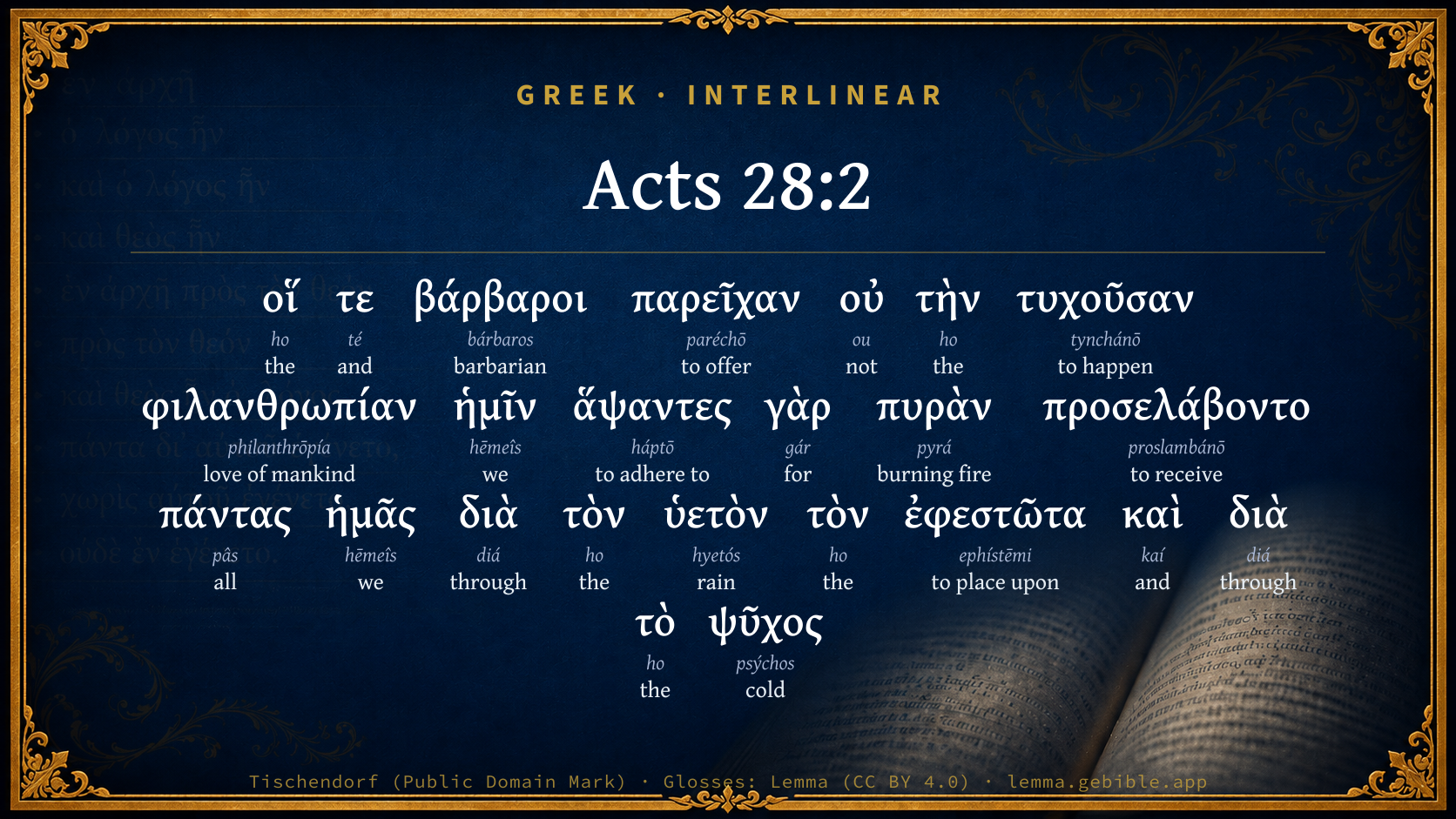
The natives showed us uncommon kindness; for they kindled a fire, and received us all, because of the present rain, and because of the cold.
Download a study sheet
One document with this verse’s original text, its word-by-word gloss line, the meaning frame, cross-references with their text, attributed commentary, and full source and license credits — printable, and it pastes into notes with its structure intact.
This verse Autodidact and up
A passage Seminary Student
Up to 50 verses in one chapter. A passage sheet keeps up to 6 commentary sources and 12 cross-references per verse, in the order this page ranks them, and says so on the sheet whenever that leaves anything out. Ask for a single verse and you get the Autodidact verse sheet above.
Everything on this page stays free to read, with no account — the sheet is a download of what is already on screen, not access to it.
Compare translations 3
The same verse in 3 English versions, stacked beneath the original-language interlinear above. Click any original word for its lexicon entry.
Each is an independent rendering of the whole verse — the interlinear is not word-aligned to these translations.
Highlighted words mark where these versions differ — a whole-verse word diff, not a word-by-word alignment.
-
World English Bible Public Domain
The natives showed us uncommon kindness; for they kindled a fire, and received us all, because of the present rain, and because of the cold.
-
King James Version Public Domain
And the barbarous people shewed us no little kindness: for they kindled a fire, and received us every one, because of the present rain, and because of the cold.
-
unfoldingWord Literal Text CC BY-SA 4.0
And the barbarians were offering no ordinary benevolence to us, for, lighting a fire because of the impending rain and because of the cold, they welcomed us all.
unfoldingWord Literal Text — © unfoldingWord, licensed CC BY-SA 4.0. Word-aligned USFM3 via Door43 (git.door43.org/unfoldingWord/en_ult).
Show all 19 translations
Every available English version of this verse, each an independent rendering of the whole verse.
-
World English Bible Public Domain
The natives showed us uncommon kindness; for they kindled a fire, and received us all, because of the present rain, and because of the cold.
-
Berean Standard Bible Public Domain
The islanders showed us extraordinary kindness. They kindled a fire and welcomed all of us because it was raining and cold.
-
Majority Standard Bible Public Domain
The islanders showed us extraordinary kindness. They kindled a fire and welcomed all of us because it was raining and cold.
-
King James Version Public Domain
And the barbarous people shewed us no little kindness: for they kindled a fire, and received us every one, because of the present rain, and because of the cold.
-
American Standard Version (1901) Public Domain
And the barbarians showed us no common kindness; for they kindled a fire, and received us all, because of the present rain, and because of the cold.
-
Revised Version (1885) Public Domain
And the barbarians shewed us no common kindness: for they kindled a fire, and received us all, because of the present rain, and because of the cold.
-
Geneva Bible (1599) Public Domain
And the Barbarians shewed vs no litle kindnesse: for they kindled a fire, and receiued vs euery one, because of the present showre, and because of the colde.
-
Douay-Rheims (1899) Public Domain
For kindling a fire, they refreshed us all, because of the present rain, and of the cold.
-
Young's Literal Translation Public Domain
and the foreigners were shewing us no ordinary kindness, for having kindled a fire, they received us all, because of the pressing rain, and because of the cold;
-
Literal Standard Version CC BY-SA 4.0
and the foreigners were showing us no ordinary kindness, for having kindled a fire, they received us all, because of the pressing rain, and because of the cold;
-
Unlocked Literal Bible CC BY-SA 4.0
The native people offered to us not just ordinary kindness, but they lit a fire and welcomed us all, because of the constant rain and cold.
-
unfoldingWord Literal Text CC BY-SA 4.0
And the barbarians were offering no ordinary benevolence to us, for, lighting a fire because of the impending rain and because of the cold, they welcomed us all.
-
Darby Bible Public Domain
But the barbarians shewed us no common kindness; for, having kindled a fire, they took us all in because of the rain that was falling and because of the cold.
-
World Messianic Bible Public Domain
The natives showed us uncommon kindness; for they kindled a fire and received us all, because of the present rain and because of the cold.
-
Webster's Bible Public Domain
And the barbarous people showed us no little kindness: for they kindled a fire, and received us every one, because of the present rain, and because of the cold.
-
Free Bible Version CC BY-SA 4.0
The people there were very kind—they started a fire and called all of us over so we could warm up from the rain and the cold.
-
Bible in Basic English Public Domain
And the simple people living there were uncommonly kind to us, for they made a fire for us, and took us in, because it was raining and cold.
-
Text-Critical English NT CC BY 4.0
The native people showed us extraordinary kindness. For they welcomed us all and kindled a fire because of the rain that had set in and because of the cold.
-
Tyndale New Testament (1534) Public Domain
And the people of the countre shewed vs no lytell kyndnes: for they kyndled a fyre and receaved vs every one because of the present rayne and because of colde.
Literal Standard Version (2020), Covenant Press — licensed CC BY-SA 4.0. Text via the HelloAO Bible API (eBible.org). Unlocked Literal Bible (unfoldingWord) — licensed CC BY-SA 4.0. Text via the HelloAO Bible API (eBible.org). unfoldingWord Literal Text — © unfoldingWord, licensed CC BY-SA 4.0. Word-aligned USFM3 via Door43 (git.door43.org/unfoldingWord/en_ult). Free Bible Version, Dr. Jonathan Gallagher — licensed CC BY-SA 4.0. Text via the HelloAO Bible API (eBible.org).
Word by word
More ways to search: Search by grammar → Find every occurrence → Compare this word →
Practice this passage: Drill this verse → Learn its vocabulary →
- Appears 2× in the Greek New Testament
- First appears here
- Part of Speech
- Noun
- Case
- Accusative
- Number
- Singular
- Gender
- Feminine
Full Thayer's Definition
- οἵ ho G3588 “the” Article, Nominative, Plural, Masculine
- τε té G5037 “and” Particle
- βάρβαροι bárbaros G915 “barbarian” Adjective, Nominative, Plural, Masculine
- παρεῖχαν paréchō G3930 “to offer” Verb, Imperfect, Active, Indicative, 3rd person, Plural
- οὐ ou G3756 “not” Particle, Negative
- τὴν ho G3588 “the” Article, Accusative, Singular, Feminine
- τυχοῦσαν tynchánō G5177 “to happen” Verb, Aorist, Active, Participle, Accusative, Singular, Feminine
- φιλανθρωπίαν philanthrōpía G5363 “love of mankind” Noun, Accusative, Singular, Feminine
- ἡμῖν hēmeîs G2249 “we” Personal pronoun, 1st person, Dative, Plural
- ἅψαντες háptō G681 “to adhere to” Verb, Aorist, Active, Participle, Nominative, Plural, Masculine
- γὰρ gár G1063 “for” Conjunction
- πυρὰν pyrá G4443 “burning fire” Noun, Accusative, Singular, Feminine
- προσελάβοντο proslambánō G4355 “to receive” Verb, Aorist, Middle, Indicative, 3rd person, Plural
- πάντας pâs G3956 “all” Adjective, Accusative, Plural, Masculine
- ἡμᾶς hēmeîs G2249 “we” Personal pronoun, 1st person, Accusative, Plural
- διὰ diá G1223 “through” Preposition
- τὸν ho G3588 “the” Article, Accusative, Singular, Masculine
- ὑετὸν hyetós G5205 “rain” Noun, Accusative, Singular, Masculine
- τὸν ho G3588 “the” Article, Accusative, Singular, Masculine
- ἐφεστῶτα ephístēmi G2186 “to place upon” Verb, Perfect, Active, Participle, Accusative, Singular, Masculine
- καὶ kaí G2532 “and” Conjunction
- διὰ diá G1223 “through” Preposition
- τὸ ho G3588 “the” Article, Accusative, Singular, Neuter
- ψῦχος psýchos G5592 “cold” Noun, Accusative, Singular, Neuter
About this verse
These counts appear in no published source. They are computed here, from the morphology-tagged text and Lemma’s own curated glosses. What Lemma adds →
- 24
- words
- 18
- distinct lemmas
- Acts
- section
Notable vocabulary
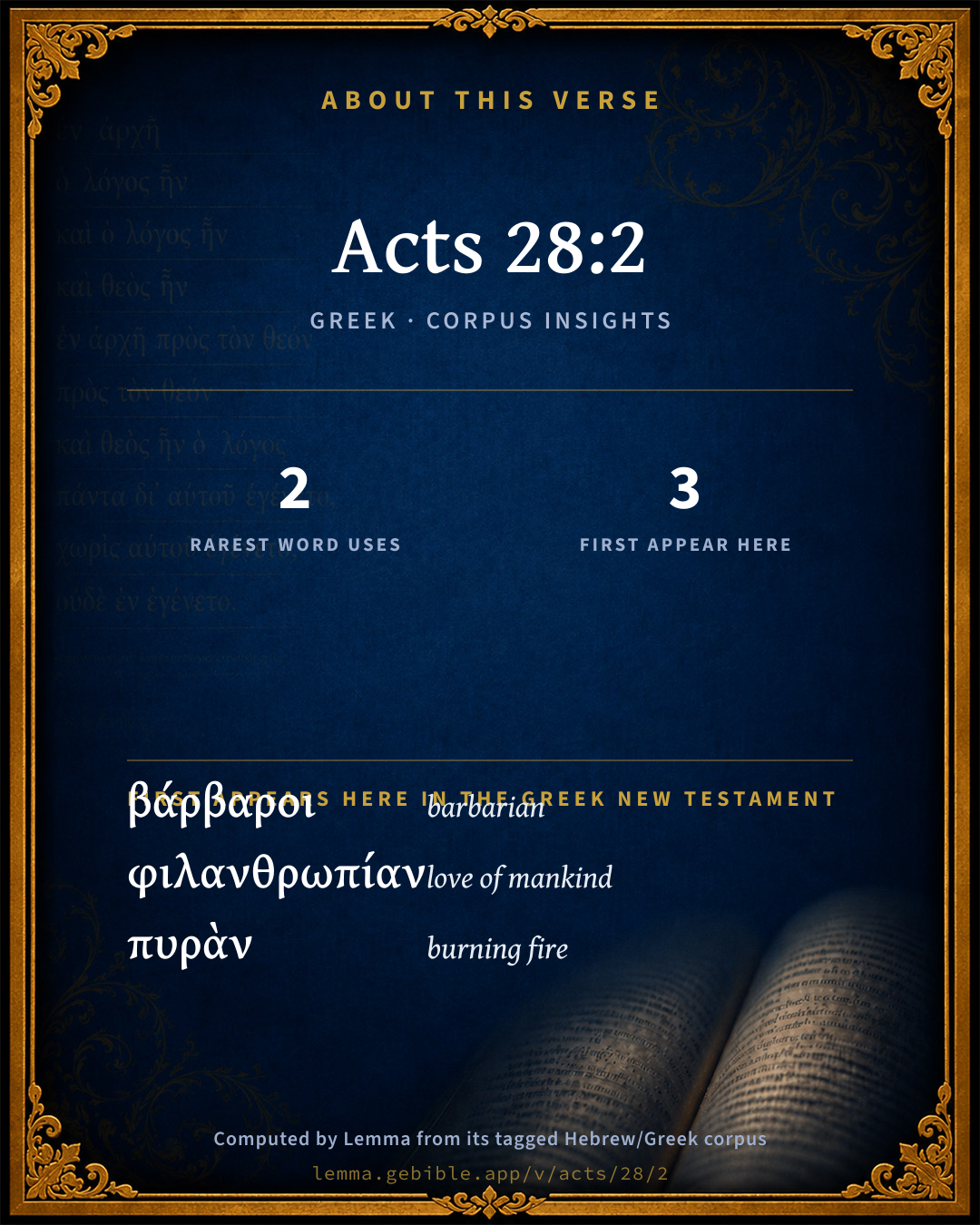
The rarest word here is φιλανθρωπίαν love of mankind G5363 — appearing just 2 times in the whole Greek New Testament.
First appearance in Scripture
These words make their first canonical appearance in the Greek New Testament here:
Shared distinctive vocabulary
φιλανθρωπίαν love of mankind G5363 occurs in 2 verses of the Greek New Testament. Also found in:
Cross-references
16Topical passages linked to Acts 28:2 in the Treasury of Scripture Knowledge — connected by theme and wording, ordered by reader-vote popularity; previews shown in the World English Bible.
- Romans 1:14 I am debtor both to Greeks and to foreigners, both to the wise and to the foolish.
- Colossians 3:11 where there can't be Greek and Jew, circumcision and uncircumcision, barbarian, Scythian, bondservant, freeman; but Christ is all, and in all.
- Hebrews 13:2 Don't forget to show hospitality to strangers, for in doing so, some have entertained angels without knowing it.
- Acts 28:4 When the natives saw the creature hanging from his hand, they said one to another, "No doubt this man is a murderer, whom, though he has escaped from the sea, yet Justice has not allowed to live."
- 2 Corinthians 11:27 in labor and travail, in watchings often, in hunger and thirst, in fastings often, and in cold and nakedness.
- Proverbs 24:11–12 Rescue those who are being led away to death! Indeed, hold back those who are staggering to the slaughter!
- Matthew 10:42 Whoever gives one of these little ones just a cup of cold water to drink in the name of a disciple, most assuredly I tell you he will in no way lose his reward."
- 1 Corinthians 14:11 If then I don't know the meaning of the sound, I would be to him who speaks a foreigner, and he who speaks would be a foreigner to me.
- Leviticus 19:34 The stranger who lives as a foreigner with you shall be to you as the native-born among you, and you shall love him as yourself; for you lived as foreigners in the land of Egypt. I am Yahweh your God.
- Acts 27:3 The next day, we touched at Sidon. Julius treated Paul kindly, and gave him permission to go to his friends and refresh himself.
- Leviticus 19:18 You shall not take vengeance, nor bear any grudge against the children of your people; but you shall love your neighbor as yourself. I am Yahweh.
- Ezra 10:9 Then all the men of Judah and Benjamin gathered themselves together to Jerusalem within the three days; it was the ninth month, on the twentieth [day] of the month: and all the people sat in the broad place before the house of God, trembling because of this matter, and for the great rain.
- Luke 10:30–37 Jesus answered, "A certain man was going down from Jerusalem to Jericho, and he fell among robbers, who both stripped him and beat him, and departed, leaving him half dead.
- John 18:18 Now the servants and the officers were standing there, having made a fire of coals, for it was cold. They were warming themselves. Peter was with them, standing and warming himself.
- Romans 2:14–15 (for when Gentiles who don't have the law do by nature the things of the law, these, not having the law, are a law to themselves,
- Romans 2:27 Won't the uncircumcision which is by nature, if it fulfills the law, judge you, who with the letter and circumcision are a transgressor of the law?
Cross-references courtesy of OpenBible.info (CC BY 4.0).
Lesson kit
Teaching starters — assembled from the data on this page, not authored interpretation. Every prompt links to the verse data it draws on. Edit before teaching.
Acts, in the Acts, opens this verse with 24 words (18 distinct Greek lemmas). Its most distinctive word is philanthrōpía (“love of mankind”). A historical commentator’s framing appears above. Read the whole chapter for the surrounding context.
Discussion questions
- The word philanthrōpía carries the sense “love of mankind.” How does it shape the verse?
- 3 words make their first appearance in Scripture here. What does this debut establish?
- How does Titus 3:4, which shares the word «love of mankind», read alongside this verse?
- What does the repetition of “through” (2× in this one verse) do in this verse?
- The translations on this page render this verse differently — a whole-verse word diff, not a word-by-word alignment. What might account for the different wordings?
- Compare how The Biblical Illustrator and Joseph Benson's Commentary read this verse. Where do they agree or differ?
Things to notice
- 3 words make their first canonical appearance in Scripture here.
- These translations choose different wording for 21 words in this verse.
- “through” occurs 2× in this single verse.
- 18 distinct Greek lemmas span 24 words in this verse.
Commentary
Notes on Acts 28:2 from classic Christian and Jewish commentators (each source and its license shown beneath its notes). The classic Christian expositions comment on the surrounding passage and are grouped to its opening verse, so a note may address several verses; the Jewish commentaries on the Tanakh (Rashi and others) are per-verse, so they appear only where the commentator wrote on this verse.
Lemma curates 59 commentaries, every one of them public domain or Creative Commons licensed, each selected and text-cleaned for this edition rather than reprinted as found. About our sources →
The Biblical Illustrator
Joseph S. Exell
The Biblical Illustrator, edited by Joseph S. Exell (c. 1880s–1900s) — public domain. Text from a community e-Sword module.
Joseph Benson's Commentary
Joseph Benson's Commentary on the Old and New Testaments (1811–1818) — public domain. Text from a community e-Sword module.
Bengel's Gnomon
Johann Albrecht Bengel
Bengel's Gnomon of the New Testament — English translation (T&T Clark, Edinburgh, 1860) — public domain. Text from a community e-Sword module.
Meyer's Critical & Exegetical Commentary
Heinrich August Wilhelm Meyer
Meyer — Critical and Exegetical Commentary on the New Testament — English translation by Peter Christie, edited by Frederick Crombie (T&T Clark, 1880) — public domain. Text from a community e-Sword module.
Expositor's Greek Testament
ed. W. Robertson Nicoll
The Expositor's Greek Testament, edited by W. Robertson Nicoll (1897–1910) — public domain. Text from a community e-Sword module.
Jamieson, Fausset & Brown
Robert Jamieson, A. R. Fausset & David Brown
Jamieson, Fausset & Brown — Commentary Critical and Explanatory on the Whole Bible (1871) — public domain (CC PDM 1.0). Text via the HelloAO Bible API.
Adam Clarke's Commentary
Adam Clarke's Commentary on the Bible (1810–1826) — public domain. Text from a community e-Sword/MySword module.
Ellicott's Commentary for English Readers
A Bible Commentary for English Readers, edited by Charles John Ellicott (1878–1897) — public domain. Text from a community e-Sword module.
The Cambridge Bible for Schools and Colleges
gen. ed. J. J. S. Perowne
The Cambridge Bible for Schools and Colleges (gen. ed. J. J. S. Perowne; Cambridge University Press, 1878–1918) — public domain. Text from a community e-Sword module.
John Gill's Exposition
John Gill's Exposition of the Whole Bible (1746–1763) — public domain (CC PDM 1.0). Text via the HelloAO Bible API.
Trapp's Complete Commentary
John Trapp
John Trapp, A Commentary or Exposition upon All the Books of the Old and New Testament (1647–1656) — public domain. Text from a community e-Sword module.
Albert Barnes' Notes on the Bible
Albert Barnes' Notes on the Bible (1834–1885) — public domain. Text from a community e-Sword/MySword module.
Matthew Poole's English Annotations
Matthew Poole's English Annotations on the Holy Bible (1683–1685) — public domain. Text from a community e-Sword/MySword module.
Whedon's Commentary on the Bible
Daniel D. Whedon
Daniel D. Whedon (gen. ed.), Commentary on the Old and New Testaments (1874–1909) — public domain. Text from a community e-Sword module.
The Pulpit Commentary
The Pulpit Commentary (1880–1919), ed. H.D.M. Spence-Jones & Joseph S. Exell — public domain. Text from a community e-Sword module.
John Wesley's Explanatory Notes
John Wesley, Explanatory Notes Upon the Whole Bible (1754–1765) — public domain. Text via the GEBible commentary corpus.
McGarvey & Pendleton's Commentaries
J. W. McGarvey
J. W. McGarvey (with Philip Y. Pendleton), Commentaries on the New Testament (The Fourfold Gospel, 1914; Acts; and the epistles) — public domain. Text from a community e-Sword/MySword module.
Cambridge Greek Testament for Schools and Colleges
Cambridge Greek Testament for Schools and Colleges (Cambridge University Press, 1896; 21 vols, various authors incl. Carr, Maclear, Plummer, Farrar, Lumby, Moule, M. R. James, Simcox) — public domain. Text from a community e-Sword module.
Alford’s Greek Testament
Henry Alford
Henry Alford, The Greek Testament (1849–1861) — public domain. Text from a community e-Sword module.
Vincent's Word Studies in the New Testament
Marvin R. Vincent
Marvin R. Vincent, Word Studies in the New Testament (1887–1900) — public domain. Text from a community e-Sword/MySword module.