
Romans 1:28

Greek (Tischendorf 8th ed.) Romans 1:28 appears in the Greek New Testament. The text above is from the Tischendorf 8th edition. Each word links to its Strong’s number and a concise gloss. Click any word for its full Thayer’s Greek Lexicon entry.
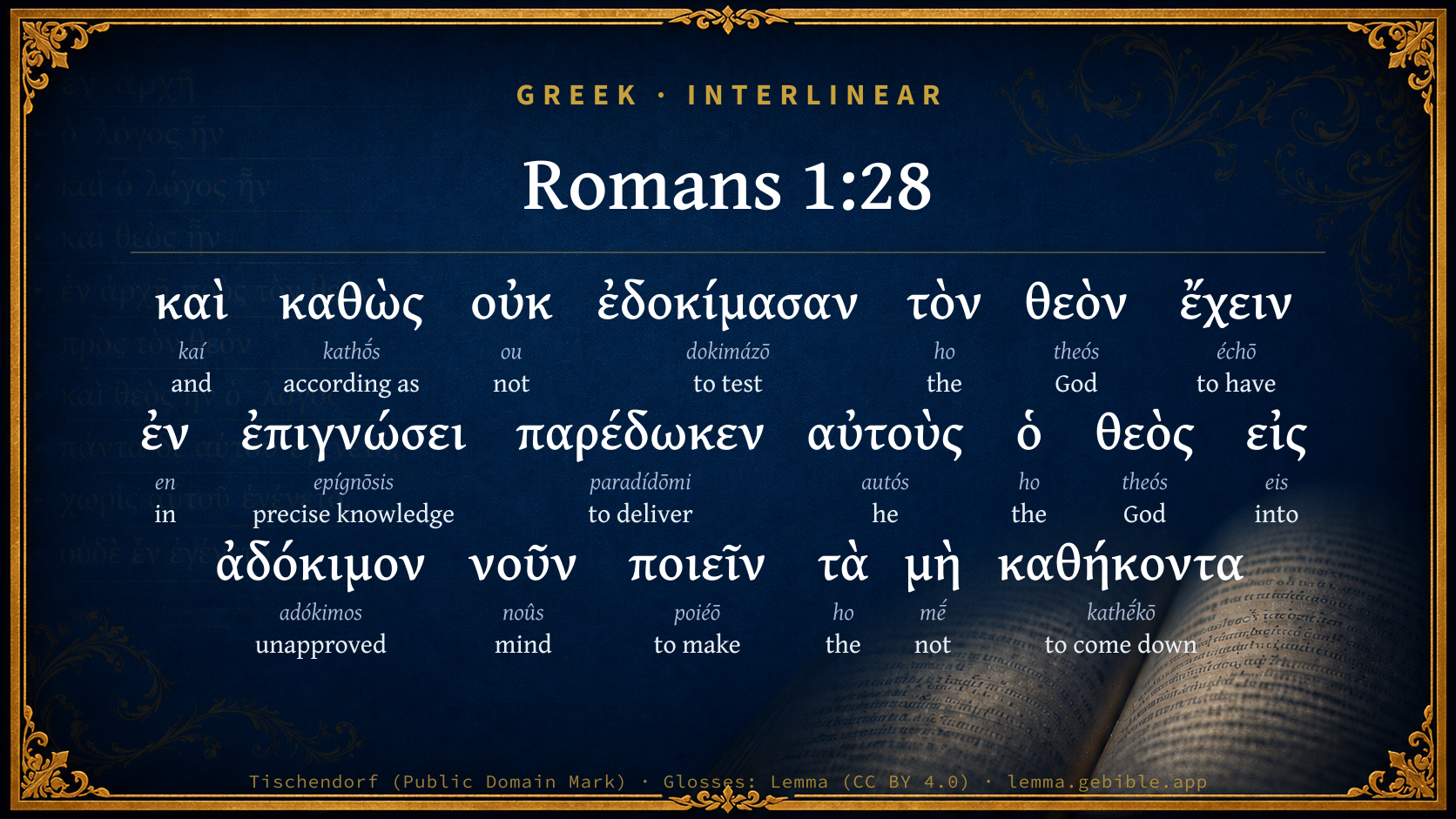
Download image
Cite this verse

Romans 1:28 (World English Bible). Public Domain. Lemma interlinear Bible study tool, https://lemma.gebible.app/v/romans/1/28.

Show BibTeX & RIS
BibTeX
RIS
English Translation
Even as they refused to have God in their knowledge, God gave them up to a reprobate mind, to do those things which are not fitting;
World English Bible · Public Domain
Highlights
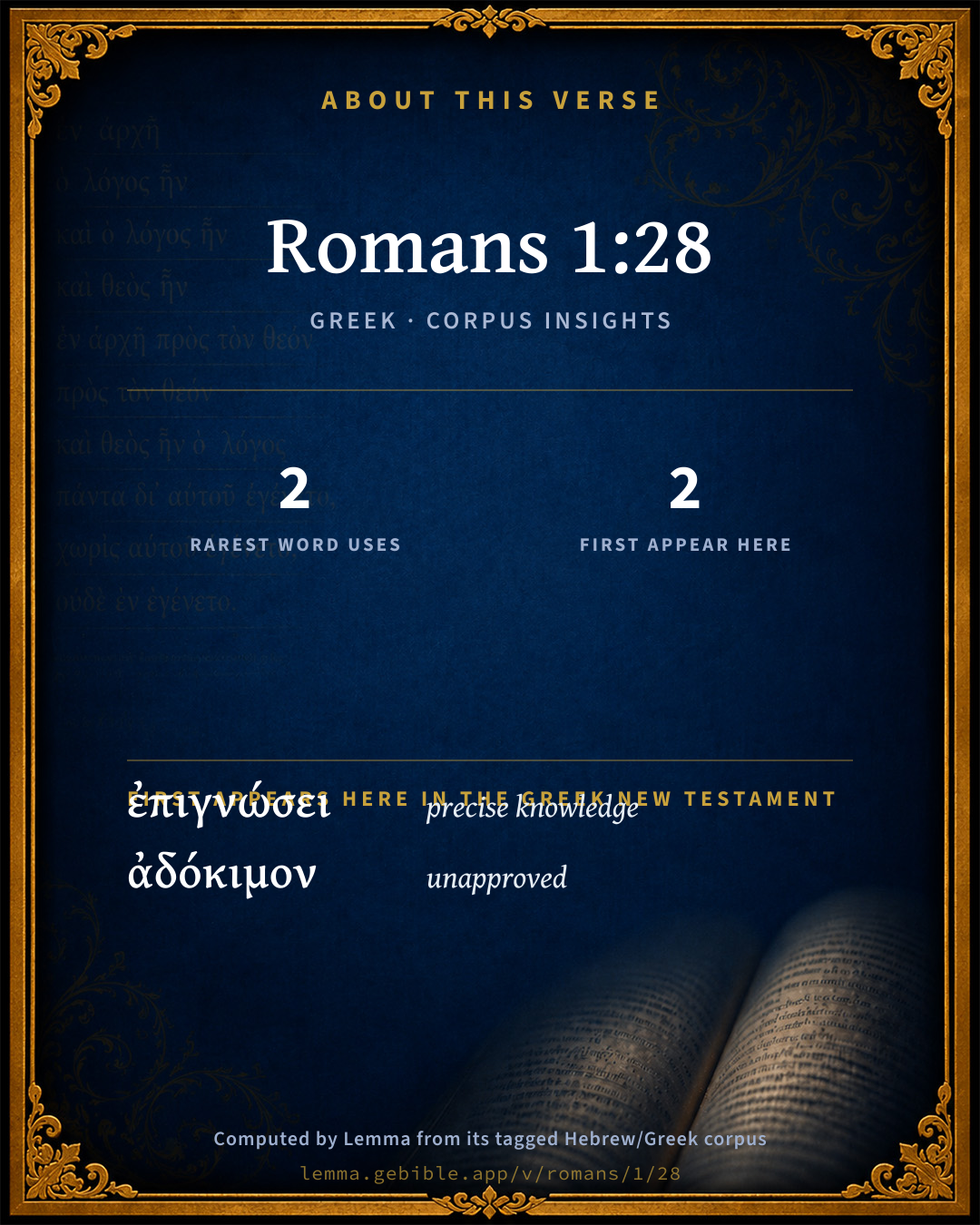
  • 2 first appearances in the Greek New Testament
Full analysis ↓
Download a study sheet

One document with this verse’s original text, its word-by-word gloss line, the meaning frame, cross-references with their text, attributed commentary, and full source and license credits — printable, and it pastes into notes with its structure intact.

This verse Autodidact and up

Study sheet (.html) Plain text (.txt)

A passage Seminary Student

Up to 50 verses in one chapter. A passage sheet keeps up to 6 commentary sources and 12 cross-references per verse, in the order this page ranks them, and says so on the sheet whenever that leaves anything out. Ask for a single verse and you get the Autodidact verse sheet above.

Everything on this page stays free to read, with no account — the sheet is a download of what is already on screen, not access to it.

Want to remove ads? Support Godless Engineer
Compare translations 3

The same verse in 3 English versions, stacked beneath the original-language interlinear above. Click any original word for its lexicon entry.

Each is an independent rendering of the whole verse — the interlinear is not word-aligned to these translations.

Highlighted words mark where these versions differ — a whole-verse word diff, not a word-by-word alignment.

  • World English Bible Public Domain
    Even as they refused to have God in their knowledge, God gave them up to a reprobate mind, to do those things which are not fitting;
  • King James Version Public Domain
    And even as they did not like to retain God in their knowledge, God gave them over to a reprobate mind, to do those things which are not convenient;
  • unfoldingWord Literal Text CC BY-SA 4.0
    And just as they did not approve of having God in their full awareness, God gave them over to a disapproved mind, to do the things that are not proper,

unfoldingWord Literal Text — © unfoldingWord, licensed CC BY-SA 4.0. Word-aligned USFM3 via Door43 (git.door43.org/unfoldingWord/en_ult).

Versions to compare (up to 4)

3 of 4 selected

Show all 19 translations

Every available English version of this verse, each an independent rendering of the whole verse.

  • World English Bible Public Domain
    Even as they refused to have God in their knowledge, God gave them up to a reprobate mind, to do those things which are not fitting;
  • Berean Standard Bible Public Domain
    Furthermore, since they did not see fit to acknowledge God, He gave them up to a depraved mind, to do what ought not to be done.
  • Majority Standard Bible Public Domain
    Furthermore, since they did not see fit to acknowledge God, He gave them up to a depraved mind, to do what ought not to be done.
  • King James Version Public Domain
    And even as they did not like to retain God in their knowledge, God gave them over to a reprobate mind, to do those things which are not convenient;
  • American Standard Version (1901) Public Domain
    And even as they refused to have God in `their' knowledge, God gave them up unto a reprobate mind, to do those things which are not fitting;
  • Revised Version (1885) Public Domain
    And even as they refused to have God in their knowledge, God gave them up unto a reprobate mind, to do those things which are not fitting;
  • Geneva Bible (1599) Public Domain
    For as they regarded not to acknowledge God, euen so God deliuered them vp vnto a reprobate minde, to doe those things which are not conuenient,
  • Douay-Rheims (1899) Public Domain
    And as they liked not to have God in their knowledge, God delivered them up to a reprobate sense, to do those things which are not convenient;
  • Young's Literal Translation Public Domain
    And, according as they did not approve of having God in knowledge, God gave them up to a disapproved mind, to do the things not seemly;
  • Literal Standard Version CC BY-SA 4.0
    And according as they did not approve of having God in knowledge, God gave them up to a disapproved mind, to do the things not seemly;
  • Unlocked Literal Bible CC BY-SA 4.0
    Because they did not approve of having God in their awareness, he gave them up to a depraved mind, for them to do those things that are not proper.
  • unfoldingWord Literal Text CC BY-SA 4.0
    And just as they did not approve of having God in their full awareness, God gave them over to a disapproved mind, to do the things that are not proper,
  • Darby Bible Public Domain
    And according as they did not think good to have God in [their] knowledge, God gave them up to a reprobate mind to practise unseemly things;
  • World Messianic Bible Public Domain
    Even as they refused to have God in their knowledge, God gave them up to a reprobate mind, to do those things which are not fitting;
  • Webster's Bible Public Domain
    And even as they did not like to retain God in their knowledge, God gave them over to a reprobate mind, to do those things which are not convenient;
  • Free Bible Version CC BY-SA 4.0
    Since they didn't consider it worthwhile to get to know God, he abandoned them to their worthless, distrustful way of thinking, doing things that should never be done.
  • Bible in Basic English Public Domain
    And because they had not the mind to keep God in their knowledge, God gave them up to an evil mind, to do those things which are not right;
  • Text-Critical English NT CC BY 4.0
    And just as they considered it worthless to have God in their knowledge, God gave them up to a worthless mind, to do what is not proper.
  • Tyndale New Testament (1534) Public Domain
    And as it semed not good vnto them to be aknowen of God even so God delivered them vp vnto a leawde mynd that they shuld do tho thinges which were not comly

Literal Standard Version (2020), Covenant Press — licensed CC BY-SA 4.0. Text via the HelloAO Bible API (eBible.org). Unlocked Literal Bible (unfoldingWord) — licensed CC BY-SA 4.0. Text via the HelloAO Bible API (eBible.org). unfoldingWord Literal Text — © unfoldingWord, licensed CC BY-SA 4.0. Word-aligned USFM3 via Door43 (git.door43.org/unfoldingWord/en_ult). Free Bible Version, Dr. Jonathan Gallagher — licensed CC BY-SA 4.0. Text via the HelloAO Bible API (eBible.org).

Word by word

More ways to search: Search by grammar → Find every occurrence → Compare this word →

Practice this passage: Drill this verse → Learn its vocabulary →

καθήκοντα
kathḗkō
G2520
“to come down”
Verb, Present, Active, Participle, Accusative, Plural, Neuter
Part of Speech
Verb
Tense
Present
Voice
Active
Mood
Participle
Case
Accusative
Number
Plural
Gender
Neuter
Full Thayer's Definition

Origin: from G2596 and G2240

TDNT: 10:17,4

1. to come down 2. to come to, reach to a. it is becoming b. it is fit
  1. καὶ kaí G2532 “and” Conjunction
  2. καθὼς kathṓs G2531 “according as” Adverb
  3. οὐκ ou G3756 “not” Particle, Negative
  4. ἐδοκίμασαν dokimázō G1381 “to test” Verb, Aorist, Active, Indicative, 3rd person, Plural
  5. τὸν ho G3588 “the” Article, Accusative, Singular, Masculine
  6. θεὸν theós G2316 “God” Noun, Accusative, Singular, Masculine
  7. ἔχειν échō G2192 “to have” Verb, Present, Active, Infinitive
  8. ἐν en G1722 “in” Preposition
  9. ἐπιγνώσει epígnōsis G1922 “precise knowledge” Noun, Dative, Singular, Feminine
  10. παρέδωκεν paradídōmi G3860 “to deliver” Verb, Aorist, Active, Indicative, 3rd person, Singular
  11. αὐτοὺς autós G846 “he” Personal pronoun, Accusative, Plural, Masculine
  12. ὁ ho G3588 “the” Article, Nominative, Singular, Masculine
  13. θεὸς theós G2316 “God” Noun, Nominative, Singular, Masculine
  14. εἰς eis G1519 “into” Preposition
  15. ἀδόκιμον adókimos G96 “unapproved” Adjective, Accusative, Singular, Masculine
  16. νοῦν noûs G3563 “mind” Noun, Accusative, Singular, Masculine
  17. ποιεῖν poiéō G4160 “to make” Verb, Present, Active, Infinitive
  18. τὰ ho G3588 “the” Article, Accusative, Plural, Neuter
  19. μὴ mḗ G3361 “not” Particle, Negative

About this verse

These counts appear in no published source. They are computed here, from the morphology-tagged text and Lemma’s own curated glosses. What Lemma adds →

20
words
17
distinct lemmas
Pauline Epistles
section

Notable vocabulary

The rarest word here is καθήκοντα to come down G2520 — appearing just 2 times in the whole Greek New Testament.

First appearance in Scripture

These words make their first canonical appearance in the Greek New Testament here:

  • ἐπιγνώσει precise knowledge G1922
  • ἀδόκιμον unapproved G96

Shared distinctive vocabulary

καθήκοντα to come down G2520 occurs in 2 verses of the Greek New Testament. Also found in:
Repetition

Words recur within this verse:

Cross-references

28

Topical passages linked to Romans 1:28 in the Treasury of Scripture Knowledge — connected by theme and wording, ordered by reader-vote popularity; previews shown in the World English Bible.

  • 2 Thessalonians 2:10–12 and with all deception of wickedness for those who are being lost, because they didn't receive the love of the truth, that they might be saved.
  • Romans 1:21 Because, knowing God, they didn't glorify him as God, neither gave thanks, but became vain in their reasoning, and their senseless heart was darkened.
  • Titus 1:16 They profess that they know God, but by their works they deny him, being abominable, disobedient, and unfit for any good work.
  • Jeremiah 9:6 Your habitation is in the midst of deceit; through deceit they refuse to know me, says Yahweh.
  • Romans 1:24 Therefore God also gave them up in the lusts of their hearts to uncleanness, that their bodies should be dishonored among themselves,
  • Romans 8:7–8 because the mind of the flesh is hostile towards God; for it is not subject to God's law, neither indeed can it be.
  • 2 Timothy 3:8 Even as Jannes and Jambres opposed Moses, so do these also oppose the truth; men corrupted in mind, reprobate concerning the faith.
  • Proverbs 5:12–13 And say, "How I have hated instruction, And my heart despised reproof;
  • Job 21:14–15 They tell God, 'Depart from us, For we don't want to know about your ways.
  • Jeremiah 4:22 For my people are foolish, they don't know me; they are foolish children, and they have no understanding; they are wise to do evil, but to do good they have no knowledge.
  • Jeremiah 6:30 Refuse silver shall men them, because Yahweh has rejected them.
  • Proverbs 1:7 The fear of Yahweh is the beginning of knowledge; But the foolish despise wisdom and instruction.
  • Proverbs 1:22 "How long, you simple ones, will you love simplicity? How long will mockers delight themselves in mockery, And fools hate knowledge?
  • Proverbs 1:29 Because they hated knowledge, And didn't choose the fear of Yahweh.
  • Hosea 4:6 My people are destroyed for lack of knowledge. Because you have rejected knowledge, I will also reject you, That you may be no priest to me. Because you have your God's law, I will also forget your children.
  • 1 Corinthians 15:34 Wake up righteously, and don't sin, for some have no knowledge of God. I say this to your shame.
  • 2 Corinthians 4:4–6 in whom the god of this world has blinded the minds of the unbelieving, that the light of the Gospel of the glory of Christ, who is the image of God, should not dawn on them.
  • 2 Corinthians 13:5–7 Test your own selves, whether you are in the faith. Test your own selves. Or don't you know as to your own selves, that Jesus Christ is in you?--unless indeed you are disqualified.
  • Romans 1:18 For the wrath of God is revealed from heaven against all ungodliness and unrighteousness of men, who suppress the truth in unrighteousness,
  • Ephesians 5:4 nor filthiness, nor foolish talking, nor jesting, which are not appropriate; but rather giving of thanks.
  • 2 Thessalonians 1:8 giving vengeance to those who don't know God, and to those who don't obey the Gospel of our Lord Jesus,
  • Proverbs 17:16 Why is there money in the hand of a fool to buy wisdom, Seeing he has no understanding?
  • Romans 1:26 For this reason, God gave them up to vile passions. For their women changed the natural function into that which is against nature.
  • Acts 17:23 For as I passed along, and observed the objects of your worship, I found also an altar with this inscription: 'TO AN UNKNOWN GOD.' What therefore you worship in ignorance, this I announce to you.
  • 2 Peter 3:5 For this they willfully forget, that there were heavens from of old, and an earth formed out of water and amid water, by the word of God;
  • Acts 17:32 Now when they heard of the resurrection of the dead, some mocked; but others said, "We want to hear you again concerning this."
  • 2 Corinthians 10:5 throwing down imaginations and every high thing that is exalted against the knowledge of God, and bringing every thought into captivity to the obedience of Christ;
  • Philemon 1:8 Therefore, though I have all boldness in Christ to command you that which is appropriate,

Cross-references courtesy of OpenBible.info (CC BY 4.0).

Commentary

Notes on Romans 1:28 from classic Christian and Jewish commentators (each source and its license shown beneath its notes). The classic Christian expositions comment on the surrounding passage and are grouped to its opening verse, so a note may address several verses; the Jewish commentaries on the Tanakh (Rashi and others) are per-verse, so they appear only where the commentator wrote on this verse.

Lemma curates 59 commentaries, every one of them public domain or Creative Commons licensed, each selected and text-cleaned for this edition rather than reprinted as found. About our sources →

The Biblical Illustrator

Joseph S. Exell

Rom_1:28

And even as they did not like to retain God in their knowledge, God gave them over to a reprobate mind.

The state of heathendom

Idolatry is essentially the same in every age and place.

1. In its origin. It flows from a corrupt heart, desirous not to retain the knowledge of God.

2. In its nature. However great the variety, or modes of worship, there is a grand generic likeness in them all. The Greeks may worship Jupiter, and the Hindoos Vishnu; one class a god, and another a goddess; but still all agree in this one point, they like not to retain God in their knowledge.

3. In its effects: God gave them over to a reprobate mind; and, as the necessary consequence of that, they did those things which are not convenient (Rom_1:29-32). Such were the effects produced by idolatry in ancient times. And we ask those who object to this language to show us by idolatry, by being continued in for nearly two thousand years, has grown better than it was in the days of the apostle?

I. The state of the heathen as here described.

1. God has given them over to a reprobate mind. The term signifies disapproved. The mind which God approves must be one which has correct views of the Divine character--a just idea of the plan of salvation; and these views must have a holy influence on the heart and life. The views of the heathen on these points prove that they are given over to a reprobate mind.

(1) What are their views of the Supreme Being? The heathens of India believe that all things exist in God, and that God exists in them all. Hence, when you charge a Hindoo with sin, he answers with the greatest gravity, Sir, it is not I that sin, but God that does all these things in me. If you ask them, Why, then, are you punished for what is not done by your agency? they answer, Because there must be a certain consequence from all actions, like fruit from a seed; and it is not in the power of all the gods to prevent it. Surely they are given over to a reprobate mind! The same may be said with regard to their views of the gods and goddesses they worship. Seeing in these nothing that is excellent, they become objects of terror only to their minds. And to those whom they consider as having the greatest power, and as doing the greatest mischief, they pay the greatest respect, and make the most frequent offerings. All their gods and goddesses have been guilty of the greatest excesses. How must this strengthen their minds in sin, when they find themselves encouraged by such examples! So that their very religion is a curse to them. As for their visible embodiments, they know that they have eyes, but see not, etc.; and yet such is their infatuation, that when the priest has pronounced certain formularies over these images, they imagine that the beings whom they represent become completely identified with the stocks of wood or of stone which stand before them. Is not this a proof that they are given over to a reprobate mind?

(2) Being ignorant of God, they are ignorant of the way in which His favour may be secured. They suppose that they can obtain absorption into the supreme Being, by meditating upon Him. Hence some of them plunge into the forest, and stand in one posture meditating upon Him, till their hair becomes grown like eagles feathers, and their nails like birds claws. Thus they remain till they believe that their souls have passed into the structure of their skulls, and are completely absorbed into it. Those who are not able to enter into this sublime course of study, found the same hope on the performance of a number of rites, such as bathing in the river Ganges; repeating thousands of times the names of their chosen gods, counting over a vast number of beads, building some temple, making some god, offering fruits and flowers to some deity. By some, or all, of these duties they hope to heap up a stock of merit for a future world; and they have no other idea whatever of anything in the way of atonement. As merit is attached to suffering as well as to actions, many of the heathen have entered on certain penalties, and inflicted severe pains upon themselves. Some hold their hands towards heaven till their arms become fixed in their sockets. Some travel hundreds of miles to visit some sacred place; others measure the whole length of their journey with their bodies on the ground. Thousands die every year by these penances. Do not these things prove that they are given over, etc.

(3) Ignorance of the means to be adopted argues ignorance of the end that is to be obtained. The heathen have no idea of a pure and eternal heaven. Those who live in meditation maintain that when the soul goes out of the body it mingles as completely with the Deity as water mingles with the ocean, and suppose that they shall be as incapable of pleasure as of pare. Those who depend on rights and ceremonies believe that in proportion to their attention to these duties will be their future degree of pleasure in a heaven that is as sensual in its nature as it is short in its duration; and that then they shall return back again to earth to suffer again. Those who are left unburied, they believe will be cast into one of the nine hells, and will then come back to earth in the form of a reptile, a bird, or a beast, before they can again assume a human form. Thus, when there is no true knowledge of God or Christ, there is no true notion of eternal life. This is life eternal, etc.

2. God has given them over to do those things which are not convenient, Without entering into all here stated, we may instance--

(1) Their lying. The character of a people must always be in accordance with the things they believe. The Hindoos believe tales the most monstrous and absurd, and what wonder that they, who receive such lies, should be themselves given to lying? They consider the sin to consist, not in lying, but in being detected. So much does it prevail in civil life, that in the courts of judicature it is almost impossible to administer justice. In mercantile concerns, after telling many lies as to the value of an article, and what it cost them, they will sell the article for one-third less than they at first demanded. And the inconveniences of this practice are almost endless.

(2) So are those which arise from the free and unrestrained indulgence of vicious appetites and propensities. The sins which are specified in this chapter are the very sins which they commit. I have gone through it with the Pundits, and have found, from their own confession, that this is really the case.

(3) Their covetousness must be noticed also. They believe that money is everything, both for this world and the next. When urged to become Christians, it is not uncommon for them to say, Give us fine houses, and gold, and we will become Christians. They will submit to anything, however base and mean, for money. It is contrary to their Shasters for any Brahmin to become the servant of a foreigner; and yet, for the sake of gain, there is not a priest among them but will acknowledge a barbarian for his master. They will offer up prayers to the goddess Kalee, to be assisted in their depredations on the property of others; and I know of one instance in which, when these prayers were supposed to be unanswered, the goddess was herself robbed.

(4) Their cruelty. Some of them they practise on themselves. In many eases they will see misery and distress, without moving to afford the least relief. I have seen men fastened to a long pole by hooks, and then swung round by a rope with a swiftness which deprived them of their reason. Some have iron spits run through their tongues, or sticks passed through their sides. But the greatest of all their cruelties is the burning of widows, infanticide and murder of parents.

II. What effect ought this view to produce in our minds? We ought to learn--

1. How evil and dreadful a thing it is to separate God from our thoughts. If we exclude God from our thoughts, we must expect that He will east us out from His presence. It became the righteous God to give over to a reprobate mind those who did not like to retain Him in their knowledge.

(1) That others may see the folly of such conduct, and avoid the rocks on which they have split.

(2) That He might show His just abhorrence of idolatry. God had tried all means with the heathen, and all in vain; and at last He said, They are joined to their idols, let them alone!

2. To be truly thankful for our superior state and privileges. Contrast your state with theirs: they have no Bible, you have the Word of God. Their sacred books countenance the most unhallowed feelings, while the Bible teaches you to deny ungodliness and worldly lusts, and to follow holiness. Your Bible reveals an immortality of purity and bliss, their Bible reveals nothing except a sensual heaven. You have teachers to guide you in the way to heaven, but ignorance is perfect bliss compared to the knowledge which they obtain from their Brahmins. The priest will visit them at their houses, and covet some article which he sees in the room; and if it be not given to him, he will leave a curse instead of a blessing. You have Sabbaths, but the Sabbath never shines on Hindoostan!

3. To pity and to pray for the heathen. We ought to look on them as Christ looked on us when in our sins and our blood. If your feeling of pity be genuine, it will lead to prayer.

4. To make the most strenuous exertions for the amelioration of their condition. It is well to pity them and to pray for them; but if you do no more, it will be difficult to prove to God or man the sincerity of your pity and your prayers.

(1) We should do so from a regard to the glory of God. The Word of God declares that He has given His Son the heathen for His inheritance. He has placed the heathen of India in our hands, that we may bring them to the knowledge of the truth.

(2) To this we are bound by the greatest obligations. Freely have ye received, freely give. What a disgrace to the Christian army if volunteers be not found to engage in this service! Some may perhaps say, there are so many discouragements. But we should remember that God does not despise the day of small things; and that from some of our saddest exercises, the most glorious prospects may arise.

(3) We call upon you, by the memory of those noble servants of the Lord who have laid down their lives in His service.

(4) We exhort you, by the example of our Lord Jesus Christ, who, though He was rich, yet for our sakes became poor. (W. Yates.)

God lost to the sight of an evil heart

The heart that is addicted to evil, that is in love with sin, that is clogged and burdened with guilt, has lost the capacity of discerning God as it has lost the wish to be near Him. His name is not welcome, the idea of Him is not pleasant; we are neither willing nor able, when we are plunged in our selfish sinfulness, to cherish the bright and purifying thought of our loving Father. As a cloud darkens the heavens, the mist of our own evil hearts rises up and fills our sky, and blots out all the starry intentions of our spirit, and drapes the face of God Himself in a blackness that can be felt. (A. Maclaren, D. D.)

Diminishing light but not diminishing responsibility

We would infer from this account that men, in the first instance, had a far more clear and convinced sense of God; but, not liking to retain it, committed the sin of a perverse disposition against the light which they had, and in part extinguished it--that they of course left their own immediate posterity in a light more shaded than that which shone around the outset of their own progress through the world--that these still disliked the remainder of truth which they enjoyed; and, by their wilful resistance inflicted upon it a further mutilation, and transmitted it to their descendants with a still deeper hue of obscurity thrown over it; but still with such glimpses as were enough at least to try the affection of man towards it, to stir up a distinct resistance on the part of those who disliked it, to keep up the responsibility of the world, and to retain it in rightful dependence on the judgment of Him who made the world--so as to make it clear on the day of reckoning, that men, even in their state of most sunken alienation from the true God, were never so destitute of all capacity for discerning between the good and the evil, as to render them the unfit subjects of a moral sentence and a moral examination. With every human creature who shall be pronounced worthy of death on that day, will it be seen that there was either a light which he actually had and liked not to retain, or a light which he might have had and liked not to recover. To whom much is given of him much shall be required; and there will be gradations of punishment in hell. (T. Chalmers, D. D.)

The Biblical Illustrator, edited by Joseph S. Exell (c. 1880s–1900s) — public domain. Text from a community e-Sword module.

Joseph Benson's Commentary

Rom 1:28-31. And as they did not like — ουκ εδοκιμασαν, they did not approve, to retain God in their knowledge — Or rather, as εχειν εν επιγνωσει more properly signifies, to retain him with acknowledgment. For it is proved above that they were not wholly without the knowledge of God in the world: but they did not acknowledge him as they ought; did not use or improve the knowledge they had of him to the purposes for which it had been vouch-safed. Or, as Dr. Macknight interprets it, They “did not approve of holding God as the object of the people’s acknowledgment and worship, but approved of the worship of false gods and of images, as more proper for the vulgar; and on that account substituted idolatry in place of the pure, spiritual worship of the one true God, and established it by law.” Therefore God gave them over to a reprobate mind — αδοκιμον νουν, an undiscerning, or injudicious mind; a mind not perceiving or approving what is good, either in principle or practice; a mind void of all proper knowledge and relish of what is excellent, treated of Rom 1:32. Men of this stamp are said, Eph 4:19, to be απηλγηκοτες, without feeling. To do things not convenient — Even the vilest abominations, treated of Rom 1:29-31. Being filled with all unrighteousness — Or injustice. This stands in the first place, unmercifulness in the last. Fornication includes here every species of uncleanness; wickedness — πονηρια, a word which implies a disposition to injure others by craft. Hence the devil is called ο πονηρος, the wicked one, by way of eminence; covetousness — Πλεονεξια, an inordinate desire to have more than God sees proper for us, which, the apostle says, is idolatry, Col 3:5; maliciousness — κακια, a disposition to injure others from ill-will to them, or which delights in hurting another, even without any advantage to one’s self; full of envy — Grieving at another’s welfare, or rejoicing at his hurt; debate —

Εριδος, strife, contention, quarrelling; deceit — Or guile, fraud; malignity — Κακοηθειας, a bad disposition, or evil habit; a disposition, according to Aristotle, to take every thing in the worst sense; but, according to Estius, the word denotes asperity of manners, rudeness; whisperers —

Such as secretly defame others; backbiters — Καταλαλους, revilers, such as openly speak against others in their absence; haters of God — Especially considered as holy and just, as a lawgiver and judge; persons under the power of that carnal mind which is enmity against him; enemies in their minds, says the apostle, by wicked works; deniers of his providence, or accusers of his justice in their adversities; despiteful — Υβριστας, violent, or overbearing in their behaviour to each other; or persons who commit injuries with violence, or who oppress others by force; proud — Persons who value themselves above their just worth; or who are elated on account of their fortune, or station, or office, or endowments, natural or acquired; boasters — Αλαζονας, persons who assume to themselves the reputation of qualities which they do not possess; inventors of evil things — Of new pleasures, new ways of gain, new arts of hurting, particularly in war; disobedient to parents — Either natural or political, not willingly subject to lawful authority; a sin here ranked with the greatest crimes. Without understanding — Who act like men void of reason; covenant-breakers — False to their promises, oaths, and engagements. It is well known, the Romans, as a nation, from the very beginning of their commonwealth, never made any scruple of vacating altogether the most solemn engagement, if they did not like it, though made by their supreme magistrate, in the name of the whole people. They only gave up the general who had made it, and then supposed themselves to be at full liberty! Without natural affection — The custom of exposing their own new-born children to perish by cold, hunger, or wild beasts, which so generally prevailed in the heathen world, particularly among the Greeks and Romans, was an amazing instance of this; as is also that of killing their aged and helpless parents, now common among the American heathen. Implacable — Persons who, being once offended, will never be reconciled. The original word ασπονδους, from σπονδη, a libation, “is used to signify irreconcilable, because, when the heathen made their solemn covenants, by which they bound themselves to lay aside their enmities, they ratified them by a sacrifice, on which they poured a libation, after drinking a part of it themselves.” Unmerciful — Unfeeling, unforgiving, or pursuing their schemes of cruelty and revenge, whenever they got any new opportunity of doing it.

Joseph Benson's Commentary on the Old and New Testaments (1811–1818) — public domain. Text from a community e-Sword module.

Tyndale Open Study Notes

Tyndale Open Resources

1:28 thought it foolish: Sin affects our actions and even our thoughts. One of the serious consequences of turning away from God is an unsound mind; people can no longer use their minds as God intended.

Tyndale Open Study Notes — © Tyndale Open Resources, licensed CC BY-SA 4.0. Text via the HelloAO Bible API.

Bengel's Gnomon

Johann Albrecht Bengel

Rom 1:28. Ἔχειν to have) [or retain] the antithesis is παρέδωκεν, [God] gave them over: ἔχειν ἐν ἐπιγνώσει, to have [or retain] in knowledge, denotes more than ἐπιγινώσκειν, to know) [to be acquainted with]. Knowledge was not altogether wanting to them; but they did not so far profit in the possession of it, as to have [or retain] God, Rom 1:32.—ἀδόκιμον) As ἀδύνατος, ἄπιστος, and such like, have both an active and passive signification, so also ἀδόκιμος. In this passage, there is denoted [or stigmatized], in an active sense, the mind, which approves of things, which ought by no means to be approved of; to this state of mind they are consigned, who have disapproved of, what was most worthy of approbation. In this sense, the word ἁδοκίμον is treated of at Rom 1:32; συνευδοκοῦσι: and the words ποιε͂ιν τὰ μὴ καθήκοντα, at Rom 1:29-31.—τὰ μὴ καθήκοντα), an example of the figure Meiosis [by which less is said, than the writer wishes to be understood].

Bengel's Gnomon of the New Testament — English translation (T&T Clark, Edinburgh, 1860) — public domain. Text from a community e-Sword module.

Meyer's Critical & Exegetical Commentary

Heinrich August Wilhelm Meyer

Rom_1:28. From the previous exclusive description of the sensual vice of the Gentiles, Paul now proceeds to a summary enumeration of yet other vices to which they had been given up by God in punishment of their apostasy.

καθώς] is not causal, but quemadmodum. The giving them up was something corresponding to their disdainful rejection of the knowledge of God, proportionate as punishment.

οὐκ ἐδοκίμασαν] they deemed God not worth (1Th_2:4); οὐ γὰρ ἀγνοίας, ἀλλὰ μελέτης εἶναι φησὶ τὰ τολμήματα, Chrysostom.

ἔχειν ἐν ἐπιγνώσει] Their γνῶναι τὸν Θεόν, derived from the revelation of nature (Rom_1:21), ought to have been brought by cultivation to an ἐπιγνῶναι, that is, to a penetrating and living knowledge of God (see on Eph_1:17; 1Co_13:12); thus they would have attained to the having God ἐν ἐπιγνώσει; but they would not, and so became τὰ ἔθνη τὰ μὴ εἰδότα τὸν Θεόν, 1Th_4:5; Gal_4:8; Eph_2:12; Act_17:30. On ἔχειν ἐν with an abstract noun, which represents the object as appropriated in the action, so that it is possessed in the latter (here in ἐπιγνῶμναι), comp Locella, a[531] Xen. Eph. p. 255. Similar is ἘΝ ὈΡΓῇ ἜΧΕΙΝ, and the like, Krüger on Thucyd. ii. 8, 3.

εἰς ἀδόκ. νοῦν] An ingenious paronomasia with ΟὐΚ ἘΔΟΚΊΜ., to set forth the more prominently the recompense, to which the emphatically repeated ὁ Θεός also contributes: as they did not esteem God worthy, etc., God gave them up to an unworthy, reprobate νοῦς (the collective power of the minds action in theoretic and moral cognition[532]). The rendering judicii expers (Beza, Glöckler and others) is opposed to the genius of the language, even as Bengel turns it, and Weiss, bibl. Theol. p. 280, defines it. The ἀδόκιμον of the ΝΟῦς is its blameworthiness according to an objective moral standard, but does not express the mode of thinking which they themselves must condemn among one another (Th. Schott; comp Hofmann), which is neither to be taken by anticipation from Rom_1:32, nor extracted from ΜῊ.

ΠΟΙΕῖΝ ΤᾺ ΜῊ ΚΑΘΉΚΟΝΤΑ] to do what is not becoming, what is not moral. Comp 3Ma_4:16. The Stoical distinction between ΚΑΘῆΚΟΝ and ΚΑΤΌΡΘΩΜΑ Paul has not thought of (as Vitringa conceives). The infinitive is epexegetical: so that they do. The participle with μή indicates the genus of that which is not seemly (Baeumlein, Partik. p. 296); τὰ οὐ καθήκοντα (comp Eph_5:4), would be the unseemly. The negative expression is correlate to the ἀδόκιμος νοῦς.

[531] d refers to the note of the commentator or editor named on the particular passage.

[532] Comp. on Rom_7:23, and Kluge in the Jahrb. f. D. Th. 1871, p. 329. The νοῦς is ἀδόκιμος when, not receptive for divine truth, it does not determine the ethical conduct in accordance with it.

Meyer — Critical and Exegetical Commentary on the New Testament — English translation by Peter Christie, edited by Frederick Crombie (T&T Clark, 1880) — public domain. Text from a community e-Sword module.

Expositor's Greek Testament

ed. W. Robertson Nicoll

Rom 1:28 ff. In Rom 1:28-30 we have the third and last παρέδωκεν expanded. As they did not think fit, after trial made ( ἐδοκίμασαν ), to keep God in their knowledge, God gave them up to a mind which cannot stand trial ( ἀδόκιμον ). The one thing answers to the other. Virtually, they pronounced the true God ἀδόκιμος , and would have none of Him; and He in turn gave them up to a νοῦς ἀδόκιμος , a mind which is no mind and cannot discharge the functions of one, a mind in which the Divine distinctions of right and wrong are contused and lost, so that God’s condemnation cannot but fall on it at last. νοῦς is not only reason, but conscience; when this is perverted, as in the people of whom Paul speaks, or in the Caananites, who did their abominations unto their Gods , the last deep of evil has been reached. Most of the words which follow describe sins of malignity or inhumanity rather than sensuality, but they cannot be classified. τὰ μὴ καθήκοντα covers all. καθήκοντα is the Stoic word which Cicero renders officia . κακοηθία , the tendency to put the worst construction on everything (Arist. Rh. ii. 13), and κακία are examined in Trench’s Synonyms , § xi., and ὑβριστής , ὕπερήφανος , ἀλάζων in § xxix. θεοστυγεῖς appears to be always passive in the classics, not God hating, but God hated: Deo odibiles , Vulg. The characters are summed up, so to speak, in Rom 1:32 : οἵτινες τὸ δικαίωμα τοῦ θεοῦ ἐπιγνόντες κ . τ . λ .: such persons as, though they know the sentence of God, that those who practise such things are worthy of death, not only do them, but give a whole-hearted complacent assent to those who follow the same practice. τὸ δικαίωμα τοῦ θεοῦ is that which God has pronounced to be the right, and has thereby established as the proper moral order of the world. θάνατος is death, not as a natural period to life, but as a Divine sentence executed on sin: it is not to be defined as physical, or spiritual, or eternal; by an such abstract analysis it is robbed of part of its meaning, which is as wide as that of life or the soul. ἀλλὰ καὶ συνευδοκοῦσιν : to be guilty of such things oneself, under the impulse of passion, is bad; but it is a more malignant badness to give a cordial and disinterested approval to them in others.

It is a mistake to read these verses as if they were a scientific contribution to comparative religion, but equally a mistake to ignore their weight. Paul is face to face with a world in which the vices he enumerates are rampant, and it is his deliberate judgment that these vices have a real connection with the pagan religions. Who will deny that he was both a competent observer and a competent judge? Religion and morality in the great scale hang together, and morality in the long run is determined by religion. Minds which accepted the religious ideas of Phenicia, of Egypt or of Greece (as represented in the popular mythologies) could not be pure. Their morality, or rather their immorality, is conceived as a Divine judgment upon their religion; and as for their religion, nature itself, the Apostle argues, should have saved them from such ignorance of God, and such misconceptions of Him, as deformed every type of heathenism. A converted pagan (as much as Paul) would be filled with horror as he reflected on the way in which he had once thought of God; he would feel in himself that he ought to have known better, and that everything in the world cried shame upon him. Now to recognise this fact is to accept the premises of the Apostle’s argument, and the use to which he puts it. “Once we went after dumb idols; our very worship led us into sin, and sometimes even consecrated it; now we can only see in this our own blindness and guilt, and God’s judgment upon them” so we can fancy the converted pagan speaking. Such a world, then, as the Apostle describes in this chapter, with this terrible principle of degeneration at work in it, and no power of self-regeneration, is a world which waits for a righteousness of God.

For an interesting attempt to show Paul’s indebtedness for some of the ideas and arguments of Rom 1:18-32 to the book of Wisdom, see S. and H., p. 51 f.

The Expositor's Greek Testament, edited by W. Robertson Nicoll (1897–1910) — public domain. Text from a community e-Sword module.

Godet's Commentaries

Frédéric Louis Godet

Vv. 28. “And even as they did not think good to retain God in their knowledge, God gave them over to a mind void of discernment, to do those things which are not fitting.”

The ungodliness of the Gentiles was accompanied by a depth of iniquity: the refusal to let the thought of the perfect God rule human life. To retain God as an object of distinct knowledge (the literal sense of Paul’s words), is to keep alive within the mind the view of that holy Being, so that His will shall give law to our whole conduct. This is what the Gentiles refused to do. Ceasing to contemplate God and His will, they were given over to all unrighteousness.—Καθώς, even as (literally, agreeably to which), indicates anew the exact correlation between this unrighteousness and the punishment about to be described.—Νοῦς ἀδόκιμος, which we translate: a mind void of discernment, corresponds to the οὐκ ἐδοκίμασαν, they did not think good; having refused to appreciate God, they lost the true sense of moral appreciation, and this loss with all its consequences is a judgment, as well as the unnatural passions described above. Such is the force of the παρέδωκεν, gave over, corresponding to the same verb in Rom 1:24; Rom 1:26.

The phrase: those things which are not fitting, to express evil, is well suited to the notion of appreciation which is included in the verb δοκιμάζειν, to judge good, and the adjective ἀδόκιμος. Evil is here characterized as moral incongruity, calculated to revolt the νοῦς, reason, if it were not deprived of its natural discernment. The infinitive ποιεῖν, to do, is almost equivalent to a Latin gerund “in doing.” The subjective negation μή with the participle signifies: all that is ranked in the class designated by the participle.

Remark, finally, the intentional repetition of the substantive ὁ Θεός, God: “As thou treatest God, God treateth thee.” It is by mistake that this second God is omitted in the Sinaït. and Alex.

Volkmar makes Rom 1:28 the beginning of a new section. He would have it that the subject begun here is Jewish, in opposition to Gentile guiltiness (Rom 1:18-27). But nothing, either in the text or in the thought, indicates such a transition; the καί, also, is opposed to it, and the charge raised by the apostle in the following verses, and especially Rom 1:32, is exactly the opposite of the description which he gives of the Jews, chap. 2. The latter appear as the judges of Gentile corruption, while the men characterized in Rom 1:32 give it their applause.

Frédéric Louis Godet — Commentaries on Luke, John, Romans, and 1 Corinthians — English translation (T&T Clark, Edinburgh, 1870s–1890s) — public domain. Text from a community e-Sword module.

Hodge's Commentary on Romans, Ephesians & First Corinthians

Charles Hodge

Rom_1:28

And as they did not think it worth while to retain God in their knowledge, he gave them up to a reprobate mind. Another repetition of the sentiment is expressed in Rom_1:24, Rom_1:26, that God abandons those who abandon him. And as, καὶ καθώς. The cases are parallel; as they deserted God, so God abandoned them; comp. Joh_17:2. They did not like, οὐκ ἐδοκίμασαν; the verb means to try or put to the test, to examine, to approve, and, dignum habere, to regard as worthy, 1Co_16:3; 1Th_2:4 and when followed by an infinitive, to think it worth while. The heathen did not think it worth the trouble to retain the knowledge of God. They considered religion as useless, and supposed they could live without God. The phrase ἔχειν ἐν ἐπιγνώσει is stronger than simply to know; both because ἐπίγνωσις, full knowledge, is stronger than γνῶσις, and because ἔχειν ἐν ἐπιγνώσει is stronger than ἐπιγιγνώσκειν. The text therefore means to retain in accurate or practical knowledge. It was the practical recognition of the only true God, whose eternal power and Godhead are revealed in his works, that men were unwilling constantly to make. God gave them up to a reprobate mind. Beza, Bengel, and others, give ἀδόκιμος here the sense of judicii expers, incapable of judgment or discernment. But this is contrary to usage, and contrary to the etymology of the word. Δόκιμος from δεχομαι, means receivable, worthy of being received; and ἀδόκιμος, worthy of rejection, reprobate. To do things not becoming; that is, to do things not becoming the nature and duties of man. Of the things meant, the following verses contain a long, and painful catalogue. Ποιεῖν is the exegetical infinitive, to do, that is, so that they did. It expresses the consequence of the dereliction just spoken of, and the natural fruit of a reprobate mind.

Charles Hodge — Commentary on Romans (1835), First Corinthians (1857), and Ephesians (1856) — public domain. Text from a community e-Sword module.

Geneva Bible (1599)

Geneva Bible translators

Into a mad and froward mind, whereby it cometh to pass, that the conscience being once put out, and having almost no more remorse of sin, men run headlong into all kinds of mischief.

He proveth the unrighteousness of man by a large rehearsal of many kinds of wickedness, from which (if not from all, yet at the least from many of them) no man is altogether free.

Geneva Bible (1599) marginal notes — public domain. Text via Bolls.life.

Jamieson, Fausset & Brown

Robert Jamieson, A. R. Fausset & David Brown

gave them over--or "up" (see on Rom 1:24).

to do those things which are not convenient--in the old sense of that word, that is, "not becoming," "indecorous," "shameful."

Jamieson, Fausset & Brown — Commentary Critical and Explanatory on the Whole Bible (1871) — public domain (CC PDM 1.0). Text via the HelloAO Bible API.

Adam Clarke's Commentary

Verse 28. They did not like to retain God] It would, perhaps, be more literal to translate ουκ εδοκιμασαν, THEY DID NOT SEARCH to retain God in their knowledge. They did not examine the evidences before them (Ro 1:19; Ro 1:20) of his being and attributes; therefore God gave them over to a REPROBATE mind, εις αδοκιμον νουν, to an UNSEARCHING or undiscerning mind; for it is the same word in both places. They did not reflect on the proofs they had of the Divine nature, and God abandoned them to the operations of a mind incapable of reflection. How men of such powers and learning, as many of the Greek and Roman philosophers and poets really were, could reason so inconsecutively concerning things moral and Divine is truly astonishing. But here we see the hand of a just and avenging God; they abused their powers, and God deprived them of the right use of these powers.

Adam Clarke's Commentary on the Bible (1810–1826) — public domain. Text from a community e-Sword/MySword module.

John Calvin's Commentaries

28. And as they chose not, etc. There is an evident comparison to be observed in these words, by which is strikingly set forth the just relation between sin and punishment. As they chose not to continue in the knowledge of God, which alone guides our minds to true wisdom, the Lord gave them a perverted mind, which can choose nothing that is right. And by saying, that they chose not, (non probasse - approved not,) it is the same as though he had said, that they pursued not after the knowledge of God with the attention they ought to have done, but, on the contrary, turned away their thoughts resignedly from God. He then intimates, that they, making a depraved choice, preferred their own vanities to the true God; and thus the error, by which they were deceived, was voluntary.

To do those things which were not meet As he had hitherto referred only to one instance of abomination, which prevailed indeed among many, but was not common to all, he begins here to enumerate vices from which none could be found free: for though every vice, as it has been said, did not appear in each individual, yet all were guilty of some vices, so that every one might separately be accused of manifest depravity. As he calls them in the first instance not meet, understand him as saying, that they were inconsistent with every decision of reason, and alien to the duties of men: for he mentions it as an evidence of a perverted mind, that men addicted themselves, without any reflection, to those vices, which common sense ought to have led them to renounce.

But it is labor in vain so to connect these vices, as to make them dependent one on another, since this was not Paul’s design; but he set them down as they occurred to his mind. What each of them signifies, we shall very briefly explain.

John Calvin's Commentaries (1540-1563) — public domain. Text from the Calvin Translation Society English edition (1840s-50s) via the Christian Classics Ethereal Library (ccel.org). Calvin's coverage is partial (roughly two-thirds of the Bible); uncommented books and verses are honest gaps, never fabricated. The 19th-century editor's footnotes and remarks are omitted so the notes are faithfully Calvin's own voice.

Ellicott's Commentary for English Readers

(28) Even as.—Rightly translated in the Authorised version: “as” is not here equivalent to “because,” but means rather, just in like proportion as. The degree of God’s punishment corresponded exactly to the degree of man’s deflection from God.

Did not like.—There is a play upon words here with “reprobate” in the clause following which cannot be retained in English. “As they reprobated the knowledge of God, so He gave them up to a reprobate mind.” As they would have nothing to do with Him, so He would have nothing to do with them. “Reprobate” means, properly, tried and found wanting, and therefore cast away as worthless.

To retain God in their knowledge.—The word for knowledge here means “exact,” “advanced,” “thorough knowledge.” They refused to hold the true idea of God so as to grow and increase in the knowledge of it.

Those things which are not convenient.—That which is unbecoming, disgraceful.

Fornication.—This word is wanting in the best MSS. and should be omitted, as also the word “implacable” in Rom_1:31.

Wickedness, . . . maliciousness.—These two words appear to be related together, so that the latter expresses rather the vicious disposition—vicious in the special sense, the disposition to do hurt to others—the former rather the active exercise of it. Similar catalogues of sins are given in other of St. Paul’s Epistles, as, for example, 2 Cor. 12:30; Gal_5:19 et seq.; Eph_5:3-4; 1Ti_1:9-10; 2Ti_3:2 et seq.

Murder, debate.—By “full of murder” the Apostle means “full of murderous thoughts.” “Debate” is the spirit of strife and contention generally; not as the English would seem to imply, specially verbal contention.

A Bible Commentary for English Readers, edited by Charles John Ellicott (1878–1897) — public domain. Text from a community e-Sword module.

The Cambridge Bible for Schools and Colleges

gen. ed. J. J. S. Perowne

28. And even as, &c.] In this and the following verses the developements of sin are followed into less monstrous but more pervading and not less guilty forms.

as they did not like] did not approve. The Gr. is akin to the Gr. of “reprobate” just below. Knowledge of God met with no approbation, and He gave them over to reprobation.

to retain God in their knowledge] Lit. to have God in real (or full) knowledge. There was an antecedent knowledge of God; partly by the universe, partly by the constitution of their nature, partly by primeval revelation.

a reprobate mind] Lit. a mind, or state of thought, rejected after test. The Gr. word, from this literal meaning, comes habitually to mean “refuse, outcast, abandoned.”

convenient] i.e. becoming. So Phm_1:8, where the Greek word is nearly the same. The euphemism here is most forcible.

The Cambridge Bible for Schools and Colleges (gen. ed. J. J. S. Perowne; Cambridge University Press, 1878–1918) — public domain. Text from a community e-Sword module.

John Gill's Exposition

And even as they did not like,.... This accounts for the justness of the divine procedure in leaving them to commit such scandalous iniquities; that since they had some knowledge of God by the light of nature, and yet did not care

to retain God in their knowledge; or to own and acknowledge him as God, to worship and glorify him as such; but took every method to erase this knowledge out of their minds, and keep it from others:

God gave them over to a reprobate mind; a vain empty mind, worthless, good for nothing devoid of all true knowledge and judgment; incapable of approving what is truly good, or of disapproving that which is evil; a mind that has lost all conscience of things, and is disapproved of by God, and all good men:

to do those things which are not convenient; which are neither agreeably to the light of nature, nor convenient to, or becoming the honour of human nature; things which the brutes themselves, who are destitute of reason, do not do.

John Gill's Exposition of the Whole Bible (1746–1763) — public domain (CC PDM 1.0). Text via the HelloAO Bible API.

Trapp's Complete Commentary

John Trapp

28 And even as they did not like to retain God in their knowledge, God gave them over to a reprobate mind, to do those things which are not convenient;

Ver. 28. To a reprobate mind] Or, an injudicious mind; or, a mind rejected, disallowed, abhorred of God; or a mind that none hath cause to glory in, but rather to be much ashamed of.

John Trapp, A Commentary or Exposition upon All the Books of the Old and New Testament (1647–1656) — public domain. Text from a community e-Sword module.

Albert Barnes' Notes on the Bible

And even as they did not like ... - This was the true source of their crimes. They did not choose to acknowledge God. It was not because they could not, but because they were displeased with God, and chose to forsake him, and follow their own passions and lusts.

To retain God ... - To think of him, or to serve and adore him. This was the first step in their sin. It was not that God compelled them; or that he did not give them knowledge; nor even is it said that he arbitrarily abandoned them as the first step; but they forsook him, and as a consequence he gave them up to a reprobate mind.

To a reprobate mind - A mind destitute of judgment. In the Greek the same word is used here, which, in another form, occurs in the previous part of the verse, and which is translated “like.” The apostle meant doubtless to retain a reference to that in this place. “As they did not approve, ἐδοκιμασαν edokimasan, or choose to retain God, etc. he gave them up to a mind disapproved, rejected, reprobate,” ἀδοκιμον adokimon, and he means that the state of their minds was such that God could not approve it. It does not mean that they were reprobate by any arbitrary decree; but that as a consequence of their headstrong passions, their determination to forget him, he left them to a state of mind which was evil, and which he could not approve.

Which are not convenient - Which are not fit or proper; which are disgraceful and shameful; to wit, those things which he proceeds to state in the remainder of the chapter.

Albert Barnes' Notes on the Bible (1834–1885) — public domain. Text from a community e-Sword/MySword module.

Matthew Poole's English Annotations

To retain God in their knowledge; or, to have God in acknowledgment. The apostle proceeds to show the analogy betwixt their sin and their punishment. The evil he here taxed them with is much the same with that in Rom 1:21; though they had some knowledge of God, yet they did not acknowledge him as God, by glorifying him, and giving thanks to him; it did not seem good to them so to do.

God gave them over to a reprobate mind; or, an injudicious mind, a mind void of judgment. It is just and equal, that he, who in his judgment disapproves of God, should be left either to be of a corrupt judgment, or of none at all. The word may be taken passively, for a mind disapproved of God; or actively, for a mind which disapproves of all good. They were not given up to this reprobate mind all at once, but by degrees. First, they were given up to their own hearts’ lusts, Rom 1:24; then, to vile affections, Rom 1:26; and then, lastly, to a mind void of judgment; to such an evil habit, that they could do nothing but evil.

Matthew Poole's English Annotations on the Holy Bible (1683–1685) — public domain. Text from a community e-Sword/MySword module.

The Pulpit Commentary

And even as they did not like to have God in their knowledge, God gave them over (pareduken , as before) to a reprobate mind, to do those things which are not convenient (i.e. unfitting or unseemly things). It is difficult to render in English ouk edokimasan and adokimon so as to retain the apparently intended correspondence between the verb and the adjective. The verb dokimazein is capable of the senses

(1) "to prove" (as in assaying metals), and, generally, "to discern," or "judge;

(2) "to approve," after supposed proving. Jowett, in his commentary on this Epistle, endeavours to retain in English the correspondence between edokimasan and adokimon by translating, "As they did not discern to have God in their knowledge, God gave them up to an undiscerning mind," thus taking the verb in sense (1), and the adjective in the same sense actively. But it is at least doubtful whether adokimov can be taken in an active sense, which is not its classical one. In the New Testament it occurs 1Co_9:27 2Co_13:5, 6 2Ti_3:8 Tit_1:16 Heb_6:8. In the first of the above passages the word obviously means "rejected" (in the Authorized Version a castaway), with reference to the comparison of a competitor in athletic contests being proved unworthy of the prize a sense cognate to the common one of the same adjective as applied to spurious metals, rejected or worthless after being tested. In 2Co_13:5, 2Co_13:6, either sense seems admissible eautouzete ... ei mhti adokimoi este . But not so in Heb_6:8, where the word is applied to barren land. The passages from 2 Timothy and Titus may in themselves admit the sense of undiscerning, but the passive one is more probable in view of the common usage of the word. On the other hand, Rom_12:2 may be adduced in favour of the active sense; for there the consequence of the renewal of the mind in Christians is said to be that they may prove, or discern (eiv to dokimazein umav), what is Gods will; and hence it may seem probable that the want of such discernment is denoted here. The same passage also favours the verb dokimazein being taken here in sense (1) given above, and Jowett"s rendering of the whole passage. It is, after all, uncertain; nor does it follow that the Greek paronomasia can be reproduced in English.

The Pulpit Commentary (1880–1919), ed. H.D.M. Spence-Jones & Joseph S. Exell — public domain. Text from a community e-Sword module.

John Wesley's Explanatory Notes

God gave them up to an undiscerning mind - Treated of, ver. 32. To do things not expedient - Even the vilest abominations, treated of ver. 29-31.

John Wesley, Explanatory Notes Upon the Whole Bible (1754–1765) — public domain. Text via the GEBible commentary corpus.

Scofield Reference Notes

C. I. Scofield

did not like

refused to have. Lit. did not approve God.

The Scofield Reference Bible (1917 edition), notes by C. I. Scofield — public domain. Text from a community e-Sword module.

Godbey's Commentary on the New Testament

William B. Godbey

28. “And so as they did not approve to hold God in perfect knowledge, he gave them up to a reprobate mind to do the things which are abominable.” Here we see how people become reprobated. They first reprobate God and then He reprobates them, as He saves none against their will. So if you want to be elected to glory, heaven and immortality, you go ahead at once and elect God, and be true to God and it will turn out that He has elected you. Here we have a picture, like the brutality in Rom 1:26-27, too black for description.

William B. Godbey, Commentary on the New Testament (1896–1900) — public domain. Text from a community e-Sword module.

McGarvey & Pendleton's Commentaries

J. W. McGarvey

And even as they refused [did not deem it worthy of their mind] to have God in their knowledge, God gave them up unto a reprobate mind [i. e., minds rejected in turn by God as unworthy], to do those things which are not fitting [indecent, immoral];

J. W. McGarvey (with Philip Y. Pendleton), Commentaries on the New Testament (The Fourfold Gospel, 1914; Acts; and the epistles) — public domain. Text from a community e-Sword/MySword module.

The People's New Testament

B. W. Johnson

28. God gave them over to a reprobate mind. A thought is repeated here that has already been hinted, and is often taught in the Scriptures. The man who turns from the truth will be allowed to have his way, will fall deeper and deeper into error, and will reap all the evil consequences of loving darkness rather than light. Those who hate the truth are “given over” to a reprobate mind. A reprobate mind is one rejected of God. Which are not convenient. Not decent, or honorable.

B. W. Johnson's The People's New Testament with Notes (1889–1891) — public domain. Electronic text from the Christian Classics Ethereal Library (CCEL) ThML edition.

unfoldingWord translationNotes

Door43 World Missions Community

Because they did not approve of having God in their awareness

"They did not think it was necessary to know God"

they ... their ... them

These words refer to the "mankind" of Romans 1:18.

he gave them up to a depraved mind

Here "a depraved mind" means a mind that thinks only about immoral things. AT: "God allowed their minds, which they had filled with worthless and immoral thoughts, to completely control them" (See: Assumed Knowledge and Implicit Information)

not proper

"disgraceful" or "sinful"

translationWords

God

unfoldingWord translationNotes — © Distant Shores Media and the Door43 World Missions Community, licensed CC BY-SA 4.0. Source: git.door43.org/Door43/en_tn.

Cambridge Greek Testament for Schools and Colleges

28. ἐδοκίμασαν, ‘they thought not fit’ (cf. Field, ad lo[77]). The verb implies approval after testing: the infinitive is epexegetic. τὸν θεὸν closely with the verb; cf. in passive construction 1Th 2:4. They tested or proved GOD and decided not to keep Him, etc.

[77] ad loc ad locum

ἔχειν, pres. = to keep, maintain what they had received. ἐν ἐπιγνώσει = rather ‘intimate’ than ‘full’ knowledge, close application of mind rather than mastery, though the latter follows in due degree. cf. Robinson, Eph. 248 f.; Moulton, p. 113; cf. Rom 3:20, Rom 10:2; Php 1:9; cf. 2Co 13:5 f.

ἀδόκιμον νοῦν—νοῦς the mind as originating purposed action, good or bad. ἀδόκιμος, unable to stand the test which is properly applied to it; cf. 2 Cor. l.c[78]; Heb 6:8.

[78] l.c. locus citatus

Cambridge Greek Testament for Schools and Colleges (Cambridge University Press, 1896; 21 vols, various authors incl. Carr, Maclear, Plummer, Farrar, Lumby, Moule, M. R. James, Simcox) — public domain. Text from a community e-Sword module.

Alford’s Greek Testament

Henry Alford

28.] The play on δοκιμάζω and ἀδόκιμος can hardly be expressed in any other language. ‘Non probaverunt’ and ‘reprobum’ of the Vulgate does not give it. Because they reprobated the knowledge of God, God gave them over to a reprobate mind, is indeed a very inadequate, but as far as the form of the two words is concerned, an accurate representation of it. (Mr. Conybeare gives it,—“As they thought fit to cast out the acknowledgment of God, God gave them over, to an outcast mind.”) For ἀδόκιμος is not ‘judicii expers’ (as Beza, Tholuck, &c.), but reprobate, rejected by God. God withdrew from them His preventing grace and left them to the evil which they had chosen. The active sense of ἀδόκιμος, besides being altogether unexampled, would, in the depth of its meaning, be inconsistent with the assertion of the passage. God did not give them up to a mind which had lost the faculty of discerning, but to a mind judicially abandoned to that depravity which, being well able to exercise the δοκιμασία required, not only does not do so, but in the headlong current of its abandonment to evil, sympathizes with and encourages (ver. 32) its practice in others. It is the ‘video meliora proboque,’ which makes the ‘deteriora sequor’ so peculiarly criminal.

οὐκ ἐδοκίμασαν ἔχειν is not = ἐδοκίμ. οὐκ ἔχειν (as Dr. Burton): the latter would express more a deliberate act of the judgment ending in rejection of God, whereas the text charges them with not having exercised that judgment which would, if exercised, have led to the retention of God in their knowledge.

ἔχειν ἐν ἐπιγν.] So Job 21:14,—“they say to God, Depart from us: for we desire not the knowledge of thy ways,” and 22:15-17.

Henry Alford, The Greek Testament (1849–1861) — public domain. Text from a community e-Sword module.

International Critical Commentary

28. ἐδοκίμασαν: δοκιμάζω = (i) ‘to test’ (1Co 3:13, &c.); (ii) ‘to approve after testing’ (so here; and 2:18; 14:22, &c.); similarly ἀδόκιμον = ‘rejected after testing,’ ‘reprobate.’

ἐν ἐπιγνώσει: ἐπίγνωσις = ‘after knowledge’: hence (i) recognition (vb. = ‘to recognize,’ Mat 7:16; Mat 17:12, &c.); (ii) ‘advanced’ or ‘further knowledge,’ ‘full knowledge.’ See esp. Sp. Comm. on 1Co 13:12; Lft. on Php 1:9.

νοῦν = the reasoning faculty, esp. as concerned with moral action, the intellectual part of conscience: νοῦς and συνείδησις are combined in Tit 1:15: νοῦς may be either bad or good; for the good sense see Rom 12:2; Eph 4:23.

τὰ καθήκοντα: a technical term with the Stoics, ‘what is morally fitting’; cf. also 2 Macc. 6:4.

International Critical Commentary — older volumes (1896–1929), various authors — public domain. Text from a community e-Sword module.

Lesson kit

Teaching starters — assembled from the data on this page, not authored interpretation. Every prompt links to the verse data it draws on. Edit before teaching.

Romans, in the Pauline Epistles, opens this verse with 20 words (17 distinct Greek lemmas). Its most distinctive word is kathḗkō (“to come down”). A historical commentator’s framing appears above. Read the whole chapter for the surrounding context.

Discussion questions

  1. The word kathḗkō carries the sense “to come down.” How does it shape the verse?
  2. 2 words make their first appearance in Scripture here. What does this debut establish?
  3. How does Acts 22:22, which shares the word «to come down», read alongside this verse?
  4. What does the repetition of “God” (2× in this one verse) do in this verse?
  5. These translations render this verse differently; the difference is in the English rendering, not the original. What questions does that raise?
  6. Compare how The Biblical Illustrator and Joseph Benson's Commentary read this verse. Where do they agree or differ?

Things to notice

  • 2 words make their first canonical appearance in Scripture here.
  • These translations choose different wording for 20 words in this verse.
  • “God” occurs 2× in this single verse.
  • 17 distinct Greek lemmas span 20 words in this verse.

Reading settings

Reading text

Shown beneath each verse's original-language words.

Old Testament
Old Testament edition

Read the OT as the Masoretic Hebrew (MT) or the Greek Septuagint (LXX).

English shown for the Greek Septuagint (in the Hebrew ↔ Greek comparison).

Comparing translations? Open the Compare panel on any verse page to stack up to four side by side.